Introduction
Social isolation and loneliness are potentially inter-related phenomena, both of which are increasing in prevalence in the current era of population ageing (De Jong Gierveld et al., Reference De Jong Gierveld, van Tilburg, Dykstra, Vangelisti and Perlman2006; Hawkley and Cacioppo, Reference Hawkley and Cacioppo2007; Victor, Reference Victor2015). Many studies identify a negative association between loneliness and the wellbeing of older persons, particularly in the realm of mental health (Golden et al., Reference Golden, Conroy, Bruce, Denihan, Greene, Kirby and Lawlor2009; Coyle and Dugan, Reference Coyle and Dugan2012; Victor and Yang, Reference Victor and Yang2012). The British Government has even appointed a Minister for Loneliness to combat the perceived risk of dramatically increasing numbers of disengaged older people and its concomitant negative effects (Walker, Reference Walker2018).
Although they are inter-related constructs, however, social isolation and loneliness are not exactly the same phenomena. One can be isolated and yet not feel lonely, while one can feel lonely even in the presence of others (Peplau and Perlman, Reference Peplau, Perlman, Peplau and Perlman1982). It is not clear, moreover, whether social isolation does indeed constitute a serious mental health risk. This is because few studies have addressed the difference between temporary and chronic states of social isolation in relation to personal wellbeing in later life. In contrast, studies of the different effects of temporary and chronic loneliness on health have been more widely executed, and they reveal significant differences (Shiovitz-Ezra and Ayalon, Reference Shiovitz-Ezra and Ayalon2010; Zhong et al., Reference Zhong, Chen and Conwell2016). It is warranted, therefore, to consider this same distinction in relation to the relative mental health effects of temporary and chronic social isolation.
The Survey of Health, Ageing and Retirement in Europe (SHARE) (Börsch-Supan et al., Reference Börsch-Supan, Hank and Jürges2005) provides a unique opportunity to examine the extent, the duration and the effects of social disconnectedness among older people. The administration of a name-generating social network inventory (Litwin et al., Reference Litwin, Stoeckel, Roll, Shiovitz-Ezra, Kotte, Malter and Börsch-Supan2013) at two time-points in the longitudinal SHARE survey allows us to scrutinise the interpersonal environments of the respondents in a large cross-national sample, and to track the transitions that may or may not have occurred over the four-year hiatus. It also presents the opportunity to measure the respective effect of chronic disconnectedness, on the one hand, and transition between perceived social isolation and perceived social connectedness, on the other hand, in relation to wellbeing in late life.
This paper builds upon a previous study that examined the network shifts of socially attached elderly persons who constitute the vast majority of older people (Litwin et al., Reference Litwin, Levinsky and Schwartzin press). The present inquiry employs the same basic methodology and the same data source (SHARE) as the prior study. It differs, however, in its focus and its implications. This is because it looks exclusively at the network transitions of a unique group in society, namely those who are social detached in late life. Specifically, the current paper examines whether extreme social isolation, that is, having no one to name as a confidant or close social tie, is a temporary or chronic state. It also considers the mental health effects of network transitions among this particularly vulnerable sub-group within the contemporary older cohort.
Literature review
People of all ages are embedded in interpersonal environments that potentially provide them with a range of supports, as well as challenges (Fingerman et al., Reference Fingerman, Hay and Birditt2004; Gray, Reference Gray2009). The various constellations that such social ties comprise are known in the literature as personal social networks (Berkman et al., Reference Berkman, Glass, Brissette and Seeman2000). One's social network takes on particular importance in late life, due to the increasing need for support at that particular stage of life (Wrzus et al., Reference Wrzus, Hänel, Wagner and Neyer2013; Northcott et al., Reference Northcott, Hirani and Hilari2017), alongside the decreasing availability of social ties in old age due to the death of close others, retirement, relocation and so on (Glaser et al., Reference Glaser, Tomassini, Racioppi and Stuchbury2006; Bloem et al., Reference Bloem, Van Tilburg and Thomése2008). A wide body of research underscores, moreover, that the presence of social network ties promotes health and wellbeing, while the lack of such connections is associated with mostly negative outcomes (Fiori et al., Reference Fiori, Antonucci and Cortina2006; Huxhold et al., Reference Huxhold, Miche and Schüz2014; Schwarzbach et al., Reference Schwarzbach, Luppa, Forstmeier, König and Riedel-Heller2014; Windsor et al., Reference Windsor, Rioseco, Fiori, Curtis and Booth2016).
An emerging line of research in this domain focuses on the notion of network type, or the varying forms that social networks may take among different individuals. Wenger (Reference Wenger1991) was among the first to study such network constellations among older people in Wales. Since her initial ground-breaking work in this area, several additional studies have scrutinised the network types that exist among older adults in a range of settings (e.g. Litwin, Reference Litwin2001; Park et al., Reference Park, Jang, Lee, Ko, Haley and Chiriboga2015; Szabo et al., Reference Szabo, Stephens, Allen and Alpass2016). Typical social network typologies that have emerged include such network types as (a) close family-based networks, (b) friend-based networks, (c) diverse networks that include several different relationship types (e.g. family, friends, neighbours and others), and (d) restricted networks (i.e. those based upon very few social ties, frequently only a daughter). Some studies have found basic similarities in the types of social networks that exist among older people in different countries, but others have uncovered characteristic differences that are unique to one cultural setting or another (Fiori et al., Reference Fiori, Antonucci and Akiyama2008; Cheng et al., Reference Cheng, Lee, Chan, Leung and Lee2009; Cheon, Reference Cheon2010; Doubova et al., Reference Doubova, Pérez-Cuevas, Espinosa-Alarcón and Flores-Hernández2010; Litwin and Shiovitz-Ezra, Reference Litwin and Shiovitz-Ezra2011; Litwin and Stoeckel, Reference Litwin and Stoeckel2014).
An equally important but less studied aspect of the network domain is the role and effect of having no network at all. The lack of a personal network is not frequently considered in the research literature because most people are believed to be in contact with at least someone within their surroundings, whether that person be a family member, friend or neighbour. Advances in social network research have clarified, however, that a significant minority of older adults are indeed bereft of meaningful social ties (Cornwell and Waite, Reference Cornwell and Waite2009; Coyle and Dugan, Reference Coyle and Dugan2012). Such insights have been made possible by the use of name-generating inventories for the derivation of social networks. That is, by asking respondents to cite the names of the people with whom they maintain purposeful or otherwise worthwhile contacts or activity within a given period, the investigator can identify those who have no meaningful ties at all, even if they are ostensibly connected to others through marriage, activity or any other reason (Mardsen, Reference Mardsen, Carrington, Scott and Wasserman2005).
A study using the data from just such a name-generating network inventory, which was administered in the 2011 SHARE, found six key network types among Europeans aged 65 and older (Litwin and Stoeckel, Reference Litwin and Stoeckel2014). They were termed, in descending order of prevalence: spouse and children (23%), children (18%), spouse (17%), other family (15%), friend (14%) and other (6%). More importantly for the current analysis, that same inquiry revealed that some 6 per cent of the respondents named no one at all. Stated differently, the study clarified that a significant minority of older adults lacked any meaningful social ties. Furthermore, the analysis revealed that the ‘no-network’ respondents also reported having the lowest degree of wellbeing, as measured on the CASP quality of life scale. Although this finding is important, it still requires further corroboration, insofar as the study in question was cross-sectional in nature. Thus, it could have been that low quality of life was what drove away potentially meaningful others, rather than the lack of meaningful others explaining the lower wellbeing scores.
Another recent line of research with relevance for the present inquiry is the study of network shifts or transitions, which examines whether people stay in the same network type over time, or whether they do indeed change their network constellation (Wrzus et al., Reference Wrzus, Hänel, Wagner and Neyer2013; Hogerbrugge and Silverstein, Reference Hogerbrugge and Silverstein2014; Kim et al., Reference Kim, Park and Antonucci2016). One study of Europeans aged 65 and older from 14 countries examined the shifts that occurred in social network size and composition after four years (Schwartz and Litwin, Reference Schwartz and Litwin2018). It found that network expansion was experienced among a majority of the respondents and that the added ties came more frequently than not from among family members. These observed transition trends were modified by gender, however.
Theories in the realm of social relations in late life explain why older people might change their network types as they age. The convoy model posits that one's social network may shift in terms of composition as one moves through the lifecourse (Kahn and Antonucci, Reference Kahn, Antonucci, Baltes and Brim1980). Consistent with this model, it has been maintained that with ageing, older adults tend to incorporate family members more frequently into their interpersonal entourage (Antonucci et al., Reference Antonucci, Ajrouch and Birditt2014). Another conceptual framework, the socio-emotional selectivity theory, explains that in very late life people tend to relinquish their more peripheral social ties and concentrate on those that are most meaningful to them (Carstensen et al., Reference Carstensen, Fung and Charles2003; Carstensen, Reference Carstensen2006). Studies have underscored that the ties that are retained are, more often than not, those that they have with close family members (Van Tilburg, Reference Van Tilburg1998; Shaw et al., Reference Shaw, Krause, Liang and Bennett2007).
To the best of our knowledge, there is still little research available on the transitions that may occur into or out of ‘network-less’ interpersonal environments. Studies that have dealt with this subject examined the transition between different levels of loneliness in older age, but they did not relate to the transition to a particular type of social network (Wenger and Burholt, Reference Wenger and Burholt2005; Victor and Bowling, Reference Victor and Bowling2012). Based upon the two theories cited above, we might expect, nevertheless, that transitions from ‘network-less’ interpersonal environments in older age will tend to occur more frequently into family-based network types rather than into the other network types. Transitions into ‘network-less’ interpersonal environments, on the other hand, are less given to explanation and need to be explored.
By using longitudinal data from SHARE (Litwin et al., Reference Litwin, Stoeckel, Roll, Shiovitz-Ezra, Kotte, Malter and Börsch-Supan2013), the current analysis addresses this particular area of inquiry. We attempt to clarify whether a lack of reported social ties is a state that prevails over time, or whether those bereft of meaningful others at one point in time nevertheless report having such ties at another time-point. In addition, we look at the socio-demographic and health correlates of the respective transitions, that is, from no-network status to network status, and vice versa. Special attention is given to those who report a continuous lack of meaningful ties.
As noted earlier, network type transitions are variously associated with wellbeing outcome measures among older people. We look, in this regard, at the effect of transitioning from no-network status to a status of social connectedness (i.e. having a network), or vice versa, on one's wellbeing. A key indicator of emotional wellbeing in the literature is the presence and/or extent of depressive symptoms (Blazer, Reference Blazer2003; Dhara, Reference Dhara2013). Another important wellbeing measure is one's sense of life satisfaction, which captures the cognitive appraisal of the quality of one's life (Pavot and Diener, Reference Pavot and Diener2008; George, Reference George2010). Both of these outcomes are considered in the present analysis. The ultimate aim of the inquiry, therefore, is not only to gauge the extent of social detachedness among older people and its duration, but to estimate the effects of network detachment on quality of life. Based upon the two theories cited earlier, we tentatively hypothesise that the transitions to or from close-family network types will have stronger effects on the respective wellbeing outcome measures than transitions to or from other network types. We also hypothesise that maintenance of no-network status at both baseline and follow-up will be associated most strongly with worse mental health.
Method
The study sample was drawn from Waves 4 and 6 of SHARE, executed in 2011 and 2015, respectively. SHARE is a large panel survey of people aged 50 and above. We chose these two specific waves of the survey because they were the ones that included a special network inventory. The current analysis focused on respondents aged 65 and older, because this is the age segment that is most at risk of social isolation due to age-related decrements. A total of 16,680 respondents met the inclusion requirements and had sufficient data. Among those who participated in both waves, 454 reported having had no network at baseline only (Wave 4), 309 reported having had no network at follow-up only (Wave 6) and 71 respondents had no network at either of the measurement points (Waves 4 and 6). Participants in the longitudinal study sample came from 14 countries (Austria, Belgium, Czech Republic, Denmark, Estonia, France, Germany, Italy, Poland, Portugal, Slovenia, Spain, Sweden and Switzerland).
Variables
Personal social networks were measured by means of a name generator in which respondents were requested to name up to six persons with whom they discussed important matters in the previous 12 months. They were also invited to cite one other person who may have been important for any other reason. Additional information was then gathered on each of the people in the roster, including the nature of the relationship with the cited person (spouse or partner, children, other family (e.g. siblings, grandchildren), friends and others (e.g. neighbours, colleagues or formal helpers)), geographic proximity, contact frequency and degree of emotional closeness.
Six network types were identified by a K-means cluster procedure that is spelled out in detail elsewhere (Litwin and Stoeckel, Reference Litwin and Stoeckel2014). The network types derived in that analysis were summarised briefly earlier. The same procedure was run here on the combined data from both Waves 4 and 6. This is described in detail in another publication that was mentioned earlier (Litwin et al., Reference Litwin, Levinsky and Schwartzin press). The analysis yielded the same network types that had emerged in the earlier cited analysis, namely: (a) ‘spouse and children’, (b) ‘children’, (c) ‘spouse’, (d) ‘other family’, (e) ‘friend’, and (f) ‘other’, and generally in the same proportions in both waves. We note that the first three of these network types reflect different forms of close-family networks, while the last three represent ‘other’ network types that are less close emotionally. Respondents who declined to name a single person, as noted earlier, were classified as having no network.
Socio-demographic background variables considered in the present analysis included, age, gender, education, and marital or partner status. Age was treated as a continuous measure. Gender was coded as 1 = men and 2 = women. The education variable was divided, for parsimony, into two levels, 1 = elementary education and 2 = secondary/high education. Having a partner, at baseline, was coded 1 if the respondent was married or in a registered partnership, and 0 if otherwise (single, divorced, widowed, separated).
Two baseline health variables were also taken into account: self-rated health and mobility. The former was measured on a five-point scale, the higher the score, the better one's self-perceived health. The latter was measured as the number of difficulties that respondents reported having in relation to a list of ten physical mobility functions, such as climbing a flight of stairs without resting. The score on this count measure ranged from 0 to 10.
Two wellbeing outcome measures were addressed: depressive symptoms and life satisfaction. Depressive symptoms were tapped on the Euro-D scale (Prince et al., Reference Prince, Reischies, Beekman, Fuhrer, Jonker, Kivela, Lawlor, Lobo, Magnusson, Fichter, Van Oyen, Roelands, Skoog, Turrina and Copeland1999). The 12 items in the Euro-D scale include such symptoms as loss of interest and fatigue. Survey participants reported whether they experienced each of the symptoms in the previous month (yes/no). The scale score was calculated as the number of symptoms experienced (0–12). This version of the questionnaire has acceptable internal consistency (Castro-Costa et al., Reference Castro-Costa, Dewey, Stewart, Banerjee, Huppert, Mendonca-Lima, Bula, Reisches, Wancata, Ritchie, Tsolaki, Mateos and Prince2008). The other outcome measure, life satisfaction, was recorded on a single indicator that ranged from 0 (very dissatisfied) to 10 (very satisfied). Such global measures are often employed in social surveys, as they generally allow valid and reliable comparisons (George, Reference George2010).
Analysis
First, we looked at the composition of the study sample by means of a univariate description of the respective study variables. This included examination of the extent of transitions from no-network status or to no-network status, as well as the number of those who lacked a network at both time-points. The inquiry then considered the bivariate associations between the study variables using analysis of variance and group mean comparisons (Scheffé). We looked at the respective associations of the study variables by network status: chronic lack of network (i.e. no network cited at either baseline or follow-up), transition to or from close-family type networks, or transition to or from other network types.
In the final statistical procedures we performed ordinary least squares regression analyses, regressing the two wellbeing outcome (Wave 6) variables (depressive symptoms and life satisfaction) on the set of study variables. The multivariate analyses also controlled for country. Towards this end, we used the cluster option in Stata to adjust the standard errors of the regression coefficients for the clustering of the data within countries. Finally, the baseline scores of the two respective outcome measures were controlled as well.
Results
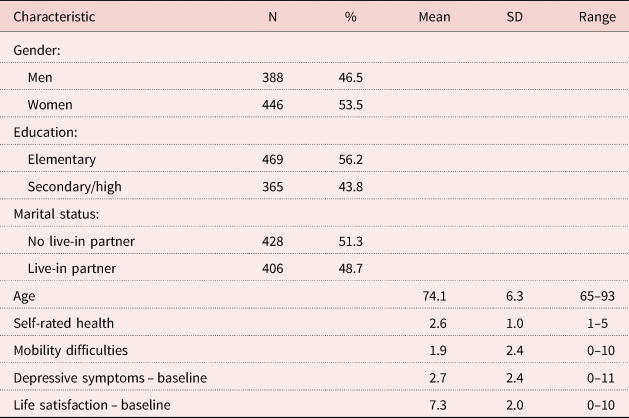
The analytic sample was comprised of the 834 respondents who had participated in both waves, cited no one in their personal social network in either wave (or both) and had sufficient data on most of the study variables. Table 1 shows that their average age was 74. There were a few more women than men and slightly more of the respondents had no live-in partner. A majority had only elementary schooling. They rated their health as fair, on average, and their mobility as partly limited. They also reported having an average of almost three depressive symptoms at baseline, less than the clinical cut-off point for risk of depression. Their baseline life satisfaction was about the same as that which is reported in the larger SHARE population of the same age (Litwin and Stoeckel, Reference Litwin and Stoeckel2013).
Europeans aged 65 and older: univariate description of the sample background characteristics

Note: SD: standard deviation.
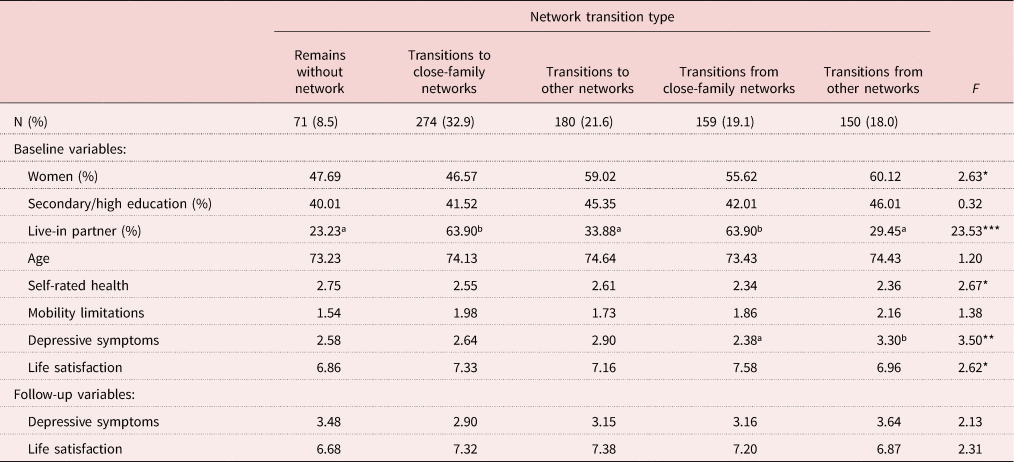
Table 2 summarises the network transitions at follow-up. The data reveal that almost 9 per cent of the study sample were in the no-network status at both baseline and follow-up. A little more than half had no network at baseline but transitioned into a network of some type (whether to close family (33%) or to other (22%) at follow-up). More than a third changed to a no-network status at follow-up, after they had reported having had one social tie or more at baseline (from close family (19%) or from other (18%)).
Socio-demographic, health and wellbeing by network transitions: analysis of variance

Significance levels: * p < 0.05, ** p < 0.01, *** p < 0.001. Means with differing superscript letters within rows are significantly different at p < 0.05 based on Scheffé post hoc paired comparisons.
Table 2 also presents the bivariate associations observed between the study variables and the five network statuses at follow-up: (a) remains without network, (b) transitions to close-family type network, (c) transitions to other network types, (d) transitions from close-family type network, and (e) transitions from other network types. As may be seen, differences in the baseline variables were evident mainly in relation to marital status. The Scheffé tests clarified that more of the respondents who transitioned to or from close-family networks had a live-in partner than those in the other network transition statuses. Gender differences were observed across the various transition statuses but there were no distinct mean differences by transition type. The same was true for self-rated health at baseline. The table also underscores that the chronically lonely group (those without a network at both time-points) were not distinguishable from the other groups, for the most part, by their socio-demographic or health characteristics.
In terms of the wellbeing variables at baseline, Table 2 shows that two transition patterns differed significantly in relation to depressive symptoms; those who transitioned from the other network type at baseline to no network at follow-up had the greatest number of symptoms, while those who transitioned from the close-family network type at baseline to no network at follow-up had the fewest. A difference emerged also in relation to the life satisfaction score at baseline, but there were no notable mean differences by transition type.
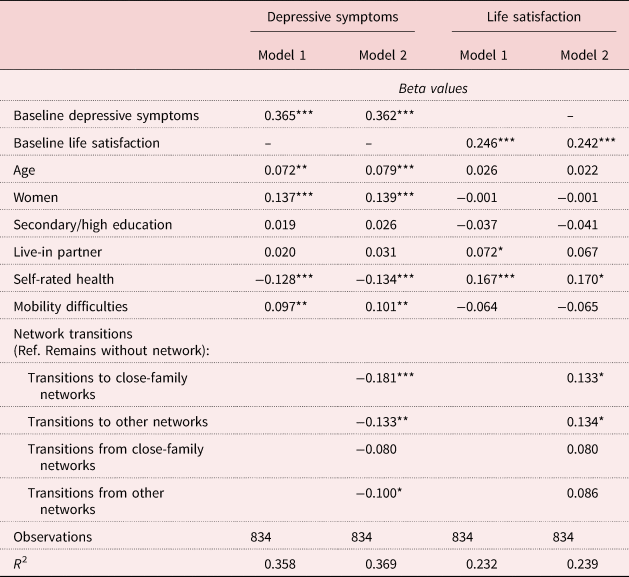
The results of the regression analyses appear in Table 3. As mentioned earlier, the procedure also controlled for the respective baseline measurements of the follow-up outcome measures: depressive symptoms and life satisfaction. Consequently, the outcomes reflect the extent and direction of change in the respective wellbeing indicators. The procedure was executed using two models for each outcome. The first model entered the background and control variables. The second model added the network transition patterns as dichotomous indicators. The no-network at both time-points pattern (remains without network) served as the reference category.
The effect of network transitions and other variables on depressive symptoms and life satisfaction at follow-up among Europeans aged 65 and older: ordinary least squares models

Notes: All models controlled for country. Ref.: reference category.
Significance levels: * p < 0.05, ** p < 0.01, *** p < 0.001.
First, in regard to depressive symptoms at follow-up, Model 2 shows that three of the four transition patterns revealed significantly fewer such symptoms than the reference category. Only the transition from close-family networks to no-network status was indistinguishable from having had no network at both time-points. Turning to life satisfaction at follow-up, Model 2 indicates that two of the transition patterns revealed significantly greater scores than the reference category. Both of these patterns reflected transitions from no-network at baseline to a network of some kind, whether close family or other, at follow-up. As for the control variables in the multivariate regression analyses, the baseline wellbeing scores were the strongest predictors of the two wellbeing outcomes. In addition, Table 3 shows that older age, female gender and greater mobility difficulties all emerged as additional predictors of an increase in depressive symptoms. Better self-rated health at baseline correspondingly predicted fewer depressive symptoms at follow-up. In regard to the life satisfaction change measure, however, only self-rated health predicted better life satisfaction at follow-up among the additional control variables in the analysis. The regression models explained a considerable amount of the variance in the respective outcome measures (37% for depressive symptoms and 24% for life satisfaction). Comparison of the explained variance in the respective models showed that the network transition patterns accounted for a modest amount of the variance only, about 1 per cent in each case.
Discussion
In this study, we sought to better understand what happens to socially isolated older people over a number of years. Using data from a large longitudinal European sample of older adults, we were able to trace the changes that occurred in their social ties – that is, the transitions they experienced in their personal social networks. The availability of a very large sample enabled us to identify the most socially isolated among Europe's eldest cohort, and to consider the concomitants of extreme social detachment and its effects.
First of note is that 5 per cent of the initial sample reported having had no meaningful social ties at all at one or both of the measurement points. If we take into account that about 19.2 per cent of the European population of some 500 million persons was aged 65 or over in 2015 (European Commission, 2017), and assuming that the SHARE sample is representative of the European population, we can tentatively estimate that almost five million older Europeans had experienced extreme social detachment at least once within a period of four to five years. Extrapolating further, we can estimate that over 400,000 older people in Europe are chronically isolated, that is, they experienced extreme social detachment over the same four to five years. Moreover, given that the socially isolated older respondents are at greater risk of attrition from a panel survey, compared to participants who have social ties, the numbers cited above may even reflect an underestimation of the actual extent of extreme social isolation among older people in Europe. Nevertheless, the current analysis also points out that that a large majority of those who were socially isolated at baseline named social ties of importance in the follow-up data collection period.
In terms of transitions from or to no-network status, we assumed that the transition from having no network would more often reflect a move to a close-family type personal network than to other networks. The data showed that this type of transition was, indeed, more frequent. That is, more respondents moved from no-network status at baseline to social network types that are characterised by the close-emotional ties that prevail among their members (spouse and children, spouse, children). A smaller percentage moved to network types in which the extent of emotional closeness was less (other family, friend or other). This finding supports the tenet of the socio-emotional selectivity theory which maintains that people tend to focus their social ties in late life on those that are more emotionally meaningful and rewarding (Carstensen, Reference Carstensen2006). In many cases, these more meaningful ties are long-standing and family-based (Shaw et al., Reference Shaw, Krause, Liang and Bennett2007).
As for the opposite direction, a move from having a network to not having one, no specific hypothesis was raised. The data showed that transitions of this kind occurred almost equally from close family-based and from other-based network types. The entry into a state of extreme social isolation may originate, it seems, from close networks and from less emotionally close other network types alike. The risk of extreme social isolation in late life, therefore, may be more widespread than is currently believed.
The second main goal of the current inquiry was to consider the effects of transitions to and from extreme social isolation on the wellbeing of older people. Towards this aim, we regressed two wellbeing measures (depressive symptoms and life satisfaction) on the respective network transitions, using no-network status at both time-points as the reference category. The analysis included key background and health measures, as well as the variable of country to control for possible cultural differences in the interpretation of what constitutes meaningful ties in different European settings. We also included the baseline scores of the respective wellbeing measures, such that the predictors in the models related essentially to the changes that occurred in the outcome indicators.
We hypothesised that a move to or from a close-family type network would more strongly affect wellbeing than a move to or from other network types. This hypothesis was partly supported in the transition from no network to network. That is, those who moved to close-family networks were shown to have fewer depressive symptoms in relation to the reference category than those who moved to other networks. This same differentiation was not observed, however, in relation to the life satisfaction measure. Both transitions equally increased the life satisfaction score compared to the reference category.
As for the transition from having a network to no-network status, the findings were more varied. Those who moved out of other network types into extreme social isolation (having no network at all) were less depressed than the chronically isolated reference category. But those who moved out of close-family networks into a state of extreme social isolation were not distinguished from the chronically isolated in terms of the depressive symptoms that they experienced. Stated differently, this finding suggests that the move from a close family-based interpersonal environment to a status of no-network was about as depressing as was being chronically isolated. In regard to life satisfaction, the regression revealed that the scores on this measure of those in the respective transitions were indistinguishable from the scores of those in the no-network reference category. That is, a move from either type of network into a state of social isolation was about as damaging to one's wellbeing as was being chronically isolated.
In sum, the findings from this study suggest that a transition out of social isolation in late life is possible, and it may be beneficial as well. Efforts should be made, therefore, to intervene in order to limit the extent of late-life social isolation and its negative effects. It could well be that greater efforts to contact socially detached older people and to clarify the nature of their current lack of connectedness can encourage greater network mobility, and specifically, a move from no-network status to a renewed network involvement. The findings also caution that one can become socially isolated in old age, irrespective of the social network type in which one was previously embedded. Consequently, the risk of social isolation among older people may, indeed, constitute an increasingly worrisome mental health risk. Finally, the study also demonstrated that chronic social isolation is generally the most damaging of the respective social states that were examined in this analysis, in relation to quality of life in old age. Special attention is required, therefore, to identify older people at risk.
A few words are required about the possible limitations of the present study. It has been suggested that name-generating social network inventories, such as that which was administered in SHARE, might be subject to potential response variations due to interview fatigue among respondents (Fischer, 2009). Specifically, participants might decrease the number of people cited in the inventory if they realise that the more names there are, the more subsequent questions there will be (if they are indeed seeking to shorten the overall interview time, which is sometimes lengthy). Taking this concern into account, SHARE placed the social network inventory at the beginning of the interview in both waves, well before respondent fatigue (should it occur) might affect the interview process (Litwin et al., Reference Litwin, Stoeckel, Roll, Shiovitz-Ezra, Kotte, Malter and Börsch-Supan2013). It is our opinion, moreover, that this concern is minor compared to the limitations that may arise in the alternative use of global self-reported loneliness measures which may overestimate the extent of the phenomenon.
A second possible limitation is the fact that the data were only available from two measurement points. Had there been more waves with social network data available, it might have been possible to scrutinise the network transitions even more deeply. That said, the trends that emerged from the two measurement points provided sufficient information to engage in the present inquiry.
In conclusion, this study presents a nuanced view of the phenomenon of social isolation among older adults. The data show that many of those faced with social detachment manage to extricate themselves from that vulnerable status, and that such network transitions are indeed related to better wellbeing. This is an important observation that has significant implications for public policy and social services. We believe that a state of social isolation is still malleable in old age and can be diminished with proper intervention. Our study underscores, moreover, that special attention needs to be given particularly to older adults who are chronically detached, those who name no one in their social network over time.
Financial support
This work was supported by Horizon 2020, SERISS (grant number 654221).