Implications
Defaunation is potentially a technology to increase the availability of intestinal dietary and microbial protein for ruminant’s nutrition. In tropical area, the presence of some secondary compounds in many forages (leaves of fodder trees, legumes, crop residues etc.) gives them properties to defaunate totally or partially ruminants. In this same area, forages are often the alone ingredients of the animal diet. Depending on the characteristics of these last one, nitrogen or energy may be the main factor limiting the growth of ruminants. The interest of this work is to generate knowledge to understand the contexts for which défaunation may be of interest to better feed the animals without the use of concentrate.
Introduction
In tropical countries, one of the major factors that limit ruminant performance is the low protein to energy (P/E) ratio of the forage. Therefore, feeding strategies are needed in order to increase animal performances using tropical grass. A study conducted to evaluate the nutritive value of tropical grass (Digitaria decumbens) with varying stage of growth fed to rams, indicated that intake, ruminal and total tract digestibility over the 14-day D. decumbens grass were similar to those reported for leafy temperate grass forage (Archimède et al., Reference Archimède, Boval, Alexandre, Xandé, Aumont and Poncet2000). Furthermore, several authors hypothesized that a positive effect of defaunation on growth and milk production of ruminants fed poor forages is expected due to increased intestinal protein availability (Bird et al., Reference Bird, Hill and Leng1979; Jouany and Ushida, Reference Jouany and Ushida1998; Hristov and Jouany, Reference Hristov and Jouany2005). We hypothesized that for defaunated animals fed tropical forage grass, the low content of dietary protein would be compensated by an increase in microbial protein flow as a result of defaunation. Reviewing the effects of several defaunation techniques on ruminant performances, Eugène et al. (Reference Eugène, Archimède and Sauvant2004a) reported that defaunation could increase the average daily gain (ADG) of lambs by 9%. However, the magnitude of the animal response is also influenced by dietary factors, such as the forage P/E ratio and the total amount of protein and energy absorbed in the intestine relative to the animal requirements.
The objective of this work was to evaluate the effect of defaunation on the growth of lambs and digestion parameters of rams fed D. decumbens at four stages of regrowth. The stage of regrowth was used as: (i) an experimental tool to drive the energy to protein ratio of the experimental diet, in agreement with our previous hypothesis; (ii) a classical and practical tool to manage forage quality. To our knowledge, the stage of regrowth of the forage has never been studied as an interfering factor of animal response (digestion, growth) to defaunation.
Material and methods
Location
The research was carried out at the animal experimental station of the National Institute of Agricultural Research, in Guadeloupe in the French West Indies, (latitude 16° 16′ N and longitude 61° 30′). During the trial, average temperatures ranged from 21°C to 31°C. The average rainfall on the experimental site is 3000 mm per year.
Digestion trial: animals, diets and experimental design
Animals
Sixteen Black Belly rams (average live weight: 43.7 ± 5.5 kg, 2-year old) fitted with ruminal and duodenum cannulas were used in this trial. Eight rams were defaunated using a milk diet derived from the method Fujihara et al. (Reference Fujihara, Todoroki and Nakamura2003). During the defaunation process, the diet was gradually changed from a fresh immature grass to a milk powder diet over 10 days. Then, animals were offered only milk during 7 days followed by a gradual change back from milk to fresh grass. The milk powder was mixed with water (400 ml at 37°C) and poured into the rumen via the rumen cannula. The milk diet was stopped 6 weeks before the beginning of the first measurement. The ruminal fluid of defaunated animals was examined weekly, to detect the presence of protozoa by light microscopy (Jouany and Sénaud, Reference Jouany and Sénaud1978).
Diets
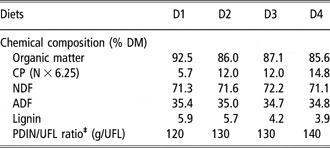
The rams were fed to ad libitum intake four diets composed of fresh D. decumbens grass cut at 56, 42, 28 and 14 days. The chemical composition of the diets is shown in Table 1. Mineralized salt blocks as described in the growth trial were freely accessible.
Chemical composition of the dietsFootnote † fed to rams in the digestion trial

DM = dry matter; CP = crude protein; NDF = neutral detergent fiber; ADF = acid detergent fiber.
† The D1, D2, D3, and D4 diets were composed of fresh Digitaria decumbens grass cut at 56, 42, 28, and 14 days.
‡ PDIN: protein digestible in the intestine from microbial origin, and UFL: energy unit, in the French feeding system (Vermorel, Reference Vermorel1978; Vérité et al., Reference Vérité, Journet and Jarrige1979).
Experimental design
Two groups of animals (eight faunated and eight defaunated) were conducted in two completely randomized designs with four experimental periods (28 days long). Defaunated and faunated rams were fed the same diet composed of D. decumbens fresh grass cut at 56, 42, 28, and 14 days during period 1, 2, 3 and 4, respectively. Defaunated and faunated rams were placed in metabolism cages isolated with a punch cloth and housed in the same room. Each period was composed of 14 days of diet adaptation, 5 days of intake and total tract digestibility measurements, 3 days of duodenal sampling, 2 days of ruminal sampling and 1 day of rumen emptying.
Experimental procedure and chemical analyses
The experimental procedures and chemical analyses were described in details in a previous study (Eugène et al., Reference Eugène, Archimède, Weisbecker, Periacarpin, Saminadin and Sauvant2004b).
Experimental procedure
Briefly, duodenal digesta flows were estimated according to the double-marker method of Faichney (Reference Faichney1980) using fecal lignin and polyethylene glycol (PEG) as markers of the particulate and liquid phases, respectively. The mean daily duodenal digesta sample was constituted by taking 12 samples of 100 ml over three consecutive days at different hours over the three collection days. Each sample was immediately fractionated as whole digesta and also divided into a liquid-rich (LR) fraction and a particle-rich fraction by filtration through nylon gauze.
Chemical analyses included organic matter (OM), crude protein (CP), neutral detergent fiber (NDF), acid detergent fiber (ADF), lignin, and purine bases. The samples of the rumen liquor were taken immediately before the morning meal, and at 3, 6 and 12 h after feeding, during two consecutive days. Rumen fluid was stored (4°C) with H2SO4 (1 vol/50 vol) before ammonia (NH3) determination. At the end of the each period, the rumen of each animal was manually emptied and the total content was weighed, 3 h after the distribution of the morning meal. All the total digesta content (minus the samples) was reintroduced in the rumen 15 min after the beginning of the emptying. During the emptying, the rumen content was introduced in small tank under CO2 pressure. The mean retention time (h) of the rumen digesta was estimated according to Archimède et al. (Reference Archimède, Aumont, Saminadin, Dépres, Despois and Xandé1999). Bacterial samples were isolated from the duodenal LR phase by carrying out two successive centrifugations (800 × g and 27 000 × g) as described by Yang (Reference Yang1992). The ratio of the purine bases to the non-ammonia nitrogen (NAN) was calculated with bacterial samples to estimate the microbial nitrogen concentration in the duodenal flow.
Chemical analyses
OM, CP, NDF, ADF, and lignin were estimated according to Van Soest et al. (Reference Van Soest, Robertson and Lewis1991). Nitrogen concentration was determined using the Dumas combustion method (AFNOR, 1988). The purine base was analyzed according to Zinn and Owens (Reference Zinn and Owens1986). The NH3 concentration was estimated in the rumen liquor by distillation and titration. The PEG concentration was estimated by spectrophotometry (Malawar and Powel, Reference Malawar and Powel1967).
Growth trial: animals, diets and experimental design
Animals
Fifty Black Belly (ovin Matnik) lambs (30 faunated and 20 protozoa free) were used in this trial. All 30 faunated lambs were weaned after 2 months of age. All the lambs were allocated in groups of two lambs and fed a solid diet based on concentrate and hay during one month. At the start of the trial, they were put in individual cage, were on average 3 months of age and weighed on average 28.3 ± 5.08 kg. Simultaneously, 20 protozoa free lambs were separated from their dams 1 day after their birth, given colustrum during 3 days (Eadie and Hobson, Reference Eadie and Hobson1962). They were reared in one group of 20 lambs and fed with artificial milk until 2 months of age. Then, they were put into groups of 2 lambs and fed a solid diet based on concentrate and hay during 1 month. At the start of the trial, they were put in individual cage, were on average 3 months of age and weighed 23.6 ± 4.4 kg.
Diets
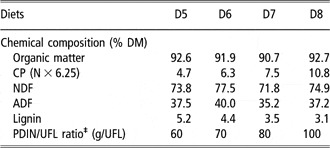
Because of climatic constraints (an exceptionally very dry season) that limited the amount of available grass, the digestion and the growth trials were not conducted at the same time. All the lambs were fed to ad libitum intake successively four diets composed of fresh D. decumbens grass at 56, 42, 28, and 14 days for diet D5, D6, D7, and D8, respectively. The chemical composition of the diet is presented in Table 2. The total tract digestibility of OM of the diets consumed by lambs in the growth trial has been estimated using equations of prediction between chemical composition of the diet and total tract digestibility values measured in the digestion trial. As indicated below, total tract digestibilities were different between faunated and defaunated animals. The energy values of the diets have been estimated using the equation of Demarquilly and Weiss (INRA, 1981): energy (forage unit, UF) = ((2.36 × total tract digestible OM, g/kg)−1.20 × total tract indigestible OM, g/kg))/1650. The values obtained were closed to those estimated according to the French feeding system (Vermorel, Reference Vermorel1978). The protein values (PDI) of the diets consumed by lambs in the growth trial has been estimated using equations of prediction between protein intake and duodenum minus fecal protein flow (non-NH3 nitrogen × 6.25) obtained in the digestion trial. The values obtained were higher than to those estimated according to the French feeding system (Vérité et al., Reference Vérité, Journet and Jarrige1979).
Chemical composition of the dietsFootnote † fed to lambs in the growth trial

DM = dry matter; CP = crude protein; NDF = neutral detergent fiber; ADF = acid detergent fiber.
† The D5, D6, D7, and D8 diets were composed of fresh Digitaria decumbens grass cut at 56, 42, 28, and 14 days of regrowth.
‡ PDIN: protein digestible in the intestine from microbial origin, and UFL: energy unit, in the French feeding system (Vermorel, Reference Vermorel1978; Vérité et al., Reference Vérité, Journet and Jarrige1979).
The P/E ratios were 120, 127, 131 and 140 g PDIN/UFL for D5, D6, D7 and D8 diets, respectively. Water and mineralized salt blocks were available ad libitum. The blocks’ composition was (g/kg): Ca (60.0), P (20.0), Mg (10.0), Na (280.0), Zn (17.5), Mn (5.5), Fe (1.5), I (0.03), Co (0.03) and Se (0.01).
Experimental design
At 3 months of age, faunated and protozoa free lambs, isolated with a punch cloth, were housed in individual pens in the same room. Animals were divided into three groups: a group of 20 protozoa free lambs, a group of 20 faunated lambs and a third control group of 10 faunated lambs. The groups of faunated lambs were constituted according to their live weight at the beginning of the trial, and their individual ADG between 1 and 2 months of age. The control group received the same mixed diet during all the experiment. The objective was to determine the growth potential of the experimental lambs used in this study. The mixed diets, composed of hay of D. decumbens grass (ad libitum) and on average 550 g concentrate (maize and soyameal), formulated and adjusted weekly to maximize their growth during the four periods. According to the French feeding system, the energy of the four diets allows an ADG greater than 200 g/day (the growth potential), whereas the amount of protein could only permit an ADG of 150 g/day. The maximum growth observed in the intensive system, with the Ovin Martinik lambs was 250 g/day (Alexandre et al., Reference Alexandre, Archimède, Chevaux, Aumont and Xandé2001).
The two other groups of lambs (faunated v. protozoa free) received D. decumbens fresh grass cut at 56, 42, 28 and 14 days during periods 1, 2, 3, and 4, respectively. Animals were fed twice a day at 7 h and 19 h.
Each experimental period lasted 1 month with 15 days for animal adaptation to the diet and 15 days for data collections (intake and daily gain).
Experimental procedure and chemical analyses
Experimental procedure
Ruminal contents (obtained via an esophageal tube) from protozoa free lambs were examined by light microscopy at the end of each experimental period and found to be free of protozoa. Intake was determined individually from the daily weighing of the amounts of feed offered and refused. Representative samples of the feeds (three samples/day of the distributed grass) were constituted for chemical analysis. A double weighing (at 24 h intervals) of the rams was performed. The ADG was calculated on the last 15 days of each period.
Chemical analyses
NDF, ADF, and lignin were estimated according to Van Soest et al. (Reference Van Soest, Robertson and Lewis1991). Nitrogen concentration was determined using the Dumas combustion method AFNOR (1997).
Statistical analyses
Digestion trial
The GLM procedures were used in all variance analyses (SAS Institute Inc., 2000).
The global model (1) was used:

where Yijk l is the observed parameter for animal i, μ is the global mean, Def is the defaunation effect (faunated v. defaunated, 1 DF), Diet is the diet effect (3 DF), (Def × Diet) is the interaction between defaunation effect, Animal(Def) is the animal effect and eijkl represents the unexplained residual error. The ruminal and total tract digestibilities were analyzed using the global model and DMI was integrated as a covariate. DMI was replaced by nitrogen intake (NI) as a covariate in the statistical analyses of ruminal NH3 concentration, duodenal nitrogen flow, fecal and urinary nitrogen excretions, and microbial efficiency.
Growth trial
The DMI and ADG of lambs were analyzed by variance analysis using the PROC GLM procedure of SAS (SAS Institute Inc., 2000). The global model (1) used was:

where Yijkl is the observed parameter for animal i, μ is the global mean, Def is the defaunation effect (faunated v. protozoa free, 1 DF), Diet is the diet effect (3 DF), (Def × Diet) is the interaction between defaunation effect and the diet effect (3 DF), Animal(Def) is the animal effect and eijkl represents the unexplained residual error. Another analysis was performed taking into account digestible OM intake as a covariate to analyze ADG.
Orthogonal polynomial contrasts were performed to determine the linear (L), quadratic (Q), or cubic (C) effect of the diet. Differences between defaunated and faunated animals on the same diet were compared by PDIFF test with the adjustment method of Tukey (SAS Institute Inc., 2000). Least square means and pooled s.e. were reported and significance was declared at P < 0.05.
Results
Digestion trial
Intake
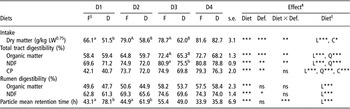
Total DMI (g/kg LW0.75) of rams increased with PDIN/UFL ratio (P < 0.001; Table 3). Overall, defaunated rams had lower DMI (P < 0.001) than faunated rams (63.7 v. 76.4 g/kg LW0.75, respectively), except on D4 diet in which there was no significant difference between defaunated and faunated rams (Table 3).
Digestion trial: Effect of dietFootnote †and defaunation on intake, on apparent digestibility in the total tract and in the rumen of rams in the digestion trial

CP = crude protein; NDF = neutral detergent fiber.
† The D1, D2, D3, and D4 diets were composed of fresh Digitaria decumbens grass cut at 56, 42, 28, and 14 days of regrowth, respectively.
‡ Effect: Def.: Defaunation effect, Diet: Linear (L), Quadratic (Q), or cubic (C) effect of the diet. ns; non-significant, *P < 0.05, **P < 0.01, ***P < 0.001. Differences between faunated and defaunated animals, on a same diet, are indicated using the following letters: a,b for P < 0.05; A,B for P < 0.01.
§ F: faunated animals; D: defaunated animals.
Total tract and ruminal digestibility and particle mean retention time
Total tract digestibility of OM and NDF increased with PDIN/UFL ratio (P < 0.001), whereas defaunated animals had lower total tract digestibility of OM and NDF than faunated ones, when fed D3 diet (Table 3). Total tract digestibility of CP increased with PDIN/UFL ratio (P < 0.001), while defaunation decreased it (64.7 v. 67.5%, P < 0.01).
Ruminal digestibility of OM and NDF increased with PDIN/UFL ratio (P < 0.001). Defaunation did not change ruminal digestibility of OM, but defaunated rams had lower ruminal digestibility of NDF than faunated rams.
Mean retention time of fiber particles in the rumen decreased with PDIN/UFL ratio (P < 0.001). The significant diet × defaunation interaction indicated that defaunated rams, fed D1 diet, had higher mean retention time of fiber particles than faunated ones (P < 0.001; Table 3).
Nitrogen digestion
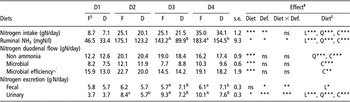
NI (g N/day) of rams increased with PDIN/UFL ratio (P < 0.001; Table 4). Overall, defaunated rams had lower NI (P < 0.01) than faunated rams (Table 4). Mean ruminal NH3 concentration increased with PDIN/UFL ratio (P < 0.05; Table 4). Defaunated rams had lower (P < 0.05) ruminal NH3 concentration than faunated rams (110.9 v. 135.3 mgN/l, respectively; Table 4).
Digestion trial: effect of dietFootnote †and defaunation on nitrogen intake, rumen ammonia concentration, nitrogen duodenal flow, microbial efficiency, fecal and urinary nitrogen excretion of rams in the digestion trial

† The D1, D2, D3, and D4 diets were composed of fresh Digitaria decumbens grass cut at 56, 42, 28, and 14 days of regrowth, respectively.
‡ Effect: Def: Defaunation effect, Diet: Linear (L), Quadratic (Q), or cubic (C) effect of the diet. ns = non-significant, *P < .05, **P < .01, ***P < 0.001. Differences between faunated and defaunated animals, on a same diet, are indicated using the following letters: a,b for P < 0.05; A,B for P < 0.01.
§ F: faunated animals; D: defaunated animals.
√ Microbial efficiency expressed as g MN/kg of organic matter apparently degraded in the rumen.
Duodenal flows of NAN and microbial N increased with PDIN/UFL ratio (P < 0.001) (Table 4). Defaunated rams had similar duodenal flows of NAN and microbial N than faunated ones. The microbial efficiency (g microbial nitrogen (MN) synthesized/kg of OM apparently degraded in the rumen (OMADr)) increased with PDIN/UFL ratio (P < 0.001) (Table 4). Defaunation had no effect on microbial efficiency.
Urinary N excretion increased with increasing PDIN/UFL ratio, whereas PDIN/UFL ratio had no effect on fecal N excretion (Table 4). A significant diet × defaunation interaction indicated that defaunated rams fed D3 and D4 diets had higher fecal N excretion than faunated ones (P < 0.01). Whereas, defaunated rams had lower (P < 0.001) urinary N excretion than the faunated rams, except for rams fed D5 diet (Table 4). The predicted values of protein intake (expressed as g PDI/kg dry matter (DM)) of faunated and defaunated rams fed D1 to D4 were 42, 81, 81 and 85 and 53, 80, 80, and 82 g PDI/kg DM, respectively.
Growth trial
The chemical composition of the diet varied with forage maturity (stage of regrowth) as presented in Table 2. The predicted energy values (UF/kg DM) of diets D5, D6, D7 and D8 were higher for faunated lambs (46, 57, 64, and 77, respectively) than for protozoa free lambs (33, 48, 57, and 76, respectively).
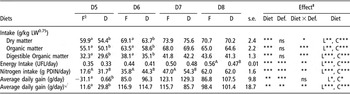
Data from eight lambs have been eliminated for analysis, because ADG was 100 g higher or lower than that predicted by digestible OM intake. There was a cubic effect of the diet on DMI (g/kg LW0.75), which increased with increasing PDIN/UFL ratio (P < 0.001) (Table 5). There was no significant effect of defaunation on DMI of lambs. However, the significant diet × defaunation interaction indicated that protozoa free lambs fed diets with low P/E ratio (D5 and D6) had lower DMI than faunated ones (P < 0.05). Intake of digestible OM tended to be lower with protozoa free lambs than with faunated lambs, but a significant decreasing effect of defaunation on energy intake (UFL/kg LW0.75) was observed (P < 0.001). On the contrary, protein intake (g PDIN/kg LW0.75) was higher for protozoa free lambs than with faunated ones, except on D5 diet. During the transition period (1 month) when the lambs received the high concentrate diet, the ADG of protozoa free lambs and faunated lambs were similar. The ADG of the control group of lambs were 123, 115, 141 and 125 ± 17 g/day during periods 1, 2, 3 and 4, respectively. There was no significant difference of ADG between the periods.
Growth trial: effect of dietFootnote †and defaunation on intake, and average daily gain of lambs in the growth trial

PDIN: protein digestible in the intestine from microbial origin; UFL: energy unit, in the French feeding system.
† The D5, D6, D7, and D8 diets were composed of fresh Digitaria decumbens grass cut at 56, 42, 28, and 14 days of regrowth, respectively.
‡ Effect: Def: defaunation effect, Diet: Linear (L), Quadratic (Q), or cubic (C) effect of the diet. ns = non-significant, *P < 0.05, **P < 0.01, ***P < 0.001. Differences between faunated and defaunated animals, on a same diet, are indicated using the following letters: a,b for P < 0.05; A,B for P < 0.01.
*,§ F: faunated lambs; D: Protozoa free lambs.
√ Average daily gain (g/day): the statistical analysis took into account the level of digestible organic matter intake.
The mean ADG of lambs increased (P < 0.001) with increasing PDIN/UFL ratio of the diet (Table 5). The mean ADG of protozoa free and faunated lambs was similar, but the significant diet × defaunation interaction indicated that protozoa free lambs fed D5 diet had greater ADG than faunated ones (P < 0.05).
Discussion
The first objective of this study was to analyze the interest of defaunation when animals were fed with 100% forage diet. Many resources used as forage, because of their content in saponin or other secondary plant products, reduce the population of protozoa in the rumen. Consequently, it is difficult to formulate diet in theory based on their direct nutritive value linked to their nutrient content. Nutritive value linked to a positive action of protozoa should be integrated.
The objective of the digestion trial was to explain the results of the growth trial mainly by predicting the energy and protein balance of lambs by assuming similar digestion of the diet between lambs and rams. Because of close chemical composition of forages between the two trials, the prediction of forage nutritive values consumed in the growth trial using the digestion data is relevant. Because of the nutrition plan used and the age of the lambs at the beginning of the experiment, we can assume that the rumen of the lambs was developed.
The results of the digestion trial indicated that energy and PDI of the diet have to be distinguished between faunated and defaunated animals. In our experimental conditions, the impact of defaunation on forage PDI is more relevant than on forage energy value. Overall, defaunation had adverse effect on total tract digestibility of NDF and intake of forage. However, defaunation effect is higher with old forage relatively to the young one. Defaunated and faunated rams in the digestion trial, fed with the oldest forage diet (D1), had similar total tract and ruminal digestibility (OM and NDF). This can be explained by the greater particle mean retention time observed for defaunated rams as compared with faunated ones, increased by 1.8 times. This result seems to indicate that rather than enzymatic activities, other factors such as adhesion, weakening of plant material, or fiber accessibility may play a key role in forage digestion (Wilson, Reference Wilson1994; Kasuya et al., Reference Kasuya, Wada, Shimada, Kawai and Itabashi2007). Furthermore, defaunation may have decreased the energetic requirements for maintenance of bacteria and fungi in the rumen of defaunated animals. These results indicated that feed digestion might not have been impaired by defaunation for lambs fed the oldest forage D5 diet. This is not in agreement with previous studies (Eugène et al., Reference Eugène, Archimède, Weisbecker, Periacarpin, Saminadin and Sauvant2004b; Jouany and Ushida, Reference Jouany and Ushida1998). However, Eugène et al. (Reference Eugène, Archimède, Weisbecker, Periacarpin, Saminadin and Sauvant2004b) indicated compensatory digestion of OM in the lower intestine of defaunated animals. This result indicated that the quality of the forage could modulate defaunation effect on digestibility. Consequently, with poor forage there are low differences in terms of forage energy value between faunated and protozoa free animal. The differences of forage energy value increased as the quality of the forage increased.
The absence of effect of defaunation on nitrogen duodenal flows and microbial efficiency is not in agreement with the results generally reported in the literature (Koenig et al., Reference Koenig, Ivan, Teferedegne, Morgavi, Rode, Ibrahim and Newbold2007). Indeed, Bird (Reference Bird1989) and Hristov and Jouany (Reference Hristov and Jouany2005) indicated that defaunation increased intestinal protein flow. However, the results of microbial efficiency registered in this study with faunated animals seem low. Archimède et al. (Reference Archimède, Boval, Alexandre, Xandé, Aumont and Poncet2000), with similar forage, reported values around 32 g MN/kg OMADr. Presumably, microbial protein synthesis is inexplicably reduced during this experiment or underestimated. The latter hypothesis is more likely considering the low ratio between nitrogen microbial duodenal flow of total nitrogen duodenal flow. Archimède et al. (Reference Archimède, Boval, Alexandre, Xandé, Aumont and Poncet2000) recorded higher values with similar diets. Nevertheless, comparing faunated and defaunated rams, the prediction of PDI of forage is varying. The improvement in terms of PDI of the forage after defaunation might have disappeared when forage quality was enhanced.
NH3 concentrations in the rumen decreased after defaunation, as is classically observed in data literature (Jouany and Ushida, Reference Jouany and Ushida1998; Eugène et al., Reference Eugène, Archimède and Sauvant2004a). In this study, small differences in NH3 concentration in the rumen between defaunated and faunated animals were observed for diets with low P/E ratios. Proteolysis was further enhanced by nitrogen incorporation in the diets (D2 to D4) thus increasing the differences. Low NH3 concentrations in the rumen of defaunated animals may be explained by the absence of predation of bacteria by protozoa after defaunation.
The potential of growth of these experimental lambs is lower than 150 g/day as illustrated by the ADG of the control group of lambs. As a consequence of the nutritional balance during the milk-feeding period (natural milk v. artificial milk) the live weight of the faunated lambs was higher than that of protozoa free lambs. This difference was the same at the beginning of the first experimental period. The ADG of the lambs were similar during the period (1 month) when they received a high-concentrate diet. This indicates the absence of an eventual compensated growth. Consequently, the growths of the lambs during the four experimental periods have to be explained by the nutritional balance of the experimental diets.
Overall, considering the different diets, the growth of lambs is logically in good agreement with the amount of digestible OM between D5 and D7. The lowest growth in lambs consuming D8 relatively to D7 can be explained by a slowdown in growth rate with age as evidenced by the growth in the control group during the fourth period. Digestible OM, was higher in faunated lambs relatively to protozoa free lambs, this result was also observed by Santra et al. (Reference Santra, Karim and Chaturvedi2007), whereas protein intake was on average higher in protozoa free lambs relatively to faunated lambs. Consequently, when digestible OM was taken into account, the ADG was similar between faunated and protozoa free lambs, except for D5 diet. Indeed, protozoa free lambs had greater ADG than faunated lambs when they were fed D5 diet because the amount of protein was the first limiting factor. These results indicated that positive effects of defaunation on growth were observed with animals fed low nitrogen to energy ratios.
Conclusions
The animal response to defaunation depended on the stage of regrowth of the tropical forage grass. No beneficial effect of defaunation was observed with young forage, whereas a positive effect could appear with old forage. To conclude on positive effect of defaunation on growth of ruminant consuming tropical forage, additional data with animals feeding grass varying in P/E are needed.
Acknowledgements
The authors thank F. Saminadin, L. Philibert, S. Calif, P. Despois, C. Césaire, F. Pommier, F. Nipeau, for their technical collaboration to this study and to A. Xande. This study was supported by the ‘Région Guadeloupe’ and the European Economic Community (FEOGA).