Knowing more than one language has clear social and economic value in a progressively more globalized society. Yet bilingualism imposes unique cognitive demands from maintaining and using two languages that share a conceptual system but take different forms (Bialystok, Craik, Green & Gollan, Reference Bialystok, Craik, Green and Gollan2009; Green & Abutalebi, Reference Green and Abutalebi2013). Even in single-language settings, phonological and semantic representations from bilinguals’ two languages are simultaneously co-active (Costa, Miozzo & Caramazza, Reference Costa, Miozzo and Caramazza1999; Grainger & Frenck-Mestre, Reference Grainger and Frenck-Mestre1998; Marian & Spivey, Reference Marian and Spivey2003; Spivey & Marian, Reference Spivey and Marian1999), suggesting that meaning and sound representations from both lexicons are interconnected and temporarily compete for selection (although see Costa, Pannunzi, Deco & Pickering (Reference Costa, Pannunzi, Deco and Pickering2017) for an account of how apparent co-activation may reflect native language effects on the organization of the second-language that occur during learning). While context can attenuate cross-linguistic competition effects in monolingual settings (Chambers & Cooke, Reference Chambers and Cooke2009), dual-language environments may increase demands for resolving competition: routine shifts between two linguistic systems require management of competing word forms, phonology, and syntactic rules from both languages (Gollan, Schotter, Gomez, Murillo & Rayner, Reference Gollan, Schotter, Gomez, Murillo and Rayner2014; Hernandez, Martinez & Kohnert, Reference Hernandez, Martinez and Kohnert2000; Meuter & Allport, Reference Meuter and Allport1999). Thus, the need for language control may affect bilinguals’ cognitive control more generally – the ability to detect conflicting representations and adjust behavior to override dominant but irrelevant responses (Botvinick, Braver, Barch, Carter & Cohen, Reference Botvinick, Braver, Barch, Carter and Cohen2001).
Several studies have reported a bilingual advantage over monolinguals in nonlinguistic cognitive-control performance (Abutalebi, Della Rosa, Green, Hernandez, Scifo, Keim, Cappa & Costa, Reference Abutalebi, Della Rosa, Green, Hernandez, Scifo, Keim, Cappa and Costa2012; Bialystok, Craik & Luk, Reference Bialystok, Craik and Luk2008; Martin-Rhee & Bialystok, Reference Martin-Rhee and Bialystok2008; Pelham & Abrams, Reference Pelham and Abrams2014; Prior & Gollan, Reference Prior and Gollan2011; Prior & Macwhinney, Reference Prior and Macwhinney2009); however, other findings fail to support this conclusion (e.g., Colzato, Bajo, van den Wildenberg, Paolieri, Nieuwenhuis, La Heij & Hommel, Reference Colzato, Bajo, van den Wildenberg, Paolieri, Nieuwenhuis, La Heij and Hommel2008; de Bruin, Bak & Della Sala, Reference de Bruin, Bak and Della Sala2015; Duñabeitia, Hernández, Antón, Macizo, Estévez, Fuentes & Carreiras, Reference Duñabeitia, Hernández, Antón, Macizo, Estévez, Fuentes and Carreiras2014; Hilchey & Klein, Reference Hilchey and Klein2011; Morton & Harper, Reference Morton and Harper2007; Paap & Greenberg, Reference Paap and Greenberg2013; Paap, Sawi, Dalibar, Darrow & Johnson, Reference Paap, Sawi, Dalibar, Darrow and Johnson2014; Valian, Reference Valian2014). The discrepancy may partly be due to the heterogeneity of cognitive control measures used to assess performance, which could lead to some studies targeting aspects of control that are unaffected by bilingualism (Colzato et al., Reference Colzato, Bajo, van den Wildenberg, Paolieri, Nieuwenhuis, La Heij and Hommel2008; de Bruin et al., Reference de Bruin, Bak and Della Sala2015; Paap, Sawi, et al., Reference Paap, Johnson and Sawi2014; Valian, Reference Valian2014), or to the heterogeneity of bilingual experiences, which can vary by exposure, proficiency, switching frequency, and other demographic factors (de Bruin et al., Reference de Bruin, Bak and Della Sala2015; Saidi & Ansaldo, Reference Saidi and Ansaldo2015; Valian, Reference Valian2014). Other factors that are known to affect cognitive control, such as genetic variation in the prevalence of striatal dopamine receptors, could also constrain or interact with the potential effects of bilingualism (Hernandez, Greene, Vaughn, Francis & Grigorenko, Reference Hernandez, Greene, Vaughn, Francis and Grigorenko2015; Vaughn, Ramos Nunez, Greene, Munson, Grigorenko & Hernandez, Reference Vaughn, Ramos Nunez, Greene, Munson, Grigorenko and Hernandez2016). Still, variability across experimental findings raises questions about whether the bilingual advantage is spurious (de Bruin et al., Reference de Bruin, Bak and Della Sala2015; Paap & Greenberg, Reference Paap and Greenberg2013) or emerges only under particular conditions that closely parallel the processing demands of bilingualism (Costa, Hernández, Costa-Faidella & Sebastián-Gallés, Reference Costa, Hernández, Costa-Faidella and Sebastián-Gallés2009; Teubner-Rhodes, Mishler, Corbett, Andreu, Sanz-Torrent, Trueswell & Novick, Reference Teubner-Rhodes, Mishler, Corbett, Andreu, Sanz-Torrent, Trueswell and Novick2016). For instance, in their Adaptive Control Hypothesis, Green and Abutalebi (Reference Green and Abutalebi2013) propose that bilinguals’ language control adapts to match the demands of their unique language environment – dual-language contexts in particular may require conflict-monitoring to detect cross-linguistic competition and re-activate the previously suppressed language when the language-in-use changes. Indeed, bilingual advantages are affected by language use: bilinguals who report switching languages more frequently exhibit smaller task-switching and conflict effects (Prior & Gollan, Reference Prior and Gollan2011; Verreyt, Woumans, Vandelanotte, Szmalec & Duyck, Reference Verreyt, Woumans, Vandelanotte, Szmalec and Duyck2015), particularly when conflict-monitoring demands are high (Hofweber, Marinis & Treffers-Daller, Reference Hofweber, Marinis and Treffers-Daller2016). Similarly, the Bilingual Brain Training account suggests that the fronto-striatal circuits that bilinguals use to select and switch between language rules and representations underlie changes in executive function (Stocco & Prat, Reference Stocco and Prat2014; Stocco, Yamasaki, Natalenko & Prat, Reference Stocco, Yamasaki, Natalenko and Prat2014). Thus, effects of bilingualism on cognitive control may be observed only when the processing demands simulate those of bilingual language experience.
Here, we investigate whether trial-to-trial fluctuations in conflict-monitoring demands during a standard Stroop task influence bilinguals’ behavior differently than monolinguals. The idea is that the need to detect information-processing conflict in real time may mimic the demands incurred in dual-language contexts. Further, across language groups, we test whether heightened trial-level monitoring demands recruit brain areas commonly involved in language switching and cognitive control. As reviewed below, our approach is motivated by evidence that bilingual advantages manifest during conflict and no-conflict trial types when frequent switching between the two is necessary (Bialystok, Craik, Klein & Viswanathan, Reference Bialystok, Craik, Klein and Viswanathan2004; Costa et al., Reference Costa, Hernández, Costa-Faidella and Sebastián-Gallés2009; Hilchey & Klein, Reference Hilchey and Klein2011; Teubner-Rhodes et al., Reference Teubner-Rhodes, Mishler, Corbett, Andreu, Sanz-Torrent, Trueswell and Novick2016), and that greater experience with switching or mixing languages is associated with larger cognitive benefits (Hofweber et al., Reference Hofweber, Marinis and Treffers-Daller2016; Prior & Gollan, Reference Prior and Gollan2011; Verreyt et al., Reference Verreyt, Woumans, Vandelanotte, Szmalec and Duyck2015). Thus, monitoring for conflict may be a key demand of bilingualism: bilinguals experience cross-linguistic conflict when perceiving a speaker's language switch and must therefore make real-time adjustments in cognitive control to reduce the experience of conflict (Green & Abutalebi, Reference Green and Abutalebi2013; Hilchey & Klein, Reference Hilchey and Klein2011). This experience, in turn, may tune bilinguals’ conflict monitoring and cognitive control performance in a way that is different from monolinguals’. Our studies do not manipulate linguistic context, but are designed to address whether bilinguals’ and monolinguals’ ability to detect conflict differs and, if so, whether this difference is instantiated in brain regions known to be involved in language switching.
The cognitive effects of bilingualism: A conflict-monitoring account
Outside the context of bilingualism, the conflict-monitoring system theoretically detects changing task demands and signals subsequent adjustments in behavior through the recruitment of control processes (Botvinick et al., Reference Botvinick, Braver, Barch, Carter and Cohen2001; Botvinick, Nystrom, Fissell, Carter & Cohen, Reference Botvinick, Nystrom, Fissell, Carter and Cohen1999). One consequence of this system is that cognitive-control engagement is boosted following conflict detection, resulting in enhanced behavioral performance when a conflict trial immediately follows another conflict versus a non-conflict trial (Botvinick et al., Reference Botvinick, Braver, Barch, Carter and Cohen2001; Botvinick et al., Reference Botvinick, Nystrom, Fissell, Carter and Cohen1999; Gratton, Coles & Donchin, Reference Gratton, Coles and Donchin1992; Ullsperger, Bylsma & Botvinick, Reference Ullsperger, Bylsma and Botvinick2005). This ‘conflict adaptation’ may be initiated by anterior cingulate cortex (ACC), which shows greater activation during conflict trials that follow non-conflict trials (i.e., conflict detection), than for those that follow other conflict trials (Botvinick, Cohen & Carter, Reference Botvinick, Cohen and Carter2004; Botvinick et al., Reference Botvinick, Nystrom, Fissell, Carter and Cohen1999). Moreover, greater ACC activation during conflict detection is associated with faster and more accurate responding and increased conflict-related activity in dorsolateral prefrontal cortex (dlPFC) one trial later (Kerns, Cohen, MacDonald, Cho, Stenger & Carter, Reference Kerns, Cohen, MacDonald, Cho, Stenger and Carter2004). Thus, the ACC may signal adjustments in prefrontal cognitive-control recruitment that yield behavioral adaptation. These ACC-prefrontal interactions are part of the classic cognitive-control network implicated in conflict-monitoring and -resolution in monolinguals.
Mounting evidence suggests that early bilingualism may particularly affect monitoring for information-conflict in the environment (Costa et al., Reference Costa, Hernández, Costa-Faidella and Sebastián-Gallés2009; Hilchey & Klein, Reference Hilchey and Klein2011). Processing language-switches generates competition between two phonological, lexical, and grammatical systems (Gollan et al., Reference Gollan, Schotter, Gomez, Murillo and Rayner2014; Hernandez et al., Reference Hernandez, Martinez and Kohnert2000; Meuter & Allport, Reference Meuter and Allport1999), mimicking conflict-monitoring demands by requiring detection of conflict and recruitment of language-control resources. Moreover, bilingual advantages emerge only when conflict-monitoring demands are high. Costa et al. (Reference Costa, Hernández, Costa-Faidella and Sebastián-Gallés2009) observed that bilinguals outperformed monolinguals on a Flanker task when unpredictable switching between congruent and incongruent trials occurred frequently (up to 50% of trials), imposing the need to monitor for conflict and adjust behavior accordingly. However, the language groups performed equivalently when switching occurred infrequently (on fewer than 8% of trials), even if the majority of trials were incongruent and required conflict resolution. In another study, bilinguals exhibited better recognition-memory on a high-conflict version of an n-back task containing familiar but irrelevant items, but not on a version without this conflict (Teubner-Rhodes et al., Reference Teubner-Rhodes, Mishler, Corbett, Andreu, Sanz-Torrent, Trueswell and Novick2016). Importantly, across these two studies, when conflict was present bilinguals outperformed monolinguals for both conflict and non-conflict trials. Thus, bilinguals globally outperformed monolinguals, but only when monitoring demands were high. Findings like these are consistent with the view that bilingualism affects monitoring – detection of conflict and flexible cognitive-control recruitment – rather than conflict resolution per se (Hilchey & Klein, Reference Hilchey and Klein2011).
Brain-imaging evidence suggests that bilingual language processing engages similar regions as nonlinguistic cognitive control tasks, although the extent to which processing language-switches and nonlinguistic conflict recruit overlapping regions of cortex remains unclear. Language switching has been found to recruit dlPFC, involved in conflict resolution (Hernandez, Reference Hernandez2009; Hernandez et al., Reference Hernandez, Martinez and Kohnert2000), and the caudate (Abutalebi, Brambati, Annoni, Moro, Cappa & Perani, Reference Abutalebi, Brambati, Annoni, Moro, Cappa and Perani2007; Abutalebi, Della Rosa, Ding, Weekes, Costa & Green, Reference Abutalebi, Della Rosa, Ding, Weekes, Costa and Green2013; Crinion, Turner, Grogan, Hanakawa, Noppeney, Devlin, Aso, Urayama, Fukuyama, Stockton, Usui, Green & Price, Reference Crinion, Turner, Grogan, Hanakawa, Noppeney, Devlin, Aso, Urayama, Fukuyama, Stockton, Usui, Green and Price2006), implicated in a range of response inhibition disorders (Gavazzi, Della Nave, Petralli, Rocca, Guerrini, Tessa, Diciottie, Filippi, Piacentini & Mascalchi, Reference Gavazzi, Della Nave, Petralli, Rocca, Guerrini, Tessa, Diciottie, Filippi, Piacentini and Mascalchi2007; Ko, Hsieh, Chen, Yen, Chen, Yen, Wang & Liu, Reference Ko, Hsieh, Chen, Yen, Chen, Yen, Wang and Liu2014; Rubia, Overmeyer, Taylor, Brammer, Williams, Simmons & Bullmore, Reference Rubia, Overmeyer, Taylor, Brammer, Williams, Simmons and Bullmore1999; Shadmehr & Holcomb, Reference Shadmehr and Holcomb1999). Moreover, bilinguals have demonstrated reduced task-switching costs and reduced activity in the ACC, left dlPFC, and left vlPFC relative to monolinguals when alternating between color and shape decisions (Gold, Kim, Johnson, Kryscio & Smith, Reference Gold, Kim, Johnson, Kryscio and Smith2013). That bilinguals exhibit better task-switching performance while simultaneously engaging to a lesser extent neural resources involved in conflict detection (ACC) and resolution (left dlPFC and vlPFC) suggests that their conflict-monitoring system may be more efficient from extensive language-switching practice. Together, these studies suggest that switching engages regions that exhibit real-time modulations in neural activity during conflict monitoring.
Recent work has directly tested the extent of overlap between neural resources activated by language switches and nonlinguistic conflict. One study asked participants to name or make a size judgement about a picture, and then reversed the language or judgment for the same items in a subsequent block so that the correct response switched across blocks (Branzi, Della Rosa, Canini, Costa & Abutalebi, Reference Branzi, Della Rosa, Canini, Costa and Abutalebi2016). Conjunction analyses revealed that these stimulus-response reversals co-activated left prefrontal cortex (Branzi, Della Rosa, et al., Reference Branzi, Della Rosa, Canini, Costa and Abutalebi2016). However, cross-block switches may involve different processing demands than online switches that occur unpredictably during bilingual language processing. Using MEG, Blanco-Elorrieta and Pylkkanen (Reference Blanco-Elorrieta and Pylkkanen2016) demonstrated that task- and language-switches both increased neural activity in bilateral dlPFC when switches occurred during production, but only language-switches increased ACC activity when the switch occurred during comprehension. In contrast, Abutalebi et al. (Reference Abutalebi, Della Rosa, Green, Hernandez, Scifo, Keim, Cappa and Costa2012) found that Flanker conflict and language switches during production co-activated the ACC. Finally, De Baene, Duyck, Brass, and Carreiras (Reference De Baene, Duyck, Brass and Carreiras2015) found that multilinguals engaged a widespread network of shared regions when switching between three languages and three nonlinguistic tasks that included the precuneus, posterior cingulum, fusiform, pre-SMA, inferior frontal junction (IFJ), and the calcarine fissure. However, language-switching also engaged unique regions of cortex in the right Sylvian fissure, pre-SMA, right precentral gyrus, and left postcentral gyrus. Across studies then, there is emerging evidence that language switching appears to recruit both domain-general and task-specific conflict control resources. However, no study has tested how neural recruitment of control resources in monolinguals and bilinguals vary more subtly during online conflict detection and ensuing adjustments in control.
From the evidence above, it appears that processing language-switches engages general-purpose conflict-control procedures and the neurobiological mechanisms that support them. Still unknown is how bilingualism affects flexible, moment-by-moment conflict monitoring that mimics the heightened monitoring demands of a conversational partner unpredictably switching languages, and whether such general conflict monitoring engages neural regions typically involved in language-switching. To this end, we compared sequential trial effects during a Stroop task in bilinguals and monolinguals to test for dynamic engagement of conflict detection and control mechanisms in real time (Experiment 1). If bilingualism improves conflict monitoring, bilinguals should exhibit superior conflict detection and/or increased reactive cognitive-control recruitment following initial conflict detection. Furthermore, we tested whether, even outside a language-switching context, bilinguals recruit a language-switching brain network differentially than monolinguals when monitoring for conflict on a trial-by-trial basis (Experiment 2). If so, this would suggest that bilinguals apply well-developed language-switching resources to enhance general conflict monitoring. Alternatively, the experience of bilingualism may affect recruitment of cognitive-control regions typically recruited by monolinguals during conflict detection and control.
The current study
The present study assesses the theory that bilingualism affects conflict monitoring by examining behavioral and neural conflict-detection and -adaptation effects in bilinguals and monolinguals. The conflict adaptation paradigm breaks-up conflict monitoring into constituent components by examining performance as a function of trial history (preceding and current trial-type) and thus the engagement status of the conflict-monitoring system (Botvinick et al., Reference Botvinick, Braver, Barch, Carter and Cohen2001; Botvinick et al., Reference Botvinick, Nystrom, Fissell, Carter and Cohen1999; Gratton et al., Reference Gratton, Coles and Donchin1992; Larson, Kaufman & Perlstein, Reference Larson, Kaufman and Perlstein2009; Ullsperger et al., Reference Ullsperger, Bylsma and Botvinick2005). For example, in the color-word Stroop task (Stroop, 1935), participants indicate the font color of written color words. In the context of conflict adaptation, preceding and current trials could be either congruent (C), with matching word and font color, or incongruent (I), with mismatching word and font color. This results in four possible trial sequences: CC, CI, IC, and II pairs, where the first letter refers to preceding and the second to current trial-type. Performance on CI trials indexes conflict detection, i.e., conflict not immediately preceded by conflict. On such trials, participants must detect the new presence of incompatible representations and activate cognitive-control functions to resolve the incongruity (Botvinick et al., Reference Botvinick, Braver, Barch, Carter and Cohen2001; Clayson & Larson, Reference Clayson and Larson2011; Egner, Reference Egner2007; Larson et al., Reference Larson, Kaufman and Perlstein2009). Successful CI performance may also reflect proactive control, entailing preparedness for current task demands in accordance with internally-represented goals (Braver, Reference Braver2012). On II trials, participants have already detected conflict and engaged cognitive control on the preceding trial. II performance should be better among individuals who more flexibly increase cognitive-control recruitment in response to stimulus conflict (Botvinick et al., Reference Botvinick, Braver, Barch, Carter and Cohen2001; Clayson & Larson, Reference Clayson and Larson2011; Egner, Reference Egner2007; Larson et al., Reference Larson, Kaufman and Perlstein2009). Thus, II trials index reactive control, wherein external stimulus conflict drives increased recruitment of cognitive-control resources to support goal-directed attention (Braver, Reference Braver2012).
Over the course of the task, engaging control more proactively should yield better performance on CI trials by directing attention to goal-relevant information to reduce the experience of conflict; using proactive control should enable equivalent performance on CI and II trials, because control is engaged regardless of the experience of prior conflict. In contrast, responding reactively should lower CI performance because participants are not prepared to resolve the conflict; using reactive control should result in performance differences between CI and II trials, because control is engaged in response to prior conflict. The conflict adaptation paradigm thus can be used to separately examine proactive and reactive control processes underlying conflict monitoring.
We tested early Spanish–English bilinguals and English monolinguals on a color-word Stroop task that systematically compared CC, CI, IC, and II conditions. Given findings that bilinguals outperform monolinguals when tasks involve frequent switching between conflict and non-conflict trials (Costa et al., Reference Costa, Hernández, Costa-Faidella and Sebastián-Gallés2009; Teubner-Rhodes et al., Reference Teubner-Rhodes, Mishler, Corbett, Andreu, Sanz-Torrent, Trueswell and Novick2016), we hypothesized that bilinguals should exhibit better performance than monolinguals on CI trials, reflecting superior detection of new conflict instances. This pattern would suggest bilinguals are prepared to detect information-conflict by proactively ‘proctoring’ the task environment for representational inconsistency. Bilinguals might also outperform monolinguals on II trial sequences, reflecting increased sustained cognitive control.
We also tested neurobiological differences across the two language groups using fMRI. We hypothesized that, during conflict detection (CI>II), bilinguals would recruit regions in the language-switching system more than monolinguals, including the caudate, pre-supplementary motor area (pre-SMA), and/or insula (Luk, Green, Abutalebi & Grady, Reference Luk, Green, Abutalebi and Grady2011), reflecting increased reliance on switching mechanisms that bilinguals recruit for routine language-use that may sharpen conflict-monitoring skills. In monolinguals, conflict detection is associated with increased ACC activity, and resolution between competing representations involves the vlPFC and dlPFC (Badre, Poldrack, Paré-Blagoev, Insler & Wagner, Reference Badre, Poldrack, Paré-Blagoev, Insler and Wagner2005; Botvinick et al., Reference Botvinick, Braver, Barch, Carter and Cohen2001; Botvinick et al., Reference Botvinick, Cohen and Carter2004; Botvinick et al., Reference Botvinick, Nystrom, Fissell, Carter and Cohen1999; Braver, Reynolds & Donaldson, Reference Braver, Reynolds and Donaldson2003; January, Trueswell & Thompson-Schill, Reference January, Trueswell and Thompson-Schill2009; Kerns et al., Reference Kerns, Cohen, MacDonald, Cho, Stenger and Carter2004; Koechlin, Ody & Kouneiher, Reference Koechlin, Ody and Kouneiher2003; Thompson-Schill, D'Esposito, Aguirre & Farah, Reference Thompson-Schill, D'Esposito, Aguirre and Farah1997). Bilinguals and monolinguals may also exhibit differential conflict-detection activity in these regions, reflecting bilinguals’ increased practice with conflict monitoring.
We conducted two experiments examining conflict-detection and -adaptation effects in bilinguals and monolinguals. Experiment 1 assessed behavioral-only effects on the Stroop task across language groups matched for critical demographic characteristics. Experiment 2 investigated neural activity accompanying conflict-detection and -adaptation effects in bilinguals and monolinguals using fMRI. The two studies contained independent participant samples.
Experiment 1: Behavioral-only Study
Method
Participants
Participants included 33 early Spanish–English bilinguals (24 females; Mage = 20.19, SDage = 1.94)Footnote 1 and 33 English monolinguals (27 females; Mage = 19.88, SDage = 1.75) recruited from the University of Maryland, College Park. The bilingual sample included 9 participants who had immigrated to the United States from Spanish-speaking countries in Central or South America. The remaining 24 participants were born in the United States and had learned Spanish either from one or both parents at home (n = 22) or through formal instruction beginning in elementary school (n = 2). Participants chose either course credit or $10/hour for participation. All provided informed consent in accordance with University of Maryland IRB procedures.
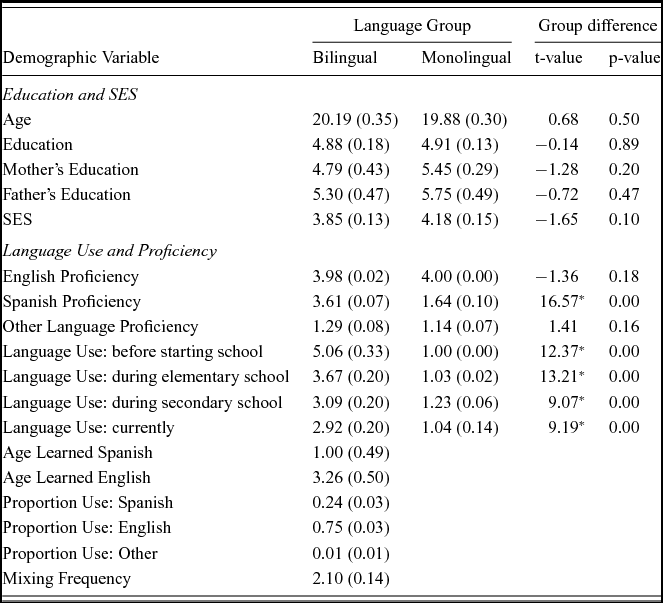
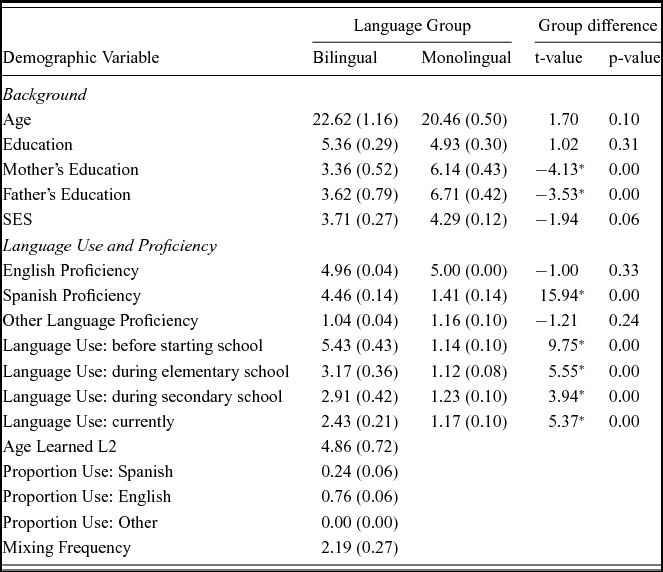
Monolinguals were recruited from a mass screening questionnaire; bilinguals were recruited via flyers, e-mail advertisements, and the mass screening questionnaire. Bilinguals and monolinguals were matched in age, gender, education, SES, and parental education (Table 1). It was confirmed prior to scheduling that 1) bilinguals were fluent in both Spanish and English and had exposure to both languages prior to age 10, and 2) monolinguals were fluent in only English and had no more than minimal exposure to a second-language prior to age 10.
Mean (and standard error) of self-report ratings for demographic variables by language group in Experiment 1

Note. *p < .05. Education, Mother's Education, and Father's Education reflects the highest education achieved, scored from 1 (less than high school) to 9 (doctoral degree). A score of 5 indicates “some college”. SES (socioeconomic status) was rated from 1 (poor) to 6 (upper class) following classic sociological classifications (Jackman, Reference Jackman1979; Ostrove & Long, Reference Ostrove and Long2007). Such subjective SES ratings are more reliable indices of psychological and physical well-being than objective SES measures (Adler, Epel, Castellazzo & Ickovics, Reference Adler, Epel, Castellazzo and Ickovics2000; Goodman, Huang, Schafer-Kalkhoff & Adler, Reference Goodman, Huang, Schafer-Kalkhoff and Adler2007). English and Spanish Proficiency are averages of reported reading, writing, speaking, and listening proficiency rated from 1 (not at all proficient) to 4 (fluent). Language Use measures are rated from 1 (always English) to 7 (always Spanish) and indicate the average amount of time hearing/speaking each language at home, in school, and with friends. Mixing frequency is rated from 0 (no mixing) to 5 (very frequent mixing).
All participants completed a language history questionnaire adapted from Costa et al. (Reference Costa, Hernández, Costa-Faidella and Sebastián-Gallés2009). Participants indicated the amount of time spent speaking English versus Spanish from 1: “Always English” – 7: “Always Spanish” at different times of their life (prior to starting school, during elementary school, during middle school, during high school, and during college/adulthood) and in different settings (at home, at school, with friends). They also reported proficiency from 1: “Not at all proficient” – 4: “Fluent” in speaking and listening in English, Spanish, and any other languages. Self-reported language proficiency correlates with objective proficiency measures (Gollan, Weissberger, Runnqvist, Montoya & Cera, Reference Gollan, Weissberger, Runnqvist, Montoya and Cera2012; Marian, Blumenfeld & Kaushanskaya, Reference Marian, Blumenfeld and Kaushanskaya2007). Bilinguals met inclusion criteria if they: indicated using both Spanish and English prior to entering middle school, rated proficiency in both speaking and listening as at least a 3 (“fairly proficient”), currently used both languages daily, and did not indicate proficiency of 3 or higher in speaking and listening in a third language. Monolinguals met inclusion criteria if: their native language was English, they had no more than minimal exposure to a second language before middle school, they did not report proficiency of 3 or higher in speaking and listening in a second language, and they did not currently use a second language (outside of school instruction). Demographics and language history are reported in Table 1. Bilinguals and monolinguals did not significantly differ in any education or SES variables. As expected, bilinguals reported significantly higher Spanish proficiency and use than monolinguals, but had equivalent proficiency in English and other languages.
If a participant's overall Stroop accuracy was less than 75%, another participant from the same language group was recruited to replace them (n = 1, monolingual). An additional 14 participants were excluded for not meeting either group's language requirements.
Materials and procedure
A computerized color-word Stroop task was administered in two blocks. We used a manual Stroop task for the following reasons: 1) the Stroop task allows for more flexible trial sequencing than other similar tasks (e.g., Flanker, Simon), because it can have more than two response options; 2) response times are faster and more reliable for manual compared to vocal responses (De-Marchis, Reference De-Marchis2013); and 3) in anticipation of Experiment 2, a manual task reduces head motion artifacts compared to vocal responses (Gracco, Tremblay & Pike, Reference Gracco, Tremblay and Pike2005), and prior studies have successfully used a manual Stroop to observe conflict adaptation during fMRI (Egner & Hirsch, Reference Egner and Hirsch2005; Kerns et al., Reference Kerns, Cohen, MacDonald, Cho, Stenger and Carter2004; Kim, Johnson & Gold, Reference Kim, Johnson and Gold2014). The manual Stroop elicits similar conflict effects and neural activity as the vocal Stroop and other non-verbal cognitive control tasks (Barch, Braver, Akbudak, Contoro, Ollinger & Snyder, Reference Barch, Braver, Akbudak, Conturo, Ollinger and Snyder2001; Cieslik, Mueller, Eickhoff, Langner & Eickhoff, Reference Cieslik, Mueller, Eickhoff, Langner and Eickhoff2015; Laird, McMillan, Lancaster, Kochunov, Turkeltaub, Pardo & Fox, Reference Laird, McMillan, Lancaster, Kochunov, Turkeltaub, Pardo and Fox2005; Neumann, von Cramon & Lohmann, Reference Neumann, von Cramon and Lohmann2008).
Each block contained 294 trials: 121–122 (counter-balanced across blocks) each of congruent (e.g., the word “blue” in blue font) and incongruent (e.g., “green” in blue font) trials; and 51 neutral trials in which the written word was unrelated to color (e.g., “horse”). Neutral words matched color-word stimuli in frequency and length. These items were not of interest, but were included to reduce predictability about upcoming trial type. Words appeared in blue, yellow, or green font colors, corresponding to key presses under the right index, middle, and ring fingers, respectively. Font colors were equally distributed across conditions to prevent response bias. Incongruent stimuli were divided equally between response-eligible trials, where the written word was one of the three response options (i.e., blue, yellow, or green) and response-ineligible trials, where it was not one of the response options (i.e., red, brown, or orange). This manipulation was included as part of a separate study not addressed here – for the present study, these trial types are collapsed into a single incongruent condition to yield equal numbers of congruent and incongruent trials.Footnote 2 To assess conflict-detection and -adaptation, blocks were sequenced to include 48 CC, CI, IC, and II trial sequences.
Stimuli were presented using E-prime version 1.2 (Psychology Software Tools, Inc.; pstnet.com). Participants were instructed to respond to the word's font color via button press as quickly and accurately as possible. Each trial began with a fixation cross that appeared in the center of the screen for 500 ms, followed by a 1000 ms color-word stimulus and a 1000 ms blank screen.
After the Stroop task, participants completed the questionnaire online via Qualtrics (http://www.qualtrics.com/). Only bilinguals completed questions about their age of second-language (L2) acquisition, frequency of first-language (L1) and L2 daily usage, and language-switching profile.
Results
We conducted 2 (preceding trial) × 2 (current trial) × 2 (language group) mixed-ANOVAs for accuracy and reaction time (RT) selectively on CC, CI, IC, and II trials to examine conflict-detection and -adaptation effects. Preceding and current trial-type were within-subjects factors, and language group was a between-subjects factor. RT analyses were conducted on correct trials only and adjusted for outlier effects by computing each participant's mean RT of all correct trials and replacing trials more than 2.5 standard deviations beyond their mean with the cutoff value.Footnote 3 This affected 2.8% of the data.
Post-error trials were excluded from analyses, because error monitoring may reflect a dissociable process from conflict monitoring (Ullsperger & von Cramon, Reference Ullsperger and von Cramon2001). We also excluded trials involving response repetitions, when the correct response matched the response on the preceding trial, and negative priming, when the correct response matched the word from the preceding trial. This was done because response repetitions typically lead to better performance and can be confounded with conflict-adaptation conditions (Mayr, Awh & Laurey, Reference Mayr, Awh and Laurey2003; Nieuwenhuis et al., Reference Nieuwenhuis, Stins, Posthuma, Polderman, Boomsma and de Geus2006), while negative priming is associated with poorer performance, because participants may have to reactivate the previously-suppressed word meaning before they can respond (Kane, May, Hasher, Rahhal & Stoltzfus, Reference Kane, May, Hasher, Rahhal and Stoltzfus1997; May, Kane & Hasher, Reference May, Kane and Hasher1995; Neill, Reference Neill1977).
Accuracy
Accuracy analyses revealed significant main effects of preceding trial (F(1, 64) = 9.29, p = .003, partial η2 = .13) and current trial (F(1, 64) = 35.25, p < .0001, partial η2 = .36), and a significant preceding-trial-by-language-group interaction (F(1, 64) = 4.78, p = .03, partial η2 = .07). The three-way preceding-trial-by-current-trial-by-language-group interaction was not significant (F(1, 64) = 0.165, p = .69, partial η2 < .01). No other effects were significant (ps > .21).
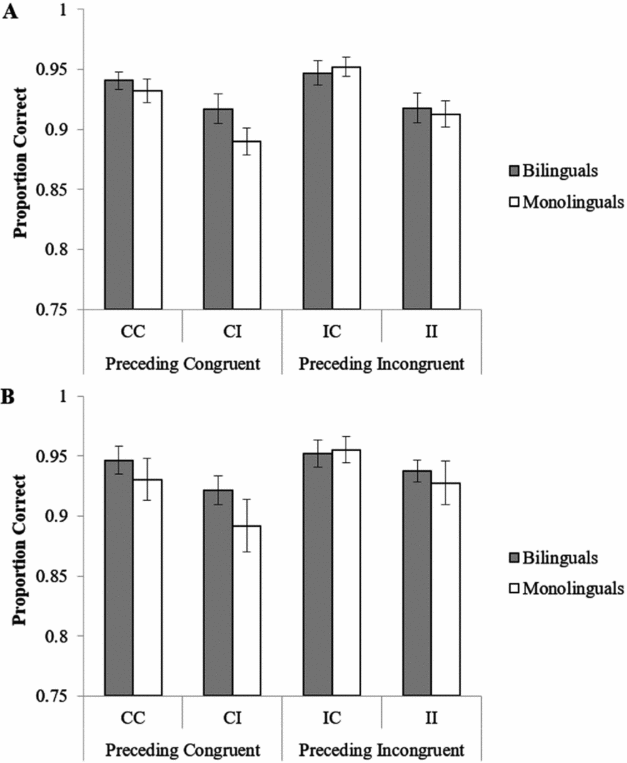
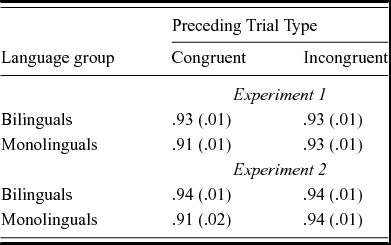
As can be seen in Figure 1A, the preceding trial effect emerged because participants were significantly more accurate after incongruent than after congruent trials. The current trial effect indicated that participants were less accurate on incongruent than congruent trials. To probe the preceding-trial-by-language-group interaction, we conducted Bonferroni-corrected pair-wise comparisons (α = .0125). Independent-samples t-tests revealed that bilinguals did not significantly differ from monolinguals in accuracy when the preceding trial was congruent (t(64) = 1.32, p = .19, Cohen's d = 0.33) or incongruent (t(64) = 0.05, p = .96, Cohen's d = 0.01). However, paired-samples t-tests revealed that whereas monolinguals exhibited significantly lower accuracy following congruent than incongruent trials (t(32) = −3.71, p < .001, Cohen's dz = 0.65), bilinguals exhibited equivalent accuracy (t(32) = −0.25, p = .80, Cohen's dz = 0.04) following congruent and incongruent trials (see Table 2). Inspection of Figure 1A suggests that monolinguals’ lower accuracy following congruent trials is primarily driven by poorer performance on CI trial sequences.
Proportion correct by language group and conflict adaptation condition in A. Experiment 1 and B. Experiment 2. Error bars indicate standard error.

Proportion Correct (and Standard Error) by Preceding Trial and Language Group

RT
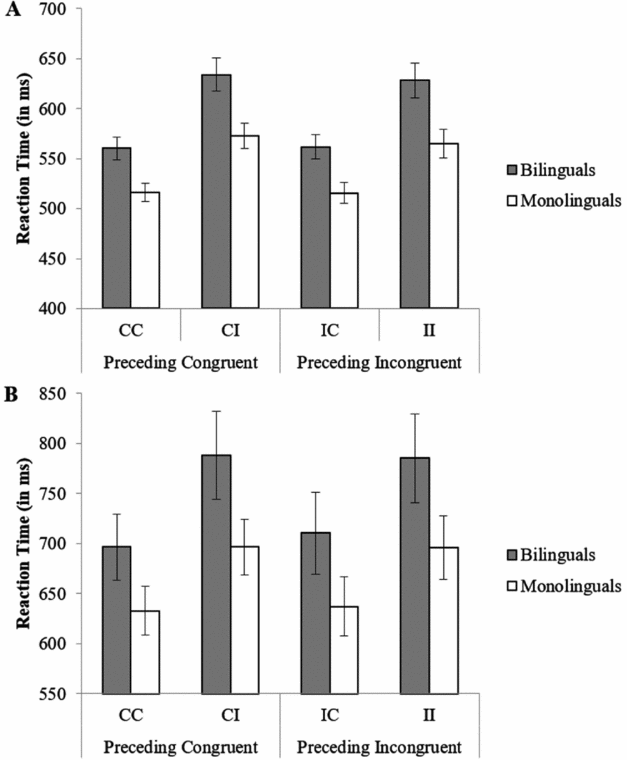
The ANOVA demonstrated significant main effects of language group (F(1, 64) = 8.99, p = .004, partial η2 = .12) and current trial (F(1, 64) = 180.94, p < .0001, partial η2 = .74). As shown in Figure 2A, the language group effect indicated that monolinguals were significantly faster than bilinguals. The effect of current trial revealed significantly slower performance on incongruent than congruent trials.
Reaction time by language group and conflict adaptation condition in A. Experiment 1 and B. Experiment 2. Error bars indicate standard error.

There was also a marginal main effect of preceding trial (F(1, 64) = 3.19, p = .08, partial η2 = .05), revealing that participants were faster following incongruent than congruent trials. Finally, a marginal current-trial-by-language-group interaction emerged (F(1, 64) = 3.52, p = .07, partial η2 = .05). No other effects reached significance (ps > .16).
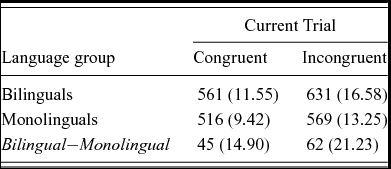
To investigate the marginal current-trial-by-language-group interaction, we conducted Bonferroni-corrected pair-wise comparisons (α = .0125) of congruent and incongruent RTs for bilinguals and monolinguals (see Table 3). Independent t-tests demonstrated that monolinguals were significantly faster than bilinguals for current congruent (t(64) = 3.02, p = .004, Cohen's d = 0.75) and for incongruent trials (t(61.02) = 2.935, p = .005, Cohen's d = 0.73; see Table 3). Both bilinguals (t(32) = 9.77, p < .0001, Cohen's dz = 1.70) and monolinguals (t(32) = 9.87, p < .0001, Cohen's dz = 1.72) exhibited significant conflict effects. Thus, monolinguals were consistently faster than bilinguals across trial types and appeared to have comparable conflict effects.
Mean RTs (and Standard Errors) by Current Trial Type and Language Group in Experiment 1

Speed-accuracy tradeoff
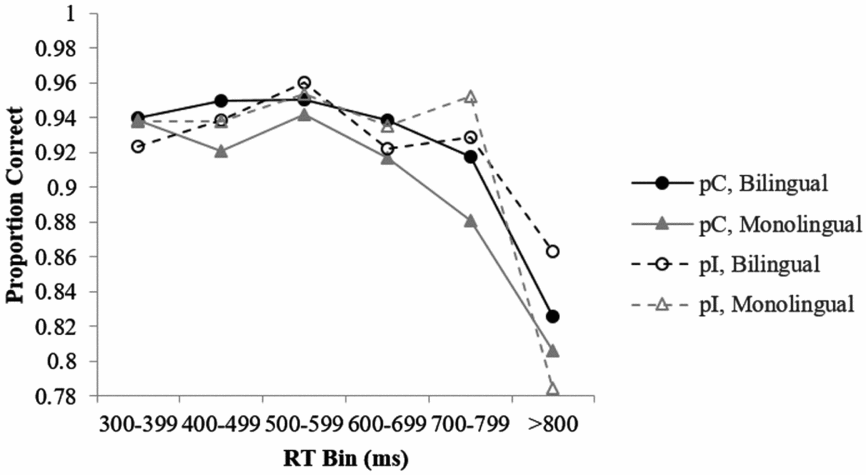
Although preceding trial congruency more adversely affected monolinguals’ accuracy than bilinguals’, monolinguals were also faster. To test the possibility of a speed-accuracy tradeoff, we performed a conditional accuracy function analysis in which accuracy is computed as a function of RT (Gratton et al., Reference Gratton, Coles and Donchin1992). By examining average accuracy in RT bins where all participants have the same response speed, conditional accuracy functions assess whether differences in accuracy are due to slower responding or differences in executive function (Bub, Masson & Lalonde, Reference Bub, Masson and Lalonde2006; Ridderinkhof, van den Wildenberg, Wijnen & Burle, Reference Ridderinkhof, van den Wildenberg, Wijnen, Burle and Posner2004; Stins, Polderman, Boomsma & de Geus, Reference Stins, Polderman, Boomsma and de Geus2007). Following Stins et al. (Reference Stins, Polderman, Boomsma and de Geus2007), we grouped RTs into 100 ms bins and imposed a lower RT cutoff of 300 ms, which excluded <1% of trials (137 out of 15328). All trials with RTs greater than 800 ms were grouped together due to a negatively-skewed distribution, ensuring that each bin included at least 5% of the data.
As evident in Figure 3, both language groups became less accurate as RTs increased. This pattern is the opposite of a speed-accuracy tradeoff: most errors were not the result of responding too quickly. This reverse speed-accuracy tradeoff was particularly pronounced when the preceding trial was congruent. For these trials, bilinguals maintained (numerically) higher accuracy than monolinguals across the RT spectrum.
Conditional Accuracy Function by preceding trial-type (pC, pI) and language group (bilingual, monolingual). pC = preceding congruent trial (solid lines); pI = preceding incongruent trial (dashed lines). Bilinguals are represented by black circles and monolinguals by gray triangles. The absence of a speed-accuracy tradeoff is evident from the stable accuracy performance at shorter RTs and declining performance at longer RTs.

Discussion
Experiment 1’s results suggest that bilingualism affects conflict monitoring, but it was not clear that this effect was advantageous. Bilinguals exhibited an overall RT disadvantage compared to monolinguals, responding more slowly across trial types. For accuracy, however, an interaction revealed that monolinguals had performance decrements following congruent compared to incongruent trials, whereas bilinguals showed no such decline. This pattern did not reflect a speed-accuracy tradeoff, as participants made fewer errors at shorter RTs.
Monolinguals’ relatively lower accuracy after congruent trials primarily reflected poorer performance on CI trial sequences, where individuals must detect initial conflicts between the font color and word meaning to respond correctly. Relative to bilinguals, monolinguals may thus deactivate cognitive-control resources or more poorly maintain the task goal following congruent trials, where the prepotent response (e.g., word reading) enables correct responding; then, after encountering conflict, they would reactively recruit cognitive control, preparing them to resolve subsequent conflict on II trial sequences. Conversely, bilinguals seem to be ready to resolve conflict regardless of whether the preceding trial is congruent or incongruent. This result suggests bilinguals are better than monolinguals at detecting initial instances of conflict, consistent with the account that bilingualism improves conflict monitoring (Costa et al., Reference Costa, Hernández, Costa-Faidella and Sebastián-Gallés2009; Hilchey & Klein, Reference Hilchey and Klein2011).
This interpretation is complicated, however, by the finding that bilinguals were slower overall and had marginally larger conflict effects in RT than monolinguals. Although bilingualism seemed to benefit accuracy during conflict detection, it also generally slowed responding, perhaps reflecting bilinguals’ slower lexical access (Gollan, Montoya, Cera & Sandoval, Reference Gollan, Montoya, Cera and Sandoval2008; Ivanova & Costa, Reference Ivanova and Costa2008; Sandoval, Gollan, Ferreira & Salmon, Reference Sandoval, Gollan, Ferreira and Salmon2010). Although our Stroop task involved manual rather than verbal responses, participants may map lexical representations of color to each button-press response. If so, lexical access is still required to respond correctly. Alternatively, bilinguals may approach the task with the strategy of maximizing accuracy, because their frequent encounters with linguistic competition make errors in conflict resolution costlier.
Although the evidence for a bilingual advantage in conflict monitoring in Experiment 1 was mixed, the results open the door to further investigations of bilingualism's effects on trial-by-trial adjustments in cognitive control. Since monolinguals’ accuracy was reduced following congruent trials, assessing changes in the neural conflict-monitoring system could delineate mechanisms that protect bilinguals from this performance decrement. Experiment 2 further examined the effect of bilingualism on sequential modulations in cognitive control by investigating the neural systems underlying conflict detection (and adaptation) in bilinguals and monolinguals. Moreover, we aimed to replicate Experiment 1’s behavioral findings to corroborate our interpretations.
Experiment 2: fMRI study
Method
Participants
Participants were 14 early Spanish–English bilinguals (7 females; Mage = 22.62; SDage = 4.19) and 14 native English monolinguals (8 females; Mage = 20.46; SDage = 1.81) recruited via flyers, e-mail advertisements, and the Maryland Neuroimaging Center's website. All were right-handed, healthy young adults between the ages of 18 and 35.Footnote 4 Participants chose either course extra credit or $10/hour for participation. All participants provided informed consent and were screened to ensure safe scanning in accordance with University of Maryland IRB procedures.
Exclusionary criteria included major hearing loss, uncorrected vision impairment, color-blindness, known psychological/neurological conditions, psychoactive medication, non-removable ferromagnetic bodily objects, and pregnancy. Language status was confirmed prior to participation and verified with a questionnaire nearly identical to that of Experiment 1, except that language proficiency was rated from 1 (not at all proficient) to 5 (fluent), which expanded the range of responses. All participants met the language criteria described in Experiment 1 for the bilingual and monolingual groups. Two additional monolinguals participated but were excluded from analyses because they exhibited overall accuracy less than 75% (n = 1) or had been exposed to the Stroop task in a separate study (n = 1). Table 4 reports demographic and language history data. Bilinguals and monolinguals had equivalent education and SES, but bilinguals had significantly lower parental education. This difference would, if anything, be expected to oppose any cognitive benefits of bilingualism, making it harder to detect bilingual advantages. As expected, bilinguals had significantly higher Spanish proficiency and use than monolinguals, but equivalent proficiency in English and other languages.
Mean (and standard error) of self-report ratings for demographic variables by language group in Experiment 2

Note. *p < .05. Education, Mother's Education, and Father's Education reflects the highest education achieved, scored from 1 (less than high school) to 9 (doctoral degree). A score of 5 indicates “some college”. SES (socioeconomic status) was rated from 1 (poor) to 6 (upper class). English and Spanish Proficiency are averages of reported reading, writing, speaking, and listening proficiency rated from 1 (not at all proficient) to 5 (fluent). Language Use measures are rated from 1 (always English) to 7 (always Spanish) and indicate the average amount of time hearing/speaking each language at home, in school, and with friends. Mixing frequency is rated from 0 (no mixing) to 5 (very frequent mixing).
Materials
During the fMRI scan, participants completed six blocks of a Stroop task that was similar but not identical to the task in Experiment 1. Each block contained 64 trials: 28 congruent, 28 incongruent, and 8 neutral. Stimuli were presented in blue, yellow, green, or red font colors, corresponding to response buttons underneath the left middle, left index, right index, and right middle fingers, respectively. Font colors were equally distributed across conditions. Word-meaning on incongruent trials was always a possible response option (blue, yellow, green, or red), and neutral words matched color words in frequency and length.
Each run contained 12 of each conflict-adaptation condition, yielding 72 CC, 72 CI, 72 IC, and 72 II trial pairings across all six blocks. Our design eliminated repetition priming (Mayr et al., Reference Mayr, Awh and Laurey2003; Nieuwenhuis, Stins, Posthuma, Polderman, Boomsma & de Geus, Reference Nieuwenhuis, Stins, Posthuma, Polderman, Boomsma and de Geus2006) and negative priming effects (Kane et al., Reference Kane, May, Hasher, Rahhal and Stoltzfus1997; May et al., Reference May, Kane and Hasher1995; Neill, Reference Neill1977) that are confounded with conflict-adaptation effects: the stimulus color never repeated on adjacent trials and the preceding stimulus word never matched the subsequent font color.
Stimuli were presented at inter-stimulus intervals (ISIs) of 3000, 4000, and 5000 ms, using an event-related fMRI design (Dale & Buckner, Reference Dale and Buckner1997). ISIs were evenly distributed across conflict-adaptation conditions, yielding 24 of each conflict-adaptation/ISI combination (4 per run).
Procedure
Before the scan, participants were instructed that their task was to indicate the font color of visually-presented words as quickly and accurately as possible. After entering the scanner, participants were given four response buttons, two in each hand, and directed to keep their middle and index fingers over each button.
Participants were instructed to lie as still as possible while inside the scanner. Then, they completed 40 self-paced practice trials while high-resolution structural images were collected. During practice, response mappings were provided on-screen, and accuracy was monitored to verify that participants learned the correct mappings.
The six task-runs were administered in one of two orders, counterbalanced across participants within each language group. Participants were reminded of response mappings and to respond as quickly and accurately as possible before each run. Each trial began with a 500 ms fixation-cross, followed by a 1000 ms color-word stimulus. Participants were reminded to keep still following any runs containing sudden movements larger than 1 mm.
After the scan, participants moved to another room to complete the background questionnaire online via Qualtrics.
Image acquisition
Imaging was conducted on a 3T Siemens Tim Trio with a 32-channel head coil at the Maryland Neuroimaging Center. High-resolution T1-weighted structural images were obtained using an MPRAGE sequence (192 slices, TA = 4.43 min, TR = 1900 ms, TE = 2.32 ms, flip angle = 9˚, FOV = 230 mm2, matrix size = 256 × 256, resolution = 0.9 × 0.9 × 0.9 mm). Functional data were collected over 6 runs within a single session. For each run, 175 whole-volume scans were acquired using an echo-planar imaging sequence (36 interleaved transversal slices, TA = 5.93 min, TR = 2000 ms, TE = 24 ms, flip angle = 70˚, FOV = 192 mm2, matrix size = 64 × 64, slice thickness = 3.2 mm, distance factor = 20%, voxel size = 3.0×3.0×3.2 mm). Within each run, acquisition began 12 seconds before first trial onset.
Image processing
All data were processed and analyzed using SPM12 (Statistical Parametric Mapping; http://www.fil.ion.ucl.ac.uk/spm) in Matlab R2012b (www.mathworks.com). Functional volumes from each run were co-registered, realigned to the mean functional image using 6th-degree B-spline interpolation to correct for head motion, and slice-time corrected to the middle slice using sinc interpolation. After co-registration to the mean functional image, each participant's T1 image was segmented into six tissue classes using SPM12’s unified segmentation algorithm. Functional and structural images were normalized to the MNI (Montreal Neurological Institute) template via 4th-degree B-spline interpolation using deformation parameters from segmentation. Finally, functional images were smoothed using a 6 mm full-width at half-maximum (FWHM) Gaussian kernel.
Subject-level statistical analyses were computed using a general-linear model with the first trial of each run (filler), correct conflict-adaptation trials (CC, CI, IC, II), correct trials where the preceding or current trial was a neutral (N) stimulus (CN, IN, NC, NI), incorrect trials, and six motion parameters as regressors, partitioned for each run. Responses were modeled as the convolution between impulse (delta) functions representing each stimulus onset and the canonical hemodynamic response function. The brain-mask image from SPM's FieldMap toolbox was applied with a 0.8-threshold to exclude voxels outside the brain. Subject-level contrast images were used as input to general-linear models with independent bilingual and monolingual groups assuming unequal variance, which were submitted to region of interest (ROI) analyses.
ROI analyses
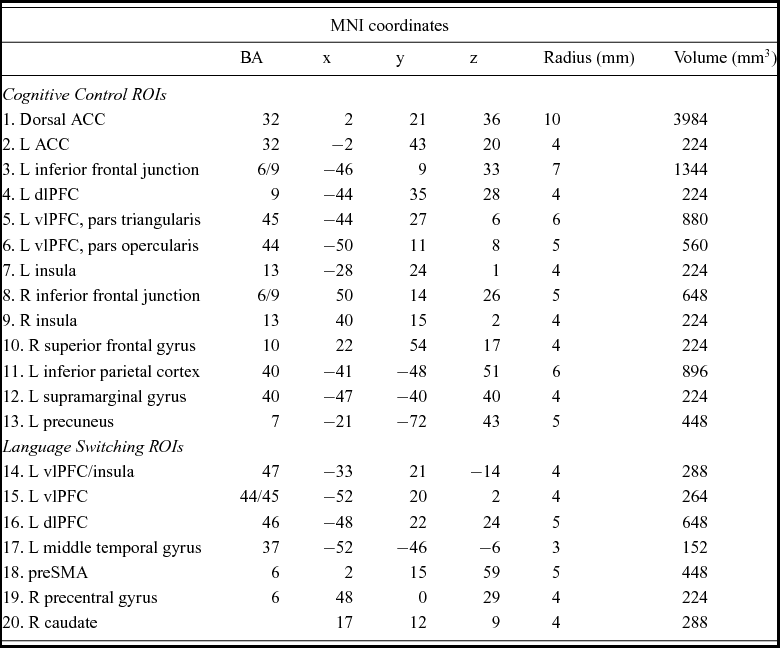
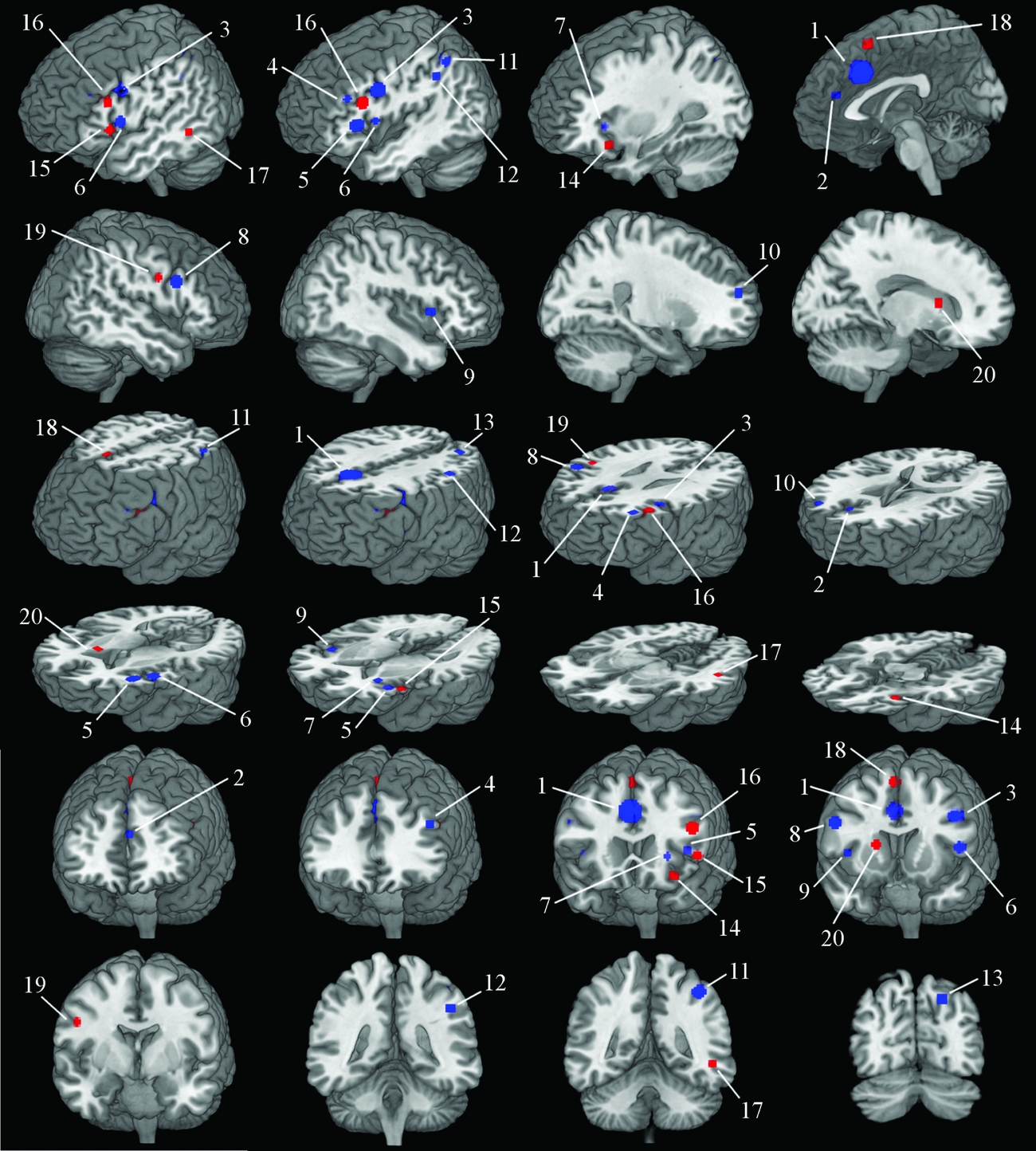
We defined ROIs corresponding to the cognitive-control network and the language-switching network to examine the extent to which bilingualism affected activity in each. By restricting analyses to pre-defined ROIs, this approach helps to mitigate the power limitations of a small sample size in fMRI research (Poldrack, Baker, Durnez, Gorgolewski, Matthews, Munafo, Nichols, Poline, Vul & Yarkoni, Reference Poldrack, Baker, Durnez, Gorgolewski, Matthews, Munafo, Nichols, Poline, Vul and Yarkoni2017). Cognitive-control ROIs were defined from an activation likelihood estimation (ALE) meta-analysis of 19 Stroop neuroimaging studies that identified clusters of greater activity for incongruent relative to non-conflict control trials (Laird et al., Reference Laird, McMillan, Lancaster, Kochunov, Turkeltaub, Pardo and Fox2005). Language-switching ROIs were defined from an ALE meta-analysis of 10 neuroimaging studies in bilinguals that identified areas of greater activity for language-switches in production or comprehension relative to single-language control conditions (Luk, Green, et al., Reference Luk, Green, Abutalebi and Grady2011). Peak coordinates for each significant cluster were transformed from Talairach to MNI space using Lancaster, Tordesillas-Gutierrez, Martinez, Salinas, Evans, Zilles, Mazziotta, and Fox's (Reference Lancaster, Tordesillas-Gutierrez, Martinez, Salinas, Evans, Zilles, Mazziotta and Fox2007) bias-corrected algorithm in the Seed-based d Mapping coordinates utility (www.sdmproject.com/utilities). Each ROI was defined by drawing a sphere centered at the MNI coordinates, with a radius equal to that of the activation cluster rounded to the nearest integer, using the MarsBaR toolbox (version 0.44; Brett, Anton, Valabregue & Poline, Reference Brett, Anton, Valabregue and Poline2002). Visual inspection revealed that some ROIs were shifted slightly relative to their initial position in Talairach space. Center coordinates were adjusted ≤2 mm in Euclidean distance as necessary to achieve better alignment with the original anatomical location of the cluster. Table 5 reports the final center coordinates, radii and volumes of each ROI. Critically, no voxels in the cognitive-control and language-switching networks overlapped (see Figure 4).
Center coordinates, radii and volumes for cognitive control ROIs and language switching ROIs

Note. L-left; R-right. ROI volume depends on both the sphere radius and location of the center coordinate within a voxel because spheres are composed of 2 × 2 × 2 mm voxels.
ROIs in cognitive-control (blue) and language-switching networks (red) from sagittal, axial, and coronal views. Numeric labels correspond to those in Table 5.

To verify that our participants demonstrated expected effects of conflict on neural activity, we examined BOLD activity for CI versus CC trials in the cognitive-control network averaged across all ROIs, as well as in the language-switching network averaged across all ROIs. This CI>CC contrast reflects activity associated with conflict resolution following congruent trials, i.e., when the experience of conflict is highest because prior cognitive-control engagement is low. This analysis served as a baseline to ensure that the selected networks were indeed responsive to conflict in the present study.
To investigate whether bilinguals differentially recruit the cognitive-control network for conflict detection, we compared their BOLD activity to monolinguals’ for CI versus II trials in each cognitive-control ROI. This CI>II contrast isolates activity associated with conflict detection, i.e., for an initial encounter with conflict versus a subsequent encounter. First, we examined this contrast separately for bilinguals and monolinguals to show patterns of activation in the cognitive-control network in each language group. Then, we examined whether bilinguals exhibited significantly different activity than monolinguals for the CI>II contrast in the cognitive-control ROIs. We repeated this procedure for language-switching ROIs.
Behavioral analyses
To examine conflict-detection and -adaptation effects, we conducted 2 (preceding trial) × 2 (current trial) × 2 (language group) mixed-ANOVAs separately for accuracy and RT on relevant trial sequences (CC, CI, IC, and II). Preceding and current trial were within-subjects factors, and language group was a between-subjects factor. RT analyses were conducted on correct trials only, and adjusted for outliers by computing the mean RT of all correct trials for each participant and replacing trials more than 2.5 standard deviations beyond their mean with the cutoff value.Footnote 5 This affected 2.6% of the data.
Results
Behavioral
Results for Experiment 2 were strikingly parallel to those of Experiment 1 (see Figures 1 and 2). Monolinguals, but not bilinguals, demonstrated worse accuracy when the preceding trial was congruent versus incongruent, while bilinguals demonstrated (numerically) slower RTs overall.
Accuracy
Significant main effects of preceding (F(1, 26) = 17.45, p < .001, partial η2 = .40) and current trials (F(1, 26) = 10.94, p < .01, partial η2 = .30) indicated that participants were less accurate following congruent (M = .92, SE = .01) than incongruent trials (M = .94, SE = .01), and less accurate on incongruent (M = .92, SE = .01) than congruent trials (M = .95, SE = .01). Finally, a marginal preceding-trial-by-language-group interaction (F(1, 26) = 3.85, p = .06, partial η2 = .13) replicated the significant interaction observed in Experiment 1. As in Experiment 1, this effect emerged because monolinguals exhibited significantly lower accuracy following congruent than incongruent trials (t(13) = −3.21, p < .01, Cohen's dz = 0.86), whereas bilinguals exhibited equivalent accuracy regardless of preceding trial congruency (t(13) = −1.32, p = .21, Cohen's dz = 0.35; see Table 2). No other main effects or interactions approached significance (ps > .39).
Thus, preceding trial-type affected monolinguals’ accuracy but not bilinguals’, apparently because of monolinguals’ poorer performance on CI trials (see Figure 1B). Indeed, both language groups exhibited accuracy above 92% on all trial types, except monolinguals responded correctly for only 89% of CI trials. This result suggests monolinguals have difficulty detecting the presence of conflict compared with bilinguals.
RT
A significant main effect of current trial (F(1, 26) = 64.16, p < .001, partial η2 = .71) demonstrated that participants were slower at responding on incongruent (M = 746ms, SE = 27) than congruent trials (M = 671ms, SE = 23). No other main effects or interactions were significant (ps > .11). We did not observe any significant RT differences between language groups. However, monolinguals were numerically faster than bilinguals on all trial types (see Figure 2B), demonstrating a trend similar to Experiment 1.
fMRI results
Participants demonstrated significantly greater activity for CI versus CC trials in the cognitive-control network (β = 0.90, t(27) = 4.79, p < 0.001) and language-switching network (β = 0.92, t(27) = 5.09, p < 0.001). Thus, both systems were sensitive to typical conflict effects, indicating that the ROIs were appropriately defined.
Conflict detection in the Cognitive-Control Network
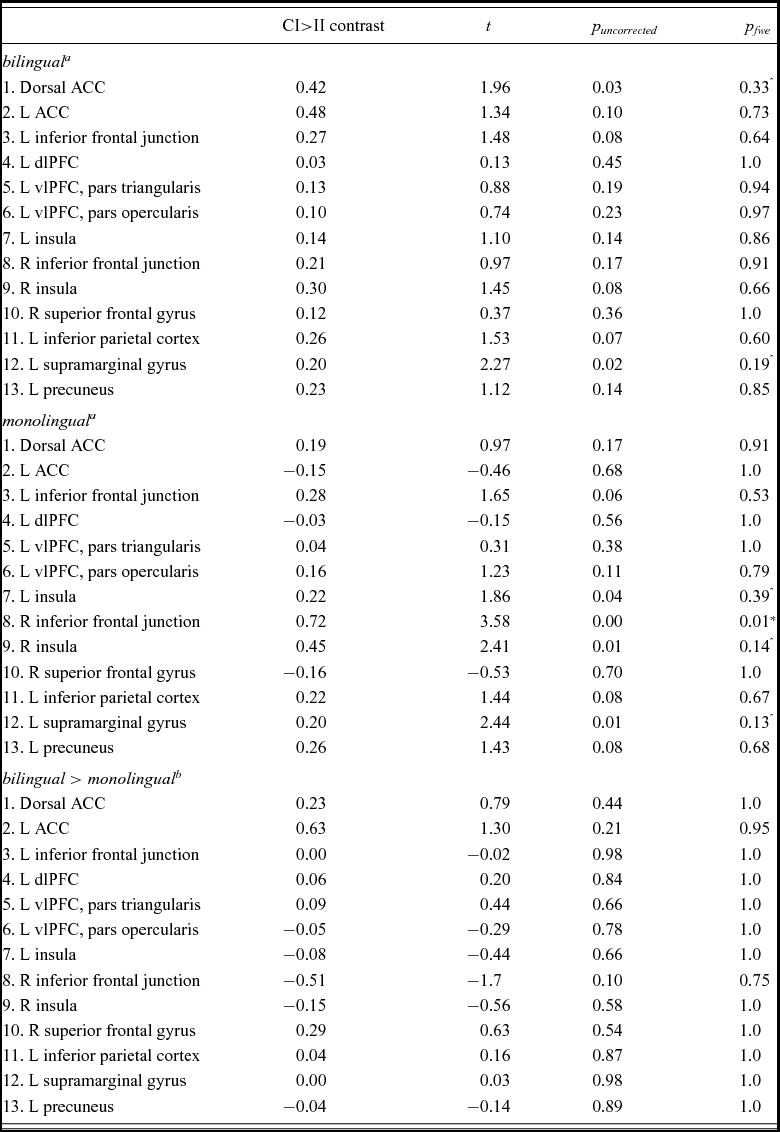
As reported in Table 6, bilinguals trended toward greater CI>II activity (p < 0.05, uncorrected) in the dorsal ACC (BA 32) and the left supramarginal gyrus (BA 40) within the cognitive-control network, although neither effect was significant after correcting for multiple comparisons. Monolinguals exhibited significantly greater CI>II activity in the right inferior frontal junction (BA 6/9), and trended toward greater activity for CI>II in the left and right insula (BA 13) and the left supramarginal gyrus (BA 40). There were no regions in the cognitive-control network where bilinguals and monolinguals exhibited differential CI>II activity.
BOLD contrast for CI>II in cognitive control ROIs for bilinguals, monolinguals, and their difference

Note. puncorrected: p-values without correction for multiple comparisons; pfwe: p-values after applying a Šidák family-wise error adjustment for the 13 cognitive control ROIs.
a Reported p-values are one-tailed for the separate language group contrasts, due to a priori predictions that activity should be greater for CI than II trials.
b The p-values for the bilingual > monolingual contrast are two-tailed.
^ p < 0.05, uncorrected, *p < 0.05, fwe-corrected
Conflict detection in the Language-Switching Network
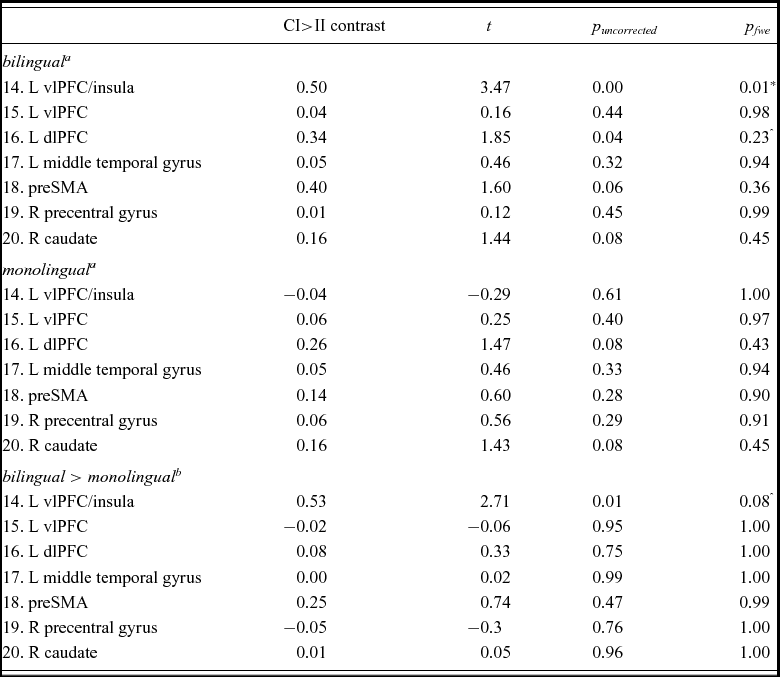
As reported in Table 7, bilinguals exhibited significantly greater CI>II activity in left vlPFC/insula (BA 47) and trended towards increased activity in left dlPFC (BA 46) within the language-switching network. Monolinguals did not exhibit significant CI>II activity in any language-switching ROI. Bilinguals trended towards greater CI>II activity than monolinguals in left vlPFC/insula (p < .05, uncorrected; p = .08, fwe-corrected).
BOLD contrast for CI>II in language switching ROIs for bilinguals, monolinguals, and their difference

Note. puncorrected: p-values without correction for multiple comparisons; pfwe: p-values after applying a Šidák family-wise error adjustment for the 7 language switching ROIs.
a Reported p-values are one-tailed for the separate language group contrasts, due to a priori predictions that activity should be greater for CI than II trials.
b The p-values for the bilingual > monolingual contrast are two-tailed.
^ p < 0.05, uncorrected, *p < 0.05, fwe-corrected
Discussion
Behavioral effects
The behavioral results of Experiment 2 patterned with Experiment 1. First, bilinguals exhibited equivalently high accuracy regardless of preceding trial-type, whereas monolinguals’ accuracy declined following congruent trials (compare Figures 1A and 1B). This effect appears to be driven by monolinguals’ relatively reduced accuracy in the CI condition, suggesting they had comparative difficulty detecting initial instances of conflict. Second, monolinguals were numerically faster than bilinguals on all trial types (compare Figures 2A and 2B). Thus, monolinguals may have responded more quickly, but were less successful at conflict detection.
This replication of Experiment 1 is especially noteworthy given several methodological differences between the two experiments. The conflict-adaptation task version in Experiment 2 placed a greater demand on cognitive resources than in Experiment 1, evidenced by overall slower RTs (see Figure 2). Experiment 2 was conducted in an MR-environment with continuous scanner noise and jittered stimulus presentation rate, thereby reducing the predictability of when stimuli would occur and increasing monitoring demands. Additionally, Experiment 2 had four response options and contained only response-eligible trials, whereas Experiment 1 had three response options and contained both response-eligible and -ineligible trials. Thus, Experiment 2 required maintaining more color-response mappings in memory and resolving stronger conflicts (as response-eligible trials induce greater conflict than response-ineligible trials; Milham, Banich & Barad, Reference Milham, Banich and Barad2003; Milham, Banich, Webb, Barad, Cohen, Wszalek & Kramer, Reference Milham, Banich, Webb, Barad, Cohen, Wszalek and Kramer2001). Despite these procedural differences, bilinguals were similarly unaffected by preceding trial-type in both experiments, whereas monolinguals’ accuracy was consistently degraded following congruent trials. The consistency of these patterns corroborates the notion that bilingualism affects conflict monitoring, enabling heightened sensitivity to initial conflicts despite generally slowing response times.
fMRI effects
Bilinguals and monolinguals exhibited similar levels of activity in the cognitive-control network during conflict detection. This suggests that bilingualism does not affect recruitment of traditional cognitive-control regions for detecting initial conflicts. However, in the language-switching network, which did not overlap with the cognitive-control network, bilinguals recruited left vlPFC/insula (BA 47) for initial conflict trials more than monolinguals, although this effect was marginal after correcting for multiple comparisons. This region may enact controlled lexico-semantic retrieval, as a prior language-switching meta-analysis shows that it is particularly activated by covert translation between languages (Luk, Green, et al., Reference Luk, Green, Abutalebi and Grady2011). Thus, bilinguals may recruit regions involved in active language translation to facilitate conflict detection. We return to this in the general discussion.
General discussion
The present study tested moment-to-moment conflict effects in bilinguals and monolinguals to disentangle the effect of bilingualism on conflict detection versus its effect on reactive adjustments in control. Prior studies have suggested that early bilinguals may experience heightened conflict-monitoring demands due to their need to manage two language systems (Abutalebi et al., Reference Abutalebi, Della Rosa, Green, Hernandez, Scifo, Keim, Cappa and Costa2012; Costa et al., Reference Costa, Hernández, Costa-Faidella and Sebastián-Gallés2009; Tao, Marzecova, Taft, Asanowicz & Wodniecka, Reference Tao, Marzecova, Taft, Asanowicz and Wodniecka2011; Teubner-Rhodes et al., Reference Teubner-Rhodes, Mishler, Corbett, Andreu, Sanz-Torrent, Trueswell and Novick2016), particularly in dual-language environments involving frequent conflicts between lexicons (Abutalebi et al., Reference Abutalebi, Brambati, Annoni, Moro, Cappa and Perani2007; Gollan et al., Reference Gollan, Schotter, Gomez, Murillo and Rayner2014; Green, Reference Green2011; Green & Abutalebi, Reference Green and Abutalebi2013; Moreno, Federmeier & Kutas, Reference Moreno, Federmeier and Kutas2002; Prior & Gollan, Reference Prior and Gollan2011; Verreyt et al., Reference Verreyt, Woumans, Vandelanotte, Szmalec and Duyck2015). This notion is supported by previous findings that bilinguals outperform monolinguals across both conflict and non-conflict trials during cognitive-control tasks (Bialystok et al., Reference Bialystok, Craik, Klein and Viswanathan2004; Costa et al., Reference Costa, Hernández, Costa-Faidella and Sebastián-Gallés2009; Tao et al., Reference Tao, Marzecova, Taft, Asanowicz and Wodniecka2011; Teubner-Rhodes et al., Reference Teubner-Rhodes, Mishler, Corbett, Andreu, Sanz-Torrent, Trueswell and Novick2016). The current work expands on prior findings by investigating the dynamics of conflict-detection and cognitive-control engagement through moment-to-moment behavioral adjustments, and the neurobiological bases of these stages of conflict monitoring. Brain-imaging was employed to test if bilinguals draw on resources known to be important for switching between languages during conflict-monitoring. We asked, do bilinguals have better conflict detection and/or reactive control adjustment than monolinguals, due to the unique language control demands they face?
Across two experiments, we demonstrated a pattern where bilinguals maintained high accuracy regardless of preceding trial-type, whereas monolinguals’ accuracy declined following congruent trials. This pattern accompanied general slowing of RTs and the additional recruitment of left vlPFC/insula within the language-switching network in bilinguals. The replication of behavioral results across two experiments despite several differences in task parameters suggests that the early, highly-proficient Spanish–English bilinguals in this study monitored conflict in a reproducibly different manner than English monolinguals, although it was not clear that this difference constituted a ‘bilingual advantage’ in conflict monitoring. Specifically, bilinguals appeared to prioritize accurately detecting and resolving conflicts over response speed, as evidenced by slower responding across trial types but high accuracy regardless of trial dynamics. This approach to conflict monitoring can be characterized as applying control proactively, preparing to resolve conflict before it occurs by keeping task goals active and maintaining focus on task-relevant information (Braver, Reference Braver2012). This might slow responding due to the effort involved in continuous goal maintenance or through increased response caution. Indeed, prior work has demonstrated that individuals slow down when they believe that they will have to implement control (for review, see Verbruggen, Reference Verbruggen2016), consistent with greater proactive monitoring or surveilling the environment for the need for control. In contrast, monolinguals appeared to apply control more reactively, refreshing goals and redirecting attention after experiencing conflict (Braver, Reference Braver2012). This is evidenced by increased errors after congruent trials. Monolinguals may deactivate cognitive-control resources or fail to maintain task goals on easy congruent trials, recruiting control only after encountering conflict.
Although the behavioral differences between language groups suggest a speed-accuracy tradeoff, trial-level analyses demonstrated that bilinguals maintained numerically higher accuracy than monolinguals after congruent trials even when they responded just as quickly. Thus, although bilinguals responded more slowly and more accurately than monolinguals overall, they apparently did not need to slow down to achieve better post-congruent accuracy than monolinguals. In fact, both bilinguals and monolinguals appeared to exhibit a reverse speed-accuracy trade-off, where accuracy dropped for the slowest trials. We believe that these reflect trials where response uncertainty was sufficiently high to simultaneously delay responding and increase the likelihood of making an error. However, disentangling the relationship between speed and accuracy is difficult in the present study because the relatively long response window allowed participants to strategically determine whether to prioritize speed or accuracy. A speed-accuracy tradeoff design, which increases time pressure when participant accuracy is too high (Bonnet & Dresp, Reference Bonnet and Dresp1993), or when participants respond too slowly (Dambacher & Hubner, Reference Dambacher and Hubner2015), could be used in future studies to evaluate whether bilinguals can actually achieve higher accuracy at faster RTs than monolinguals.
It is nevertheless interesting that early Spanish–English bilinguals consistently prioritized accuracy more than monolinguals, whereas monolinguals prioritized speed. This suggests that bilinguals prefer to accumulate more evidence to support a single correct response before acting. Why might bilingualism induce a conservative response bias? One possibility is that, because bilinguals encounter linguistic competition more frequently than monolinguals, conflict-resolution errors are costlier. Monolinguals may be able to resolve within-language competition relatively quickly and still make few comprehension or production errors. However, if bilinguals sped up to achieve the same error rate as monolinguals, this could drastically increase the number of errors they make, because they constantly face cross-linguistic competition. Adopting a conservative response strategy may help reduce the number of cross-linguistic errors they commit.
Is there a ‘bilingual advantage’ in cognitive control?
Our results appear inconsistent with evidence that bilinguals are faster than monolinguals on cognitive-control tasks (Bialystok, Reference Bialystok2010; Bialystok et al., Reference Bialystok, Craik, Klein and Viswanathan2004; Costa et al., Reference Costa, Hernández, Costa-Faidella and Sebastián-Gallés2009; Hernández, Costa, Fuentes, Vivas & Sebastián-Gallés, Reference Hernández, Costa, Fuentes, Vivas and Sebastián-Gallés2010; Martin-Rhee & Bialystok, Reference Martin-Rhee and Bialystok2008) – in fact, we found that bilinguals were overall slower on the Stroop task. From this perspective, our findings align with recent studies failing to find evidence of a bilingual advantage in performance across various executive-function tasks (Branzi, Calabria, Gade, Fuentes & Costa, Reference Branzi, Calabria, Gade, Fuentes and Costa2016; Hilchey & Klein, Reference Hilchey and Klein2011; Paap & Greenberg, Reference Paap and Greenberg2013; Paap, Johnson & Sawi, Reference Paap, Johnson and Sawi2014; Paap, Sawi, et al., Reference Paap, Johnson and Sawi2014; von Bastian, Souza & Gade, Reference von Bastian, Souza and Gade2016). One explanation for such mixed findings is that bilingualism does not actually impact cognitive control, and the positive results are due to study confounds and/or random chance (Paap & Greenberg, Reference Paap and Greenberg2013; Paap, Johnson, et al., Reference Paap, Johnson and Sawi2014). This explanation has received growing support as many studies with large samples and early, highly proficient bilinguals have found no consistent evidence of bilingual/monolingual differences in inhibitory control, task-switching, or conflict monitoring (Antón, Duñabeitia, Estévez, Hernández, Castillo, Fuentes, Davidson & Carreiras, Reference Antón, Duñabeitia, Estévez, Hernández, Castillo, Fuentes, Davidson and Carreiras2014; Branzi, Calabria, et al., Reference Branzi, Calabria, Gade, Fuentes and Costa2016; Duñabeitia et al., Reference Duñabeitia, Hernández, Antón, Macizo, Estévez, Fuentes and Carreiras2014; Gathercole, Thomas, Kennedy, Prys, Young, Vinas Guasch, Roberts, Hughes & Jones, Reference Gathercole, Thomas, Kennedy, Prys, Young, Vinas Guasch, Roberts, Hughes and Jones2014; von Bastian et al., Reference von Bastian, Souza and Gade2016). Moreover, the DRD2 genetic phenotype varies systematically across certain bilingual and monolingual populations (Hernandez et al., Reference Hernandez, Greene, Vaughn, Francis and Grigorenko2015), suggesting that, when observed, cognitive control differences could be explained by genetic rather than linguistic factors. Considering evidence on both sides of the issue, it remains possible that bilingualism, simply put, does not affect cognitive-control abilities.
However, the present results suggest that a more nuanced view may be warranted. Much of the research investigating bilingualism and cognitive control uses tasks susceptible to ceiling effects, with typical accuracy above 90% (Antón et al., Reference Antón, Duñabeitia, Estévez, Hernández, Castillo, Fuentes, Davidson and Carreiras2014; Bialystok, Reference Bialystok2006, Reference Bialystok2010; Bialystok et al., Reference Bialystok, Craik and Luk2008; Bialystok et al., Reference Bialystok, Craik, Klein and Viswanathan2004; Bialystok & Viswanathan, Reference Bialystok and Viswanathan2009; Costa et al., Reference Costa, Hernández, Costa-Faidella and Sebastián-Gallés2009; Duñabeitia et al., Reference Duñabeitia, Hernández, Antón, Macizo, Estévez, Fuentes and Carreiras2014; Emmorey, Luk, Pyers & Bialystok, Reference Emmorey, Luk, Pyers and Bialystok2008; Hernández et al., Reference Hernández, Costa, Fuentes, Vivas and Sebastián-Gallés2010; Hernández, Costa & Humphreys, Reference Hernández, Costa and Humphreys2012; Luk, De Sa & Bialystok, Reference Luk, De Sa and Bialystok2011; Martin-Rhee & Bialystok, Reference Martin-Rhee and Bialystok2008; Paap & Greenberg, Reference Paap and Greenberg2013; Paap, Johnson, et al., Reference Paap, Johnson and Sawi2014; Schroeder, Marian, Shook & Bartolotti, Reference Schroeder, Marian, Shook and Bartolotti2016). Performance on these tasks may be affected by strategic decisions about prioritizing accuracy versus speed as much as by true individual differences in cognitive-control abilities. These strategic decisions could vary across studies depending on instructions and the precise task parameters. Our study is no exception – accuracy was above 90% in almost every condition tested, and our speed-accuracy tradeoff analysis showed that accuracy did not decline for faster responses in either language group. This pattern suggests that participants generally prioritized response accuracy over speed; it is unclear whether RTs provide a valid index of cognitive-control processes in such cases. The accuracy data suggested that monolinguals had more difficulty resolving new instances of conflict than bilinguals, but the magnitude of this difference may be hard to estimate when accuracy approaches ceiling.
New investigations of cognitive control in bilinguals and monolinguals can avoid this limitation by using more challenging tasks that are less susceptible to ceiling effects. For example, Teubner-Rhodes et al. (Reference Teubner-Rhodes, Mishler, Corbett, Andreu, Sanz-Torrent, Trueswell and Novick2016) found global accuracy and RT advantages for early Spanish–Catalan bilinguals relative to Spanish monolinguals on an N-back recognition-memory task involving occasional conflict from ‘lure’ items that were familiar but irrelevant to the current memory judgment. Average accuracy on this task was approximately 70%, and bilinguals achieved higher accuracy than monolinguals on both conflict (lure) and non-lure trials. These prior results are consistent with the idea that bilinguals are better at monitoring for conflict when the task is sufficiently challenging, but further work should address how ceiling effects may have contributed to inconsistent results in previous studies.
Another issue is that most research has focused on the claim that bilingualism improves nonlinguistic cognitive control. This claim is striking because it implies that experience with language control improves control over nonlinguistic stimuli. However, we believe that more empirical support is needed for the assumption that underlies this claim, namely, that practice resolving cross-linguistic interference actually improves cognitive control in linguistic contexts. Some findings suggest this may be the case: bilinguals experience less interference from cross-linguistic phonological competitors in a newly learned language than monolinguals (Bartolotti & Marian, Reference Bartolotti and Marian2012), exhibit higher comprehension of sentences with atypical word order while ignoring an auditory distractor sentence (Filippi, Leech, Thomas, Green & Dick, Reference Filippi, Leech, Thomas, Green and Dick2012), and demonstrate better sentence comprehension when monitoring for recurring syntactic ambiguity (Teubner-Rhodes et al., Reference Teubner-Rhodes, Mishler, Corbett, Andreu, Sanz-Torrent, Trueswell and Novick2016). However, bilinguals are also slower than monolinguals at determining if a word was semantically related to a previous sentence, including when the decision required suppressing a dominant homograph meaning (Paap & Liu, Reference Paap and Liu2014). Thus, more evidence is needed to understand how bilingualism affects cognitive control for linguistic material. Delineating the mechanisms of language control that are subject to experience-dependent plasticity in bilinguals will help determine how bilingualism might impact non-linguistic cognitive-control abilities.
Finally, we note that Spanish–English bilinguals living in the United States may switch languages infrequently compared to those living in communities where many people speak two languages. Such single-language contexts may reduce the conflict monitoring demands of bilingual language control. Our bilingual participants reported relatively low frequency of mixing languages in conversation, but nevertheless demonstrated higher conflict detection accuracy, albeit with slower responses than monolinguals. Many of the prior studies that have observed faster RTs in bilinguals compared to monolinguals have been conducted with bilingual populations who mix languages more frequently (Bialystok et al., Reference Bialystok, Craik, Klein and Viswanathan2004; Costa et al., Reference Costa, Hernández, Costa-Faidella and Sebastián-Gallés2009; Martin-Rhee & Bialystok, Reference Martin-Rhee and Bialystok2008; Pelham & Abrams, Reference Pelham and Abrams2014; Teubner-Rhodes et al., Reference Teubner-Rhodes, Mishler, Corbett, Andreu, Sanz-Torrent, Trueswell and Novick2016), and increased language switching is associated with faster RTs in bilinguals (Hofweber et al., Reference Hofweber, Marinis and Treffers-Daller2016; Verreyt et al., Reference Verreyt, Woumans, Vandelanotte, Szmalec and Duyck2015). Moreover, code-switching usage affects ease of processing: code-switch structures that occur more frequently in production facilitate comprehension (Guzzardo Tamargo, Valdés Kroff & Dussias, Reference Guzzardo Tamargo, Valdés Kroff and Dussias2016; Valdés Kroff, Reference Valdés Kroff, Guzzardo Tamargo, Mazak and Parafita Couto2016; Valdés Kroff, Guzzardo Tamargo & Dussias, in press) and populations that code-switch regularly interpret code-switches more quickly than those that don't (Valdés Kroff et al., in press). Future work should address whether frequency of language mixing or code-switching impacts the effect of bilingualism on moment-to-moment conflict detection and resolution. Additionally, future work should test whether bilinguals’ own conflict-monitoring performance dynamically adjusts across different linguistic contexts (e.g., those involving code-switches vs. those that don't). Rather than relying on correlations or across-group comparisons, such studies could directly evaluate whether perceiving a switch is a processing demand of bilingualism that engages conflict-monitoring procedures in real time.
Neural activity related to conflict detection
Bilinguals and monolinguals demonstrated differential neural activation within the language-switching network for initial relative to subsequent conflict trials, providing a potential mechanism for the relatively more proactive conflict detection that bilinguals demonstrated behaviorally. Specifically, conflict-detection-related activity was greater in bilinguals than monolinguals in left vlPFC/insula (BA 47). This is consistent with prior evidence that bilinguals exhibit greater activity in this region during task-switching than monolinguals (Garbin, Sanjuan, Forn, Bustamante, Rodriguez-Pujadas, Belloch, Hernandez, Costa & Avila, Reference Garbin, Sanjuan, Forn, Bustamante, Rodriguez-Pujadas, Belloch, Hernandez, Costa and Avila2010). According to Badre and colleagues (Reference Badre, Poldrack, Paré-Blagoev, Insler and Wagner2005), BA 47 underlies controlled retrieval of semantic information when environmental cues are insufficient to support retrieval. That is, the left vlPFC/insula comes online to facilitate retrieval when the association between external cues and semantic knowledge is relatively weak. This region has also been implicated in maintenance and retrieval of task goals, as it is engaged by multidimensional stimuli associated with multiple response rules (Crone, Wendelken, Donohue & Bunge, Reference Crone, Wendelken, Donohue and Bunge2006). In the present study, the association between the font color and the relevant color representation, and the task goal to respond to font color, may be relatively weak on CI trials because the previous trial did not require participants to access the font-color representation to respond correctly. Thus, on CI trials, perceptual cues may be insufficient to retrieve the appropriate color representation and response rule. That bilinguals have greater left vlPFC/insula activation than monolinguals on these trials may indicate that they are using top-down control to retrieve the goal-relevant information, leading to their increased accuracy following congruent trials and perhaps to their generally slower responding. Importantly, by employing this control during initial conflict detection, bilinguals proactively prepare to handle potential information conflicts. The role of this region in language-switching, coupled with its increased recruitment by bilinguals, suggests that bilinguals may rely on the neural system underlying language-switching mechanisms (particularly controlled semantic retrieval), to enact conflict detection more generally. Reliance on this practiced network may facilitate successful conflict resolution upon first encountering conflicts, as bilinguals achieved equivalently high accuracy on CI and II trial sequences.
One question raised by the present results is why bilinguals’ more accurate conflict detection was associated with increased rather than decreased left vlPFC/insula recruitment relative to monolinguals. This result is potentially inconsistent with the finding that bilinguals’ reduced task-switching costs have been associated with decreased activation in cognitive-control regions (Gold et al., Reference Gold, Kim, Johnson, Kryscio and Smith2013). However, the findings come from different age groups, which may impact the relationship between functional activation and performance. Indeed, prior research has observed an interaction between the effects of age and executive-function demands on neural activity in bilateral vlPFC and dlPFC: in young adults, activity increases as goal-maintenance and shifting demands increase; in older adults, this pattern reverses (Hagen, Ehlis, Haeussinger, Heinzel, Dresler, Mueller, Herrmann, Fallgatter & Metzger, Reference Hagen, Ehlis, Haeussinger, Heinzel, Dresler, Mueller, Herrmann, Fallgatter and Metzger2014). Moreover, the relationship between activation in right vlPFC and executive-function performance changed as a function of age (Hagen et al., Reference Hagen, Ehlis, Haeussinger, Heinzel, Dresler, Mueller, Herrmann, Fallgatter and Metzger2014). Thus, activity-performance relationships are not necessarily the same in younger and older adults. Our finding that bilinguals exhibited increased left vlPFC/insula engagement during conflict detection is consistent with prior evidence that recruitment of this region as task demands increase corresponds to better performance in young adults.
We found little evidence that bilinguals and monolinguals engaged the cognitive-control network differentially during conflict detection – activation did not significantly differ between the language groups in cognitive-control regions that are typically engaged by Stroop conflict. Thus, our results support the notion that bilinguals recruit additional language-switching areas during conflict monitoring rather than differentially recruiting existing cognitive-control regions. This is surprising given evidence that language-switching engages regions that also implement nonlinguistic cognitive control (Abutalebi et al., Reference Abutalebi, Brambati, Annoni, Moro, Cappa and Perani2007; Abutalebi et al., Reference Abutalebi, Della Rosa, Ding, Weekes, Costa and Green2013; Abutalebi et al., Reference Abutalebi, Della Rosa, Green, Hernandez, Scifo, Keim, Cappa and Costa2012; Blanco-Elorrieta & Pylkkanen, Reference Blanco-Elorrieta and Pylkkanen2016; Branzi, Della Rosa, et al., Reference Branzi, Della Rosa, Canini, Costa and Abutalebi2016; Crinion et al., Reference Crinion, Turner, Grogan, Hanakawa, Noppeney, Devlin, Aso, Urayama, Fukuyama, Stockton, Usui, Green and Price2006; De Baene et al., Reference De Baene, Duyck, Brass and Carreiras2015; Hernandez, Reference Hernandez2009; Hernandez et al., Reference Hernandez, Martinez and Kohnert2000). However, only some of this evidence directly shows overlap between language-switching and cognitive-control regions (Abutalebi et al., Reference Abutalebi, Della Rosa, Green, Hernandez, Scifo, Keim, Cappa and Costa2012; Blanco-Elorrieta & Pylkkanen, Reference Blanco-Elorrieta and Pylkkanen2016; Branzi, Della Rosa, et al., Reference Branzi, Della Rosa, Canini, Costa and Abutalebi2016; De Baene et al., Reference De Baene, Duyck, Brass and Carreiras2015), and even co-activation of these tasks within bilinguals does not indicate whether bilinguals recruit specialized language-switching regions to support cognitive-control or vice versa. The language-switching and cognitive-control ROIs we identified from meta-analyses (Laird et al., Reference Laird, McMillan, Lancaster, Kochunov, Turkeltaub, Pardo and Fox2005; Luk, Green, et al., Reference Luk, Green, Abutalebi and Grady2011) were adjacent, but non-overlapping. This approach revealed that bilinguals engage the language-switching network during conflict detection but do not differentially engage the classic cognitive-control network. However, the small sample size in the present study may have prevented us from detecting differential recruitment within the cognitive-control network.
Prior work has found greater ACC activity in response to conflict for monolinguals relative to bilinguals (Abutalebi et al., Reference Abutalebi, Della Rosa, Green, Hernandez, Scifo, Keim, Cappa and Costa2012). In contrast, we did not observe any language group differences in this region. One reason for this discrepancy may be the nature of the conflict effects that were examined. The goal of our study was to selectively examine neural activity related to conflict detection by comparing activation for initial conflicts (CI trial sequences) to activation for subsequent conflicts (II trial sequences). Accordingly, we maximized the number of CI and II trial sequences in our study design by making nearly half (44%) of all trials incongruent. In contrast, Abutalebi et al. (Reference Abutalebi, Della Rosa, Green, Hernandez, Scifo, Keim, Cappa and Costa2012) examined conflict resolution by comparing incongruent to congruent trials, and only one-third of the trials in their study were incongruent. Conflict effects and associated ACC activity increase as the frequency of conflict decreases (Botvinick et al., Reference Botvinick, Braver, Barch, Carter and Cohen2001; Carter, MacDonald, Botvinick, Ross, Stenger, Noll & Cohen, Reference Carter, MacDonald, Botvinick, Ross, Stenger, Noll and Cohen2000). Thus, we may not have observed language group differences because our participants experienced less conflict in general; perhaps monolinguals only exhibit greater ACC activity than bilinguals for relatively stronger conflicts (i.e., under conditions when conflict is rarer).
Together, our findings suggest that bilinguals tend to detect conflict more accurately, perhaps due to increased reliance on the neural resources involved in language switching: namely, the left vlPFC/insula. However, conclusions regarding the overlap between the mechanisms underlying language switching and conflict detection are limited in the present study, which did not attempt to co-localize activation related to both conflict detection and language-switching within subjects. Future studies should address this issue.
In sum, bilinguals enacted conflict-monitoring differently than monolinguals, prioritizing accurate conflict detection while responding more slowly. This supports the conflict-monitoring account of bilingualism's effect on cognitive control, although it was not clear that this effect was advantageous. Our study opens the door to research examining online regulation of cognitive control in bilinguals and monolinguals. Our results suggest that lifelong bilingualism may increase readiness to resolve new or unexpected conflicts given unique processing demands that language-switching imposes.