Introduction
In zebrafish, fertilization and subsequent embryo development take place in a hyposmolar environment with respect to the embryo internal osmolarity. The inner osmolarity of a zebrafish embryo is around 300 mOsm, similar to that required for isolated somatic cells or blastomeres in culture, whilst the suitable osmolarity for an intact embryo is 30 mOsm (Westerfield, Reference Westerfield2003). The osmolarity difference between that of the medium required by embryos and for isolated embryonic cell culture should be taken into account in chimaerism experiments in zebrafish, in which it is necessary to reconcile the osmolar requirements of both cells and embryos. In this way, for chimaerism, the common practice involves the employment of two different drops of medium during manipulation, one for donor cells and the one that contains the recipient embryos and where the cell injection is performed (Hong et al., Reference Hong, Winkler and Schartl1998; Ma et al., Reference Ma, Fan, Ganassin, Bols and Collodi2001). However, a single medium is used when chimaerism is performed by aspirating cells directly from a donor embryo and introducing them into the recipient embryo. In all cases, cell injection is usually performed in a low osmolarity environment (30 mOsm) according to the requirements of the intact embryos (Lin et al., Reference Lin, Long, Chen and Hoplins1992; Nakagawa & Ueno, Reference Nakagawa and Ueno2003). However, in this case, no attention is paid to the external osmotic barrier breakdown in recipient embryos by the transplant pipette and to its interaction with the low osmolarity of the manipulation medium, which could temporally modify osmolar characteristics of embryos along the pipette entry channel, causing intra-embryonic cell lysis. Moreover, injuries could appear in intermediate steps in which donor cells are loaded into the transplant pipette and injected into the embryo, due to the osmolar changes produced by ion exchanges between the inside (300 mOsm) and outside (30 mOsm) of the pipette opening.
In a previous study, we found that survival and further development were not affected by culture of embryos at the mid blastula transition state (MBT) in an isosmolar medium (300 mOsm) for 1 h (Pérez-Camps & García-Ximénez, Reference Pérez-Camps and García-Ximénez2008). In addition, no reference on these manipulation particularities in chimaerism could be found in the literature. Therefore, the aim of this study was to assess donor cell viability and chimaeric embryo survival when different manipulation medium osmolarities are used in chimaerism assays.
Materials and Methods
Care of zebrafish specimens, Danio rerio, and embryo collection were carried out as described by Francisco-Simão et al. (Reference Francisco-Simão, Pérez-Camps and Garcia-Ximenez2007). Embryos near the mid blastula transition stage (MBT) were dechlorinated by pronase (1.5 mg/ml in H10), H10 being Hanks’ buffered salt solution (HBSS) diluted 10% in distilled water, v/v. Then, dechlorinated embryos were washed twice in H10. Damaged embryos were discarded and only intact embryos were used in the experiments.
All chemicals and culture media were from Sigma-Aldrich.
Experimental design and procedures
Experiment I. Effect of handling medium osmolarity on injected embryo viability
In order to assess embryo viability after chimaerism, two experimental groups were established depending on the medium osmolarity in which recipient embryos were manipulated (E1: HBSS, 300 mOsm; E2: H10, 30 mOsm). Osmolarity was measured using a cryoscopic osmometer (Osmomat 030; Gonotec).
Micromanipulation was carried out using an inverted microscope (Nikon ECLIPSE TE200) equipped with Leitz micromanipulators. Embryos were placed in the different manipulation media described and covered by mineral oil. Embryos were held with a 260 μm outer diameter holding pipette. The outer diameter of the injection pipette was set between 50–60 μm. Embryo manipulation consisted of the injection of cell medium (around 0.1 to 0.5 μl of HBSS, 300 mOsm), but not cells, into the marginal zone of the recipient embryo blastoderm (15 embryos per batch).
After manipulation, embryos from the two groups were incubated at 28.5°C in H10. Two control groups were established, composed of non-injected embryos from each batch of E1 and E2 experimental groups. They remained in the same manipulation medium (C1: 300 mOsm; C2: 30 mOsm) for as long as the injection process took, and then were incubated at 28.5°C in H10.
At least 125 embryos were injected in both experimental groups, in different sessions.
Embryo survival rate was assessed after 1 h post-injection and at the larval stage (5 days). Only embryos with no malformations were considered well developed embryos.
Results were analysed using the chi-squared test. When a single degree of freedom was involved, Yates’ correction for continuity was performed.
Experiment II. Evaluation of a possible osmolar change effect on the donor cells in chimaerism experiments
Donor blastomeres were obtained from 5–10 embryos (per batch) at the MBT stage as described by Cardona-Costa & García-Ximénez (Reference Cardona-Costa and García-Ximénez2007). They were kept in HBSS without Ca2+ and Mg2+ (cell medium, 300 mOsm).
With the aim of simulating the chimaerism process, blastomeres were exposed (A) or not (B) to an osmolar change, using in each group two different micropipette outer diameters, 40–50 μm (I) and 60–70 μm (II), so four experimental groups were established (A-I, A-II, B-I and B-II).
In the A group, around 50–100 blastomeres were aspirated with a micropipette (I and II) from the cell medium and were held near the micropipette opening. Then, the micropipette was immersed for 10 s in H10 medium (30 mOsm) and blastomeres were finally transferred to HBSS (300 mOsm). The B group was not exposed to a possible osmolarity change, so the blastomeres were aspirated with a micropipette (I and II) from the cell medium (300 mOsm) and directly transferred to HBSS medium (300 mOsm).
After each batch, a sample of 20 μl from HBSS medium that contained the largest number of cells possible was immediately taken and mounted onto a slide. Cell survival rate was established as the number of live cells from intact cells (live plus dead) recovered, using 0.4% trypan blue dye (1:1 v/v). Unfortunately, it was impossible, in our experimental conditions, to identify and quantify the immediate cell lyses because they disappeared rapidly as ghosts. Only intact cells could be assessed at the end of the process. In this way, dead and alive intact cells were counted in eight random fields (100× magnification) as Cardona-Costa & García-Ximénez (Reference Cardona-Costa and García-Ximénez2007) described.
For the control, a sample of cells that remained the whole time in the initial medium, cell medium, were directly recovered with a Pasteur pipette at the end of each batch.
Results were analysed by chi-squared analysis. When a single degree of freedom was involved, Yates’ correction for continuity was performed.
Results and discussion
Handling medium osmolarity in chimaerism experiments affects embryonic survival
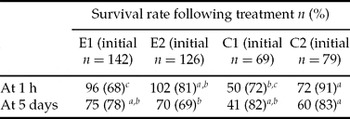
Results are presented in Table 1.
Embryo survival rates.
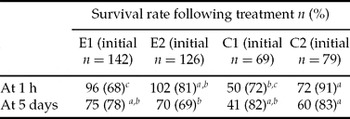
Embryos were injected with 0.1 μl to 0.15 μl approximately of Hanks’ saline (300 mOsm) in two different handling media (E1: 300 mOsm; E2: 30 mOsm). Control groups (C1: 300 mOsm; C2: 30 mOsm) were parallel carried out to their respective experimental groups.
a ,b,c Between columns, data with different superscripts are statistically different (p < 0.05).
In the first assessment (1 h post-injection), embryo survival was significantly lower in the E1 group, manipulated in the higher osmolarity medium (E1: 68% vs E2: 81%; p < 0.05). This low percentage could be attributed to a momentary harmful effect due to a sharp osmolar change (E1 group was transferred from H10 to HBSS medium for manipulation and to H10 again for incubation). Moreover, the survival differences at 1 h between the control groups (C1 and C2) supported this possibility because significant differences in survival rates were also detected among them in favour of H10 medium (C1: 72% vs C2: 91%; p < 0.05). In addition, mechanical damage during manipulation would enhance this effect. In fact, after injecting 0.1 μl to 0.15 μl approximately of HBSS (300 mOsm) into the basal area of the blastoderm, the immediate survival (1 h) was reduced both in the E1 and E2 experimental groups, when they were compared with the respective control groups not handled (E1: 68% vs C1: 72%; E2: 81% vs C2: 91%), although these differences did not reach levels of significance.
At 5 days post-injection, differences between the E1 and E2 experimental groups did not reach significance levels. Despite this, the survival rate of the first group was slightly higher (E1: 78% vs E2: 69%). This fact implies the possibility that, when embryos are micromanipulated at low osmolarity (E2, 30 mOsm), additional damage could be sustained as consequence of the external osmotic barrier breakdown during the injection process and affect them until their resealing. This situation would permit the osmolar interchange between the internal (300 mOsm) and external (30 mOsm) media, causing intra-embryonic cell lyses. In this case, and as results suggested, these effects are not immediate but presented in later stages of development.
In terms of percentage, the survival rate in the E1 group increased at 5 days post injection (HBSS – 1 h: 68% vs HBSS – 5days: 78%), in contrast with embryos from E2 group, in which the survival rate even decreased (H10 – 1 h: 81% vs. H10–5 days: 69%). These results suggest that the final survival rate increases when chimaerism is performed in HBSS medium (E1, 300 mOsm) if compared with H10 medium (E2, 30 mOsm). Moreover, keeping the embryos in HBSS only during micromanipulation and transferring them to H10 medium for incubation (with the consequent sharp osmolarity change) did not prevent embryos continuing their development without any delay (Pérez-Camps & García-Ximénez, Reference Pérez-Camps and García-Ximénez2008). So, these results are of interest for future chimaerism studies.
Handling medium osmolarity in chimaerism experiments does not affect viability of transplanted cells
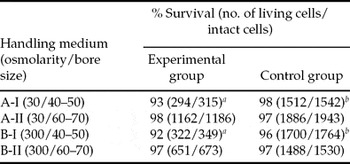
In fish, to achieve germ-line chimaerism success, the final number of living cells to be inserted into the recipient embryo is an important experimental aspect (Fan et al., Reference Fan, Crodian, Liu, Aleström, Aleström and Collodi2004; Hong et al., Reference Hong, Winkler and Schartl1998; Ma et al., Reference Ma, Fan, Ganassin, Bols and Collodi2001). Therefore, to assess the osmolar effect on cells in chimaerism, two different transplant pipette outer diameters were used in Experiment II. Results are presented in Table 2.
Cell survival.
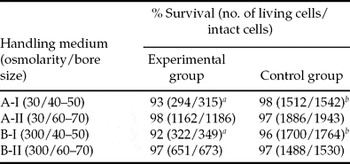
In the cell control groups (cells maintained in the initial drop of Hanks’ saline without Ca2+ and Mg2+) and experimental groups, cells picked up from the initial drop and manipulated on two handling media (A: 30 mOsm; B: 300 mOsm) and with different bore diameters of transplant micropipettes (I: 40–50 μm; II: 60–70 μm).
a ,b Between columns, data with different superscripts are statistically different (p < 0.05).
After assessing the number of live versus intact cells that survived the passage from the cell medium (HBSS without Ca2+ and Mg2+) to the two different handling mediums (HBSS or H10), results obtained did not show differences in terms of the use of different handling osmolarities (A: H10, 30 mOsm; B: HBSS, 300 mOsm). In fact, differences related to the possible osmolar damage between the use of two different pipette bore sizes, presumably greater as diameter increased, were not detected. However, cell survival differences between the A-I and B-I groups (both with 40–50 μm outer diameter) showed levels of significance (p < 0.05) when compared with respective control groups. It seems that these cell mortalities, occurring during transfer by pipette, are a consequence of the mechanical damage incurred during aspiration and when cells are expelled through the pipette opening. Thus, they increased when the pipette bore size decreased, favouring in our case the A-II and B-II groups (60–70 μm outer diameter, without significant differences compared with their control groups). So, higher diameters avoid mechanical damage to donor cells during their manipulation but, at the same time, they can produce higher mechanical embryo disorganization and perhaps osmolar effects into recipient embryos.
In conclusion, the use of a 300 mOsm manipulation medium and bore-sized pipettes adjusted as closely as possible to the donor cell size may be recommended as the best combination for chimaerism assays.
Acknowledgements
We would like to thank Mr Javier Rubio for technical support regarding colony maintenance, microinstrument making and embryo micromanipulation. The authors also thank Mr Neil Macowan for revising the English of this manuscript.
Manuel Francisco-Simão received a grant from the AECI (Spanish Agency for International Cooperation) and the Universidade Agostinho Neto (Angola).
This work is part of the project AGL2008–03275. Financial support of this project was denied by the CICYT of the Ministerio de Ciencia e Innovación del Gobierno de España.