Introduction
The “quality of life” measures the effect of disease and treatment on an individual’s physical and psychological functioning and sense of well-being. Reference Kaylor and Gallios1 Assessment of health-related quality of life involves understanding individuals’ perceptions and emotional experiences, alongside evaluation of physical health, psychological status, and social functioning, thereby providing a comprehensive perspective on health outcomes beyond traditional clinical indicators. Reference Uysal, Berbekova and Wang2 In paediatric populations, health-related quality of life is particularly important as chronic health conditions may adversely affect growth, development, emotional well-being, and social participation. Consequently, evaluation of health-related quality of life in children must take into account developmental stage, disease severity, family environment, life circumstances, and the child’s perceived health status. Reference Wilson and Cleary3
Cyanotic CHD represents a severe subgroup of CHDs that warrants continuous investigation. Although surgical intervention can improve survival, it does not necessarily ensure a normal daily life, as many affected children require long-term medical follow-up and continue to experience functional limitations. Reference Maya4 Children with congenital and persistent cardiac malformations have therefore been recognised as a vulnerable subgroup requiring additional medical and psychosocial support. Reference Borghi, Ciuffreda, Quattrociocchi and Preda5 Previous studies have demonstrated that children with cyanotic CHD have significantly lower health-related quality of life compared with children without CHD. Reference Maya4 Regular hospital readmissions, ongoing medical treatments, and disease-related activity restrictions significantly impact the psychological well-being of affected children. However, many children with cyanotic CHDs constitute a high-risk subgroup for persistent psychosocial difficulties, either because such limitations are perceived as unavoidable or because access to appropriate supportive services is limited. Reference Biber, Andonian and Jürgen6
Critical cyanotic CHD encompasses complex cardiac malformations characterised by abnormal cardiac anatomy and impaired systemic oxygenation, including right- and left-sided obstructive and mixing defects. Reference Zeng, Zhang, Liu and Zhang7 Common cyanotic CHDs include tetralogy of Fallot, transposition of the great arteries, and total anomalous pulmonary venous return. Reference Hoffman and Kaplan8 In contrast, atrial septal defects, ventricular septal defects, atrioventricular septal defects, and obstructive lesions of the left ventricular outflow tract, such as aortic stenosis and coarctation of the aorta, are not typically classified as cyanotic CHDs unless accompanied by additional haemodynamic abnormalities. Despite advances in diagnostic techniques and clinical management, the precise aetiology of cyanotic CHD remains incompletely understood. Proposed risk factors include exposure to chemical substances, genetic disorders, parental consanguinity, and gestational rubella infection. Reference Blue, Kirk, Sholler, Harvey and Winlaw9–Reference Priyanka, Vyas, Deora, Nag and Singh11 The burden of cyanotic CHD extends beyond medical complications to include substantial financial strain on families, healthcare institutions, and government systems, as the costs associated with medications, repeated hospitalisations, and surgical interventions often exceed initial expectations. Reference Phull, Grimes and Kamara12 Poor quality of life in children with cyanotic CHD is usually linked to social acceptance issues, particularly in school settings. Limitations due to physical impairments may reduce involvement in age-appropriate activities, leading to a sense of isolation, rejection, and loneliness. Reference Vukojević, Zovko and Talić13 While advancements in surgical techniques and post-operative care have improved survival and quality-of-life outcomes in many settings, CHD remains an important and under-researched public health problem in Iraq, where the number of newly diagnosed CHD cases continues to increase. While certain CHDs have low disease burden and minimal management, others require major cardiac surgery for survival into adulthood. In Iraq, the availability of advanced paediatric cardiac surgical services is limited due to the deficiencies of available trained specialists, healthcare personnel, and necessary resources, driving families to seek treatment abroad. Reference Phillips14 In addition to physical complications, children with cyanotic CHD are frequently affected by cognitive impairment, further influencing academic performance and psychosocial development. Reference Liamlahi and Latal15 Moreover, the quality of life in these children is shaped by multiple factors, including socio-economic status and long-term health outcomes. Reference Raj, Sudhakar and Roy16 Therefore, the present study aimed to evaluate and compare the quality of life of children with cyanotic CHD and healthy children in Sulaimani, Iraq.
Materials and methods
Study design and setting
A hospital-based case–control study was conducted between October 2023 and April 2024 in Sulaimani, Iraq. Participants were recruited from the Pediatric Heart Hospital and affiliated primary health service centres within the Sulaimani Governorate.
Study population
The study included 400 children aged 3–13 years, comprising 200 children diagnosed with cyanotic CHD and 200 healthy controls. Diagnosis of cyanotic CHD was confirmed by a paediatric cardiologist based on clinical evaluation and echocardiographic findings. Healthy controls were recruited from primary health service centres during routine vaccination, growth monitoring, or developmental follow-up visits. Children with any known chronic disease, congenital anomaly, or history of cardiac disorders were excluded to ensure that the control group represented healthy peers. They were selected to be comparable to cases in terms of age, sex, and geographic location. Children with non-cyanotic CHD, known genetic syndromes, or a history of corrective cardiac surgery were excluded from the study.
Quality-of-life assessment
Quality of life was assessed using the Pediatric Quality of Life Inventory (PedsQL™), incorporating the Generic Core Scale Version 4.0 and the Cardiac Module Version 3.0. Data were collected through parent-reported, face-to-face interviews conducted by trained researchers. The combined instrument comprised 37 items across 7 domains: heart problems (7 items), physical functioning (8 items), social functioning (5 items), treatment condition (3 items), emotional functioning (5 items), cognitive functioning (5 items), and school functioning (4 items). Responses were recorded on a 5-point Likert scale ranging from 0 (never) to 4 (almost always). They were linearly transformed to a 0–100 scale according to standard PedsQL™ scoring procedures, with higher scores indicating better quality of life. In the present study, the instrument demonstrated good internal consistency, with a Cronbach’s alpha coefficient of 0.88 across domains.
Covariates
Demographic and clinical variables collected included child age, sex, body weight, educational level, and peripheral oxygen saturation (SpO2). SpO2 was measured using pulse oximetry at the time of assessment.
Statistical analysis
Data were analysed using SPSS version 22 (IBM Corp., Armonk, NY, USA). Continuous variables were summarised as means ± standard deviations, and categorical variables as frequencies and percentages. Unadjusted comparisons of quality-of-life scores between children with cyanotic CHD and healthy controls were conducted using independent-samples t-tests.
To account for potential confounding, analysis of covariance was applied to examine adjusted differences in quality-of-life scores across individual domains and the total quality-of-life score. Disease status (cyanotic CHD vs. control) was included as the fixed factor, while age, sex, peripheral oxygen saturation (SpO2), and educational level were entered as covariates. Adjusted means with standard errors were reported. Effect sizes were expressed using partial eta squared (η 2). A two-tailed P-value ≤ 0.05 was considered statistically significant. Because some baseline characteristics differed between groups, adjusted analyses using analysis of covariance were performed to control for potential confounding variables.
Ethical considerations
The study was approved by the Scientific and Ethics Committees of the Sulaimani Polytechnic University (Approval No. 17/256; October 21, 2023). Written informed consent was obtained from parents or legal guardians. All procedures complied with the Declaration of Helsinki.
Results
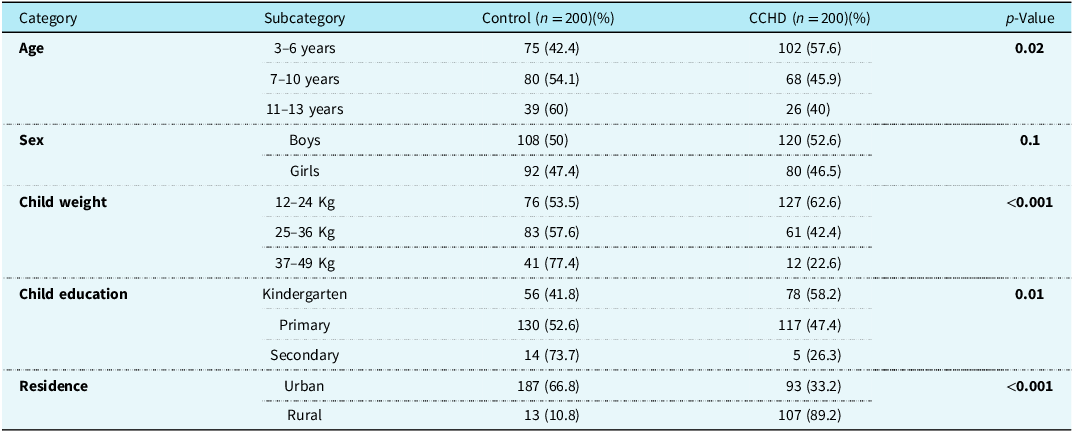
Table 1 summarises the demographic characteristics of the study participants and compares children with cyanotic CHD with healthy controls. A total of 400 children were included in the analysis: 200 with cyanotic CHD and 200 healthy children. A statistically significant difference in age distribution was observed between the two groups (p = 0.02), indicating variation across age categories. Sex distribution was comparable between children with cyanotic CHD and controls, with no statistically significant difference observed (p = 0.10). Child weight differed significantly between groups (p < 0.001), with children with cyanotic CHD more frequently classified into lower weight categories than healthy peers. Educational status also differed significantly (p = 0.01), reflecting reduced school attendance or delayed educational progression among children with cyanotic CHD. A highly significant difference was observed in residence (p < 0.001), with a higher proportion of children with cyanotic CHD residing in rural areas than in controls.
Demographic and clinical characteristics of children with cyanotic CHD (CCHD) and healthy controls
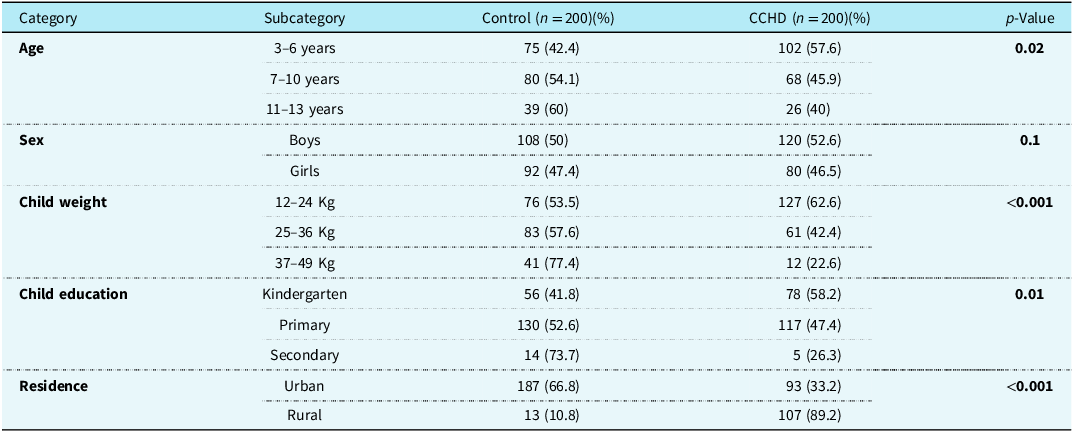
Table 1. Long description
The table compares demographic characteristics of children with cyanotic congenital heart disease (CCHD) and healthy controls. It includes data for 200 children in each group. The table has five categories: Age, Sex, Child weight, Child education, and Residence, each with subcategories. Age is divided into 3-6 years, 7-10 years, and 11-13 years. Sex is divided into Boys and Girls. Child weight is divided into 12-24 kilograms, 25-36 kilograms, and 37-49 kilograms. Child education is divided into Kindergarten, Primary, and Secondary. Residence is divided into Urban and Rural. The table shows percentages for each subcategory in both the control and CCHD groups, along with p-values indicating statistical significance. Notable trends include a significant difference in age distribution (p-value 0.02), with more CCHD children in the 3-6 years age group. Child weight shows a significant difference (p-value less than 0.001), with more CCHD children in lower weight categories. Child education also differs significantly (p-value 0.01), with fewer CCHD children in secondary education. Residence shows a highly significant difference (p-value less than 0.001), with more CCHD children residing in rural areas.
Table 2 presents a comparison of age, body weight, and SpO2 between children with cyanotic CHD and healthy controls. Healthy children were, on average, slightly older than children with cyanotic CHD. The mean age in the control group was 7.53 ± 2.84 years, compared with 6.74 ± 2.80 years in the cyanotic CHD group; this difference was statistically significant (p = 0.006). Body weight differed markedly between the two groups. Healthy children had a higher mean weight (28.0 ± 8.39 kg) than children with cyanotic CHD (23.20 ± 7.96 kg). The observed mean difference of 4.82 kg was statistically significant (95% CI: 3.21–6.42; p < 0.001). As expected, SpO2 was substantially lower in children with cyanotic CHD. The mean SpO2 in the control group was 96.12 ± 1.19%, whereas in children with cyanotic CHD it was 87.82 ± 6.05%. This difference was highly significant (95% CI: 7.43–9.16; p < 0.001).
Comparison of continuous demographic and clinical variables between children with cyanotic CHD (CCHD) and healthy controls

Table 2. Long description
The table presents a comparison of continuous demographic and clinical variables between children with cyanotic congenital heart disease (CCHD) and healthy controls. It includes three rows and five columns, with headers for Variable, Healthy controls, CCHD, Mean difference, and p-Value. The first row compares age in years, showing a mean age of 7.53 plus or minus 2.84 years for healthy controls and 6.74 plus or minus 2.80 years for CCHD, with a mean difference of 0.79 years and a p-value of 0.006. The second row compares body weight in kilograms, with healthy controls averaging 28.0 plus or minus 8.39 kilograms and CCHD averaging 23.20 plus or minus 7.96 kilograms, resulting in a mean difference of 4.82 kilograms and a p-value of less than 0.001. The third row compares SpO2 in percentage, with healthy controls averaging 96.12 plus or minus 1.19 percentage and CCHD averaging 87.82 plus or minus 6.05 percentage, showing a mean difference of 8.29 percentage and a p-value of less than 0.001.
As shown in Supplementary Table S1, children with cyanotic CHD demonstrated significantly lower quality-of-life scores than healthy controls across nearly all assessed domains. Marked impairments were observed in heart-related symptoms and physical functioning, reflecting greater limitations during physical activity, increased fatigue, and more frequent cardiopulmonary symptoms (all p < 0.001). Social, emotional, cognitive, and school functioning domains were also significantly affected, indicating widespread psychosocial and functional impairment among children with cyanotic CHD.
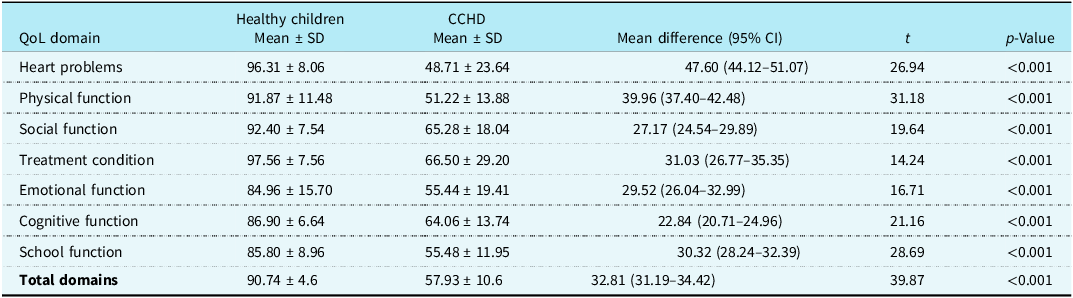
Table 3 presents the unadjusted comparison of quality-of-life domain scores between children with cyanotic CHD and healthy children. Significantly lower scores were observed across all quality-of-life domains in children with cyanotic CHD compared with controls (all p-values < 0.001).
Comparison of quality-of-life domains between children with cyanotic CHD (CCHD) and healthy controls
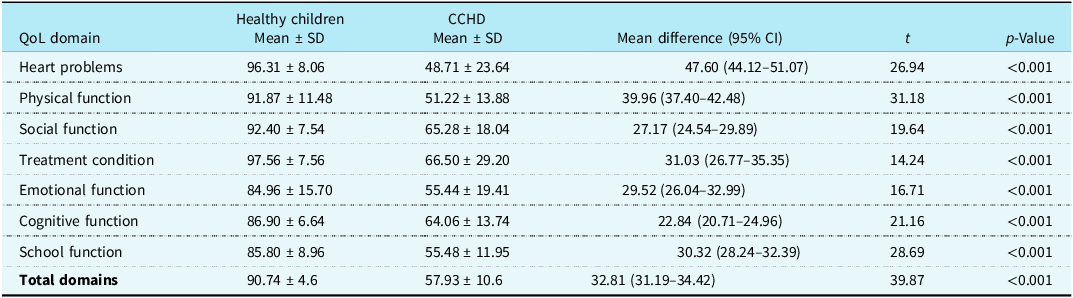
Table 3. Long description
The table compares quality of life domains between children with cyanotic congenital heart disease (CCHD) and healthy children. It includes eight quality of life domains: Heart problems, Physical function, Social function, Treatment condition, Emotional function, Cognitive function, School function, and Total domains. The table has eight rows for each domain and six columns for Mean and Standard Deviation (SD) for both healthy children and CCHD, Mean difference with 95 percentage Confidence Interval (CI), t-value, and p-Value. Children with CCHD have significantly lower scores across all domains compared to healthy children, with all p-values being less than 0.001. For example, the mean score for Heart problems is 96.31 for healthy children and 48.71 for CCHD, with a mean difference of 47.60. Similar patterns are observed in other domains such as Physical function, Social function, and Emotional function.
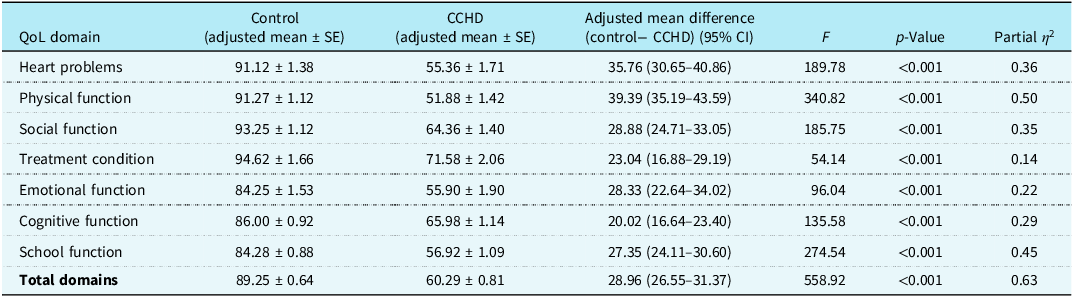
Table 4 presents a comparison of adjusted quality-of-life domain scores between healthy children and children with cyanotic CHD, controlling for child age, sex, peripheral oxygen saturation (SpO2), and educational level. After adjustment for these covariates, children with cyanotic CHD had significantly lower quality-of-life scores across all domains than healthy children (all p < 0.001). The largest adjusted differences were observed in the physical functioning and total quality-of-life scores, with children with cyanotic CHD showing substantially poorer outcomes than controls. These differences were associated with large effect sizes (partial η 2 = 0.50 and 0.63, respectively), indicating a strong association between cyanotic CHD status and impaired quality of life. Pronounced deficits were also evident in the heart-related and school functioning domains, with adjusted mean scores markedly lower among children with cyanotic CHD than among controls (partial η 2 = 0.36 and 0.45, respectively). Significant differences with moderate-to-large effect sizes were further observed in the social, emotional, and cognitive domains, reflecting widespread psychosocial and functional impairment. Although the smallest effect size was observed in the treatment-condition domain (partial η 2 = 0.14), the difference between groups remained statistically significant, suggesting a greater treatment-related burden among children with cyanotic CHD even after adjustment for key demographic and clinical factors.
ANCOVA comparison of adjusted quality-of-life domain scores between healthy children and cyanotic CHD (CCHD). Adjusted for child age, sex, SpO2, and education
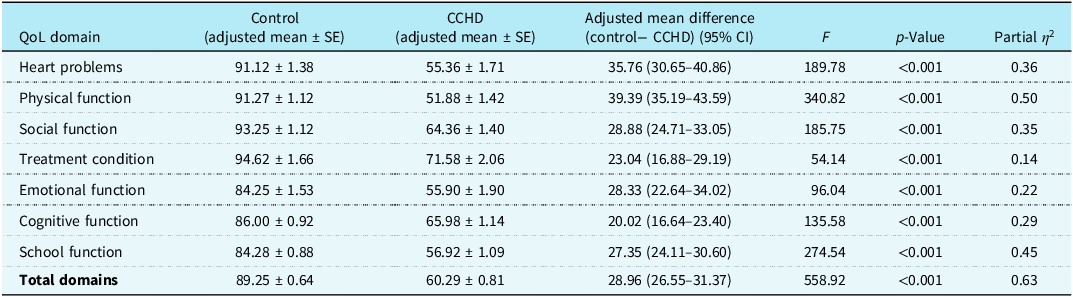
Table 4. Long description
The table presents a comparison of adjusted quality-of-life domain scores between healthy children and children with cyanotic CHD, controlling for child age, sex, peripheral oxygen saturation (SpO2), and educational level. The table includes seven rows and six columns. The columns are labeled Control (adjusted mean plus or minus standard error), CCHD (adjusted mean plus or minus standard error), Adjusted mean difference (control minus CCHD) with 95 percent confidence interval, F value, p-value, and Partial eta squared. The rows are labeled Heart problems, Physical function, Social function, Treatment condition, Emotional function, Cognitive function, School function, and Total domains. Notable trends include significantly lower quality-of-life scores across all domains for children with cyanotic CHD compared to healthy children. The largest adjusted differences are observed in the physical functioning and total quality-of-life scores, with children with cyanotic CHD showing substantially poorer outcomes. Pronounced deficits are also evident in the heart-related and school functioning domains. Significant differences with moderate-to-large effect sizes are observed in the social, emotional, and cognitive domains, reflecting widespread psychosocial and functional impairment.
Values are adjusted means ± standard error (SE). ANCOVA was adjusted for child age, sex, SpO2, and education. Mean differences represent control−CCHD. η 2 = partial eta squared.
Discussion
The most pronounced impairments were observed in the heart-related and physical functioning domains among children with cyanotic CHD compared with healthy peers. Children with cyanotic CHD reported substantial limitations in physical activities such as running, walking long distances, and participating in sports, as well as symptoms including shortness of breath, chest discomfort, fatigue, and cyanosis during exertion. These findings are consistent with previous studies showing that chronic hypoxaemia and reduced exercise tolerance significantly restrict physical capacity in children with CHD. Reference A Hussien, Abd-Elhamid Zaki and E.Emery17–Reference Raj, Sudhakar and Roy19 Similar reductions in physical functioning have been reported in studies from the New York Children’s Hospital medical facilities, Iran, and the Netherlands Reference Uzark, Jones, Slusher, Limbers, Burwinkle and Varni20–Reference Qu, Shi, Chen, Li, Liang and Cui23 underscoring the consistency of these impairments across settings. The large effect sizes observed in several domains likely reflect the profound physiological and functional limitations associated with chronic hypoxaemia and reduced exercise tolerance in children with cyanotic CHD.
Significant deficits were also identified in the social functioning domain, where children with cyanotic CHD experienced difficulties keeping up with peers and participating in age-appropriate activities. Physical limitations and frequent medical absences may restrict opportunities for social interaction, contributing to feelings of social exclusion. These findings are in line with previous research indicating that children with CHD often face challenges in peer relationships and social participation, Reference Amedro, Dorka and Moniotte24
Growth impairment was another important finding in the present study. Children with cyanotic CHD exhibited slower growth and poorer nutritional status compared with healthy children. This growth delay may be attributed to multiple factors, including chronic hypoxaemia, reduced cardiac output, recurrent respiratory infections, pulmonary hypertension, malnutrition, and psychological stress. These findings are consistent with a meta-analysis reporting significant growth retardation among children with CHD, Reference Zhang, Xu, Zhu, Pu and Bian25 as well as studies conducted in cyanotic and non-cyanotic CHD populations. Reference Varan, Tokel and Yilmaz26,Reference Batte, Lwabi and Lubega27 Similar growth deficits have also been reported in children with CHD in Pennsylvania, New Jersey, and Delaware. Reference Daymont, Neal, Prosnitz and Cohen28
Children with cyanotic CHD also exhibited significantly lower scores in the cognitive functioning domain, including difficulties with attention, memory, learning, and academic tasks. Prolonged exposure to hypoxaemia during critical periods of brain development, along with repeated medical interventions, may contribute to these cognitive challenges. Similar cognitive impairments have been reported in studies conducted in Indonesia and other regions, supporting the association between CHD and reduced cognitive performance. Reference Wernovsky29–Reference Harvey32
The school functioning domain revealed notable difficulties among children with cyanotic CHD, including problems with school attendance, keeping up with schoolwork, and participation in classroom activities. Frequent medical appointments, hospital admissions, and fatigue may interfere with consistent engagement in school. These findings align with previous reports demonstrating that children with CHD experience academic challenges and reduced school participation compared with healthy peers. Reference Limperopoulos, Majnemer, Shevell, Rosenblatt, Rohlicek and Tchervenkov33,Reference Biber, Andonian and Jürgen34
Treatment-related issues were also evident in the treatment condition domain, where children with cyanotic CHD demonstrated higher levels of anxiety and distress related to medical visits and procedures. Dependence on ongoing medical care before and after surgical intervention places a considerable psychological burden on both children and their families. Parents of children with cyanotic CHD frequently reported their children’s anxiety and nervousness as being directly linked to the demands and stress of ongoing medical treatment. Furthermore, the study identified significant differences in the treatment experiences of children with cyanotic CHD compared to their healthy peers, highlighting the profound psychological and physical burden imposed by the condition. Comparable findings have been reported in studies from Italy and other countries, highlighting the emotional impact of long-term treatment in paediatric CHD populations. Reference Khajali, Sayyadi, Ansari and Aliramezany35–Reference Amodeo, Ragni and Calcagni37
Overall, the significantly lower total quality-of-life score observed among children with cyanotic CHD reflects the cumulative impact of physical symptoms, emotional distress, social limitations, cognitive difficulties, school challenges, and treatment-related stress. These findings emphasise that survival alone is an insufficient outcome measure in CHD and that there is a need for comprehensive care strategies that address multiple dimensions of well-being.
Strengths and limitations
A key strength of this study is the use of a validated, multidimensional instrument (PedsQL™ Generic Core Scale 4.0 and Cardiac Module 3.0) to assess health-related quality of life across several relevant domains. In addition, the study provides one of the first comprehensive evaluations of quality of life among children with cyanotic CHD in the local context. To our knowledge, this is the first large case–control investigation examining health-related quality of life in children with cyanotic CHD in Iraq, providing valuable regional evidence for paediatric cardiac care in low-resource settings.
However, the findings should be interpreted in light of several limitations. Quality of life was assessed through parent-reported interviews, which may be subject to reporting bias. Disease severity and surgical status were not stratified, which may have influenced health-related quality-of-life outcomes. Furthermore, the case–control design limits the ability to infer causal relationships between disease characteristics and quality-of-life outcomes.
Conclusions
Children with cyanotic CHD experience marked reductions in quality of life across physical, emotional, cognitive, social, and school-related domains when compared with healthy children. These impairments remain evident even after accounting for key demographic and clinical factors, underscoring the persistent impact of the disease beyond survival outcomes. The findings highlight the importance of integrating quality-of-life assessment into routine clinical follow-up for children with cyanotic CHD. Multidisciplinary care approaches that address physical limitations, psychological well-being, and educational support may help improve overall functioning and long-term outcomes. Future research should focus on longitudinal evaluation and targeted interventions to improve the quality of life for this vulnerable population.
Supplementary material
The supplementary material for this article can be found at https://doi.org/10.1017/S104795112611347X.
Acknowledgements
The author would like to express their gratitude to the staff of the Children’s Heart Hospital and all primary Health Services Centers staff, as well as to the children and their parents, for their help in completing this study.
Financial support
This research received no external funding.
Competing interests
There are no conflicts of interest to declare concerning this article.