Research has shown that evidence-based parenting programs improve parenting practices and reduce child behavioural problems (Furlong, McGilloway, Bywater, & Hutchings, Reference Furlong, McGilloway, Bywater and Hutchings2012; Thomas & Zimmer-Gembeck, Reference Thomas and Zimmer-Gembeck2007) and there is increasing emphasis on making evidence-based parenting programs available for diverse families around the world (World Health Organization, 2004). However, dissemination of evidence-based parenting programs to parents from developing countries is limited (Mejia, Calam, & Sanders, Reference Mejia, Calam and Sanders2012), and the focus of most programs has been on enhancing maternal responsiveness to children in the early years (Engle et al., Reference Engle, Black, Behrman, Cabral de Mello, Gertler, Kapiriri and Young2007; Eshel, Daelmans, Mello, & Martines, Reference Eshel, Daelmans, Mello and Martines2006). As the reported prevalence rates of child adjustment problems are increasing in developing countries (Shenoy, Kapur, & Kaliaperumal, Reference Shenoy, Kapur and Kaliaperumal1998; Syed, Hussein, & Mahmud, Reference Syed, Hussein and Mahmud2007), evidence-based parenting programs that emphasise preventing child emotional and behavioural problems are warranted.
Triple P is an evidence-based parenting program developed in Australia that is based on social learning principles (Sanders, Reference Sanders2012). As a behavioural family intervention, Triple P aims to prevent child emotional and behavioural problems by enhancing parents’ knowledge, skills, and confidence in managing child problem behaviour (Sanders, Reference Sanders2012). It is a multi-level program ranging from a media and information strategy (level 1), brief parenting advice (level 2), narrow focus parent skill training (level 3), broad focus parent skill training (level 4), to intensive family intervention (level 5; Sanders, Reference Sanders2012). The effectiveness of Group Triple P (level 4 intervention) has been shown for parents from developed countries, including Japan and Hong Kong (De Graaf, Speetjens, Smit, De Wolff, & Tavecchio, Reference De Graaf, Speetjens, Smit, De Wolff and Tavecchio2008; Leung, Sanders, Leung, Mak, & Lau, Reference Leung, Sanders, Leung, Mak and Lau2003; Matsumoto, Sofronoff, & Sanders, Reference Matsumoto, Sofronoff and Sanders2010), but the evaluation of the program in developing countries has been limited (e.g., Tehrani-Doost, Shahrivar, Mahmoudi Gharaie, & Alaghband-Rad, Reference Tehrani-Doost, Shahrivar, Mahmoudi Gharaie and Alaghband-Rad2009). The less intensive levels of Triple P have also been found efficacious (Calam, Sanders, Miller, Sadhnani, & Carmont, Reference Calam, Sanders, Miller, Sadhnani and Carmont2008; Morawska, Haslam, Milne, & Sanders, Reference Morawska, Haslam, Milne and Sanders2011), but these trials were conducted with parents from western cultural backgrounds.
Indonesia is a developing country in South-East Asia that has a substantial number of families (i.e., 61 million; Badan Koordinasi Keluarga Berencana Nasional, 2009). Rates of reported child abuse are relatively high: 2.3 million children or 3% of the total number of children in Indonesia in 2006 experienced violence, and parents were often identified as the abusers (Ministry of Women Empowerment and Child Protection, 2011). Anthropological studies indicate that Indonesian-Javanese parents indulge their young children and use a variety of discipline strategies with older children, such as threatening and embarrassing the child in front of other people (Geertz, Reference Geertz1961; Koentjaraningrat, 1985). Children are expected to obey and respect their parents (Mulder, Reference Mulder1994). A more recent study with 273 Indonesian parents in Indonesia and Australia showed that parents often practised ineffective parenting strategies, such as making the child apologise for his or her misbehaviour, giving the child a lecture, and shouting (Sumargi, Sofronoff, & Morawska, Reference Sumargi, Sofronoff and Morawska2013). The majority of parents (80% and 83% in Indonesia and Australia, respectively) had not participated in any parenting program in the past 12 months. Parents reported the main barrier to participating in a parenting program was not being aware of such programs. Nevertheless, most parents (78%) expressed their interest to participate in a parenting program if one were available in the future (Sumargi et al., Reference Sumargi, Sofronoff and Morawska2013).
Dissemination of an evidence-based parenting program developed in one culture to people from another culture requires consideration of different belief systems and practices in child rearing (Kumpfer, Pinyuchon, de Melo, & Whiteside, Reference Kumpfer, Pinyuchon, de Melo and Whiteside2008). Investigating the cultural acceptability of a program is critical before the program is delivered (Forehand & Kotchick, Reference Forehand and Kotchick1996). Studies have documented low participation rates of ethnic minority groups in attending parenting programs (Cunningham et al., Reference Cunningham, Boyle, Offord, Racine, Hundert, Secord and McDonald2000; Reid, Webster-Stratton, & Beauchaine, Reference Reid, Webster-Stratton and Beauchaine2001), particularly when the program was not conducted in the minority group's language (Eisner & Meidert, Reference Eisner and Meidert2011). There have also been some inconsistent findings reported on the acceptability of some strategies across cultures. Chinese parents, for example, have shown resistance in using some positive parenting strategies such as descriptive praise (Crisante & Ng, Reference Crisante and Ng2003; Lau, Fung, & Yung, Reference Lau, Fung and Yung2010). In contrast, recent research has shown that parents from diverse cultural backgrounds, including South-East Asian parents, reported high acceptability of various parenting strategies introduced in an evidence-based parenting program and suggested that substantial modification of program content was not necessary (Morawska et al., Reference Morawska, Sanders, Goadby, Headley, Hodge, McAuliffe and Anderson2010). Ensuring the cultural appropriateness of a parenting program is important as it can influence parent participation in the program and guide any future adaptation of the program.
The purpose of this study was to examine the acceptability of a Triple P seminar with Indonesian parents residing in Australia. The Triple P seminar series is a brief intervention that introduces the principles of positive parenting in three 90-minute presentations (Sanders & Turner, Reference Sanders and Turner2005). The program has been found effective for Australian parents in reducing dysfunctional parenting practices and child emotional and behavioural problems, even when parents only received a single seminar exposure (Sanders, Prior, & Ralph, Reference Sanders, Prior and Ralph2009). The seminar format was chosen because in our previous work (Sumargi et al., Reference Sumargi, Sofronoff and Morawska2013), Indonesian parents expressed a preference for brief parenting programs. As part of this study, only the first seminar of the series was delivered in Indonesian. Kumpfer et al. (Reference Kumpfer, Pinyuchon, de Melo and Whiteside2008) suggested that at the initial stage of an evidence-based parenting program delivery, fidelity to the original program manual is required. Minimal program adaptation was made by including pictures of Indonesian families in the presentation slides and using culturally relevant examples during the seminar. This study also evaluates the efficacy of the Triple P seminar in reducing dysfunctional parenting practices and child behavioural problems. This evaluation is necessary to ensure the benefit of the program received by Indonesian parents. It was predicted that parents would report significant reductions in the use of dysfunctional parenting practices and the rate of child emotional and behavioural problems after the intervention.
This pilot study is the first empirical study to evaluate the acceptability and efficacy of a brief, evidence-based parenting program developed in a western culture with Indonesian parents. This is an initial and important stage prior to the program delivery to parents in Indonesia.
Methods
Participants and Recruitment
Participants were recruited from mailing lists of Indonesian communities in Brisbane, Australia (e.g., University of Queensland Indonesia Student Association, Indonesian Islamic Society in Brisbane, Indonesian Catholic Family), a social networking website (i.e., Facebook), and personal contacts. Information about the study was posted on the mailing lists and the Facebook page of the first author. The first author also distributed flyers that advertised the study in Indonesian community events.
Forty parents expressed their interest to participate in the study. A screening interview was conducted over the telephone to assess eligibility. Participants were eligible if they were Indonesian parents of children aged 2–12 years old and lived with their child in Australia. Participants were excluded if they had a child with disability and lived separately from their child at the time of study. Thirty-two parents were eligible for the study and provided written informed consent. Pre-intervention questionnaires were sent to the parents. Thirty of 32 parents returned the questionnaire and were invited to attend the Triple P seminar. There was no cost involved to attend the seminar. Parents received a certificate of attendance after the seminar.
Of the 30 parents, 90% were mothers who had a child in the age range of 2 to 11 years (M = 5.33, SD = 2.50). The parents were on average aged 34.20 years (SD = 4.09). Approximately half of the parents (53%) had male children. All participants were married. Most of them identified their family as a nuclear family (97%) and had no other child caregiver (93%). Parents had been in Australia for less than a year (24%), 1 to 3 years (50%), 4 to 6 years (13%) and more than 6 years (13%). Most parents (60%) came from the two largest ethnic groups in Indonesia, Javanese and Sundanese. Parents had completed a university degree with diploma (7%), undergraduate (50%), and postgraduate qualification (43%). Forty-six per cent of parents were unemployed (e.g., being a student). The rest had full-time (27%), part-time (20%), and home-based employment (7%). The majority of parents indicated that they were able to meet their household expenses (97%) and had left-over money to purchase some (77%) or most of the things (10%) they wanted. With respect to help-seeking behaviour, a small number of parents had participated in a parenting program (7%) and talked to teachers about their child's behaviour (20%) in the past 12 months.
Measures
Family Background Questionnaire
The Family Background Questionnaire (FBQ; Turner, Markie-Dadds, & Sanders, Reference Turner, Markie-Dadds and Sanders2002) was used to gather information on demographic characteristics of participants and their family. This included parent and child age and gender, marital status, family structure, education level, employment and financial status. Questions about participants’ ethnic background, length of stay in Australia, other child caregiver, and help-seeking behaviour were added to the questionnaire.
Parent acceptability and satisfaction
The Parent Acceptability Questionnaire (PAQ) was developed to measure parents’ ratings of acceptability of the five positive parenting principles introduced in the Triple P seminar: ensuring a safe and engaging environment, creating a positive learning environment, using assertive discipline, having realistic expectations, and taking care oneself (Sanders & Turner, Reference Sanders and Turner2005). A short description of each principle was included in the questionnaire. Parents were asked to provide ratings on a 7-point scale for the five parenting principles, ranging from not acceptable (1) to extremely acceptable (7). A question was added to assess the cultural appropriateness of the seminar content. A 7-point scale was used, with 1 indicating not at all appropriate and 7 indicating extremely appropriate. Parents who rated 5 or below were asked to list their concerns with the content of seminar. The internal consistency of the PAQ was good (α = .82).
The Parent Satisfaction Survey
(PSS; Sanders & Turner, Reference Sanders and Turner2005) is a 10-item rating scale that evaluates the quality and usefulness of the program, including the seminar materials and presentation. Parents rated their satisfaction to the program using a 7-point scale ranging from poor or no, definitely not (1) to excellent or yes, definitely (7). Parents were also asked to list what went well in the seminar and what needed to improve. The PSS has adequate internal consistency (α = .79).
Parenting practices and child outcome
The Parenting Scale (PS; Arnold, O’Leary, Wolff, & Acker, Reference Arnold, O’Leary, Wolff and Acker1993) was used to measure dysfunctional parenting styles, particularly laxness or permissive disciplines (11 items), overreactivity or authoritarian disciplines (10 items), and verbosity or overly long reprimands (7 items). The total score is based on 30 items across the subscales and additional items. For each item, parents rated on a 7-point scale, with the most and least effective parenting strategy being the anchors. The PS was found to have good internal consistencies, α = .83 (Laxness scale), α = .82 (Overreactivity scale), α = .79 (Verbosity scale), and α = .84 (Total score), and good test-retest reliability, α = .84 (Arnold et al., Reference Arnold, O’Leary, Wolff and Acker1993). In this study, the internal consistencies for the translated PS were .66 (Laxness scale), .54 (Overreactivity scale), .48 (Verbosity scale), and .44 (Total score). We decided to use only the PS Laxness and Overreactivity to measure dysfunctional parenting practice because of low reliability of the PS Verbosity and PS Total score in this sample. Furthermore, research has consistently reported strong psychometric supports for the PS Laxness and PS Overeactivity, but not for the PS Verbosity (Arney, Rogers, Baghurst, Sawyer, & Prior, Reference Arney, Rogers, Baghurst, Sawyer and Prior2008; Prinzie, Onghena, & Hellinckx, Reference Prinzie, Onghena and Hellinckx2007; Steele, Nesbitt-Daly, Daniel, & Forehand, Reference Steele, Nesbitt-Daly, Daniel and Forehand2005) and additional items included in the PS Total score (Salari, Terreros, & Sarkadi, Reference Salari, Terreros and Sarkadi2012). For analyses, parent ratings were averaged on each subscale where higher scores indicate more dysfunctional parenting practices. Parents are considered in the clinical range if their scores are higher than 3.2 for laxness and 3.1 for overreactivity.
The Child Adjustment and Parent Efficacy Scale
(CAPES; Morawska, Sanders, Haslam, Filus, & Fletcher, Reference Morawska, Sanders, Haslam, Filus and Fletcher2013) was used to measure child emotional and behavioural problems. The CAPES consists of two different scales, the Intensity scale assesses children's emotional and behavioural problems over the past 4 weeks and the Confidence scale assesses parental efficacy in managing this problem behaviour. For this study, only the Intensity scale was used. The Intensity scale consists of 30 items measuring behaviour concerns (e.g., ‘My child yells, shouts or screams’) and behavioural competencies (e.g., ‘My child accepts rules and limits’), and emotional adjustment (e.g., ‘My child worries’). Each item is rated on a 4-point scale, ranging from not true of my child at all (0) to true of my child very much, or most of the time (3). The total intensity score (range of 0–90) indicates child emotional and behavioural problems where higher scores means higher levels of child emotional and behavioural problems. The CAPES Intensity was found to have satisfactory convergent and discriminant validity, as well as good internal consistency, α = .90, within an Australian population (Morawska et al., Reference Morawska, Sanders, Haslam, Filus and Fletcher2013). The internal consistency for the Indonesian version was .86 (Sumargi et al., Reference Sumargi, Sofronoff and Morawska2013) and .81 in this study.
Design and Procedure
This study was cleared in accordance with the ethical review processes of the University of Queensland and the National Statement on Ethical Conduct in Human Research guidelines. Participation in this study was voluntary and written informed consent was obtained from all participants. An anonymous identification number was assigned to each participant and linked to the data obtained.
A quasi experimental design was employed in this study. Parents completed either an online questionnaire or a paper version of the questionnaire at pre- and post-intervention, and 3-month follow-up. The pre-intervention questionnaire included the FBQ, CAPES, and PS. The PAQ was distributed immediately after the seminar. Three weeks after the seminar, the post-intervention questionnaire consisting of the CAPES, PS, and PSS was sent to parents. A follow-up assessment with the CAPES and PS was conducted 3 months after the intervention.
The measures and materials used in the seminar (i.e., presentation slides and tip sheets) were translated into Indonesian by the first author. The translation was then reviewed by an Indonesian bilingual postgraduate student to improve clarity and the appropriateness of word usage. A few pictures of Indonesian families and children were inserted in the presentation slides.
The Triple P seminar, The Power of Positive Parenting, was held at the University of Queensland on a weekend. The seminar introduces five positive parenting principles: ensuring a safe and engaging environment, creating a positive learning environment, using assertive discipline, having realistic expectations, and taking care oneself (Sanders & Turner, Reference Sanders and Turner2005). It was delivered in Indonesian by the first author, an accredited Triple P practitioner, with time allocated for a 1-hour presentation and 30-minute question and answer.
The presentation closely followed the Triple P standardised manual (Sanders & Turner, Reference Sanders and Turner2005). To elaborate some key points, the presenter used culturally relevant examples consisting of common situations in Indonesian families. A protocol adherence checklist indicating key points of the seminar that should be delivered was completed at the end of seminar. The result was compared with one coded by a second rater who was present in the seminar session. There was 100% rate of agreement between the presenter and the second rater.
Results
Parent Acceptability and Satisfaction
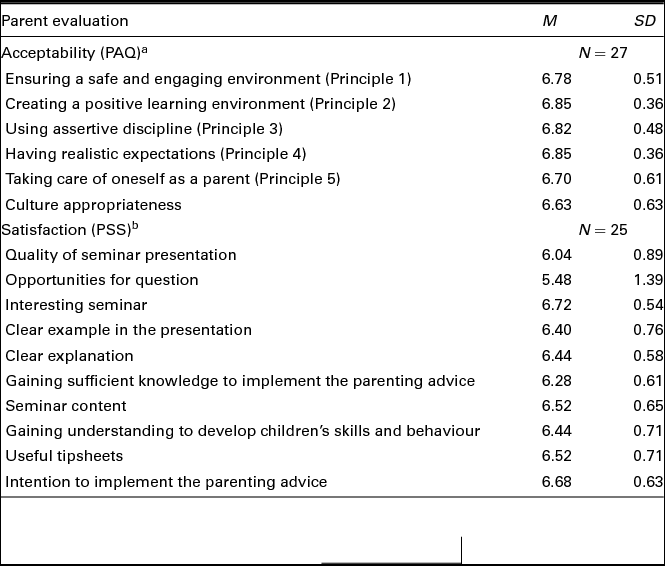
Parents who attended the Triple P seminar (N = 27) reported high levels of acceptability of the five positive parenting principles (M = 6.80, SD = 0.47) as measured by a 7-point scale PAQ (see Table 1).
Mean and Standard Deviation Parent Acceptability and Satisfaction with the Triple P Seminar

Note: a PAQ = Parent Acceptability Questionnaire. It consists of five items of positive parenting principles with 7-point of scale ranging from not acceptable (1) to extremely acceptable (7) and an item of cultural acceptability with 7-point scale ranging from not at all appropriate (1) and extremely appropriate (7). b PSS = Parent Satisfaction Survey. It is a 7-point of scale ranging from poor or no, definitely not (1) to excellent or yes, definitely (7).
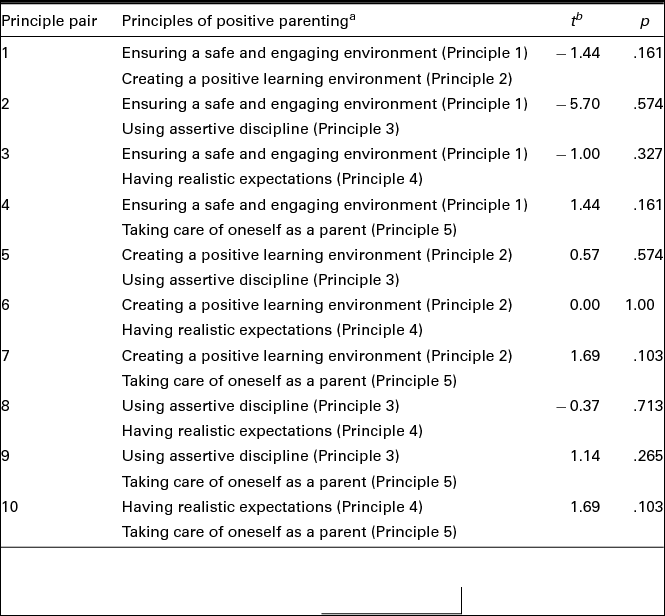
A series of paired sample t tests was conducted to examine differences in the acceptability level between principles. No significant differences were found, which indicate that the five positive parenting principles were equally acceptable to Indonesian parents (see Table 2).
Paired Sample of t Test Results Comparing Parent Acceptability of the Five Principles of Positive Parenting in the Triple P Seminar
Note: a Parent acceptability of the five principles of positive parenting in the Triple P seminar was measured using a 7-point scale of Parent Acceptability Questionnaire (PAQ), where 1 indicates not acceptable and 7 indicates extremely acceptable. bN = 27, df = 26, see Table 1 for M and SD parent acceptability of each principle.
As displayed in Table 1, parents indicated that the content of the seminar was culturally acceptable. Two parents who gave the lowest rating (rating of 5) on the cultural acceptability item reported that assertive discipline strategies, such as quiet time and time out, may not be easy to implement in an Indonesian context. As children in Indonesia commonly have more than one caregiver, it is challenging for parents to develop teamwork with the other child caregiver to employ similar parenting strategies to their child.
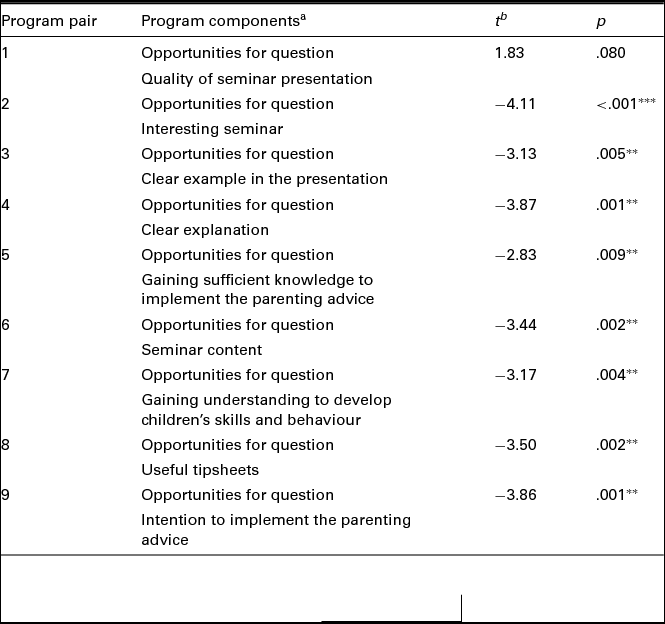
With respect to program satisfaction (see Table 1), parents (N = 25), showed high levels of satisfaction with various program components (M = 6.35, SD = 0.84), with the highest rating for interesting seminar and the lowest rating for opportunities for questions. Paired sample t tests were used to compare the satisfaction ratings of the program components. Opportunities for questions had a significantly lower rating when compared to each program component, with the exception of when it was compared to the quality of seminar presentation (see Table 3).
Paired Sample of t Test Results Comparing Parent Satisfaction With Opportunities for Question and Other Program Components of Triple P Seminar
Note: a Parent satisfaction with the program components of the Triple P seminar was measured using a 7-point scale of the Parent Satisfaction Survey (PSS), where 1 indicates poor or disagree (no, definitely not) and 7 indicates excellent or agree (yes, definitely). bN = 25, df = 24, see Table 1 for M and SD parent satisfaction with each program component. **p < .01, ***p < .001.
Parents provided qualitative responses about what went well in the seminar and these were categorised into three themes: program content, delivery, and format. Parents were satisfied with the content of the program as it was simple and practical (six responses), and provided them with new knowledge and ideas (14 responses). The seminar was also well delivered as the presentation was clear and included relevant examples (seven responses). A few parents commented on the program format and indicated the benefit of meeting and having discussion with other parents (two responses).
Parents also provided some suggestions for what needs to be done to improve the program, and these were categorised into three themes: duration, program delivery, and additional support. It was suggested that the duration for the seminar should be lengthened with more time given for question time (10 responses). In terms of program delivery, parents requested more variety of examples and applications of parenting strategies across child age (three responses) and culture (one response). Parents also provided suggestions for additional supports after the seminar, such as tips for working together with a partner in managing a child's difficult behaviour (one response), reminders of positive parenting strategies sent by e-mails or messages in social networking websites, or SMS (two responses), and parenting group (one response).
Parenting Practice and Child Outcome
Attrition
Twenty-seven of the 30 parents (90%) who completed pre-intervention assessment attended the Triple P seminar. Three parents did not attend the seminar because of problems with child care or competing obligations. Post-intervention and follow-up assessments were conducted only with parents who attended the seminar.
Twenty-five of the 27 parents (93%) completed post-intervention assessment and 24 of 27 parents (89%) completed the follow-up assessment. The reasons for not completing the assessment were lack of time and travelling overseas. Parents who did not complete post-questionnaires were compared with those who completed the questionnaires on demographic and dependent variables. No significant differences were found between the two groups on demographic variables and parenting and child outcome at pre-intervention.
Missing values in this study were 12% in the overall data sets. Multiple imputation (MI) procedures were employed using SPSS 18. MI is a statistical technique used to replace each missing value with several values derived from Bayesian model (Rubin, 1987/Reference Rubin2008). MI is considered more accurate and powerful in dealing with missing data in comparison to traditional methods, such as case deletion and mean substitution (Schafer & Graham, Reference Schafer and Graham2002). In this study, five multiple data sets were generated using the Markov Chain Monte Carlo (MCMC) method, with 100 iterations for each child behaviour and parenting measure across three points of time of assessment. Under the assumption that data were missing at random, the item scores of CAPES Intensity and PS at pre-intervention were used as potential predictors. Statistical analyses were performed in each data set and the pooled results were obtained based on Rubin's (1987/Reference Rubin2008) rules of multiple imputations using a built-in procedure in SPSS and a SPSS syntax created by Van Ginkel (Reference Van Ginkel2010) to adjust the degrees of freedom of the combined results.
Short-term intervention effects
A series of paired sample t tests was employed to evaluate the intervention effects 3 weeks after the seminar. Following the suggestion of Tabachnick and Fidell (Reference Tabachnick and Fidell2007), multivariate analysis was not used for parenting measures because dependent variables (Laxness and Overreactivity scale) were component scores and uncorrelated at each time of assessment. Instead, a Bonferroni correction was applied to control family wise Type I error.
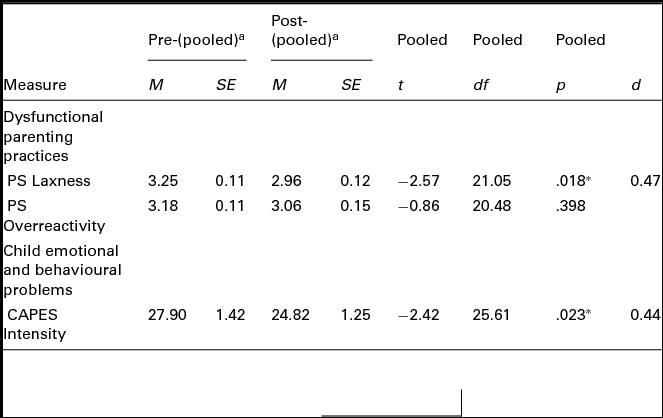
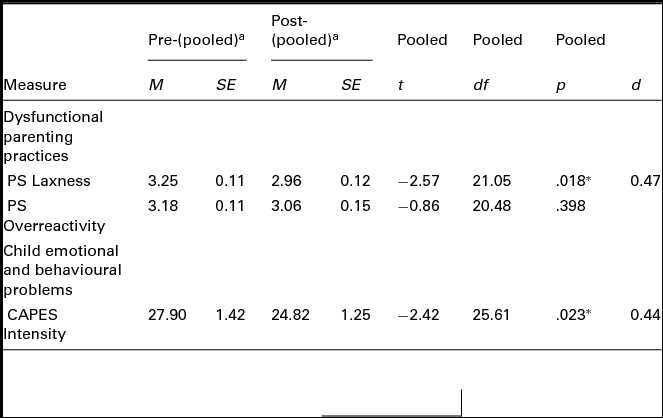
Analyses of parenting measures with Bonferroni adjusted alpha level of .025 indicated a significant reduction in PS Laxness after parents received the intervention, with a medium effect size (see Table 4). Inspection on the mean scores of PS Laxness at pre- and post-intervention indicated that the score moved out of the clinical range at post-intervention. For the PS Overreactivity, the mean score decreased at post-intervention; however, it was not statistically significant (see Table 4).
Short-Term Intervention Effects With Imputed Values
Note: Pre-(pooled) = pre-intervention assessment, consisting of pooled M and SE values computed from multiple imputation data sets; Post-(pooled) = post-intervention assessment, consisting of pooled M and SE values computed from multiple imputation data sets; Pooled t, df, p = t, df, and p values that were combined across multiple imputation data sets according to Rubin's (1987/Reference Rubin2008) rules using SPSS syntax by Van Ginkel (Reference Van Ginkel2010) to adjust the degrees of freedom of the combined results; d = Cohen's d for repeated measures design computed from pooled t and n (Morris & DeShon, Reference Morris and DeShon2002); PS = Parenting Scale; CAPES Intensity = Child Adjustment and Parent Efficacy Scale, Intensity Scale. aN = 30, *p < .05.
A significant reduction in the mean score of CAPES Intensity at post intervention was found, with a medium effect size (see Table 4).
Long-term intervention effects
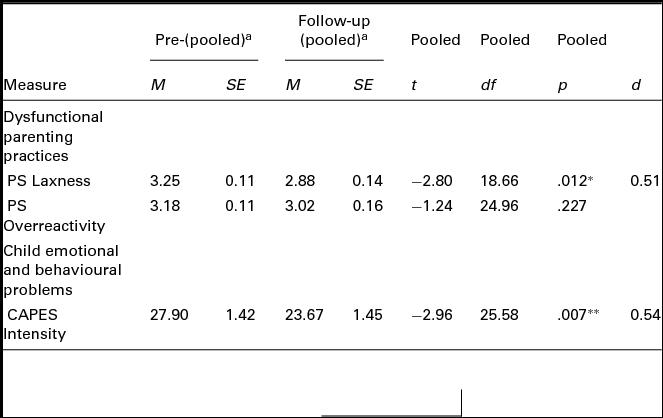
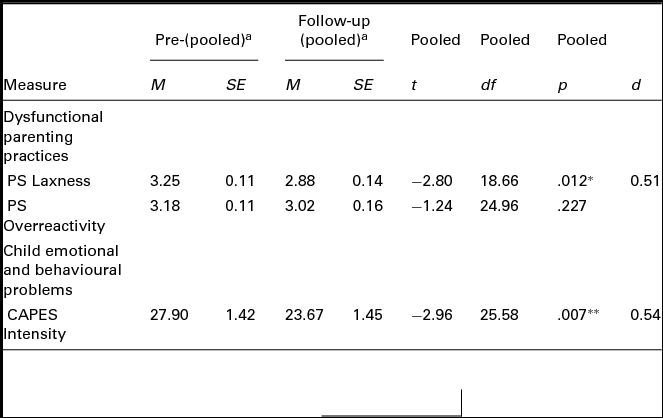
A series of paired sample t tests was carried out to examine the intervention effects 3 months after the seminar. The analyses of parenting and child measures showed a significant decrease in PS Laxness with Bonferroni adjusted alpha level of .025 and in CAPES Intensity (see Table 5). This indicates that the lack of permissive discipline style and reduction in child emotional and behavioural problems after the seminar was maintained at 3-month follow-up.
Long-Term Intervention Effects With Imputed Values
Note: Pre-(pooled) = pre-intervention assessment, consisting of pooled M and SE values computed from multiple imputation data sets; Follow-up (pooled) = follow-up assessment, consisting of pooled M and SE values computed from multiple imputation data sets; Pooled t, df, p = t, df, and p values that were combined across multiple imputation data sets according to Rubin's (1987/Reference Rubin2008) rules using SPSS syntax by Van Ginkel (Reference Van Ginkel2010) to adjust the degrees of freedom of the combined results; d = Cohen's d for repeated measures design computed from pooled t and n (Morris & DeShon, Reference Morris and DeShon2002); PS = Parenting Scale; CAPES Intensity = Child Adjustment and Parent Efficacy Scale, Intensity Scale. aN = 30, *p < .05, **p < .01.
Discussion
This study evaluated the acceptability of the Triple P seminar with Indonesian parents. The results showed high levels of parent acceptability on the five positive parenting principles introduced in the program. Although a few parents were sceptical about the implementation of assertive discipline strategies, such as quiet time and time out, in an Indonesian context, parents reported that all parenting principles were equally acceptable. Furthermore, parents indicated that the content of the Triple P seminar was culturally appropriate and they were satisfied with various aspects of the program. Parents specifically highlighted that the content, delivery, and format of the program were useful and helpful. This extends the findings of program acceptability and satisfaction within Japanese parents (Matsumoto, Sofronoff, & Sanders, Reference Matsumoto, Sofronoff and Sanders2007) and parents from culturally diverse backgrounds residing in Australia (Morawska et al., Reference Morawska, Sanders, Goadby, Headley, Hodge, McAuliffe and Anderson2010).
The results support the earlier findings that substantial changes on the content and structure of an evidence-based program delivered to parents from a different culture may not be necessary (Kumpfer, Alvarado, Smith, & Bellamy, Reference Kumpfer, Alvarado, Smith and Bellamy2002; Morawska et al., Reference Morawska, Sanders, Goadby, Headley, Hodge, McAuliffe and Anderson2010). In this study, minimal program adaptation was made, by translating the materials, delivering the program in participants’ native language, using culturally relevant examples and graphic materials. Kumpfer, Pinyuchon, de Melo, and Whiteside (Reference Kumpfer, Pinyuchon, de Melo and Whiteside2008) emphasised that cultural adaptation in program delivery, such as the use of culturally appropriate greetings, stories, examples, pictures and videos, while maintaining critical components of the program, would not reduce the benefit of an evidence-based parenting program. Adherence to the program content was related to parent satisfaction (Parra Cardona et al., Reference Parra Cardona, Domenech-Rodriguez, Forgatch, Sullivan, Bybee, Holtrop and Bernal2012), and positive parenting and child outcomes (Kumpfer et al., Reference Kumpfer, Alvarado, Smith and Bellamy2002). This study shows that implementing an evidence-based parenting program with fidelity was sufficient to create high levels of parent acceptability and satisfaction, as well as some positive results.
This study also tested the efficacy of the program. We hypothesised that the use of dysfunctional parenting practices and the intensity of child emotional and behavioural problems would reduce after the seminar and the effects would be maintained over a 3-month period of time. The results indicate that the hypotheses were mostly supported. Parents reported less frequent use of dysfunctional parenting practices, particularly permissive discipline and a reduction in the intensity of child emotional and behavioural problems, after attending the program. The reduction in the use of permissive parenting practice and the intensity of child emotional and behavioural problems was maintained at the 3-month follow-up assessment. The findings were consistent with the previous study that showed the efficacy of Triple P seminar series in reducing dysfunctional parenting practice and child problem behaviour among Australian parents (Sanders et al., Reference Sanders, Prior and Ralph2009).
However, this study failed to find a significant decrease in over-reactive parenting practice after the intervention. Sumargi and colleagues (Reference Sumargi, Sofronoff and Morawska2013) found that controlling emotion when dealing with children's difficult behaviour was challenging for Indonesian parents, and shouting at or becoming angry with their child were common parenting strategies. Furthermore, evidence from migrant studies has indicated a tendency for migrant parents to use authoritarian discipline to protect their children from perceived risk in a new, different cultural environment (Daglar, Melhuish, & Barnes, Reference Daglar, Melhuish and Barnes2010). Thus, a single exposure of the Triple P seminar may not be sufficient to encourage parents to change their over-reactive parenting style. Parents may need elaborated examples, discussion, and practice before they can adjust their parenting practices. This is in line with parent feedback in this study that revealed the need for greater question or discussion time, examples of parenting strategies across contexts, and additional supports in the implementation of parenting strategies. Therefore, delivering the complete Triple P seminar series may be beneficial for Indonesian parents as it exposes parents to more examples of parenting strategies and more opportunities to discuss any implementation issues. Consistent with this, previous work (Sanders et al., Reference Sanders, Prior and Ralph2009) has indicated that attendance at all three Triple P seminar sessions led to lower levels of dysfunctional parenting practices (i.e., laxness, overreactivity, and verbosity) compared to parents who attended the first session only or parents in the waitlist control group. Future studies should examine whether the delivery of the Triple P seminar series to Indonesian parents could provide a larger intervention effect on parenting and child outcomes.
It should be noted that this study involved only a small number of Indonesian parents residing in Australia who were mostly highly educated and had good financial status. This may limit the generalisability of the results and the power to detect an intervention effect. Furthermore, this study does not have a control group and therefore it is difficult to ensure that the effects were caused by the intervention alone, rather than by maturity or other extraneous factors. It is suggested that further study employs a randomised control design with a larger sample size.
Future studies should also work on validating the existing parenting and child outcome measures in an Indonesian context. While the Parenting Scale (PS) is widely used in parenting research (Locke & Prinz, Reference Locke and Prinz2002), it has not been validated for an Indonesian population. In this study, the PS had low internal consistencies that can bias the results. The child outcome measures (CAPES Intensity) also lacked normative values that limit the clinical interpretation of the outcome.
This study is the first empirical study that reported the acceptability and efficacy of an evidence-based parenting program within an Indonesian population. The program was delivered with minimal changes to Indonesian parents in Australia. The results were promising as they showed that the Triple P seminar was culturally acceptable and effective for Indonesian parents. It supports the findings that a brief parenting program can improve parenting practices and child behaviour (Morawska et al., Reference Morawska, Haslam, Milne and Sanders2011; Sanders et al., Reference Sanders, Prior and Ralph2009). The Triple P seminar is a cost-effective and time-efficient program. It is important to note that this study did not consider the degree of acculturation of participating parents that could be related to parenting style (Yagmurlu & Sanson, Reference Yagmurlu and Sanson2009), and therefore, further work should examine if the degree of acculturation moderates the efficacy of the Triple P program. Future studies should also examine if the program is acceptable and efficacious when it is delivered to parents in Indonesia who may have different circumstances (e.g., multi-caregivers) than parents residing in Australia.