Introduction
In the last 30 years, elder abuse and neglect has been recognized as a social and health-related problem (WHO, 2008). The World Health Organization (WHO, 2008, p. 1) defined abuse and neglect as “one-time or ongoing actions, or lack of appropriate action, occurring within any relationship where there is an expectation of trust which causes harm or distress to an older person.” Various forms of elder abuse have been observed, such as physical, psychological/emotional, sexual, and financial abuse (Burnes et al., Reference Burnes, Pillemer and Lachs2016). Intentional or unintentional neglect can also be included in the phenomenon (Fulmer et al., Reference Fulmer2005). More recently, abuse and neglect have been combined and defined as “mistreatment,” which implies both an omission and a commission dimension (Muehlbaur and Crane, Reference Muehlbaur and Crane2006).
Social workers are key service providers in this area. They take care of older adults’ mental and physical health, safety, and overall well-being. In the context of elder abuse and neglect, reaching out, identifying, and intervening with victims and abusers are sometimes a matter of life and death (Alon and Berg-Warman, Reference Alon and Berg-Warman2014).
In Israel, awareness of the elder abuse and neglect phenomenon is growing. The first national survey on elder abuse and neglect was conducted in 2003 (Lowenstein et al., Reference Lowenstein, Eisikovits, Band-Winterstein and Enosh2009). As part of the developed world, Israel is characterized by a heterogeneous multicultural society (Norris and Inglehart, Reference Norris and Inglehart2012) and has not yet emphasized the encounter between the elder abuse phenomenon and a cultural minority that chooses to segregate itself, such as the ultra-Orthodox Jewish society (UOJS).
Old age and the UOJS
As a “faith-based community,” the UOJS is a differentiated group within Jewish society in Israel and worldwide (Goodman and Witztum, Reference Goodman and Witztum2002), characterized by extreme views regarding faith and religious practices (Baum, Reference Baum2007). Its strong community discipline stems from subordination to rabbinical authority, which encourages strong loyalty to the community, while dictating strict behavioral codes (Coleman-Brueckheimer et al., Reference Coleman-Brueckheimer, Spitzer and Koffman2009). According to the Central Bureau of Statistics in Israel (CBS) (2009), the general increase in life expectancy, alongside the UOJS high fertility rate, will lead to a 2.5-times increase in the ultra-Orthodox Jewish (UOJ) older adult population during the next 15 years.
The basis for the ultra-Orthodox community's perception of old age can be found in the Bible. The importance of respecting one's parents in Judaism is established by the Fifth Commandment: “Honor thy father and thy mother” (Exodus 20:12), from which the laws pertaining to honoring parents are derived. Based on Jewish tradition, ultra-Orthodox Jews believe that the life-experience of the older adult is a beneficial asset, raising the value of older adult individuals in the family and the community. In general, the Jewish tradition tends to perceive the aging process as an important stage in life, rather than a period of physical decline (Brodsky et al., Reference Brodsky, Shnoor and Be'er2014).
In UOJ families, usually with a large number of children and grandchildren, daily care of the older adults is divided among many, since it is a Mitzvah (commandment, or the religious expectation to do good deeds) to attend to the needs of the older adult (Iecovich, Reference Iecovich, Troisi and Von-Kondrtowitz2013). In some cases, the older adults remain in their own homes, aided by family members; in other cases, they move to their children's homes and are cared for there. This is in vast contrast to many secular families in Israel and Western societies, where it is unusual to see older adult parents living with their children (Iecovich, Reference Iecovich, Troisi and Von-Kondrtowitz2013).
Lately, as the ultra-Orthodox population expands, social and personal conflicts are clearly externalized. Therefore, in spite of its ideology, the public is compelled to interact constantly with the secular environment due to a lack of professional resources in the ultra-Orthodox community. A major characteristic of this dynamics is the increasing demand, in the ultra-Orthodox society, for professionals, in general, and social workers, in particular and the rise in awareness of help-seeking options and introduction of services (Freund and Band-Winterstein, Reference Freund and Band-Winterstein2013).
Domestic violence and the UOJS
In the UOJS, social and mental health problems such as mental illness, child abuse, substance abuse, and domestic violence have been hidden from outsiders until the last few years when attitudes started to change (Ringel and Bina, Reference Ringel and Bina2007; Freund and Band-Winterstein, Reference Freund and Band-Winterstein2013). Similar to other religious communities, the UOJS perceived protecting the community and preserving its values and cohesion as a central value. Consistent with this view, social problems are hidden and sometimes even neglected (Jones and Fowler, Reference Jones and Fowler2009).
The basic assumption is that in a society that adheres strictly to the Jewish Mitzvot, various types of violent behavior should not occur. Therefore, cases of deviation are suppressed and are treated as private issues and not as a reflection of the general rule. This attitude enabled longstanding avoidance of defining the family violence phenomenon in the UOJS as a social problem and of providing responses tailored to this society in general (Ringel and Bina, Reference Ringel and Bina2007; Sweifach and Heft-LaPorte, Reference Sweifach and Heft-LaPorte2007). Similar to the prevailing attitude to elder abuse and neglect in recent years, anything to do with intimate violence against women in the UOJS has been hidden and denied (Sweifach and Heft-LaPorte, Reference Sweifach and Heft-LaPorte2007). Women who experienced violence were subjected to social pressure not to disclose the story outside of the community or to go to the police, but to turn to the community Rabbi (Shechory-Bitton, Reference Shechory-Bitton2014).
Constant interaction with the secular environment such as through access to formal educational and academic institutions has led to more openness (Fass and Lazar, Reference Fass and Lazar2011). The consequences can be noted in various areas, including the willingness to turn to social services (Freund and Band-Winterstein, Reference Freund and Band-Winterstein2013). As a result, social problems in general and domestic violence in particular were recognized as existing phenomena that should be addressed in the UOJS. In the context of elder abuse and neglect, it can be assumed that the phenomenon exists. However, due to the secrecy that characterizes the community's strategy for coping with social problems, empirical inquiry has been difficult. Thus, no research on elder abuse and neglect in the UOJS exists.
Social workers’ encounter with elder abuse and neglect and the UOJS
Social workers are required to assess risk factors that might predict the occurrence of abuse as well as to identify the strengths and resources in the older victim of abuse or neglect. They also assess the threat posed to the victim (Day et al., Reference Day, McCarthy and Leahy-Warren2012), the type and severity of the abuse, victim and abuser characteristics, social, professional and personal attitudes, and the existence of community services (Alon and Berg-Warman, Reference Alon and Berg-Warman2014).
In the UOJS context, the encounter combines professional values and cultural norms, and requires cultural sensitivity by social workers (Freund and Band-Winterstein, Reference Freund and Band-Winterstein2013). Moreover, the interventions must be culturally sensitive to the UOJS, with its unique characteristics, and must meet the specific needs of the older adults in abusive or neglectful situations. The experience of the professional encounter has not received attention in the research literature. The few studies that have dealt with social workers’ encounters with elder abuse and neglect do not focus on this topic in the UOJS, and hence the significance of this study.
Methods
Sample and population
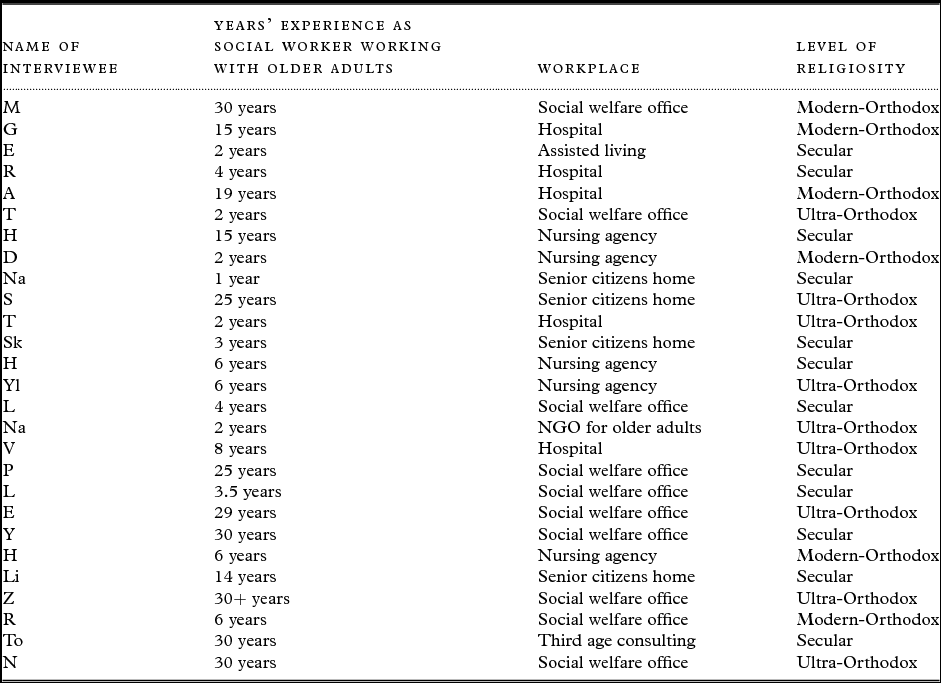
The study was based on the qualitative-phenomenological method, using a purposeful sample (Patton, Reference Patton2002). The research sample consisted of 28 Jewish social workers who were providing long-term intervention to older adults in the UOJS. Participants included 1 man and 27 women: 10 self-defined as ultra-Orthodox, 6 as modern-Orthodox, and 12 as secular, with 3–30 years of experience (see Table 1). The social workers in the sample worked in public welfare agencies, health facilities, and non-profit organizations. Theoretical saturation was reached when no new relevant information was added (Morse, Reference Morse2000).
Participants

Research procedure
The interviews were conducted by UOJ social work students. Prior to the interviews, these students underwent a training and reflection process (Finlay and Gough, Reference Finlay and Gough2003). The process included insights into their personal background, attitudes toward and opinions about elder abuse and neglect, and how they identified themselves in relation to the participants. The self-awareness gained in this process allowed the interviewers to focus on the participants’ experiences (Finlay and Gough, Reference Finlay and Gough2003). Participants were recruited by contacting relevant welfare agencies and organizations. The students identified themselves to the participants as future social workers doing a seminar research project on various topics pertaining to UOJ older adults that interested them, and that one of the topics was elder abuse. Unexpectedly, all of the potential participants expressed willingness to take part in the study. None of them refused. Each participant gave written consent to be interviewed after the researchers explained the nature and purpose of the study and promised to maintain confidentiality. Each interview lasted 60–90 minutes, was audio-recorded and transcribed verbatim.
Research instruments
An in-depth semi-structured interview was developed, to understand the participants’ experiences and attributed meanings. The interview included three major topics: (1)Being a social worker in the gerontological field in the ultra-Orthodox society, e.g. “What is unique about working with older adults in the UOJS?” (2)Social work in an UOJS, in the context of elder abuse and neglect, e.g. “In your opinion, what are the unique aspects of elder abuse and neglect in the UOJ sector compared to elder abuse and neglect in the general population?” (3) Intervention issues, e.g. “Have you experienced particular problems in your encounter with elder abuse and neglect?”
Data analysis
The data analysis was performed alongside a process of ongoing reflection and bracketing (Liamputtong, Reference Liamputtong2010), which added insights to the author's personal opinions as a secular researcher who teaches UOJ students in a social work educational program for the UOJS. Data analysis was performed according to the interpretive phenomenological analysis (IPA) approach, as suggested by Smith et al. (Reference Smith, Flowers and Larkin2009). First, the transcripts were read several times to become as familiar as possible with the text. At this stage, each reading is very close to being a free textual analysis and includes pinpointing significant statements, e.g. identifying a wide range of feelings and thoughts about elder abuse. The next step involved grouping the statements into themes, including quotes that capture the essential quality of the participants’ experiences and perceptions, for example, gathering quotes relating to the professionals’ dilemmas. This stage provides a higher level of abstraction that allows theoretical connections within and across cases, while grounded in the particular text. The following step involves identifying connections between the emerging themes, clustering them together and conceptualizing them (Smith et al., Reference Smith, Flowers and Larkin2009).
Trustworthiness
Trustworthiness (Lincoln and Guba, Reference Lincoln and Guba1985) was achieved in several ways: The interview material was transcribed verbatim, enabling analysis of original narrations. The material was reviewed separately by each of the researchers. Then a peer cross-examination was performed by working with another colleague experienced in qualitative research, who served as an external expert, by commenting on and analyzing the quotes with the researchers (Lincoln and Guba, Reference Lincoln and Guba1985). Finally, the wide range of participants who narrated similar experiences contributed to the trustworthiness of the research (Patton, Reference Patton2002).
Ethical issues
Since the study was conducted in a closed society, it was necessary to preserve client confidentiality, especially in the context of this sensitive topic. Participants stressed the importance of this issue in the UOJS, all the more so because some of them belonged to the ultra-Orthodox community and were personally acquainted with their clients. The issue raised a great deal of ambivalence between the need to preserve client privacy and the value of learning.
Findings
Data analysis revealed three main themes: (1) Between the commandment to honor one's parents and concealment patterns: Cultural barriers to exposing the abuse and neglect phenomenon. (2) “Life is demanding:” The unique expression of abusive and neglectful behavior in the UOJS. (3)Culturally related dilemmas when intervening with cases of elder abuse and neglect.
1. Between the commandment to honor one's parents and concealment patterns: Cultural barriers to exposing the abuse and neglect phenomenon
The sociocultural construction in the UOJS is based on fundamental family values rooted in the Torah and the Halakhah. At the heart of these values is the commandment to honor one's parents, to which abusive and/or neglecting behaviors are perceived as a contradiction. In addition to this is the tendency in the UOJS to conceal such behaviors out of shame and due to the potential damage to the family name with implications for various life domains, especially matchmaking. In extreme cases, an informal application might be made to the authorities while maintaining a low profile.
The first quote illustrates the dissonance between harming the older parent and fundamental values based on belief:
This issue comes up the whole time: he is not Haredi [ultra-Orthodox] if he does that . . . a God-fearing person, who genuinely keeps the Torah and the Mitzvot, will not reach a state of abusiveness and wickedness . . . I checked recently, and I tell you that in the last 10 years, there were only two cases of elder abuse in Haredi homes! . . . and then I said ‘wait, are they hiding them? What is going on here?’ . . . we don't really know what is happening there with abuse and neglect! (H, 6−10 yrs in practice.)
The dissonance described is built in to the cultural-belief relationship, as emerges from the following quote:
The Haredi older adult feels upset and ashamed, and very disappointed that this has happened to him. The cultural aspect might intensify the shame and disappointment, when religious people sin and break the Halakhah . . . (V, 6−10 yrs in practice)
The social worker tries to address the reason for concealing the issue:
Don't we keep things inside the home all our lives? There is the matchmaking issue that is a main topic of conversation and so it is important to maintain the family's reputation. Sometimes you find older adults who don't care what people say anymore . . . Others will carry their secrets to the grave so as not to ruin the family name. (Na, 6−10 yrs in practice)
Another cultural barrier is avoiding contact with formal institutions. This attitude is rooted in the fundamental mistrust of the general establishment and keeps the conspiracy of silence:
What if they put him in an old-age home? Isn't it enough that his son hits him and in the end they'll move him to a home as well? Things get twisted like that, and it is frightening what they might do with him . . . they will just gloss over it [the abuse/neglect situation] and if they go to anyone it will be to the Rabbi, not to the social worker . . . and only when they have had it up to here, they try to solve the problem within the family, and the social services are the last resort. (E, 20−25 yrs in practice)
2. “Life is demanding:” The unique expression of abusive and neglectful behavior in the ultra-Orthodox Jewish society
During the interviews, it emerged that the broad etiology of the abuse and neglect phenomenon receives unique expression in the UOJS. The findings presented provide a complex picture of the abuse and neglect situations. Family members of older persons are torn between the need and the obligation to care for them and the day-to-day demands of family and work. The caregiving offspring are committed to honoring their parents as well as to caring for their own children. This often creates dilemmas related to the division of time, attention, and financial resources, which might lead to situations of abuse or neglect. Paradoxically, the ultimate adherence to the value of honoring one's parents might lead to various types of elder neglect in the UOJS, as illustrated in the following quote:
The first thing that is unique in the Haredi society is the wish to give to one's parents. The children bring their parents to live with them when they start to require care to some extent or another . . . they want to take care of them. But they are not available to do that and this leads to a state of neglect . . . let's say, they refuse to bring in a caregiver, ‘no, I'll do it; I'll do it; honor your mother and father, I'll do it.” But they don't do it. Sometimes they don't take care of the older person's physical needs. They think that all they need to do is bring them Tefilin [phylacteries for prayer] in the morning. (R, 25−30 yrs in practice)
Another aspect of unintentional neglect develops when primary caregivers are overloaded with the daily tasks involved in raising a large family. In this demanding reality, neglect is manifest as follows:
A family that keeps on having children has a lot of needs and the old grandfather is at home with them as well . . . If he doesn't shout, they won't go to him so he doesn't always get fed and they don't always come to amuse him and he doesn't always have a social life, and he doesn't always get a shower because, you know, life is demanding and lots of things need doing. The family is overburdened. ‘I haven't finished raising the children and I'm starting to raise the grandchildren and now, my parents as well’ . . . And a lot of the time, it all happens together. (L, 1−5 yrs in practice)
The remark that “life is demanding” refers to the package of obligations that include the rigorous daily commitment to practicing the religion and keeping the Halakhah (e.g. praying three times a day at the synagogue, learning the Holy Scriptures on an day-to-day basis, including men who are working during the day), the social expectation to care for older parents, as written in the Bible, and devotion to their children's needs in very large families. In some Haredi families, such overwhelming stressors might lead to neglect.
The following quote emphasizes the great financial strain apparently imposed on the UOJ family that comes under the “life is demanding” theme, leading to failure to provide the older person's medical needs:
The major source of distress is when the main caregiver has to go out to work to make a living for the family while his parents are living with them . . . the reason for neglect is mainly financial. They say, ‘I have lots of expenses, I need to spend a lot of money on the children. What? I need to pay for his medication as well?! Where from?’(Y, 25−30 yrs in practice)
Another aspect in this context is the focus on respect for the older parent, helping the family to avoid making decisions that might improve the situation:
The Haredi community is torn between the wish not to harm the parent's honor and making decisions that are actually in the parent's best interest . . . raising little children while feeding her old mother through a tube leading directly to the stomach isn't the nicest thing in the world. And then they are torn . . . ‘As long as he has his mental faculties, I will not make decisions for him . . . (T, 1−5 yrs in practice)
3. Culture-related dilemmas when intervening with cases of elder abuse and neglect
Working with older persons in the UOJS, in the context of abuse and neglect, includes a wide spectrum of dilemmas, both in identifying gray areas of abuse and neglect, the issue of reporting and exposure (which constitutes a Hillul Hashem—a desecration of God's name), the inclusion of the Rabbi as a basis for intervention and attaining trust, and how to protect the older person. Differences in the dilemmas were found mainly between the UOJ social workers and the secular social workers regarding if and when to report. The ambivalent emotions of a social worker from the UOJS regarding her obligation to report abuse and neglect are apparent in the following quote:
The conflict of whether or not to report always comes up, but it will be harder for me because a Haredi person trusts me more, as a Haredi social worker; you're ‘one of us, and if you report us then it's a betrayal.’ But that doesn't mean that I won't report, it just means that it will be more difficult . . . they have high expectations. (E, 20−25yrs in practice)
T, who is also an UOJ social worker, adds to E's description:
It is my obligation to report all cases of elder abuse or neglect to the Ministry of Health. They send their people right away for a really thorough home visit . . . and that's when the friction starts: don't report, do report, don't report. Of course there is no real question of whether to report or not. There will be a report! End of story. But I know that I am smearing the name of the Haredi society in general . . . there might be an issue of Hillul Hashem here . . . the Haredi orientation suddenly becomes a many-legged monster. ‘You Haredim, look how you all behave’ . . . that is the essence of my indecision, but the law is the bottom line.” (T, 1−5 yrs in practice)
Being a minority creates a sense of solidarity that includes conformity and loyalty to the community. One of the norms is the social conception of not reporting deviant phenomena “outside” of the community. Moreover, it is considered as Lashon Harah, a religious prohibition against gossiping and goes hand in hand with internal social sanctions imposed on those who break the prohibition. Lashon Harah is considered as a Hillul Hashem on both the community and the personal levels: by the potential harm that it can cause to the community and by undermining the individual's pure service of God.
An additional dilemma involved in reporting the phenomenon is the family's good name:
The person begs, ‘don't do this to me!!’ Why? Because he is afraid of exposure, because harming his good name means not only his good name, but the family's also . . . In fact, it creates a very serious dilemma. (Y, 25−30 yrs in practice)
Another dilemma raised by the secular social worker is the relativeness of the harm:
You need to consider the community rabbis and consult with them . . . it helps to build trust . . . with the ultra-Orthodox community, you don't issue an order right away and create a scandal; everything is done more quietly . . . if it's a case of abuse or cases that need immediate intervention for the older person's well-being, then we really do everything, but on the other hand, we don't make a mountain out of a molehill in every case. Everything is done in proportion, carefully, quietly, respectfully. (V, 6−10 yrs in practice)
Discussion
Elder abuse and neglect in the UOJS indicates difference versus similarity and is expressed in three main themes: (1) Between the commandment to honor one's parents and concealment patterns: Cultural barriers to exposing the abuse and neglect phenomenon; (2)“Life is demanding:” The unique expression of abusive and neglectful behavior in the UOJS; and (3) Culturally-related dilemmas when intervening with cases of elder abuse and neglect.
The existence of the elder abuse and neglect phenomenon is anchored in the contexts of a belief-based society, which views the striking or the cursing of a parent very seriously and as punishable by death (Exodus, 21:15). The Mitzvah of honoring one's parents is a fundamental commandment in Judaism, as the Fifth of the Ten Commandments. It receives additional meaning through the promised rewards for adherence and is described as a significant value in the UOJS. For its members, keeping the Torah and the Mitzvot is an obligation integral to the lifestyle, which is independent of emotional stances. This commandment is instilled from an early age and constitutes Halakhah and a source of spiritual reward: “He shall not stand in the place set aside for [his father] . . . and shall not sit in his special place . . . and shall not contradict his words, neither in his life nor after his death” (Shulhan Arukh, Yoreh Deah III, 240:2). The social workers reinforce this assumption, which sees the perception of caring for the older parent as a Halakhic obligation that might create a positive platform in care relationships, not only out of a positive emotional stance, but in relation to the obligatory commandment of continuous optimal care for parents and commitment to their well-being as part of the UOJ lifestyle. Nevertheless, adherence to this commandment and giving first priority to the older person's spiritual needs might lead to abuse and neglect. Hence, the existence of a “cultural color” in identifying and locating the elder abuse and neglect phenomenon in the UOJS raises difficulties and barriers. Since the abusive behavior is examined according to certain moral criteria that are accepted in every society and culture, the findings indicate that the voice of indecision was heard mainly among social workers belonging to the UOJS.
It was found also that the UOJ older parent makes sacrifices for the children, as is common among older parents in the general society. In this context, however, it is manifest not only in the closeness of the family but also in the fear of harm to the family's good name and damaging the family members’ chances of a good match for matrimony. Hence, from the UOJ older persons’ point of view, the potential price for the family members is greater than the value of their own well-being, and in the context of the collective society, self-sacrifice is acceptable for the sake of the good name of all family members and of the community as a whole.
Another significant finding relates to the unique etiology of the abuse and neglect phenomenon in the UOJS. The size of the family and large number of children compared to other societies were described sometimes as an advantage and sometimes as a source of difficulty when caring for the older person. As shown by the findings, the existence of a large family does not guarantee good care. At times, the extended family's sense of obligation might be the cause of unintentional failure to meet the needs and maintain the privacy of their older family members, who might find themselves neglected in this complex reality.
In a reality of intergenerational care in families with many children (Gurevich and Cohren-Castro, Reference Gurevich and Cohren-Castro2004), the sandwich generation shoulders most of the tasks, and the load that falls on the caregiving offspring demands organization. The most prominent dilemma in this situation is whether assistance to older parents should come at the expense of care and attention to the large number of offspring. Coping with a limited budget and multiple tasks might lead to unintentional neglect. The findings show that the encounter between the value of honoring one's parents and the Halakhic commandment of “Be fruitful and multiply, replenish the earth” (Genesis 1:28), expressed through the huge time demands associated with raising and educating a large number of children, does not leave much time to care for the older person. Recent studies have indicated a growing understanding that multigenerational families in the UOJS experience burden of care since most adults must attend not only to the needs of their older parents, but also to the needs of their own children and grandchildren (Edelstein et al., Reference Edelstein, Band-Winterstein and Bachner2016).
The final issue raised by the social workers reflects the struggle, in recent years, between openness and insularity in the UOJS vis-à-vis the general secular society (Fass and Lazar, Reference Fass and Lazar2011; Band-Winterstein and Freund, Reference Band-Winterstein and Freund2015). There is constant conflict between coping with difficulties privately and autonomously within the UOJ community, and seeking help from external sources. Results show that despite the fact that the UOJ community is currently more aware and more eager to use external services, a certain amount of ambivalence prevails; conflicts are often still solved within the community, by consulting rabbis and/or additional figures of authority recognized by the religious leadership (Ringel and Bina, Reference Ringel and Bina2007).
The voices emerging from the findings underscore the suspicious and ambivalent approach that is prevalent in the UOJS toward the welfare authorities. The findings indeed show that UOJ clients, including older persons who experience abuse and neglect, would rather solve the problems within the community than turn to the welfare services. Goodman and Witztum (Reference Goodman and Witztum2002) noted that the UOJS tries to resolve conflicts by consulting with rabbis and other community authorities. A great need that emerged from the findings is an integration of UOJS authorities and the welfare authorities as well as other state services, to bridge these two worlds and help to provide appropriate treatment on the one hand, and to preserve the nature of the society, on the other. In this context, it is a known fact that common to all three monotheistic faiths is the perception of modern society as a threat to important religious and social values. This perception is accompanied by a suspicious and hostile attitude toward those identified with the establishment and toward external practitioners (Ringel and Belcher, Reference Ringel and Belcher2007). Due to the central position of religious leaders in these societies, expressed through their spiritual and practical authority in the eyes of the community, external professionals need to obtain their approval and create cooperation with them regarding the treatment of community members. It seems that without the approval of the clergy, the community members will avoid applying for help and will prefer to manage without external professional help. Treatment that does not consider the accepted norms and values will have less chance of success and might create definite resistance from the community and religious leadership (Ringel and Belcher, Reference Ringel and Belcher2007).
Culturally sensitive treatment requires social workers to provide proper evaluations, exhibit a good level of understanding, and demonstrate responsibility regarding their own beliefs and opinions. At the same time, they must increase their multicultural knowledge and fulfill their clients’ treatment expectations (Marsh, Reference Marsh2004). In this context, the findings show that the social workers find themselves “in-between” the cultural norms and their professional obligation to report cases of elder abuse and neglect in the UOJS. Both secular and ultra-Orthodox social workers are aware of and reflect on this dilemma. An interesting finding is that UOJ social workers, who share the community's culture and have a profound understanding of the implications of exposure, are faced with complex dilemmas regarding the entire issue of reporting. Although the fact that they are ultra-Orthodox Jews breaks down walls and barriers and helps the clients to cooperate and create trust, at the same time, the clients expect them to remain faithful, first and foremost, to the shared values of the UOJS. This is sometimes out of line with their obligation to professional intervention. This expectation adds to the existing difficulty and tension involved in choosing between their obligation to the law and to the community. Nevertheless, the findings also indicated the importance of professional intervention that is not dependent on the practitioner's religious identity, and the need to navigate intervention for the benefit of the older client.
Limitations of the study and implications for future research
This preliminary study focused on the perspective of social workers in the gerontology field, who routinely encounter older persons and the abuse and neglect phenomenon in the UOJS. The sample included secular, ultra-Orthodox, and modern-Orthodox Jewish social workers and differences among them were noted. Therefore, future studies are recommended to investigate each of these groups more deeply to learn about the nature of the encounter with all its complexities. Lacking also is the perspective of the older persons who experienced abuse and neglect, as well as that of their family members. Future studies could attempt to throw light on these experiences.
Implications for practice and policy
Most of the literature on abusive situations in “faith-based communities” focuses on domestic violence and not on elder abuse and neglect (Ringel and Belcher, Reference Ringel and Belcher2007; Ringel and Park, Reference Ringel and Park2008; Nason-Clark, Reference Nason-Clark2009). However, considering the similarities between the ultra-Orthodox community and other societies in which filial piety is strongly observed, it is important for professionals and community leaders to address the interplay between values, norms and ethical issues to help their community members. In the context of this article, it seems that increased awareness of the different aspects, etiology, and implications of abuse and neglect are needed to overcome the difficulty of identifying the phenomenon. Information programs, including religious authorities from within the community, could contribute to this effort. Culturally sensitive instruments could be used to legitimize naming the phenomenon, serving to bridge and mediate between the rabbinical authorities and the professional sphere. As well as benefitting those already experiencing elder abuse and/or neglect, it would also help social workers to identify and locate older persons at risk, while taking into consideration the unique “cultural color” of the UOJS; how to cope with its fundamental values of honoring one's parents and respect for older persons, which simultaneously serve the prevention and creation of abuse and neglect situations. To this end, it is appropriate and recommended to establish support groups for large families of low socioeconomic status when several generations are living under the same roof, and who report a multitude of roles and care-overload. Another important way is to create a therapeutic continuum and cooperation with community authorities: the welfare services, local health clinics, mental health services, and UOJ institutions that are accepted by the community, including institutions of Jewish learning, free-loan funds, benevolent and non-profit organizations as well as consulting the Rabbi or the rabbinical courts.
In conclusion, the awareness of culturally-sensitive social work and the fact that the UOJS in general is showing signs of opening up toward intervention for elder abuse and neglect, in particular, pose a challenging encounter to social workers and health professionals.
Conflict of interest
None.