1 Introduction
Cross-linguistic research reveals variability in the surface encoding of passive predicates.Footnote [2] Sometimes, the predicate is a synthetic word containing passive morphological marking and sometimes it is realized by independent elements that co-occur in the clause, e.g. a lexical verb appearing together with a particle or another verb. Thus, synthetic exponence, as in (1b), and multi-word, or periphrastic, exponence, as in (2b), can be equivalently characterized by the lexical schemata for mapping semantic roles to grammatical relations in (3).

In (3a), the active lexical schema associates its actor argument with a subject grammatical relation (gr) and its patient argument with an object, while the same semantic arguments are re-aligned with grammatical relations in (3b): the act becomes an optional oblique and the pat is associated with the subj. The lexical schema in (3a) can be used to account for (1a) and (2a), while (3b) accounts for (1b) and (2b).Footnote [3] Footnote [4] The different surface encodings correspond to a uniformity in the passive alignments of semantic roles with grammatical relations: the subject of the passive predicate corresponds to the object of the active transitive variant.
While morphologists and lexicalist syntacticiansFootnote [5] agree that a voice distinction such as passive is morphological, there is disagreement on whether passive should be treated as inflection or derivation. Most of the contemporary morphology literature assumes it to be inflectional (e.g. S. Anderson Reference Anderson1992; Börjars, Vincent & Chapman Reference Börjars, Vincent, Chapman, Booij and van Marle1997; Sadler & Spencer Reference Sadler, Spencer, Booij and van Marle2001; Stump Reference Stump, Booij and van Marle2002, Reference Stump2006; Hippisley Reference Hippisley, Baerman, Corbett, Brown and Hippisley2007), with a few dissenting voices (Kiparsky Reference Kiparsky, Booij and van Marle2005, Walther Reference Walther2013); on the other hand, the syntactic lexicalist literature uniformly takes passive to be derivational, since Bresnan (Reference Bresnan1982a) and Pollard & Sag (Reference Pollard and Sag1987). What is clear, however, is that in diverse lexicalist analyses, active and passive verbs need to have distinct lexical representations, given the valence-changing and grammatical relation reassigning properties of passive. In this paper, we adopt the working assumption that passive is derivational, although nothing in the analysis hinges crucially on this assumption.
The observation that passive represents a derivational relation between active and passive variants of a verb conforms to conventional assumptions within such lexicalist frameworks as Head-driven Phrase Structure Grammar (HPSG; Pollard & Sag Reference Pollard and Sag1994) and Lexical Functional Grammar (LFG; Bresnan Reference Bresnan2001) concerning the postulation of a lexical rule that constrains the observed correspondences between these verbal variants: as a relation-changing and valence-affecting operation, it falls within what Ackerman, Stump & Webelhuth (Reference Ackerman, Stump, Webelhuth, Borsley and Börjars2011: 326) refer to as the principle of lexical modification:

The idea informing this principle corresponds in some fashion to Kaplan & Bresnan’s (Reference Kaplan and Bresnan1982: 32) hypothesis of direct syntactic encoding, which states that syntactic operations may not alter the subcategorization requirements of a predicate, and is an assumption that is challenged in treatments of multiword complex predicates in which various properties of predicates are effected as they combine in the syntax (e.g. Abeillé, Godard & Sag Reference Abeillé, Godard, Sag, Hinrichs, Kathol and Nakazawa1998 and Kathol Reference Kathol, Nerbonne, Netter and Pollard1994 within HPSG and Alsina Reference Alsina1996 and Butt Reference Butt1995 within LFG). On these latter views, the realignment of grammatical relations with semantic roles in periphrastic expressions of passive can be specified as the pieces of the relevant predicate combine in syntactic structure. Crucially, there is no single lexical representation associated with a synthetic wordform in which all of the information associated with the passive alignment is specified prior to its placement in the syntax: in this respect, the lexical specification of information differs between synthetic and periphrastic expressions on these accounts.
The recognition that different types of surface encodings, e.g. synthetic vs. periphrastic, can correlate with uniform grammatical effects was observed to raise an analytic paradox for these frameworks in Nash (Reference Nash and Swartz1982): the hypothesis that lexical operations are restricted to a morphology consisting solely of synthetic words is challenged by multiword predicates, if these are interpreted as morphological. This type of phenomenon raises two analytic options for its resolution:

The selection of either option requires appealing to criteria that are independent of synthetic or periphrastic expression itself, since it is precisely the status of such surface encodings that needs to be established.Footnote [6] As pointed out earlier, researchers within lexicalist frameworks have developed variants of option B, with the consequence that both morphology and certain areas of syntax can alter the properties originally hypothesized to be restricted to the lexicon.Footnote [7] It is assumed that synthetic expressions are the sole objects of morphology: morphology is the study of words and words are hypothesized to occur only as synthetic expressions. From the perspective of morphology, such proposals adopt what Ackerman et al. (Reference Ackerman, Stump, Webelhuth, Borsley and Börjars2011: 330) refer to as the synthetic realization principle:

As argued in Ackerman et al. (Reference Ackerman, Stump, Webelhuth, Borsley and Börjars2011), the alternative adoption of option A permits the preservation of lexical modification and is consistent with the classical tradition of Word and Paradigm morphology (Robins Reference Robins1959; Matthews Reference Matthews1970, Reference Matthews1991; Jackendoff Reference Jackendoff1975; Bochner Reference Bochner1993; Blevins Reference Blevins2015), which posits periphrastic expression as one of several cross-linguistic encoding strategies for the realization of morphosyntactic information within words. Ackerman et al. (Reference Ackerman, Stump, Webelhuth, Borsley and Börjars2011: 331) refer to this as the periphrastic realization principle:

If periphrasis can be the realization of morphosyntactic propertiesFootnote [8] and performs the same task that is usually performed by synthetic morphology, as presented above, then there is a theoretical challenge concerning the morphology–syntax interface: What are the principles that constrain both synthetic and periphrastic expressions in their surface syntactic encodings?
In this article, we argue that insights concerning the word-based nature of morphology, especially the hypothesis that periphrastic expressions are cross-linguistically common exponents of lexical relations, permit a novel lexical constructional analysis of passives that departs from the analyses circumscribed within option B. In particular, we develop an analysis of Thai periphrastic passives in which the surface syntax of these predicates is mediated by appropriate lexical representations:Footnote [9] this preserves the restriction of morphosyntactic and morphosemantic mapping operations to the lexicon, where the former are responsible for alternations in semantic role to grammatical encodings without semantic alteration, while the latter apply when related lexemes display differences in meaning. Crucially, these lexical representations participate in morphological relations that yield a periphrastic surface expression.Footnote [10] This maintains the basic word-based morphological assumption that periphrasis is a legitimate and expected form of expression for a lexical representation: given language-specific conditions, any lexeme can be expressed by either synthetic or periphrastic exponence. We focus here on the simplifying consequences of adopting these assumptions within lexicalist and construction-theoretic frameworks (specifically HPSG and Sign-Based Construction Grammar (SBCG; Sag Reference Sag, Boas and Sag2012)) and leave it to advocates of other formal approaches to identify the effects of making analogous assumptions within their respective frameworks.
Most of the arguments for the morphological status of periphrastic structures in renascent word-based models derive from the examination of languages with indisputable (complex) morphology. Results from these languages concerning the need to recognize the morphological status of periphrasis and to develop the appropriate theoretical constructs raises the surprising possibility that periphrastic morphology may be found in analytic languages, such as Thai, which are generally assumed to possess no morphology. The analytic and theoretical problem that arises in this domain is that two basic intuitions come into conflict when we think about periphrasis, as noted by Bonami & Samvelian (Reference Bonami and Samvelian2015): the intuition that morphology is the component of grammar responsible for expressing lexical relatedness and the realization of lexemes, and the intuition that morphology deals with words defined as syntactic atoms. To avoid introducing confusion, we adopt the terminological distinction proposed by Bonami & Samvelian (Reference Bonami and Samvelian2015: 330):Footnote [11]

On this definition, periphrasis performs the same task that is usually performed by synthetic morphology (expression of grammatical content in the case of inflection; expression of lexical relatedness in the case of derivation), but through means that rely partly on syntax (although, cross-linguistically and specifically in Thai, it is something demonstrably different than ordinary syntax), rather than via morphological marking alone.Footnote [12]
In Section 2, we present the essential features of the so-called ‘thuuk construction’ in Thai. We argue that it is a monoclausal construction with flat surface constituency. In Section 3, we introduce the analytic assumptions that we will adopt: these are based on independently motivated assumptions for periphrastic tense-aspect-mood (TAM) constructions developed in Bonami & Webelhuth (Reference Bonami and Webelhuth2013) and Bonami (Reference Bonami2015). In Section 4, we demonstrate how the evidence adduced for the passive status of the thuuk construction and its phrase structure constituency are straightforwardly handled in this new approach to treating the morphology–syntax interface. We also demonstrate how a construction-theoretic approach provides a representational means of relating three independent passive constructions in Thai. In Section 5, we summarize our results.
2 Thuuk + verb = passive?
Thai has a transitive lexical verb thuuk,Footnote [13] as illustrated in (4) (example from Prasithrathsint Reference Prasithrathsint, Abraham and Leisiö2006: 122):

Informally, we can define the argument structure of the verb thuuk in (4) as follows: it is a transitive predicate that selects for pat and source arguments, which are realized as the subject and object respectively.
The verb thuuk also occurs in constructions containing other verbs, as exemplified in (5b) and (6b):

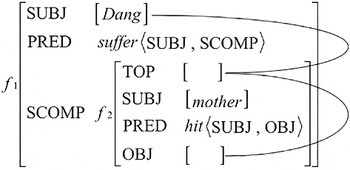
Sudmuk (Reference Sudmuk, Butt and King2003) proposes an LFG analysis of these constructions in which both (5b) and (6b) are instantiations of a single thuuk construction: by hypothesis, there is a single biclausal construction that involves an anaphoric relation between the subject of the main clause and a covert element in a dependent clause located (in principle) an unbounded distance away. On her analysis, the thuuk in the single thuuk construction is a lexical verb that means ‘suffer’ and subcategorizes for a sentential complement (scomp). In addition, there is a condition that the subj of thuuk be identified with the topic of the scomp, which in turn is co-indexed with an (potentially deeply) embedded subj or obj. All of these properties are specified in the lexical representation for thuuk in (7) (adapted from Sudmuk Reference Sudmuk, Butt and King2003: 420):

The conventions associated with such a lexical representation for thuuk ensure that its matrix subj is identified with the scomp’s top, as indicated in the second line, while also restricting this top to being identified with either the subj or obj of an embedded clause, as indicated in the third line. On Sudmuk’s analysis, the thuuk construction involves the grammatical processes of functional control and topicalization. Figure 1 shows LFG’s functional-structure representation for the sentence in (8) (example and f-structure adapted from Sudmuk Reference Sudmuk, Butt and King2003: 421).

Sudmuk’s proposed f-structure for (8).

As indicated in this f-structure, the matrix clause is headed by thuuk and its subj is anaphorically identified with both the top and the obj of the embedded clause: this renders the meaning as ‘Dang
 $_{\text{i}}$
suffered (from the experience that) mother hit (her
 $_{\text{i}}$
)’. This is an active sentence in which the relevant lexical representation for thuuk is necessarily associated with the anaphoric possibilities typified in (7). Since Sudmuk’s proposal specifies a biclausal structure for this variant of the thuuk predicate, it (i) entails the attendant anaphoric relations, and (ii) predicts the absence of monoclausal behaviors from this construction. In contrast, an alternative analysis of thuuk as a simple Thai reflex of ordinary passive predicates would be consistent with monoclausal properties and would not necessarily entail positing anaphoric relations associated with its lexical representation for this use.
In fact, Lee (Reference Lee2006) argues that while (5b) and (6b) are surface similar, they are actually instances of two different constructions: on this hypothesis, Sudmuk’s proposal conflates these distinct constructions into a single thuuk construction. Lee argues that (5b) is a single clause that should be treated as the passive counterpart of (5a), while (6b) is a biclausal construction in which thuuk is a matrix verb that takes an scomp and the matrix subj is a possessor ‘raised’ from the lower clause. As mentioned previously, the analysis of sentences typified by (5b) as passive raises an analytic paradox: on the one hand, the passive interpretation is signaled by the presence of thuuk, which is categorically separate from the verb; on the other hand, passives, in HPSG and LFG, are a valence-changing operation, and hence, lexical, in accordance with the principle of lexical modification and the hypothesis of direct syntactic encoding. The challenge for standard lexicalist approaches can be stated cogently: How can the lexicality of the passive be maintained if its expression is periphrastic rather than synthetic?Footnote [14]
In order to address this larger theoretical question, we first demonstrate that one variant of the thuuk construction is indeed a passive. We show, using evidence from reflexive binding and disjoint reference, that sentences such as (5b) and (8) above have the properties of a monoclausal passive construction: these are constructions whose pat argument is the only subject in the construction. A straightforward application of the principle of lexical modification and direct syntactic encoding entails that the passive predicate is a lexical item, and since it is the obligatory co-occurrence of thuuk and the verb that signals the passive,Footnote [15] the passive predicate represents an instance of periphrasis with discontinuous syntactic exponence. Following the demonstration of monoclausality, we provide empirical evidence for the constituency of the passive thuuk construction in order to identify the specific syntactic realization of this discontinuous multiword expression.
2.1 Evidence for the monoclausality of the passive thuuk construction
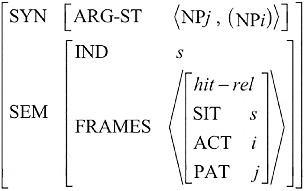
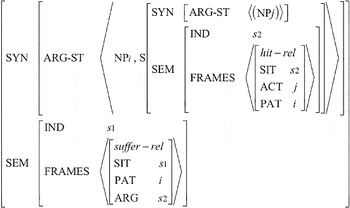
On conventional cross-theoretical assumptions, the object of an active transitive clause is realized as the subject of the passive variant. Within HPSG, this is analyzed in terms of a rearrangement of arguments within arg-st, an ordered list specifying the arguments selected by the verb: the pat, associated with the second member on the arg-st of the active verb, is associated with the first member on the arg-st (loosely speaking, the subject) in the passive variant (e.g. Pollard & Sag Reference Pollard and Sag1987, Kathol Reference Kathol, Nerbonne, Netter and Pollard1994, Koenig Reference Koenig1999, Davis & Koenig Reference Davis and Koenig2000, Abeillé & Godard Reference Abeillé and Godard2002, Müller Reference Müller2002, inter alia). With respect to (5b), these alignments between semantic roles and syntactic arguments could arise in two distinct ways, as schematized in Figures 2 and 3.
Monoclausal passive analysis of (5b).

Biclausal complementation analysis of (5b).

On a passive analysis, the pat
dɛɛŋ, which corresponds to the second argument of the active verb, is the first argument of the passive verb (NP
 $_{j}$
in Figure 2), while phɔɔ ‘father’ represents the act as an optional second argument (NP
 $_{i}$
). The construction is monoclausal with both dɛɛŋ and phɔɔ being co-arguments in the arg-st list of the passive predicate. On Sudmuk’s analysis, the structure of (5b) is quite different: it is an active construction in which the matrix verb thuuk ‘suffer’ selects for two arguments, the first of which corresponds to the pat
dɛɛŋ (NP
 $_{i}$
in Figure 3), while phɔɔ is an optionally appearing argument (NP
 $_{j}$
) of the complement clause headed by tii ‘hit’. The complement clause also contains a covert pat co-indexed with the first argument of the matrix verb.
Since both of these proposals account for several evident properties of this construction concerning semantic roles and syntactic arguments, it is crucial to identify behavioral properties that distinguish these alternatives. The most obvious point of difference concerns any syntactic behaviors relating to the mono- vs. biclausal status assumed by each proposal. In particular, while the passive analysis assumes that there is a single subject in (5b), Sudmuk must assume that there are two distinct subjects: dɛɛŋ is the subject of the matrix clause and phɔɔ is the subject of the complement clause. If there is more than one subject, then the construction contains a complex clause and cannot be a passive. The basic competition between these analyses can then be stated in terms of the status of the post-thuuk constituent: on the passive analysis, it is an optional oblique argument, while on Sudmuk’s analysis, it is a subject. Accordingly, we will test the status of the post-thuuk NP by appealing to two diagnostics for subjecthood in Thai: reflexive binding and disjoint reference. Both of these phenomena are diagnostic of the mono- vs. biclausality of the domains in which they operate.
2.1.1 Reflexive binding
Hoonchamlong (Reference Hoonchamlong1991) observes that the reflexive tuaʔeeŋ must be bound by a subject, and is thus a subject-oriented anaphor (examples from Hoonchamlong Reference Hoonchamlong1991: 55):

The reflexive tuaʔeeŋ can also occur as the subject of an embedded clause, in which case, its antecedent is located in the higher clause. The subject-orientation property is retained, as shown in (10) (examples from Hoonchamlong Reference Hoonchamlong1991: 56):

When preceded by more than one subject, the antecedent can only be the closest subject. This is true whether tuaʔeeŋ occurs as non-subject, as in (11a), or subject, as in (11b) (examples from Hoonchamlong Reference Hoonchamlong1991: 57–58):

Within HPSG, tuaʔeeŋ can be construed as an a-subject-oriented anaphor that must be bound by the closest a-subject, where an a-subject is an entity that is first on some arg-st list (Manning & Sag Reference Manning and Sag1999). When tuaʔeeŋ occurs as a subject (i.e. it is the first member on its arg-st list), it takes as its antecedent the a-subject of the immediately higher clause: when tuaʔeeŋ is not a subject (i.e. it is not the first member on its arg-st list), its interpretation is clause-bounded and it can only take as its antecedent the a-subject of its minimal clause (i.e. the first member on its arg-st list).
Given the binding conditions for the reflexive tuaʔeeŋ, it can serve as a useful diagnostic for the status of the post-thuuk NP in the thuuk construction: if this NP can bind a reflexive that follows, then it must be a subject; if only the pre-thuuk NP is capable of being the antecedent of a reflexive that follows the post-thuuk NP, then the pre-thuuk NP must be the closest subject, which entails that the post-thuuk NP cannot be a subject. Consider (12):

In (12a), we have a biclausal active sentence in which the embedded reflexive in subject position takes the matrix subject as its antecedent. In the thuuk construction in (12b), the reflexive also takes the pre-thuuk NP as its antecedent, suggesting that this NP is the closest subject preceding it: given its inability to serve as a potential binder, the post-thuuk NP, in contrast, is not construable as a subject. Therefore, Sudmuk’s treatment of the post-thuuk NP as a subject in sentences such as (12b) seems unsupportable. The binding effects are only consistent with a monoclausal interpretation, and hence, provide evidence consistent with the hypothesis that thuuk is part of a passive predicate construction in this use.Footnote [16]
2.1.2 Disjoint reference
In Thai, a pronoun cannot take a co-argument NP within the same minimal clause as its antecedent (examples (13a–b) from Hoonchamlong Reference Hoonchamlong1991: 33):

When a pronoun occurs as an object, it cannot take the subject of its clause as its antecedent, as shown in (13a). When the pronoun occurs as an object of an embedded transitive clause, as in (13b), the only NP that cannot serve as its antecedent is the subject of its minimal clause. (13c) shows that arguments of the higher clause can serve as the antecedents of the pronoun even when the pronoun occurs as the subject of the lower clause. Therefore, there is a negative constraint on pronominal binding: an argument pronoun cannot take a clause-mate (i.e. an argument on the same arg-st list as itself) as its antecedent.
Given the clause-mate condition on pronominal binding, we can test whether the thuuk construction is mono- or biclausal by inserting a pronoun into the post-thuuk NP position. If this pronoun (assuming that it is an argument of the predicate) can take the pre-thuuk NP as its antecedent, then the construction must be biclausal; if the pronoun cannot take the pre-thuuk NP as its antecedent, then we have evidence for monoclausality. (14) shows that the latter is indeed the case.

The pronoun in (14) cannot take the pre-thuuk NP as its antecedent, suggesting that the two NPs are clause-mates. Therefore, evidence from disjoint reference supports the monoclausal analysis of this variant of the thuuk construction, and contrary to Sudmuk’s analysis, the post-thuuk NP is such sentences is not the subject of an embedded clause.
One might wonder if the binding facts in (14) could instead be attributed to a paradigmatic contrast between reflexives and pronouns when they occur as the subject of an embedded clause. On this hypothesis, the pronoun in (14) is the subject of an embedded clause, and it cannot take the pre-thuuk NP as its antecedent because the intended meaning can be expressed with a reflexive in the same position, as in (15):

However, note the minimal pair formed by (12b) and (13c), which respectively involve a reflexive and a pronoun occurring as an embedded subject. The fact that both the reflexive in (12b) and the pronoun in (13c) can be bound by the immediately preceding subject shows that the hypothesized paradigmatic contrast does not exist.
Sudmuk presents the example in (16), which seems to contradict our claim that the passive thuuk construction is monoclausal (example from Sudmuk Reference Sudmuk, Butt and King2003: 409):

Sudmuk argues that since the pronoun in (16) can take the pre-thuuk NP as its antecedent, the two NPs cannot be clause-mates and thus, (16) supports the biclausal analysis of the variant of the thuuk construction that we argue to be a passive. However, all the speakers we consultedFootnote [17] categorically rejected the sentence in (16). We hypothesize that for speakers who may allow such sentences, the final NP does not have an argument status, but is instead an adjunct serving an emphatic/resumptive purpose. This would be consistent with Sudmuk’s reference to the pronoun in (16) as a ‘resumptive pronoun’ (Sudmuk Reference Sudmuk, Butt and King2003: 409).
With the exception of the sentence in (16), Sudmuk does not provide evidence for the biclausal nature of the thuuk construction. She shows that the post-thuuk NP cannot be an object, because unlike objects, it cannot undergo complex NP shift (Sudmuk Reference Sudmuk, Butt and King2003: 412–413). She suggests that it is instead a subject, because this NP can occur with a relative complement, as shown in (17) (example from Sudmuk Reference Sudmuk, Butt and King2003: 413):

This claim, however, does not address the possibility that the relativized NP is an oblique argument. In fact, there is no a priori reason to believe that only subjects in Thai take relative complements, and as we show in (18d) below, there is empirical warrant to suggest that oblique arguments can, indeed, do so.
In summary, since evidence from reflexive binding and disjoint reference converge on the same conclusion, we conclude that there is empirical motivation to consider the hypothesis that the passive thuuk construction represents a simple clause. Moreover, given that in all the examples of the passive thuuk construction that we have seen, the act is omissible but optionally expressible, while the pat is realized as subject, we have reason to extrapolate that the passive thuuk construction exemplifies the cross-linguistic passive type where acts are oblique arguments (or adjuncts). This, too, is consistent with the evidence that the post-thuuk argument is not a subject.
2.2 Family of passives
Further evidence that the thuuk construction should be treated as a passive can be found in the paradigmatic contrast it exhibits with another passive construction in the language. In this connection, it has traditionally been noted that the passive thuuk construction is associated with adversity (Prasithrathsint Reference Prasithrathsint, Abraham and Leisiö2006: 123):

In this regard, the thuuk passive recalls the semantic effects of the indirect passive in Japanese, which also carries negative connotations (Tsujimura Reference Tsujimura1996): it is not, however, similarly analyzable in terms of its grammatical behaviors. In addition to the adversative thuuk passive, Thai also has a neutral passive construction that does not contain thuuk and does not convey a sense of adversity, as illustrated in (18b) (example (18b) from Iwasaki & Ingkaphirom Reference Iwasaki and Ingkaphirom2005: 316).

The examples in (18a–b) represent an active–passive alternation: the pat and act are realized as subject and object respectively in the active variant in (18a), whereas the pat is realized as subject in the dooy passive in (18b), where the demoted act is obligatorily expressed in a ‘by’-phrase and the construction contains a synthetic passive expression of the verb. Unlike the examples of the thuuk construction that we have seen thus far, the subject of (18b), ‘this book’, is not interpreted as having been adversely affected by its writing. This is in contrast with the attempt to create a thuuk passive in (18c), which requires an adversative interpretation in order for it to be even marginally acceptable. There is, thus, a paradigmatic opposition between the thuuk passive and the dooy passive: only the dooy passive is compatible with a neutral interpretation. This can be straightforwardly accommodated within a morphological interpretation of lexical constructions, where paradigmatic oppositions are commonplace: the two homophonous variants of the verb are simply associated with active and passive mappings between semantic roles and syntactic arguments. Additionally, we see in (18d) that the NP introduced by dooy, which on standard analyses of passives would be considered an oblique argument, can take a relative complement. This contrasts with Sudmuk’s previously discussed supposition that relative complementization is restricted to subjects.
Prasithrathsint (Reference Prasithrathsint, Abraham and Leisiö2006: 124) notes that since the latter half of the 20th century, the meaning of the adversative passive marker thuuk has been generalized for some speakers, who now allow the thuuk passive to be used in a neutral, non-adversative manner:

Interestingly, if the agent of the neutral thuuk passive construction is expressed, it tends to occur at the end of the sentence in the form of a prepositional phrase introduced by dooy, rather than before the verb as in the adversative thuuk construction (ibid.). This is illustrated in (19) (example from Prasithrathsint Reference Prasithrathsint, Abraham and Leisiö2006: 124):

In (19), the discovery of the disease to considered to be a positive event and the construction as a whole does not convey any adversity. Unlike the instances of the thuuk construction that we initially encountered, where the demoted act is expressed between thuuk and the verb, the act in (19) occurs within a ‘by’-phrase, after the collocation of thuuk and the main verb. It appears that in co-opting the preposition dooy, used in the neutral dooy passive, the thuuk … dooy passive has also inherited its neutrality.
Therefore, the adversative thuuk passive appears to be in paradigmatic opposition with the passive constructions containing dooy: while the adversative thuuk passive is reserved for use in situations that connote a sense of negative affect, the other two passive constructions that use dooy are neutral in this regard. From a functional point of view, the adversative thuuk passive, the dooy passive, and the thuuk … dooy passive appear to form a family of passive constructions in Thai, and the monoclausal thuuk construction can be appropriately analyzed as an adversative passive within this class of ‘allo-constructions’ (Pike Reference Pike1962: 236). In a sense to be further developed in our analysis of these related constructions in Section 4, these are paradigmatically contrasting instances of passive diathesis with different exponences. This is a domain where Word and Paradigm morphological assumptions naturally account for the interdependence between morphology and syntax.
2.3 Evidence of constituency for the thuuk passive
Having established that one variant of the thuuk construction is indeed a passive, the surface discontinuity of thuuk and the verb calls into question the lexicality of the passive: since it is the obligatory co-occurrence of thuuk and the verb that signals the passive, the passive predicate, in Word and Paradigm based terms, represents an instance of periphrasis with discontinuous syntactic exponence. In this section, we provide empirical evidence for the constituency of the passive thuuk construction in order to identify the specific syntactic realization of this discontinuous periphrastic predicate.
2.3.1 Coordination
Consider some of the coordination facts of the adversative thuuk passive:

Example (20a) shows that when the act is not expressed, two sequences of thuuk and a verb can be coordinated. (20b) shows that two sequences of thuuk, the act, and the verb can also be coordinated. In contrast, the unacceptability of (20c) indicates that the presence of thuuk in both conjuncts is necessary for coordination of two passive verbs to take place, while (20d–e) show that the presence of the act does not salvage the unacceptability of not repeating thuuk in the second conjunct. This evidence from the distributions of coordination suggests that the elements after the subject in the adversative thuuk passive form a constituent to the exclusion of the subject. Furthermore, thus must be a flat constituent with no internal hierarchy, as it is possible to coordinate subordinated constituents elsewhere in the language:

In light of the sentences in (21), which show that subordinated constituents can be coordinated, the unacceptability of (20c–e) would be surprising if thuuk, the act, and the verb do not form a flat constituent. Thus, it is reasonable to conclude that the periphrastic passive predicate targets this constituent for its realization.
2.3.2 Topic constructions
Evidence from Thai topic constructions independently confirms the constituency we identified on the basis of coordination. Consider the examples in (22) ((22b) from Hoonchamlong Reference Hoonchamlong1991: 85):

The sentence in (22a) is a canonical declarative. Hoonchamlong observes, as shown in (22b), that the object NP from the lower clause can be fronted, and leave either a gap or an overt pronoun in its original position. Now, compare this with the English examples in (23) (from Hoonchamlong Reference Hoonchamlong1991: 78):

In languages such as English, a distinction is made between topicalization, where a gap occurs in the original position, as in (23a), and left dislocation, which involves the presence of an overt pronoun, as in (23b) (e.g. Chomsky Reference Chomsky, Culicover, Wasow and Akmajian1977, Baltin Reference Baltin1982, Lasnik & Uriagereka Reference Lasnik and Uriagereka1988). First, extraction from an embedded clause is possible in topicalization but not left dislocation. Second, while topicalization observes island constraints, left dislocation does not. Therefore, these authors argue that topicalization involves wh-movement, but left dislocation is base-generated in the topic position. In other words, the front element in (23a) is regarded as an argument of the verb, while the fronted element in (23b) is a non-argument that is related to the clause in an ‘aboutness relation’.
One therefore wonders whether a similar distinction exists in Thai, and if the example in (22b) conflates two distinct topic constructions. Hoonchamlong argues that topicalization and left dislocation are not distinct in Thai. Since Thai is a pro-drop language, the gap may simply be an empty pronoun, in which case the distinction between the presence or absence of the pronoun is only a matter of optional pro-drop. Moreover, referring to phenomena that have been used to argue for the distinct statuses of topicalization and left dislocation, Hoonchamlong (Reference Hoonchamlong1991: 86–99) shows that the presence or absence of the pronoun does not affect the grammatical behavior of topic constructions in Thai: both constructions can occur in a root clause or an embedded clause, and they do not obey the Subjacency Condition (Chomsky Reference Chomsky, Anderson and Kiparsky1973).
There is, additionally, evidence that the fronted element in a Thai topic construction does not always have argument status. (24) shows that the topic need not syntactically bind any argument in the clause that follows it (example from Hoonchamlong Reference Hoonchamlong1991: 89–90):

Such sentences suggest that the topic need not be an argument of the clause from which it is extracted, and that the relation between the topic and the clause is instead a looser ‘aboutness relation’. On such an analysis, the gap that appears in (22b) is really an instance of pro-drop. We will not pursue the issue of topicalization vs. left dislocation any further, but simply note that in a Thai topic construction, the presence of a gap is indicative of pro-drop.
Now, let us consider the types of elements that can be fronted in a Thai topic construction. In Thai, only phrasal constituents can occur as topics. (25) illustrates this with PPs ((25a) from Hoonchamlong Reference Hoonchamlong1991: 132):

Example (25a) shows that an entire PP can occur as a topic, while (25b) shows that the preposition alone cannot. Yet, the NP within the PP as occur as topic in (25c), as NP is a phrasal constituent. It should be pointed out that the pronoun man ‘it’ is obligatory in (25c); pro-drop is not an option here. This is probably because the language in general does not allow PPs to occur without an overt dependent NP:

Hoonchamlong notes that when a VP appears as topic, a proform is required in the main clause. This is reminiscent of the do-so phrase in English. The proform for VPs headed by stative verbs is pen ‘be’, as in (27a), while that for active verbs is tham ‘do’ (27b) (examples from Hoonchamlong Reference Hoonchamlong1991: 108):

The lexical verb tii ‘hit’ alone cannot occur as topic as it does not constitute a phrase on its own:

On the basis of what we have seen so far, one might be inclined to think that the restriction on topicalization can be cast in terms of headedness: phrasal heads cannot occur as topics. This, however, is not true. Consider (29):

In (29), the NP within a VP occurs as the topic. Since this is a simple NP headed by the noun luuk ‘child’, this shows that phrasal heads can occupy the topic position in Thai. The head of a complex NP, however, cannot:

The sentence in (30a) is a canonical declarative with a complex NP object. As (30b) shows, the entire NP can be fronted. However, the head of this complex NP cannot occur on its own as a topic because, unlike luuk ‘child’ in (29), dɔɔkmaay ‘flower’ in (30c) is not a phrasal projection. Therefore, the restriction on topics is that they must form a phrasal constituent; heads alone cannot be topics, unless the head exhaustively dominates the phrase.
Let us now consider how topicalization works in the adversative thuuk passive. We first consider if individual elements can be fronted. If individual elements can be fronted, they must be phrasal constituents.

The sentence in (31a) is our example of the adversative thuuk passive. (31b) shows that thuuk alone cannot occur as a topic. Because we do not know the exact status of thuuk, we included the proforms tham/pen in the example so as not to exclude the possibility of thuuk being a VP; all other phrasal categories allow a gap. Therefore, thuuk alone cannot be a phrasal constituent. The verb tii ‘hit’, too, cannot occur as topic, as shown in (31c). Thus, the verb in the adversative thuuk passive does not constitute a phrase on its own. (31d) shows that the act can occur as topic, suggesting that the act is a phrasal constituent, which is consistent with the analysis of this construction as a passive: the act is indeed an NP in the active clause – the subject.
Note that the pronoun in the main clause is obligatory when the act appears as topic. As we saw earlier, the only time that an obligatory pronoun is required in place of a topicalized NP is if that NP is part of a PP. This suggests that thuuk may be a preposition, and that thuuk and the act form a ‘by’-phrase. However, this is not tenable because we also know that PPs in Thai cannot occur without an NP, and yet the expression of the act is optional. Furthermore, as (32a) below shows, negation can occur before thuuk. Given that negation is a common diagnostic for verbhood in Thai (Jenks Reference Jenks2011: 26), this suggests that thuuk is a verb.
Next, we consider if sequences of two or more words that appear after the subject can be topics.

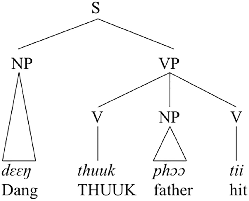
The sentence in (32a) is an example of the adversative thuuk passive. (32b) shows that thuuk, the act, and the verb can together occur as topic, suggesting that this sequence of words forms a phrasal constituent. In (32c), we see that when the act is left unexpressed, thuuk and the verb, too, can occur as a topic, and thus constitute a phrasal constituent. However, as the unacceptability of (32d–e) indicates, neither thuuk and the act, nor the act and the verb form a phrasal constituent, suggesting a lack of internal hierarchy within the topic phrase in (32b). Thus, topicalization informs us of two facts concerning the constituency of the passive thuuk construction: (i) the act is a phrasal constituent, and (ii) thuuk, the act, and the verb together form a flat constituent.Footnote [19]
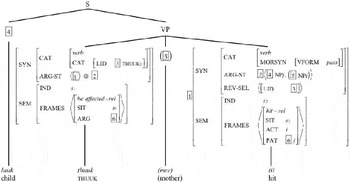
In sum, these empirical facts are best analyzed by assuming a flat structure. We assume that the category of this constituent is a VP. Figure 4 illustrates the constituency of (5b).
Constituency of (5b).

The topicalization facts in (31) above suggest that the lexical verb in the adversative thuuk passive does not project its own verb phrase: only phrasal constituents can be topics, but the verb in the adversative thuuk passive cannot be a topic. Further evidence that this verb does not constitute a phrasal constituent can be adduced by comparing the adversative thuuk passive to other constructions in Thai that share the identical sequence of elements on the surface – what Muansuwan (Reference Muansuwan2002) refers to as Thai aspectual constructionsFootnote [20] in (33a) and the resultative construction in (33b) (example (33b) from Muansuwan Reference Muansuwan2002: 226):

Like the adversative thuuk passive in (5b), the aspectual and resultative constructions in (33) consist of the linear sequence V NP V after the subject.
Muansuwan observes that raising verbs can occur before either verb in the aspectual construction. (34) illustrates with the raising verb kəət ‘happen’ (examples from Muansuwan Reference Muansuwan2002: 151):

Because raising verbs take VP complements, and kəət ‘happen’ can occur before the second verb in the aspectual construction, Muansuwan argues that the second verb in the aspectual construction projects its own VP. (35a–b) below show that preverbal TAM markers such as tɔŋ ‘must’ share the same distribution as the raising verb kəət ‘happen’, suggesting that preverbal TAM markers, too, take VP complements, while (35c) demonstrates that tɔŋ ‘must’ can also precede the second verb in the resultative construction, suggesting that this verb, too, projects a VP (example (35c) from Muansuwan Reference Muansuwan2002: 227):

Now, since the raising verb kəət ‘happen’ and the preverbal TAM marker tɔŋ ‘must’ take VP complements, we would expect these verbs to be able to precede the second verb in the thuuk passive if this verb does indeed project its own VP. The data in (36) show that this is not borne out.

Since VP complement-taking verbs cannot precede the second verb in the passive thuuk construction, we must conclude that this verb does not project its own VP. Hence, the constituency in Figure 4 above.
Therefore, even though the word order in the adversative thuuk passive is identical to that in the aspectual and resultative constructions, the constituent statuses of their second verbs are different.
3 Periphrasis and the morphology–syntax interface
Having provided empirical evidence to establish the passive status of one of the thuuk constructions and identified the syntactic constituency for its surface syntactic realization, we turn to an analysis of the interface between morphological periphrases and their surface syntactic exponence. We adapt the treatment of inflection for periphrastic TAM morphology developed in Bonami & Webelhuth (Reference Bonami and Webelhuth2013) and elaborated in Bonami (Reference Bonami2015) to a morphosyntactic relation-changing operation that relates active and passive predicates. Before presenting the details of our extension, we introduce the analytic assumptions we will adopt.
3.1 Inflection and the morphology–syntax interface
As observed in Bonami & Webelhuth (Reference Bonami and Webelhuth2013) and Bonami (Reference Bonami2015), languages differ concerning whether they employ synthetic vs. periphrastic expressions for particular tense, aspect and mood distinctions of lexemes. For example, English uses periphrasis to express the present perfect tense, as exemplified in (37):

Following the tradition in word-based morphology (Robins Reference Robins1959; Matthews Reference Matthews1970, Reference Matthews1991; Jackendoff Reference Jackendoff1975; Bochner Reference Bochner1993; Blevins Reference Blevins2015; inter alia) that such periphrastic expressions are realizations of lexemes in context, Bonami (Reference Bonami2015) develops a formal treatment that permits this type of expression to receive the surface encoding reflective of independently motivated syntactic structures in specific languages.
Bonami’s proposal is guided by several insights. First, the paradigm cells defined by the combination of morphosyntactic properties such as tense, aspect and mood with a lexeme can be realized synthetically or periphrastically. Second, inflected words are simply variants of a shared lexeme, which can be expressed synthetically or periphrastically. This means that the challenges for addressing the periphrastic expression type are to ensure that (i) it is construed as a particular morphosyntactic variant of a single (class of) lexeme, just like its synthetic forms, and (ii) its pieces are placeable in appropriate, empirically motivated syntactic positions. Bonami proposes that words can carry a reverse-selection requirement, which specifies that the word must occur in the local syntactic context of a particular lexeme that selects for that word (or one of its projections). Reverse selection is defined in (38):

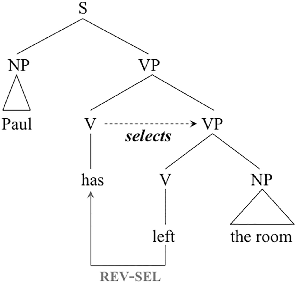
On this account, the collocational quality of the syntactic realization of periphrastic predicates, such as has left, is ensured by requiring that one piece of the predicate, here left, reverse-selects for the other, has: the auxiliary has displays ordinary syntactic selection to co-occur with a verbal complement, while the reverse-selection requirement on left ensures that it will co-occur with the selecting auxiliary.Footnote [21] The rule of periphrastic exponence for the English present perfect can then be informally stated as in (39) (Bonami Reference Bonami2015: 87):

The basic syntactic representation of (37) can be represented schematically as in Figure 5, where left, the past participle of leave, reverse-selects for the auxiliary have in the present third singular, which selects, as it usually does, for a VP complement.
Selection and reverse selection (Bonami Reference Bonami2015: 88).

As Bonami (Reference Bonami2015: 91) points out, periphrasis, on this view, is not literally syntactic exponence: rather it is the exponence of a morphosyntactic feature by a reverse-selection requirement. The requirement for the main verb to co-occur with the auxiliary is specified on the main verb, just as the requirement for a verb to appear in a certain form is specified on the verb in the case of synthetic morphology. Thus, both synthetic and periphrastic inflection rules play the same role of partially constraining the relation between the morphosyntactic features expressed by words and the realizations of those words. The only difference is that synthesis expresses the features locally on the word, whereas periphrasis expresses them as conditions on the context of occurrence.
This treatment of TAM has the desired effects of (i) unifying the analysis of inflectional information, independent of language-particular synthetic vs. periphrastic expression type, as properly morphological, while (ii) accounting for the syntactic distribution of the relevant pieces of expression in a manner that conforms to independent evidence concerning the diverse syntactic constituency configurations found in different languages. On Bonami’s account, periphrastic TAM constructions in e.g. English, French and German, have different syntactic encodings from each other, but in each instance, the specific encoding parallels that found in each language’s verb syntax. It is important to emphasize that the genuine appeal of this proposal resides in making explicit the relation between independent syntactic structure and the way that periphrasis is encoded. In particular, it proposes that the syntactic expression of periphrasis is constrained by the independently attested syntactic phrasal structure of a language: in default of such a constraint, the syntactic expression of periphrastic constructions could be stipulated to occur in many different ways (as it is in Ackerman & Webelhuth Reference Ackerman and Webelhuth1998).
In Section 4, we extend some aspects of this proposal for the morphology–syntax interface so that it can account for a morphosyntactic relation-changing operation that relates active and passive predicates. Another result of this extension will be the delineation of a more comprehensive cross-linguistic taxonomy for the syntactic realization of periphrastic predicates, one in which periphrastic predicates can sometimes receive syntactic encodings that are otherwise unattested in other languages.
3.2 Lexical representations
As mentioned earlier, within lexicalist and some construction-theoretic proposals, the active–passive relation is interpreted as a type of lexeme-altering or derivational relation: this assumes that manipulations of argument structure – semantic role alignments are one of several ways in which verbs can vary. For active–passive pairs, the lexical semantics remains essentially constant, while there are different mappings between the semantic roles and syntactic arguments. Given that such manipulations are, by hypothesis, independent of the ways in which the resulting verbs can be expressed, it is predicted that, as with inflection, languages could differ with respect to the use of synthetic vs. periphrastic encoding strategies. In this respect, the variation in the actual surface expression of words is a language-particular and historically contingent phenomenon: there is little reason to assume that any particular encoding provides more or less insight into essential cross-linguistic aspects of morphological organization or that it constitutes a default on the cross-linguistic morphology–syntax interface. In the aggregate, all of the attested variation provides the range of possible encoding types that natural languages present for theoretical analysis.
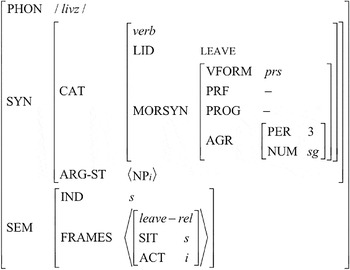
Since a lexeme-altering relation such as passive affects the alignment of semantic roles and syntactic arguments, certain aspects of lexical representations are especially relevant. We adopt the lexical representations of HPSG and SBCG, where a linguistic sign minimally consists of phonological, syntactic and semantic dimensions of information. Consider the lexical representation in Figure 6 below for the synthetic form leaves of the lexeme leave.Footnote [22] The phon attribute stipulates the phonological shape of the word. The syn attribute contains information concerning category and argument-structure. A number of different features of syntactic relevance are contained in cat. cat in Figure 6 identifies leaves as the lexical category of type verb. Major lexical categories such as verbs and nouns are associated with a core lexical identity: this is designated by the lid attribute, which will be of particular significance for the purposes of our analysis. Each lexeme has a lid value, which uniquely identifies a lexeme in the lexicon and allows for selectors to identify lexemes (Sag Reference Sag, Boas and Sag2012). A lexeme, the words that realize it, and the phrases headed by such words all share the same lid value: it is the attribute by which distinct wordforms are specified as being variants of a single lexeme. cat also contains the attribute morsyn, which encodes morphosyntactic information concerning, e.g. TAM, v(erb)form and agreement properties of the verb. In addition to cat, syn also contains an arg-st attribute that stipulates the syntactic arguments with which the verb co-occurs. The fact that leaves contains one NP argument indicates that this is an intransitive verb. We will assume that the order of elements in arg-st represents an obliqueness hierarchy determining syntactic relation status,Footnote [23] where the leftmost argument is subject, the next is object, with increasing obliqueness rightward (Keenan & Comrie Reference Keenan and Comrie1977, Pullum Reference Pullum, Cole and Sadock1977). As referenced by the indices, the NP argument is linked to the semantic role, act, specified in the frames attribute required by the sem attribute. Finally, the lexical representation for leaves represents a semantic relation designated by leave-rel.
Lexical item for 3rd person singular leaves.

4 Analysis of Thai passives
4.1 Adversative thuuk passive
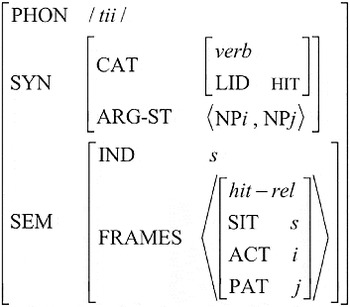
Recall the Thai active form of the verb ‘hit’, repeated from (2a) as (40), whose lexical representation can be given as in Figure 7 below.

Lexical entry for tii ‘hit’.

As an independent verb, tii ‘hit’ has its own distinct lid. The shared indices between the NPs in arg-st and the semantic role values of frames specify that the act will be subject and the pat will be object.
Let us reconsider the passive variant in (2b), repeated as (41).

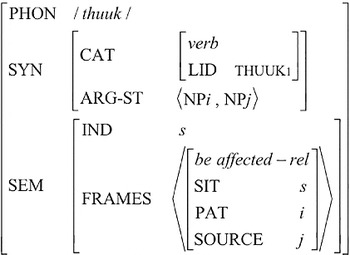
When the lexical verb co-occurs with thuuk, it is associated with the passive grammatical relation alignment. The passive alignment cannot be associated solely with the lexical verb tii, since that would mandate an active mapping, given the lexical representation in Figure 7. On the other hand, it cannot be associated with the independent verb thuuk either, since this verb does not have the appropriate semantic role inventory for the correct mapping. To see why this is so, consider the representation for the independent verb thuuk in Figure 8. This is the active variant of thuuk, with a unique lid, that occurs in a clause such as (42), repeated from (4) above.

Lexical entry for independent verb thuuk (THUUK
 $_{1}$
).

As shown in Figure 8, the semantic role inventory of the independent verb thuuk does not match the semantic role inventory of the passive verb in (41), given that the lexical semantics in frames remains constant in active–passive pairs. Hence, the combination of the two independent active verbs, thuuk and tii, cannot result in a passive, if both retain their own semantic roles and correlative active grammatical relation assignments.
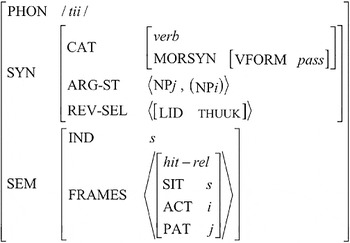
On standard lexicalist assumptions, the passive verb merits a lexical item of its own that is distinct from that of the active variant, such that the assignment of semantic roles to syntactic arguments is altered and the syntactic expression of the act argument is optional. In addition, for Thai adversative passives, the verb is also constrained to co-occur with thuuk which, as observed in (42) and Figure 8, conveys a sense of affectedness. To ensure this, we propose that the passive verb contains a reverse-selection requirement to co-occur with thuuk. The passive variant of tii ‘hit’ can thus be represented as in Figure 9. It is specified in its vform as a passive verb, and even though its frames value is identical to that of the active variant, the assignment of semantic roles to syntactic arguments is different, as indicated by the indexing of the arguments. Also unlike the active verb, the second NP, now associated with the act, is optionally expressed in the syntax. In addition, thuuk must occur in the local syntactic context of this passive verb, due to the rev-sel constraint in the lexical representation of the latter.
Preliminary lexical item for passive tii ‘hit’.

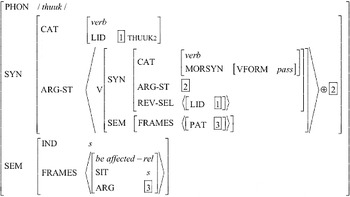
Now, the thuuk that is reverse-selected by the passive verb in the adversative thuuk passive cannot be the same lexical verb as that represented in Figure 8, since that lexical verb contains its own arg-st requirements, as well as semantic roles to syntactic argument assignments that, as we saw, are incompatible with the passive verb. Hence, we posit a separate lexical entry for thuuk, with a different lid value, thuuk
2, shown in Figure 10. Unlike thuuk
1 in Figure 8, this version of thuuk subcategorizes for a verb and inherits the arguments of that verb, as indicated by the tag  The subcategorized verb is constrained to (i) being a passive verb and (ii) reverse-selecting for this version of thuuk, as indicated by the tag
 Thuuk
2 also differs from thuuk
1 in its semantics: even though this version of thuuk retains its semantics of affectedness, it, unlike thuuk
1, contains only one semantic argument, which is constrained to be token-identical to the pat of the passive verb, and predicates of this argument that it be affected. Hence, despite being independent lexical entries in the lexicon, the two thuuks are nonetheless related phonologically and semantically.
Lexical entry for thuuk in the adversative passive (THUUK
 $_{2}$
).

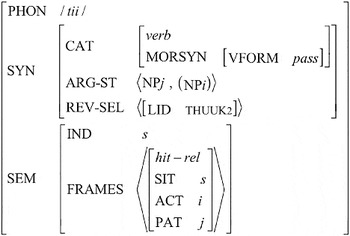
We can now update our lexical item for the passive tii ‘hit’ so that it reverse-selects specifically for thuuk 2 by referencing the lid of this latter verb, as shown in Figure 11. The resulting predicate is expressed by two categorical verbs, the first of which, thuuk 2, selects for a passive verb, which in turn reverse-selects for thuuk 2.
Updated lexical item for passive tii ‘hit’.

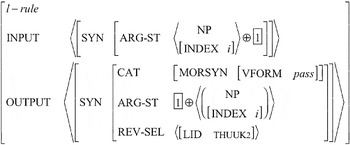
On this analysis, the collocational quality of the adversative thuuk passive is due to requirements on both thuuk 2 and the passive verb to co-occur with each other. The lexical rule deriving such passive verbs is shown in Figure 12. By convention, information that is identical in the input and output is neither stated in the input nor the output: the rule only makes reference to information that is different. Here, the output is stipulated to be of passive vform and to reverse-select for thuuk 2. Additionally, the order of elements within arg-st has been rearranged such that what was the first argument on the arg-st list of the active verb is the last (and optional) argument on the arg-st list of the passive verb.
Adversative thuuk passive lexical rule.

Our analysis of the adversative thuuk passive extends Bonami’s proposal by incorporating lexical semantics and the mapping between semantic roles and syntactic arguments. Unlike the auxiliary in periphrastic TAM constructions, thuuk 2 has its own semantics, specifying that its sole semantic argument be token-identical with the pat of its subcategorized verb. However, thuuk 2 does not specify the passive alignment of pat with subject and act with an oblique. Instead, it is combined with another verb that has these properties: consistent with the principle of lexical modification and direct syntactic encoding, the passive mapping between semantic roles and syntactic arguments that obtain in the adversative thuuk passive is associated solely with the passive verb and is not effected in the syntax.
In the remainder of this section, we consider some consequences of thuuk 2’s semantics of affectedness and discuss the peculiar phrase structure of this construction. We also consider the relationship between the adversative thuuk passive and the other two passive constructions.
4.1.1 Affectedness
As presently formulated, the adversative thuuk passive derives its semantics of affectedness from the presence of thuuk 2. For (2b)/(41), this is straightforwardly produced by a combination of thuuk 2 with the lexical verb tii ‘hit’, which is compatible with thuuk 2’s requirement that its sole semantic argument be identified with the pat of tii, since hitting someone, in most cases, negatively affects them. In contrast, if one uses a verb such as ‘love’, it is predicted that the positive affect of this verb would clash with the adversative constraint set by thuuk 2: the contradictory predications of thuuk 2 and ‘love’ would lead to unaceptability. As expected, only the negated variant of ‘love’ can appear in this passive construction. The relevant data are presented in (43) (example (43b) from Jenks Reference Jenks2011: 26).Footnote [24]

Since a mother’s love is intrinsically positive, the active sentence mɛɛ rak dek ‘mother loves child’ cannot be cast as an adversative thuuk passive, as shown in (43a), since this would create a semantic clash: the pat of rak ‘love’ would have to be interpreted as both positively and negatively affected. On the other hand, since being unloved by one’s mother is a negative situation, the adversative thuuk passive is acceptable: the pat of may rak ‘unloved’ can suitably be identified with the affected semantic argument of thuuk 2. Thus, the composition of passive predicates must address two distinctive encoding options for the lexical verb: (i) a simple verb, when the pat of the verb can be naturally identified with the affected semantic argument of thuuk 2, and (ii) a negative variant of the verb, when the affect of the affirmative is not compatible with the semantics of thuuk 2.
Further inquiry into Thai reveals that it is also possible to construct examples of the adversative thuuk passive in which neither of the two options is satisfied. In particular, the lexical verb can be a simple verb that is not typically compatible with negative affect, but yet occurs in the adversative thuuk passive in the absence of negation. The examples in (44) illustrate this phenomenon.

Each of the examples in (44) contains a lexical verb whose pat is not plausibly construed as being negatively affected. Yet, they occur felicitously in the adversative thuuk passive without any negation.
Crucially, such examples can only be given an adversative interpretation, e.g. Nit was hugged/kissed by someone disgusting whom she dislikes, or Nit was invited and had to attend a party against her wishes. We argue, following Bresnan’s (Reference Bresnan1994) analysis of locative inversion, that examples such as those in (44) are licensed by constructional coercion.Footnote [26] As observed in Bresnan (Reference Bresnan1994), the restriction on locative inversion in English (and Chichewa) reflects a core theme–locative argument structure, as illustrated in (45) (examples from Bresnan Reference Bresnan1994: 75):

Yet, extending around this core ‘is a penumbra of intransitive verbs whose lexical argument structures do not match the core pattern but can be assimilated to it in certain contexts’ (Bresnan Reference Bresnan1994: 84, emphasis added). An example is given in (46), where the inverted subject is the agent, rather than theme, of shoot (example from Bresnan Reference Bresnan1994: 84).

As Bresnan notes (ibid., emphasis added),

Although not described in these terms by Bresnan, we can interpret the theme–locative predication as a construction, and the overlay of this predication on the basic predication of the verb as constructional coercion, given the appropriate context.
In a similar vein, we argue that the condition of the application of the adversative thuuk passive are lexical, as is the case in English and Chichewa locative inversion, but that the construction becomes associated with negative evaluation, thus licensing unexpected predicates to participate, given the appropriate contexts. Thus, even though the passive verbs in the examples in (44) do not have pats that are naturally interpretable as being affected, the interpretation of affectedness is licensed by the particular construction: since the construction itself is associated with negative affect, it can coerce an otherwise semantically inappropriate passive verb into a negative affect reading. From a pragmatic perspective, listeners encountering such constructions cooperatively impose an adversative interpretation, by, for instance, providing a suitable context in which an adversative interpretation would be felicitous. In this connection, Goldberg (Reference Goldberg1995: 159) observes that ‘[t]o the extent that the occurring lexical items can be coerced by the construction into having a different but related interpretation, the entire expression will be judged grammatical’.Footnote [27]
An obvious consequence of our approach is that a suitable grammatical characterization of this construction can also explain principled deviations from it: the approach, therefore, provides a means to account for the evident synchronic dynamics of the construction. This aspect of our analysis permits us in Section 4.2 below to address various aspects of synchronic syntactic encodings and their relation to the diachronic development of the family of Thai passive constructions. Before discussing this, however, we conclude the present section with some brief comments about the surface encoding of these periphrastic constructions.
From the perspective of syntactic encoding, the lexical item for the passive verb in Figure 11 can be interpreted as accounting for the syntactic relation between the component verbs of the adversative thuuk passive. In particular, as mentioned previously, thuuk 2 selects for the passive verb, while the passive verb selects an NP functioning as a subject and an optional oblique NP, while reverse-selecting for thuuk 2. These specifications facilitate the syntactic realization of this lexical construction within the empirically motivated structures identified in Section 2. Thus, in order to complete this analysis, these lexical representations must be set in correspondence with the constituency relations previously demonstrated for Thai, as illustrated in Figure 13. Thuuk 2 selects for a passive verb and inherits the arguments of this verb, while requiring that its sole semantic argument is identified with the pat of the passive verb. The passive verb tii ‘hit’, is an ideal candidate, since its pat can suitably be interpreted as an affected argument. This latter verb, the output of the adversative thuuk passive lexical rule in Figure 12 above, is specified with the passive alignment and reverse-selects for thuuk 2.
Analysis of (41).

As discussed in Section 2.2, Thai adversative thuuk passives are not realized in independently attested syntactic structures, but within a VP structure unusual for the language. In particular, despite displaying a surface linear order that resembles Thai aspectual and resultative constructions, specifically [NP V NP V], the final V does not project a VP in the passive. Accordingly, the structure in Figure 13 reflects the empirically motivated constituency of Thai passives.Footnote [28]
4.2 Neutral passives and the grammaticalization of thuuk
Having provided an analysis for the adversative thuuk passive, we now turn our focus to the neutral passives in Thai, namely the dooy passive and the thuuk …dooy passive. The relevant examples are (18b) and (19), repeated in (47).

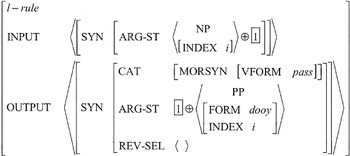
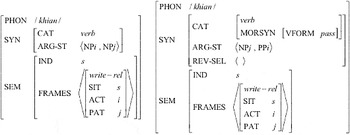
The analysis of the dooy passive in (47a) is straightforward: as a synthetically expressed predicate,Footnote [29] it has no reverse-selection requirement. The lexical rule relating the active and passive variants of khian ‘write’ can be represented as in Figure 14, and the respective lexical items are shown in Figure 15. The two lexical items contain identical frames, but differ in how the semantic roles in these frames map onto the syntax. In the active, the act maps onto the first NP in the arg-st list, while the pat maps onto the second NP: in the passive, it is the pat that maps onto the first NP, while the act is obligatorily expressed by a PP. As indicated by the empty list value of the rev-sel attribute of the passive verb, passive verbs formed by the rule in Figure 14 do not reverse-select for thuuk 2
Dooy passive lexical rule.

Active (left) and passive (right) khian ‘write’.

and this passive construction is thus not associated with adversity. Note that the need to associate the passive alignment with the (sole) verb in the dooy passive, and hence the requirement for creating a separate passive lexical item, lends support for our treatment of the adversative thuuk passive, where the grammatical relation assignments for the periphrastic passive are similarly associated only with a passive variant of a verb, as opposed to, say, the co-occurring thuuk: given that a lexical rule that operates on a single verb to change its grammatical relation assignments is independently required for creating the synthetic dooy passive, it is all the more plausible that the periphrastic adversative thuuk passive is created via a similar lexical rule, as we have proposed.
Unlike the dooy passive in (47a), the passive in (47b) does contain thuuk. On present assumptions, this means that the passive verb in (47b) must reverse-select for thuuk. Yet, like the dooy passive in (47a), and unlike the adversative thuuk passive, the passive in (47b) does not convey a sense of negative affect. This appears to create a challenge for our analysis of the adversative thuuk passive: if thuuk contributes the semantics of affectedness when reverse-selected by the passive verb, how can we explain the acceptability of (47b), which is not conceivable as expressing negative affect?
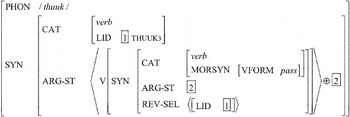
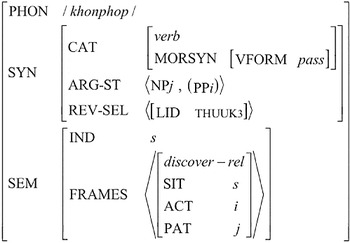
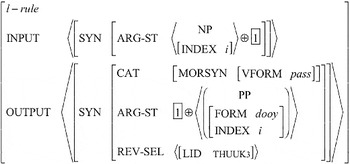
In this connection, it is important to highlight that the thuuk …dooy passive in (47b) is a recent innovation in Thai. The fact that it does not receive an adversative interpretation in the presence of thuuk, and that the act, when expressed, is introduced by dooy suggests that the thuuk …dooy passive is interpretable as a convergence of the two pre-existing passive constructions. Like the adversative thuuk passive, it contains the formal exponent thuuk; like the dooy passive, introduces the demoted act by dooy. In inheriting the properties of the other two passives, however, the thuuk …dooy passive also needs to reconcile their conflicting properties: (i) the thuuk passive is adversative whereas the dooy passive is not, and (ii) the syntactic expression of the demoted act is optional in the thuuk passive but obligatory in the dooy passive. This means that it is not possible for the thuuk …dooy passive to replicate all the properties of either construction. This being the case, it should not come as a surprise that thuuk, as used in the thuuk …dooy passive, is not the same thuuk as that used in the adversative thuuk passive. Recall that Prasithrathsint (Reference Prasithrathsint, Abraham and Leisiö2006) refers to this thuuk as a ‘neutral passive marker’. As a neutral marker, it does not possess the semantics of negative affect, and therefore needs to be listed as a separate lexical entry, as represented in Figure 16. In contrast to thuuk 2 in Figure 10, thuuk 3 in Figure 16 does not contain the semantics of affectedness: it is semantically empty. Like thuuk 2, however, thuuk 3 selects for a passive verb that reverse-selects for it, and inherits the arguments of the passive verb. The lexical item for the passive verb khonphop ‘discover’ in (47b) can then be represented as in Figure 17. The verb selects for a subject NP that is associated with the pat, and optionally, a PP associated with the act; it also reverse-selects for thuuk 3. The thuuk …dooy passive lexical rule is given in Figure 18.
Lexical entry for thuuk in the neutral thuuk …dooy passive (THUUK
 $_{3}$
).

Lexical item for passive khonphop ‘discover’.

Thuuk …dooy passive lexical rule.

While positing multiple synchronic lexical entries for the phonological form thuuk may seem like an unprincipled proliferation of lexical representations, the specific relations between these lexical entries actually reflects the grammaticalization of thuuk as a passive auxiliary, as documented by Prasithrathsint (Reference Prasithrathsint, Abraham and Leisiö2006). The diachronic trajectory is, thus, reflected in the synchronic relations among these lexical entries. As Prasithrathsint (Reference Prasithrathsint, Abraham and Leisiö2006: 125) argues, the adversative thuuk passive is relatable to a variant of the active verb where the subject is essentially a pat, such as in (4)/(42) – this is our thuuk 1. Over time, as a frequent collocate in syntactic expressions of negative affect, it acquired new arg-st requirements as a participant in the periphrastic adversative passive construction – this is thuuk 2. Though distinct from thuuk 1, thuuk 2 retains its semantics of affectedness, requiring its sole semantic argument to be identified with the pat of its complement verb. Finally, the verb loses its semantics and becomes a purely formal auxiliary marker of the passive, i.e. thuuk 3. Here, it is semantically bleached and simply retains its participation in the periphrastic passive construction. This development can be similarly understood in terms of Harris & Campbell’s (Reference Harris and Campbell1995) proposal to refine appeals to grammaticalization into several interacting and distinct processes. In particular, the adversative thuuk passive can be seen as combining the processes of reanalysis, whereby surface expression belies an underlying change in the relations among component parts, and actualization, whereby the underlying changes are gradually reflected in the surface expression of the construction. Another aspect of their proposal that seems important for the present data is the simultaneous existence of related constructions, rather than the replacement by an innovative construction of its source.
G. Anderson (Reference Anderson2011) observes in a discussion of cross-linguistic auxiliary verb constructions that semantic ambiguity of the sort exemplified by thuuk is ‘in fact an expected consequence of the grammaticalization process, where original and derived interpretations are expected to co-exist, and may do so for a very long time in a given language’, and that this overlap ‘underscores the fact that grammaticalization is a process with a diachronic dimension with expected periods of potential ambiguity’ (Reference Anderson2011: 817–818). The diachronic dimension concerning the development from an independent verb to an auxiliary in a periphrastic lexical construction further enhances relations with languages containing periphrastic passives such as German and Hungarian, discussed in Ackerman & Webelhuth (Reference Ackerman and Webelhuth1998), among others.
G. Anderson also observes that the course of grammaticalization does not simply end when a lexical verb comes to be used as an auxiliary. He presents the following developmental path, demonstrating that verbal affixes may be derived from former auxiliary verb structures (Reference Anderson2011: 818):

Though this is a less likely trajectory in a classically ‘isolating’ language like Thai, there is some evidence that thuuk sometimes does evince affixal behavior: Prasithrathsint (Reference Prasithrathsint, Abraham and Leisiö2006: 125) observes that there are some neutral passives such as thuuk thaam ‘to be asked’ and thuuk pit ‘to be closed’, where nothing can be inserted between the component verbs. She suggests that thuuk and the verb have become morphologically synthetic in these cases, where thuuk has, in effect, become a prefix. While such fixed formations are consistent with the general trend we observe for Thai, there is no evidence to suggest that this is a productive process. Moreover, given the probabilistic nature of grammar change and the essentially isolating profile of the Thai grammar system, we cannot predict that Thai will ever trace the full trajectory in (48) and reach a state in which prefixal passive formations become the norm.
4.3 Synthesis, periphrasis and syntax
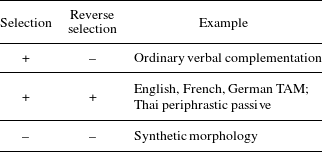
The analysis that we have developed locates the adversative thuuk passive construction in the partial taxonomy of constructions found in natural languages shown in Table 1. The space defined in this identifies a classification from purely syntactic combinations through periphrastic constructions to synthetic words. As can be seen, when a matrix verb simply selects for a complement, this is expressed by familiar syntactic verbal complementation constructions. When there is both syntactic selection by a verb and a co-occurring verb with reverse-selection specification, this entails language-particular variants of periphrastic predicates: as demonstrated by Bonami & Webelhuth (Reference Bonami and Webelhuth2013), the selected complement is a VP in English TAM constructions, but a verbal complex in German and a lexical verb in French. Finally, when there is neither a syntactic complementation requirement nor a lexical stem that specifies syntactic co-occurrence, this is realized by the familiar complex synthetic word. It remains to be observed that these interactions define a space that can be populated by a great variety of reflexes in natural languages. Some of the nuances of these realizations are presented in G. Anderson (Reference Anderson2011), Steever (Reference Steever1993) and Wagner-Nagy (Reference Wagner-Nagy2011), among others.
Cross-classification of selection and reverse selection.

5 Conclusion
We have argued that the basic analysis proposed by Bonami (Reference Bonami2015) provides the type of morphological and syntactic assumptions for dealing with the morphology–syntax interface in a manner that permits appropriate adaptations to address cross-linguistic variety in the realization of both inflectional and derivational periphrasis. In accordance with construction-theoretic and lexicalist approaches to grammar analysis, the proposal provides explicit formal mechanisms for dealing with strong parallelisms between ordinary syntactic expression and periphrastic syntactic expression when this is empirically motivated: it also allows language-particular specification for realizations of lexical constructions when no such evidence is available.
In summary, on this account of the Thai adversative thuuk passive, the novelty of the proposal resides in the explicitness with which it facilitates the interaction between periphrastic morphology and syntax; it is conservative, however, from a word-based morphological perspective, in reflecting the basic assumption that periphrastically derived lexemes are lexical constructions (see Ackerman & Webelhuth Reference Ackerman and Webelhuth1998). In this respect, it is distinguishable from lexicalist proposals such as Kathol (Reference Kathol, Nerbonne, Netter and Pollard1994), Butt (Reference Butt1995), Alsina (Reference Alsina1996) and Abeillé et al. (Reference Abeillé, Godard, Sag, Hinrichs, Kathol and Nakazawa1998), in which grammatical relation assignments are effected in the syntax where the pieces of the relevant elements have access to one another. This renders periphrastic compositions as having a purely syntactic status, without a joint morphological status: while this permits morphology to remain exclusively the domain of synthetic words, these proposals do not participate in the exploration of morphology–syntax interfaces that seek to relate the periphrastic predicates familiar from Word and Paradigm morphological analyses to their realization in phrasal syntax. These two types of approaches, syntactic composition vs. morphological formation, often account equally well for the relevant data, so they are sometimes not clearly distinguishable in their descriptive scope. However, they reflect commitments to quite different perspectives on morphological theory and, thereby, lead to different research questions.Footnote [30]
As with inflection, derivation expressed by periphrasis can be interpreted as lexicalized syntactic exponence (Bonami & Webelhuth Reference Bonami and Webelhuth2013). Both obvious and sometimes subtle differences between inflection and derivation should not obscure certain essential similarities across these two morphological types. First, as observed in traditional morphological literature (Robins Reference Robins1959; Curme Reference Curme1960; Matthews Reference Matthews1970, Reference Matthews1991), they can both be expressed by synthetic and periphrastic expressions. This, of course, is not surprising since both are the result of diachronic development, whereby the auxiliary verbs are often transparently related to independent verbs in the language: this is as true for inflection as for the derivational instances examined here. In effect, our proposal reflects the assumption that the Thai passive construction is a reuse of old parts for new purposes, and that this has parallels in many construction types cross-linguistically. In particular, the component pieces of the constructions are independently attested lexical/morphological entities that get recombined in ways that produce more than would be expected (or even permitted) by a simple composition of all the information associated with them individually: new constructions emerge via the recombination of independent elements within the grammar system.Footnote [31] Moreover, from the perspective of Thai, it is worth observing that the periphrastic predicate fits into the general system of predicate expression types attested in the language: there are many other periphrastic expressions of predicates other than passive, but in each case, one must be careful to distinguish periphrasis from syntactic combination.Footnote [32] Second, the lexical constructions associated with periphrasis in both inflection and derivation can be straightforwardly interfaced with language-specific phrasal constituency. An analysis along these lines raises a large typological question that we cannot address here, namely, what the actual taxonomy of constraints on the realization of periphrastic predicates look like. While it is clear that there is a class of languages where the constraints on realization reflect ordinary syntax, the nature of constraints on syntactic encoding and the ensuing effects on the variety of possible syntactic realizations are far less clear in languages where this does not obtain. On the other hand, adoption of this perspective on the morphology–syntax interface encourages further empirical investigation into additional variation as well as the development of theoretical analyses that can account for the resulting typology.