Introduction
Tonsillectomy is amongst the most performed surgical procedures in the UK, with over 50 000 operations annually.1 The primary indication for tonsillectomy is recurrent tonsillitis and associated complications.1 Post-tonsillectomy haemorrhage represents the most severe complication and can be classified into primary (<24 hours post-operatively) or secondary (>24 hours post-operatively) haemorrhage. A 2005 national audit reported a 3.8 per cent post-tonsillectomy haemorrhage rate (primary, 0.6 per cent; secondary, 3.3 per cent), but this may be significantly underestimated.2, Reference Milner, Hilmi, Marshall and MacKenzie3 In severe cases, surgical arrest of haemorrhage is required (1 per cent).2 Numerous risk factors for post-tonsillectomy haemorrhage have been evaluated, with surgical technique, male gender, increasing age and surgeon experience implicated.2, Reference Windfuhr, Chen and Remmert4, Reference Ordemann, Hartzog, Seals, Spankovich and Stringer5
Obesity is an important peri-operative risk factor across surgical practice. It is used for surgical risk-stratification in orthopaedic and gastrointestinal surgery, as well as being a component of anaesthetic stratification.Reference Kivrak and Haller6 In the UK, obesity prevalence is rising, with 26.2 per cent of English adults classified as obese in 2023, rising from 22.6 per cent in 2016.7 In obesity, increased visceral fat and decreased airway compliance can be responsible for respiratory complications that can challenge anaesthetic care.Reference Azizad and Joshi8 Furthermore, obesity is associated with impaired wound healing and infection.Reference Pierpont, Dinh, Salas, Johnson, Wright and Robson9
The relationship between obesity and post-tonsillectomy haemorrhage in adult patients remains unclear.Reference Ramesh and Abraham10 Limited retrospective studies have shown conflicting evidence regarding post-tonsillectomy haemorrhage risk in overweight patients, with a paucity of evidence in a solely adult cohort.Reference Windfuhr, Chen and Remmert4, Reference Riechelmann, Blassnigg, Profanter, Greier, Kral and Bender11–Reference Akin, Holst and Schousboe14 This study aimed to examine post-tonsillectomy haemorrhage incidence and severity, and all peri-operative complications in overweight versus normal weight adults.
Methods
Study design
A retrospective observational study was performed at a single health board. The study obtained Caldicott approval in accordance with the Data Protection Act (1998) for handling of person identifiable data within the National Health Service (NHS) in Scotland. The Strengthening and Reporting of Observational Studies in Epidemiology guideline was followed in the design and reporting of this study. The need for research ethics committee review was assessed using the online tool developed by the Medical Research Council and the NHS Health Research Authority, and was not required for this study.15
Power calculations
Power calculations were undertaken using an anticipated post-tonsillectomy haemorrhage incidence of 5 per cent within the normal population and 10 per cent in the overweight population, based on prior studies.2, Reference Hoshino, Tanigawa, Yanohara, Murotani, Horibe and Murohara12, Reference Kshirsagar, Mahboubi, Moriyama, Ajose-Popoola, Pham and Ahuja16 The largest study analysing the effect of obesity on post-tonsillectomy haemorrhage reported an odds ratio of 2.1 for post-tonsillectomy haemorrhage in obese patients.Reference Kshirsagar, Mahboubi, Moriyama, Ajose-Popoola, Pham and Ahuja16 An alpha value of 0.05 and a beta value of 0.2 were used. Sample sizes needed to detect a difference were calculated to be 434 within the body mass index (BMI) less than 25 and BMI greater than 25 groups.
Definitions
Post-tonsillectomy haemorrhage
Post-tonsillectomy haemorrhage was defined as any haemorrhagic episode after extubation, identified either during the initial post-operative hospital admission or on return to hospital. Patients who did not present to our health board were unable to be captured as post-tonsillectomy haemorrhage within this study. Post-tonsillectomy haemorrhage was categorised according to severity: conservative, haemorrhage able to be controlled without taking the patient to the operating theatre; surgical, haemorrhage requiring surgical arrest of post-tonsillectomy bleed under general anaesthesia. Time to post-tonsillectomy haemorrhage was defined as the number of days to the initial bleed.
Treatment for post-tonsillectomy haemorrhage
For patients with multiple post-tonsillectomy haemorrhage and admissions, the highest intervention required to arrest the bleeding was considered as the true management of their post-tonsillectomy haemorrhage. For a patient with multiple post-tonsillectomy haemorrhages, where two episodes were managed conservatively and one episode required operative management, surgical arrest was recorded as the intervention required.
Body mass index
Patients were divided into 4 categories based on BMI: underweight (BMI < 18.5 kg/m2), normal weight (18.5 < BMI < 25 kg/m2), overweight (25 < BMI < 30 kg/m2) and obese (BMI > 30 kg/m2).
Day-case procedure
A day-case procedure was defined as patient discharge from hospital on the same calendar date as the operation.
Patient selection
Electronic clinical records were reviewed to identify all adult patients who underwent tonsillectomy at NHS Greater Glasgow and Clyde within two distinct time periods: 1 January 2015 to 1 June 2017 and 1 January 2021 to 1 June 2023. The following further exclusion criteria were applied: tonsillotomy, coblation use, unilateral tonsillectomy and malignant tonsillar disease.
Data collection
The data collected included patient demographics, surgical indication, surgeon experience, operative technique, anaesthetic complications (including difficult intubation), intra- or post-operative hypoxia, post-operative intensive care stay and length of in-patient stay. The characteristics of post-tonsillectomy haemorrhage identified were incidence, severity, timing and clinical management.
Statistical analysis
Continuous variables were analysed using the Mann–Whitney U test or Spearman correlation because these variables did not conform to a normal distribution as per the Shapiro–Wilkes normality test. The chi-square test was used for all categorical variables. To study the association between BMI and post-operative complications, univariate and multivariate logistic regression models were used. For categorical analysis, patients in different BMI categories were compared to those of normal weight. All potential confounders (age, gender, surgical indication, dissection method, surgeon experience and anaesthetic complications) were entered to ensure an unbiased estimate in the regression model. In our model, electrical dissection techniques were compared with cold steel dissection, and training surgeons were compared with consultant-operated procedures. Results are reported as odds ratio with a 95 per cent confidence interval (CI). A p value less than 0.05 was considered statistically significant. All statistical analysis was performed using RStudio Integrated Development for R (version 2023.03.0+386; RStudio, Boston, MA, USA).
Results
Patient demographics
Overall, 1073 patients were initially identified and 78 patients (7.3 per cent) were excluded (malignancy, 58 patients; unilateral tonsillectomy, 15 patients; paediatric, 5 patients). A total of 995 patients were analysed. The mean BMI was 26.47 ± 5.54. The most common indication for tonsillectomy was recurrent tonsillitis. Nearly half of tonsillectomies were undertaken by cold steel dissection (n = 474, 47.4 per cent). Table 1 displays the baseline patient and surgical characteristics.
Patient and surgical characteristics by PTH status

Table 1 Long description
The table compares patient and surgical characteristics based on post-tonsillectomy haemorrhage status. Key findings include a higher percentage of males in the PTH group and a notable use of electrocautery-only dissection among PTH patients. Age and BMI distributions are similar across groups, with no significant differences in mean values. Most patients underwent tonsillectomy due to infective reasons, with recurrent tonsillitis being the most common indication. Surgeon experience varied, with a slightly higher proportion of trainees performing surgeries in the PTH group. The dissection technique shows a significant difference, with PTH patients more likely to have had electrocautery-only procedures. These findings suggest potential factors influencing post-tonsillectomy haemorrhage risk, though further investigation is needed to confirm causality.
* Chi-square test, Fisher’s exact test, Mann–Whitney U test. †Underweight = BMI < 18.5, normal weight = 18.5 < BMI < 25, overweight = 25 < BMI < 30, obese = BMI > 30. PTH = post-tonsillectomy haemorrhage; SD = standard deviation; IQR = interquartile range; BMI = body mass index.
Post-tonsillectomy haemorrhage characteristics
A total of 193 post-tonsillectomy haemorrhage cases (19.8 percent) were recorded. Of these, 8.8 percent were primary post-tonsillectomy haemorrhage, 88.1 percent were secondary post-tonsillectomy haemorrhage, while 2.6 percent had both primary and secondary bleeds (Table 2). The median time to post-tonsillectomy haemorrhage was 5 days. Within the post-tonsillectomy haemorrhage cohort, 40 patients (20.1 per cent) were haemodynamically unstable, with 8 patients (4.1 per cent) receiving blood products. Management of post-tonsillectomy haemorrhage was largely conservative, with only 25 per cent of bleeds requiring surgical management (Table 2).
Peri-operative complications split by BMI categories*

Table 2 Long description
The table examines peri-operative complications across different BMI categories, focusing on post-tonsillectomy haemorrhage (PTH) rates, types, and management. PTH was most common in normal weight patients at 21.6%, while underweight patients had the lowest incidence at 15.2%. Secondary PTH was the predominant type across all BMI groups. Median time to PTH was consistent at 5 days for most groups, except underweight patients at 7 days. Haemodynamic instability was similar across BMI categories, with no significant differences. Conservative management was preferred for PTH, especially in obese patients. Day case rates were high across all groups, with minimal variation. Length of in-patient stay was generally short, with social reasons being the most common cause for extended stays. Anaesthetic complications were rare, with difficult intubation or ventilation occurring in overweight and obese patients.
* Underweight = BMI < 18.5, normal weight = 18.5 < BMI < 25, overweight = 25< BMI < 30, obese = BMI > 30. †Chi-square test, Spearman correlation, Fisher’s exact test. BMI = body mass index; PTH = post-tonsillectomy haemorrhage; IQR = interquartile range
Impact of body mass index on post-tonsillectomy haemorrhage
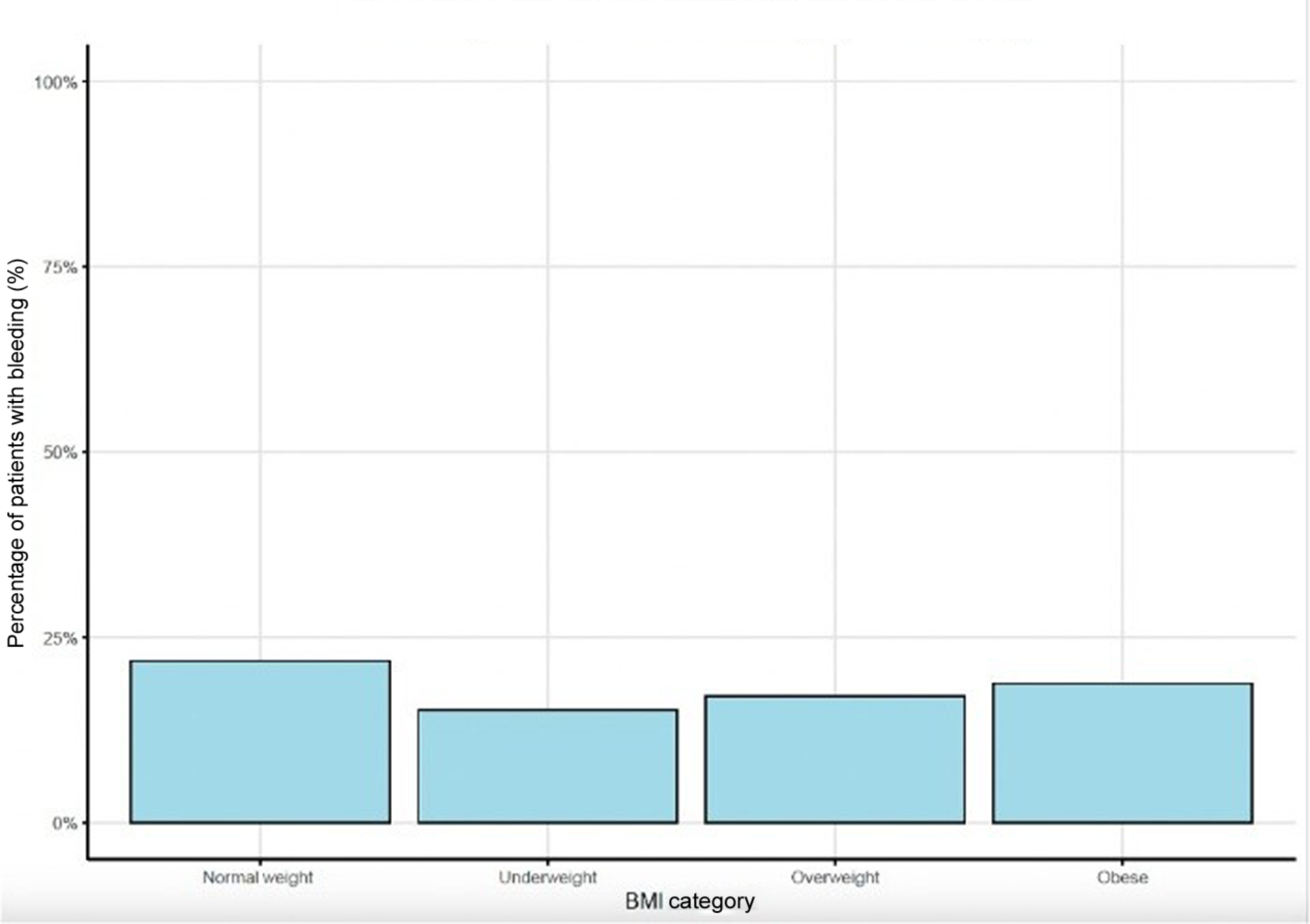
The incidence of post-tonsillectomy haemorrhage was similar across all BMI categories (Figure 1). The mean BMIs in the no post-tonsillectomy haemorrhage and post-tonsillectomy haemorrhage cohorts were 26.6 ± 5.6 and 26.1 ± 5.6 (p = 0.230). The BMI category was not significantly associated with the occurrence (p = 0.467), timing (p = 0.617) or severity of post-tonsillectomy haemorrhage (p = 0.568).
Regression analysis, adjusting for confounders, did not show any association between increasing BMI and post-tonsillectomy haemorrhage (odds ratio = 0.99, 95 per cent CI = 0.95–1.02) (Table 3). Figure 2 displays the post-tonsillectomy haemorrhage rate across all BMI values. Overweight (odds ratio = 0.77, 95 per cent CI = 0.51–1.15) and obese (odds ratio = 0.78, 95 per cent CI = 0.50–1.22) categories were also not associated with increased post-tonsillectomy haemorrhage risk.
Percentage of patients with post-tonsillectomy haemorrhage by BMI category.

Figure 1 Long description
A bar graph illustrating the percentage of patients with bleeding across different BMI categories. The x-axis is labeled 'BMI category' and includes four categories: normal weight, underweight, overweight and obese. The y-axis is labeled 'Percentage of patients with bleeding (percent)' and ranges from 0 percent to 100 percent. Each category has a bar of similar height, indicating a comparable percentage of patients with bleeding across all BMI categories.
Percentage of patients with post-tonsillectomy haemorrhage by BMI value.

Figure 2 Long description
The graph shows the percentage of patients with bleeding plotted against BMI values, rounded. The x-axis is labeled 'BMI (rounded)' and the y-axis is labeled 'Percentage of patients with bleeding (percent)'. Data points are scattered across the graph and a trend line runs through them, indicating a general decrease in bleeding percentage as BMI increases. The graph includes a shaded area around the trend line, representing the standard deviation within the data. .
Univariable and multivariable logistic regression analyses for the association between BMI and post-tonsillectomy haemorrhage

Table 3 Long description
The table presents univariable and multivariable logistic regression analyses examining the relationship between body mass index and post-tonsillectomy haemorrhage. Key findings include a significant association between male sex and increased haemorrhage risk, with an adjusted odds ratio of 1.71. Additionally, the unknown dissection technique is significantly associated with higher risk, with an adjusted odds ratio of 3. Other variables, such as continuous body mass index, age, and anaesthetic complications, do not show significant associations. The analysis adjusts for factors like age, sex, surgical indication, dissection technique, surgeon grade, and anaesthetic complications. The results suggest that sex and dissection technique are important factors in post-tonsillectomy haemorrhage risk.
* A multivariable logistic regression model adjusted for age, sex, surgical indication, dissection technique, surgeon grade and anaesthetic complication. Although continuous BMI was tested with all variables, the p values shown for all other variables are from the model that included categorical BMI. †Statistically significant (p < 0.05). BMI = body mass index; CI = confidence interval
Wider variable impact on post-tonsillectomy haemorrhage
Multivariate analysis showed male sex (odds ratio = 1.71, 95 per cent CI = 1.13–2.57) and unknown dissection technique (odds ratio = 3.00, 95 per cent CI = 1.64–5.54) were associated with increased incidence of post-tonsillectomy haemorrhage.
Age (odds ratio = 0.99, 95 per cent CI = 0.96–1.01), infective indication (odds ratio = 1.109, 95 per cent CI = 0.70–2.56), solely electrocautery dissection (odds ratio = 1.04, 95 per cent CI = 0.66–1.62) and anaesthetic complications (odds ratio = 1.82, 95 per cent CI = 0.24–10.18) did not have a significant impact on post-tonsillectomy haemorrhage incidence (Table 3).
Peri-operative complications
It was found that 86.3 per cent of patients underwent a day-case procedure. A total of 136 patients (13.7 per cent) were admitted following tonsillectomy, with a median length of stay of 1 day. Admission details are given in Table 2. The BMI category had no significant association with the likelihood of in-patient stay post-tonsillectomy (p = 0.682). Spearman correlation showed a weak positive non-significant correlation between increasing BMI and length of in-patient stay (p = 0.290, rho = 0.33).
A small number of patients had recorded peri-operative anaesthetic complications, with the most common complications being difficult intubation or ventilation (n = 4, 0.41 per cent) or oral trauma (n = 3, 0.31 per cent). A mild non-significant increase in respiratory complications was seen in the overweight and obese patients compared with the normal weight patients (p = 0.064).
Discussion
Tonsillectomy is one of the most performed surgical procedures in the UK across all age groups.1 There have been numerous studies in paediatric populations examining complications and the presence of causative risk factors. Obesity has been identified as a risk factor for paediatric patients undergoing tonsillectomy, and as a result patients with high BMI have been identified as requiring their procedure within a unit equipped with paediatric intensive care.1
In comparison, the association of BMI with post-tonsillectomy complications within the adult population has been less well examined, with an extremely limited number of studies solely focusing on adults. To the authors’ knowledge, this is the largest study to date assessing the effect of BMI in the adult population, and it demonstrates that obesity is not significantly associated with post-tonsillectomy haemorrhage.
This study identified a post-tonsillectomy haemorrhage rate of 19.8 per cent. Although earlier UK-based literature reported considerably lower rates (3.8 per cent),2 our findings are consistent with more recent retrospective and prospective UK studies evaluating tonsillectomy outcomes that have demonstrated post-tonsillectomy haemorrhage rates ranging from 19 to 20 per cent.Reference Milner, Hilmi, Marshall and MacKenzie3, Reference Riggin, Ramakrishna, Sommer and Koren36 Our study did not show a relationship between increasing BMI category and the incidence, severity or timing of post-tonsillectomy haemorrhage. Inuzuka et al. demonstrated similar findings in 325 adult patients.Reference Inuzuka, Mizutari, Kamide, Sato and Shiotani13 Including paediatric cohorts, there are numerous studies that have also found no link between BMI and post-tonsillectomy haemorrhage.Reference Windfuhr, Chen and Remmert4, Reference Ordemann, Hartzog, Seals, Spankovich and Stringer5, Reference Riechelmann, Blassnigg, Profanter, Greier, Kral and Bender11, Reference Akin, Holst and Schousboe14, Reference Gross, Lindburg, Kallogjeri, Molter, Molter and Lieu17–Reference Spektor, Saint-Victor, Kay and Mandell21 The largest of these, by Windfuhr et al., evaluated a multitude of risk factors in 15 218 patients of all ages, but in this study 91 per cent of patients were under the age of 9 years.Reference Windfuhr, Chen and Remmert4
There is conflicting evidence, however, with a limited number of studies showing obesity increases post-tonsillectomy haemorrhage risk.Reference Hoshino, Tanigawa, Yanohara, Murotani, Horibe and Murohara12, Reference Kshirsagar, Mahboubi, Moriyama, Ajose-Popoola, Pham and Ahuja16, Reference Burckardt, Rebholz, Allen, Cash and Goldman22 Hoshino et al.Reference Hoshino, Tanigawa, Yanohara, Murotani, Horibe and Murohara12 evaluated a series of 98 patients older than 12 years and found that post-tonsillectomy haemorrhage incidence was significantly higher in obese patients. Kshirsagar et al. evaluated 139 000 paediatric patients and showed post-tonsillectomy haemorrhage was twice as likely to occur in obese children.Reference Kshirsagar, Mahboubi, Moriyama, Ajose-Popoola, Pham and Ahuja16 In these studies, the total number of post-tonsillectomy haemorrhage cases in both studies was limited, at 19 cases (19.4 per cent) and 156 cases (0.1 per cent), respectively.
An explanation for different outcomes in our study from those in Hoshino et al. may be that given their limited sample size and only six cases of post-tonsillectomy haemorrhage in obese patients, their study had inherent bias, limiting our ability to statistically evaluate the impact of BMI on post-tonsillectomy haemorrhage.Reference Hoshino, Tanigawa, Yanohara, Murotani, Horibe and Murohara12 Furthermore, including patients above 12 years, rather than 16 years, may have included cases that were inherently excluded from our study.
Whilst a large series, Kshirsagar et al. did not evaluate any other risk factors for post-tonsillectomy haemorrhage, which, combined with the limited incidence of post-tonsillectomy haemorrhage, raises the possibility of other confounding variables affecting the resulting analysis.Reference Kshirsagar, Mahboubi, Moriyama, Ajose-Popoola, Pham and Ahuja16 Additionally, the haemorrhage rate of 0.1 per cent is significantly below the typical post-tonsillectomy haemorrhage rate presented in other literature and our own study, and raises concerns regarding data capture.2, Reference Milner, Hilmi, Marshall and MacKenzie3
Finally, it is important to highlight the difference between paediatric and adult populations when assessing post-tonsillectomy haemorrhage risk. The tonsillectomy indications, post-tonsillectomy haemorrhage rates and risk factors have been demonstrated to differ between adult and paediatric populations, highlighting the need to assess these cohorts in isolation, as done in our study.1, Reference Heward, Rocke, McNally, Thompson, Oladokun and Timms23–Reference Kim, Koo, Ahn, Lee and Kim25
Our study results conflict with the known effects of obesity on wound healing and infection.Reference Pierpont, Dinh, Salas, Johnson, Wright and Robson9, Reference Thelwall, Harrington, Sheridan and Lamagni26 Obesity is proposed to cause poor wound healing through relative avascularity of adipose tissue, resulting in increased oxidative stress, ischaemia and subsequent infection. Low serum iron and albumin in obesity is also proposed to impair wound healing through relative hypoxia and reduced collagen production.Reference Pierpont, Dinh, Salas, Johnson, Wright and Robson9 The tonsillar beds and oropharynx are low in large amounts of avascular adipose tissue, in contrast to the abdominal cavity.
Furthermore, the dorsal lingual artery, ascending palatine artery, facial artery and ascending pharyngeal artery, among others, all vascularise the tonsillar beds. The resulting high levels of oxygenated nutrient-rich blood may explain why obesity does not impact wound healing following tonsillectomy in a similar fashion to other surgical procedures. These rich vascular supplies may also explain why BMI does not appear to significantly influence overall rates of medical complications, surgical complications or flap failure in head and neck free flap reconstruction.Reference Crippen, Brady, Mozeika, Eloy, Baredes and Park27
Increasing age, electrocautery dissection, male sex, recurrent tonsillitis and obstructive sleep apnoea (OSA) have been implicated in increased post-tonsillectomy haemorrhage risk.Reference Milner, Hilmi, Marshall and MacKenzie3, Reference Windfuhr, Chen and Remmert4, Reference Akin, Holst and Schousboe14, Reference Aldrees, Alzuwayed, Majed, Alzamil, Almutairi and Aloqaili18, Reference Kwok, Subramaniyan, Rimmer and Karahalios19 Our study demonstrates that males have an increased risk of post-tonsillectomy haemorrhage. Previously postulated hypotheses for this have been a reduced anti-inflammatory effect of oestrogen on wound healing and increased alcohol intake predisposing males to an increased risk of bacterial complications.Reference Inuzuka, Mizutari, Kamide, Sato and Shiotani13
Dissection technique has been demonstrated to impact on haemorrhage rates, particularly the use of ‘hot techniques’.Reference Söderman, Odhagen, Ericsson, Hemlin, Hultcrantz and Sunnergren28 This study highlighted there was a higher bleeding risk amongst those patients where the dissection technique was unknown. Further analyses were performed in these cohorts, but no clear demographic or clinical differences were identified. The significant variability demonstrated in the literature, and this study, on the effect of dissection technique highlights the need for high-quality standardised documentation in one of the UK’s most common operations.
Prior studies on paediatric populations have shown a significant association between obesity and anaesthetic complications during tonsillectomy: difficult intubation, respiratory complications, intensive care stay and post-operative in-patient stay.Reference Gross, Lindburg, Kallogjeri, Molter, Molter and Lieu17, Reference Gleich, Olson, Sprung, Weingarten, Schroeder and Warner29–Reference Tweedie, Bajaj, Ifeacho, Jonas, Jephson and Cochrane32 Obstructive sleep apnoea is a common indication for tonsillectomy in the paediatric population, and this cohort are known to be at risk of pulmonary oedema post-tonsillectomy, with this risk greatest among obese patients.Reference Sonsuwan, Pornlert and Sawanyawisuth33 Furthermore, chest wall fat deposits, decreased airway compliance and increased atelectasis have been proposed to account for the peri-operative respiratory complications seen in obese patients.Reference Azizad and Joshi8 With these considerations in mind, the British Association of Paediatric Otolaryngologists has recommended that children with BMI above the 98th percentile are not suitable for day-case procedures, regardless of OSA or polysomnography results.34
In adults, a threshold of BMI greater than 46 has been identified with an increased risk of 30-day respiratory complications, and in UK practice obese patients are more likely to be admitted for airway monitoring post-tonsillectomy.Reference Ramesh and Abraham10 Within our study, obesity (BMI > 30) was not significantly associated with increased likelihood or length of in-patient stay post-tonsillectomy. There was a mild increase in the proportion of respiratory and anaesthetic complications as BMI category increased, but this was not significant (Table 2). Of note, only 6 patients (0.6 per cent) had BMI > 46 within our cohort, with none experiencing 30-day major cardiorespiratory or anaesthetic complications.
There are several limitations to our study. Firstly, retrospective data collection limited the number of variables studied and the ability to control for confounding factors. For example, operative notes were not standardised, limiting the collection and subsequent analysis of the impact of operative technique on post-tonsillectomy haemorrhage within our cohort. Secondly, the post-tonsillectomy haemorrhage cases recorded in this study were patients who returned to our hospital. This may have underestimated the number of post-tonsillectomy haemorrhages. Some patients may have had small, self-limiting bleeds at home and chosen not to attend hospital. Additionally, patients may have presented to other hospitals, but because our region is a relatively centralised ENT service, we anticipate patients would most frequently present or be referred for admission to our centre. Lastly, non-steroidal anti-inflammatory drug and post-operative steroid administration were not included in our study design, but recent meta-analyses have demonstrated no significant impact of these variables on post-tonsillectomy haemorrhage risk.Reference Titirungruang, Seresirikachorn, Kasemsuwan and Hirunwiwatkul35, Reference Riggin, Ramakrishna, Sommer and Koren36
• Numerous risk factors for post-tonsillectomy haemorrhage have been evaluated, with surgical technique, male gender, increasing age and surgeon experience identified as contributing variables
• Limited retrospective studies have shown conflicting evidence regarding post-tonsillectomy haemorrhage risk in overweight patients, with a paucity of evidence in a solely adult cohort
• This is the largest study to date assessing the effect of body mass index (BMI) in the adult population and it demonstrates that obesity is not significantly associated with post-tonsillectomy haemorrhage occurence, timing or severity.
• A patient’s BMI should be considered in the context of their overall anaesthetic risk, but overweight patients do not appear to be at increased risk of surgical complications following tonsillectomy
• Further large-scale prospective research studies in adult patients are required to determine the impact of all variables on post-tonsillectomy haemorrhage risk as well as peri-operative medical complications
Conclusion
This cohort adult study suggests increasing BMI is not associated with a higher incidence of post-tonsillectomy haemorrhage. A patient’s obesity should be considered in the context of their overall anaesthetic risk, but these patients do not appear to be at increased risk of surgical complications following tonsillectomy. Our study also highlights the need for standardised tonsillectomy documentation, particularly dissection technique, to enable subsequent analysis of this variable on post-tonsillectomy haemorrhage risk. Further large-scale prospective research studies in adult patients are required to determine the impact of all variables on post-tonsillectomy haemorrhage risk as well as peri-operative medical complications.
Acknowledgements
Thanks to the Biorobertson Centre for Statistics, Glasgow, for their expertise when performing statistical analysis. The academic activities of CD are supported by a Chief Scientist Office NHS Research Scotland Fellowship and a Medical Research Council Clinical Academic Research Partnership award.
Competing interests
None declared.