Introduction
One of the biggest challenges faced by agriculture is susceptibility to natural occurrences. Pests and plant diseases, which are part of the ecosystem and its natural process, are among the most important constraints in the production of marketable products in general, especially in the production of leafy vegetables such as cabbage, collards and other cole cropsReference Francis, Smith and Shepard1. To address this need, many pest management research efforts have been undertaken by the United States Department of Agriculture (USDA), in the areas of biological control, integrated pest management (IPM), invasive species and pesticide application2. Of these, pesticide application has been a popular, conventional risk mitigating practice employed by farmers as it has usually been proven to be relatively inexpensive, easy, and effective in meeting market demands for blemish-free crops.
Meanwhile, consumers have become increasingly concerned about healthy lifestyles and the health risks posed by crops grown using synthetic pesticidesReference Gandhi and Snedeker3–Reference Govindasamy, Italia and Rabin5. In response to consumers’ rapidly growing demand for healthy food options and producers’ inability to employ pesticide-free growing methods without significant yield losses, IPM offers a compromising solution that reconciles the contrasting consumer's concerns and farmers’ production goals. Hence, IPM has become a viable alternative and a great tool in transition to organic farming. IPM lowers pesticide application and at the same time controls pest infestations. As the focus of IPM is on prevention, avoidance, monitoring and suppression of pests, chemical pesticides are used only where and when these measures fail to keep pests below damaging levels6. Therefore, pest identification and the use of pesticide action thresholds to signal spraying actions is an essential component of IPM.
Information needed on pest identification and pesticide action thresholds are gathered through scouting, making this practice crucial. Scouting with a fixed number of plants to make a decision has been the conventional practice of farms. However, a major criticism by producers was that the method was too time-consumingReference Smith and Shepard7. Thus, more often than not, farmers tend to do it inefficiently or totally skip the process and go directly to spraying. This contention was confirmed by J.P. Smith, a county extension agent of Lexington, South Carolina, based on his interactions with his farmer clientele (April 2007). This defeats the purpose of IPM.
In 2005, Smith and Shepard designed a new way to scout the fields and called the process binomial sequential sampling method (sequential scouting method (SSM))Reference Smith and Shepard7, 8. They applied it on collard fields, the most economically important vegetable crop in Lexington County, South Carolina where lepidopteran pests, mainly the diamondback moth and the cabbage looper are major constraints to production. The fixed sample size used by Lexington County farmers in the conventional method for scouting in collard farms is 100 samples. Smith and Shepard found at least 75% reduction in the required samples shifting from conventional sampling (CS) to sequential sampling. The latter method was found to be more time efficient and equally precise as the conventional method. The complete description of the method can be found in the IPM for Cabbage and Collard: A Grower's Guide Reference Francis, Smith and Shepard1. The study recommendations contend that it will significantly reduce production costs and ultimately increase net benefits to farmers. There has been, however, no published empirical work that can support such an assertion.
This study is designed to address the lack of empirical evidence to establish the efficiency and reliability of the non-conventional scouting method. Specifically, this study will address issues of relative cost efficiency of the SSM vis-à-vis the conventional scouting alternative. Financial analytical tools are employed to evaluate comparative cost efficiencies of the two scouting methods on traditionally operated farms. Findings of this research will potentially benefit producers by enhancing their understanding of the financial viability of their farms under the SSM method.
Data and Methodology
Since pesticides are used frequently in collard production and the application cost per acre is high9, Reference Ferreira10, scouting makes more sense and somehow can be viewed as a substitute input to pesticides. Especially in the cases where the scouting decision is not to spray, scouting costs displace pesticide costs, which in most of the cases are a better trade-off. This presents a whole new set of potentials in production where the total variable cost (TVC) curve shifts downwards, providing possibilities for bigger profit margins.
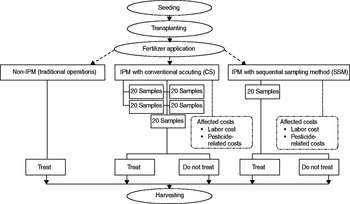
To evaluate and compare the effects of CS and SSM under IPM on traditional farms, an experiment using these methods was designed to gather data on the number of labor hours spent, biocontrol or pesticide applications, changes in amount of pesticides used and related items that were further reflected to costs affected. The amount of farm output and other farm-related data were also collected in an effort to replicate and extend the Smith and Shepard study using economic analysis. These records were also used to verify the production and economic data used to develop the Clemson Extension enterprise budget, which is a decision tool popularly used by extension farmer-clients. A schematic diagram explaining the flow of the experiment and comparison of the methods is shown in Figure 1. The diagram also presents information on the number of samples required for each IPM method. The two scouting methods are embedded in the standard production process from seeding to harvesting. Basically, two different methods of pest protection (non-IPM (control) and IPM with CS (IPM-CS)) were compared with SSM (IPM-SSM).The economic comparisons of these methods were kept at the level of whole farm operations in order to account for all relevant and necessary farm costs and determine the overall effect of potential fluctuations in the market price on farm profitability.
Schematic diagram of the difference in the three methods as a process in planting.

The experiment was conducted in one of the biggest collard farms in Lexington County, South Carolina, which is ranked first among the 46 states and among the 3078 US counties in collard production11. Two parcels of land measuring around 1.62 ha per parcel were planted with collards and the two different scouting methods were used on each area. The experiment covered an entire cropping season of 16 weeks in 2007.
To verify the claim that affected inputs account for a vital reduction of farm expenses and that the corresponding percentage of savings account for 75% reduction in scouting inputs (samples), the cost-effectiveness of the two scouting methods were analyzed using costs and returns analysis. The Clemson Extension Service enterprise budgets for collardsReference Ferreira10 were used in reflecting the changes in costs to gross and net revenues. These enterprise budgets are updated annually to reflect any technological, production changes that farmers should consider and accommodate annual movements in market price volatility. The 2006/2007 collard enterprise budget without any cost changes was used as the costs and returns per hectare for non-IPM farms and, for purposes of this analysis, is designated as the control system (converted from the per acre basis given in the original budget). The changes in costs were particularly reflected on the cost of pesticides (herbicide, insecticide and fungicide), tractor/machinery and the like. The net income per box or profit per box and breakeven price per box were specifically scrutinized in order to determine the required minimum increase in price of collards that would result in maintaining or enhancing farm profits, while employing the scouting activity. Cost savings were also considered, along with short-run production and costs that were used to determine breakeven and shutdown prices for different scenarios. In order to test for the robustness of this study's results, the analysis is extended to include some sensitivity analysis that paid particular attention to changes in farm profit in response to potential input and output price changes.
Results
The first of the three being compared, the non-IPM farms, carry out long-established operations especially when it comes to pesticide management. Over time, farmers subscribed to calendar spraying that protects the crop from pests, but at the same time imposes some negative externalities on the environment. Pesticides have become a substantial part of farm expenses and account for almost 10% of the TVC. Non-IPM farms do not perform any sort of needs assessment or scouting before spraying chemicals on the field. Since most of the operating farms carry out practices under non-IPM circumstances, the costs and returns for this farm were used as the basis of comparison for cost changes due to IPM with conventional practices and IPM with sequential sampling methods.
Alternatively, the two other farm systems fall under IPM and only differ by the scouting method they employed. Under CS, the scout took 100 samples per visit before arriving at a conclusion whether to spray or not to spray pesticides, while sequential sampling only require as few as 20 samples. Every time the scout visits the IPM-CS parcel, he also visits the IPM-SSM plots. On average, it requires 0.45 h or 27 min to obtain 100 samples and 0.16 h or 9.6 min to obtain 20 samples per visit for CS and SSM, respectively. Both methods arrived at the same decision for every visit, verifying the ability of the SSM to be precise with fewer samples and reduced scouting time. For the entire season, the total scouting time under the IPM-CS method took 4.01 h, compared with only 1.48 h that was needed to implement IPM-SSM.
Shifting from conventional to sequential scouting showed a decrease in scouting time. Overall, there is a mean of 59% reduction in time spent per visit, which is smaller than the 75% reduction in samples needed found by Smith and ShepardReference Smith and Shepard7. However, this measure could be skewed downward due to an outlier found in the data possibly from misreporting of data on the time sheet, such as conducting and reporting SSM results under CS records.
Changes in input costs attributable to conventional scouting
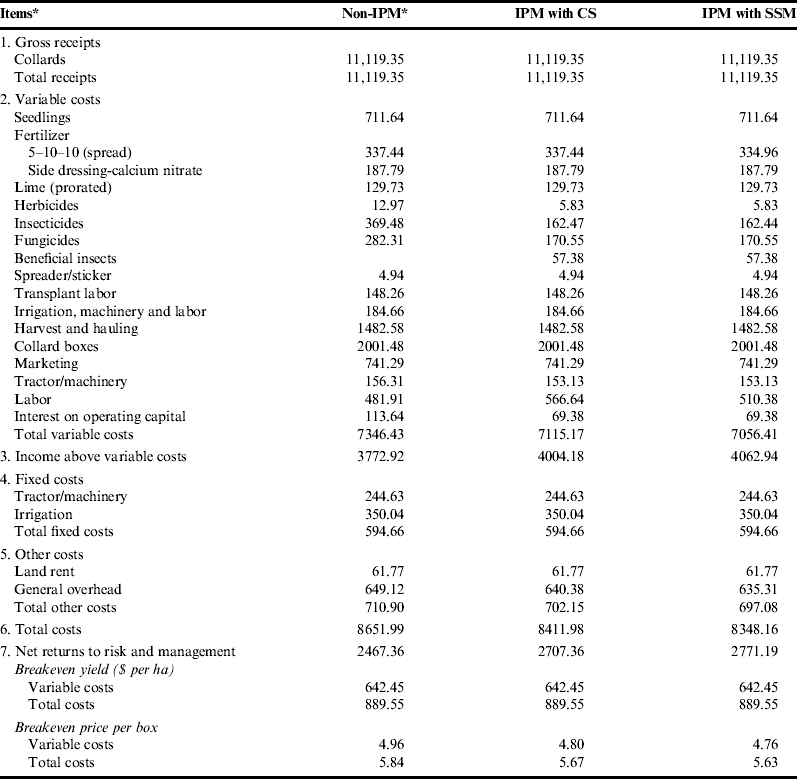
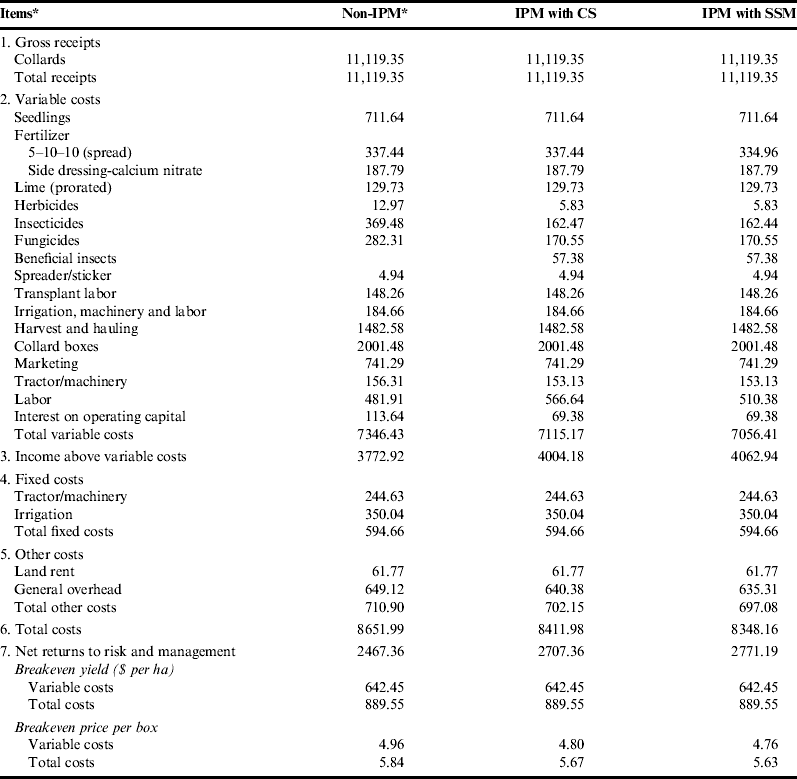
The costs and returns per hectare for a non-IPM farm are displayed in the second column of Table 1. The values under this column are adopted from the enterprise budget from the Clemson Extension Service for 2006/2007. The breakeven prices, i.e., the breakeven price per box for variable costs ($4.96 per box) and breakeven price per box for total costs (TC; $5.84 per box), were the ‘base prices’ used in comparing the breakeven prices calculated from other farm systems being analyzed.
Collards estimated costs and returns per hectare (irrigated-hand harvest), 2006/2007, 1483 boxes—(around 22.5 kg) harvested in October.
* The list of items and the values under the non-IPM column are adopted from the Clemson Extension Service—Enterprise Budgets, 2006/2007.
Most of the input costs differ for an IPM farm using conventional scouting. Its costs and returns per hectare are shown in Table 1 (third column). The variable costs affected were pesticides (herbicide, fungicide and insecticide) and other pest protection costs (beneficial insects), tractor/machinery, labor and interest on operating capital, while general overhead costs changed for the fixed costs. In general, the TC per hectare of producing under IPM with CS was lower than non-IPM farms.
Specifically, the herbicide, fungicide and insecticide costs were smaller due to less application of pesticides brought about by scouting. Different kinds and unit prices of pesticides affected the variation in costs and the use by farms of beneficial insects in place of other farm chemicals to protect the vegetables from damaging insects. Taken as a whole, the pesticide and pest related costs for the non-IPM farm was $664.76 per hectare, whereas for IPM on a CS farm, the cost was estimated at $396.22 per hectare, which represents a 40% reduction in pesticide costs ($268.54 per hectare). The tractor/machinery expenses were affected because of the reduction in the overall spraying time.
Labor cost is the expense most explicitly affected by the scouting method. The change in labor cost was the net effect of additional hours spent on scouting and smaller labor hours used in spraying. In total 4.01 scouting hours were added and 0.20 spraying hours were deducted from the quantity of labor used for non-IPM farms. To maintain the ceteris paribus assumption and maintain consistency with the current situation, the wage per hour used for all of the systems is $9.00 per hour per laborer. Overall, the added cost by labor as a result of scouting in the IPM-CS system was $84.73 per hectare.
Both interest on operating capital and general overhead costs changed due to changes in the input costs discussed above. First, the interest on operating capital is dependent on borrowed funds financing pre-harvest operation, which comprised costs on seeds, fertilizer and lime, pesticides, machinery repairs, fuel and others. In this case, since the pre-harvest operating cost was smaller in IPM with CS than non-IPM, the interest on operating capital was also smaller. Second, the general overhead cost varies with TVC. Since the net effect of IPM with CS in the system showed a decrease in variable costs, the general overhead cost also decreased as a result. This cost captures all other costs including utilities, telephone and emergencies. The interest rate assumed for both scenarios is 9% as used by the Clemson Extension Service.
Hence, the $44.26 and $20.81 disparity per hectare between non-IPM and IPM with CS for interest on operating capital and general overhead costs, respectively, were indirect effects of the changes in pesticide, tractor/machinery and labor costs.
Changes in input costs attributable to SSM
Costs affected by performing the SSM under IPM were the same as the costs affected by using the IPM with CS techniques. Amounts of changes in the costs of herbicides, fungicides, insecticides, tractor/machinery and interest on operating capital were exactly alike, except for labor and general overhead costs. This was expected because the greater accuracy of results obtained under the SSM vis-a-vis the conventional scouting results influences the amount of pest protection-related inputs used in the shortest amount of time.
No additional cost representing the amount related to acquiring the know-how to perform the new SSM was given because the Clemson University Cooperative Extension Service typically does not charge anything for training the farmers. However, in other situations, there might be a training cost to farmers or to supervisors. At this point, the cost associated with training a scout to learn the SSM technique is still unknown. Incorporating this in future analysis as well as accounting for various risk pressures is highly recommended to give a better picture of the scouting effects on the actual farm costs.
Instead of adding 4.01 h spent on scouting conventionally, only 1.48 h of scouting were added to the labor cost under the sequential method. As a result, the expenditure on labor only increased by $28.47 per hectare instead of $84.73 per hectare under the IPM with CS system. In addition, since the TVC were smaller, the general overhead costs decreased to $635.31 per hectare, $5.07 less than the general overhead costs of IPM with CS. Similar components of the overhead costs discussed in the previous section are affected in the same magnitude and direction as those in the IPM-CS system. The decrease in the overhead costs was an indirect effect of the lower labor costs under the IPM-SSM. The costs and returns per hectare of IPM-SSM farms are shown in Table 1 as well (Column 4).
Comparison of the net impacts of CS and SSM relative to non-IPM farms and between CS and SSM systems
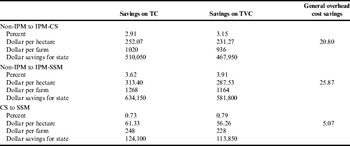
After identifying all the input costs affected by performing IPM with CS and SSM in the farm, the overall financial impacts in terms of the amount of savings in costs per hectare were summarized (Table 2). Evidently, there was a positive impact on shifting from non-IPM practices to IPM with scouting—both for conventional and sequential methods. However, it is obvious that the farm under SSM experiences higher savings amounting to $313.40 per hectare (3.62%) compared with a savings of $252.07 per hectare (2.91%) for CS in TC with a difference of $61.33 per hectare (0.73%). The savings per hectare for TVC of $287.53 (3.91%) for SSM and $231.27 (3.15%) for CS were consistent with the savings in TC. The difference in savings in TVC was $56.26 per hectare (0.79%). These percent reductions on savings are not comparable to the 75% reduction in samples needed; however, they could still have significant effects.
Savings between different systems by type of cost.

Solely considering the percentage changes, the savings do not appear appealing because the percentages seem minute, yet if taken as fraction of commercial production, these could account to significant dollar amounts. The differences in savings between TC and TVC for every system being compared were calculated and can be found in Table 2. The differences between TC and TVC for every scenario were simply the differences in the general overhead costs of the systems in comparison because the sole part of the fixed costs that changed for every system was the general overhead cost causing the variation in savings based on the type of cost.
Whole farm effect and state-level savings
The quantified percentage savings for both methods under IPM seems to be trivial because the per hectare figures are small. For this reason, the whole farm effect on savings was calculated to assess the impact on the grower. Using the average size of about 4 ha for plantings for collards per farm in Lexington County and 2023 ha of land planted with collards in South Carolina, the percentage savings were converted into per farm savings and total savings from collards at the state level (Table 2).
The per farm savings range from around $220 to $1270 while the savings in South Carolina considering that 2023 ha of land are planted with collards range from $114,000 to around $635,000 depending on the method being compared and the type of cost. These numbers provide sufficient evidence to say that the amount of savings derived were significant. It should be noted, however, that these results are limited to a 1-year, 1-farm sample, nevertheless the results of this preliminary step is crucial in realizing and communicating the advantages of adapting the SSM. Reproduction of the study with more sample replications is highly recommended for future work.
Sensitivity analysis
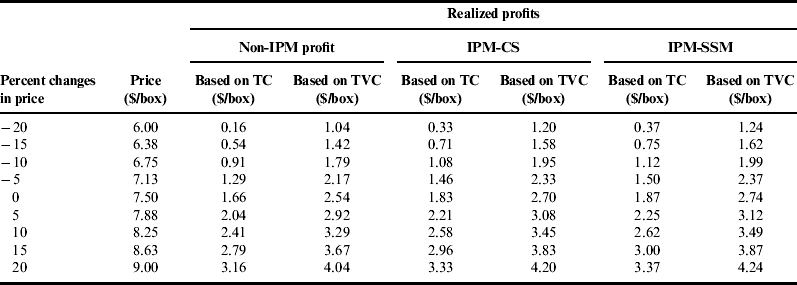
Responses of profit on potential changes in market prices were studied. The profit per box of collards grown under the non-IPM system using the sales price of $7.50 per box were $1.66 per box based on TC and $2.54 per box based on TVC (returns above variable costs). These are the baseline profits to be used as the basis for changes in profitability. Realized profits under the three systems at different price levels were obtained and are shown in Table 3.
Sensitivity analysis on profit.
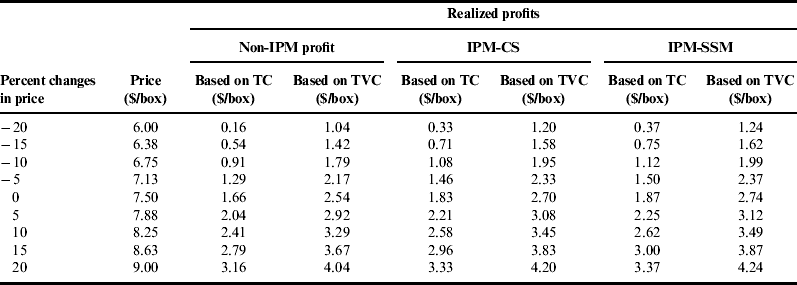
At a sales price of $7.50 per box, which is basically the no-change in price scenario, it is evident that the profits under IPM-CS and IPM-SSM were higher than the baseline profits mentioned above. In fact, the profits of the two systems under IPM were all higher than the non-IPM farm profit at all price levels. This shows that IPM improves farm profitability by eliminating unnecessary pesticide costs.
Nevertheless, looking closely at the figures, it can be noted that the profits from IPM with SSM are higher than the profits from IPM with CS at all price levels. The $1.83 profit per box under IPM with CS could be stretched to $1.87 per box under IPM with SSM. Thus, in terms of financial benefits among the three systems in comparison, production under IPM with SSM is better than the other systems. IPM with SSM is the optimal choice for profit maximization.
The least prices needed by the CS and SSM systems that can yield a higher profit and their corresponding percent changes relative to the sales price of traditional farms are calculated. All of the minimum prices required to have a higher profit than the traditional farm are lower than $7.50 per box. This suggests that CS and SSM systems can generate a higher profit than non-IPM produce at lower prices. More importantly, the necessary percent changes for the minimum prices are negative, which accommodate a 2 and 3% decrease in sales price for IPM-CS and IPM-SSM, respectively, and still generate a higher profit.
Summary and Conclusions
Gradual alteration of the whole farming system to an environment friendly production is a very protracted process. Breakthroughs in farm activities toward the transition away from chemical-based inputs bring agriculture one step closer to its desired goal of being sustainable, which entails not only environmental health but also economic profitability and social and economic equity12. Working toward this goal, three pest protection methods were compared in this study, namely non-IPM, IPM-CS and IPM-SSM. Results confirmed that IPM with CS and IPM with SSM are both cost-effective and provide savings to the farm. The latter has higher savings as a result of the reduced scouting time required under SSM, thus lowering labor costs for the farm. Both represent improvements over traditional systems and, thus, offer both positive environmental and economic benefits to the farming business. These production methods can be reliable tools for farms that are in transition to sustainable farming.
More importantly, given the volatility of prices and market conditions, positive and negative shocks on sales price were analyzed to determine the capability of the suggested methods to accommodate possible positive and negative price changes. This analysis contends that both methods under all scenarios analyzed are able to sustain a decrease in sales price of at least 2% greater than traditional systems. This is a robust characteristic and only adds to the quality of the two methods. Matching up IPM with CS and IPM with SSM, the latter was proven to be more cost-effective and considered the option with the best potential to optimize the farm's profit-generation capability.
Subsequent application of the SSM to other production systems, specifically to other brassica crop production in the south, has great potential and is highly recommended. Specifically, this scouting method could be highly beneficial to the production of other leafy greens for instance, turnip greens, mustard greens, kale and other cole crops that are affected by similar pests.
Acknowledgements
This project was supported by IPM—Collaborative Research Support Program, Southeast Asia Regional Program. We are very thankful to Dr Powell Smith who helped us in the collection of data for economic analysis.