Introduction
Long-term alcohol abuse may result in cognitive disorders. It is estimated that about half of the people seeking treatment for alcohol addiction have cognitive deficits (Rourke & Grant, Reference Rourke, Grant, Grant and Adams2009). Cognitive disorders may appear long before alcohol-induced neurological symptoms are visible and may have important negative consequences for treatment success and everyday functioning (Rourke & Grant, Reference Rourke, Grant, Grant and Adams2009). Cognitive disorders can be the result of the direct effects of long-term alcohol abuse, such as the toxic action of alcohol itself or the consequences of abrupt alcohol withdrawal, and by indirect effects of alcohol use, like thiamine deficiency or liver cirrhosis (Bodani, Reed, & Kopelman, Reference Bodani, Reed, Kopelman, David, Fleminger, Kopelman, Lovestone and Mellers2009). These cognitive disorders include memory deficits, visuospatial impairment, attention deficits and executive dysfunction, but the extent to which these domains are affected varies greatly. About 10 per cent of people with alcohol addiction develop severe cognitive disorders, such as Korsakoff's syndrome (Rourke & Grant, Reference Rourke, Grant, Grant and Adams2009). Victor, Adams and Collins (Reference Victor, Adams and Collins1989) described this syndrome as ‘an abnormality of mentation, in which memory and learning are affected out of proportion to other cognitive functions in an otherwise alert and responsive patient’.
In some cases of chronic alcoholism, the severity of memory impairment resembles the deficits seen in alcoholics with Korsakoff's syndrome, which led to the continuity hypothesis reflecting a continuum of cognitive impairment, ranging from normal at the one extreme to very severe deficits at the other. The continuity hypothesis assumes a dose–response relationship between frequency, quantity and duration of alcohol intake on the one hand and brain dysfunction and cognitive impairment on the other (Bowden, Reference Bowden1990; Ryan & Butters, Reference Ryan and Butters1980; Ryback, Reference Ryback1971). Also, in their overview paper, Sullivan and Pfefferbaum (Reference Sullivan and Pfefferbaum2009) indicated that chronic alcohol abuse in itself resulted in volume reduction of the diencephalon (mammillary bodies and thalamus), hippocampus, pons and cerebellum, ranging from mild or moderate in those with ‘uncomplicated’ alcoholism, to severe in those with Korsakoff's syndrome. This finding was later confirmed by Pitel et al. (Reference Pitel, Chételat, Le Berre, Desgranges, Eustache and Beaunieux2012), who reported a similar pattern of grey and white matter volume reduction in a group of 34 uncomplicated alcoholics and 11 Korsakoff patients, although the volume reduction in the diencephalon was more pronounced in the latter group.
In clinical practice it is important to distinguish patients with permanent alcohol-related cognitive deficits from patients who may show partial or full cognitive recovery. That is, the prognosis of non-Korsakoff alcoholics with cognitive disorders is more favourable in the case of long-term abstinence (Wilson, Reference Wilson2011). This abstinence, combined with tailor-made treatment programmes, generally results in improved cognitive functioning, leading to permanent abstinence and more successful everyday functioning (i.e., independent living). In contrast, alcoholics with Korsakoff's syndrome require a different therapeutic approach, that is, a treatment programme that fits their severe memory disorders, improves their social functioning and, at best, prepares them for living in sheltered accommodation (Ganzevles, de Geus & Wester, Reference Ganzevles, de Geus and Wester1994).
With targeted treatment in mind, it is important that neuropsychological assessment provides a reliable estimate of the difficulties patients may encounter during rehabilitation, at home or in occupational settings. A wide variety of neuropsychological tests is available to examine memory functioning, such as word-list learning tests like the California Verbal Learning Test (CVLT) or the Rey Auditory Verbal Learning Test (RAVLT). However, the ability of a standard memory test to predict everyday memory functioning (often referred to as ecological validity) has been questioned (Wilson, Reference Wilson1993). The Rivermead Behavioural Memory Test (RBMT) has been developed to detect everyday memory deficits and monitor changes over time (Wilson, Cockburn, Baddeley, & Hiorns, Reference Wilson, Cockburn, Baddeley and Hiorns1989). Its variety of ‘real-life’ subtests may also provide more insights into the underlying nature of the everyday memory problems. So far, only one study examined the discriminating capability of the RBMT subtests directly comparing two patient groups (Glass, Reference Glass1998). That retrospective analysis of RBMT subtest scores in a clinical sample of 74 dementia patients demonstrated significant differences between patients with vascular dementia and patients with non-vascular dementia on four of the RBMT subtests, i.e., Appointment, Route Recall, Story Recall and Message. However, RBMT subtests use single-trial presentations after which the total number of correctly recalled or recognised items is recorded as the outcome measure. In contrast, repeated presentation of trials in standard tests such as the CVLT provide information that can be used to estimate a learning curve, which may be a more sensitive measure than the total number of items recalled (Strauss, Sherman, & Spreen, Reference Strauss, Sherman and Spreen2006). Also, standard tests make a more systematic comparison between free and cued recall possible, which is lacking in the RBMT.
Although both standard memory tests and ecologically valid tasks have their own strengths and weaknesses, studies directly comparing these are scarce. To our knowledge, only one study exists in which both the RBMT and the CVLT were administered simultaneously. However, that study (Quemada et al., Reference Quemada, Cespedes, Ezkerra, Ballesteros, Ibarra and Urruticoechea2003) focused on the rehabilitation outcome of a small sample of patients with traumatic brain injury and did not directly compare the tests’ diagnostic accuracy. In another study (Pérez & Godoy, Reference Pérez and Godoy1998), the RBMT was found to be as robust as the Wechsler Memory Scale-Revised (WMS-R) in the ability to discriminate patients with Alzheimer's disease or epilepsy from older controls with or without memory complaints. A similar observation was made by Koltai, Bowler and Shore (Reference Koltai, Bowler and Shore1996) in patients exposed to neurotoxics, showing similar diagnostic accuracy for the RBMT and the WMS-R. More detailed comparisons at a subtest level may provide insight into the sensitivity of specific subtests in the assessment of patients with alcohol-related cognitive disorders.
The aim of the present study was to make a direct comparison between the RBMT and the CVLT at a subtest level, using three groups of patients, that is, patients with alcoholic Korsakoff's syndrome (KS), patients with chronic alcoholism and cognitive impairments (CI) who do not fulfil the criteria for KS, and ‘uncomplicated’ patients with alcoholism who do not have cognitive impairment (ALC). Specifically, we investigated which (sub)test contributes to a better discrimination between the KS and CI group and between the CI and ALC group.
Method
Participants
In this study, 233 patients were included. All participants were inpatients of a psychiatric treatment facility in Venray, The Netherlands, specialised in neuropsychological assessment and treatment of patients with alcohol-related cognitive impairments. One hundred and thirty-six of the participants in this study were diagnosed with Korsakoff's syndrome (KS), 73 with alcohol-related cognitive impairments (CI) not fulfilling the criteria for KS and 24 participants had a history of alcohol abuse, but no cognitive impairments (ALC). The KS patients fulfilled the DSM-IV-TR (American Psychiatric Association, 2000) criteria for alcohol-induced persisting amnestic disorder (code 291.1) for which a memory deficit had to be present that results in severe deficits in social functioning, in the absence of delirium or dementia, with a history of alcohol-abuse disorder. In addition, the criteria for alcoholic Korsakoff's syndrome (Kopelman, Reference Kopelman2002) had to be met, which included evidence for a history of Wernicke encephalopathy, confabulation behaviour and history of malnutrition or thiamine deficit. The CI group had a history of chronic alcoholism (DSM-IV-TR code Alcohol Dependence, 303.90) and fulfilled the DSM-IV-TR criteria for cognitive disorder not otherwise specified (DSM-IV-TR code 294.9). The ALC group had a history of chronic alcoholism (DSM-IV-TR code Alcohol Dependence, 303.90), but no cognitive impairments. All diagnoses were made using a multidisciplinary approach supported by medical history, psychiatric assessment, neuropsychological testing and neuroradiological findings, and all patients had been abstinent for alcohol for at least 6 weeks. Neuropsychological testing covered all other major cognitive domains, including memory (Rey Complex Figure Test, in addition to the RBMT and CVLT), intelligence (Wechsler Adult Intelligence Test – Third Edition (WAIS-III), National Adult Reading Test), speed of processing and executive function (Behavioural Assessment of the Dysexecutive Syndrome, Trail Making Test, Stroop Colour-Word Test, Tower of London) and working memory (WAIS-III Working Memory Index), using validated Dutch versions of these established tests (for a description of each test, see Lezak, Howieson, Bigler, & Tranel, Reference Lezak, Howieson, Bigler and Tranel2012). None of the patients had any evidence of brain abnormalities that could account for their condition, apart from atrophy or white-matter lesions associated with the chronic alcohol abuse. None of the participants met the proposed criteria for alcohol-related dementia (Oslin, Atkinson, Smith, & Hendrie, Reference Oslin, Atkinson, Smith and Hendrie1998) and none of the participants had any hearing problems, language or communication deficits, or visual agnosia that could confound the performance on memory tests.
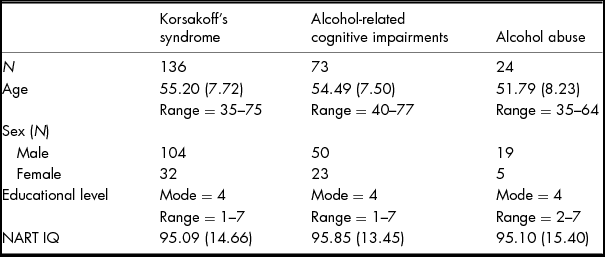
The mean age of the sample was 54.6 years (range 35–77 years). Table 1 presents the demographic information regarding the three groups. One-way analysis of variance did not reveal significant age differences (F(2,230) = 2.01, p = .14) between patients with KS, CI or ALC, or significant group differences on a premorbid intelligence measure (F(2,224) = .07, p = .93), the National Adult Reading Test (NART). Also, no significant group differences were found on sex distribution (χ2(2) = 1.91, p = .39) or educational level (χ2(2) = .61, p = .74).
Demographic Information of Patients with Korsakoff's Syndrome, Cognitive Impairments and Alcohol Abuse
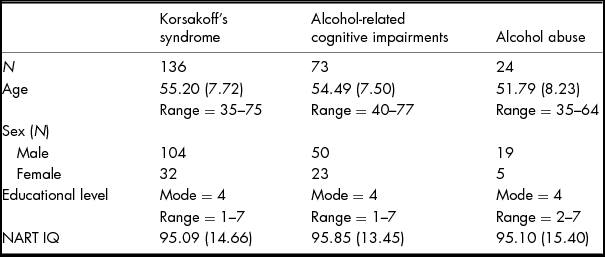
Educational level was scored using 7 categories in accordance with the Dutch educational system. These ordinal scores equal approximately the following number of years of education as used in Anglo-Saxon countries: Level 1, incomplete primary education: 1–5 years; Level 2, primary education: 6 years; Level 3, incomplete lower secondary education: 7–8 years; Level 4, lower general secondary education: 7–9 years; Level 5, vocational education: 7–10 years; Level 6, higher general secondary/higher vocational/pre-university education: 7–16 years; Level 7, academic degree: 17–20 years.
NART, National Adult Reading Test.
Materials
Rivermead Behavioural Memory Test
The Rivermead Behavioural Memory Test (RBMT) was designed to be an ecologically valid everyday memory test (Wilson et al., Reference Wilson, Cockburn, Baddeley and Hiorns1989). A Dutch version of the RBMT has been developed by Van Balen, Westzaan and Mulder (Reference Van Balen, Westzaan and Mulder1996), which was used in this study, and was found to have adequate psychometric properties that are equivalent to those of the original UK version. By mapping memory abilities essential for adequate daily functioning, the RBMT aims to provide meaningful information regarding therapy (Van Balen et al., Reference Van Balen, Westzaan and Mulder1996; Wilson et al., Reference Wilson, Cockburn, Baddeley and Hiorns1989). The RBMT consists of 14 subtests, measuring a variety of everyday memory skills: remembering a name (first and second name), a hidden belonging, an appointment, a news story (immediate and delayed recall), a route (immediate and delayed recall), delivering a message (immediate and delayed recall), recognising pictures and faces, orientation in time and place, and recollection of the date. The subtests encompass verbal memory, visual memory and visuospatial memory in immediate, delayed and prospective (recollection of something that needs to be done) conditions. Both intentional as well as incidental learning is required and both cued and uncued recall tests are used. For every subtest a raw score, standardised profile score and screening score were obtained using the Dutch normative data set. Raw scores range between 0 and 21, with a maximum total score of 93. Raw scores have been converted into standardised profile scores and screening scores using the test's manual. Standardised profile scores range from 0 to 2 per subtest (reflecting an impaired, borderline or unimpaired performance, respectively), with a maximum total score of 24 (Van Balen et al., Reference Van Balen, Westzaan and Mulder1996; Wilson et al., Reference Wilson, Cockburn, Baddeley and Hiorns1989).
California Verbal Learning Test
The California Verbal Learning Test (CVLT; Delis, Kramer, Kaplan, & Ober, Reference Delis, Kramer, Kaplan and Ober1987) was developed to measure impairments in learning and remembering of new verbal information in patients with acquired brain damage during four stages of learning: encoding, consolidation, retrieval and recognition. The Dutch version (Mulder, Dekker, & Dekker, Reference Mulder, Dekker and Dekker1996) was used in the current study, which also has good psychometric properties. The CVLT involves the oral presentation of a 16-word (shopping) list with items from four semantic categories (List A) over five immediate-recall trials. An interference list (List B) is also presented for one immediate-recall trial, followed by short-delay free-recall and cued-recall tests of list A, a long-delayed free recall and cued recall of list A and a recognition memory trial. The indices obtained include the level of correct recall over the various trials, learning strategies (e.g., semantic or serial clustering) and error types (e.g., intrusions and perseverations). In this study, the following measures were included: total score of list A (over five trials), rate of learning (trial 5 minus trial 1), rate of forgetting (trial 5 minus long-term free recall), short-term free recall, short-term cued recall, long-term free recall, long-term cued recall and recognition (hits minus false positives).
Procedure
All participants were examined by a psychiatrist, neurologist, general practitioner and a neuropsychologist, and the medical history and the history of alcohol abuse were reviewed. The complete neuropsychological examination was conducted after a period of minimally 6 weeks of abstinence for alcohol. Patients were tested individually during two test sessions on separate days. Testing was performed by trained assessors and took about 3 hours per session. Consensus on diagnoses was reached in a multidisciplinary meeting where all data from laboratory, neuroimaging, psychiatric and neurological investigation, clinical observations and neuropsychological assessment were evaluated.
Statistical Analyses
We performed a multivariate analysis of variance (MANOVA) to investigate whether there were significant differences between the three groups: patients with KS, CI and ALC, on all 14 raw scores of the RBMT and 8 CVLT variables. The CVLT recognition scores of 15 patients with KS and 10 patients with CI were missing because of refusal of the patients to complete the test. These scores were replaced with the mean recognition score per group. To explore the relative contribution of the CVLT and RBMT variables to group discrimination, we performed a discriminant analysis that provides information about the underlying dimensions of the data.
Results
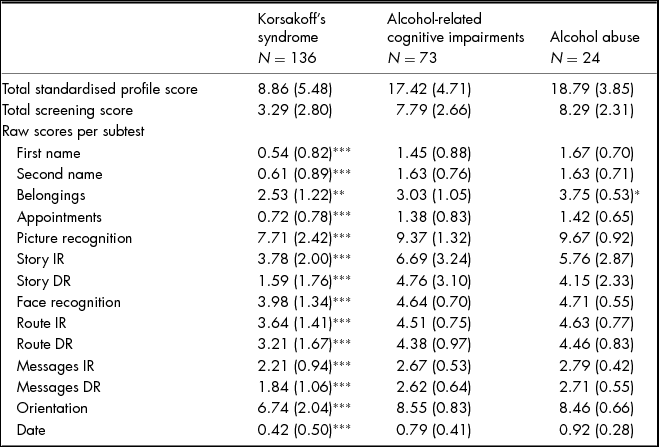
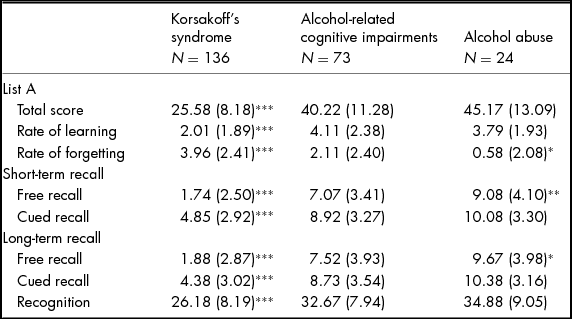
Tables 2 and 3 show the results on the RBMT and CVLT variables for the patients with KS, CI and ALC. A significant main effect for group was found on the RBMT and CVLT variables (F(44, 420) = 5.04, p < .05). Post-hoc comparisons were performed on the RBMT subtests and CVLT indices using Dunnett's test, with patients with CI as reference group. As expected, patients with KS performed significantly lower on all RBMT and CVLT variables (see Tables 2 and 3) than patients with CI. Patients with ALC achieved a significantly higher score than patients with CI on the RBMT subtest ‘belongings’, and obtained a significantly lower rate of forgetting and significantly higher scores on both immediate and delayed free-recall testing on the CVLT (see Tables 2 and 3).
Mean Scores and Standard Deviations of RBMT Raw Scores of Patients with Korsakoff's Syndrome, Cognitive Impairments (reference group) and Alcohol Abuse

*p < .05, **p < .01, ***p < .001.
RBMT, Rivermead Behavioural Memory Test; IR, immediate recall; DR, delayed recall.
Mean Scores and Standard Deviations of CVLT scores of Patients with Korsakoff's Syndrome, Cognitive Impairments (reference group) and Alcohol Abuse
*p < .05, **p < .01, ***p < .001.
CVLT, California Verbal Learning Test.
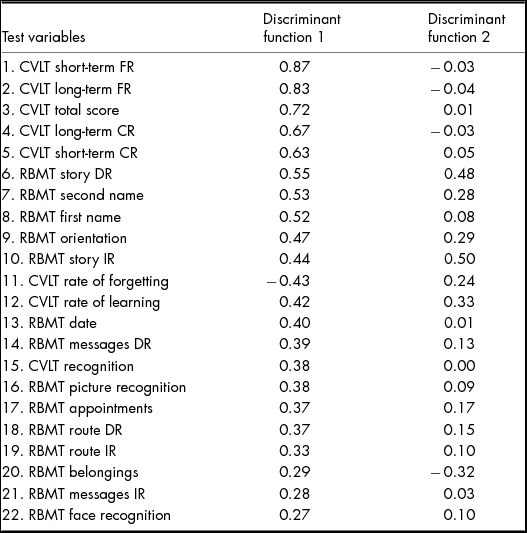
Discriminant analysis of the RBMT subtests and CVLT indices revealed two discriminant functions. The first function explained 89.3% of the variance, canonical R2 = .56, whereas the second function explained only 10.7%, canonical R2 = .13. In combination, these discriminant functions significantly differentiated the three patient groups, Wilks’ Lambda = .38, χ2(44) = 210.77, p < .05, but removing the first function indicated that the second function did not significantly differentiate the three groups, Wilks’ Lambda = .87, χ2(21) = 30.97, p = .07. The canonical structure, i.e., the correlations between the RBMT and CVLT variables and the discriminant functions are shown in Table 4. Coefficients higher than .40 were considered significant. The correlations between outcomes and the first discriminant function revealed that the CVLT variables contributed more to the prediction of group membership than the RBMT variables. Of the former, the most discriminating variables were free and cued recall, CVLT total score, and CVLT's rate of forgetting and rate of learning. The best discriminating RBMT variables were story recall, remembering a name, orientation and date. The correlations between outcomes and the second discriminant function indicated that, on top of the contribution of the first function, the subtest ‘story recall’ of the RBMT had an additional contribution to the prediction of group membership.
Canonical Variate Correlation Coefficients between the CVLT and RBMT Variables and the Discriminant Functions
CVLT, California Verbal Learning Test; RBMT, Rivermead Behavioural Memory Test; FR, free recall; CR, cued recall; IR, immediate recall; DR, delayed recall.
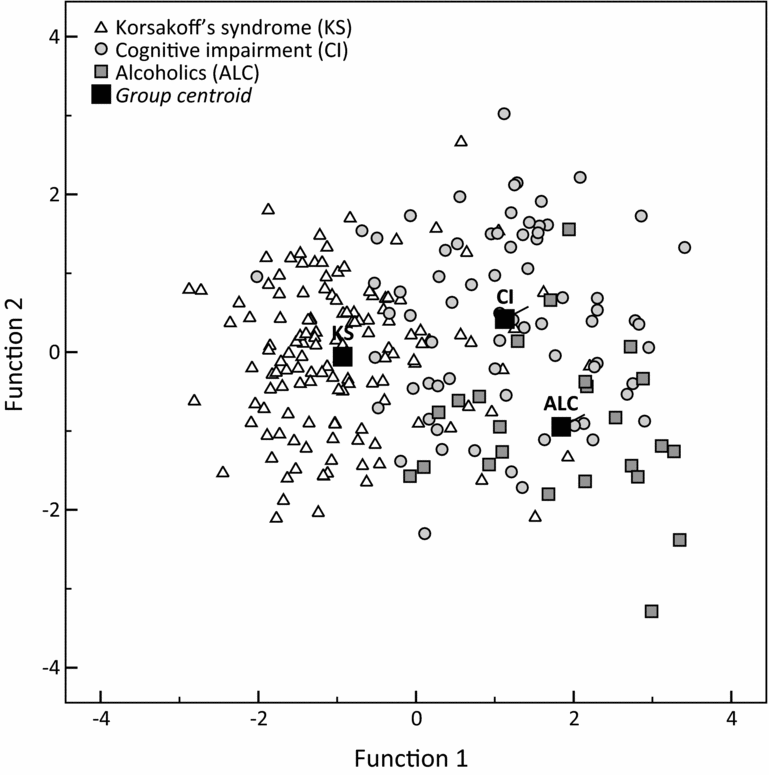
The discriminant function plot in Figure 1 showed that the first function discriminated patients with KS from patients with CI and ALC, and the second function differentiated the patients with CI from patients with KS and ALC. However, the combination of the two functions appeared to be most effective in predicting group membership.
Graphical representation of variate scores for each patient, grouped by diagnosis.
Discussion
This study compared the performance of patients with Korsakoff's syndrome, alcoholic patients with moderate to mild cognitive deficits, and alcoholic patients with no cognitive dysfunctions, on a ‘behavioural’ test (RBMT) and a ‘traditional’ test (CVLT). As expected, patients with KS performed significantly lower on all RBMT and CVLT variables than patients with CI. On the RBMT, ALC patients did not differ from the CI patient group, except for a significantly higher score on the RBMT subtest ‘belongings’. Previously, it has already been suggested that the RBMT may not be sensitive for identifying more subtle memory deficits (Lezak et al., Reference Lezak, Howieson, Bigler and Tranel2012). Still, the RBMT was able to discriminate moderate from severe memory impairments, as evident by the significant difference between KS and CI patients on all subtests. Comparing ALC and CI patients, using the CVLT showed that rate of forgetting was significantly lower for patients with ALC, and ALC patients also performed significantly better on short-term and long-term free recall. This pattern of ‘rapid forgetting’ is similar to what was found in the KS group, that is, decay from immediate to delayed testing. This result seems in contrast with previous studies on forgetting in KS patients, indicating impaired acquisition yet normal forgetting rates (Huppert & Kopelman, Reference Huppert and Kopelman1989; Martone, Butters, & Trauner, Reference Martone, Butters and Trauner1986). However, CVLT forgetting rate is assessed using free-recall tests, which are more susceptible for motivational factors or retrieval deficits than cued-recall or recognition tests. Indeed, the delayed cued-recall and recognition trials of the CVLT enhance the memory performance in KS patients, albeit that the performance is lower than those of the ALC and the CI groups. The discrepancy between free and cued recall/recognition is also evident in the CI group, who even obtained unimpaired scores on the cued recall and recognition trial.
A combination of two discriminant functions makes it possible to discriminate significantly between the three patient groups. Examining the relative contribution of the subtests to the first discriminant function also highlights that measures of free and cued recall of the CVLT are better at discriminating than recognition performance. With respect to the second discriminant function, immediate and delayed testing of a newspaper story (story recall) in the RBMT added to the discrimination of the groups. This subtest differs from the other subtests of the RBMT in that a large amount of information is presented in a free-recall format, in contrast to all other subtests that rely on recognition and/or have a limited information load. It also differs from the CVLT in that the information of the RBMT story recall is largely contextual in nature, in contrast to the single words of the CVLT. Although CVLT items can be semantically categorised, the contextual aspect of the RBMT story can be argued to have a stronger episodic component which determines the impairment in KS patients (cf. Kessels & Kopelman, Reference Kessels and Kopelman2012). In addition, prose recall relies on detailed information processing which requires more motivation and attention than other RBMT and CVLT subtests. Indeed, lowered motivation has previously been found to hamper the performance on prose recall tests in KS patients (Davidoff et al., Reference Davidoff, Butters, Gerstman, Zurif, Paul and Mattis1984). The CI and ALC groups did not differ on the RBMT story recall subtest, in agreement with previous studies (e.g., Ueckermann, Daum, Schlebusch, Wiebel, & Trenckmann, Reference Uekermann, Daum, Schlebusch, Wiebel and Trenckmann2003).
Apart from the story recall subtest, the RBMT subtests identified as most sensitive in the Glass (Reference Glass1998) study do not overlap with the subtests identified in the present discriminant analysis. However, the type of patients under investigation differs, i.e., two groups of dementia patients (who may both be severely cognitively impaired, see also Glass, Reference Glass1998) compared to severely amnesic KS patients and milder cognitively impaired alcoholic patients in the present study.
It should be noted that the present study has some limitations. First, the RBMT and the CVLT were part of the neuropsychological examination that partly supported the diagnostic outcome. However, it should be stressed that the diagnosis of KS and CI was not solely based on the RBMT and CVLT performance, but also took other cognitive domains into account, in addition to medical history and clinical functioning. Furthermore, our aim was to establish which subtests or indices of these tests were most sensitive to the diagnostic categories, while the clinical diagnosis was predominantly based on the memory tests’ overall scores. Still, future studies should compare behavioural and traditional memory tests independent of the diagnostic work-up of cognitively impaired patients. Another limitation is the relatively small sample size of the ALC group. However, the statistical power was sufficient to detect between-group differences, making our results reliable and valid.
In all, a combination of the RBMT subtests and the CVLT indices can be used to discriminate KS patients from alcoholic patients without cognitive impairment or with non-Korsakoff cognitive deficits. To distinguish cognitively impaired and unimpaired alcoholic patients who do not fulfil the criteria for KS, the discrepancy between immediate and delayed CVLT trials (i.e., rate of forgetting) as well as a comparison between free- and cued-recall testing on the CVLT appears the most informative. The RBMT subtests by themselves could not significantly discriminate those who were cognitively impaired from those who were unimpaired.
This insensitivity of the RBMT for more subtle memory impairments has led to a recent revision of this test, resulting in the RBMT-3, to overcome this insensitivity (Wilson et al., Reference Wilson, Greenfield, Clare, Baddeley, Cockburn, Watson and Nannery2008). Indeed, the Global Memory Index of this revised RBMT-3 – comparable to the RBMT total standard profile score – was better able to discriminate chronic alcoholics with and without cognitive impairments (Wester, Van Herten, Egger, & Kessels, Reference Wester, Leenders, Egger and Kessels2013). Also, compared to the RBMT, the RBMT-3 is less susceptible to ceiling and floor effects (Wester, Leenders, Egger, & Kessels, Reference Wester, Leenders, Egger and Kessels2013). While behavioural memory tests such as the RBMT may be useful in providing information about everyday memory problems, which can be used in tailoring cognitive interventions, our results show that traditional memory tests also provide valid diagnostic information.