That early modern Britain had a “petitioning culture” is well known. Addresses and petitions were gathered to acclaim the accession of monarchs, raise a grievance, launch legal appeals, and support parliamentary bills. In the 1640s, and again in the 1760s, petitions were signed by thousands of people to aid campaigns against the church and crown, and later in support of parliamentary reform and the abolition of slavery.Footnote 1 Historians have shown that the late Stuart period saw an outpouring of addresses and loyalist subscription campaigns, and that communities and interest groups petitioned Parliament frequently throughout the eighteenth century.Footnote 2 More recently, Scott Sowerby has used addresses to map support for James II's religious policies.Footnote 3 But these previous accounts have not systematically investigated the numbers subscribing to these petitions, the weight of opinion they reflected, and the ways in which petitioners legitimized and imagined their participation. Since the records of the House of Lords survived the parliamentary fire in 1834, its archive can provide systematic evidence of the extent of popular involvement in the petitioning of the Lords throughout the early modern period.
Petitions were submitted to Parliament and the Crown for a variety of reasons throughout the long eighteenth century. In the period covered by this article, 1688 to 1720, nearly four thousand petitions were made to the Lords. Broadly speaking, there were three main forms of petitioning.Footnote 4 First, the majority of petitions to Parliament were procedural in nature, and had only a small number of signatures. These petitions were not created to oppose policy, but to introduce private bills and legal appeals to the Lords.Footnote 5 The second form of petitioning is what I call large responsive petitions, and is the focus of this article. These are the petitions with more than twenty signatures that were supporting or contesting legislation already before Parliament. Between 1689 and 1720, a total of fifty-six thousand people signed one of the 330 large responsive petitions on legislative matters to the Lords.Footnote 6 William Pettigrew has estimated that the proportion of counter petitions rose from 1 percent of all petitions presented to Parliament in 1660 to 24 percent by 1713, making large responsive petitions an important feature of politics after 1689.Footnote 7 In order to differentiate the 330 petitions under investigation from those introducing business to Parliament, the adversarial addresses of the Episcopalians, political petitions of the Wilkites, and mass petitions of the Chartists, I refer to them as responsive petitions, as they were produced in response to legislation and were not initiating debates in the public sphere.Footnote 8 The third form of petitions, those concerned with constitutional and religious issues, were not presented to the Lords in this period.Footnote 9
This article examines the effect of the transformation of Parliament's role as a legislative marketplace after 1689 on the pattern of petitioning activity and the extent of public involvement in the signing of petitions. After 1689, parliamentary statutes increasingly replaced orders of the Privy Council, royal proclamations, and court judgments as the means by which interest groups regulated the British economy.Footnote 10 The central state was a reactive one, with most legislation reflecting the lobbying and petitioning of interest groups and individuals.Footnote 11 Petitioning allowed local communities to represent themselves to Parliament, bring legitimacy to its decisions, and reduce the tensions between the center and locality that created the instability of the seventeenth century.Footnote 12 In this form, petitioning offered a means for the middling and lower sorts to lobby for changes in policy, during what used to be seen as the “aristocratic century.”Footnote 13
Subscribing to large responsive petitions raised concerns across the political spectrum about the capacity of the public to be rational arbiters of policy disputes. The responses of parliamentarians to these concerns are the second focus of this article. Mark Knights has shown that contemporaries believed the partisan electoral conflicts in the late Stuart period had manipulated the public, who, consequently, could not be trusted to act in a rational way.Footnote 14 The divided nature of public opinion, the accusations of lying, and the alleged mercenary behavior of voters during elections raised questions about the capacity of the public to judge the claims of competing parties. In Knights's account, anxieties over the decay of public discourse and the decay of reasoned debate were among the factors resulting in the Septennial Act of 1716, which reduced the frequency of general elections from every three to every seven years.
Petitioning, even on local acts of Parliament, also raised concerns about misrepresentation, lying, and the participation of ignorant and poorer sorts. In response, MPs and peers attempted to regulate the public voice and encourage its expression through more consensual mechanisms. With the Tumultuous Petitioning Act of 1661 and the Riot Act of 1716, political elites sought to circumscribe petitioning and violent riot of the kind experienced during the upheavals of the 1640s and the “rage of party” in the late Stuart period. They encouraged instead a more deliberative politics, where petitioners would participate within limits and with regard to laws proposed by elites and middling sorts. Just as they participated less frequently in the election of MPs, the public was discouraged from commenting on constitutional and religious issues through petitioning. But parliamentarians were largely content for the public to comment on the local and specific matters that petitioners would have known through their everyday lives. This meant eighteenth-century Britain was still ruled by an oligarchy, but, in Paul Langford's words, “it was one which operated within a restricted framework and on a consensual basis; it accepted the priorities of a broadly bourgeois society.”Footnote 15 Petitioning provided a mechanism for the public to demonstrate where the public interest and majority lay, helping political elites to understand and manage the greater plurality of interests present in the eighteenth century. The weakening of oligarchy in the 1760s reflected a shift from petitioning as a “responsive” mechanism to one that initiated debates in the public sphere, as was the case in the campaigns of John Wilkes or the antislavery movement.
I begin by exploring the chronological and geographical distribution of large responsive petitioning from 1689 to 1720. I then consider the nature of restrictions on petitioning and ask why parliamentarians had an increasingly tolerant attitude to this form of public participation. I conclude with a discussion of the impact of petitioning on political culture, the role of the language of “interest,” and the nature of oligarchy in early modern Britain.
PATTERNS OF PETITIONING
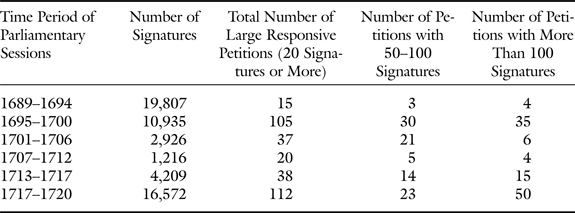
The 330 large responsive petitions presented to the House of Lords from 1689 to 1720 represent a significant increase from the levels of petitioning during the Restoration period, reflecting the more frequent meeting of Parliament and growth in its legislative business. Table 1 shows the chronological incidence of large responsive petitions to the Lords. There were two main prompts encouraging petitioning in this period. The first were the economic policies pursued in the postwar periods, namely bills dealing with the silk and wool industries in the late 1690s and trade with France and Spain during the 1710s. The second was the “working up [of] a temper” of parliamentarians into a “love of navigation” after the Treaty of Ryswick in 1697 and again between 1717 and 1722, when projectors funded “bubbles” in river and road improvement schemes.Footnote 16 The expansion of the number of projecting schemes in the context of the South Sea Bubble, together with the tensions of the “Calico Crisis,” were responsible for this outburst of petitioning after 1717; a decline in the frequency of general elections after the repeal of the Triennial Act was not its cause. Significantly, no large responsive petitions were sent to the Lords on religious issues in this period. It is probable that the frequency of general elections provided a more attractive forum for the expression of religious partisanship. Unlike debates on communication projects or economic regulation where divisions were based on the “clashing of interests” or local rivalries, religion was fundamental in the division between whigs and tories, and capable of being a determining factor in any electoral contest.Footnote 17
Chronological Distribution of Large Responsive Petitions to the House of Lords, 1689–1720

Sources: HL/PO/JO/10/1 Main Papers; HL/PO/JO/10/6 Main Papers; HL/PO/JO/10/3 Main Papers (Large Parchments), Parliamentary Archives (hereafter PA).
Note: There were two sessions in 1717; the second, which ran into 1718, has been counted in the last time bracket.
Knights has suggested that there may have been a shift from “innovative petitioning to a form of national acclamation” in the late 1710s, which threatened the growth of the public sphere and critical debate.Footnote 18 If this had occurred in isolation, it would indicate that because the public increasingly chose to sign addresses to demonstrate loyalty and allegiance to the government, the public's role as a regular and critical arbiter of policy disputes was weakened. However, table 1 suggests that extensive public mobilization continued, expanding the political nation and the extent of negotiation on policy. Responsive petitions to Parliament raised and maintained partisan divisions in periods when addresses were few in number, as they were in the early 1690s and the late 1710s, ensuring that “a civil war [rages] among neighbourhoods and societies,” though motivated by the “clash of interests,” rather than the “rage of party.”Footnote 19 There was no contraction in the number of large responsive petitions during the period from 1689 to 1720—a year that saw nearly seventy thousand people sign a petition to Parliament if petitions to the Lords are representative of petitions to the Commons. The hostile rhetoric against the “more violent and lasting heats and animosities among the subjects” found in the Septennial Act, the Riot Act, or against the Kentish petition of 1701 seems to have had little, if any, impact on the extent of public involvement in responsive petitioning.Footnote 20
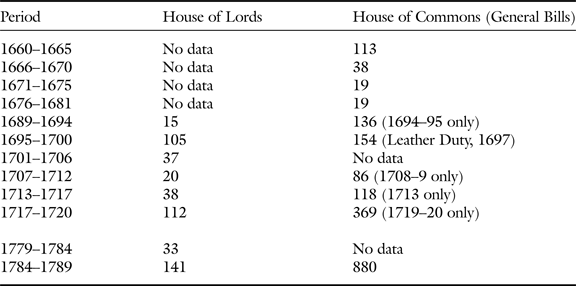
The pattern represented in table 1 can be seen only as suggestive of the general trend in large responsive petitioning. As Julian Hoppit has shown, most bills failed in the Commons, suggesting most petitioning would have occurred there, making the wider trend a different one.Footnote 21 For example, the national campaign against the leather duty saw 154 petitions presented only to the Commons in 1697; straw hat makers presented thirteen petitions to the Commons in 1719, with peers receiving none.Footnote 22 Bills that reached the Lords tended to receive fewer petitions: the bill to improve the navigation of the River Tone in 1699 resulted in only one petition to the Lords, but six to the Commons.Footnote 23 There were also specific factors that led petitioners to appeal to peers. The Commons were not as receptive to the inhabitants of Wales in 1689 as the Lords, complaining that “they had several petitions … [but because they] were not well obtained, they did not see fit to read them.”Footnote 24 Interest groups sometimes chose to rely on one house. The London Weaver's Company petitioned only the Lords between 1718 and 1720, presumably reflecting the strength of their interest in the upper house.Footnote 25 Thus, the data from the Lord's archive can reflect only a small proportion of overall petitioning activity relating to Parliament.
The ability of the public to appeal to other parts of the state and resolve issues in institutions other than Parliament also had an impact on the incidence of petitioning. London livery companies and the corporation were capable of addressing the demands of interest groups before Parliament became involved. Curriers petitioned the curriers company in January 1700; the company also gave journeymen twenty pounds to support their petition to Parliament.Footnote 26 London's common council was subject to lobbying by outside interests, 120 inhabitants attended the council in support of a petition in 1717 and cheesemongers petitioned the council in 1720.Footnote 27 The treasury was also petitioned, but the petitions it received were far smaller in size compared to those presented to Parliament. A petition on the regulation of Hackney coaches had nearly 120 signatures and was the largest that treasury ministers received between 1689 and 1720.Footnote 28 Individuals were petitioned, too, such as Viscount Weymouth, whom sixty-five landholders in Frome petitioned in 1710 for his support.Footnote 29 But it was the Westminster Parliament that received petitions with the largest number of signatories, reflecting its central role in making policy after 1688.
Public involvement in responsive petitioning was firmly part of late Stuart and early Hanoverian political culture. Throughout the eighteenth century, responsive petitioning was high and could be national in scope. Large numbers of petitions were received by Parliament from across England against the leather duty in 1697, with 154 petitions sent to the Commons, and from across Great Britain in 1719, when 220 petitions were received by both houses on the Calico Bill.Footnote 30 Between 1730 and 1732, 109 communities petitioned the Commons against the practices of hawkers and peddlers.Footnote 31 This activity compares favorably with the sixty petitions, mainly from the Midlands and Scotland, to Parliament against the Irish trade propositions of 1785.Footnote 32 It is at a comparable level to the 1640s, when sixteen petitions were presented complaining of the decay of trade in 1642.Footnote 33 The collection of thousands of signatures on petitions relating to economic bills in the 1780s had some early parallels in the late Stuart and early Hanoverian period, though later in the century petitions were greater in frequency and size.Footnote 34
The level of national petitioning reflects the awareness of a shared grievance and capacity for national organization amongst different communities and interests, even if petitioners' descriptions of themselves retained a focus on their specific locality and interest. London curriers had ordered their clerk to write to supporters in the country to “desire their assistance in money and making interest of the members of Parliament,” and entered into correspondence with Bristol curriers to draft a petition.Footnote 35 London weavers sent copies of their petition to Norwich in November 1719 to encourage its allies there to petition on the Calico Bill.Footnote 36 The brother ports of Kent and Sussex frequently coordinated petitions along the southeast coast during the 1710s and 1720s. The mayor of Folkestone had been able to gain the support of Great Yarmouth's corporation to petition for “our own common interest.”Footnote 37 The response of Folkestone's mayor to the presentation of petitions from the “western towns [was to] hope Hythe, Sandwich, Dover, Rye, and Hastings will do the same.”Footnote 38 The final petitions were jointly agreed by the ports.Footnote 39 London was an important point where interest groups could coordinate their petitioning, but campaigns were also organized in the localities. Cheshire tanners had written to “all the county towns in the north and west of England” on leather issues, and planned to “join … [their] petition with … several others of the like nature from Bristol, Exeter, Worcester, Gloucester, Sudbury, and Shrewsbury.”Footnote 40 They had previously written “to our brethren in the country of Cumberland” with intelligence on parliamentary business, and had received information from supporters in Bristol.Footnote 41 Even dispossessed groups were capable of national coordination. The Cry of the Oppressed recorded that sixty-five debtors prisons had been advised “to petition all the members of the several counties” on a bill for their relief. Fisherton prison in Salisbury was said to have petitioned thirty-one MPs as a result.Footnote 42
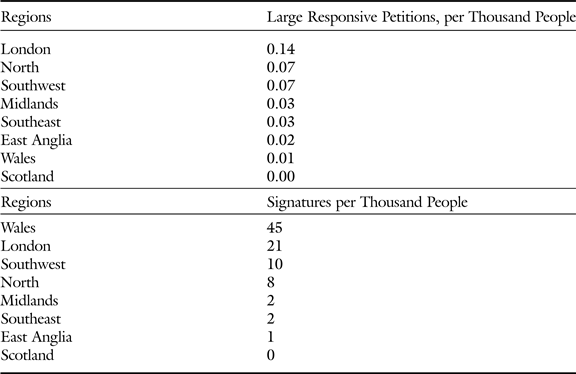
This petitioning culture was not only a feature of London or urban society. Extensive petitioning campaigns occurred in the localities and more rural regions. Table 3 shows the geographic distribution of large responsive petitions. The number of petitions from London totaled sixty-nine, constituting 20 percent of those presented between 1689 and 1720. The geographic distribution of petitions reflects the legislative issues that motivated them. Proposed legislation for improving river navigation and building new ports resulted in petitions from Yorkshire, Cumberland, and the northern Midlands; the regulation of the cloth and wool industries encouraged petitions from the West Country; and the enclosure of the New Forest led to petitions coming from Hampshire. Petitioners equivalent in number to a fifth of the voterate of Wiltshire were mobilized to petition the Lords on the wool industry and road communication in 1714 and 1717 respectively, while inhabitants equal in number to half the voterates of both Chester and Durham petitioned on navigation bills.Footnote 43 The largest petition of this period came from Wales, in support of a bill for the abolition of the Council of the Marches, and was signed by eighteen thousand people (equal in size to the entire voterate of the principality).Footnote 44 Significantly, the court had been reestablished in 1660 with the support of petitions signed by three thousand people sent to the crown from Worcester, Hereford, and Shropshire.Footnote 45 But during the Restoration its judgements had been frequently subject to prohibitions by other courts, halting the implementation of its decisions. The council, which the petitioners argued to be “oppressive,” “useless,” and “different to other courts,” was removed in 1689, with the result that the Welsh appealed to the Courts of Westminster Hall on civil cases.Footnote 46 The abolition of one of the last Welsh institutions was embraced by the rural population of the province, who were able to mobilize in such numbers to produce a petition larger in size than that collected in London during the Exclusion Crisis.Footnote 47
Large Responsive Petitions to Both Houses of Parliament at Select Periods, 1660–1789
Sources: In addition to those listed under table 1, see Commons Journal, viii–xix; Reports From Committees, 1831–2, 18 vols. (London, 1832), 5:10; John Brewer, The Sinews of Power: War, Money, and the English State 1688–1783 (London, 1989), 233; Hoppit, and Innes, eds., Failed Legislation, 19; Innes, “Legislation and Public Participation,” 117–19; Colin Leys, “Petitioning in the Nineteenth and Twentieth Centuries,” Political Studies 3, no. 1 (February 1955): 45–64, at 57; Pettigrew, “Regulatory Inertia and National Economic Growth,” 27.
Note: Due to the loss of records for the Commons in the Parliament fire of 1834, petitions presented to the Commons on general bills have been used for the period before 1720 to enable a comparison. The figure for the Lords between 1779 and 1789 is also for petitions on general bills, i.e., bills affecting more than an individual or small group and with a larger geographic scope, although not all of these petitions were heavily subscribed.
Geographic Distribution of Large Responsive Petitions and Their Signatories to the House of Lords, 1689–1720
Sources: See references for table 1. Apart from London, which is shown separately here, the regions are those in Peter Clarke, ed., The Cambridge Urban History of Britain, 1540–1840, 3 vols. (Cambridge, 2000), 2:30. Population figures are from Tony Wrigley, “Rickman Revisited: The Population Growth Rates of English Counties in the Early Modern Period,” Economic History Review 62, no. 3 (August 2009): 711–35.
Note: Thirty-six petitions make no reference to their place of origin.
Although no large responsive petitions came from Scotland to the House of Lords before 1720, Scotland had a strong petitioning culture. In 1689, there was “a petition by several thousand hands for the settlement of that kingdom according to the example of England,” and petitions were also collected to dissolve the Union in 1713.Footnote 48 As Karin Bowie has shown, seventy-nine addresses were organized against the Treaty of Union in late 1706 and early 1707. These represented the hostility of around twenty thousand subscribers, with different communities able to shape the messages of each address.Footnote 49 Lower levels of Scottish legislation at Westminster meant national institutions in Scotland were important recipients of popular pressure and seen as fora to pursue local schemes for improvement, especially in the early stages of union. In August 1709, the General Assembly of the Church of Scotland received “addresses subscribed by some thousands of hands from Edinburgh, and the places about, against … [the] abuses” of the Episcopal minister James Greenshields. He had appealed to the Lords from the Court of Session against their suppression of his reading of the English liturgy in Scotland.Footnote 50 The Convention of Royal Burghs also served as a significant point of contact for Scottish localities after 1707, and often lobbied the Westminster Parliament on behalf of Scottish interests.Footnote 51 But, as Bob Harris has shown, Scottish petitioning to Westminster did increase as the century continued.Footnote 52 Forty petitions had been sent to the Commons on the Calico Bill in 1719 and petitions had also been presented in defense of Scottish linen interests throughout the 1710s.Footnote 53 By the 1780s, the presence of parliamentary agents in London, regular news from correspondents in the Scottish press, and more legislation specific to Scotland combined to create a large growth in Scottish petitioning directed to the Parliament at Westminster.Footnote 54
This survey of petitioning to the House of Lords shows that groups from across mainland Britain were capable of being mobilized in defense of their interests, reflecting the presence of a national political culture. In the next section I consider the conventions and rules governing petitioning in the seventeenth and eighteenth centuries.
CONVENTIONS AND RULES GOVERNING PETITIONING
The frequency and scale of large responsive petitioning after 1689 was a fairly novel experience for parliamentarians. As table 2 shows, the Commons received only 189 petitions on general bills during the Restoration (many of which would have had fewer than twenty signatures), while 154 were presented against the leather duty to the Commons in 1697 alone. Although Parliament remained secretive in some respects after 1689, with the Lords continuing to refuse printing even a summary of its proceedings, other everyday participatory practices reflected the increasing desire of both parliamentarians and those “out of doors” to enable public participation and commentary in debates on proposed bills.Footnote 55 Peers and MPs increasingly saw public involvement as desirable and necessary for legislative business and took steps to organize and regulate public participation through petitioning, rather than seeking to reduce and suppress it. The practices of responsive petitioning and participatory lobbying thus continued to be informed by the methods and practices advanced in the 1640s.Footnote 56
Parliamentarians acted against petitioners in this period, but primarily when petitioners intimidated MPs and peers or when the collection of signatures resulted in rioting. The 1648 declaration and ordinance Against tumultuous Assemblies, under Pretence of preparing Petitions, and the 1661 act, Against Tumults and Disorders upon p[re]tence of p[re]paring or p[re]senting publick Petic[i]ons or other Addresses to His Majesty or Parliament, placed similar limits on petitioning. Both were hostile to the public petitioning on constitutional and religious matters, and they contained clauses that helped to regulate the number of petitioners appearing at Westminster. The 1661 Act is often interpreted alongside the Licensing Act of 1662 as an attempt to “prevent the more effective involvement” of the public in politics, discouraging petitions signed by more than twenty people and the use of print to publicize them.Footnote 57 However, its aim was to hinder the creation of political petitions and suppress the violent presentation or collection of all petitions.
Through this legislation, MPs and peers sought to suppress the potential intimidation of Parliament by large crowds, who would “fright him [a peer] into unwilling compliance.”Footnote 58 This attitude led peers to reject two petitions, both produced during 1689. The first was “the humble petition of a great number of citizens and other inhabitants of the cities of London and Westminster” that “desire[d] the … Prince of Orange … [to] be speedily settled in the throne.”Footnote 59 Significantly, the petition “was not signed,” but presented “in a tumultuous manner.”Footnote 60 “The gang” had said that “if [they were] not satisfied, [they] will come themselves” and they were already “begin[ning] to threaten the bishops.”Footnote 61 The petition was eventually presented to the Lords, but “they could not read it because it was not signed by any person.” The process of gathering signatures eventually led to the petition being suppressed by the lord mayor, who believed that its collection had “improved into a tumult.”Footnote 62 A petition in the same year from the silk weavers of London and Canterbury was also “presented … in a tumultuous manner,” because there was an “unusual manner of application of men, who ought to be better directed.”Footnote 63 The petition, which was signed by seven men, was only accepted after the Lords had “first require[d] that those crowds would go home.”Footnote 64 Narcissus Luttrell estimated that “two or three thousand men and women of the trade” were present.Footnote 65 This fear also hindered the collection of large responsive petitions in the localities. James Oglethorpe, MP in 1731 said he had declined to collect a petition signed by more than six thousand people, because “it might occasion tumults.”Footnote 66 These were the forms of petitioning the 1661 act sought to suppress—not those for which more than twenty signatures had been gathered, nor those presented to Parliament by more than ten people, when either had been done in a “tumultuous” fashion.
Parliamentarians sought to police the process of petitioning through these acts. The clause in the 1661 Act banning a group of more than ten people presenting a petition was only used to regulate and control public access to the Palace of Westminster. The MP, Sir William Pultney, was “not fond of falling upon addressers” with force; it was “not the way to make friends for the King.”Footnote 67 The physical mobilization of ordinary citizens was part of the culture of responsive petitioning. In one case in 1697, women had been “hired to a ring a bell … to raise the weavers” to petition Parliament. The crowd that subsequently entered the lobby of the Commons and Westminster Hall later became violent as a result of “scandalous” rumors spread by their opponents that the bill had been rejected.Footnote 68 This participatory element of petitioning and the relatively unrestricted access of the public to the Palace of Westminster are consistent features of early modern political culture that weakened only after the 1817 Seditious Meetings Act.Footnote 69
Within the boundaries set by parliamentarians, responsive petitioning was becoming a more central part of the parliamentary process in the second half of the seventeenth century. Parliamentary procedure required public notices for bills, ensuring that the wider public was informed of bills that affected them. Opponents of the River Wey Navigation Bill in 1759 successfully lobbied for the legislation to be rejected on the grounds that “no public notice, either by advertisement or otherwise,” was given of the intention of the bill's proposers to petition Parliament.Footnote 70 Even before petitions to Parliament were organized, meetings were held in the affected locality to co-opt any opposition. Supporters of the Dunn Navigation Bill stressed that they had “frequently proposed [their project] to many of the landowners of the river … at a general meeting” and there was also a “large meeting at Doncaster to prove the practicalness of the thing.”Footnote 71
The extent of public involvement in debates on legislation was aided by the decision of parliamentarians to force lobbyists and interest groups to present their arguments through print and to introduce private bills with a petition. Echoing the practice of the 1640s, when the Commons had ordered cloth workers to print their petition because the “business [was] of a general concernment,” MPs ordered that all private bills had to be printed before their first reading in 1705, which was later made into a standing order in 1722 for both houses.Footnote 72 Similarly, the Lords ordered that petitions on legal appeals should be “published in print, to the end that all persons concerned may take notice thereof.”Footnote 73 This enabled an appeal to the public to be part of parliamentary proceedings, with the College of Physicians printing five hundred copies of their legal appeal, far higher than the membership of the Lords, while London curriers printed 850 copies of their pamphlet supporting a drawback on the leather duty.Footnote 74 The intensification of a print culture centered on Parliament did create tensions, with the MPs John Milward and Andrew Marvell both complaining that the presentation of papers was “too frequently done,” but a motion to ban the presentation of such papers at the door of the Commons was defeated in 1667.Footnote 75 Parliamentarians were willing to wait for petitions, believing “we ought to allow them time,” and demand that public bills would be printed to inform the public.Footnote 76 They created a “skeleton” of future business to provide advance notice to petitioners; the Commons ordered that “no petitions be received after ten o'clock in the forenoon.”Footnote 77 This process was not new in the 1690s, but there was an intensive attempt to organize and inform those who sought to participate in parliamentary business after the Glorious Revolution.Footnote 78 This was in contrast to the attitude of early Stuart parliamentarians, who had banned the printing of petitions, and enabled Parliament to function as a site channeling the multiple public spheres and interest groups of early modern Britain into national debates on matters of policy after 1688.Footnote 79
Although parliamentarians increasingly recognized the utility of petitioning, responsive petitions could still be rejected by either house. The Lords had thought twice about accepting the large responsive petition from Wales in 1689, having read “the statute 13 Car II concerning riots … as to the petition.”Footnote 80 In 1697, a limit to petitioning was introduced on bills relating to public finance, an urgent concern during the Nine Years War. MPs justified their decision by arguing that “all are represented here” by their member; petitions were unnecessary, however small the number of subscribers, or how great the corporation or company.Footnote 81
By invoking the idea that Parliament was the true representative of the political nation, MPs and peers were able to reject politically difficult petitions, though this did come at some cost. Claims on the power of Parliament initially intended by parliamentarians to justify the suppression of political petitions were also employed to suppress petitions commenting on proposed legislation. However, this resulted in heightened rhetoric from opponents concerning the right to petition, which checked Parliament's actions. One rejected petition from London clergy in 1721 saw some peers protest that “the right of petitioning … is as essential to the public … as the liberty of debate to the constitution of Parliament.”Footnote 82 When petitions calling for the relief of those affected by the South Sea Bubble were rejected, the first septennial Parliament was also attacked in these terms. Opponents argued “our servants” in Parliament had “been the great invaders of [the right to petition] … [and] prevented our redress.”Footnote 83 Such rhetoric suggests there was a clear expectation by the public that parliamentarians should accept their petitions on proposed legislation.
As a consequence of the decisions of parliamentarians to make aspects of their business more transparent, representing the public's views through petitioning was becoming a more frequent practice after 1689. Although there were concerns about the public signing responsive petitions, parliamentarians desired petitions that commented on their legislative business. Why this was the case, and how parliamentarians squared wider public involvement with the ideals of deliberative and reasoned debate, are examined in the next section.
LEGITIMISING CONFLICT
Large responsive petitions were not accepted because they occurred sporadically and were uncontroversial; indeed, they could be highly organized affairs and had the potential to divide communities. During proceedings on the River Don Navigation Bill, a Mr. Sheburne had a “mob of five or six hundred about his house for the apprehension that he opposed the navigation.”Footnote 84 In Tiverton, five hundred people signed a petition on the wool industry in 1698, with later complaints that laborers were forming themselves “into combinations or clubs” and becoming “insolent”; they would “comply with whatever their clubs shall determine and assemble,” against the wishes of the mayor and corporation.Footnote 85 By accepting their petitions, parliamentarians acknowledged the presence of a wider political nation and made the process of ruling more open to negotiation and popular pressure, something that they had been unwilling to do on matters of state or public finance.
By allowing certain forms of petitioning, parliamentarians hoped to strengthen the institutional arrangements established after the Glorious Revolution and gain legitimacy for the local improvements being pursued in Parliament. In response to the Lords rejecting a petition in 1722, some peers protested that “rejecting such petitions and … not receiving … them” would “occasion disorders and tumult.”Footnote 86 Petitioning was a nonviolent means for negotiation that aided the development of political stability, but by different means than those Sir John Plumb set out nearly fifty years ago.Footnote 87
Neither did formally accepting these petitions require parliamentarians to consider them when judging the merits of a bill. There was a tacit recognition amongst parliamentarians that by accepting petitions, the role of the “public voice” could be safely contained without seeming to threaten the right of the wider public to participate. In response to the adversarial addresses in Scotland against the union, opponents claimed that the addresses threatened to turn MPs into “delegates.” They argued that the Scottish Parliament was a “sovereign constituted body” that would not be directed by outside opinion.Footnote 88 Daniel Defoe also stressed the unrepresentative nature of the addresses compared to Parliament, writing that he had “not heard [of] above five [of the] three hundred gentleman of quality and estates in Lothian” who had petitioned.Footnote 89 Others portrayed anti-union addresses as involving the “meaner sort [who] were imposed upon and deluded.”Footnote 90
This same rhetoric was also employed to undermine the legitimacy of the larger responsive petitions presented to the Westminster Parliament. There were allegations that petitioners had been “unwearyingly drawn into the signing of the petition” in 1721 on a river navigation scheme and the Corporation of Hereford in 1698 were accused of “clandestinely prevail[ing] upon William Williams, a poor boatman, and several other poor men of the town of Monmouth to subscribe a paper.”Footnote 91 Opponents attempted to undermine the validity of petitions by tricking “ignorant work people” into signing blank sheets that were later presented as a petition,Footnote 92 Petitions presented against the laying of water pipes in Southwark had led to complaints that they had been signed “by a number of persons for the most part unknown” to the people of Southwark, with claims that petitioners were “rewarded” for signing or given “half a crown … to carry round the petition.”Footnote 93 The legitimacy of these larger responsive petitions could be undermined by questioning the social status or local credentials of the petitioners, by claiming that signatures were fraudulently obtained and therefore represented corrupted opinion, or by stressing the role of Parliament as the true representative body, echoing the rhetoric employed against overtly political and adversarial petitioning. This could be done without parliamentarians openly challenging the validity of the claims of petitioners or their right to participate.
Parliamentarians and elites attempted to maintain the political status quo by accepting large responsive petitions and their associated subscription campaigns; there was a tacit acknowledgement that it was no longer possible to eliminate the “public voice.” Elites actively sought petitions to inform parliamentary deliberations on legislation. John Brewer has argued that petitions provided information that was not easily available to parliamentarians at Westminster.Footnote 94 Petitions represented the views and claims of those deemed knowledgeable on the legislative matter at hand. Defoe argued, for instance, that petitions could offer a “just knowledge of the reality” and encouraged parliamentarians “to look a little into the state of manufactures.”Footnote 95 The rejection of these petitions would, as peers put it, “deprive the legislature of proper lights, which they might otherwise [have] received,” and result in poorer policy and weaker parliamentary deliberation.Footnote 96 This importance attached to “expertise” suggests why the average petition from merchants was signed by forty-nine people, less than half the average number of those who signed a large responsive petition to the Lords.Footnote 97
More than a third of descriptions of the petitioners who signed the large responsive petitions refer to either “inhabitants” or the “makers” of manufactured goods, making no reference to expertise or social status. These were groups that the Marquis of Halifax believed required “solicitors to pursue and look after their interests” that otherwise would be too weak and unwieldy.Footnote 98 This language of “interest” was a new intervention in political discourse during the mid-seventeenth century, and helped to increase the significance and legitimacy of petitioning from nonelite groups. There were four major consequences of contemporaries imagining society as constituted by various “interests.”Footnote 99 First, the concept of interest increased the anxieties and reality of partisanship, by allowing those who could claim to have a legitimate interest in any bill or policy to participate in debates on it. Enabling communities and individuals to pursue their private interests was seen to advance the public good.Footnote 100 The support of these interests was crucial to enforcing the law, as otherwise “it hath not root enough upon the public utility to maintain itself against private encroachments.”Footnote 101 Through “preserv[ing] industrious men in a peaceable way of improving their own interest,” contemporaries argued that a plural politics was compatible with political stability.Footnote 102 It therefore became necessary for policy-makers to actively seek out interests and allow them to influence change. As a result, it was seen as “very proper for those whose interest it is to be against making the Darwent navigable to join in a petition” if they “had land on the water,” as a wide range of groups did.Footnote 103 Private interests could be legitimized as contributing to the “public” interest. Thus, weavers justified their petition on the basis that “the complaint against the printed calicoes is the complaint of the whole nation, not the particular complaint of Spitalfields.”Footnote 104 The acknowledgement that the crown was only one interest amongst many created a plural conception of society in which conflict was an inbuilt feature of political and economic life, without the need for party divisions. This balancing of competing interests would “make the chief magistrate strong, while … keep[ing] his interest in all of them,” and required those in power to seek out and identify those interests implicated in legislation.Footnote 105
Secondly, the situation, in which parliamentarians needed to “take in all parts” in order to consider the public interest, raised the question of how parliamentarians could discover the views of different interests and channel them into policy making while also ensuring the public contributed in a rational and dispassionate way.Footnote 106 Because elections did not provide the best means for this due to the restrictive franchise and their perceived tendency to encourage lying, corruption, and misrepresentation, Parliament itself had to provide the mechanism for the public voice to be heard through participation in committees or petitioning. Importantly, writers argued that MPs could not “be chosen to represent the sense of the people, because it's impossible the sense of the people about future transactions, should be known.”Footnote 107 As a result of the extended length of parliaments after the repeal of the Triennial Act, one author argued that because “it is impossible for the people to foresee at the time of the election what affairs might come under their [MPs] deliberation,” there was a need to “furnish them with matters of instruction … [or] addresses.”Footnote 108 The limited franchise meant the citizenship expected was not a passive one that deferred to representatives in Parliament, but rather an active one that was heard through certain regulated mechanisms.
Parliamentarians encouraged the public to participate in debates on these legislative issues because it was perceived that petitioners knew their own interest, were knowledgeable of facts, and were able to provide useful information to Parliament. Political elites considered it problematic for the public to judge political debates, because it was feared they were being misled by competing partisan commentaries. However, public commentary on issues the public had direct and lived experience of was seen as conducive to the application of reason and the creation of a deliberative politics.Footnote 109 One opponent of the “Monster Petition” created in London during the Exclusion Crisis argued that men “are to be esteemed capable of knowing their own wants, fears, and dangers … yet not everyone is to be accounted sufficiently qualified … to umpire differences between his majesty and his great council.”Footnote 110 Merchants petitioning in 1738 were claimed to be “the most proper hands for giving in such a representation … [being] the most immediately interested in the facts.”Footnote 111 Equally, petitioners during the Excise Crisis of 1733 were said to have provided MPs with “the best information … of their own neighbourhood particularly.” The “lower people,” such as the “small heritor's and husbandmen, shop-keepers, seamen, [and] artificers,” were seen as qualified to advise Parliament on the legislative issues that came before the two houses for it was “in these they are occupied, and get their bread, and therefore must have great knowledge of the particular … without knowledge of the particulars, he [an MP or peer] may with all his brightness invent very good things for utopia, but not for Britain.”Footnote 112
On occasion, petitioners claimed that the success of legislation should depend on whether a bill had the support of the “majority” of the locality or interest it affected. Defoe echoed this, asking “what can the meaning of numbers be, but of strength?”Footnote 113 Others argued that petitions provided a “sense of the county” to parliamentarians. For example, opponents of the Calico Bill were said to have been “so populous throughout the nation” that parliamentarians would not “lay it on without their … consents.”Footnote 114 Legal counsel and petitioners in parliamentary committees also appealed to the importance of numerical support. A bill on the silk industry was claimed to have been “brought in by very few throwsters [while] their main body … disown[ed] it.”Footnote 115 Calls for judging on a majority basis and considering the “general sense of this nation” were important in resolving disputes that could otherwise focus on what groups were qualified to judge based on their interest or expertise.Footnote 116
The experience of the public in their “own dealings” contrasted with the “higher” political and constitutional issues that the public only saw as representations in print. Parliamentarians could trust petitioners to act as rational actors and witnesses to their own lives in this regard, for the “creator has not formed his rational creatures incapable of what is so needful for their wellbeing.”Footnote 117 The interest that “will not lie” acted as a guide for public actions, because only “fools or madmen … do not know or understand their own interest … [and] act directly contrary to it.”Footnote 118 Through the 1648 ordinance and the 1661 act, parliamentarians aimed to shift public involvement away from faction and violence, seen largely in the context of petitions motivated by “high politics,” towards more reasoned and deliberative debate on matters of their locality and circumstances. This process of regulated public participation and deliberation was strengthened further by the institutionalization of political arithmetic in Parliament and the hearing of witnesses in committees to “make out the facts.”Footnote 119
Interest mattered, thirdly, as a test by which parliamentarians could establish whether the claims of petitioners were useful and true. By arguing that petitioners' claims were based on their self-interest rather than the public interest, it was possible to dismiss their claims, and to control the pluralistic political culture the language of interest had helped to justify.Footnote 120 Shoemakers had petitioned against an act for the transportation of leather, arguing that it sought to serve “the interest of some particular persons.” Opponents of the woollen manufactures bill in 1698 claimed that the bill had been “calculated wholly for Exeter,” at the cost of the wider West Country,Footnote 121 and petitioners opposing the Aire and Calder navigation argued the scheme was “only to the private advantage of the undertakers.”Footnote 122
Fourthly, the language of interest mattered in early modern discourse because it functioned as a driver in the creation of social identities.Footnote 123 The long histories of many of these bills and acts signify that these disputes were persistent features in many communities; regular bouts of litigating, protesting, and petitioning raised awareness of shared interests amongst inhabitants, and offered an alternative identity to those based on class, rank, or sorts. A legal dispute over improving Parton Harbour in Cumberland had lasted for nearly thirty years, and continued after the act of 1706 was passed. It had already been “rais[ing] a great hubbub,” with the first legal proceedings beginning in 1678, well before the statute was proposed and petitioning begun.Footnote 124 Similarly, the cheesemongers of London had been involved in litigation against the Corporation of Chester in the Exchequer about paying local duties, fearing that the judgement would be “troublesome to all the ports in the county” in 1699, and petitioned on the Weaver Navigation bill associated with it.Footnote 125 Litigation helped to crystallize identities amongst inhabitants, encouraging larger groups to represent themselves to Westminster through petitioning. This was aided by the intensity of petitioning, with communities subject to negotiation, mobilization, and division, session after session. The River Weaver Navigation Bill, for example, was revived five times between 1679 and 1721.Footnote 126 The county of Lancashire presented 111 petitions to the Commons between 1689 and 1731, or an average of 2.5 per session.Footnote 127 It was seen as a point of criticism to “get petitioners for the bill from many places where they are not at all concerned.” Petitioning was rooted in a locality and helped to solidify local and interest-based identities as a result.Footnote 128
With elections won on the majoritarian principle, the implications of the rhetoric of some petitions was that legislative matters should be too, though many petitions continued to stress the expertise and experience of petitioners or appealed to the desire of parliamentarians to balance competing interests. This is not to say, however, that petitioners did not continue to show deference to social hierarchy. Elites sought to create the impression of control and suggest that the petitions signed by large numbers of inhabitants were the result of their guidance. Peter Shakerly, MP for Chester, hoped that petitions would have a common statement and be initially signed by “the justices and grand jury at the quarter sessions.” Ideally, the next wave of petitions would come from “justices, gentlemen, [and] freeholders, adjacent to the River [Weaver].”Footnote 129 In Cumberland, John Lowther's father had been in “so dangerous a condition” about the Parton Harbour Bill in 1705, being concerned “with a list of the whole grand jury, the hands of the mayor and aldermen and others of Carlisle, [and a] great many justices of the peace” from whom he needed support.Footnote 130 There were two competing processes at work in petitioning. There was an initial attempt in the first petitions to Parliament to stress social hierarchy by gathering signatures from the mayor, borough, corporation, or county body. This would then be followed by a second wave of petitioning signed by lesser inhabitants; this petitioning involved the use of print to appeal to the wider public, legitimized by the search for the “national interest” and parliamentarians' need for external expertise or information.
The two languages of interest and of majority are significant in three respects. First, by legitimating public participation they enhanced the concern of political elites for the ability of the public to act as rational arbiters of disputes. However, rather than the Septennial Act and the ending of the “rage of party” reducing many of these fears, this culture of partisanship and the associated allegations of misrepresentation were present throughout the early modern period, driven by conflicts amongst petitioners and interest groups.Footnote 131 Secondly, these languages mark the abandoning of any notion of unity within society, and the recognition by elites of the need for negotiation. Even though the electorate was restricted, individual judgement and an active citizenship had its place when determining the merits of a bill. These two features suggest that elites were relatively tolerant of opinion “out of doors” and sought to direct its representation into peaceful petitions presented on specific matters of policy, in an attempt to help resolve political divides through reasoned debate.
Such attitudes enabled the time between winter and late spring, when Parliament assembled, to become a “petitioning season.” When London weavers called for the end to “violence … upon the wearing of printed calicos” in 1719, they argued that there were “proper seasons, as well as proper methods, to be used to get redress of grievances … [and] weavers [should] wait [until] the proper season to lay our case before the Parliament.”Footnote 132 Although the 1661 Act did not go as far as the Ordinance of 1648, which declared there was a “right and a privilege” to petition, both laws acknowledged the existence of an avenue for legitimate petitioning.Footnote 133 The rise of legislation, the growth in responsive petitioning, and relative tolerance of public commentary meant Parliament was firmly established as a point of contact for petitioners after 1689. The experience and practices of public participation in responsive petitioning was quickly applied to adversarial and initiatory petitioning when it came to events such as the Excise Crisis of 1733, as the public was already used to being mobilized to comment on matters of public policy.
CONCLUSION
The pattern of petitioning campaigns to Parliament in the first thirty years after the Glorious Revolution shows the extent of popular mobilization, participation, and negotiation that surrounded the passage of bills in Parliament. In Public Life and the Propertied Englishman, Paul Langford demonstrated the extent to which propertied society was active in “public life” in the eighteenth century: associations, voluntary organizations, and other nonstatutory bodies and individuals used the power of parliamentary statute to advance schemes for improvement.Footnote 134 These were not driven by party politics, but rather by sectional and regional viewpoints. Because local institutions sought parliamentary authority to pursue many projects, petitioners could play an important role in determining their success, strengthening the self-government of these communities.Footnote 135 This gave a second wind to the participatory local state as a result of the transformation of Parliament's legislative role after the Glorious Revolution. Within an oligarchic political system, the creation of petitions ensured a degree of pluralism, allowing elites to be informed and advised of opinion “out of doors.”
Petitioning also played an important part in the growth and maintenance of the public sphere. In several respects, petitioning after 1689 followed the pattern David Zaret has set out for the 1640s, albeit now at a more sustained and intense level.Footnote 136 Large responsive petitions were signed by many social groups from across the British Isles, and their signatories were not limited to members of established companies, local corporations, or the electorate. Petitioners criticized elites and proposed bills, appealed through print to the public to sign, and claimed legitimacy on grounds other than rank or membership of corporate bodies. The initiators of these petitions violated the “secrecy” of Parliament, and contributed to a divisive political culture that continued beyond the repeal of the Triennial Act in 1716 and the decline of the “rage of party.” The later revival of political petitioning drew on the rhetoric, experience, and identities created and maintained through the collection of large responsive petitions. The clash of interests inherent in legislation helped keep the features of partisanship, and the concerns resulting from them, alive.
A frequently overlooked element of the Habermasian public sphere is that it proceeds along two tracks. While the seventeenth-century saw the growth of what Nancy Fraser called “weak” public spheres that consisted of wider civil society, it was only after 1688 that the “strong,” decision-making public sphere of Parliament came to be influenced on a permanent basis by these publics.Footnote 137 This is because parliamentarians encouraged the public to comment in reasoned deliberations on how eighteenth-century Britain should be ruled. In doing so, parliamentarians demonstrated that concerns for public reason and rationality were present at the conception of the public sphere. Nonetheless, after 1688 Parliament functioned as a site that allowed the multiple public spheres of early modern Britain to be represented and integrated into the structures of decision making, but without the embracing of representative models of government.