The topic of the social exclusion of people with severe mental illness (SMI) and disabilities remains high on the political agenda of developed countries. Political bodies such as the European Union or the United Nations have expressed their will to better the social situation of marginalised groups and among them those who suffer from SMI. Mental health researchers support these inclusion goals (Evans-Lacko et al. Reference Evans-Lacko, Courtin, Fiorillo, Knapp, Luciano, Park, Brunn, Byford, Chevreul, Forsman, Gulacsi, Haro, Kennelly, Knappe, Lai, Lasalvia, Miret, O'Sullivan, Obradors-Tarrago, Rusch, Sartorius, Svab, van Weeghel, Van Audenhove, Wahlbeck, Zlati, Consortium, McDaid and Thornicroft2014; Heinz et al. Reference Heinz, Müller, Wackerhagen and Sartorius2015). The issue of social exclusion goes beyond older concepts such as the socioeconomic position (Muntaner et al. Reference Muntaner, Eaton, Miech and O'Campo2004) towards a more comprehensive picture that also covers societal distance or stigma (Sayce, Reference Sayce2001; Repper & Perkins, Reference Repper and Perkins2003). With the support of the United Nations Convention on the Rights of People with Disabilities (UN-CRPD), an increasing number of countries (e.g. Germany) have adopted policies to advance the participation and inclusion of people with disabilities. However, such policies are often based on a weak state of empirical data on social exclusion, especially with regard to people with SMI.
Reasons for this are manifold. Firstly, terminologies, definitions and operationalisations of social inclusion and exclusion are not consensus-based and often contradictory (Morgan et al. Reference Morgan, Burns, Fitzpatrick, Pinfold and Priebe2007). For example, there is no clear usage of terms and concepts such as social participation, social integration or social inclusion and their conceptual counterparts such as social exclusion. While these terms and concepts overlap to a certain degree, they do not completely cover the same subdomains (e.g. social networks, employment status and subjective feeling of loneliness). Secondly, research on comprehensive social exclusion in people with SMI is rare. The only comprehensive report we are aware of, has been compiled from several administrative data resources and research papers; it was published by the UK government in 2004 (Social Exclusion Unit, 2004). When research is focused on SMI, different aspects of what is being covered by social exclusion such as the employment rate (e.g. Marwaha et al. Reference Marwaha, Johnson, Bebbington, Stafford, Angermeyer, Brugha, Azorin, Kilian, Hansen and Toumi2007; Evensen et al. Reference Evensen, Wisloff, Lystad, Bull, Ueland and Falkum2016), income and debt (e.g. Jenkins et al. Reference Jenkins, Bhugra, Bebbington, Brugha, Farrell, Coid, Fryers, Weich, Singleton and Meltzer2008; Davidson et al. Reference Davidson, Kapara, Goldberg, Yoffe, Noy and Weiser2016), marital status (e.g. Kessler et al. Reference Kessler, Walters and Forthofer1998; Breslau et al. Reference Breslau, Miller, Jin, Sampson, Alonso, Andrade, Bromet, de Girolamo, Demyttenaere, Fayyad, Fukao, Galaon, Gureje, He, Hinkov, Hu, Kovess-Masfety, Matschinger, Medina-Mora, Ormel, Posada-Villa, Sagar, Scott and Kessler2011) or social networks (Sibitz et al. Reference Sibitz, Amering, Unger, Seyringer, Bachmann, Schrank, Benesch, Schulze and Woppmann2011) are addressed. As these studies cover different countries and populations and use diverse methodologies, the overall picture of social exclusion of people with SMI remains blurred. Thirdly, with regard to illness severity, recent research on narrow exclusion indicators has predominantly covered schizophrenia and psychoses (e.g. Killaspy et al. Reference Killaspy, White, Lalvani, Berg, Thachil, Kallumpuram, Nasiruddin, Wright and Mezey2014). This does not reflect the societal impact and burden of the whole range of SMI. The most recent Global Burden of Disease study has demonstrated that the burden of depression and anxiety disorders exceeds schizophrenia with depression as the third highest and anxiety disorder as the ninth highest cause for years lived with disability (GBD 2015 Disease and Injury Incidence and Prevalence Collaborators, 2016).
Within ‘Disability Studies’, social inclusion refers to the status of those individuals who represent the social mainstream (Rimmerman, Reference Rimmerman2013). The analysis of social exclusion, therefore, should preferably demand a comparison with the general population. As many researchers and theorists conceptualise social exclusion as a relative status (Chakravarty & D'Ambrosio, Reference Chakravarty and D'Ambrosio2006), comparisons with other disadvantaged groups may also inform us of the special situation of people with SMI. Todd et al. have shown that patients with comorbid mental illness and substance abuse are more excluded than patients with a single problem in terms of housing, education and problems with the legal system (Todd et al. Reference Todd, Green, Harrison, Ikuesan, Self, Pevalin and Baldacchino2004). Similarly, Fakhoury et al. (Reference Fakhoury and Priebe2006) have identified a subgroup of mental outpatients who are more socially excluded than others while suffering from mental disorders and substance abuse at the same time. Richter et al. (Reference Richter, Eikelmann and Reker2006) have demonstrated in a large sample of disability pension recipients that people with SMI were significantly more excluded than individuals with severe physical illness over the course of their lives and at the time of receiving a pension. Exclusion indicators were employment history, income and marital status. Luciano and Meara (Reference Luciano and Meara2014) compared people with SMI to people with less severe illness and to the general population. The authors found a clear gradient on several indicators such as employment status or receipt of income and social benefits. Lipskaya-Velikovsky et al. (Reference Lipskaya-Velikovsky, Jarus, Easterbrook and Kotler2016) have recently shown a similar pattern in a comparative study on daily life activities where people with schizophrenia participated in fewer activities such as entertainment or child care, and where they did, tended to do so alone.
The most important methodological insight from this short review of recent research on social exclusion of people with mental illness is the need to compare the social exclusion status not only with the general population but also with other disadvantaged groups as well as with people with less SMI. Further methodological issues concern the specific domains that need to be covered. Comprehensive social inclusion/exclusion measures encompass as many as possible of the following domains: material deprivation/income, social network participation/social support, access to basic social rights (e.g. health care, education, transport), health status, life satisfaction/quality of life, discrimination/stigma (Baumgartner & Susser, Reference Baumgartner and Susser2013; Rimmerman, Reference Rimmerman2013; Baumgartner & Burns, Reference Baumgartner and Burns2014; van Bergen et al. Reference van Bergen, Hoff, van Ameijden and van Hemert2014). Additionally, social inclusion/exclusion measures often include objective indicators (e.g. participation in employment) and subjective indicators (e.g. how respondents feel about being or not being socially integrated) (Coombs et al. Reference Coombs, Nicholas and Pirkis2013). Our study aims to cover most of the aforementioned domains and present a comprehensive view of the social exclusion of people with SMI in Switzerland whilst also drawing comparisons with people with severe physical illness, common mental illness and the general population.
Methods
Sampling
We used a data file from the Swiss Health Survey (SHS) 2012. The SHS is a representative cross-sectional self-report health survey that is conducted every 5 years by the Swiss Federal Statistical Office. Researchers can obtain an anonymised SHS data file on the basis of a confidentiality and privacy contract with the Statistical Office. Under Swiss law, no further ethical approval is needed when analysing this data file.
The SHS sampling is a multistage stratified random procedure. Data are collected by a private contractor; the authors of this article were not involved in the data collection. The target sample in 2012 was the non-institutionalised population older than 14 years and living in private households with a telephone connection. The full sample encompassed 21 597 people, corresponding to a response rate of 53%. The telephone survey was followed by a written/online questionnaire that was not used for this study.
We selected a working age sample between the ages of 18–64 for men and 18–63 for women, according to the gender-related difference of retirement age (N = 15 764). The restriction to a working age sample was necessary because of our operationalisation of SMI. While SMI has traditionally been defined by the combination of diagnosis, severity and duration of psychosis (Schinnar et al. Reference Schinnar, Rothbard, Kanter and Jung1990), more recent definitions refer to a broader spectrum of mental illness and also to the criterion of being in treatment (Ruggeri et al. Reference Ruggeri, Leese, Thornicroft, Bisoffi and Tansella2000; Parabiaghi et al. Reference Parabiaghi, Bonetto, Ruggeri, Lasalvia and Leese2006). People who receive a disability pension fulfil these criteria as such a pension will be granted to those who are not able to fully participate in working life for a longer period due to a medically approved condition. We operationalised SMI as receiving a disability pension and being treated for a mental health problem. Using the criterion of being in receipt of disability pension necessarily leads to a working age sample.
A limitation of this survey is the lack of any detailed diagnosis of the mental illness that respondents suffer from. A recent analysis of the disability pension recipients with mental health issues has revealed that the most frequent category is ‘Affective disorders’, followed by ‘Personality disorders’ and ‘Neurotic, adjustment and somatoform disorders’ (Baer et al. Reference Baer, Frick and Fasel2009). The rate of disability pensions due to schizophrenia and other psychoses is comparably small.
Social exclusion indicators
We used and created the following dichotomous variables as the basis for our exclusion indicators.
• The question of whether the respondent has been employed for money in the recent week was used as an indicator of employment.
• The household equivalent income was used for assessing the income situation. The equivalent income accounts for potential savings due to more than one person living in a household. We used a quartile index created by the Federal Statistical Office and chose the lowest quartile as our indicator (<2857 Swiss Francs). As this income is slightly higher than the absolute poverty line at that time (2200 Francs per person) (Bundesamt für Statistik/Federal Statistical Office, 2014), it can be regarded as a proxy for poverty.
• The current living situation was used for extracting two further indicators: living alone and living without a partner. Apart from the marital status, the SHS does not include any further question on partner status. Thus, partner situations where the couple does not live together could not be covered.
• The social network was analysed by four variables. Firstly, we used the ‘No’ response to the question of whether there is a close person with whom one can talk about personal matters. Secondly, we used the ‘Never’ response to the question of how often the respondent usually attends organised social events with organisations such as clubs, political parties, religious groups, etc. Thirdly, we collapsed the ‘Very often’ and ‘Rather often’ responses to the question of how often the respondent feels lonely. Fourthly, we used an index on subjective social support created by the Federal Statistical Office. This index encompasses three questions from a larger social support instrument (Dalgard et al. Reference Dalgard, Bjork and Tambs1995) that are commonly used in European health surveys.
• In terms of health status, we used an index on limitations of Instrumental activities of daily living created by the Federal Statistical Office. This index encompasses eight questions on limitations such as preparing food, doing the laundry or using public transport. The questions were collapsed into a four categories index from which we chose the most severe category as our exclusion indicator. This category means that the respondent cannot execute at least one of the instrumental activities. Furthermore, we collapsed the ‘Bad’ and ‘Very bad’ responses to the question on how the respondent would rate the health status in general into one health status indicator.
Analytic and statistical strategy
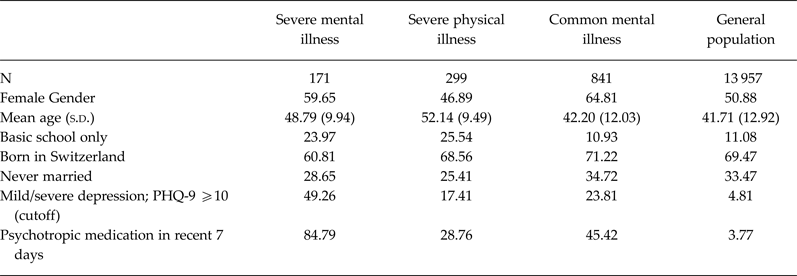
We created four groups for our statistical analyses: (1) People with SMI (being treated for a mental health problem and receiving a disability pension; N = 171), (2) people with severe physical illness (receiving a disability pension and not being treated for a mental health problem; N = 299), (3) people with common mental illness (being treated for a mental health problem and not receiving a disability pension; N = 841) and (4) general population (neither being treated because of a mental health problem nor receiving a disability pension; N = 13 957). We checked for additional indicators for the characterisation of SMI. Eighty-four per cent of participants in the SMI group used psychotropic medication (i.e. sleep-inducing drugs, sedatives, antidepressants) in the 7 days prior to the interview compared with 45% of participants in the common mental illness group. The rate of mild to severe depression as measured by the Patient Health Questionnaire (PHQ-9) was more than double in the SMI group than in the common mental illness group (see Table 1, Sociodemographic data).
Sociodemographic characteristics in per cent unless indicated otherwise
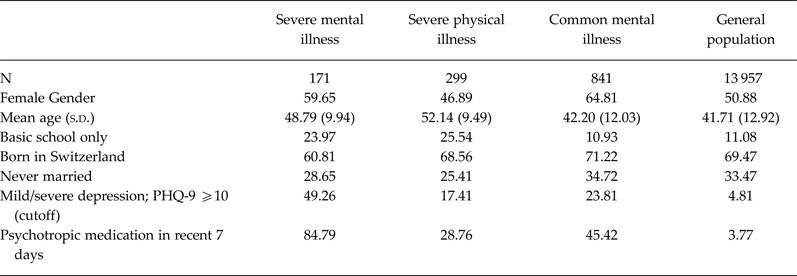
N, absolute number, s.d., standard deviation.
Descriptive analyses were conducted for sociodemographic variables and for the indicator variables. The ultimate goal was to analyse the differences in terms of the exclusion indicators among the four groups. Therefore, the indicator variables were used as dependent variables in a series of logistic regression analyses. The aforementioned groups were utilised as predictor variables, adjusted for age and gender. The general population served as the reference group in all analyses. Unadjusted regression analyses were also conducted and are shown in the results table. All analyses have been conducted with the statistical software R, version 3.3.2 (R Core Team, 2016).
Results
The sociodemographic data revealed important differences between the SMI group and the three comparison groups (Table 1). The female rate was higher in people with SMI and in people with common mental illness compared with the general population and to those with severe physical illness. People in both groups with severe illness were on average older than the general population and those with common mental illness. Other commonalities in both illness severity groups were the relatively high proportion of people with basic school education only and the low rate of those participants who were not married during their lifetime. The SMI group stands out with a comparably low rate of those participants who were born in Switzerland, i.e. a larger proportion with migration background compared to the other three groups.
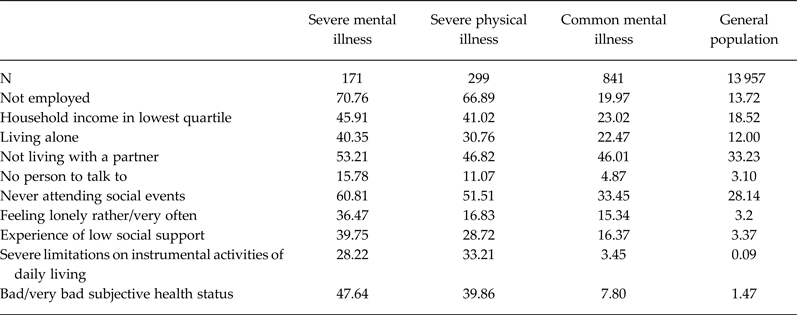
Table 2 shows the descriptive results of the exclusion indicators. All but one exclusion indicator showed a gradient with people with SMI being most excluded, followed by people with severe physical illness, people with common mental illness and, finally, the general population. The only exception was the rate of people who reported severe limitations with instrumental activities of daily living with the severe physical illness group exceeding the SMI group. Overall, however, the exclusion rates of people with SMI were by far higher than those of people with common mental illness or the general population. The only exception was the rate of people who do not live with a partner. Here, the general population had a much lower rate than all three comparison groups. In many instances, the exclusion rates of the SMI group were rather similar to those with severe physical illness. This was especially true for the employment and income indicators.
Social exclusion indicators in per cent
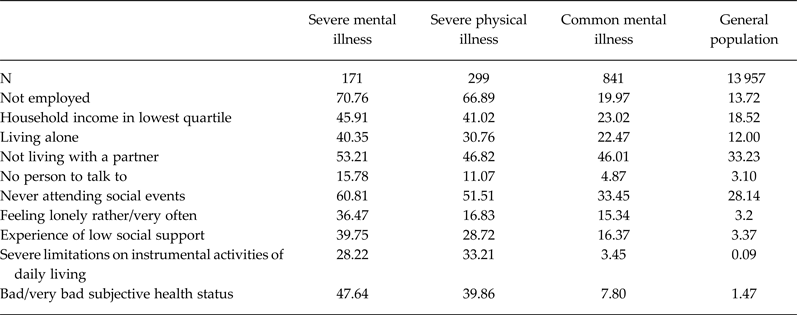
N, absolute number.
A detailed inspection of the exclusion rates reveals that 45% of people with SMI live close to the poverty line. Although 30% of people with SMI were employed to some extent, the poverty rate was strikingly higher than in people with common mental illness and in the general population. Some results on the social network of people with SMI does suggest that a relevant minority lives rather isolated with 40% living alone and 15% having no one to talk to. More than one-third (36%) of respondents with SMI have reported feeling lonely rather often or very often.
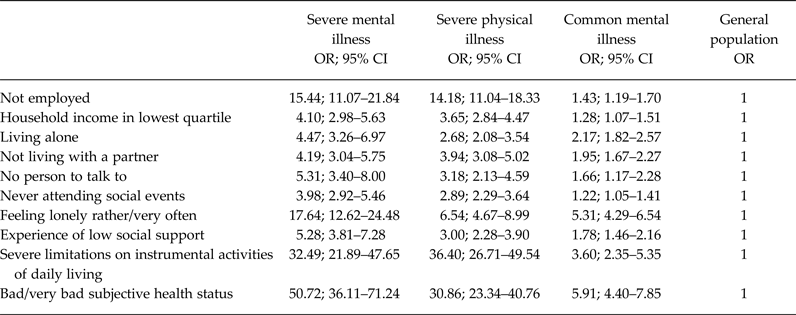
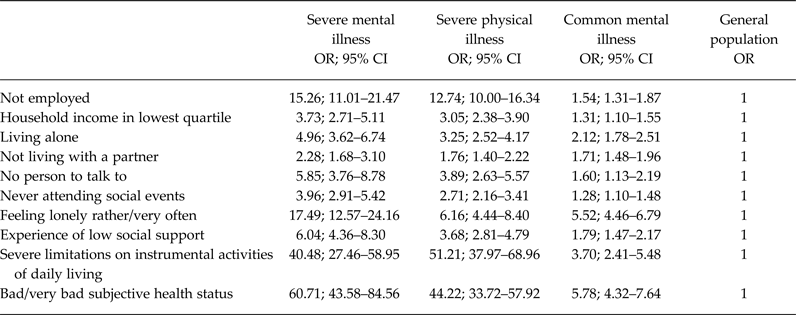
The results of the logistic regression analyses revealed that, compared to the general population, the three illness groups were significantly different on all exclusion indicators in the adjusted (Table 3) and on most unadjusted analyses (Table 4). Highest odds ratios were reported on the indicators ‘Bad/very bad health status’ (SMI: 50.72; Severe physical illness: 30.86), ‘Severe limitations of instrumental activities of daily living’ (SMI: 32.49; Severe physical illness: 36.40) and ‘Feeling lonely rather/very often’ (SMI: 17.64). The adjusted confidence intervals of the SMI group and the severe physical illness group overlapped in all exclusion indicators except the feeling of being lonely often or rather often, where the SMI group exceeded the severe physical group. The adjusted confidence intervals of the SMI group and the common mental illness group did not overlap on all exclusion indicators, indicating serious differences among these groups in terms of social exclusion.
Logistic regression results of social exclusion variables of people with severe mental disorder, severe physical disorder and common mental disorder compared to the general population (reference)
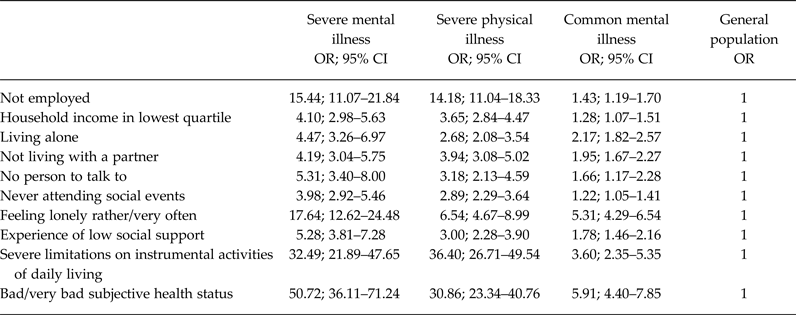
Odds ratios (OR) and 95% confidence intervals (CI) adjusted for age and gender.
Logistic regression results of social exclusion variables of people with severe mental disorder, severe physical disorder and common mental disorder compared to the general population (reference)
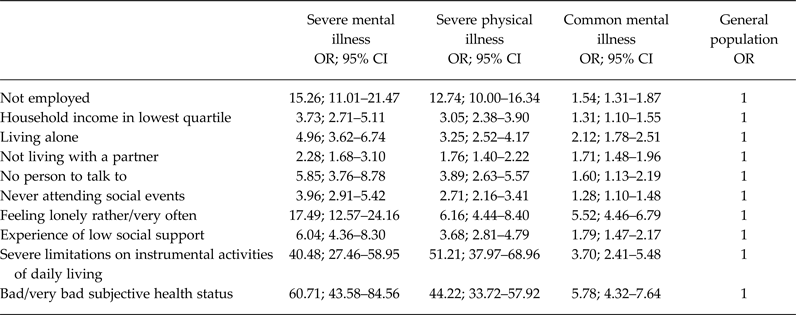
Unadjusted odds ratios (OR) and 95% confidence intervals (CI).
Discussion
Our analysis of the Swiss Health Survey data has shown that the social exclusion of people with SMI is significantly worse compared with the general population and much worse when compared with people with common mental illness. The exclusion status is, however, closer to people with the severe physical illness. The general social situation of people with any severe illness, operationalised by receiving a disability pension, is, to a large degree, characterised by social exclusion.
Our results support previous research that has indicated the severity of social exclusion of people with SMI compared with people with less SMI (Todd et al. Reference Todd, Green, Harrison, Ikuesan, Self, Pevalin and Baldacchino2004; Luciano & Meara, Reference Luciano and Meara2014). We could, however, not confirm the result of a German study that found significant differences on several exclusion indicators between people who received a disability pension due to SMI and people who received a pension due to severe physical illness (Richter et al. Reference Richter, Eikelmann and Reker2006). We assume that the differences between the studies are based on the welfare system differences between Germany and Switzerland.
Limitations
Our study has limitations that have to be considered when interpreting the results. First and foremost, our data did not cover the institutionalised population. Several studies on the social situation of psychiatric care home residents have demonstrated a very high rate of social exclusion, especially in terms of labour market access and partnership/marital bonds (de Girolamo et al. Reference de Girolamo, Picardi, Santone, Falloon, Morosini, Fioritti, Micciolo and Group2005; Richter, Reference Richter2010). The social exclusion rate is assumed to be higher in those institutions compared with people with SMI who live independently. There is, however, a risk of social isolation in those who live independently as our results have indicated. Overall, we would assume that the inclusion of institutionalised persons in our study would have led to higher exclusion rates with regard to income and access to the labour market, but lower exclusion rates with regard to social networks and loneliness.
Secondly, we did not have any information on the diagnoses of the people in the three illness groups. We do assume, however, that the diagnosis groups within the SMI group are similar to the results of a study on case files of disability pension recipients due to mental illness (Baer et al. Reference Baer, Frick and Fasel2009). This study found non-psychotic disorders to be a major component of the group.
Associated with this limitation are our operationalisations of illness and severity. We have relied on the criteria of being treated and of receiving a disability pension. With these operationalisations we definitely could not include (severely) mentally ill people who were not in treatment or did not receive a pension. It is likely that this operationalisation strategy will lead to underestimation of both illness rates and severity and the differences in exclusion rates would be larger. We are aware of the treatment gap in mental health care. This gap is assumed to be smaller for people with psychosis and larger for people with affective or anxiety disorders (Kohn et al. Reference Kohn, Saxena, Levav and Saraceno2004). However, recent research has challenged this assumption and shown that common mental illness does not necessarily indicate a need for treatment (Wang et al. Reference Wang, Henriksen, Ten Have, de Graaf, Stein, Enns and Sareen2017).
Our separation of people with mental illness and with physical illness is associated to the operationalisations, too. We are aware of the high rate of physical comorbidity in the mental illness group (Gill et al. Reference Gill, Swarbrick, Murphy, Spagnolo and Zechner2009). But this is also true for people with physical illness. As we have shown in the sociodemographic characteristics (Table 1), there are considerable rates of people with severe physical illness who suffer from mild to severe depression and who take psychotropic medication. Recent research from the German health care system has demonstrated that such comorbid mental illness is predominantly being treated in the somatic health care system (Gaebel et al. Reference Gaebel, Kowitz, Fritze and Zielasek2013). Thus, a clear and satisfying separation of mental and physical illness is nearly impossible as is indicated by the call for a joint effort by mental health care and by physical health care (Doherty & Gaughran, Reference Doherty and Gaughran2014).
Finally, we could not cover the full range of social exclusion indicators. Important indicators such as discrimination experiences or stigma experiences are missing. Our indicators cover mainly the domains of employment and income, social relations and subjective health status.
Strengths
There are several strengths in our study. Firstly, we were able to use a nationally representative sample. We are not aware of any other study on a social exclusion that was based on such a sample. Secondly, while the criteria of being in treatment and receiving a disability pension have been mentioned as a limitation, this can also be regarded as strength. Illness and severity of illness are medically approved. With these criteria, however, we have a bias towards the more severely ill participants in our illness groups. Thirdly, we were able to contextualise the issue of social exclusion as we had relevant comparison groups. With this contextualisation we could demonstrate that the social exclusion situation of people with SMI is rather similar to people with severe physical illness on many indicators.
Conclusions
Compared with the general population, but also compared to people with common mental illness, we conclude that many people with SMI live socially excluded. Many people live near the poverty line or in poverty, they have a small social network and they feel alone. These results demand political consequences as well as consequences in the psychiatric care system. The current situation of many people with SMI is not in line with their entitlement to social inclusion in accordance with the United Nations Convention on the Rights of People with Disabilities.
Politically and clinically, it seems crucial to better the economic situation of people with SMI. Apart from higher disability pensions, an important step is to bring more people with mental disorders into the general labour market. Supported employment or Individual Placement and Support is an evidence-based tool that is able to provide up to 50% of participants with a regular and steady job (Hoffmann et al. Reference Hoffmann, Jackel, Glauser, Mueser and Kupper2014). It is now obvious that sheltered workshops or jobs in the second or third labour market are not able to bring people with mental illness back into regular employment.
Another crucial issue for the care system to tackle is the high amount of people with SMI who live isolated. Recent research has demonstrated that institutionalised settings do provide better social care in terms of social relations to people with SMI better than private living accommodations (Killaspy et al. Reference Killaspy, Priebe, Bremner, McCrone, Dowling, Harrison, Krotofil, McPherson, Sandhu, Arbuthnott, Curtis, Leavey, Shepherd, Eldridge and King2016). This result may lead politicians and care planners to favour institutionalised settings on the basis of value for money considerations. We know, however, that the housing preferences of people with SMI suggest otherwise, namely to live independently (Richter & Hoffmann, Reference Richter and Hoffmann2017). To counter such considerations of favouring institutionalised settings we conclude that outpatient care has to offer the same amount of social care and support that institutions provide. This does not mean providing this support formally by professionals but instead working with clients to build stronger social networks by learning communication skills and by boosting motivation in the direction of social inclusion.
Conflict of interest statement
On behalf of all authors, the corresponding author states that there is no conflict of interest.
Availability of data and materials
The data used in this study will not be publicly available as they are provided by the Swiss Federal Statistical Office only after having signed a written agreement on the data use and on data protection issues. However, Swiss Health Survey Data are available to any researcher from the Swiss Federal Statistical Office on request.