Introduction
Gentiana L. (Gentianaceae) comprises about 362 species and is widely distributed in the temperate and alpine regions of north-west Africa (Morocco), America, Asia, east Australia and Europe (Ho & Pringle, Reference Ho, Pringle, Wu and Raven1995; Mabberley, Reference Mabberley2008). The genus is credited with more than 65 species in India; most of them are found in the Himalayas, whereas the Western Ghats harbour only two species (Clarke, Reference Clarke and Hooker1883; Garg, Reference Garg1987; Sasidharan, Reference Sasidharan2004; Maity, Reference Maity2014; Anilkumar et al., Reference Anilkumar, Prabhu Kumar and Udayan2015).
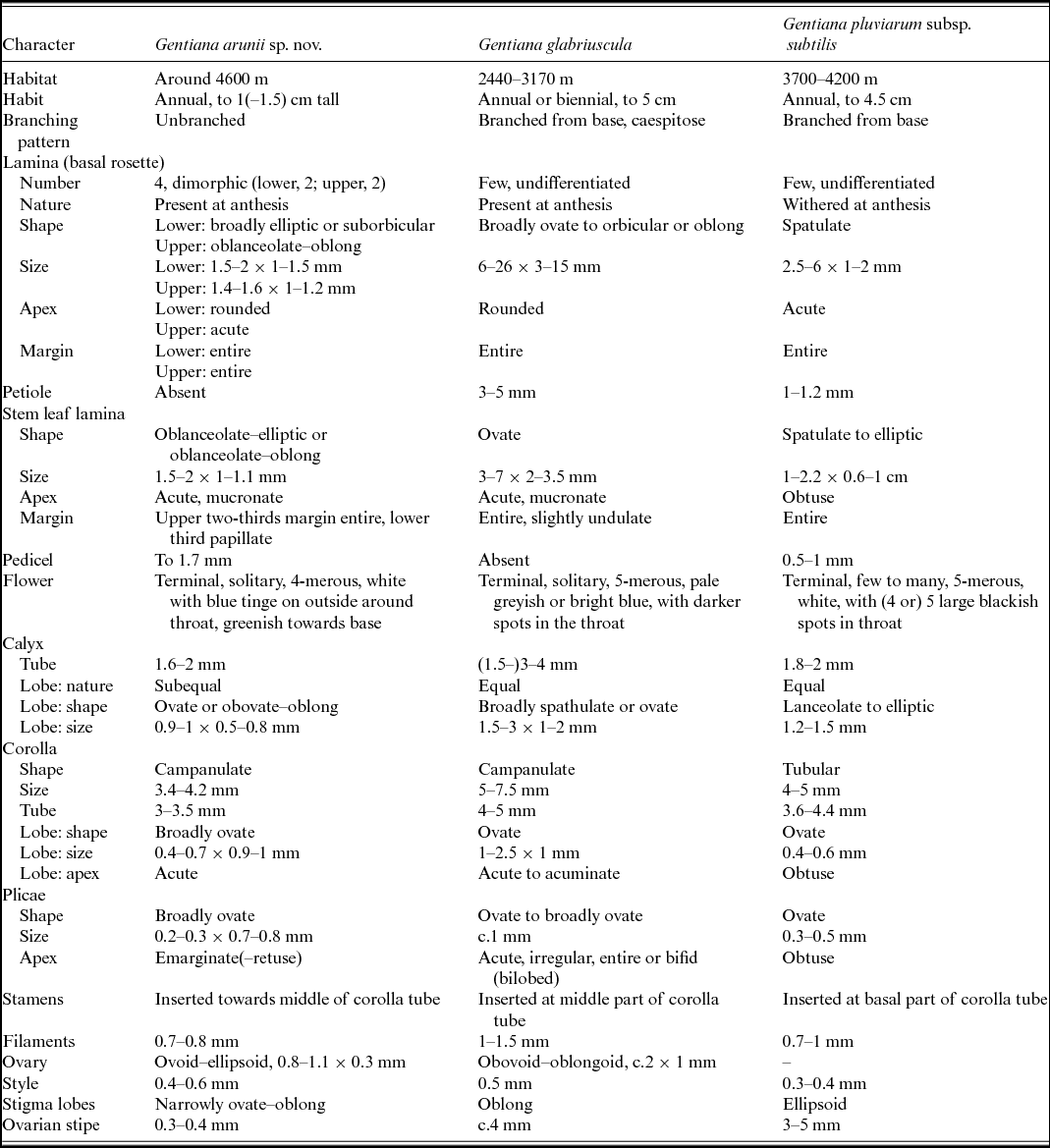
In 2015, during an expedition to North Sikkim, a few specimens of an attractive Gentiana were collected from alpine pastures. The plants were remarkable by their tiny size, mostly to 1 cm (occasionally to 1.5 cm) high with a simple stem having a solitary terminal white flower with a blue tinge outside around the throat. Moreover, the calyx lobes had deflexed purple tips. To determine the variability in growth form, if any, it was decided by our research team not to publish the taxonomy of the plant immediately. Later, in two successive years, 2016 and 2017, we observed the populations and collected representative specimens with similar morphology. A detailed literature search (Clarke, Reference Clarke and Hooker1883; Garg, Reference Garg1987; Ubolcholaket, Reference Ubolcholaket1987; Ho & Liu, Reference Ho and Liu1993; Ho & Pringle, Reference Ho, Pringle, Wu and Raven1995; Aitken, Reference Aitken and Long1999; Ho & Liu, Reference Ho and Liu2001; Hul, Reference Hul2003), subsequent morphotaxonomic examinations of the specimens, and comparisons with almost all Gentiana species of the Himalaya (India, Nepal, Bhutan and Tibet) reveal that this species belongs to Gentiana section Chondrophyllae Bunge, and morphologically resembles Gentiana glabriuscula T.N.Ho and Gentiana pluviarum W.W.Sm. subsp. subtilis (Harry Sm.) T.N.Ho, but differs notably in its significantly smaller size, its simple stem with solitary terminal 4-merous white flower, the presence of basal leaves at anthesis, its obovate stem leaves with acute apex having deflexed cartilaginous mucro, emarginate/retuse plicae and filaments being attached near the middle of the corolla tube. A detailed description, illustration and images of the new species are provided to facilitate its identification. A comparison of this new taxon to Gentiana glabriuscula and G. pluviarum subsp. subtilis is also provided (Table 1).
Comparison of the morphological features of Gentiana arunii sp. nov., Gentiana glabriuscula Ho and Gentiana pluviarum W.W.Sm. subsp. subtilis (Harry Sm.) T.N.Ho

Species Description
Gentiana arunii D.Maity, S.K.Dey, J.Ghosh & Midday sp. nov.
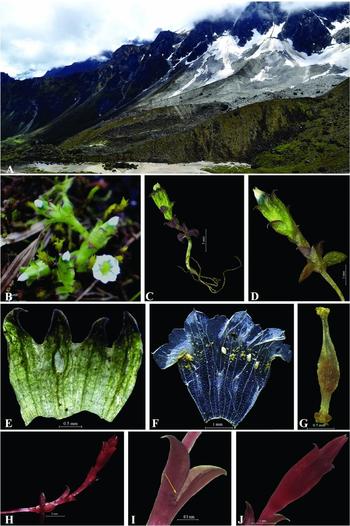
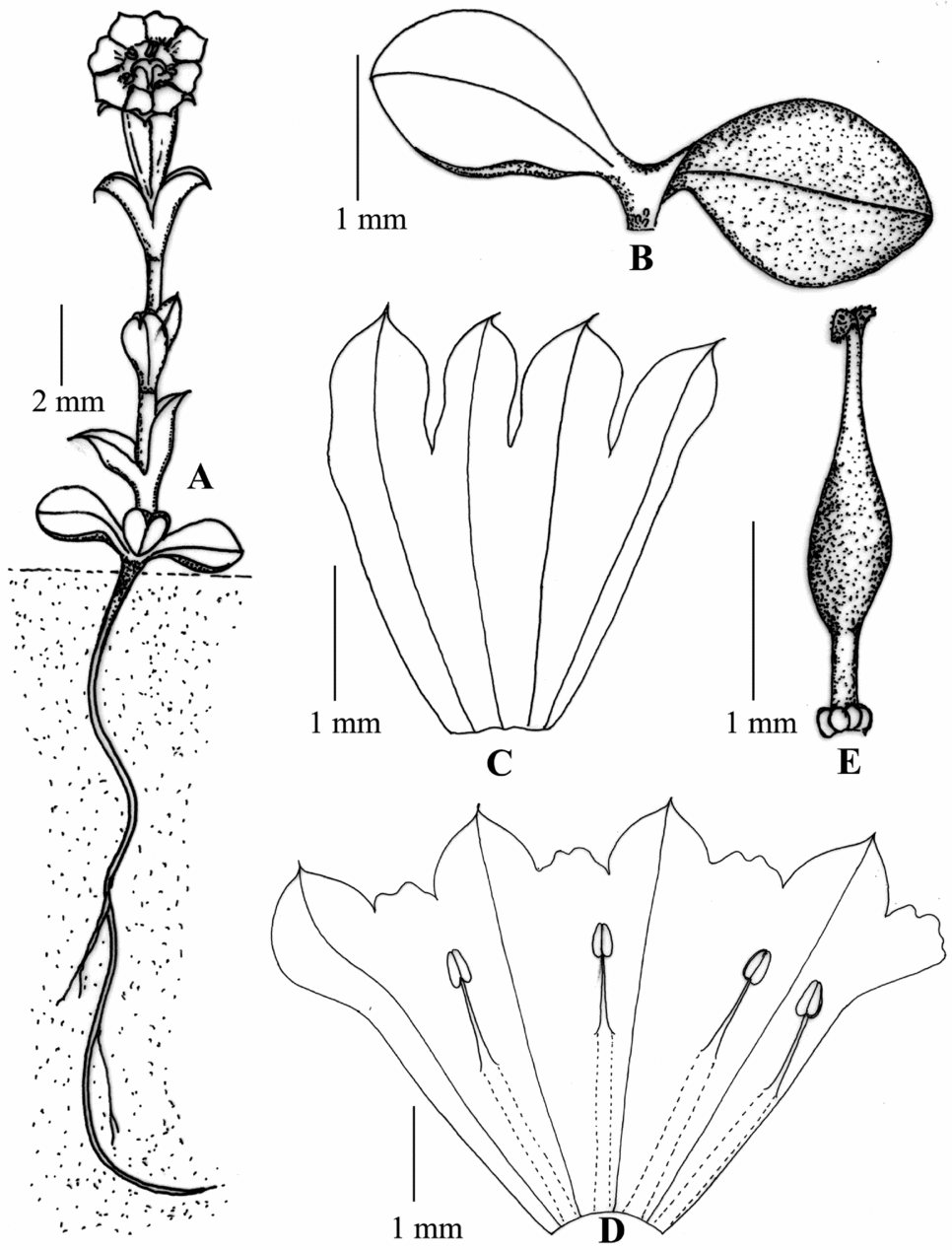
Akin to Gentiana glabriuscula Ho but plants smaller, mostly to 1 cm high (occasionally to 1.5 cm); basal leaves 4, dimorphic, smaller, to 2 × 1.5 mm, present at anthesis, basal-most two with rounded apex; stem leaves reflexed only by apical third part; flowers 4-merous, white with bluish tinge outside around throat; calyx, corolla lobes, filaments and anthers smaller; ovary ovoid–ellipsoid, smaller. Moreover, Gentiana arunii is found at much higher elevations than G. glabriuscula (c.4600 m versus up to 3200 m). The new species is also close to Gentiana pluviarum subsp. subtilis (≡ Gentiana subtilis Harry Sm.) but differs in plants being smaller, mostly to 1 cm high (occasionally to 1.5 cm); basal leaves 4, dimorphic; stem simple with solitary, terminal, 4-merous white flower with bluish tinge outside around throat; basal leaves present at anthesis; stem leaves elliptic–ovate with acute apex with deflexed cartilaginous mucro; plicae emarginate/retuse; and filaments being attached near the middle of corolla tube. Type – Upper Thangu Valley, 4600 m, 9 viii 2015, Maity & Dey 21885 (holo CUH; iso CAL, CUH). Figs 1 , 2 .
Gentiana arunii D.Maity, S.K.Dey, J.Ghosh & Midday. A, Habitat; B, plants with flowers; C, dried whole plant; D, dried plant soaked in water; E, split calyx (ventral face); F, split corolla showing epipetalous stamens (ventral face); G, gynoecium; H, cleared and stained plant; I, stained leaves (pair), note papillate margin marked with arrow; J, cleared and stained flower bud.

Gentiana arunii D.Maity, S.K.Dey, J.Ghosh & Midday. A, Habit; B, lowermost leaf pair of basal rosette; C, split calyx (ventral face); D, split corolla showing epipetalous stamens (ventral face); E, gynoecium.

Annual, erect herb, 0.6–1(–1.5) cm tall. Taproot cylindrical, to 2.5 cm long, c.0.1 mm diameter. Stems simple, glabrous. Basal rosette leaves 4, present during anthesis, dimorphic; basal-most leaf blades broadly elliptic or suborbicular, 1.5–2 × 1–1.5 mm, apex rounded, margin entire, smooth, slightly cartilaginous, petioles short, to 0.2 mm, base fused to c.0.25 mm long sheath, glabrous, vein not prominent, with few papillae at node; other two leaf blades oblanceolate–oblong, 1.4–1.6 × 1–1.2 mm, apex acute, mucronate; mucro reflexed, cartilaginous; margin entire, slightly cartilaginous, midvein ± prominent. Stem leaves lax, 2–4 pairs, longer or shorter than internodes; petioles fused, forming a sheath 0.25–0.5 mm long, smooth; leaf blade oblanceolate–elliptic or oblanceolate–oblong, 1.5–2 × 1–1.1 mm, leathery, smooth, apex acute, often purplish, mucronate; mucro cartilaginous, recurved; upper two-thirds margin entire, lower third papillate, slightly cartilaginous, vein 1, strongly cartilaginous, winged (prominent when dry), without distinct petiole, reflexed only in apical third part. Flowers terminal, solitary, 4-merous; uppermost node (below flower) minutely papillate; pedicels to 1.7 mm long, often surrounded by uppermost pair of leaves, glabrous. Calyx campanulate, 2.5–3 × 1–1.5 mm; tube 1.6–2 mm long, with prominent veins; lobes 4, ovate (obovate–oblong), 0.9–1 × 0.5–0.8 mm, subequal, margin slightly cartilaginous, apex caudate–mucronate, often purplish, 1-veined, moderately reflexed; midvein cartilaginous. Corolla campanulate, 3.4–4.2 mm, white with blue tinge on outside around throat, greenish towards base; tube 3–3.5 mm; lobes broadly ovate, 0.4–0.7 × 0.9–1 mm, apex acute, mucronate; plicae broadly ovate, 0.2–0.3 × 0.7–0.8 mm, emarginate(–retuse). Stamens inserted towards middle of corolla tube, 1.1–1.8 mm above corolla base; filaments 0.7–0.8 mm long, white, flattened towards base; anthers 0.2–0.3 mm long, yellow; ovary ovoid–ellipsoid, 0.8–1.1 × 0.3 mm. Ovarian stipe 0.3–0.4 mm long; style 0.4–0.6 mm long; stigma lobes narrowly ovate–oblong, c.0.2 mm.
Distribution
Sikkim, probably endemic.
Habitat
Plants growing on grassy slopes in open alpine forests at around 4600 m a.s.l. As well as the specimens collected, several individuals along with young plants and seedlings were observed. The common associated species are Aletris pauciflora (Klotzsch) Hand.-Mazz., Bistorta affinis (D.Don) Greene, Corydalis meifolia Wall., Diplarche multiflora Hook.f. & Thomson, Diplarche pauciflora Hook.f. & Thomson, Gentiana phyllocalyx C.B.Clarke, Gentiana springateana D.Maity, Koenigia nummulariifolia (Meisn.) Měsíček & Soják, Kuepferia kanchii D.Maity, S.K.Dey & Adr.Favre, Kuepferia infelix (C.B.Clarke) Adr.Favre, Ranunculus L. spp., etc.
Flowering
July to August.
Proposed IUCN conservation status
Critically Endangered (CR). Gentiana arunii is presently known from two populations, each having 10–15 individuals in the small state of Sikkim. It is geographically restricted. The area of occupancy and extent of occurrence of the species are < 10 km2 and < 100 km2, respectively. The species must be considered at high risk, owing to its limited geographical range and the fact that the populations occur along a road with high anthropogenic activity on open slopes. Therefore, we propose the IUCN conservation category Critically Endangered (CR B&D) for this species (IUCN Standards and Petitions Subcommittee, 2016).
Etymology
The specific epithet commemorates late Prof. (Dr.) Arun Kumar Sharma (1943–2017), Padma Bhushan, a legendary cytotaxonomist of the Department of Botany, University of Calcutta, who made great contributions to the cytology of Himalayan plants.
Additional specimens examined (paratypes). Sikkim. Upper Thangu Valley: 4600 m, 9 viii 2015, Maity & Dey 21886; 4600 m, 29 vii 2017, Maity & Dey 20123; 4600 m, 21 vii 2017, Dey, Ghosh & Midday 22410, 22411 (CUH).
Discussion
The new species, Gentiana arunii, has attracted attention primarily by its tiny habit, usually under 1 cm high, and could be the smallest species of the genus known to date. This small plant with its simple stem bears one terminal, white, 4-merous flower, a dimorphic (2 + 2) basal leaf rosette and is unparallelled among all known species in the Himalaya, as such a combination of characters is not found in any other known taxon of the genus. The habit of the species was confirmed by visits in three successive years (since 2015) to confirm the stability of the morphological characters, particularly the height of the plants and the colour of the flowers. These observations confirm the diagnosis of this remarkable little plant and its affinity to Gentiana glabriuscula and G. pluviarum subsp. subtilis. Gentiana arunii is significantly smaller in almost every respect than its relative G. glabriuscula; furthermore, qualitatively it is also very different. A number of characters distinguish the new species from Gentiana glabriuscula, viz. those of the stem (simple versus branched, caespitose), basal leaves (dimorphic, up to 2 × 1.5 mm, sessile versus uniform, 6–26 × 3–15 mm, long-petiolate to 5 mm), stem leaves (oblanceolate–elliptic or oblanceolate–oblong versus ovate), pedicels (prominent, to 1.7 mm long versus absent), flowers (4-merous versus 5-merous), calyx lobes (subequal versus equal) and corolla colour (uniform inside versus darker spots in throat). Moreover, the plicae in Gentiana arunii are emarginate(–retuse), in contrast to the acute, irregular, entire or bifid (bilobed) plicae in G. glabriuscula.
Similarly, the new species differs from another allied taxon Gentiana pluviarum subsp. subtilis not only by its smaller size, but also by many significant qualitative characters, viz. the nature of the stem (simple versus branched from base), basal leaves (present at anthesis versus withered at anthesis), stem leaves (sessile, papillate along lower third margin versus prominently petiolate, entire throughout margin), flowers (4-merous versus 5-merous), calyx lobes (subequal versus equal), corolla shape (campanulate versus tubular) and corolla colour (uniform white within versus white with [4 or] 5 blackish spots in throat). Notably, the plicae in Gentiana arunii have emarginate(–retuse) apices, whereas in G. pluviarum subsp. subtilis the plicae are obtuse.
The new species shows some morphological similarity with Gentiana pedicellata (Wall. ex D.Don) Griseb., viz. elliptic or lanceolate basal leaves, elliptic, oblanceolate or spathulate stem leaves, ovate or broadly ovate corolla lobes and ellipsoid ovary. However, the later species has a large, much branched growth form (often to 10 cm high) and glandular–papillose stems and leaves. Moreover, leaves are much larger and flowers are in a loose cyme in Gentiana pedicellata; G. arunii has smaller leaves and a solitary flower. Gentiana arunii also occurs at higher altitudes than the other three species.
Molecular phylogenetic studies may reveal the relationships of these four taxa in the future. The annual habit and solitary terminal flowers with symmetrical plicae place this species in Gentiana sect. Chondrophyllae (Ho & Pringle, Reference Ho, Pringle, Wu and Raven1995). Severe anthropogenic activity around the type locality have been observed in recent years, therefore immediate action should be taken by the competent authorities to save this remarkable little plant.
Acknowledgements
We are thankful to the Ministry of Environment, Forest and Climate Change, Government of India, for financial assistance towards our research programme, and to the Department of Forests, Environment and Wildlife Management and Home Department, Government of Sikkim, the Superintendent of Police, Gangtok, and the 17th Mountain Division and Indo-Tibetan Border Police Force, Indian Army, for permitting and supporting our field visit. This study was also partially supported by the University Grants Commission, Government of India. We thank Mr Umed Singh, coordinator of this field trip, who made the event successful. We are grateful to Dr Neil Bell, Editor-in-Chief, Edinburgh Journal of Botany, and two reviewers for their constructive comments on our manuscript.