Introduction
In amphibians, fully grown oocytes are arrested at G2, at the beginning of meiosis I. This meiotic arrest is released under the stimulus of progesterone, a process termed oocyte maturation (Fortune et al., Reference Fortune, Concannon and Hansel1975; Schuetz, Reference Schuetz and Browder1985). Progesterone interacts with the oocyte surface to trigger a complex chain of reactions that induce germinal vesicle breakdown (GVBD), chromosome condensation and extrusion of the first polar body to produce a fertilizable egg.
A maturation-inducing substance (MIS) binds to the receptor located on the oocyte plasma membrane to produce rapid changes in intracellular signalling pathways, ultimately leading to the formation of a maturation-promoting factor (MPF), a complex formed by cdc2 kinase and cyclin B protein. While MPF activation is universal to oocyte maturation, the signalling events that lead to MPF activation are quite variable among species (Yamashita et al., 2002; Klima et al., 2004; Voronina et al., 2004).
Although progesterone is the established maturation inducer in Bufo arenarum, meiosis resumption also occurs spontaneously when follicular cells are removed and oocytes are cultured in vitro under suitable conditions. In this species it is possible to obtain oocytes competent or non-competent to undergo spontaneous maturation according to the seasonal period in which animals were captured (Zelarayán et al., Reference Zelarayán, Oterino and Bühler1995). Interestingly, fully grown Bufo arenarum oocytes always respond to progesterone, independently of the time of the year in which they are obtained (Zelarayán et al., Reference Zelarayán, Oterino and Bühler1996).
Studies concerning oocyte maturation in species as diverse as amphibians, starfish and mammals report the identical conclusion that levels of the second messenger cAMP in the oocytes play a critical role in maintaining meiotic arrest (Ferrell, Reference Ferrell1999). In this sense, it has been proposed that cAMP diffuses from follicle cells to the oocytes through heterologous gap junction coupling (Eppig, Reference Eppig1991; Webb et al., Reference Webb, Bains, Cruttwell and Carroll2002).
One common signalling event initiated upon hormonal induction of oocyte maturation in amphibians, starfish and lower vertebrates is a decrease in oocyte cAMP levels caused, at least partly, by the activity of the G protein in the plasma membrane (Sadler & Maller, Reference Sadler and Maller1980, Reference Sadler and Maller1981) during the period in which oocytes resume meiosis. cAMP levels would be enhanced by a concomitant stimulation with either membrane-permeable cAMP analogues or phosphodiesterase (PDE) inhibitors that prevent maturation in vitro (Sánchez Toranzo et al., Reference Sánchez Toranzo, Bonilla, Zelarayán, Oterino and Bühler2004). High cAMP levels in the oocyte maintain the oocyte in meiotic arrest, probably via the protein kinase A (PKA) pathway. PKA in an active state causes phosphorylation of unknown protein substrates.
The earliest known biochemical events in oocytes treated with progesterone are a rapid decrease in cAMP caused by the inhibition of adenylate cyclase activity related, at least partly, to the activity of the G protein in the plasma membrane (Sadler & Maller, Reference Sadler and Maller1980, Reference Sadler and Maller1981) and complex changes in phospholipid metabolism (Morrill & Kostellow, Reference Morril and Kostellow1999).
It has been hypothesized that a decrease in cAMP concentrations in the oocytes is sufficient to promote maturation in Bufo arenarum (Zelarayán et al., Reference Zelarayán, Oterino and Bühler1996) and mouse oocytes, presumably through inhibition of cAMP-dependent protein kinase activity leading to MPF activation.
Another event during oocyte maturation in many species is the generation of second messengers, such as the ones generated by the hydrolysis of membrane-bound phosphatidylinositol 4,5-bisphosphate (PIP2). The hormonal stimulus involves a receptor-dependent hydrolysis of inositol phospholipids by phospholipase C (PLC) to generate two second messengers, inositol 1,4,5-trisphosphate (IP3) and 1,2-diacylglycerol (DAG). In this sense, DAG is involved in the regulation of protein kinase C (PKC) activity (Nishizuka, Reference Nishizuka1984). The activation of PKC is thought to be involved in the initial response of amphibian oocytes to agonists that induce GVBD (Smith, Reference Smith1989; Zelarayán et al., Reference Zelarayán, Oterino and Bühler1996). In addition, IP3 is released into the cytosol and acts to mobilize intracellular Ca2+ (Berridge & Irvine, Reference Berridge and Irvine1989; Downes, Reference Downes1989; Fissore et al., Reference Fissore, Reis and Palermo1999).
Recent studies have shown that, in Bufo arenarum, the inhibition of PIP2 hydrolysis by treatment of denuded oocytes with neomycin totally blocks progesterone-induced maturation, suggesting that the products of this hydrolysis (DAG and IP3) are involved in the pathway normally used by progesterone in this species (Zelarayán et al., Reference Zelarayán, Oterino, Toranzo and Bühler2000).
Lithium, which blocks phosphoinositide metabolism (Hanson, Reference Hanson1991), has been reported to exert an inhibitory effect on the maturation of mouse (Pesty et al., Reference Pesty, Lefevre, Kubiak, Geraud, Tesarik and Maro1994), starfish (Picard & Dorée, Reference Picard and Doreé1983) and Bufo arenarum oocytes (Sánchez Toranzo et al., Reference Sánchez Toranzo, Bonilla, Zelarayán, Oterino and Bühler2004).
GABAA receptor, which is coupled to chloride ion channels, is an oligomeric complex with binding sites for direct GABAA receptor agonists such as muscimol and antagonists such as picrotoxine. GABAA receptor has been found both in neuronal and in several non-neuronal mammalian cells including pancreatic α2-cells (Rorsman et al., Reference Rorsman, Berggren, Bokvist, Ericson, Mohler, Ostenson and Smith1989), pars intermedia melanotrophs (Taraskevich et al., 1985) and in mammalian oviducal tissue (Laszlo et al., Reference Laszlo, Villanyi, Zsolnai and Erdo1989). It has been suggested that this receptor is also involved in the progesterone induction of the acrosome reaction of human sperm in vitro (Wistrom & Meizel, Reference Wistrom and Meizel1993). This finding agrees with the results obtained in mouse sperm that underwent acrosomal exocytose when stimulated with progesterone. This effect was inhibited by picrotoxin, the GABAA receptor antagonist (Sih & Roldan, Reference Sih and Roldán1995). This finding indicates that the action of progesterone in the sperm is mediated by a GABAA receptor and apparently linked to Cl− channels (Sih & Roldan, Reference Sih and Roldán1995). Sperm have GABAA receptors, but the signal transduction that mediates the effect of progesterone on the acrosome reaction is not clear (Meizel, Reference Meizel1997).
Although the non-genomic actions of progesterone in oocyte maturation are clearly mediated by a receptor located at the oocytes plasma membrane, this receptor has not yet been characterized.
Membrane-bound GABAA receptors have not been described in oocytes. These cells, however, were used to study the GABAA receptor. In Xenopus oocytes the experimental procedures were carried out by injecting cells with cRNAs composed of the α1 and β1 subunits of the bovine GABAA receptor to express the receptor.
There is no evidence that progesterone action on oocyte meiosis resumption is mediated by a GABAA-receptor-like receptor. Nevertheless, this fact was demonstrated in the acrosome reaction (Sih & Roldan, Reference Sih and Roldán1995). In this respect, studies performed by Covey (2001) suggest that progesterone action in oocytes involves a coupling place different from that of the GABAA receptor.
The aim of this work was to determine whether the activation of a GABAA receptor is able to induce GVBD in denuded oocytes and to analyse its possible participation in progesterone-induced maturation, as well as to evaluate the role of purines and phospholipids in the maturation process induced by a GABAA-receptor agonist such as muscimol in fully grown denuded oocytes of Bufo arenarum.
Materials and Methods
Animals
Adult specimens of Bufo arenarum were collected in the northwestern area of Argentina, from September to December (summer animals) and kept at 15 °C until use, which generally took place 15 days after collection.
In vitro follicle and denuded oocyte culture
Experimental manipulation and culture were performed at room temperature (22–25 °C) in amphibian Ringer's solution (AR) (6.6 NaCl g/l, 0.15 CaCl2 g/l and 0.15 KCl g/l) containing penicillin G-sodium (30 mg/l) and streptomycin sulfate (50 mg/l), pH 7.4.
Fully grown follicles (1.7–1.8 mm in diameter) were isolated from other ovarian tissues using watchmaker's forceps. Denuded oocytes were obtained by manually pulling off the follicle epithelium and the theca layer using fine forceps with the aid of a dissecting microscope (Lin & Schuetz, Reference Lin and Schuetz1985). Follicle cells were removed by incubation of defolliculated oocytes in AR for 5 min with gentle shaking (100 oscillations/min) (Zelarayán et al., Reference Zelarayán, Oterino and Bühler1995). Denuded oocytes were kept in AR until use.
Freshly denuded oocytes were placed in AR at 22–25 °C. Routine in vitro cultures were carried out using plastic multiwell culture dishes (Costar 3524). Randomized samples of 20 oocytes were distributed into separate wells containing 2 ml of AR; the reagents were added (5 μl) directly to the culture medium. Two-well duplicates were routinely run in each experimental group.
Oocyte maturation was assessed 24 h after hormone or reagent addition. Meiosis reinitiation was scored both by the presence of a transient white spot in the animal pole and by the absence of GVBD after subsequent dissection of the oocytes fixed in trichloroacetic acid (TCA).
Hormones and reagents
All hormones and reagents were purchased from Sigma. Progesterone was dissolved in ethanol and added (5 μl) directly to the culture medium to give a final concentration of 2.5 μM, concentration at which the GVBD reach almost 98%. Muscimol was dissolved in NaCl until used and was used at a final concentration of 1 μM.
Defolliculated oocytes were incubated with various concentrations (0.0025–2.5 μM) of muscimol.
Dibutyryl cAMP (dbcAMP) was dissolved in AR and various doses were added to the culture medium at a constant volume (5 μl). Picrotoxin was dissolved in ethanol and different doses (10–50 μM) were added to the culture medium.
Theophylline was used at a final concentration of 0.1 μM. Stock solution of neomycin sulfate (10 mm) and LiCl (1 M) was prepared in ddH2O. 1-(5-Isoquinolinyl sulphonyl)-2-methyl-piperazine (H-7), a stock solution of PKC antagonist was dissolved in DMSO. Various doses were added directly to the culture medium in a constant volume of vehicle (5 μl).
Insemination of ovarian oocytes
Sperm suspensions were obtained by gently disrupting the testes in 4 ml AR and centrifuging at 1085 g for 10 min; then, the pellet was resuspended in AR. Denuded ovarian oocytes were treated with trypsin according to Elinson (Reference Elinson1973).
Trypsin-treated denuded oocytes (Elinson, Reference Elinson1973) were inseminated in 10% AR containing the diffusible factor (1 : 1) obtained according to Barbieri & Oterino (1972). A 20 μl sperm suspension (final concentration 2 × 10⁶ sperm/ml) was added; 10 min later oocytes were placed in 10% AR for different periods and fixed for cytological examination (Bühler et al., Reference Bühler, Petrino and Legname1987).
Cytological preparations
The oocytes were fixed in Ancel & Vintemberger's solution (10% formol; 0.5% acetic acid and 0.5% NaCl), embedded in paraffin and sliced into 7 μm thick sections, which were then stained with Ehrlich hematoxylin and eosin. This method allowed us to easily observe the pronucleus (Bühler et al., Reference Bühler, Petrino and Legname1987).
Results
Effect of muscimol on denuded oocytes incompetent to mature spontaneously
Fully grown Bufo arenarum oocytes obtained during the winter period did not mature spontaneously, but they were able to respond to progesterone. We examined whether the treatment of an agonist of the GABAA receptor such as muscimol is able to induced GVBD.
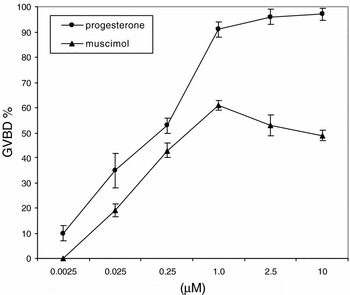
Denuded oocytes not competent to mature spontaneously were cultured in AR with different doses of muscimol (0.0025–10 μM) for 24 h at 25 °C and examined for GVBD. Results were compared with the response of these oocytes to the same doses of progesterone. The results obtained (Fig. 1) show that muscimol induced GVBD in a dose-dependent manner. The maximum response obtained with muscimol, however, was 60%, which is quite lower than the response obtained with progesterone.
Dose–response curves for muscimol-induced and progesterone-induced GVBD in denuded oocytes. Oocytes not competent to mature spontaneously were cultured in AR with different doses of muscimol or progesterone (0.0025–2.5 μM). GVBD was scored after 24 h of incubation. Values are the mean ± SEM of four experiments. Each experiment was performed on a different animal.

Time course of muscimol-induced maturation in denuded oocytes
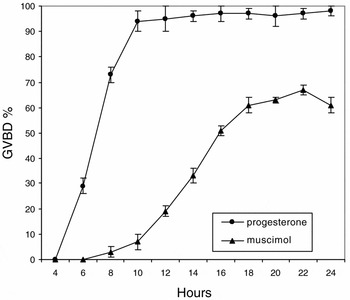
Denuded oocytes that did not show spontaneous maturation were cultured in AR with muscimol (1 μM) or progesterone (2.5 μM) at 25 °C and examined for GVBD at different times during culture (Fig. 2). After 16 h of incubation, 50% of the oocytes underwent GVBD in response to muscimol and after 22 h the response was almost 60%. The maturation of muscimol-treated oocytes was slow when compared with the response of those treated with progesterone, in which 50% of GVBD was observed after 6 h of culture.
Time course of muscimol-induced GVBD in denuded oocytes. Oocytes not competent to mature spontaneously were cultured with muscimol (1 μM) or progesterone (2.5 μM) at 25 °C and examined for GVBD at different times during culture. Values are the mean ± SEM of three experiments. Each experiment was performed on a different animal.

Effect of muscimol on progesterone-induced maturation
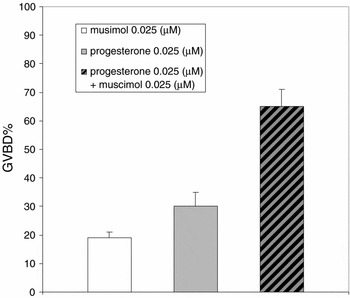
The effect of combination of low doses of muscimol (0.025 μM) and progesterone (0.025 μM) was assayed in denuded oocytes not competent to mature spontaneously.
In progesterone-induced maturation we used a low dose of progesterone (0.025 μM), with which GVBD reached almost 30%. Figure 3 shows that the percentage of GVBD increased to 75% when low doses of muscimol (0.025 μM) were added. This fact suggests a synergistic effect between muscimol and progesterone-induced maturation.
Effect of muscimol on progesterone-induced maturation. Denuded oocytes not competent to mature spontaneously were treated with a low dose of muscimol (0.025 μM) and progesterone (0.025 μM). The GVBD was scored after 24 h of incubation. Values are the mean ± SEM of three experiments. Each experiment was performed on a different animal.

Effect of GABAA antagonist
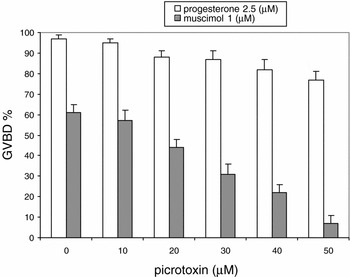
The effect of picrotoxin (antagonist of GABAA receptor) on nuclear maturation was studied by incubating non-competent denuded oocytes in AR in the presence of different doses of the antagonist (10–50 μM) for 60 min before maturation was induced with progesterone (2.5 μM) or muscimol (1 μM). The GVBD was scored after 24 h of culture at 25 °C.
Results presented in Fig. 4 indicated that picrotoxin blocked the ability of muscimol to stimulate maturation. Nevertheless, the GVBD induced by progesterone was slightly inhibited by same doses of picrotoxin.
Effect of picrotoxin on muscimol and progesterone-induced maturation. Denuded oocytes not competent to undergo spontaneous maturation were incubated for 60 min in AR with different doses of picrotoxin (10–50 μM) before muscimol (1 μM) or progesterone addition (2.5 μM). The GVBD was scored after 24 h of incubation. Values are the mean ± SEM of four experiments. Each experiment was performed on a different animal.

Pronuclear formation in oocytes matured with muscimol
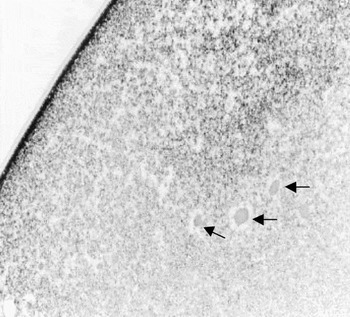
To determine whether the muscimol-induced maturation was genuine, oocytes was inseminated with homologous sperm (see Material and methods). Pronuclear formation was followed through cytological examination of oocytes fixed at various time after insemination. Two hours after insemination, oocytes exhibited well developed pronuclei, similar to that observed in oocytes matured with progesterone (Fig. 5).
Pronuclear formation in denuded oocytes matured with muscimol. Oocytes matured with muscimol were inseminated with homologous sperm and fixed at various times after insemination. Two hours after insemination, oocytes exhibited well developed pronuclei (arrows).

Effect of dbcAMP on muscimol-induced maturation
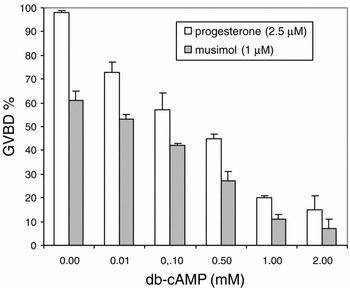
In order to determine whether muscimol-induced maturation was dependent on intracellular levels of cAMP, denuded oocytes not competent to mature spontaneously were cultured in AR and muscimol (1 μM) or progesterone (2.5 μM) with different doses of dbcAMP (0.1–2.0 mM). The GVBD was scored after 24 h of culture at 25 °C.
Results (Fig. 6) indicated that the increase in intracellular levels of dbcAMP inhibited maturation in both cases in a dose-dependent manner.
Effect of dibutyryl cAMP (dbcAMP) on oocytes incompetent to undergo spontaneous maturation. Oocytes incompetent to mature spontaneously were cultured in AR with different doses of dbcAMP (0.01–2.0 mM) 60 min before muscimol (1 μM) or progesterone addition (2.5 μM) and examined for GVBD after 24 h of culture. Values are the mean ± SEM of three experiments. Each experiment was performed on a different animal.

Effect of phosphodiesterase inhibition on muscimol-induced and progesterone-induced maturation
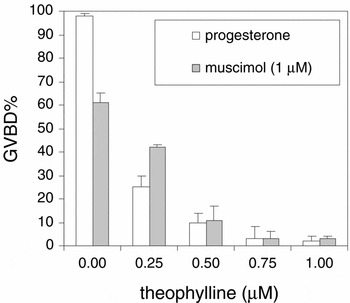
The effect of PDE inhibition on GVBD was assayed using theophyllin, an inhibitor of the enzyme. Denuded oocytes not competent to mature spontaneously were cultured in AR with different doses of theophyllin (0.25–1.00 μM) for 60 min before the addition of muscimol (1 μM) or progesterone (2.5 μM). Oocytes were cultured at 25 °C and examined for GVBD after 24 h of culture (Fig. 7). Results indicated that the inactivation of PDE with theophyllin inhibited maturation in a dose-dependent manner in all cases.
Effect of phosphodiesterase inhibition on muscimol-induced and progesterone-induced maturation. Oocytes incompetent to mature spontaneously were cultured in AR with different doses of theophylline (0.25–1.0 μM) 60 min before muscimol (1 μM) or progesterone addition (2.5 μM). The GVBD was scored after 24 h of incubation. Values are the mean ± SEM of four experiments. Each experiment was performed on a different animal.

Effect of neomycin and LiCl on muscimol-induced and progesterone-induced maturation
In order to analyse the participation of membrane phospholipids hydrolysis during maturation in Bufo arenarum, we studied the effect of neomycin and LiCl on denuded oocytes. Neomycin is an antibiotic that binds to PIP and PIP2, then preventing their hydrolysis in DAG and IP3 and LiCl inhibits the turnover of membrane lipids.
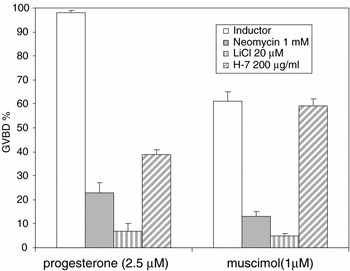
Denuded oocytes not competent to mature spontaneously were preincubated in neomycin (1 mM) or LiCl (20 μM) for 60 min before muscimol (1 μM) or progesterone (2.5 μM) treatment. GVBD was scored after 24 h of culture at 25 °C.
The results, shown in Fig. 8, indicate that the maturation induced by muscimol or progesterone was inhibited when we used neomycin. In the case of LiCl, the GVBD was blockaded. This finding suggests that the participation of membrane phospholipids could be the same in progesterone-induced and muscimol-induced maturation.
Effect of neomycin, LiCl and H-7 on muscimol-induced and progesterone-induced maturation. Oocytes incompetent to mature spontaneously were preincubated in AR with neomycin (1 mM) or LiCl (20 μM) or H-7 (200 μg/ml) 60 min before muscimol (1 μM) or progesterone addition (2.5 μM). The GVBD was scored after 24 h of incubation. Values are the mean ± SEM of four experiments. Each experiment was performed on a different animal.

Effect of PKC inactivation on muscimol-induced and progesterone-induced resumption of meiosis
The effect of PKC inhibition on GVBD was assayed using H-7, which is known to inhibit purified PKC. Denuded oocytes incompetent to mature spontaneously were cultured with H-7 (200 μg/ml) for 60 min before muscimol (1 μM) or progesterone (2.5 μM) treatment and examined for GVBD after 24 h of culture at 25 °C (Fig. 8).
The inactivation of PKC with H-7 slightly inhibited only the maturation induced by muscimol. H-7, however, caused a decrease in the percentage of GVBD in progesterone-induced maturation.
Discussion
Our results indicate that treatment of fully grown denuded Bufo arenarum oocytes not competent to undergo spontaneous maturation with an agonist of the GABAA receptor, such as muscimol, induces meiosis resumption in a dose-dependent manner. Maximum GVBD values of 60% being reached, these values did not increase with the increase in the dose used. These results suggest the presence of GABAA receptors in the oocyte plasma membrane of this species and, for the first time, demonstrate their participation in the process of nuclear maturation.
The time required for oocytes to reach 50% GVBD was longer when maturation was induced with muscimol with respect to the time required for progesterone (16 versus 6.5 h, respectively). This difference could indicate that the response to muscimol could involve a signalling pathway different from the one used by progesterone or the need to synthesize some of the enzymes involved.
The enhancement of the effect of the combination of low doses of muscimol and progesterone observed in denuded oocytes not competent to mature spontaneously suggests that these inducers would act at the level of the plasma membrane using different receptors. The possibility of progesterone acting on its own receptor, however, and in turn activating the GABAA receptor, then increasing the percentage of GVBD, cannot be ruled out (Sih & Roldán, Reference Sih and Roldán1995).
The participation of the GABAA receptor in the resumption of meiosis was confirmed by the use of the specific inhibitor for this receptor, picrotoxine. Treatment of oocytes with picrotoxine inhibited muscimol-induced maturation in a dose-dependent manner, but did not affect the action of progesterone. This result supports the idea that in oocytes progesterone acts through a receptor different from the GABAA receptor.
Taking into account that there are no reports in the existing literature concerning the participation of the GABAA receptor in the maturation of amphibian oocytes, the effect of muscimol on meiosis resumption was confirmed, analysing the ability of the mature oocytes obtained to form pronuclei after fertilization. The cytological analysis showed that muscimol-treated oocytes are capable of forming pronuclei, suggesting that the GABAA-receptor agonist induces GVBD and the subsequent progression to metaphase II.
The decrease in cAMP intracellular levels is one of the key events for progesterone to induce meiosis resumption in the oocytes of Bufo arenarum (Zelarayán et al., Reference Zelarayán, Oterino and Bühler1996, Reference Zelarayán, Oterino, Toranzo and Bühler2000, Sánchez Toranzo et al., Reference Sánchez Toranzo, Bonilla, Zelarayán, Oterino and Bühler2004), Rana pipiens and Rana dykoski (Kwon & Schuetz, Reference Kwon and Schuetz1986; Kwon et al., Reference Kwon, Lin, Choi and Ahn1989). In this sense, adenylate cyclase inhibition has been associated with the binding of the hormone to its receptor in the membrane of Xenopus oocytes (Sadler & Maller, Reference Sadler and Maller1982).
Our results demonstrate that high dbcAMP levels inhibit progesterone or muscimol-induced maturation of incompetent oocytes. Similar results were obtained when PDE was inhibited with theophylline, which suggests the participation of the purine pathway in the maturation induced by agonists of the GABAA receptor.
In previous works we demonstrated that PIP2 hydrolysis and PKC activation with phorbol esthers (PMA) induced a genuine maturation in Bufo arenarum oocytes (Zelarayán et al., Reference Zelarayán, Oterino and Bühler1996). The inhibition assays of the hydrolysis of PIP2 with neomycin and of its exchange in the membrane by treatment with LiCl showed a significant inhibitory response when maturation was induced with muscimol, a response similar to the one obtained with progesterone (Sánchez Toranzo et al., Reference Sánchez Toranzo, Bonilla, Zelarayán, Oterino and Bühler2006). These results suggest that both the exchange of lipids in the membrane and the PIP2 hydrolysis are involved in the maturation induced by agonists of the GABAA receptor.
The analysis of the importance of the PKC in the signalling pathways used by muscimol, however, shows that the inhibition of this enzyme by H-7 does not significantly modify the percentages of GVBD, but inhibits GVBD by 60% in progesterone-treated oocytes, which agrees with the reports of Zelarayán et al. (Reference Zelarayán, Oterino, Toranzo and Bühler2000) in Bufo arenarum. These results indicate certain differences in the signalling pathways used by progesterone and muscimol.
In conclusion, the results presented in this work suggest the presence of GABAA receptors in the plasma membrane of the oocytes of Bufo arenarum that would not be used by progesterone to induce GVBD. We also demonstrate that an agonist of the GABAA receptor such as muscimol is able to induce genuine maturation in denuded oocytes incompetent to mature spontaneously, using signalling pathways similar but not identical to the ones used by progesterone.
Acknowledgement
This work was supported by grants from Consejo Nacional de Investigaciones Cientificas y Tecnicas (CONICET) and Consejo de Investigaciones de la Universidad Nacional de Tucumán (CIUNT).