Economics is work minus the people (Alain de Botton, Twitter, 15 November 2012)
Introduction: the end of work or work without end?
After decades of decreasing labour force participation among the elderly (Kohli and Rein Reference Kohli and Rein1991; Guillemard and Rein Reference Guillemard and Rein1993), many governments have begun to curtail programmes of early exit and to increase the statutory retirement age (Ebbinghaus Reference Ebbinghaus2006; OECD 2006). However, such efforts often meet fierce resistance from the public. For example, when the French government raised the statutory retirement age from 65 to 67 and reduced the level of “early pensions” in 2010, the measure provoked one of the most serious and, at times, even violent general strikes and huge mass demonstrations. France is not alone. Similar protests have been staged in many countries, especially – though certainly not exclusively – in the course of recent austerity packages (e.g. in Spain March 2012, Greece September/October 2012 and Slovenia 2012). These protests illustrate the general problem of when and why some countries have maintained policies of exit longer than others and the ways in which popular demand played a role in this.
The literature has given different answers to this question. Some authors claim that reforms are ultimately driven by factors other than public opinion (Bonoli Reference Bonoli2000; Ebbinghaus and Hassel Reference Ebbinghaus and Hassel2000; Myles and Pierson Reference Myles and Pierson2001). Yet, the examples given above seem to suggest otherwise. Others argue that material factors on the individual level play a large role in public opinion and political outcomes (Blekesaune and Quadagno Reference Blekesaune and Quadagno2003; Blekesaune Reference Blekesaune2007; Rueda Reference Rueda2007; Rehm Reference Rehm2011). However, it is interesting to note that people who do not directly benefit from policies of early exit often support them. Finally, some authors claim that public opinion matters, but in a different sense: the population adheres to normative ideas and cultural expectations rather than personal interest (Svallfors Reference Svallfors1997; Boeri et al. Reference Boeri, Börsch-Supan and Tabellini2001; Velladics et al. Reference Velladics, Henkens and Van Dalen2006; Albrekt-Larsen Reference Albrekt-Larsen2007; Caplan Reference Caplan2007; Landier et al. Reference Landier, Thesmar and Thoenig2008). However, this approach often shifts the puzzle merely towards an understanding of the differences between these norms and cultures.
While all of these approaches have clear merits, I argue that a particular causal belief plays an important intermediate role in explaining public opinion on retirement. By “intermediate”, I mean that this belief reveals a “boundedly rational” core, which can be related back to underlying structural and institutional determinants but may go beyond those people who are directly affected. In this sense, the article proposes a mechanism of influence that extends past the individualistic perspective, though more narrowly confined than the broader cultural or norm-based approaches.
Causal beliefs in the efficacy of policies have been intensively studied by comparative analysts of welfare states (Hall Reference Hall1993; Cox Reference Cox2001; Schmidt Reference Schmidt2002; Beland and Cox Reference Beland and Cox2011), but – to the best of my knowledge – have never been applied to early retirement, nor examined as an intermediate variable. Moreover, the literature on ideas is dominated by qualitative approaches, whereas this article aims at quantifying and testing the relevance of beliefs. This article should therefore also contribute to a better understanding of the role of ideas in policy reforms more generally.
The specific belief studied is the lump-of-labour idea. It is, in short, the idea that the labour market is a zero-sum game: if someone wants to get a job, he or she needs to take it away from someone else. This belief depends not (only) on individual or historical contingencies, but (also) on the structural and institutional characteristics of the labour market. Most importantly, strongly regulated labour markets make it difficult for voters to see how expanding employment of the elderly will ultimately be good for the country. In such a context, voters systematically oppose any policy that increases the labour supply, with the retrenchment of early retirement being the most pertinent example. Ultimately, where public opposition is strong, it makes life more difficult for governments who try to reform early retirement.
The article proceeds as follows. After a review of the literature (section 2) and the exposition of the lump-of-labour idea (section 3), I introduce the data and the methodology used – a multi-level regression for Eurobarometer data from 1992 and 2001 (section 4). In the next section, I look at the determinants of the lump-of-labour belief. We will see that, among other things, the regulation of the labour market explains a substantive share in cross-national variation. Thereafter, I use the same dataset to explore the relationship between the beliefs among people and their policy preferences about (early) retirement. The section following this discusses the political consequences of the belief, giving some anecdotal evidence on policy reforms. The last section discusses the limits of this study and its implications for the literature on the welfare state and labour market reform.
The role of public opinion in reforming early retirement
Policies of early exit are, by their very nature, multidimensional and interdependent. There are many functional equivalents to explicit programmes designed for early retirement (Ebbinghaus Reference Ebbinghaus2006). Therefore, Kohli and Rein (Reference Kohli and Rein1991, 6) speak of “pathways of exit”, as the “…different institutional arrangements that are sequentially linked to manage the transition process, that is, the period between exit from work and entry into the normal old-age pension system”. Other authors prefer to define a policy in terms of its outcome, such as the decreasing incidence of early exit below a particular age, such as 65. This bears the risk of ascribing causal effects to governments when often social or market forces are more decisive in shaping exit decisions (Blöndal and Scarpetta Reference Blöndal and Scarpetta1999; Van Dalen and Henkens Reference Van Dalen and Henkens2002).
Given this complex nature of early exit policies, it is no small wonder that scholars have adopted many different perspectives in explaining whether or not and why a reform has taken place in a given country. These approaches differ tremendously in the role they ascribe to public opinion. To keep matters simple, I distinguish between three broad classes of approaches: (1) those that see little direct influence of public opinion or voters, (2) those that focus on individualistic “material” interests and (3) those that bring in “subjective” factors, such as norms or culture.
Approaches of the first type attribute little explanatory power to public opinion and come in many shapes and varieties. Some authors deem problem pressure as the major determinant of a policy reform (Blöndal and Scarpetta Reference Blöndal and Scarpetta1999; OECD 2006). Since problem pressure is often endogenous, other authors highlight the role of institutional complementarities and path dependencies (Pierson Reference Pierson1996; Ebbinghaus Reference Ebbinghaus2000). Labour-market institutions, for instance, may have direct consequences on the “costliness” and comparative institutional advantages of different forms of retirement regimes (Blöndal and Scarpetta Reference Blöndal and Scarpetta1999; Hartlapp and Kemmerling Reference Hartlapp and Kemmerling2008). Welfare state institutions may also play a role, especially by influencing the forms of different pension regimes (Myles and Pierson Reference Myles and Pierson2001; Ebbinghaus Reference Ebbinghaus2006), which affect the feasibility of reforms. Political institutions play a powerful role in shaping and delaying costly political reforms (Bonoli Reference Bonoli2000; Immergut et al. Reference Immergut, Anderson and Schulze2007).
Another approach puts more emphasis on special interest groups, in particular, industrial partners (Trampusch Reference Trampusch2005; Ebbinghaus Reference Ebbinghaus2006). In times of economic turbulence or restructuring, “labour shedding” is to the benefit of both employers’ associations and trade unions if they do not represent all workers equally (Ebbinghaus and Hassel Reference Ebbinghaus and Hassel2000; Hartlapp and Kemmerling Reference Hartlapp and Kemmerling2008). Others have a more benign view on industrial partners, arguing that corporatist pacts often enhance the capacity of a state to reform (Visser and Hemerijck Reference Visser and Hemerijck1997).
Approaches of the second type assign public opinion and voters a much stronger role. The first entry point to this literature is the idea of policy responsiveness (Page and Shapiro Reference Page and Shapiro1983; Brooks and Manza Reference Brooks and Manza2006). Though the view that governments respond to public demands has been contested in the literature (Burstein Reference Burstein2003; Myles Reference Myles2006), it is the implicit motivation behind many quantitative analyses of public opinion data: differences in public opinion lead to differences in political outcomes.
Individual material cleavages play a large role in these approaches. Older or aging people, for instance, may want to maintain early retirement for their own benefit (Lazear Reference Lazear1979; Busemeyer et al. Reference Busemeyer, Goerres and Weschle2009). Skill specificity and exposure to risk may differ from country to country and explain differences in the demand for retirement (Iversen and Soskice Reference Iversen and Soskice2001; Rehm Reference Rehm2011). Insidership can also play a role (Rueda Reference Rueda2007; Häusermann and Schwander Reference Häusermann and Schwander2009), especially where social protection is closely linked to employment.
Institutional differences reinforce differences of public opinion in a feedback loop. For instance, the varieties-of-capitalism approach argues that different production regimes lead to differences in the policy preferences of employers and employees (Estevez-Abe et al. Reference Estevez-Abe, Iversen and Soskice2001; Mares Reference Mares2001). Another famous example is the idea that social policies create vested interests among their beneficiaries (Skocpol Reference Skocpol1992; Pierson Reference Pierson1994).
Many of these arguments have been successfully tested on public opinion data regarding retirement policies (Hayes and Vandenheuvel Reference Hayes and Vandenheuvel1994; Boeri et al. Reference Boeri, Börsch-Supan and Tabellini2001; Van Groezen et al. Reference Van Groezen, Kiiver and Unger2009). Yet, the individualistic approach is somewhat at odds with the fact that opposition against retrenching early retirement is often much larger and reaches beyond those who most likely will lose from a reform (Hayes and Vandenheuvel Reference Hayes and Vandenheuvel1994; Boeri et al. Reference Boeri, Börsch-Supan and Tabellini2001). Approaches of the third type hence go beyond the simple logic based on self-interest; they focus much more on “subjective” determinants of public opinion, such as norms or culture.
A basic criticism about the direct link between benefits and preferences is that voters are not well informed (Boeri et al. Reference Boeri, Börsch-Supan and Tabellini2001; Caplan Reference Caplan2007) and may strike down any type of reform due to their bias for maintaining the status quo (Vis and Van Kersbergen Reference Vis and Van Kersbergen2007). Other authors argue that norms and values have a powerful effect on the formation of public opinion (Mau Reference Mau2003; Svallfors Reference Svallfors2006). The qualitative literature on discourse comes to similar conclusions (Schmidt Reference Schmidt2002). Some authors also claim that there is another form of a positive feedback effect: a link from welfare regimes to public opinion, which works through the formation of norms and values (Velladics et al. Reference Velladics, Henkens and Van Dalen2006; Albrekt-Larsen Reference Albrekt-Larsen2007; Landier et al. Reference Landier, Thesmar and Thoenig2008).
While there is arguably some truth to these claims, critics claim that this approach just moves the question one step further: why do countries differ in these norms and cultures? In addition, “regime type” can refer to many different aspects of welfare states and is therefore hard to conceptualise as an explanatory variable (Arts and Gelissen Reference Arts and Gelissen2002; Scruggs and Allan Reference Scruggs and Allan2008). More recent studies found that there are also important negative feedback effects from institutions to public opinion (Lynch and Myrskyla Reference Lynch and Myrskyla2009; Fernandez and Jaime-Castillo Reference Fernandez and Jaime-Castillo2012). Weaver (Reference Weaver2010), for instance, argues that negative feedback effects, such as financial instability, should also affect the support of an existing policy. Finally, there are well-known theoretical and empirical problems explaining attitudes that haunt part of this literature (Hamermesh Reference Hamermesh2004; Myles Reference Myles2006). Thus, while some individualistic approaches seem to underestimate the role of public opinion, and in some sense overestimate the likelihood of reform, approaches based on regimes and culture may overestimate the role of public opinion. A method that seeks to reconcile the two approaches must take account of how people learn about the way modern labour markets function in order to show how this matters.
The belief in lumps of labour
Economists call it the “lump of labor fallacy”. It’s the idea that there is a fixed amount of work to be done in the world, so any increase in the amount each worker can produce reduces the number of available jobs. […] As the derisive name suggests, it’s an idea economists view with contempt, yet the fallacy makes a comeback whenever the economy is sluggish. (Paul Krugman, New York Times, 7 October 2003)
European politicians often like to blame outsourcing for the disappearance of jobs. But in reality the work isn’t going to the Chinese—it’s going to the robots. (Jeremy Rifkin, Der Spiegel International, 8 March 2005)
Processes of learning and belief formation are one way of explaining policy persistence and policy change (Braun and Gilardi Reference Braun and Gilardi2006; Meseguer Reference Meseguer2006). A particularly important variant of these beliefs are causal beliefs, as in “cause-effect relationships” (Goldstein and Keohane Reference Goldstein and Keohane1993; Hall Reference Hall1993). These beliefs are less encompassing than norms or cultural expectations, but they may be highly contagious, that is, easily spread from person to person (Cox Reference Cox2001; Schmidt Reference Schmidt2002).
Causal beliefs are clearly not the only way to conceptualise the role of beliefs and ideas (Blyth Reference Blyth1997; Campbell Reference Campbell1998; Berman Reference Berman2002), but causal beliefs are relatively easy to operationalise. Moreover, cause-effect statements can easily be inserted into a larger causal mechanism to explain how and when beliefs matter. This is important for two reasons: First, the literature on ideas and beliefs has often stated that the origins of beliefs are important even if just to understand their consequences (Campbell Reference Campbell1998; Beland and Cox Reference Beland and Cox2011). And, second, as argued above, tracing ideas in public opinion is complicated by the much older problem – the difficulty of inferring behaviour from attitudes (Wicker Reference Wicker1969; Alwin Reference Alwin1973). Therefore, I suggest a two-step procedure for the following analysis: first developing arguments about the determinants of a certain type of belief and then dealing with the consequences of this belief.
The causal belief investigated here is the lump-of-labour idea. In its static version, people may think that there is an upper limit to the total number of jobs in a society, and hence that jobs cannot be generated but only redistributed. In its dynamic version, people may even think that this upper limit of total jobs will fall as time passes due to processes of globalisation or technological change. This idea is far from new. In the early nineteenth century, the Luddite movement destroyed factory machines as technical progress threatened to make workers redundant (Polanyi Reference Polanyi1944; Thomis Reference Thomis1970; Acemoglu and Robinson Reference Acemoglu and Robinson2012, Chapter 8). Marxism popularised the idea of a “reserve army of labour”: people fired in some sector must remain unemployed or else wages will decrease in other sectors to the point of pauperisation [Marx Reference Marx1962 (1864)]. Modern versions of the argument that “the modern economy” inherently destroys jobs can be found in the writings of Jeremy Rifkin (Reference Rifkin1994) and among policy makers.Footnote 1
Some economists call these arguments a fallacy (Krugman Reference Krugman1999; Caplan Reference Caplan2007; Sowell Reference Sowell2007). They argue that a dynamic economy will always create new jobs, so a constant or shrinking number of jobs should not exist at the macro level. If it does, it is not due to secular trends or market forces. Not everyone shares this view, however. Most scholars would concede that a higher labour supply increases pressure on labour markets beyond the short run (e.g. Carlin and Soskice Reference Carlin and Soskice2005). Moreover, microeconomic models of imperfect labour markets could lead to similar effects (Blundell and MaCurdy Reference Blundell and MaCurdy1999). Finally, the empirical literature on the substitution effects between younger and older workers comes to mixed conclusions (Mincer Reference Mincer1991; Schmid Reference Schmid2002; Börsch-Supan Reference Börsch-Supan2003). Hence, the question of the lump-of-labour fallacy is a controversial one even among academics (Walker Reference Walker2007). For the purposes of this article, however, it is not relevant whether the claims are true or false, as long as (some) people believe in them.
In a less articulate version, this belief is present in many national labour markets (Kapteyn et al. Reference Kapteyn, Kalwij and Zaidi2004; Litwin et al. Reference Litwin, Achdut and Youssim2009). But, why do people believe it? Several factors may play a role in shaping this belief. Starting at the individual level, those already unemployed or involuntarily underemployed might directly share this belief. It also makes sense to an employed person in the face of uncertain job prospects if they are unable to move quickly between economic sectors or regions (Iversen and Soskice Reference Iversen and Soskice2001; Rehm Reference Rehm2009).
What about the non-employed, or more generally, those for whom the issue is less salient? Beliefs are not individualistic, and they can be contagious. Other people may share the belief even if not directly affected by the risk of unemployment. People may, for instance, look in their personal environment for clues. In this sense, beliefs will be affected by social “multipliers”: the unemployment risk other people face – such as close friends – may make a person believe in zero-sum games in the labour market.
If beliefs and attitudes are sociotropically formed, an alternative source is information about the state of the economy. Krugman (Reference Krugman1999) points to sluggish growth and high rates of unemployment as factors. Macroeconomic shocks can generate low employment and high unemployment, which affect the general probability of cohorts finding new jobs. This, in turn, may lead people to the lump-of-labour belief.
Finally, any type of labour market institution that affects the transition into and out of the labour market, or from one job to another, will affect this belief. For instance, if people see that hiring and firing is slowed down in a labour market, perhaps due to a formal labour market institution, they will see that transitions in labour markets are hazardous and will start to believe in trade-offs among workers. Rather ironically, this can even make “insiders” worry about job security (Clark Reference Clark1998; OECD 2004).
All in all, even though many economists may believe that lumps of labour are a fallacy on the macroeconomic level, there are several “good” reasons for people to believe in it from their perspective. This brings us to the first hypothesis on the origins of the lump-of-labour belief:
H1: If people see that labour market transitions are difficult, they will believe that there are trade-offs among workers and that there is a lump-of-labour problem. Personal, structural and institutional factors that make transitions seem difficult should therefore lead to a stronger lump-of-labour belief.
The focus on a certain type of causal belief makes it easier to theorise the origins of this belief. Not all people will share the same type of information, and labour markets do not work in the same way everywhere. But, how does this influence public opinion on early retirement? The argument is straightforward: if people believe in the lump-of-labour idea, they effectively believe that the job market is a zero-sum game. While this argument may apply to all kinds of trade-offs between different types of employees – for example, male versus female or domestic workers versus immigrants – it should be especially relevant for a trade-off between older and younger employees. In this belief system, the only way to get younger people into the market is by shedding older members of the workforce. This brings us to the second hypothesis:
H2: People holding the lump-of-labour belief should be more likely to favour policies of early exit than the rest of the population.
Combining the two hypotheses shows the role of causal beliefs in shaping public opinion, which may eventually leave its mark on political decisions. Structural and institutional conditions of the labour market make people believe in the lump of labour. Individuals directly affected may be more likely to share the belief, but the belief does not have to stop with them. The belief can also blur the lines of other cleavages: insiders versus outsiders or left versus right. Once people believe in it, they are against retrenching early retirement whether or not they directly benefit from policies of early exit. Beliefs are a kind of “intermediate” variable. They should matter for policy preferences (and perhaps ultimately even for outcomes), but it should also be possible to trace a “rational” core to these beliefs, revealing the personal, structural or institutional determinants.
Data and methodology
Though no international survey asks about this belief explicitly, there are several with questions about perceived trade-offs between different types of workers. Among these surveys, the Eurobarometer 56.1 survey of 2001 is most suitable, as it combines questions of this type with questions about attitudes towards the reform of retirement and pensions. Question 68.1 reads: “People in their late 50s should give up work to make way for younger and unemployed people”. To crosscheck the results, I will use a similar survey from 1992.Footnote 2
There are two drawbacks to using this data. First, the data is more than ten years old and only available for 15 countries. Recent policy evolutions, for instance, could render it outdated. However, the country rankings of aggregate pubic opinion have remained remarkably stable over time, suggesting that public opinion is not particularly volatile in this respect. This also holds for some of the key independent variables, such as labour market regulation. Moreover, one can triangulate the results for slightly more recent data from the World Value Surveys and for a different set of countries (see below).
The second drawback lies in the nature of the question. The question nests a claim about the substitutability of younger for older workers with the desirability to make “use” of this substitutability. Hence, the question merely and imperfectly proxies the idea of a trade-off between these two types of workers. As the question is given, and is by far the closest proxy to the underlying and latent belief, there is no perfect remedy for this problem. However, one can arguably control for alternative explanations such as norms (elderly people should be treated well) or different types of beliefs (demography is a big problem), which should control for some of the variation on the second part of the question.
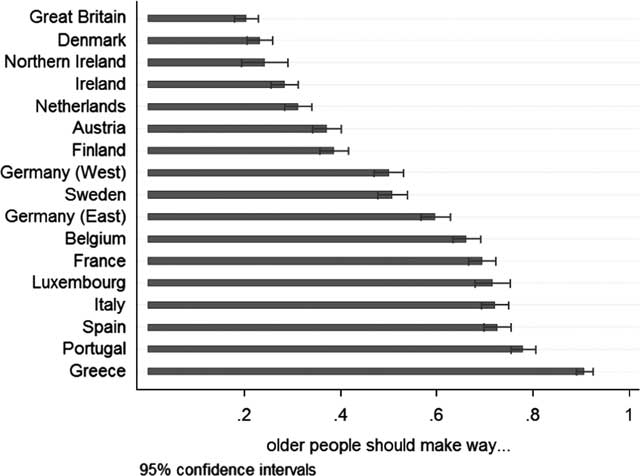
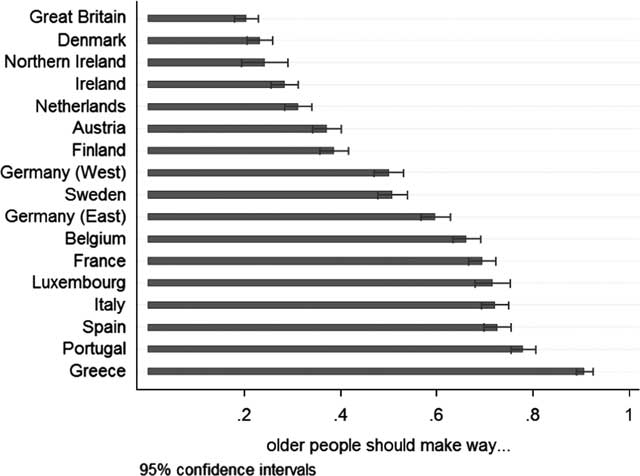
Figure 1 shows the percentage of people who agree or strongly agree with the statement in each country. Agreement ranges from less than 25% in Great Britain and Denmark to a formidable 90% in Greece. Eyeballing the national aggregates does yield some hunches. People in Southern European countries are particularly prone to this belief. It is not, however, straightforward to subsume this variation into varieties of (welfare state) capitalism. Denmark, for instance, ranks very low, whereas Sweden is in the middle of the “pack”. There is also interesting intra-country variation. In Eastern Germany, for instance, the rate of agreement is 10 percentage points higher than in Western Germany.
Cross-country variation in the lump-of-labour idea.
From an econometric perspective, there are two major challenges: First, the data structure is multi-level, varying across and within countries, though the number of countries is relatively small. As such, there are several options (Steenbergen and Jones Reference Steenbergen and Jones2002; Luke Reference Luke2004; Franzese Reference Franzese2005). Similar to Anderson and Pontusson (Reference Anderson and Pontusson2007), I use a mixed-effects model in its simplest version with independent variables on the individual and country level and random intercepts for each country.Footnote 3 The dependent variable is whether or not a respondent (strongly) agreed with the belief. Therefore, the model uses the logit function. Given the small number of countries, I use clustered standard errors and, as a check of robustness, bootstrapping. Given the fact that I have two surveys from 1992 and 2001, an alternative modelling choice would be a pooled model with country fixed effects. Unfortunately, this further reduces the number of countries to nine. Also, the wording of the key questions changes slightly between the two surveys. Hence, I will stick to the mixed-effects models, but run the pooled models as further checks of robustness.
The second major methodological challenge is not often openly discussed in models that use attitudes as dependent variables. The problem with this strategy is that it might create an attitude-on-attitude problem, which makes a causal interpretation of the results difficult (Bertrand and Mullainathan Reference Bertrand and Mullainathan2001; Hamermesh Reference Hamermesh2004). This is the major reason why I use a two-step procedure, first using the belief as a dependent variable relating it to “objective” independent variables, and then moving on to the second attitudinal variable about policy preferences. Further robustness checks control for omitted variables and endogeneity.
I am primarily interested in variables related to the labour market. On the individual level, these are whether the interviewee is unemployed or retired and whether or not he or she has been unemployed in the last five years. These variables should catch much of the effect of being directly affected by a (perceived) trade-off between older and younger workers. There is also a question about whether the interviewees have a lot of unemployed friends. This variable is particularly interesting, because it indicates that there may be social multipliers of unemployment beyond those directly related to the interviewee’s personal situation. To be fair, the question about unemployed friends still catches a lot of information about people’s perceived risk of becoming unemployed. For instance, people tend to have friends with similar skills and professional backgrounds. And yet, the variable would still measure how people’s perception of the labour market changes related to different pieces of information beyond their own experience (Green et al. Reference Green, Felstead and Burchell2000; Origo and Pagani Reference Origo and Pagani2009).
On the macro-level, I add three types of variables. The first are rates of employment and youth unemployment. The belief should increase with youth unemployment and decrease with employment. The second is the net replacement rates for unemployment benefits (OECD 2007) as well as the statutory retirement age (OECD 2011).Footnote 4 Higher unemployment benefits make unemployment less of a financial problem, and hence could make people disagree with the lump-of-labour idea, whereas the retirement age might catch an effect of policies on the belief. Further robustness checks will also use other types of social benefits. This may catch alternative explanations, such as the idea that people afraid of losing their jobs prefer more redistribution and thereby also earlier retirement ages.
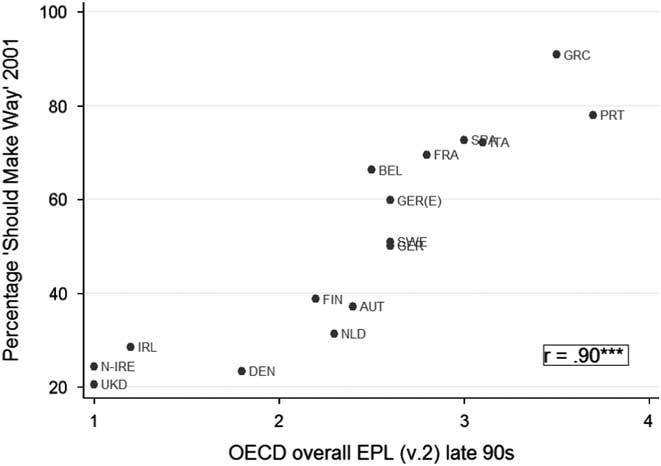
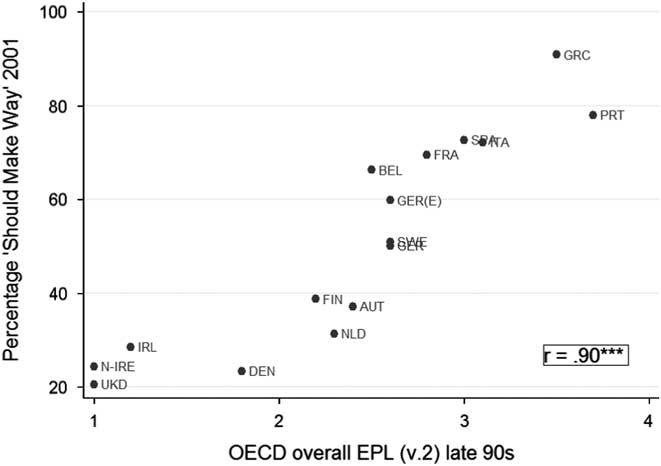
The third type of variable is the OECD (2004) measure of employment protection, which needs more explanation. There is increasing attention given to the question of whether or not layoff protection increases or decreases perceived job security (Anderson and Pontusson Reference Anderson and Pontusson2007; Clark and Postel-Vinay Reference Clark and Postel-Vinay2009), but it may also affect how people think labour markets “work”. The expectation is that labour markets that are more regulated cause people to believe that transitions are difficult and that there are trade-offs between workers. This would explain why the Danish and British populations share this belief less than the Spanish or Greeks. Figure 2 shows a simple scatter plot of this relationship between the degree of employment protection in the late 1990s and those who agree with the lump-of-labour idea. We see a high cross-country correlation between these two variables.
The relationship between employment protection and public opinion.
The models contain a batch of control variables following the empirical literature on public opinion and welfare state attitudes (Svallfors Reference Svallfors1997; Blekesaune and Quadagno Reference Blekesaune and Quadagno2003). Workers closer to retirement should favour early exit and hence agree with the question. There may also be a non-linear relationship, since older people – pensioners for example – do not need to share this wish.Footnote 5 More affluent people should be more likely to reject the proposition, either because they do not see that these trade-offs matter (for them) or they value work more than leisure (Becker Reference Becker1976). Since absolute income is difficult to compare across countries, I use subjectively stated relative income instead. Next, level of education should capture the effects of skill and information. Adding gender is interesting in so far as it checks for a bias of retirement rules to the benefit of men. I also check for a partisan effect using the self-positioning of respondents on a political left-right scale. Finally, according to the literature on industrial partners, there should be a positive relationship between question number 44.13 (…workers need strong trade unions) and the dependent variable.
Why do people believe it?
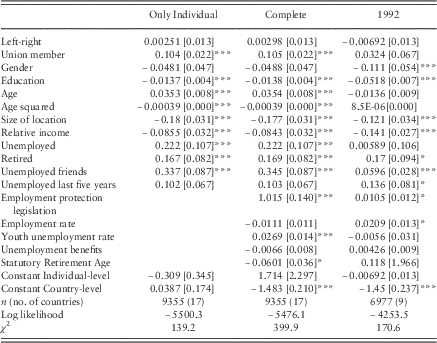
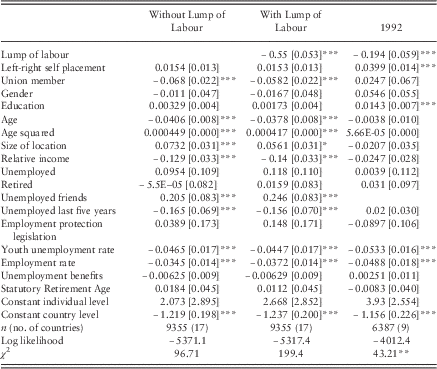
Table 1 presents the findings of three regression models: The first only reports micro-level variables. The second also includes macro-level variables. And, the third model reports findings for a similar Eurobarometer survey of 1992 with fewer covariates and a smaller sample.
Dependent variable: “older people should make way…”
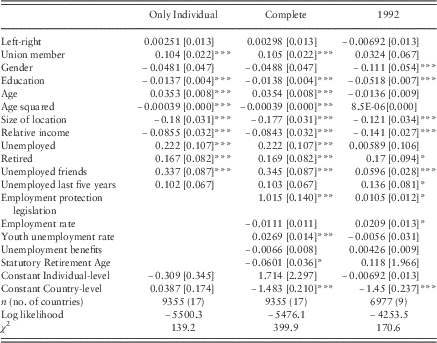
Note: *p<0.10, ***p<0.05, ***p<0.001, standard errors in brackets.
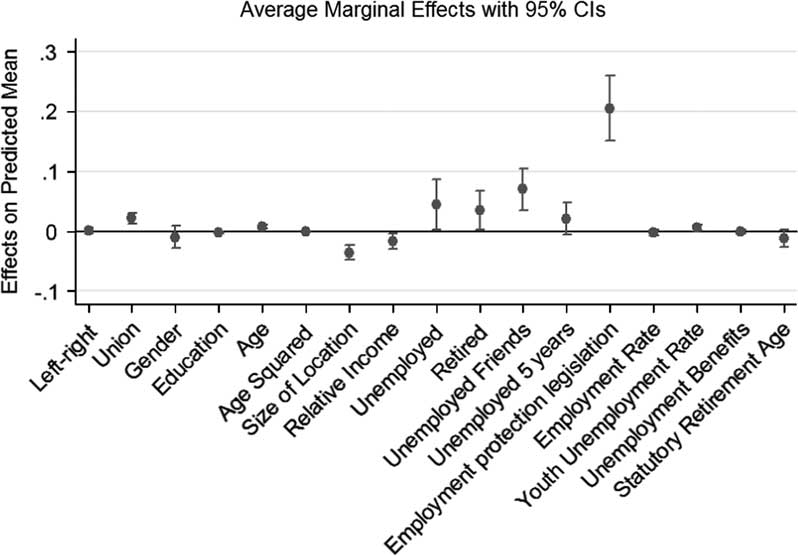
Starting with the individual-level variables, unemployed and retired people are indeed more inclined to agree than others. The only exception is the survey for 1992 (model 3 in Table 2), in which case previous experience of unemployment has more predictive power. Having more unemployed friends is an even stronger predictor. Those with a lot of unemployed friends are almost 1.5 times more likely to agree than those without. Interestingly, this information also seems to be more relevant than national aggregates in employment. Only in model 3 is there a statistically significant, slightly negative effect for the employment rate. Youth unemployment does affect the lump-of-labour belief. Moreover, in a society with a higher pensionable age, the belief is slightly smaller, but the effect is in the 10% level only. The strongest effect on the macro level comes from employment protection. Just a unit increase around the mean of employment protection, which roughly coincides with the German level, increases the likelihood by about 1.5 (model 2), that is, from around 40 to 60% approval.Footnote 6
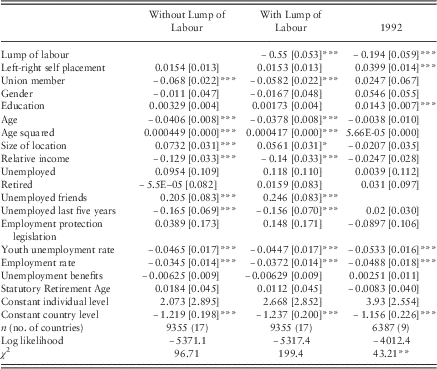
Dependent variable: “raise retirement age?”
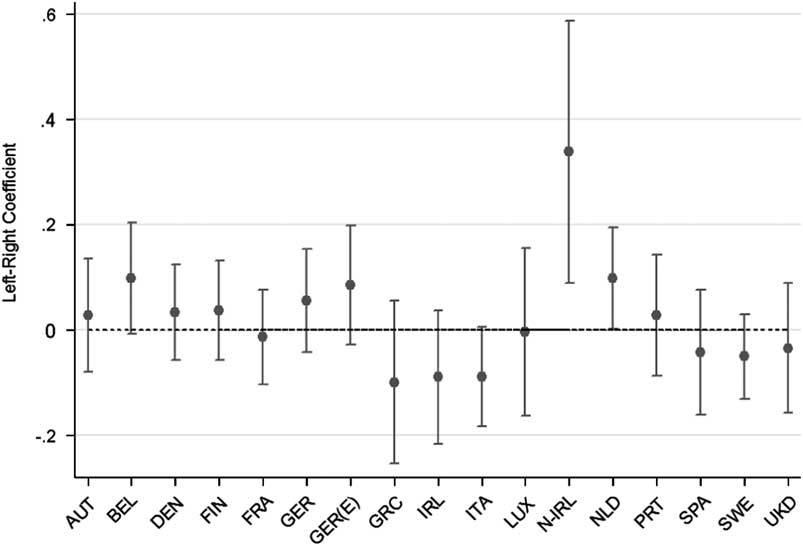
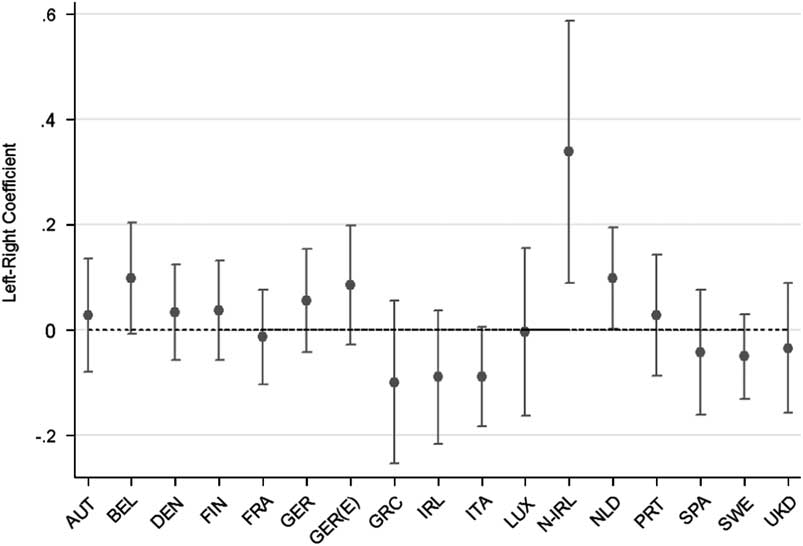
The control variables yield, by and large, the expected results. There is a hump-shape relationship between age and the belief, that is, middle-aged people are those who are most likely to agree with the statement. People living in cities and who are richer are less likely to agree. Members of trade unions are more likely to agree. There is no gendered answer pattern, except for in 1992, when women were less likely to believe in the trade-off. No partisan effect could be found. Closer inspection of separate regressions for each country gives a more nuanced picture.Footnote 7 In some cases, such as in Belgium or Northern Ireland, it is the more right-leaning voters who agree with the statement, whereas in others, for example Greece to some extent, it is the political left.Footnote 8 Nonetheless, in most countries, the belief straddles around the median, and arguably makes it difficult for mainstream parties to ignore it, so that the partisan cleavage disappears.
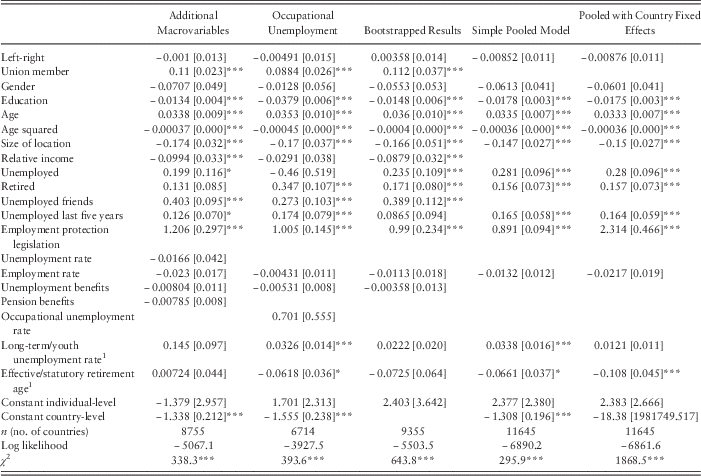
The model fit is reasonably high. The model predicts slightly less than two-thirds of the cases correctly. The inclusion of country-level variables reduces the country-level random effects significantly. Auxiliary regressions show that the major findings are robust in several respects. Additional information on other subjective attitudes or other macro-level variables did not change the results (e.g. model 1, Table A.1). I also constructed a measure of occupational unemployment rates roughly comparable to Rehm (Reference Rehm2009). I did not find an effect (model 2, Table A.2), but this might be due to data constraints.Footnote 9 The key results also remained fairly stable when the estimates were bootstrapped or when I pooled the data and ran a fixed-effects model (models 3–5, Table A.2). Thus, all things considered, the data is largely consistent with the major hypothesis. Though one’s personal situation clearly drives sharing the belief, this is not enough. The immediate socioeconomic environment has a strong impact on perceptions of the labour market. In some cases, it seems more decisive than a look to the national level or even being unemployed. On the macro level, factors that shape the dynamics of labour markets, such as employment protection, seem to matter more than the actual ups and downs of the labour market.Footnote 10
Additional checks of robustness for Table 1
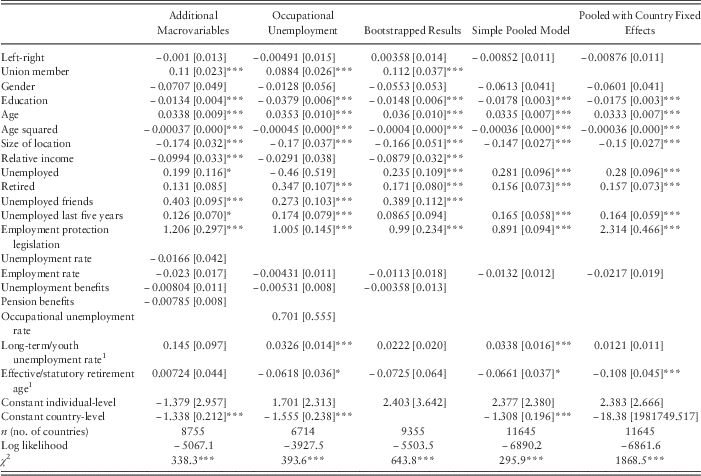
Notes: The dependent variable is the same as Table 1.
1 Second model (column 2); country fixed effects (last column) not shown. The second model includes a measure for the occupational unemployment rates. The measure is constructed similar to Rehm (Reference Rehm2009, Reference Rehm2011) but much coarser due to the few categories available in the Eurobarometer dataset. The data comes from ILO labour force statistics. “Bootstrapped Results” is a simple logit model with stata bootstrap command clustered for countries. The pooled model is a simple logit regression with the pooled 1992 and 2001 data. The last model is a pooled model including country fixed effects.
Levels of significance *p<0.10, **p<0.05, ***p<0.001, standard errors in brackets.
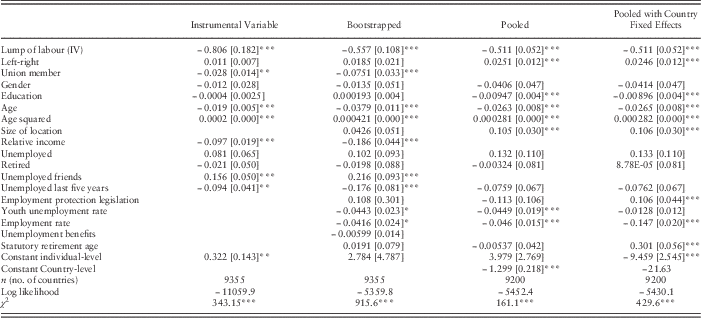
Additional checks of robustness for Table 2
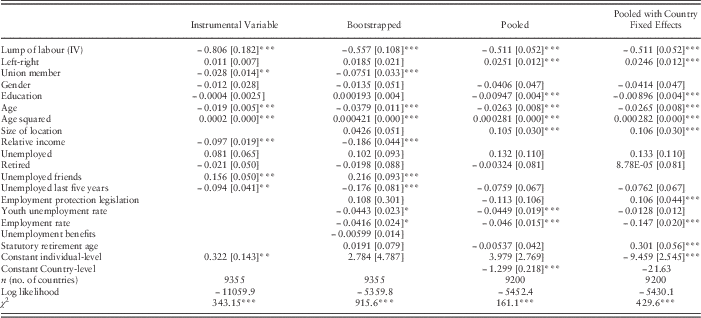
Notes: The dependent variable is the same as Table 2. Country fixed effects (second and last column) not shown. Instrumental variable model is a stata ivprobit model with country fixed effects and the omitted (macrolevel variables plus size of location) as instruments for the lump of labour. The Wald test rejects the null of no endogeneity. “Bootstrapped results” is a simple logit model with stata bootstrap command clustered for countries. The pooled model is a simple logit regression with the pooled 1992 and 2001 data. The last model is a pooled model including country fixed effects.
*p<0.10, **p<0.05, ***p<0.001, standard errors in brackets.
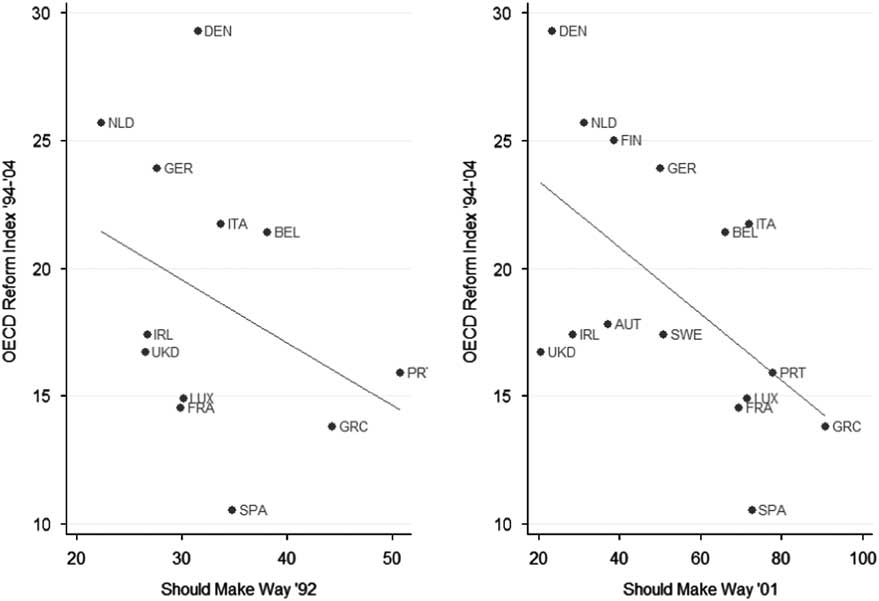
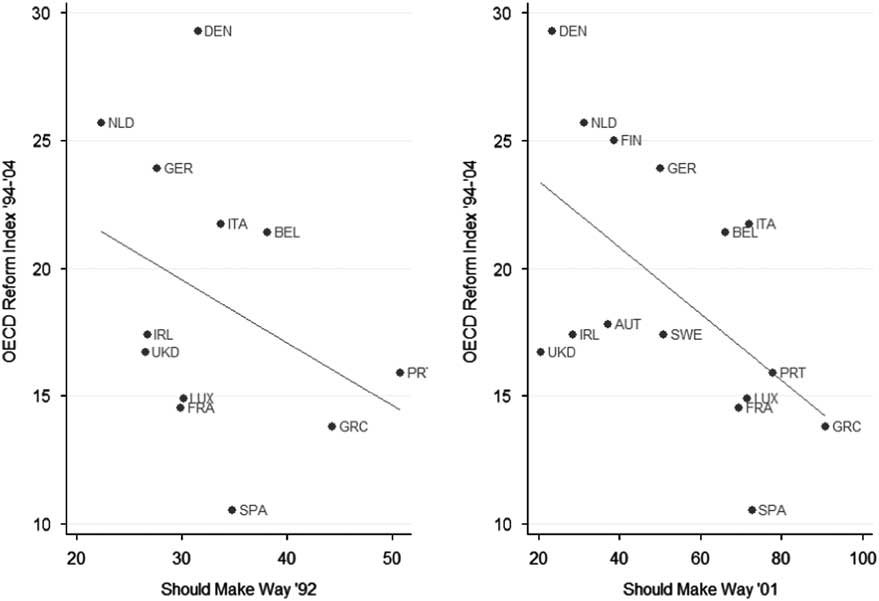
The robustness checks cannot control for all sorts of endogeneity. A particularly important concern is that public opinion heats up due to a series of tough policy reforms. In this case, preferences are the consequences of political reform. The OECD provides information about the extent of labour market reforms (Brandt et al. Reference Brandt, Burniaux and Duval2005). One of its summary indices measures the overall extent of labour market reforms between 1994 and 2003–2004. Figure 3 shows the relationship between people who agree with the statement in 1992 and 2001 and the incidence of labour market reforms (including early retirement). If anything, the graph shows the contrary for the observations in 2001. In countries with a higher incidence of reforms, the populations’ belief about trade-offs in labour markets do not show signs of heating up. Looking at the 1992 values, it seems to be the case rather that it is particularly hard to make reforms in countries where the majority of people believe in the lump-of-labour idea.Footnote 11
The incidence of reform and the lump-of-labour idea.
From beliefs to policy preferences
Now that the roots of the lump-of-labour idea have been identified, we can discuss some of its consequences. The focus will lie on the covariation between beliefs and preferences about (early) retirement in the population. The dependent variable will be question q67.03 of the 2001 survey about whether or not people agree with raising the retirement age. In the dataset, about a quarter of the population agrees. As in the previous analysis, there is important individual and cross-country variation. For instance, only some 13% of the Greek sample agrees compared to almost 40% in Ireland.
For ease of exposition, I use the same set of independent variables as in Table 1. The batch of independent control variables again coincides with similar studies (Hayes and Vandenheuvel Reference Hayes and Vandenheuvel1994; Velladics et al. Reference Velladics, Henkens and Van Dalen2006; Van Groezen et al. Reference Van Groezen, Kiiver and Unger2009; Fernandez and Jaime-Castillo Reference Fernandez and Jaime-Castillo2012). To these variables I add the belief in the lump-of-labour idea.Footnote 12 Table 2 presents three models: The first only uses all the control variables. The second model adds the belief. And, the third model replicates the second model for the year 1992.
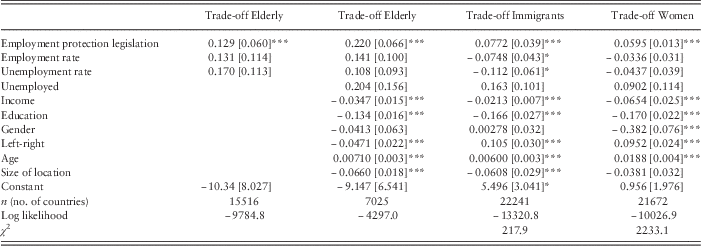
Again, we start the discussion with those variables related to the labour market. Past experience of unemployment makes respondents disagree more with the statement, whereas both the unemployed and the retired do not differ significantly from the rest of the respondents. Experiencing unemployment in one’s close environment does increase the odds of agreement (except for model 3). On the macro level there are some, but nevertheless limited, signs that higher employment rates make people less likely to agree. The national statutory retirement age (OECD 2011) is not significant. This is in contrast to Fernandez and Jaime-Castillo (Reference Fernandez and Jaime-Castillo2012), but it might be due to a smaller sample size. Moreover, employment protection legislation does not affect preferences directly. On the contrary, its main effect seems to be indirect by affecting the belief. In turn, the belief exerts a substantive impact on the dependent variable. The probability of agreeing with the statement is reduced to less than 40% in model 2 and around 45% in model 3, all else equal.
As for the control variables, these replicate and refine some of the previous findings in the literature. Political ideology seems to matter in 1992, but does not nine years later. In turn, union membership is more important in the 2001 survey. There is a weak education effect in the earlier survey, and a clear age pattern only arises in 2001 when the relationship is again U-shaped: middle-aged people are more likely to disagree with the statement than others. This mirrors the findings of Boeri et al. (Reference Boeri, Boersch-Supan and Tabellini2002) and may explain the lack of a result for linear age (Velladics et al. Reference Velladics, Henkens and Van Dalen2006). The size of the location and income only matter for 2001.
The model fit is reasonably high: the model predicts some 60% of the cases correctly. Again, I ran a series of robustness checks. Including other covariates does not affect the main results. Similarly to the previous regressions, bootstrapping or pooling the results does not change the main conclusions (Table A.2, models 2–4). Partisanship again produces mixed results. Country-by-country regressions would show that, in Greece and Portugal, the policy preference for higher retirement ages is stronger among left voters, whereas in Italy and France it is stronger among right voters. Finally, given the problem of an attitude-on-attitude regression, I also used an instrumental-variable regression (model 1, Table A.2) to check for the potential endogeneity of the belief. The effect of the exogenous part of the belief on the policy preference remains stable.
Does it matter? The belief and the politics of labour supply
The larger question of to what extent this belief causes political outcomes is beyond the scope of this article. However, what we see on an anecdotal level is consistent with the differences in beliefs. For instance, we see anecdotal evidence that the contentious nature of the politics of retirement reform is clearly related to the cross-national patterns of public opinion. As argued in the introduction, some countries have more difficulty reforming retirement systems, and when they do, there is massive unrest. The unrest is clearly related to pro-welfare state groups (Pierson Reference Pierson1994; Bonoli Reference Bonoli2000) and new forms of social risks (Kitschelt and Rehm Reference Kitschelt and Rehm2006; Häusermann Reference Häusermann2010). But, in many of these cases, the resistance goes beyond the group of insiders. There seems to be a deeply rooted disbelief in simple arguments about expanding labour supply, and many people share this disbelief.
Anecdotal evidence shows that cross-national differences in public opinion are consistent with national debates. Key political actors, such as party politicians or trade unionists, seem to agree with the vox populi. When the German government announced its decision to increase the statutory retirement age from 65 to 67 in the year 2006, Jürgen Peters, a leading trade unionist of the German metal industry, ironically stated: “Those who have work should have to work two years longer, so that those who don’t have employment won’t find any”.Footnote 13 Left politician Gregor Gysi agreed. He argued that, with growing productivity, there are only two options: either reducing working time (over life) or unemployment (Plenary Protocol, German Parliament, 14 December 2006, p. 7242). He was not alone. Politician after politician used this reasoning in previous reforms, such as the debate on flexible (early) retirement in the early 1970s and to justify the transition from unemployment to retirement.
The belief also appears in the political debates of countries in which public opinion agrees strongly with the lump-of-labour idea. For instance, when the Spanish parliament discussed the introduction of “flexible pensions”, basically a gradualisation of retirement, Basque politician Vazquez Vazquez criticised the government proposal on the grounds that it would cause serious problems for people under 30 searching for jobs (Cortes General, plenary protocol, 5 February 2002, p. 6791). In a country like the UK where few voters would agree with the lump-of-labour idea, it is much less traceable in parliamentary debates. For instance, in the 1980s, the Thatcher government reduced and eventually abolished the clearest case of an early retirement scheme, the so-called Job Release Scheme. It is true that some representatives of the Liberals and the Labour Party evoked the lump-of-labour idea (House of Commons, 20 November, 1984). However, compared with other countries, the debate was dominated by other considerations, and there is hardly any explicit mention of lumps of labour ever since. Of course, the relationship between mass opinion and the opinion of political elites is complex and would need much more research in the given context. Yet, it seems obvious that the elites’ claims about the lump-of-labour idea have much more resonance in countries where the belief is shared by many voters.
Moreover, there are broader implications of the argument, which can be tested. For instance, the belief should be visible in other fields of labour market reform that follow the logic of extending labour supply. Thus, people who believe in the lump of labour should see trade-offs between any types of voters: younger and older, immigrant or domestic workers, men and women, etc. It follows that people who share the belief should also have reservations against workers’ immigration, extending working hours, facilitating female labour force participation and so forth. With the Eurobarometer dataset, there are clear limits to test all of this, but the World Value Surveys have a battery of similar questions about the trade-offs between young versus old, foreign versus domestic workers or male versus female labour force participation. The results are similar to those of the Eurobarometer data (model 1, Table A.3). This may be seen as an additional check of robustness, since the sample is different and slightly newer. More importantly, key independent variables, such as employment protection, seem to affect all types of trade-offs and not only those of young versus old.
Results for data from the world value survey
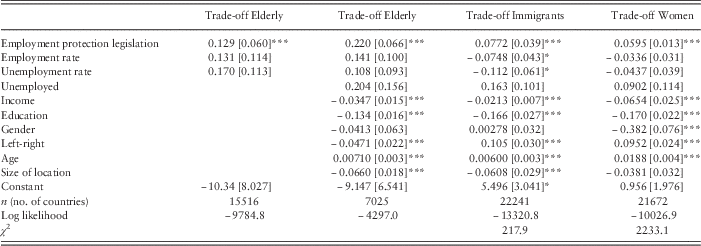
Notes: Simple logit models with clustered standard errors. Individual-level data comes from the World Value Surveys five wave aggregated file, v.20060423 questions C001 (“Jobs scarce: Men should have more right to a job than women”), C002 (Jobs scarce: Employers should give priority to (national) people over immigrants) and C004 (“Jobs scarce: older people should be forced to retire”) as dependent variables. Employment protection legislation comes from Aleksynska and Schindler (2011). Labor Market Institutions in Advanced and Developing Countries: A New Panel Database. IMF Working Papers, 11/154. Other macro data comes from the World Bank’s World Development Indicators.
*p<0.10, **p<0.05, ***p<0.001, standard errors in brackets.
All things considered, the available evidence suggests that how the belief arises has non-trivial consequences for important policy areas such as immigration. Again, anecdotal evidence is consistent with this. In the 2006 debate on the extension of the retirement age in Germany, several politicians complained that there was no need for a Green Card for foreign engineers if there were so many unemployed elderly German ones (Plenary Protocol, German Parliament, 14 December 2006, p. 7247).
Conclusions and broader implications
This article has argued that causal beliefs play an important role in shaping the politics of early retirement. It singled out one such belief, the lump-of-labour idea, and investigated its origins and consequences. Among the most compelling findings is that the belief is much stronger in more strictly regulated labour markets. Where the belief is strong, it affects people’s policy preferences for early retirement. Anecdotal evidence also suggests that the belief leaves its trace in the reform process.
The empirical tests showed clear limitations. For instance, the questions nest several different attitudes and make it impossible to dissect them from each other. Further tests, perhaps with an experimental setup, would help to cross-validate the findings of mass surveys. This may also help to sort out alternative hypotheses and the intricate problems of endogeneity. Equally, the anecdotal evidence for the impact of the belief can only open the discussion; much more needs to be done to show that the belief can be related to policy outcomes.
Nonetheless, the findings give rise to the expectation that policy areas as disparate as retirement, immigration and working-time might be related to each other due to an underlying cognitive structure. If true, this is an alternative explanation for the strong complementarities between the institutions of different welfare state regimes (Hall and Soskice Reference Hall and Soskice2001; Palier and Thelen Reference Palier and Thelen2010): people growing up in a regulated labour market perceive questions of public policy completely differently than those in less regulated labour markets. Many do not see how expanding the labour supply could be a good policy in the long run. This would be an important contribution to related policy areas such as immigration policies, where non-economic explanations have recently gained currency (Hainmueller and Hiscox Reference Hainmueller and Hiscox2010).
Beliefs may also help in explaining why other cleavages based on partisanship or insidership are sometimes invisible. Some people have argued that partisan cleavages have been overshadowed by new politics and new types of pro-welfare state coalitions (Bonoli Reference Bonoli2000; Myles and Pierson Reference Myles and Pierson2001; Rueda Reference Rueda2007). This may not be the only reason, however. If the majority of voters believe in the lump-of-labour idea, neither left nor right parties will dare to go against them. Also, outsiders or people who are not directly affected by welfare state reforms may share the belief. If they start sharing the insiders’ policy preferences and overlay a cleavage between insiders and outsiders, this may explain why the insider cleavage is not always visible (Emmenegger Reference Emmenegger2009).
In such cases, reform issues such as extending retirement age may become an “electoral taboo”, which is very reluctantly mentioned by mainstream parties. Blame avoidance might be the only way out of the political impasse in these cases. In Germany, for instance, it seemed to take a grand coalition between the mainstream left and right parties to increase the statutory retirement age from 65 to 67.Footnote 14 These are important issues for future research.
Finally, this article makes a contribution to ideational approaches in comparative political economy. This is hardly the first article to argue that mass opinion matters, but most ideational approaches tend to focus on qualitative evidence, mainly based on the practices of political elites (Beland and Cox Reference Beland and Cox2011). This article has shown that a shift in the beliefs of masses can help quantify the role of ideas and sheds a different light on the origins and political dynamics of beliefs. The interplay between the beliefs of the masses and the political elites is an area that is not well addressed in the literature on political reform processes.
Acknowledgements
The author is grateful for comments from the following people: Achim Goerres, Paul Marx, Michael Neugart, Herbert Obinger, Philipp Rehm, David Rueda, Günther Schmid, Peter Starke, Pieter Vanhuysse and the participants of the Transnational Capitalism Workshop 2010 in Budapest, the Drei-Länder-Tagung 2011 in Basel and EPSA 2012 in Berlin, as well as the three anonymous reviewers and the editors of JPP.
Appendix
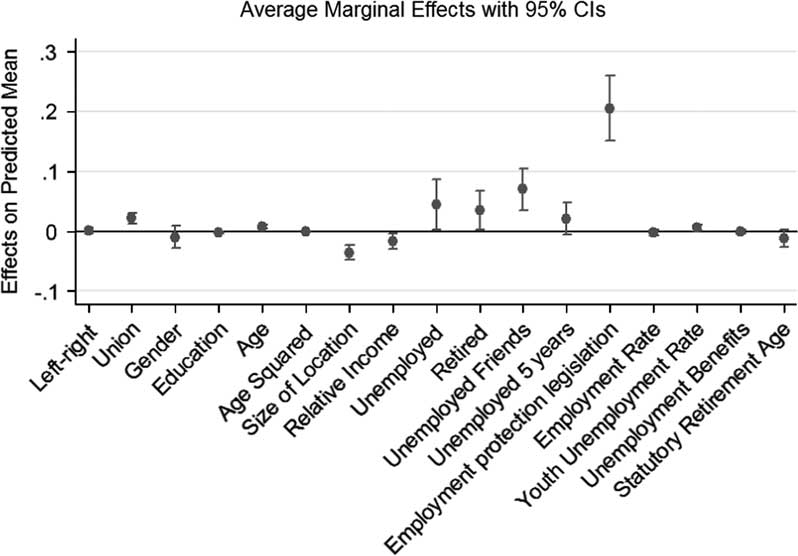
Marginal effects. Notes: Based on model 2, Table 1.
Coefficients for partisanship. Notes: The dots are partial regression coefficients of country-by-country regressions of partisanship, controlling for other individual-level variables, on the lump-of-labour idea; the bars are 95% confidence intervals.