1. Introduction
Probabilists think that our beliefs come in degrees. And they have suggested some constraints on our rational degrees of belief (i.e., credences and their rational updates). For example, our credences at a given time are required to be probabilistically coherent in the sense that they satisfy the axioms of probability theory, that is, nonnegativity, normalization, and (countable) additivity. It is also widely accepted that our credences should be updated using conditionalization. Here are two versions of conditionalization, that is, strict conditionalization (SC) and Jeffrey conditionalization (JC):
SC: When at time  an observation leads an agent to be certain of E and nothing else, for any X,
 , when
 .
JC: When at time  an observation leads an agent to change directly her credence in E from
 to
 (<1) and nothing else is changed directly, for any X,
 , when
 .
Here Pt and  are the agent's credence functions at time t and at time
 , respectively.
It is noteworthy that probabilistically coherent credence functions are still probabilistically coherent after updating by conditionalization. In this sense, we may say that these two constraints do not conflict with each other, or that probabilistic coherence of credence functions is preserved through updating by conditionalization. This relationship between two constraints is desirable. And if there are other rationality constraints, then they should not conflict with the above two constraints. In particular, any other synchronic constraints like probabilistic coherence should be satisfied after updating by conditionalization if they are satisfied before the updating. That is, preservation is natural:
Preservation: For any rationality constraint C, if C holds for a credence function P, then C should also hold for a credence function P′ that is obtained from P by conditionalization.
When a constraint satisfies preservation, I say that the constraint is preserved under conditionalization. In what follows, I suggest an argument that seems to show that another well-known rationality constraint conflicts with conditionalization (i.e., the constraint is not preserved under conditionalization).
The constraint in question is the reflection principle, formulated and named by van Fraassen (Reference van Fraassen1984, 244). This is a constraint on our higher-order credences (i.e., credences in credences). This principle may be formulated in various ways. Here is a standard formulation that is suggested by Maher (1993, 105):
RP: For any X and any real number  ,
 , when
 .
Here  refers to the proposition that the credence function is
 at time
 . Van Fraassen (1984, 244) originally formulates the principle in a slightly different way. Let
 assign x to X at time
 . Here is van Fraassen's formulation:
RP′: For any X, real numbers x and a (>0) such that x is assigned to the credence in X at time  ,
 when
 .
RP is a formulation that simplifies RP′ without the variable x and the phrase “x is assigned to the credence in X at time  .” The following discussion does not depend on whether we adopt RP or RP′ as a formulation of the principle. For simplicity, I adopt RP rather than RP′ in what follows.
Informally, RP explicates a rational relationship between an agent's current and future credence functions. Why is it rational to obey RP? An intuitive reason is that our future selves are epistemically superior to our current selves, and it is rational to follow opinions of agents who are superior to us. Then, does RP not conflict with conditionalization? To put it another way, is RP preserved under conditionalization? More precisely, do agents who satisfied RP before updating by conditionalization still satisfy RP after the updating? In section 2, I suggest an argument that appears to show that RP conflicts with conditionalization—in particular JC. But I point out in section 3 that the conflict is due to an ambiguity of the standard formulation of the principle (i.e., RP). In section 4, furthermore, I attempt to reformulate the reflection principle so as to circumvent the prima facie conflict.
Before presenting my discussion, let me explain some expressions. If and only if an agent whose credence function is Pt satisfies RP, I say that Pt satisfies RP. That is, I use interchangeably ‘an agent’ and ‘her credence function’ in this article. And if and only if it holds that for any X,  when
 , I say that Pt satisfies RP concerning
 .
2. A Conflict between Reflection and Conditionalization
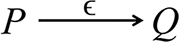
I examine in this section whether RP is preserved under conditionalization. Consider figure 1, where ∊ stands for a course of experience, P is an agent's credence function at a given time, and Q is her credence function that is updated from P after the agent undergoes ∊. It is well accepted by Bayesians that when a course of experience leads an agent to change her credence function, the new credence function is determined by her old credence function and the experience itself (see, e.g., Field Reference Field1978). Figure 1 is intended to describe this explicitly. That is, the figure represents that Q is determined by the old credence function P and the experience ∊.
Figure 1.

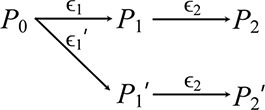
Now let's consider figure 2, where P 0 is an agent's credence function at time t, and P 1 and  are credence functions that the agent might have at time
 . Similarly, P 2 and
 are credence functions that she might have at time
 . Meanwhile, ∊1 and
 stand for possible courses of experience that the agent might undergo during [t,
 ], and ∊2 stands for a possible course of experience during [
 ,
 ]. Similar to figure 1, figure 2 describes what experience and what old credence function determine what new credence function. For example, P 1 is determined by P 0 and ∊1, and P 2 is determined by P 1 and ∊2. Since P 1 is determined by P 0 and ∊1, it can be said that P 2 is determined by P 0, ∊1, and ∊2.
Figure 2.

Our purpose is to examine whether RP is preserved under conditionalization. Suppose that P 0 satisfies RP. Then, P 0 satisfies RP concerning P 2 as well as  . And let's consider a case in which the agent undergoes ∊1 during [t,
 ], and so P 1 is obtained from P 0 by conditionalization. For our purpose, then, what should we do? I should emphasize here that in this case, P 1 does not have to satisfy RP concerning all future credence functions of P 0. In particular, P 1 does not have to satisfy RP concerning
 . This is because
 is not a future credence function of P 1. If one credence function is a future credence function of another function, the former should be affected by all courses of experience that affect the latter. Note that
 is not affected by a course of experience that affects P 1—in particular, P 1 is affected by ∊1 but
 is not. Thus,
 is not a future credence function of P 1, and so we do not have to examine whether P 1 satisfies RP concerning
 . In this case, rather, all we should do is to examine whether P 1 satisfies RP concerning P 2.
With the help of this consideration, we can say that in order to examine whether RP is preserved under conditionalization, it is sufficient to consider the case represented by figure 3, where P 0 is an agent's credence function at a given time t, P 1 is updated from P 0 after the agent undergoes ∊1 at time  , and P 2 is obtained from P 1 after the agent undergoes ∊2 at time
 . Then, all we have to do is to answer the following question: Does P 1 satisfy RP concerning P 2 if P 0 satisfies RP concerning P 2 and P 1 is obtained from P 0 by conditionalization? In response to this question, if an affirmative answer can be given, then it should be concluded that RP is preserved under conditionalization. Otherwise, we should say that RP is not preserved. Before seeking the answer, it should be emphasized that in this article, I rule out cases in which the future credence functions are affected by cognitive malfunction, memory loss, and so forth. Thus, it is assumed that an agent's future credence functions have all evidence that her current function has. In particular, it is assumed that P 2 has all evidence that P 1 has.
Figure 3.

Now, it is time to examine whether RP is preserved under conditionalization. Let's begin with a simple case. Suppose that ∊1 leads the agent to be certain of E 1 at time  . Thus,
 . Here we should note that

This is because P 2 has all evidence that P 1 has. At time  , thus, the agent has the evidence that the agent learns from ∊1 at time
 , and so equation (1) holds. Now, suppose that the agent updates her credences using conditionalization. In this case, the agent updates her credence using SC. Then, we have thatFootnote 1

Moreover, let's suppose that P 0 satisfies RP concerning P 2. Thus, we have thatFootnote 2

Here, R 2 refers to the proposition that the credence function is P 2 at time  . Then, it follows from equations (1), (2), and (3) thatFootnote 3

Thus, we can say that if P 0 satisfies RP concerning P 2 and P 1 is obtained from P 0 by SC on E 1, then P 1 also satisfies RP concerning P 2. Thus, we can conclude that RP is preserved under SC. This is a desirable result.
However, we should note that we have considered just a simple case in which experience leads the agent to be certain of a proposition. Then, what if experience leads the agent to change her credence in some propositions to a value that is less than 1? In this case, Bayesians advise us to update our credences using another version of conditionalization (i.e., JC). Can we show that RP is also preserved under JC? Unfortunately, it seems not.
Suppose that ∊1 leads the agent to change her credence in E 1 from  to
 (<1) at time
 and that
 is in (0, 1). Then, we have that

Suppose also that the agent is a JC updater, that is, she updates her credence function using JC. In particular, let's assume that P 1 is obtained from P 0 by JC on {E 1, ∼E 1}. Then, it follows thatFootnote 4

Now, suppose that P 0 satisfies RP concerning P 2. Then, it holds that

Then, can it follow from equations (5), (6), and (7) that P 1 also satisfies RP concerning P 2? No. Suppose, for reductio, that P 1 also satisfies RP concerning P 2. Then, it holds that

Now we have the following three equations:Footnote 5

And these equations imply that  , which contradicts equation (5) (see app. A). Thus, we should conclude that equations (5)–(8) jointly imply a contradiction, and so RP is not preserved under JC. In other words, even if an agent's credence function satisfies RP before updating using JC, she cannot satisfy RP after the updating. This is an undesirable result. If RP is a plausible rationality constraint, then it is natural that RP should satisfy preservation. But the above result says that RP does not. In particular, RP is not preserved under one version of conditionalization (i.e., JC).Footnote 6 How can we respond to this problem? In the next section, I try to answer this question.
3. Diagnosis: An Ambiguity of RP
In this section, I explain first why RP cannot be satisfied when a credence function is updated by JC on a partition. With the help of this explanation, I argue that RP is not a plausible formulation of the reflection principle.
Let's revisit figure 3, first. Suppose that P 0 satisfies RP concerning P 2. Then, we have that  , for any X. As was mentioned earlier, P 2 is determined by P 0, ∊1, and ∊2. So, we can say that the credence function
 is also determined by P 0, ∊1, and ∊2. Now, let's consider a case in which the agent actually undergoes ∊1 during [t,
 ]. In this case,
 is obtained from
 by JC. We can say, then, that
 is determined by the old credence function
 and the experience ∊1. In other words,
 and ∊1 jointly affect
 through the updating. It should be noted again that
 is affected by P 0, ∊1, and ∊2. Thus, the impact of ∊1 has already been reflected in
 before the updating. Nevertheless, if the experience ∊1 affects
 once again through the updating, then it should be said that the updated credence function, that is,
 , is overdetermined by ∊1. However, P 2 is determined by P 0, ∊1, and ∊2. This credence function P 2 is not overdetermined by ∊1. That is, P 2 is not twice affected by ∊1. For this reason,
 that is obtained from
 by JC and so is overdetermined by ∊1 cannot be equal to P 2 that is not overdetermined by ∊1. Despite this fact, however, RP still requires that
 , for any X. Hence, we cannot help concluding that RP conflicts with JC.
Then, should we abandon at least one of the reflection principle and JC? I think we do not have to. In particular, we do not have to give up the reflection principle. I think that what should be abandoned is not the reflection principle itself but the standard formulation of this principle (i.e., RP).Footnote 7 In what follows, I explain why RP is a misleading formulation.
Consider the proposition that the credence function is changed from Pt to  . (Here it is assumed that
 .) Let's abbreviate this proposition by using
 . Then, what should be the value of
 ? RP says that for any X,
 should be equal to
 . Here,
 is the agent's conditional credence in X, given that her credence function is
 at time
 . Here,
 is her future credence function that is updated from Pt. Thus, we can say that the information obtained from
 in
 is as follows: (i)
 is obtained from
 ; (ii) there is a course of experience that leads to changing the credence function from Pt to
 .Footnote 8 Consider
 in
 . It is intuitive, I think, that the information obtained from
 is the same as the information from
 in
 . That is,
 informs us of i and ii. Thus, it is natural that the value of
 is equal to the value of
 . Hence, when we say that the reflection principle should be satisfied at time t, it is required that

Now, let's revisit figure 3. Let  be the proposition that the agent's credence function is changed from P 0 to P 2. Similarly, let
 be the proposition that the agent's credence function is changed from P 1 to P 2. As in the previous discussion, let's assume that the agent satisfies the reflection principle at time t. In particular, suppose that
 , for any X. Suppose also that the agent undergoes ∊1 during [t,
 ], and so P 0 is updated to P 1 by JC. Then,
 is changed to
 . Recall that the argument in the previous section has shown that even if
 is equal to
 ,
 obtained from
 by JC cannot be equal to
 . Redescribing this result using ‘
 ’, it can be said that even if
 is equal to
 ,
 obtained from
 by JC cannot be equal to
 . Does it follow from this result that the reflection principle conflicts with JC? No. Here we should pay attention to what the principle requires in this case. According to equation (9), when we say that the reflection principle is satisfied at time
 what is required is not that

but that

For this reason, the result that  is not equal to
 after the updating does not threaten the reflection principle and JC. In order to show that the reflection principle is not preserved under JC, we should demonstrate that equation (11), not (10), does not hold after JC updating. However, the argument in the previous section shows just that equation (10) does not hold after the updating.
To sum up, the source of the problem resides in the fact that the standard formulation of the reflection principle (i.e., RP) is ambiguous. In particular, when RP requires that  for any X after the updating by JC, it is ambiguous whether the requirement means equation (10) or (11).Footnote 9 Now we can conclude that the prima facie conflict that is suggested in the previous section does not impugn the reflection principle and JC. The problem is resolved.
There is a limit to the above discussion, however. I have argued why the conflict between RP and JC cannot threaten the reflection principle itself and JC. But I have not shown positively that agents who satisfied the reflection principle before updating by JC also satisfy the principle after the updating. It is time to show this.
4. A New Formulation of the Reflection Principle
I have shown in section 3 that the conflict between RP and JC is due to an ambiguity of RP. In order to rescue the reflection principle from the conflict, thus, we should first reformulate the reflection principle so as to avoid this ambiguity. In this section, I suggest a new formulation of the principle and show that when the principle is formulated using the new one, the conflict in question disappears.
My suggestion is to reformulate the principle using  , rather than
 . Suppose that Pt satisfies the reflection principle and that
 is obtained from Pt by JC. Suppose also that the principle is preserved under JC. According to equation (9), then, the principle requires that

I should emphasize here that  is updated from
 —not
 —by JC. In other words,
 is determined by the experience during [t,
 ] and
 —not
 .Thus, we need to identify
 in order to examine whether the reflection principle is preserved under JC.
Let's consider a conditional credence 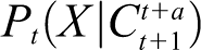 . This credence is a conditional credence at t in X, given that the credence function is changed from
 to
 . The change from
 to
 is due to a course of experience during [
 ,
 ]. So, the condition could be naturally thought as saying that the agent undergoes the course of experience during [
 ,
 ]. But the reflection principle that hitherto has been discussed in this article says nothing about what the value of
 should be. As was shown, equation (9) just requires that
 should be equal to
 . More generally, equation (9) is silent on the value of
 when
 . For our purpose, thus, the reflection principle should be formulated so that the value of
 can be determined.
As was mentioned, the reflection principle requires that  should be equal to
 . Here,
 is determined by Pt and a course of experience during [t,
 ] that leads the credence function to be changed from Pt to
 . Then, what function should
 be equal to? It is natural that the credence function in question should be one that is determined by Pt and the course of experience during [
 ,
 ] that leads the credence function to be changed from
 to
 . So, in order to determine the value of
 , we need to find a way to combine the two factors—Pt and a course of experience during [
 ,
 ]—into a credence function. For this purpose, we should also be able to represent the course of experience during [
 ,
 ] using a parameter.
Fortunately, there is a parameter that many Bayesians think plays such a role: the Bayes factors (see, e.g., Field Reference Field1978; Jeffrey Reference Jeffrey2002; Wagner Reference Wagner2002, Reference Wagner2003). Consider an outcome space  whose members are mutually exclusive and exhaustive. Suppose that there is an agent whose credence functions are measured on this space. Suppose also that her credence function is changed from P to Q. Then, the Bayes factor of ωi against ω1 is defined as follows:

Here, ω1 is an arbitrary anchored proposition that is a member of Ω. If we think that the Bayes factors represent the impact of experience that leads the agent's credence function to be changed from P to Q, then we can determine the value of  using the Bayes factors in question and Pt. How can we do it?
This situation is very similar to the collaborative belief updating. Jeffrey (Reference Jeffrey2002, 59–61) suggests a way to update our credences using another agent's observation. Suppose that an agent S1 wants to update her credence function using her colleague S2's observation. Suppose also that at time  , the colleague S2 observes something and changes her credence function from P 2 to Q 2. Then, how should S1 use S2's observation? Jeffrey says that S1 cannot regard S2's new credence function as her own new credence function since S2's new credences are affected by S 2's old credences as well as the observation in question. Instead, he advises that S1 should regard S2's Bayes factors as her own Bayes factors.
Suppose that the credences of S1 and of S2 are measured on an outcome space  . Let X be a disjunction of members of Ω. Suppose also that S1's credence function is changed from P 1 to Q 1. Then, JC can be reformulated as follows:

Here  is S1's Bayes factor of ωi against ω1, that is,
 . For the above collaborative belief updating, Jeffrey suggests replacing S1's Bayes factor in the formula with S2's Bayes factor
 that is obtained by her observation. Through this collaborative belief updating, thus, S1's new credences are updated by the following rule:

Here,  is S2's Bayes factor of ωi against ω1, that is,
 . Note that equation (12) describes a way to obtain the new credence function from the old credence function and the Bayes factors that represent experience itself. To put it another way, equation (12) suggests a way to combine the two factors—a credence function and a course of experience—into another credence function.
Recall that in order to determine the value of  , we have to seek a way to combine the two factors—Pt and a course of experience during [
 ,
 ]—into a credence function. Thus, a similar method to the collaborative belief updating can be applied. That is, we can determine the value of
 using Pt and the Bayes factors that are obtained from
 , and so we are able to reformulate the reflection principle as we wish. Suppose that an agent's credence functions are measured on an outcome space
 . Here is my new version of the reflection principle:
NRP: For any proposition X and any real number  ,

Here, ‘ ’ expresses that the credence function is changed from
 to
 . And βi is the Bayes factor of ωi against ω1 that is obtained from
 . That is,

Now, we should show that this NRP is preserved under conditionalization—in particular JC. Before presenting the proof, let's consider a relationship between RP and NRP.
What is the difference between RP and NRP? Suppose that P is your current credence function and you know this. Suppose also that you update your credences using conditionalization. And let's consider a case in which you get to know that Q is your future credence function. According to RP, then, your credence function should be changed to Q. Now, let's consider another case in which you get to know that you will undergo a course of experience that could change your credence function from P′ to Q. Do you get to know that Q is your future credence function? It depends. If P′ is the same as P, then you can get to know that Q is your future credence function. This is because you know that your current credence function is P and that the experience will lead your credence function to be changed from P to Q. In this case, RP requires that you should change your credence function to Q. However, if P′ is not the same as P, then you cannot get to know that Q is your future credence function. All you get to know is just that you will undergo the experience in question—not that you will undergo the experience in question and so your credence function will be changed from P to Q. In this case, RP seems difficult to guide any change of your credence function. In other words, RP says nothing how the knowledge of your future experience should be reflected in your current credence function. It is natural, nevertheless, that the knowledge is informative and thus affects your current credences. Here is an advantage of NRP over RP. When you get to know that you will undergo a course of experience that could change your credence function from P′ to Q, NRP says that your credence function should be the same as one that is obtained from your current function P and the Bayes factors that represents the experience in question. Moreover, I should emphasize here that, like RP, NRP also says how our future credence function is reflected in our current credence function. That is, NRP also requires that if we know what our future credence function is, then our current credence function should be the same as the future one. This can be shown easily (see app. B). From the above considerations, we can say that NRP is a generalization of RP. This means that NRP says how our future experience as well as our future credence function should be reflected in our current function, while RP says nothing but how our future credence function should be reflected.
Now, let's consider the relationship between NRP and conditionalization. First of all, it can be shown that NRP is preserved under SC. That is to say, we can show that agents who satisfied NRP before updating by SC on E also satisfy NRP after the updating (see app. C). Similarly, we can also prove that NRP is preserved under JC. Suppose that a JC updater who satisfies NRP at time t changes directly her credence in E from  to
 . Then, does the agent satisfy NRP at time
 ? For notational simplicity, let C refer to
 . (It is assumed here that
 and
 .) Since the agent satisfies NRP at time t, we have that

Now, let's update the conditional credence in X given C using JC on {E, ∼E}. By a bit of mathematics, we have thatFootnote 10

Here, α is an abbreviation for  . Appendix D shows that it follows from equations (13) and (14) that

Finally, we can conclude that the agent also satisfies NRP after updating by JC on {E, ∼E}. That is, an agent who satisfies NRP before updating by JC also satisfies NRP after the updating.Footnote 11 As our discussion has shown, NRP is a generalization of RP and is preserved under conditionalization—SC and JC.
5. Concluding Remarks
In this article, I have discussed a prima facie conflict between the reflection principle and another constraint—conditionalization. In particular, I have shown that RP conflicts with JC and that this conflict is due to an ambiguity of the standard formulation of the principle (i.e., RP). So, I suggested a new formulation of the principle so as to circumvent the conflict in question.
Discussions in the literature about the relationship between conditionalization and the reflection principle have been limited to the relationship between SC and the reflection principle (see, e.g., van Fraassen Reference van Fraassen1984, Reference van Fraassen1995; Maher Reference Maher1993; Howson and Urbach Reference Howson and Urbach2006; Weisberg Reference Weisberg2007). And the relationship between JC and the principle has attracted less attention. As we discussed in this article, however, the standard formulation of the principle conflicts with JC, and so we need to revise the formulation. For this reason, this article may call philosophers’ attention to this issue. And I want to emphasize that my proposal (i.e., NRP) is a revision of RP using Bayes factors. Some philosophers like Wagner (Reference Wagner2000) and Jeffrey (Reference Jeffrey2002) have attempted to resolve some critical problems of Bayesianism by means of Bayes factors—for example, the old evidence problem. Interestingly, I have shown that Bayes factors are one of the keys to resolving the conflict between RP and JC. For this reason, my proposal may be treated as an exemplar that shows the theoretical importance of Bayes factors.
Appendix A
Let's show that the following three equations imply that  :


From Bayes's theorem, it follows that

Let k and l be numbers such that  and
 . Then, equations (A1)–(A4) imply that

If  , then
 , and so
 . Note that it has been assumed that
 is in (0, 1). Thus,
 . Similarly, it is implied that
 . Thus, it follows from the last equation that
 .
Appendix B
Suppose that  . Then,
 . From NRP, then, it follows that

And this equation can be transformed as follows:

The denominator of the right-hand side is equal to 1 since  . And the numerator of the right-hand side is transformed as follows:
 . Note here that ωi is a disjunct of X or not. And
 if ωi is a disjunct of X;
 , otherwise. And this logical relation is not changed at time
 . Thus,
 . Therefore, we have that
 . Finally, we have that
 . Now, we can conclude that when
 , NRP is equivalent to equation (9). As was explained, the value of
 is equal to the value of
 . Thus, it follows that
 . For this reason, NRP is a generalization of RP.
Appendix C
Suppose that  and
 . From the probability calculus and NRP, it follows that

Thus, we can say NRP implies that
NRP*: For any propositions X and Y and any real number  ,

Now let's prove that NRP is preserved under SC. Suppose that an agent satisfies NRP at time t. Suppose also that she learns that E is true at time  , and so she updates her credence using SC on E. As was mentioned, NRP implies NRP*. Thus, it follows from NRP that, for any X,

Here it is assumed that  and
 . Note that it follows from SC that, for any X,

From equations (C1) and (C2), then, it follows that

Thus, the agent satisfies NRP at time  .
Appendix D
From equation (13), we have the following equations:

Then, the above equations and (14) imply that

Note that  . Then, equation (D2) is transformed as follows:

Meanwhile, JC says that

Thus, equation (D3) is transformed as follows:

Finally, we have equation (15).
 , and so
 is well defined.
 , and so
 is well defined. Now, suppose that P 0 satisfies RP concerning P 2. Then, we have that (a) for any X,
 when
 . And the probability calculus says that for any X and Y,
 when
 . From a, thus, it follows that for any X and Y,
 when
 . Note that it is assumed that
 . Thus, we have eq.
 . By eq.
 . And eq.
 , and so
 . Thus, it follows from b that for any X,
 . Now, we have eq.
 , an observation leads an agent to change directly her credence in E from
 to
 (<1) and nothing else is changed directly, for any X,
 and
 , when
 .
 ,
 , and
 . Thus,
 and
 . And it follows from
 .
 itself says nothing about from what credence function
 is updated. However,
 in the context of
 informs us that
 is updated from Pt.
 , the agent updates her credence function from P 0 to P 1. Suppose even that P 0 and P 1 assign a and b to X, respectively. Then, RP′ requires that
 updated from
 should be equal to c. But, the expression ‘
 ’ ambiguously stands for the following two conditional credences: P 1(X|the credence in X is changed from a to c at time
 ); P 1(X|the credence in X is changed from b to c at time
 ).
 . Note that for any proposition X, if an agent's old credence in X is greater than 0 and is updated by a JC, then her new credence in X is also greater than 0. Thus,
 . So,
 is well defined for any X. According to the probability calculus, thus, it holds that
 for any X. From JC and the probability calculus, then, it follows that for any X
 . Finally, if we transform the conditional probabilities on the right-hand side by means of Bayes's theorem, we can obtain
 are directly affected by a course of experience and the credence function is updated by JC on the partition. This is just a matter of the complexity of mathematics.