Clinical Implications
• Consensus has not yet been achieved in the definition of treatment outcome and tolerability for pharmacogenetic studies of in mood disorders.
• Genetic testing for CYP450 variants has not been shown to be helpful guiding treatment in SSRI monotherapy.
• Genetic testing for CYP450 may have a role in polypharmacy.
Introduction
The promise of personalized medicine offers a vision of a world where we will be able to match medications with patients, maximizing efficacy while eliminating adverse effects. Pharmacogenetics stands as the vehicle to bring personalized medicine into practice. The idea that differences in patients’ DNA sequences could provide some insight into their biology, and more specifically, whether they will respond or tolerate pharmacological treatment, has been widely embraced and promoted out of a real difficulty in predicting outcomes. This is particularly relevant in mood disorders where remission is not always the case and treatments may have significant undesired effects. Studies have shown that response to antidepressants and lithium may be correlated in family members; thus, there is an argument to be made that there may be a genetic component to treatment response.Reference Schlesser and Altshuler1–Reference Pare and Mack3
Progress in pharmacogenetics has been slow across medical specialties. The best-known example of successful pretreatment genetic testing is the anticoagulant warfarin. The U.S. Food and Drug Administration (FDA) has recommended genetic testing for vitamin K metabolism and other genesReference Wadelius, Chen and Downes4 because genetics can account for about 40% of the difference in individual dosing. The field of psychiatry stands to significantly benefit from any gains that pharmacogenetics could provide, especially since all of our treatment options are empirical and the matching of patients with treatments is largely a question of clinical judgment. At the present time, we do not have, in psychiatry, a marker or group of markers that can provide this level of information for clinical use. However, as will be discussed in this review, we do have certain situations where pharmacogenetic testing could prove to be informative.
Genetics in psychiatric pharmacogenetics
In the last decade we have witnessed exponential growth in our understanding of gene biology. This has been fueled in part by plummeting costs of genetic testing and the development of new methodologies to test genetic variation and analyze the growing amount of data gathered. We have gone from a multi-billion dollar, international effort, such as the Human Genome Project, to being able to obtain the whole genomic sequence of an individual for less than $5,000. This has posed a different challenge: the storage, analysis, and interpretation of the vast amounts of data from a single individual.
One of the big developments in genetics has been the wide availability of technologies that allow the screening of the whole genome with a single set of genetic markers. These technologies have opened the door for genome-wide association studies that use large numbers of single nucleotide polymorphisms (SNP) (now 750,000 to 5,000,000) to screen the entire genome for alleles that influence a trait of interest.
The term “genetic variation” is a broad description of the many “changes” or mutations that are contained in an individual's DNA when compared to a reference sequence. DNA can have mutations of a single nucleotide (SNPs), but it can also have variants that may be larger than a single nucleotide, extending from 2 to millions of base pairs in length. These segments could be deleted, inserted, transposed, duplicated, or expanded. The effect these variants have on gene expression depends on their structure and localization, but they could render an inactive, partially active, or even more active byproduct.
The chromosome pictures or cartoons we routinely observe show DNA as a tightly “packed” double strand. This DNA needs to be “unpacked” before it can be transcribed. Epigenetic sites are the “zippers” that make DNA available to be read, and they control the regulatory processes involved in the “unpacking” of DNA. These epigenetic signatures can also be transgenerationally inherited, thus influencing the trait of interest without modifying DNA structure. Recent findings suggest that antidepressants can also affect epigenetic signatures, and agents that modify epigenetic signatures can exert antidepressant effects (reviewed in Duman and NewtonReference Duman and Newton5). Moreover, the traits of interest can be influenced by genetic variants that have a wide arrange of frequencies in the population: common variants (found in >5% population), uncommon variants (found between 1–5% of the population), and rare variants (found in <1% of the population).
Gene expression is a very complex and highly regulated process. Though all cells have the same DNA “blueprint,” different cell types express different genes. The study of gene expression in psychiatry is even more complex. First, the brain is not an easily accessible organ, and second, different areas of the brain have different gene expression patterns that vary at different points in development.Reference Kang, Kawasawa and Cheng6 Therefore, the study of the effect of genetic variation in the brain is limited by tissue access and availability. Over the past several years, studies of gene expression in the brain have been limited to postmortem samples, where confounders such as postmortem interval and pH can have an impact on the gene expression of a dying brain. Nevertheless, these studies provide important clues on the transcriptional effects of genetic variation. Another potential source of in-vivo brain gene expression data is the use of genetics and neuroimaging methods such as positron emission tomography (PET), where the quantification of binding potential could prove to be a proxy for gene expression.Reference Laje, Cannon and Allen7 However, this method can only use one or very few tracers at a time, therefore limiting studies to a very small number of genes.
High throughput genotyping methods based on SNPs were initially built to interrogate common variants. Although we know that most SNPs could have an impact on gene expression, most of the functional roles of markers identified remain obscure. As the cost of sequencing decreases, we will have the ability to obtain a precise DNA sequence of an individual that includes not only SNPs, but other structural variants that may not be tagged by SNP studies. Moreover, sequencing technologies can be used to sequence all the messenger RNA in a cell, the transcriptome, to learn about the transcriptional effects of DNA variation.
Many different strategies have been used to search for pharmacogenetic markers. These methods evolved from candidate gene studies, where one or more genes are selected due to their hypothesized role in the trait of interest, to genome-wide studies, where all the genes in the genome are interrogated in the same experiment, providing a hypothesis-free approach. Both methods have strengths and weaknesses. While candidate gene studies can keep the number of tests low, our limited understanding of the pathophysiology of mood disorders makes the selection of candidates confined to known genes, ignoring other potentially relevant genes; thus, the genome-wide approach (GWAS) has a better chance to cover all genes. These methods, however, supplant linkage methods, which require the enrollment of families and are impractical for most pharmacogenetic questions. In the past decade, we have also had the opportunity to access larger cohorts that have given psychiatric pharmacogenetics the basis to establish biomarkers and/or gain information on the underlying mechanisms of mood disorders and treatment response.
Psychiatric aspects of psychiatric pharmacogenetics: the phenotype
The adequate definition of a phenotype is essential to genetic studies. Varying phenotype definitions will have a direct, but complex, impact on statistical power, thus making gene finding and replication very difficult. The current psychiatric nosology has created definitions of illness that cluster symptoms. The presence of a certain number of these symptoms amounts to a diagnosis. This is true for the diagnoses of mood disorders, where definitions are clearly outlined in the American Psychiatric Association's Diagnostic and Statistical Manual (DSM-IV-TR) as well as in the International Classification of Diseases (ICD-10). These definitions are designed to be reliable and relatively broad, consistent with the needs of clinicians. However, genetic studies work best with phenotypes that are not just clinically reliable, but biologically based. Different symptoms, such as initial insomnia or psychomotor agitation, may be associated with different genes. Based on our current definition of depression, a patient may experience insomnia or agitation or both, thus the association signal may be influenced by the relative symptom frequency in the sample under study. The use of more stringent criteria to define phenotypes is likely to result in smaller samples that may be harder to collect, but it may improve the power to detect genetic associations by reducing heterogeneity. Additionally, pharmacogenetic studies have an added layer of complexity: drug exposure.
The course of illness and severity may also impact phenotype definition in mood disorder pharmacogenetics. Spontaneous remission of depression and/or mania could happen and cloud any potential drug efficacy. Phenotype definitions in pharmacogenetic studies should also include elements that are unique to the drug(s) used, such as pharmacokinetics, pharmacodynamics, time to effect, tolerability, and drug adherence. In this context, the field of psychiatric pharmacogenetics is in dire need of a consensus on phenotype definitions, particularly of treatment outcome and adverse effects. Without such definitions, replication studies and meta-analyses are difficult to interpret. Although more complex and thorough definitions might impair statistical power in small studies, large studies, have helped to identify important confounders, such as tolerability, in analyses of the SLC6A4 (serotonin transporter) in Sequenced Treatment Alternatives to Relieve Depression (STAR*D).Reference Hu, Rush and Charney8
Finally, an additional source of heterogeneity in genetic studies is race and ethnicity. This is particularly important in mood disorders, since racial effects have been reported as predictors of treatment outcome.Reference Lesser, Castro and Gaynes9 Small genetic differences between ethnic groups may be detected as signals associated with the phenotype when, in fact, they are confounders (racial stratification). While a more ethnically homogeneous sample may be desirable from a genetic perspective, the results may be less generalizable and of limited use.
In the past several years, we have been accumulating pharmacogenetics data on the role of common variation, which in contrast with our high expectations, have not yet provided many clinically meaningful clues as to how to treat patients with mood disorders or how to prevent adverse effects. However, we are gaining further insights into the pathophysiology of mood disorders that could allow for the discovery of new drug targets. Ongoing studies based on ultra-high throughput sequencing technology may provide additional clues about the regulatory effects of genetic variation on treatment outcome and tolerability, as well as the effect of drugs on gene expression and regulation. In the near future, the complete genome sequence may become a standard part of each patient's medical record. This will pose an enormous challenge to clinicians, who will need to interpret this large quantity of data to determine the potential for successful outcome and treatment tolerability.
Understanding Pharmacogenetic Studies
There have been a large number of small studies that have aimed to find genetic associations with antidepressant treatment outcome. However, most of these findings have not been replicated in larger cohorts. The STAR*D (n = 1953) remains the largest dataset for pharmacogenetic studies of major depression carried out to date.Reference Laje, Perlis, Rush and McMahon10 It has provided, and continues to provide, a tremendous opportunity to elucidate genetic determinants of treatment outcome and tolerability. Two common genetic analytic approaches have been used in the STAR*D sample: (1) candidate gene and (2) genome-wide association studies and more recently sequencing studies (where the whole DNA sequence is obtained and analyzed), but these are still underway. Additionally, two other independent samples have been used for pharmacogenetic studies of antidepressant treatment outcome and tolerability: The Munich Antidepressant Response Signature (MARS) sample (n = 339) and the Genome-based Therapeutic Drugs for Depression (GENDEP) sample (n = 706). This section will discuss the most relevant candidate gene results and the genome-wide studies conducted in these samples for antidepressant treatment outcome and treatment-emergent adverse effects, and will show how the intricacies of phenotype definition and genetics can have an impact on results.
Antidepressant treatment outcome
Response and remission phenotype definitions
The definition of antidepressant treatment response has not yet been universally agreed upon; thus many of the studies conducted to date carry different interpretations of outcome measurement, and interstudy reliability is unknown. To make matters worse, remission in major depressive disorder (MDD) can occur spontaneously, and placebo effects can reduce symptoms in up to 40% of participantsReference Khan, Detke, Khan and Mallinckrodt11; thus, it may be difficult to demonstrate the efficacy of antidepressant treatment in mild to moderate depression.Reference Fournier, DeRubeis and Hollon12 Additionally, tolerability and treatment adherence, as well as other unmeasured variables such as environmental stressors, pose further complications.
Patients with major depression often have many comorbid conditions. Studies such as STAR*D have identified clinical variables associated with poorer outcome, such as frequency and severity of concomitant medical illness and/or anxious depression subtype,Reference Trivedi, Rush and Wisniewski13 but other comorbidities had already been recognized, for example personality disorders, alcohol abuse, and drug abuse (reviewed in Serretti etal. Reference Serretti, Kato and Kennedy14). Therefore, to the extent that comorbidities vary across samples, very different association results may be found. Conversely, it might be unrealistic to conduct a study that accounts for all of these factors. The number of participants needed would be quite large, and the generalizability of any findings would be very limited, given that the large majority of MDD patients often have one or more complicating factors. The samples included in the available pharmacogenetic studies are representative of “common” MDD patients; however, the phenotypic heterogeneity introduced by comorbidities has significant implications for the strength of any genetic associations these samples might produce.
The STAR*D sample offered a premium opportunity to search for new genes linked to antidepressant outcome and to replicate previously reported results, although it was not designed for pharmacogenetic studies (for review see Laje etal. Reference Laje, Perlis, Rush and McMahon10). Other studies, such as the Munich Antidepressant Signature (MARS) project, which obtained smaller naturalistic samples in an inpatient setting, or the Genome-Based Therapeutic Drugs for Depression (GENDEP), which was originally designed for pharmacogenetic studies but did not achieve the same numbers as STAR*D.
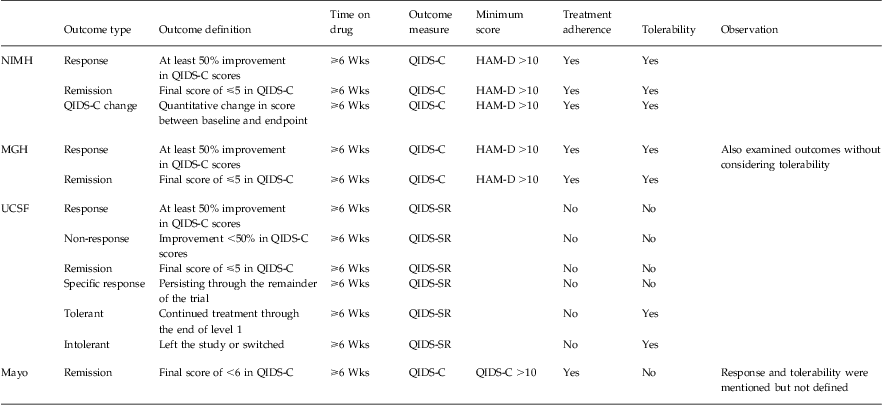
Although the outcomes were antidepressant treatment response and remission, all of the definitions have subtle, yet significant, differences. This is particularly problematic when analyzing genes such as the serotonin transporter (SLC6A4), because tolerability has been shown to be a confounder of outcome, and, depending on whether it is included or not, the results could vary even within the same sample. This is the case for STAR*D, where four groups across the U.S. have tested outcome phenotypes. These groups were as follows: (1) the Intramural Research Program at the National Institute of Mental Health (NIMH),Reference McMahon, Buervenich and Charney15 (2) Massachusetts General Hospital (MGH), (3) University of California at San Francisco (UCSF),Reference Peters, Slager and Kraft16 and (4) the Mayo Clinic.Reference Mrazek, Rush and Biernacka17 The phenotype definitions by group are summarized in Table 1.
Comparison of phenotype definitions of the four groups that reported results on antidepressant treatment outcome in the Sequenced Treatment Alternatives to Relieve Depression (STAR*D) study

QIDS-SR, Quick Inventory of Depressive Symptomatology – Self-rated; QIDS-C, Quick Inventory of Depressive Symptomatology – Clinician rated; HAM-D, Hamilton Depression Rating Scale.
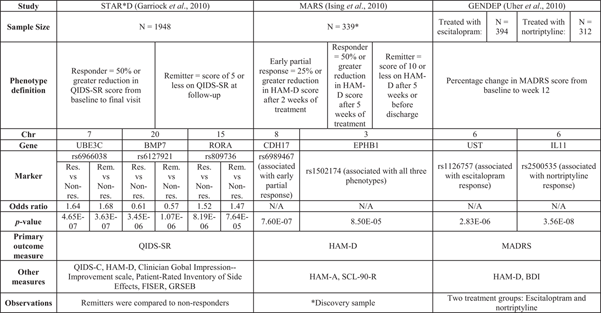
MARS and GENDEP used other phenotype definitions (see Table 2). The lack of consensus in the definition of antidepressant outcome poses a major hurdle in pharmacogenetic studies of MDD, making meta-analyses and replication of previous findings very difficult to achieve. In an attempt to increase sample size, a joint meta-analysis was recently conducted by the three groups (STAR*D, GENDEP, MARS), and, despite best efforts, the researchers did not find any common genetic variation that could be a reliable predictor of antidepressant treatment outcome.18
Comparison of phenotype definitions and results in genomewide association studies (GWAS) of antidepressant treatment outcome
Candidate genes involved in pharmacodynamics of antidepressants
The case for the serotonin transporter (SLC6A4)
The serotonin transporter (SLC6A4), along with a functional polymorphism in its promoter region [known as the linked polymorphic region (LPR)], has been the most studied genetic variant in psychiatry. It is characterized by the presence (long allele) or absence (short allele) of a 43 base pair segment that seems to affect gene expression.Reference Rasmussen and Werge19 The serotonin transporter is the target for selective serotonin reuptake inhibitors (SSRIs), which are the most widely prescribed antidepressants, thus the most obvious pharmacodynamic candidate for association studies and a good hypothesis to explain their efficacy. Multiple studies and a subsequent a meta-analysis by Serretti etal. Reference Serretti, Kato, De and Kinoshita20 suggested an association with antidepressant outcome, but the signal has not been universal. A more recent meta-analysis that included all previous studies, STAR*D, and a number of unpublished studies found no association.Reference Taylor, Sen and Bhagwagar21 Another study, by Murphy etal.,Reference Murphy, Hollander, Rodrigues, Kremer and Schatzberg22 had suggested a role for the LPR in antidepressant medication side effects. The serotonin transporter was widely studied in STAR*D. Three different publications reported results of SLC6A4 variation and treatment outcome.Reference Mrazek, Rush and Biernacka17, Reference Hu, Rush and Charney23, Reference Kraft, Peters and Slager24
Kraft etal.,Reference Kraft, Peters and Slager24 using the UCSF phenotype definitions (see Table 1), reported no association with 9 tagging SNPs and the LPR with citalopram treatment response. Hu etal.,Reference Hu, Rush and Charney23 using the NIMH outcome definitions (see Table 1), found that variation in the LPR was associated with tolerability and not treatment outcome; therefore, carriers for the less functional alleles had an increased side-effect burden that could lead to discontinuation and nonresponse. Finally, Mrazek etal.,Reference Mrazek, Rush and Biernacka17 from Mayo Clinic, ran analogous experiments, and concluded that there was an association between remission of depression treated with citalopram and both the variable number tandem repeats (VNTR, or short nucleotide sequences organized in tandem repeats) 12/12 genotype in intron 2 and the LPR variant in white non-Hispanic subjects. While this study's phenotype definition was close to the NIMH remission phenotype, it did not include tolerability (see Table 1). Participants who could not tolerate citalopram had a lower response and remission rate. These findings highlight the need for consistent and adequate phenotype definitions and show how seemingly minor changes could have a significant impact on results. Future pharmacogenetic studies of antidepressant response should consider tolerability when defining outcome phenotypes, especially when studying the serotonin transporter LPR.
The HTR2A and GRIK4 genes
The first pharmacogenetics report from STAR*D was a candidate gene study conducted by McMahon etal. Reference McMahon, Buervenich and Charney15 in 2006. The three NIMH phenotypes (see Table 1) were tested, namely response, remission, and QIDS-C16 change from baseline to endpoint. The primary analysis showed two associated markers: rs7997012 located in the second intron of the HTR2A (serotonin 2A receptor) gene and rs1954787 located in another intron of the GRIK4 (encodes the KA1 subunit of the glutamate kainite receptor) gene.Reference McMahon, Buervenich and Charney15, Reference Paddock, Laje and Charney25 The homozygous carriers of both the HTR2A and GRIK4 response associated alleles were 23% less likely to be citalopram nonresponders than participants with none of these marker alleles. Although these results are very interesting, the probability of correctly identifying a responder from a random pair of participants had a very small predictive value.Reference Paddock, Laje and Charney25 An attempt at replication was conducted using the smaller MARS sample.Reference Horstmann, Lucae and Menke26 Although both the HTR2A and GRIK4 markers did not reach experiment-wide significance, other markers in these genes were associated with remission in the MARS sample, suggesting some converging results with these genes.
The brain derived neurotrophic factor (BDNF) gene
BDNF is a member of the neurotrophin family that is involved in neuronal growth and plasticity. Variation in BDNF has been thought to play a role in the etiology of affective disorders and the mediation of antidepressant treatment response.Reference Green and Craddock27 Furthermore, expression of BDNF has been shown to be modified by antidepressant treatment.Reference Saarelainen, Hendolin and Lucas28 A functional nonsynonymous SNP causing an amino acid substitution of valine to methionine has been identified in codon 66 (val66met; rs6265).Reference Egan, Kojima and Callicott29, Reference Ventriglia, Bocchio Chiavetto and Benussi30 Multiple studies support a potential role of BDNF variation in the pathogenesis of MDD,Reference Hwang, Tsai and Hong31–Reference Schumacher, Jamra and Becker33 but not all,Reference Hong, Huo and Yen34, Reference Tsai, Cheng, Yu, Chen and Hong35 including a recent meta-analysis.Reference Chen, Lawlor and Lewis36 The BDNF val66met polymorphism has been at the center of antidepressant treatment response with some positiveReference Choi, Kang, Lim, Oh and Lee37 and negativeReference Anttila, Huuhka and Huuhka38 results. Undertaken by Domschke etal.,Reference Domschke, Lawford and Laje39 a report was published that suggests that neither in a German (n = 268) sample nor the STAR*D (n = 1914) samples was BDNF variation, including the val66met, associated with treatment outcome. Recent studies have found ketamine to be a “fast-acting” antidepressant when used at low doses (0.5 mg/kg).Reference Zarate, Singh and Carlson40 Animal data suggest that variation in BDNF, and more specifically val66met, may have an impact on ketamine treatment.Reference Liu, Lee and Li41 These findings have also been reported in humans, suggesting that this particular BDNF variant may be relevant to fast-acting antidepressants but not traditional SSRIs.Reference Laje, Lally and Mathews42
Genome-wide association studies (GWAS) of antidepressant treatment outcome
There have been three antidepressant treatment outcome studies that have implemented genome-wide approaches to detect common variation associated with response: STAR*D (n = 1953),Reference Garriock, Kraft and Shyn43 MARS (n = 339),Reference Ising, Lucae and Binder44 and GENDEP (n = 706).Reference Uher, Perroud and Ng45 These studies have many differences (in design, genotyping platform used, sample size, and outcome measures), but what they all have in common are negative findings. Nevertheless, all of them report “top hits,” and interpret them in the context of their plausible biological role in antidepressant pathophysiologyReference Laje and McMahon46 (see results in Table 2). At first glance, it is apparent that none of the GWAS results survive standard genome-wide correction for the number of markers and phenotypes tested. The top results also do not overlap at the level of alleles or genes. A meta-analysis that combined the 3 samples did not provide any clinically useful information, given that the aggregate number of patients remained relatively small.18 This is not surprising in the context of the vast heterogeneity that comes from different phenotype definitions, differences in ethnic background, and sample size.
Genes involved in pharmacokinetics of antidepressants
Genes that regulate the bioavailability of antidepressant drugs could also have a significant impact on response and tolerability. The majority of antidepressant compounds are metabolized by the liver through the cytochorme P-450 pathway and its enzymatic subgroups. Genes such as CYP2D6, CYP1A2, CYP3A4, and CYP2C19 have been studied and well characterized, but their clinical use has proven to be limited in monotherapy. The CYP2D6 is possibly the most relevant gene in this group, given that most antidepressants are metabolized by it. It is a very polymorphic gene with over 60 different allele variants, some of which are nonfunctional. This system was targeted early on as a natural candidate for pharmacogenetic studies. Although studies have shown that poor metabolizers (patients with two nonfunctional copies) may be more susceptible to adverse events at low antidepressant doses, these findings have not yet been shown to have significant clinical application in SSRI monotherapy.47 The best candidates for CYP2D6 testing would be the tricyclic antidepressants (TCAs), given their narrow therapeutic index. However, with the increasing use of the safer selective serotonin reuptake inhibitors (SSRIs), TCA use has been steadily declining.
The ABCB1, another pharmacokinetic gene, also known as MDR1 (multidrug resistance), encodes the p-glycoprotein and is expressed in tissues that have protective or elimination roles, such as the intestines, liver, kidney, and blood–brain barrier. Peters etal. Reference Peters, Slager and Kraft16 published a study using a split sample design to assess 15 polymorphisms from 5 pharmacokinetic genes including CYP2D6, CYP2C19, CYP3A4, CYP3A5, and ABCB1. Using the UCSF phenotype definitions outlined in Table 1, they found no association with citalopram outcome in any of these genes.
The GENDEP group reported that escitalopram concentration might be associated with CYP2C19 genotype in 196 patients.Reference Huezo-Diaz, Perroud and Spencer48 This study, however, does not comment on treatment outcome or tolerability associated with CYP2C19 genotype.
Pharmacogenetics of adverse effects: treatment emergent suicidal ideation (TESI)
The emergence of adverse reactions is common to all pharmacological treatments. Their severity, however, determines whether a patient will have partial adherence, or will continue or discontinue treatment.
Suicidal ideation is an uncommon symptom that can emerge during antidepressant treatment. The FDA determined after a scrupulous analysis that there was sufficient evidence to issue a “black box warning” highlighting the risk of treatment-emergent suicidality in patients prescribed antidepressants who are younger than 25 years old.49 There were several TESI studies conducted in STAR*D, MARS, and GENDEP.
First, Perlis etal.,Reference Perlis, Purcell and Fava50 in a candidate gene study of the cyclic adenosine monophosphate response element binding protein (CREB1), reported 2 SNPs and 2 of the 5 SNP haplotypes associated with TESI in men. The phenotype was defined using item 12 of the QIDS-C16 (clinician rated). Subsequently, Laje etal.,Reference Laje, Paddock and Manji51 using a different phenotype definition based on item 12 of the QIDS-SR16 (self-rated), reported results from 68 candidate genes. In this study, two markers, one in GRIA3 (rs4825476) and another in GRIK2 (rs2518224), were associated with TESI. These genes encode different subunits of the ionotropic α-amino-3-hydroxy-5-methyl-4-isoxazolepropionic acid receptor (AMPA) and kainate glutamate receptors. Later, different alleles on GRIA3 and other markers in GRIK2 were also implicated with TESI in the MARS sample, deriving the phenotype from item 3 of the HAM-D17.Reference Menke, Lucae and Kloiber52 Finally, the NIMH group conducted a genome-wide study in a case-control subsample (n = 274). The phenotype definition for the TESI cases was the same as previously reported by this group. The controls, however, were selected by minimum of 3 visits, a baseline QIDS-C total score (CRC) ⩾ 10, adherence to medication, recurrent depression, no history of suicide attempts, and further, no report of suicidal thoughts throughout citalopram treatment on QIDS-C16 and QIDS-SR16. Two more markers were implicated in TESI: one residing in the PAPLN gene (rs11628713) that encodes papilin, a protoglycan-like sulfated glycoprotein, and another that showed a strong trend located in the IL28RA gene (rs10903034) that encodes the IL-28 (interferon lambda) receptor.Reference Laje, Allen and Akula53 Although these markers offered promising results with some meaningful effect sizes, these are still not enough to be used in a clinical setting.
The MARS group also conducted a genome-wide TESI study in its inpatient cohort (N = 397).Reference Menke, Domschke and Czamara54 Phenotype definition was obtained using a similar method as the NIMH group, using the suicide item 3 of the HAM-D17 defined by an emergence of suicidal thoughts during hospitalization without suicidal thoughts at admission. MARS had a comparable TESI prevalence in its sample to that of STAR*D (8.1% and 6.3%, respectively). In this study, they attempted to replicate their top results in an independent sample (N = 501). However, none of the variants achieved genome-wide significance. The best-associated SNP was rs1630535 (p-value = 1.3e-7), an intergenic marker in the vicinity of the RORA gene (∼300 kb from the 3′ end). This gene was associated with antidepressant treatment outcome in the STAR*D sample (see above).
Genetic predictors of TESI were also studied by the GENDEP group, using both a candidate gene and a genome-wide approach.Reference Perroud, Uher and Ng55, Reference Perroud, Aitchison and Uher56 Its phenotype definition, however, departed from previous definitions of TESI in that it included participants who experienced “worsening” in suicidal ideation. This definition approach, unfortunately, cannot distinguish those patients who have a worsening of their depression with increased suicidal thinking from those participants who experience de novo suicidality. The candidate gene study included 9 genes and 123 polymorphisms. This report concluded that rs962369 in BDNF (p = 0.002) was associated with an increase in TESI, and that an epistatic effect between BDNF and NTRK2, the gene that encodes the BDNF receptor, may also lead to TESI.Reference Perroud, Aitchison and Uher56 The genome-wide study, using the same phenotypic definition, reported no genome-wide significant associations and highlighted rs11143230 as its most significantly associated marker (8.28e-7). This is an intergenic marker located ∼30 kb downstream of the GDA gene that encodes guanine deaminase.Reference Perroud, Uher and Ng55
These results, which are consistent with those from antidepressant treatment outcome studies, offer a window into the complexities of psychiatric phenotyping, genetic association studies, and the barriers we need to overcome before we can obtain clinically useful markers in the treatment of MDD.
Pharmacogenetics of mood stabilizers: relapse prevention and adverse effects
Mood stabilizers include both lithium and anticonvulsants. In general, studies have been very limited in this area, mainly due to limited access to large samples. Mood stabilizers are the standard treatment for bipolar disorder, and given the management complexity of both manic and depressive episodes, the phenotype definitions are intricate. Phenotypes in bipolar disorder could range from acute mania to depression, but most studies have focused on relapse prevention.
For over 50 years, lithium treatment has been at the forefront of the therapeutic approaches in bipolar disorder and, more recently, in major depression. There is a growing body of evidence that suggests that response to lithium is a familial trait,Reference Grof, Duffy and Cavazzoni57 thus this drug is a promising target for pharmacogenetic analyses. Many small candidate gene studies have focused on well-known mood disorders genes, but few findings have been replicated. In recent years, progress has been made in elucidating lithium's mechanism of action, with the consequent expansion of downstream candidate genes (for review see McCarthy etal. Reference McCarthy, Leckband and Kelsoe58). Another known effect of lithium treatment is its ability to alter gene expression; however, these studies have not yielded any consistent findings.Reference Brandish, Su and Holder59–Reference Yu, Ono, Sora and Tomita61
The phenotypic definition of response in bipolar disorder can be more intricate than in major depressive disorder, and lithium is a good example to illustrate this complexity. Lithium can have acute antimanic effects and antidepressant effects, as well as the longer-term effects of relapse prevention. Most pharmacogenetic studies of lithium have focused on this latter effect. There have been both candidate gene and genome-wide association studies (GWAS) that have not generated any conclusive findings, and replication has been scarce (for a review on candidate genes, see McCarthy etal. Reference McCarthy, Leckband and Kelsoe58).
Two GWAS of lithium response have been published to date. The largest dataset was obtained by the Systematic Treatment Enhancement Program for Bipolar Disorder (STEP-BD). This multicenter study followed over 1000 bipolar disorder patients over a period of about 2 years each.Reference Perlis, Dennehy and Miklowitz62 Concordant with STAR*D, STEP-BD was not designed as a pharmacogenetic study, but provided systematically ascertained data in approximately 500 patients treated with lithium. One of the phenotypes studied, “time to recurrence,” did not have a genome-wide significant association; however suggestive signals in the GRIA2 gene (encodes the gluR2 subunit of the AMPA receptor) were also found in different markers in the same region of a second sample. The second study was smaller in size (n = 200), but was conducted in a more homogeneous sample than STEP-BD and with long-term follow-up. As anticipated, this study did not yield any significant associations either.Reference Squassina, Manchia and Borg63 To overcome some of the difficulties of collecting a large enough sample, the Consortium on Lithium Genetics (ConLiGen) is currently assembling a worldwide sample that is uniformly phenotyped for GWAS analysis.Reference Schulze, Alda and Adli64
Lithium tolerability has been a major barrier to adherence, mainly due to its narrow therapeutic index. Two common adverse effects of lithium include thyroid and renal disease. Although many patients take lithium for very long periods of time (sometimes years), not all of them experience these problems. This suggests that there may be individual variation in the risk for these adverse effects, and, while there may be a significant environmental component, genetic variation also may contribute to this risk.
Anticonvulsant medications such as carbamazepine, lamotrigine, and valproic acid play an important role in the treatment of mood disorders. The efficacy and tolerability of these medications has been well established; however, there have been no meaningful pharmacogenetic studies of outcome or adverse effects to date. Interestingly, many anticonvulsants have a rare, but potentially fatal, adverse effect known as toxic epidermal necrolysis or Stevens–Johnson syndrome (SJS). In 2004, a report by Chung etal. Reference Chung, Hung and Hong65 suggested that patients of Han Chinese ancestry who carried the human leukocyte antigen (HLA) marker known as HLA-B*1502 were more likely to develop SJS when exposed to carbamazepine. Clinical testing for this marker, which is also present in other Asian populations, was later included as a “boxed warning” in the labeling of carbamazepine by the FDA. Interestingly, HLA-B*1502 is uncommon in non-Asian populations, but similar findings with HLA-A*3101 were also reported in other studies.Reference McCormack, Alfirevic and Bourgeois66
Clinical Application
Psychiatric clinicians are eager to have a genetic (or other) test to assist with diagnosis and treatment. However, as it may be apparent from the examples given, our current understanding of mood disorders pharmacogenetics is very limited. The findings previously described are arguably the most studied genes by different groups around the world, yet with the exception of carbamazepine, a clinically relevant test for mood disorders has not been attained.
In 2007, the Evaluation of Genomic Applications in Practice and Prevention Working Group (EGAPP)47 published a report reviewing the evidence for CYP genotyping in nonpsychotic major depression before starting antidepressants and concluded that there was not enough evidence to support a recommendation for or against use of CYP450 testing. Furthermore, EGAPP discouraged use of CYP450 testing for patients beginning SSRI treatment until further clinical trials are completed. This additional evidence is yet to be gathered. The rationale for EGAPP's recommendation is based on data suggesting that outcomes are not consistently associated with CYP450 genotypes. It is important to highlight that most studies done to date were based on monotherapy and a limited number of CYP450 enzymes. Another caveat to keep in mind is that although a large number of commonly used antidepressants are metabolized by CYP2D6, other CYP450 enzymes such as CYP3A4, CYP2C19, and CYP1A2 also participate in antidepressant metabolism, and it remains unclear how much they could compensate any CYP2D6 deficits.
Is there a role for CYP450 testing in polypharmacy? This remains an open question with no data in favor or against this argument. There are many situations where pharmacokinetic interactions between antidepressants, antipsychotics, or mood stabilizers on the CYP2D6 system could be problematic, for example, using fluoxetine, risperidone, and carbamazepine. Fluoxetine is metabolized by CYP2D6, but it is also a potent inhibitor of this enzyme. Risperidone is a substrate to CYP2D6, thus, patients who are poor metabolizers (due to the presence of two nonfunctional alleles) could have increased adverse events from both drugs and their interaction. Furthermore, patients who are phenotypically intermediate or extensive metabolizers (one or two functioning alleles, respectively) could also experience increased adverse events due to CYP2D6 inhibition by fluoxetine and its interaction with risperidone. Carbamazepine, on the other hand, could alter the equation by inducing CYP2D6. Obviously, CYP2D6 could have a larger impact on increasingly complex medication regimens where the pharmacodynamic and pharmacokinetic interactions are exponentially increased. Thus, a priori knowledge of CYP2D6 status could inform clinicians as to whether certain combinations are more likely to produce adverse events at least at the pharmacokinetic level.
Due to our limited understanding of the pharmacodynamic basis of antidepressant efficacy and the effect of genetic variation on the known pharmacodynamic genes, such as the serotonin transporter LPR, clinical testing for these variants may be of little use.
At the moment, only carbamazepine carries a boxed warning for increased risk for Stevens–Johnson syndrome when being considered for patients of Asian ancestry, and screening for HLA-B*1502 before commencing treatment is recommended. It remains unclear whether genetic testing is indicated in patients of non-Asian ancestry; however, a prior family history of hypersensitivity or other skin reactions after exposure to anticonvulsants may suggest higher risk.
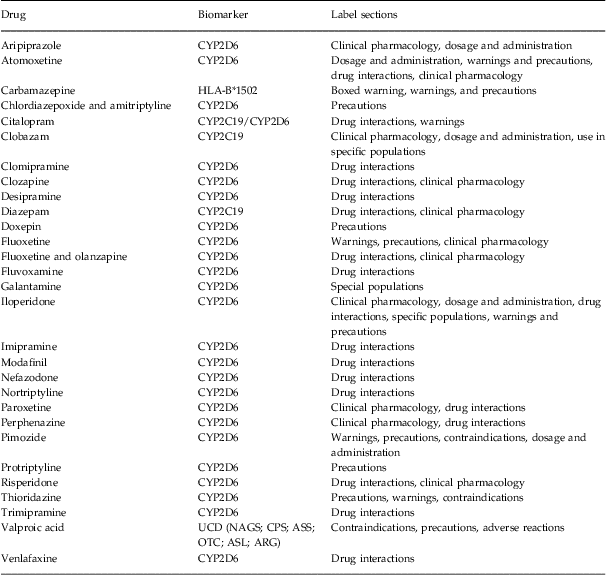
The typical antipsychotic pimozide has an FDA recommendation of CYP2D6 testing to prevent increased levels that could lead to QT prolongation and cardiac arrhythmias. Other psychotropics have pharmacogenetic information discussed in different sections of their labels. Table 3 lists those medications that might be relevant for mood disorders.
Pharmacogenetic markers in psychotropic drug labels
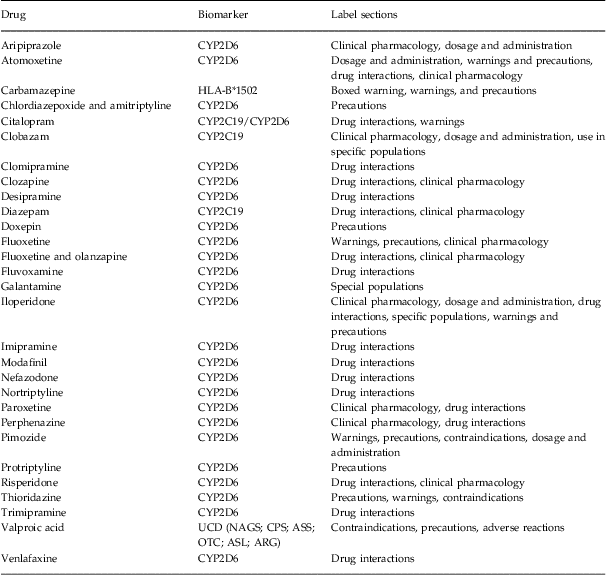
Adapted from FDA (http://www.fda.gov/drugs/scienceresearch/researchareas/pharmacogenetics/ucm083378.htm, accessed February 13, 2013.)
Clinicians who wish to order these pharmacogenetic tests should include in their requests the genotype to be tested (eg, “CYP2D6 genotype”). At this time, these tests can take several days/weeks to be reported, thus, empirical treatment might need to be started before the results are returned. Commercial laboratories that conduct pharmacogenetic tests (most large laboratories do) will usually provide an interpretation of findings. The implementation, however, will be up to the clinician.
Conclusions
In summary, the next decade should bring significant progress for pharmacogenetics in psychiatry. This progress will require a significant effort in sample collection, genetic assays, and clinical validation. Establishing consensus in phenotype definitions will help the field move forward and facilitate experiment replication. For the promise of clinically useful tools to be realized, the field must produce clinically meaningful findings and not just statistically significant associations. The use of pharmacogenetic testing in psychiatry is currently limited to carbamazepine, pimozide, and to assess risks of drug interactions. Thus testing is less relevant for monotherapy, but with some potential to inform polypharmacy.
Disclosures
Dr. Laje is listed as co-inventor in U.S. patents 7,795,033 and 7,906,283 filed by the NIH related to genetic markers of antidepressant treatment outcome and genetic markers associated with treatment-emergent suicidal ideation. Under federal law, the NIH is required to pay inventors a portion of any royalties the NIH receives through licenses granted under patents.