Introduction
It has been well established that life events are associated with depression (Paykel, Reference Paykel2003). Several studies have shown that this association can be explained by life events preceding the onset of depression (for a review, see Paykel, Reference Paykel2003). However, depression also predicts the occurrence of negative life events (Hammen, Reference Hammen2003; Patton et al. Reference Patton, Coffey, Posterino, Carlin and Bowes2003). This would suggest that the association is due to reciprocal causation or, alternatively, to a third factor influencing the risk for exposure to life events as well as for depression. Such a third factor could represent a genetic liability, constituting a form of gene–environment correlation, that can arise when there is genetic control of exposure to environmental events and when these genes overlap with the genes that influence depression itself (Kendler & Eaves, Reference Kendler and Eaves1986). Gene–environment correlation has been shown to explain the association between life events and depression in some twin and family studies (McGuffin et al. Reference McGuffin, Katz and Bebbington1988; Kendler & Karkowski-Shuman, Reference Kendler and Karkowski-Shuman1997; Kendler et al. Reference Kendler, Karkowski and Prescott1999), but not in others (Farmer et al. Reference Farmer, Harris, Redman, Sadler, Mahmood and McGuffin2000; Romanov et al. Reference Romanov, Varjonen, Kaprio and Koskenvuo2003). One of the studies that found support for gene–environment correlation suggested that the correlation could be explained by genes that influence personality traits associated with depression (Kendler et al. Reference Kendler, Karkowski and Prescott1999). This hypothesis was later confirmed for neuroticism, extraversion and openness for experience (Saudino et al. Reference Saudino, Pedersen, Lichtenstein, McClearn and Plomin1997; Kendler et al. Reference Kendler, Gardner and Prescott2003a).
Life events also seem to be associated with anxiety disorders (Faravelli & Pallanti, Reference Faravelli and Pallanti1989; Newman & Bland, Reference Newman and Bland1994; de Graaf et al. Reference de Graaf, Bijl, Ravelli, Smit and Vollebergh2002; Kendler et al. Reference Kendler, Hettema, Butera, Gardner and Prescott2003b; Sandin et al. Reference Sandin, Chorot, Santed and Valiente2004). The aetiology of this association has been less extensively investigated, but several studies have indicated that life events precede the development of anxiety disorders (Faravelli & Pallanti, Reference Faravelli and Pallanti1989; Kendler et al. Reference Kendler, Hettema, Butera, Gardner and Prescott2003b; Sandin et al. Reference Sandin, Chorot, Santed and Valiente2004). To our knowledge, reciprocal causation or gene–environment correlation have not been investigated.
Detailed knowledge about the mechanisms underlying the associations between life events, personality and depression or anxiety is not only important to gain more insight into their aetiology, but also in order to investigate the importance of gene–environment interaction in these symptoms. Gene–environment interaction reflects genetic control of sensitivity to the environment (Kendler & Eaves, Reference Kendler and Eaves1986). A significant gene–environment interaction effect can be due to gene–environment correlation if this correlation is not included in the model (Purcell, Reference Purcell2002). Before investigating gene–environment interaction, it is therefore necessary to determine that the environmental pathogen has causal effects and to exclude gene–environment correlation (Moffitt et al. Reference Moffitt, Caspi and Rutter2005).
In the current study, the association between life events and anxious depression, neuroticism and extraversion was investigated in a prospective and genetic design in a large sample of twins. A self-report questionnaire measuring symptoms of anxiety and depression was used in the analyses. This is in contrast to clinical practice in which psychiatric diagnoses, for example, according to DSM-IV criteria (APA, 1994), are mostly used. The advantage of analysing DSM-IV diagnoses is their clinical relevance. The disadvantage is that the sets of DSM criteria are consensus based and the categorical classification of a particular behavioural profile as disordered or not is somewhat arbitrary. Therefore, in a study aiming to get insight into the mechanisms underlying the development of symptoms, it might be more appropriate to analyse a continuous measure. This gives a better reflection of the variance in the population, especially for the subjects scoring around the boundary for being affected or not, who are otherwise considered to be similar to the subjects scoring either clearly above or below the threshold.
The prospective and genetic design provided the opportunity to investigate the following two hypotheses regarding anxious depression, neuroticism and extraversion: (1) the association with life events is causal, either unidirectional or reciprocal; (2) the association with life events is due to gene–environment correlation, i.e. genes that influence personality or the risk of depression also increase the risk of exposure to life events. The first hypothesis was tested using longitudinal data. The effect of the life events on the anxious depression, neuroticism and extraversion scores was investigated in a mixed model also including the scores before exposure. The influence of anxious depression, neuroticism and extraversion on the risk for exposure to life events was studied by comparing the scores before the exposure to the life events between subjects who later did not report a life event and subjects who later reported one or more life events. The second hypothesis was tested with the co-twin control design (Cederlof et al. Reference Cederlof, Friberg and Lundman1977; Kendler et al. Reference Kendler, Neale, MacLean, Heath, Eaves and Kessler1993). With this approach, the association between life events and anxious depression, neuroticism and extraversion is compared between monozygotic (MZ) twins discordant for life events, dizygotic (DZ) twins discordant for life events and unrelated individuals discordant for life events.
Method
Subjects
The study is part of a longitudinal survey study of the Netherlands Twin Register that has assessed families with adolescent and young adult twins roughly every 2 years since 1991. Sample selection and response rates are described in detail in Boomsma et al. (Reference Boomsma, Vink, van Beijsterveldt, de Geus, Beem, Mulder, Derks, Riese, Willemsen, Bartels, van den Berg, Kupper, Polderman, Posthuma, Rietveld, Stubbe, Knol, Stroet and van Baal2002, Reference Boomsma, de Geus, Vink, Stubbe, Distel, Hottenga, Posthuma, van Beijsterveldt, Hudziak, Bartels and Willemsen2006). Data from the 1997, 2000 and 2002 surveys were used. Only data from twins between ages 18 and 65 years whose zygosity was known were included. For the majority of the twin pairs, zygosity was determined from questions about physical similarity of the twins and confusion of the twins by family members, friends and strangers. Information on zygosity was available from DNA polymorphisms for 726 same-sex twin pairs. The agreement between zygosity diagnoses from questionnaire and DNA data was 97% (Willemsen et al. Reference Willemsen, Posthuma and Boomsma2005).
In 1997, 2000 and 2002, neuroticism, extraversion and anxious depression were measured with self-report questionnaires. In 2000 and 2002, exposure to life events was also assessed. Mean age, scores on neuroticism, extraversion and anxious depression and frequencies of experienced life events were comparable for the 4379 twins participating in 2000 and the 4339 twins who participated in 2002. Therefore, the largest possible sample was created by combining the data collected in 2000 and 2002. Data of subjects, who participated in 2000, but not in 2002 (n=1443), were added to the dataset of subjects who participated in 2002. This led to a sample with cross-sectional data on life events, anxious depression, neuroticism and extraversion of 1918 male and 3864 female twins including 4490 twins from complete pairs and 1292 twins from incomplete twin pairs. For 1058 male and 2226 female twins, personality and anxious depression data were available before the exposure to life events (T1, measured either at 1997 or at 2000) and after the exposure (T2, measured either at 2000 or 2002). This sample was used to analyse hypothesis 1, i.e. causality (see below, Statistical analysis).
To study hypothesis 2, MZ and DZ twin pairs discordant for life events and unrelated subjects, either exposed or not, were selected. Discordant twin pairs were defined as a pair in which one twin had never experienced a life event, while the other had experienced a life event at least once. Only same-sex twin pairs were included in this analysis. The sample of unrelated individuals consisted of twins of a same-sex twin pair of whom the co-twin had not participated, or twins who were randomly selected from a same-sex twin pair concordant for exposure to life events. The group of MZ twins discordant for life events last year, the last 5 years or ever consisted of, respectively, 107, 269 and 372 pairs. For the discordant DZ twins, the numbers of pairs were 55, 143 and 201. In the groups of unrelated subjects, 993 were never exposed to a life event, while 498, 1102 and 1504 subjects were exposed to a life event last year, in the last 5 years or ever.
Instruments
Neuroticism and extraversion were measured with the Amsterdamse Biografische Vragenlijst (ABV) (Wilde, Reference Wilde1970). The ABV neuroticism and extraversion scales were modelled after the Eysenck Personality Questionnaire (Eysenck & Eysenck, Reference Eysenck and Eysenck1964). Anxious depression was measured with the Young Adult Self Report (Achenbach, Reference Achenbach1990; Verhulst et al. Reference Verhulst, Ende and Koot1997). Examples of items are: In the last 6 months ‘I cry a lot’, ‘I am nervous or tense’, ‘I am unhappy, sad or depressed.’ Cronbach's α was 0.89. The correlation between neuroticism and extraversion and between anxious depression and extraversion varied around −0.23 in men and women. The correlation between neuroticism and anxious depression was 0.60 in men and 0.70 in women (Middeldorp et al. Reference Middeldorp, Cath, van den Berg, Beem, van Dyck, Boomsma and Canli2006). An earlier study performed in a subsample of twins and siblings showed that scores on the anxious depression scale are strongly related to DSM-IV major depression and anxiety disorders (Middeldorp et al. Reference Middeldorp, Cath, van den Berg, Beem, van Dyck, Boomsma and Canli2006). Subjects diagnosed with one or more of these disorders scored at least one standard deviation higher than subjects without any of these diagnoses. Another recent study also demonstrated excellent convergence between the anxious depression scale and major depression (Doyle et al. Reference Doyle, Mick and Biederman2007).
In the 2000 and 2002 surveys, a Dutch life event scale (the Schokverwerkings Inventarisatie Lijst; Van der Velden et al. Reference Van der Velden, Van der Burg, Steinmetz and Van den Bout1992) asked about the experience of the following life events: death of a spouse, father, mother, child, sibling or significant other, serious illness or injury of self or a significant other, divorce/break-up of a relationship, traffic accident, violent and sexual assault and robbery. Response categories were ‘never experienced’, ‘0–6 months ago’, ‘6–12 months ago’, ‘1–5 years ago’ and ‘more than 5 years ago’. In the current study the response categories ‘0–6 months ago’ and ‘6–12 months ago’ were combined to ‘last year’. Familial clustering in death of a family member and death or serious illness/injury of significant other was explained by common environmental factors and not by genetic factors (Middeldorp et al. Reference Middeldorp, Cath, Vink and Boomsma2005). Therefore, gene–environment correlation cannot be present for the relation of these life events with anxious depression, neuroticism or extraversion and are not included in our analyses. This leaves the life events serious illness or injury of self, divorce/break-up, traffic accident, robbery, violent assault and sexual assault to be included.
Statistical analysis
To investigate hypothesis 1 (the association is causal), the longitudinal data were analysed in two ways using linear mixed models. First, the effect of the life events on anxious depression, neuroticism and extraversion scores were tested modelling the score at T2 as the dependent variable and the exposure to life events as the independent variable. Sex, age and the score at T1 were included as covariates. Because data from family members are not independent, a family effect was included as a random effect. Second, the influence of anxious depression, neuroticism and extraversion on the risk of exposure to life events was tested modelling the score at T1 as the dependent variable and the exposure to life events in the upcoming period as measured at T2 as the independent variable. Again, sex and age were included as covariates and the relation between family members as a random effect.
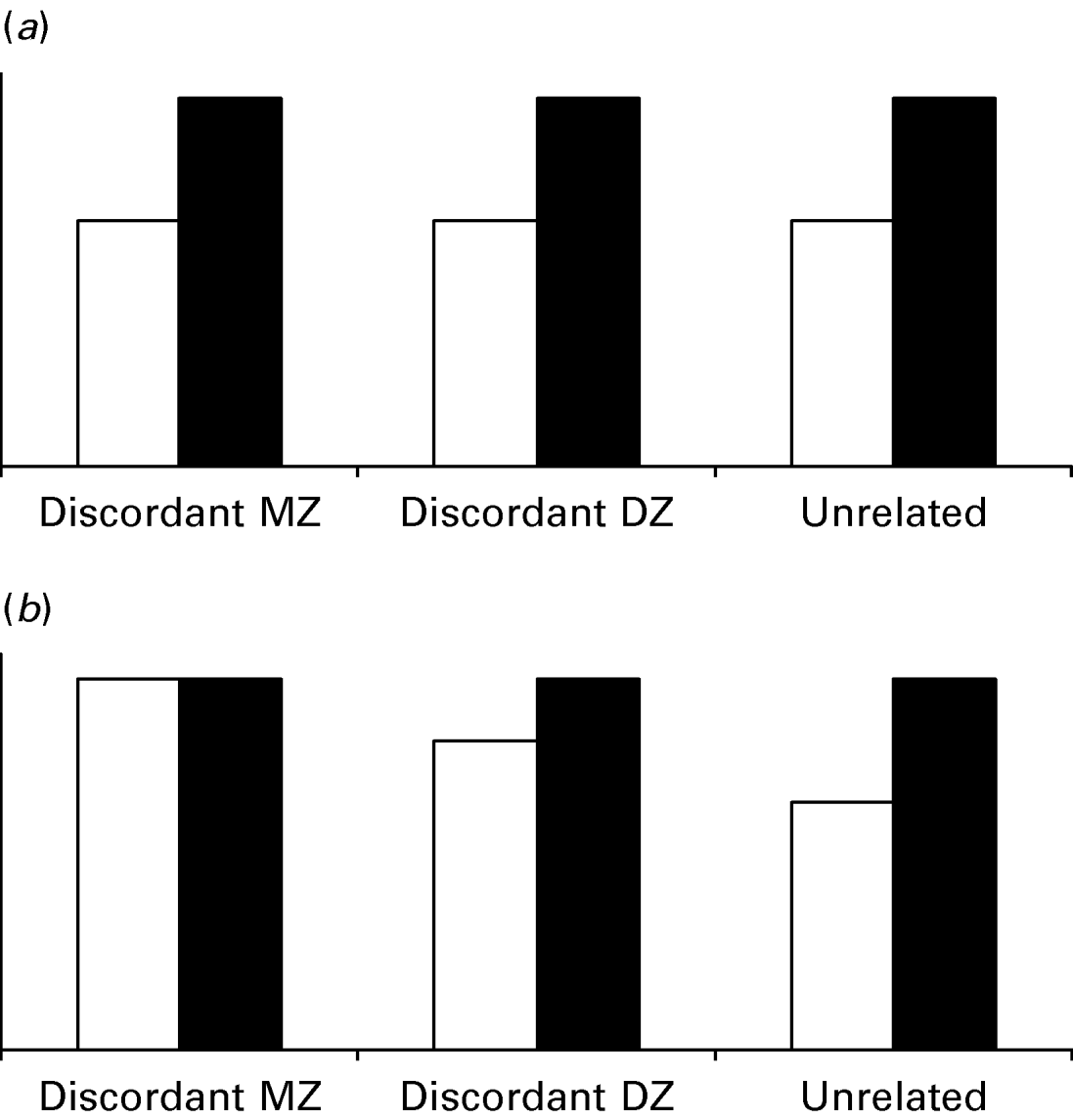
The co-twin control method was used to investigate hypothesis 2 (gene–environment correlation explains the association) (Cederlof et al. Reference Cederlof, Friberg and Lundman1977; Kendler et al. Reference Kendler, Neale, MacLean, Heath, Eaves and Kessler1993). This design makes use of three groups: (1) MZ twin pairs discordant for exposure to the risk factor, i.e. life events; (2) DZ twin pairs discordant for exposure to the risk factor; (3) a sample consisting of unrelated exposed and non-exposed individuals. Given the different degree of genetic relationship between the members of the three groups, the scores of the exposed and the non-exposed subjects will show different patterns in the absence and presence of gene–environment correlation. In the absence of gene–environment correlation, the differences in scores between exposed and non-exposed subjects will be similar in the three groups (Fig. 1 a). Two results are expected if the association between the variable and the risk factor is entirely due to shared genes, i.e. complete gene–environment correlation (Fig. 1 b). First, it is expected that the differences in scores between the exposed and non-exposed subjects are larger in the unrelated sample than in the discordant DZ pairs, while the discordant MZ pairs do not differ from each other. Second, it is expected that the differences are not due to differences in scores between the exposed subjects, but to differences in scores between the non-exposed subjects in the three groups. Non-exposed subjects from the total population will score lower than the DZ discordant non-exposed subjects who in turn will score lower than the MZ discordant non-exposed subjects. Since the non-exposed member of the MZ twin pair has the same genetic vulnerability for the variable under investigation as the exposed member, the non-exposed twin will score similar to the exposed co-twin. This score will be higher than the score of a non-exposed subject in the general population, as the genes increasing the risk for exposure also lead to higher, for example, anxious depression scores. Since DZ twins share on average half of their genes, the non-exposed twin will share some, but not all, of the genetic vulnerability for the variable under investigation with the twin exposed to the risk factor and will therefore score lower than the exposed co-twin, but higher than the non-exposed subjects in the general population. This was tested with regression analyses with the anxious depression, neuroticism and extraversion scores in the non-exposed subjects as the dependent variables and group membership as the independent variable. Group membership was coded as 0 for the non-exposed subjects in the MZ discordant group, −1 for the non-exposed subjects in the DZ discordant group and −2 for the non-exposed subjects in the group of unrelated individuals. In the presence of gene–environment correlation, the regression of group membership on the anxious depression, neuroticism or extraversion scores in the non-exposed subjects will be significant.
(a) Scores of the non-exposed (□) and the exposed subjects (■) in discordant monozygotic (MZ) and dizygotic (DZ) twins and unrelated individuals in the absence of gene–environment correlation. The scores of the non-exposed and the exposed subjects are similar across the three groups. (b) Scores in the non-exposed (□) and the exposed subjects (■) in discordant MZ and DZ twins and unrelated individuals in the presence of gene–environment correlation. The scores of the non-exposed and the exposed MZ twins are similar. The scores of the non-exposed DZ twins and unrelated individuals are lower than the scores of the exposed individuals, with the scores of the non-exposed DZ twins lying in between the scores of the non-exposed MZ twins and unrelated individuals.

It is possible that both causality and gene–environment correlation play a role. This will lead to a pattern lying in between the expected patterns as described above for the situations in which only one mechanism is of importance. Thus, the difference in scores between the MZ twins discordant for exposure will not be zero, but will be less than for the DZ twins who, in turn, will differ less from each other than the unrelated subjects. Still, the scores of the non-exposed subjects will differ between the three groups whereas the exposed subjects in the three groups will have similar scores.
Given the number of performed tests, a p value below 0.01 was considered significant.
Results
Hypothesis 1: the association is causal, either unidirectional or reciprocal
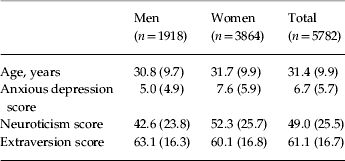
Table 1 shows mean age and anxious depression, neuroticism and extraversion scores. As expected, women scored higher than men on anxious depression and neuroticism.
Age and anxious depression, neuroticism and extraversion scores measured at the time of the life event questionnaire

Values are mean (standard deviation).
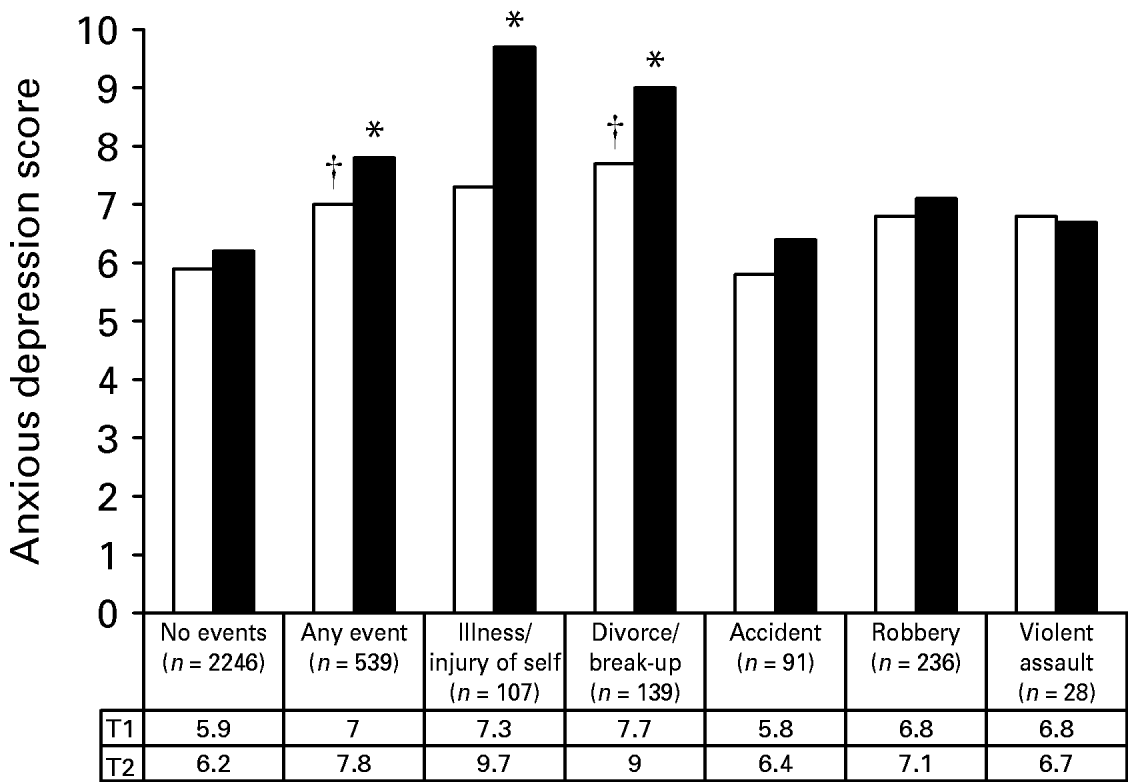
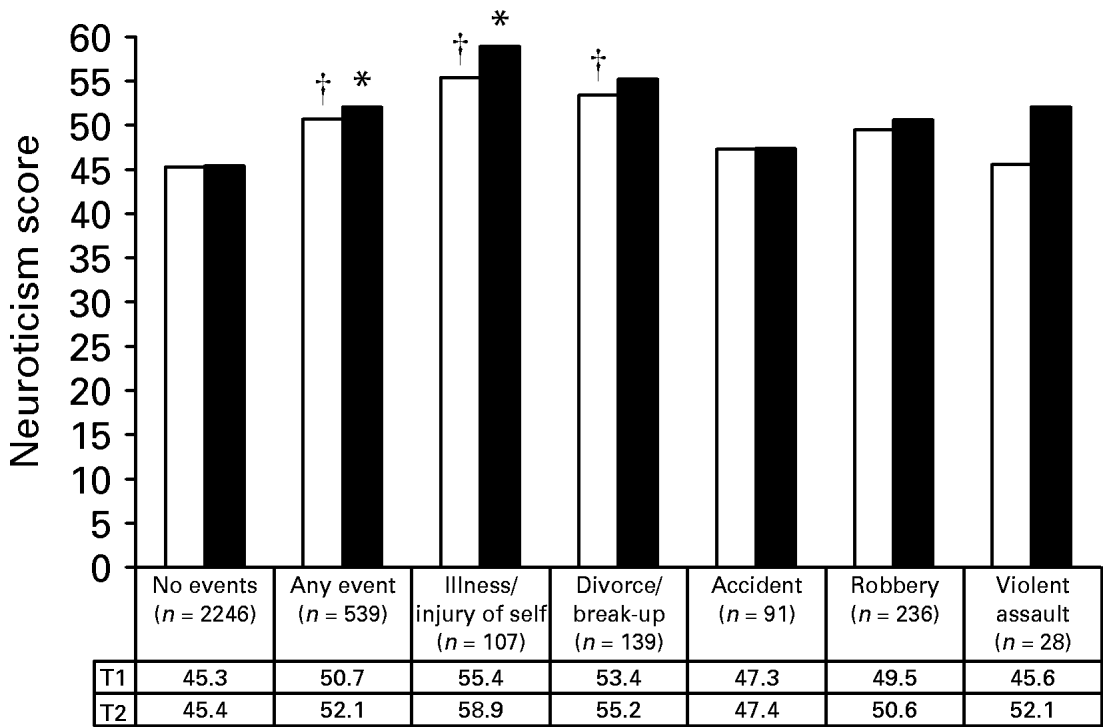
First, the influence of life events on anxious depression, neuroticism and extraversion scores was investigated. Sexual assault was not separately investigated, as only three exposed subjects participated on both occasions. Anxious depression and neuroticism scores were significantly affected by the experience of any life event (Figs 2 and 3). This tendency was apparent for all life events, but reached significance for serious illness or injury of self (anxious depression and neuroticism) and divorce/break-up (anxious depression). Extraversion scores showed no considerable change after exposure (results not shown).
Anxious depression scores before (T1; □) and after (T2; ■) exposure to life events. * Anxious depression score is significantly different from that at T1 (p<0.01) (F values are 18.5 for any event, 23.3 for illness/injury of self and 20.2 for divorce/break-up). † Anxious depression score is significantly different from that at T1 of the group who did not report a life event at T2 (p<0.01) (F values are 20.9 for divorce/break-up and 22.2 for any event).

Neuroticism scores before (T1; □) and after (T2; ■) exposure to life events. * Neuroticism score is significantly different from that at T1 (p<0.01). (F values are 11.7 for any event and 11.4 for illness/injury of self). † Neuroticism score is significantly different from that at T1 of the group who did not report a life event at T2 (p<0.01) (F values are 19.5 for any event, 14.2 for illness/injury of self and 14.0 for divorce/break-up).

Second, we investigated whether anxious depression, neuroticism or extraversion might influence the risk of experiencing life events. Subjects who reported a life event in the last year were compared with subjects who reported no life event in the last year on their anxious depression, neuroticism and extraversion scores 2 years before the assessment of life events (T1). Subjects who were to experience a life event scored significantly higher at T1 on anxious depression and neuroticism than subjects who were not going to experience a life event (Figs 2 and 3). Again, this effect was seen for all life events, but only reached significance for serious illness or injury of self (neuroticism) and divorce/break-up (neuroticism and anxious depression). There were no significant differences in extraversion scores before life event exposure.
Hypothesis 2: the association is due to gene–environment correlation
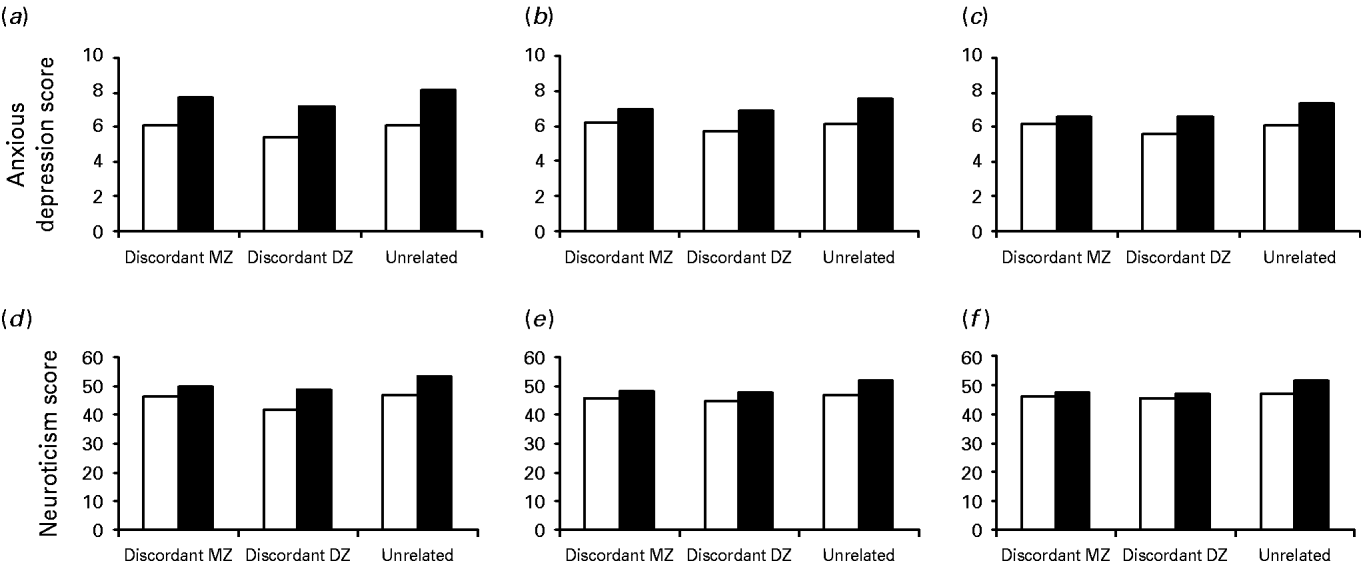
Fig. 4 shows the anxious depression and neuroticism scores for the exposed and non-exposed subjects in the three groups. The higher anxious depression scores of the exposed subjects in the group of unrelated subjects reflect the higher number of experienced life events compared with the exposed subjects in the MZ and DZ discordant twin pairs. As can be seen in Fig. 4, the differences between exposed and non-exposed subjects were sometimes larger in the discordant DZ twin pairs and in the unrelated subjects than in the discordant MZ twin pairs, but the pattern of non-exposed subjects scoring highest in the discordant MZ twin pairs, lowest in the unrelated subjects and in-between in the discordant DZ twin pairs was not seen. The regression analysis comparing the scores in the non-exposed subjects of the three groups yielded no significant effects. Results were similar for extraversion (not shown in Fig. 4). This indicated that gene–environment correlation did not play a role. The results were similar when the life events were analysed separately (not shown). Violent and sexual assault were not included in the latter analyses since less than 20 discordant DZ pairs could be identified.
Anxious depression (a, b, c) and neuroticism (d, e, f) scores in monozygotic (MZ) twins discordant for life events, dizygotic (DZ) twins discordant for life events and unrelated subjects. Scores are shown for the subjects who were never exposed to life events (□) and for the subjects who were exposed to one or more life events (■) last year (a, d), in the last 5 years (b, e) and ever (c, f).

Discussion
To our knowledge, this is the first study in which the relationship between life events and anxious depression, neuroticism and extraversion has been investigated in a prospective and genetic design. Our results from the longitudinal analyses indicate that having experienced a life event increases anxious depression and, to a lesser extent, neuroticism scores, especially for the life events serious illness or injury of self and divorce. Higher scores on anxious depression and neuroticism at T1, in turn, also increased the risk for exposure to life events at T2. This relationship was again strongest for serious illness or injury of self and divorce. Finally, extraversion was not found to be influenced by life events or vice versa. The results obtained with the co-twin control method indicated the absence of gene–environment correlation for anxious depression as well as neuroticism and extraversion. Overall, our findings suggest that the relationship between life events and anxious depression as well as neuroticism can be explained by reciprocal causation. Extraversion does not seem to be related to life events.
The results of our longitudinal analyses are largely in agreement with earlier studies. It has repeatedly been found that life events precede the onset of depression or anxiety (Faravelli & Pallanti, Reference Faravelli and Pallanti1989; Kendler et al. Reference Kendler, Hettema, Butera, Gardner and Prescott2003b; Paykel, Reference Paykel2003; Sandin et al. Reference Sandin, Chorot, Santed and Valiente2004) and the absence of an effect of life events on extraversion was also suggested by other research (Magnus et al. Reference Magnus, Diener, Fujita and Pavot1993; Vaidya et al. Reference Vaidya, Gray, Haig and Watson2002). Neuroticism was found to be influenced by life events in one study, but not in another study (Magnus et al. Reference Magnus, Diener, Fujita and Pavot1993; Vaidya et al. Reference Vaidya, Gray, Haig and Watson2002). Overall, it seems that the effect of life events on neuroticism is not as large as on anxiety or depression, but it cannot be concluded that neuroticism is entirely stable. Furthermore, several studies have shown that depression and neuroticism, in contrast to extraversion, predict the occurrence of negative life events (Fergusson & Horwood, Reference Fergusson and Horwood1987; Ormel & Wohlfarth, Reference Ormel and Wohlfarth1991; Poulton & Andrews, Reference Poulton and Andrews1992; Magnus et al. Reference Magnus, Diener, Fujita and Pavot1993; van Os et al. Reference van Os, Park and Jones2001; Hammen, Reference Hammen2003; Patton et al. Reference Patton, Coffey, Posterino, Carlin and Bowes2003).
The finding that there is no gene–environment correlation for life events and anxious depression or neuroticism is in agreement with two other studies (Farmer et al. Reference Farmer, Harris, Redman, Sadler, Mahmood and McGuffin2000; Romanov et al. Reference Romanov, Varjonen, Kaprio and Koskenvuo2003). However, a number of other studies concluded that gene–environment correlation is present for life events and depression, neuroticism or extraversion (McGuffin et al. Reference McGuffin, Katz and Bebbington1988; Kendler & Karkowski-Shuman, Reference Kendler and Karkowski-Shuman1997; Saudino et al. Reference Saudino, Pedersen, Lichtenstein, McClearn and Plomin1997; Kendler et al. Reference Kendler, Karkowski and Prescott1999, Reference Kendler, Gardner and Prescott2003a). Our results suggest that analysing depression as a dichotomous variable can lead to results indicating the presence of gene–environment correlation, while in reality a causal mechanism explains the association. As depression is partly heritable, it is highly likely that non-depressed family members of depressed subjects score, in general, more closely to the threshold of being depressed than non-depressed family members of control subjects. This effect will be strongest in MZ twins. By dividing all subjects into affected or not, this variation is not evident any more. As a consequence, gene–environment correlation is not the only explanation for the result that the difference in risk for exposure to life events is lower in MZ twins discordant for major depression than in discordant DZ twins which, in turn, is lower than between unrelated subjects. A causal relationship remains a possible explanation with subjects who are closer to the threshold of being depressed, i.e. the non-depressed MZ twins with a depressed co-twin, having a higher risk for exposure to life events than subjects who are not as close to the threshold, i.e. the non-depressed DZ twins with a depressed co-twin followed by the subjects with no depressed family member. We tried to confirm this explanation for the divergence in results by calculating odds ratios in the MZ and DZ twins discordant for life events and the unrelated subjects after dichotomizing depression by dividing subjects scoring below or above the 90th percentile in the ‘unaffected’ and ‘affected’ group. Results were similar to the results of the analysis of continuous depression scores. The fact that the other two studies that did not find evidence for gene–environment correlation also used dichotomous scores is not in favour of this explanation either. However, the only way to definitely exclude this explanation is to repeat the analysis in the three studies that did find evidence for gene–environment correlation with depression as a continuous variable.
Regarding the two earlier articles on personality and life events, the results of one of the studies could be interpreted in favour of both gene–environment correlation and causality (Kendler et al. Reference Kendler, Gardner and Prescott2003a). In this study, the relationship between the exposure to life events and the neuroticism score of the co-twin was investigated in MZ and DZ twins. It appeared that in MZ twins this relationship was stronger than in DZ twins. The question then remains whether this is due to genes influencing only neuroticism or to genes influencing both neuroticism and life events. By using the co-twin control method, our results support the former. The other study that found support for gene–environment correlation for neuroticism, extraversion and openness to experience only found this in women and analysed a sample that was much older (mean age 58.6 years) (Saudino et al. Reference Saudino, Pedersen, Lichtenstein, McClearn and Plomin1997). It is possible that the occurrence of life events later in life is influenced by other factors than earlier (Ormel et al. Reference Ormel, Oldehinkel and Brilman2001), explaining the differences in results.
The study suffers from some limitations. Life events were assessed with a questionnaire and not with an interview. Interviews may be more reliable than questionnaires (Paykel, Reference Paykel1983). However, it would have been difficult to reach such a large twin sample with interviews in a longitudinal design. We were most concerned that our results were influenced by mood congruence recall bias, i.e. when ‘some material, by virtue of its affectively valenced content, is more likely to be stored and/or recalled when one is in a particular mood’ (Blaney, Reference Blaney1986). Since life events were measured on two occasions, it was possible to test whether bias was present. First, for the subjects whose life event report was inconsistent, their depression score at the time that they reported a life event was compared with their depression score at the time that they did not report a life event. Second, anxious depression scores of subjects with consistent life event reports were compared with scores of subjects with inconsistent reports measured at the time that the last group did not report the event. Both analyses did not show any evidence for mood congruence recall bias.
Furthermore, difficulties, such as marital problems or minor somatic symptoms, were not assessed. Possibly, these difficulties precede life events and, in anticipation, lead to an increase in anxious depression. In that case, the higher anxious depression or neuroticism scores before exposure to life events do not increase the risk for these events, but are a result of the earlier problems. Several longitudinal studies on divorce suggest that depression and neuroticism are increased before marital problems occur (Karney & Bradbury, Reference Karney and Bradbury1995; Lucas, Reference Lucas2005). This needs further investigation for other life events.
The time between the occurrence of the life event and the measurement of the anxious depression, neuroticism and extraversion scores was unknown and differed between subjects. In the longitudinal analysis the time between the life event and the T2 measurement could vary between 0 and 12 months. This could explain why only small effects were found, as earlier analyses showed that major depression mostly develops 1–3 months following a life event (Kendler et al. Reference Kendler, Karkowski and Prescott1998).
Finally, this study did not exclude the possibility that other factors than genes influence both anxious depression or personality and the change of exposure to life events.
Exclusion of gene–environment correlation is an essential step before investigating gene–environment interaction (Moffitt et al. Reference Moffitt, Caspi and Rutter2005). The results of the current study imply that gene–environment correlation is not likely to explain interactions between the effect of genes and life-events in the development of depression. Future research should reveal the exact mechanisms explaining why more depressed and neurotic subjects are more prone to life events.
Acknowledgements
The study was supported by the Netherlands Organization for Scientific Research NWO/ZonMW (940-37-024, 904-61-193, 985-10-002, 575-25-006, 916-76-125).
Declaration of Interest
None.