Spanish-speaking children with primary language impairment (PLI) show consistent and robust difficulties with the production of articles and direct object pronouns when compared to typically developing (TD) children (Anderson & Souto, Reference Anderson and Souto2005; Bedore & Leonard, Reference Bedore and Leonard2001, Reference Bedore and Leonard2005; Jacobson, Reference Jacobson2012; Morgan, Restrepo, & Auza, Reference Morgan, Restrepo and Auza2012; Restrepo & Gutierrez-Clellen, Reference Restrepo and Gutierrez-Clellen2001). Therefore, articles and direct object pronouns are considered to be robust indicators of language impairment in Spanish-speaking children and potential grammatical markers of PLI in this population. However, emerging evidence suggests that these two grammatical structures are not only difficult for children with language impairment but also sensitive to changes in English language proficiency (Jacobson, Reference Jacobson2012; Morgan et al., Reference Morgan, Restrepo and Auza2012). Bilingual children exhibit systematic differences in language development in comparison with monolingual children. For example, bilingual children show both language-specific vocabulary and shared vocabulary between their both languages (e.g., Pearson, Fernandez, & Oller, Reference Pearson, Fernandez and Oller1993). In the area of morphosyntax, bilingual children show differences in the acquisition of grammatical gender (e.g., Cuza & Pérez-Tattam, Reference Cuza and Pérez-Tattam2015). These observed differences are referred to as bilingual effects (Paradis & Genesse, Reference Paradis and Genesee1996; Pirvulescu, Roberge, Thomas, Pérez-Leroux, & Strik, Reference Pirvulescu, Roberge, Thomas, Pérez-Leroux and Strik2013). Although grammatical markers of language impairment in a given language should be reliable (Rice & Wexler, Reference Rice and Wexler1996), bilingual effects might mitigate that reliability. We investigate the interaction between bilingual effects and language impairment in Spanish-speaking children with the purpose of exploring the clinical utility of articles and direct object pronouns as grammatical markers of PLI in Spanish-speaking bilingual children.
BILINGUAL EFFECTS
Bilinguals inherently exhibit more variability in linguistic development than monolinguals (e.g., Bedore & Peña, Reference Bedore and Peña2008; Paradis, Reference Paradis2007) because acquisition is driven by experience (i.e., amount and quality of language input; Hart & Riesly, Reference Hart and Risley1995; Hoff, Reference Hoff2006), mediated by maturation and individual differences in learning abilities (e.g., working memory). In monolinguals, chronological age is a reasonable indicator of experience. In bilinguals, however, the association between age and language experience is more complex because the time the child is involved in language learning is partitioned across two languages; the relative mix of these languages in a child's environment may shift over time depending on many factors, including immigration, family changes, community support, and schooling, among others (Jia, Reference Jia1998). The course of a child's linguistic development is further determined by the social and political status of languages in a child's community, the age at which the child starts learning the second language, and the quality of input of each language (Paradis, Genesse, & Crago, Reference Paradis, Genesee and Crago2011). This variability in language experience results in a continuum of bilingual proficiency (Bialystok, Reference Bialystok and Bialystok2001).Footnote 1
Different patterns for the codevelopment of a first language (L1) and second language (L2) are possible. Bilingual children can acquire their two languages simultaneously (exposure to both languages before the age of 3) or sequentially (L2 exposure begins after age 3). Sequential bilingualism represents the situation of a majority of Spanish-speaking bilingual children in the United States: children learn Spanish as L1 at home and intensive exposure to English starts when the child enters English-only schooling. Onset of schooling typically entails a dramatic shift in language exposure that impacts the development of their Spanish skills (Anderson, Reference Anderson1999, Reference Anderson2001; Montrul, Reference Montrul2008).
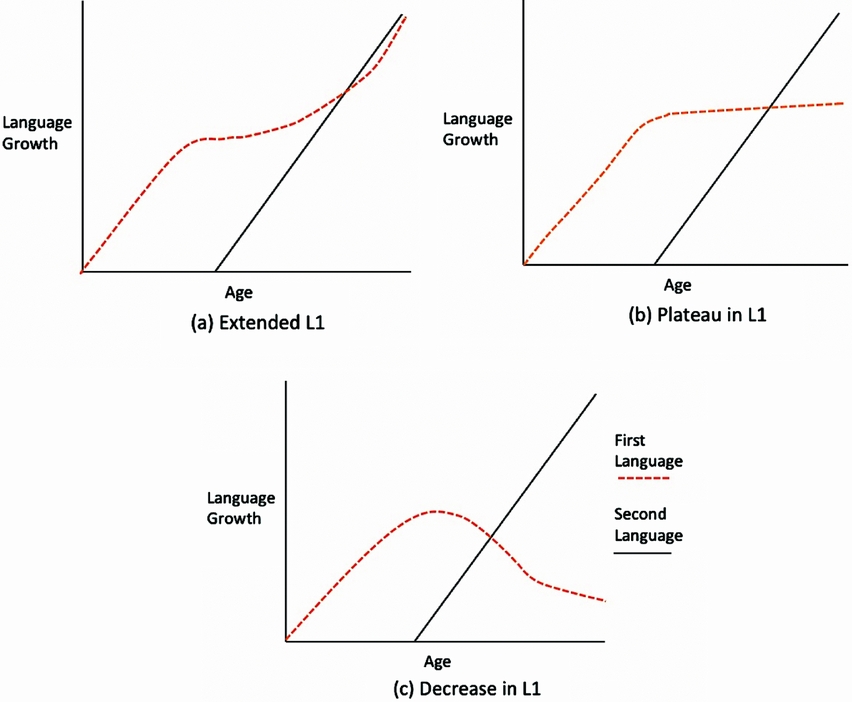
Changes seen in one of the languages of a bilingual that result from exposure to another language are known as bilingual effects (Paradis & Genesse, Reference Paradis and Genesee1996; Pirvulescu et al., Reference Pirvulescu, Roberge, Thomas, Pérez-Leroux and Strik2013). Depending on timing and intensity of experience, several patterns of bilingual effects have been described in the literature for L1 development: extended L1 development, L1 plateau, and L1 language loss (Anderson, Reference Anderson1999; Montrul, Reference Montrul2008; Restrepo et al., Reference Restrepo, Castilla, Schwanenflugel, Pritchett, Hamilton and Arboleda2010). Continued support for L1 is likely to result in an extended L1 scenario, where L1 skills continue to develop, but with the possibility of extended timetables of development (Figure 1a). In optimal conditions, where the child has continuous access to the minority L1 in the community and in education, differences in timing of acquisition are expected to be minimal, and eventual attainment of full L1 development is expected. In this scenario, balanced bilingual proficiency is attainable. This is the case for English–French bilingual children in Canada studied by Paradis and colleagues (Paradis, Crago, & Genesee, Reference Paradis, Crago and Genesee2005; Paradis, Crago, Genesee, & Rice, Reference Paradis, Crago, Genesee and Rice2003; Paradis et al., Reference Paradis, Genesee and Crago2011). Under the right circumstances (e.g., community support, availability of bilingual schools, and high language status), many children become speakers of two or more languages. Alternatively, with less support for L1, bilingual children may experience a plateau, without later recovery effect (Figure 1b; Restrepo et al., Reference Restrepo, Castilla, Schwanenflugel, Pritchett, Hamilton and Arboleda2010). This scenario often results in a shift of language dominance, in which L1 becomes the less developed language (Montrul, Reference Montrul2008). In the extreme scenario, one can observe rapid L2 acquisition (Figure 1c) and concomitant L1 attrition. In essence, in this subtractive scenario, L1 not only stops developing but also existing abilities can decline over time (Anderson, Reference Anderson1999, Reference Anderson2001). Such patterns of language attrition can result in language shift, or even full loss of productive L1 abilities (Sherkina-Lieber, Pérez-Leroux, & Johns, Reference Sherkina-Lieber, Pérez-Leroux and Johns2011). Children in a given bilingual community can reflect the whole range of potential outcomes.
Changes in language proficiency.
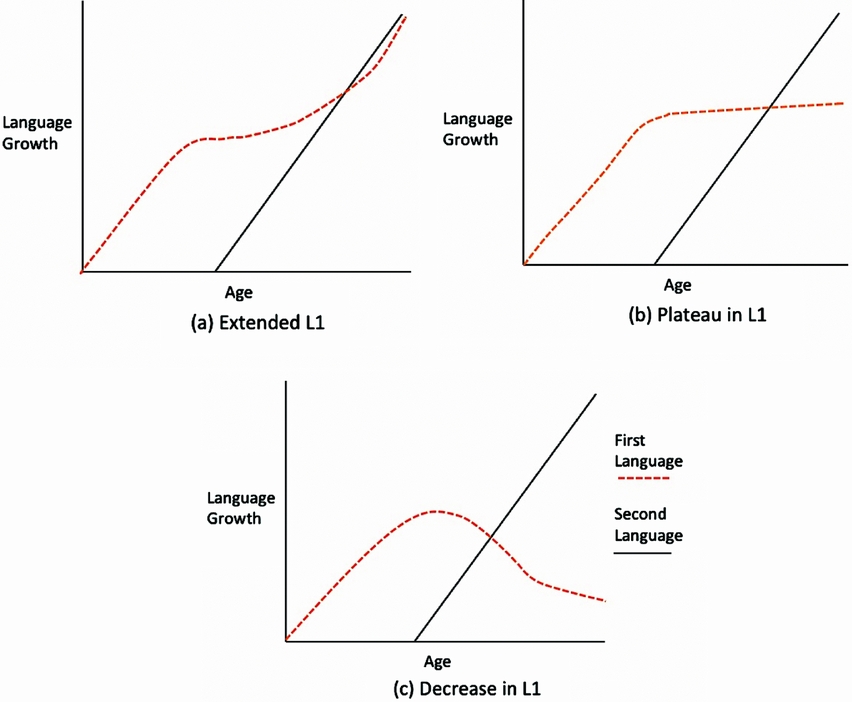
Variations in educational programming are particularly relevant to the patterns of language development illustrated in Figure 1. Children in the United States may receive varying degrees of L1 support, and this is likely to influence their use of Spanish. Even children in less advantaged socioeconomic situations have been found to maintain their use of Spanish with educational and community support (Jacobson, Reference Jacobson2012; Montrul & Potowoski, Reference Montrul and Potowski2007). Variations in the level of language support provided are often regulated by the social and economic status of L1 (Paradis et al., Reference Paradis, Genesee and Crago2011). For example, the state of Arizona has an English-only educational policy, while the state of New York mandates bilingual education for school districts with more than 20 pupils with limited English proficiency (Crawford, Reference Crawford2007; Garcia & Bartlett, 2007; CR Part 154, New York State). Such variations in support for the development of L1 can produce different patterns of bilingual effects.
Bilingual effects can differ across language domains and grammatical structures and even across dimensions of the same structure (Muller, 2003; Nicoladis & Marchak, Reference Nicoladis and Marchak2011). For example, research on bilingual acquisition reveals differences between monolinguals’ and bilinguals’ production of objects in elicited tasks.Footnote 2 In an elicited production task, Pérez-Leroux, Pirvulescu, and Roberge (Reference Pérez-Leroux, Pirvulescu and Roberge2009) found that French-speaking children produced overt objects at lower rates than monolingual when they were growing up in bilingual contexts. Similarly, Pirvulescu et al. (Reference Pirvulescu, Roberge, Thomas, Pérez-Leroux and Strik2013) found that bilingual children aged 3 and 4 produced French object pronouns at about half the rate of monolinguals. Furthermore, balanced bilinguals had higher rates of pronoun omissions than asymmetric bilinguals in their stronger language. These authors propose that object pronouns are specifically vulnerable to bilingual effects.
Bilingual effects are also evidenced in the development of article usage in bilingual children. Kupisch (Reference Kupisch2007) compared the use of articles in 3-year-old German/Italian bilingual and monolingual children using longitudinal corpora. Bilingual children produced more articles in German than German monolinguals, but were slightly delayed in Italian, when compared to Italian monolinguals. In other words, Kupisch found no systematic delay with determiner use, and possible acceleration effects for one of the languages. In elicited tasks in Spanish, monolingual preschool-aged children living in the United States (Bedore & Leonard, Reference Bedore and Leonard2001) produced omission rates around 10%–20%, which is within the range of monolingual children growing up in monolingual environments (Castilla, Reference Castilla2008). Morgan et al. (Reference Morgan, Restrepo and Auza2012) reported a slightly higher rate (23%) of article omissions for bilingual children than in Bedore and Leonard's (Reference Bedore and Leonard2001) study. However, these findings are inconclusive; discrepancies may stem from differences in the methodologies used or from the variability in participant's bilingual profiles, such as the language of instruction in their educational context, the age of the children examined, and L2 exposure. These studies suggest that, in principle, articles might also be vulnerable to bilingual effects.
GRAMMATICALITY IN SPANISH-SPEAKING CHILDREN WITH PLI
Children with PLI experience limitations in language ability that are not attributable to sensory or neurological deficits (Leonard, Reference Leonard1998). These limitations include difficulties in lexical learning, phonology, pragmatics, and particularly morphosyntax. Spanish-speaking children with PLI have been described as having difficulties with articles, direct object pronouns, plural marking, adjective agreement, and the subjunctive mood, when compared to TD children (e.g., Bedore & Leonard, Reference Bedore and Leonard2001, Reference Bedore and Leonard2005; Gutierrez-Clellen, Restrepo, & Simon-Cereijido, Reference Gutierrez-Clellen, Restrepo and Simon-Cereijido2006; Morgan et al., Reference Morgan, Restrepo and Auza2012; Torrens & Escobar, Reference Torrens, Escobar and Grinstead2009).
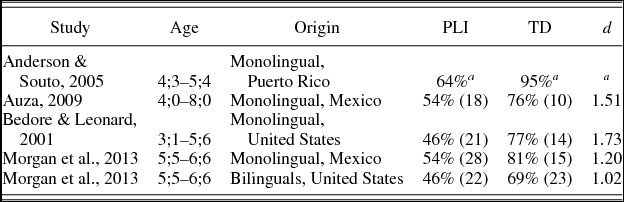
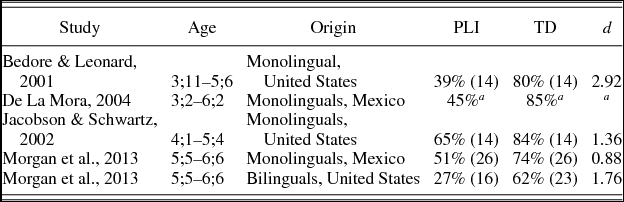
Among these grammatical structures, direct object pronouns, and articles are noteworthy because of the consistent findings in the literature of low accuracy rates in children with PLI. A summary of the results of various elicitation studies comparing the production of articles and direct object pronouns in Spanish-speaking children (TD and PLI) is presented in Tables 1 and 2. We calculated the Cohen d values (Cohen, Reference Cohen1988), a measure of effect size, using the results of the studies in Tables 1 and 2. The magnitudes of the effect sizes for article and direct object pronouns indicate large differences between TD children and children with PLI. The Cohen d values for articles ranged from 1.02 to 1.73 and for direct object pronouns from 0.88 to 2.92.
Accuracy production in elicited tasks for articles
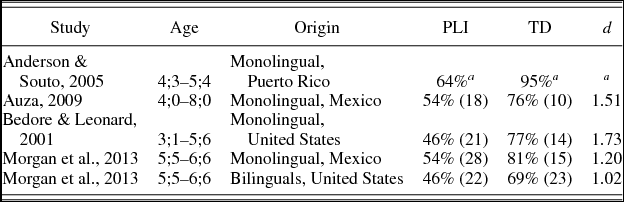
Note: Ages are in years;months. PLI, Primary language impairment; TD, typically developing children matched on age; d, Cohen effect size.
a No standard deviation provided.
Accuracy production in elicited tasks for direct object pronouns
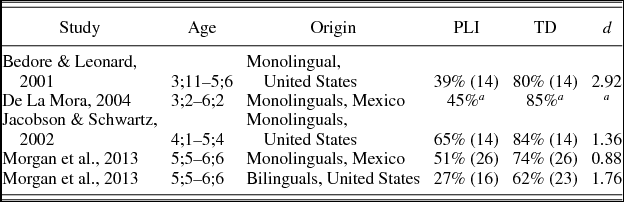
Note: Ages are in years;months. PLI, Primary language impairment; TD, typically developing children matched on age; d, Cohen effect size.
a No standard deviation provided.
Although these summarized data do not take into account variability across studies (e.g., children's age, level of English proficiency, educational background, and task variability), they do suggest that both articles and direct object pronouns are robust indicators of PLI in Spanish-speaking children given the consistent difference on performance between TD children and children with PLI. If it is found that these robust indicators can reliably identify children with language disorders, these structures could become clinical markers.
INTERACTION BETWEEN BILINGUAL EFFECTS AND LANGUAGE IMPAIRMENT
In a series of studies, Paradis et al. (Reference Paradis, Crago, Genesee and Rice2003, Reference Paradis, Crago and Genesee2005, Reference Paradis, Genesee and Crago2011) demonstrated that language impairment was not exacerbated by bilingualism. They compared a group of French–English bilingual children with PLI with two different groups of English and French monolingual children with PLI matched on age. Paradis et al. reported that the grammatical deficits seen in the bilingual children closely resembled those difficulties seen in both groups of monolingual children. Being bilingual did not worsen or facilitate grammatical development in language-impaired children: children with PLI produced more grammatical errors than did typically developing bilinguals, as expected, but bilingual children with PLI did not perform better or worse than monolingual children with PLI.
Studies with Spanish-speaking children suggest similar findings to those of Paradis et al., but with some caveats. An important observation from the research in Spanish-speaking children in the United States has been the decreased ability to detect a disorder after age 6. Using a general elicitation task encompassing various grammatical structures that included direct object pronouns and articles, Gutierrez-Clellen et al. (Reference Gutierrez-Clellen, Restrepo and Simon-Cereijido2006) found no differences in the diagnostic accuracy between monolingual and bilingual children. However, the oldest children with PLI in their study (6–7 years) were more likely to be misclassified in comparison with the younger groups. The explanation for this decrease in classification accuracy with age is unclear. One plausible speculation is that such measures only discriminate well at high levels of language proficiency; older children in their study might be experiencing decline in their Spanish abilities after the start of English-language schooling. Another possibility is that the forms employed in the study by Gutierrez-Clellen et al. are not suitable diagnostic markers for older children in general.
In another study using a general grammatical task, Peña, Gillam, Bohman, and Bedore (Reference Peña, Gillam, Bedore and Bohman2013) investigated the classification accuracy of the Bilingual English Spanish Oral Screener (Peña, Bedore, Iglesias, Gutierrez-Clellen, & Goldstein, Reference Peña, Bedore, Iglesias, Gutierrez-Clellen and Goldstein2015). Children were classified in five bilingual proficiency groups: functionally monolingual Spanish, bilingual Spanish dominant, balanced bilingual, bilingual English dominant, and functionally monolingual English. According to Peña and colleagues, bilingual children were not more likely to be classified at high risk of language impairment than were other language groups, when tested in both languages. However, bilingual children received significantly lower scores than did monolingual children in their morphosyntactic task. The results of these two studies suggest that although the level of bilingualism did not directly affect classification accuracy, there were some differences in performance on general grammatical tasks between monolingual and bilingual children.
Few studies allow a direct comparison of articles and direct object pronouns in monolingual and bilingual children with and without PLI. In the case of direct object pronouns, Morgan et al. (Reference Morgan, Restrepo and Auza2012) compared 6-year-old monolingual children in Mexico and bilingual children to same-age monolingual and bilingual children with PLI using an elicitation task. They found comparable accuracy rates between monolingual children with PLI (51%) and typically developing bilingual children (61%) with respect to direct object pronoun use. However, when a total score was obtained across different grammatical forms, there were significant differences between monolinguals and bilinguals, indicating the presence of bilingual effects in this study. Further, this study had a small sample in each group, and there was on average 10% difference in scores between monolinguals and bilinguals in each area examined.
In older children, Jacobson (Reference Jacobson2012) studied the use of elicited direct object pronouns in Spanish–English bilingual children (ages 7 and 11 years) with and without PLI. This study found accuracy rates of 71% for the younger PLI group and of 83% for the younger TD group. Older children with PLI showed an accuracy rate of 79% in comparison to 96% for the TD group (Jacobson, 2013, personal communication). Jacobson did not find statistically significant differences on direct object pronoun accuracy between younger (early grades, mean age = 7-year-olds) and older (later grades, mean age = 11-year-olds) children for either the TD or the PLI group. Neither growth nor attrition was evident for direct object pronouns in either the PLI or the TD group. This apparent plateau/maintenance scenario may be because the children in her study were enrolled in a late-exit bilingual program. Similarly, Gutierrez-Clellen et al. (Reference Gutierrez-Clellen, Restrepo and Simon-Cereijido2006) studied a large group of Spanish–English bilingual children in the United States. These researchers found no differences between Spanish-monolingual children and Spanish-dominant bilingual children in a general elicitation task testing their use of various grammatical structures. However, children ages 5 and 6 demonstrated no improvement in the accuracy of elicited direct object pronouns (PLI, 48% vs. 49%, and TD, 86% vs. 76%, for 5- and 6-year-olds, respectively). Results from these three studies suggest that direct object pronouns are vulnerable to bilingual effects; however, studies controlling the level of language proficiency will help determine the extent of which L2 language proficiency impacts performance across groups, and whether this form is consistent across proficiency levels to be a clinical marker of PLI.
Article usage is also sensitive to bilingual effects in Spanish–English bilingual children. For example, Morgan et al. (Reference Morgan, Restrepo and Auza2012) found that TD bilinguals produced articles in elicited tasks at levels that approximated those of monolingual children with PLI (monolingual children with PLI 54% and TD bilinguals 62%), a similar pattern for direct object pronouns. In addition, although they reported no significant differences for articles between their monolingual (81%; n = 18) and bilingual (69%; n = 23) TD children, we found their differences to be marginally significant (p = .053), suggesting the likelihood of bilingual effects for articles may be found with a slightly larger sample. Similarly, Gutierrez-Clellen et al. (Reference Gutierrez-Clellen, Restrepo and Simon-Cereijido2006) found that the accurate use of articles did not improve between 5- and 6-year-olds for either group (PLI, 62% vs. 63%, and TD, 89% vs. 91%, for 5- and 6-year-olds, respectively). The accuracy percentage for articles at this age for the TD group was near perfect. Based on these research findings, articles also seem to be sensitive to bilingual effects in Spanish-speaking children.
In summary, previous studies suggest that grammatical markers of language impairment in bilinguals show a heterogeneous picture. Finding which grammatical structures are stable or vulnerable to bilingual effects will improve clinical and theoretical knowledge of PLI in bilingual children. Given that bilingual children with TD and monolingual children with PLI have similar patterns in production of direct object pronouns and articles calls for an examination of the validity of these grammatical markers as indicators of language impairment within a bilingual setting. In this preliminary study, we examined the interaction between language impairment and level of English language proficiency, by testing the elicited production of articles and direct object pronouns in four groups of Spanish-speaking children differing by clinical language status (TD or PLI) and English language proficiency (asymmetric bilinguals with intermediate English proficiency [AsyB] and near-balanced Spanish–English bilinguals [BIL]).
RESEARCH QUESTIONS
-
Bilingual effects: Do Spanish-speaking children who differ in language ability status (TD vs. PLI) and their level of English proficiency (AsyB vs. BIL) differ on the use of Spanish object pronouns and articles?
-
Bilingual effects and grammatical markers: Are direct object pronouns and articles stable grammatical markers of language impairments in Spanish-speaking children with varying English language proficiency?
METHOD
Participants
The data for this study were selected from a large parent database of 1,483 children from a scale development project of a screening assessment tool for language impairment in Spanish-speaking children. All children in the parent study came from Hispanic families, were enrolled in public or charter schools in Arizona, attended English-only education, and passed a hearing screening.
Sixteen Spanish-speaking children classified as having PLI were selected from the parent database as targets for the study. An additional 16 TD children were selected as matches for the PLI children based on age, English-proficiency level, and mother's level of education. Selected participants (10 girls, 22 boys) were attending grade levels from preschool to third grade (preschool = 6, kindergarten = 18, first grade = 7, second grade = 2, and third grade = 1). Children were further classified based on their English language proficiency into AsyB), and BIL. This classification resulted in the following four groups: AsyB-TD (n = 8), AsyB-PLI (n = 8), BIL-TD (n = 8), and BIL-PLI (n = 8).
Participant selection from the parent database was constrained by various methodological factors. First, the parent database included all children within the continuum of language skills, but only approximately 11% of these children had qualifying criteria for PLI. Second, we included only PLI children who had an exact match for age, English-proficiency level, and mother's level of education. Third, to control for variation in bilingual profiles, we limited our selection to two groups of bilingual children at different ranges within the continuum of English proficiency: clearly Spanish dominant, and clearly in the balanced range. These rigorous inclusion criteria were aimed to enhance control for measurement error derived from variation in bilingual profiles, age, and mother's education level.
All children in the study passed the following criteria: (a) attended public or charter school, (b) passed a hearing screening following American Speech–Language–Hearing Association (2004) recommendations, (c) scored above 75 on the nonverbal scale of the Kaufman Assessment Battery for Children—Second Edition (Kaufman & Kaufman, Reference Kaufman and Kaufman2004) or the Wechsler Nonverbal Scale of Ability (2004), and (d) qualified as Spanish-dominant English language learners as described below.
Children were further selected based on their English language proficiency because we purposely wanted to include children at two different points in the bilingual language continuum: asymmetrical bilinguals with strong Spanish proficiency but low English language proficiency (i.e., those children characterized by the schools as English language learners) and children who were either balanced or near balanced in their English/Spanish proficiency. We relied on two tools to assign children to the English language proficiency groups: the English scores on the Spanish–English Language Proficiency Scale (SELPS; Smyk, Restrepo, Gorin, & Gray, Reference Smyk, Restrepo, Gorin and Gray2013) and a teacher report. The SELPS is a criterion reference measure validated against language sample measures and teacher's rating of language skills with moderate to high correlations. The SELPS has also shown high interrater reliability and high reliability across stories elicited by the same participant (Smyk et al., Reference Smyk, Restrepo, Gorin and Gray2013). Children were asked to retell a story in English that was rated using the SELPS for sentence complexity, grammaticality, verbal fluency, and vocabulary diversity. In addition, a similar rating was done in Spanish to verify that they were native Spanish speakers. The scores of the SELPS range from 1 to 5, with 1 being equivalent to low language proficiency and 5 to nativelike production. The raters for each language, Spanish and English, were undergraduate or graduate students who were native speakers of one or the other language and who underwent training for reliability in the scoring system. They had to obtain a reliability of 90% accuracy with the established standard.
The second inclusionary criterion for language proficiency was based on teacher report. Teachers were asked to rate each child's ability to speak English using a 5-point scale: cannot speak English at all, speaks a little English, speaks limited English with errors, speaks fluent English with errors, and speaks like a native speaker of English.
The inclusion criteria for the AsyB group were (a) a score of 2.5 or lower on the English SELP average, indicating low English proficiency; and (b) the teachers rated them to speak English with low proficiency (cannot speak English at all, speaks a little English, or speaks limited English with errors). The inclusion criteria for the BIL group were (a) a score of 3.5 or higher on English SELP average, indicating high intermediate to advanced English proficiency; and (b) the teachers rated them to speak English well (speaks fluent English with errors or speaks like a native speaker of English).
Children with PLI met the following criteria: (a) a score below 73 on the Clinical Evaluation of Language Fundamentals, Spanish—Fourth Edition (CELF-4 Spanish; Wiig, Secord, & Semel, Reference Wiig, Secord and Semel2004; we used this lower score instead of the score of 85 suggested by the CELF-4 Spanish manual because in a previous study, we identified a pattern of overidentification of language disorders in this population when using the CELF-4’s suggested cutoff score of 85; Barragan, Restrepo, Castilla-Earls, Olivares, & Gray, Reference Barragan, Restrepo, Castilla-Earls, Olivares and Gray2013); (b) parents or teachers reported they were concerned about the child's language development using either the parent Report of Speech and Language Problems or the Teacher Concern report (Restrepo, Reference Restrepo1998); and (c) no reports of neurological or hearing problems by parents.
Individual matches were selected for each of the children with PLI using the following criteria: (a) a score on the CELF-4 Spanish of 73 or higher; (b) no reports of concerns of speech and language problems by either parents or teachers; (c) no reports of neurological or hearing problems by parents; (d) exact match to a child with PLI on mother's education level; (e) match to the same child with PLI of ±4 months on chronological age; and (f) match to the same child on the average SELP scores (±1 point; in 80% of the cases this match was ±0.5 points; children were never matched in a range outside the inclusion criteria).
Spanish and English usage and exposure were measured using a parent questionnaire sent home. This questionnaire revealed that in all the households but one Spanish was the main language used up to the age of 4, when children usually started attending preschool programs. In the only household where parents did not report Spanish as the main language, the report stated that both parents used Spanish and English at home, but the score of the SELPS in English and the teacher report placed this child in the AsyB group. At age 4, most parents reported a change in children’ s language exposure from mainly Spanish to both Spanish and English, coinciding with the onset of attendance in a preschool program. It was not the case that parents explicitly reported that they changed the use of Spanish at home.
Parents reported the highest level of education of the mother as elementary (AsyB = 6/16; 38%; BIL = 4/16; 25%), high school (AsyB = 8/16; 50%; BIL = 8/16; 50%), or college (AsyB = 2/16; 12%; BIL = 4/16; 25%). The patterns of distribution in mother's education between the AsyB and BIL children were very similar. The pattern of distribution in mother's education between TD children and children with PLI was identical because of the matching methodology.
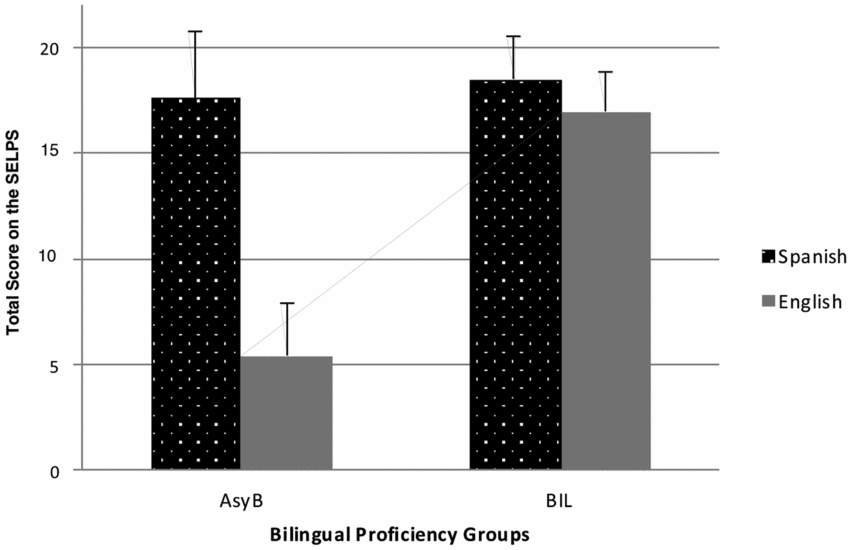
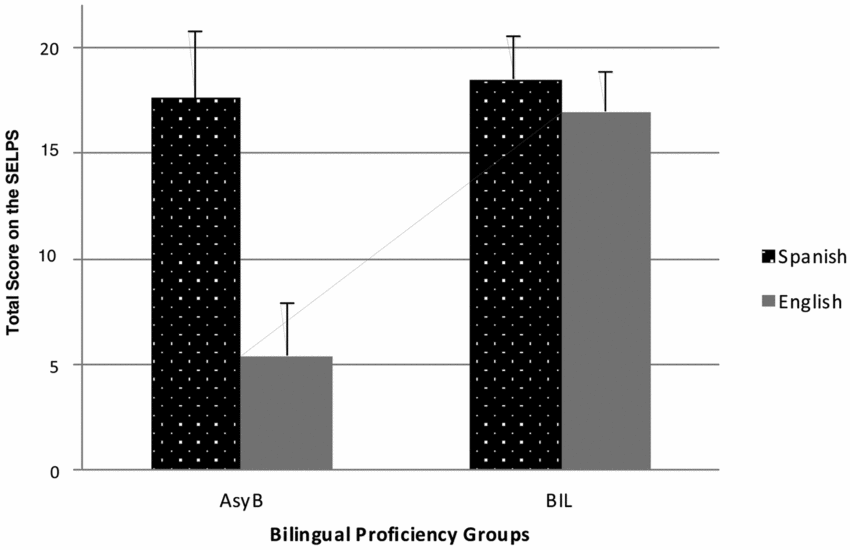
Figure 2 shows a comparison of the SELPS scores in Spanish and English. The SELPS score used here represents the added scores of sentence complexity, grammaticality, verbal fluency, and vocabulary. Nativelike proficiency in all four domains equals a combined score of 20. Both groups have comparably high Spanish SELPS scores and differed mostly in terms of their English SELPS scores, by design of the study.
Total scores on the Spanish and English Spanish–English Language Proficiency Scale.
Experimental measures
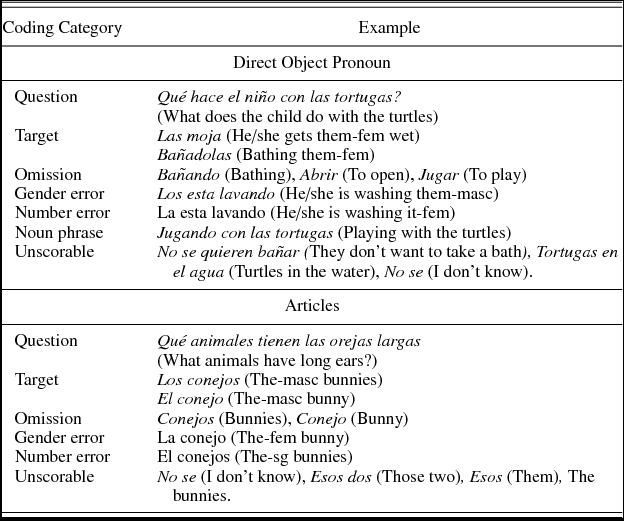
We administered an elicitation task evaluating the productive use of direct object pronouns (eight tokens) and articles (eight tokens) to all children. Both direct object pronouns and article tasks targeted singular-feminine, singular-masculine, plural-feminine, and plural-masculine pronouns and articles. Direct object pronouns were elicited using the classic question “What does X do to Y” (Schaeffer, Reference Schaeffer1997) while showing a picture. An example of one of the items in this task is ¿Qué hace el niño con las tortugas? (What does the child do with the turtles?) accompanied by a picture of a child washing turtles. The target response was the pronoun “Las” (plural feminine) with any accompanying verb in either the pronominal or the postnominal position. Other examples of questions included: ¿Qué hace el ratón con el queso?/lo jala (What does the mouse do with the cheese?/ He pulls it) and ¿Qué hace el gato con los peces?/Los agarra (What does the cat do with the fish?/ He catches them). Table 3 shows coding categories with examples. Out of 256 responses, only 2 responses contained English. In one case, the child produced a mixed response “Los licking” to answer the question ¿Qué hace el perro con los regalos? (What does the dog do with the gifts?). Because the pronoun was in agreement with the object, we accepted this response as a target response. In another case, a different child answered fully in English “Fold them” to the question qué hacen los hermanos con las sábanas (What do the brothers do with the sheets?). This response was considered unscorable. A category of unscorable responses was created to include all those responses that did not allow us to judge whether the child could use Spanish direct object pronouns or not. This category included English responses, unintelligible responses, unrelated responses, and answers in which the child did not respond or said he/she did not know the answer. The number of unintelligible responses was extremely low with only four instances.
Coding categories and examples for the elicitation task
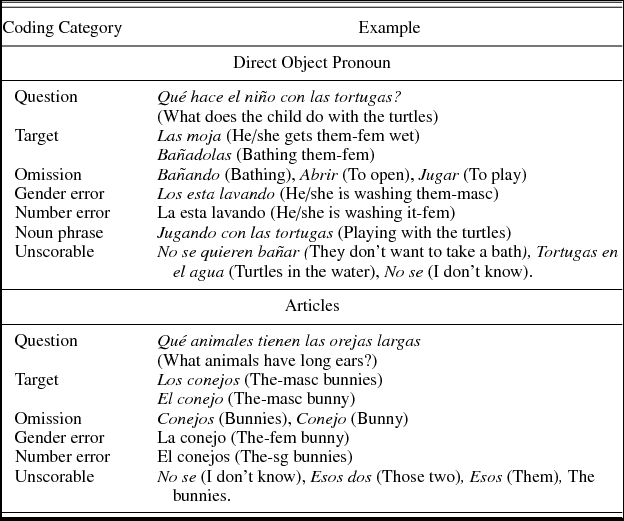
For the article task, children were asked questions that elicited a noun phrase requiring an article while showing a picture. For example, ¿Qué animales tienen las orejas largas? (What animals have long ears?) accompanied by a picture of two rabbits. This item targets a generic noun phrase, and should contain a noun preceded by an agreeing definite article, such as Los conejos (the-masc bunnies) or El conejo (the-masc bunny). A bare noun answer such as Conejos (“bunnies”) would result in ungrammatical article omission in Spanish, which like other Romance languages has limited distribution of bare nouns (Chierchia, Reference Chierchia1998; Ionin & Montrul, Reference Ionin and Montrul2010; Pérez-Leroux, Munn, Schmitt, & DeIrish, Reference Pérez-Leroux, Munn, Schmitt, DeIrish, Brugos, Micciulla and Smith2004). Other examples of prompts for articles targeted specific (definite or indefinite) are noun phrases ¿A quién le lee la gallina? A los pollitos (Who is the hen reading to?/To the chickens) and ¿Qué le quitó la niña a la muñeca? El zapato (What did the girl take from the doll?/The shoe). Table 3 shows all coding categories with examples. The number of English responses was considerably higher in this section in comparison with the direct object pronouns segment. These included code mixing responses, in which the article was in Spanish and the noun in English such as Los rabbits (the-masc rabbits; coded as target), or all English responses, such as “The rabbit” and “Bunnies” (coded as unscorable responses). Out of 256 responses, 17 were code-mixing answers with the article in Spanish and the noun in English, and 13 were English-only responses (e.g., butterflies, turkeys, and chickens). Unscorable responses include all answers that did not allow us to judge if the child could use an appropriate article. These again included English-only responses, unintelligible responses, and responses in which the child manifested he/she did not know the answer to the question or did not respond. The subtests were given in two different orders. There were two different forms for the test, and children were given a specific test randomly across many testers.
Procedures
Undergraduate and graduate students who were native Spanish speakers or spoke Spanish fluently were trained to administer the Spanish measures. Testers who spoke Spanish as an L2 had to pass an interview and written exam with the project manager (a native speaker) to ensure that the tester had high intelligibility, and nativelike proficiency in understanding/hearing, scoring, and writing responses to these measures. The trained assistants went to the children's schools, and the children were pulled out from their classrooms and tested individually in a quiet place in the school. All children and schools received small monetary incentives for participation. As part of the conditions of the larger study, testers attempted to test only one language per day. For the few children who were tested in the two languages in the same day, the measures were administered by a different tester in each language. Reliability was obtained in 32% of the sample by double scoring the task live. The interrater reliability for the total morphology measure was 90.16%.
RESULTS
Question 1: Bilingual effects
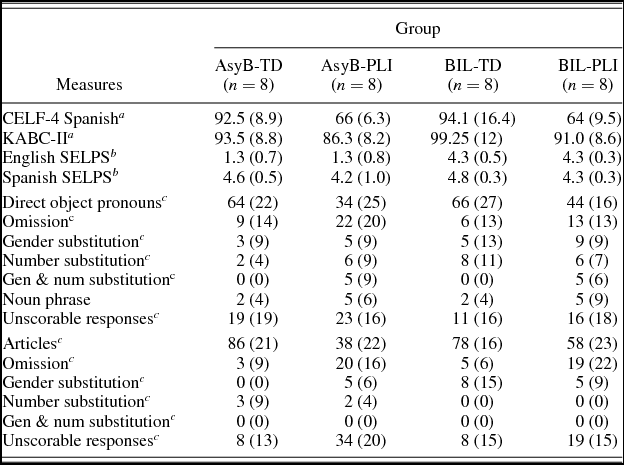
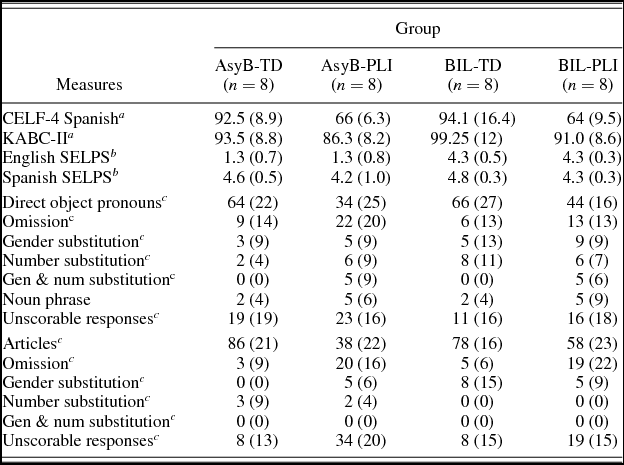
Descriptive statistics for inclusion measures and percentages of accuracy and other responses for both direct object pronouns and articles in all four groups are presented in Table 4. During our initial exploratory analysis, we identified a significant confounding factor that impacted the statistical analyses needed for this study. That is, the BIL group was on average 16 months older than the AsyB group (chronological age: AsyB M = 67 months, SD = 6 months, range = 55–73 months; BIL M = 83 months, SD = 11 months, range = 68–100 months; F = 25.451, p < .001), which is expected due to the greater experience with the language among the BIL students. Average age did not differ between PLI and TD children (TD M = 75 months, SD = 12 months, range = 55–100 months; PLI TD, M = 75 months, SD = 12 months, range = 55–99 months; F = 0.002, p = .966). While the observed differences in ages across groups confounds the direct comparison of BIL and AsyB populations, other comparisons can be made as long as proper care is taken in the modeling and interpretation of the data.
Descriptive statistics for inclusion measures, direct object pronouns (eight tokens), and articles (eight tokens)
Note: Values are means (standard deviations).
a Standard scores.
b Raw scores.
c Percentage of eight items.
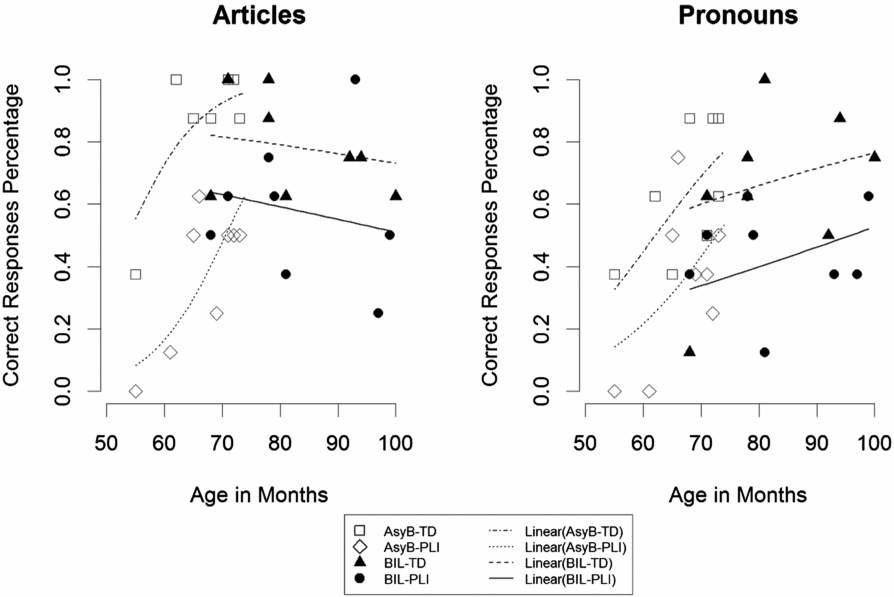
We employed a generalized linear model (GLM) with a cumulative logit link function (McCullagh & Nelder, Reference McCullagh and Nelder1989) for all of our statistical analyses. The GLM approach allowed us to model the probability of a subject providing a correct answer as a function of age as well as other factors. Specifically, the correct number of responses for the ith subject was modeled as a binomial random variable with n = 8 trials and success probability, pi . For the full model, the success probability was modeled as logit regressions and suggests that language proficiency, age, and the interaction between language proficiency and age are important factors/predictors for the production of both articles and direct object pronouns. We see differences between AsyB children and BIL children (both PLI and TD) for both articles and direct object pronouns. Therefore, we interpret these results as supportive evidence of the existence of bilingual effects for both articles and direct object pronouns in typical and language impaired Spanish-speaking children.
Error analysis
Table 4 shows the percentages of responses for the direct object pronouns and articles. For direct object pronouns, the most common responses, other than target, are omissions and unscorable responses. AsyB-TD children made very few substitutions errors (5%), in comparison with the other groups. Similarly for articles, the most prevalent responses were target, followed by unscorable responses and omissions. Gender and number errors were rare in general. In both language groups, children with PLI produced substantially more errors of omission and unscorable responses than TD children.
Question 2: Bilingual effects and grammatical markers of PLI
The second research question of this study is related to the validity of direct object pronouns and articles as grammatical markers of PLI in Spanish-speaking children with two different levels of English language proficiency. We conducted a second round of modeling to assess the differences between article and direct object pronoun correct response rates as a function of age, language impairment, and bilingual status. The difference, with respect to clinical language status, in the differences between article and direct object pronoun correct response rates was also tested. For ease of interpretation, and in consideration of the age-related differences, the data were split according to bilingual status and modeled separately. Unlike the first round of modeling, the article and direct object pronoun counts were modeled together, with the endpoint being correct response count and the model including an independent factor variable denoted as “grammatical structure.” To account for the matched nature of the data, a random effect term for subject was included in the model and the model was fit using a general linear mixed effect model.
We employed a parametric bootstrap to test the difference between article and pronoun correct response rates for AsyB subjects. The area between the predicted response curves for article and pronoun response rates as a function of chronological age was calculated and bootstrapped. Points for which predicted responses in one grammatical structure exceeded the predicted response to the other grammatical structure were used to calculate the area. A total of 10,000 bootstrap samples were assessed. A p value for the test of the null hypothesis that the article response rate does not provide, on average, for a larger difference than direct object pronouns in correct response rates between language ability language groups was estimated by the percentage of bootstrap samples with a net negative estimated area (Tables 5 and 6).
General linear model selection with correct article counts as an endpoint

Note: CA, Chronological age of children (months); LEP, bilingual proficiency; LI, language impairment; AIC, Akaike information criterion. The blank spaces are omitted model terms.
General linear model selection with correct direct object pronoun counts as an endpoint

Note: CA, Chronological age of children (months); LEP, bilingual proficiency; LI, language impairment; AIC, Akaike information criterion. The blank spaces are omitted model terms.
Table 7 provides a summary of the Akaike information criterion (AIC; Sakamoto, Ishiguro, & Kitagawa, Reference Sakamoto, Ishiguro and Kitagawa1986) general linear mixed effect model-building results for correct counts for AsyB subjects. Rows and columns are defined as in Table 5, with the exception that grammatical structure is included as a factor in place of bilingual proficiency. The AIC selected model includes chronological age, grammatical structure, language impairment, and a Grammatical Structure × Language Impairment interaction term. Note that the p value for the selected model versus the null model is highly significant (i.e., 2.08 × 10⁻⁶). This indicates that, for AsyB subjects, grammatical structure is a relevant covariate. The parametric bootstrap p value for the test of the null hypothesis that the article response rate does not, on average, provide for a larger difference (than direct object pronouns) in correct response rates between language impairment and typically developing groups was estimated to be .0176. Therefore, we conclude that the article response rate does, on average, provide for a larger difference than pronouns in correct response rates for asymmetrical bilinguals.
General linear mixed effect model selection with correct counts as an endpoint for asymmetric bilinguals only

Note: CA, Chronological age of children (months); LEP, bilingual proficiency; LI, language impairment; AIC, Akaike information criterion. The blank spaces are omitted model terms.
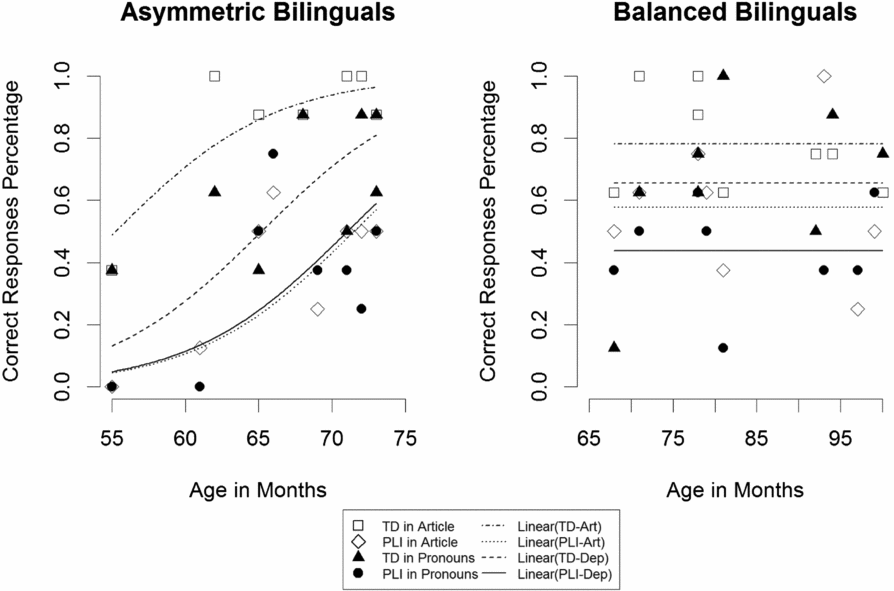
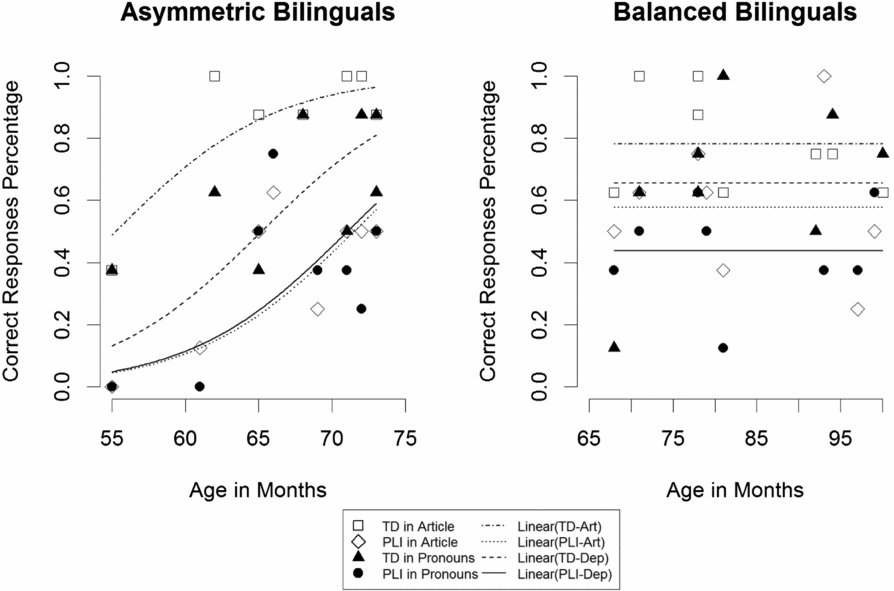
The leftmost plot in Figure 3 displays the plotted correct count data points (converted to percentages) and the AIC selected model fit curves constructed from the AIC selected model (also converted to percentages) for asymmetrical bilinguals. This figure displays the effect of age on the production of both direct object pronouns and articles for these children. The difference between the areas of the TD and PLI curves appears to be larger for articles than for direct object pronouns, and is consistent with our bootstrap finding that a statistically significant difference exists.
Scatter and regression plot for percentages of correct response as a function of age. Plotted lines correspond to the predicted values obtained from the Akaike information criterion optimal models identified in Tables 5 and 6. TD, Typically developing; PLI, primary language impairment; AsyB, asymmetric bilinguals; BIL, bilinguals.
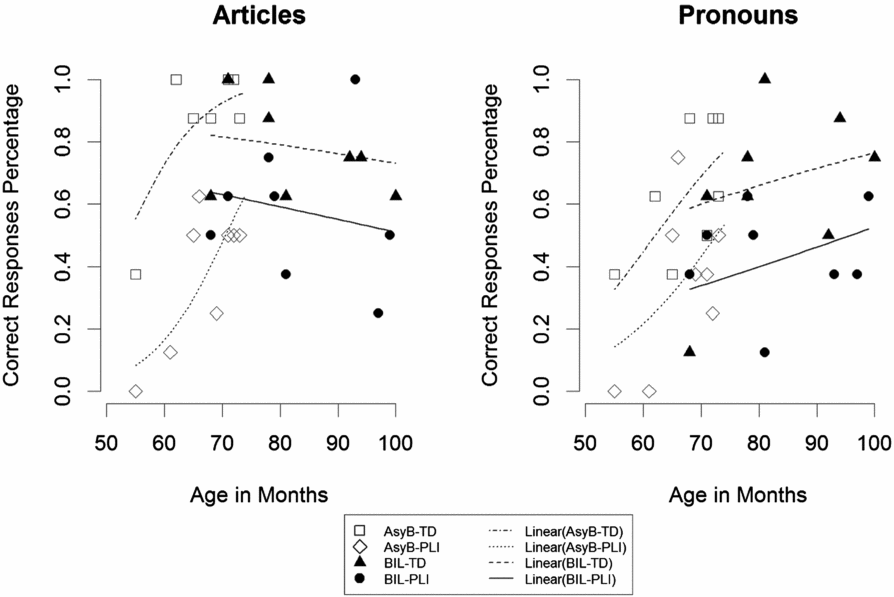
Table 8 provides a summary of the AIC general linear mixed effect model-building results for correct counts for BIL subjects. Rows and columns are defined as in Table 7. The AIC selected model includes grammatical structure and language impairment with no interaction terms. The selected model parameterizes the difference in response rates with respect to clinical language group to be the same for both grammatical structures, and has a p value of .002834 compared to the null model. Hence, we conclude that for BIL subjects, grammatical structure is a relevant covariate. Note that a parametric bootstrap test of the “difference of the differences” is not appropriate because the AIC selected parametric model indicates that there is no difference.
General linear mixed effect model selection with correct counts as an endpoint for balanced bilinguals only

Note: CA, Chronological age of children (months); LEP, bilingual proficiency; LI, language impairment; AIC, Akaike information criterion. The blank spaces are omitted model terms.
The rightmost plot in Figure 4 displays the plotted correct count data points (converted to percentages), and the AIC selected model fit curves constructed from the AIC selected model (converted to percentages) for the BILs. In this figure, there is no effect of chronological age. The difference between the TD and PLI groups in their accuracy of direct object pronouns is evident, but the area between the TD and PLI curves for both articles and direct object pronouns appears to be considerably smaller than the differences found in asymmetrical bilinguals.
Scatter and regression plot for correct response rates as a function of age by bilingual proficiency group. Plotted lines correspond to the predicted values obtained from the Akaike information criterion optimal models identified in Tables 7 and 8. TD, Typically developing; PLI, primary language impairment.
DISCUSSION
Bilingual effects
The first aim of this study was to examine how variation in language proficiency in Spanish–English bilingual children impacts the productive use of direct object pronouns and articles. For that purpose, we tested four groups (n = 8) of Spanish-speaking children that differed in their English-proficiency (AsyB vs. BIL) and language ability status (TD vs. PLI). Our results suggest that there are differences between language ability groups: we found that language ability status (TD vs. PLI) significantly predicted direct object pronouns and articles production accuracy in both English proficiency groups. These results are consistent with those of Anderson and Souto (Reference Anderson and Souto2005), Auza (Reference Auza2009), Bedore and Leonard (Reference Bedore and Leonard2001), and Morgan et al. (Reference Morgan, Restrepo and Auza2012), who found higher rates of accuracy for TD than for children with PLI.
The second aim of the study examined whether language proficiency impacts performance across language ability groups in article and object pronoun production accuracy. Our results suggest that there are group differences in the patterns of development of direct object pronouns and articles between AsyB and BIL children. Language proficiency group was a significant factor in the prediction of accuracy responses for both direct object pronouns and articles. Furthermore, we found both an effect of age and a significant interaction of age and language proficiency for accurate use of both grammatical structures. However, this interaction was pertinent to the AsyB group only. The BIL group showed a plateau on scores by age in the production of both direct object pronouns and articles. These results are important to the goals of the current study in two ways. First, that language proficiency was a factor in the GLM analysis suggests that language proficiency impacted the performance of both TD children and children with PLI. Second, as children became more balanced bilinguals, their accuracy of direct object pronouns and articles plateaued. As shown in previous literature, these grammatical structures should continue to develop during childhood: monolingual children reach accuracy rates of approximately 85% by age 5 for both direct object pronouns and articles in a very similar type of elicitation task, and adults are 100% accurate (Castilla, Reference Castilla2008; Castilla & Perez-Leroux, Reference Castilla and Pérez-Leroux2010).
The results of this study differ from those in Jacobson (Reference Jacobson2012) in that we found an effect of proficiency on the accuracy of direct object pronoun usage. Jacobson's study (Reference Jacobson2012) observed a pattern of high accuracy and small change between younger and older children. However, there are significant differences between these two studies. First, children in Jacobson's study were older than the children in our study. Second, they were enrolled in a late-exit bilingual program and possibly were less affected by attrition. In our study, language skills were still developing, and children were enrolled in English-only programs since Kindergarten and possibly preschool. This might have impacted both the low direct object pronoun accuracy and the observed plateau effects for the BIL children.
Our findings of bilingual effects for direct object pronouns are congruent with Pirvulescu et al. (Reference Pirvulescu, Roberge, Thomas, Pérez-Leroux and Strik2013), who found that the degree of bilingualism in French–English bilingual children affected the accuracy of production of direct object pronouns. In terms of type of errors, the pattern of errors found in this study is consistent with previous findings of higher percentages of unscorable responses and omissions for children with PLI than for TD children of a similar age (Bedore & Leonard, Reference Bedore and Leonard2001).
Both age and interaction of age and language proficiency were significant factors in this preliminary study. In the context of English-only education, the more proficient the child is in English, the more protracted the development in Spanish skills are because of limited L1 support. With age and increased L2 exposure, changes in language dominance tend to occur (Kohnert, Reference Kohnert2010). In some instances, dominance switches completely from L1 to L2. Although we did not follow the English language skills of these children, it is likely that these children were experiencing greater language gains in their L2.
Another important fact to consider in the interpretation of the results of this study is that these children were attending English-only schools in Arizona, a state known for its English-only policies in the schools (e.g., Crawford, Reference Crawford2007). It is possible that the low support for L1 at the school level explains the bilingual effects seen in this study. These results, therefore, cannot be generalized to all bilingual children across the United States. Bilingual children can maintain and continue to develop their L1 skills with community and school support (Jacobson, Reference Jacobson2012; Montrul & Potowski, Reference Montrul and Potowski2007).
Bilingual effects and grammatical markers of PLI
To explore the validity of direct object pronouns and articles as grammatical markers of PLI in Spanish-speaking children, we conducted separate analysis for AsyB and BIL children. The results of this study suggest differences for these two English proficiency groups. For AsyB children, we found significant effects for their grammatical accuracy that were mediated by language impairment, language proficiency, age, and the interaction between age and language proficiency. AsyB-TD children showed higher rates of accuracy for both direct object pronouns and articles than did children with AsyB-PLI. Furthermore, the magnitude of the difference between AsyB-TD and AsyB-PLI was found to be considerably larger for articles than for direct object pronouns. Therefore, for Spanish-dominant bilingual children, articles might be a more stable grammatical marker than direct object pronouns. The results for the BIL children suggest significant effects for language ability status and grammatical structure. However, no differences were found between direct object pronouns and articles for this language proficiency group. Although both of these grammatical structures show differences between TD and PLI children, the magnitude of these differences is smaller for BILs in comparison to AsyB. Stability and efficiency of grammatical markers in finding group differences between TD and PLI should be a component in the development of an assessment.
The article advantage is not easily predicted by most general developmental features of articles in comparison to direct object pronouns: both emerge very early in monolingual acquisition and show similar patterns of growth, as argued by Pérez-Leroux, Castilla-Earls, and Brunner (Reference Pérez-Leroux, Castilla-Earls and Bruner2012). Rates of growth in their study are similar for articles and direct object pronouns (if anything, direct objects have a slight advantage in monolingual children in their data). These authors further point out that there are no obvious independent differences in prosodic and semantic behavior between these categories.
Our results suggest that direct object production is affected by bilingualism, confirming well-established findings in other Romance languages. Why are articles less affected? It is conceivable that any bilingual delay in grammar is linked to the vocabulary differences generally seen in bilingual children (e.g., Pearson et al., Reference Pearson, Fernandez and Oller1993). If the effect of lexical development in direct object acquisition is more important/substantive than in other domains of grammar, as proposed by Pérez-Leroux et al. (Reference Pérez-Leroux, Castilla-Earls and Bruner2012), then direct object pronouns would be more negatively affected by bilingualism. This depressed bilingual performance limits their usefulness in a clinical setting.
As previously discussed, these BIL children were enrolled in English-only education, and in a context of low support for L1. This contrast in the differences between direct object pronouns and articles between the two language proficiency groups can be interpreted as an effect of variations in the L1 linguistic profiles. Articles appear to be a more stable grammatical marker of language impairment in AsyB children than are direct object pronouns. As children increase their language proficiency in English (become more balanced bilingual), the size of the differences between TD and PLI seems to decrease.
At this point, unable to conduct discriminant analyses, we cannot ascertain whether articles and/or direct objects pronouns are grammatical markers of PLI in Spanish–English bilingual children. The difference between the TD and PLI groups was small, and the variability on performance was high, for both grammatical markers. However, our results do suggest a potential asymmetry. Because clitics are developing much slower in these bilingual children, the magnitude of the difference size decreases. Given general variability in bilinguals, a reduction in magnitude of difference is likely to impact the clinical usefulness of a marker. Articles appear less vulnerable to bilingual fluctuations and, therefore, may perform better in a clinical context. Other grammatical structures, such as the subjunctive, verb, adjective–noun agreement, and plurals, should also be explored as potential markers of PLI in bilingual contexts.
The current results are not in line with those of Gutierrez-Clellen et al. (Reference Gutierrez-Clellen, Restrepo and Simon-Cereijido2006), who found no differences in classification accuracy between Spanish-only speaking children living in the United States and a group of bilingual children using a general elicitation task in Spanish. However, Gutierrez-Clellen et al. reported that their classification accuracy decreased significantly for their 6-year-old group. Perhaps older children had experienced some loss in Spanish ability in comparison to their younger counterparts, which is a common scenario in many US communities with English-only schooling practices. In contrast with Gutierrez-Clellen et al.’s (Reference Gutierrez-Clellen, Restrepo and Simon-Cereijido2006) elicitation task, we included specific grammatical markers in our study. It is possible that the differences in performance can only be detected at the level of individual grammatical markers. Further, the strict matching methodology used in this study may explain the surface difference between our study and theirs.
We see two potential clinical implications. First, in English-only environments, BIL children demonstrate a plateau on the production of direct object pronouns and articles affecting both children with TD and those with PLI. Second, this study points to the possibility that grammatical markers of language impairment are not stable across the continuum of bilingual language proficiency. Clinicians should be aware of the changing profiles of language proficiency in bilingual children and interpret the results of grammatical tests with caution.
Limitations and directions for further research
This study suggests that bilingual effects might play an important role in our ability to diagnose language impairment in bilingual children. However, this study is limited in that it only represents two groups of language proficiency. Future studies should include the full range of the continuum of language proficiency. In addition, further research should explore other grammatical structures that might be less vulnerable to bilingual effects and increase the number of tokens per grammatical structure. Although this study found a relationship among age, language proficiency, and grammatical accuracy for direct object pronouns and articles, the cross-sectional nature of the data does not permit us to establish a direct line of development. Further longitudinal data can strengthen the results of this study by suggesting developmental trends for bilingual children. Additional research is also needed to replicate and expand the observations established in this investigation.
ACKNOWLEDGMENTS
The research reported in this publication was supported by the National Institute on Deafness and Other Communication Disorders of the National Institutes of Health under Award R15DC013670 (to A.C.-E.). This research was also supported by IES NCSER Award R324A080024 (to M.A.R., S.G., and J.G.). The content is solely the responsibility of the authors and does not necessarily represent the official views of the National Institutes of Health.