Introduction
In recent years, there has been growing public and media concern regarding hospital-acquired infection, including those due to methicillin-resistant Staphylococcus aureus and Clostridium difficile, and also regarding perceived hygiene standards within the National Health Service (NHS). As a result of a new Department of Health (DoH) policy, most NHS hospital trusts have introduced a ‘bare below the elbow’ dress code, which requires healthcare staff to ensure that all shirts or blouses are short-sleeved and that watches and jewellery, excluding a plain wedding band are removed from the forearms and hands.1 In addition, male doctors have been encouraged to abandon the traditional necktie in favour of open collar shirts.
The evidence base for this policy was outlined in the DoH 2007 publication Uniforms and Workwear: an Evidence Base for Local Guidelines.2 This policy document examined a range of issues pertaining to work attire, including evidence for clothes as a vector for infection, the effect of appearance on the public perception of NHS staff, and effective laundry techniques for uniforms and hospital attire. Whilst this report recommended a ‘bare below the elbow’ policy, it also stated that ‘there is no conclusive evidence that uniforms (or other work clothes) pose a significant hazard in terms of spreading infection’. A number of authors have commented on the self-conflicting content of this report, and the rationale for the ‘bare below the elbow’ policy has been openly questioned.3–Reference Magos, Maclean, Baker, Goddard and Ogunbiyi6 The report also recommended that NHS staff ‘dress in a manner which is likely to inspire public confidence. People may use general appearance as a proxy measure of competence’.
Whilst the messages that have been taken from the DoH report may be confusing, there is little doubt that the way healthcare staff dress has a significant effect on the public's perception of doctors.Reference Nihalani, Kunwar, Staller and Lamberti7–Reference McKinstry and Wang18 The way in which doctors choose to present themselves will hopefully achieve a number of aims. It will identify the person as a doctor, a profession traditionally indicated by the white coat and stethoscope. It will also convey an air of competence and professionalism, and instill confidence in the attending physician.
The aim of this study was to assess the public perception of doctors' clothing, focusing specifically on the ‘bare below the elbow’ policy.
Materials and methods
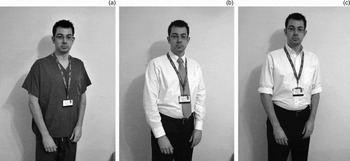
A patient survey was undertaken in a regional teaching hospital. A questionnaire was distributed to 160 consecutive patients: 80 out-patients attending routine out-patient appointments in the ENT department, and 80 in-patients attending the day-case surgery and short stay surgical units. The questionnaire showed colour photographs of a male junior doctor dressed in three different types of work attire (see Figure 1). A male doctor was chosen as it was felt easier to define a typical male doctor's outfit fulfilling ‘bare below the elbow’ criteria, compared with a female doctor's outfit. Outfit A (Figure 1a) showed the doctor in theatre ‘scrubs’, outfit B (Figure 1b) showed traditional formal attire of dark trousers, long-sleeved shirt and necktie, and outfit C (Figure 1c) showed the doctor ‘bare below the elbow’ with shirt sleeves neatly rolled up, necktie removed and collar open. Patients were asked to indicate which outfit they felt best fulfilled the following criteria: (1) most professional; (2) best for infection control and hygiene; (3) easiest identification that the person was a doctor; and (4) overall preference.
Photographs of dress codes included in questionnaire. (a) Outfit A: clean surgical ‘scrubs’. (b) Outfit B: traditional formal attire, with long-sleeved shirt and necktie. (c) Outfit C: ‘bare below the elbow’.

A different choice of outfit was allowed for each of the above, but patients were asked to only choose one outfit for each category. Patients were invited to indicate their gender and age. Assistance in recording answers was offered to all children (if parents were unable to help, although their permission was sought) and to adults unable to complete the survey themselves.
Data were analysed using the Statistical Package for the Social Sciences version 11.1 software package (SPSS Inc, Chicago, Illinois, USA). Ninety-five per cent confidence intervals were calculated for all values, and a difference was considered significant if these intervals did not overlap. Parametric and non-parametric tests of significance could not be applied to the survey results.
Results and analysis
A total of 160 surveys were completed, by 80 in-patients and 80 out-patients. No patients declined to complete the questionnaire. Eighteen respondents did not state their age and four did not state their gender, but all other answers were complete.
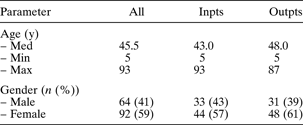
The respondents' demographic data are summarised in Table I. Ninety-five per cent confidence intervals were calculated for all results. Subgroup analysis of in-patient and out-patient groups was undertaken, as these represented different patient cohorts, hospital work areas and situational roles for healthcare professionals. Subgroup analysis of dress code preference by gender and age was also undertaken.
Patients' demographic data
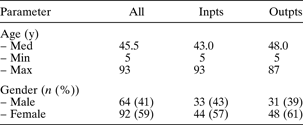
All = all respondents; inpts = in-patients; outpts = out-patients; y = years; med = median; min = minimum; max = maximum
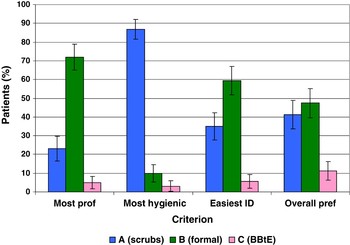
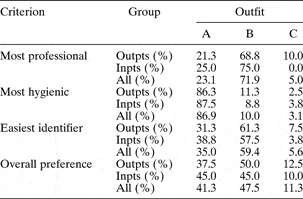
The overall results of the survey are summarised in Table II and Figure 2. In all categories, patients favoured either scrubs (outfit A) or formal attire (outfit B) rather that the ‘bare below the elbow’ outfit (outfit C). Formal attire was considered the most professional and the easiest identification that the person was a doctor. Scrubs were considered the most hygienic. Respondents' overall preference was divided between scrubs and formal attire. The ‘bare below the elbow’ outfit received the lowest votes in all categories.
Patients' dress code preferences. Error bars display 95% confidence intervals. BBtE = bare below the elbow; prof = professional; ID = identifier of person as a doctor; pref = preference

Patients' outfit preferences: summary

Outfit A = ‘scrubs’; outfit B = formal attire; outfit C = ‘bare below the elbow’. Outpts = out-patients; inpts = in-patients; all = all respondents; easiest identifier = easiest identifier of person as a doctor
Subgroup analysis
The in-patient and out-patient subgroups showed the same pattern of preferences.
Likewise, there was no difference in preferences between male and female responders.
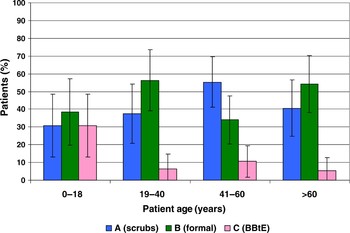
A subgroup analysis was undertaken based on age, dividing respondents into four groups: 0 to 18 years, 19 to 40 years, 41 to 60 years and over 61 years. There was no significant difference in preferences between patients in these various age groups, considering the categories of professionalism, hygiene or ease in identifying the person as a doctor. However, there was a significant difference between age groups regarding overall preference (Figure 3). Whilst younger patients (18 years and under) showed no strong overall preference, older patients (i.e. 19 to 40, 41 to 60 and over 61 years) all showed a clear preference for either scrubs or formal attire. As 95 per cent confidence intervals overlap for these groups, it is not possible to state a clear favourite. The ‘bare below the elbow’ outfit received significantly fewer votes in these three older age groups, compared with patients younger than 18 years.
Patients' dress code preferences by patient age group. Error bars display 95% confidence intervals. BBtE = bare below the elbow

Discussion
This study highlights patients' perception of doctors' dress, and gives a clear indication of our respondents' preferred choice. When asked to choose between scrubs, traditional formal attire and a ‘bare below the elbow’ outfit, patients expressed an overall preference for either scrubs or traditional attire. Scrubs were considered the most hygienic, whilst traditional attire best allowed easy identification of the person as a doctor and was considered most professional. The ‘bare below the elbow’ outfit was considered least satisfactory in all categories. This raises significant questions about the current Department of Health (DoH) policy.
The DoH Uniform and Workwear documents states that:
…the way staff dress will send messages to the patients they care for, and to the public. It is sensible for Trusts to consider what messages they are trying to convey, and to advise on dress codes accordingly. Both infection control and public confidence should underpin a Trust's uniform policy, but the two are not necessarily interchangeable.2
In the absence of clear evidence linking healthcare workers' attire to the transmission of hospital-acquired infections, the purpose of the ‘bare below the elbow’ policy is to inspire public confidence in NHS healthcare workers. However, whilst the intentions of this policy may be laudable, the current study findings suggest that enforcing a ‘bare below the elbow’ dress code may result in failure to achieve those intentions.
• Recently, there has been growing public and media concern regarding hospital-acquired infection, including that due to methicillin-resistant Staphylococcus aureus and Clostridium difficile, and also regarding perceived hygiene standards within the UK National Health Service (NHS)
• As a result of Department of Health policy, most NHS hospital trusts have introduced a ‘bare below the elbow’ dress code for doctors
• This study assessed patients' perceptions of doctors' appearance, especially regarding the ‘bare below the elbow’ policy
• Patients considered formal attire to be the most professional dress code, and the easiest way to identify a person as a doctor; surgical ‘scrubs’ were considered the most hygienic, and overall preference was divided between scrubs and formal attire
We suggest that an alternative policy be considered, with scrubs worn in clinical situations and formal attire being allowed during non-clinical encounters. This compromise would facilitate hand-washing in clinical situations and maximal patient perception of hygiene, whilst ensuring a professional presentation at other times, thus addressing both infection control and public confidence in one policy.
Conclusion
Patient safety must, of course, be paramount, but if it is possible to do this in a way that allows us to maintain an appearance that patients value, we hope it could be considered.
Acknowledgements
We thank Dr Robert Douglas, Mr Stuart Gillett, Mr Owain Hughes, Dr Hugh Jewsbury, Dr Christopher Pocock and Dr Jessica Ussher for their help with questionnaire construction and data collection.
We also thank the staff of the Day Surgery Unit, Bath Treatment Centre, and the ENT Outpatient Department, Royal United Hospital, Bath.