Introduction
Although research has identified several cognitive risk factors that predispose individuals for major depressive disorder (MDD), little is known about the mechanisms through which such risk factors translate into maintaining mechanisms that contribute to the persistence of the disorder. Initial onsets often occur in response to major life events, yet as episodes recur, symptoms are increasingly maintained through mechanisms that require little or no external input (Segal et al. Reference Segal, Williams, Teasdale and Gemar1996). Psychological models suggest that such trajectories are characterized by trait–state interactions in which trait vulnerabilities lead to maladaptive responses to current challenges that cause further entrenchment of these vulnerabilities and establish a self-perpetuating regulative system that keeps the disorder in place (Beck, Reference Beck1987; Abramson et al. Reference Abramson, Metalsky and Alloy1989; Barnard & Teasdale, Reference Barnard and Teasdale1991).
There is considerable evidence that maladaptive interpersonal behaviours play an important role in these processes (Coyne, Reference Coyne1976; Hammen, Reference Hammen1992, Reference Hammen2006). Research on interpersonal stress generation suggests that depressed patients often show interpersonal behaviours that are likely to provoke problematic responses which lead to further sensitization for interpersonal stressors, thus contributing to the maintenance of the disorder (Hammen, Reference Hammen2005). From early on, cognitive approaches have emphasized the importance of biases in judgment in this context. For example, the hopelessness theory of depression (Abramson et al. Reference Abramson, Metalsky and Alloy1989) has highlighted how a tendency to attribute negative events to global and stable causes increases risk for depression, and large studies have demonstrated the relevance of a negative attributional style for both initial onsets and recurrences of depression (Alloy et al. Reference Alloy, Abramson, Whitehouse, Hogan, Tashman, Steinberg, Rose and Donovan1999, Reference Alloy, Abramson, Whitehouse, Hogan, Panzarella and Rose2006). However, less is known about the specific psychological factors that may bias patients' interpersonal judgments.
Interpersonal stress is likely to arise when people misinterpret others' behaviours, and let themselves be guided by general judgments of other people without sufficiently taking into account information that arises from the actual situation. Judgments are often made quickly and automatically (Bargh & Chartrand, Reference Bargh and Chartrand1999). Research on person perception suggests that interpersonal behaviour is significantly guided by unconscious appraisals of other people, called spontaneous trait inferences (STIs; Uleman, Reference Uleman, Chaiken and Trope1999; Uleman et al. Reference Uleman, Saribay and Gonzalez2008). STIs are automatic ‘snap judgments that spring to mind unbidden, (which can) introduce biases that can go unnoticed and uncorrected’ (Uleman et al. Reference Uleman, Hon, Roman and Moskowitz1996, p. 377). For example, if someone was described as having called their partner several times at a particular occasion, others might infer that this person is ‘needy’. Such inferences seem to have important consequences for interactions with other people. For example, stronger tendencies to infer aggressive traits in others have been found to predict increased interpersonal difficulties in a healthy population (Wilkowski & Robinson, Reference Wilkowski and Robinson2010).
The propensity to make STIs is influenced by psychological distance, i.e. the level of abstraction (‘construal’) at which people mentally represent their experiences. Construal level theory (Trope & Liberman, Reference Trope and Liberman2010) posits that high psychological distance is reflected in abstract, decontextualized, schematic and structured, high level construals whereas low psychological distance is reflected in low level construals that are more concrete, contextualized and incidental. Levels of construal differ according to individuals' preferences and contexts, and research has demonstrated that induction of high levels of construal significantly increases tendencies to make STIs in healthy individuals (Rim et al. Reference Rim, Uleman and Trope2009). This is an interesting finding with regard to interpersonal functioning in depression because overgeneral thinking – indicative of a high level of construal – is one of the cognitive hallmarks of depression (Williams et al. Reference Williams, Barnhofer, Crane, Hermans, Raes, Watkins and Dalgleish2007). By analogy, depressed patients may be particularly prone to making STIs, and STIs may potentially contribute to an increased generation of interpersonal stress in depression.
To provide a first test of these assumptions, we used a novel version of a false recognition task established as one of the standard paradigms for measuring STIs (Todorov & Uleman, Reference Todorov and Uleman2002, Reference Todorov and Uleman2003) and assessed interpersonal daily hassles as an indicator of interpersonal stress over a one-week follow-up period. In the false recognition task, participants encoded faces of individuals and behavioural descriptions that were suggestive of, but did not explicitly feature, personality traits. In the subsequent recognition phase, participants were asked to indicate whether presented faces had been explicitly described using respectively featured traits. STIs become evident in erroneously ascribed traits to faces of individuals upon prior encoding of suggestive but ambiguous behavioural descriptions.
We hypothesized that (1) depressed patients would show higher levels of STIs than a matched group of healthy controls. We also explored associations of STIs with daily hassles following the hypothesis that (2) STIs would correlate positively with interpersonal daily hassles over the one-week follow-up period.
To gather further information about the validity of STIs as a marker of interpersonal functioning in depression, we explored their association with the severity of depression and indices of childhood trauma. Interpersonal stress generation is likely to be higher in patients with more severe levels of depressive symptoms, and we therefore expected that (3) levels of symptoms would be positively related to the extent to which participants tend to make STIs.
Although we hypothesized increased STIs to be a general characteristic of depression, there is evidence that interpersonal difficulties are particularly pronounced in patients with childhood trauma (Harkness et al. Reference Harkness, Lumley and Truss2008; Liu et al. Reference Liu, Choi, Boland, Mastin and Alloy2013). Previous research has linked childhood adversity and trauma to a range of deficits in social information processing (Ford, Reference Ford2005; Chen et al. Reference Chen, Coccaro, Lee and Jacobson2012), and we therefore expected that, regardless of current levels of depression, (4) tendencies to make STIs would be higher in those patients with more severe levels of trauma.
Method
Participants
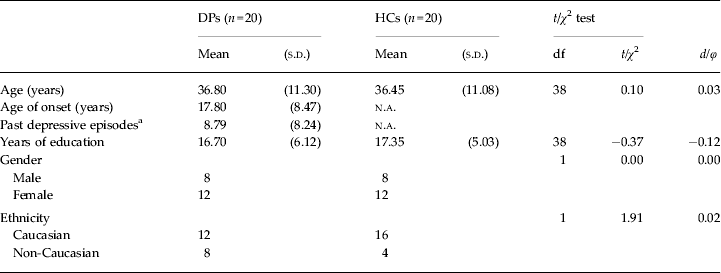
Twenty depressed patients (60% of whom were female) and 20 age- and gender-matched healthy controls participated in the study. Depressed participants were recruited through local Improving Access to Psychological Therapies (IAPT) services. Control participants were recruited through a volunteer database at the Institute of Psychiatry. Depressed patients met ICD-10 criteria for MDD. Inclusion criteria were (1) a current diagnosis of MDD, (2) self-reported severity of current symptoms on a clinical level as indicated by Beck Depression Inventory-II (BDI-II; Beck et al. Reference Beck, Steer and Brown1996) scores above 19, (3) age 25 to 65 years, (4) fluency in spoken and written English and (5) not more than two sessions of current psychological treatment (while previous courses of treatment were recorded). Exclusion criteria comprised (1) self-reported lifetime history of psychosis or rapid-cycling bipolar disorder and (2) current psychosis or rapid-cycling bipolar disorder, eating disorder, obsessive–compulsive disorder, self-harm or substance use disorder/dependence. Patients who were taking antidepressants were allowed into the study provided that the medication had not been changed in the past four weeks before the study commenced. Current medication was recorded. Healthy controls (1) were not currently seeking and/or receiving any form of psychological treatment for a mental health problem and (2) did not meet diagnostic criteria for MDD. The study was approved by the London City and East Research Ethics Committee. All participants provided written informed consent and were reimbursed for their time and travel expenses. The two groups were comparable in terms of age, years of education, gender and ethnicity. Table 1 presents an overview of the sample characteristics.
Sample characteristics of depressed patients (DPs) and healthy controls (HCs)

s.d., standard deviation; df, degrees of freedom; n.a., not applicable; d, Cohen's d; φ, Cramér's φ.
Age of onset and number of past depressive episodes were determined through a brief clinical interview at the beginning of the research session.
a Based on 14 depressed patients because six patients reported ‘too many past episodes to remember’.
Questionnaire measures
Major Depression Inventory
Diagnostic status of MDD was ascertained using the Major Depression Inventory (MDI; Bech et al. Reference Bech, Rasmussen, Olsen, Noerholm and Abildgaard2001), which has been developed to establish diagnoses of MDD based on self-report (Olsen et al. Reference Olsen, Jensen, Noerholm, Martiny and Bech2003). Internal consistency in the current sample was good (Cronbach's α = 0.97).
Beck Depression Inventory-II
The severity of participants' current symptoms of depression was assessed by self-reports on the BDI-II (Beck et al. Reference Beck, Steer and Brown1996), a widely used 21-item self-report inventory measuring characteristic attitudes and symptoms of depression over the past 2 weeks with good psychometric properties (Richter et al. Reference Richter, Werner, Heerlein, Kraus and Sauer1998; Groth-Marnat, Reference Groth-Marnat2009). Internal consistency in the current sample was good (Cronbach's α = 0.98).
Beck Anxiety Inventory
Current symptoms of anxiety were assessed using the Beck Anxiety Inventory (BAI; Beck & Steer, Reference Beck and Steer1990), a 21-item self-report measure with good psychometric properties (Osman et al. Reference Osman, Kopper, Barrios, Osman and Wade1998), measuring the severity of common somatic and cognitive symptoms of anxiety over the past month. In the current sample, internal consistency was good (Cronbach's α = 0.94).
Childhood Trauma Questionnaire – Short Form
Childhood trauma was assessed using the Childhood Trauma Questionnaire – Short Form (CTQ-SF; Bernstein et al. Reference Bernstein, Fink, Handelsman, Foote, Lovejoy, Wenzel, Sapareto and Ruggiero1994), a 28-item self-report inventory measuring five types of maltreatment (emotional, physical or sexual abuse, and emotional or physical neglect). The measure includes a three-item Minimization/Denial subscale for detecting false-negative trauma which was excluded in all analyses. The CTQ-SF has been shown to have good internal consistency (Bernstein & Fink, Reference Bernstein and Fink1998; Bernstein et al. Reference Bernstein, Stein, Newcomb, Walker, Pogge, Ahluvalia, Stokes, Handelsman, Medrano, Desmond and Zule2003); in the current sample Cronbach's α was 0.96.
Interpersonal stress
Interpersonal stress was assessed by asking participants to complete a brief daily hassles survey over a period of one week. The questionnaire consisted of a subset of items from the ‘hassles’ subscale of the Daily Hassles and Uplifts Scale (DHUS; Kanner et al. Reference Kanner, Coyne, Schaefer and Lazarus1981), which were a priori categorized as having an interpersonal focus (e.g. ‘Difficulties with friends’). Participants indicated (1) the frequency of each hassle, (2) the felt severity of each event (from 1, not at all stressful to 5, very stressful) and (3) the extent to which they felt each life event had depended on their own behaviour (from 1, not at all dependent to 5, totally dependent). Events with a subjective dependence score of ⩾3 were classified as dependent interpersonal daily hassles. Interpersonal stress indices were computed as weighted frequencies, that is the mean product of frequencies of hassles and felt severities per day. Because the study's focus lay on participants' experience of interpersonal stress, two outcome indices were computed: interpersonal daily hassles and, as a subset, dependent interpersonal daily hassles.
False recognition paradigm
STIs were assessed using a novel adaptation of the False Recognition Paradigm (FRP) by Todorov & Uleman (Reference Todorov and Uleman2002), specifically tailored towards a depressed population. In the encoding phase of this paradigm, participants were asked to memorize displays in which pictures of faces were paired with behavioural descriptions that contained either explicit trait descriptions or implied traits that were not mentioned explicitly. In the recognition phase of the task, participants were shown displays in which the same pictures of faces as well as control stimuli were paired with trait words. Participants had to indicate whether a presented trait word was part of the behavioural description of that person in the encoding phase or not.
Experimental stimuli
A random subsample of 96 neutral faces (50% female) was drawn from the 76 available male and 59 available female faces on the AR Face Database (Martinez & Benavente, Reference Martinez and Benavente1998).
Adapting procedures reported by Wilkowski & Robinson (Reference Wilkowski and Robinson2010), 24 target sentences were constructed that contained an implicit trait description [target sentences (implicit trait), e.g. ‘I called the secretary until I was put through to the head of the company’]. To ensure relevance for depression, these implicit traits were derived from a previous investigation on traits reflecting ‘need for approval’ and ‘performance evaluation’ (Barnhofer et al. Reference Barnhofer, Crane, Spinhoven and Williams2007). Sentences were constructed and tested in a series of pilot studies to ensure that behavioural descriptions did indeed connote the implied traits. Here, participants were asked to rate sets of sentences for whether a set of outlined target adjectives applied and, if so, to what extent (a little, somewhat, or very much). Sentences were selected as target sentences if ⩾50% of participants rated the respectively implied target adjectives as applying ‘somewhat’ or ‘very much’ [pilot study 1: n = 22 (target n = 11); pilot study 2: n = 18 (target n = 9); pilot study 3: n = 17 (target n = 9); pilot study 4: n = 15 (target n = 8)].
In addition, 24 control sentences were constructed, 20 of which each contained an explicit trait description derived from Anderson's list of personality trait words (Anderson, Reference Anderson1968) [control sentences (explicit trait), e.g. ‘I was so impolite that I did not thank my host for being invited to dinner’]. The selected trait words were unambiguous in valence and unrelated to ‘need for approval’ or ‘performance evaluation’. To increase task credibility, the remaining four sentences explicitly mentioned traits that were implied in the target sentences [control sentences (explicit–implicit trait)]. Participants' responses to explicit and explicit–implicit trait sentences constituted control, i.e. memory errors as applicable.
All sentences were balanced for Valence (positive versus negative); the target and explicit–implicit trait sentences were additionally balanced for Trait Type, that is whether they related to ‘need for approval’ or ‘performance evaluation’.
Two stimulus lists were created that counterbalanced Gender in both the encoding and recognition phases between participants to ensure that specific traits were not systematically associated with a particular gender. Moreover, explicit–implicit traits varied across lists. For each list, faces were randomly allocated to the behavioural descriptions (in line with gender restrictions) and varied across lists. During both the encoding and recognition phases of the task, stimuli were presented in random order for each participant.
Because none of the data analyses showed differences between Valence or Trait Type, these factors are not reported here for ease of exposition.
Encoding phase
During the encoding phase, participants studied the 24 target and 24 control face–sentence pairs being aware of a later memory test. The face–sentence pairs were presented for 7500 ms with a 1000-ms interstimulus interval.
Recognition phase
During the recognition phase, participants indicated whether a pictured individual had previously described themselves using a presented trait term (1, yes; 0, no). All descriptions were presented twice: once with the previously paired face and once with a face pseudo-randomly selected from those that had been previously paired with a different sentence to determine whether the tendency to make STIs was specifically bound to previously presented faces (Todorov & Uleman, Reference Todorov and Uleman2002). Fifty percent of trait descriptions and control traits were paired with control faces of the same gender as the previously paired faces, and 50% with control faces of the opposite gender.
Face–trait pairs remained on screen until participants responded. There was a 500-ms interval between recognition trials.
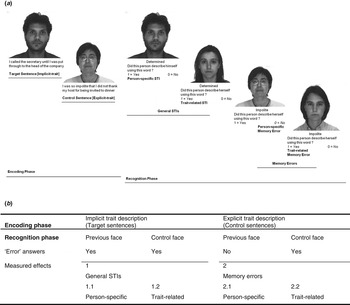
To investigate depressed patients' tendencies to ascribe depression-relevant personality traits to other people, we computed two indices: first, general STIs were computed as the number of erroneously ascribed target traits to both previously paired and control faces controlled for erroneously ascribed control traits. General STIs thus denote depressed patients' general tendency to ascribe depression-relevant personality traits to other people irrespective of their previous occurrence with specific individuals. Second, person-specific STIs were computed as the number of erroneously ascribed target traits to previously paired faces controlled for target traits erroneously ascribed to control faces and control traits. Person-specific STIs denote the tendency to ascribe depression-relevant traits to those individuals they had previously been paired with (see Fig. 1 b). Although research on STIs in healthy controls typically focuses on person-specific STIs (Todorov & Uleman, Reference Todorov and Uleman2002), we assumed general STIs to be of even greater relevance in the present context as they capture depressed patients' tendencies to ascribe target traits to indiscriminate individuals, thus reflecting cognition in a broader range of potential encounters relevant for interpersonal stress generation. Figure 1 presents a schematic illustration of the paradigm and an overview of the measured effects.
(a) Schematic illustration of the false recognition paradigm (FRP) and (b) overview of measured effects. All effects were computed as count statistics on the respective ‘error’ answers. Analyses reporting general spontaneous trait inferences (STIs) comprised effects 1.1 and 1.2 controlled for effects 2.1 and 2.2. Analyses reporting person-specific STIs comprised effect 1.1 controlled for effects 1.2, 2.1 and 2.2.

The paradigm was programmed using Xojo software (Xojo, Inc., USA) and presented on a 19-inch standard computer screen. The laboratory temperature was set to 22°C.
Design
All participants completed baseline assessments of STIs, depression severity, anxiety and childhood trauma. Following baseline assessments, participants recorded interpersonal daily hassles over a follow-up period of one week.
Procedure
Responsible clinicians obtained permission from their patients to be contacted for research purposes. Those patients who consented to be contacted and who were interested in participating in the research were then screened on the telephone for main inclusion and exclusion criteria, including administration of the MDI. Eligible participants were then sent a pack including the information sheet, consent forms and questionnaires, and an appointment for the research session was scheduled. At the research session, participants (1) gave written informed consent, (2) completed the FRP and CTQ-SF and (3) were introduced to the daily survey and asked to complete the questionnaire each evening over the following week. Participants were then handed the daily questionnaires and a pre-paid envelope and were reimbursed with £20. Starting the following day, participants received a daily text message at 18:00 h to remind them to fill in the daily questionnaire. Upon completion of data collection, participants were called and debriefed about the study.
Power calculation
To detect clinically significant effects, power was estimated based on a study demonstrating that a high versus a low level of construal predicted the occurrence of STIs in healthy individuals (Rim et al. Reference Rim, Uleman and Trope2009) and that reported a large effect size of 1.34. Our sample size provided 98% power to detect an effect of such size using a two-group t test with a 0.05 two-sided significance level.
Data analysis
All analyses were computed using SPSS version 20 (SPSS Inc., USA).
Results
Sample characteristics
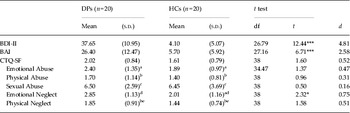
The two groups were comparable in terms of average age and gender distribution. Table 2 shows the mean scores and standard deviations for the obtained measures of depression, anxiety and childhood trauma. As expected, patients were significantly more depressed than controls and reported significantly higher levels of anxiety. Depressed patients and healthy controls differed significantly on an index of emotional neglect but not on any other index of childhood trauma.
Between-group differences of depression, anxiety and childhood maltreatment

DPs, Depressed patients; HCs, healthy controls; BDI-II, Beck Depression Inventory-II; BAI, Beck Anxiety Inventory; CTQ-SF, Childhood Trauma Questionnaire – Short Form; s.d., standard deviation; df, degrees of freedom; d, Cohen's d.
For reasons of clinical convention, sum scores are reported for the BDI-II and BAI. All other scores are reported as means. CTQ-SF scores with different superscripts differ at p < 0.05 as indicated by 5-level repeated-measures analyses of variance (rANOVAs) within each group.
* p < 0.05, *** p < 0.001.
STIs
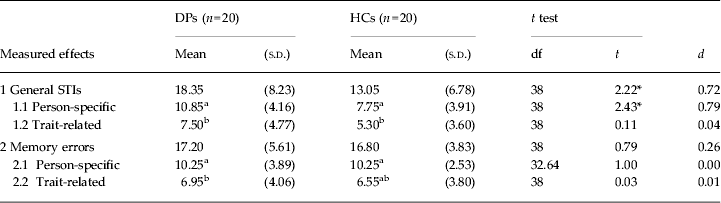
On average, participants made 32.70 (s.d. = 10.90; 34.06%) errors across all 96 recognition trials. Table 3 presents the mean error rates for the depressed patients and healthy controls. Univariate comparisons indicated significantly higher levels of both general and person-specific STIs in depressed participants compared to healthy controls.
Descriptives of error frequencies for the false recognition paradigm (FRP)

DPs, Depressed patients; HCs, healthy controls; s.d., standard deviation; df, degrees of freedom; d, Cohen's d; STIs, spontaneous trait inferences.
Means with different superscripts differ at p < 0.05 as indicated by 4-level rANOVAs across effects 1.1, 1.2, 2.1 and 2.2 within each group.
* p < 0.05.
To investigate whether group differences in a general tendency to make STIs represented a trend that was different from general tendencies for memory errors, that is errors related to recognition of faces initially presented with explicit traits, a 2 × 2 repeated-measures ANCOVA was computed, with Group as the between-group factor, Response (general STIs versus memory errors) as the within-group factor and Gender as the covariate. The results revealed a significant Response by Group interaction (F 1,37 = 5.11, p = 0.03, d = 0.74), with significantly higher rates of STIs, but not memory errors, in depressed participants compared to healthy controls (see Table 3). Gender did not predict additional variance once group affiliation was held constant.
We also investigated whether trends in person-specific STIs differed from trends for error rates across all remaining effects [depressed patients: mean (s.d.) = 8.23 (3.16); healthy controls: mean (s.d.) = 7.37 (2.16); see Fig. 1 b] using a 2 × 2 repeated-measures ANOVA with Group as the between-group factor and Response (person-specific STIs versus averaged errors across remaining effects) as the within-group factor. This revealed significant main effects of Group (F 1,38 = 4.62, p = 0.04, d = 0.70) and Response (F 1,38 = 6.85, p = 0.01, d = 0.85). The Group by Response interaction failed to reach significance (F 1,38 = 3.80, p = 0.06, d = 0.63), and averaged errors did not show significant group differences (t 38 = 1.01, p = 0.32, d = 0.32) whereas person-specific STIs did.
STIs, depressive symptoms and childhood trauma
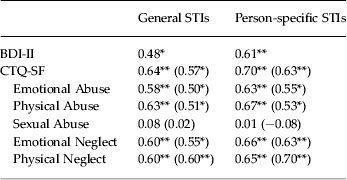
To investigate how far the tendencies to make STIs were related to severity of current depression and childhood trauma, we computed partial correlations controlling for memory errors or averaged errors across remaining effects respectively. Within the group of depressed patients, the results revealed significant associations between depression severity, as measured by the BDI-II, and general as well as person-specific STIs. STIs further correlated significantly with all indices of childhood trauma except sexual abuse both prior to and after controlling for depression severity. Table 4 shows the bivariate coefficients for these associations. There were no significant associations between STIs and mood or childhood trauma in the healthy control group.
Bivariate correlations between spontaneous trait inferences (STIs), depressive symptoms and childhood trauma within depressed patients

BDI-II, Beck Depression Inventory-II; CTQ-SF, Childhood Trauma Questionnaire – Short Form.
Coefficients in parentheses indicate partial correlations, controlled for levels of depressive symptoms, i.e. BDI-II scores. For general STIs, all correlations control for memory errors; for person-specific STIs, for averaged errors across remaining effects.
* p < 0.05, ** p < 0.01.
Interpersonal daily hassles
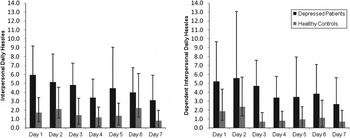
Follow-up data were provided by 18 depressed patients and 18 healthy controls (N = 36; 90%). Following examination of the diary data, extreme outliers were identified on a case-by-day basis as defined by respective frequency scores above the sample's 75th percentile plus three times its interquartile range. Missing values comprised 2.8% (day 6) and 5.6% of cases (day 7). To minimize missing data, outlying values were substituted with the subject's mean weighted frequency rating less the outlying value. Figure 2 presents an overview of interpersonal daily hassles for the depressed patients and healthy controls.
Mean weighted frequencies of (dependent) interpersonal daily hassles for depressed patients and healthy controls.

To compare the weighted frequency of (dependent) interpersonal daily hassles for depressed patients versus healthy controls, two 7 × 2 repeated-measures ANCOVAs were computed with Group as the between-group factor, Day as the seven-level within-group factor and Gender as the covariate. The results indicated that depressed patients reported significantly more interpersonal daily hassles than healthy controls (F 1,32 = 25.10, p = 0.00, d = 1.77). The main effect of Day and the Group by Day interaction were not significant. Gender did not predict additional variance when group affiliation was held constant. Similar results were obtained for dependent interpersonal daily hassles (F 1,32 = 15.65, p = 0.00, d = 1.40).
STIs and interpersonal daily hassles
Within the depressed patients, there was no significant correlation between STIs and interpersonal daily hassles during follow-up. Across participants, general STIs correlated positively with interpersonal (r = 0.40, p = 0.02) and dependent interpersonal daily hassles (r = 0.41, p = 0.02). These correlations were reduced to non-significance once depression severity was partialled out. There were no such associations for person-specific STIs.
Discussion
To our knowledge this is the first study to have investigated spontaneous trait inferences in depressed patients. Consistent with our hypothesis, and using a novel experimental paradigm, depressed patients showed increased tendencies to make STIs compared to healthy controls, suggesting systematic deficits in automatic person perception such that ‘in the absence of both the intention to do so and awareness of having done so, trait labels are used to categorize behaviour during the encoding stage of information processing’ (Moskowitz, Reference Moskowitz1993, p. 132). Accounting for general memory errors, participants showed two types of STIs: Firstly, a general tendency to ascribe depression-relevant traits to other people and secondly, a trend towards ascribing such traits to those people with whom the traits had previously been implicitly associated. Hence, person-specific STIs in depression seem to be embedded in a more general tendency to make trait inferences about other people. This dovetails well with existing knowledge about cognitive overgenerality being a defining feature of depressive thinking. For example, previous work has demonstrated that depressed patients retrieve autobiographical memories in an overgeneral way, which has been linked to a range of other deficits including difficulties in solving interpersonal problems (Williams et al. Reference Williams, Barnhofer, Crane, Hermans, Raes, Watkins and Dalgleish2007). Research in healthy controls has found that high levels of construal facilitate tendencies to make STIs, and it is therefore possible that a similar mechanism is responsible for the increased levels of STIs observed in our depressed participants.
Across, but not within, groups, STIs predicted levels of interpersonal daily hassles during the one-week follow-up. This result is in line with other research linking overgenerality and interpersonal functioning (Williams et al. Reference Williams, Barnhofer, Crane, Hermans, Raes, Watkins and Dalgleish2007) and provides some preliminary support for the idea that deficits in person perception might contribute to interpersonal stress generation, possibly through reducing patients' ability to respond flexibly to social encounters and increasing the likelihood that their responses are guided by general assumptions about others. The fact that this association was not evident within the depressed group might be due to methodological restrictions. Further research with larger numbers of participants and more thorough assessments of stress generation are needed to address this issue in more detail.
Exploration of the association between tendencies to make STIs and clinical characteristics showed that, in depressed patients, indices of childhood trauma (except sexual abuse) predicted tendencies to make STIs over and above the influence of depressive symptoms, suggesting that early adversity influences social perception in adulthood. This finding is consistent with previous research showing that childhood trauma impacts negatively on social information processing (Ford, Reference Ford2005; Chen et al. Reference Chen, Coccaro, Lee and Jacobson2012), facilitates associative processing of self-perceptions (van Harmelen et al. Reference van Harmelen, de Jong, Glashouwer, Spinhoven, Penninx and Elzinga2010) and leads to a ‘diffuse’ perceptive style characterized by difficulties in detecting nuances in past or present perceptual stimuli in children (Rogosch et al. Reference Rogosch, Cicchetti and Aber1995), all of which suggest that childhood trauma may undermine individuals' cognitive and/or motivational resources to accurately process social information, although findings based on retrospective report of early trauma need to be interpreted with caution. Underlying this association, increased tendencies to make STIs may form part of an overgeneral processing style in depression. Research on autobiographical memory specificity has highlighted that overgenerality is particularly pronounced in individuals with a history of childhood trauma (Hermans et al. Reference Hermans, van den Broeck, Belis, Raes, Pieters and Eelen2004), and it has been suggested that such a processing style may be acquired at an early stage as a means of regulating, or avoiding, the negative affect associated with the specific recollection of traumatic memories (Williams et al. Reference Williams, Barnhofer, Crane, Hermans, Raes, Watkins and Dalgleish2007).
Somewhat surprisingly, healthy controls and depressed participants reported comparable levels of childhood trauma; although our data seem to be in line with prevalence rates reported in other research. A study by Stiles et al. (Reference Stiles, Barkham, Mellor-Clark and Connell2008) reported that 63.3% of patients seen by UK primary care services suffered from depression, and of these, 15.3% suffered from trauma or abuse. Although it has been difficult to establish reliable prevalence rates for childhood trauma in the general population, a comprehensive study by May-Chahal & Cawson (Reference May-Chahal and Cawson2005) estimated its prevalence in a sample of 2869 young adults from the UK as 12%, a rate that is in keeping with the observed trauma rates in the present sample. The fact that the association between childhood trauma and STIs emerged only in the depressed group is in line with the observation that many survivors of childhood trauma develop high levels of resilience and points towards a potential role for increased tendencies to make STIs in the development of trajectories into depression.
The current study has several limitations. First, this study was based on a small sample and the results should therefore be seen as preliminary. This is particularly important to bear in mind with regard to the within-group correlations reported to explore the association of this phenomenon with other aspects of functioning, which are subject to an increased risk of Type II errors. To further investigate the specificity of STIs for depression, future studies may want to replicate our findings in larger representative samples and compare participants with different psychopathologies. Second, daily hassles were assessed using self-report. Self-report measures of interpersonal stress have been considered problematic because of potential confounding influences of mood, and the usual validity limitations of this approach apply (Paulhus & Vazire, Reference Paulhus, Vazire, Robins, Fraley and Krueger2007). However, gold-standard measures of interpersonal stress generation, that is semi-standardized interviews such as the Life Events and Difficulties Schedule (LEDS; Brown, Reference Brown, Brown and Harris1989) or the UCLA Life Stress Interview (Hammen, Reference Hammen2005), were unsuitable for the present study because of their extensive administration requirements. Similarly, criteria for depression were assessed using self-report instruments, and although there is good evidence for their diagnostic validity (Olsen et al. Reference Olsen, Jensen, Noerholm, Martiny and Bech2003), such assessments are obviously more vulnerable to the effects of reporting bias than are structured clinical interviews. Third, participants with moderate-to-severe depression are likely to suffer from a high degree of co-morbid mental health problems such as anxiety (Middeldorp et al. Reference Middeldorp, Cath, Van Dyck and Boomsma2005) or personality difficulties (Rossi et al. Reference Rossi, Marinangeli, Butti, Scinto, Di Cicco, Kalyvoka and Petruzzi2001). Although the results of the present study may be confounded by these factors, the current sampling accurately reflects clinical populations currently accessing UK primary care services, thus adding to the study's external validity. Fourth, although control participants were selected based on the absence of current symptoms of depression, we did not assess their lifetime history of depression, that is whether they had ever suffered from depression in the past. It therefore remains unclear whether, or to which degree, increased tendencies towards STIs are a trait-like phenomenon, i.e. a vulnerability factor for low mood. Future studies might use remission designs comparing previously and never-depressed participants to specifically investigate this question. Fifth, because we assessed participants only once and mood was not controlled experimentally, it remains unclear whether tendencies to make STIs vary with mood. Indeed, if this phenomenon was part of a depressogenic mode of thinking, it might – like other cognitive characteristics of depression – lie dormant at times of normal mood, but be easily reactivated through changes in mood. Further research using mood-induction paradigms could test this assumption.
Altogether, our findings suggest that depressogenic cognitive deficits extend to the domain of person perception, with potential consequences for interpersonal functioning and stress generation, and that such deficits may arise as a consequence of early trauma and adversity. Future research could investigate whether established cognitive characteristics such as overgeneral memory relate to tendencies to make STIs, as findings on relationships with levels of construal would suggest. Furthermore, it would be of interest to investigate how far the demonstrated deficits in person perception might be related to a negative attributional style.
If replicated, the current findings would suggest that interpersonal therapy approaches for depression, which have long proven to be effective (Hollon et al. Reference Hollon, Thase and Markowitz2002; Cuijpers et al. Reference Cuijpers, Geraedts, van Oppen, Andersson, Markowitz and van Straten2011), may profit from the inclusion of training of social perception, for example through specific computer-based exercises or interpersonal mindfulness training (Kramer, Reference Kramer2007).
Acknowledgements
We thank J. Wingrove for her support with the recruitment of depressed patients and J. Oliver for his administrative help in this regard. We also thank J. Fish who contributed to the creation of some of the experimental stimuli and A. Brand who programmed the False Recognition Paradigm. This study was supported by a research grant from the Institute of Psychiatry, King's College London to B. Boecking.
Declaration of Interest
None.