

Introduction
Interactions between seabirds and fisheries occur in all oceans and in most fisheries (Montevecchi Reference Montevecchi, Schreiber and Burger2001; Tasker et al. Reference Tasker, Camphuysen, Cooper, Garthe, Montevecchi and Blaber2000). These primarily take place as seabirds attempt to feed on net resources, discarded fishery by-products, and/or bait, often resulting in entanglements or strikes with fishing gear. This last may lead to severe injuries, or incidental mortality, which is known as bycatch (Furness Reference Furness2003; Phillips et al. Reference Phillips, Fox, Crawford, Prince and Yates2024). Fishery discards refer to the portion of total catch, encompassing both commercial and non-commercial species, that is dumped into the sea whole or as offal (Kelleher Reference Kelleher2005). In this context, the low selectivity of certain fishing gear (e.g. trawl nets) can lead to substantial catches of non-target species, subsequently discarded at sea (Zeller et al. Reference Zeller, Cashion, Palomares and Pauly2018). Bycatch of seabirds associated with fishing is one of the main threats affecting their conservation worldwide, particularly in oceanic species like albatrosses and petrels (Dias et al. Reference Dias, Martin, Pearmain, Burfield, Small and Phillips2019). These seabirds travel thousands of kilometres while foraging or migrating, overlapping with a range of fisheries in the same highly productive oceanic areas. They are also attracted by fishing activities, which provide them with a predictable and reliable food source in space and time (Copello et al. Reference Copello, Seco Pon and Favero2014; Petersen et al. Reference Petersen, Phillips, Ryan and Underhill2008). Discards provided by fisheries as food subsidy are often considered beneficial for seabirds in the short term; however, they can induce long-term changes of varying magnitude and across different dimensions, such as seabird foraging distribution and behaviour (as indirectly observed in this study), diet and body condition, population dynamics, and community structure (Bartumeus et al. Reference Bartumeus, Giuggioli, Louzao, Bretagnolle, Oro and Levin2010; Church et al. Reference Church, Furness, Tyler, Gilbert and Votier2019; Hüppop and Wurm Reference Hüppop and Wurm2000; Mariano-Jelicich et al. Reference Mariano-Jelicich, Copello, Seco Pon and Favero2017).
The Argentine Continental Shelf is a globally significant marine ecosystem with high biodiversity and rich in endemism, and hosts one of the largest seabird biomasses in the world (Bastida et al. Reference Bastida, Rodriguez, Scarlato, Favero, Miyazaki, Adeel and Ohwada2005; Campagna et al. Reference Campagna, Sanderson, Coppolillo, Falabella, Piola and Strindberg2007; Carneiro et al. Reference Carneiro, Pearmain, Oppel, Clay, Phillips and Bonnet-Lebrun2020; Falabella et al. Reference Falabella, Campagna and Croxall2009; Favero and Silva Rodriguez Reference Favero and Silva Rodriguez2005). This area extends approximately from the Río de la Plata to the North Scotia Ridge, and from the coastline to 200 nautical miles at the edge of the continental slope (Violante et al. Reference Violante, Laprida and García Chapori2017). Fisheries are one of the main economic activities carried out in the Argentine Continental Shelf, with most of the effort being exerted by trawl vessels (Anticamara et al. Reference Anticamara, Watson, Gelchu and Pauly2011). In 2022, the landings reported by this fleet were approximately 654,000 tons, representing 81% of the total landings for that year (Secretaría de Agricultura Ganadería y Pesca 2022). Seabird interactions with trawl and other fisheries in the Argentine Continental Shelf are well-documented, including collisions with trawls and sonde cables, and entanglements with hooks or nets, often resulting in injuries and bycatch (Favero et al. Reference Favero, Blanco, García, Copello, Seco Pon and Frere2011, Reference Favero, Blanco, Copello, Seco Pon, Patterlini and Mariano-Jelicich2013; González-Zevallos et al. Reference González-Zevallos, Yorio and Svagelj2011; Jiménez et al. Reference Jiménez, Domingo and Brazeiro2009; Marinao and Yorio Reference Marinao and Yorio2011; Paz et al. Reference Paz, Seco Pon, Favero, Blanco and Copello2018; Seco Pon et al. Reference Seco Pon, Copello, Tammini, Mariano-Jelicich, Paz, Blanco and Garret2015, Reference Seco Pon, Favero, García, Estrada, Copello and Yorio2020; Sullivan et al. Reference Sullivan, Reid and Bugoni2006).
The most abundant albatross species in the Argentine Continental Shelf is the Black-browed Albatross Thalassarche melanophris. This species is currently listed by the International Union for Conservation of Nature (IUCN) as ‘Least Concern’ (BirdLife International 2023), although it is listed as a threatened (Vulnerable) seabird species in Argentina (Ministerio de Ambiente y Desarrollo Sustentable y Aves Argentinas 2017). The Black-browed Albatross has been referred to as the main oceanic seabird interacting with different fishing fleets in the region – either through contact or as bycatch – including trawlers, longliners, and other vessels (Favero et al. Reference Favero, Blanco, García, Copello, Seco Pon and Frere2011, Reference Favero, Blanco, Copello, Seco Pon, Patterlini and Mariano-Jelicich2013; Grémillet et al. Reference Grémillet, Wilson, Wanless and Chater2000; Paz et al. Reference Paz, Seco Pon, Favero, Blanco and Copello2018; Sullivan et al. Reference Sullivan, Reid and Bugoni2006). The current global Black-browed Albatross population is estimated at 700,000 breeding pairs, of which approximately 72% breed in the Malvinas (Falkland) Islands, 19% in the Diego Ramírez and Ildefonso Islands in southern Chile, and 8% in the Georgias del Sur (South Georgia) Islands (BirdLife International 2023). During the non-breeding season, birds from the Malvinas Islands mainly forage along the Argentine Continental Shelf and adjacent areas including Uruguayan and Brazilian waters (Grémillet et al. Reference Grémillet, Wilson, Wanless and Chater2000; Paz et al. Reference Paz, Seco Pon, Krüger, Favero and Copello2021; Ponchon et al. Reference Ponchon, Cornulier, Hedd, Granadeiro and Catry2019), while those breeding in the Georgias del Sur Islands predominantly migrate to richer Benguela waters off South Africa, Namibia, and Angola, with a small proportion remaining in the south-west Atlantic (Phillips et al. Reference Phillips, Silk, Croxall, Afanasyev and Bennett2005).
Recent studies have investigated how the behaviour of seabirds at sea changes when attending fishing vessels. These analyses were conducted using data from bird locations obtained through biologging (e.g. GPS, satellite transmitters) and the spatial distribution data of fishing vessels (Cianchetti-Benedetti et al. Reference Cianchetti-Benedetti, Dell’Omo, Russo, Catoni and Quillfeldt2018; Clark et al. Reference Clark, Vigfúsdóttir, Jessopp, Burgos, Bodey and Votier2020; Collet et al. Reference Collet, Patrick and Weimerskirch2017a, Reference Collet, Patrick and Weimerskirchb; Jurinović et al. Reference Jurinović, Zec, Dumbović Mazal and Kralj2019; Orben et al. Reference Orben, Adams, Hester, Shaffer, Suryan and Deguchi2021; Paz et al. Reference Paz, Seco Pon, Copello, Mariano-Jelicich, Ronconi and Ryan2024a; Weimerskirch Reference Weimerskirch2021). The results vary not only depending on the species but also on the age classes, sex, and behaviour of the individuals. For example, one study conducted on Scopoli’s Shearwaters Calonectris diomedea in the Mediterranean showed some individuals attending fishing vessels for food while others preferred natural prey (Cianchetti-Benedetti et al. Reference Cianchetti-Benedetti, Dell’Omo, Russo, Catoni and Quillfeldt2018). Another work suggests that adult and immature Great Shearwaters Ardenna gravis are more likely to forage when the fishing effort of high-seas trawlers increases and that of coastal trawlers decreases, with certain differences between age classes (Paz et al. Reference Paz, Seco Pon, Copello, Mariano-Jelicich, Ronconi and Ryan2024a). One study reported differences between juvenile and adult Wandering Albatross Diomedea exulans and Amsterdam Albatross D. amsterdamensis, and found that attraction to fishing vessels increases through immaturity to peak adulthood, later decreasing with old age (Weimerskirch Reference Weimerskirch2021; Weimerskirch et al. Reference Weimerskirch, Corbeau, Pajot, Patrick and Collet2023). Our study tests the hypothesis that with increased fishing effort by different fleets, adult albatrosses are more likely to show such foraging behaviour compared with less experienced birds (e.g. immatures). Such differential behaviour of birds associated with fishing activities could then be translated into a differential risk of bycatch between individuals of different age classes (see Gianuca et al. Reference Gianuca, Phillips, Townley and Votier2017). Identifying changes in the albatrosses’ association with fisheries by controlling intrinsic factors of the studied species may better help in identifying and understanding when and where potential conflicts with fishing activities may occur and help to plan effective conservation actions for an ecosystem-based approach to fisheries management. In this context, the aim of this study was to evaluate the effect of fishing effort on the foraging behaviour of different age classes of Black-browed Albatross in the Argentine Continental Shelf.
Methods
Data collection and tracking data analysis
A total of 31 Black-browed Albatrosses were fitted with satellite transmitters (Platform Terminal Transmitters battery powered, K3H 179A KiwiSat303 Sirtrack and TAV-2656 Telonics Inc.) from April to September between 2011 and 2015 (Table 1). The locations and techniques used to capture and deploy these tracking devices are detailed in Paz et al. (Reference Paz, Seco Pon, Krüger, Favero and Copello2021, Reference Paz, Seco Pon, Krüger, Favero and Copello2024b). Tags were programmed to transmit with a duty cycle of 8 hours on–16 hours off in 2011 (09h00–17h00 h local time, -3 GMT) and 12 hours on–12 hours off in 2012, 2013, and 2015 (06h00–18h00 local time, -3 GMT), obtaining 8–12 locations per individual per day overall. Position fixes for satellite-tagged albatrosses were received from the Argos System (CLS America, Inc., Largo, MD, USA) using the Satellite Tracking and Analysis Tool (STAT) to download data (Coyne and Godley Reference Coyne and Godley2005). All Argos locations (accuracy classes A, B, 0, 1–3), except class = Z (Invalid location) were used (CLS 2016). Positions were filtered by maximum flight speed of 100 km/hour (BirdLife International 2004) using the R package Argosfilter 0.62 (Freitas Reference Freitas2012). Age class was determined using plumage and bill coloration to identify adults and immature individuals (Harrison Reference Harrison1983). Immature individuals included both juvenile and sub-adult age classes as their plumage and bill characteristics vary among colonies, making classification difficult when an individual’s origin is unknown (Bugoni and Furness Reference Bugoni and Furness2009). To identify different behaviours from Black-browed Albatross locations, the Expectation Maximisation Binary Clustering algorithm was used through the R package EMbC (Garriga et al. Reference Garriga, Palmer, Oltra and Bartumeus2016, Reference Garriga, Palmer, Oltra and Bartumeus2019). This technique (1) allows the differentiation of movement states based on speed and trajectory tortuosity without the need to establish thresholds a priori; (2) does not assume specific data distributions and can adapt to different movement patterns across various species and ecological contexts; (3) is independent of the temporal sequence and is, therefore, applicable to different remote tracking technologies; (4) can be used to analyse both short-term movements and large-scale displacements; (5) is computationally efficient, providing easily interpretable outputs (Afán et al. Reference Afán, Navarro, Grémillet, Coll and Forero2019; Garriga et al. Reference Garriga, Palmer, Oltra and Bartumeus2016; Joo et al. Reference Joo, Boone, Clay, Patrick, Clusella-Trullas and Basille2020). The types of behaviour were assigned according to speed and turning angle of successive locations. Thus, low turning angles and low speeds were categorised as resting (mostly sitting on water and drifting); low turning angles and high speeds were assigned as travelling (Garriga et al. Reference Garriga, Palmer, Oltra and Bartumeus2016; Mendez et al. Reference Mendez, Borsa, Cruz, de Grissac, Hennicke and Lallemand2017); high turning angles and low speeds were interpreted as intensive search (specific foraging locations); high turning angles and high speeds were categorised as extensive search (interpreted as a displacement between restricted areas of intensive foraging) (Mendez et al. Reference Mendez, Borsa, Cruz, de Grissac, Hennicke and Lallemand2017). Ten individuals were excluded from the analysis due to an insufficient number of locations in which to conduct the analysis (<50 fixes). To perform a comparative analysis and account for differences between the two age classes, only adult individuals recorded within the same time frame as immature individuals were considered in the analysis, thus within the southern winter (July–September). The analysis was based on information recorded by 15 transmitters deployed on six adults (2011–2013) and nine immatures (2015). See Supplementary material Table S1 for a summary of classified behavioural types.
Summary of tracking data for adult (A) and immature (I) Black-browed Albatrosses

* Indicates failure of the transmitter.
Fishing effort
A range of commercial Argentinian fisheries operate in the Argentine Continental Shelf (Argentine NPOA-Seabirds 2010; Copello et al. Reference Copello, Seco Pon and Favero2014; Seco Pon et al. Reference Seco Pon, Copello, Tammini, Mariano-Jelicich, Paz, Blanco and Garret2015). The distribution of fishing vessels in this area was obtained from a satellite vessel monitoring system database (VMS) from the Subsecretaría de Pesca y Acuicultura de la Nación, which provides the hourly GPS position of each vessel. Data obtained from the VMS were filtered by speed and time to obtain fishing locations (Martinez Puljak et al. Reference Martínez Puljak, Navarro, Prosdocimi, Sánchez and Remes Lenicov2018). From these filtered points, monthly fishing effort was determined as the number of points per grid cell (0.083 × 0.083°) and averaged per the tracking period (Figure S1). For this study trawlers and squid jiggers were analysed. Trawlers were divided into ‘ice-trawlers’ (both coastal and high seas, preserving the catch in ice) and ‘freezer trawlers’ (freezing the catch after onboard processing, including vessels towing double beam trawls and other freezer trawlers). The ice-trawl fleet consists of vessels approximately 9–72 m long with a carrying capacity of 5–1,227 m3, while freezer trawlers range from 30 m to 113 m in length and can carry 100–4,531 m3 (Argentine NPOA-Seabirds 2010). Both fleets primarily target Argentine hake Merluccius hubbsi, although this sometimes may vary depending on fishing gear and fishing area (Argentine NPOA-Seabirds 2010). In general, all fleets discharge waste – both non-target and undersized target species – without processing. See Table S2 for further details on the Argentine fleet.
Data analysis
To determine the effect of fishing effort on the foraging behaviour of albatrosses, Generalised Linear Mixed Models (GLMMs) were fitted for each age class separately. Firstly, multicollinearity among fishing effort from different trawl and jigging fleets was assessed using the ‘ggpairs’ function from the GGally package (Emerson et al. Reference Emerson, Green, Schloerke, Crowley, Cook and Hofmann2013). Since no multicollinearity was detected (Figure S2), all variables were included in the modelling (Emerson et al. Reference Emerson, Green, Schloerke, Crowley, Cook and Hofmann2013). A binomial distribution with a logit link function was used to determine whether the fishing effort of different fleets affects foraging behaviour (classified as 1 or 0 for the remaining behavioural categories), with individual ID incorporated as a random effect. The fit of the global model was assessed through visual inspection of the residual plots and by evaluating their dispersion, which should be close to 1 for an adequate fit (Zuur et al. Reference Zuur, Ieno, Walker, Saveliev and Smith2009). To determine the significance of the random variable in the global models for each age class, an ANOVA analysis was conducted comparing each global GLMM model with the random variable ‘individual’ to the global GLM model without the random variable. Model selection was based on the Akaike information criterion (AIC) corrected for small sample sizes (AICc). Once all models have been ranked by AICc, it is common to identify a ‘top model set’ normally based on the change in AIC values relative to the best AIC model (ΔAICc). Historically, Burnham and Anderson (Reference Burnham and Anderson2002) recommended that only models with ΔAICc between 0 and 2 should be used for inference. The Akaike weights (wi) represent the relative probability that each model is the best within the set of models considered (Burnham and Anderson Reference Burnham and Anderson2002). Finally, when the best model had a wi <0.7, multiple model inference procedures were applied. This approach also allows for the identification of variables that may not be significant, such as those whose confidence intervals include zero (Garamszegi Reference Garamszegi2011). In addition, a spatial association between the foraging locations of adult and immature Black-browed Albatross and the fishing effort of fleets that yielded significant results in the GLMM analysis was assessed. The data management and analysis were conducted using the R programs (R Core Team Reference Team2021) and QGIS 3.14 (QGIS Development Team 2020).
Results
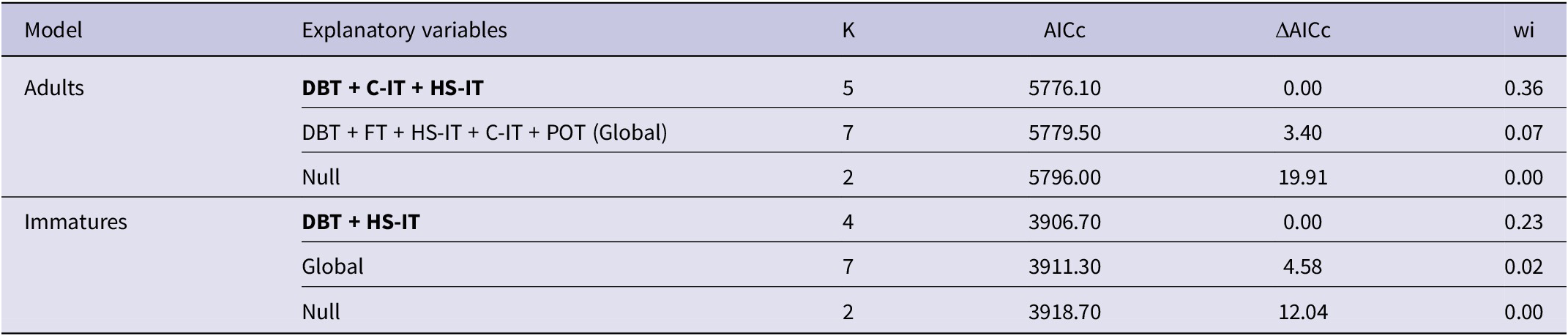
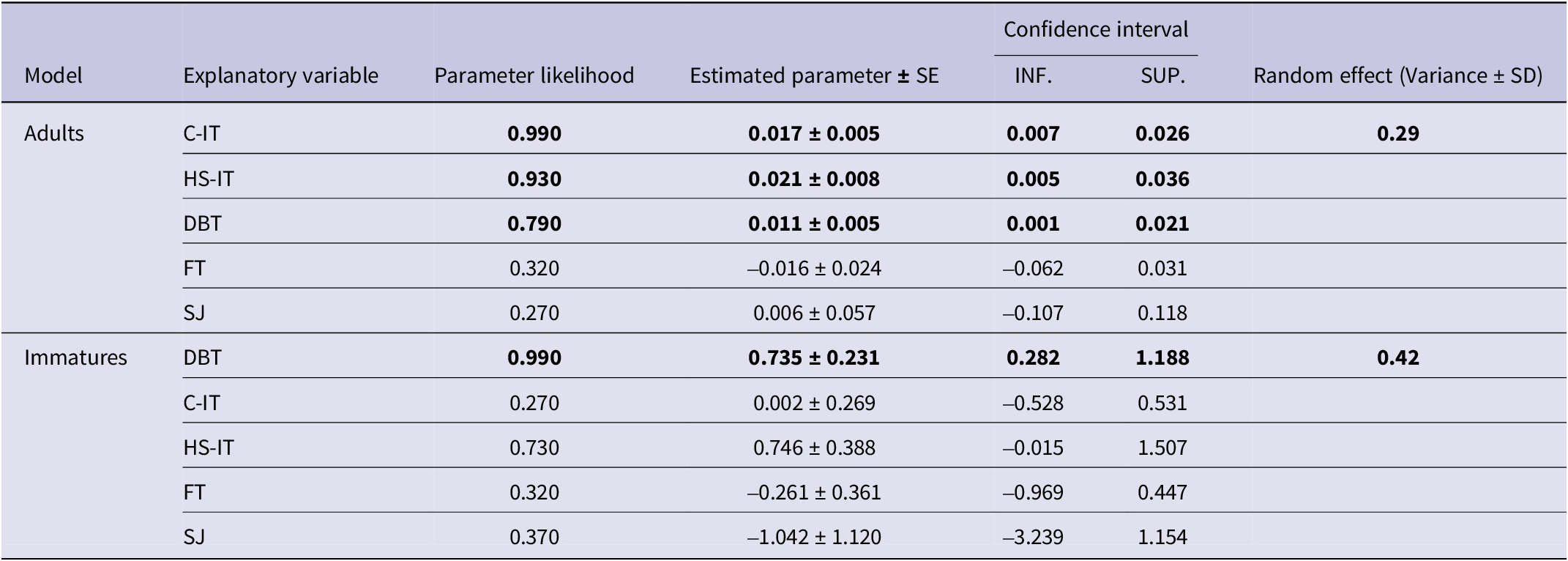
Global models showed a good fit to the data with dispersion values of 0.99 for both age classes. The inclusion of the random variable for the global model VarianceAdults (SD) = 0.29 (0.54), VarianceImmatures (SD) = 0.39 (0.63) was significant in both cases (X2 Adults = 404.32; X2 Immature = 231.83; P <0.05). Since the best-selected models had a wi value <0.7 (Table 2), multiple model inference was conducted. In immature albatrosses the probability of individuals foraging increased with increasing fishing effort by double beam trawlers, while in adults the foraging activity was primarily associated with the increased effort of coastal and high-seas ice-trawlers, followed by double beam trawlers (Table 3). The overall effect observed in adults was weaker than that for immatures. Additionally, immatures exhibited higher individual variability than adults when results from the best-supported models were compared across age classes (Table 3).
Generalised Linear Mixed Models (GLMMs) explaining the probability of foraging behaviour in Black-browed Albatross in relation to the fishing effort of different fleets by age class. The models included the most important model (according to ΔAICc and wi), the global model, and the null model. K = number of parameters; AICc = corrected Akaike information criterion; wi = Akaike weight; FT = freezer trawlers; C-IT = coastal ice-trawlers; HS-IT = high-seas ice-trawlers; SJ = squid jiggers; DBT = double beam trawlers
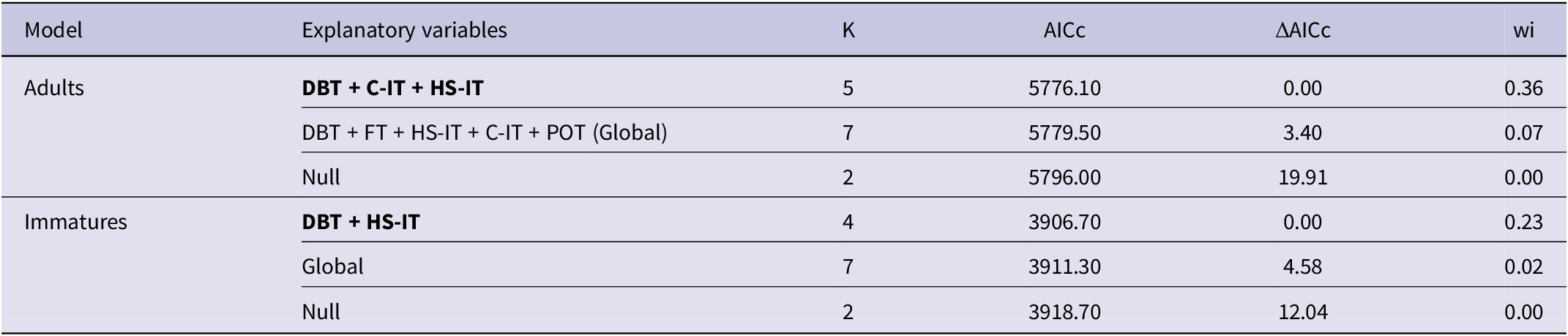
Coefficients of the Generalised Linear Mixed Models (GLMMs) explaining the probability of foraging behaviour in the Black-browed Albatross. Independent variables with confidence intervals excluding zero are those included in the candidate model (highlighted in bold). SE = standard error; SD = standard deviation; FT = freezer trawlers; C-IT = coastal ice-trawlers; HS-IT = high-seas ice-trawlers; SJ = squid jiggers; DBT = double beam trawlers
The foraging locations of adults, associated with the fishing effort of fleets that yielded significant results in the GLMM analyses, showed a degree of spatial overlap with areas of concentrated fishing activity, such as the waters to the north and off San Jorge Gulf (for double beam trawlers, Figure 1A), off El Rincón, along the 50-m isobath covering the south-east coast of Buenos Aires Province – including productive waters like the mouth of the Río de la Plata to the north – (for coastal ice-trawlers, Figure 1B), and areas along the shelf break (high-seas ice-trawlers, Figure 1C). For immatures, spatial overlap was observed with areas of concentrated fishing effort by double beam trawlers – the only fleet type that yielded significant results in the GLMM analyses – in the waters to the north and off San Jorge Gulf (Figure 1D).
Foraging locations of adult (A–C) and immature (D) Black-browed Albatrosses and their spatial association with fishing efforts in fisheries that yield significant results for GLMM analysis, i.e. for adults: double beam trawlers (A), and coastal (B) and high-seas (C) ice-trawlers; for immatures: double beam trawlers (D).

Discussion
Associating fishing effort by fleet and gear with the foraging location of oceanic birds can help identify areas where interactions between the two may occur in the future. This may also enable identification of marine areas where the risk of seabird bycatch is likely to be higher both in time and space. Our results highlight the influence age class and fleet type can have albatross behaviour and, consequently, bycatch risk. As predicted, our results indicate that, when fishing effort of different fleets increase, adult albatrosses are more likely to show a foraging behaviour compared with immatures. This suggests that factors like experience, discard availability, vessel size, and fishing gear used may be important when developing measures for conservation and management (Favero et al. Reference Favero, Blanco, Copello, Seco Pon, Patterlini and Mariano-Jelicich2013; Genovart et al. Reference Genovart, Bécares, Igual, Martínez-Abraín, Escandell and Sánchez2018; Zhou and Brothers Reference Zhou and Brothers2021).
This study identified trawl fleets as having a positive effect in triggering the foraging behaviour of Black-browed Albatross, namely double beam trawlers for immature albatrosses, and double beam trawlers and coastal and high-seas ice-trawlers for adults. The presence of Black-browed Albatross attending these fleets is consistent with onboard observations, which show that the species frequently attends vessels to take advantage of fish and other prey entangled in nets, discard, and offal, which are more available in trawl fisheries compared with squid jiggers (Favero et al. Reference Favero, Blanco, García, Copello, Seco Pon and Frere2011; González-Zevallos and Yorio Reference González-Zevallos and Yorio2011; Marinao and Yorio Reference Marinao and Yorio2011; Paz et al. Reference Paz, Seco Pon, Favero, Blanco and Copello2018; Tamini et al. Reference Tamini, Dellacasa, Chavez, Marinao, Góngora and Crawford2023). Double beam trawl vessels operating in northern Argentine Patagonia (specifically in the San Jorge Gulf) during winter, have reported immature and adult Black-browed Albatross as one of the most abundant species attracted by the important volume of discards generated by this fishery (Bovcon et al. Reference Bovcon, Góngora, Marinao and González-Zevallos2013; González-Zevallos and Yorio Reference González-Zevallos and Yorio2011). The presence of other fleets, such as coastal and high-seas ice-trawlers, was also positively correlated with the probability of foraging in adult Black-browed Albatross. These results followed the reported dominance of adult over immature albatrosses and other seabird species in foraging and access to discards produced for that fleet (Seco Pon Reference Seco Pon2014). Building on this, various studies have indicated that immature seabirds are less competitive and less proficient scavengers than adults, primarily due to their limited experience in competing for prey compared with older individuals (Bertellotti and Yorio Reference Bertellotti and Yorio2000; Depestele et al. Reference Depestele, Rochet, Dorémus, Laffargue and Stienen2016; Seco Pon Reference Seco Pon2014). The differential effect of fishing effort on the foraging behaviour of adult and immature albatrosses could also be explained by age-related segregation in the use of foraging areas, where immature individuals foraged chiefly off coastal waters, while adults foraged in both coastal waters and deeper waters over the Argentine Continental Shelf (Paz et al. Reference Paz, Seco Pon, Krüger, Favero and Copello2024b). No relation between the fishing effort of squid jiggers and Black-browed Albatross foraging behaviour was observed, which was expected given the selective fishing technique used in this fleet that results in virtually no or low discards or prey near the surface, hence negligible seabird attraction generated during fishing operations (Argentine NPOA-Seabirds 2010). Moreover, since this fishery operates at night, and the foraging activity of albatrosses is primarily diurnal (Phalan et al. Reference Phalan, Phillips, Silk, Afanasyev, Fukuda and Fox2007), a low attendance and interactions with fishing gear would be expected. No association of albatross foraging behaviour was found for the freezer trawl fleet, an unexpected result given that these vessels generate both discards and offal as byproducts of processing the catch. The lack of relationship between this fleet and the foraging behaviour of albatrosses could be explained by differences in the winter distribution of Black-browed Albatross and that of the freezer fleet. Freezer fleet vessels primarily operate between 40°S and 55°S, along the shelf edge and the boundary of the Argentine hake fishing closure, whereas wintering Black-browed Albatrosses are distributed further north in the Argentine Continental Shelf (Argentine NPOA-Seabirds 2010; Bertolotti et al. Reference Bertolotti, D’Atri, Pagani and Cassanelli2017; Grémillet et al. Reference Grémillet, Wilson, Wanless and Chater2000; Paz et al. Reference Paz, Seco Pon, Krüger, Favero and Copello2021; Paz et al. Reference Paz, Seco Pon, Krüger, Favero and Copello2024b; Ponchon et al. Reference Ponchon, Cornulier, Hedd, Granadeiro and Catry2019). Therefore, we cannot rule out the possibility that, during the breeding period – when their range is more southerly, concentrated around breeding areas in the Malvinas Islands – this fleet may influence their foraging behaviour under a scenario of greater overlap between seabirds and fisheries (Argentine NPOA-Seabirds 2010; Grémillet et al. Reference Grémillet, Wilson, Wanless and Chater2000; Ponchon et al. Reference Ponchon, Cornulier, Hedd, Granadeiro and Catry2019).
As was previously mentioned, our results indicate a higher risk of incidental bycatch for the species when associated with certain fleets. This finding is in line with several studies in the area. For example, in this study we observed that an increase in the fishing effort of ice-trawlers (both coastal and high-seas) raises the probability of foraging by adult Black-browed Albatross. In accordance with this result, onboard studies on the same fleets have shown that the species frequently interacts with these vessels and was among the most affected by incidental mortality, particularly during discarding and net-hauling operations (Favero et al. Reference Favero, Blanco, García, Copello, Seco Pon and Frere2011; Paz et al. Reference Paz, Seco Pon, Favero, Blanco and Copello2018; Tamini et al. Reference Tamini, Chavez, Dellacasa, Crawford and Frere2020). Another fleet that showed a significant effect was the double beam freezer trawlers. Although studies conducted onboard these vessels have not recorded incidental captures of Black-browed Albatross, they have documented bycatch of other coastal seabird species (González-Zevallos and Yorio Reference Garamszegi2011; González-Zevallos et al. Reference González-Zevallos, Yorio and Svagelj2011). However, since this fleet showed a significant effect in our study, it is crucial to obtain bycatch data from pelagic zones, where the highest fishing effort of this fleet is concentrated (Martinez Puljak Reference Martínez Puljak, Navarro, Prosdocimi, Sánchez and Remes Lenicov2018). Regarding the freezer trawl fleet, our results did not show an effect on foraging behaviour. This finding is, in part, consistent with studies on fleets targeting Patagonian scallop Zygochlamys patagonica, which have reported low mortality of the species (Seco Pon et al. Reference Seco Pon, Copello and Favero2023). However, other demersal trawl fleets targeting hake and austral species have shown high interactions and incidental mortality of Black-browed Albatross. It is important to interpret these comparisons with caution, as they are limited to southern operational areas near the species’ breeding colonies (Sullivan et al. Reference Sullivan, Reid and Bugoni2006; Tamini Reference Tamini, Chavez, Góngora, Yates, Rabuffetti and Sullivan2015, 2023). Finally, and as was mentioned above, no effect of the selective squid-jigging fleet on foraging behaviour was observed. Reports from jigging fleets indicate low levels of seabird bycatch including our studied species (e.g. Kuepfer Reference Kuepfer2019; Reid et al. Reference Reid, Yates, Crofts and Kuepfer2021; Savigny et al. Reference Savigny, Firstater, González and Caille2005). However specific investigations on the abundance of seabirds and their interactions with the large Argentine jigging fleet are still needed.
It is relevant to highlight individual differences regarding association with areas of high fishing effort, which was observed to a greater extent in immature individuals. Since the age of immature individuals is unknown and may vary significantly, some may be much younger and less experienced than others (Fayet et al. Reference Fayet, Freeman, Shoji, Padget, Perrins and Guilford2015; Phillips et al. Reference Phillips, Lewis, González-Solís and Daunt2017). In long-lived species such as albatrosses, immatures may spend nearly a decade at sea before their first breeding attempt, during which time they gradually develop the skills needed to recognise and efficiently exploit productive marine habitats, such as frontal zones and continental shelf areas. For instance, while juvenile Wandering Albatrosses can adopt adult-like foraging strategies shortly after fledging, additional experience is required during the immature period to reach adult-level efficiency (de Grissac et al. Reference de Grissac, Bartumeus, Cox and Weimerskirch2017). Additionally, in various albatross species, immature individuals tend to be more exploratory/dispersive than adults, which likely explains their greater individual variability in how they associate with fishing vessels (Campioni et al. Reference Campioni, Dias, Granadeiro and Catry2020; Frankish et al. Reference Frankish, Manica and Phillips2020; Weimerskirch et al. Reference Weimerskirch, Åkesson and Pinaud2006).
Studies on the foraging behaviour of Black-browed Albatross in relation to fishing vessel activities are scarce and mainly related to the effect of longline vessels, not investigating whether intrinsic characteristics affect interactions between individuals and fishing vessels. In one study, breeding individuals from the Kerguelen Islands were attracted to and actively interacted with demersal longline vessels once they encounter them (Collet et al. Reference Collet, Patrick and Weimerskirch2017a). Further, while Black-browed Albatross can remember the locations where they attend fishing vessels, they can alternate the use of these anthropogenic resources with the use of areas for ‘natural’ prey feeding (Collet and Weimerskirch Reference Collet and Weimerskirch2020). Another study showed that the boundaries of the Argentine hake fishing closure area also affect the foraging behaviour of adult Black-browed Albatross, as fishing effort concentrates at the edges, leading to what is known as ‘fishing the line’ (Copello et al. Reference Copello, Blanco, Seco Pon, Quintana and Favero2016). Our results indicate that the probability of adult and immature Black-browed Albatross foraging increased upon encountering fishing vessels and with the rise in fishing effort (fishing points per hour). Although more fleet types showed a greater effect for adults than for immatures, the results suggest that the species broadly associates with fishing vessels and most likely benefits from the anthropogenic food source, as evidenced by stable isotope analysis (Mariano-Jelicich et al. Reference Mariano-Jelicich, Copello, Seco Pon and Favero2017). Aware of the limited sample size, these results should be considered with caution. However, our results remain significant as a limited data set can still be valuable when studying species exposed to threats or underrepresented life stages, such as immatures, which represent a substantial portion of the population (Sequeira et al. Reference Sequeira, Heupel, Lea, Eguíluz, Duarte and Meekan2019).
The greatest fishing effort in terms of the number of vessels and catches on the Argentine Continental Shelf is dominated by trawl fleets, which currently represent one of the most significant threats to seabirds (Dias et al. Reference Dias, Martin, Pearmain, Burfield, Small and Phillips2019; Seco Pon et al. Reference Seco Pon, Copello, Tammini, Mariano-Jelicich, Paz, Blanco and Garret2015). In Argentina, there is currently a regulation requiring the use of bird-scaring lines in freezer trawlers; these efforts and other actions are coordinated through the implementation of a National Plan of Action for Seabirds, initially adopted in 2010 and revised in 2019 (Argentine NPOA-Seabirds 2010). There is still considerable work to be done in the uptake of conservation measures and the development of further measures applicable to other fleets that may pose a risk for seabirds. This includes research and regulations for discard management, which is critical to reduce seabird attendance at fishing operations and, consequently, reduce the risk of incidental mortality (Favero and Seco Pon Reference Favero and Seco Pon2014; Favero et al. Reference Favero, Blanco, García, Copello, Seco Pon and Frere2011). The differential association between Black-browed Albatrosses of different age classes and fishing fleets in the Argentine Continental Shelf could lead to varying bycatch risk (see Gianuca et al. Reference Gianuca, Phillips, Townley and Votier2017), having significant implications for the population dynamics of the species, as observed in other albatross species (Pardo et al. Reference Pardo, Forcada, Wood, Tuck, Ireland and Pradel2017). Therefore, it is crucial that studies on seabird–fishery interactions include information on the age of the individuals studied to ensure that conservation efforts are effectively targeted. This study provides essential information for identifying areas of overlap and potential conflict between different seabird age classes and fisheries in the Argentine Continental Shelf, using the Black-browed Albatross as an indicator species. Additionally, the results presented here help to pinpoint those fleets that require more concerted efforts when formulating, planning, and monitoring compliance with mitigation measures at different temporal and spatial scales. Finally, this study is also relevant to identifying and implementing conservation and management measures in marine ecosystems during the development of marine protected areas.
Supplementary material
The supplementary material for this article can be found at https://doi.org/10.1017/S0959270925100257.
Acknowledgements
The authors thank the institutions that provided their facilities for this work, particularly IIMyC (UNMdP-CONICET), the Universidad Nacional de Mar del Plata, and the Consejo Nacional de Investigaciones Científicas y Técnicas. We would also like to thank the Subsecretaría de Pesca y Acuicultura de Argentina for facilitating access to VMS data. We appreciate the improvements in English usage made by Ashley Staab through the Association of Field Ornithologists’ programme of editorial assistance, and we thank Daniel Brooks for managing it. We thank the anonymous reviewers, the handling editor Dr Phil Atkinson, and the associate editor Dr Annick Morgenthaler for their suggestions on improving this paper. This work was supported by the Universidad Nacional de Mar del Plata (grant 15/E795-EXA842/17), the Agencia Nacional de Promoción Científica y Tecnológica (PICT 2013-0711, PICT 2017-0573, PICT 2017-1761), and the Consejo Nacional de Investigaciones Científicas y Técnicas (PIP 11220200101031CO). The authors thank SeaWorld and Busch Gardens Conservation Fund, Mohamed bin Zayed Species Conservation Fund, Phil and Marsha Dowd, and the Agreement on the Conservation of Albatrosses and Petrels for additional funding.