1 Introduction
The main goal of this study is to investigate phonetic underpinnings of lexical and rhythmic stress in Ukrainian. The findings of the present acoustic investigation have implications for current metrical theories because Ukrainian is potentially an example of an intricate bidirectional stress system with an internal lapse adjacent to the main stress. The experimental results are significant from the theoretical perspective as they run afoul of a recent hypothesis that bidirectional stress systems with internal lapses are non-existent (Newlin-Łukowicz Reference Newlin-Łukowicz2012).
According to traditional descriptions, Ukrainian has lexical stress and rhythmic stresses radiating from the word edges towards the syllable carrying primary stress, e.g. ˌpereˈpysaˌno ‘rewritten’, ˌveloˌsypeˈdyst ‘cyclist’, ˈbačyˌtymeˌte ‘you will see’ (Ziłyński Reference Ziłyński1932, Nakonečnyj Reference Nakonečnyj1969).Footnote [2] The prosodic system of Ukrainian has been seriously under-researched so far: the few descriptions that are available date back to the early-to-mid 20th century and mostly characterise phonetic attributes of stress in impressionistic terms. The only available instrumental study of the Ukrainian prosodic system examines the correlates of primary stress but not secondary stress (Brovčenko Reference Brovčenko1969). Due to the lack of reliable phonetic sources, the Ukrainian stress system largely remains a terra incognita in the phonological literature. Although Ukrainian is listed in the Stress Typ database (available at http://st2.ullet.net/), the only information available there is that it has lexical primary stress and secondary stress is ‘none reported’ or ‘verifiably none’. The current study fills this gap by presenting instrumental measurements which confirm the presence of the iterative secondary stress in Ukrainian.
Given that Ukrainian has lexical stress, a word of clarification is in order in what sense its prosodic characteristics might be regarded ‘bidirectional’. By definition, bidirectional systems exhibit primary stress placed at one edge of the word and iteration of secondary stresses from the opposite end (e.g. Kager Reference Kager2001). Classic examples of such systems are Polish and Garawa, having a rightward and leftward iteration of subsidiary stresses, respectively; see Furby (Reference Furby1974), Rubach & Booij (Reference Rubach and Booij1985), Halle & Vergnaud (Reference Halle and Vergnaud1987), Hammond (Reference Hammond1989), McCarthy & Prince (Reference McCarthy, Prince, Booij and van Marle1993), Kraska-Szlenk (Reference Kraska-Szlenk2003), McCarthy (Reference McCarthy2003). Characteristically, in both languages lapses are adjacent to the peak (e.g. bagatelizowany (ˌ
 $\unicode[STIX]{x1D70E}\unicode[STIX]{x1D70E}$
)(ˌ
 $\unicode[STIX]{x1D70E}\unicode[STIX]{x1D70E}$
)
 $\unicode[STIX]{x1D70E}$
(ˈ
 $\unicode[STIX]{x1D70E}\unicode[STIX]{x1D70E}$
) ‘belittled’ in Polish). The obvious difference between the systems customarily reported as bidirectional and Ukrainian is that in the former both primary and secondary stresses are predictable, and in Ukrainian only secondary stress potentially exhibits an edge-based pattern. Still, there are two theoretically conceivable ways to assign secondary stress in odd-parity words with lexical stress on the penultimate syllable, juxtaposed in (1a) and (1b):Footnote
[3]

If Ukrainian is a ‘bidirectional’ stress system, acoustic evidence should confirm the former scenario, in (1a), but not the latter, in (1b).
The goal of the present study is to find out whether Ukrainian has secondary stress and, if so, to determine its location with respect to primary stress. To this end, we conducted an acoustic study based on 28 polysyllabic single-root words, collected from 16 monolingual native speakers of Ukrainian. The results reveal a clear subsidiary stress pattern, manifested by syllable duration. In words with primary stress separated by three and more syllables from the left word edge, secondary stress is identified word-initially and on the third syllable, thus confirming the pattern in (1a) above. In addition, a small lengthening effect is found in pretonic position, which appears to be connected with lexical stress rather than rhythm.
The paper is organised as follows: Section 2 provides basic generalisations and reviews previous studies of stress in Ukrainian. The design and procedure of the present experiment are described in Section 3. Section 4 presents statistical results, followed by the discussion in Section 5. Conclusions are summarised in Section 6.
2 Basic generalisations
Ukrainian has a free lexical stress system. Stress is weight-insensitive: neither syllable structure nor vowel quantityFootnote [4] affects stress assignment in Ukrainian. Any syllable within a word can be lexically stressed, as demonstrated by the following examples:

Standard descriptions of Ukrainian do not agree on how stress is manifested phonetically. Ziłyński (Reference Ziłyński1932: 161) allocates duration, pitch and intensity an equal status, noting that it is not clear which factor is most important in expressing stress. According to Nakonečnyj (Reference Nakonečnyj1969: 359) and Loboda (Reference Loboda and Plušč2009: 21), Ukrainian stress is dynamic with duration and pitch playing only a subsidiary role. In contrast, Toc’ka (Reference Toc’ka1969: 127; Reference Toc’ka1981: 136) points to duration as the main exponent of stress in Ukrainian.
The most comprehensive experimental study of Ukrainian stress to date has been conducted by Brovčenko (Reference Brovčenko1969), who compared different acoustic parameters of stressed and unstressed syllables in the data collected from seven native speakers of Ukrainian. The recorded material consisted of 1532 words produced in isolation and in 600 sentences (declarative, interrogative) and in word lists. The overall results showed that duration and intensity were used to differentiate stressed and unstressed syllables, while pitch was not involved in manifesting word stress. In addition, Brovčenko (Reference Brovčenko1969) argues that the most important acoustic parameter of stress in Ukrainian is the total energy, which she calculated by multiplying the average loudness by the duration of the prosodic domain of stressed and unstressed syllables and vowels. The main drawback of this study is that stressed syllables are compared with unstressed syllables occurring in different prosodic positions. However, Toc’ka (Reference Toc’ka1973) has demonstrated that the duration of unstressed vowels exhibits considerable variation dependent on their position relative to the stressed syllable.
There is no general consensus in the literature as to the presence of secondary stress in Ukrainian. While some descriptive grammars report several degrees of rhythmic stress (Broch Reference Broch1910, Lehr-Spławiński Reference Lehr-Spławiński1916, Ziłyński Reference Ziłyński1932, Nakonečnyj Reference Nakonečnyj1969), other deny its existence altogether (Brovčenko Reference Brovčenko1969). According to Nakonečnyj (Reference Nakonečnyj1969), secondary stress occurs on the initial and/or final syllables if they are separated from the main stress by one or two syllables.

Moreover, an additional degree of stress (referred to as tertiary stress here) appears if word-edge stresses are more than two syllables away from the main stress.

The rhythmic stress pattern for longer words with main stress followed or preceded by five and more syllables is not reported in the literature (e.g. telefonizuˈvaty ‘to set up telephone connection’, amerykaniˈzovanyj ‘Americanised’).
It is not clear how secondary stress is expressed phonetically. Older descriptive grammars (Broch Reference Broch1910, Ziłyński Reference Ziłyński1932) entirely ignore this issue. Nakonečnyj (Reference Nakonečnyj1969) states that syllables carrying secondary stress are produced with greater intensity. However, there are no instrumental measurements to confirm this assertion. Furthermore, it has been observed in the literature that vowels in lexically unstressed positions differ significantly in duration, depending on word length and their distance from main stress (Toc’ka Reference Toc’ka1973: 172). However, Toc’ka (Reference Toc’ka1973) does not relate this characteristic to any rhythmic pattern.
3 Present study
3.1 Research questions and hypotheses
The aim of the current research is to conduct an acoustic study of rhythmic stress in Ukrainian. As very little is known about Ukrainian stress, the present research is exploratory and the precursor of a much broader study of the Ukrainian metrical system. To answer the current research questions (formulated in (5) below), we look at stress patterns of words with the main stress removed from the left edge of the word by three, four and five syllables:
 $\unicode[STIX]{x1D70E}\unicode[STIX]{x1D70E}\unicode[STIX]{x1D70E}$
ˈ
 $\unicode[STIX]{x1D70E}$
(
 $\unicode[STIX]{x1D70E}_{\text{n}}$
),
 $\unicode[STIX]{x1D70E}\unicode[STIX]{x1D70E}\unicode[STIX]{x1D70E}\unicode[STIX]{x1D70E}$
ˈ
 $\unicode[STIX]{x1D70E}$
(
 $\unicode[STIX]{x1D70E}_{\text{n}}$
),
 $\unicode[STIX]{x1D70E}\unicode[STIX]{x1D70E}\unicode[STIX]{x1D70E}\unicode[STIX]{x1D70E}\unicode[STIX]{x1D70E}$
ˈ
 $\unicode[STIX]{x1D70E}$
(
 $\unicode[STIX]{x1D70E}_{\text{n}}$
).Footnote
[5]
As mentioned above, standard descriptions of secondary/tertiary prominence have not been confirmed by acoustic evidence. Moreover, Brovčenko (Reference Brovčenko1969: 14–16) explicitly denies its presence in Ukrainian. Therefore, our main objective is to find out whether there is secondary/tertiary stress in the first place. If the standard descriptions of Ukrainian stress are correct, secondary stress is expected to surface on the initial syllable in all the data under investigation, e.g. ˌ
 $\boldsymbol{\unicode[STIX]{x1D70E}}\unicode[STIX]{x1D70E}\unicode[STIX]{x1D70E}$
ˈ
 $\unicode[STIX]{x1D70E}$
(
 $\unicode[STIX]{x1D70E}_{\text{n}}$
). Another conceivable scenario would be to stress the second syllable in even-parity words:
 $\unicode[STIX]{x1D70E}$
ˌ
 $\boldsymbol{\unicode[STIX]{x1D70E}}\unicode[STIX]{x1D70E}$
ˈ
 $\unicode[STIX]{x1D70E}$
(
 $\unicode[STIX]{x1D70E}_{\text{n}}$
).Footnote
[6]
An additional (tertiary) stress intervening between the main stress and the initial stress should appear in words with the main stress removed from the left edge of the word by four syllables: ˌ
 $\unicode[STIX]{x1D70E}\unicode[STIX]{x1D70E}$
ˌ
 $\boldsymbol{\unicode[STIX]{x1D70E}}\unicode[STIX]{x1D70E}$
ˈ
 $\unicode[STIX]{x1D70E}$
(
 $\unicode[STIX]{x1D70E}_{\text{n}}$
). Standard grammars do not specify the position of tertiary stress in words with the main stress removed from the left edge of the word by five syllables:
 $\unicode[STIX]{x1D70E}\unicode[STIX]{x1D70E}\unicode[STIX]{x1D70E}\unicode[STIX]{x1D70E}\unicode[STIX]{x1D70E}$
ˈ
 $\unicode[STIX]{x1D70E}$
(
 $\unicode[STIX]{x1D70E}_{\text{n}}$
). Assuming that secondary stress falls on the initial syllable, either the third or the fourth syllable counting from the left can potentially bear tertiary stress: ˌ
 $\unicode[STIX]{x1D70E}\unicode[STIX]{x1D70E}$
ˌ
 $\boldsymbol{\unicode[STIX]{x1D70E}}\unicode[STIX]{x1D70E}\unicode[STIX]{x1D70E}$
ˈ
 $\unicode[STIX]{x1D70E}$
(
 $\unicode[STIX]{x1D70E}_{\text{n}}$
) or ˌ
 $\unicode[STIX]{x1D70E}\unicode[STIX]{x1D70E}\unicode[STIX]{x1D70E}$
ˌ
 $\boldsymbol{\unicode[STIX]{x1D70E}}\unicode[STIX]{x1D70E}$
ˈ
 $\unicode[STIX]{x1D70E}$
(
 $\unicode[STIX]{x1D70E}_{\text{n}}$
). Interestingly, only the former pattern has been attested cross-linguistically, and languages with a lapse not adjacent to the primary stress are predicted not to exist (Kager Reference Kager2001, Alber Reference Alber2005, among others).
In sum, the current research aims to provide answers to the following questions:

3.2 Participants
The data were collected from 16 monolingual native speakers of Ukrainian (four male, 12 female). All of the participants were born and had continuously lived in the Drohobyč region, in western Ukraine. Given the dialectal diversity of modern Ukrainian, the choice of a single region enhances the chance of detecting a uniform pattern. Although most of the participants declared some knowledge of foreign languages, predominantly Russian, Polish, and English, Ukrainian was the language of their everyday use. Therefore, we do not expect any significant interference from other languages. The age of the participants ranged from 18 to 67 years (M = 33.4 years, SD = 13.6). The participants had different educational backgrounds – nine had a Masters degree, four had a high-school degree, and three were college students. All of them were naı̈ve about the purpose of the study.
3.3 Stimuli
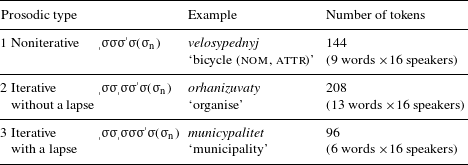
The data set consisted of 28 single-root words with primary stress either on the odd-numbered syllable or on the even-numbered syllable; see Appendix A. The lexical stress in the words chosen for the experiment fell on the antepenultimate, penultimate or final syllable. It was separated from the left edge by minimally three syllables and maximally five syllables. Overall, three prosodic types were distinguished, as shown in Table 1.Footnote [7]
Division of tokens.

In all the three types, secondary stress is expected to appear on the first syllable. Type 1 and type 3 are predicted to have a lapse on the pretonic syllable, and types 2 and 3, to have an additional secondary stress on the third syllable. Only words with the rightward iteration of the rhythmic stress are included in the present study.Footnote [8]
Care was taken to select words in accordance with criteria minimising the risk of biased results. First, words with consonantal clusters in the second or third syllable were discarded. Second, the distribution of high and non-high vowels in the second versus the third syllable did not show bias in favour of the iterative stress hypothesis.Footnote [9]
3.4 Experimental procedure
Recordings were produced in Ukraine, using an H4 Zoom portable digital audio recorder, set at a sampling rate of 44.1 kHz, and an AT897 microphone. Participants read the list of 28 words, consisting of single-root nouns, adjectives and verbs. The words were presented as a list of isolated words printed in Arial typeface, 13 pt letter size. Participants were asked to embed the tokens within a carrier sentence Vin skazav …druhyj raz ‘He said …for the second time’, which was printed at the top of the page. The critical item appeared in a position where it did not carry sentence stress and was not subject to sentence-final lengthening. Primary stress was marked orthographically to avoid hesitations on the speakers’ part.Footnote [10] The participants were asked to read the sentences at a natural pace, taking breaks when needed.
3.5 Data analysis
The data were analysed using Sound Forge and Praat (Boersma & Weenink Reference Boersma and Weenink1992–2017). Segmentation was done manually by the authors based on the inspection of the waveforms and the spectrograms as well as auditory perception. The syllable boundaries were marked at vowel–consonant junctures. In the tokens containing sonorant–obstruent clusters, the sonorant was syllabified into the coda of the first syllable. There were five such words in the data set: ver.sy.fi.ka.ci.ja ‘versification (noun)’, ver.sy.fi.ka.cij.nyj ‘versification (adj)’, kon.fe.de.ra.ci.ja ‘confederation’, kon.fe.de.ra.cij.nyj ‘confederate’, and or.ha.ni.zu.va.ty ‘organise’. Syllable boundaries were aligned with the beginning of the closure phase in stops and the onset of noise in fricatives. Sonorant consonants were identified according to the formant transitions between consonants and preceding vowels. Initial onsetless syllables were extracted on the basis of the formant structure and the dynamics of glottalisation patterns. Out of 448 recorded tokens, 94 tokens were rejected due to mispronunciations and hesitations on the speakers’ part. Rejected tokens were mostly long unfamiliar words of six or seven syllables. Additionally, 170 vowel-initial syllables were excluded from the statistical analyses in order not to underestimate the duration score of the initial syllable. We also discarded a handful of syllables containing clusters or codas. In total, 1410 syllables in six positions were included in the analysis.
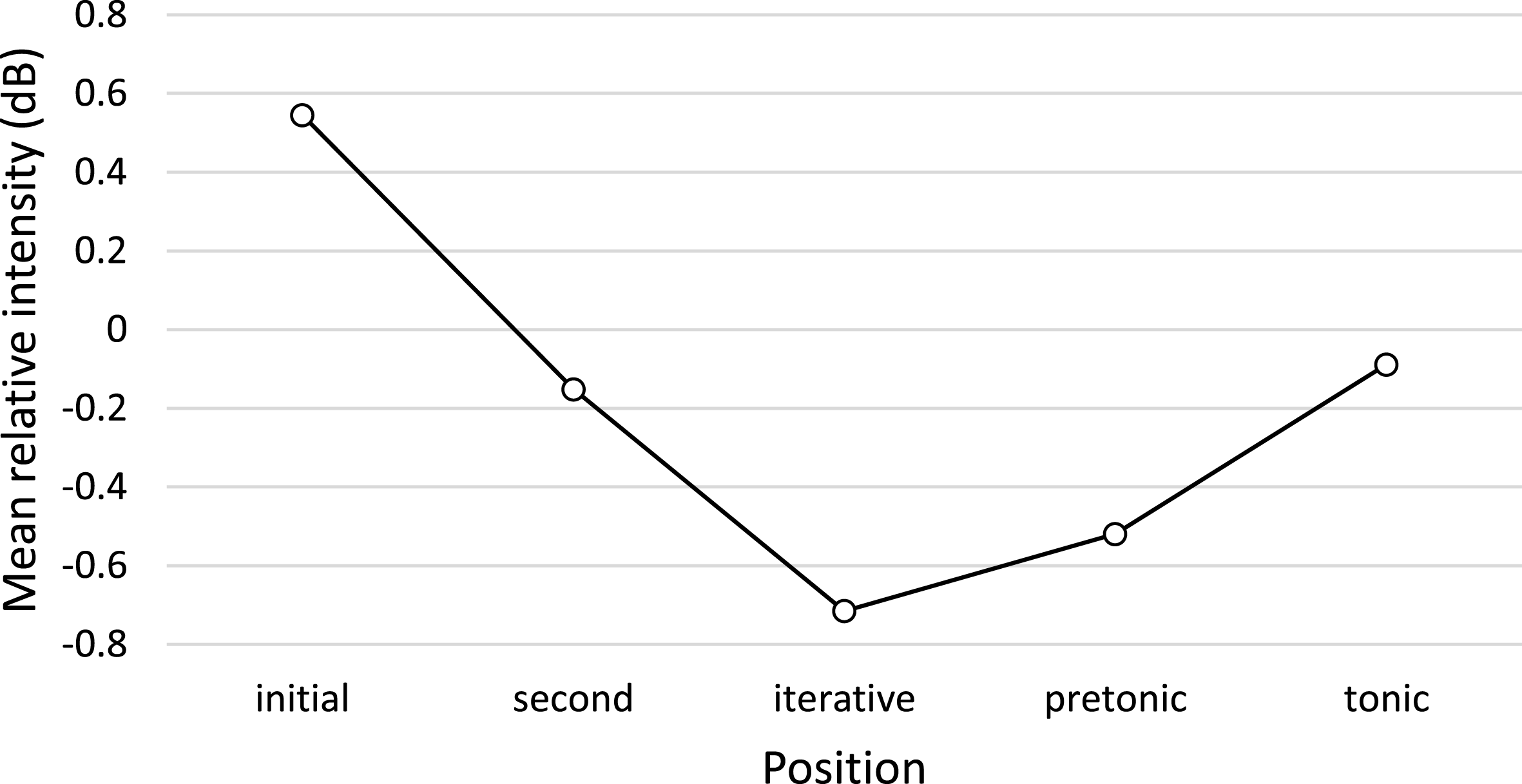
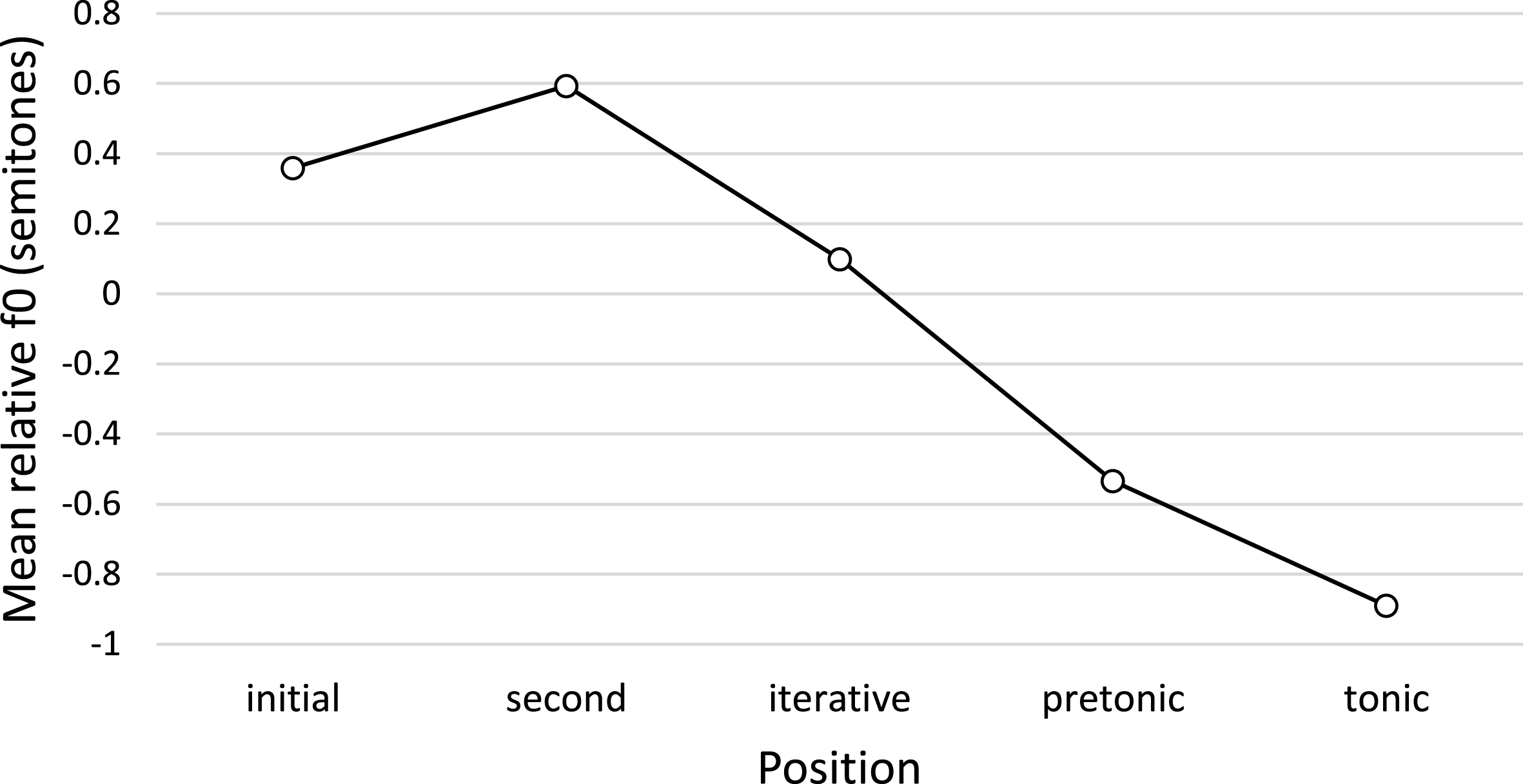
The parameters which usually manifest both primary and secondary stress include duration, intensity, and pitch change (Fry Reference Fry1955, Lehiste & Peterson Reference Lehiste and Peterson1959, Peterson & Lehiste Reference Peterson and Lehiste1960, Morton & Jassem Reference Morton and Jassem1965, Lehiste Reference Lehiste1970, Beckman Reference Beckman1986, Cutler Reference Cutler, Pisoni and Remez2005, Plag, Kunter & Schramm Reference Plag, Kunter and Schramm2011). However, a preliminary inspection of the collected data as well as the previous work on primary stress (Brovčenko Reference Brovčenko1969) have indicated that the main cue of stress in Ukrainian is duration. The results reported in an accompanying pilot study by Łukaszewicz & Mołczanow (Reference Łukaszewicz and Mołczanow2016) point to no correlation between increased intensity or f0 values and lexical or subsidiary stress in Ukrainian. The contours of the two parameters obtained for the iterative subset, i.e. ˌ
 $\unicode[STIX]{x1D70E}\unicode[STIX]{x1D70E}$
ˌ
 $\unicode[STIX]{x1D70E}\unicode[STIX]{x1D70E}$
ˈ
 $\unicode[STIX]{x1D70E}$
(
 $\unicode[STIX]{x1D70E}_{\text{n}}$
) words, are presented in Figures 1 and 2. Clearly, the tonic vowel is not characterised by the highest level of intensity or f0. Also, there is no discernible pattern of alternating stresses in the syllables preceding main stress.
Mean relative intensity in ˌ
 $\unicode[STIX]{x1D70E}\unicode[STIX]{x1D70E}$
ˌ
 $\unicode[STIX]{x1D70E}\unicode[STIX]{x1D70E}$
ˈ
 $\unicode[STIX]{x1D70E}$
(
 $\unicode[STIX]{x1D70E}_{\text{n}}$
) words. Relative intensity stands for amplitude standardised in dB (with average amplitude in the word as the reference level).

Mean relative f0 in
 $\unicode[STIX]{x1D70E}\unicode[STIX]{x1D70E}$
ˌ
 $\unicode[STIX]{x1D70E}\unicode[STIX]{x1D70E}$
ˈ
 $\unicode[STIX]{x1D70E}$
(
 $\unicode[STIX]{x1D70E}_{\text{n}}$
) words. Relative f0 stands for f0 standardised in semitones (with average f0 in the word as the reference level).

A recent acoustic study of secondary stress in Polish, which is geographically and historically related to Ukrainian, has revealed that secondary stress is expressed by an increased length of consonants in the onsets of stressed syllables (Łukaszewicz Reference Łukaszewicz2015, Reference Łukaszewiczto appear). As for Ukrainian, there are indications in the literature that vowels have different durations in unstressed syllables depending on their distance from lexical stress (Toc’ka Reference Toc’ka1973). Since it is possible that both vocalic and consonantal length may be affected in positions of secondary/tertiary stress, a decision was made to measure the duration of the whole syllable. Overall, we expect both primary and secondary/tertiary stress to be manifested by a substantial difference in duration of adjacent syllables.
There is no literature on just-noticeable differences in duration (JNDs) specific to Ukrainian. In the analyses below we tentatively assume 10 ms as the minimal threshold because it is generally agreed that, in the range of durations between 30–300 ms, JNDs are between 10–40 ms, although the limit of perceptibility under optimal conditions may be much smaller (Lehiste (Reference Lehiste1970: 13); see also the more recent work of Fletcher (Reference Fletcher, Hardcastle, Laver and Gibbon2010: 526) and the literature cited therein).Footnote [11]
4 Statistical analyses
Six non-overlapping positions were distinguished in the analyses: initial, second, iterative (optional), fourth (optional), pretonic, and tonic. The syllables in the three data subsets were coded as shown in (6). Based on the traditional descriptions, we expected to find longer duration in the initial, iterative, and tonic positions, relative to the neighbouring unstressed positions.

The statistical analyses were divided into two parts. The first set of analyses had a purely exploratory character and tackled all syllables regardless of their segmental content (Section 4.1). In order to control for the potentially confounding segmental factor, the second set of analyses was designed to compare segmentally identical syllables in different positions (Section 4.2).
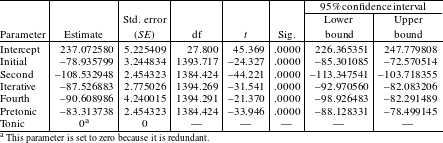
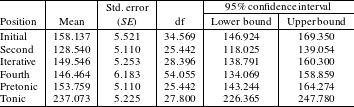
Estimates of fixed effects. Dependent variable: duration (ms).

Estimates of means. Dependent variable: duration (ms).

4.1 An overall analysis
The overall analysis was based on 1410 syllable tokens. All of the tokens were of the consonant–vowel type. All other syllable types were discarded.
The effect of stress on syllable duration was tested in terms of linear mixed-effects models, fitted in SPSS (version 23). Syllable duration may be affected considerably not only by prosodic position but also by other factors, such as inter-speaker differences in speech rate or word length. In order to control for such factors, the random effects of Speaker and Item were included. The competing models were compared in terms of likelihood ratio tests (e.g. Pinheiro & Bates Reference Pinheiro and Bates2000, Baayen Reference Baayen2008). The best fit was achieved by the linear mixed-effects model with random intercepts for Speaker and Item, and with Position as the fixed-effect term. The comparison of the nested models, using the standard chi-square reference, shows that the effect of stress is extremely significant (
 $\unicode[STIX]{x1D712}^{\text{2}}(5)=1282.108$
,
 $p<.0001$
). All positions exhibit significantly smaller duration compared to the baseline, i.e. the tonic position carrying lexical stress (see Table 2). The biggest distance is between the second and the tonic positions (
 $\unicode[STIX]{x1D6FD}_{\text{2}}=-108.5$
, SE
 $=$
2.45,
 $t=-44.22$
,
 $p<.0001$
.) The initial position (i.e. the secondary-stress carrying syllable) is the second longest syllable in the word (
 $\unicode[STIX]{x1D6FD}_{\text{1}}=-78.9$
, SE
 $=$
3.24,
 $t=-24.33$
,
 $p<.0001$
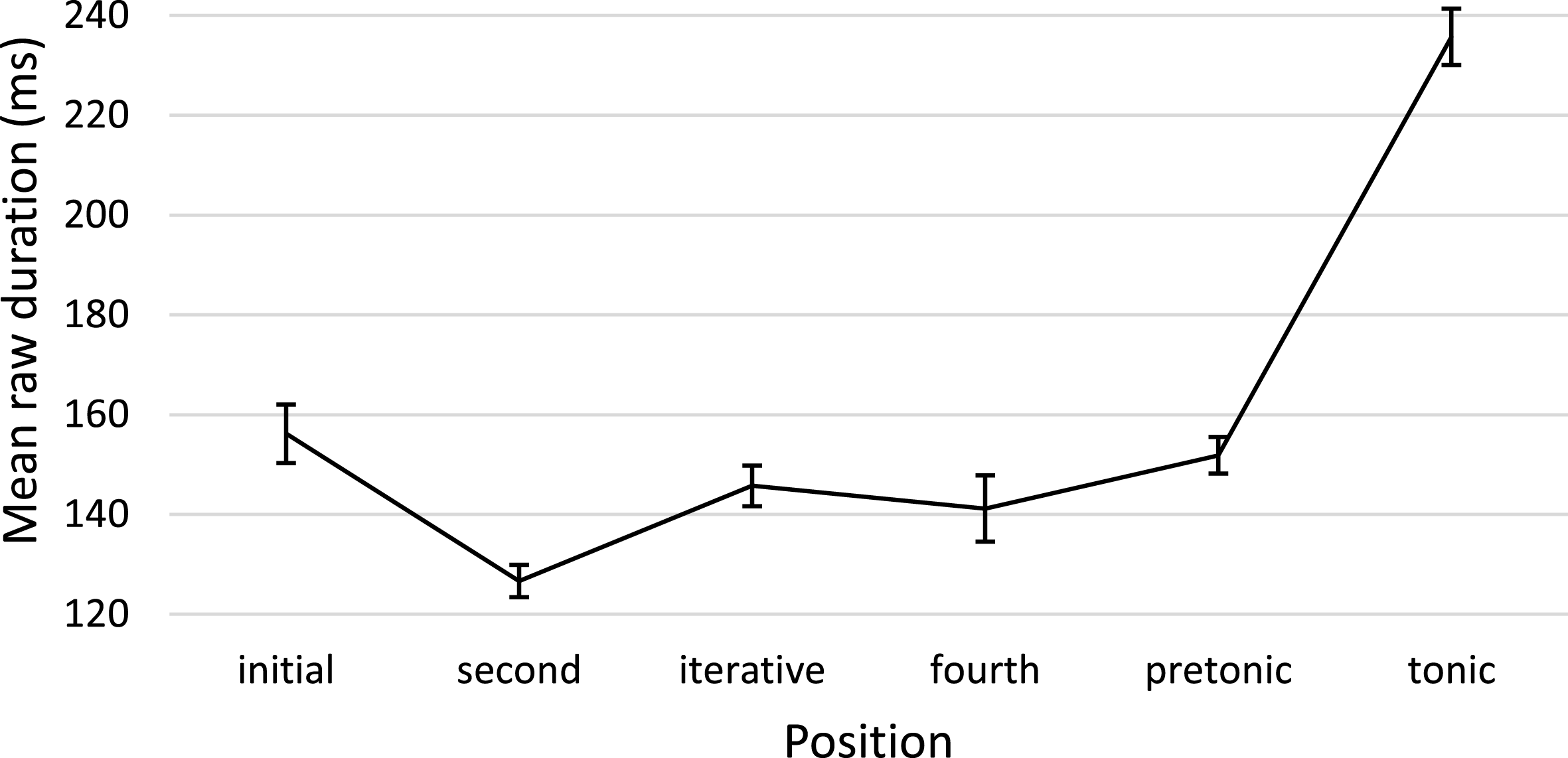
). Table 3 depicts the predicted mean durations for the six positions (see also Figure 3). Post-hoc pairwise comparisons (see Appendix B) confirm that the tonic syllable is significantly longer and the second syllable significantly shorter than all the other positions. On average, the initial syllable is 29.6 ms longer than the second syllable. A significant increase in duration is also reported for the iterative position (the tertiary-stress carrying syllable), which turns out 21 ms longer than the preceding (i.e. second) syllable (
 $p<.0001$
).
Mean syllable duration depending on position. (Error bars represent 95% confidence interval for the mean.)

As illustrated in Figure 3, changes in syllable durations form a wave-like pattern, in which we can discern three peaks – in the initial, iterative and tonic positions. There is no clear pattern of peaks and valleys corresponding to alternating stresses in the two syllables preceding the tonic syllable (fourth and pretonic): both the downward slope in the fourth syllable and the upward slope in the pretonic position turn out statistically insignificant. As the latter is followed by a much bigger and statistically significant rise in the tonic positon, we interpret it as a lengthening effect in the vicinity of lexical stress. Notably, pretonic lengthening recurs regardless of the type of the word, i.e. it is also seen in the noniterative subset. That is why we take it to be unconnected with rhythm and connected with the tonic syllable. In other words, in the close vicinity of the syllable carrying lexical stress, some kind of anticipation of the lexical stress takes place and there is no space for an alternating pattern of smaller peaks and valleys characteristic of rhythm.
4.2 An analysis of segmentally identical syllables
In order to dismiss a possibility that the rise on the iterative syllable could be caused by intrinsic differences in segmental length, another linear mixed-effects model was fitted to compare segmentally identical syllables in different positions. For the purpose of this analysis, we identified three CV syllables (ka, ni, li), each of which recurred in four word-medial positions in the data: second, iterative, fourth, and pretonic;Footnote [12] see Appendix C for the list of words. The analysis was based on 180 tokens (12 words). (Each syllable in each position was represented by 15 tokens.) To make the three segmentally different syllables comparable, raw duration values were standardised (z-scores were calculated). The random intercept for Speaker was included to control for individual differences in speech rate.
As in the previous analysis, the effect of Position turned out statistically significant (
 $\unicode[STIX]{x1D712}^{\text{2}}(3)=39.853$
,
 $p<.0001$
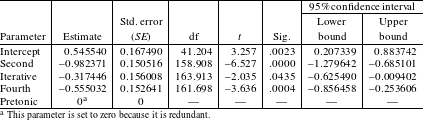
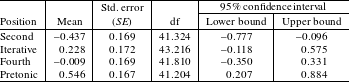
). The pretonic position was longer than all other positions at
 $\unicode[STIX]{x1D6FC}=.05$
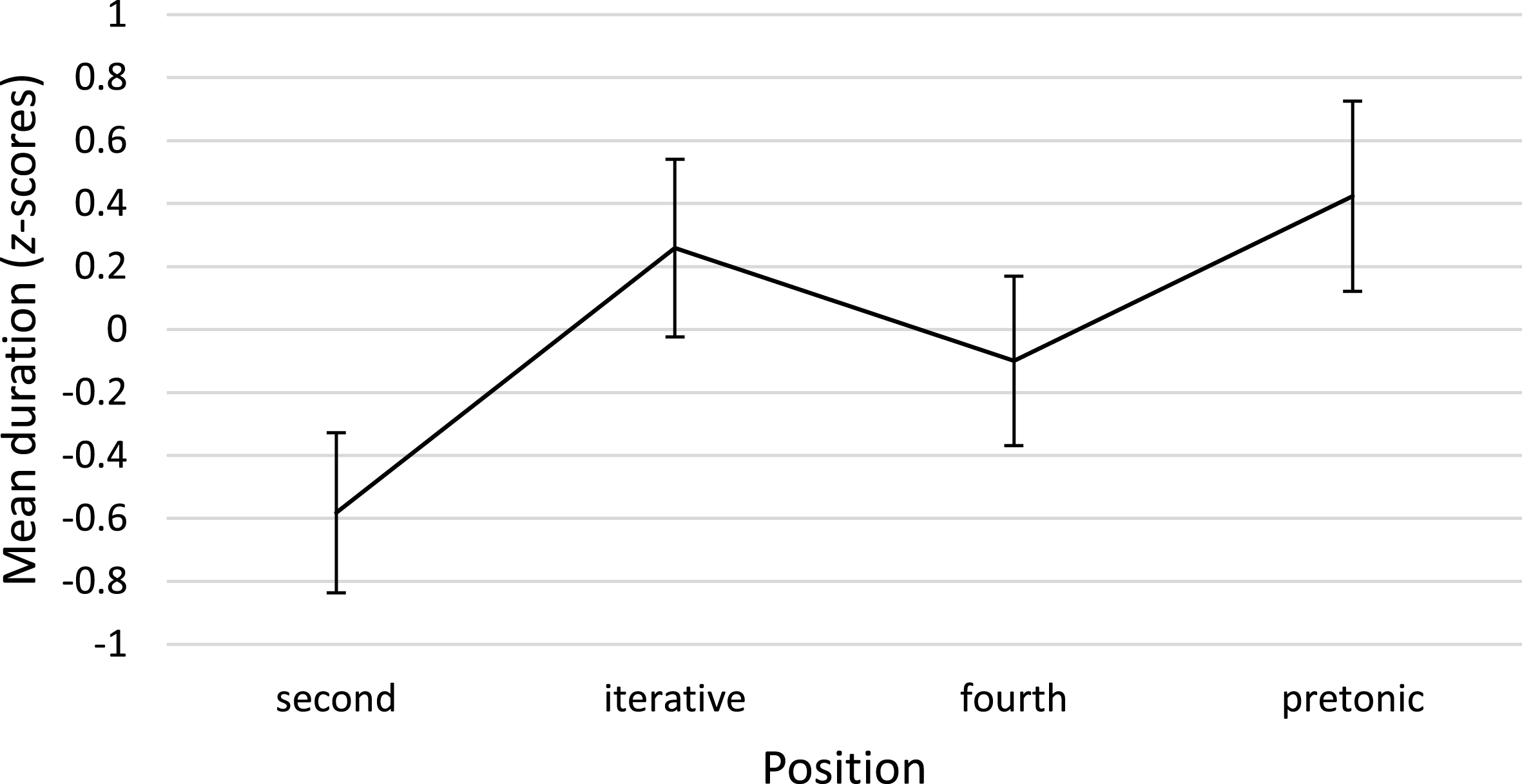
(see Table 4). Crucially, the biggest significant increase in syllable duration (by 0.665 standard deviation; see Appendix D) was found in the iterative position (compare the estimates for the mean standardised duration of the second and iterative syllables in Table 5). In raw duration terms, the iterative syllable was about 16 ms longer than the second syllable (
 $p<.0001$
). The fourth syllable was not statistically different from the iterative position (for post-hoc comparisons see Appendix D). Overall, these findings confirm the pattern obtained in the previous analysis (see also Figure 4).
Estimates of fixed effects. Dependent variable: duration (
 $z$
-scores).

Estimates of means. Dependent variable: duration (
 $z$
-scores).

Mean standardised syllable duration depending on position. (Error bars represent 95% confidence interval for the mean.)

5 Discussion
Investigations of stress in various languages have demonstrated that acoustic correlates of stress include increased duration, intensity, the fundamental frequency (f0) changes, as well as differences in vowel quality (e.g. Fry Reference Fry1955, Lehiste & Peterson Reference Lehiste and Peterson1959, Peterson & Lehiste Reference Peterson and Lehiste1960, Beckman Reference Beckman1986). Previous experimental research suggests that duration is the most robust cue to stress in Ukrainian (Brovčenko Reference Brovčenko1969). In the light of this finding as well as our pilot study and impressionistic evidence, the focus of the present experiment was on syllable duration measurements. The results of the current research corroborate both intuitive descriptions as well as previous experimental findings, and show that duration is a robust indicator of lexical stress. The comparison of lexically stressed and unstressed syllables has yielded statistically significant differences in length between the two prosodic positions. On average, syllables carrying primary stress are 1.5 times longer than other syllables within a word.
Furthermore, the present study has demonstrated that duration also cues rhythmic stress, which was detected on odd-numbered syllables counting from the left edge of the word. This finding is consistent with traditional descriptions of Ukrainian, which report secondary level of prominence on the basis of impressionistic evidence (Broch Reference Broch1910, Lehr-Spławiński Reference Lehr-Spławiński1916, Ziłyński Reference Ziłyński1932, Nakonečnyj Reference Nakonečnyj1969). Prior to the present study, there was no experimental research investigating acoustic correlates of secondary stress. Toc’ka (Reference Toc’ka1973) provides a phonetic characterisation of Ukrainian vowels, where she specifies relative duration of vowels in different prosodic positions. However, though she notes (on page 172) that ‘there is a tendency in Ukrainian to periodically shorten unstressed vowels in every second or third syllable’,Footnote [13] she does not explicitly relate the differences to possible occurrence of secondary stress.
An unexpected finding of the present experiment concerns the increased duration of the syllable immediately preceding the syllable with main stress. The nature of pretonic lengthening is presently little understood. It has been traditionally assumed that the minimum size of the unit of stress realisation is a syllable (Lehiste Reference Lehiste1970: 147). However, the Ukrainian data suggest that, at the phonetic level, the domain of stress can be extended to a preceding syllable. Let us note that pretonic lengthening is attested in some East Slavic dialects spoken at the Ukraine–Belarus border (Upper Snov Basin dialect type) and in Russia (Vladimir–Volga Basin dialect type) (Bethin Reference Bethin2006). Bethin (Reference Bethin2006) argues that the lengthening of pretonic syllables in these dialects is caused by the presence of a lexical high tone which is associated with the pretonic syllable. However, it is unlikely that the same mechanism underlies the Ukrainian lengthening. First, the immediately pretonic vowels are either equal in duration or longer than the stressed vowel in the East Slavic dialects referred to by Bethin (Reference Bethin2006), while pretonic syllables in standard Ukrainian are considerably shorter than the following stressed syllables (having less than two thirds of the tonic syllable’s length). Second, the data analysed in the present study were collected in Western Ukraine, which is geographically removed from the area where dialects with pretonic length are spoken.
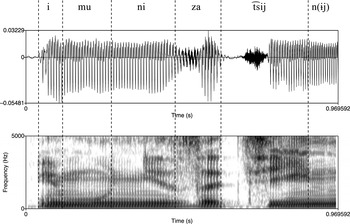
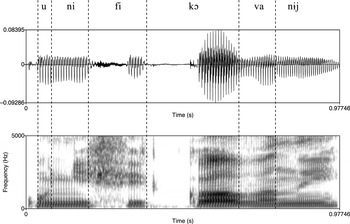
Similarly to Ukrainian, pretonic syllables are longer than syllables in other unstressed positions in Standard Russian, where relative duration of vowels in the first and second pretonic positions are 68% and 49% of the duration of the stressed vowel (Vysotskij Reference Vysotskij, Azarx, Bromlej and Bulatova1973, cited from Bethin Reference Bethin2006: 131). However, Russian is different from Ukrainian in that it does not have rhythmic stress. In contrast, in Ukrainian the duration of the syllable in second pretonic position varies depending on whether or not it appears in the position of tertiary stress. For example, the syllable ni occurs in the second pretonic position both in ˌimuˌ ni zaˈcijnyj ‘immunising’ and ˌu ni fiˈkovanyj ‘unified’, but it is 90 ms longer in the former due to rhythmic stress (208 ms vs. 118 ms), as illustrated in Figures 5 and 6, with data from a male speaker (M11). (It is interesting to note that the syllable za following the ni in imunizacijnyj is only 132 ms long, although it contains an open vowel.) To the best of our knowledge, no such difference has been reported to exist in Russian. The Ukrainian system is therefore more intricate as it exhibits a complex interplay of pretonic lengthening with rhythmic stress.
Waveform and spectrogram for ˌimuˌ ni zaˈcijnyj ‘immunising’. Data from a male speaker (M11).

Waveform and spectrogram for ˌ
 $u$
ni
fiˈkovanyj ‘unified’. Data from a male speaker (M11).

The detection of rhythmic stress in Ukrainian is an important result as it demonstrates that Ukrainian has a typologically rare bidirectional stress system in which rhythmic stress is located at the opposite edge of the lexical stress, with stress iteration on the intervening syllables and a lapse adjacent to the peak. The existence of bidirectional iterative stress systems has been recently called into question by Newlin-Łukowicz (Reference Newlin-Łukowicz2012), who failed to detect secondary stress in her experimental study of Polish, so far the best documented system with bidirectional iterative stress (Dłuska Reference Dłuska1932, Rubach & Booij Reference Rubach and Booij1985, Kraska-Szlenk Reference Kraska-Szlenk2003). However, Łukaszewicz (Reference Łukaszewiczto appear) provides acoustic evidence for the existence of consonantal rhythm in Polish based on increased duration of onset consonants. The current study demonstrates that a similar rhythmic pattern is found in Ukrainian, where secondary stress appears on initial and every odd-numbered syllable separated from the primary stress by at least one position. The two languages differ in the acoustic manifestation of the rhythmic stress: Polish employs consonant lengthening, while Ukrainian exhibits an increased duration of the whole syllable.
The stress pattern attested in Ukrainian proves the adequacy of theoretical models generating bidirectional systems with internal lapses (see van der Hulst Reference Hulst, Goedemans, van der Hulst and Visch1996, Reference Hulst and van der Hulst2014; Kager Reference Kager2001, Reference Kager2005; Gordon Reference Gordon2002; Hyde Reference Hyde2002, Reference Hyde2016; Alber Reference Alber2005; Bennett Reference Bennett2012, for different approaches). The fragment of Ukrainian metrical system discussed in this paper constitutes an example of a rightward iteration of secondary stresses towards the main stress located near the right word edge, which makes it similar to languages such as Polish (Dłuska Reference Dłuska1932), Piro (Matteson Reference Matteson1965) and Lenakel (Lynch Reference Lynch1978). These languages can be analysed equally well in terms of different theoretical models and so cannot be used to choose between the current prosodic theories.
Ukrainian is different from the classic bidirectional systems reported in the literature (as discussed in Section 1) where both primary and secondary stresses are predictable and can be derived by the same mechanism. Unlike other systems, it combines predictable rhythmic stress with unpredictable lexical stress which can move freely back and forth and change the rhythmic structure in its vicinity. As the present study is a first step towards a comprehensive description of the Ukrainian prosodic system, it has only considered words with lexical stress at or near the right word edge. Interestingly, a mirror image pattern potentially occurs in Ukrainian words with primary stress on or near the left edge of the word and secondary stresses to the right of the primary stress. Standard grammars note the presence of secondary stress in such words but disagree as to its exact location. For instance, Nakonečnyj (Reference Nakonečnyj1969: 360) asserts that the final syllable gets stressed whenever the initial primary stress is separated from the right edge of the word by two or more syllables, with additional prominence on the intermediate syllable, e.g. ˈlahodyˌty ‘repair’, ˈbačyˌtymeˌte ‘you will see’. It is not clear what happens in six-syllable words such as ˈvyskorožuvaty ‘to harrow’, which are not mentioned in Nakonečnyj (Reference Nakonečnyj1969). These words can potentially have secondary stress either on the second or the third syllable, in addition to the final subsidiary stress: ˈ
 $\unicode[STIX]{x1D70E}\unicode[STIX]{x1D70E}\unicode[STIX]{x1D70E}$
ˌ
 $\unicode[STIX]{x1D70E}\unicode[STIX]{x1D70E}$
ˌ
 $\unicode[STIX]{x1D70E}$
or ˈ
 $\unicode[STIX]{x1D70E}\unicode[STIX]{x1D70E}$
ˌ
 $\unicode[STIX]{x1D70E}\unicode[STIX]{x1D70E}\unicode[STIX]{x1D70E}$
ˌ
 $\unicode[STIX]{x1D70E}$
. Both patterns are predicted to be unattested in Kager’s (Reference Kager2001, Reference Kager2005) typology. The structure ˈ
 $\unicode[STIX]{x1D70E}\unicode[STIX]{x1D70E}$
ˌ
 $\unicode[STIX]{x1D70E}\unicode[STIX]{x1D70E}\unicode[STIX]{x1D70E}$
ˌ
 $\unicode[STIX]{x1D70E}$
, with a lapse between secondary stresses, would also be ruled out by van der Hulst’s (Reference Hulst, Goedemans, van der Hulst and Visch1996, Reference Hulst and van der Hulst2014) model, which predicts that it cannot coexist within one language with the pattern ˌ
 $\unicode[STIX]{x1D70E}\unicode[STIX]{x1D70E}$
ˌ
 $\unicode[STIX]{x1D70E}\unicode[STIX]{x1D70E}\unicode[STIX]{x1D70E}$
ˈ
 $\unicode[STIX]{x1D70E}$
. In this respect, the Ukrainian system is especially interesting as it offers an excellent testing ground for existing metrical theories. Needless to say, this issue cannot be settled without further acoustic research demonstrating whether secondary stresses are present to the right of the primary stress in Ukrainian, and, if so, determining the location of the lapse (see Łukaszewicz & Mołczanow Reference Łukaszewicz, Mołczanow, Czaplicki, Łukaszewicz and Opalińskato appear).
6 Conclusion
This paper has reported on an acoustic study of stress in Ukrainian, a language which has not received much attention in the phonological literature. The phonetic measurements have revealed secondary degree of stress, manifested by increased syllable duration. Moreover, a complex pattern of rhythmic stress has been detected on odd-numbered syllables in words with main (lexical) stress on the right-hand word edge with a lapse next to the primary stress: (ˌ
 $\unicode[STIX]{x1D70E}\unicode[STIX]{x1D70E}$
)(ˌ
 $\unicode[STIX]{x1D70E}\unicode[STIX]{x1D70E}$
)
 $\unicode[STIX]{x1D70E}$
(ˈ
 $\unicode[STIX]{x1D70E}\unicode[STIX]{x1D70E}$
). This is an important result for two reasons. First, traditional sources provide contradictory descriptions of secondary stress, not agreeing as to its location or even denying its presence in Ukrainian. Second, this study provides evidence of a typologically rare bidirectional stress, whose existence has been recently called into question (Newlin-Łukowicz Reference Newlin-Łukowicz2012).
As the present study has not intended to provide a complete acoustic description of the Ukrainian stress system, we limited its purview to acoustic measurements of syllable duration in words with main stress on the right edge. More research is needed to investigate words with primary stress in the medial position and at the left edge of the word, including the measurements of intensity and pitch levels, as well as vowel quality, as potential cues to stress in Ukrainian.
APPENDIX A
List of words

APPENDIX B
Mean differences in duration (ms)

APPENDIX C
Items used to compare durations of segmentally identical syllables in different prosodic positions

APPENDIX D
Mean differences in duration (z-scores)