INTRODUCTION
There has been considerable effort devoted to developing sensitive, noninvasive behavioral markers for the earliest detectable onset of Alzheimer’s disease (AD). It is well known that the pathological changes associated with AD are present a decade or more before the behavioral symptoms are apparent (Bateman et al., Reference Bateman, Xiong, Benzinger, Fagan, Goate, Fox, Marcus, Cairns, Xie, Blazey, Holtzman, Santacruz, Buckles, Oliver, Moulder, Aisen, Ghetti, Klunk, McDade, Martins, Masters, Mayeux, Ringman, Rossor, Schofield, Sperling, Salloway and Morris2012; Price et al., Reference Price, McKeel, Buckles, Roe, Xiong, Grundman, Hansen, Petersen, Parisi, Dickson, Smith, Davis, Schmitt, Markesbery, Kaye, Kurlan, Hulette, Kurland, Higdon, Kukull and Morris2009; Sperling et al., Reference Sperling, Aisen, Beckett, Bennett, Craft, Fagan and Phelps2011). Thus, it is important to identify preclinical behavioral markers in individuals who appear cognitively normal but are at increased risk for developing the disease.
Although much of the past work has focused on cognitive markers, specific personality traits have also been identified as behavioral risk factors that appear to be sensitive to the early detection of AD. For example, in an early cross-sectional study, Duchek, Balota, Storandt and Larsen (Reference Duchek, Balota, Storandt and Larsen2007) found that individuals with very mild AD had higher scores on neuroticism and lower scores on conscientiousness, compared with cognitively normal controls. Interestingly, neuroticism and conscientiousness scores discriminated these two groups as well as a highly sensitive composite measure of episodic memory performance.
There have also been large-scale longitudinal studies that indicate high neuroticism and low conscientiousness may place individuals at a greater risk for developing AD. Several studies have reported a link between baseline neuroticism and conscientiousness and subsequent onset of dementia (Crowe et al., Reference Crowe, Andel, Pedersen, Fratiglioni and Gatz2006; Duberstein et al., Reference Duberstein, Chapman, Tindle, Sink, Bamonti, Robbins, Jerant and Franks2011; Terracciano et al., Reference Terracciano, Sutin, An, O’Brien, Ferrucci, Zonderman and Resnick2014; Wilson et al., Reference Wilson, Evans, Bienias, Mendes de Leon, Schneider and Bennett2003, Reference Wilson, Schneider, Arnold, Bienias and Bennett2007). In a recent large-scale study, Terracciano, An, Sutin, Thambisetty, and Resnick (Reference Terracciano, An, Sutin, Thambisetty and Resnick2017) reported high neuroticism and low conscientiousness were independently associated with increased risk of cognitive impairment and dementia, and also low conscientiousness predicted conversion from mild cognitive impairment without dementia to a clinical diagnosis of dementia.
It is interesting to note that relative to the other traits in the Big Five model of personality (i.e., extraversion, openness, agreeableness), neuroticism and conscientiousness are the two traits that consistently have been related to AD risk. A priori, one might expect neuroticism to be predictive of disease onset given the well-established link between chronic stress and dysregulation in the hypothalamic–pituitary adrenal (HPA) axis (e.g., Zobel et al., Reference Zobel, Barkow, Schulze-Rauschenbach, von Widdern, Metten, Pfeiffer, Schnell, Wagner and Maier2004), which in turn has been associated with changes in hippocampal structure and function (e.g., Baker & Kim, Reference Baker and Kim2002; McEwen & Magarinos, Reference McEwen and Magarinos2001). Moreover, there is substantial evidence that hippocampal volume mediates memory performance (e.g., Fjell & Walhovd, Reference Fjell and Walhovd2010; Head, Rodrigue, Kennedy, & Raz, Reference Head, Rodrigue, Kennedy and Raz2008; Squire, Reference Squire1987) and neuropathological changes in hippocampal structures accompany AD onset (e.g., Price, Davis, Morris, & White, Reference Price, Davis, Morris and White1991). In this light, Wilson et al. (Reference Wilson, Evans, Bienias, Mendes de Leon, Schneider and Bennett2003, Reference Wilson, Schneider, Arnold, Bienias and Bennett2007) have argued that exposure to chronic stress (as exhibited in individuals high in neuroticism) over time may produce changes in the hippocampal formation, thereby rendering an individual more susceptible to lower levels of overall neuropathology.
There are also reasons why conscientiousness may be an important behavioral marker of AD. Conscientiousness is defined as being dependable, reliable, goal-directed, self-disciplined, and in control of impulses (Costa & McCrae, Reference Costa and McCrae1992). Conscientiousness has been linked to a myriad of outcomes (see Bogg & Roberts, Reference Bogg and Roberts2013, for a review), including health outcomes (Bogg & Roberts, Reference Bogg and Roberts2004), depressive symptoms (Kendler, Gatz, Gardner, & Pederse, Reference Kendler, Gatz, Gardner and Pederse2006), occupational and educational attainment (Lodi-Smith et al., Reference Lodi-Smith, Jackson, Bogg, Walton, Wood, Harms and Roberts2010), and even mortality (Friedman et al., Reference Friedman, Tucker, Tomlinson-Keasey, Schwartz, Wingard and Criqui1993; Wilson et al., Reference Wilson, de Leon, Bienias, Evans and Bennett2004). Hence, it is quite possible that individuals high in conscientiousness are more likely to engage in health and lifestyle behaviors that may serve to protect against the accumulation of AD neuropathology and hence reduce risk for AD onset (e.g., Bogg & Roberts, Reference Bogg and Roberts2013; Chapman et al., Reference Chapman, Roberts and Duberstein2011; Terracciano & Sutin, Reference Terracciano and Sutin2019; Terracciano et al., Reference Terracciano, Iacono, O’Brien, Troncoso, An, Sutin, Ferrucci, Zonderman and Resnick2013; Wilson et al., Reference Wilson, Schneider, Arnold, Bienias and Bennett2007).
Given that neuropathology consistent with AD is present in the brains of cognitively normal older individuals decades before the onset of the disease (e.g., Bateman et al., Reference Bateman, Xiong, Benzinger, Fagan, Goate, Fox, Marcus, Cairns, Xie, Blazey, Holtzman, Santacruz, Buckles, Oliver, Moulder, Aisen, Ghetti, Klunk, McDade, Martins, Masters, Mayeux, Ringman, Rossor, Schofield, Sperling, Salloway and Morris2012; Price et al., Reference Price, McKeel, Buckles, Roe, Xiong, Grundman, Hansen, Petersen, Parisi, Dickson, Smith, Davis, Schmitt, Markesbery, Kaye, Kurlan, Hulette, Kurland, Higdon, Kukull and Morris2009), there also has been interest in identifying how biomarkers for the disease may influence the relationship between personality and behavioral symptoms of dementia. For example, Jackson, Balota, and Head (Reference Jackson, Balota and Head2011) have reported that high neuroticism and low conscientiousness are associated with reduced volume in prefrontal and medial temporal areas. Dar-Nimrod et al. (Reference Dar-Nimrod, Chapman, Franks, Robbins, Porsteinsson, Mapstone and Duberstein2012) have argued that the risk for cognitive decline as a function of APOE status is modulated by neuroticism (i.e., APOE-4 risk for cognitive decline is greater for individuals high in neuroticism). In an autopsy study, Terracciano et al. (Reference Terracciano, Iacono, O’Brien, Troncoso, An, Sutin, Ferrucci, Zonderman and Resnick2013) found that individuals low in neuroticism and high in conscientiousness were more likely to remain asymptomatic in the presence of AD neuropathology, suggesting these personality characteristics may afford cognitive resilience in the face of accumulating brain pathology. Finally, in a recent study of healthy controls and individuals with mild cognitive impairment or mild AD, Tautvydaitė, Antonietti, Henry, von Gunten, and Popp (Reference Tautvydaitė, Antonietti, Henry, von Gunten and Popp2017) reported that retrospective informant ratings of neuroticism and conscientiousness accompanied by abnormal levels of cerebral spinal fluid (CSF) biomarkers predicted cognition as defined by CDR sum of box scores (Morris, Reference Morris1993). Thus, there is an emerging literature that the personality traits of neuroticism and conscientiousness may be related to biomarkers that predict risk for the onset of AD.
The present study further explores this relationship in a large well-characterized longitudinal sample, with a rich set of AD-related biomarkers, and estimates of personality from both self- and informant reports. In this light, we have three major goals. First, we further explore the relationship between conscientiousness and neuroticism in the discrimination between healthy aging and the earliest detectable stage of AD, via cross-sectional analyses. Second, we further examine the extent to which baseline neuroticism and conscientiousness predict conversion from healthy aging to early-stage AD, utilizing longitudinal data. Third, and most critically, we examine the role of biomarkers in mediating any observed relationship between neuroticism/conscientiousness and dementia status/conversion to early-stage AD observed in the first two goals.
The present project adds to the available literature in the following three ways. First, previous studies have utilized either baseline self-report (e.g., Duberstein et al., Reference Duberstein, Chapman, Tindle, Sink, Bamonti, Robbins, Jerant and Franks2011, Terracciano et al., Reference Terracciano, Sutin, An, O’Brien, Ferrucci, Zonderman and Resnick2014; Wilson et al., Reference Wilson, Evans, Bienias, Mendes de Leon, Schneider and Bennett2003, Reference Wilson, Schneider, Arnold, Bienias and Bennett2007) or retrospective informant report (e.g., Tautvydaitė et al., Reference Tautvydaitė, Antonietti, Henry, von Gunten and Popp2017) and have not examined the convergence of self- and informant reports of personality in predicting dementia status or conversion to dementia. Second, we examine the relative predictive power of well-established biomarkers compared with personality in discriminating healthy aging from earliest stages of AD, and longitudinal conversion from healthy aging to dementia. Third, this rich dataset affords an examination of any potential mediating effects of a wide range of multiple well-established AD biomarkers (amyloid imaging, hippocampal volume, CSF Aβ42, CSF tau) in understanding any observed relationship between personality and dementia status (CDR 0 vs.CDR 0.5) or conversion from healthy aging to dementia (CDR 0 to CDR ≥0.5).
METHODS
Participants
Five hundred and ten individuals participated in this study; 436 cognitively normal older adults (CDR 0; 57% female) and 74 individuals with very mild AD (CDR 0.5; 32% female).Footnote 1Participants were recruited from the Charles and Joanne F. Knight Alzheimer’s Disease Research Center at Washington University in St. Louis, as part of an ongoing longitudinal research program on AD progression. All participants were originally screened for depression with the Geriartic Depression Scale (GDS short form; Yesavage et al., Reference Yesavage, Brink, Rose, Lum, Huang, Adey and Leirer1983), untreated hypertension, reversible dementias, and other disorders that could potentially produce cognitive impairment. The inclusionary and exclusionary criteria for AD are consistent with the criteria set forth by the National Institute of Neurological and Communicative Disorders and Stroke/Alzheimer’s Disease and Related Disorders Association (McKhann et al., Reference McKhann, Drachman, Folstein, Katzman, Price and Stadlan1984). We staged the severity of dementia according to the Washington University Clinical Dementia Rating (CDR) scale (Morris, Reference Morris1993). The CDR is based on a 90-min clinical interview that assesses both the participant and relies on information from an informant concerning the participant without reference to neuropsychological test performance. According to this scale, CDR scores of 0, 0.5, 1, 2, and 3 represent no dementia, very mild dementia, mild dementia, moderate dementia, and severe dementia, respectively. We focus here on the CDR scores of 0 and 0.5 to examine the earliest detectable stages of symptomatic dementia. It should be noted that we refer to this earliest stage as very mild AD (CDR 0.5), rather than MCI. In a longitudinal study, Storandt, Grant, Miller, and Morris (Reference Storandt, Grant, Miller and Morris2006) found that individuals who were CDR 0.5 who met criteria for MCI progressed faster than individuals who were CDR 0.5 but were not yet impaired enough to meet MCI criteria. This suggests that a CDR of 0.5 represents an earlier stage of AD than MCI because the CDR relies upon information regarding intraindividual change rather than group norms. Both the reliability of the CDR (Burke et al., Reference Burke, Miller, Rubin, Morris, Coben, Duchek, Wittels and Berg1988) and the validation of the diagnosis of AD (based upon autopsy) have previously been shown to be excellent (Berg et al., Reference Berg, McKeel, Miller, Storandt, Rubin, Morris, Baty, Coats, Norton, Goate, Price, Gearing, Mirra and Saunders1998; Storandt et al., Reference Storandt, Grant, Miller and Morris2006). The Washington University in St. Louis Institutional Review Board approved this study.
Materials and Procedure
All participants and their informant (i.e., typically a spouse or adult child) filled out the NEO Five-Factor Inventory (NEO-FFI; Costa & McCrae, Reference Costa and McCrae1992). NEO-FFI measures the five factors of neuroticism, extraversion, openness, agreeableness, and conscientiousness. Based on the extant literature reviewed above, we focus on the traits of neuroticism and conscientiousness in this study. Participants and informants filled out the form at the time of the participants’ clinical visit. There is relatively good agreement between self- and informant report ratings for individuals with very mild AD (Duchek et al., Reference Duchek, Balota, Storandt and Larsen2007; Rankin, Baldwin, Pace-Savitsky, Kramer, & Miller, Reference Rankin, Baldwin, Pace-Savitsky, Kramer and Miller2005). In the present study, the correlations between self- and informant report across all participants were as follows: neuroticism r = .46; conscientiousness r = .44 (all p’s < .001), after controlling for age.
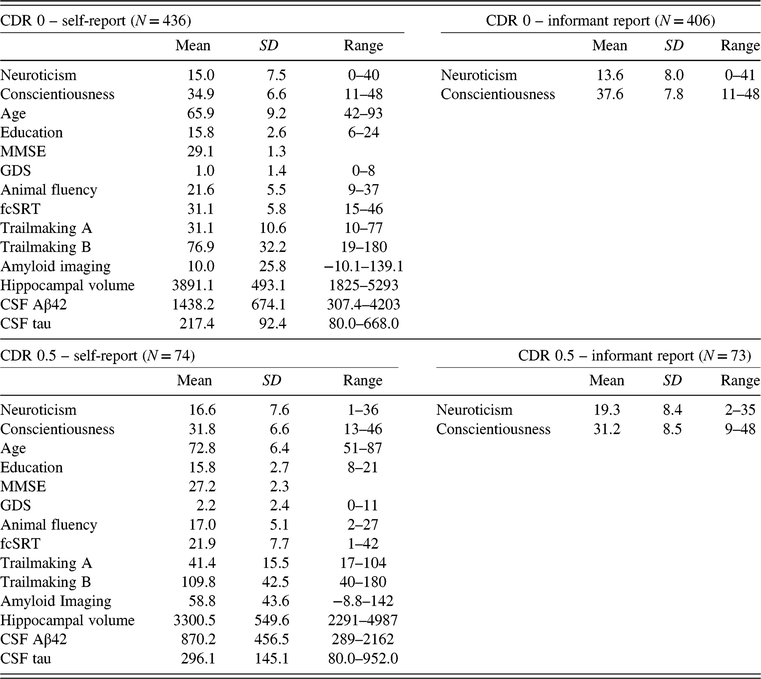
Participant characteristics including MMSE, GDS, neuropsychological test scores, and biomarkers scores for the CDR 0s and 0.5s, along with the raw scores for neuroticism and conscientiousness for self- and informant report, are presented in Table 1. It is important to note that although there were missing values for some informant reports, the overall response rate was very high (86%). In this sample, 35% and 62% were APOE 4+ for the CDR 0 and CDR 0.5 groups, respectively.
Participant demographic characteristics, NEO raw scores, and biomarkers a function of CDR and self- versus informant report

Notes: GDS refers to the Geriatric Depression Scale (short form – scored 0–15, score ≥5 suggests depression). Animal fluency is scored as the number of animals named in 1 min. fcSRT represents the Free and Cued Selective Reminding Test, free recall score. Trailmaking A and B are scored as number of seconds (180 max).
Biomarkers
To address the mediating effects of biomarkers on personality and dementia status and dementia conversion, we selected subsamples of our CDR 0 and CDR 0.5 participants with NEO self-report data who also had amyloid imaging (CDR 0, N = 393; CDR 0.5, N = 38), hippocampal volumetric estimates, CSF Aβ42, and CSF tau (CDR 0, N = 436; CDR 0.5, N = 74) data available. We selected four years as the cutoff interval between baseline NEO assessment and biomarker assessment. The average interval between MRI and NEO was 295 days (SD = 363) and between lumbar puncture and NEO was 162 days (SD = 248).
Amyloid imaging. Amyloid PET imaging was acquired using either florbetapir (18F-AV-45) or [11C] PiB. Full details of the scanning procedure have been described elsewhere (Su et al., Reference Su, D’Angelo, Vlassenko, Zhou, Snyder, Marcus, Blazey, Christensen, Vora, Morris, Mintun and Benzinger2013). Imaging data were converted to standardized uptake value ratios (SUVRs) using the cerebral cortex as the reference region. A regional spread function approach was used for partial volume correction, and amyloid deposition was quantified as an average across the following regions: left and right lateral orbitofrontal, medial orbitofrontal, rostral middle frontal, superior frontal, superior temporal, middle temporal, and precuneus.
Hippocampal volume. MRI scans were obtained on a Sonata 1.5T, Vision 1.5T, or Trio 3.0T scanner (Siemens Corporation). Structural MRI processing steps have been described in detail previously (Buckner et al., Reference Buckner, Head, Parker, Fotenos, Marcus, Morris and Snyder2004; Xiong et al., Reference Xiong, Roe, Buckles, Fagan, Holtzman, Balota, Duchek, Storandt, Mintun, Grant, Snyder, Head, Benzinger, Mettenburg, Csernansky and Morris2011) and included motion correction, averaging across scans, atlas transformation, and inhomogeneity correction. Regional volumes were obtained via the Freesurfer image analysis suite (version 4.1.0, Athinoula A. Martinos Center for Biomedical Imaging, Charlestown, Massachusetts). Hippocampal volume was selected as the region of interest (ROI) in this analysis and corrected for total brain volume.
CSF Aβ42 and CSF tau. Following Fagan et al. (Reference Fagan, Roe, Xiong, Mintun, Morris and Holtzman2007), after participants fasted overnight, 20- to 30-ml samples of CSF were collected via a lumbar puncture, then aliquoted (500 μl) in polypropylene tubes, and stored at −84°C. Samples were analyzed after a single thaw using ELISA (INNOTEST, Fujirebio [formerly Innogenetics], Ghent, Belgium).
Statistics
NEO scores and biomarker values were converted to z-scores standardized to the first NEO assessment (and closest associated biomarker) for the entire sample of CDR 0s and CDR 0.5s. Age, also z-scored, was treated as a covariate in all of the following analyses.Footnote 2 Logistic regression analyses were performed to determine whether: (1) neuroticism and conscientiousness discriminate CDR 0 and CDR 0.5 groups; (2) biomarkers discriminate CDR 0 and CDR 0.5 groups; (3) baseline neuroticism and conscientiousness predict conversion from CDR 0 to CDR ≥0.5; (4) baseline biomarkers predict conversion from CDR 0 to CDR ≥0.5. There were 47 individuals in this sample who converted from CDR 0 to CDR ≥0.5 during this study period. To maximize our sample size, we only included two times of testing for the longitudinal analyses, which averaged 6.95 years apart.
Linear regression analyses were performed to determine whether biomarkers mediated any observed relationship: (1) between neuroticism/conscientiousness and CDR status; (2) between neuroticism/conscientiousness and dementia conversion. Mediation analyses were conducted using the lavaan package (Yves, Reference Yves2012) in the R statistical environment. In each model, personality was specified as the independent variable and CDR status or conversion as the outcome. Individual biomarkers were entered into the model as proposed mediators. The indirect effect (i.e., the extent to which a biomarker mediates the relationship between personality and CDR) was calculated as the product of the β weights predicting the biomarker from personality (the “a” path) and predicting CDR status from the biomarker (the “b” path). Standard errors of these estimates were generated using the delta method (Oehlert, Reference Oehlert1992). A significance value of p < .01 was adopted across all analyses due to multiple comparisons.
Results
Discriminating Healthy Aging (CDR 0) from the Very Earliest Stage of AD (CDR 0.5)
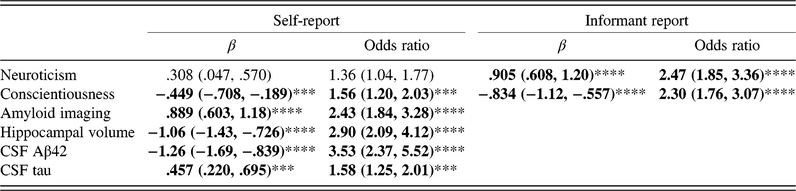
As predicted, based on self-report, the CDR 0.5 group had lower conscientiousness scores (p < .001) and marginally higher neuroticism (p = .021) than the CDR 0 group (Table 2). Also, as shown in Table 2, these differences were even larger in the informant report data, with both conscientiousness and neuroticism producing highly reliable effects (both p’s < .0001). Of course, one might be concerned that the higher neuroticism ratings in the informant report may be due to some participants having very mild depression (as reflected by GDS scores) in the CDR 0.5 group. However, the higher neuroticism ratings in the CDR 0.5 group remained after controlling for GDS scores, p = .01.
β weights and odds ratios (95% CI) for CDR discrimination based on NEO self- and informant reports and biomarkers

**p < .01, ***p < .001, ****p < .0001.
Amyloid imaging, hippocampal volume, CSF Aβ42, and CSF tau discriminated the CDR 0 versus CDR 0.5 groups (Table 2) indicating clear sensitivity of these biomarkers. Interestingly, the partial correlations (controlling for age) between each of the biomarkers and neuroticism and conscientiousness were unsystematic and quite small, with the exception of hippocampal volume, which was negatively related to neuroticism (−.17, p < .001 for informant report and −.10, p < .05, for self-report) and positively related to conscientiousness (.19, p < .001 for informant report and .10, p < .05, for self-report). The only remaining correlations that approached significance were between CSF tau and neuroticism (.10, p < .10 for informant ratings, and .11, p < .05 for self-ratings).
Do Biomarkers Mediate the Relationship Between Neuroticism and Conscientiousness and Dementia (CDR) Status?
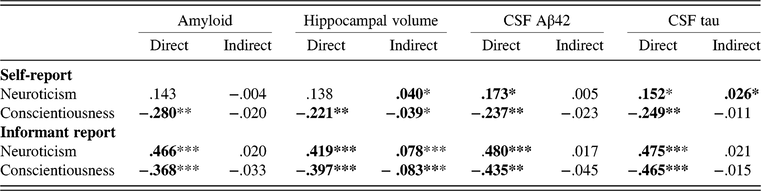
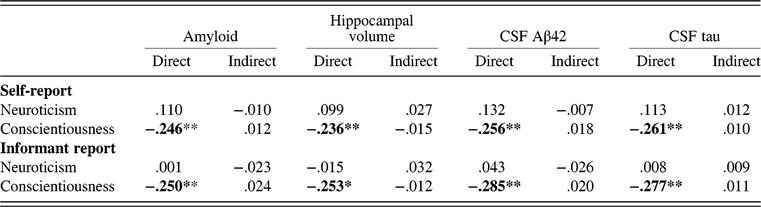
Table 3 displays both the direct effect between neuroticism/conscientiousness and CDR and the indirect effect that represents the extent to which a specific biomarker mediates a given personality–CDR relationship. First, consider the self-report data. As shown, there is relatively little evidence of biomarker mediation for neuroticism and conscientiousness, with the exception of two mediational effects that may be expected a priori (Jackson et al., Reference Jackson, Balota and Head2011; Wilson et al., Reference Wilson, Evans, Bienias, Mendes de Leon, Schneider and Bennett2003, Reference Wilson, Schneider, Arnold, Bienias and Bennett2007). Specifically, there was a marginally reliable mediation of hippocampal volume on the relationship between both neuroticism (p = .028) and conscientiousness (p = .047) and CDR status. Turning to the informant report relationships, a similar but much stronger pattern was observed. Specifically, hippocampal volume significantly mediated the relationship between both neuroticism (p < .001) and conscientiousness (p = .0002) and CDR status, indicating that hippocampal volume accounts for some of the shared variance between personality and CDR status.
β weights for personality–CDR relationship as mediated by biomarkers as a function of self and informant reports

Notes: The direct effect represents the direct relationship between neuroticism/conscientiousness and CDR. The indirect effect represents the relationship between neuroticism/conscientiousness and CDR, mediated by each biomarker.
*p < .05, **p < .01, ***p < .001.
Predicting Conversion from Healthy Aging (CDR 0) to Early-Stage AD (CDR ≥0.5)
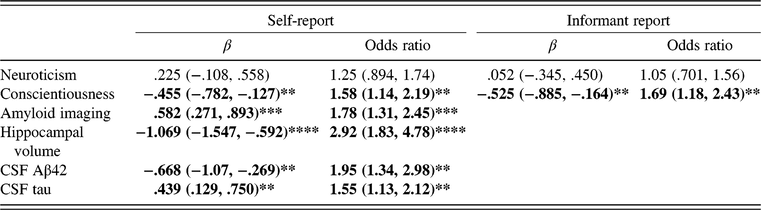
As shown in Table 4, baseline conscientiousness strongly predicted conversion in both self- and informant report. Cognitively normal participants (CDR 0) lower in conscientiousness at baseline were more likely to convert to CDR ≥0.5 than individuals high in conscientiousness at baseline.
β weights and odds ratios (95% CI) for conversion to dementia based on NEO self- and informant reports and biomarkers

** p < .01, *** p < .001, **** p < .0001.
The results also demonstrated clear sensitivity of the biomarkers in predicting conversion. Specifically, amyloid imaging estimates, hippocampal volume, CSF Aβ42, and CSF tau at baseline predicted conversion (see Table 4). It is noteworthy that the β weights and corresponding odds ratios are much larger for hippocampal volume than the other biomarkers. Importantly, with the exception of hippocampal volume, conscientiousness was comparable to the remaining biomarkers in predicting conversion based on both self- and informant reports. To further examine this issue, we included hippocampal volume and informant report of conscientiousness in a stepwise regression model and found that conscientiousness predicted conversion above and beyond hippocampal volume (χ 2(1) = 7.31, p = .007).
In addition to the above analyses, we also created a cognitive composite measure from the neuropsychological measures in Table 1 [z-scored to a reference sample of biomarker negative, healthy older adults (Hassenstab et al. Reference Hassenstab, Chasse, Grabow, Benzinger, Fagan, Xiong, Jasielec, Grant and Morris2016)] to assess if another powerful behavioral marker (cognition) predicted conversion. The results were quite clear. Although this cognitive composite strongly discriminated CDR 0 participants from CDR 0.5s (β = −1.29, odds ratio = 3.61, p < .0001), it did not predict conversion (β = −.183, odds ratio = 1.20, p > .05) in these data, which further points to the unique predictive power of conscientiousness as an important behavioral marker for conversion. Finally, there were no significant baseline differences between converters and nonconverters in education (15.7 vs. 15.9, p = .99), GDS scores (1.2 vs. .98, p = .39), or APOE+ status (47% vs. 33%, p = .09).
Do Biomarkers Mediate the Relationship Between Conscientiousness and Conversion to Early-Stage AD?
Remarkably, as shown in Table 5, none of the available biomarkers mediated the relationship between conscientiousness and conversion for either self- or informant report, again supporting the unique predictive power of conscientiousness.
β weights for personality–conversion relationship as mediated by biomarkers as a function of self- and informant reports

Notes: The direct effect represents the direct relationship between neuroticism/conscientiousness and conversion. The indirect effect represents the relationship between neuroticism/conscientiousness and conversion, mediated by each biomarker.
*p < .05, **p < .01.
DISCUSSION
The three primary issues addressed in the present study were (1) the relative extent to which neuroticism and conscientiousness discriminate healthy aging (CDR 0) from the earliest detectable stage of AD (CDR 0.5), (2) whether baseline neuroticism and/or conscientiousness predict conversion to early-stage AD, and (3) the role of well-established AD biomarkers in mediating the relationship between neuroticism and conscientiousness and CDR status and/or conversion to dementia. We now turn to a discussion of how the present work informed each of these issues.
Discriminating Healthy Controls from the Earliest Detectable Stage of AD
Consistent with previous work (Duberstein et al., Reference Duberstein, Chapman, Tindle, Sink, Bamonti, Robbins, Jerant and Franks2011; Duchek et al., Reference Duchek, Balota, Storandt and Larsen2007; Terracciano et al., Reference Terracciano, Sutin, An, O’Brien, Ferrucci, Zonderman and Resnick2014), we found in cross-sectional analyses that both neuroticism and conscientiousness reliably discriminated cognitively normal older adults (CDR 0) from individuals in the earliest stages of AD (CDR 0.5). Specifically, both higher neuroticism and lower conscientiousness were associated with very mild AD based on both self- and informant reports (although the effect in neuroticism in the self-report data was only marginal, p = .02). It is possible that the stronger CDR discrimination in the informant report may in part reflect the informant’s more negative perceptions of the individual on these personality dimensions due to the diagnosis of early-stage AD. However, Duchek et al. (Reference Duchek, Balota, Storandt and Larsen2007) directly examined this issue, and the predictive power of neuroticism and conscientiousness to discriminate these groups did not change when informants did or did not know the diagnostic status of the very mild AD individuals. Hence, the present results are more consistent with the possibility that informant reports may be particularly good at identifying personality, compared with the individual’s self-report. Of course, this would be expected especially in the very mildly demented individuals, since these individuals may lose some ability to report on their own personality due to meta-cognitive changes. Indeed, the value of informant reports has been established in more general cognitive domains. For example, Carr, Gray, Baty, and Morris (Reference Carr, Gray, Baty and Morris2000) reported that informant reports of memory problems are more predictive of cognitive performance and subsequent dementia onset than self-reports. Moreover, there also is evidence that even healthy individuals are less likely to be able to report on their own personality (relying on long-standing self-perceptions), compared with close informants (e.g., Balsis, Cooper, & Oltmanns, Reference Balsis, Cooper and Oltmanns2015).
All biomarkers in the present study strongly discriminated dementia status (CDR 0 vs. CDR 0.5). Importantly, however, most standard AD biomarkers did not mediate the relationship between neuroticism and conscientiousness and CDR status, with one exception. Hippocampal volume mediated the relationship between both neuroticism and conscientiousness and CDR status based on informant report. Reduced volume in various brain regions, including prefrontal and medial temporal areas, has been associated with higher neuroticism and lower conscientiousness in older adults (e.g., Jackson et al., Reference Jackson, Balota and Head2011). As indicated earlier, the well-established links between reduced hippocampal volume and chronic stress, memory decline, and AD onset lend support to the notion that high neuroticism may render an individual more susceptible to the buildup of AD pathology and thus at increased risk for the onset of AD symptomatology (Terracciano et al., Reference Terracciano, Iacono, O’Brien, Troncoso, An, Sutin, Ferrucci, Zonderman and Resnick2013; Wilson et al., Reference Wilson, Evans, Bienias, Mendes de Leon, Schneider and Bennett2003, Reference Wilson, Schneider, Arnold, Bienias and Bennett2007). Moreover, individuals high in conscientiousness also are more likely to engage in health related activities (Rhodes & Smith, Reference Rhodes and Smith2006), and indeed there is evidence that hippocampal volume is related to health activities, such as exercise (e.g., Erickson et al., Reference Erickson, Prakash, Voss, Chaddock, Hu, Morris and Kramer2009, Reference Erickson, Voss, Prakash, Basak, Szabo, Chaddock, Kim, Heo, Alves, White, Wojcicki, Mailey, Vieira, Martin, Pence, Woods, McAuley and Kramer2011).
Personality and Dementia Conversion
Of course, the cross-sectional analyses do not address the important question of whether the group differences in neuroticism and conscientiousness reflect changes in personality in the earliest stage of the disease or whether these specific personality traits at baseline predispose individuals to develop AD. The longitudinal conversion to dementia analyses shed light on this question. Again, our results are straightforward. In our sample of cognitively normal older adults (CDR 0), baseline conscientiousness predicted later conversion to dementia. Based on both self- and informant reports, lower conscientiousness at baseline was associated with greater risk of conversion to AD. Our results are consistent with Terracciano et al.(Reference Terracciano, An, Sutin, Thambisetty and Resnick2017) who found no evidence for preclinical change in personality before onset of the disease, thus indicating that lower conscientiousness is a risk factor for, rather than consequence of dementia. Interestingly, and contrary to some reports in the literature (e.g., Terracciano et al., Reference Terracciano, Sutin, An, O’Brien, Ferrucci, Zonderman and Resnick2014, Reference Terracciano, An, Sutin, Thambisetty and Resnick2017; Wilson et al., Reference Wilson, Evans, Bienias, Mendes de Leon, Schneider and Bennett2003), neuroticism did not reliably predict conversion to dementia in our sample, although the βs were in the predicted direction. It is possible that variations in the measurement of neuroticism (e.g., Terracciano et al., Reference Terracciano, An, Sutin, Thambisetty and Resnick2017 used the Midlife Development Inventory) or using extreme values (e.g., Wilson et al., Reference Wilson, Evans, Bienias, Mendes de Leon, Schneider and Bennett2003 compared individuals with scores from the NEO in the top 10% vs. the lowest 10%) increase the sensitivity of neuroticism to predict conversion in these past studies. Moreover, it is apparent in our sample that GDS scores were quite low. Studies that have investigated the specific facet scores of neuroticism have found that depression, anxiety, and vulnerability to stress are significant predictors of AD onset (Terracciano et al., Reference Terracciano, Sutin, An, O’Brien, Ferrucci, Zonderman and Resnick2014; Wilson, Begeny, Boyle, Schneider, & Bennett, Reference Wilson, Begeny, Boyle, Schneider and Bennett2011). Indeed the predictive power of neuroticism is reduced when controlling for depressive symptoms (Wilson et al., Reference Wilson, Bennett, Mendes de Leon, Bienias, Morris and Evans2005). Thus, the trait of neuroticism may be tapping overlapping aspects of depression, which were quite low in our sample.
Although all of the current biomarkers predicted conversion to dementia, none of the biomarkers reliably mediated the relationship between conscientiousness and conversion to dementia. Remarkably, both self- and informant report of conscientiousness were comparable predictors of conversion compared with the standard biomarkers, with the exception of hippocampal volume (see Table 4). Moreover, multiple regression analyses indicated that conscientiousness predicted conversion above and beyond hippocampal volume, and a highly sensitive cognitive measure for discrimination did not reliably predict conversion in this sample. These results again suggest that conscientiousness at baseline may serve as a strong and independent behavioral predictor of dementia onset.
As previously discussed, various explanations have been offered for the role of conscientiousness as a protective factor for AD onset (e.g., Boggs & Roberts, Reference Bogg and Roberts2013; Duberstein et al., Reference Duberstein, Chapman, Tindle, Sink, Bamonti, Robbins, Jerant and Franks2011; Terracciano et al., Reference Terracciano, Iacono, O’Brien, Troncoso, An, Sutin, Ferrucci, Zonderman and Resnick2013; Wilson et al., Reference Wilson, Schneider, Arnold, Bienias and Bennett2007). Specifically, the self-discipline facet (i.e., high self-discipline) has been shown to be strongly related to reduced dementia risk (Terracciano et al., Reference Terracciano, Sutin, An, O’Brien, Ferrucci, Zonderman and Resnick2014). As noted, a conscientious behavioral lifestyle protects against various health conditions that increase risk for disease onset (e.g., cardiovascular disease, diabetes, obesity) and promote certain behaviors that may reduce risk for AD (e.g., exercise, cognitive engagement). We believe that it is most likely that conscientiousness may serve as an important proxy for various protective lifestyle and health behaviors and thus is an important and relatively simple behavioral marker to assess in predicting risk for AD.
Importantly, we found that all of the biomarkers predicted dementia status and conversion to dementia in our sample of cognitively normal older adults. Thus, we were in an excellent position to test the extent to which these biomarkers mediated the influence of conscientiousness and neuroticism. Interestingly, only hippocampal volume reliably mediated the relationship between neuroticism and conscientiousness and dementia status. It is possible that changes in hippocampal volume represent neurodegenerative processes that occur after the buildup of amyloid and tau burden (Jack et al., Reference Jack, Knopman, Jagust, Petersen, Weiner, Aisen, Shaw, Vemuri, Wiste, Weigand, Lesnick, Pankratz, Donohue and Trojanowski2013). Thus, the earlier biomarkers of amyloid imaging, CSF Aβ42, and CSF tau may not be as sensitive to the personality–dementia status/conversion relationship.
Although there is evidence in the longitudinal literature indicating neuroticism and conscientiousness as behavioral risk factors for AD onset (e.g., Duberstein et al., Reference Duberstein, Chapman, Tindle, Sink, Bamonti, Robbins, Jerant and Franks2011; Terracciano et al., Reference Terracciano, Sutin, An, O’Brien, Ferrucci, Zonderman and Resnick2014; Wilson et al., Reference Wilson, Evans, Bienias, Mendes de Leon, Schneider and Bennett2003, Reference Wilson, Schneider, Arnold, Bienias and Bennett2007), there has been relatively little work addressing the mediating influences of biomarkers on this relationship. Tautvydaitė et al. (Reference Tautvydaitė, Antonietti, Henry, von Gunten and Popp2017) reported that informant retrospective ratings of neuroticism and conscientiousness modulated the relationship between CSF biomarkers and cognitive performance. Specifically, high conscientiousness and, somewhat surprisingly, high neuroticism accompanied by abnormal levels of CSF biomarkers predicted better cognitive performance, as defined by the CDR sum of the box scores. Thus, it may seem surprising that hippocampal volume was the only biomarker that mediated the personality–dementia relationships in the present study. However, there are several differences between the present study and the Tautvydaitė et al. study. For example, in the latter study the sample size was relatively small and included both 44 cognitively normal adults and 66 individuals with either MCI or mild dementia. Moreover, the NEO was based upon retrospective informant reports of the participants’ premorbid personality and cognitive performance was based upon the CDR sum of the box scores (Morris, Reference Morris1993). Thus, there were no longitudinal data per se in the latter study. Our study included a much larger sample and only CDR 0 individuals were included in our longitudinal analyses of conversion. Importantly, we obtained the informant reports of personality at the current time of testing (i.e., prior to behavioral changes and the onset of clinical symptoms), rather than relying upon informants’ retrospective estimates of personality, as is often the case in the dementia literature (e.g., Tautvydaitė et al., Reference Tautvydaitė, Antonietti, Henry, von Gunten and Popp2017). Thus, the informant reports of personality in this study provide unique support for the argument that personality is a risk factor for dementia onset.
It also should be noted that the current sample only included cognitively normal individuals (CDR 0) or individuals in the very earliest stage of the disease (CDR 0.5). It is possible that the biomarkers have a stronger influence on the personality–dementia relationship in the later stages of the disease. As previously mentioned, at autopsy Terracciano et al. (Reference Terracciano, Iacono, O’Brien, Troncoso, An, Sutin, Ferrucci, Zonderman and Resnick2013) found that individuals low in neuroticism and high in conscientiousness were more likely to remain asymptomatic in the presence of AD neuropathology. Of course, eventual autopsy data on our sample will be particularly useful to replicate this pattern.
The present study also has some limitations. As mentioned, the present study only included two times of testing for the longitudinal analyses (average 6.95 years apart)Footnote 3 to examine the relationships among personality, biomarkers, and dementia conversion. To further elucidate these relationships future studies should examine more extensive longitudinal data of personality and biomarkers, as well as more subtle behavioral measures of cognitive decline. Although several biomarkers were available for the present sample, it is possible that other biomarkers may be related to personality traits. For example, Schultz et al. (Reference Schultz, Gordon, Mishra, Su, Morris, Ances, Duchek, Balota and Benzinger2019) recently reported a relationship between neuroticism and regional tau deposition using positron emission tomography in a smaller cross-sectional sample (N = 128) of cognitively normal older adults. Similarly, Gatchel et al. (Reference Gatchel, Donovan, Locascio, Schultz, Becker, Chhatwal, Papp, Amariglio, Rentz, Blacker, Sperling, Johnson and Marshcal2017) reported an association between depressive symptoms and tau deposition in a cognitively normal sample and Terracciano et al. (Reference Terracciano, Iacono, O’Brien, Troncoso, An, Sutin, Ferrucci, Zonderman and Resnick2013) reported an association between neuroticism and more advanced staging of neurofibrillary tangles in an autopsy study. As noted, we have emphasized the earliest stages of AD, that is, cognitively normal versus very mildly demented individuals. Future work should consider the relationship between informants and biomarkers, in individuals who are in the very mild and mild stage of dementia.
CONCLUSIONS
The present results extend the existing literature indicating that neuroticism and conscientiousness serve as behavioral/lifestyle indicators of dementia risk (e.g., Duberstein et al., Reference Duberstein, Chapman, Tindle, Sink, Bamonti, Robbins, Jerant and Franks2011; Duchek et al., Reference Duchek, Balota, Storandt and Larsen2007; Terracciano et al, Reference Terracciano, Sutin, An, O’Brien, Ferrucci, Zonderman and Resnick2014, Reference Terracciano, An, Sutin, Thambisetty and Resnick2017; Wilson et al., Reference Wilson, Evans, Bienias, Mendes de Leon, Schneider and Bennett2003, Reference Wilson, Schneider, Arnold, Bienias and Bennett2007). It is particularly noteworthy that conscientiousness at baseline for CDR 0s is as strong a predictor of later conversion as standard biomarkers, with the only exception being hippocampal volume. Given the cost and demands of obtaining CSF and imaging biomarkers, the present results indicate that there is considerable clinical potential in the additional 5 min necessary to obtain estimates of conscientiousness and neuroticism.
ACKNOWLEDGEMENTS
This research was supported by grants from the National Institute on Aging (P01-AG026276, P01-AG03991). We thank our participants for their dedication to this project, and the Clinical Core of the Knight Alzheimer’s Disease Research Center at Washington University in St. Louis for providing careful clinical evaluations.
CONFLICT OF INTEREST
The authors report no actual or potential conflicts of interest relevant to this article.
SUPPLEMENTARY MATERIAL
To view supplementary material for this article, please visit https://doi.org/10.1017/S1355617719001358.