


%20--%3e%3c!DOCTYPE%20svg%20PUBLIC%20'-//W3C//DTD%20SVG%201.0//EN'%20'http://www.w3.org/TR/2001/REC-SVG-20010904/DTD/svg10.dtd'%3e%3csvg%20version='1.0'%20id='Layer_1'%20xmlns='http://www.w3.org/2000/svg'%20xmlns:xlink='http://www.w3.org/1999/xlink'%20x='0px'%20y='0px'%20width='64px'%20height='64px'%20viewBox='5.5%20-3.5%2064%2064'%20enable-background='new%205.5%20-3.5%2064%2064'%20xml:space='preserve'%3e%3cg%3e%3ccircle%20fill='%23FFFFFF'%20fill-opacity='0'%20cx='37.785'%20cy='28.501'%20r='28.836'/%3e%3cpath%20fill='%23595959'%20d='M37.441-3.5c8.951,0,16.572,3.125,22.857,9.372c3.008,3.009,5.295,6.448,6.857,10.314%20c1.561,3.867,2.344,7.971,2.344,12.314c0,4.381-0.773,8.486-2.314,12.313c-1.543,3.828-3.82,7.21-6.828,10.143%20c-3.123,3.085-6.666,5.448-10.629,7.086c-3.961,1.638-8.057,2.457-12.285,2.457s-8.276-0.808-12.143-2.429%20c-3.866-1.618-7.333-3.961-10.4-7.027c-3.067-3.066-5.4-6.524-7-10.372S5.5,32.767,5.5,28.5c0-4.229,0.809-8.295,2.428-12.2%20c1.619-3.905,3.972-7.4,7.057-10.486C21.08-0.394,28.565-3.5,37.441-3.5z%20M37.557,2.272c-7.314,0-13.467,2.553-18.458,7.657%20c-2.515,2.553-4.448,5.419-5.8,8.6c-1.354,3.181-2.029,6.505-2.029,9.972c0,3.429,0.675,6.734,2.029,9.913%20c1.353,3.183,3.285,6.021,5.8,8.516c2.514,2.496,5.351,4.399,8.515,5.715c3.161,1.314,6.476,1.971,9.943,1.971%20c3.428,0,6.75-0.665,9.973-1.999c3.219-1.335,6.121-3.257,8.713-5.771c4.99-4.876,7.484-10.99,7.484-18.344%20c0-3.543-0.648-6.895-1.943-10.057c-1.293-3.162-3.18-5.98-5.654-8.458C50.984,4.844,44.795,2.272,37.557,2.272z%20M37.156,23.187%20l-4.287,2.229c-0.458-0.951-1.019-1.619-1.685-2c-0.667-0.38-1.286-0.571-1.858-0.571c-2.856,0-4.286,1.885-4.286,5.657%20c0,1.714,0.362,3.084,1.085,4.113c0.724,1.029,1.791,1.544,3.201,1.544c1.867,0,3.181-0.915,3.944-2.743l3.942,2%20c-0.838,1.563-2,2.791-3.486,3.686c-1.484,0.896-3.123,1.343-4.914,1.343c-2.857,0-5.163-0.875-6.915-2.629%20c-1.752-1.752-2.628-4.19-2.628-7.313c0-3.048,0.886-5.466,2.657-7.257c1.771-1.79,4.009-2.686,6.715-2.686%20C32.604,18.558,35.441,20.101,37.156,23.187z%20M55.613,23.187l-4.229,2.229c-0.457-0.951-1.02-1.619-1.686-2%20c-0.668-0.38-1.307-0.571-1.914-0.571c-2.857,0-4.287,1.885-4.287,5.657c0,1.714,0.363,3.084,1.086,4.113%20c0.723,1.029,1.789,1.544,3.201,1.544c1.865,0,3.18-0.915,3.941-2.743l4,2c-0.875,1.563-2.057,2.791-3.541,3.686%20c-1.486,0.896-3.105,1.343-4.857,1.343c-2.896,0-5.209-0.875-6.941-2.629c-1.736-1.752-2.602-4.19-2.602-7.313%20c0-3.048,0.885-5.466,2.658-7.257c1.77-1.79,4.008-2.686,6.713-2.686C51.117,18.558,53.938,20.101,55.613,23.187z'/%3e%3c/g%3e%3c/svg%3e)
%20--%3e%3c!DOCTYPE%20svg%20PUBLIC%20'-//W3C//DTD%20SVG%201.0//EN'%20'http://www.w3.org/TR/2001/REC-SVG-20010904/DTD/svg10.dtd'%3e%3csvg%20version='1.0'%20id='Layer_1'%20xmlns='http://www.w3.org/2000/svg'%20xmlns:xlink='http://www.w3.org/1999/xlink'%20x='0px'%20y='0px'%20width='64px'%20height='64px'%20viewBox='5.5%20-3.5%2064%2064'%20enable-background='new%205.5%20-3.5%2064%2064'%20xml:space='preserve'%3e%3cg%3e%3ccircle%20fill='%23FFFFFF'%20fill-opacity='0'%20cx='37.637'%20cy='28.806'%20r='28.276'/%3e%3cg%3e%3cpath%20fill='%23595959'%20d='M37.443-3.5c8.988,0,16.57,3.085,22.742,9.257C66.393,11.967,69.5,19.548,69.5,28.5c0,8.991-3.049,16.476-9.145,22.456%20C53.879,57.319,46.242,60.5,37.443,60.5c-8.649,0-16.153-3.144-22.514-9.43C8.644,44.784,5.5,37.262,5.5,28.5%20c0-8.761,3.144-16.342,9.429-22.742C21.101-0.415,28.604-3.5,37.443-3.5z%20M37.557,2.272c-7.276,0-13.428,2.553-18.457,7.657%20c-5.22,5.334-7.829,11.525-7.829,18.572c0,7.086,2.59,13.22,7.77,18.398c5.181,5.182,11.352,7.771,18.514,7.771%20c7.123,0,13.334-2.607,18.629-7.828c5.029-4.838,7.543-10.952,7.543-18.343c0-7.276-2.553-13.465-7.656-18.571%20C50.967,4.824,44.795,2.272,37.557,2.272z%20M46.129,20.557v13.085h-3.656v15.542h-9.944V33.643h-3.656V20.557%20c0-0.572,0.2-1.057,0.599-1.457c0.401-0.399,0.887-0.6,1.457-0.6h13.144c0.533,0,1.01,0.2,1.428,0.6%20C45.918,19.5,46.129,19.986,46.129,20.557z%20M33.042,12.329c0-3.008,1.485-4.514,4.458-4.514s4.457,1.504,4.457,4.514%20c0,2.971-1.486,4.457-4.457,4.457S33.042,15.3,33.042,12.329z'/%3e%3c/g%3e%3c/g%3e%3c/svg%3e)
Introduction
Sinusitis is a leading indication for outpatient antibiotic prescribing among adults in the United States, accounting for approximately 3.7 million antibiotic prescriptions annually, and approximately 90% of sinusitis diagnoses are made in primary care settings. Reference Deida, Bizune and Kim1–Reference Novis, Akkina, Lynn, Kern, Keshavarzi and Pynnonen3 Antibiotic selection and duration of therapy frequently deviate from national guideline recommendations. Reference Deida, Bizune and Kim1,Reference Fleming-Dutra, Hersh and Shapiro2,Reference King, Sanchez, Bartoces, Hicks and Fleming-Dutra4–Reference Arensman Hannan, Ilges, Le, Cole, Stevens and Jensen7 More fundamentally, the true frequency of bacterial sinusitis may be overestimated because symptoms attributed to sinusitis overlap substantially with other common conditions. Reference Payne, McKenna and Buckley5,Reference Barlam, Cosgrove and Abbo8–Reference Schreiber, Hutchinson, Webster, Ames, Richardson and Powers13 Consequently, diagnostic uncertainty may contribute to potentially avoidable antibiotic exposure. Unnecessary antibiotic treatment is associated with adverse drug events and contributes to broader antibiotic resistance, making accurate diagnosis an important component of outpatient antimicrobial stewardship. Reference Barlam, Cosgrove and Abbo8,Reference Goldman and Jackson14–Reference Vaughn, Gandhi and Chopra18
Diagnosing sinusitis in primary care is challenging because commonly reported symptoms, including nasal drainage, nasal obstruction, facial pain or pressure, and smell loss, are non-specific and may occur with allergic rhinitis, viral upper respiratory tract infections, primary headache disorders, and gastroesophageal or laryngopharyngeal reflux. Reference Barlam, Cosgrove and Abbo8–Reference Hornung, Ganti, Lunos and Tyler10,Reference Schreiber, Hutchinson, Webster, Ames, Richardson and Powers13,Reference Jones19 Clinical assessment is further complicated by limited access to diagnostic modalities such as nasal endoscopy, and when clinically indicated, computed tomography (CT) imaging. Reference Hornung, Ganti, Lunos and Tyler10,Reference Wuister, Goto and Oostveen20–Reference Curran, Lo and Leung25 Although symptoms and their duration may inform the diagnosis of acute bacterial rhinosinusitis, symptom-based assessment alone has limited specificity. Reference Payne, McKenna and Buckley5,Reference Chow, Benninger and Brook6,Reference Bhattacharyya, Piccirillo and Wippold21–Reference Curran, Lo and Leung25 Importantly, imaging is not routinely recommended for uncomplicated acute rhinosinusitis; however, nasal endoscopy and CT can provide objective evidence of sinonasal inflammation in select patients, such as those with persistent, recurrent, or diagnostically uncertain symptoms. Reference Payne, McKenna and Buckley5,Reference Chow, Benninger and Brook6,Reference Bhattacharyya, Piccirillo and Wippold21–Reference Curran, Lo and Leung25
These diagnostic challenges have important treatment implications. Contemporary recommendations from the 2025 Clinical Practice Guideline update for Adult Sinusitis from the American Academy of Otolaryngology-Head and Neck Surgery preferentially recommend a “watchful waiting” approach for three to five days after initial visit over initial antibiotic therapy for uncomplicated acute bacterial rhinosinusitis, although the utilization of this approach in clinical practice is not well-described. Reference Payne, McKenna and Buckley5 Improved diagnostic assessment and reassessment of patients with persistent or recurrent symptoms may therefore represent opportunities to reduce avoidable antibiotic exposure.
The Centers for Disease Control and Prevention (CDC) Core Elements of Outpatient Antibiotic Stewardship suggests identifying “high-priority conditions” where clinicians commonly deviate from best practices in antibiotic prescribing, including conditions like sinusitis where antibiotics are overprescribed or not necessary. 26 In 2023, the Henry Ford Health ambulatory antimicrobial stewardship program developed several initiatives targeting optimal antibiotic use in sinusitis, in collaboration with a rhinologist [ear–nose–throat (ENT) subspecialist)], that included tracking antibiotic utilization in patients with sinusitis diagnoses. While this institutional initiative initially focused on tracking antibiotic prescribing for sinusitis in primary care, it was observed that a subset of patients subsequently underwent ENT referral, reflecting persistent symptoms, diagnostic uncertainty, or concern for more complex disease. This provided a unique opportunity to examine how often an initial sinusitis diagnosis, used to justify antibiotic therapy, was retained after otolaryngologists’ evaluations. The purpose of this study was to determine the proportion of patients who retained sinusitis diagnoses made by PCPs after subsequent evaluation by ENTs or rhinologists. This study will also elaborate on the diagnostic modalities used by ENT surgeons to confirm or refute infectious sinusitis, as a means to optimize antibiotic stewardship in sinusitis.
Methods
Study setting
This study was conducted at Henry Ford Health, that includes over 2,300 inpatient beds, nine emergency departments, 200 outpatient clinics, and approximately 1,000 outpatient providers. The hospital system consists of a flagship academic medical center located in Detroit, Michigan.
Study design
This was an IRB-approved, retrospective cohort study of adult patients (18 yr old) who were referred by an in-network ambulatory PCP to an in-network otolaryngologist specialty clinic for sinusitis management between 1/1/2022 and 1/31/2025. Patient inclusion criteria required objective ENT evaluation of sinusitis via nasal endoscopy, CT, or magnetic resonance imaging (MRI). Exclusion criteria included patients who had a prior diagnosis of sinusitis by an out of network ENT specialist, initial sinusitis diagnosis greater than two years prior to ENT specialist referral, hospitalization for sinusitis management, and simultaneous SARS-CoV-2 infection at the time of sinusitis diagnosis. The two-year window was selected to standardize ascertainment of antibiotic exposure preceding ENT referral and to minimize reliance on remote diagnoses for which treatment histories may be incomplete. Additionally, patients with confirmed SARS-CoV-2 infection were excluded due to limited ability to obtain nasal endoscopy, known associations of suboptimal antibiotic use, and an already identified cause of mimicking sinusitis symptoms prior to ENT evaluation. Patients who met criteria for inclusion were only included once.
The primary outcome was the proportion of patients with a retained sinusitis diagnosis after ENT specialist referral for sinusitis management. Patient characteristics, alternative diagnoses, modalities for objective confirmation of sinonasal inflammation and/or infection (ie, nasal endoscopy, CT, or MRI), and previous sinusitis antibiotic and corticosteroid courses prescribed for patients with and without a confirmed sinusitis diagnosis were described. Previous antibiotic and corticosteroid courses documented in the electronic health record (EHR) were manually reviewed by two trained abstractors (CA, AL) and collected in chronological order for up to 2 years prior to ENT specialist referral.
Patient data
For the purposes of this study, “sinusitis” was defined broadly and was not limited to confirmed acute bacterial rhinosinusitis. Patients were identified for screening using an electronic ENT referral dashboard comprised of patients with an International Classification of Diseases, Tenth Revision code (ICD-10) for sinusitis, including acute (J01.X0), recurrent acute (J01.X1), and chronic sinusitis (J32.XX) associated with a PCP encounter prior to ENT specialist referral (Microsoft SQL Server Management Studio, Microsoft Inc., Redmond, WA).
The sinusitis designation at the time of ENT evaluation was determined based on documentation in the ENT assessment, including the final diagnostic impression recorded in the encounter note. This determination reflected the ENT surgeon’s synthesis of clinical history, physical examination, nasal endoscopy when performed, and available imaging, rather than reliance on a single diagnostic test or ICD-10 code alone.
Statistical analyses
A sample of 194 patients was calculated using the following assumptions: two-sided alpha of 0.05, beta of 0.8, and anticipated effect size of 20% as the threshold for variable detection/risk factor analysis for a confirmed sinusitis diagnosis after ENT specialist referral. The total population sample size was enriched to a target of 500 patients to allow for meaningful exploratory end point evaluation. Descriptive statistics (n, %, median [interquartile range]) were used to summarize patient demographics and variables of interest. In bivariate analysis, continuous data were analyzed using the Mann-Whitney U test; categorical data were compared using the Chi-squared or Fisher’s Exact Test. Variables with P <.20 were entered into an exploratory multivariable logistic regression using backward stepwise selection, where collinearity was assessed and variable inclusion guided by the magnitude of effect. All statistical analyses were performed using SPSS Software for MacIntosh version 30.0 (IBM Corporation, Armonk, New York).
Results
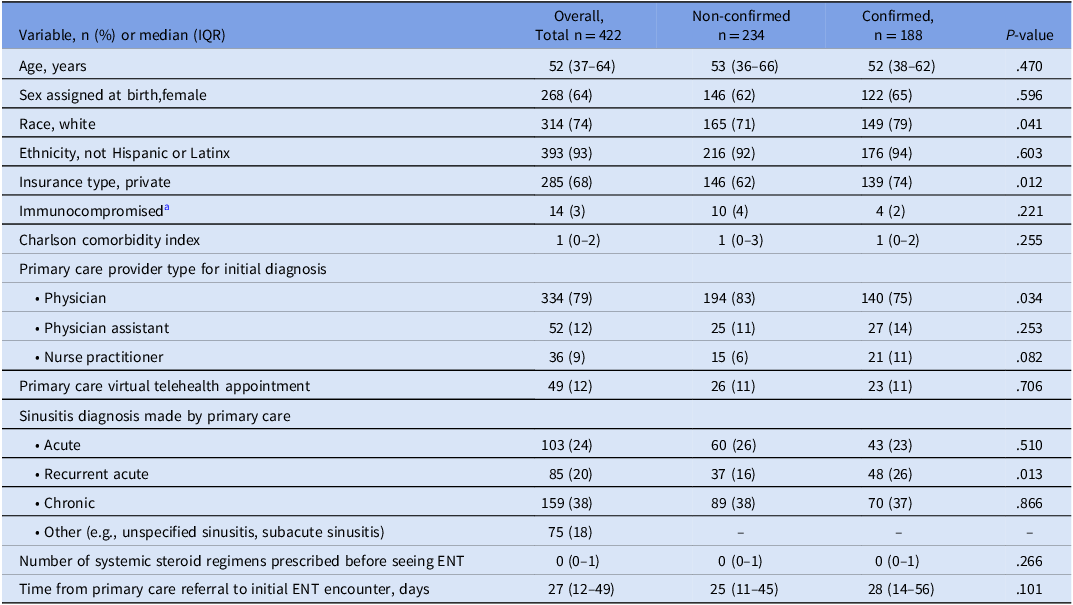
A total of 422 patients were prescribed antibiotics and referred by an outpatient PCP to an ENT specialist for sinusitis management (Figure 1). The median (IQR) time from when the ENT specialist referral was placed to initial visit was 27 (12–49) days for the overall population; patient characteristics and variables of interest for the overall population are listed in Table 1. After evaluation from an ENT specialist, 188 (45%) patients had a confirmed sinusitis diagnosis and 234 (55%) did not maintain a sinusitis diagnosis. The ENT specialists classified 28 (15%) patients with acute, 35 (19%) with acute recurrent, and 125 (67%) with chronic sinusitis. Among patients with a confirmed sinusitis diagnosis by the ENT specialist, the initial sinusitis classification by the PCP did not align with the ENT specialist in 92 (49%) patients. Figure 2a and 2b illustrate patient symptoms documented in the EHR at PCP and ENT visits.
Derivation of patients with a sinusitis diagnosis and antibiotic prescribed at PCP.

Commonly Reported Patient Symptoms at PCP and ENT. (a) Common symptoms documented by PCP of those in the non-confirmed and confirmed sinusitis cohorts. (b) Common symptoms documented by ENT of those in the non-confirmed and confirmed sinusitis cohorts.

Population characteristics and outcomes of interest in ambulatory patients with a sinusitis diagnosis who received an ENT referral

Table 1. Long description
A table comparing characteristics and outcomes of patients with sinusitis diagnosis referred to ENT. The table has 15 rows and 6 columns. Column headers are Variable, Overall Total, Non-confirmed, Confirmed, and P-value. Row labels include Age, Sex assigned at birth, female, Race, white, Ethnicity, not Hispanic or Latinx, Insurance type, private, Immunocompromised, and more. Each row provides data for the overall total, non-confirmed, and confirmed groups, along with P-values for comparisons. Notable trends include differences in race, insurance type, and primary care provider type for initial diagnosis between non-confirmed and confirmed groups.
a Immunocompromised patients were defined as those with conditions or treatment known to impair immune function, including active malignancy, solid organ or stem cell transplantation, HIV infection with CD4 count <200 cells/uL, or use of systemic immunosuppressive medications.
The types of diagnostic modalities utilized at ENT encounters for objective sinusitis diagnosis were nasal endoscopy (377, 89%), CT (114, 27%) and MRI (9, 2%). Purulence was visualized on nasal endoscopy in 51 (12%) patients; one patient with chronic adenoiditis and 50 with confirmed sinusitis. Patients with a confirmed sinusitis diagnosis had a median (IQR) of 2 (1–3) antibiotic courses prior to ENT referral, compared to 1 (1–2) antibiotic courses in patients with a non-confirmed diagnosis (P = .085). Additionally, patients with a confirmed sinusitis diagnosis received a median (IQR) of 12 (7–21) days of antibiotics prior to ENT referral, compared to a median (IQR) of 10 (7–18) days of antibiotic use in non-confirmed diagnosis patients (P = .090).
Most patients with a non-confirmed sinusitis diagnosis had multiple alternative diagnoses after ENT visit. The most common non-sinusitis diagnoses made by an ENT specialist were allergic rhinitis (69, 30%), deviated nasal septum (49, 21%), laryngopharyngeal reflux (44, 19%), and facial pain (36, 15%). Of these patients, 27 (12%) were referred by ENT to other specialties to support alternative diagnoses. Most patients were referred to neurology (n = 23) and allergy (n = 3) clinics, among others. Exploratory analyses and logistic regression were unable to identify variables significantly associated with a confirmed sinusitis diagnosis.
Antibiotic prescribing practices
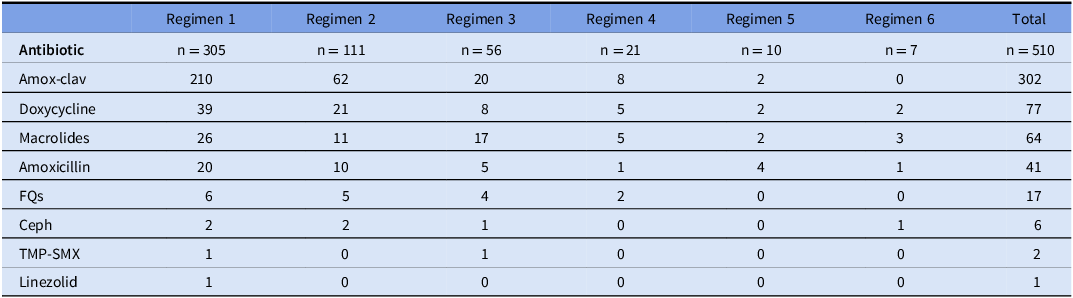
In total, there were 510 antibiotics prescribed (Table 2) by primary care providers (PCPs) for a median (IQR) duration of 10 (7–20) days per antibiotic course. Among these patients, 305 received one antibiotic prescription before their ENT visit, 111 received two prescriptions, 56 received three, 21 received four, 10 received five, and 7 patients received six prescriptions. Amoxicillin-clavulanate was prescribed most often (n = 302), followed by doxycycline (n = 77), macrolides (n = 64), and amoxicillin (n = 41). There were no meaningful associations of antibiotic selection or treatment duration with a confirmed sinusitis diagnosis.
Total antibiotic prescriptions, in chronological order, for regimens 1 through 6 of the total population

Table 2. Long description
The table presents data on antibiotic prescriptions across six different regimens. It has 8 rows and 8 columns, including a total column. The columns are labeled Regimen 1, Regimen 2, Regimen 3, Regimen 4, Regimen 5, Regimen 6, and Total. The rows are labeled with different types of antibiotics: Amox-clav, Doxycycline, Macrolides, Amoxicillin, FQs, Ceph, TMP-SMX, and Linezolid. Each cell contains the number of prescriptions for that antibiotic in the corresponding regimen. For example, Amox-clav has 210 prescriptions in Regimen 1, 62 in Regimen 2, and so on, totaling 302 prescriptions. Doxycycline has 39 prescriptions in Regimen 1, 21 in Regimen 2, and so on, totaling 77 prescriptions. The table provides a detailed breakdown of the distribution of various antibiotics across different treatment regimens.
Amox-clav, amoxicillin-clavulanate; FQs, fluoroquinolones; Ceph, cephalosporins; TMP-SMX, trimethoprim-sulfamethoxazole.
Discussion
The primary finding of this study was that 55% of antibiotic-exposed patients referred by PCPs for sinusitis did not retain a sinusitis diagnosis following subsequent ENT evaluation. Symptoms documented during PCP encounters substantially overlapped among patients who subsequently did and did not retain the diagnosis, highlighting the difficulty of distinguishing sinusitis from conditions with similar presentation. Importantly, ENT assessment occurred a median of 27 days after referral; while the lack of objective sinusitis evidence at ENT evaluation cannot establish that sinusitis was absent at the preceding PCP encounter or that prior antibiotic therapy was inappropriate, these findings demonstrate limited diagnostic concordance across sequential assessments in a selected population with persistent symptoms or sufficient diagnostic uncertainty to warrant ENT referral. Additionally, the study results represent opportunity for outpatient antimicrobial stewardship programs to promote sinusitis diagnostic reassessment, guideline-concordant antibiotic selection and duration when treatment is indicated, and consideration of alternative diagnoses or ENT evaluation when symptoms persist.
Given that the majority of patients did not have a confirmed sinusitis diagnosis following ENT evaluation, the routine use of antibiotic therapy may be overutilized in certain clinical contexts. This observation is consistent with findings from a cross-sectional database evaluation by Hornung et al., which revealed that only half of the patients referred to an otolaryngologist for sinusitis were confirmed to have the condition after specialist assessment using ICD-10 coding evaluation. Reference Hornung, Ganti, Lunos and Tyler10 This analysis included 99,581 patients and 97.8% were initially seen in a primary care setting. Reference Hornung, Ganti, Lunos and Tyler10 Similarly, Al-Hashel et al reported that 81.5% of patients with a prior sinusitis diagnosis were ultimately determined to have migraines, highlighting significant misdiagnosis. Reference Al-Hashel, Ahmed, Alroughani and Goadsby11 These findings collectively emphasize the need for more judicious diagnostic practices, identification of other common sinusitis “mimicking” conditions, a reevaluation of antibiotic prescribing patterns in primary care settings, and implementation of guideline-endorsed, effective “watch and wait” practices for patients presenting with sinusitis symptoms. Reference Payne, McKenna and Buckley5
Despite the high volume of suboptimal antibiotic use in outpatient settings, including sinusitis, efforts to implement and study antibiotic stewardship initiatives in outpatient settings remain limited and underrepresented in the literature. Reference Deida, Bizune and Kim1,Reference Fleming-Dutra, Hersh and Shapiro2,Reference Sayood and Durkin27,Reference Fairlie, Shapiro, Hersh and Hicks28 An effective strategy to advance outpatient ASP is through incentivization, particularly by leveraging pay-for-performance models or value-based reimbursement frameworks. Reference Veve, Arena, Kenney, Church, Fried and Shallal15 These models can be tied to standardized performance metrics, such as those established by the Centers for Medicare and Medicaid Services (CMS), including Healthcare Effectiveness Data and Information Set (HEDIS) measures. Reference Veve, Arena, Kenney, Church, Fried and Shallal15,Reference Arena, Veve, Fried, Ware, Lee and Shallal29 Despite sinusitis being one of the most common reasons for outpatient visits, there is currently no HEDIS measure specifically targeting its management. However, CMS has introduced three relevant quality measures, Quality ID #331, #332 and #332, under the Merit-Based Incentive Payment Systems that are related to sinusitis. Reference Arena, Veve, Fried, Ware, Lee and Shallal29–33 Integrating and adapting sinusitis as a performance metric to better reflect outpatient care practices should be a central focus of future stewardship initiatives. Doing so would help address the current inconsistencies in sinusitis management and support more standardized, evidence-based care. Lastly, fostering collaboration between ENT specialists and PCPs may yield highly impactful improvements in sinusitis management, as these clinicians are primarily responsible for diagnosing and treating the condition. Future studies should explore whether improved diagnostic accuracy by ENT specialists using nasal endoscopy with or without CT leads to reduced unnecessary antibiotic prescriptions. Reference Gitterman34
Limitations
This study offers valuable insights into the ongoing challenge of diagnosing sinusitis in the outpatient primary care setting; however, several limitations must be acknowledged. Misclassification bias may have affected the accuracy of sinusitis subtype categorization, despite efforts to mitigate this through extensive chart review. In many cases, discrepancies were observed between the ICD-10 codes and the diagnoses documented in PCPs’ notes. Furthermore, insufficient documentation often prevented alignment of provider’s diagnoses sinusitis diagnostic criteria. Reference Payne, McKenna and Buckley5,Reference Chow, Benninger and Brook6 The exclusive reliance on ICD-10 codes for screening patients, and the exclusion of ICD-9 codes, may have further limited the sample size. Exploratory logistic regression failed to identify significant predictors of a sustained sinusitis diagnosis due to significant symptom overlap in patient presentation. Additionally, diagnostic variability was noted following endoscopy when purulence was absent, likely reflecting the multifactorial nature of sinusitis diagnosis, which includes endoscopic findings of edema or possibly sinus mucosal thickening or opacification on CT in the absence of endoscopic findings. This study was also subject to selection bias, as patients referred to an ENT specialist represent a clinically distinct population with greater symptoms persistence or diagnostic uncertainty compared with typical primary care presentations. Further evaluation is needed to assess the incremental value of ENT consultation and its impact on antibiotic prescribing across different care settings. Antibiotic exposures may have been underestimated, as patients with an initial sinusitis diagnosis more than two years prior to ENT referral were excluded to ensure data consistency and limits generalizability to chronic sinusitis populations. Another potential study limitation is the interval between the initial primary care assessment and otolaryngology evaluation, where a median (IQR) time to ENT visit of 27 (12–49) days may have allowed some patients to experience clinical improvement or resolution of sinusitis by the time of specialty follow-up. As a result, the absence of objective findings at the ENT visit may not fully reflect the clinical context at presentation. Nonetheless, this temporal gap does not negate the broader observation that sinusitis is commonly invoked to justify antibiotic prescribing in respiratory illness and highlights the challenges of assessing diagnostic accuracy and treatment appropriateness when care occurs across different time points. Larger studies with more granular clinical data are needed to better define factors associated with diagnostic persistence and outcomes following ENT referral.
Conclusions
Among antibiotic-treated patients referred by PCPs for sinusitis, more than half did not retain a sinusitis diagnosis following subsequent ENT evaluation, highlighting diagnostic uncertainty in patients with persistent or recurrent sinonasal symptoms. The most common non-sinusitis diagnoses made after objective ENT evaluation were allergic rhinitis and deviated nasal septum.
Patients frequently received multiple antibiotic courses prior to ENT evaluation, including those who subsequently did not retain a sinusitis diagnosis; the appropriateness of individual preceding antibiotic prescriptions could not be determined. Outpatient antimicrobial stewardship strategies that support guideline-concordant treatment, diagnostic reassessment, and consideration of alternative diagnoses may help optimize management of patients with persistent sinonasal symptoms.
Acknowledgments
None
Funding statement
This work was completed without funding support.
Competing interests
None.



 Open access

