I. INTRODUCTION
The excellent combination of high strength and toughness of low carbon bainitic steels can be upset by the thermal cycles experienced during welding. Reference Qiu, Mori, Enoki and Kishi1–Reference Gliha, Vuherer, Ule and Vojvodic-Tuma3 The presence of the M–A constituent along the prior austenite grain boundaries is the main factor in reducing the heat-affected zone (HAZ) toughness. Reference Matsuda, Ikeuchi, Fukada, Horii, Okada, Shiwaku, Shiga and Suzuki4,Reference Lambert, Drillet, Gourgues, Sturel and Pineau5 The M–A constituents are formed in intercritical heat-affected zone (IC HAZ) or intercritically reheated coarse-grained HAZ (IC CG HAZ), when steels are heated to temperature between the Ac1 and Ac3 during single or double welding thermal cycles, respectively. Since the M–A constituent has high carbon content and is predominantly high carbon martensite, most researchers considered that the difference in hardness values between M–A constituent and surrounding matrix causes stress concentration, which leads to cleavage fracture. Reference Kweon, Kim, Hong and Lee6–Reference Mohseni, Solberg, Karlsen, Akselsen and Østby8 In addition, the distribution and morphology of the M–A constituent are reported to be related to the loss in toughness of HAZ. Inconsistent results were found in different studies. Liu et al. reported that the HAZ toughness is mainly controlled by the fraction of M–A constituent. Reference Liu, Zhao and Northwood9 Kaplan found that the correlation between toughness and M–A fraction is rather loose; this correlation can be improved by taking more particularly into account the fraction of M–A constituents, which are massive and large-sized. Reference Kaplan and Lambert-Perlade10 Moeinifar identified that the sizes of M–A constituents, such as mean diameter and length, were important factors influencing HAZ toughness. Reference Moeinifar, Kokabi and Hosseini11 Li et al. reported that the poorer IC CG HAZ toughness was related to the large size and area fraction of the M–A phase. Reference Li, Crowther, Green, Mitchell and Baker12 Davis observed that the minimum impact toughness for the IC CG HAZ was associated with a particular microstructure containing a near-connected grain boundary network of blocky M–A particles. Reference Davis and King13 On the other hand, Ohya found that the brittle fracture initiation site is associated with the intersection of bainitic ferrite areas with different orientations rather than the M–A constituents. Reference Ohya, Kim, Yokoyama and Nagumo14
In view of the above research methods, since the actual HAZ is generally narrow, they used a weld thermal simulator to produce large volumes of uniform microstructure, which is suitable for microstructural and impact toughness assessment. However, the simulated specimen may not fully reflect the microstructure of the true welded joint. For example, the grain size of a simulated specimen is slightly larger, and the effect of residual stresses in actual welding cannot be simulated. Reference Komazaki, Sugimoto, Hasegawa and Kohno15,Reference Shi and Han16 Meanwhile, the size of the simulated specimen is still limited for a valid impact toughness test when the heat input is low. In this paper, an effective and simple method has been designed to simulate thermal cycle during welding and obtain large samples of IC HAZs, which will significantly promote further investigation on microstructures and mechanical properties of the zones.
II. MATERIALS AND EXPERIMENTS
A. Material
Commercial Q690 steel of 808 MPa yield strength was used. It was provided as 25 mm thick plate obtained after thermomechanical-controlled processing. The composition (wt%) was C 0.07, Si 0.32, Mn 1.63, Nb 0.04, V 0.06, Cr 0.23, Ni 0.13, Mo 0.13, B 0.0014, P 0.008, S 0.004, and Fe as the balance. The phase transformation temperatures were measured by a dilatometric method first, and the Ac1 and Ac3 were 721 and 859 °C, respectively.
B. Experimental design
As is well-known, austenite nucleates preferentially at prior austenite grain boundaries when steels are heated above Ac1, then it grows into the ferrite with carbon being supplied from surrounding matrix. In a welding thermal cycle, the high degree of superheat will promote the transformation of austenite during heating, a small portion of austenite transforms at high temperature and excludes carbon into the remainder during cooling. Reference Biss and Cryderman17 Therefore, the austenite, which will transform into M–A constituent, has a higher volume fraction and higher carbon content at relatively lower heating temperature. This is contradictory to the condition of equilibrium phase transformation, which can be judged from the iron–carbon phase diagram. As a result, it is impossible to simulate the M–A constituent completely by a heat treatment method under which equilibrium phase transformation occurs. However, the distribution morphology of M–A constituent, that is, the spaced hard phase distributes along the boundaries of soft matrix, can be simulated by combinations of heat treatments. First, the specimens would be heated at high temperatures to achieve the same volume fraction of austenite under welding conditions, then they would be cooled quickly to bring about martensite product with high hardness analogous to the M–A constituent whose hardness is induced by high carbon content. In this paper, the specimens were cut in the midthickness of the plate, along the rolling direction. They were heated at a series of high temperatures (750, 790, 800, 810 or 830 °C) close to Ac3 for 30 min and then quenched in water. Large samples with uniform microstructure and properties would be obtained using these treatments.
C. Testing of specimens
Microstructures were etched using lepera etchant (50 mL of 1% Na2S2O5 aqueous solution + 50 mL picric acid 4% in ethanol) Reference Ale, Rebello and Charlier18 and examined by optical microscopy. Charpy specimens (10 mm × 10 mm × 55 mm) were tested on a Charpy impact tester (Model: JB30B, Jinan, China) at a temperature of −20 °C. The fracture surfaces of the Charpy specimens were observed by scanning electron microscope (SEM).
III. RESULTS
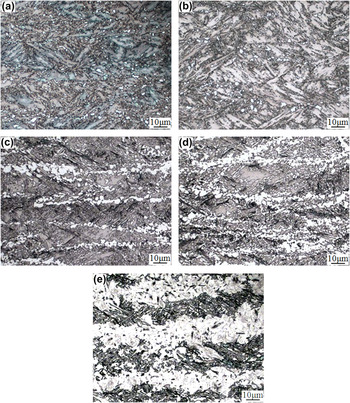
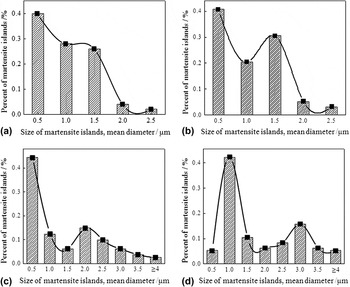
Figure 1 shows the microstructures of samples, which were heated at different temperatures and then quenched. The martensite islands appear white and distribute mainly along the grain boundaries of prior austenite, this is quite similar to the morphology and distribution of the M–A constituent in HAZ. Reference Bonnevie, Ferriere, Ikhlef, Kaplan and Orain19,Reference Lan, Qiu, Zhao, Gao and Du20 The optical micrographs were processed using image software. As may be seen in Fig. 2, the size distribution of martensite islands all exhibits double peak at different heating temperatures. The martensite islands corresponding to the small peak size distribution between bainite laths have a maximum amount, in addition, the most probable sizes of larger martensite islands at temperatures of 750, 790, 800, and 810 °C are 1.0, 1.5, 2.0, and 3.0 μm, respectively.
Effect of heating temperature on microstructures of experimental steels (etched by lepera) (a) 750 °C; (b) 790 °C; (c) 800 °C; (d) 810 °C; and (e) 830 °C.

Size distribution of the martensite islands at different heating temperatures (a) 750 °C, (b) 790 °C, (c) 800 °C, and (d) 810 °C.

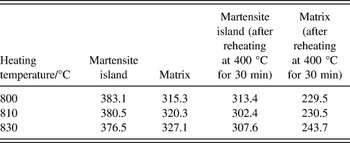
The microhardness values of samples with different heating temperatures are shown in Table I. The martensite island exhibits a much higher hardness compared to the surrounding matrix. By combining the results of microstructure and microhardness, we can conclude that the microstructure of the experimental steel could transform into ones similar to that of IC HAZ through a heat treatment method.
Microhardness of simulated samples/HV0.1.

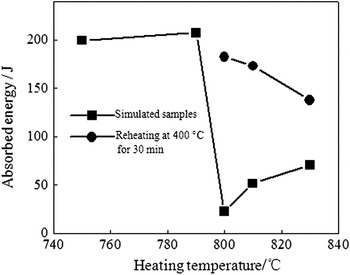
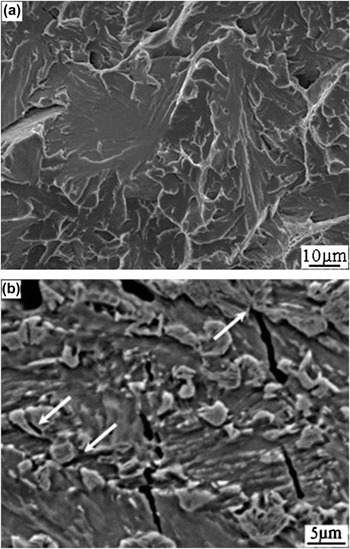
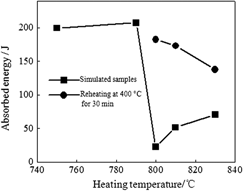
Figure 3 shows the charpy impact energy as a function of heating temperature. The charpy impact energy was relatively high at 750 and 790 °C, when the temperature exceeded 790 °C, it dropped dramatically, indicating the occurrence of embrittlement. This was in accordance with the fracture appearance as is shown in Fig. 4(a), the fracture mode in the propagation region was primarily cleavage. Figure 4(b) shows the secondary cracks near fracture surface of the impact samples. The cracking of martensite islands can be seen (pointed by the white arrows). This was in accordance with many reports, which had observed the cracking of M–A particles. Reference Hrivnak, Matsuda, Li, Ikeuchi and Okada21,Reference Li and Baker22
Effect of heating temperature on the impact toughness of simulated samples.

Morphology of (a) impact fracture surface and (b) secondary cracks near fracture surface.

IV. DISCUSSION
During the initial stage of loading, both the martensite island and matrix deform elastically, and no stress concentration will occur as they both have the same elastic modulus. Because the martensite island has higher hardness than the matrix, the matrix deforms plastically and sheds load into the former with the increasing load. The martensite island with low deformability cracks as large stress develops on it. When the crack formed within the martensite island extends to a critical length, which acts as a Griffiths crack and matches the loading stress, it will propagate catastrophically through entire specimen. Thus, it can be seen that the size of martensite island from which crack initiates and propagates is the main factor inducing the embrittlement of simulated microstructure, and the size should be greater than a critical value. As can be seen from Fig. 1, the increase of size of martensite islands was accompanied by the increase of volume fraction, this was usually the case of the M–A constituent in many reports. Reference Bonnevie, Ferriere, Ikhlef, Kaplan and Orain19,Reference Moeinifar, Kokabi and Hosseini23 The similar variation trend of different microstructure characteristics may be the reason why previous reports have different judgments, concerning the microstructure factors affecting the embrittlement. According to the criterion for cleavage fracture, the size of martensite island or M–A constituent can be confirmed as the determining factor of the embrittlement of IC HAZ. As can be seen from Fig. 4(a), the change of samples from ductile to brittle is abrupt, it means that there is a critical heating temperature below which the samples are ductile and above which the samples are brittle. Because the determining factor of the embrittlement is the size of martensite island and it increases with temperature, so it is clear that the critical heating temperature, which induces embrittlement, corresponds to the critical size of martensite island. Samples become brittle when the size of martensite island exceeds the critical value. Figure 4(b) shows no concentrated crack initiation site over the whole fracture surface, the cleavage fracture has multiple crack initiation sites. Thus, the critical size of martensite island is the most probable size. Sungtak has pointed out that the critical crack size for cleavage crack propagation in HAZ of high strength steel appears to range from 0.5 to 2.0 μm. Reference Lee, Kim and Kwon2 Obviously, the martensite islands, which induce embrittlement, should have larger size. According to the statistical results in Fig. 2, the critical size could be identified as 2.0 μm.
The brittle samples (heated at 800, 810, and 830 °C) were reheated at 400 °C for 30 min. Clearly, the martensite would be tempered after reheating. It can be seen from Table I that the hardness of both martensite island and matrix dropped, but there still exited large difference. However, the impact toughness increased significantly (see Fig. 3), which means that the samples were in the state of toughening. This can be related to the improvement of deformability of the martensite island. The stress concentration can be relieved through the deformation of martensite island. Thus, it can be concluded that the hardness difference between the martensite island and the matrix was not the determining factor of embrittlement. The increase of deformability is the reason for the elevated toughness.
This study confirmed that the martensite island with size greater than a critical value and with low deformability was also the reason for the embrittlement of IC HAZ. Due to the similarities of microstructure and property between martensite island and M–A constituent, the results are consistent with the nature of embrittlement caused by M–A constituent in the actual IC HAZ. That is, when the size of M–A constituent is above the threshold value (2.0 μm) and the deformability is low, the IC HAZ will be brittle. All the same, the distribution and volume fraction of M–A constituents should also play important role in impact toughness, and their effects cannot be neglected because the crack initiation was not concentrated on one point.
V. CONCLUSIONS
The microstructure of the Q690 steel could be transformed into microstructure similar to that of the IC HAZ using combinations of heat treatments. By exploiting this heat treatment scheme, large samples with microstructure similar to IC HAZ could be achieved. This provides a new method for the property studies of the IC HAZ. Embrittlement induced by the martensite island depends on the deformability and size of the martensite island, and the size should be larger than 2.0 μm. The above results can be applied to the actual IC HAZ with M–A constituent as the hard phase.
ACKNOWLEDGMENTS
The authors are grateful for financial support from the Independent Innovation project of Universities/Research institutes in Jinan City (No. 201202073).