

Introduction
Multisensory integration (MSI) research investigates how concurrent sensory information from the external world is processed simultaneously in the brain. Primarily, MSI has been explored in pairings of the three “major” senses (i.e., visual, auditory, and somatosensory systems), which are typically referred to as auditory-somatosensory (AS), auditory-visual (AV), and visual-somatosensory (VS) pairs, but tri-modal auditory-visual-somatosensory interactions have also been assessed (Diederich & Colonius, Reference Diederich and Colonius2004). Using psychophysical, electrophysiological, and neuroimaging procedures, researchers are able to investigate these integrative effects in humans across all ages. Behavioral research focusing on reaction times (RTs) has demonstrated multisensory effects with shorter RTs for multisensory conditions compared to RTs to constituent unisensory conditions (AV: Harrington & Peck, Reference Harrington and Peck1998; Molholm et al., Reference Molholm, Ritter, Murray, Javitt, Schroeder and Foxe2002; AS: Murray et al., Reference Murray, Molholm, Michel, Heslenfeld, Ritter, Javitt, Schroeder and Foxe2005; VS: Pavani et al., Reference Pavani, Spence and Driver2000). Additionally, electrophysiological results have revealed multisensory effects of short latency that likely reflect early sensory processing across multisensory pairings (Giard & Peronnet, Reference Giard and Peronnet1999; AV: Fort et al., Reference Fort, Delpuech, Pernier and Giard2002; AS: Foxe et al., Reference Foxe, Wylie, Martinez, Schroeder, Javitt, Guilfoyle, Ritter and Murray2002; Molholm et al., Reference Molholm, Ritter, Murray, Javitt, Schroeder and Foxe2002; VS: Schurmann et al., Reference Schurmann, Kolev, Menzel and Yordanova2002; Murray et al., Reference Murray, Molholm, Michel, Heslenfeld, Ritter, Javitt, Schroeder and Foxe2005; Teder-Sälejärvi et al., Reference Teder-Sälejärvi, Di Russo, McDonald and Hillyard2005).
Much of the current work in the field of MSI has been driven by the seminal neurophysiological work of Stein, Meredith, and colleagues who studied the integration of auditory, visual, and somatosensory evoked responses using single-cell recordings in the superior colliculus (SC) of cats (e.g., Stein et al., Reference Stein, Magalhaes-Castro and Kruger1975; Meredith & Stein, Reference Meredith and Stein1986; Meredith et al., Reference Meredith, Nemitz and Stein1987; Stein & Meredith, Reference Stein and Meredith1993; Stein & Wallace, Reference Stein and Wallace1996; Meredith & Stein, Reference Meredith and Stein1996; Wallace et al., Reference Wallace, Wilkinson and Stein1996). The SC located superior to the brainstem and inferior to the thalamus contains seven layers of alternating white and gray matter and a high proportion of multisensory neurons (Stein et al., Reference Stein, Huneycutt and Meredith1988). The deeper layers of SC contain overlapping spatial maps of the visual, auditory, and somatosensory modalities (Stein & Meredith, Reference Stein and Meredith1993). Additionally, the SC plays a direct role in the motor control of orientation behaviors of the eyes, ears, and head toward various sensory stimuli and is therefore considered a specialized structure for stimulus detection and subsequent gaze-orienting.
Results from Stein & Meredith’s work revealed that the neural response elicited from two or more concurrent sensory inputs causes a change in a cell’s responsiveness (i.e., excitation) that is either less than or greater than the sum of the responses to the constituent unisensory stimulus inputs. The researchers revealed that such integration appeared to be highly affected by various stimulus properties and detailed three simple governing principles critical for MSIs to occur in SC (cf., Stein & Meredith, Reference Stein and Meredith1993). They posited that integration of multisensory inputs in SC was greatest for inputs presented simultaneously or in close temporal proximity (the “temporal rule”). The second rule, the “inverse-effectiveness rule,” stated that the strength of multisensory responses was inversely related to the magnitude of the constituent unisensory inputs. That is, as the detectability of the constituent unisensory inputs decreased, such that multisensory SC neurons responded poorly to either sensory input in isolation, MSI effects became relatively greater. Finally, and of most relevance to the current experiment, Stein and Meredith concluded that MSI was greatest for stimuli that were presented to the same location in space (the “spatial rule”). The authors claimed that spatially aligned bimodal stimuli would fall within the excitatory receptive fields of a given multisensory neuron, resulting in an enhancement of the bimodal neuron’s response. However, as the spatial disparity of the bimodal stimuli increased, inhibitory mechanisms that could potentially suppress the neural response of either constituent unisensory modality were subsequently activated.
In the ongoing effort by researchers to detail the significance of the aforementioned cortical MSI effects, these principles have provided a framework from which to derive testable hypotheses; however, these principles are not without their limitations. That is, recent studies have revealed that cortical integrations simply do not always adhere to the “rules” set forth by Stein and colleagues (e.g., Murray et al., Reference Murray, Molholm, Michel, Heslenfeld, Ritter, Javitt, Schroeder and Foxe2005; Holmes, Reference Holmes2007; Ross et al., Reference Ross, Saint-Amour, Leavitt, Javitt and Foxe2007). Specifically, in an effort to determine whether multisensory interactions in early cortical regions were truly governed by the “spatial-rule,” Murray et al. (Reference Murray, Molholm, Michel, Heslenfeld, Ritter, Javitt, Schroeder and Foxe2005) presented spatially aligned and misaligned AS stimuli to left and right while simultaneously recording evoked-related potentials. Participants were told to respond to all stimuli via a foot pedal. Behavioral results revealed statistically significant speeding of RTs to multisensory AS conditions regardless of spatial alignment. ERP findings revealed similar AS multisensory interactions in auditory association areas for spatially aligned and misaligned AS pairs at just 50 ms. Similarly and as part of a larger study, Teder-Sälejärvi et al. (Reference Teder-Sälejärvi, Di Russo, McDonald and Hillyard2005) reported statistically significant RT facilitation to multisensory AV conditions regardless of spatial alignment. Collectively, these results revealed that AV and AS interactions in humans are not constrained by space using a simple RT task; however, other researchers argue that the spatial rule fails in some cases because behavioral analyses assessing redundant signals are not sensitive to spatial alignment (see Otto et al., Reference Otto, Dassy and Mamassian2013).
Investigations concerning MSI have predominantly been limited to young adults, and consequently very little information is known about this phenomenon in aging. Nevertheless, a handful of studies have revealed significantly greater MSI effects for old compared to young adults (Laurienti et al., Reference Laurienti, Burdette, Maldjian and Wallace2006; Peiffer et al., Reference Peiffer, Mozolic, Hugenschmidt and Laurienti2007; Hugenschmidt et al., Reference Hugenschmidt, Mozolic and Laurienti2009; Stephen et al., Reference Stephen, Knoefel, Adair, Hart and Aine2010; Mahoney et al., Reference Mahoney, Li, Oh-Park, Verghese and Holtzer2011). In fact, results from our recent investigation examining the differential effects of AV, AS, and VS multisensory processing revealed that older adults exhibited the greatest multisensory RT benefit when presented with concurrent VS information (Mahoney et al., Reference Mahoney, Li, Oh-Park, Verghese and Holtzer2011). Thus, there is evidence to suggest successful MSI in older adults; however, whether such integrative RT effects vary in non-demented older adults using visual and somatosensory inputs presented within and across hemifields has yet to be reported. Attainment of this knowledge could prove useful in the development of specific rehabilitative tools designed to optimize MSI processes in older adults.
Materials and methods
Participants
Eighteen (11 female) old adults recruited from the Central Control of Mobility in Aging (CCMA) study at the Albert Einstein College of Medicine campus in Bronx, NY, participated in the current study. Sixteen participants were right-handed as assessed by the Edinburgh handedness inventory (Oldfield, Reference Oldfield1971). Potential participants were identified from a population list of lower Westchester county, NY, and were first contacted with a letter and then by telephone inviting them to participate. A structured telephone screening interview was administered to potential participants to assess for eligibility. Briefly, eligibility criteria required that participants be 65 years of age and older, reside in lower Westchester county, and speak English. Participants were required to see, hear, and feel all sensory stimulation at appropriate levels (see Sensory screening procedures section). Exclusion criteria included inability to independently ambulate, dementia, significant loss of vision and/or hearing, current or history of neurological or psychiatric disorders, recent or anticipated medical procedures that may affect mobility, and/or receiving hemodialysis. All participants provided written informed consent to the experimental procedures (see also Holtzer et al., Reference Holtzer, Wang and Verghese2014), which were approved by the Committee on Clinical Investigation (CCI; the institutional review board of the Albert Einstein College of Medicine).
Cognitive and disease status
All study participants took part in an initial telephone screening session where medical and psychological history was acquired by a research assistant to ensure appropriateness for the CCMA study. Participant’s cognitive status was first screened using reliable cut scores from the AD8 Dementia Screening Interview (cutoff score = 2; Galvin et al., Reference Galvin, Roe, Powlishta, Coats, Muich, Grant, Miller, Storandt and Morris2005; Galvin et al., Reference Galvin, Roe, Xiong and Morris2006) and the Memory Impairment Screen (MIS; cutoff score <5; Buschke et al., Reference Buschke, Kuslansky, Katz, Stewart, Sliwinski, Eckholdt and Lipton1999) and later confirmed using standardized clinical case conference procedures (see Holtzer et al., Reference Holtzer, Verghese, Wang, Hall and Lipton2008 for specifics). Tests included in our in-house clinical neuropsychology battery have been validated in previous studies of this aged population (Masur et al., Reference Masur, Sliwinski, Lipton, Blau and Crystal1994; Sliwinski et al., Reference Sliwinski, Buschke, Stewart, Masur and Lipton1997; Holtzer et al., Reference Holtzer, Verghese, Xue and Lipton2006; Holtzer et al., Reference Holtzer, Friedman, Lipton, Katz, Xue and Verghese2007). Additionally, participants were screened for depression (Geriatric Depression Scale (GDS) – 30 item; Yesavage et al., Reference Yesavage, Brink, Rose, Lum, Huang, Adey and Leirer1982) and anxiety (Beck Anxiety Inventory (BAI); Beck et al., Reference Beck, Epstein, Brown and Steer1988).
Global disease status summary scores (range 0–10) were obtained from dichotomous rating (presence or absence) of diabetes, chronic heart failure, arthritis, hypertension, depression, stroke, Parkinson’s disease, chronic obstructive pulmonary disease, angina, and myocardial infarction (see also Holtzer et al., Reference Holtzer, Verghese, Xue and Lipton2006; Verghese et al., Reference Verghese, Wang, Lipton, Holtzer and Xue2007; Holtzer et al., Reference Holtzer, Verghese, Wang, Hall and Lipton2008; Mahoney et al., Reference Mahoney, Verghese, Goldin, Lipton and Holtzer2010; Mahoney et al., Reference Mahoney, Li, Oh-Park, Verghese and Holtzer2011).
Sensory screening procedures
All participants were required to successfully complete a sensory screening exam, where visual, auditory, and somatosensory acuity were formally tested to ensure appropriateness for the study. All participants’ visual acuity was measured using a Snellen eye chart (better or equal to 20/70). A computerized tone-emitting otoscope that delivered lateral and bilateral 20, 25, and 40 dB tones at 500, 1000, 2000, and 4000 Hz using E-prime 2.0 software (Psychology Software Tools, Inc., (PST), Pittsburgh, PA) was used to assess hearing loss. In terms of the somatosensory screening, each individual received a pulse of 30 V, which was gradually increased in voltage by 5 V to determine each individual’s minimal threshold of detection; this threshold was operationally defined as the minimum level of voltage necessary for each participant to feel equal stimulation in their left and right fingers at a level that was not painful (see Mahoney et al., Reference Mahoney, Li, Oh-Park, Verghese and Holtzer2011; Mahoney et al., Reference Mahoney, Verghese, Dumas, Wang and Holtzer2012 for specifics).
Stimuli and task procedures
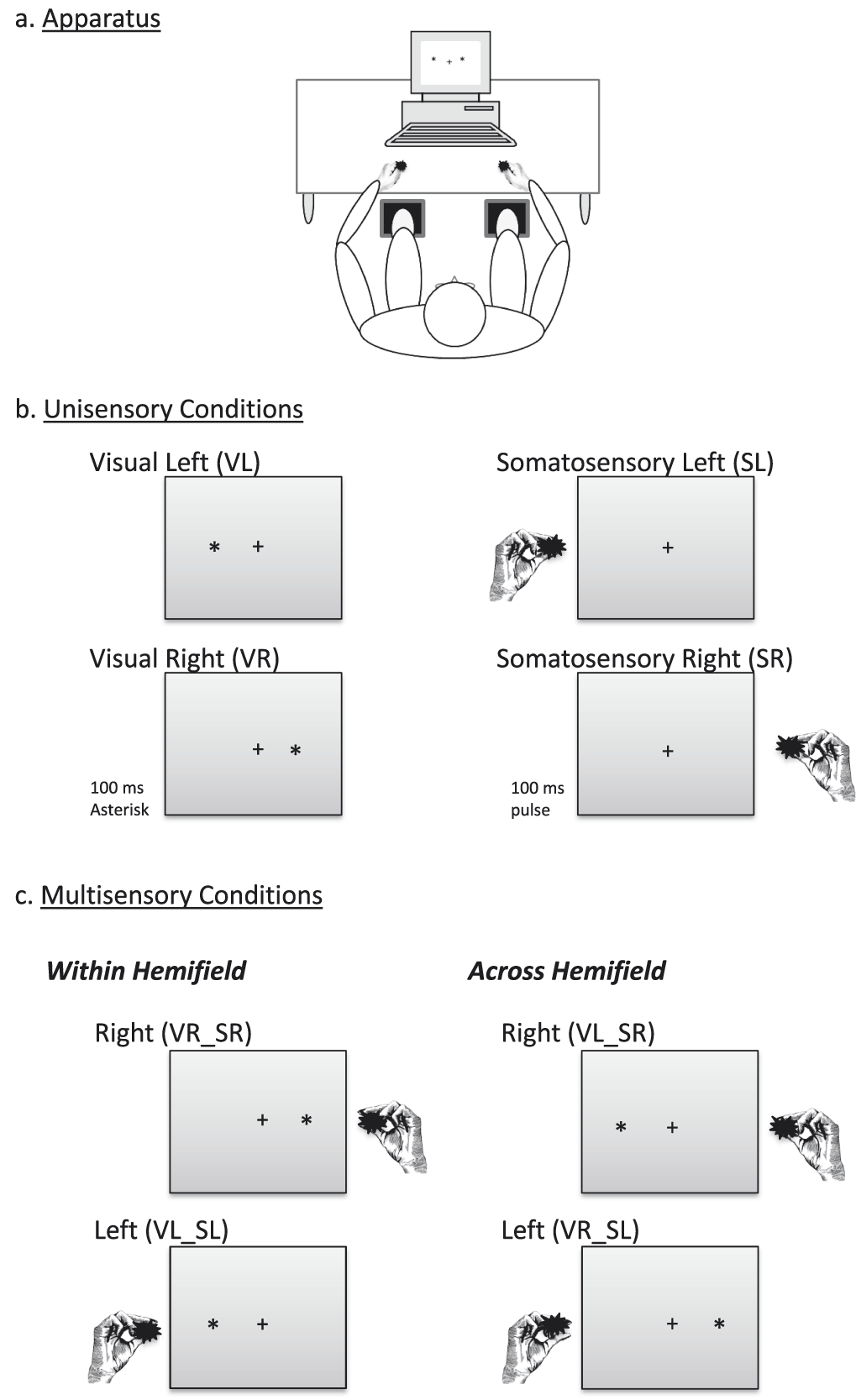
Participants were seated comfortably in a well-lit room and asked to fixate a fixation point (a black cross measuring 0.5 cm × 0.5 cm) visible on the center of the display while avoiding any unnecessary head movements during the experimental blocks. The viewing distance was set at 57 cm and the stimulus field was 38 × 30.5 deg of visual angle. The background field luminance was 105 cd/m2. Participants’ arms rested comfortably on a table and were roughly half the distance from the visual display. Their hands were about 57 cm apart, symmetrical about the vertical meridian. RT and accuracy were collected as participants performed a simple RT task, depressing a foot pedal located under their right foot as quickly as possible, in response to all stimuli, regardless of the unisensory spatial location. In total, participants responded to eight different stimulus conditions (four unisensory and four multisensory; see Fig. 1). The unisensory conditions included right- or left-sided visual (V) or somatosensory (S) stimuli. The V stimuli were black asterisks presented for 100 ms on a 17″ computer monitor, which were 0.64 cm in diameter, 8.14 cm from the central fixation point. Lateralized unisensory S pulses were produced from a constant voltage linear isolated programmable stimulator (Biopac Systems, Inc., www.biopac.com) that delivered 100 ms pulses at a custom voltage (individually adjusted to a comfortable level for each participant) to electrodes placed symmetrically on the left and right index or middle fingers (depending upon pre-existing nerve or skin damage at the time of testing).
Experimental Procedures. (a) Apparatus: Participants were seated in a comfortable chair and were required to make speeded foot-pedal responses to all stimuli, regardless of sensory modality and spatial location. They responded to all stimuli by pressing the pedal under their right foot. (b) Unisensory conditions: Participants received visual (V) and somatosensory (S) alone stimuli that were presented to either the left or right side of space. (c) Multisensory conditions: Participants received a total of four multisensory VS stimulus conditions, where both V and S information were presented within or across hemifields.

The multisensory conditions included simultaneous VS stimulation presented within (left or right) or across hemifields (e.g., left somatosensory and right visual stimulation – see Fig. 1). In terms of naming the VS conditions, the location of the somatosensory input (left or right) determines the condition type, whereby simultaneous visual inputs are presented to either the same (i.e., within hemifield) or opposite (i.e., across hemifield) side of the somatosensory inputs (see Fig. 1c and section Linear mixed effects model). The spatial separation between the visual and somatosensory inputs was equal to 49 deg within and 65 deg across hemifields. Using E-prime 2.0 software, the eight stimulus conditions were presented in random order with equal frequency over 3 blocks of 96 trials, yielding a total of 36 trials per condition. The inter-stimulus interval (ISI) varied randomly from 1.0 to 3.0 s to avoid anticipatory effects.
Behavioral data analysis
Linear mixed effects model
The multisensory effect of condition and spatial location, and their interactions on RT were assessed using a linear mixed effects model (LMEM), adjusted for gender, education, global disease status, and speed of processing (Salthouse, Reference Salthouse, Birren and Schaie1985). All statistical analyses were run using SAS 9.2 (SAS Institute Inc., Cary, NC) statistical software. A random intercept was included in the model to allow the entry point to vary across individuals.
The model consisted of a two level condition (multisensory or unisensory average), a two level spatial location (within or across hemifield), and a two level hemispace (left (L) or right (R) side). Specifically, the four multisensory conditions were: within hemi left (VL_SL); within hemi right (VR_SR); across hemi left (VR_SL); across hemi right (VL_SR); and the four unisensory averaged conditions were: within hemi left [(VL + SL)/2]; within hemi right [(VR + SR)/2]; across hemi left [(VR + SL)/2]; and across hemi right [(VL + SR)/2] (see also Fig. 1). Inverse transformation for RT (1/RT*1000) was applied to achieve normality and variance stabilization of differences in speed of processing in old participants. The advantage of the linear mixed effects model (LMEM) is that the heterogeneity and correlation of repeated measures under different conditions are taken into account (Laird & Ware, Reference Laird and Ware1982).
Test of the race model
Multisensory integrative processing can easily be derived through psychophysical data (e.g., RTs) because when two sources of sensory information (e.g., a visual cue and somatosensory pulse) are presented concurrently, they offer redundant signals that give rise to faster detection responses. This phenomenon is referred to as a redundant signal effect (RSE; Kinchla, Reference Kinchla1974). Two very distinct models can be implemented to explain a RSE: race models and co-activation models (Miller, Reference Miller1982). In race models, when two information sources are presented concurrently (e.g., a multisensory stimulus), the signal from the information source that is processed the fastest is the signal that produces the response (i.e., the “winner” of the race). However, co-activation models are supported when RTs to multisensory stimuli are faster than would be predicted by race models. In the latter case, the RT facilitation is accounted for by interactions that allow signals from redundant information sources to integrate or combine non-linearly. Nonetheless, tests developed to assess race model violations are inherently controversial (Eriksen et al., Reference Eriksen, Goettl, St James and Fournier1989; Mordkoff & Yantis, Reference Mordkoff and Yantis1991) since these models are conservative (Miller, Reference Miller1986; Gondan et al., Reference Gondan, Lange, Rosler and Roder2004) and have inherent limitations like assumptions about independence between unisensory processes (Colonius & Diederich, Reference Colonius and Diederich2006; see also Mahoney et al., Reference Mahoney, Li, Oh-Park, Verghese and Holtzer2011). Similarly, work from Otto and Mamassian (Reference Otto and Mamassian2012) and Otto et al. (2013) also reveals that RT facilitation can be explained by probability summation, providing evidence for multisensory integrative effects even when distinct parallel processes are not integrated.
To circumvent some of these various limitations, a more conservative test of the race model as outlined by Colonius and Diederich (Reference Colonius and Diederich2006) was used in the current study: RXY = P(RTXY = t) – min [P(RTX = t) + P(RTY = t),1]. For any latency, the race model holds when the cumulative probability (CP) value of the multisensory condition (actual CP) is less than or equal to the sum of the CP values from each of the unisensory stimuli or the predicted CP. The model places an upper limit of 1 on the predicted CP of RT for the constituent unisensory stimuli. When the actual CP value is greater than the predicted CP value, the result of this inequality is a positive value, which is indicative of a violation of the race model.
Specifically, individual RTs were recorded for each trial. RTs were sorted in ascending order by stimulus condition and then averaged. Trials with RT responses that exceeded ±2 standard deviations from the individual mean of each participant were considered outliers and were excluded. Trials with RTs <100 ms were also excluded from the analysis as they were not considered to be physiologically plausible responses. For each participant, the RT range within the valid RTs was calculated across the eight stimulus conditions and quantized into twenty bins from the fastest RT (or zero percentile) to the slowest RT (hundredth percentile) in 5% increments (0%, 5%, … , 95%, 100%). Differences between actual CP distributions [P(RTXY = t)] and predicted CP distributions [min [P(RTX = t) + P(RTY = t)]] were calculated across each time bin for each multisensory pairing (see also Colonius & Diederich, Reference Colonius and Diederich2006; Mahoney et al., Reference Mahoney, Li, Oh-Park, Verghese and Holtzer2011), where values greater than zero are indicative of race model violation, providing support for multisensory integrative processes.
Results
Demographics
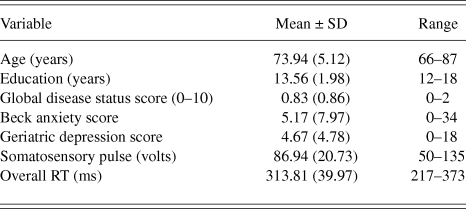
Eighteen older individuals (mean age 74 ± 5.13 years; 11 female) participated in the current experiment. None of the participants met criteria for dementia or mild cognitive impairment using established clinical consensus case-conference procedures (Holtzer et al., Reference Holtzer, Verghese, Wang, Hall and Lipton2008). All participants were deemed relatively healthy as determined by their global health status (Holtzer et al., Reference Holtzer, Verghese, Xue and Lipton2006; Verghese et al., Reference Verghese, Wang, Lipton, Holtzer and Xue2007; Holtzer et al., Reference Holtzer, Verghese, Wang, Hall and Lipton2008; Mahoney et al., Reference Mahoney, Verghese, Goldin, Lipton and Holtzer2010). Table 1 delineates other demographic information including mean education level (in years), GDS (Yesavage et al., Reference Yesavage, Brink, Rose, Lum, Huang, Adey and Leirer1982) score, BAI (Beck et al., Reference Beck, Epstein, Brown and Steer1988) score, and mean value and range of the unisensory probes, and overall RT in milliseconds (ms).
Participant demographics (n = 18)
RT and linear mixed effects model results
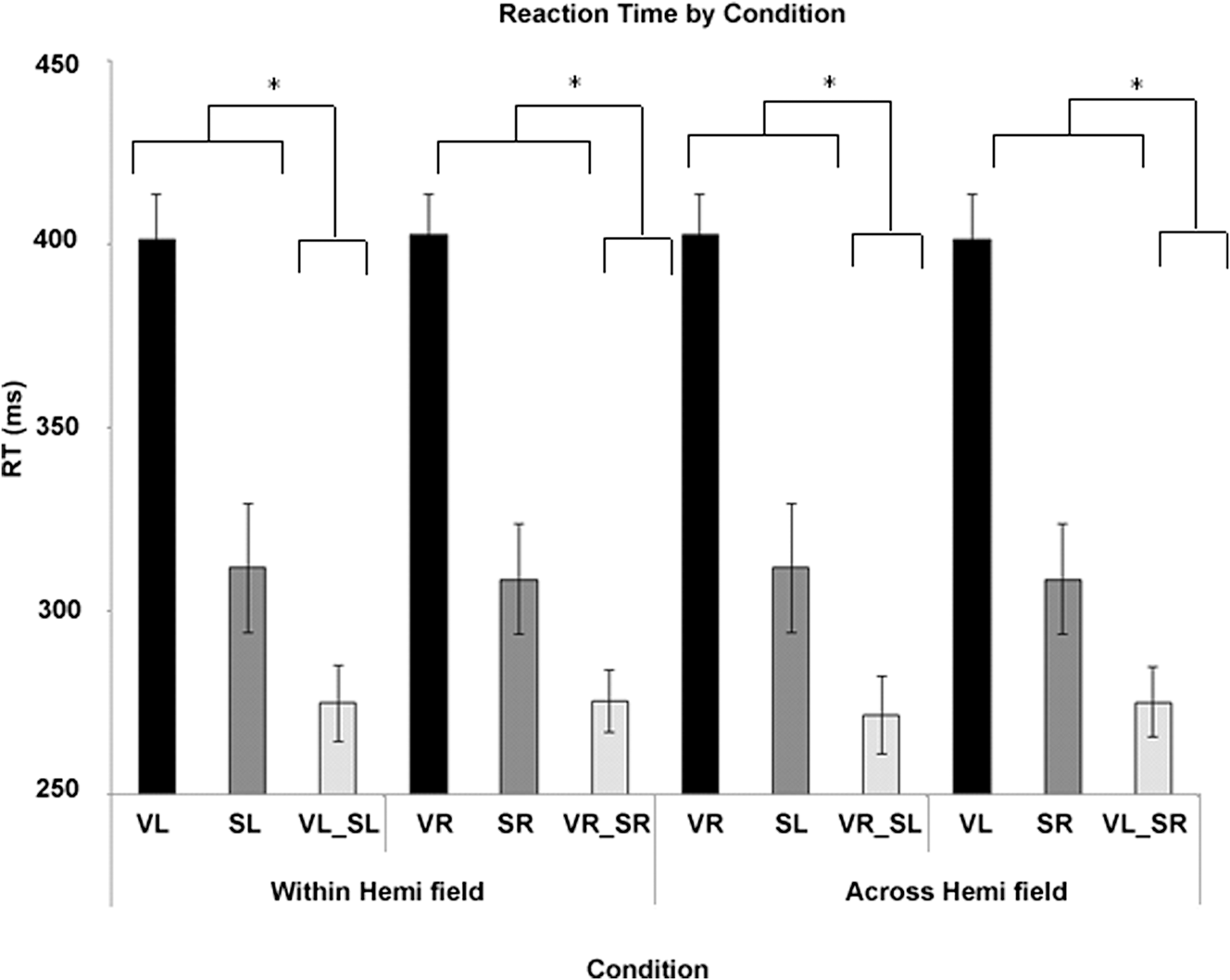
The current task required participants to quickly press a foot-pedal in response to both unisensory and multisensory stimulation (refer to Stimuli and task procedures section and Fig. 1 for details). In total, participants received 288 randomly presented trials and their RT per trial was recorded in milliseconds (ms) using E-prime 2.0 software. Individual mean values were calculated. Trials that exceeded ±2 standard deviations from the mean and that were equal to 100 ms were excluded from the analysis to avoid the influence of outliers. The mean percentage of excluded trials ranged from 1.54 to 2.62% across the eight stimulus conditions. The mean RT (with SEM bars) to each of the multisensory conditions is displayed next to the constituent unisensory conditions for convenience in Fig. 2.
Averaged RT data by modality. Mean values (with SEM bars) of each VS multisensory pairing, placed directly next to constituent unisensory V and S mean values. *p ≤ 0.01.
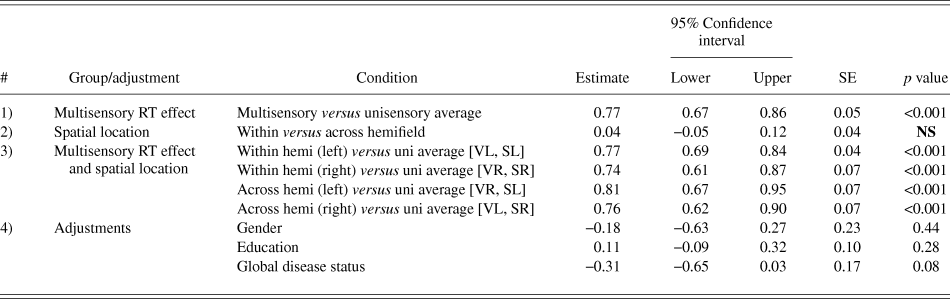
Results from the linear mixed effects model (LMEM; see Table 2), which adjusted for speed of processing, gender, education, and global disease status, revealed significant multisensory RT effects (Table 2, #1; p < 0.001), with RTs to VS multisensory stimuli faster than RTs to unisensory V and S averages. Further, the effect of spatial location (Table 2, #2; p = .41) was not significant; suggesting no reliable difference in RTs to unisensory stimulation presented within or across spatial hemifields. RTs to all four multisensory conditions were significantly faster than RTs to unisensory averaged conditions regardless of spatial location (Table 2, #3; p < 0.001). Taken together, participants demonstrated significant VS multisensory effects to stimuli presented within and across hemifield, indicating that spatial location of the unisensory stimulus is not a critical stimulus parameter for multisensory RT effects to occur in aging.
Linear mixed effects model results for: 1) multisensory RT effect, 2) spatial location, 3) multisensory RT effect by spatial location, and 4) adjustments1
1 This Linear Mixed Effects Model adjusted for processing speed by using the inverse transformation of reaction time (RT: 1/RT*1000).
Race model results
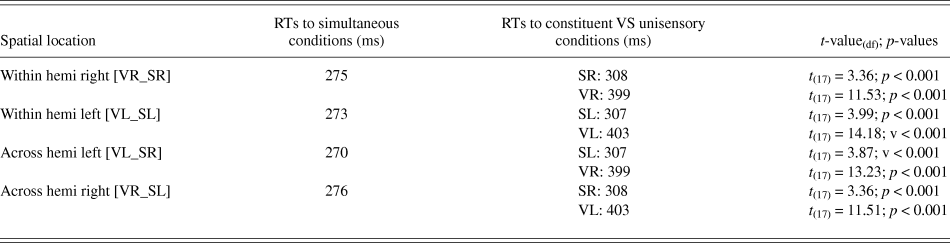
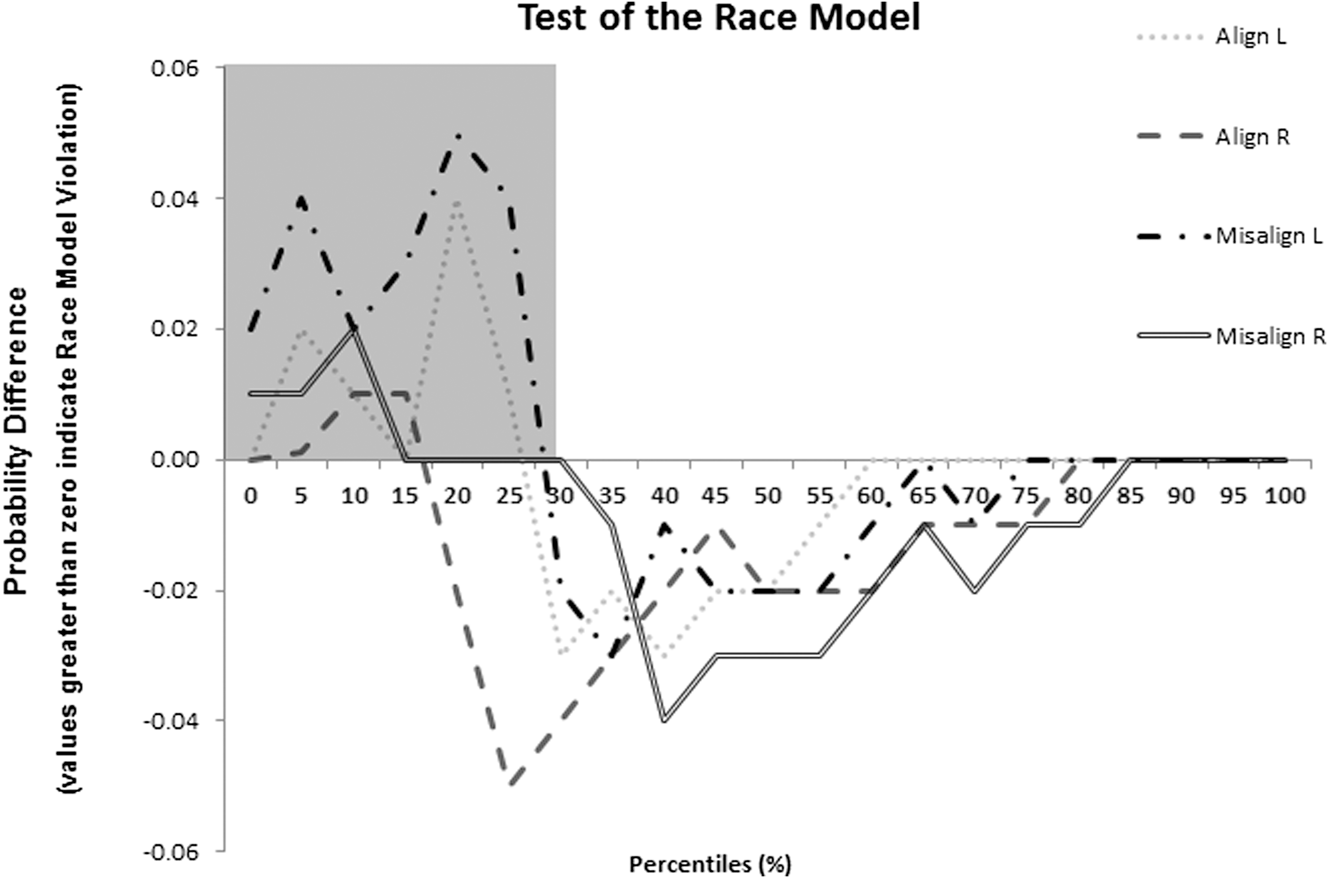
Results from planned comparisons (paired t-tests) confirm that RTs to all VS pairs, within and across hemifields, were significantly shorter than any unisensory stimulus condition (see Table 3). This provides evidence for a RSE across all sensory combinations. In regards to testing the race model, CP at each time bin was group-averaged separately for each multisensory condition (actual) to form a distribution that maintained the shape of the individuals’ data and was then compared to the model (predicted) for the multisensory pairings. Differences between actual and predicted CP models of the grouped RT distribution for all four multisensory conditions are depicted in Fig. 3; where positive values represent a violation in the race model.
Multisensory RT effect by spatial location
Results of Miller’s Test of the Race Model. The cumulative probability difference waves (actual minus predicted probability), over the trajectory of averaged responses, are depicted for each of the four multisensory VS pairings. Note that violations of the race model were evident across all four multisensory conditions over the fastest quartile (0–25%) of RT responses (see shaded box).
Discussion
To date, multisensory research in young adults has shown clearly that sensory information is simultaneously gathered in the brain and integrated in a parallel, not serial, manner (Harrington & Peck, Reference Harrington and Peck1998; Pavani et al., Reference Pavani, Spence and Driver2000; Molholm et al., Reference Molholm, Ritter, Murray, Javitt, Schroeder and Foxe2002; Murray et al., Reference Murray, Molholm, Michel, Heslenfeld, Ritter, Javitt, Schroeder and Foxe2005). While such integration is said to be governed by basic stimulus principles including time, space, and magnitude (Stein et al., Reference Stein, Magalhaes-Castro and Kruger1975; Meredith & Stein, Reference Meredith and Stein1986; Meredith et al., Reference Meredith, Nemitz and Stein1987; Stein et al., Reference Stein, Huneycutt and Meredith1988; Stein & Meredith, Reference Stein and Meredith1990; Stein & Meredith, Reference Stein and Meredith1993; Meredith & Stein, Reference Meredith and Stein1996; Wallace et al., Reference Wallace, Wilkinson and Stein1996), these principles do not always hold true for young human psychophysical and electrophysiological studies (e.g., Murray et al., Reference Murray, Molholm, Michel, Heslenfeld, Ritter, Javitt, Schroeder and Foxe2005; Holmes, Reference Holmes2007; Ross et al., Reference Ross, Saint-Amour, Leavitt, Javitt and Foxe2007). The current available body of research on MSI in aging is quite limited and to our knowledge this is the first study to report significant MSI RT effects in older adults under conditions with varying degrees of spatial separation between unisensory visual and somatosensory constituents.
Results from this experiment demonstrate that older participants were significantly faster at responding to the VS multisensory conditions compared to the combined unisensory stimuli. Even after controlling for speed of processing, gender, education, and global disease status, MSI RT effects persisted across all four multisensory conditions, regardless of whether the unisensory inputs were presented within or across hemifields. These results provide evidence for a RSE (Kinchla, Reference Kinchla1974) and are consistent with other behavioral multisensory findings in young (Harrington & Peck, Reference Harrington and Peck1998; Pavani et al., Reference Pavani, Spence and Driver2000; Molholm et al., Reference Molholm, Ritter, Murray, Javitt, Schroeder and Foxe2002; Murray et al., Reference Murray, Molholm, Michel, Heslenfeld, Ritter, Javitt, Schroeder and Foxe2005) and old adults (Laurienti et al., Reference Laurienti, Burdette, Maldjian and Wallace2006; Peiffer et al., Reference Peiffer, Mozolic, Hugenschmidt and Laurienti2007; Mahoney et al., Reference Mahoney, Li, Oh-Park, Verghese and Holtzer2011). Further, this significant RSE across all VS conditions subsequently violated the race model; a result that is congruent with previous studies (see Molholm et al., Reference Molholm, Ritter, Murray, Javitt, Schroeder and Foxe2002; Murray et al., Reference Murray, Molholm, Michel, Heslenfeld, Ritter, Javitt, Schroeder and Foxe2005; Mahoney et al., Reference Mahoney, Li, Oh-Park, Verghese and Holtzer2011). However, this methodology was not without its limitations, as it did not take into account measures of noise that form as a result of repeated exposure to sensory stimulation (Otto & Mamassian, Reference Otto and Mamassian2012). Nevertheless, these results do reveal a significant multisensory RT effect for simultaneously presented visual and somatosensory stimulation to different spatial locations, thus indicating that spatial location was not a critical stimulus parameter for successful VS multisensory RT effects in aging.
MSI in aging is not fully understood
Older adults demonstrate greater multisensory enhancement compared to younger adults when provided with redundant information across multiple sensory channels (Laurienti et al., Reference Laurienti, Burdette, Maldjian and Wallace2006; Peiffer et al., Reference Peiffer, Mozolic, Hugenschmidt and Laurienti2007; Hugenschmidt et al., Reference Hugenschmidt, Mozolic and Laurienti2009; Stephen et al., Reference Stephen, Knoefel, Adair, Hart and Aine2010; Mahoney et al., Reference Mahoney, Li, Oh-Park, Verghese and Holtzer2011). Laurienti et al. (Reference Laurienti, Burdette, Maldjian and Wallace2006; Peiffer et al. 2007) have examined AV integration in young and old adults and reported shorter RTs to AV compared to unisensory conditions across both age groups. Results from our recent investigation (Mahoney et al., Reference Mahoney, Li, Oh-Park, Verghese and Holtzer2011) examining the differential effect of AV, AS, and VS multisensory processing revealed that older adults exhibit the greatest multisensory RT benefit when presented with concurrent VS information. However, very little is known about the behavioral benefits of MSI in aging (see also Freiherr et al., Reference Freiherr, Lundström, Habel and Reetz2013), and the notion as to whether increased levels of MSI are actually beneficial has yet to be determined, as it could be the case that older adults simply require greater MSI.
In the limited number of multisensory aging experiments, the effect of MSI has been attributed to basic degenerative changes in neuronal architecture during the aging process. However, this speculative interpretation has not been systematically assessed in aging. Given that compensatory models of aging suggest that alternate brain networks are recruited to help older adults compensate for age-related differences (Stern et al., Reference Stern, Habeck, Moeller, Scarmeas, Anderson, Hilton, Flynn, Sackeim and van Heertum2005), it could be argued that larger multisensory RT benefits in older adults might be a compensatory process used to overcome age-related physiological declines in unisensory processing. However, clearly further investigations are required to better understand the biological basis of the aging process, as it relates to MSI, including specific contrasts between young and old adults as well as individual variations in MSI processing across the adult lifespan.
Future directions and implications for daily functioning for elders
VS integration is not well understood in aging. We believe that MSI is an integral aspect of functioning and mobility in the real world, given known overlaps in direct cortico-cortico and cortico-thalamic connections involved in successful MSI and motor functions. The finding that older adults demonstrate MSI effects regardless of whether stimuli are presented within or across hemifields has major public health implications. Given the current finding of multisensory RT speeding to VS cues regardless of spatial location in older adults, perhaps implementation of multisensory cross-walk stimulators (either VS or even AV) would be beneficial in senior-living communities. These stimulators will increase public safety, as older adults will undoubtedly demonstrate faster responses (i.e., start crossing the street earlier) to these external cues, regardless of the stimulator’s physical location. Although admittedly speculative, these findings could also be implemented as assistive or rehabilitative tools designed to enhance functional independence in older adults.
Conclusions
The present study expands upon previous findings delineating the occurrence of successful VS integration in aging (Mahoney et al., Reference Mahoney, Li, Oh-Park, Verghese and Holtzer2011) by demonstrating that older adults experience such integrative RT effects regardless of whether constituent stimuli are presented within or across hemifields. The speeded multisensory VS responses were indicative of a RSE that subsequently violated the race model, regardless of spatial location. Taken together, our results suggest that spatial location of the unisensory constituents is not critical for the occurrence of VS integration in older adults and could prove useful in the development of future MSI rehabilitative tools.
Acknowledgments
Research was supported by funding from the Albert Einstein College of Medicine’s Resnick Gerontology Center Pilot Grant awarded to Dr. Mahoney. Additional funding was given to Dr. Holtzer, who is supported by the National Institute on Aging (R01AG036921).