1. INTRODUCTION
The connection between language and reasoning has been noted since the days of the ancient Greeks, who used the same word, logos, to denote both concepts (Kalmar & Davidson, 1997). More recent work in cognitive sciences and psycholinguistics has established the relationship between language and reasoning (Levinson, 1996; Li & Gleitman, 2002). The relationship between language and reasoning for the purposes of design, such as in spatial reasoning and decision making, has also been established (Gero et al., 1994; Dentsoras, 2005). In this paper, we examine the effects of language on concept generation with the goal of establishing the foundation for a language-based design support system. Such a system will exploit the relationship between language and reasoning to facilitate the concept generation process.
Other researchers also recognize the overall importance of natural language to the design process. Natural language can be used in requirements specification (Burg, 1997; Nuseibeh & Easterbrook, 2000), concept generation (Segers, 2004; Chiu & Shu, 2005, 2007), design representation (Pahl & Beitz, 1996; Stone & Wood, 2000), and design outcome analysis (Mabogunje & Leifer 1997; Dong et al., 2003). We choose to focus on concept generation, as it is a crucial stage where many decisions are made that affect the rest of the product realization cycle. It is frequently estimated that 75% of total product cost is committed by the end of conceptual design (Ullman, 2003). Using the connection between language and reasoning to improve concept generation may assist in reducing the overall cost in the product realization cycle.
Our past work involved searching for biological analogies for design in natural-language format using computational linguistic techniques (Chiu & Shu, 2005, 2007). In this context, we recognized the use of lexical relationships within natural-language knowledge sources, that is, how authors tend to think about and express their knowledge. We used these relationships to retrieve relevant biological phenomena for use as stimuli in engineering problems. The presence of lexical relationships has also been identified in design activity outputs such as in design conversations (Dong, 2006) and sketch annotations, where new intermediate words generated using lexical relationships were iteratively used as design stimuli (Segers, 2004). The production of lexical relationships by designers expresses the ongoing reasoning and thought processes that occur during design.
The focus of the current study is the direct presentation of language as design stimuli, using lexical relationships as a means to generate stimuli related to the design problem. This is in contrast to the technique of using words as unrelated stimuli where the designer attempts to relate a randomly selected word back to the design problem in hopes of developing a new perspective on the problem (De Bono, 1992). Our current work is motivated by our past work in biomimetic design, where the process of traversing lexical relationships, such as within the framework of WordNet (WordNet 2.0, n.d.), provided surprising and nonobvious alternative search words. This work is also motivated by evidence that designers produce ideas, concepts, and annotations that can be structured within such a language framework (Segers, 2004; Dong, 2006).
We specifically investigate words in the form of verbs. Verbs are suitable as design stimuli as they convey action and not form, and therefore are not necessarily tied to a concrete representation. Also, verbs are more flexible than nouns, displaying an attribute called “mutability,” where they can take on different meanings depending on their noun arguments (Gentner & Frances, 1988). Nouns have an average of 1.74 senses, or meanings, and verbs have an average of 2.11 senses (Fellbaum, 1998).
As we cannot directly observe either language or design reasoning processes within the designer, we observe expressed responses to language stimuli. We use WordNet, a lexical database modeled on psycholinguistic theories of human lexical memory to provide a language hierarchy. Nouns and verbs within WordNet are organized in a hypernym/hyponym hierarchy, where hypernyms are superordinate words and hyponyms are subordinate words (Miller et al., 1993). A hyponym inherits all attributes of its hypernym term while possessing additional attributes that distinguish it from its hypernym and coordinate term. Thus, hyponyms are more specific than hypernyms. Of importance is that we can use word level as a measure of specificity.
We use verb forms of hyponyms, or troponyms (Fellbaum, 1998), which describe a specific manner of carrying out an action, as design stimuli. Starting from the problem statement, the main function desired of the design is expressed as a verb or as an action word (Stone & Wood, 2000; Ullman, 2003). Next, the troponym hierarchy is descended, and troponyms, in turn, are examined as candidate stimuli for the generation of ideas. Because the troponym hierarchy is more broad than deep, it may be necessary to ascend the hierarchy and descend again on another path if no appropriately specific verbs are found. However, because increased specificity limits a verb's use, there is a limit to the number of levels that can be descended. We aim to examine the effect of hierarchy level on concept generation.
2. NOMENCLATURE
Hypernym describes the superset of a word, where the hypernym encompasses all instances of x. For example, “tree” is the hypernym of “maple” (Miller et al., 1993).
Hyponym describes the subset of a word, where the hyponym is a specific instance of y. For example, “tree” is a hyponym of “plant” (Miller et al., 1993).
Sense is the meaning of a word. Words may have multiple senses or meanings. Senses in WordNet are enumerated.
Sister term are words with the same immediate hypernym (WordNet 2.0, n.d.).
Troponym specifically refers to the hyponym relationship between verbs. A troponym of a verb is related to that verb as some particular manner of that verb (Fellbaum, 1998). For example, “to amble” is a troponym of “to walk,” because ambling is a particular manner of walking.
Verb, intransitive is a verb that does not need a direct object, or cannot take a direct object. For example, “he sleeps” is a grammatical, or grammatically correct sentence, but if the direct object “bed” is added, “he sleeps a bed” is not a grammatical sentence.
Verb, transitive is a verb that can take a direct object, for example, “he eats his lunch.” Many verbs can either be transitive or intransitive. For example, “he eats” is a grammatical sentence.
3. METHOD
For this investigation, we explored the relationship between word stimuli and design outcome. As this involves collecting information about how designers perceive and use information for the purposes of engineering, we chose an open-ended approach commonly used in knowledge elicitation to determine relationships between concepts (Cooke, 1994). Participants were provided with a series of unrelated problems and asked to use stimuli provided in the form of words related to each problem to generate concepts.
Participants were
- instructed to review all words in the stimuli set before selecting a word or words,
- instructed to sufficiently develop their concepts based on selected words such that concepts could be evaluated with respect to whether it solves the problem presented,
- given a maximum of 10 min per problem to first review the stimuli set and then to develop a concept, and
- provided with a similar practice problem before commencing the experiment.
3.1. Description of participants
A total of 33 engineering students from different engineering disciplines and years of undergraduate engineering education participated in this experiment. Participants were enrolled in a design course at the time of this experiment, and thus were familiar with the design process, different concept generation techniques, and the reasons for utilizing such techniques within concept generation.
3.2. Description of problems
A total of four problems were chosen, two general problems and two that are related to manufacturing:
- sunflower-seed shelling (Design that Matters, 2006),
- grinding of soft materials (Kosse, 2004),
- egg orientation (Kosse, 2004), and
- bushing and pin alignment and insertion (Kosse, 2004).
The problem statements will be presented along with corresponding results and discussions.
3.3. Description of word stimuli sets
The related-word stimuli were generated using the troponym/hyponym semantic relationship in WordNet 2.0 and consist of only verbs. The original verb used to generate the stimuli set was excluded, for example, the word “shell” for the sunflower-seed shelling problem. This was done to prevent the participants from defaulting to the original verb as used in each problem statement. Each stimuli set consisted of 12 to 14 words, which allowed multiple words from different levels to be included. Not all related words from the extensive hierarchies within WordNet were presented. The size of the stimuli set was restricted to expose participants to words from different levels while allowing them to develop concepts within the allotted time.
Although words were identified by traversing the troponym/hyponym hierarchy, the stimuli were presented to participants not in the form of a hierarchy, but randomly placed in a grid. Participants were not requested to place the words within a hierarchy, as it is not our intention to verify or validate WordNet. Participants were also not provided with the definitions of the words, as a previous related study found that participants provided with definitions would use words from the definition as stimulus, and not the defined word itself (Mak & Shu, 2004).
3.4. Example
The following shows an example problem statement and stimuli set as seen by the participant. Below is the sunflower-seed shelling problem and its associated word stimuli set placed randomly in a grid.
Sunflower-seed oil is a nutritious and valuable commodity in sub-Saharan West Africa. Mechanical presses to make oil from the shelled seeds exist locally, but machines to remove the shells do not. At present, there exists no alternative to the laborious and time-consuming process of shelling the sunflower seeds individually by hand before loading them into the press. Develop a concept for shelling sunflower seeds that can be used locally with minimal resources (Design that Matters, 2006).

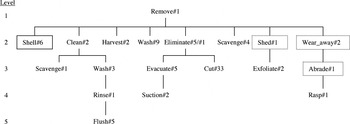
Figure 1 depicts the word hierarchy as it exists in WordNet. The original word “shell” is shown in a solid box, whereas the dashed boxes contain intermediate words that were used to generate the word stimuli set, but were not presented to the participants.

The stimuli in hierarchy form for the sunflower-seed shelling problem.
The levels are numbered at the far left, from 1 for the word “remove” and increased for each subsequent level, ending at 5 for “flush.” We will refer to words from level 1, for example, “remove” as a word from the “highest level,” whereas a word from level 5, for example, “flush” is referred to as a word from the “lowest level.” The “#number” immediately following each word indicates the WordNet sense, or meaning, of the word used to generate the stimuli set.
Word senses in WordNet are numbered according to their use in everyday language as captured in a tagged corpus, a sample of written text that has been annotated by an expert, with more commonly used senses having a smaller number. Some words in this hierarchy have more than one sense that is applicable to the design problem. For example, we show two senses of “eliminate”:
Eliminate sense #1: “getting rid of”
Eliminate sense #5: “eliminating from the body” (WordNet, 2.0).
The hierarchy above contains “eliminate” with sense #5, but the more common meaning of “eliminate,” sense #1, is also appropriate for this problem, and thus, was added to the hierarchy to expand it by including more stimuli words. Different senses of “wash” and “scavenge” appear in different locations of the hierarchy. The senses for “wash” follow:
Wash sense #9, level 2: “remove by application of water or other liquid and soap or some other cleaning agent”
Wash sense #3, level 3: “cleanse with a cleaning agent, such as soap and water” (WordNet, 2.0).
When there are multiple senses of a word applicable to the problem, these multiple senses were considered in the stimuli set. When different senses of a word appear in different levels, the more commonly used sense of the word is assumed to be used by the participants, and the level corresponding to that sense is attributed to the word in the analysis. In the case of “wash,” it is assumed that participants used sense #3 of “wash” that resides in level 3. Note that in the randomized presentation of the stimuli set, words with multiple senses are shown only once to the participants, but shown multiple times in the actual hierarchy above for completeness.
4. RESULTS AND DISCUSSION
Overall, lower level words were more successfully used to develop complete concepts. Participants selected these lower level words more often and then used them in a related manner to develop complete concepts. However, the words in the lowest level were not used as successfully. For many problems, for example, level 5 words are the most specific, lowest level words and were not as successful compared to level 4 words. Higher level words were often observed being used in conjunction with the lower level words in complete concepts. The complete concepts demonstrated consistent relationships between the words used and the concepts developed.
The sections below discuss the analysis process and provide the detailed results for each problem.
4.1. Analysis
As expected from an experiment of this type, the responses were varied, as were the response formats. To facilitate the analysis, the data were first categorized based on the two response components:
- indicated a (chosen) word from the stimuli set and
- attempted a concept to address the problem.
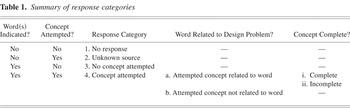
If both indicated words and an attempted concept were present in the response, the indicated words were examined for relatedness to the concept. If the words appeared related to the attempted concept, the concept was examined for completeness with respect to a first-level functional decomposition. Table 1 summarizes the response categories.
Summary of response categories

Although the first three categories of responses provide interesting insights into the concept generation process, we chose to concentrate on responses with both indicated words and attempted concepts as our focus is on word-based concept generation.
In this response category, some concepts were related to the indicated words, whereas many others were not related to the indicated word. Instances of attempted concepts that were not related to indicated word(s) occurred for the following reasons:
- Words were misused or misunderstood: For example, for the egg problem, participants misunderstood the word “stem,” meaning “to turn inwards,” when they expressed “stem means root shaped.”
- Words were used in a statement with no further elaboration: For example, “remove the dirt,” or “break away parts.”
- Words were used in high-level, abstract statements: These abstract statements may lead to creative concepts, but do not immediately address the problem, for example, from the grinding problem, “separate the processes [of removing material from the work piece and cleaning the grinding wheel].”
- Words were expressed as definitions: For example, from the sunflower-seed problem “harvest = pick/ collect.”
- Words indicated were not used, nor could their use be inferred in the attempted concept: This is different from responses in response category 3 (no concept attempted), as the participant may have indicated more words than those used to develop a concept.
Attempted concepts developed using the noun form of the word stimulus intended as a verb could still be considered related, as most verbs are derivationally related to their noun forms, for example, the verb “to grate” and the noun “grater” (WordNet 2.0, n.d.).
Finally, after determining the relationship between the indicated words and the attempted concept, the concepts were assessed for completeness with respect to a first-level functional decomposition (according to Suh, 1990; Dieter, 1999; Ullman, 2003; etc.). Concepts that fulfilled functions of the first-level functional decompositions were categorized as “complete.” Concepts were evaluated only for completeness, and not creativity or innovativeness, for example, using Altshuller's scale (Terninko et al., 1998). Evaluating for creativity and innovativeness is beyond the scope of this current work.
Specific results and discussion that focus on Response Category 4 (concept attempted and word indicated) for each of the problems are given in the following sections.
4.2. Problem 1: Sunflower-seed shelling
In this problem, participants were asked to develop concepts to shell sunflower seeds so that the seeds can be pressed for its valuable oil locally in sub-Saharan West Africa communities. The stimuli words were generated using the verb “to shell”—to remove from its husk or shell (WordNet 2.0, n.d.). The original problem and its stimuli set are presented in Section 0.
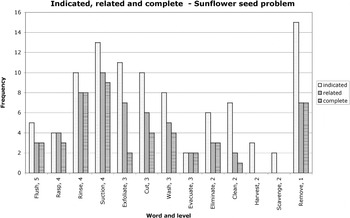
This stimuli hierarchy consisted of 13 words in five levels, with levels 3 to 5 referred to as lower levels, and levels 1–2 as higher levels. Of the six most frequently indicated words (approximately half of the 13 words presented), “remove” at level 1 was the most frequently indicated, but the second most frequently indicated was “suction” at level 4. The remaining frequently indicated words all reside in the lower levels and include “exfoliate” at level 3, “rinse” at level 4, and “cut” at level 3. The participants indicated a total of 96 words (including repeats), of which 57 led to related concepts, and 46 contributed to complete concepts. As complete concepts can be associated with multiple words, 46 of the words above contributed to a total of 18 complete concepts.
Figure 2 compares the frequency of the indicated words, and words that led to related and complete concepts against the word level. The figure indicates that the concept completion rate (#complete/#indicated) is higher for the lower level words “rinse” (0.80) and “suction” (0.69) than for the higher level word “remove” (0.47).

The frequency of indication, related concepts, and complete concepts for stimuli words for the sunflower-seed shelling problem.
Concepts were categorized as “complete” if they addressed both functions of the first-level functional decomposition below:
Function 1: Remove shell encasing the seed.
Function 2: Separate loose shells from bare seed.
For example, an attempted concept where the shell would be removed through cutting would be considered incomplete, as the second function is not addressed.
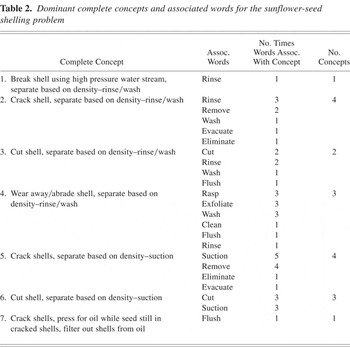
Many of the participants developed concepts consisting of a method to open the shell, either through cutting or cracking, and then separating the shell fragments from the seed through density differences, either by washing/rinsing/flushing, or suctioning the lighter shells away from the denser seeds. Table 2 summarizes the dominant complete concepts and their associated words.
Dominant complete concepts and associated words for the sunflower-seed shelling problem

A total of 18 complete concepts were developed for this problem, and several participants developed multiple solutions. Although most of the complete concepts are not considered innovative, concept 7 is perhaps the most unique. It involves first fracturing the shell, then pressing the entire shell and seed for oil without extracting the seed, and allowing the oil to drain out of the fractured shell. Although some concepts do not appear feasible, for example, cutting individual sunflower seeds may be difficult because of size, concept feasibility was not considered at this stage.
Table 2 shows a consistent relationship between the word stimuli used and the resulting concept. For example, the 10 out of 18 concepts developed based on buoyancy to separate the broken shells from the seeds were developed using words in the “wash/rinse/flush” branch, and an additional 7 out of 18 developed concepts using “suction” to perform the same separating function. The word “cut” also plays a prominent role in many of the concepts that involves “cutting” open the shell.
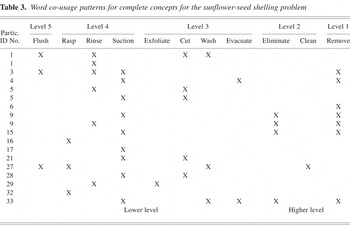
Many participants used higher level words as well in developing their complete concepts. Of the 18 complete concepts, 8 were associated with the level 1 and level 2 words “clean,” “remove,” and “eliminate.” However, most of these higher level words, seven of eight, were used in conjunction with lower level words such as “suction” and “rinse,” whereas others words, for example, “rinse” and “rasp” from level 4, were indicated as being used alone to produce concepts. Table 3 shows the co-usage patterns of the participants who produced complete concepts. The first column corresponds to participant identification numbers. Table 3 does not display all words, but only the words used successfully in complete concepts.
Word co-usage patterns for complete concepts for the sunflower-seed shelling problem

The above suggests that participants who use higher level words are more successful when using them in conjunction with lower level words.
4.3. Problem 2: Grinding of soft materials
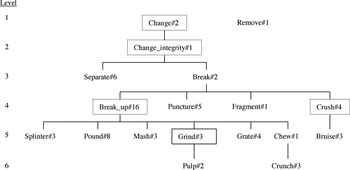
The problem statement for the grinding of soft materials follows with the stimuli set shown in WordNet hierarchy form (Fig. 3). Recall that participants were provided with randomized presentation of the stimuli, not the hierarchical presentation shown in Figure 3 to facilitate discussion of the results.
Grinding of metals is quite common to obtain a fine surface finish and tight tolerances. But when grinding soft materials such as rubber or plastic, the grinding wheels quickly become clogged. Repeated dressings (sharpening and shaping of the grinding wheel) do not help. Develop concepts that will enable surface finishing (with or without grinding wheels) to be used on soft materials.

The stimuli hierarchy for the grinding problem.
The higher level words in the main hierarchy, shown in the dashed boxes of Figure 3, were not presented to participants, but are included to illustrate the root of the hierarchy at the word “change.” This hierarchy is six levels deep and contains 13 words that were presented as stimuli, with words in levels 4–6 considered as lower level words. As this is a material removal problem, “remove” was included as a stimulus word to provide another higher level word, but not expanded to prevent confusion with the previous problem.
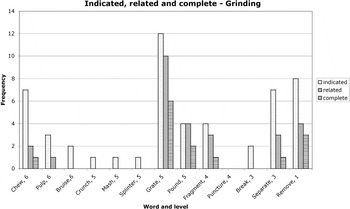
This problem had response patterns similar to the first problem, in that participants indicated lower level words more frequently, for example, “grate” at level 5. Figure 4 compares the frequency of words with corresponding levels that were indicated and led to related and complete concepts. A total of 52 words were indicated, 27 led to related concepts and 14 were associated with a complete concept.

The frequency of indication, related concepts, and complete concepts for stimuli words for the grinding problem.
To determine completeness, concepts were examined for whether they address both functions of the following functional decomposition:
Function 1: Shape/remove the surface material on work piece.
Function 2: Remove/clean material chips/residue from area/work piece/tool.
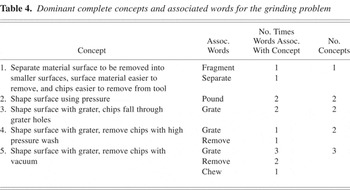
A total of 7 out of 10 concepts were developed around using a “grater,” much like a cheese grater, to remove surface material. Perforations on the back of the grater enable the removed material to drop away from the work piece and the tool to help prevent clogging. Another complete concept involved applying high pressure or “pounding” to shape the work piece. Although this concept does not explicitly address Function 2, there is no need to remove or clean the removed material using this strategy; thus, it is considered complete.
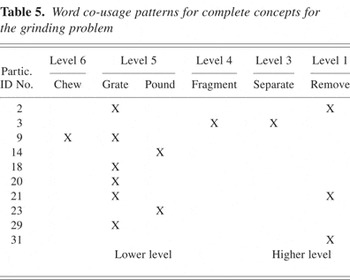
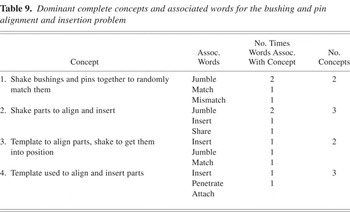
Table 4 summarizes dominant complete concepts for this problem and reveals that the higher level word “remove” is used in conjunction with lower level words like “grate” to form complete concepts. Two of the three times “remove” is used were done so in conjunction with a lower level word, that is, “grate” (level 5). Table 5 shows co-usage patterns by participants' complete concepts.
Dominant complete concepts and associated words for the grinding problem

Word co-usage patterns for complete concepts for the grinding problem

The small number of complete concepts (10) may indicate that many participants had difficulty with this problem, as they are not familiar with the grinding process. Also observed is a carryover effect as some of the participants used the words “exfoliate,” “suction,” and “wash,” words found in the stimuli set of the previous problem.
4.4. Problem 3: Egg orientation
The statement for this problem is as follows:
Develop concepts to automatically orient raw chicken eggs with the pointed ends all facing one direction.
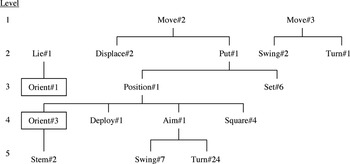
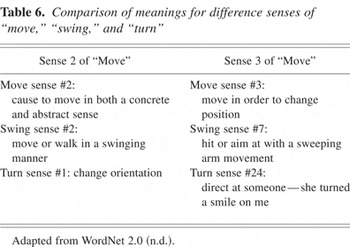
The stimuli set in hierarchy form is shown in Figure 5. The hierarchy shows that the sister terms “swing” and “turn” can appear either as direct troponyms of the third sense of “move” or as more distant troponyms of the second sense of “move.” The corresponding meanings for the senses follow in Table 6.

The stimuli hierarchy for the egg orientation problem.
Comparison of meanings for difference senses of “move,” “swing,” and “turn”

Although the two senses of “move” are similar, it is likely that the more commonly used senses of “swing” and “turn,” senses #2 and #1 residing in level 2, were the ones intended by the participants, although the level 5 words were originally intended as stimuli.
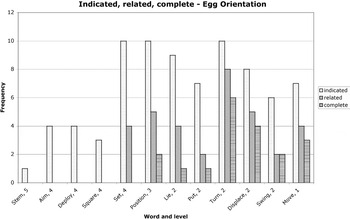
The stimuli set consists of 12 words in five levels, with lower levels being levels 3, 4, and 5. “Swing” and “turn” from level 2 were among the words most frequently indicated. “Turn” resulted in the highest percentage of complete concepts. Figure 6 compares the frequency of words that were indicated, led to related and complete concepts, and shows that words in levels 4 and 5 are not associated with many complete concepts.

The frequency of indication, related concepts, and complete concepts for the stimuli words for the egg orientation problem.
Concepts were assessed as complete if they address both functions of the following decomposition:
Function 1: Determine which eggs need to be turned.
Function 2: Turn eggs.
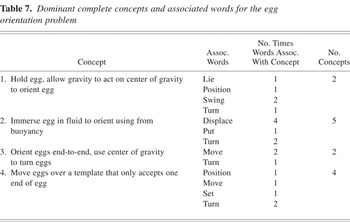
Most (9 of 13) participants developed complete concepts by using the asymmetry of the egg's shape and center of gravity to determine egg orientation and to turn the egg. Two similar solutions were developed that involve suspending the egg in fluid or by a pivot point, and allowing gravity to act through the centre of gravity to turn the egg.
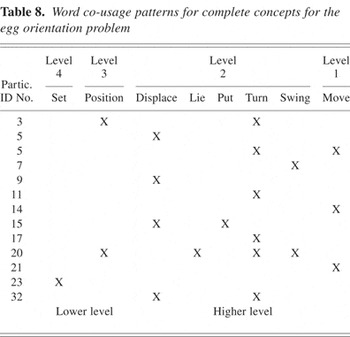
Table 7 shows that all but one participant used words that were level 2 and higher, for example, level 1 words, to develop their concepts, and only 2 of 13 used these higher level words in conjunction with a lower level word, that is, the level 3 word “position.” The level 4 word “set” was not used in conjunction with any other words. Table 8 shows co-usage patterns from complete concepts:
Dominant complete concepts and associated words for the egg orientation problem

Word co-usage patterns for complete concepts for the egg orientation problem

Unique to this problem, most (12 of 13) participants used words that are level 2 and higher to develop their concepts and only 2 of 13 used the higher level words in conjunction with lower level words. This result may be because this stimuli set was effectively shallower than the other sets because of two factors:
- Participants likely used the more common senses of “swing” and “turn” from level 2 of the hierarchy, not the senses in level 5 intended as stimuli.
- The remaining level 5 word, “stem” is associated with an obscure sense: “to cause to turn inward, e.g., to stem your skis” (WordNet, 2.0), that made it difficult to relate this word to the problem.
Considering the above two factors, the hierarchy is reduced to only four levels, with 5 of 10 words residing in the upper levels, levels 1 and 2, of the hierarchy.
Another possibility for the greater use of higher level words in this problem is that participants are more familiar with eggs than grinding and seed pressing, and thus were able to approach this problem at a higher level. This would result in successful application of higher level words that convey more abstract ideas. However, this possibility is confounded by the “flattening” of the hierarchy.
Despite these differences, the results of this problem still suggest that words at the effectively lowest level, that is, level 4, are not often used successfully as stimuli in concept generation.
4.5. Problem 4: Bushing and pin alignment and insertion
The problem statement is as follows:
Parts that are automatically mated, for example, a bushing and a pin, must be positioned so that their axes coincide. Using chamfers on mating parts does not solve the problem. Develop a concept to centre mating parts that does not require high positioning accuracy and provides for assembly without the use of robotics.
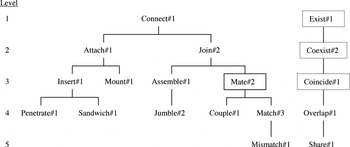
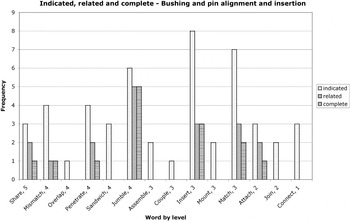
The stimuli hierarchy is shown in Figure 7. The stimuli set consisted of 14 words in five levels. The results from this problem are similar to those from the first two problems in that the words associated with the most complete concepts are in the lower levels of the hierarchy, for example, the level 4 word “jumble.” Figure 8, comparing the words that were indicated, and led to related and complete words, shows that the word “jumble” in level 4 led to the highest number of complete concepts.

The stimuli hierarchy for the bushing and pin alignment and insertion problem.

The frequency of indication, related concepts, and complete concepts for stimuli words for the bushing and pin alignment and insertion problem.
Concepts were assessed as complete if the requirements of following functional decomposition were addressed:
Function 1: Align bushing and pin.
Function 2: Insert pin into bushing.
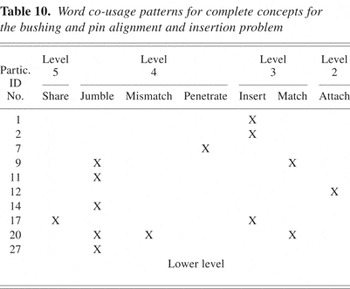
Two dominant concepts were developed: using a template to align and insert the bushing and pin, and shaking/vibrating parts to align and insert. For this problem, only a small number of participants were able to develop complete concepts, which may be because of either poor understanding of this mechanically based problem or participant fatigue. However, from the 10 complete concepts, 7 of 10 concepts were developed based on the idea of “jumbling” or shaking parts to align and insert them, suggesting the direct influence of the chosen stimuli on the generated concept. Table 9 summarizes the concept types and associated words.
Dominant complete concepts and associated words for the bushing and pin alignment and insertion problem

Table 10 shows the word groupings used by the 10 participants who developed complete concepts. Data from this problem show that 7 of 10 participants used a single word to develop their concept, unlike in previous design problems where most participants used multiple words. This difference may be because of participant fatigue. In 9 of 10 cases, concepts were developed using lower level words.
Word co-usage patterns for complete concepts for the bushing and pin alignment and insertion problem

Another possible source of difficulty for this problem was that there is a mismatch between the stimuli and the actual functional decomposition. The stimuli sets were generated using words found in the problem statements, for example, “shell” for the sunflower-seed problem. In the three previous problems, there was a good correspondence between the word chosen from the problem statement and the functional decomposition. However, for this problem, there was less correspondence as the stimuli set was generated using “mate” as given in the problem statement, but the functional decomposition is expressed as aligning and inserting, specific aspects of mating for assembly. In addition, it is curious that the single word that led to the most concepts, “jumble” has a connotation almost opposite to the orderliness associated with “align.”
4.6. Overall results and discussions
4.6.1. Word levels
Although this seemed like a simple experiment, many difficulties were encountered. This included varied responses; large amounts of data; qualitative data, and the possibility to analyze the data in many different ways, for example, analyzing on a per word basis, per designer basis, or per unique concept basis.
The number of participants who were able to develop complete concepts was low, between 8 and 16 participants per problem out of a total of 33 participants. The low number of complete concepts may be because of the fact that participants were not asked to explicitly perform a functional decomposition. However, it appears that the most successful participants implicitly performed a functional decomposition, as the use of multiple verbs seems to show participants were decomposing the problem.
The words chosen by the participants appear to be clearly related to the completely developed concepts, confirming that words presented as stimuli have a direct influence on concept generation. In three of the four problems (sunflower seed, grinding and bushing, and pin), the participants tended to select words in the second lowest level of the hierarchy (“suction,” level 4/5 total; “grate,” level 5/6 total; and “jumble,” level 4/5 total, respectively), and then preceded to successfully develop complete concepts based on these indicated words. Those who also chose higher level words tended to be more successful if they used the higher level words in conjunction with lower level words. The ability to incorporate higher level words to develop a concept may suggest an ability to perform higher level abstraction. This is supported by Dong (2006), who found in his studies of design groups, that generation of hypernym relationships in design conversations suggests the capacity for higher level abstraction required of a successful designer. The ability to abstract may be related to the designer's experience.
The egg-turning problem did not show the same word-usage pattern, as most participants developed complete concepts from the higher level words. But for this problem, the resultant stimuli set was only four levels deep when considering that participants likely intended the most commonly used senses for the words “swing,” “turn,” and did not understand the meaning of the verb “stem” at all. Verb hierarchies in general are more shallow than deep (Fellbaum, 1998), such that there are many sister terms but not many troponyms. Therefore, missing a level may result in a fairly significant difference in participant response. However, consistent with results of the other problems, the lowest level words were rarely chosen. The overall results suggest that highest level words may be too general, whereas the lowest level words may be too specific for the purposes of concept generation.
It must be emphasized that the stimuli set is by no means complete, nor the hierarchies exhaustive; the hierarchies extend further down, and as a result, may include many more words that can potentially be used as related design stimuli. A complete hierarchy cannot be practically presented during a experiment such as this; however, a designer seeking stimuli for his or her own concept generation process can examine words at any level of the hierarchy.
4.6.2. Verb intransitivity
Although the overall trend is that lower level verbs are more successfully used in complete concepts, less successful words can be found in all levels of the hierarchies. For the grinding problem that included six levels. Figure 4 shows that “splinter” (level 5) and “break” (level 3) are unsuccessful words with no related or complete concepts, and that “fragment” (level 4) and “separate” (level 3) have low success rates. One characteristic common to these verbs is some degree of intransitivity. Transitive verbs can take a direct object, whereas intransitive verbs cannot take a direct object. Most verbs can be transitive or intransitive. For example, consider the verbs “build” and “sleep” in the following sentences:
He is building.
He is sleeping.
Both are complete sentences, yet they do not have a direct object. Now consider the next pair of sentences:
He is building a house.
He is sleeping a bed.
Here, “build” can take a direct object but “sleep” cannot. However, both verbs can take a prepositional phrase as in the following:
He is building with a team.
He is sleeping in a bed.
After observing that many of the unsuccessful verbs appear to have strongly intransitive dominant senses, we used WordNet verb frames and sentence examples to examine the transitivity of all senses of the stimuli words. As we are not certain of the specific sense participants associated with the verbs presented, we calculated a “percentage of weighted intransitivity” for each verb using the following:

For example, the verb “break” has 59 total senses, 28 of which are intransitive, resulting in 47.4% intransitivity for this verb. However, as the WordNet senses are ordered according to usage from most common to least common, the more commonly associated sense for “break” would be the first sense of “break” rather than the last sense of break. Therefore, the intransitivity associated senses should be weighted according to the sense number. For “break,” the percentage of weighted intransitivity is 23%, as most of the intransitive senses were associated with the less commonly used senses. The percentage of weighted intransitivity was then compared to the percentage indicated, related, and complete as calculated below:


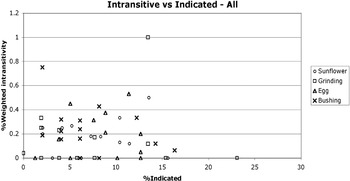
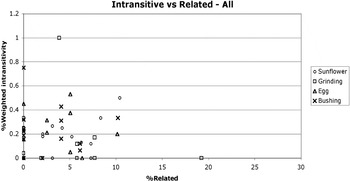
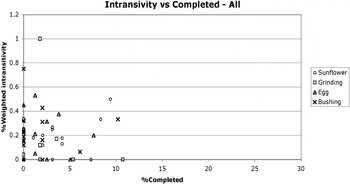
The denominator term is maintained for all three categories as it tracks the relationship between intransitive words and their ultimate successful use in a complete concept. Figures 9, 10, and 11 show the relationship between percentage intransitivity and words that were indicated, and led to related and complete concepts.

The percentage of weighted intransitivity compared to the percentage indicated for all problems.

The percentage of weighted intransitivity compared to the percentage related for all problems.

The percentage of weighted intransitivity compared to the percentage complete for all problems.
The sequence of graphs shows a shift toward the left as we move from the graph corresponding to percentage indicated to the graph corresponding to percentage completed. In this same sequence, the graphs also become sparser. This suggests that although participants may initially select intransitive verbs as stimuli, they experience increasing difficulty applying them toward a complete concept.
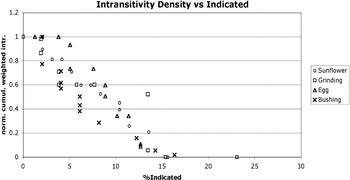
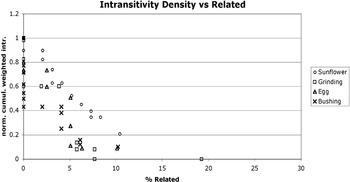
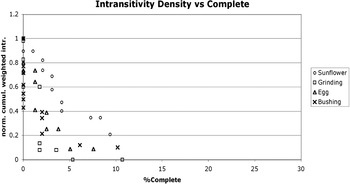
The inverse relationship between intransitivity and successful application of the word stimuli can also be illustrated by transforming above graphs into cumulative density graphs where the y axis is the normalized cumulative intransitivity. Graphing the cumulative density clarifies the contribution of intransitive verbs to the unsuccessful or successful use of the word as stimuli because data points no longer overlap. The graphs are normalized with respect to total intransitivity of all verbs within that problem to allow comparisons between problems. The normalized cumulative density is calculated as follows:

where x = {% indicated, % related, % complete}. Figures 12, 13, and 14 show the normalized cumulative density graphs.

The normalized intransitive density compared to the percentage indicated for all problems.

The normalized intransitive density compared to the percentage related for all problems.

The normalized intransitive density compared to the percentage complete for all problems.
The preceding graphs show that, overall, participants were not as successful with intransitive verbs, whether it was relating the word to the problem or using the word to complete a concept. Verbs that have more dominant intransitive senses are associated with fewer complete concepts, whereas verbs that have fewer dominant intransitive senses are associated with more complete concepts. As noted, although participants may initially choose intransitive verbs from the stimuli set, intransitivity appears to act as a filter as participants work through the problems. The type of problem presented could also be a factor in the success of transitive verbs. All four problems in this investigation were transitive in nature, that is, functional verbs act on objects, which may have led participants to indicate more transitive verbs in the first place, or influenced them to abandon attempts to develop complete concepts with intransitive verbs. The function of many engineering designs can be described with a transitive verb. Although this is an unexpected observation of this experiment, it is supported by how design is described, analyzed, and modeled. For example, Stone and Wood, in their functional basis (2000), developed a design language to describe products using a verb–object format and also defined verb and object taxonomies. Although some of the verbs in the function/verb taxonomy may have intransitive senses, all of these verbs also have a transitive sense to enable a valid verb–object formulation.
5. SUMMARY AND CONCLUDING REMARKS
In this investigation, we attempted to elicit information about how designers use words as stimuli to assist in concept generation. We were especially interested in using the hyponym/troponym relationships to determine the specificity of the stimuli being presented. Each participant was provided with four problems and related stimuli sets arranged randomly. Participants indicated words from the stimuli set and then attempted to develop concepts based on those words. We examined two properties of the verbs within the stimuli set; the level of the verb within the WordNet hierarchy; and the transitivity of the verb, where a transitive verb can take a direct object, and an intransitive verb cannot.
We found that the words indicated by the participants played a role in the type of concepts attempted, and that generally, words from lower levels of the hierarchy tended to result in a higher percentage of complete concepts. We also found that participants were able to use transitive verbs with more success in the development of complete concepts. This suggests that for transitive problems, that is, those where a functional verb acts on an object, increasing the number of transitive verbs as stimuli may increase the number of complete concepts generated.
Future work includes comparing the effects of presenting a different number of stimuli levels to different groups, the effects of verb intransitivity on concept generation, and evaluating concept creativity when using words as stimuli for concept generation. This work will contribute to understanding the relationship between language and the reasoning processes used within conceptual design.
ACKNOWLEDGMENTS
The authors gratefully acknowledge the financial support of NSERC (Natural Sciences and Engineering Research Council of Canada). We also acknowledge the assistance of Professors Greg A. Jamieson and Susan McCahan from the Department of Mechanical and Industrial Engineering, University of Toronto. Finally, we thank the anonymous reviewers for their suggestions and comments.