


INTRODUCTION
From Afghanistan and Pakistan in South Asia to Iraq in the Middle East, Islam is implicated in many of the most deadly civil wars in the last decade. Although current studies focus on how Islamic ideology impacts the causes and duration of such conflicts (e.g., Toft Reference Toft2007; Fish, Jensenius, and Michel Reference Fish, Jensenius and Michel2010), the impact of Islamic religious practices on the day-to-day conduct of violence has not been thoroughly investigated. The Islamic calendar provides an opportunity to illuminate the impact of religious practices on violence because the calendar regulates the timing of society-wide observance and because the religious meaning of specific days changes predictably and annually, creating sufficient variation to assess its effect.
How does the Islamic calendar influence the conduct of violence in Islamic societies, and does it do so in predictable ways? Although policymakers and journalists often assert that Islamic militants time their strikes to coincide with important Islamic holidays, no scholarly consensus on the relationship between the Islamic calendar and violence has yet emerged. Ramadan has attracted particular attention. For example, Timothy Carter (Reference Carter2011) finds a statistically significant 34% increase in daily risk of U.S. and North Atlantic Treaty Organization (NATO) coalition fatalities during the month of Ramadan in Afghanistan. Toft and Zhukov (Reference Toft and Zhukov2015) similarly find that Islamic militant attacks were 20% more likely during Islamic holidays in the North Caucasus. Other scholars find the opposite. Hassner (Reference Hassner2011) and Medina, Siebeneck, and Hepner (Reference Medina, Siebeneck and Hepner2011) find that violence does not significantly change, or that it even declines, on Ramadan and other Islamic holidays in Iraq. Since these disparate findings could easily result from different cases, dependent variables, operationalizations of significant religious time, and estimation techniques, the overall effect is that empirical truth behind the popular wisdom—that the main effect of the Islamic calendar is to increase violence—remains poorly understood.
To date, Hassner (Reference Hassner2011) offers the best conceptual framework to understand the countervailing incentives for violence generated by religious holidays. According to Hassner, the likelihood that an armed actor will attack on a holiday increases “if the force multiplying effects of sacred time, motivation, and vulnerability, outweigh its force dividing effects, constraint, and outrage” (Hassner Reference Hassner2011, 491). However, the framework makes no concrete predictions about which factors—multipliers or dividers—are likely to prevail in any given case.
In this article, we develop a theory of the effect of the relationship between the Islamic calendar and the conduct of violence, and we test it rigorously against the evidence in multiple prominent cases of sustained political violence in Islamic societies. Our core argument is that important religious holidays, defined as those with national days off to facilitate dedicated society-wide observation, consistently and predictably serve as focal points for collective restraint rather than escalation, suppressing rather than promoting violence during an ongoing campaign. For example, although Ramadan is a religiously significant period, our theory predicts a suppression of violence on only those days of the month that are also public holidays. The main suppressive mechanism is the increase in broad societal disapproval of violence during major Islamic holidays beyond that which might be incurred on other days. This mechanism, we argue, threatens militant actors who consider attacks on these days with a loss of societal support critical to their campaign and even survival, offsetting tactical and strategic benefits to violence on these days. In this way, the Islamic calendar is not itself a root cause of political violence, but like weather and other annual cycles that affect the costs and benefits of violence on specific days, operates as a “structural moderator” that constrains the full set of forces driving political violence in Islamic societies.
We test our prediction of the effect of the Islamic calendar on political violence in three Islamic countries experiencing large-scale and enduring civil conflict: Iraq, Afghanistan, and Pakistan. In addition to testing the theory across cases, we use five separate publicly available datasets of daily incidents of political violence from the period 2004 to 2014, two common to all of our country-cases and one unique to each, to control for dataset-specific biases. Our research design accounts for competing structural moderators such as nonreligious public holidays as well as weather, economic, and political cycles, and bolsters quantitative analysis with qualitative evidence of the proposed societal disapproval mechanism at work. This research design increases the confidence that we are isolating the effect of the Islamic calendar, and that our findings are not artifacts of common sources of bias stemming from case selection, data sources, coding rules, and omitted variables.
What do we find? Our statistical analysis lends strong evidence to our claim that the only consistent effect of the Islamic calendar is as a force for peace. Major Islamic religious holidays reduce violence significantly in every one of our three cases across each of our political violence datasets by as much as 25% in Afghanistan, 34% in Iraq, and 41% in Pakistan compared to an ordinary day. Neither public holidays in general, nor the month of Ramadan or other religious holidays without days off, had a consistent effect on violence, positive or negative, confirming that it is the religious nature of a given day—not a day off alone—that explains the Islamic calendar’s consistent and powerful suppressive effect. In addition, our qualitative analysis finds evidence for both outrage on the part of Islamic publics regarding violence on important religious holidays and fear of this outrage on the part of militant groups, lending further support to the societal disapproval mechanism. These findings are a significant contribution to existing scholarship on Islamic time and violence and have implications for both civilian and military decision makers formulating counterinsurgency strategy in predominantly Muslim societies.
A SOCIAL THEORY OF RELIGIOUS TIME AND MILITANT VIOLENCE
There are two ways to think about religious, including Islamic, understandings of time. Studies of religious violence have long focused on the role of eschatological time—that is, a religious community’s beliefs about its location in the temporal trajectory between the creation of the universe and the “end of days” heralding the religion’s final triumph—as a root cause of religious violence (e.g., Juergensmeyer Reference Juergensmeyer2000). This grand, cosmological and transcendent notion of religious time is not the primary concern of our project. Rather, our study investigates the effect of religious calendrical time—annual and recurring celebrations and festivities commemorating key moments in a faith—on the occurrence of violence in protracted militant campaigns in Islamic societies.
Calendars are a formalized way of organizing time—past, present, and future—according to a recurring cycle of events (Lakoff and Johnson Reference Lakoff and Johnson1999, 137–138). Calendars not only mark a progression of dates of national and religious significance and celebration, but they also identify periods important to life in society, such as the time for planting and harvesting crops. The Islamic calendar is a framework for marking the progress of a year as laid down in the Islamic scripture and tradition comprising a recurring cycle of religious dates, periods, and festivals central to the practice of the Islamic faith (Böwering Reference Böwering1997; Karamati et al. Reference Karamati, Negahban, Pakatchi, Poor, Madelung and Daftary2016).
The Islamic calendar (or Hijri calendar as it is formally known) determines both the timing of religious obligations and cultural practices shared widely by Muslim societies. Like the commonly used solar Gregorian calendar, the Islamic calendar comprises 12 months. Unlike the Gregorian calendar, in which months occur at the same seasonal points every year, the Islamic calendar is a pure lunar calendar with each Islamic month beginning a week and a half earlier every solar year, traversing the entire solar calendar every 33 years. The Islamic calendar is thus formally delinked from secular holidays and obligations tied to the solar year (e.g., planting and harvesting) and the seasons. Indeed, states and societies in the Islamic world typically use a solar calendar like the Gregorian calendar to regulate the secular functions of state and society while reserving the Hijri calendar solely for marking religious time (Mughal Reference Mughal2014).
Calendars are not root causes of political conflict. The root causes of conflict in Islamic societies as elsewhere are the broad political, economic, social, and religious factors that motivate political actors to use violence (Fearon and Laitin Reference Fearon and Laitin2003; Pape Reference Pape2005; Glaeser Reference Glaeser2005; Philpott Reference Philpott2007). Calendars affect the causal chain between these root causes and observed violence by enhancing or diminishing the incentives for militant groups to attack at particular moments. In other words, calendars act as structural moderating variables: they moderate not just one particular primary causal process (as is commonly understood by the “moderator” concept in the social sciences) but multiple generative mechanisms of violence at the same time.Footnote 1
Indeed, scholars of conflict have long considered the structural impact of seasonal weather and political and economic cycles on the logistics and timing of military operations (e.g., Winters Reference Winters1998), incentives to interfere with political institutions (e.g., Staniland Reference Staniland2015), and availability of resources and manpower (e.g., Bellemare Reference Bellemare2015). Perhaps surprisingly, cultural cycles of annual observance tied to national and religious identity communities have not received as much attention.
All structural moderators, including cultural cycles, influence patterns of violence over specific time-horizons (e.g., day, week, month). This temporally delimited impact distinguishes structural moderators from root causes. The key is not the precise length of this time horizon, which can vary across and within weather, economic, political, and cultural cycles, but that these are periods of time over which root causes of violence themselves will rarely vary substantially.Footnote 2
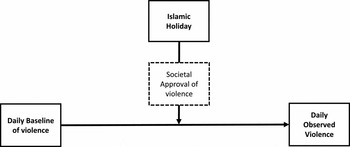
Conceptualizing the Islamic calendar as a structural moderator is consistent with how the literature implicitly understands the relationship between religious time and conflict. For example, the popular expectation among American policymakers that violence surges during Ramadan presumes conflict is intensified, but not caused by, the holiday. Toft and Zhukov’s (Reference Toft and Zhukov2015) prediction that Islamic holidays increase violence, by creating focal-points allowing militant groups to better coordinate activity, similarly presumes a baseline level of ongoing conflict. Hassner’s (Reference Hassner2011) framework of incentives and constraints on violence during religious holidays, although agnostic on the primary direction of effect, nonetheless presumes that the root motivations for conflict are exogenous to sacred time. Our contribution is to make this heretofore unacknowledged structural moderator logic, found across the literature, explicit. This logic is depicted in Figure 1.
How the Islamic Calendar Impacts Violence

Unlike these existing accounts, we argue that the Islamic calendar’s structural-moderating effect is to restrain militant group violence through the mechanism of societal disapproval. As we explain below, societal disapproval creates powerful disincentives for violence during important religious holidays, such that force-dividing effects (in Hassner’s terminology) will predictably dominate on Islam’s most holy days, those marked by public days off to facilitate dedicated observance. Especially in societies where a common overarching religious tradition dominates—as is the case in Afghanistan, Pakistan, and Iraq—we argue that normative disapproval for attacks on important religious holidays suppresses violence, and does so in a consistent and predictable manner. This mechanism operates through the decision making of militant groups, and their anticipation that societal outrage will deny them critical support.
How Societal Approval Impacts Violence
Our theory presumes an Islamic society experiencing a large-scale, sustained campaign of violence carried out by organized militant groups motivated by some set of political goals. However, motivation alone is insufficient to achieve these goals. As Shapiro and Fair (Reference Shapiro and Fair2010, 84) argue, “militant organizations cannot engage in meaningful violence without some measure of popular support,” which, as we explain below, is in large part conditional upon community approval of the means used to achieve desired political ends.
Militant groups depend on societal support for manpower, materiel, sanctuary, and information to maintain their activities (Paul Reference Paul, Davis and Cragin2009), and court an audience of current supporters, the indifferent, and those that actively resist the group that can move across these categories in both helpful and harmful directions (Petersen Reference Petersen2001). Militant group survival requires that active support outweighs active resistance and that the group avoid actions that might push individuals from support to indifference, or worse, from either support or indifference to active resistance. Among supporters, “true believers” who share militant political goals, or “opportunists” who join a winning side, are most likely to withdraw support due to normative disapproval. Coerced support alone will likely be insufficient to offset losses due to normative disapproval. Since coercion is itself costly, it has the potential to push people toward resistance, creating a spiral requiring ever increasing coercion which may be beyond militant capabilities to sustain (e.g., Kalyvas Reference Kalyvas2006; Condra and Shapiro Reference Condra and Shapiro2012). It follows that for groups to balance tactical objectives and survival, maintaining voluntary support and, more importantly, avoiding active resistance, is crucial (e.g., Arjona, Kasfir, and Mampilly Reference Arjona, Kasfir and Mampilly2015). Indeed, the larger and the more ambitious a group, the more it depends on sustainable support and approval from the community in which it operates, for two reasons.
First, community support enables a militant group to grow and replenish its membership. While small terrorist groups numbering in the dozens can husband their resources by hiding from government forces or society for long periods of time, large militant organizations actively engaged in protracted campaigns of political violence cannot operate without losses, particularly if they are carrying out suicide attacks (Pape Reference Pape2005). The major militant groups operating in Afghanistan, Pakistan, and Iraq fall into this latter category, having sustained strengths estimated in the tens of thousands of fighters. Although foreign fighters represent one potential source of new recruits, they are rarely sufficient to replace the substantial losses incurred in intense campaigns of political violence. Indeed, an analysis of conflicts across the Islamic world since 1945 found that foreign fighters never comprised more than 5% of total combatants in any of them, including Iraq (Hegghammer Reference Hegghammer2010/11).
Second, community support is essential to enable large militant groups to avoid detection, surveillance, and elimination by the security forces of the government (Pape Reference Pape2005, 80–82). The fighters for the groups in our study are overwhelmingly volunteers, which requires these groups to keep a relatively high profile; therefore, it is impossible to prevent members of the local community in which the group operates from gaining basic information that would be useful to the government, such as the identity of recruiters, common locations for recruitment, and means of communication (Berman and Matanock Reference Berman and Matanock2015). Accordingly, without broad sympathy from the local population, these militant groups would be especially vulnerable to penetration, defection, and informants (Berman, Shapiro, and Felter Reference Berman, Shapiro and Felter2011). As active resistance increases, it becomes more difficult for the group to operate at all, let alone achieve its political goals. The threat to militant groups is very real: the Sunni militant group Al Qaeda in Iraq (AQI) was nearly destroyed when Iraqi Sunnis, its core constituency, turned against them and ultimately joined anti-Al Qaeda Awakening militias once the opportunity presented itself (Biddle, Friedman, and Shapiro Reference Biddle, Friedman and Shapiro2012).
Even militant groups that benefit from foreign support must manage the problem of backlash resulting from attacks that violate fundamental community norms in their areas of operation. While some argue that external support insulates militant groups from popular opposition (e.g., Salehyan, Siroky, and Wood Reference Salehyan, Siroky and Wood2014; Toft and Zhukov Reference Toft and Zhukov2015), foreign resources are unlikely to completely substitute for local resources for all but the smallest and most socially isolated groups. Local support is critical to the success of large and protracted insurgent campaigns that contest and control territory, as is the case for many Islamist organizations. The loss of local support matters not just by reducing material benefits that could be replaced by external sources, but also by pushing otherwise indifferent segments of society into more active resistance, from basic noncooperation to forming antigroup militias (Jentzsch, Kalyvas, and Schubinger Reference Jentzsch, Kalyvas and Schubinger2015). Moreover, this threat applies to small and isolated groups sustained heavily by external support, because a single betrayal can destroy them.
Put simply, militant groups will avoid violence when it risks the kind of societal disapproval that puts critical support at risk.
How Islamic Holiday Norms Affects Societal Approval
We argue that the primary way in which the Islamic calendar affects militant group decisions about violence is by creating anticipated costs for attacks on particular days. This mechanism is normative: on the most important holidays, there exists a deeply felt sense within Islamic societies that violence disrupting observance is especially inappropriate, or taboo—a tradition stretching back to the religion’s contentious formative years (Firestone Reference Firestone1999; Jackson Reference Jackson2002). Current and potential supporters judge militant groups not only by tactical success and failure but also the degree to which their violent activity conforms to predominant cultural—and in this case religious—norms. Normative violations thus risk turning current and potential supporters into bystanders or adversaries. Groups therefore anticipate punishment for violence that violates these norms, inducing restraint.
To be sure, societal approval is a complex phenomenon with variegated sources operating individually as well as interactively at multiple levels of society. For example, violence against innocent civilians, forcible recruitment of child soldiers, human trafficking, sex slavery, ethnic cleansing, use of human shields, and public executions all undoubtedly violate societal norms (e.g., Wood Reference Wood2009), that will force groups to consider the costs to support they might suffer for violations. Our argument is not that the Islamic calendar supersedes these other important norms, but that it works in conjunction with them. As a structural moderator, the Islamic calendar magnifies these existing general norms while also adding an additional time-delimited one. For example, an attack against civilians may generally cause outrage, but the same attack on a major Islamic holiday more so because it adds an additional source of anger. In short, the religious calendar interacts with other sources of societal disapproval but also produces a distinct independent effect.
In the case of the religious calendar, the mechanism of societal disapproval operates through the shared meaning holidays create in a societies with a common deeply held religious tradition. How does this work? According to Benedict Anderson and other scholars, understandings of time are fundamental to the self-identity and consciousness of national communities. For a religious community, its understanding of time creates an association among members that links earthly chains of events to the Devine in a manner they can all experience (Anderson Reference Anderson1983). As Elie Podeh (Reference Podeh2011, 16) explains, collective identity is fostered when “[h]olidays help establish an annual cycle of remembrance designed to ensure that several times every year members will recall certain ‘sacred’ moments from their collective past.”
In our cases, the most important holidays are Islamic religious holidays for which societies are given days off from their normal everyday obligations to dedicate themselves to observance. Islam is the official religion in Afghanistan, Pakistan, and Iraq, with overwhelming majorities in each state identifying as Muslim. Important Islamic holidays are thus observed by the entire national community generating widespread solidarity and empathy on these days. Public days off facilitate the dedicated observation of rituals and practices and thus signify important normative focal points in a given national context. Our theory does not classify holidays without days off—such as most days during the sacred month of Ramadan—as “important holidays,” not because they are insignificant to believers, but because they are not exclusively set aside for dedicated religious observance. Violence on important Islamic holidays is most likely to generate societal outrage because, in contrast with violence on Islamic holidays without days off, this violence mars the sanctity of days entirely reserved for practices central to the reaffirmation of religious identity.
Of course, Islamic societies are also divided along sectarian lines, and this is evident in the celebration of holidays, with some more significant for one sect than another, and others taking place sometimes days apart. Ashura, the day Shia Muslims commemorate their founding, is perhaps the best known example and serves as a flashpoint for sectarian violence in Iraq and Pakistan, and more recently in Afghanistan. However, important Islamic holidays are observed by Sunni and Shia alike and thus have the potential to reduce violence between sectarian rivals that share the same underlying religious norms (Hoffman Reference Hoffman and McAuliffe2016). When important religious holidays are observed with a national day off, it underscores their significance across any sectarian divides that may be present. Attacks on such religious holidays are thus likely to be met with society-wide outrage and disapproval, creating fear in the minds of militant groups contemplating violence on these days.
The central mechanism of societal disapproval operates irrespective of a given militant group’s ideology (whether religious or secular) because they are subject to a local normative context they do not control. It is society’s understanding of religion that constrains militant violence and not the particular understandings held by the militants themselves. Militants, like other potential norm entrepreneurs, cannot easily ignore or reframe a preexisting religious cultural landscape because these understandings are rooted in the diffuse semiotic practices of individuals and are thus challenging to transform (Wedeen Reference Wedeen2002). Therefore, it is the preexisting core beliefs of their local supporters that matters to militant groups contemplating violence. Nevertheless, even foreign donors may well share these norms of restraint on Islamic holidays and punish groups that defy them (e.g., Stanton Reference Stanton2016). The violation of holiday norms thus poses a significant risk to any militant group operating in an Islamic society, even to those whose primary support base is non-local (contra Toft and Zhukov Reference Toft and Zhukov2015).
Alternative Mechanisms
Two alternative mechanisms could also explain why violence would decline on important religious holidays. Both of them operate by increasing the practical challenges posed to militant groups contemplating violence, rather than through militant fears of lost societal support for attacking on these days.
First, important Islamic holidays might affect violence through the mere fact that they are also public holidays, and that it is the disruption entailed in any day off that is important, not the religious meaning of the holiday per se. Days off are associated with significant changes in the pattern of societal activity, with individuals potentially gathering in their homes or other dispersed locations leaving militant groups with fewer vulnerable targets for their violence (Hassner Reference Hassner2011, 501–503). Yet, in addition to religious holidays, societies also tend to observe a number of secular days off (not least being the weekend) that would similarly reduce available targets. If it is the day off that explains systematic reductions in violence on important religious holidays, it should do so on secular days off as well.
The second alternative mechanism for reduced violence on major religious holidays in Islamic societies is the heightened security measures taken in anticipation of militant violence on these days. Since these focal-point opportunities for violence are easy to foresee, governments routinely deploy additional security forces in vulnerable areas.Footnote 3 Accordingly, violence may go down on these days not because society disapproves of it, but because executing attacks is more difficult. However, if this mechanism explained the reduction of violence, it would do so any time counterinsurgent forces were deployed, including on any society-wide day off when they are also routinely brought out in force to anticipate possible militant disruption.
By including both secular days off and recent counterinsurgent military activity in our analysis, our research design allows us to assess both alternatives.
Expected Islamic Calendar Effects
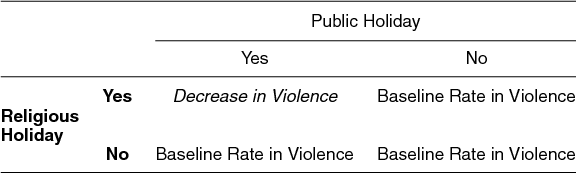
Our theory predicts that the moderating effect of the Islamic calendar on violence is conditioned on public holidays, resulting in the 2 x 2 representation provided by Table 1.
Predicted Effects of Islamic Calendar and Public Holidays on Violence

Based on our theory, we expect important Islamic holidays to have regular and predictable restraining effects on violence in our cases. We identify important Islamic holidays as those with official nationally observed days off.
Primary Hypothesis (H1): Islamic holidays that are also public holidays will experience lower levels of violence compared with ordinary days.
However, our theory also confronts three further alternative hypotheses on the relationship between holidays and violence. First, it is possible that our theory is incorrect on the suppressive effect of holidays, religious or otherwise, and that the enhanced opportunity to conduct attacks for tactical or symbolic reasons would lead to an increase of violence on such days (e.g., Toft and Zhukov Reference Toft and Zhukov2015; Hassner Reference Hassner2011). Second, it may be Islamic religious meaning alone driving a suppressive moderating effect. In other words, even Islamic holidays without days off would experience the same violence-restraining effect. Finally, societal disruption or added security precautions may act to suppress violence on any public holiday, rather than just religious ones.
General Holiday Increase Alternative Hypothesis (H2): Holidays in general—either Islamic or secular—will experience higher levels of violence than ordinary days.
General Religious Alternative Hypothesis (H3): Islamic holidays will experience lower levels of violence than ordinary days regardless of whether they are a public holiday.
General Public-Holiday Alternative Hypothesis (H4): Public holidays in general— Islamic or secular—will experience lower levels of violence than ordinary days.
RESEARCH DESIGN AND DATA
Our strategy for causal inference follows our understanding of the Islamic calendar as a structural moderator operating on a broad spectrum of causes of violence, rather than one in particular, in sustained civil conflicts. Indeed, if the Islamic calendar constrained violence only when it resulted from one particular cause, then we would need to identify this primary cause. However, our theory is not that one particular cause of violence (e.g., Western occupation of a Muslim society) is more likely than another cause (e.g., economic grievances) to be affected by the Islamic calendar, but that the broad set of causes that together generate baseline levels of daily violence would be collectively moderated for predictable and delimited periods of time.
The three cases we have selected for analysis—Afghanistan, Pakistan, and Iraq between 2004 and 2014—are well suited for testing out theory. All three are predominantly Muslim countries, and each case includes at least one major organized militant group actively engaged in a campaign of violent attacks within the country’s borders. As of 2014, all three have experienced significant levels of such political violence more or less continuously for at least a decade. In addition, extending the analysis over so many years allows us to control for seasonal effects (beyond the specific confounding effects of alternative structural moderators) because, as we describe below, the Hijri calendar annually “migrates” in relation to the solar calendar. Thus, over such long period of time, the same holy days will fall at substantially different times of the year, further ruling out the influence of seasonal confounds. If our hypothetical expectations can be expected to hold anywhere, it would be in these three cases, thus representing a critical test of our theory.
Our research design is built on a parallel rather than pooled quantitative analysis of our three country-cases, using three distinct operationalizations of our dependent variable of violence within each. We opt to test our general theory of religious suppression in Islamic insurgency separately in each case, and further with different dependent variables within each, not because we have strong prior reasons to believe our expectations will play out differently in each context. Rather, we argue that this parallel analysis strategy, by providing a larger number of opportunities to have our primary hypothesis falsified by the evidence, represents a tough test of our theory and thus represents a superior foundation for making our broader causal claims linking Islamic religious time to insurgent violence.
Our approach for identifying the causal effect of the Islamic calendar on levels of violence is to account for and rule out potentially confounding structural moderators and alternative explanations. To do so, our research design controls for a wide variety of exogenous factors, a strategy that greatly reduces the risk of attributing causal effect to the Islamic calendar that is in fact spurious, thus reducing omitted-variable bias. Moreover, the usual concerns about endogeneity do not apply, because political violence, the dependent variable in our study, does not determine the Islamic calendar or many of these other exogenous controls. Finally, we also provide qualitative evidence for the societal disapproval mechanism, including evidence that militants in our cases anticipate the loss of support for attacks on Islamic holidays with public days off but not other days, including Ramadan.
Dependent Variables
We test for the effects of the Islamic calendar on incidences of political violence in our three cases, in Pakistan and Iraq at the province-day, and in Afghanistan at the Regional Command (RC)-day.Footnote 4 We disaggregate our country cases to subnational geographic units to account for local variation in weather conditions. We define political violence broadly to include (1) both fatal and nonfatal violent attacks; (2) initiated by organized militant groups and unaffiliated individuals; (3) using a wide range of methods from kidnapping to assaults to suicide attacks; (4) against a wide range of government, military, and civilian targets; (5) in support of political objectives, broadly defined. We include violence by all militant groups within the geographic boundaries of our cases, both “Islamist” and otherwise. Pooling violence irrespective of group motivation is a strong test of our claim that it is societal norms, not a particular group’s ideology, that generates the suppressive effect of important Islamic holidays. If non-Islamist groups operated according to different rules, including their violence would lower the chances of confirming our theory.
We use five different sources of political violence events data, two that span across our cases and three more specific to each case. Because each dataset is measuring the same underlying construct—political violence–we expect Islamic calendar effects to be visible across them. If this is true, we can be confident that our findings reflect real effects in militant decision making on the timing of attacks.Footnote 5
We use two main datasets—the U.S. National Counter Terrorism Center’s World Incident Tracking System (WITS) database and the National Consortium for the Study of Terrorism and Responses to Terrorism’s Global Terrorism Database (GTD) —to measure political violence across all three cases in our study. Both the WITS and GTD databases use media reports to collect global political violence initiated by nonstate actors (militant groups and individuals) against a wide range of government, security, and civilian targets while excluding ordinary crime and militant violence resulting from ground battles initiated by the state (LaFree and Dugan Reference LaFree and Dugan2007; Wigle Reference Wigle2010; Sheehan Reference Sheehan, Lum and Kennedy2012). They are not identical, but both capture a broad spectrum of both terrorist and insurgent violence while excluding potentially confounding events. For each dataset, we aggregate attacks to the province/RC-day for the WITS from 2004 to 2011 and for the GTD from 2004 to 2014.
In addition to the main two datasets, we supplement each case with a third, case-specific dataset of political violence events. For the Iraq case, we use the Iraq Body Count (IBC) database provided by the Empirical Studies of Conflict Project (ESOC) to create a province-day dataset of fatal events attributed to nonstate actors from 2004 to 2009 (Condra and Shapiro Reference Condra and Shapiro2012). For the Afghanistan case, we use insurgent violence reported in unclassified Significant Activities data (SIGACTs) from 2008 to 2014 released to the public via the U.S. Central Command (CENTCOM).Footnote 6 SIGACTs are individual “significant” events involving U.S. and NATO military forces in Afghanistan, and include a wide variety of enemy and coalition activity. Each event is timestamped, geolocated, and categorized based on event type. To construct our RC-day dataset, we use event classifications to filter the SIGACT data for enemy actions geolocated within the borders of Afghanistan and indicate intentional insurgent actions. Finally, for our third dataset in the Pakistan case, we use geolocated data on nonstate political violence from 2004 to 2014 collected in the the Pak Institute for Peace and Security’s (PIPS) Digital Database on Conflict & Security.
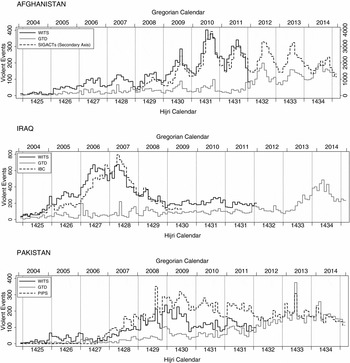
Figure 2 charts our dependent variables in each case, aggregated to the month for ease of comparison. Given the variation in levels violence captured by these datasets, any consistent findings across them should be taken seriously, while inconsistent findings should be interpreted cautiously. Summary statistics for our nine dependent variables are presented in Table 2.
Distribution of Attack Dependent Variables in Afghanistan, Iraq, & Pakistan, 2004–2014

Summary Statistics of Dependent Variable Event-Counts in Afghanistan, Iraq, and Pakistan, 2004–2014

The Islamic Calendar
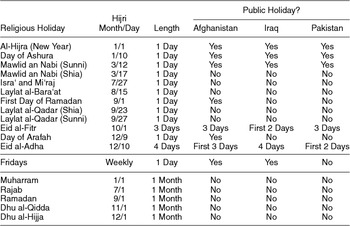
To model the Islamic calendar, we constructed variables mapping Islamic holidays to their corresponding Gregorian dates.Footnote 7 The two largest religious holidays on the Islamic calendar are the 3-day festival of Eid al-Fitr, which begins on the first day of Shawwal and marks the end of the fasting month of Ramadan, and the 4-day festival of Eid al-Adha, which takes place on the 10th day of Dhu al-Hijja and coincides with the Hajj, the annual pilgrimage to Mecca in Saudi Arabia that all Muslims are obligated by the Koran to complete at least once in their lives. A third important holiday, Mawlid an Nabi, commemorates the prophet Mohammad’s birthday and is celebrated during the month of Rabi al-thani, by Sunnis on the 12th and Shia on the 17th. Throughout the Islamic world, Muslims are given official days off to celebrate these holidays, as they are in our three cases of Iraq, Afghanistan, and Pakistan. Two Islamic holidays in the month of Muharram, the Islamic New Year, celebrated on the 1st, and Ashura, a holiday most central to Shia and celebrated on the 10th, are also public holidays in our three cases. Other potentially relevant Islamic holidays include Laylat al-Bara‘at and Lyalat al-Qadar during Ramadan, along with Isra‘ and Mi‘raj during the month of Rajab, which are not public holidays, and the first day of Ramadan and the Day of Arafa, which are only public holidays in Afghanistan.
We also include five sacred months as “religious holidays without days off” in our study. Ramadan is perhaps best known. It is Islam’s holiest month, the only month mentioned by name in the Koran, during which Muslims worldwide are obligated to fast during daylight hours (Plessner Reference Plessner, Bearman, Bianquis, Bosworth, van Donzel and Henrichs2016). Four additional months are the so-called Al Ashur al Haram or peace months—identified in Hadiths as the months of Rajab, Dhu al-Qidda, Dhu al-Hijja and Muharram—during which warfare is expressly forbidden (Firestone Reference Firestone1999). None of these five months are fully public holidays, though Rajab, Dhu al-Hijja, and Muharram have Islamic public holidays that take place during them.Footnote 8 Finally, we also include Fridays, Islam’s weekly day of prayer (Jumma), which is part of the weekend and therefore a day off in Afghanistan and Iraq, though not in Pakistan. The full set of holidays is presented in Table 3.
Holidays on the Islamic Calendar

The start of any Islamic month is governed by the sighting of the new moon at sunset, which can lead to variation among cases on the specific Gregorian date on which Islamic holidays are celebrated (Karamati et al. Reference Karamati, Negahban, Pakatchi, Poor, Madelung and Daftary2016). To capture the correct dates on which Islamic holidays were celebrated in our cases, we constructed case-specific Hijri calendars based on official moon sightings marking the beginning of each of the 136 Hijri months in our study. For Pakistan, we used official declarations by the Central Ruet-i-Hillal Committee, while for Iraq and Afghanistan, which follow Saudi Arabia, we used official declarations by the Saudi Supreme Court.Footnote 9
Controls
Perhaps the biggest threat to our ability to infer the effects of holidays on violence is the possible omitted-variable biases exerted by alternative structural moderating factors. Accordingly, in addition to religious holidays, we also control for secular holidays, economic, weather, and political cycles, as well as counterinsurgent military activity.
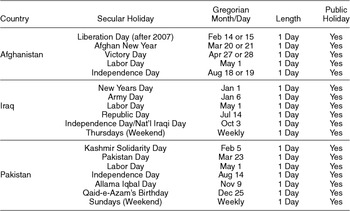
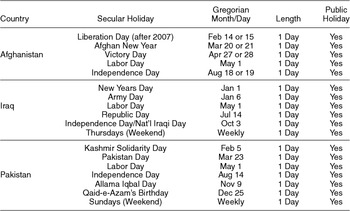
To test whether the relationship between Islamic holidays was an the result of having a day off, not the religious significance of the Islamic holiday per se, we identified secular public holidays to include as controls in our model.Footnote 10 In our cases, secular holidays such as Independence Day and Labor Day are not linked to the Islamic calendar. Pakistan and Iraq use the Gregorian calendar, whereas in Afghanistan, with the exception of Labor Day, secular holidays are marked on the Shamsi Hijri calendar, the same solar calendar used in Iran. In addition, we included secular weekend days (i.e., weekend days other than Fridays: for Iraq, Thursdays, and for Pakistan, Sundays). Afghanistan has only one official weekend day, Fridays. The full list of secular national days off for each case is presented in Table 4.
Secular Holidays by Country-Case
The existing literature has particularly emphasized the importance of food prices (e.g., Bellemare Reference Bellemare2015) and oil prices (e.g., Fearon Reference Fearon2005) on domestic political unrest and violence. To control for broad factors resulting from these international economic cycles, we include measures of daily global prices of two critical commodities, grain (the International Grains Council composite Grain and Oilseed Index) and oil (Brent crude prices from the U.S. Energy Information Administration).
Four meteorological variables—temperature, cloud cover, precipitation, and snow cover—have featured prominently in the literature on weather as a structural moderator of violence (e.g. Winters Reference Winters1998; O’Loughlin, Linke, and Witmer Reference O’Loughlin, Linke and Witmer2014; Carter and Veale Reference Carter and Veale2013). We measured these variables at the level of our geographic units to maximize fidelity to local weather conditions. We use global gridded daily averages estimated from a mix of weather station and remote sensing data and aggregated to the province/RC-day, derived from NCEP Reanalysis data provided by the National Oceanographic and Atmospheric Administration’s (NOAA) Earth Systems Research Laboratory for temperature, cloud cover, and snow cover (Kalnay et al. Reference Kalnay, Kanamitsu, Kistler, Collins, Deaven, Gandin, Iredell, Saha, White, Woollen, Zhu, Leetmaa, Reynolds, Chelliah, Ebisuzaki, Higgins, Janowiak, Mo, Ropelewski, Wang, Jenne and Joseph1996), and the Global Precipitation One-Degree Daily Data Set for precipitation produced by NASA’s Goddard Space Flight Center (Huffman et al. Reference Huffman, Adler, Bolvin and Gu2009).
As the literature on electoral violence suggests, pre-election periods are particularly dangerous because they act as focal points that combine an opportunity for symbolic political contestation with the potential to have direct influence on electoral results (e.g., Staniland Reference Staniland2015). In addition, because the United States plays a prominent role in each of our cases, we also control for the possibility that American election cycles influence the timing of militant violence. To control for political cycles, we account for periods immediately preceding these important national elections (executive and legislative) using election data from the National Elections Across Democracy and Autocracy Dataset (Hyde and Marinov Reference Hyde and Marinov2012) through 2010, and updated through 2014 using popular sources. We control for the presence of a local national election, and the presence of an American election, within the 30 days proceeding the observation in question.
Finally, to control for the suppressive effect of recent counterinsurgent military activity, we include a 1-day lagged measure of militants killed in clashes with government forces in a given province/RC-day from 2004 to 2014 based on data in the UCDP-GED version 5 dataset (Sundberg and Melander Reference Sundberg and Melander2013; Croicu and Sundberg Reference Croicu and Sundberg2015). We combined militant fatalities with uncategorized fatalities for the included events to capture the greatest possible range of government counterinsurgent activity.
Model Specification
The overdispersion of our count dependent variables makes negative binomial regression the appropriate statistical estimator for our purposes. The negative binomial is given by:
 $$\begin{equation}
P(Y_t)={\displaystyle \frac{\Gamma (\theta +Y_t)}{Y_t!\cdot \Gamma (\theta )}}\cdot u^{\theta }_t(1-u_t)^{Y_t},
\end{equation}$$
where P(Y
t
) is the probability of Y
t
events at time t, Γ is the gamma function, u
t
is θ(θ + λ
t
), θ is
 $\frac{1}{\alpha }$
, α is the dispersion parameter, and λ
t
specifies the negative-binomial model parameters (Hilbe Reference Hilbe2007). Our estimations employ a λ
t
of the general form:
 $$\begin{eqnarray}
ln(\lambda _t)&=&\beta _{0} +\beta _{1}LocalElection_{t} +\beta _{2}USElection_{t} \nonumber\\
&&+\,\beta _{3}OilPrice_{t} +\beta _{4}GrainIndex_{t}\nonumber\\
&& +\, \beta _{5}Temperature_{t} +\beta _{6}SnowCover_{t}\nonumber\\
&& +\,\beta _{7}Precipitation_{t} +\beta _{8}CloudCover_{t}\nonumber\\
&& +\, \beta _{9}COINActivity_{t-1}\nonumber\\
&& +\,\beta _{10}DaysFromOnset_{t} +\beta _{11}Y_{t-1}\nonumber\\
&&+\, {\bf GregorianYear_{t}\phi } +\,{\bf Province_{t}\phi }\nonumber\\
&& +\,{\bf HolidayPredictors_{t}\beta } +\epsilon _t,
\end{eqnarray}$$
where the exponential function of ε t is a gamma-distributed error term with a mean of 1 and a variance of α. HolidayPredictorst represents a vector of holiday indicators, which we use to perform our central hypothesis tests. GregorianYeart and Provincet represent vectors of indicators capturing the year and location of each observation creating an unconditional fixed-effects negative binomial model, which is preferable to the conditional given the manageable number of panels in our data (Hilbe Reference Hilbe2007, 199–208). Since our data takes the form of a time-series panel, we include a lagged value of the dependent variable (Y t − 1) to account for possible autocorrelation across consecutive cases, and the count DaysFromOnset t to capture trend effects.Footnote 11
QUANTITATIVE ANALYSIS
Our quantitative analysis primarily investigates the main hypotheses with days grouped into four categories—religious holidays with days off, religious holidays without days off, secular holidays with days off, and all other days, including secular holidays without days off—and also disaggregates the holidays to explore specific holiday effects, both supported by numerous robustness checks. Thus, for our primary analysis, HolidayPredictorst includes three categorical binary indicator variables—one for each relevant type of holiday—with “all other days” left out as a reference category. Similarly, for our disaggregated analysis, HolidayPredictorst includes an array of 23–25 (depending on the country-case) individual holiday indicator variables with “all other days” omitted to serve as a reference category baseline.
Primary Analysis
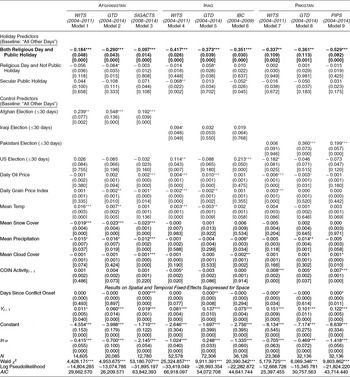
To assess the effect of the Islamic calendar on violence, we performed nine negative binomial regressions. Here, the key holiday predictor variables are operationalized according to the typology presented in Tables 3 and 4 above as the most straightforward and direct test of our hypotheses. These regressions are grouped into three clusters of three, with each model estimating the effect of our predictors separately on each dependent variable in each case. Table 5 reports the results.
Negative Binomial Regression Analysis of Daily Violence in Afghanistan, Iraq, and Pakistan, 2004–2014

Notes: Standard errors in parentheses; p-values in brackets; *Significant at .05, **Significant at .01, ***Significant at .001 (Two-Tailed)
Our primary analysis provides a strikingly strong confirmation of H1 across all nine models, thus confirming our core theoretical expectations. Controlling for numerous most-likely confounding factors, we find consistently negative and significant coefficients for days that are “Both Religious and a Public Holiday,” which represent the effect of such days on insurgent violence relative to a “normal” day in the life of each conflict. Indeed, this religious public holiday indicator is the only variable to achieve such a consistent statistically significant effect. Notably, H2 was not supported, as religious days that were not also public holidays—which includes most days in the month of Ramadan—did not significantly and consistently reduce violence. Similarly, public holidays in general also failed to consistently predict systematic increases (H3) or decreases (H4) in levels of violence, all else being equal. Taken together, these findings not only provide a 9 for 9 confirmation of our core hypothesis but also suggest that this suppressive effect does not generalize to just any holiday, religious or secular.
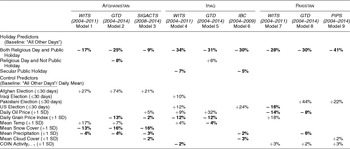
To identify the substantive suppressive effect on violence of important religious holidays, we conducted simulations of our results using the Clarify software (King, Tomz, and Wittenberg Reference King, Tomz and Wittenberg2000). Table 6 provides the percentage shift in the mean expected values yielded by our 1,000-per-model Clarify simulations, holding all else constant.Footnote 12
Substantive Shift in Significant Clarify Mean Expected Violent Attacks (Source: Negative-Binomial Analysis of Afghanistan, Iraq, and Pakistan, 2004–2014, Table 5)

Note: Significant substantive declines bolded for emphasis.
Cast in terms of percentage-shifts, Table 6 presents the relative impact of our religious public holiday predictors versus the other significant explanatory variables. Several important conclusions follow. The impact of religious public holidays is not only consistently negative, but sizable in effect: a decline in violence of roughly 25% on average compared to a “normal” day in the life of each conflict. This result needs to be understood in the context of other structural-moderating causal forces operating on daily violence levels. Indeed, none of our control variables garnered suppressive effects of a substantially different magnitude, with virtually all of them well below the 25% average decline found with religious public holidays. Not only do religious public holidays exhibit a significant negative relationship with observed violence levels, but also their influence is likely unique in terms of both size and consistency across our cases. Theoretically, this result makes sense given that—unlike the effects of politics, weather, economics, and counterinsurgent activity which might vary a great deal across different circumstances—Islamic holidays are shared across our three otherwise very different country-cases.
To explore the sensitivity of our models to specification issues, including the effect of the large number of independent variables required to capture our various controls, we reran all nine of our primary models including only the three holiday predictor variables, with substantively similar results (see Supplemental Table 1).Footnote 13 Second, there is a risk that our findings were an artifact of our choice to use a negative binomial estimator for our count response dependent variables. To test whether a binary estimator would have produced different results given the large number of zeros in our data, we reran all nine of our estimations using logit regression, and again found substantively similar results (see Supplemental Table 2).Footnote 14 This initial set of checks gives us confidence that our findings are sufficiently robust to alternative model specifications.
Exploration of Individual Holidays
Did our decision to “group” holidays together into categories for our primary analysis obscure the effects of Ramadan, or other specific holidays? To explore this possibility, we assessed the effect of each holiday or “holiday period” individually. This extension allows us to evaluate which holidays are having possibly disproportionate, or hidden, effects on violence levels that cannot be detected when they are grouped together for the sake of estimation.
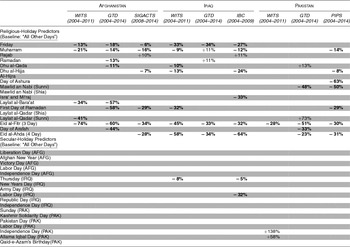
To facilitate our discussion, we only present the summary results of the Clarify simulations derived from these models, again reporting the percentage shift in the mean expected-values for statistically significant explanatory variables in Table 7, holding all else constant (see Supplemental Table 4 for the full estimation results).
Substantive Shift in Significant Clarify Mean Expected-Violent Attacks By Holiday (Source: Negative-Binomial Analysis of Afghanistan, Iraq, and Pakistan, 2004–2014, Supplementary Table 4)

Note: Significant substantive declines bolded for emphasis.
From Table 7, at least two important conclusions are evident. First, among the results on the 18 different Islamic holidays we examine, there are almost no examples of a holiday exerting a significant positive effect on violence, and none that do so consistently. With a scattered few exceptions, Islamic holidays are almost always associated with declines in violence. Second, the dearth of significant results on secular holidays confirm they have no analogous systematic effect on violence (either positive or negative). These results challenge the common presumption of a systematic Ramadan surge in violence: we found a significant increase in only one of our nine models, a significant decrease in another, and no significant effect in the other seven.
Significantly, while few Islamic holidays exert consistent effects across our cases, the exceptions are precisely those “public holiday” religious days that serve as the focal point of our theory. In particular, Eid al-Fitr proved to be the only Islamic holiday associated with significant declines in violence across all nine models. We also found substantial suppressive effects on Eid al-Adha, though they were statistically significant in only six of our nine models. Friday was found to have a significant negative effect on violence in all six of our models associated with Afghanistan and Iraq, but none in Pakistan—the sole country-case among our three which does not observe a “public holiday” that day of the week. Taken together, these results demonstrate the strengths and weaknesses of Hassner’s (Reference Hassner2011) analysis. While they replicate Hassner’s findings on these three holidays in Iraq, they nevertheless reveal that not all of these holidays have clearly analogous effects across Islamic societies. Moreover, our nonsignificant findings on Fridays in Pakistan suggests a pattern our theory is better equipped to explain.
EVIDENCE FOR THE SOCIETAL DISAPPROVAL CAUSAL MECHANISM
Our statistical evidence leaves open whether militant group fears of a loss of societal support—and not some other unidentified causal factor—best explains this observed restraint. Finding evidence for our mechanism is challenging because it operates through militant groups that do not necessarily document their reasoning. Furthermore, even when such evidence might exist, it is rarely available to researchers. Accordingly, any direct evidence of our mechanism on important Islamic holidays is valuable even if not fully dispositive. In this section, we provide evidence that militant groups do in fact worry about the loss of societal support, that they understand that they are judged by their adherence to Islamic religious norms, and that militant violence on important religious holidays elicits consequential outrage they explicitly discuss in their secret deliberations. The section concludes with a discussion of why religious holidays in general, and secular days off in particular, do not witness similar effects.
Previous studies of militant groups have found that leaders both appreciate the importance of local support and warn against actions that might undermine it, designing their organizations to allow for greater control over their fighters (Shapiro Reference Shapiro2013; Abrahms and Potter Reference Abrahms and Potter2015). We find similar evidence for these concerns in the internal deliberations of Al Qaeda in Pakistan and the Afghan Taliban’s code of conduct. In May 2010, Osama bin Laden wrote to a senior Al Qaeda commander emphasizing the dangers of engaging in attacks that alienate the local population he clearly views as vital to the group’s success: “Here is an important issue that we should pay attention to; carrying out several attacks without exercising caution, which impacted the sympathy of the nation’s crowds towards the Mujahidin. It would lead us to winning several battles while losing the war at the end.”Footnote 15
Groups also believe behavior conforming to shared religious principles is integral to securing popular support in our cases, which is underappreciated in previous studies. For example, the Taliban leadership has issued clear edicts to their fighters to conduct themselves according to the dictates of Islamic law to ensure continued support from the group’s local support base. According to the 2010 Taliban code of conduct (Layha), “Mujahedin are obliged to adopt Islamic behavior and good conduct with the people and try to win over the hearts of the common Muslims and, as mujahedin, be such representatives of the Islamic Emirate that all compatriots shall welcome and give the hand of cooperation and help.”Footnote 16 Indeed, Al Qaeda stipulates in its bylaws that members “have all Fridays and the two ‘Eid’s holidays off.”Footnote 17 Thus, adherence to the religious expectations of the local population is explicitly identified as central to public support by the most infamous militant group of the past twenty years.
Evidence for the societal disapproval mechanism is visible in the public’s response to violations of norms against violence on important religious holidays. For example, on October 23, 2006, the first day of the Eid al-Fitr holiday, 21 people were killed in multiple attacks throughout Iraq.Footnote 18 The media widely covered public condemnation of these attacks. As one Sunni religious leader said, “Brothers, we have to make use of these blessed days and stop killing each other and end our divisions. . . We have to live together in peace again.”Footnote 19 Similarly, the Pakistani president condemned a 2011 attack that occurred on Eid al-Fitr in Quetta, declaring to the country that the “killing of innocent people was contrary to the spirit of Islamic teachings and the message of Eid-ul-Fitr.”Footnote 20
Furthermore, there is also evidence from the secret internal deliberations of militant groups showing they recognize the threat to public support posed by public condemnation of attacks on important religious holidays. One significant case in point took place on January 20, 2005, when a suicide bomber detonated at an Eid al-Adha celebration in a failed attempt to assassinate the Uzbek warlord Rashid Dostum, wounding 21 civilian bystanders. Osama bin Laden himself, in the May 2010 letter referenced above, specifically identifies “the assassination attempt of Dustum [sic] during the holiday worship location” as a prime example of “operations that bear extreme negative impact on the partisans of the Jihad.”Footnote 21 Importantly, bin Laden does not suggest that the failure to kill Dostum was why the attack was, in his words, “a mistake.” Such a reaction would be expected if it were the failure to circumvent state security on the holiday, not loss of public support, that was animating his concern. Indeed, our review of publicly available and translated internal documents of Al Qaeda, Afghan Taliban, Pakistani Taliban, and Al Qaeda in Iraq found no evidence of frustration at their inability to successfully mount attacks on important religious days.Footnote 22
Why do religious holidays without days off, especially those in Ramadan or the four sacred months, exert no consistent effect on violence in our cases? One likely answer is that refraining from violence for months at a time in a high-intensity insurgent conflict would have considerable strategic costs. Nevertheless, even here, militant groups appear sensitive to the need to justify their violence during these sacred times. For example, prominent Islamic militant groups have made special efforts to frame violence during these holy periods as necessary and even religiously appropriate, sometimes declaring special “Ramadan” offensives (e.g., Bodansky Reference Bodansky2005).Footnote 23 There is also direct evidence that militant groups justify violence during the sacred peace months on similar grounds. A detailed exegesis spanning four articles in Al Qaeda’s Voice of Jihad magazine concluded “there is no doubt that the operations of the mujahedeen today is legitimate,” first because the defensive jihad “has nothing to do with a sacred month or any other,” and second because the enemy “does not respect the sacred months” circumstances “permit fighting” during them (bin Nasser al-Rasheed Reference bin Nasser al-Rasheed2004).
Finally, why not expect any day worthy of a public holiday to create the conditions for societal outrage that constrain militant groups from attacking on those days? The ambiguous normative status of secular holidays (and their associated observances) means that they are unlikely to have any consistent effect on violence, as our findings show. For example, in 2011, the Afghan Taliban attacked the British diplomatic compound in Kabul on Independence Day, citing the symbolic meaning of the holiday as motivation: “Today is our independence day from Britain. They recognized our independence 92 years ago—today’s attack was marking that day.”Footnote 24 Moreover, evidence of widespread outrage is scant after attacks on secular public holidays. For example, after a 2010 attack that killed 46 in Pakistan on a day off to celebrate the birthday of the country’s modern founder, the only reference to the holiday in media sources was indirect and in connection to the lack of immediate medical care for the victims, “as staff was on leave due to public holiday.”Footnote 25
CONCLUSION
This article shows that the Islamic calendar impacts violence primarily as a force for restraint. Because militants rely critically on societal support, they must take the norms of the surrounding societal context regarding the appropriateness of violence on significant Islamic holidays into account when planning their operations. Empirically, we find that important Islamic holidays reduce violence consistently across the sustained conflicts in Afghanistan, Iraq, and Pakistan from 2004 to 2014. Conversely, we find no significant evidence that any holidays consistently increase violence. Our finding challenges the commonly assumed association between the month of Ramadan and violence: while there may be spikes in isolated cases, there is no evidence of a systematic, recurring surge in attacks. Further, qualitative evidence of societal outrage in response to transgressive violence, and militant group concerns over the resulting loss of public favor, supports our theoretical account. This discovery has a number of important implications for existing understandings about the role of Islam in the production of violence.
First, in contrast to Hassner’s (Reference Hassner2011) indeterminate theoretical framework, our theory identifies a specific causal mechanism—militants’ fear of popular disapproval—that allows us to predict when the Islamic calendar will suppress violence. While our study creates substantial confidence that previous findings of a suppressive effect for certain Islamic holidays in Iraq (Hassner Reference Hassner2011; Medina, Siebeneck, and Hepner Reference Medina, Siebeneck and Hepner2011) are correct, our theoretical account provides a better explanation for them. Where this study goes beyond previous efforts is not only in the specification of a clear mechanism but also its discovery that this suppressive effect generalizes beyond the single potentially outlier case of Iraq to other conflicts in Islamic societies, and evident even when using a number of different measures for daily violence. Indeed, these findings persist even when taking a number of significant controls into account, confounds which previous studies have not taken as seriously.
Second, our findings challenge previous studies that have found that violence systematically increases on Islamic holidays. The majority of these studies have included only crude binary indicators for Ramadan alone, and minimal theorizing of the Islamic calendar as a whole. Hence, one should be skeptical about these findings. Toft and Zhukov (Reference Toft and Zhukov2015) are a partial exception. Their study of violence in the North Caucasus does offer an explicit theoretical mechanism for increases in violence on Islamic holidays and confirms this prediction for Islamist groups but not nationalist groups. However, their single case may be an outlier to the more general pattern that we find. Alternatively, their results may be an artifact of the single measure they use to capture violence in their empirical analysis. Their results could also be a product of the relatively blunt way they operationalize Islamic holidays, as “holiday-weeks” rather than our more precise daily analysis. More research is needed to know.
Third, our findings raise questions about why practitioners and scholars have devoted so much more attention to the idea of a surge of violence during the month of Ramadan rather than the suppression of violence on religious public holidays. Perhaps the main explanation is violence during Ramadan is likely to be salient, not because attacks are more frequent necessarily, but because they stand out as particularly inappropriate during such a holy time, even as strategic incentives create pressures for militant groups not to take the whole month off. In other words, cognitive attention bias might encourage observers to confirm their existing belief in a Ramadan surge via unrepresentative anecdotal incidents while ignoring disconfirming systematic trends. Whether the theory holds for violence against non-Islamic targets, including vivid transnational attacks in the West sometimes linked to Islamic holidays like Ramadan, remains a subject for further investigation.
To be sure, our study’s logic and evidence for the suppressive role of the Islamic calendar does not definitively settle the debate over the impact of religious time on violence. Going beyond our study, further research should probe the limits of the generalizability of our theory, both across Islam and across faiths. Extending our research design to other Muslim majority countries with large-scale sustained insurgent conflicts—such as those in the North Caucasus, Yemen, Somalia, or Syria—would further explore the possible differences in local religious practices and other case-specific factors. Extending our research design to militant violence in societies with salient Christian, Hindu, or other religious traditions would establish whether the theory applies beyond Islam, and if so, to what degree.
Finally, our findings suggest that policymakers should resist presumptions that religion necessarily exacerbates violence, and remain open to its potential pacifying influences. As we show, militants in Islamic societies are sensitive to the costs of violating the sanctity of their actual and potential supporters’ important religious holidays, resulting in predictable days of restraint in otherwise bloody conflicts. Publicly emphasizing even minor attacks on these holidays could thus help drive a wedge between militants and the supporters they need to achieve their ultimate political ambitions. Understanding the restraining effect of religious holidays is thus more than academic; it has the potential to contribute to more effective approaches to resolving protracted conflicts in religious societies.
SUPPLEMENTARY MATERIAL
To view supplementary material for this article, please visit https://doi.org/10.1017/S0003055417000193.
Replication files can be found on Dataverse at doi: 10.7910/DVN/1QZ0JZ.





Comments
No Comments have been published for this article.