

Introduction
One of the most problematic challenges in research on interest groups is how to measure their influence in policy making (Baumgartner and Leech, Reference Baumgartner and Leech1998; Mahoney, Reference Mahoney2007; Beyers et al., Reference Beyers, Eising and Maloney2008; Dür, Reference Dür2008). Yet, it is a key factor for understanding the role played by groups in every democratic system: this role mainly depends upon the amount of power – that is, the influence that they are able to exert in the decision making – held by these groups, as well as the ways in which that amount of power is distributed among them (Dür and de Bievre, Reference Dür and de Bièvre2007).
The discrepancy between the importance of the objective in question (the measurement of interest group influence) and the methodological tools used for this purpose, is still quite evident, despite the fact that political scientists have been debating this issue for decades (Truman, Reference Truman1955; Dahl, Reference Dahl1961; Salisbury, Reference Salisbury1984; Baumgartner and Leech, Reference Baumgartner and Leech1998; Mahoney, Reference Mahoney2007), and despite the use of more and more innovative measurement techniques (Arts and Verschurent, Reference Arts and Verschurent1999; Verschuren and Arts, Reference Verschuren and Arts2004; Dür, Reference Dür2008). The reasons for these persistent difficulties are both theoretical – concerning the analytical definition of the concept of influence – and at the same time linked to the methods of empirical measurement. The aim of this paper is to clarify both the conceptual and methodological issues. In other words, this paper mainly addresses the literature on concept formation (Sartori, Reference Sartori1970; Collier and Mahon, Reference Collier and Mahon1993; Adcock and Collier, Reference Adcock and Collier2001; Goertz, Reference Goertz2005, Reference Goertz2006), and tries to contribute to the most recent discussion on the differences (but also synergies) between (qualitative) concept formation and (quantitative) measurement (Gerring, Reference Gerring2012; Goertz and Mahoney, Reference Goertz and Mahoney2012). As previously claimed, the concept under scrutiny is ‘influence’, therefore this paper also tries to propose a sort of conceptual and methodological ‘toolbox’ for interest group scholars who mainly focus on groups’ policy influence. For this (very demanding) purpose, the first step is to recognize the trade-off between the level of generality of any concept and the precision with which that concept can be empirically analysed: the higher the level of generality characterizing that concept, the less the average validity of its empirical indicators. Therefore, in order to use valid and reliable indicators, it is necessary to establish some analytical and conceptual caveats, thus restricting the field of observable phenomena, while at the same time increasing the accuracy of the empirical evidence. To this respect, I suggest reducing the level of generality at which the influence of interest groups is to be empirically analysed. For this purpose, it is necessary to decompose the concept on the basis of two main dimensions: the direction of lobbying mobilization (pro-status quo or anti-status quo)Footnote 1 and the stage of the policy cycle (agenda setting; decision making; implementation).Footnote 2 From this point of view, it is possible to give quantitative measurement to interest group influence only in the case of pro-status quo lobbying in the decision-making stage.
In what follows, this methodological approach is applied to the analysis of the liberalization process that took place in Italy in 2006: indeed, one of the first relevant political acts by the second Prodi government was the decision to approve the so-called ‘first lenzuolata of liberalisation policy’ (Boitani, Reference Boitani2007). Thus, my aim is to empirically detect (and quantitatively measure) how much influence Italian professional ordersFootnote 3 have been able to exert with respect to that policy process. I chose this particular case study in order to quantitatively test what has been repeatedly argued in the literature from a qualitative point of view, namely that Italian professional interest groups exerted a great deal of influence on that policy process (Berlinguer, Reference Berlinguer2009; Lirosi and Cinotti, Reference Lirosi and Cinotti2009; Cappello, Reference Cappello2010; Stefanoni, Reference Stefanoni2011). In other words, this paper wants to apply a new methodological approach to a paradigmatic caseFootnote 4 of interest group influence, in order to analyse it quantitatively rather than qualitatively. The main added value of this study thus lies on this methodological approach: indeed, it is ‘general’ enough so as to be applied far beyond the case under scrutiny.
This paper is arranged as follows: in second section, the most important methodological literature on interest group influence is reviewed. In third section, the conceptual coordinates for measuring such an influence are presented. In fourth section, valid and reliable measuring techniques are proposed. Penultimate section consists of the empirical analysis of the selected case, whereas in concluding section, I propose some concluding remarks as well as suggestions for future research.
The ‘question of interest group influence’
Problems in conceptualizing influence
For over 50 years, the polysemous nature characterizing the concept of influence has caused serious conceptual and methodological problems. More specifically, these problems mainly regarded the level of ‘generality’Footnote 5 and, in turn, the empirical definition of that concept (March, Reference March1955).
With regard to this, the first empirical studies on interest group influence tended to formulate ad hoc hypotheses and conceptualizations. In this sense, the most obvious issues were therefore the divergences – depending on the aims of the research – among the various operational definitions of influence, as well as the vague connection between these definitions and the more general concepts of ‘power’ and ‘control’ (March, Reference March1955). In greater detail, these operational definitions were alternatively connected to the recognition of the attributed (or perceived) influence, to the change of opinion, and to attempts of influence.
Soon, however, all of these operational definitions were considered to be inadequate to fully understand the semantic scope of the concept. As a consequence, ‘influence’, more recently, has been alternatively conceptualized as: control over resources; control over actors; control over policy outputs (Hart, Reference Hart1976). Defining interest group influence as control over resources means that each actor bases her/his influence on the particular share of the (economic, political, social) resources she/he holds. However, this approach creates a decisive disadvantage: it captures the existing situation before the interaction among players, rather than after its fulfilment.
On the other hand, identifying interest group influence as control over actors means acknowledging that one actor influences another, if and only if – given certain initial beliefs – the latter changes her/his policy position owing to the interaction with the former. This approach has the undoubted merit of focussing on the final result of the relationship between actors. However, it is never possible to infer that any actor’s change of policy position necessarily depends on the influence exerted by one individual on another. Indeed, it might be due to other causes as well. Moreover, the exclusive emphasis on change would create indifference regarding all those relations of influence that tend towards maintaining the status quo, rather than towards change (Bachrach and Baratz, Reference Bachrach and Baratz1962).
As a result, the most recent studies (Bunea, Reference Bunea2013; Heaney and Lorenz, Reference Heaney and Lorenz2013; Klüver, Reference Klüver2013; Lowery, Reference Lowery2013; Pedersen, Reference Pedersen2013) tend to conceptualize influence as control over policy outputs, namely the distance between the outputs that have been produced (or have not been produced, in the case of status quo maintenance) in that specific policy field and the ideal points expressed by all actors. In this sense, the actor showing a smaller gap between her/his own preferences and the output of the decision making exercises the greatest influence. This conceptualization follows a preference attainment approach, which has become the mainstream theoretical approachFootnote 6 to detect and measure interest group influence (Bernhagen et al., Reference Bernhagen, Dür and Marshall2014).
However, even this approach is subject to some important limitations. First of all, it is indeed plausible to hypothesize that any interest group in the bargaining process it is involved in, may decide to exaggerate its initial requests in order to achieve the best possible result (Ward, Reference Ward2004; Dür and de Bievre, Reference Dür and de Bièvre2007). This strategy avoids the ‘objective’ check of the spatial distance between the ideal point and the policy output. This in turn makes it impossible to measure the actual influence exerted by the group on policy making. Moreover, the influence of a group is not the only force shaping policy making. For example, during the agenda-setting stage in particular, a big role is played by public opinion and media (Smith, Reference Smith2000), who can push policy makers towards the prioritization of a certain policy issue: if a group stresses a policy argument, which is strongly supported by a vast majority of citizens, it will be much easier to get its instance acknowledged (or at least taken into account very carefully).Footnote 7 The same may happen – for instance, during the implementation stage – if bureaucrats, who are in charge of making legislation coming into force, exert their discretional power (Huber and Shipan, Reference Huber and Shipan2002) and, in turn, become a new actor in the bargaining game.
These considerations have led some authors to prefer the concept of ‘policy success’ to the concept of ‘policy influence’ (Mahoney, Reference Mahoney2007): as the policy process is too complex to actually recognize ‘who pushed for what, when and with which results’, the degree of preference attainment would appear to be a good measure for interest group success rather than interest group influence (Mahoney, Reference Mahoney2007; McKay, Reference McKay2011; Dür et al., Reference Dür, Bernhagen and Marshall2015). As already mentioned, these observations represent important limitations to the empirical detection (and measuring) of interest group influence. However, I am going to argue that they do not completely prevent that possibility.
Problems in ‘operationalizing’ and measuring influence
The main challenge concerning the preference attainment approach lies in spatially locating the policy positions of each individual who participates in policy making as well as the policy output itself. In this regard, scholars in recent years have developed a great number of content analysis techniques for extracting policy positions from political documents (Grimmer and Stewart, Reference Grimmer and Stewart2013). Yet in the literature, three approaches in particular have been widely adopted: hand-coding (Budge et al., Reference Budge, Klingemann, Volkens, Bara and Tanenbaum2001; Klingemann et al., Reference Klingemann, Volkens, Bara, Budge and McDonald2006), Wordscores (Laver et al., Reference Laver, Benoit and Garry2003), and Wordfish (Slapin and Proksch, Reference Slapin and Proksch2008; Proksch and Slapin, Reference Proksch and Slapin2009).
Hand-coding is probably the most widespread approach in text analysis.Footnote 8 Yet, it has been questioned on account of its theoretical foundationFootnote 9 in particular, and because it is very time-consuming and labour intensive: this would make it difficult to analyse large amounts of texts. However, hand-coding of a legislative text – especially, if we only consider parts where a particular interest group is concerned – appears to be a little puzzling: first, texts to be coded are rather small and, in turn, not very time-consuming and labour intensive; second, they are hand-coded according to the issues upon which they can be divided, rather than a comprehensive theoretical scheme driven by salience theory (which, on the contrary, could be rather questionable).
The second major content analysis technique for extracting policy positions from political documents is Wordscores, which is a computer-based text analysis tool developed by Laver et al. (Reference Laver, Benoit and Garry2003): this method uses reference texts and reference values for predicting policy positions. The basic idea is that one can estimate policy positions by comparing two sets of texts: ‘reference texts’ and ‘virgin texts’. Reference texts are documents pinpointing policy positions that are known to the researcher; by contrast, virgin texts are completely unknown in terms of policy positions. By comparing the relative frequency of words in the reference texts with the relative frequency in the virgin texts, it is possible to gather information about which of the reference texts the virgin text most closely resembles. Many scholars have rightly claimed that the need to choose reference texts is the biggest disadvantage of this approach, as one has to draw on an independent source for the policy position estimates (Klüver, Reference Klüver2013).
The most recent approach in quantitative content analysis is Wordfish (Slapin and Proksch, Reference Slapin and Proksch2008; Proksch and Slapin, Reference Proksch and Slapin2009): it is a statistical scaling model estimating the policy positions of texts on a predefined policy dimension by drawing on relative word frequencies in texts. Unlike Wordscores, it does not require reference texts. In recent years, especially, scholars have tended to recur to this computerized technique more and more often (Klüver, Reference Klüver2009, Reference Klüver2013, Reference Klüver2015).
Although the process of hand-coding is generally associated with a high degree of validity and, conversely, with a low degree of reliability, computerized techniques such as Wordscores and, above all, Wordfish, are most often considered to be very reliable, but not particularly valid (Klüver, Reference Klüver2009: 537). However, a strong limitation characterizing both Wordscores and Wordfish concerns the extension of the document under analysis: the shorter the document (the fewer words it contains), the less reliable the results of the automated coding, as well as manifesting a paucity of validity. It is precisely for this reason that this type of statistical technique focusses almost exclusively on party manifestos (Laver et al., Reference Laver, Benoit and Garry2003; Slapin and Proksch, Reference Slapin and Proksch2008) and parliamentary debates (Proksch and Slapin, Reference Proksch and Slapin2009; Benoit and McElroy, Reference Benoit and McElroy2012): mostly very complex and multifaceted documents, as well as completely political documents. It is much more difficult to apply these techniques to the analysis of the legislation with which interest groups are concerned: in this case, the text under analysis is both too short and written in very legal terms, making it rather difficult to extract an underlying political dimension from the text.Footnote 10 Furthermore, a questionable assumption of both Wordfish and Wordscores is that only words count as a data source. Thus, applying these methods to content analysis requires removing any information conveyed with the help of numbers and figures from the texts; yet, the exclusion of such information from policy documents is very problematic (Bunea and Ibenskas, Reference Bunea and Ibenskas2015).
Conceptual map: how to measure interest group influence
As already mentioned, there is always a trade-off between the degree of generality of a concept and the average validity of its empirical indicators. In this sense, in order to increase the validity and reliability of empirically detected data, it is necessary to dismantle the concept of ‘influence’ on the basis of multiple dimensions, thus identifying some sub-categories (or sub-concepts). For this purpose, I would like to point out two main criteria: the lobbying direction and the policy-making stage. As regards to the first criterion, it is widely accepted (and assumed) in the literature that interest groups mainly push policy makers in one of two directions: to maintain public policy status quo or to change it (Baumgartner et al., Reference Baumgartner, Berry, Hojnacki, Kimball and Leech2009; Klüver, Reference Klüver2015).
Concerning the second criterion, scholars of public policies are likely to split up the policy-making process into various stages (Lasswell, Reference Lasswell1956). In fact, the vast majority of scholars agree on a step characterized by the identification and planning of the policy problem (which does not necessarily leads to the entrance of the issue on to the political agenda), a real decision-making stage (generally corresponding to the parliamentary procedure of the legislative measure) and finally, a step characterized by the implementation of the decision. On these bases, I therefore divide the policy-making process into three consecutive stages: agenda setting; decision making; and implementation.
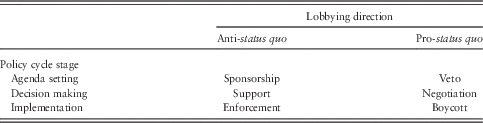
For a better understanding, see Table 1, which identifies the six categories arising from the intersection between the lobbying direction (pro- or anti-status quo) and the policy cycle stage (agenda setting, decision making, implementation) in which it is carried out. In other words, the following categories may thus be considered as representing six different sub-concepts of the general concept of influence.
Typological breakdown of the concept of ‘influence’
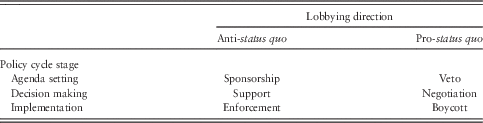
With respect to agenda setting, the activation of an interest group aimed at changing the public policy status quo is identified by the term ‘sponsorship’, as that group becomes the spokesperson of an issue, which is deemed to require public debate. On the contrary, an interest group, which lobbies policy makers to maintain the public policy status quo, tries to exercise a ‘veto’ power, given that its main aim is not to politicize that issue. In the decision-making stage, insisting on changing the public policy status quo gives rise to a form of legislative ‘support’Footnote 11 to policy makers, given the incentive experienced by interest groups to contribute to the definition of a policy output. On the other hand, a pro-status quo lobbying mobilization unfolds in forms of influence such as ‘negotiation’: this negotiation can alternatively consist in a pure exercise of filibusteringFootnote 12 or in a real bargain.Footnote 13 Finally, as far as the implementation stage is concerned, if the interest group lobbies to modify the public policy status quo, this kind of mobilization gives rise to forms of influence oriented towards the ‘enforcement’ of the approved law: the interest group coordinates with bureaucrats to facilitate the effective implementation of the measures. Conversely, a pro-status quo mobilization can be seen as an attempt to ‘boycott’ the law; indeed in this case, the interest group’s main aim is to make the measures approved by parliament concretely ineffective.
Out of those six forms (sub-concepts) of influence, the only one which can be quantitatively measured is ‘negotiation’. There are two main reasons for this conviction: first, the abovementioned distinction between interest groups’ strategic and sincere policy positions makes sense, if and only if, it is subordinated to the distinction of such interest groups in pro- or anti-status quo.Footnote 14 Indeed, anti-status quo groups can rationally exaggerate their calls for policy change in order to maximize the likelihood that some (if not all) of them are accepted by policy makers. On the contrary, this is not true for pro-status quo interest groups: their ideal policy point coincides by definition with that same status quo (Baumgartner et al., Reference Baumgartner, Berry, Hojnacki, Kimball and Leech2009). Therefore, any reforming attempt that produces no policy change represents the maximum influence exerted by pro-status quo interest groups. On the contrary, any policy-making process that ends with a broader policy change than the one originally forecasted, means that the lobbying of pro-status quo interest groups was not influential at all. Thus, the influence of anti-status quo interest groups is not empirically measurable (Baumgartner and Leech, Reference Baumgartner and Leech1998); yet, this is not true in the case of pro-status quo interest groups. Therefore, it is important to look at the right-hand column in Table 1.
As already mentioned, one of the drawbacks of conceptualizing influence as control over policy outputs is the possibility that policy change might depend on reasons other than interest group lobbying. However, this issue is not insurmountable. In more detail, it is more or less challenging on the basis of how much interest groups have to interact with different policy actors throughout the policy process. With respect to this, it therefore appears to be particularly appropriate to focus on the decision-making stage, if and only if, both the government and the parliamentary majority have the same political configuration, namely that the same parties are both in office as well as constituting the parliamentary majority sustaining the cabinet. In this case, it is thus reasonable to assume that policy makers act as a unitary actor; moreover, interest groups have to (directly) interplay only with political parties, whereas public opinion and – above all – bureaucrats are temporarily (and relatively) out of the picture.
Put it differently: the less conspicuous the political differentiation between the governmental arena (the institutional locus in which the vast majority of national decision-making processes begin) and the parliamentary arena (the institutional locus in which the vast majority of national decision-making processes end), the more likely it is that the only factors pushing towards a particular policy output are those due to the lobbying influence by pro- and anti-status quo interest groups. In other words, under these circumstances, it is reasonable to assume that any proposal of policy change can fail only because of the lobbying activities by pro-status quo interest groups. Although this assumption would be considered rather brave without the ‘caveats’ already listed, the fact that government and parliament are ‘politically equivalent’ contributes to seeing the preferences of political decision makers as fixed over the course of the decision-making stage. As a consequence, pro-status quo interest groups’ lobbying activities become crucial in such a situation. On the basis of these specifications, it is therefore possible to quantitatively measure interest group influence, if and only if: (a) they are pro-status quo interest groups; (b) they face policy makers who do not change in their political characteristics during the interaction process.
Finally, it is necessary to list further assumptions on which this methodological approach is built upon: first of all, as already claimed, in the decision-making stage both actors – policy makers and pro-status quo interest groups – are considered as unitary; second, each stage of policy making is considered as being a ‘new game’, without any legacies from the past or expectations for the future. On the one hand, interest groups are thus supposed to lobby in every moment of the process regardless of the results they have (not) been able to obtain in the previous stage of interaction. On the other hand, they are also supposed to lobby regardless of the delayed payments, which could have been promised to them for the subsequent stage of the policy making. Moreover, the choice of chopping the policy process into different (and subsequent) stages allows us to overcome criticism about government ‘sincerity/insincerity’ in proposing its initial policy measure;Footnote 15 the decision-making stage begins when the agenda-setting stage ends, thus the government’s initial policy proposal – also being the result of lobbying efforts, which went in diverging directions during the agenda-setting stage – cannot be strategically pinpointed by the government on its own.
Measurement techniques: quali-quantitative analysis of legislation through expert survey
The likelihood of measuring the influence of pro-status quo interest groups in the decision-making stage depends on the reliability and validity characterizing the identification of three fundamental policy positions, namely: the reforming project by the government; the public policy status quo (coinciding with the ‘ideal’ policy point of pro-status quo interest groups); the policy output of the decision-making process. Although the public policy status quo – where regulatory policies are concernedFootnote 16 – represents what happens if no policy change occurs, both the reforming project of the government and the final policy output must be quantified with respect to ‘how much’ policy change they imply. However, deciding how policy change is to be defined is not an easy task (Capano, Reference Capano2009). In the literature, there have been various suitable ways of rendering the concept of policy change operational, such as the tripartition suggested by Hall (Reference Hall1993) and by Sabatier and Jenkins-Smith (Reference Sabatier and Jenkins-Smith1993), or the taxonomy by which Cashore and Howlett (Reference Cashore and Howlett2007) design six possible orders of policy change. More precisely, Hall (Reference Hall1993) distinguishes between ‘first order’ policy change (when the calibration of policy instruments changes within existing institutional and instrument confines), ‘second order’ policy change (which involved changes to instruments within an existing policy regime), and ‘third order’ policy change (when exogenous events lead to a change of policy paradigm). Cashore and Howlett (Reference Cashore and Howlett2007: 535–536) later built on Hall’s seminal work by differentiating policy change with respect to two criteria: policy focus (on ends or means) and policy content (goals, objectives, or settings): thus, they discern six, rather than three, levels/orders of policy that can undergo change. The main shortcoming of both these conceptual proposals is that operational definitions give rise to ordinal scales rather than cardinal ones, which makes it more difficult to measure policy change quantitatively. In this case, in other words, the connection between concept formation and empirical measurement (Gerring, Reference Gerring2012; Goertz and Mahoney, Reference Goertz and Mahoney2012) is not straightforward. As a consequence, we need an operational definition allowing for continuous rather than discrete measurement.
With regard to this, I thus first, decomposed legislative documents under scrutiny by hand-coding: in so doing, I have been able to list all the policy issues interest groups had to react to. Second, I decided to ‘rate’ each policy issue with respect to its relative degree of policy innovation; thus, a survey of specialists in the policy field in question was carried out. The ‘amount’ of policy change characterizing the policy measure under scrutiny is thus individualized by summing-up how much policy innovation each issue implies.
Yet, if the quantitative measurement of policy change depends on the ‘policy innovation’ characterizing each issue, what must be clarified is the meaning of the concept of ‘policy innovation’. Is this the amount of substantive change in policy or does it refer to the adopting of some innovative policy instruments? Or is this about the magnitude of change? With respect to this, the starting point in concept formation is again the public policy status quo: the more any given policy issue implies a ‘deviation’ from the previous path, the more it has to be considered as being innovative. Put differently: innovation is about policy content rather than the nature of policy instruments. It therefore refers to the structure of opportunities and constraints characterizing the policy sector in which the interest group under scrutiny operates: the more a particular policy issue modifies that same structure of opportunities and constraints, the more it has to be considered as being innovative.
As I previously claimed, in order to link (qualitative) concept formation to (quantitative) measurement, I decided to recur to an expert survey. The first step in each survey is to identify the population of experts whose judgement is available. This selection must be carried out very carefully: indeed, many scholars have correctly pointed out that the quality of expert survey data is directly influenced by the quality of the expert panel (Benoit and Laver, Reference Benoit and Laver2006). With regard to this, the experts were identified on the basis of the following procedure: first of all, I contacted the most outstanding Italian scholars in liberalization policy and judicial policy. They were selected on the basis of two different (but not mutually exclusive) criteria: their publication record; the fact of their having served as policy consultants for Italian policy makers (namely, for Ministry of Economic Growth and Ministry of Justice). In this way, I was able to list a first panel of five policy specialists. Second, I asked these same specialists to recommend further scholars who could contribute to the survey. Following their recommendations, I finally contacted a total of 27 academics specializing in liberalization policy and judicial policy; from June to November 2013, 12 of them completed the questionnaire (response rate: 44.4%). Apart from the traditional criticisms usually received by expert surveys (Budge, Reference Budge2000: 103–104), it is important to emphasize that the number of respondents was perfectly in line with what is generally considered as acceptable for party positioning (Laver and Hunt, Reference Laver and Hunt1992; Benoit and Laver, Reference Benoit and Laver2006).
Furthermore, it seems that evaluating policy issue innovation by means of an expert survey is less challenging than resorting to the same analytical tool in order to spatially place political parties. First, one of the main reasons of criticism concerning the use of expert surveys in party positioning relates to the fact that whenever experts place parties on policy dimensions, they are affected by the parties’ political alliances. In other words, specialists are used to placing parties joining a coalition very (too?) closely together, whereas parties belonging to opposing alliances are placed very (too?) far apart. Obviously, that is not a risk which characterizes the evaluation of policy issues. Second, as it is generally accepted that a country’s specialist is able to place many (from three or four to more than 10) parties on many (usually from eight to 12) very different policy dimensions (Benoit and Laver, Reference Benoit and Laver2006), even more so her/his capability of evaluating the policy innovation of a few issues within a well-defined policy field should be barely questionable. Notwithstanding, the first prescriptive suggestion in future is to increase the number of experts called in to value the hand-coded issues: the greater the number of specialists/experts, the higher the level of reliability of the data (especially, if the variability of their responses is not particularly high: therefore it would be a very important signal of a certain homogeneity in valuing the policy issues under investigation).
In the questionnaire, the experts were asked to divide all the issues – which I previously had personally listed – into four categories: ‘insignificant innovation’, ‘low significant innovation’, ‘significant innovation’, ‘very significant innovation’, depending on the evaluation of their impact on the public policy status quo. All of these assessments were then accompanied by a rising cardinal label: 0.25;Footnote 17 0.50; 0.75; 1. The total amount of policy change, which is implied by the legislative measure(s), therefore equals the sum of all average experts’ evaluations, whereas the influence of pro-status quo interest groups is therefore identifiable through the following formula:
 $$\,\%\,{\rm IG}\,{\rm influence}={\left[{({\rm Government}\,{\rm proposal}\,{\rm policy}\,{\rm change}){\minus}({\rm Approved}\,{\rm law}\,{\rm policy}\,{\rm change})} \over {{\rm Government}\,{\rm proposal}\,{\rm policy}\,{\rm change}}\right]{\times}{\rm 1}00}$$
where government proposal policy change is ∑ of the average experts’ evaluations of the policy innovation characterizing each issue in which the government proposal has been broken down. Approved law policy change is ∑ of the average experts’ evaluations of the policy innovation characterizing each issue in which the approved law has been broken down.
In this sense, any decision-making process ending with a legislative output equal to the initial government policy proposal, as well as any decision-making process ending with a legislative output, which can be considered as being more innovative than what was originally foreseen in the government policy proposal, highlights the total lack of influence of pro-status quo interest groups.
Finally, if no issue is shelved during the decision-making stage under scrutiny – but a partial reformulation is produced – its coding value would depend on the direction in which modifications are oriented: if these changes involve further policy innovation, coefficients would be positive, and would once again range between 0.25 (insignificant innovation) and 1 (very significant innovation); on the contrary, if the new regulatory content goes shoulder to shoulder with the wishes of the pro-status quo interest group, those same coefficients would assume a negative sign, varying between −0.25 and −1. For the sake of clarity, consider the following example: let us hypothesize that the original government proposal is characterized by two issues with values of 0.6 and 0.8 as for policy innovation on the basis of experts’ judgements, respectively. If these same issues are finally reformulated in a way that they are considered by specialists as being −0.3 and −0.4 innovative, respectively, in this case it is possible to argue that pro-status quo interest groups – over the course of the decision-making stage – have exercised an influence equal to 50%. Indeed:
 $${\vskip 10pt {\left[(0.{\rm 6}{\plus}0.{\rm 8})-(0.{\rm 3}{\plus}0.{\rm 4})} \over {(0.{\rm 6}{\plus}0.{\rm 8})}}{\times}{\rm 1}00\right]={{({\rm 1}.{\rm 4}-0.{\rm 7})} \over {{\rm 1}.{\rm 4}}}{\times}{\rm 1}00={{0.{\rm 7}} \over {{\rm 1}.{\rm 4}}}{\times}{\rm 1}00={\rm 5}0\,\%\,$$
From d.l. 223/2006 to l. 248/2006: the influence of Italy’s professional orders on liberalization policy
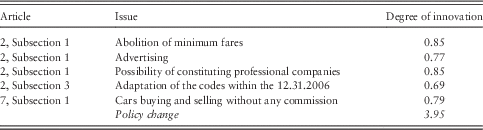
One of the first relevant political decisions taken by the second Prodi government, which took office following its electoral victory on 10 April 2006, was the approval of the so-called ‘first lenzuolata of liberalisation policy’. D.l. 223/2006, Title I, which was entitled ‘Urgent measures for the development, growth and promotion of competition and competitiveness for consumer protection, and for the liberalisation of productive sectors’, contained 12 articles with as many policy measures relating to different sectors to be liberalized (Lirosi and Cinotti, Reference Lirosi and Cinotti2009). This piece of legislation came as a ‘bolt from the blue’, without any prior involvement of the interests that would be affected by the measures as well as without any previous broad public debate. From this point of view, a government whose composition was extremely heterogeneous,Footnote 18 and whose parliamentary majority was based on a majority of just two seats in the Senate, demonstrated an unexpected decision-making capacity (Pritoni, Reference Pritoni2015). More specifically, within this piece of legislation, article no. 2 and article no. 7 dealt with professional orders (especially, lawyers and notaries). On this point, see Table 2:
D.l. 223/2006: articles, issues, degree of innovation
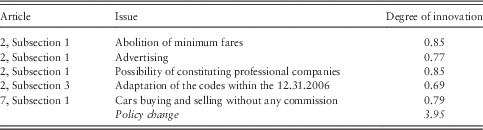
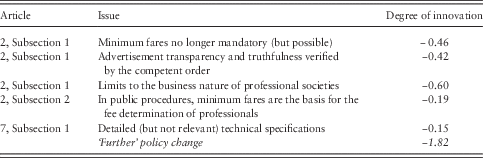
Both article no. 2 as well as article no. 7 contain extremely innovative policy measures. More precisely, the government imposed the abolition of minimum fees and allowed each professional to promote her/his own practice as well as to establish a company with other professionals. In order to enforce these rules, government also required the adjustment of each Professional Code by 31 December 2006. In addition, notarial commissions on the buying and selling of cars were abolished. In particular, four out of these five issues appear to be extremely significant: they are, in a descending order of importance, the possibility of setting up professional companies and the abolition of minimum fees; the cancellation of notarial commissions on the buying and selling of cars; the possibility of using advertising by professionals. The least significant issue is (rightly) considered the fact that Professional Codes had to formally adapt those new policy measures by the end of 2006. Overall, the government policy proposal was therefore highly innovative. This, in turn, led to a great lobbying response from pro-status quo interest groups, in order to abolish, or – at least – to mitigate, large parts of the decree (Lirosi and Cinotti, Reference Lirosi and Cinotti2009). More precisely, notaries and lawyers followed two different mobilization paths: on the one hand, notaries did not immediately oppose the measure and did not organize any particular protest; on the contrary, they initiated dialogue with the Minister and his staff, in order to reach a satisfactory compromise. On the other hand, lawyers mobilized as best they could: first of all, they organized a public protest calling for the withdrawal of the policy measures; later, they arranged for direct dialogue with policy makers. Differently from notaries, who from the very beginning opted for bargaining, lawyers were able to react strongly to the governmental decree, mainly because of their powerful political resources: indeed, within the Italian parliament, lawyers are traditionally one of the most represented occupational categories.Footnote 19 Yet, regardless of how much legal professions mobilized in reaction to the decree, what really matters is the evaluation of the (eventual) results of that mobilization. With regard to this, see Table 3, which highlights how d.l. 223/2006 was converted into l. 248/2006
Comparison between d.l. 223/2006 and l. 248/2006
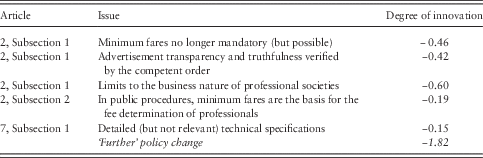
Overall policy change after the decision-making process: 3.95−1.82=2.13. Maintenance of the government’s policy proposal: (2.13/3.95)×100=53.9%. Pro-status quo interest group influence: 100−53.9%=46.1%.
By examining Table 3, it seems to be that all changes which were made between the governmental decree (d.l. 223/2006) and the policy output (l. 248/2006) led towards reducing the amplitude of policy change, and therefore must be deemed to be successful by pro-status quo interest groups. In more detail: the abolition of minimum fees was attenuated by recommendation that they were not resorted to; the possibility of professional advertising – previously characterized by no limitation – had to be examined by the competent order; parliament also limited the business nature of professional companies, thus imposing barriers to their actual founding; as far as public procedures are concerned, fees remained the main criterion for determining the costs of professional services; finally, parliament decided on the addition of some technical specifications with respect to the buying and selling of cars without any commission charged by a notary. Apart from this last issue, which is rightly considered to be not very significant by the experts, all the other policy changes appear to be rather important. Among these modifications, the most relevant one seem to be the fact that parliament placed limits to the business nature of professional companies, as well as the fact that the abolition of minimum fees was attenuated by the recommendation not to resort to them. From a quantitative point of view, we can establish that the influence of pro-status quo interest groups in the decision-making process under investigation was equal to 46.1%.Footnote 20 Thus, their lobbying effort has to be considered as rather successful.
Despite the fact that pro-status quo interest groups exercised such a huge influence during the decision-making stage, they also took action in the implementation stage, so as to boycott even the policy’s innovative drive that policy makers succeeded in adopting. Put differently: they were not satisfied with the partial result they had achieved, but continued to lobby even after parliament approved the policy measure (Lirosi and Cinotti, Reference Lirosi and Cinotti2009). As clearly illustrated by the investigation carried out by the Italian Antitrust Authority from 2007 to 2009 (Autorità Garante della Concorrenza e del Mercato, 2009), the Order of Lawyers has proven especially reluctant to implement the measures approved, with a particular emphasis on the abolition of minimum fees: with respect to this, indeed, the Order has repeatedly stated that minimum fees are a valuable parameter to assess the extent of payment required (Cappello, Reference Cappello2010; Stefanoni, Reference Stefanoni2011).
This further lobbying effort cannot be quantitatively measured, yet it proves useful for a deeper understanding of the policy-making process. Moreover, it appears to be a first – very preliminary – confirmation of one of the assumptions structuring the methodological approach here presented: regardless of the previous/future policy results, interest groups lobby in every part of the policy process.
Concluding remarks
Even though it is an absolutely central theme in research on interest groups, scholars’ ability to measure interest group influence has always been rather poor (Baumgartner and Leech, Reference Baumgartner and Leech1998). This is because there was no concordance, both with respect to the analytical limits with which to connote the concept of influence, as well as in relation to the specific techniques for empirically measuring that concept.
In this study, I proposed to establish these conceptual limits and to indicate some of the methodological techniques. Specifically, I suggested taking into consideration the inverse relationship between the level of generality of a concept and our ability to empirically measure it: the greater the degree of generality, the lower the average validity of its indicators. As a consequence, I thus proposed to breakdown the general concept of influence on the basis of two criteria: the lobbying direction (pro-status quo or anti-status quo) and the stage of the policy cycle. In doing so, there are six different sub-concepts that can be linked to the more general concept: ‘sponsorship’ (anti-status quo lobbying; agenda-setting stage); ‘veto’ (pro-status quo lobbying; agenda-setting stage); ‘support’ (anti-status quo lobbying; decision-making stage); ‘negotiation’ (pro-status quo lobbying; decision-making stage); ‘enforcement’ (anti-status quo lobbying; implementation stage); ‘boycott’ (pro-status quo lobbying; implementation stage).
Conceptualizing influence following the preference attainment approach (Dür, Reference Dür2008) implies that it is necessary to measure the distance between the policy output and actors’ ideal points. Thus, it is possible to measure influence, if and only if, it is exerted by pro-status quo interest groups: indeed, in this case it is not affected by any strategic bias (bias that, on the contrary, affects the ideal policy positions of anti-status quo interest groups, which have the rational incentive to exaggerate their initial requests). Furthermore, policy makers must present the same political configuration during their interaction with interest groups under scrutiny. As a result, we must focus on the decision-making stage of the policy cycle.
The hand-coding of policy issues has been also proposed. It should be quantitatively evaluated by policy specialists. In order to achieve this, I resorted to an expert survey of 12 academics who are specialized in both liberalization as well as judicial policy. Their assessments allowed for the identification of the innovation level of each issue and of the policy output in its entirety.
This methodological approach represents the most valuable added value of this paper, which therefore mainly deals with concept formation literature (Sartori, Reference Sartori1970; Collier and Mahon, Reference Collier and Mahon1993; Adcock and Collier, Reference Adcock and Collier2001; Goertz, Reference Goertz2005, Reference Goertz2006), and also tries to contribute to the most recent discussion on the relationship between qualitative concept formation and quantitative measurement (Gerring, Reference Gerring2012; Goertz and Mahoney, Reference Goertz and Mahoney2012). Yet, this paper also addresses interest group research: as soon as interest group scholars accept limiting themselves to the analysis of influence under certain circumstances rather than ‘always and in any case’, they will be able to improve their capability of reaching quantitative evidence.
Indeed, the application of the methodological structure here proposed for analysing the legislative process, which converted d.l. 223/2006 into law n. 248/2006 appeared to be fruitful: it was therefore possible to quantitatively measure the influence exerted by Italian professional orders (namely, lawyers and notaries) in reaction to the measures initially dismissed by the second Prodi government. This influence has repeatedly been said to be anything but marginal; however, it has only been affirmed in qualitative terms (Berlinguer, Reference Berlinguer2009; Lirosi and Cinotti, Reference Lirosi and Cinotti2009; Cappello, Reference Cappello2010; Stefanoni, Reference Stefanoni2011). By applying this methodology, it is possible to take a step forward and try to determine these impressions quantitatively. Yet, this methodological approach is ‘general’ enough so as to be applied far beyond the case here analysed: indeed, it could be adopted with regard to any policy process in which a pro-status quo interest group lobbies during a decision-making stage characterized by ‘political equivalence’ between cabinet, on one side, and a parliamentary majority, on the other.
Notwithstanding, this study represents a very preliminary analysis. In order to measure interest group influence accurately, further research on a number of issues is required. First, it might be advisable to vary the panel of experts: not only academics but also including professionals, interest group executives, policy makers, and bureaucrats. From this point of view, it might be interesting to observe different response patterns supplied by different kinds of respondents, proving us with useful information concerning their (potential) strategic behaviour. Second, as already mentioned, the panel of experts should include a greater number of individuals than in this study: the higher the number of specialists/experts, the greater the reliability of the data.
Finally, it is well known that professional orders reform in Italy is still ongoing (Cappello, Reference Cappello2010; Stefanoni, Reference Stefanoni2011): after the policy measure here analysed, many further changes led to another reform in 2012, whose implementation is still in the pipeline. As a result, future investigation appears to be both interesting and necessary.
Acknowledgement
I would like to acknowledge Ryner Eising, Helene Helboe Pedersen and all the participants to the XLII ECPR Joint Sessions of Workshops (Salamanca 10-15 April 2014), who provided very appreciated suggestions and comments to a preliminary draft of this paper. I would also like to thank the two anonymous reviewers for their useful comments.
Financial Support
The research received no grants from public, commercial or non-profit funding agency.
Data
The replication data set is available at http://thedata.harvard.edu/dvn/dv/ipsr-risp