Nantwich and its region in the later seventeenth century have not been the focus of specific research, but in general terms this period was one which saw the unequal distribution of economic growth and the emergence of ‘significant gulfs within different social groups’.Footnote 1 By the later seventeenth century, it is estimated that the proportion of the national population enduring material hardships ranged from 35 to 50 per cent.Footnote 2 It is fair to assume that there was a similar experience of material hardship in seventeenth-century Nantwich. The evidence regarding the socio-economic circumstances of Nantwich townsfolk reveals that seventeenth-century Nantwich was a much-troubled town. Records from the Cheshire Inquisitions Post Mortem,Footnote 3 Cheshire Quarter SessionsFootnote 4 and Chester Consistory court reveal substantial information about the discord that existed in seventeenth-century Nantwich. There were many and varied indications of this discord. The Church court records examined here reveal how verbal infringement and the litigation that emerged from it related wholly to land, money or property. In an examination of the dynamics of ill will in Nantwich, this research explores how social and economic tensions and struggles over credit and reputation were played out through the arena of the Church court. Most families lived in debt and a reputation for creditworthiness was essential to survival. By disentangling the complex interplay of argument, reputation and social relationships, what is offered here is an approach that scrutinizes the interpersonal circumstances and fragility of trust between neighbours within an urban context.
The evidence consulted for this inquiry demonstrates that many individuals were experiencing financial difficulties. Tradesfolk as well as those of gentle status were trying to protect their reputations for creditworthiness so that they could remain economically active.Footnote 5 Investigation of Nantwich shows that some middling families were exposed to debt and that some women were temporarily pushed into prostitution to make ends meet. As Craig Muldrew has observed, ‘there were a significant number of middling sort households declining into poverty’.Footnote 6 Wealth did not automatically mean stability in early modern England. Households, and indeed entire villages and towns, had to work together, lending and extending credit, acting as sureties and witnesses and arbitrators in disputes.Footnote 7 Co-operation between households was essential to ensure that patterns of credit and debt could be maintained. This was a delicate balance. Just one debtor defaulting on a debt could have a severe domino effect on an entire community.Footnote 8 Anne Knutsford was a loose cannon within the context of this fragile composition.
Verbal transgression and the Consistory court
The act of damaging another's reputation was illegal in early modern England. Canon law ‘allowed a remedy for any abusive language that caused harm to a person's reputation’, although English Church courts throughout the Middle Ages had interpreted defamation as the malicious imputation of a crime.Footnote 9 Church courts in early modern England continued to rely on canon law and defamatory words had first to cause severe harm to a person's reputation. Rumour itself was not defamatory; however, when discourse between women involved cursing or scolding, the language used could become an offence against morality and was then punishable in an ecclesiastical court. When litigation was instigated, citing scolding or chiding, it typically, if not invariably, involved a female offender.Footnote 10 Slander suits were often about more than the defamatory words spoken. The abusive exchanges ‘often arose from immediate quarrels over money, property, personal jealousies (whether sexual or otherwise), minor trespasses, boundary disputes and the like’.Footnote 11 Verbally related offences fell largely within the control of the English Church courts but some cases were also heard by Quarter Sessions and Assize courts when they led to criminal breaches of the peace where punishments were often severe. Shaming rituals were imposed on women for moral discipline and women were whipped and carted around the town. The occurrence of defamation and sexual slander in early modern England has received some historical attention in recent years, and this study contributes further to this subject by providing a close analysis of the interpersonal circumstances of ill will in Nantwich.Footnote 12
Defamation causes in the Diocese of Chester demonstrate a high proportion of female involvement in defamation suits.Footnote 13 Of all kinds of verbal contravention, scolding is described as ‘the most distinctive offence of the early modern period’ and is presented as a branch of ‘defamation’ in Church court records.Footnote 14 Archival records arising from cases of verbal transgression show a significant female presence in the London Consistory and Archdeaconry courts in the period 1572 to 1640.Footnote 15 In the same period in Somerset, women have been found to have a high profile.Footnote 16 The York records indicate female involvement in 75 per cent of such suits.Footnote 17 Similarly, women were involved in a majority of legal cases arising from scolding. It has been argued that in those areas where a high incidence of scolding persisted the evidence points to a situation which constituted a crisis in gender relationsFootnote 18 and Laura Gowing has concluded that gender relations in London were in ‘perpetual conflict’.Footnote 19
By contrast, Martin Ingram denies both women's high level of involvement in scolding and any special pattern of female involvement above that of male in the crime of scolding.Footnote 20 He does, however, suggest that women were ‘predisposed’ to verbal crime but fails to explain how or why it came about that women were labelled as scolds. His analysis of Wiltshire records suggests that increased scolding denoted not so much a crisis in gender relations as the presence of mere crisis ‘hotspots’.Footnote 21 Ingram argues that women were verbally aggressive because they did not have access to litigationFootnote 22 and proposes ‘delving deeper into the actual circumstances of scolds and scolding in order to get closer to the reality of the lives both of women and of men in the past’.Footnote 23 The case of Anne Knutsford allows us to do precisely that.
The Chester Consistory court and social control: 1660 to 1670
In early modern society, women dominated the world of speech and played an important role in the dissemination of local knowledge. Social attitudes to women's speech were ambivalent. On the one hand, it was regarded as mere tittle-tattle, whilst on the other it was rigorously censured.Footnote 24 Because the Church courts had dominion over public morality, they were often involved with sexual matters and they also had control over incidents that disrupted the peace, such as verbal forcefulness.
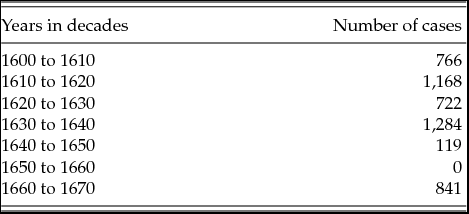
The evidence of the Chester Consistory court where women frequently resorted to legal action shows that they were well aware of the legal system and of its manipulation. The records permit access to a micro-history of rumour, social networks and factional divisions.Footnote 25 The Consistory court provided an official platform from which to broadcast public disputes and offered women an opportunity to present their grievances publicly. The table above demonstrates the rise of court business during the period under investigation.
Table 1 shows a steady increase in court business with three distinct high points in the distribution of prosecutions. These periods were 1610 to 1620, 1630 to 1640 and 1660 to 1670. It displays the distribution of the ‘causes’, that is, legal instances that were heard between the years 1600 and 1750. The Chester Consistory court heard a total of 7,227 causes during this period. No court matters were heard during the interregnum between 1650 and 1660. When the Consistory court resumed business in 1660, there was a rise with 841 causes being heard between 1660 and 1670.Footnote 26 The highest annual increase within the second peak decade of 1660 to 1670 took place in 1663, when the court heard 126 causes in a single year. Anne Knutsford was involved in 12 of these causes.
The distribution of Chester Consistory court papers by decade from 1600 to 1670

The records incorporate detailed data about the language that offended ruling authorities. I have not established what proportion of cases were brought by women but it is safe to say that a large proportion of verbal cases were, and cursing cases always involved a female offender. Language that involved curses was unacceptable.Footnote 27 Cursing was not simply a matter of swearing, insulting or slandering. To curse an individual was a spoken ritual contrived to bring down the wrath of God upon one's enemies. It was considered to be especially heinous and the curse was greatly feared. Cursing came within the Church courts’ responsibility for moral welfare and such cases were typically heard there. Contemporaries designated coarse female speech as scurrilous and denoted women gathered in social get-togethers as ‘gossiping’ and ‘idle, irresponsible, spend thrift, bad neighbours and treacherous wives’.Footnote 28 Gowing has demonstrated how the term gossiping conveyed male contempt for women's speech and that in the course of the early modern period gossip ‘swiftly became a derogatory term for women talking’.Footnote 29 Capp, in response to Gowing's critique of use of language, has claimed that gossiping is not a pejorative word,Footnote 30 but whether pejorative or not, such uncritical acceptance and misinterpretation of women's language as ‘gossip’ does not capture the fine distinction of language that reveals knowledge of the interpersonal relations of the period as the following analysis will confirm.
Who was Anne Knutsford?
Anne Knutsford was accused of ‘lying, swearing and cursing’. The language that she used outraged the community who censured her for ‘abusing and injuring townsfolk’ with ‘scandalous speeches’, for having a ‘scurrilous tongue’ and for ‘revealing the secrets of women’.Footnote 31 This incident sparked off more than 10 years of litigation which was to involve eventually over 100 people from every level of the social scale.
Anne Knutsford was born in Nantwich, to prosperous parents Raphe and Margery Elcocke and had three sisters, Bridgett, Sarah and Ellen, and three brothers, Ephrain, Raphe and Samuel.Footnote 32 Knutsford's family had once owned property in Mill Street, but their ownership was hotly disputed in the 1660s and led to a long-running quarrel that was fought out in battles over pew space and status. Anne Knutsford married Thomas Knutsford sometime between 1640 and 1644. Between 1645 and 1677, 12 children were recorded under the name of Thomas Knutsford and were baptized in Nantwich church.Footnote 33 Thomas was her only surviving son and he became a tanner in later years.Footnote 34 By 1660, she had been a midwife in Nantwich for 15 years. As well as practising within Nantwich, Anne's midwifery business took her to Wybunbury, Wrenbury, Wigsbaston and Acton.Footnote 35 Her moneylending undertakings provided credit to her neighbours and to those further afield. Her house was located in ‘Baron's Fee’, the largest district within the hundred of Nantwich.Footnote 36 Her husband, Thomas, was a labourer who paid hearth tax on two hearths in 1664.Footnote 37 In 1662, a turn of events ensured that Anne Knutsford's nearby residents of Pepper Street became her adversaries.Footnote 38
Anne Knutsford generated much paperwork for the Chester Consistory court. In the 1660s, she was involved in 10 official separate instances of litigation, and 6 unofficial instances.Footnote 39 Official cases were those instigated by the Consistory court while unofficial incidents were those that were reported but not pursued further. The people involved, numbering more than 100, were artisans, shopkeepers and tradesfolk. Several were of gentle status, and two were high-ranking members of the community.
Collective morality and petitioning
You, Anne Knutsford, are ordinarily much addicted and given to lyinge sweringe and cursinge, and for a women so vitiously disposed, you have been and are amongst your neighbours and such as know you commonly accompted reputed and taken.Footnote 40
In the open street at Nantwich Anne Knutsford did call Ann Blagg a whore, porkie arst whore, Coon whore and a bitch and bid her run thou bitch like Jim Baxter and bring me home the money thou owest me, with such base and scandalous speeches in the presence of a great many people.
In Nantwich, before all Hallows tide, Margaret Howell in a very bitter scolding and cursing manner did grivously curse Anne Knutsford and pulled her by the bosom, and bid the plague of Christ take her.Footnote 41
On 5 February 1663, a large number of Nantwich townsfolk organized a petition against Anne Knutsford. Initially, 19 people signed the petition, then 30 people more appeared in court to give evidence and a further 93 people were involved indirectly.Footnote 42 The petition was directed at the midwife for cursing and underlined numerous other charges of verbal violence against community goodwill. Upon receipt of the petition, John Wainwright, ‘Doctor of Lawes’ and the bishop of Chester acted against Knutsford and issued a Prohibition of Practice.
In February 1663, Richard Jackson, minister of Nantwich, published Bishop Wainwright's prohibition on Nantwich church door against Knutsford to stop her from practising midwifery.Footnote 43 The Chester Consistory court heard the cause against the midwife for disturbing the peace on 24 March 1663.Footnote 44 Anne Knutsford ignored Wainwright's ‘Inhibition’, and continued to practise and, in a symbolic gesture of defiance, contrived what was in her opinion the more useful function for the document. The registrar wrote: ‘[Anne Knutsford] you have not only contemptuously abused the Authority of this court – when the inhibition was served upon you, you said it should serve to wipe your arse with.’Footnote 45
According to the processes of the Chester Consistory court, signatories to such a petition were required to attend court as witnesses. The witnesses, or deponents as they were called, were required by the court to give evidence about ‘Items’, or a list of charges, which were read out in the court. The verbal accounts of witnesses, known as ‘depositions’, were often found to be contradictory. Investigation of these inconsistencies exposed details of bastardy, debt, stealing, lying and sexual impropriety. Anne Knutsford made common knowledge of such sensitive, secret, information.
Careful examination of the underlying implications raised by the accusations made against the midwife uncovers the ways in which resentment was generated. The depositions contain minor but important details that some witnesses wished to conceal. Resentment existed in Nantwich long before accusations were made. The litigation involving Anne Knutsford matured into a full-blown accusation within three years but the initial momentum behind the circumstances, that is, the conversations involved, had arisen in Nantwich 10 years before the petition that led to her presentation in court.
The depositions of the townsfolk contain the details of several levels of antagonism. On the surface, the legal process was a demonstration of fear and hostility against a midwife with a ‘scurrilous tongue’. In reality, Nantwich was a town conscious of maintaining a reputation of honour, credit and trust in a very difficult commercial world. Many people claiming to be of ‘good credit’ were in debt, while others were involved in extra-marital affairs with females who were prominent members of Nantwich society. When these relationships produced children, the women involved, Elizabeth Cliffe, Anne Blagg and Dorothy Delves (previously Hussey), became anxious since they knew that any midwife was required by law to disclose the identities of the parents of bastard children. There was little tolerance for children born outside wedlock.Footnote 46 Knutsford did little to conceal her knowledge of the extra-marital affairs that allegedly involved members of the urban elite such as Sir Philip Egerton and Richard Walthall. Some critics of the midwife, finding safety in numbers, joined forces, supporting each other when thrust into the public eye before a court. Their public demonstration of solidarity ensured protection from the midwife's words and it also shielded them against the negative moral judgements of influential members of the community.
As a known source of ill will, Anne Knutsford's enemies said that her words and behaviour were antagonistic and disruptive. She was rebuked for her language, charged as a ‘public bawd’ and accused as the source of social scandal. Numerous conversations were reported in which the midwife had, over the previous years, implicated townsfolk in improper behaviour and witnesses in court repeated these conversations. The townsfolk protested that Anne Knutsford had slandered them and would invent stories to discredit them. The petition implied that Anne Knutsford's words were invention. Her critics hoped that Knutsford's allegations of sexual impropriety, bastardy, insobriety, stealing and prostitution would be quashed by a legal battle in the public arena of the court. By bringing a petition designed to discredit and preclude her from practising, the witnesses hoped to stop her from talking about them and aimed to restore their credit and reputation. However, in this they were much mistaken.Footnote 47
Many of the signatories of the petition in 1663 appeared as witnesses to give evidence to the court of what they knew in relation to the charges brought against Anne Knutsford. Some signed the petition, but did not appear in court, whilst some appeared but did not sign the petition. Some claimed that they signed the petition, but in fact they did not. Those who were unable to write made their mark, which was usually the first initial of the Christian name.Footnote 48 The court issued a list of ‘Items’ that set out in precise detail the crimes of the midwife as follows: ‘You, Anne Knutsford, have been and are a woman of very uncivill language towards your neighbours, and have abused and injured many or some of them who are persons of quality by your scandalous speeches, as the witnesses in the cause to be produced against you can particularly demonstrate.’Footnote 49
Further to the allegations of verbal crime, the midwife was accused of behaving ‘imodestly’. Her speech and behaviour was construed in a way that reflected unfavourably upon her as a female. Amongst these allegations was one of violating a sacred bond between women. The townsfolk complained that Anne Knutsford spoke lightly of the most intimate details of women in labour: ‘you have imodestly by words not bifittinge a midwife or modest and civill woman rivealed the sicrettes of women who had been in trauell [labour] the particulars whereof the witnesses to be produced are required to declare’.Footnote 50 Most female signatories gave evidence about the midwife speaking ‘imodestly’ and ‘rivealing the sicrettes of women’.Footnote 51 However, most of the women who were asked to provide depositions were unable to say that they personally were victims of Knutsford's indiscretions. Instead, they repeated what they had heard others say. Knutsford's critics repeated rumour and hearsay – what had been said, what had been heard – and what was said to have been heard and said. Nevertheless, the court relied on such public information to regulate behaviour in the community. Through issuing a petition in writing the signatories were able to claim respectable status as ‘persons of good name, quality and reputation’.Footnote 52 They made their charges against Knutsford in the following words: ‘By rieson [sic] of your lewd and civill life and scurrilous disgraceful and immodest language as aforesaid, your neighbours both men and womane, persons of good quality and reputation, are much offended and abused.’Footnote 53 Lying, swearing, cursing and ‘rivealing the sicrettes of women’ had already led to her exclusion from the profession of midwifery when these allegations had been first raised in February 1663. The long list of ‘Items’, that is, wrongdoings presented in court in March 1663, also included a condemnation of Knutsford for practising midwifery when forbidden by the bishop and minister from doing so.Footnote 54 In addition, the midwife faced charges of professional neglect. Her enemies claimed that she selected her patients, not out of concern for the well-being of mother and child, but for financial reward, thus neglecting poor folk.Footnote 55 The final Items united the signatories in a common voice of disapproval. The people of Nantwich substantiated their allegations. They appeared in public to discredit the midwife where they announced that she was a nuisance and that ‘all and singular’ were in agreement with the Items brought against her.Footnote 56 But, as the following analysis will demonstrate, ‘all and singular’ did not agree.
Cursing and scurrility
You, Anne Knutsford, are ordinarily much addicted and given to lyinge sweringe and cursinge, and for a women so vitiously disposed, you have been and are amongst your neighbours and such as know you commonly accompted reputed and taken.Footnote 57
Anne is a very frequent curser and swearer, and will ordinarily goe down on her knees and curse people grivously, and this deponent hath seen her doe soe diverse times.Footnote 58
The church used the power of cursing to its advantage, but the efficacy of the curse was derived, not from theological sources, but from common belief. Cursing was powerful not only because it had ritual connections with the church, but also because people believed it could work. It was owing to such beliefs that the curser was endowed with power. A powerful weapon against adversaries, the reputation for being a successful curser, could and often did result in a formal charge. Unlike other forms of power, such as high-ranking social status or financial power, the power of cursing could be wielded by any member of society.Footnote 59 However, the eagerness with which puritan justices of the peace reacted to cursing arose out of their efforts to rid the north-west region of what they believed were surviving remnants of Catholicism. The evidence of 1660 to 1670 of Nantwich suggests a shift away from cursing as sorcery and more as a manifestation of female social protest.
Cursing, presumed to be the midwife's main crime, was closely related to scandal mongering. Knutsford was accused of offending people with lies, swearing and curses. The midwife had a damaging reputation for her use of language. She was quick-witted and imaginative with her choice of ribald expressions. She launched scathing attacks upon the pretentious and did not conform to the behavioural expectations of women during the seventeenth century. However, such attributes as these could conflict with the business skills a woman in Anne Knutsford's position as moneylender and midwife would have had to develop. Gowing argues that women were supposed to be modest and show ‘virtue, submission, obedience, thrift and dependence’.Footnote 60 This dichotomy of expected female modesty and the confidence required of women to negotiate in business highlights one problematic aspect of Anne Knutsford's relationships with her neighbours in Nantwich. Anne Knutsford was neither obedient nor was she dependent. She was a successful businesswoman whose demeanour did not conform to the townsfolk's expectations of female behaviour.
Nine close neighbours in Pepper Street gave evidence against the midwife for cursing. Janet Brookett, in her deposition, said that Anne Knutsford cursed James Wilson.Footnote 61 Barbara Croxton said: ‘Anne Knutsford is accounted to be addicted to lying and swearing and cursing.’Footnote 62 Similarly, Jane Wright, grocer, said she heard Anne Knutsford ‘curse her father’.Footnote 63 Margaret Jackson also supported the claims of Anne Knutsford's propensity for cursing.Footnote 64 Coster, William Blundell, shared the common view of the midwife as a curser and swearer.Footnote 65 William Blundell, as did the minister, referred to hearsay, and did not provide a specific example, simply alleging that his wife was a victim of a curse and he did not make a distinction between cursing and swearing.Footnote 66
Certainly, these depositions are proof that Anne Knutsford's language was scurrilous and that she cursed publicly. Amongst those she cursed was Margaret Birkerton, a teacher of reading and sewing who had lived in Nantwich. It is difficult to establish the nature of her association with Anne Knutsford. Her deposition does give evidence in support of many of the items against the midwife and she had allegedly been on the receiving end of Anne's sharp tongue: ‘She hath done as much to this depots. selfe to her owne face before severall people of late calling her salt bitch and drunken salt women bitch, and the like, and thou hast a hole I may put my head in.’Footnote 67 The teacher illustrated the midwife's tendency to attack without provocation. She referred the court to unprovoked attacks upon the Proudmans.Footnote 68 Thomas Proudman, 52, shoemaker and neighbour of Anne Knutsford, gave evidence to the court. In the course of his everyday life, he had frequently witnessed the midwife's curses and claimed that he was present when Anne cursed members of her own family: ‘Anne is much given to cursing and swearinge on any idle occasion’ and recalled an occasion when Anne Knutsford cursed her father, beat him up and threw him out of doors.Footnote 69 The shoemaker signed the certificate to demonstrate his loyalty to the community.Footnote 70
Margaret Birkerton, however, also provided evidence of a very serious nature against Anne Knutsford for cursing. The charge was serious because the midwife publicly executed the curse in the formal ritual style. Knutsford was accused of getting down on her knees, while raising her hands and eyes dramatically towards the heavens. The curse executed in this way was a theatrical display, performed with the intention of attracting the attention of as many people as possible – publicly magnifying issues of contention. Margaret Birkerton saw the midwife perform this ritual many times. She did not say whom the curse was directed at, but she did draw attention to the regularity of the midwife's attacks.Footnote 71 She affirmed solidarity with her neighbours and stated her familiarity with them.Footnote 72 She claimed she was cursed along with many others.Footnote 73 She also stated that Knutsford was a skilled practitioner and that she had a good reputation: ‘Anne is a good midwife and generally accounted soe to be.’Footnote 74
Innkeeper, Elizabeth Cliffe, said that she was present when Anne Knutsford cursed Sir Phillip Egerton and Captain Richard Walthall. She claimed that she also was a victim of Knutsford's rumour mongering but that when she confronted the midwife, Knutsford then cursed herself and subsequently denied rumour mongering:
Anne hath very falsely and iniustly raised a scandall upon this deponent and Sir Philip Egerton, as alsoe of Captain Walthall and Samuel Husseys wife and notice thereof being given to Anne Knutsford she came to this deponent one time and fell downe on her knees and grivously swore and cursed her selfe if ever she had reported any such thinge by any of them or ever iniured any of them by her.Footnote 75
Most significantly, the minister of Nantwich church, Richard Jackson, supported the claims of those who had subscribed to the certificate.Footnote 76 He said: ‘Anne is too much adicted to lyeing, swearing and cursinge And for such a one is comonly taken and reputed in the neighbourhood.’Footnote 77 However, he was unable to provide an example of it.
The above evidence demonstrates that whilst the townspeople were mutually supportive in their attack on the midwife for cursing, some individuals, such as the minister and William Blundell, could not support the consensus of opinion with fact. In their depositions, they reveal that they relied solely upon what they had heard others say about the midwife. Similarly, 76-year-old widow, Margaret Wirkstadt, was anxious to fortify her position of good standing in the community because the midwife referred to her as a witch: ‘And this deponent hath been told that by persons of credit that Anne reported that this deponent was a dun arse and a leather-faced witch, and when she met with her she had noe luck that day.’Footnote 78
Wirkstadt supported the general view of the midwife as a common curser.Footnote 79 She stated: ‘Anne is much given to idle vaine cursing and swearinge and lyinge, And is ordinarily taken of for such a one.’Footnote 80 Although Wirkstadt did not disclose the names of the ‘persons of credit’ who asked her to appear, it is reasonable to assume that, since she was related to Richard Walthall, she was probably induced to appear by him.Footnote 81 She refuted any association with the term ‘witch’ and was anxious to show her sympathy for the respectable Nantwich townsfolk and said that Knutsford called her husband ‘an old rotton Rogue’.Footnote 82 Nevertheless, she had tried to persuade Anne to curb her tongue, but the midwife's response was less than enthusiastic: ‘And one time this deponent being in company with Anne was advising her to be fair conditioned amongst her neighbours, and in a familiar way be [sic] laid her hand upon Anne's hand when Anne before all sundry sufficient neighbours answered to this deponent, “ah! the divill, lay thy hand off me!”’Footnote 83
Anne Knutsford before ‘all sundry’, parodied her neighbour's kindly efforts. Margaret Wirkstadt promptly sought to safeguard her name and position in the community and demonstrated solidarity with those who wanted to put an end to the ‘lewd and scurrilous life’ of the midwife.Footnote 84 She set down her signature on the petition, joined the others and washed her hands of Knutsford.
‘Rivealing the sicrettes of women’
Anne Knutsford was alleged to have violated a sacred bond between women by revealing the private details of women to whom she provided assistance as midwife. The women of Nantwich were infuriated to find that Anne Knutsford had spoken so freely of them and of the intimate details of the delivery of their children. Since Knutsford, as midwife, was required to provide details of bastardy, some, such as Elizabeth Cliffe, Dorothy Hussey and Anne Blagg, were more outraged than others. Witnesses lined up to give evidence about this charge.
Janet Brookett accused the midwife of having said: ‘Richard Yorksalls wife was rotton and stunke so that she could scarce sit by her for the smell.’Footnote 85 Of her client, Mrs Booth, she claimed Knutsford said: ‘when she went to John Booths wife in bed she found her drunke and with the childe upon the hearth’.Footnote 86 In similar manner, she said of the minister's wife: ‘she took a child from Mrs Jackson that stunke like a turd and came from her in peeces as black as a thrush’.Footnote 87 Anne Knutsford did not discriminate between rich and poor when it came to speaking of intimate details. She similarly admonished James Wilson, whose wife was one of Anne's poorer clients, for drinking in the alehouse while his wife languished dangerously at home. When someone raised a glass to his good health on the birth of his child, she said that since it was his wife who had recently given birth and not Wilson, why drink to his good health? ‘She answered with an oath that if he were so, [in good health] his wife were not, for she had been twice with her of a child but she bled soe exceedingly at the fundament that she had noe minde to goe againe.’Footnote 88
Perhaps it was common for Anne Knutsford to speak in such frank and open terms about her profession, but Nantwich people disapproved. Her talk contravened unwritten laws associated with the kind of language expected of a midwife and she violated these rules in reference to the female body. The details of women's bodies during labour ought to have remained private and were to be discussed only by women.
On close investigation, the depositions disclose that the secrets Anne Knutsford revealed were related to what she knew about Nantwich's bastards and concubines. Her profession naturally put her in a position to know intimate details concerning sexual relations and the midwife spoke too freely of such matters. Knutsford made public knowledge of Captain Richard Walthall's sexual services from women who rented properties from him. These women were Elizabeth Cliffe and Dorothy Hussey. Similar but less specific claims of infidelity and bastardy were made against Janet Brookett and Anne Blagg. The details of these exploits might have remained secret had their midwife not laid bare the details of bastardy before all Nantwich.
When the likelihood of bastardy arose, the men of Nantwich were at risk. This predicament brought forth male comment into a largely a female concern. The midwife spoke in rude terms of Captain Richard Walthall and Sir Philip Egerton. These respected members of the community were the subjects of reports which related the details of torrid sexual encounters with married women: Elizabeth Cliffe and Dorothy Hussey. Illicit sexual dalliances out of wedlock were unacceptable in Restoration Nantwich. Such activities encompassed ‘cuckolding’ their husbands, but, more importantly, such sexual adventures raised issues of bastardy and prostitution. The information relating to Walthall, Egerton, Cliffe and Hussey had been an ongoing subject of speculation in Nantwich, as is reported in the depositions of the townsfolk. The midwife, who, owing to her profession, had access to more intimate knowledge than most, simply spoke candidly of them. The most damaging disclosure transpired when Edward Blagg alleged that the midwife said that Captain Walthall paid for the sexual favour of Dorothy Hussey and that ‘Mr Walthall did give Samuel Hussey's wife 50 shillings a year to occupy her.’Footnote 89 Moreover, Knutsford also revealed that Sir Philip Egerton paid Mrs Cliffe a little less handsomely for the same kind of service.Footnote 90
These examples demonstrate the circumstantial nature of prostitution within smaller urban communities in early modern England. Whilst prostitution in large urban centres such as London and Amsterdam could provide full-time employment for some women, selling sexual services appears to have acted as a stopgap measure to prevent complete destitution in smaller urban communities. Prostitution in Amsterdam for example was ‘big business’ and it formed a significant segment of the urban community where ‘prostitution made money go around’.Footnote 91 In smaller towns like Nantwich, prostitution was a far more ad hoc form of employment. Making ends meet was the driving force behind prostitution for many women, who only occasionally solicited when their income was insufficient. This point is made by a number of historians, who argue that many women in early modern Portsmouth resorted ‘to occasional prostitution’.Footnote 92 Anne Knutsford's case discloses a number of examples that conform to this pattern of informal and occasional prostitution. Prostitution did not make money go around here; rather, it ensured that a number of women continued to be able to pay rent. The clandestine nature of such arrangements meant that these women could continue to be regarded in relatively good standing within their communities.
Dorothy Delves was exposed by the midwife who disclosed the intimate particulars about a relationship between her and wealthy notable Randle Mottershead. This relationship, Anne Knutsford said, produced a bastard child: ‘Hugh Delves, his wife was as arrant a whore as ever turned tale to hedge, and Randle Mottershead got her last child and had fuckt her a hundred times up the house and down.’Footnote 93 Dorothy Hussey, who rented property from Captain Walthall, was accused of behaving improperly with him. This affair, according to the midwife involved prostitution:
coming to this deponent from Samuel Husseys where she had been laying his wife in bed, [Anne Knutsford] told the deponent that she had been with Sam Husseys wife and had taken her a young Walthall in the world, for she was an arrant whore, and her Landlord Walthall was the father of it, and she kissed out her rent with him for fifty shillings a year.Footnote 94
Similarly, the midwife divulged that Sir Philip Egerton fathered the bastard child of Elizabeth Cliffe. It was alleged that she said: ‘Mrs Cliffe was an arrant whore, and Sir Phillip Egerton got most of her children and she would not care how many children she had for he gave her forty pounds a year.’Footnote 95
Not only did Knutsford disclose knowledge of prostitution and bastardy. She quipped about the illegal ways in which some of her clients had made a living. For example, during the lying in of Mrs Leeth, to whom she was midwife, Knutsford spied two lovers. The midwife observed the details of the tryst and recorded her observation of their first union. In accordance with her profession, she calculated the time and place of conception of Mrs Delves’ first child and linked it to that first observed meeting: ‘[Anne] looked out of the window and saw Mrs Delves and Randle Muttershead together at Mrs Delves door.Footnote 96 Look yonder, ugly Muttershead does goe. He has got Mrs Delves first child and kisses her up the house and down, and I reccun’d her for to the very house that he got it, and it was his.’Footnote 97
In contradicting the allegation of prostitution, Edward Blagg counter-accused the midwife of speaking ill, of levelling accusations of cuckoldry and of spreading malicious rumours about creditable persons. The circumstances of the older man, Hugh Delves, being married to the younger woman, Dorothy Hussey, was too much for Knutsford to resist. According to Blagg's deposition she said:
one time seeing John Hussey, since deceased, and his wife, being a young woman, walking together, said to this deponent and others that were there, ‘soe howe nowe yonder old foole is of that young whore, he thinks that he marryed a mayde but she has been a whore there seven years to my knowledge, its an easie thing to cozen such an old foole for if I were to be marryd againe I could make a straight comodity and cozen him’.Footnote 98
Margaret Jackson persuaded the court that it should pay no heed to a similar exposé, namely that Mrs Walley ‘when she was a widow’ had been guilty of prostitution and of receiving gold in return for sexual services.Footnote 99 She asserted that the midwife's words had no meaning and that she used wild language recklessly without basis in truth or fact: ‘And in her ordinary discourse talking of severall people would frequently calle them if they were younge people, young whores, and if old people, old whores and she is generally taken notice of for such an abusive woman.’Footnote 100
Indeed, the midwife's talk of bastards and prostitutes was not well received by Nantwich society. Yeoman, Edward Blagg, whose wife, Anne Blagg, was in dispute with Anne Knutsford about moneylending, was intent upon defending the honour and reputation of Dorothy Hussey, and challenged her. He publicly upbraided Anne Knutsford, in his words: ‘blaming her for it and commanding her modesty of Hussey's wife’.Footnote 101 The midwife stood her ground. Unrepentant, she did not retract a word. Indeed, she claimed superiority on the subject of prostitution, especially in relation to Dorothy Hussey. She answered: ‘Hold your tongue she's as arrant a whore as ever turn’d tale to hedge I know more than you doe.’Footnote 102
The yeoman, Edward Blagg, was defending his neighbour and challenged the midwife.Footnote 103 Evidently there was no love lost between Blagg and the midwife; indeed, they were sworn enemies.Footnote 104 The Chester Consistory court heard evidence of the shoemakers, Mr and Mrs Proudman, who were friends of Ann and Edward Blagg, that Anne had previously maligned the yeoman's wife as ‘a porky arst whore and called her also in the open street a whore and double whore’.Footnote 105
Whilst the analysis of the discourse above illustrates that the midwife was held responsible for creating ill will, the depositions also reveal an underlying theme. The women who were involved as prostitutes, Cliffe, Blagg and Hussey, were either ‘paid’ by Walthall or ‘paid’ him in sexual services for the rent on their properties. As noted above, according to Anne Knutsford's testimony, Mrs Cliffe received ‘forty pounds a year’ from Sir Philip Egerton, and Samuel Hussey's wife received ‘fifty shillings a year’ from Richard Walthall. Although Anne Knutsford certainly did reveal information that her clients believed was of a private sexual character, she said in addition much that impinged on sensitive issues of bastardy. According to law, bastardy was always the result of fornication outside of wedlock. In the common law court it was punished very severely.Footnote 106 Both offenders, male and female, were subject to the punitive measure of whipping or gaol at the house of correction. Those accused of such an offence had the option of pursuing a suit at the Consistory court and this is exactly what the townsfolk did.
Richard Walthall was the focus of much conversation in Nantwich. Many deponents had a financial obligation to him. For example, the Johnsons were indebted to him and leased land from him.Footnote 107 Innkeeper, Elizabeth Cliffe, also rented property from him. Later, in 1675, he was married ‘clandestinely’ to wealthy Maria Wilbraham.Footnote 108 As with others of high standing in the community, he was deeply disturbed by the midwife's disclosures. He took aggressive measures against the midwife to discredit her from naming him as the potential father of the bastards born to Dorothy Hussey, Elizabeth Cliffe and Anne Blagg.
It was probably true that Anne Knutsford had a scurrilous tongue, and that she had cursed people frequently and townsfolk were concerned about the damage to their reputations. If any hearsay was true, then it was probably the observations made by the midwife about prostitution and bastardy. Prostitution certainly was circumstantial and it was driven by the same challenging social and economic circumstances that drove the court cases. It is clear that Anne Knutsford was present as an eyewitness on several occasions when various alleged lovers were seen to have met secretly. What is more, she was consulted by each of the women involved to deliver their children. In her capacity as midwife, Anne Knutsford was required by law to express any doubts she had about the parentage of the children she delivered. However, her conduct was damaging in a social climate that emphasized trust, virtue and reliability and Knutsford went against social conventions to unmask those who had themselves secretly contravened the expectations of public morality.
The midwife and moneylending
As noted previously, the Knutsford case had a 10-year history. Barbara Croxton informed the court of an altercation between herself and the midwife, which came shortly before the cause with Walthall, in 1662. It resulted in Anne Knutsford bringing a ‘Citation’ against Barbara Croxton for allegations she had made about Anne Knutsford, Mrs Walley and Mrs Brumall.Footnote 109 The litigation with Croxton subsequently went ahead later that same year. Anne Blagg's deposition told of an ongoing antagonism, which had resulted in legal action between herself and Anne Knutsford, but Anne Blagg did not disclose that she was in debt to the midwife. Janet Brookett's account is significant in drawing attention to Anne Blagg's concealed motive, which was unrelated to allegations of sexual slander, cursing and defamation. Mrs Janet Brookett's account of the people who had subscribed to the certificate stated that, although she was familiar with many of them and acknowledged them as persons of good ‘repute’, she was unable to say the same of their good ‘credit.’ She claimed that many of them were financially indebted to the midwife: ‘she knows most of the persons subscribed to the Certificate now shewed her and saith that they are persons of good repute, but this deponent hath heard that severall of them are or have been engaged to Anne for money that she hath lent them’.Footnote 110
It is clear from this report that the witnesses withheld this information from the court. Why did they not tell the court that they owed Anne Knutsford money? The fact that Anne Knutsford was a moneylender adds a further dimension to the social role of the midwife. She wielded financial dominance and was a moneylender, even to those ‘of good quality’. It is not unreasonable to suggest that those who signed the petition did so in order to control not only the midwife's verbal power but also to loosen her financial control over them.
Anne Knutsford's enemies
Despite the initial commotion of 1663, Anne Knutsford did not refrain from her habitual swearing or cursing. Accusations of cursing were thrown at her again and again. Knutsford, in reply, initiated cursing allegations of her own. The financial concerns revealed in the previous years were to resurface repeatedly in the litigation that appeared in court throughout the rest of the decade. Cursing, slander, pew disputes, disputes over rent, property and legal costs were all to be the subjects of continuing conflict between the midwife and her neighbours. The subsequent proceedings embraced the broad range of issues discussed above but always the causes were related to social status and credit, debt and reputation.
Anne Knutsford clashed repeatedly with the various factions and alliances in Nantwich. The details of their battles were to be recorded in the Consistory court papers across the 1660s. The more specific issues relating to moneylending, property, sick children, childbirth and bastardy, which arose in the action of Richard Walthall, and that were to involve Knutsford during the 1660s, were mentioned again in each of the 10 separate causes. The problem of moneylending arose most particularly, however, in 1663, when Anne Knutsford took Anne Blagg to court to collect an outstanding debt.Footnote 111 Knutsford, perhaps because her reputation for cursing had undermined her credibility, failed to obtain the money owed to her by Blagg. Subsequently, in later years, when it was decided that she should apologize to Anne Blagg for cursing, she opted instead to refer the matter to the High court at York, only to decide against this action eventually when the cost of running the case proved to be too expensive.Footnote 112 As the court record for 1668 makes clear, financial considerations loomed large in the case. Foulke Harte, a mysterious witness, who appeared in court in support of Anne Blagg's action, provided the details of Ann Knutsford's long-running pursuit of Anne Blagg.Footnote 113 In his deposition, however, he claimed that Anne Knutsford had vociferously pursued Anne Blagg for the money she owed her.Footnote 114
The background behind another long-standing antagonism that existed between Elizabeth Cliffe and Anne Knutsford was also revealed in the Blagg case of 1664. As we now know, Anne Knutsford had long asserted that Elizabeth Cliffe was guilty of producing bastard children. Further evidence came to the fore through the lawsuit against Anne Blagg, which claimed that it was in reaction to Anne Knutsford's continuing claims of prostitution against her that Elizabeth Cliffe was compelled to clear her name. Knutsford apparently scattered her accusations of prostitution in numerous conversations. She alleged that Cliffe was ‘nought [naughty] with John Egerton, and Dorothy Hussey parded out her rent with Richard Walthall, her landlord’.Footnote 115 The persistence of these allegations, and the repetition of the claims in the subsequent lawsuits, eventually forced Elizabeth Cliffe to pay what Knutsford described as a ‘iourney’ (a fee for swearing one's freedom from guilt), and to swear her innocence before a justice of the peace.Footnote 116
To understand the accusations piled against Knutsford in 1663, and the motivation of her enemies, one must also be aware that the case had a prelude. Knutsford herself had launched proceedings against Barbara Croxton in 1662, in a case which anticipated many of the features of the major case in 1663. In March 1662, Knutsford summonsed Barbara Croxton for slander and for revealing indiscretions during the private business of childbirth.Footnote 117 It was Anne Knutsford, however, who took exception at Barbara Croxton's report.Footnote 118 The quarrel continued when, in 1664, in yet another lawsuit, Knutsford accused Barbara Croxton of defaming her by claiming that Knutsford's techniques of midwifery had endangered the life of her child.
Hardship, hearsay and reputation
Though often divided against each other, some women challenged the midwife's injurious discourse through the legal system. In the conflict of 1663, Anne Knutsford, after a long and expensive legal battle, was finally victorious. In the succeeding years, she resorted to, and was the recipient of, a series of charges and counter-charges by which she intended to make her enemies sorry for denouncing her. Throughout the rest of the decade, she issued citations almost as often as she did curses.
In conclusion, the main protagonist in this drama of accusation and counter-accusation had much influence. Anne Knutsford parodied notions of respectability and exposed hypocrisy in colourful language, in physical demonstration and in the dissemination of hurtful speech. Her rhetorical aptitude allowed her to expose the pretences of the respectable and she made no distinction between victims of high or low status. Such rhetoric became indictable when it came to include cursing, and, as the evidence above demonstrates, she frequently resorted to ritualistic public demonstrations of cursing to achieve her aims. Anne Knutsford would go on to defend her reputation through the court with counter-suits and citations against her enemies. She attacked persons of any status, divulging secret sexual matters as a strategy to deflect attacks from her would-be assailants and draw attention to those who owed her money. Cursing, revelations and rumour remained her armoury in a war of words which were clearly a pragmatic response to the pressures of everyday existence. Evidence from the 1660s examined here shows that the middle strata of Nantwich lived in the shadow of debt. Some of those families were even forced to compromise their ideals of respectability in order to survive. Women were forced to imperil their good names when harsh conditions forced them to offer landlords sex instead of money. Reputation and honour were at stake, and a position of status in a social hierarchy based upon reputation, good character and credit were fought over. Each person considered it essential to maintain his or her status in what was an unstable environment. The perspective offered here has given some insights into the intimate aspects of early modern life and relationships and illuminated the complex interplay of gender relations in an urban context. It delineates the parameters of what was deemed unacceptable in women's language and behaviour within seventeenth-century Nantwich, which was itself a deeply divided community. Here, a person's reputation was fiercely defended in court and community. Hearsay was carefully guarded, monitored and subject to censure, and the litigation process was a counter-measure, reflecting the attempts of worried townsfolk to defend themselves from damaging speech. During one altercation, when Anne Knutsford was censured for ill-spoken words, she retorted that: ‘it was noe hanging matter’.Footnote 119 Perhaps some people might agree with her, but I doubt that the good folk of Nantwich would.