Introduction
Body mass index is calculated from a person's weight and height and is considered an indirect measure of nutritional status. Change in nutritional status plays an important role in the course of a person's health. Therefore, BMI can be used as an indicator for health status, and association with some diseases can be expected. A BMI value of over 30 kg/m2 has been shown to be a risk factor for hypertension, heart disease, diabetes mellitus, cardiovascular disease, gall bladder disease and various types of cancer. On the other hand, a low BMI (underweight BMI<18.5 kg/m2) has been associated with a higher risk of hip fracture in women (Gnudi et al., Reference Gnudi, Sitta and Lisi2009; Morin et al., Reference Morin, Tsang and Leslie2009). Low birth weight and higher mortality rate has also been associated with a low BMI in pregnant mothers (Hosegood & Campbell, Reference Hosegood and Campbell2003). Trends in BMI over time may provide useful information about changes in the level of public health and reflect the general living environment of a given population. This is particularly important for developing countries where health and medically related reforms are being actively implemented.
Secular trends of increasing BMI have been observed in many Western countries (Flegal et al., Reference Flegal, Harlan and Landis1988; Shah et al., Reference Shah, Hannan and Jeffery1991; Gullinford et al., Reference Gullinford, Rona and Chinn1992; Lahti-Koski et al., Reference Lahti-Koski, Jousilahti and Pietnen2001; Lysens & Vansant, Reference Lysens and Vansant2001; Bielicki et al., Reference Bielicki, Szklarska, Welon and Rogucka2001; Mascie-Taylor & Goto, Reference Mascie-Taylor and Goto2007; Walls et al., Reference Walls, Wolfe, Haby, Magliano, de Courten and Reid2010). Negative trends in BMI have been reported in a Glasgow alumni cohort (Okasha et al., Reference Okasha, McCarron, Smith and Gunnell2003). An increasing tendency towards a negative trend has also been found in Vietnam (Khan et al., Reference Khan, Tue, Mai le, Vinh le and Khoi2010), China (Chen & Ji, Reference Chen and Ji2009), Kuwait (Al-Isa, Reference Al-Isa1997) and Japan (Yanai et al., Reference Yanai, Kon, Kumasaka and Kawano1997). An examination of these trends in BMI is of special importance for married women in developing countries.
In Bangladesh, researchers have investigated the relationship between BMI and mortality (Hosegood & Campbell, Reference Hosegood and Campbell2003; Pierce et al., Reference Pierce, Kalra, Argos, Parvez, Chen and Islam2010) and socioeconomic and demographic factors (Pryer et al., Reference Pryer, Rogers and Rahman2003; Shafique et al., Reference Shafique, Akhter, Stallkamp, de Pee, Panagides and Bloem2007; Khan & Kraemer, Reference Khan and Kraemer2009) in female populations. Efforts have been made to improve the general conditions of this population section, and BMI can provide a tool for evaluation of the effectiveness of these measures. Special attention should be paid to married women considering their potential influence on the family and their contribution to the nation's workforce and productivity. Due to their unique role in the population, it is important to investigate the relationship between the BMI of married women and important factors such as age at first marriage, age at first delivery, number of ever-born children, place of delivery and delivery system, in order to ensure corrective measures can be undertaken.
The purpose of the present study was to test for the presence of trends in BMI of married, non-pregnant Bangladeshi women born over three decades and look at the association between BMI and various socio-demographic factors.
Methods
Data
Cross-sectional data were derived from the Bangladesh Demographic and Health Survey (BDHS) conducted between March 24th and August 11th 2007. This is a national-level survey with the various districts of Bangladesh represented. The sample population of this study consisted of 10,115 married, currently non-pregnant Bangladeshi women. Ages at the time of measurements ranged from 15 to 49 years, with an average age of 31.15±9.29 years. The survey collected socio-demographic, health and lifestyle information from each subject. In addition, body height and weight were measured. The sampling technique, survey design, survey instruments, measuring system and quality control have been described elsewhere (NIPORT, 2009). Body mass index was defined and calculated as the ratio of weight in kilograms to height in metres squared.
Data from a sample of 10,996 married Bangladeshi women were collected by the 2007 BDHS. The data set was checked for outliers by the present authors using statistical techniques (Dunn & Clark, Reference Dunn and Clark1974), because these abnormal points can affect the interpretation of results (Stevens, Reference Stevens1996). Some missing values were also detected, and these cases were excluded. Pregnant women were also excluded in the present study. After removing outliers, cases with incomplete data, and excluding currently pregnant women, the data set was reduced to 10,115 for the analysis in the present study.
Analysis
To find the average trends in BMI over time, the sample was subdivided into 36 groups according to birth year cohorts from 1957 to 1992. To examine the interclass variation of BMI, a one-way analysis of variance (ANOVA) was utilized. The model corresponding to each variable is:
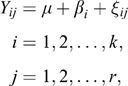
where Yij is the jth observation (response variable) for the ith birth year cohort; μ is the general mean effect; βi=μi−μ the additional effect of ith birth year cohorts; μi is the average effect of ith birth year cohorts; ξij is the random error term, which follows normal distribution with mean zero (0) and variance (σ 2), k is the number of cohorts, and r is the number of observations for each cohort.
The ANOVA procedure is primarily concerned with testing the hypothesis H 0: β 1=β 2=…=βp=0, or equivalently μ 1=μ 2=…=μp=μ by means of a single F-test. If the hypothesis of equality of cohort means is rejected, it may be concluded that there are differences among the cohort means. The standard assumptions of the ANOVA, randomness, normality and homogeneity of cohort variances were checked using the Kolmogorov–Smirnov non-parametric test, a normal probability plot, and the Levene test, respectively. Linear regression analysis was applied to detect the presence of trends in BMI among the birth year cohorts.
Multiple linear regression was utilized to examine the average relationship between the BMI and socio-demographic factors. The underlying multiple linear regression model corresponding to each variable is:

where Y is the response variable (BMI), Xi (i=1, 2, 3,…, k) are the predictor variables (socio-demographic factors), β 0 is the intercept term, β 1, β 2,…, βk are the unknown regression coefficients, and ε is the error term with a N(0, σ 2) distribution. In multiple regression analysis, an important assumption is that the explanatory variables are independent of each other; that is, there is no significant correlation between the explanatory variables used to estimate the ordinary least squares (OLS) relationship. However, in some applications of regression, the explanatory variables are related to each other. In this study, the relationship between the predictor variables was examined using a variance inflation factor (VIF). The VIF for independent variables Xj is:
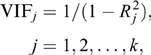
where k is the number of predictor variables and Rj 2 is the square of the multiple correlation coefficient of the jth variable with the remaining (k−1) variables where:
1) if 0<VIF<5, there is no evidence of multicollinearity problem;
2) if 5≤VIF≤10, there is a moderate multicollinearity problem; and
3) if VIF>10, there is a seriously multicollinearity problem of variables (Chatterjee & Hadi, Reference Chatterjee and Hadi2006).
To find the proportion of trends of women for each category of BMI, the BMI was subdivided into four classes according to most widely used categories of BMI for adults. These were: underweight (BMI≤18.5 kg/m2), normal weight (18.5<BMI<25 kg/m2), overweight 25≤BMI<30 kg/m2) and obese (BMI≥30 kg/m2) (Flegal et al., Reference Flegal, Graubard, Williamson and Gail2005; Subramanian et al., Reference Subramanian, Perkins and Khan2009).
Finally, the t-test for comparison of mean values was utilized to find the differences in BMI between categories: urban versus rural; Muslim versus other religion; delivery at hospital/clinic versus at home; Caesarean versus non-Caesarean delivery; living with husband versus without (separated); and housewife versus employed. Statistical significance was accepted at p<0.05. All statistical analyses were performed using SPSS (version 15.0).
Results
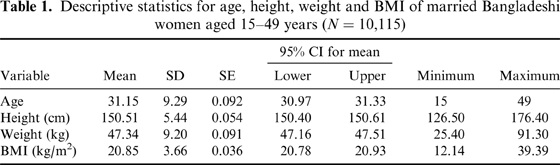
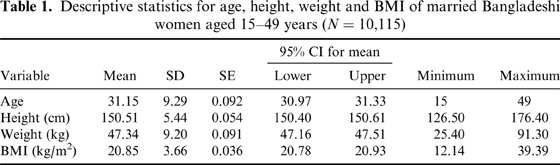
A total of 10,115 married and currently non-pregnant Bangladeshi women were analysed in the present study. The age of subjects varied from 15 to 49 years, with a mean age of 31.15±9.29 years (95% CI: 30.97–31.33). The average height of the women was 150.51±5.44 cm (95% CI: 150.40–150.61), ranging from 126.50 to 176.40 cm. Their average weight was 47.34±9.20 kg (95% CI: 47.16–47.51), ranging from 25.40 to 91.30 kg. The BMI varied from 12.14 to 39.39 kg/m2, with a mean of 20.85±3.66 kg/m2 (95% CI: 20.78–20.93) (Table 1).
Descriptive statistics for age, height, weight and BMI of married Bangladeshi women aged 15–49 years (N=10,115)
Trends in BMI
The variation in BMI among the birth year cohorts from 1957 to 1992 was examined with the ANOVA. Before utilizing the ANOVA, it was necessary to check that the standard assumptions underlying the model of ANOVA were satisfied. Consequently, the data were checked for randomness, normality and homogeneity. The Kolmogorov–Smirnov non-parametric test and the normal probability plot exhibited no serious problems concerning the randomness and normality of the data. In addition, the Levene test showed that the data were homogeneous. Thus, the data satisfied the standard assumptions of the ANOVA model. The ANOVA results demonstrated that the variations in BMI of married, currently non-pregnant Bangladeshi women among the birth year cohorts from 1957 to 1992 were statistically significant (p<0.001).
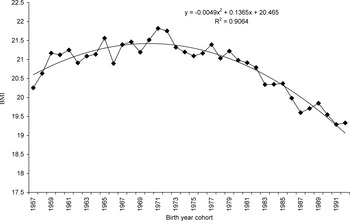
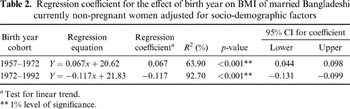
The mean BMI values of the study population are depicted graphically in Fig. 1 by birth year cohort from 1957 to 1992. Yearly fluctuations in BMI are observed, and this is a characteristic of such cohort studies. There was an increasing trend during the first sixteen years from 1957 to 1972, but a decreasing trend thereafter. Consequently, a second-degree polynomial was found to be a good fit and the model explained 90.64% of the variation of the data (Fig. 1). Linear regression analysis was used separately for birth year cohorts from 1957 to 1972 and those of 1972 to 1992 to calculate the average rate of increase and decrease in BMI values with increase in birth year cohort, respectively. The coefficient of regression analysis showed that the average rate of increase of BMI was 0.067 kg/m2 (95% CI: 0.044–0.098, p<0.001) among the birth year cohorts from 1957 to 1972. The coefficient −0.117 (95% CI from −0.131 to −0.099) indicated an average rate of decrease 0.117 kg/m2 (p<0.001) among the birth year cohorts from 1972 to 1992 (Table 2).
Secular trend in BMI over time.

Regression coefficient for the effect of birth year on BMI of married Bangladeshi currently non-pregnant women adjusted for socio-demographic factors

a Test for linear trend.
** 1% level of significance.
Trends in proportion for each category of BMI
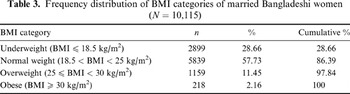
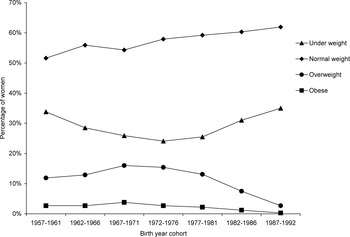
More than half of the participants in the current study were normal in weight (57.73%), and 28.66% were underweight. Some participants were overweight (11.45%) and a few were obese (2.16%) (Table 3). To find the trends in various type of BMI, the samples were classified into seven classes according to birth cohort (1957–1961, 1962–1966, 1967–1971, 1972–1976, 1977–1981, 1982–1986 and 1987–1992). The proportions of women (percentage) for each category of BMI are displayed in Fig. 2. A decreasing pattern in proportion of underweight women was observed from 1957–1961 to 1972–1976. The proportion then increased with increasing birth year cohort from 1972–1976 to 1987–1992. The proportion of overweight and obese individuals showed a pattern in the opposite direction over the same periods. The proportion of women who were of normal weight increased with increasing birth year cohort from 1957 to 1992 (Fig. 2).
Frequency distribution of BMI categories of married Bangladeshi women (N=10,115)

Secular trend in various types of body size over time.

BMI and socio-demographic factors
Multiple regression analysis was used to find the association between BMI and socio-demographic factors. The model used was:

where the BMI is the response variable and the other variables are predictors: Age, respondent's age; REL, respondent's education level; NFM, number of family members; WI, wealth index; TEBC, total ever-born children; AAFB, age at first birth; AAFM, age at first marriage; HEL, husband's education level.
The estimated multiple regression calculation yielded:

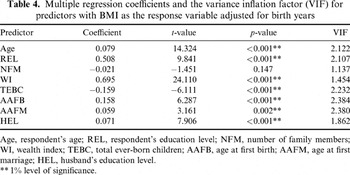
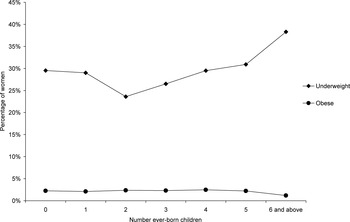
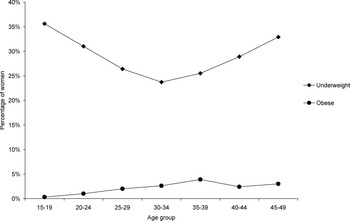
The variance inflation factor (VIF) showed that there was no evidence of a multicollinearity problem among the predictor variables (Table 4). The coefficients of the multiple regression analysis exhibited a significant positive relationship between BMI and age (p<0.001), respondent's education level (p<0.001), wealth index (p<0.001), age at first delivery (p<0.001), age at first marriage (p<0.001) and husband's education level (p<0.001). A negative association was observed between BMI and total number of ever-born children (p<0.001). Also, a positive association was found between the total number of ever-born children (after 2) and proportion of women who were underweight (Fig. 3). However, there was no clear association between age group and number (proportion) of underweight women. A negative association was found between age group and proportion of underweight women from 15–19 to 30–34 years old, displaying a positive association thereafter (Fig. 4).
Multiple regression coefficients and the variance inflation factor (VIF) for predictors with BMI as the response variable adjusted for birth years

Age, respondent's age; REL, respondent's education level; NFM, number of family members; WI, wealth index; TEBC, total ever-born children; AAFB, age at first birth; AAFM, age at first marriage; HEL, husband's education level.
** 1% level of significance.
Association between proportion of underweight and obese women with the total ever-born children.

Association between age group and proportion of underweight and obese women.

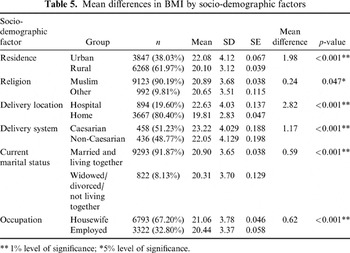
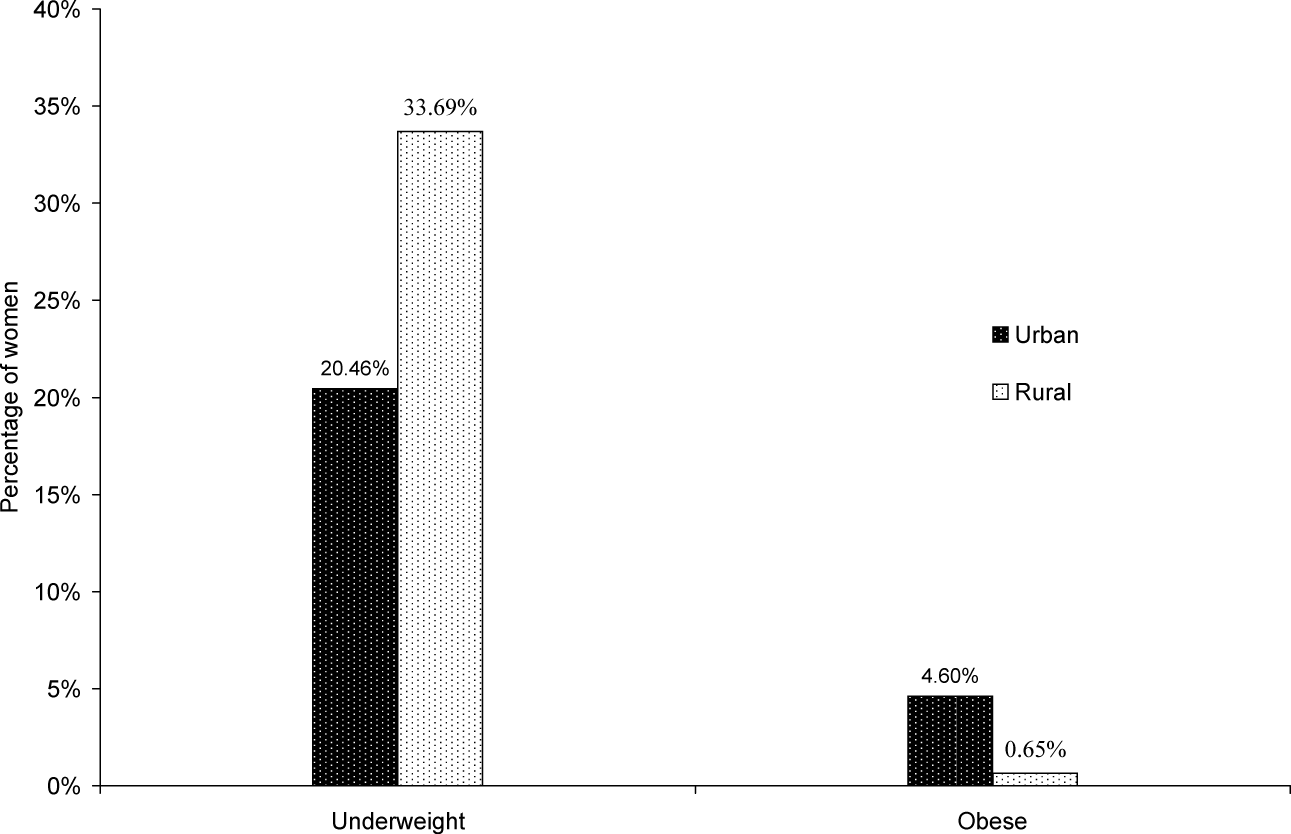
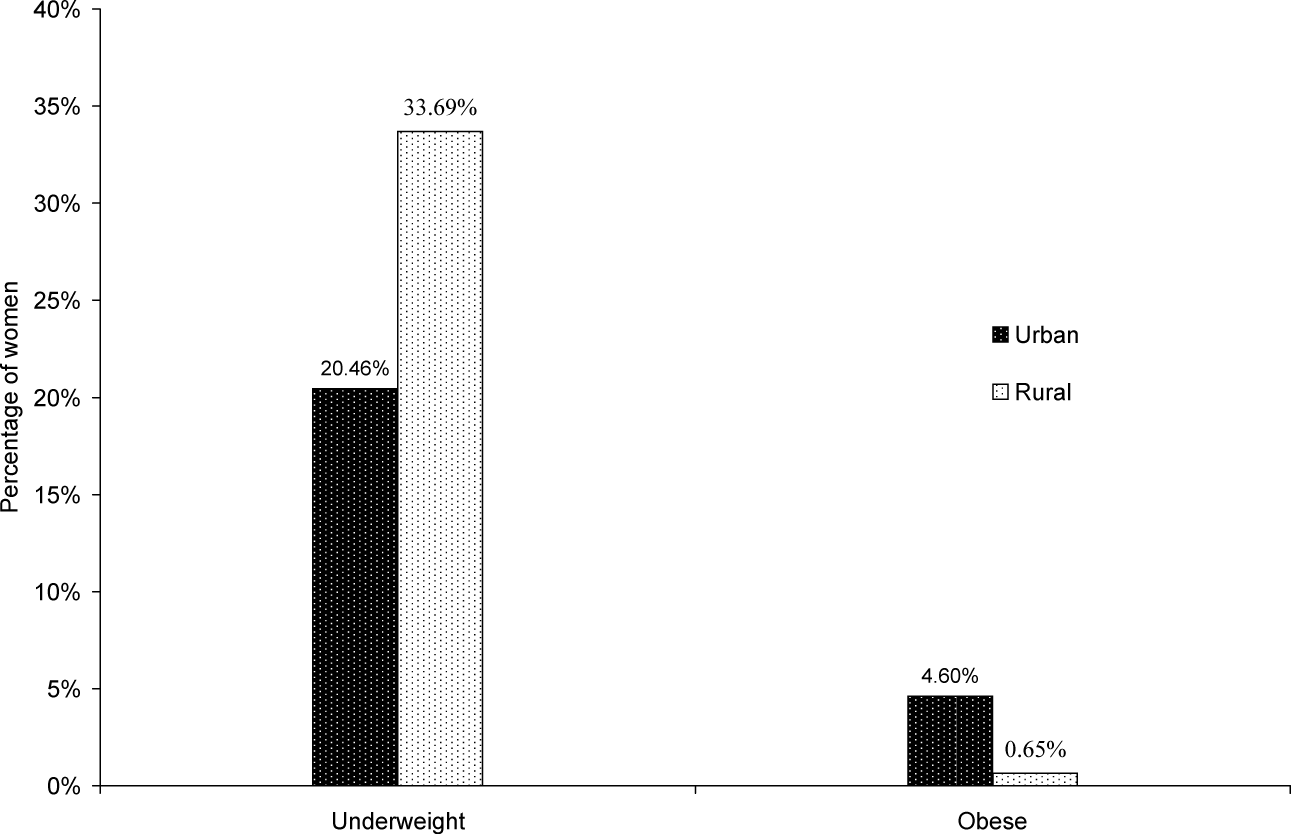
Student's t-test was applied to test for significant differences in BMI between two groups. More than 61% of participants in the study were living in a rural environment. Women who lived in rural areas had a significantly lower BMI (p<0.001) than urban women (Table 5). Moreover, the proportion of women who were underweight was greater in rural areas (33.69%) than in urban areas (20.46%), and the proportion of obese women was greater in urban areas than rural areas (Fig. 5). The majority of women were Muslim (90.19%) and Muslim women had a significantly higher BMI (p<0.001) than those of other religions. A high percentage (80.40%) of women still delivered babies at home and they had a significantly lower BMI (p<0.001) than women who delivered at a hospital/clinic. Women who delivered at a hospital/clinic were classified into two classes: Caesarean and non-Caesarean. It was found that women who underwent Caesarean section had a higher BMI (p<0.001) than those who delivered without surgery. The majority (91.87%) of women were living with their husbands, and they had a higher BMI (p<0.001) than those living without their husbands. More than 67% of women were housewives, and these had a higher BMI (p<0.001) than those who were employed.
Mean differences in BMI by socio-demographic factors

** 1% level of significance; *5% level of significance.
Differences between urban and rural areas in proportion of underweight and obese women.
Discussion
The data used in this study, gathered by the 2007 BDHS, are nationally representative, covering both urban and rural areas. Previous studies in Bangladesh have examined the relationship between BMI and age, mortality, level of education, wealth index and other social variables (Shafique et al., Reference Shafique, Akhter, Stallkamp, de Pee, Panagides and Bloem2007; Khan & Kraemer, Reference Khan and Kraemer2009), but they used much smaller data sets that were not representative of the nation. In addition, the present study may be the first to examine other pertinent information such the association of BMI with number of family members, total number of ever-born children, age at first delivery, age at first marriage, education level of husband, and place and system of delivery.
This study showed that the mean BMI of married Bangladeshi women between the ages of 15 and 49 years was 20.85 kg/m2. More than half of the women (57.73%) were of normal weight. Underweight women constituted 28.66% of the study population, while overweight women constituted 11.45%. Only 2.16% were considered obese. This information is consistent with other studies on Bangladeshi women. A study on female Bangladesh women living in an urban area reported that 15.7% were overweight and 3.9% were obese (Khan & Kraemer, Reference Khan and Kraemer2009), while another study on women living in the slum area of Dhaka reported that 54% of women were underweight (Pryer et al., Reference Pryer, Rogers and Rahman2003). A relatively similar pattern was also observed in a large population study in neighbouring India, where 56.9% of married women were reported to be of normal weight, 31.2% were underweight, 9.4% were overweight and 2.6% were obese (Bharati et al., Reference Bharati, Pal, Bhattacharya and Bharati2007).
Trends in BMI
The BMI of married Bangladeshi women varied over the birth year cohorts from 1957 to 1992 (Fig. 1). There was an increasing trend during the first sixteen years (1957 to 1972), and over the last 20 years (1972–1992) a decreasing trend was noted. This variation may represent the trends in BMI of married Bangladeshi women over the three decades, although this may not be the only factor. A slight decrease in mean BMI was reported in female students attending Glasgow University in the United Kingdom between 1948 and 1964, although the value increased in male students over the same period (Okasha et al., Reference Okasha, McCarron, Smith and Gunnell2003). On the other hand, a study on the secular trend of various anthropometric measurements conducted for two generations of 38- and 50-year-old Swedish women was not able to detect a significant change in BMI over the years (Lissner et al., Reference Lissner, Sjöberg, Schütze, Lapidus, Hulthén and Björkelund2008). A similar finding was noted in another study conducted in Finland from 1972 to 1997 (Lahti-Koski et al., Reference Lahti-Koski, Jousilahti and Pietnen2001).
The socioeconomic conditions of Bangladesh have been adversely affected by many factors, including political instability and natural calamities. Independence from Britain in 1947 was followed by a period of relative stability. However, political turmoil gradually developed in the 1960s cumulating in war between West Pakistan (now Pakistan) and East Pakistan (now Bangladesh) in March 1971. There were critical shortages of essential food grains and other staples because of wartime disruptions. The war ended in December 1971 with the establishment of the new country called Bangladesh (Iqbal, Reference Iqbal2008). A rapid increase in population due to a lack of family planning policies and returning of refugees from neighbouring countries exerted a heavy strain on this small country, which was also regularly ravaged by natural disasters such as floods and cyclones. The general condition may have eased over the last two decades, as reported by a more recent study by Shafique et al. (Reference Shafique, Akhter, Stallkamp, de Pee, Panagides and Bloem2007), which showed a decrease in percentage of underweight and an increase in percentage of overweight Bangladeshi women from 15 to 45 years of age between the years 2000 and 2004. This recent change was beyond the present paper's study period.
In most other parts of the world, a decrease in the percentage of underweight women and an increase in the percentage of overweight and obese women have been reported over the last 50 years. The most obvious changes have been observed in North American (Freedman et al., Reference Freedman, Khan, Serdula, Galuska and Dietz2002; Torrance et al., Reference Torrance, Hooper and Reeder2002) and European countries (Gullinford et al., 1992; Bendixen et al., Reference Bendixen, Holst, Sørensen, Raben, Bartels and Astrup2004; Berg et al., Reference Berg, Rosengren, Aires, Lappas, Torén, Thelle and Lissner2005), and a similar pattern has also been reported for Australia (Dal Grande et al., Reference Dal Grande, Gill, Taylor, Chittleborough and Carter2005) and parts of Asia (Aekplakorn & Mo-Suwan, Reference Aekplakorn and Mo-Suwan2009). The uncontrolled increase in population with limited natural resources is probably be the single most important factor that contributed towards the increasing percentage of underweight women over the last 20 years in Banglasdesh. However, the percentage of normal weight women has shown an increasing tendency over the last three decades. Further studies should be conducted to analyse the current situation and active measures have been taken to improve the situation.
BMI and socio-demographic factors
Looking at the whole sample population, it was noted that BMI is higher with increasing age, education level of women and their husbands, wealth index, age at first marriage and age at first delivery. On the other hand, BMI decreases with increasing number of family members and number of ever-born children. It is interesting to note that the percentage of underweight woman was lower in women with two children and greater in those with six or more children (Fig. 3). A negative association was observed between BMI and increasing age group for these women until age 30–34, and then it become positive in older age groups (Fig. 4). These results are partially supported by the findings of a Bangladeshi study using the 2004 BDHS samples (Khan & Kraemer, Reference Khan and Kraemer2009). They found that age, education level, region of residence, marital status and type of occupation affected the BMI of married non-pregnant urban women in Bangladesh. However, the study was based on only urban women. The results of the current study are also in partial agreement with the findings of another Bangladeshi study (Shafique et al., Reference Shafique, Akhter, Stallkamp, de Pee, Panagides and Bloem2007). They used data from the Nutritional Surveillance Project (NSP) from 2000 to 2004 and observed that age, level of education, wealth index, residence and area were important factors affecting the BMI of 15- to 45-year-old, non-pregnant women with children under 5 years of age. Moreover, another study reported that the BMI of Bangladeshi females was associated with age, smoking status and level of education (Pierce et al., Reference Pierce, Kalra, Argos, Parvez, Chen and Islam2010).
More than 35% of the women in this study were living under poor economic conditions, and 32% were illiterate and did not have enough knowledge about good health practices (NIPORT, 2009). They may not have sufficient resources to meet their caloric requirements. Education can play an important role in improving women's knowledge of general health and balanced nutrition, and this is supported by the observed positive association between BMI and level of education. The majority of the study women were living in rural areas. Thus, people living in rural environments still face major health problems. The percentage of underweight women was higher in rural compared with urban regions, while the reverse was observed for the percentage of obese women (Fig. 5). More than 61% of rural women who participated in the current study did not receive adequate health care, and more than 80% delivered their babies at home without any specialist help. Both the mother and the newborn child are thus exposed to a higher risk of birth-related complications.
The present study suggests that poor economic conditions, illiteracy, large family size, early age at marriage, early age at first delivery and insufficient medical facilities in rural areas are the main causes of the observed decrease in BMI of married non-pregnant women in Bangladesh. Decreased protein in the diet, increased psychological and physiological stress and decreased socioeconomic conditions of married Bangladeshi women are some of the other possible reasons for the decrease in BMI.
Nowadays some wealthy adult women in Bangladesh are very conscious of their body weight and try to keep themselves slim without performing any exercise and only controlling their diet. Consequently, they are not aware of the long-term medical problems related to being underweight. It may be necessary for the authorities to make the general population aware of the importance of a balanced diet and the need to make good conscious decisions about one's health. Other possible influences on BMI include smoking habits, weight goals, weight-loss methods, body-shape perceptions, eating attitudes and behaviours, self-concept and physical activity (Cilliers et al., Reference Cilliers, Senekal and Kunneke2006), level of energy intake (Ortega et al., Reference Ortega, Reguejo, Quintas, Redondo, López-Sobaler and Andrės1997; Herrera et al., Reference Herrera, Rebato, Arechabaleta, Lagrange, Salces and Susanne2003; Najat et al., Reference Najat, Alice, Abbass and Sandra2008) and age at menarche (Hossain et al., Reference Hossain, Islam, Aik, Zaman and Lestrel2010).
Acknowledgment
The authors would like to thank the Bangladesh Demographic and Health Survey (BDHS) for providing nationally representative data collected in 2007.