The generally open-armed Nordic response to the ‘refugee crisis’ of 2015–16, climaxing in the arrival of 163,000 asylum seekers in Sweden in the second half of 2015, gave rise to a variety of competing narratives in Sweden, in the Nordic countries, throughout Europe and worldwide. Like earlier moments of mass international migration, these arrivals were broadly figured as a ‘crisis’.Footnote 2 Swedish responses included a ‘welcome culture’, marked by scenes such as volunteers greeting new arrivals with gifts at the Stockholm train station, as well as a populist backlash that doubled support for the ethnic nationalist Sweden Democrats party.Footnote 3 Finland, meanwhile, received an unprecedented 33,170 asylum applications in 2015, largely from Iraqi applicants, approximately ten times more than in the previous few years and the subsequent years, when numbers returned to earlier levels.Footnote 4
At a moment when migration was being vigorously debated in the press, we turned our attention to migration-themed plays in Nordic theatres, focusing especially on two plays by Iraqi playwrights in Finland and Sweden that were translated and produced in the same period: The Digital Hats Game by Hassan Blasim (2016), a memory play about hacking and international border controls, and I Came to See You by Karim Rashed (also spelled Rashid, 2015), a dream play about a migrant's return from Sweden to Iraq. We ask, in this moment marked as a ‘refugee crisis’, how were Arab writers (former refugees) portraying migration on Nordic stages? Beyond the debates of the immediate moment, the plays raise questions about a politics of representing migration that is at once European, Arab, global and particular to Swedish and Finnish spheres of culture. This article aims to analyse the plays themselves and to define some of the underlying questions of representation in the emergent field of Arab–Nordic theatre studies. After situating this field theoretically with reference to Arab–Nordic literary studies and migration theatre studies, we compare Sweden to Finland and also set Blasim and Rashed's works against two other migration-themed plays staged in Stockholm: Swedish writer Jonas Hassen Khemiri's groundbreaking Invasion! (2006) and British playwright Anders Lustgarten's more recent Lampedusa (2015).Footnote 5 All four plays approach similar thematics, including who is allowed to define a border or a migrant. As we show, however, Blasim and Rashed were both more ambitious and granted less autonomy than the non-Arab Lustgarten and the Swedish-educated Khemiri. As Iraqi immigrant playwrights in Nordic countries, they carried an extra burden, telling their stories and attempting to innovate as artists under an added weight of audience preconceptions about what kind of theatre to expect from immigrants, warzone witnesses and Arab Muslims.
Arab man's burden?
Though Arab diasporic literature and theatre are both vast and varied, a few overarching issues of representation continue to define the field. In the West in particular, Arab artists have long contended with orientalism and audience expectations that make their background a privileged site of inquiry. The gendering of this section's subheading is intentional; like the colonial discourse that it references, the expectations placed on Arab artists are also shaped by gender. Because the playwrights discussed in this article identify as men, the constraints that we discuss do not take into account the particular challenges and opportunities that women artists face. Furthermore, in calling these backgrounds a burden, we take our cue from Arab artists themselves. New York-based Iraqi novelist Sinan Antoon has said,
Life for a displaced Arab writer, if you're willing to exoticise yourself and self-orientalise, life is very good and very profitable . . . I don't want to be the native informant . . . There is increased interest in the Arab world. But I call it forensic interest . . . I am against that kind of interest, and I am always in support of writers who debunk that kind of interest and confuse the reader.Footnote 6
Voicing a similar defiance, Iraqi–Swedish theatre-maker Karim Rashed told us, ‘Often people are interested in Arabic theatre because they expect tragic true stories. We're here to make art, not to tell our stories’.Footnote 7
Rashed's comment internalizes the value system that locates ‘Art’ hierarchically above the particular, striving for the autonomy of the artistic field.Footnote 8 To post-structuralist critics this may seem a sterile aspiration, a pretentious modernist dead end. However, many immigrant and minority writers perceive it – not incorrectly – as their clearest path to professional and cultural dignity. As recent scholarship on theatre and statelessness has shown, well-intentioned projects to elicit and stage refugees’ stories, including both verbatim theatre and adaptations of Greek tragedies, can cause ‘an unintended reproduction of racism and (colonial) stereotypes’, leaving the migrant participants neither really seen nor really heard.Footnote 9 Perhaps inadvertently, these projects treat migrants as raw materials, not creators, for the theatre process. That they often present amateurs also works to obscure the fact that trained professional Arab artists exist in Europe.
Being seen as a repository of stories rather than as an artist is not purely an Arab problem. The immigrant ‘ghetto’ of exotic niches and predictable plots awaits all cultural production identified as minority or immigrant (or perhaps any work whose reception is framed in terms of a particular group's identity or history).Footnote 10 More generally still, every professional writer or artist, minority-identified or not, must negotiate institutional factors to see his or her work into production and circulation, especially a collaborative work such as a play. There are always agendas and strings attached. There is artistry in manipulating those agendas, playing tug of war or cat's cradle with those strings. An Arab or Muslim or ‘war-torn’ background can confer opportunities as well as burdensome expectations. To quote Kuwaiti–British director Sulayman Al-Bassam, recipient of prestigious international commissions from such institutions as the Royal Shakespeare Company and the Comédie-Française: ‘You have to conform to their agenda as long as it's a playable surface’.Footnote 11
So the image of carrying a burden is apt, but too passive. To mark Arab immigrant artists’ agency and highlight their works’ artistry and provocation, we need a more dynamic metaphor. Al-Bassam's ‘playable surface’ calls to mind the boards of a stage or, similarly, a wooden ship's deck. It figures the international artist as an innovator and a restless merchant, braving shipwrecks to ply desirable wares from shore to uncertain shore.Footnote 12 However, for an immigrant theatre-maker settled in one country, international mobility may not be the goal. A more fitting metaphor may be the career of an ‘escape artist’ such as Harry Houdini (aka Erik Weisz or Ehrich Weiss, 1874–1926), a Hungarian–Jewish immigrant who, in a previous era of global mass migration, made a sensational living getting locked into difficult situations and wriggling out again.Footnote 13 This article grows from our respect for that kind of immigrant dynamism.
In homage to Houdini, we have tried to disaggregate and briefly label as ‘boxes’ or ‘traps’ three facets of the expectations that both constrain and stimulate Arab immigrant artists in Europe. We have termed them biographical voyeurism, orientalism and the allegory of worthiness. We will use them as a heuristic device to organize our analysis of the plays.
The first two, biographical voyeurism and orientalism, are facets of Antoon's ‘forensic reading’. Both stem from the audience's expectation that an immigrant writer can offer insight only into his or her own background, whether on the level of personal experience (biography) or on the level of ‘culture’ (ethnography) – in this case, some amalgam of Arab and Muslim culture. The artist is downgraded to a case witness or schoolteacher, a less valuable position in the artistic hierarchy.
Scholars in the very young field of Nordic migration literature studies have begun to consider this problem. Fiction and poetry dubbed ‘immigration literature’ (maahanmuuttajakirjallisuus in Finnish, invandrarlitteratur in Swedish) or ‘migrant literature’ date back decades in Nordic and Scandinavian countries: it emerged in Sweden around the 1970s, in Norway in the mid-1980s and in Denmark in the early 1990s.Footnote 14 Ingeborg Kongslien notes that the terms ‘immigrant literature’ and ‘immigrant writer’, even though they relegate certain writers and texts to categories defined by personal biography and national origins, are still widely used in Scandinavian contexts.Footnote 15 Olli Löytti adds that Finland's situation most closely resembles that of Denmark and notes that recent discussions of immigrant literatures have actually obscured what are in fact much longer histories of multilingualism and migrancy, even in Finland.Footnote 16 He argues for the term ‘migrant literature’, which lets scholars take a step back from a singular focus on the author's origins (biography) and look instead at the questions the literary work raises about post- and transnational belongings and at the links between its thematic and political questions and literary form.Footnote 17
The emergent field of Nordic migrant literature studies focuses almost exclusively on authors who write in Swedish, Norwegian, Danish and Finnish. Unlike these authors, Iraqi-born writers Hassan Blasim and Karim Rashed write originally in Arabic, though Rashed has rewritten his own texts in Swedish as well. Both of them, like Iraqi–Danish writer Duna Ghali, engage simultaneously with local audiences and languages and with an Arabic-language literary sphere.
Scholarship on literature written in Arabic in Nordic and Scandinavian countries is in its infancy. The flourishing Arabic literary scene in the region boasts its own diaspora-facing publishing houses and events, but has a low local profile and not many active translators into local languages. Thus Arabic-language literary texts, even those with Nordic settings, have been analysed in Arabic literary studies forums but not in theorizations of Scandinavian or Nordic im/migrant literature, let alone Nordic theatre.Footnote 18 Recontextualizing two Arabic-language plays alongside a Swedish-language work by Jonas Hassen Khemiri, we hope to bring them in, to ask how these linguistically and referentially complex works have navigated the traps of biographical and orientalist interpretation.
Our third ‘trap’, the allegory of collective ontological worthiness, is more complicated, because it is often embraced by the artist as well as by the audience. Here it is precisely the possession of an autonomous artistic sphere that marks a community's maturity and its right to exist and participate in self-government. Just as many countries’ newly founded national theatres signalled national worthiness in the early postcolonial period, so has a mature ‘post-migrant’ arts scene come to signal collective ontological worthiness for migrant communities in today's Europe.Footnote 19 Critics sense this too: drawn in by ‘timely’ or ‘moving’ stories, they often turn around and praise a play for tackling ‘universal questions’ – by which they mean questions that affect the majority community too.Footnote 20
On some level, the question of ontological worthiness – the viability of Iraqi–Nordic artistic cultures – preoccupies both Rashed and Blasim. Arriving in the mid-1990s and mid-2000s respectively, both pre-dated the current wave of migrants driven into Europe since 2013 by the long-term consequences of the US invasion of Iraq, the 2011 Arab uprisings and the Syrian civil war. Both have the reputation and European connections to get original scripts produced in mainstream theatres. As professionally trained artists (Blasim in film, Rashed in theatre) they have a different status from the ‘refugee theatre’ projects that some scholars have recently studied, which variously aim to acculturate migrants into European (French) society, help them advocate for their rights or display them as physical presences onstage.Footnote 21 Although born in Iraq and not in Europe, Blasim and Rashed instantiate something closer to what Germans call ‘post-migrant theatre’.Footnote 22 As we will see, one of their self-conscious concerns is to create a welcoming environment in their countries for the next generation of Arab immigrant artists.
Decentring the migrant
For two points of comparison to how Blasim and Rashed navigate their various audiences’ expectations, we will turn briefly to two plays on migration staged in Sweden that both decentre the figure of the migrant, but in very different ways. The first is the play Invasion! by Jonas Hassen Khemiri, now one of Sweden's foremost novelists and playwrights. First performed in Sweden in 2006, a decade before the other plays discussed in this article, it helped prepare the ground in Sweden for reception of work such as Rashed's, loosening some of the ‘boxes’ of audience expectations. The second is British playwright Anders Lustgarten's Lampedusa, a play about refugees performed in Stockholm in the winter of 2016 at the height of the migration ‘crisis’ during the period when we were researching Blasim and Rashed's work. As we will see, it includes no refugee or migrant characters at all.
Invasion! probes questions of how to represent migrants and whether migrants constitute a category that is amenable to collective representation. The first of six plays Khemiri has written to date, Invasion! was initially performed at the Stockholm City Theatre.Footnote 23 It was later produced internationally, including in France, Germany and the United States (with the New York production winning the author an Obie award). The title of the play points to a discourse equating migration, especially from the Arab world, with an invasion of Europe. The play rises to the challenge of staging a highly unstable and slippery figure of the migrant, not as a particular individual, but rather in a way that showcases how individual identities and stories can fade into the distance amidst the chatter of pundits, fears and discourse of ‘experts’.
The first production was staged soon after the publication of Khemiri's first novel Ett öga rött (One Eye Red), an instant, if initially misunderstood, bestseller written in the form of the diary of young Halim, a self-proclaimed revolutionary ‘thought sultan’. Critics worked under the assumption that the protagonist was a mouthpiece for the author and the novel a window into life in immigrant suburbs.Footnote 24 Reviews alternatively chastised the ‘broken’ Swedish as improper and non-literary, or celebrated the novel for giving voice to immigrant youth. The work of critical reception in pigeonholing ‘immigrant literature’ in Sweden could not have been clearer. Khemiri, who was born, raised and educated in Sweden, had immediately been classified in the immigrant – writer category, with the attendant expectations placed on it by cultural gatekeepers and audiences. Arguably, the conversations following the book's publication represented a formative moment for critics and readers to open to literary rather than biographical or culturalist understandings of Khemiri's innovative, playful texts. In fact, Invasion! challenges the figure of the migrant as a knowable category altogether.
Invasion! opens with a high-school class watching a formal and dull performance of nineteenth-century Swedish playwright Carl Jonas Love Almqvist's romantic drama Signora Luna. Two actors seated in the audience, playing the two classmates Arvind and Yousef, storm the stage and disrupt the performance. They gladly forget about Signora Luna, but the play's orientalized Arab knight Abulkasem becomes a fixture in their imagination and begins to take on multiple and shifting meanings.

As the high-schoolers enter young adulthood, Abulkasem transitions from an all-purpose slang term into an imaginary character or adopted identity. Gradually, Abulkasem also becomes an imagined migrant who is omnipresent yet always slightly elsewhere. Panels of experts appear to expound on their theories about Abulkasem. He was born in a refugee camp. He was born in Lebanon or Palestine. He is both noteworthy and newsworthy and devoid of features, ‘a little bit anonymous’, ‘a little bit like a shadow’.Footnote 26 He writes articles in support of American foreign policy and marches in anti-American demonstrations. He is both a collaborator and a member of the resistance. The experts forecast that his arrival could cause everything from a plague of bedbugs and text thumb to linguistic confusion and natural disasters.
Through its creative play with language, mistranslations and multiple Abulkasems, Invasion! deconstructs the notion of a definable Arab migrant and subverts familiar us–them discourses. Abulkasem, as one asylum seeker character points out, could be me or you.
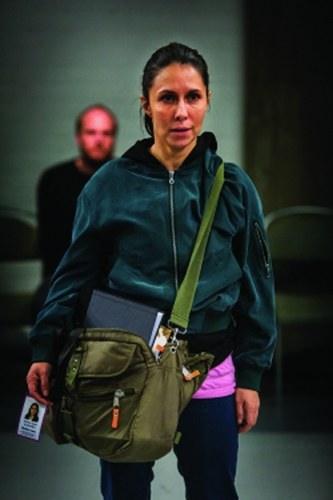
Anders Lustgarten's Lampedusa decentres the migrant in another way. Premiered at London's Soho Theatre in 2015, it was quickly translated into Swedish for a spring 2016 production at Stockholm's Kulturhuset. (Maltese and Greek productions followed in 2016 and 2017.) Named for the Italian island that became a primary European entry point for migrants coming from Africa, the play interweaves a pair of extended monologues between London and Lampedusa. Stefano, the Lampedusa-based character, is a depressed former fisherman who now makes a living plying the Mediterranean for a more sinister catch: capsized migrants, or more often the corpses of those who drowned trying to get to Europe. He can find no other work. The London-based character, Denise, is a part-time student who works door-to-door collecting overdue payday loans. She is smart and tough, but overwhelmed by her asocial ageing mother. Of mixed Chinese and Caucasian descent, her interracial appearance draws cruel comments on the Tube.
The two characters’ stories proceed in precise parallel (Fig. 1). Each meets a migrant who redeems their otherwise arid emotional existence. For Denise it is Carolina, a single mother from Portugal who starts chatting during a debt collection stop and ends up cooking Denise a Portuguese dinner, attending her mother's cremation and inviting Denise to become her roommate. Meanwhile Stefano meets the Malian Modibo. He begins by fixing Stefano's stalled boat motor. ‘Not much use for a boat mechanic in the Sahara, I tell him. “Yes! This is why Europe needs me!”’ the Malian responds.Footnote 27 He insists on buying Stefano an espresso and becomes his constant companion. Finally, Stefano goes out in a terrible storm to rescue Modibo's wife Aminata on her own migrant journey from Libya. The couple's reunion is a rebirth for the whole community. At the wedding-like reunion celebration in the migrant camp, Aminata wears a dress borrowed from Stefano's wife, Chiara, a marker of how the two families have merged.
Emil Almén and Sandra Medina in Anders Lustgarten's Lampedusa, Stockholm, January 2016. Photograph: Bengt Wanselius.

As one Britain-based scholar enthused, the play provides ‘a complacent continent’ with ‘lessons in conscience and compassion, humility and humanity’.Footnote 28 In both monologues it is the immigrants who first show generosity, offering food or coffee and friendship to their sceptical First World hosts. In Lampedusa's closing speech, Stefano muses, ‘They've given us joy. And hope. They've brought us things we have nothing of’.Footnote 29
The striking thing is that these transformative foreign characters never appear onstage. Their words are only quoted by Stefano or Denise. Lustgarten's risky writing strategy, targeting European audiences, manages to foreground Stefano and Denise and involve the audience in the slow melting of their hearts. Although this indirect representation ends up reinforcing certain stereotypes, including the idea that migrant others bring a more humane and meaningful set of values to their host societies, it circumvents others. For example, since the Malian and Portuguese characters are not portrayed at all, there is no question of what should be the background of actors who play them, what accents they should have or the like. Any racist preconceptions the audience might harbour are sidelined. But this strategy silences the immigrants altogether. They serve as objects: catalysts for the First World characters’ redemption and for the demonstration of Lustgarten's theories about social solidarity.
In Stockholm, the play's most effective device was the staging. Directed by Macedonian-born director Dritero Kasapi for the black box theatre of Stockholm's Kulturhuset, a single square of hard folding chairs framed the playing area. The house lights remained on, leaving the audience members vulnerable to the actors and squirmingly visible to each other. As the actors paced in the square, they would occasionally make eye contact with audience members, as if personally addressing them. While this staging created a degree of intimacy, even a sense of urgency, the characters and their stories were not in any way adapted for the Swedish context. In bringing this tight and gritty show to Sweden, Stockholm's Municipal Theatre sought only to translate it, not to deepen its resonance with Sweden's current debate on refugees. ‘We never intended to and didn't adapt it’, dramaturg Sofia Fredén told us. ‘It didn't need to [be], and the whole point of the play would vanish if you adapted it’.Footnote 30
Lampedusa resisted the pitfalls of predictable and ethnographic plots by making European hosts the grateful spokespersons for the migrants they have encountered. However, it raises the question, what stories would Modibo, Aminata or Carolina write once they got settled? What stories would their European hosts-turned-peers expect them to write, and how would they confront these ‘boxes’? With these questions in mind, we turn now to Karim Rashed and Hassan Blasim, whose 2015 and 2016 productions navigate these questions of representation but, unlike Lustgarten, operate within the dynamics of Arab diasporic theatre and face the expectations of local cultural agents and mixed (to different extents) Nordic–Arab audiences.
The Digital Hats Game
Blasim and Rashed have differing backgrounds and very different writing styles, but perhaps the most salient source of difference between the productions of their plays in 2016 was the reception context: the contrasting perceptions of migration in Sweden and in Finland. Many Swedes take pride in their country's history as a haven for refugees and immigrants. They also still remember Sweden as a migrant-sending country, with about a third of the population, or 1.3 million Swedes, leaving for the United States during the nineteenth and early twentieth centuries.Footnote 31 Today Sweden has a mature Arabic-language arts and publishing scene, established mainly by Iraqis since the 1990s, and also a robust presence of Arab artists in the mainstream arts and literature scene, including a few theatres that specialize in plays in Arabic or translated from Arabic. One Stockholm University linguist recently estimated that Arabic would soon outpace Finnish as the second-largest native language spoken in Sweden, with well over 200,000 native speakers, or about 2.2 per cent of Sweden's population.Footnote 32
By contrast, Finland has much less experience as a reception country for immigrants other than those from Russia and Estonia. Finland's statistics bureau classifies as Arabic-speakers only about fifteen thousand people, or 0.27 per cent of the population – one-tenth the proportion that Sweden has. Similarly, there are very few established writers and playwrights of immigrant background in Finland's literary and theatre scene.
One of the few Arab voices with a public profile in Finland is Hassan Blasim, the Helsinki-based Iraqi writer of macabre short stories whom London's Guardian newspaper once anointed ‘perhaps the best writer of Arabic fiction alive’.Footnote 33 His international fame ricocheted into some renown in Finland as well. Commissioned to write his first play for the Telakka (Shipyard) theatre in Tampere, Finland, where he used to live, Blasim handed over his text to a production context that would drastically transform it. Telakka marked its twentieth anniversary with several grand gestures at once: The Digital Hats Game not only was its first ever play by an immigrant author, but also was co-directed by two Finnish directors of different generations and styles, on top of which it was co-produced with an Estonian theatre company from Tartu, whose actors did not all speak Finnish. The play tackled a topic of global, not local, interest: a community of hacktivists who try to crash government drones, hack border control systems and make radical performance art.
Our first trap, biographical voyeurism, is something that Blasim has flirted with for years. His own backstory enhances both his credibility and his mystique. After growing up in a large, poor Shi'a family in Iraq, he trained as a film-maker in Baghdad and soon ran into political trouble. He fled Baghdad to work under a pseudonym in Kurdistan, left Iraq after the US invasion, and then took a harrowing four years to cross Iran, Turkey and most of Europe to end up in Finland in 2004. In vivid interviews he has recounted his refugee ordeal: the ugly under-the-table jobs in Turkey, the encounters with smugglers and cruel Bulgarian police.Footnote 34 He has been careful never to write a memoir or autobiographical fiction, instead mining Iraq's bloody collective past and the networks of contemporary migration and human trafficking for Borgesian puzzle stories, or what he calls ‘nightmare realism’ – an Iraqi cousin to magical realism.Footnote 35
The theatre's posters and online publicity framed Blasim as a refugee, promoting ‘the first play of Hassan Blasim, who fled 10 years ago from Iraq to Finland’.Footnote 36 But the play itself denied any voyeuristic access to the playwright's life, highlighting instead his history as a successful short-story writer. As the audience filed toward the theatre through a small square antechamber made of wooden slats, guarded by actors in white Anonymous masks (as in V for Vendetta), the lights went down. In darkness, the fenced-in audience heard a solemn male voice read (in Finnish) Hassan Blasim's haunting short story ‘The Truck to Berlin’, in which traffickers abandon a locked truck full of Arab migrants in a forest in Serbia; all the men claw each other to death except one, who turns into a wolf and flees into the forest. The fence and darkness pushed the audience into a subject position similar to that of the truck's inmates, uncomfortably close to strangers and under scrutiny by undefined others. It also reminded them of Blasim's literary fame.
The second trap, orientalized exoticization, was harder to escape. Blasim wrote the play directly for his Finnish and English translators, Sampsa Peltonen and Jonathan Wright, who made it accessible to the Finnish and Estonian directors and cast. He intended a philosophical as well as an activist play.Footnote 37 He included almost no Arab or Islamic material, preferring political sloganeering to cultural exploration or making his cultural signifiers ironic and hip – his character Mohamed, for instance, goes by the hacker alias Prophet. The play's characters perform stories-within-stories, argue about whether to buy drone-hacking technology from black-hat nihilist hackers, and try to fight off various infiltrations. Their goal is helping refugees: for instance, they build a virtual/actual reality ‘Borders Game’ in which hackers try to help refugees disable border surveillance systems to sneak across. Their adversaries include the state intelligence services, fundamentalist ideologies and political despair.
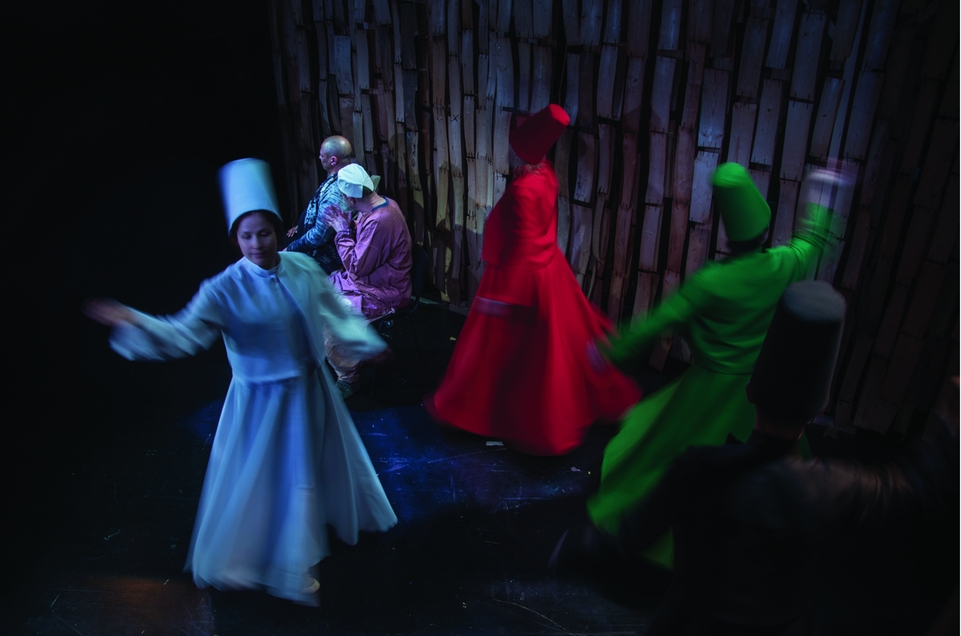
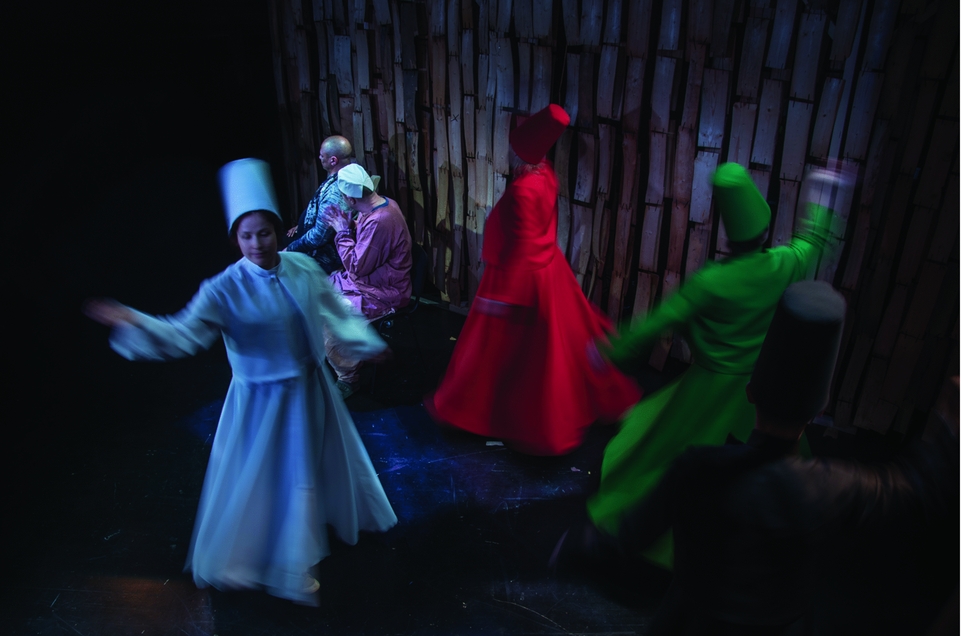
Blasim's text is a memory play, the self-consciously literary structure marking its distance from the headlines. Set sixteen years in the future, it flashes back to delve into the hackers’ backgrounds and failed aspirations. But veteran Finnish director Hanno Eskola cut all this, set it in the present and decorated it with many orientalist flourishes. The production accentuated the few Arab and Islamic points in the plot. A brief and deliberately ugly parody of belly dancing marked one villain's character. The production included Arabic writing that most in the Tampere audience would not have been able to read: when a European Muslim character had to choose between violence and non-violence, another actor (not, in real life, an Arabic-speaker) wrote the Arabic words  and
 (‘death’ and ‘love’) on an onstage chalkboard. A Sufi-style whirling dervish performance apparently represented the Muslim character's state of mind as he wrestled with a difficult decision (Fig. 2). In a scene not present in the Arabic and English scripts we read, the three female actors were veiled and prayed in Arabic. The actors, who were Finnish and Estonian and non-Arabic-speakers, had been coached by the translator of the play. One woman, an Estonian actor not fluent in Finnish, then delivered a fundamentalist rant in English.
Orientalism in The Digital Hats Game, Telakka Theatre, Tampere, Finland, 2016. Photograph: Henry Griin.
We do not speak Finnish, but we can say that the production departed significantly from both the Arabic script and its English translation, both in content and in its aesthetic choices. There was an over-the-top, even cartoonish, quality to the visuals in the production, quite distinct from the text's insistence on making the brutality of war visible. The character representing the global regime the hackers were targeting wore a bright red pantsuit and had a ringing bad-guy cackle. In a broad send-up of fundamentalist ideologies, a jihad-preaching imam and a Quran-burning preacher with a backyard barbecue grill were both played by the same actor. In our interview, Blasim was dismayed that his characters had been so drastically transformed but did not object to the new emphasis on Islam. When we interviewed director Hanno Eskola, one of Telakka Theatre's founders, he was jocular: ‘Well, it's theatre’, he said. ‘You have to give people something to look at’.Footnote 38
The last big pitfall we identified is the perceived need to show ontological worthiness: in this case, to bear witness to what one's society has endured, as well as to showcase the maturity of its art in order to argue for its right to exist and be heard. For Blasim this was not a trap but a goal. His script aimed to illuminate the suffering of the Syrian people, merging Syria's story with Iraq's. But the directors left out scenes calling for graphic onstage depictions of waterboarding, gang rape and murder involving Islamic State fighters and the US Army. To Blasim's surprise, they used wooden puppets to perform an inset story of a Syrian mother's attempt to protect her daughter from rape by armed groups by burning her skin in the sun. This was a visually elegant solution, but it contrasted with Blasim's brutal, literal, cinematic idea for his play. Perhaps this was partly a problem of genre, the awkward adjustment of a trained filmmaker and celebrated writer to the medium of live theatre. In our interview, for instance, Blasim referred to his play under the heading of literature and used the term ‘short story’ to describe these violent vignettes. He described how he would have done the scenes in a film but not onstage.Footnote 39
The Digital Hats Game was warmly reviewed in some corners of the Finnish arts scene, even compared by one reviewer to the work of a revered Finnish controversialist, the director Jouko Turkka.Footnote 40 Undoubtedly it brought something new to the Nordic theatre. But it was not recognized on its own terms. For a combination of reasons – an overly complex institutional collaboration, genre trouble and perhaps a sedimented orientalist outlook in Finnish theatre circles – the script changes flattened Blasim's characters and timescale, even as the aestheticization of extreme violence softened his brutal message about the wars in the Middle East. The production enacted a compromise between the author's desire for an activist theatre and the two directors’ sensibilities, which tended more toward the postmodern, multimedia and ostentatiously multicultural.
I Came to See You
Because of the differences between Sweden and Finland discussed above, and because the playwright is also an actor who took part in producing his own play, Karim Rashed's play I Came to See You had much better luck being received on its own terms.
Inviting a reading as autobiography, the play dissects a fantasy of return that could easily have been the playwright's own. This tight four-character drama follows a successful immigrant who decides to return to his home country, war-torn contemporary Iraq. Like his author, the protagonist Salim (‘safe one’) is an ex-leftist Iraqi exile who has spent twenty years building a secure life in Malmö, Sweden. Salim has a European wife, soccer-playing children, a job, a house and a Mercedes, but he is homesick and curious. He separates from his wife, leaves his family and flies to Baghdad, where he meets his old friend Mokhlis (‘the loyal’); he dreams a conversation with Roaa (‘vision’), his Iraqi girlfriend whom he abandoned to flee to the West; and he meets some US soldiers, who in the original Arabic version of the play actually shoot him.
Rashed originally wrote the play in Arabic, winning a prize from the Sharjah-based Arab Theatre Authority for his 2011 script, which was published but never produced. He later rewrote it in Swedish for the Malmö production.Footnote 41 His Swedish version kept some Arabic dialogue and toned down the fantasy ending, making a biographical reading more plausible. But it kept the structure – that of a Greek tragedy, with each scene pitting Salim against just one other character in a series of clarifying interrogatory dialogues, including two police interrogations.
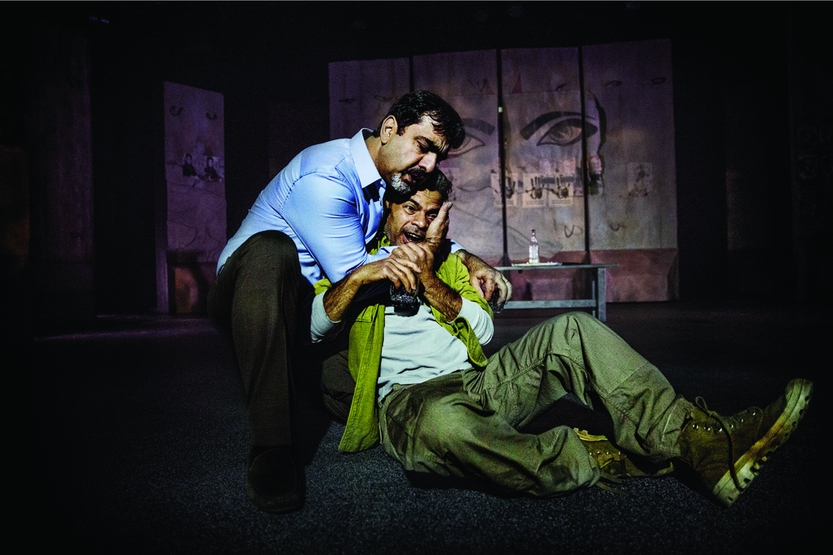
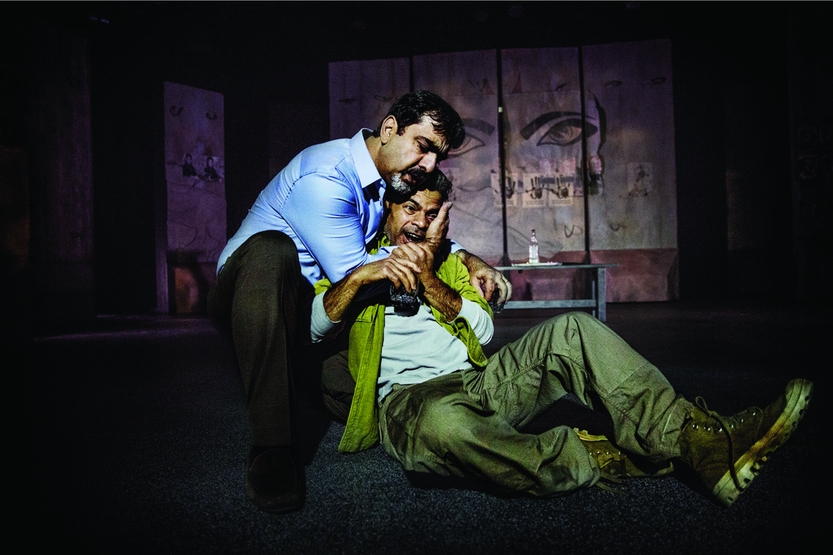
In production, the casting also worked to fend off the danger of biographical voyeurism. To Rashed's delight, director Petra Brylander, artistic director of the Malmö Stadstheater where he works, cast him in the production – not as Salim, but as his friend Mokhlis, a photographer who stayed in Iraq documenting Saddam Hussein's dictatorship and the US occupation and civil war that followed. He gave an amazing performance: bitter and jumpy, a tightly wound ball of anger. He played well off the Salim character created by Miran Kamala, an Arabic-speaking Kurdish actor based in Gothenburg, who stumbled around the stage like a confused bear (Fig. 3). ‘I didn't want to play Salim, because his character is close to my own’, Rashed told us after their January 2016 performance at Stockholm's Södra Teatern. This was the context for his comment about making art, not telling his story, quoted above.
Miran Kamala (left) and Karim Rashed in Rashed's I Came to See You, Stockholm, 2016. Photograph: Annalisa Pauly.
Rashed's play also resisted exoticization or self-orientalization: the implicit demand to serve up Arab or Muslim culture for European (or nostalgic Arab) audiences. There are many ways an Arab play can be infused with an aura of authenticity for such audiences. On the level of language and characterization, characters could, for example, slip into what Susan Nance calls ‘oriental voice’, talking like an old Arabian Nights translation.Footnote 42 ‘Traditional’ Arab or Islamic costuming or props such as food could telegraph cultural authenticity, as in the Royal Shakespeare Company's first Arabic commission in 2007.Footnote 43 Some plays emphasize their location by including Arabic music or dance, or even fragments of untranslated Arabic speech.Footnote 44 On the other hand, theatres with significant Arab immigrant audiences often use Middle Eastern music or decor to add nostalgia value.
The Arabic and Iraqi cultural signifiers in Rashed's play functioned quite differently, creating dramatic irony rather than an ethnography lesson or nostalgia bath. The protagonist himself felt an expatriate's foolish nostalgia for an Iraq that no longer existed. Thus the arak that Mokhlis served tasted to him like the good old days, whereas to Mokhlis it tasted ‘bitter, like photo chemicals, like betrayal’.Footnote 45 The Iraqi girlfriend Roaa performed a tiny snippet of belly dance, but did it with bitter irony. She and Salim shared brief untranslated Arabic-language dialogues, but these added emotional resonance rather than cultural window dressing, conjuring a private space for their relationship. Deepening the irony, these scenes were Salim's hallucinations, because unbeknownst to him Roaa had already been killed by a suicide bomber. The protagonist's lengthy expatriation shut him out of any access to a ‘real Iraq’ – and the audience, sharing Salim's subject position, were shut out too. The exceptions were the Iraqis and Iraqi–Swedes in the audience, who received the play's painful narrative of return (and, with it, the confrontation with a construction of home that reveals itself to be illusory) with audible emotion. During the after-party several audience members expressed their feeling that the play had told their story.
The last pitfall we proposed is the perceived need to present an allegory of a collective ontological worthiness, to prove that a particular community deserves to exist because it can produce moving testimony or world-class art. Rashed preferred to take the path of art, not testimony, resisting a ‘forensic’ reading. To sidestep the headlines, he cleverly used Western intertexts to elude Western expectations about Iraqis. Working in Sweden, the obvious entry point was Strindberg. Rashed had studied his plays in drama school in Iraq, directing his two-woman miniature play The Stronger (1889). For I Came to See You he turned to Strindberg's famous 1901 play Ett Drömspel (A Dream Play), which has the daughter of the god Indra come down from heaven to see how things are on earth. To flag the intertextual reference, Rashed's play refers to Sweden as a ‘snowy heaven’ (jannat-al-thalj) and to Baghdad as either earth or hell. Critics caught the point, one calling the play no mere political product but detta mångskiktade drömspel (‘this multi-layered dream play).Footnote 46 Adding depth, the echoes also helped relate the Iraqi predicament to Sweden's own emigration history; one critic was reminded of a musical based on the Emigrants novels, Swedish writer Vilhem Moberg's famous fictionalization of nineteenth-century Swedish migration to the United States.Footnote 47
On a metatheatrical level, of course, the play was an allegory of ontological worthiness – but a post-national one. Salim achieved no resolution, but the show itself did the celebratory work that its plot and protagonist refused to do.Footnote 48 Here casting became important; the presence of three accomplished Arabic-speaking actors actually born in Iraq or Syria (Helen al-Janabi, Miran Kamala and Karim Rashed) sent a subtextual message about the viability of Arab–Swedish migration and professional integration. That logic of national verity dictated the casting of the fourth role, too: Salim's wife Ester, written as a Hungarian woman in the script, became a Swede, because the actress cast, Anette Lindebäck, was Swedish. By contrast, Rashed's original Arabic text had made her Hungarian to help Arab audiences deconstruct the binary setup of the Arab immigrant against a unitary society of native Westerners.Footnote 49
With an Iraqi author; a Swedish and Iraqi directorial team; and Iraqi (Arab and Kurdish), Syrian and Swedish performers, the institutional realization of the play worked to show that Arabic theatre and its concerns are not marginal to the Swedish stage. If the title I Came to See You captured Salim's failure to ‘see’ anything about himself or his long-lost Baghdad, it also described the mixed audiences who eagerly ‘came to see’ Karim Rashed's show. Indeed, the Arab and Swedish play-goers were not two separate groups; those who laughed the most at the intercultural jokes seemed to be the bicultural audience members who, like Rashed, may have been in Sweden for decades.
Meeting the next boat
Blasim and Rashed are part of an emergent Arab theatre community that is growing in several Nordic countries, and already flourishing in Sweden. This community has created venues such as the Foratt theatre in Malmö, which was founded in 2005 and has staged Swedish, Arabic and Persian-language performances of European classics, as well as newly written plays focused on migration and intercultural milieus.Footnote 50 There are also upstarts like Arabiska Teatern (The Arabic Theatre) in Stockholm, newly founded by a collective including Helen al-Janabi, the Syrian–Iraqi actress who played Roaa in I Came to See You.
Karim Rashed, who has previously worked with the Foratt theatre, now holds a permanent position at the Malmö Stadsteater, or Municipal Theatre. He has been one of the figures at the forefront of both creating opportunities for Arab actors and directors in Swedish theatre and making space on Swedish stages for the convergence of Arab and Nordic narratives. Though he clearly distinguishes between the social and political project of ‘integration’ on the one hand and art on the other, he insists that Malmö Stadsteater can and should be a destination and forum for all residents of the diverse city of Malmö: ‘This is our theatre’.Footnote 51 One of the ways that The Digital Hats Game and I Came to See You have contributed to local and regional theatre life is that they have put into practice this idea of our theatre, bravely facing the tensions that can be engendered by collaboration and conflicting visions.
Whereas Azadeh Sharifi and S. E. Wilmer point to diaspora communities as a ‘missing link’ between new refugees and established arts institutions in much of Europe, in Sweden the situation is relatively better.Footnote 52 In the midst of the migration ‘crisis’, many producers of culture in the Arab–Nordic nexus are mobilizing in creative ways. There is still institutional racism, of course, but also spaces where Arab immigrant or first-generation Swedish artists can help new arrivals create narratives on their own terms. In the spring of 2017, for example, Hassan Blasim was guest professor at the Gothenburg-based Clandestino Institute, whose artistic profile melds art with political activism. He led writing workshops in Arabic and English for newly arrived immigrants and refugees and others ‘interested in writing that is situated in the contemporary framework of asylum and residence permits’.Footnote 53
Though it is not surprising that Blasim would travel for this opportunity to Sweden, where there are more Arabic-speakers and more funding for such initiatives, he has expressed his hopes that Finnish theatre will also be transformed by contemporary migration. As he told us in March 2016,
There are not a lot of Arab actors here in Finland. There are writers and visual artists. With the new refugees that are coming, there will be actors, directors. But they are still in the camp, you know. I'm sure I'll be working with them in the future. The community is starting to form.Footnote 54
A vibrant Arab–Nordic theatre community can sprout a range of efforts, not all or mostly focused on advocacy or on migration itself. The newly formed Arabiska Teatern in Stockholm works both to present high-quality professional Arabic theatre and to create venues for broader participation and access to the theatre. This group debuted with an Arabic production of Antoine Saint-Exupéry's The Little Prince in 2017 and was simultaneously crowdsourcing and curating the stories of Arab immigrant communities through theatre workshops with Arabic-speaking students, asylum seekers and others. Performances of the reworked script titled Sverige, Sverige, älskade vän? (Sweden, Sweden, Dear Friend?), are scheduled for the spring of 2018. Working strategically to engage its various funders and audiences, Arabiska Teatern envisions Sweden developing into a world hub for new directions in Arab theatre.Footnote 55
As we have shown, the ethics and politics of staging migration in Nordic–Arabic theatre explored in this article are anchored in global, Arab, European and Nordic contexts all at once. The Digital Hats Game and I Came to See You, as well as future productions, can be situated with and between both immigrant and Arab writing and theatre. They share some of the dynamics of immigrant writing and theatre, including the expectation that art provide an ethnographic lens into immigrant communities and the coexisting effort to push back against this narrative toward autonomy and toward a claim of collective ontological worthiness. In this first (to our knowledge) article on translated Arabic theatre in Nordic contexts, we hope to have sketched some of the traps that Blasim and Rashed have faced and the strategies they have employed. By navigating the traps, mixing careful doses of predictability and surprise, they and their colleagues are contributing to new directions in Arab theatre in the Nordic countries, and in Nordic theatre as a whole.