





Multisectoral collaboration involves actors coming together from different organizational sectors (government, nonprofit, market) to solve complex problems (Gray, Reference Gray1989; Hardy et al., Reference Hardy, Lawrence and Phillips2006; McGuire et al., Reference McGuire, Brudney, Gazley, O’Leary, Van Slyke and Kim2010). These collaborations aim to incorporate cooperative decision-making processes negotiated discursively, emphasizing mutual accountability and large-scale problem-solving. Such collaborations are mobilized to address “wicked problems,” complex societal problems which require involvement of multiple actors working toward systemic change (Ansell & Gash, Reference Ansell and Gash2008; Austin, Reference Austin2010; Gazley, Reference Gazley2017; Hardy et al., Reference Hardy, Phillips and Lawrence2003, p. 322; Page et al., Reference Page, Stone, Bryson and Crosby2015; Phillips et al., Reference Phillips, Lawrence and Hardy2000; Rittel & Webber, Reference Rittel and Webber1973; Williams, Reference Williams2002). “Wicked problems” include public health crises, environmental catastrophes, child poverty, and homelessness, all complex problems that require involvement from multiple actors (Gray & Purdy, Reference Gray and Purdy2018; Hardy et al., Reference Hardy, Lawrence and Phillips2006; McGuire et al., Reference McGuire, Brudney, Gazley, O’Leary, Van Slyke and Kim2010; Mosley, Reference Mosley2021; Olvik, Reference Olvik2024; Witkowski et al., Reference Witkowski, Whetsell and Ganapati2024). These collaborations, while highly beneficial for fostering innovation and knowledge-sharing, may be challenging as organizations in varied sectors, holding conflicting logics, may find it frustrating to work toward a solution with actors that have different values around such “wicked problems.” While the benefits (and challenges) of multisectoral collaboration are significant, more research is needed to understand the specific conditions of multisectoral collaboration (Shier & Handy, Reference Shier and Handy2016).
The U.S. overdose crisis is a wicked problem, shaped by interrelated sociopolitical factors, and involving multiple stakeholders with different views of the crisis (Lee, Reference Lee2018; McCrea, Reference McCrea2019). During the late 2000s, multiple US states began implementing policies to decrease opioid-prescribing in order to reduce overdoses (Chiarello, Reference Chiarello2025; Szalavitz, Reference Szalavitz2021). As opioids became harder to obtain, some users turned to street-based substitutes, leading to an increase in fatal overdoses in the 2010s (McCrea, Reference McCrea2019; Pacula & Powell, Reference Pacula and Powell2018). As such, increasing state attention has been paid to harm reduction practices, such as syringe service programs (SSPs), organizations that provide sterile syringes, naloxone, wound care, and basic needs services to people who use drugs (PWUD) (Weiland, Reference Weiland2022). In the US, SSPs are delivered through a mix of public and nonprofit/mutual aid sectors, staffed by social workers, medical staff, and peer providers. Thus, they are an important site for examining the dynamics of informal multisectoral collaboration in a politically contested setting (Jones, Reference Jones2019).
This paper shows how multisectoral collaboration addressing the overdose crisis in one US state emerged from a small informal network of public and private actors to a burgeoning and formal(izing) multisectoral collaboration created to disseminate harm reduction practices intended to address the opioid crisis. In politically contested service environments, such as that of SSPs, frontline actors may work to maintain informal collaborative arrangements that support the field in the absence of broad-based state and community support (Szalavitz, Reference Szalavitz2021). Most research on collaborative efforts focuses on formal arrangements (Gazley, Reference Gazley2008, Reference Gazley2010; Jang et al., Reference Jang, Feiock and Saitgalina2016), while much of the research on collaboration (in)formality uses quantitative research methods to investigate why organizations enter such arrangements, as well as the characteristics of organizations that enter (in)formal collaborative arrangements (Bauer et al., Reference Bauer, AbouAssi and Johnston2022). Thus, scholars know that organizations collaborate, and with whom they collaborate, but have less information about how such collaborations are managed, particularly in the absence of formal governance. This study uses qualitative interview data with SSP practitioners in a Midwestern US state to explore the emergence of an informal, multisectoral collaboration between public and nonprofit sectors in implementing SSPs and disseminating harm reduction practices, describing the role of frontline SSP practitioners as driving these collaborative processes. These collaborative arrangements did not result from state mandates but rather through informal relationships that fostered trust, navigated hostile institutions, and supported boundary-spanning leadership. The collaboration began to coalesce in 2020 in response to a rapid expansion of SSPs in the state between the years 2017-2020 due to an increase in state interest, and a corresponding shift from service delivery by a small cohort of nonprofit/mutual aid organizations to expanding public health involvement in SSP delivery. Thus, this study asks: How do frontline service providers construct and sustain multisectoral collaboration in environments with weak and/or absent formal governance structures?
Theoretical framework
Multiple theoretical frameworks have been proposed to understand the emergence and sustainability of multisectoral collaborations (Bryson et al., Reference Bryson, Crosby and Stone2015; Emerson et al., Reference Emerson, Nabatchi and Balogh2012), recognizing that collaborations arise when sectors find a way to exchange resources, organizations have prior relationships, and complex issues emerge requiring collective responses (Bryson et al., Reference Bryson, Crosby and Stone2015, p. 648; Gray, Reference Gray1989; Thomson & Perry, Reference Thomson and Perry2006). External factors, such as the collaboration’s institutional environment (including mandates, windows of opportunity, and vulnerability to change), can create incentives for organizations to engage in multisectoral collaboration (Alhassan et al., Reference Alhassan, Gauvin, Judge, Fuller, Engler-Stringer and Muhajarine2021; Bryson et al., Reference Bryson, Crosby and Stone2015; Omar et al., Reference Omar, Leach and March2014). Windows of opportunity, for instance, could take place in challenging or favorable political environments. Challenging political environments may facilitate collaboration when organizations need to address adverse conditions, while favorable political environments may result in increased resources for the multisectoral collaboration (Bryson et al., Reference Bryson, Crosby and Stone2015; Schmid & Almog-Bar, Reference Schmid and Almog-Bar2020). For organizations that work within complex and possibly contentious environments, there are multiple factors that hinder and support the creation of collaborative mechanisms. For instance, formal mechanisms are important to sustain collaboration (Bauer et al., Reference Bauer, AbouAssi and Johnston2022; Jang et al., Reference Jang, Feiock and Saitgalina2016), yet collaborations may start with informal arrangements in the absence of formal governance. Without formal support, collaborations may be sustained by frontline human service professionals who may act as boundary spanners who cultivate interpersonal trust among divergent actors.
Informal and relational trust-building in multisector and cross-sector collaborations
Formal mechanisms of collaboration typically emerge from top-down and state-mandated processes, such as formal contracting relationships, memorandum of understandings (MOUs), and mandated participation in collaborative processes (Bauer et al., Reference Bauer, AbouAssi and Johnston2022; Guo & Acar, Reference Guo and Acar2005; Isett et al., Reference Isett, Mergel, LeRoux, Mischen and Rethemeyer2011; Jang et al., Reference Jang, Feiock and Saitgalina2016). While these processes are typically stable, as they are often legally binding and contain enforceable accountability mechanisms, informal collaborative arrangements may also play a crucial role in multi-sectoral collaborations, particularly in the absence of strong institutional supports. Much of the research on such collaborations has focused on the public-private contracting relationship, overlooking other relational and informal forms of collaboration between the government and nonprofit sectors (Gazley, Reference Gazley2008, Reference Gazley2010). Suggesting that studying “informal linkages” between government and nonprofit actors may not be valuable to stakeholders, Gazley (Reference Gazley2008, p.141) notes that such trust-based relationships, fostered by interpersonal connections, may supersede formality and create relationships that serve as a substitute for formal collaboration mechanisms. Informal collaborations can be highly beneficial, as they allow organizations autonomy from commitment and foster “organic networks” (Bauer et al., Reference Bauer, AbouAssi and Johnston2022, p. 161) that bring actors with shared norms and values together to meet goals (Guo & Acar, Reference Guo and Acar2005; Romzek et al., Reference Romzek, LeRoux, Johnston, Kempf and Piatak2014). Trust-based informal networking can serve as a precursor to formal collaboration, which can provide additional benefits to small human service organizations (Peng & Kim, Reference Peng and Kim2018). Indeed, Hung et al. (Reference Hung, Gazley and Guo2025) note that trust is the only individual-level antecedent predicting an organization’s decision to collaborate, indicating the importance of trust in facilitating informal collaboration.
This study examines nonprofit-state collaboration in an area historically served by the nonprofit/mutual aid sector. Early mutual aid SSPs were reliant on informal and trust-based coordination, particularly considering the disregard state actors had for these services (Hassan, Reference Hassan2022; Kelley et al., Reference Kelley, Lune and Murphy2005; Szalavitz, Reference Szalavitz2021). Such collaborations relied on relational strategies and “soft control” (Vangen & Huxham, Reference Vangen and Huxham2003, p. 14) mechanisms to maintain collaborations, using trust between individual and organizational actors as a “lubricant for collaborative transactions” (Szalavitz, Reference Szalavitz2021; Vangen & Huxham, Reference Vangen and Huxham2003 p. 14). The history of SSPs provides some insight into current collaborations, with some in the field expressing mistrust of formal top-down mechanisms that may come with multisectoral collaboration, particularly with the state (Hassan, Reference Hassan2022), while others acknowledge the need for state involvement to disseminate the work of SSPs to broader communities (Fontaine et al., Reference Fontaine, Day, Luhmann, Madden, Sabin, Scheibe, Stoove, Vickerman, Wisse, Grebely, Taylor and Voets2026). Regardless, such multi-sectoral collaborations can yield increased legitimacy for under-resourced community-based nonprofits, while also providing insights into the needs of the local community for public sector actors (AbouAssi et al., Reference AbouAssi, Chen, Grossman and Johnston2024a). In a recent survey with US SSPs, community-based SSPs had a higher uptake of services than public ones, indicating increased accessibility among nonprofit/mutual aid SSPs (Ray et al., Reference Ray, Humphrey, Patel, Akiba, Bluthenthal, Tookes, LaKosky, Wenger, Kral and Lambdin2024). This finding underscores why nonprofits may be mobilized to collaborate with state actors to extend their reach and to obtain resources, while organizations in the public sector collaborate to learn from nonprofit community expertise (Schmid & Almog-Bar, Reference Schmid and Almog-Bar2020).
Navigating conflicting relationships in multisectoral collaborations
Despite the benefits emerging from collaboration, multisectoral collaborations may encounter tensions because of conflicting goals and objectives (Gray, Reference Gray1989; Kivleniece & Quelin, Reference Kivleniece and Quelin2012). These tensions may include disagreements over inclusion and efficiency; balancing autonomy and interdependence; and having unclear accountability structures (Gray & Purdy, Reference Gray and Purdy2018; Hardy et al., Reference Hardy, Lawrence and Phillips2006; Koliba et al., Reference Koliba, Mills and Zia2011; Romzek et al., Reference Romzek, LeRoux, Johnston, Kempf and Piatak2014). Additionally, multisectoral collaborations may fail in attaining agreed-upon outcomes, and there could be a reputational risk for collaboration involvement (Andrews & Entwistle, Reference Andrews and Entwistle2010; Bakko, Reference Bakko2026; Foss et al., Reference Foss, Intindola, Martin and Coșciug2025; Gray & Purdy, Reference Gray and Purdy2018; Hardy et al., Reference Hardy, Lawrence and Phillips2006). A perception among community members, donors, and other stakeholders that collaboration participation prioritizes the collaboration’s interest over the community or clients of the nonprofit may lead to reputational harm, funding loss, and reduced community trust (Omar et al., Reference Omar, Leach and March2014).
An additional complication emerges when considering the role of law enforcement, a public sector institution that is intertwined with the governance of drugs and drug use. Law enforcement is involved as an actor in a variety of “wicked problems” (such as homelessness, drug use, sex work and trafficking), although their involvement in addressing complex problems is often met with skepticism among service providers (Alford & Head, Reference Alford and Head2017; Anasti, Reference Anasti2020; Bakko, Reference Bakko2026; Daviter, Reference Daviter2017; Lee, Reference Lee2018; Van Dijk et al., Reference Van Dijk, Herrington, Crofts, Breunig, Burris, Sullivan, Middleton, Sherman and Thomson2019). As noted by Bakko (Reference Bakko2026), although law enforcement is on the front lines in addressing certain social concerns, they also pose a significant risk of causing harm to certain communities, leading to divergent approaches among providers when considering provider-law enforcement collaboration. Law enforcement’s role as frontline public sector employees who use discretion (Lipsky, Reference Lipsky2010) in enforcing federal, state, and local drug laws may make them important collaborators for organizations working with PWUD, considering the incompatible logics under which these actors operate.
Recent work looking at relationships between SSPs and law enforcement shows that experiences are mixed. Sightes et al. (Reference Sightes, Ray, Paquet, Bailey, Huynh and Weintraut2019) found that most law enforcement officials believe that SSPs promote drug use, despite evidence to the contrary. Allen et al. (Reference Allen, Danforth, Grieb, Glick, Harris, Tomko and Sherman2022) found that some members of law enforcement advocate for SSP implementation, while others actively oppose SSPs. Rudisill and Mohammad (Reference Rudisill and Mohamed2025) note that law enforcement believe that SSPs could decrease infectious diseases, but are also concerned about their potential for introducing drugs into a community. Understanding the relationships between public-sector law enforcement and public and nonprofit service providers can help untangle how actors manage differing logics and tensions, how they address complexity, and how they minimize risk of reputational harm (Bakko, Reference Bakko2026; Franke & Shdaimah, Reference Franke and Shdaimah2022).
Frontline actors as boundary spanners
While much of the literature on multisectoral collaboration emphasizes structural and field-level conceptions of collaboration, Bronstein (Reference Bronstein2003) focuses on interpersonal processes that emerge through interdisciplinary social work and other helping professionals’ collaboration. Bronstein’s interdisciplinary collaboration model, which emphasizes interdependence, newly created professional activities, flexibility, collective goal ownership, and process reflection, provides a framework to understand how social workers—which are referred to broadly as frontline human service professionals, even if they do not have a formal degree in social work—might perceive multisectoral collaborations at the micro level. This paper focuses on informal collaborations, where such informality may provide flexibility in assigning roles, but establishing collective goal ownership may be challenging because new collaborations may lack accountability. Bronstein’s framework helps explain how individual social workers understand their own collaboration responsibilities while balancing dedication to their profession. In this case, role flexibility, where an actor can define their role over time, may serve to counteract role ambiguity, the confusion around who fills which collaboration role. This tension is present as social workers navigate inter-professional dynamics in multisectoral collaborations, collaborating with individuals of varied occupational backgrounds/statuses and organizational contexts.
One characteristic cited as necessary in this form of collaboration is boundary-spanning, where an individual has a specific internal role within an institution (whether leadership or otherwise) while working to connect outside organizations (Miles, Reference Miles, Cooper and Payne1980; Oliver, Reference Oliver2013; Stephens et al., Reference Stephens, van Steden and Schoonmade2024; van Meerkerk & Edelenbos, Reference Van Meerkerk and Edelenbos2018). In this context, navigating power imbalances is critical in balancing the interests of diverse and perhaps unequal stakeholders. While the boundary-spanning literature emerges from management and organization studies, the emotional labor involved in connecting disparate organizations and sectors is pertinent to frontline social work and human service professionals. Frontline human service professionals may function as boundary spanners, facilitating coordination with actors across sectors (Miles, Reference Miles, Cooper and Payne1980; Stephens et al., Reference Stephens, van Steden and Schoonmade2024; van Meerkerk & Edelenbos, Reference Van Meerkerk and Edelenbos2018). Boundary spanners are key agents in developing and sustaining collaborative partnerships through managing non-hierarchical partnerships and holding a deep understanding of multiple environments (Williams, Reference Williams2002). Individuals who can engage in cross-boundary communication are important in building trust among different sectoral actors in collaborative processes and for improving coordination in decision-making processes (Steadman, Reference Steadman1992; Van Meerkerk & Edelenbos, Reference Van Meerkerk and Edelenbos2014, Reference Van Meerkerk and Edelenbos2018). These actors often hold formal roles within one organization, while simultaneously maintaining relationships with external partners. Boundary spanners are often discussed in the context of leadership, with boundary-spanning being cited as a necessary component of formal leadership (Guo et al., Reference Guo, Heidl, Hollenbeck, Yu and Howe2022). However, such boundary-spanning processes are seen among frontline professionals who engage in social work broadly defined, who are often skilled at facilitating communication across sectors, and at engaging in “emotionally laborious” practices (Needham et al., Reference Needham, Mastracci and Mangan2017, p. 288). Frontline human service professionals’ roles at the intersection of organizations and communities allow them to mediate relationships and to connect with different sectors in ways that are rooted in community and an openness to new solutions (Bakken & van der Wel, Reference Bakken and van der Wel2023; Stephens et al., Reference Stephens, van Steden and Schoonmade2024). One under-researched area of boundary-spanning leadership concerns individuals with lived experience. For SSPs, lived experience has been cited as an important characteristic necessary to cultivate relationships with PWUD, and the empathy necessary to engage in this work may prove beneficial for boundary-spanning.
Methodology
Data
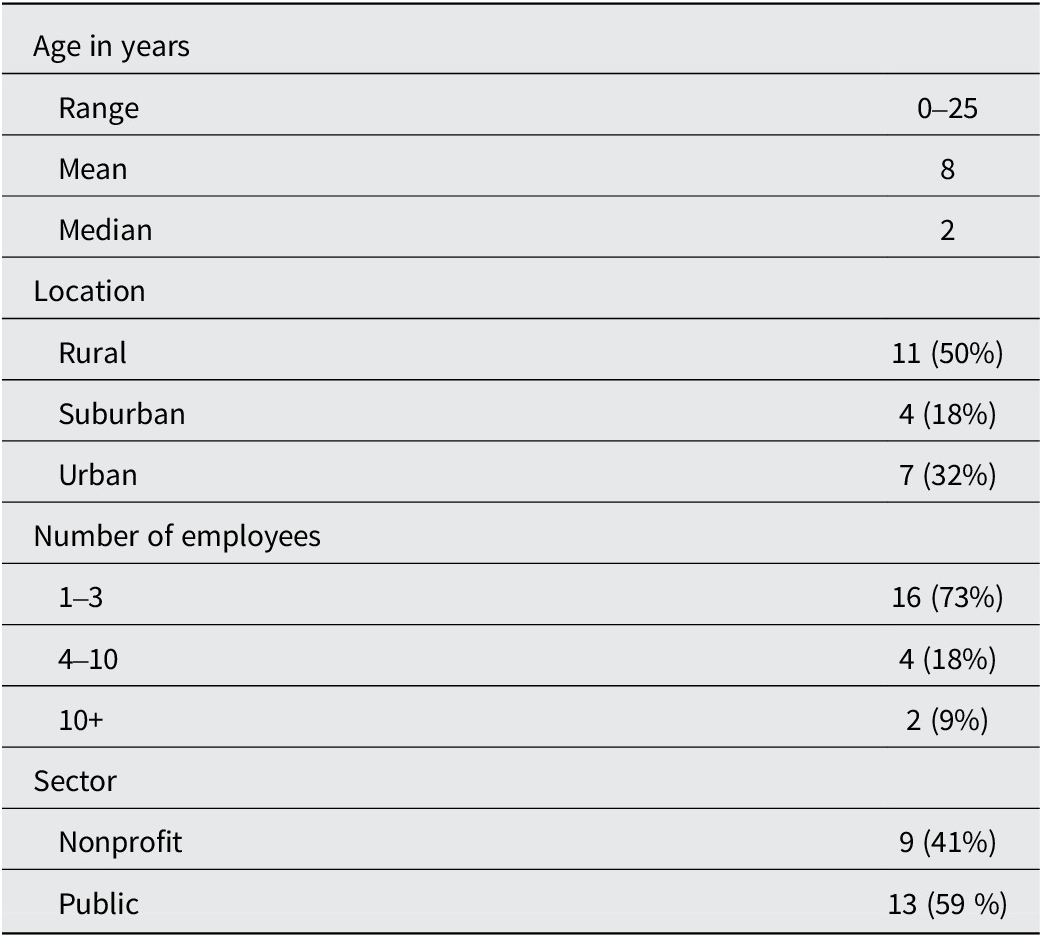
The data draws from qualitative interviews conducted with 26 paid employees from 22 SSPs in a midwestern US state in 2020. During data collection, directories maintained by the state’s Department of Health and Human Services, as well as the North American Syringe Exchange Network (NASEN), identified 54 SSPs, managed by 29 organizations in the state. Interviewing employees from 22 SSPs out of 29 SSPs in the state resulted in a 76 percent response rate. Any person currently in a paid position at an SSP in the state was eligible. Of the sample, nine organizations represented are 501c3 nonprofits, and 13 are SSPs run out of local public health departments. The average age of the SSPs was 8 years old, while the median was just two years old. Seventy-three percent of SSPs had fewer than four employees. For the SSP employees, all were direct service providers, and many also held positions of leadership. Other organizational and individual demographics are in Tables 1 and 2.
Descriptive statistics: SSPs (N = 22)

Table 1. Long description
The table presents descriptive statistics for a sample size of N = 22 S S Ps.
Age in years:
* Range: 0 to 25
* Mean: 8
* Median: 2
Location:
* Rural: 11 (50 percent)
* Suburban: 4 (18 percent)
* Urban: 7 (32 percent)
Number of employees:
* 1 to 3: 16 (73 percent)
* 4 to 10: 4 (18 percent)
* 10 plus: 2 (9 percent)
Sector:
* Nonprofit: 9 (41 percent)
* Public: 13 (59 percent)
Demographics: Employees (N=26)

Table 2. Long description
The table presents demographic data for N equals 26 employees across several categories.
Race:
* White: 20 (76 percent)
* Black: 3 (12 percent)
* Hispanic/Latine: 3 (12 percent)
Gender:
* Male: 6 (23 percent)
* Female: 19 (73 percent)
* Non-Binary/Trans*: 1 (4 percent)
Education:
* Less than college: 6 (23 percent)
* College degree: 14 (54 percent)
* Graduate degree: 6 (23 percent)
Former drug user:
* Yes: 9 (35 percent)
* No: 17 (65 percent)
Time employed in field:
* 0 to 5 years: 9 (35 percent)
* 5 to 9 years: 10 (38 percent)
* 10 plus years: 8 (31 percent)
Position at S S P:
* Service provider: 26 (100 percent)
* Service provider and management: 17 (65 percent)
This project sought to understand how SSPs conducted their work in a place-based environment that was rapidly changing regarding funding, public support, and transformation of the field. The semi-structured questionnaire included questions about the history of the SSP, collaborations with other organizational and individual actors, perspectives on harm reduction, and hiring peer providers, among other questions. All interviews were conducted via telephone or Zoom. Data collection ended upon saturation, during which no new themes emerged from subsequent interviews. Immediately following each interview, memos were written to capture author insights. These memos were integrated into the analysis to highlight patterns in the interview not apparent in the transcript. This project was approved by Oakland University’s IRB in April 2020.
The author, a MSW and PhD-level social worker with 20+ years of harm reduction experience, conferred with multiple harm reduction experts throughout the project to determine issues of importance. However, she does not have insider relationship with the SSP community in this context.
Analysis
This study used thematic analysis (Braun & Clarke, Reference Braun and Clarke2006) to find patterns and meaning in the data and twenty-first-century flexible coding (Deterding & Waters, Reference Deterding and Waters2021) as a guiding method of data analysis. Thematic analysis involves: (1) familiarization with data, (2) coding data (3) searching for themes, (4) reviewing themes, (5) defining themes, and (6) producing a report. Familiarization (multiple readings of transcripts) was followed by coding using the twenty-first-century flexible coding approach, which allows for flexible coding for large-scale studies, and facilitates re-analysis among projects likely to yield multiple papers (Deterding & Waters, Reference Deterding and Waters2021). Coding began by applying index codes (broad-scale code across large sections of text to assist in data retrieval) to selected chunks of the text. Coding was an iterative process, as it continued while the author fleshed out respondent memos and created cross-case memos to identify commonalities and differences across respondents. A priori and a posteriori analytic codes were applied to the index codes for further refinement. The author then proceeded to output the codes of interest to distinguish whether they had applied the correct criteria across the sample of codes. A codebook was created to document code labels, corresponding definitions, and example quotations. Reflexive memoing was engaged in throughout the research process to track the author’s subjectivity and how it influenced the act of research—specifically interactions with research participants—as well as to document the transparency of the research process (Olmos-Vega et al., Reference Olmos-Vega, Stalmeijer, Varpio and Kahlke2023). These results, including transcripts and memos, were discussed with a second qualitative researcher to assess the quality and coherence of themes. With the various concepts and themes discussed and referenced throughout the project, results were disseminated to the community in the form of a report for feedback and member checking (Padgett, Reference Padgett2017).
Limitations
Limitations included the lack of in-person ethnographic data collection. Being able to visit SSPs and observe their day-to-day work would have been beneficial in triangulating the qualitative data collection, thus increasing rigor. It is also important to note that only 1-2 individuals at each SSP were interviewed (except one organization, where four individuals who worked at four different sites run by the same SSP were interviewed). While most SSPs had fewer than four employees, there is likely information missing from employees who were not interviewed. Additionally, some participants mentioned that members of law enforcement were involved in the collaboration: interviewing law enforcement was not a part of this study, which could have provided alternative perspectives. Other limitations included the fact that this is a point-in-time project conducted during the COVID-19 pandemic lockdown—respondents were not re-interviewed to assess changes following the resumption of in-person activities.
Research context
This study examines multisectoral collaboration among SSPs in a midwestern US state up to the year 2020. To protect organizational identities and due to IRB constraints, the state is hidden. The first sanctioned nonprofit SSPs, or “legacy programs,” were established in the 1990s and remained the only programs in the state until 2018-2019. A shift in the policy landscape, spurred by the 2015 HIV outbreak in rural Indiana and the 2016 federal removal of the SSP funding ban, led to increased political interest in harm reduction. In response, the state’s public health department undertook significant efforts to expand SSP availability into underserved rural communities, growing from five to 29 by 2020. Newer SSPs were primarily managed by public health departments. In rural areas, public health departments led SSP delivery by leveraging existing infrastructure and state funding, often with technical assistance and support from nonprofit partners. This expansion extended SSP access to previously unserved regions, though new public health programs faced challenges in meeting community needs.
Results
To address the question of how informal collaborative arrangements develop with weak state support, the findings are organized into process mechanisms, followed by a reflection upon the formal(izing) collaboration. These process mechanisms are grouped into (1) Relationship development in the absence of formal state support, (2) Navigating hostile institutions, (3) Boundary-spanning leadership among frontline actors, and (4) Collaboration formalization. Respondents are described as one of three types: (1) legacy SSP employees, working at one of the five legacy nonprofit SSPs in the state, (2) public health SSP employees, employed at a public health-run SSP, and (3) nonprofit SSP employees, who are working at one of the newer nonprofit SSPs in the state.
Multisectoral relationship development in the absence of formal state support
In initial stages of SSP development, early adopters (the “legacy” programs) relied on informal collaboration with actors across sectors to sustain their work, particularly considering the opposition of legislative and other community stakeholders. Relationship-based, “handshake” collaborations laid the groundwork for trust and the cultivation of shared understandings of harm reduction as SSPs expanded across the state. When it comes to defining such relationships as “multisectoral,” there initially lacked a cohesive structure that characterizes such relationships, yet these early organizational collaborations provided relational groundwork for emerging multisectoral partnerships, with the presence of actors in multiple sectors providing mechanisms to navigate challenges and gain legitimacy in often hostile environments. Such relationships were spearheaded by individual frontline actors, who were often among one of the only employees at the organization. As grassroots members engaging in the illicit work of syringe exchange, some legacy members described initially introducing themselves to individuals who could advance SSP efforts, thereby building informal networks of support that could provide leverage in addressing implementation challenges, including capacity building and resistance within hostile policy and criminal-legal environments.
Remembering her early role as an employee of one of the state’s first SSPs in the 1990s, one legacy SSP staff member recounts the process of collaborating with multiple public and private institutions to strip the ordinance criminalizing the possession of drug paraphernalia:
…we were doing teach and bleach, street outreach…with injection drug users… transmission of HIV, just like with any other place…was extremely high…So, we went to the [city] Health Department. It was a real public-private partnership effort…We initially worked on an [paraphernalia] ordinance…In order to operate a syringe exchange program, you have to have a paraphernalia ordinance. (LN2)
Considering that SSPs were in a legal gray area in the state until the 2010s (and in some counties remain in a legal gray area, as noted by respondents), these informal multisectoral partnerships were constructed by frontline actors in the absence of formal state support, often relying on supportive state actors who functioned as harm reduction champions as brokering early trust-building among sectors. While acknowledging the role of such champions, respondents suggested that this support varied across jurisdictions, reflecting varying political climates. As one legacy SSP provider explained:
But I think everybody else, because the health department is on board, we haven’t had to have those MOUs [memorandum of understandings] because the [NAME] County Health Department is amazing. Other health departments in other cities, it’s going to be different….it really depends on the health department in the community because in [NAME] county the health department is very involved, very supportive. (LN4)
For many legacy programs, there is a focus on the necessity of program champions—public health officials for whom harm reduction efforts (including SSPs) were a necessary cause to defend. However, for some legacy providers, some of whom were former users themselves, developing relationships was initially challenging. Legacy organizations recounted that they were used to being perceived as “outsiders,” having to do this work on their own terms, without state support. Yet over time, this bottom-up relational work generated legitimacy among public and nonprofit SSPs alike, serving to lay the foundation for supporting the more structured and formalized collaborations as SSPs proliferated across the state.
Navigating challenging state institutions: Relationships with law enforcement
SSPs must strategically navigate relationships with law enforcement to address both the legal ambiguity surrounding SSPs and law enforcement hostility toward PWUD by focusing on shared public health goals. Indeed, relationships with law enforcement are challenging due to the historical mistrust that drug-using communities-and the organizations serving them--have toward law enforcement. Nevertheless, law enforcement collaboration was considered a necessary component of SSP work in order to protect their vulnerable participants. As one employee at a legacy SSP noted, the fact that SSPs are still in a legal gray area in the state requires building relationships with law enforcement:
[The state’s] law enforcement structure is pretty autonomous…They have a lot of discretion. So in some of those situations it can help to work with the health department and law enforcement a little bit more closely because the legality of SSP is a gray area…[but] partnership with our departments is a bonus…I was speaking with a county sheriff…but he liked the idea so much that he wanted the sheriff’s office to operate the SSP. (LN31)
Akin to the relationships discussed previously, these relationships were not formally codified, relying on personal relationships between frontline workers and law enforcement and informal verbal agreements. As one nonprofit SSP employee described:
We have just personal connections…they know what we’re doing and we tell them what we are doing. Then also, just last month, we had somebody come into the precinct, one of our syringe exchange people…she [officer] said, “Just please call this number,” and it was one of us…So she walked there and then they called us and they arranged for somebody to come bring her here…It was cool how that worked out. (N3)
However, these relationships, relying on law enforcement discretion and personal relationships, may be fragile. The respondent goes on to note that “the relationships that we do have with law enforcement in [county] are so personal, everybody might not know what we’re doing and so we have a couple of preventive measures, just to protect our clients.” In noting the conflicting perspectives that may be held with some law enforcement stakeholders, a public health SSP employee describes how collaboration is based on relationships rather than formal institutional agreements:
Some law enforcement are a little more progressive in their thinking….[with them] our relationships are nothing written on paper, it’s more of a verbal agreement type thing. A mutual understanding rather. (PH1)
Here, it should be noted that there were minimal differences between the relationships of nonprofit SSPs and public health-run SSPs with law enforcement. These organizations described similar forms of collaborative relationships which were nonetheless beneficial insofar as law enforcement was not actively harmful to their participants. For instance, one legacy SSP provider noted: “We go to camp staff meetings for [city] policy department…they’re aware, they know and support us.” Another legacy nonprofit program employee described a process of formalizing law enforcement relationships, noting that their relationships could increase cross-sectoral collaboration in order to directly support an individual at increased risk for overdose:
We do have a relationship…for law enforcement, when they do reverse an overdose, we’ve thought about taking this one step further, so we have what’s called the wellness chat program, so when they do report an overdose, we’re provided with that information, and then we have a recovery coach go out and follow up with that individual the following day. (LN20)
These collaborations, being negotiated through “verbal agreement type things,” “personal relationships,” and “mutual understandings,” may appear to be fragile without the backing of institutional mandates for collaboration. Yet, for many respondents, they created the groundwork to facilitate more formalized collaborations with state and local agencies over time. Including these early forms of collaboration demonstrated the possibility for SSPs to thrive in challenging institutional environments, even if, for a minority of respondents, collaboration with the state, particularly law enforcement, was ideologically in opposition to how they perceived their work. While uncommon with respondents, one community-based employee described segregating themselves from police (Bakko, Reference Bakko2026), interacting with them only when absolutely necessary: the respondent described a situation wherein a cop intervened on their work distributing needles. When the respondent gave them their organization’s card, the cop left them alone, and the respondent noted that no interactions with law enforcement have happened since—a relationship they prefer. Nevertheless, for most SSP providers, law enforcement members become involved in collaborations as the collaborations have become increasingly formalized, which many respondents credit to these “mutual understandings.”
The role of boundary-spanning leadership among frontline actors
For the legacy programs that engaged in substantial early relationship-building to gain support for their work, several individuals used their talents and emotional intelligence to reach “drug users, sex workers…those populations that are already so vulnerable and looked down upon.” Respondents informed me that empathy allowed such boundary spanners to connect with state employees and business owners to gain support for the implementation of SSPs—a form of charisma that was able to influence a wide range of actors. One former legacy provider, whom a respondent described as a “a one man show,” was a former user who would “sit there, talk to people…respect them, I think that just his personality has benefited from that.” This provider’s success in “meeting people where they are at,” shaped his ability to connect with a wide swath of individuals, such as business owners, who allowed the SSPs to operate in parking lots, and local law enforcement, who have become key supporters of this SSP. These ad-hoc public-private relationships succeeded by focusing on the broader goal of overdose prevention and improving public health, while also having someone available to translate the values of the work across sectors.
Boundary-spanning leaders were cited by respondents as using their lived experience in drug use, their adaptability, and their deep knowledge of different systems to connect individuals across sectors. Multiple boundary-spanning leaders were cited, but respondents mentioned one repeatedly: the individual’s background was especially relevant to their emergence in this leadership role, as a former service user, a nonprofit SSP employee, and eventually, holding a position in the state public health department. Respondents noted that his experiential expertise allowed him to navigate varied organizational contexts and institutional logics, maintain the respect from other collaborative actors due to his lived experience and facilitating collaboration across geographically dispersed programs. His familiarity with the lived realities of program participants conferred credibility and authenticity, further enhancing his capacity to cultivate trust across multiple stakeholder groups. A single boundary-spanning leader can serve as a catalyst for multisectoral collaboration—especially when equipped with lived experience, granting them experiential legitimacy that usurps conventional notions of hierarchical power. Having boundary-spanning leadership appeared to destabilize power dynamics in the collaboration, as participants were able to view such de facto leaders as individuals who shared their concerns and were able to speak to a variety of different stakeholders. As one respondent put it: “He was one of the old hands and he has now moved forward in his position in working through [public health department].” The perception of being one of the “old hands,” and his openness about his own experience likely provides a sense of trust and security in pushing this collaboration forward. As one public health SSP respondent noted, “he knew this [syringe exchange] works”:
He actually is one of the state representatives for harm reduction, and he has personal experience with [ORGANIZATION]. I think he really brought to the table, [STATE] knew they had a hepatitis C problem, and he knew this works. (PH15)
While this specific boundary-spanning individual was described most frequently, it should be noted that similar discussions occurred regarding similar boundary-spanning individuals. These individuals maintained connections with their community, did not hide their lived experience, and were able to navigate the intricacies of cross-sector relationships due to their ability to connect authentically with others and speak from a place of lived experience as a source of credibility and insight. For one organization, one of the only legacy programs located in a rural community, they described the founder of the organization as follows:
…we have ongoing presentations that we do at public libraries. Sometimes nursing students…come to our presentation….If [ORG LEADER] who is our biggest egghead, if they’re doing the presentation, they have hours of subject matter and things that they can present on. They can just plug and play whatever somebody’s looking for. [LN7]
Having these interpersonal skills, being a person of lived experience, and being able to present in mainstream venues were all crucial components of what made a boundary-spanning leader and how these individuals were able to connect with stakeholders who may not have been attuned to the needs of an SSP.
Transitioning to “formalized” multi-sectoral collaborations
Relational trust-building, working with hostile institutions, and the presence of boundary-spanning leadership have set the stage for the gradual formalization of multi-sectoral collaborations that have emerged between the public health sector and community-based nonprofits. Respondents noted that the collaboration, the formation of which was encouraged by the state public health department upon the increase in government funding in the late 2010s, took some time to gain traction—an issue which was compounded by the onset of the COVID-19 pandemic in 2020. Nevertheless, individuals felt that due to the relative freedom to join this work, they had role flexibility in this process and appreciated the range of perspectives that were put forth. The reason for the collaboration was to determine the SSP funding process (which was now distributed through the state public health department) and to disseminate harm reduction practices. As one respondent who works at a health department SSP described:
There’s a Syringe Service Program Advisory Committee…the goal is looking at funding coming into the state. I guess they said…some of those funding decisions needed to be made quickly….But now just really wanting to be very strategic in that, and in getting input across the state in order advance harm reduction…this includes some of the syringe programs in the state, some people from the medical community, places that are going to provide technical assistance to us via monthly webinars. [PH5]
The transition from informal to formal(izing) collaboration created opportunities for more cohesive leadership (particularly through boundary-spanning leadership) to institutionalize collaboration in such a way as to enhance the shared vision of the collaborative—not an easy task when contending with public health departments, mutual aid groups, and community-based nonprofits located in different geographical communities.
Respondents emphasized that these monthly gatherings created necessary spaces for organizations to collaboratively address challenges like funding for syringes, as state funding cannot be used to fund actual syringes. Respondents describe collaborative members as being engaged in problem-solving actions and “out of the box thinking,” indicating the importance of flexibility in roles to explore innovative solutions, as one nonprofit SSP employee suggested:
… if [SSPs] aren’t…participating on the monthly state syringe call be part of that. They don’t have to be necessarily one of the recipients of state funding although most are. But it’s been a great network to especially brainstorm some of these out-of-the-box thinking…it’s such a critical part because when you’re trying to fundraise for syringes…[you need] some good backing behind you and good data behind you, which we discuss in the state calls. (N2)
This respondent highlights the importance of network building in finding new ways to explore challenges, providing context for collective problem-solving, information-sharing, and decision-making. One notable outcome was the state’s first Harm Reduction Conference. These spaces were established through strategic efforts to create a community of individuals and organizations (nonprofits, mutual aid, law enforcement, health department, academics) to discuss a shared goal to disseminate harm reduction practices statewide. The conference’s creation deepened participant dedication to ongoing partnerships, highlighting what can be accomplished through sustained and strategic collaboration efforts, as this public health SSP noted:
Well, [the conference] was phenomenal…They had a panel of individuals who are utilizing syringe exchanges…they have state health representatives come up and discuss the HIV outbreak …Even law enforcement speaks in support of it, I thought was so cool. (PH15)
Here, the respondent illustrates how the conference showcased creative efforts through bringing together multiple stakeholders and co-producing innovative solutions. Respondents suggested that these processes can create mutual values across geographically dispersed areas in the state, where such values may not be assumed.
While participants expressed support for these collaborations, some respondents viewed them as more of an obligation, showcasing the need for leaders to work on fostering trust and engagement among a diverse group of collaborative members. While no participant explicitly dismissed the value of the collaboration, engagement was at times superficial. As one health department SSP employee in a rural community noted:
I regularly sit in on the state calls for the syringe program that they have… I’m on their something or other, I don’t even know what it’s called but they have a harm reduction brainstorming, grow brighter, something…. the Syringe Service Program coalition-type brainstorming group, I don’t even know what it’s called. (PH6)
This limited engagement suggests strategies to develop trust and secure buy-in from participants with minimal involvement. Other participants spoke of it as something that was useful but stopped short when discussing it as a driver of meaningful, systemic change. While this could be an individual decision among the SSP employees, collaborations may distract from frontline work, particularly in low-resource contexts. This can shift power dynamics, in that the SSPs with lower interest may be less likely to have their voices heard within the collaboration, which may hinder the ability to identify shared collaborative goals.
Discussion
Participation in multisectoral collaborations is crucial to addressing wicked problems. As multisectoral efforts are often discussed in highly formalized, large-scale terms, this paper offers an alternative perspective by examining an informal (yet formalizing) multisectoral collaboration among SSPs, public health departments, and law enforcement. This paper makes several contributions to understanding multisectoral collaboration. First, this paper focuses on how informality can be an overlooked structure in such collaborations, particularly as the bulk of collaboration literature focuses on formalized partnerships. While limited to a single location and time, this study shows how frontline relational work created the groundwork for governance structures that later resulted in a more formalized process—a process that may be similar for other collaborations starting informally. Second, for a core-stigmatized service (Anasti & Zhao, Reference Anasti and Zhao2025), the ability to navigate relationships with hostile institutions is important to developing sustainable multisector relationships. Third, boundary-spanning leadership rooted in lived experience may foster positive relationships in collaborations, indicating that the trust built through such individuals may matter more than top-down authority. Finally, while multisectoral collaboration may be fraught with tension, confusion, and/or miscommunication (Gray, Reference Gray1989; Hardy et al., Reference Hardy, Lawrence and Phillips2006), addressing low buy-in is also important in early-stage collaborations. Figure 1 presents a process model illustrating the pathway toward formalizing multisectoral collaboration in a case study of a marginalized social service that has limited, yet existing, state support.
Process Model of Multisectoral Collaboration.

Fig. 1. Long description
The flowchart consists of four rectangular boxes connected by arrows.
At the top, the first box is titled Bottom-up Relationship Development and lists three points: 1. Handshake Collaborations, 2. Program Champions, and 3. Building relational trust with state actors.
Two arrows point downward from this top box to two parallel boxes in the middle row.
The middle-left box is titled Navigating Challenging State Institutions and lists: 1. Focusing on shared public health goals, 2. Protecting clients from harm, and 3. Mutual understandings/verbal agreements.
The middle-right box is titled Boundary-Spanning Leadership and lists: 1. Use of talents to connect to stakeholders, 2. Expertise of lived experience as experiential legitimacy, and 3. Authentic connection to mainstream audiences.
Arrows from both middle boxes point downward to a single final box at the bottom.
The bottom box is titled Formal(izing) Multisectoral Collaborations and lists four points: 1. Syringe service program advisory committee created for funding decisions, 2. Range of organizational and individual actors, 3. Creation of Harm Reduction Conference to disseminate harm reduction practices, and 4. Challenges in fostering full participation.
One of the biggest drivers of multisectoral collaboration is the existence of prior relationships (Bryson et al., Reference Bryson, Crosby and Stone2015; Vangen & Huxham, Reference Vangen and Huxham2003). Prior research shows that trust is the only individual-level factor associated with nonprofit collaboration (AbouAssi et al., Reference AbouAssi, Tran, Bowman and Johnston2024b; Gazley & Guo, Reference Gazley and Guo2020). AbouAssi et al. (Reference AbouAssi, Tran, Bowman and Johnston2024b) found that nonprofits privilege trust with individuals when deciding to collaborate, while local governments privilege trust with the organization—in either case, trust is a key driver for multisector collaboration. Given that early organizations in the SSP space were accustomed to existing without state support (Bramson et al., Reference Bramson, Des Jarlais, Arasteh, Nugent, Guardino, Feelemyer and Hodel2015; Hassan, Reference Hassan2022; Showalter, Reference Showalter2018), it follows that building trust and the relational groundwork between individuals were necessary preconditions for considering collaborative work. Some organizations (particularly legacy SSPs) had long-standing relationships with multisectoral partners in the public health space facilitating knowledge and resource-sharing, underscoring the importance of having program champions (Romzek et al., Reference Romzek, LeRoux, Johnston, Kempf and Piatak2014). This highlights the importance of investing in trust-based relationship-building early in the organizational tenure to strengthen future collaboration efforts.
Navigating hostile institutions, such as law enforcement, is necessary for SSPs to secure space for their work and to protect program participants. According to Hardy et al. (Reference Hardy, Lawrence and Phillips2006), collaborative conversations are successful when participants put aside their individual interests to work with other collaborators to pursue an issue of mutual interest, a dynamic emphasized in relationships with law enforcement. As noted by other scholars, the entrenchment of carcerality in human service provision makes it challenging to disentangle care from control (Bakko, Reference Bakko2026; Jacobs et al., Reference Jacobs, Kim, Whitfield, Gartner, Panichelli, Kattari, Downey, McQueen and Mountz2021; Kim, Reference Kim2020). This tension between care and control is particularly salient for SSPs as organizations that have actively worked to distance themselves from carceral control yet need to collaborate with law enforcement to ensure their participants do not become involved in the criminal-legal system. Broadly speaking, law enforcement may hold negative or mixed views of SSPs (Faber & Rigg, Reference Faber and Rigg2026), while harm reduction proponents may hold negative views of law enforcement and the carceral state (Hassan, Reference Hassan2022). However, other research holds that syringe program staff may have positive views of law enforcement (Franco et al., Reference Franco, Lee-Winn, Brandspigel, Alishahi and Brooks-Russell2021), which held in this study. The positive regard--or at least the respectful distance--with which SSP employees held toward the police created openings through which multisectoral collaborations could be developed and maintained, setting the stage for broader state-level work.
The participants highlight the importance of multiple boundary-spanning leaders in collaborative efforts, emphasizing their significance at the individual and organizational levels. For some early SSPs, these leaders—who may not have been in positions of official authority but nevertheless were consistently looked to as key figures because of their expertise—were accepted because of their lived experience and ability to connect to various stakeholders. These individuals leveraged their connections to PWUD and field-level knowledge to address stakeholders’ concerns. In particular, the work of several individuals with lived experience, emerging as leaders in the field, exemplified how they successfully translated goals and values across organizations operating with different logics, and were respected across sectors (Van Meerkerk & Edelenbos, Reference Van Meerkerk and Edelenbos2018). While they often did not hold a formal leadership position, they were described as individuals able to lend mutual respect and credibility to the de facto “leadership” position. As noted by Armistead et al. (Reference Armistead, Pettigrew and Aves2007), recognition of someone who is a leader in this space relies on the “traits and behaviors of people…performing a leadership role emergently” (p. 19). As individuals who were perceived as trustworthy with deep knowledge of the community, such characteristics were noted in the enactment of boundary-spanning leadership—even if the individual was not in a formal authoritative position. Moreover, second-person strategies, the “inter-relationships between people and within and between groups and factions in a partnership” (p. 19), were brought forth as important relational behaviors to facilitate shaping the outcomes and process of the collaboration.
Multisectoral collaborations allow for combining expertise, information, and resources to work toward solving wicked problems (Bryson et al., Reference Bryson, Crosby and Stone2015) and can foster innovation through merging knowledge acquired in multiple sectors (Thomson & Perry, Reference Thomson and Perry2006). The respondents in this study acknowledged these factors, describing these collaborations as necessary for brainstorming solutions and sharing knowledge they would not have obtained otherwise. Respondents highlighted tangible outcomes emerging from the collaborations, such as the harm reduction conference, which provided a practically and symbolically important venue for social workers, service users, and other health professionals to come together and learn about other’s work in the harm reduction field. Indeed, the informal components of collaboration highlighted in this paper such as information sharing, working groups, and consistent communication are early steps in building trust and the groundwork for more formal collaborations (Park et al., Reference Park, Krause and Hawkins2021). As noted by Romzek et al. (Reference Romzek, LeRoux and Blackmar2012, Reference Romzek, LeRoux, Johnston, Kempf and Piatak2014, p. 834), relationship-building and champion behaviors not only are important antecedents to collaborative behavior, but also “shape effective informal accountability.” In this case, while there are no sanctions for low participation in the collaboration, there seemed to be a mutual understanding among participants that collaboration involvement outweighed any costs. Yet while public and nonprofit SSP employees come together to discuss shared issues and challenges, engagement varies, and participants note that there is a minimal accountability process for involvement. Collaboration requires shared commitment and proactive efforts to balance power and encourage participation—without equitable participation participants may become disengaged from the collaborative process over time even with general agreement on the goals of the collaboration (Hardy et al., Reference Hardy, Lawrence and Phillips2006). Reiterating that these were new collaborations taking place during the height of the COVID-19 pandemic, this may be evidence of early growing pains as the collaboration takes shape.
These multisector collaborations emerged to advocate for more equitable distribution of resources amongst SSPs, dissemination of harm reduction practices, and supporting existing harm reduction programs. In these collaborations, having limited formal authority fosters interorganizational trust, although the informal structure may require more intentional participation to counteract disengagement. Establishing collective goal ownership is challenging in informal contexts, where inconsistent participation may be more likely without the presence of accountability. While this project does not make claims around the collaboration effectiveness in its meeting of operational goals, and acknowledges its location in a single US state, it does describe a process through which organizations can consider their orientation to multisectoral projects with limited state support, findings that may hold in similar contexts. Future research should continue to explore how informal multisectoral projects emerge, evaluate the effectiveness of such processes in addressing wicked problems, and to investigate how trust can be cultivated in sectors characterized by an initial mistrust. Understanding how and why collaborations emerge in response to politically stigmatized issues is essential for social work and other human service professionals to contribute meaningfully to multisectoral efforts, allowing these joint efforts to endure.
Acknowledgments
I would like to thank the two anonymous reviewers and the editors of VOLUNTAS-Fredrik O. Andersson, Galia Chimiak and Marlene Walk-for their thoughtful suggestions and support. I would also like to thank Jennifer Mosley, Sunggeun (Ethan) Park, and Peter Raeymaeckers, the editors of this special issue, for initial readings and suggestions for this article. I also thank participants at the 2023 ARNOVA conference and the 2024 ISTR conference for their helpful comments, and Chris Dingwall for a thorough reading of the paper and valuable suggestions.
Funding statement
This paper was funded by the University Research Council at Oakland University.
Competing interests
The author confirms that there are no competing/financial interests related to this work.
Ethical standards
Informed consent was obtained from all study participants, and the study was approved by the Oakland University IRB. Participants were assured of confidentiality and the right to withdraw without penalty. Data were anonymized prior to analysis to protect participants’ privacy.


 Open access

