

The proliferation of conspiracy theories (hereafter, CTs) in the online sphere and the endorsement of some by mainstream party leaders have amplified the political significance of these narratives. In this political environment, voters are exposed to different types of CTs. Some are highly partisan and focus on salient domestic political affairs: prominent US examples include QAnon and Pizzagate. Other CTs are non-partisan and less domestically salient, such as popular CTs from foreign countries (e.g., the death of Princess Diana or the burning of the Notre-Dame Cathedral). This article focuses on the second class of CTs and asks whether and how CTs that are unrelated to domestic politics influence voters’ attitudes toward their domestic information environment and politics.
We argue that exposure to CTs unrelated to partisan domestic political issues can raise uncertainty toward the domestic information environment and increase mistrust of domestic political institutions. By definition, CTs cast doubt on mainstream beliefs and narratives. Hence, regardless of the domestic relevance of their content, CTs would create noise and confusion in the information environment, undermining the credibility of new information and boosting suspicions toward sources of information. CTs also call for suspecting the motives and sincerity of those in power, which might increase mistrust of domestic political institutions.
To test the effects of exposure to CTs, we run an online experiment among US subjects who identify as Republicans and Democrats. Subjects in the conspiracy treatment watch a video that is completely unrelated to the political object of their evaluation. The video discusses alternative explanations regarding the burning of Notre-Dame Cathedral, suggesting that it was not an accident. Subjects in the control condition watch a placebo video of similar length. The second experimental treatment alters whether subjects are exposed to positive or negative information involving the current government, to investigate how exposure to CTs shape voters’ interaction with the informational environment. After watching the conspiracy video, subjects read some good news (achievement condition) or some scandals (scandal condition) involving the current government. Finally, subjects proceed to answer a set of questions regarding trust in various institutions and their support for the government.
The results provide strong evidence that conspiracy theories undermine voters’ trust in the informational environment. Subjects in the conspiracy treatment are significantly less likely to trust information providers and the credibility of new information both in the achievement and scandal conditions. While the finding that unrelated CTs negatively affect trust in information providers is alarming, we fail to reject the null hypothesis that CTs do not affect accountability (i.e., evaluations of the incumbent government). Today, CTs are employed by political actors to fuel political polarization and present non-mainstream political information about domestic political affairs. We suggest that CTs can hurt democratic institutions insofar as they diverge voters’ attention with false accounts of current political events and erode their trust in the domestic informational environment.
Hypotheses
In line with recent work (Einstein and Glick Reference Einstein and Glick2015), we define conspiracy theories as false explanations of events based on some true facts, describing a secret plot by powerful perpetrators. Footnote 1 The literature hints at two mechanisms by which CTs might affect politics. First, conspiratorial narratives could reduce the perceived accuracy of the information received by voters (Bräuninger and Marinov Reference Bräuninger and Marinov2022). Conspiracies challenge mainstream beliefs and narratives and question their credibility. This could detract voters from incorporating new information into their political evaluations and increase their suspicions toward information providers. We argue that any CT can decrease the value of new information and hypothesize that unrelated CTs reduce the weight voters put on new information and their trust in information providers.
Hypothesis 1
Subjects exposed to CTs report lower trust in the information environment.
Second, CTs could decrease voters’ trust in institutions. Existing work shows that exposure to CTs related to domestic political institutions lowers voters’ political engagement (Uscinski and Parent Reference Uscinski and Parent2014) and trust in government (Einstein and Glick Reference Einstein and Glick2015; Kim and Cao Reference Kim and Cao2016). We hypothesize that even exposure to CTs that are unrelated to domestic political institutions – providing no information or partisan cues – decreases trust in these institutions.
This is because CTs – by definition – demonize the powerful and call for doubting their motives. Individuals could derive insights by analogy: learning about conspiracies in other contexts could lead individuals to suspect their own political institutions’ trustworthiness.
Hypothesis 2
Subjects exposed to CTs report lower trust in political institutions.
How should the trust and information mechanisms affect political accountability? The answer depends on whether voters receive good or bad news about politicians’ performance. The trust mechanism (Hypothesis 2) implies that exposure to CTs has a constant negative effect on voters’ support for the government: that is, a decrease in trust in political institutions should always hurt the incumbent, regardless of performance. Conversely, the informational mechanism (Hypothesis 1) suggests that voters exposed to CTs should react less to news about the incumbent’s performance. Hence, we expect the two mechanisms to go in the same direction of discounting positive information when voters are informed of good news regarding the government. However, when voters are exposed to bad news, the effects on political support will go in opposite directions: positive for the information channel (discounting bad news) and negative for the trust mechanism. Hence, exposure to conspiracies could be particularly detrimental to accountability when the government performs well.
Hypothesis 3
-
(i) Trust Mechanism: Subjects exposed to CT report lower political support when receiving good and bad news about politicians’ performance.
-
(ii) Information Mechanism: Subjects exposed to CT report lower (higher) political support when receiving good (bad) news about politicians’ performance.
All the hypotheses reported in the paper were pre-registered. Section 6 in the Appendix reports additional pre-registered hypotheses, including heterogeneous treatment effects by partisanship, race, religion, and political knowledge.
The experiment
To test the effects of exposure to CTs, we run an online experiment among US subjects who identify as Republicans and Democrats. Footnote 2 Because we are primarily interested in the fundamental features of conspiratorial narratives that might alter voters’ attitudes, our experiment exposes subjects to a CT that is completely unrelated to the political object of their evaluation. This design choice contrasts with the literature which studies the effect of domestically salient political CTs on political attitudes (Butler, Koopman, and Zimbardo Reference Butler, Koopman and Zimbardo1995; Einstein and Glick Reference Einstein and Glick2015; Kim and Cao Reference Kim and Cao2016). The rationale behind this choice is simple: we are interested in knowing the fundamental modus operandi of CTs. To do it, we need to extrapolate from the political context, which likely brings about partisan reactions to the conspiratorial narrative.
The experiment employs a 2×2 between-subjects factorial design. After answering a set of background questions, subjects are randomly assigned to watch a CT or a placebo video. The CT video discusses alternative explanations regarding the burning of Notre-Dame Cathedral in France: in particular, it suggests that the official narrative might be a cover-up by some actors with special interests. Footnote 3 The video matches our definition of a CT as it provides pieces of factual information to build an alternative narrative and casts suspicion on the mainstream official narrative. It also does not directly make any mention of American political debates. Hence, it represents an unrelated CT, as it contains no information on the following information that subjects evaluate or clear partisan cues. Subjects in the control condition watch an entertaining placebo video of similar length. Footnote 4 To ensure maximum exposure to the conspiracy treatment, subjects are told before the video is displayed that a set of related questions would follow the video and that the accuracy of the responses would affect the amount of the bonus received. Footnote 5 To ensure symmetry in the experimental design, subjects watching the placebo video also answer the same number of incentivized questions related to the video’s content.
Second, to understand how exposure to CTs affects voters’ interaction with the information environment, we also manipulate whether subjects receive positive or negative information about the current government. After watching the video, subjects are randomly assigned to read one of two articles discussing the performance of the Trump administration. The first article provides a list of political scandals (negative information) that hit the Trump administration. The second article presents a list of achievements (positive information) covering improvements in employment rates and provision of health services as of October 2019. Footnote 6
The material used in the treatments was selected to resemble online content salient on social media. The conspiracy video was obtained from a YouTube channel that often sponsors conspiratorial explanations of political events. The scandal information was obtained from mainstream media sources, while the achievements’ list was mostly collected from governmental sources. In our selection of both forms of information, we avoided partisan-charged articles in favor of a more straightforward presentation of fact-based arguments, to enable subjects to focus on the informational content.
We focus on the following sets of outcome variables to test our hypotheses. First, we evaluate voters’ perceptions about the informational environment using two measures. The first is an index of voters’ trust in information providers including liberal media, conservative media, alternative media, government think-tanks, non-government think-tanks, universities, social media, and online search engines. The second gauges whether the treatment reduces the weight voters put on new informational content, by asking subjects to evaluate the accuracy of the article they read on the current administration. The second outcome of interest is trust in political institutions, measured by an index of subjects’ trust in a set of institutions including the FBI, CIA, district courts, the Supreme Court, and leaders of both the Democratic and Republican Party. Footnote 7 Finally, to evaluate support for the current administration we create an index of political support score, which includes subjects’ willingness to vote for President Trump in the next election, assessment of the administration’s performance, opposition to the investigations into the President’s misconduct, and opposition to the President’s impeachment. Footnote 8
Results
Does exposure to a CT unrelated to domestic politics reduce trust in the domestic informational environment and political institutions? How does the effect of CTs interact with the information environment? To present our results, we estimate the treatment effects and accompanying standard errors with linear regression analysis, comparing outcomes in the treatment groups to those in the control group as in:
 ${Y_i} = \alpha + \beta {C_i} + \gamma {S_i} + \delta {C_i} \times {S_i} + {\varepsilon _i},$
where
 ${Y_i}$
refers to the outcome of interest – for example, the perceived accuracy of the article and trust in information providers –,
 ${C_i}$
stands for the conspiracy treatment and
 ${S_i}$
for the scandal treatment.
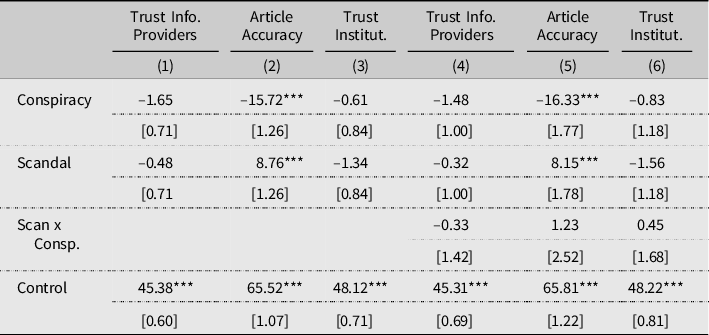
Table 1 summarizes the results. We find support for our theoretical proposition that exposure to unrelated CTs can distort the informational environment by reducing voters’ trust in information providers and the credibility of new information. In columns (1) and (2), we first estimate the results without interaction effects. The conspiracy treatment decreases trust in information providers by 1.7 percentage points. Footnote 9 This is a substantively meaningful shift. For example, Republican subjects are less likely to trust information providers by about 9.4 percentage points compared to Democrats. So, the effect of exposure to CTs is equivalent to about 17 percent of the difference between Republicans and Democrats on this outcome. Similarly, subjects with college education have significantly higher levels of trust in information providers by 2.8 percentage points; hence, the effect of exposure to conspiracies amounts to 60 percent of the gap between those with a college education and the less educated on the same outcome. Footnote 10
Treatment Effects on Attitudes toward the Informational Environment and Political Institutions

Notes: OLS estimations; coefficients reported. Number of observations is 2089. Standard errors are indicated in brackets. *** p < 0.01, ** p < 0.05, * p < 0.1.
Furthermore, exposure to CTs is associated with a 16 percent drop in the perceived accuracy of new information (i.e., the news article received after watching the video), which is equivalent to a 25 percent decrease from the baseline control condition. The interaction between the Conspiracy and Scandal treatments is statistically insignificant in columns (4) and (5), showing that these effects do not depend on whether subjects receive positive or negative information about politicians. The CT treatment decreases trust in political institutions by approximately 0.8 percentage points; however, the estimate is not statistically significant.
We do not find substantive results that CTs affect accountability: we fail to reject our null hypothesis that voters do not weigh CTs in their evaluation of the incumbent administration. Note that we do not claim that there is no effect of exposure to CTs on trust in political institutions or the evaluation of the incumbent administration. Given our data, we cannot arbitrate that statement. Footnote 11 Section 4 in the Appendix reports the estimated treatment effects of CTs on the evaluation of the incumbent’s administration.
In additional exploratory analyses reported in the Appendix, we provide evidence for the heterogeneity of treatment effects. Most notably, we find that the negative effects of exposure to CTs on trust in the informational environment, the perceived credibility of new information, and trust in political institutions are more concentrated among Democrats and racial minorities. Given the timing of our study during the Trump’s administration, this suggests that conspiracy theories might be more effective among groups that feel more politically alienated, in accordance with the existing literature (e.g., Goertzel Reference Goertzel1994; Uscinski and Parent Reference Uscinski and Parent2014)
Conclusion
Conspiracy theories permeate the information environment and often interact with positive and negative information affecting political actors. We provide experimental evidence that exposure to CTs creates distortions in the informational environment by reducing the credibility of new information and voters’ trust in democratic institutions such as information providers, regardless of the type of information that voters consume.
Our findings contribute to a recently growing literature seeking to explain the political consequences of exposure to conspiracy theories. While previous psychological studies find that individuals who are already prone to conspiratorial thinking are less likely to trust domestic institutions, we show that mere exposure matters, in line with recent experimental work (Einstein and Glick Reference Einstein and Glick2015; Kim and Cao Reference Kim and Cao2016).
We also demonstrate that CTs can affect attitudes toward domestic politics, even when the CT is entirely detached from the political entities evaluated and regardless of other features of the informational environment (whether other political information is positive or negative). In this sense, our treatment effects identify a lower bound of what we expect to be the effect of political CTs: narratives linked to the current government could arguably trigger a more prominent effect, being directly related to the events evaluated by voters. Analogously, it seems reasonable to conjecture that persistent exposure to CTs could have a far-reaching impact on political evaluations. We believe this is a promising area for future research.
Supplementary Material
To view supplementary material for this article, please visit https://doi.org/10.1017/XPS.2022.11
Data Availability Statement
The data, code, and any additional materials required to replicate all analyses in this article are available at the Journal of Experimental Political Science Dataverse within the Harvard Dataverse Network, at: doi: 10.7910/DVN/OSEXBV.
Acknowledgements
We are grateful to Alessandra Casella, Donald Green, Andrew Guess, Nikolay Marinov, Kai Ou, Brendan Nyhan, Robert Shapiro, Adam Zelizer and audience members at the 2019 MPSA Annual Meeting, 2020 SPSA Annual Meeting and 2020 Harvard Experimental Working Conference for their helpful comments. This research was funded by the Columbia Experimental Laboratory for the Social Sciences (CELSS).
Conflicts of Interest
The authors declare no conflicts of interest.
Ethics Statement
The experiment was approved by Columbia IRB, with protocol number IRB-AAAS3434. The research adheres to APSA’s Principles and Guidance for Human Subjects Research. Section 1 in the supplemental Appendix describes in detail the experimental procedures employed.