1. Introduction
Abundant red-bed facies, with evaporites, aeolian sands and evidence of ephemeral lakes, rivers and extreme seasonality, has led to a long-held prevailing view that the climate through much of the Triassic Period was predominantly arid or semi-arid at least across Europe and North America (Crowley, Reference Crowley and Klein1994; Lucas & Orchard, Reference Lucas and Orchard2013). In 1989 two of us (MJS, AR) collated evidence, from published sources as well as our own observations, for a significant increase in humidity during the early Julian to Tuvalian of the Carnian Age. The onset and cessation of this humid episode appeared to be broadly synchronous with significant biotic changes, both as extinctions and diversifications (Simms & Ruffell, Reference Simms and Ruffell1989, Reference Simms and Ruffell1990). Despite increased interest in palaeoclimate studies through the 1990s, this hypothesis was not immediately embraced by the geological community and aroused significant opposition in some quarters both in Europe (Visscher et al. Reference Visscher, Houte, Brugman and Poort1994) and North America (P. Olsen, pers. comm. 1995). However, the ensuing two decades has seen a growing body of evidence (summarized below) in support of our original hypothesis that the Carnian was significantly more humid than at other times during the Triassic Period.
2. Challenges to the humid episode theory
Following the publication of Simms & Ruffell (Reference Simms and Ruffell1989, Reference Simms and Ruffell1990), there have been more than 20 publications that have supported the hypothesis (the key 12 works are included in Table 1) and one publication, and a website, that have cast doubt on the theory. The key works that were negative, positive or modified the theory are summarized in Table 1. However, some of the publications misinterpret what Simms & Ruffell (Reference Simms and Ruffell1989) suggested this episode to be and, furthermore, the two more critical works include information that supports our hypothesis. The desire on our part to clarify some issues drove us to write this review article. Visscher et al. (Reference Visscher, Houte, Brugman and Poort1994) rather provocatively entitled their paper ‘Rejection of a Carnian (Late Triassic) “pluvial event” in Europe’. Significantly they substituted the word ‘event’ in place of ‘episode’, as was used in Simms & Ruffell (Reference Simms and Ruffell1989) or ‘phase’, as in Simms & Ruffell (Reference Simms and Ruffell1990). In summary, Visscher et al. (Reference Visscher, Houte, Brugman and Poort1994) suggested that a widespread inundation was not necessary in order to explain the features of the upper Triassic sandstone successions in northern Europe that were key evidence in the hypothesis. Instead, they suggested these humid-climate deposits could be local to the river systems and a consequence of isolated, elevated water tables. On closer examination of the evidence for this humid episode (see Ruffell, Reference Ruffell1991), namely a network of fluvial channels prograding onto the late Triassic ‘Keuper’ or ‘Mercia’ landscape, there is little difference in the two hypotheses. The main divergence of opinion would be that Visscher et al. (Reference Visscher, Houte, Brugman and Poort1994) perceived a River Nile situation, where a major river has penetrated an arid landscape, but without forcing a widespread change to a humid climate. Conversely, we envisaged a more extensive development of discrete river systems in numerous separate basins, much as was later developed more eloquently by Shukla, Bachmann & Singh (Reference Shukla, Bachmann and Singh2010) for the same stratigraphic unit, the Schilfsandstein (syn. = Stuttgart Formation) and its regional equivalents, that were discussed by both Visscher et al. (Reference Visscher, Houte, Brugman and Poort1994) and us (Simms & Ruffell, Reference Simms and Ruffell1989, Reference Simms and Ruffell1990). In summary, the evidence for an increase in the volumes of water flowing through previously arid areas (especially of the northern European, or Germanic basins) was not in dispute between Visscher et al. (Reference Visscher, Houte, Brugman and Poort1994) and Simms & Ruffell (Reference Simms and Ruffell1989), but the effect on local climate was, which is one reason we will review the evidence that has come forward subsequently. A second result of the work of Visscher et al. (Reference Visscher, Houte, Brugman and Poort1994) was their introduction of the word ‘event’ to describe the hypothesis, which has a bearing on subsequent criticism of the theory by Kozur & Bachmann (Reference Kozur and Bachman2010) and by Paul Olsen (pers. comm. 1995). The latter is summarized well in a scientific website article by Alan Kazlev (http://palaeos.com/authors/MAK.html), wherein the contradictory evidence of Carnian humid-indicator fluvial sandstones and coals being deposited at the same time as arid-indicator evaporites is examined. Kazlev provides an excellent summary of how Olsen reconciles this by observing that the main evidence for the Carnian Pluvial Event, as termed by Visscher et al. (Reference Visscher, Houte, Brugman and Poort1994), comes from E–W-aligned deposits in the equatorial Tethyan Rift that would have developed diachronously and/or with coeval evaporitic and fluvial basins along its breadth. This too has only minor disagreement with Simms & Ruffell (Reference Simms and Ruffell1989) who comment (p. 267) on the coincidence of depositional evidence with the palaeo-Triassic equator, and how the rifting and break-up of Pangaea could have played a part in generating the Carnian Pluvial Episode (as they termed it). The main difference between our view and Olsen's is that he could not reconcile his rift-related origin for an ‘event’ and we suggested the humid episode could be more widespread than the Tethyan Rift. On the former, we never suggested this was an event as Visscher et al. (Reference Visscher, Houte, Brugman and Poort1994) envisaged it. Our hypothesis sits comfortably with diachroneity in deposition along the graben and basins of the rift as Olsen sees them. On the latter, whatever generated the Carnian Humid Episode, it did have a more widespread effect than we envisaged, as described here, making it a significant period of Earth history, but one still with an enigmatic origin. The different views of the three sets of authors (Simms & Ruffell; Visscher et al.; Olsen) can be resolved by examination of Dal Corso et al. (Reference Dal Corso, Mietto, Newton, Pancost, Preto, Roghi and Wignall2012: examined in detail in Section 4.d below) and by examination of our Table 1. These latter authors demonstrated how the indicators of humid palaeoclimates began deposition during what they termed ‘a major negative δ13C spike in the Carnian’. It appears then that the humid episode lasted for most of the Carnian Age, but began with a shorter-lived isotope excursion that could be considered an event (an abrupt change), followed by a longer-lived episode of humid climates (probably a few million years after the 237 Ma base of the Carnian, to somewhere into the Tuvalian, post 230 Ma). To clarify, we follow Dal Corso et al. (Reference Dal Corso, Mietto, Newton, Pancost, Preto, Roghi and Wignall2012) in terming the negative carbon isotope excursion the Carnian (Carbon) Isotope Excursion (CCIE), which best approximates an ‘event’ as in event stratigraphy, as opposed to the bulk of the Carnian, which we term the Carnian Humid Episode. The two must no longer be confused in the literature.
Key publications that supported, did not support or modified the original Carnian Pluvial Episode of Simms & Ruffell (Reference Simms and Ruffell1989)

3. Support for the humid episode theory
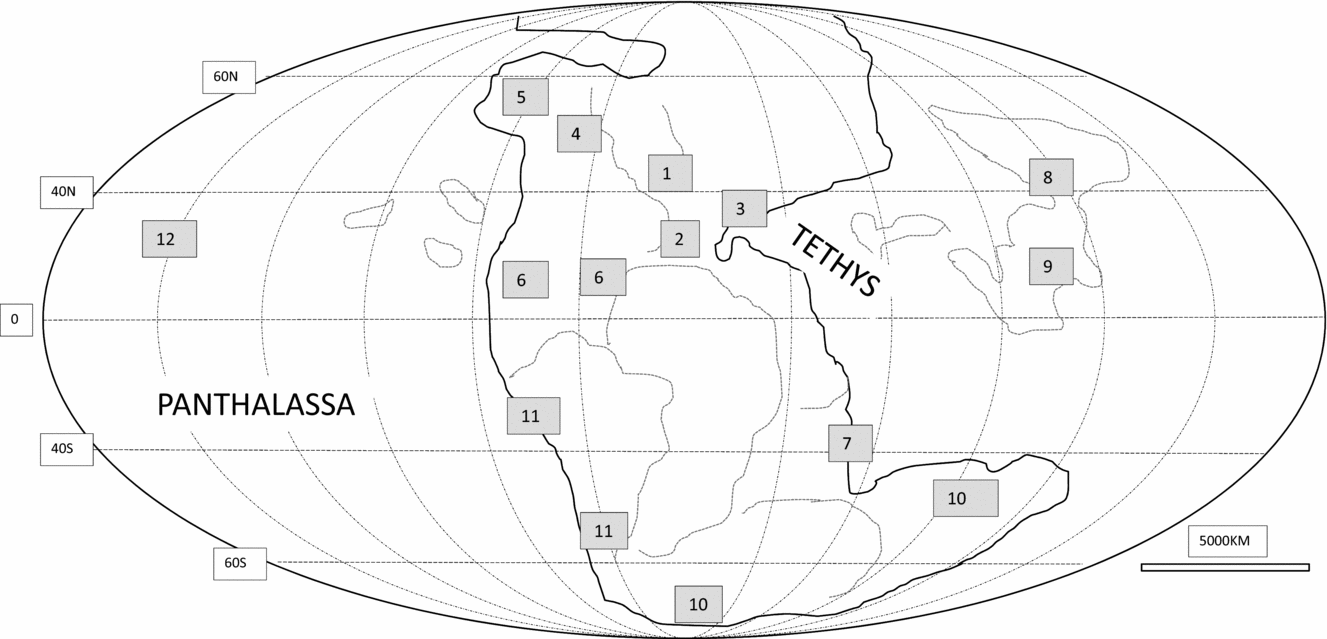
A major consideration in evaluating what the Carnian Humid Episode was is the assessment of the palaeogeographic extent of the evidence for such a climate change. Such evidence encompasses lithofacies changes, for instance from evaporitic playas to fluvial sandstones, or from reef limestones to shales; mineral and/or element abundances; isotopes; and weathering features such as palaeosols and palaeokarst. One of the strengths of our original evidence was in its diverse sources, while the evidence for synchroneity with the biotic changes came from the independence of the climatic and biotic palaeorecords. Thus, a broad geographic spread (Fig. 1) of publications is included here in this review in order to facilitate discussion of the origin of the Carnian changes. These are also all post-1994, the last year in which Simms, Ruffell & Johnson (Reference Simms, Ruffell, Johnson, Fraser and Sues1994) and Visscher et al. (Reference Visscher, Houte, Brugman and Poort1994) published on the matter.
Global distribution of the main data sources used in this review that show evidence for humidity in the Carnian Age (or early late Triassic time in some poorly dated locations). The palaeogeographic map of Golonka (Reference Golonka2007) is used as a template. Solid black denotes the continental shelf of Pangaea; grey lines denote supposed island masses (both continental and volcanic arc) and the shape of the continents following Mesozoic break-up and sea floor spreading. 1 – Austria, Dolomites, Hungary, Slovenia, Sicily, Spain (Dal Corso et al. Reference Dal Corso, Mietto, Newton, Pancost, Preto, Roghi and Wignall2012; Furin et al. Reference Furin, Preto, Rigo, Gianolla, Crowley and Bowring2006; Haas et al. Reference Haas, Budai, Gyoori and Kele2014; Kolar-Jurkovsek & Jurkovsek, Reference Kolar-Jurkovsek and Jurkovsek2010; Pott, Krings & Kerp, Reference Pott, Krings and Kerp2008; Rostasi, Rausick & Varga, Reference Rostasi, Raucsik and Varga2011); 2 – Iberia (Arche & Lopez-Gomez, Reference Arche and Lopez-Gomez2014); 3 – Israel (Magaritz & Druckman, Reference Magaritz and Druckman1984); 4 – North Sea, Germany, UK (Kozur & Bachmann, Reference Kozur and Bachman2010; McKie, Reference McKie, Martinius, Ravn, Howell, Steel and Wonham2014; Shukla, Bachmann & Singh, Reference Shukla, Bachmann and Singh2010; Porter & Gallois, Reference Porter and Gallois2008); 5 – Svalbard (Xu et al. Reference Xu, Hannah, Stein, Mark, Vigran, Bingen, Sschutt and Lundschein2014); 6 – Eastern North America (Arche & Lopez-Gomez, Reference Arche and Lopez-Gomez2014), Utah (Prochnow et al. Reference Prochnow, Nordt, Atchley and Hudec2006); 7 – Indian Himalayas (Hornung, Krystyn & Brandner, Reference Hornung, Krystyn and Brandner2007); 8 – China (Lehrmann et al. Reference Lehrmann, Enos, Payne, Montgomery, Wei, Yu, Xiao and Orchard2005); 9 – Indonesia (Martini et al. Reference Martini, Zaninetti, Lathuillière, Cirilli, Cornée and Villeneuve2004); 10 – Australia (McLoughlin et al. Reference McLoughlin, Lindstrom and Drinnan1997); 10 – Antarctica (Retallack & Alonzo-Zarza, Reference Retallack and Alonso-Zarza1998; Retallack, Veevers & Morante, Reference Retallack, Veevers and Morante1996); 11 – Argentina (Tabor et al. Reference Tabor, Montanez, Kelso, Currie, Shipman, Colombi, Alonso-Zarza and Tanner2006), Chile (Nielsen, Reference Nielsen2005); 12 – Japan (Nakada et al. Reference Nakada, Ogawa, Suzuki, Takahashi and Takahashi2014).

Our review examines the primary question – where is the evidence for this episode of Triassic climate change or, indeed, are there locations where no evidence exists? Owing to the existence, or non-existence, of published data on the Triassic Period of the world we have split this review into broad, and somewhat arbitrary, locations (Fig. 1), which we use as a numbered sequence for descriptions and comment (sections 4–15 below). Two observations have been fundamental in the development of the Carnian Humid Episode theory. First, in the NW European (Germanic) basins (see Section 7 below), red-bed and evaporite deposition was interrupted by Carnian sandstones and blue/grey/green mudstones; secondly, throughout the Tethys Ocean, carbonate deposition ceased and Carnian siliciclastic sediments formed, after which carbonate platforms were re-established. Thus, in some ways, pre-Carnian Humid Episode conditions returned in Ladinian time, but with a different biota in place. By substituting ‘event’ for ‘episode’, Visscher et al. (Reference Visscher, Houte, Brugman and Poort1994) set in train two courses of action that have had consequences for the theory. The first was negative, in that Olsen (pers. comm. 1995) and Kozur & Bachman (Reference Kozur and Bachman2010) were led to believe that Simms & Ruffell (Reference Simms and Ruffell1989, Reference Simms and Ruffell1990) were talking about a geological phenomena in the event stratigraphy sense (http://www.inqua-saccom.org/stratigraphic-guide/event-stratigraphy/), and they could not reconcile what they saw in the diachronous deposition of some deposits and simultaneous laying down of salts and sands in other locations along the Tethyan Rift. The second effect was that Visscher et al. (Reference Visscher, Houte, Brugman and Poort1994) actually coined a far more appealing phrase for the humid episode than Simms & Ruffell (Reference Simms and Ruffell1989) did, causing it to be used in most of the works cited above, and often incorrectly quoted as being the correct term. It may seem trivial to concern ourselves with the change of one word, but when one examines the effect this has had on how this theory was subsequently viewed, this is no minor matter as a conception was created of an event rather than a more prolonged episode of humidity, when we consider that both may have occurred.
4. Alpine Fold Mountain Belt or Western Neotethys (Austria, Hungary, Slovenia, Italy north and south and adjacent areas (Spain, Iberia))
It seems logical to begin this global review of publications in those locations where the first post-1994 evidence for support, or otherwise, for the Carnian Humid Episode was found.
4.a. Austria
Pott, Krings & Kerp (Reference Pott, Krings and Kerp2008) studied fossil plants, mainly gymnosperms, from a well-dated Triassic succession near Lunz, west of Vienna, in Austria. They examined plant morphology, stoma and cuticle from the plant-rich shale and associated coal of the Carnian Lunzer Sandstein, from which they concluded that, although the plants could tolerate drought, the shales and coals had been deposited under humid conditions during a sea-level lowstand. Their work did not specifically mention Carnian humidity or event, yet it provides strong supporting evidence. Roghi et al. (Reference Roghi, Gianolla, Minarelli, Pilati and Preto2010) studied the upper Triassic Raibler Schichten of the same Lunz area but were more explicit in their aim of investigating the palaeoclimate of the Carnian Age. They also highlighted the early work of Schlager & Schöllnberger (Reference Schlager and Schollnberger1974) who had previously identified a ‘Reingrabener Wende’, or Reingraben event/turnover in the Northern Calcareous Alps of Austria and Germany. Roghi et al. (Reference Roghi, Gianolla, Minarelli, Pilati and Preto2010) identified this as a distinct event but incorrectly ascribed the concept, and name (‘event’), to Simms & Ruffell (Reference Simms and Ruffell1989) when in fact it had been Visscher et al. (Reference Visscher, Houte, Brugman and Poort1994) who used the term. Like Pott, Krings & Kerp (Reference Pott, Krings and Kerp2008), Roghi et al. (Reference Roghi, Gianolla, Minarelli, Pilati and Preto2010) based their interpretations primarily on the evidence from fossil plants, but used palynology instead of macrofossils. They provided a correlation between the Raibler Schichten of the Northern Calcareous Alps and the Lunz succession, and thence on to the Julian Alps and Dolomites of Italy, thereby demonstrating the widespread extent of the clastic input to the late Triassic carbonate systems that prevailed before and returned afterwards. Their pollen data provided information on the plant types of the time, with hygrophytes dominant and some rare xerophytes. They identified four episodes of siliciclastic input and indicated that they may represent four humid phases in the Julian Alps and Dolomites. This evidence led Roghi et al. (Reference Roghi, Gianolla, Minarelli, Pilati and Preto2010) to consider a widespread episode of humid climates in the Carnian Age that they correlated with similar successions in the Germanic basins (northern Europe, see Section 7 below); Barents Sea and Svalbard (also see Section 8 below); northern Iraq, Tunisia, Israel (for the latter, see Section 6 below) and Iran.
4.b. Hungary
Two papers summarize the evidence from Hungary. In the first, Rostasi, Rausick & Varga (Reference Rostasi, Raucsik and Varga2011) provided a background that is similar to that of Roghi et al. (Reference Roghi, Gianolla, Minarelli, Pilati and Preto2010), summarizing the widespread nature of Carnian humidity. The authors went further, however, in considering whether this palaeoclimate change was due to uplift in the margins of the Palaeotethys, as Pangaea coalesced and then broke up (Dubiel et al. Reference Dubiel, Parrish, Parrish and Good1991), or instead was due to a large igneous province such as Wrangellia (Furin et al. Reference Furin, Preto, Rigo, Gianolla, Crowley and Bowring2006; Greene, Scoates & Weis, Reference Greene, Scoates and Weis2008). Rostasi, Rausick & Varga (Reference Rostasi, Raucsik and Varga2011) used clay mineral analysis in order to understand the nature of sediment input during an episode of clastic, mainly shale, deposition during the upper Triassic carbonate-dominated successions of the Hungarian Transdanubian Range. The inputs of illite–smectite, smectite and variable kaolinite observed, especially in the Menschely Marl Member, were taken by Rostasi Rausick & Varga (Reference Rostasi, Raucsik and Varga2011) as evidence for more humid hinterland climates during Carnian time in this part of Hungary. They explained lateral variations in clay mineralogy as a consequence of the complex palaeogeography of the time, including rift and graben systems that were intermittently active through changing palaeoclimatic conditions, much as Olsen (pers. comm. 1995) and Ruffell & Shelton (Reference Ruffell and Shelton1999) envisaged for the North Atlantic successions. In the second key paper, Haas et al. (Reference Haas, Budai, Gyoori and Kele2014) used samples from the Balatoneederics Bet-1 borehole with a consideration of a similar succession of the Transdanubian Range that Rostasi, Rausick & Varga (Reference Rostasi, Raucsik and Varga2011) analysed. Haas et al. (Reference Haas, Budai, Gyoori and Kele2014) considered the shallow groundwater conditions necessary for early dolomite formation, and concluded that the diagenetic conditions necessary were caused by increased freshwater inputs in Carnian time. Haas et al. (Reference Haas, Budai, Gyoori and Kele2014) compared this interpretation to clay mineral contents, which like Roghi et al. (Reference Roghi, Gianolla, Minarelli, Pilati and Preto2010) showed a change from arid-indicator illites to semi-humid smectites through much of the Julian Substage (Carnian). Both Hungarian works confirmed the presence of humid climates in the Carnian hinterland throughout much of Europe – the Germanic Basin, Mecsek Mountains of southern Hungary, Northern Alps, Transdanubian Range and Dolomites – as well as a similar, earlier (poorly dated, but early Triassic) ‘Campil Event’. Fijałkowska-Mader (Reference Fijałkowska-Mader1999) described analogous successions from Poland, with good palynological records of palaeoclimate change: further work on the clay mineralogy and stable isotope stratigraphy of these successions will yield interesting results for the Carnian climate story.
4.c. Slovenia
In Slovenia, Kolar-Jurkovsek & Jurkovsek (Reference Kolar-Jurkovsek and Jurkovsek2010) identified three shale and silt-dominated intervals as a ‘Carnian clastic interval’, equivalent to the Raibl Beds (below the Hauptdolomit) of the Southern Alps (see the descriptions from Roghi et al. Reference Roghi, Gianolla, Minarelli, Pilati and Preto2010 in Section 4.a above, who recognized four such intervals in Austria). They ascribed the term ‘Carnian Pluvial Event’ to Hornung, Krystyn & Brandner (Reference Hornung, Krystyn and Brandner2007). Unlike some other publications reviewed here, which used palynology or sporomorphs, their approach was to use conodonts to elucidate whether the age of this episode can be resolved in Slovenia. No new evidence of palaeoclimatic conditions was presented, although the mere presence of this siliciclastic interval, dated to within the Carnian Age, is taken by these authors to be evidence of humid climates in this area.
4.d. Italy
Triassic successions in northern Italy formed much of the original evidence for a Carnian humid episode and, while many subsequent papers have confirmed this, two papers stand out in contrast. The first, by Roghi (Reference Roghi2004) on the succession at Cave del Predi in the Julian Alps, was published ten years after the controversy concerning whether this was an ‘event’ as interpreted by Visscher et al. (Reference Visscher, Houte, Brugman and Poort1994) or a longer-lasting and possibly diachronous ‘episode’ as originally argued by Simms & Ruffell (Reference Simms and Ruffell1989, Reference Simms and Ruffell1990). Roghi (Reference Roghi2004) incorrectly stated that Simms & Ruffell ‘suppose a Carnian “pluvial event” briefly interrupting the prevalent arid climate of the late Triassic’. Roghi used palynomorphs as the basis for analysis. This confirmed a more or less complete Carnian succession at the Cave de Predi, with a major change at the Julian–Tuvalian Boundary, thus defining the age of the evolution to humid hinterland climates in this area of northern Italy. Roghi (Reference Roghi2004) also commented on the presence of humid-indicator materials in the putative Carnian of Nova Scotia, the Colorado Plateau (see Section 9.b below), China, Bear Island in Norway, and the North Sea and showed the widespread nature of the humid episode.
The second paper we highlight here, also based on the northern Italian successions, forms a complete contrast. Dal Corso et al. (Reference Dal Corso, Mietto, Newton, Pancost, Preto, Roghi and Wignall2012) sampled two of the well-dated upper Triassic successions of the Dolomites, specifically the Carnian type section at Stuores Wiesen and Milieres-Dibona, for stable isotope (δ13C) analysis. The δ13C record shows a positive trend towards heavier carbon through Carnian time, punctuated by a negative shift, towards lighter carbon, in middle Julian time (see Dal Corso et al.'s fig. 2 for details). This coincides with parts of the stratigraphy where no fossil wood was recorded, followed by an influx of wood where the authors place the start of their Carnian Pluvial Event. This, they conclude, coincides with the onset of eruptions in the Wrangellia Large Igneous Province or LIP of the northern Pacific and offshore Alaska, which could have injected CO2 and other gases into the atmosphere. This would have caused both acidification of the oceans and warming, thereby increasing weathering and runoff and exerting a major influence on carbonate reef platforms and the carbonate compensation depth (CCD) (as recorded by Rigo et al. Reference Rigo, Preto, Roghi, Tateo and Mietto2007).
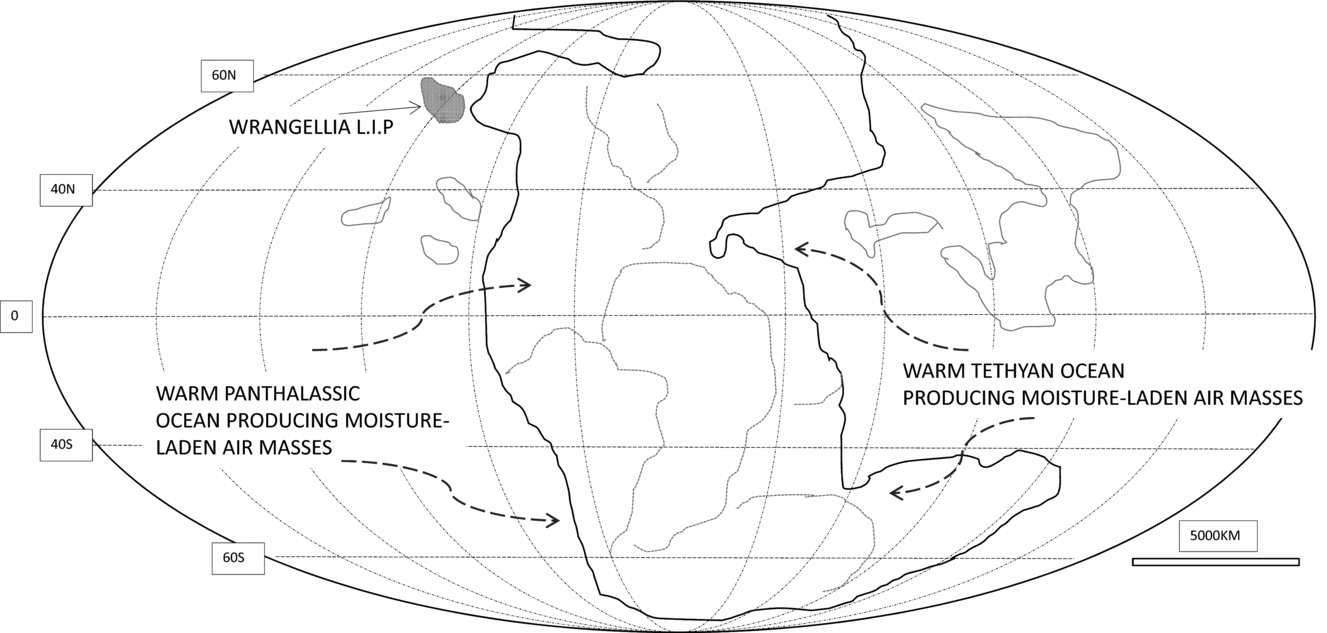
A model of how warming of the Carnian oceans may have increased precipitation in many (but possibly not all) of the areas studied. Palaeogeography redrawn after Golonka (Reference Golonka2007) and possible climate scenarios after McKie (Reference McKie, Martinius, Ravn, Howell, Steel and Wonham2014).

Furin et al. (Reference Furin, Preto, Rigo, Gianolla, Crowley and Bowring2006) made a similar comparison between the rise of Carnian humidity and the Wrangellia LIP. The latter authors, working in the Lagonegro Basin of the southern Apennines, showed the absence of limestones through the Julian–Tuvalian Boundary, which they interpreted as a rise in the CCD. The significance of their work is that this absence of carbonates is here recorded in a deep-water setting, thus expanding the extent of the event environmentally, if not geographically. Rigo et al. (Reference Rigo, Preto, Roghi, Tateo and Mietto2007) stated that the Carnian input of green clays, which are more organic-rich than the clays and silts above and below, is unprecedented in the successions. This change could be ascribed solely to increased terrigenous input, although this would have to contain significant terrestrial organic matter as well. Rigo et al. (Reference Rigo, Preto, Roghi, Tateo and Mietto2007) anticipated the work of Dal Corso et al. (Reference Dal Corso, Mietto, Newton, Pancost, Preto, Roghi and Wignall2012) in conjecturing that increased CO2 could be responsible for the Carnian climate change.
5. Spain and Portugal – the Iberian Peninsula
The main work concerning this area is by Arche & Lopez-Gomez (Reference Arche and Lopez-Gomez2014), who undertook detailed analysis of the Carnian Manuel Formation of the southern regions of Spain and Portugal. Like Hornung, Krystyn & Brandner (Reference Hornung, Krystyn and Brandner2007) on the Himalayas and Nakada et al. (Reference Nakada, Ogawa, Suzuki, Takahashi and Takahashi2014) on Japan, Arche & Lopez-Gomez (Reference Arche and Lopez-Gomez2014) were critical in their global assessment of Carnian palaeoenvironmental events. This was owing primarily to the palaeogeographic location of Iberia in Triassic time, as the deposits here provide something of the missing link between the deposits in eastern North America and both northern (‘Germanic’) and central (‘Tethyan’) successions. The remarkable aspect of the Manuel Formation is the coarse nature of the clastic deposits compared with the generally finer clastic deposits found in the Tethyan or Germanic Carnian. These conglomerates are found between evaporite-dominated successions above and below, broadly comparable with the clays and salts of the Germanic successions and the limestones of the Tethyan sequences. As such the Carnian Manuel Formation is a high-sediment-load deposit. Arche & Lopez-Gomez (Reference Arche and Lopez-Gomez2014, p. 196) were correct in their assessment that we assumed a Carnian wet episode, but they then introduced the term ‘Middle Carnian Pluvial Event’ in parentheses, although unascribed to any specific authors. The middle Carnian is used informally by Arche & Lopez-Gomez (Reference Arche and Lopez-Gomez2014), when either Carnian (in poorly dated successions) or Julian (plus any biozone identified) is preferred, where the succession is better dated.
Arche & Lopez-Gomez (Reference Arche and Lopez-Gomez2014) used the superb evidence of the Manuel Formation, which they date convincingly as Carnian, to compare to many of the successions considered here in Europe and, most critically, north African successions in Morocco, Algeria and Tunisia and further south into the Sahara. How much further south in central Africa this evidence can be traced becomes difficult as the next known Carnian successions that can be used to develop the story are in Kenya, Mozambique and South Africa. Arche & Lopez-Gomez (Reference Arche and Lopez-Gomez2014) provided very useful summaries of the marine deposits of Western Neotethys (Italy, Hungary, Austria, see Section 4 above) as well as eastern North America. Two aspects stand out from their work as critical for our discussion. First, some papers (e.g. Dal Corso et al. Reference Dal Corso, Mietto, Newton, Pancost, Preto, Roghi and Wignall2012) have linked the Carnian episode to volcanic activity, specifically the Wrangellia LIP (offshore Alaska): Arche & Lopez-Gomez (Reference Arche and Lopez-Gomez2014) showed evidence of Carnian volcanic rocks within and close to the area of Manuel Formation deposition and are one of the few papers to show this direct comparison. Secondly, they described in detail their interpretation of the depositional conditions of the Manuel Formation, specifically ‘a series of fluvial networks disposed in a radial pattern . . . as a laterally continuous apron, at the subsiding rifted margins of the Iberian Massif’ (p. 21). This interpretation, together with the lithostratigraphical context of coarse clastic sediments sandwiched between evaporites, makes interpretation of the Manuel Formation critical to the debate between our original concept of a widespread humid phase and Visscher et al.'s (Reference Visscher, Houte, Brugman and Poort1994) ‘Nile valleys in a Carnian Sahara’ as quoted by Arche & Lopez-Gomez, Reference Arche and Lopez-Gomez2014, p. 196). A final observation in this work is intriguing: the authors comment that in some locations, evidence for humid-related Carnian deposits is absent (e.g. the Aquitaine Basin), a phenomenon we have also encountered in examining the South African and Antarctic successions.
6. Israel
In comparison with the Alpine foldbelt, the Triassic of Israel has limited outcrop but is significant for two reasons. Firstly, this was the first location where a significant negative δ13C excursion was recorded (Druckman, Hirsch & Weissbrod, Reference Druckman, Hirsch and Weissbrod1982; Magaritz & Druckman, Reference Magaritz and Druckman1984) and related to the Carnian episode (Simms & Ruffell, Reference Simms and Ruffell1989). Subsequently Bialik, Korngreen & Benjamini (Reference Bialik, Korngreen and Benjamini2013) have related the Triassic stratigraphy of the Makhtesh region of Israel to the Carnian humid interval on the basis both of this isotope excursion and the changing facies patterns of carbonates and evaporites. The second reason that the Israeli successions are important is that palaeogeographic reconstructions suggest the area would have been on the margins of Pangaea, with the Tethys Ocean to the east. This is significant because, should the Carnian Humid Episode be a tectonically driven event related to the mid-Atlantic Rift and Alpine belts, a record of increased humidity on the far-distant eastern margin of Pangaea would be anomalous and require alternative explanation (see Hornung, Krystyn & Brandner, Reference Hornung, Krystyn and Brandner2007, Section 10 below). Major changes in early–middle Triassic pollen are recorded in the subsurface of NE Libya (Brugman & Visscher, Reference Brugman, Visscher, El-Arnauti, Owens and Thusu1988) as well as other circum-Mediterranean locations (Buratti & Cirilli, Reference Buratti and Cirilli2007).
7. Germanic basins (northern Germany, Paris Basin, southern England)
Although much of the initial evidence for the Carnian Humid Episode came from the Italian successions, the upper Triassic non-marine record in northern Europe was equally important in development of the theory. In exploiting the idea of a humid climate phase within the otherwise mainly arid late Triassic period, Simms & Ruffell (Reference Simms and Ruffell1990) cited Wurster's (Reference Wurster1964) seminal work on the sedimentology of the Schilfsandstein of the German non-Alpine Triassic. However, Angermeier, Poschil & Schneider (Reference Angermeier, Poschil and Schneider1963) had previously made a connection between the pale sandstones and green mudstones of the Schilfsandstein (within the evaporite- and red-bed dominated Keuper Marl) and a major change in palaeoenvironments. Unlike the Italian, Austrian, Hungarian and contiguous deposits that have been the focus of significant subsequent work, relatively little work specific to palaeoclimate reconstructions has occurred in the Germanic, and related, non-marine basins, with Kozur & Bachmann (Reference Kozur and Bachman2010), McKie (Reference McKie, Martinius, Ravn, Howell, Steel and Wonham2014) and Shukla, Bachmann & Singh (Reference Shukla, Bachmann and Singh2010) being the exceptions. By ‘Germanic’ we imply that some or the entire classic three-fold Triassic lithostratigraphy – Bunter, Muschelkalk and Keuper stratigraphy – can be applied to the area under study. Some papers have improved our knowledge of the already known Carnian sandstones, the Schilfsandstein and its equivalents, such as Peron et al. (Reference Peron, Bourquin, Fluteau and Guillocheau2005) on the Chaunoy Sandstones of the Paris Basin, and the equivalent Gres a Roseaux (Goggin & Jacquin, Reference Goggin, Jacquin, de Graciansky, Hardenbol, Jacquin and Vail1998), and Porter & Gallois (Reference Porter and Gallois2008) on the UK Keuper-equivalent Mercia Mudstone Formation sandstones. These confirm previous records of a change in depositional conditions from arid-dominated to a greater influence of fluvial deposition. Three publications in particular are significant to the Carnian climate story from the Germanic basins. First, Shukla, Bachmann & Singh, (Reference Shukla, Bachmann and Singh2010) carried out facies and sandbody geometric analysis of the Stuttgart Formation (Schilfsandstein) and compared their observations with the modern Ganga Plain of the Ganges. Their descriptions are remarkably similar to those of correlative Carnian sandstones in the Paris Basin and southern UK. The analogy with the Ganges, if correct, suggests that significant volumes of water were carried by the Schilfsandstein fluvial system. This, however, is still not at odds with the original objection of Visscher et al. (Reference Visscher, Houte, Brugman and Poort1994) to the Carnian Pluvial Episode, which suggested that such a large river system could flow through an essentially arid landscape (the Nile analogue). What is significant for our argument is that this river system appeared at, and existed during, a specific interval. The second major contribution from the Germanic successions to discussions concerning the Carnian palaeoclimate is the comprehensive synthesis of Kozur & Bachmann (Reference Kozur and Bachman2010). This encompasses all of the evidence for the humid episode, both from the Germanic series and adjacent areas, and also spells out much of the terminology for the same episode – Northern Alpine Raibl Event (Angermeier, Poschil & Schneider, Reference Angermeier, Poschil and Schneider1963); ‘middle Carnian wet interval’ (Kozur, Reference Kozur1972, Reference Kozur1975); Reingraben turning point/Riengraben Event (Schlager & Schollnberger, Reference Schlager and Schollnberger1974); Carnian Pluvial Episode (correctly cited – Simms & Ruffell, Reference Simms and Ruffell1989), Carnian Crisis (Hornung, Krystyn & Brandner, Reference Hornung, Krystyn and Brandner2007) and ‘Middle Carnian Wet Intermezzo’ (Kozur & Bachmann (Reference Kozur and Bachman2010). The use of middle Carnian is not strictly accurate, Julian being preferred (Dal Corso et al. Reference Dal Corso, Mietto, Newton, Pancost, Preto, Roghi and Wignall2012). The earlier naming of this siliciclastic influx to a carbonate system, demonstrates that the dramatic intercalation of grey mudstones, siltstones and plant fossil-bearing sandstones in the predominantly red mudstones of the Keuper has long been recognized as something other than an isolated event. Kozur & Bachmann (Reference Kozur and Bachman2010) go on to make an interesting point: ‘Ever since the careful studies by Hornung (Reference Hornung2008) in the Northern Alps and other parts of the Tethys (summarized in Hornung, Reference Hornung2008), it generally has been accepted that there was a real Carnian Wet “Intermezzo” in the sense of Kozur & Bachmann (Reference Kozur and Bachman2010) in the Germanic Basin and in the adjacent northwestern Tethys region and not just a strong influx of outside fresh water into an otherwise arid region. But often a pluvial event is automatically assumed, even though this cannot be demonstrated anywhere within the Germanic Basin or in the adjacent northwestern Tethys region’. This apparently contradictory statement is predicated on the use of yet another name to describe Carnian humidity – here ‘intermezzo’, or a musical term meaning a short movement, often inserted in a longer piece of music. The Carnian episode as seen here, could be considered an intermezzo for the Germanic basins, should its duration be accurately determined. We consider that Kozur & Bachmann (Reference Kozur and Bachman2010) are stating that the ‘event’ (a rapid, more or less geologically instant) part of the Carnian episode cannot be demonstrated in the Germanic successions: below we show how the rise in humidity may well have begun (geologically) quickly, but led to a prolonged period of humid climates. The third work we wish to highlight on the Germanic successions is that of McKie (Reference McKie, Martinius, Ravn, Howell, Steel and Wonham2014), who presented a comprehensive examination of the Triassic of the North Sea. McKie's (Reference McKie, Martinius, Ravn, Howell, Steel and Wonham2014) figures 18, 19 and 21 show four wet climate phases (Olekenian; late Ladinian; early Carnian; and Rhaetian): the Carnian and Rhaetian are associated with warmer temperatures (from oxygen isotopes), and only the Carnian is associated with volcanic rocks (in the Alpine successions in McKie, but also known from Iberia, see Arche & Lopez-Gomez, Reference Arche and Lopez-Gomez2014). McKie (Reference McKie, Martinius, Ravn, Howell, Steel and Wonham2014) showed the effect the development of the Ladinian and Carnian fluvial systems had on the palaeogeography of the North Sea Basin, and ascribes this to an increase in the summer monsoon from Tethys and a southern migration of the northern (higher) latitudinal precipitation.
Comparing Dal Corso et al.'s (Reference Dal Corso, Mietto, Newton, Pancost, Preto, Roghi and Wignall2012) record of a carbon isotope spike to the sedimentary record of the Germanic basins, we see that in the carbonate successions, the humid interval lasted for some millions of years, but started, coincidentally with a quite sudden event. Examining the sedimentary log of Ruffell & Warrington (Reference Ruffell and Warrington1988), we see that the Carnian influx of sands and muds began with an erosional event, marked by rip-up clasts and a vertebrate-bone conglomerate, suggestive of a rapid erosional change. Thus, the sudden start to the Carnian humid phase may be reconcilable in both the clastic Germanic and carbonate Tethyan successions as starting abruptly, but lasting for some time as an episode of humid climates.
8. Svalbard (Norwegian North Sea)
The work of Xu et al. (Reference Xu, Hannah, Stein, Mark, Vigran, Bingen, Sschutt and Lundschein2014) is highlighted in this review since it provides an accurately dated record of pre- and post-Carnian events from a Boreal marine succession, unlike all the other articles considered here. This succession would have been located well north of any influence from circum-equatorial events or Pangaean rifting. Xu et al. (Reference Xu, Hannah, Stein, Mark, Vigran, Bingen, Sschutt and Lundschein2014) based their analyses on Re–Os geochemical ages and 187Os/188Os ratios. The osmium ratios show late Carnian excursions that Xu et al. (Reference Xu, Hannah, Stein, Mark, Vigran, Bingen, Sschutt and Lundschein2014) compared to the strontium isotope (seawater) curve. They concluded that the Wrangellian LIP episode is of the same age, and would have had the required effect on ocean chemistry, to be a prime candidate for the cause of the Carnian climatic events.
9. North America – western United States
9.a. Eastern seaboard
The eastern seaboard of North America has historical analogues to how the Germanic basins played a role in the development of the Carnian Humid Episode theory. These locations extend from the New York / New Jersey, Connecticut palaeovalley successions, to the critical Milankovitch-calibrated successions of the Newark Rift Basin (Olsen & Kent, Reference Olsen and Kent1999) and the basins of New Brunswick. Many show evidence of major changes in Carnian time, although generally neither as dramatic as the ‘intermezzo’ of the Germanic successions nor as well dated as the type Italian sections. However, as Olsen (Reference Olsen1980) pointed out, determining the cause of this rise in palaeohumidity will not be determined by examining the circum-Atlantic successions, since they were dominated by the same equatorial climate and Pangaean break-up mechanisms. An excellent summary of the eastern seaboard basins is provided by Arche & Lopez-Gomez (Reference Arche and Lopez-Gomez2014, see Section 5 above), who stress the palaeogeographic connections between the basins around the Bay of Fundy and those in Morocco, thereby reinforcing the fact that, although now separated by the Atlantic, these basins were adjacent from a palaeoclimatic perspective and thus provide only confirmatory local evidence of changing humidity. The Stockton Formation (Chatham Group) provides important evidence for the Carnian Humid Episode (Arche & Lopez-Gomez, Reference Arche and Lopez-Gomez2014), as it comprises a braided fluvial and lacustrine set of environments (Olsen et al. Reference Olsen, Kent, Cornet, Witte and Schlisse1996), with minimal aeolian influence on deposition. Further south on the United States eastern seaboard, Triassic deposits are mainly covered, although Driese & Mora (Reference Driese, Mora, Renaut and Ashley2002) use combined palaeopedology and stable isotope geochemistry to demonstrate similar late Triassic climate changes to those to the north and west (see Section 9.b below).
9.b. West and southwestern USA
Unlike the circum-Atlantic basins, local controls on palaeoclimate are harder to envisage further to the west, where evidence for the Carnian episode in the southwestern and western USA Chinle Formation was identified during the initial (Dubiel, Reference Dubiel, Lucas and Hunt1989) and later confirmatory publications on the Carnian strata (Cleveland, Atchley & Nordt, Reference Cleveland, Atchley and Nordt2007). Prochnow et al. (Reference Prochnow, Nordt, Atchley and Hudec2006) made a significant contribution to the debate concerning the nature of the Carnian Humid Episode through their application of a multi-proxy approach to the analysis of Lower Chinle Formation soils in Utah. From this they gained abundant information on changing rainfall rates, atmospheric temperatures and CO2 contents, compared to palaeobotanical communities. Their figure 7 contains a summary of this information, with convincing correlation of pedogenic interpretations of precipitation, palaeo-CO2 (from C isotopes), palaeotemperature (from O isotopes) and changing plant communities (palaeobotanical reconstruction). Interestingly, the world-famous Petrified Forest Member was deposited as the Carnian Humid Episode became established (see fig. 7 of Prochnow et al. Reference Prochnow, Nordt, Atchley and Hudec2006). Cleveland, Atchley & Nordt (Reference Cleveland, Atchley and Nordt2007) found evidence that increased rainfall occurred not only in the palaeosols of the Lower Chinle Formation but in an associated palynological association which could be correlated with the hygrophytic associations described in Roghi (Reference Roghi2004) and Litwin, Traverse & Ash (Reference Litwin, Traverse and Ash1991).
10. Indian Himalayas
Although the publications on the European Tethyan successions, Germanic basins and NE North American deposits were critical in helping develop theories of climate change in Carnian time, it is data from beyond these ‘central Pangaean’ locations that will really provide further evidence as to what happened in the Carnian Age. Just as the successions in Israel, Svalbard, South America, China and Japan assist in this manner, so the work of Hornung, Krystyn & Brandner (Reference Hornung, Krystyn and Brandner2007) provides data for the Indian Himalayan successions. The critical point is the palaeogeographic location of the succession in late Triassic time, which was Perigondwanan, on the southern shores of the Tethyan Ocean (Hornung, Krystyn & Brandner, Reference Hornung, Krystyn and Brandner2007). This removes the Himalayan succession from the central Pangaean and western Tethyan area of influence and shows the Carnian episode as occurring away from the equatorial Tethyan/Germanic/North Atlantic area. Hornung, Krystyn & Brandner (Reference Hornung, Krystyn and Brandner2007) recorded a shift to siliciclastic deposition following a cut-off in carbonate production, as the Carnian change takes place, and suggested that this occurred throughout the exposed Triassic of the Himalayas. They also documented a δ13C excursion comparable with that seen at a similar level in other regions. The shift to siliciclastic deposition, the isotope record and the correlation to the ‘Reingraben Event’ or Carnian Humid Episode forced Hornung, Krystyn & Brandner (Reference Hornung, Krystyn and Brandner2007) to conclude that this climatic change was a global event that could have caused a complete shut-down in platform carbonate production. They suggest a reinforcement of the mega-monsoonal system as a possible cause.
11. China
The Triassic successions of China contain a wealth of data with great potential for contributing to the Carnian climate change debate, but they remain relatively poorly documented. There are non-marine (aeolian, fluvial and lacustrine) basins such as Junggar (Tang, Parnell & Ruffell, Reference Tang, Parnell and Ruffell1994) that can be compared to many of the North American and Germanic basins, as well as extensive carbonate platforms comparable with the Italian, Hungarian and other Tethyan Platform successions (Hornung, Krystyn & Brandner, Reference Hornung, Krystyn and Brandner2007). In SW China, Shi et al. (Reference Shi, Qian, Xiong and Zeng2010) described the complete cessation of sponge reef limestones in Carnian time, and the onset of deposition of dark shales with tuffs. In the eastern, non-marine successions, Ji & Meng (Reference Ji and Meng2006) described the palynology of eastern Gansu Province and the dramatic changes to Carnian floras in this area, commensurate with a major climatic change. Lehrmann et al. (Reference Lehrmann, Enos, Payne, Montgomery, Wei, Yu, Xiao and Orchard2005) described the Triassic of the Yangtze platform and Great Bank of Guizhou in the Nanpanjiang Basin of Guizhou and Guangxi, south China, where an influx of clastic material occurs. This clastic influx appears very similar to that described from the Austrian Alps (Raibler Schichten: see Hochuli & Frank, Reference Hochuli and Frank2000), with Banan Formation sandstones and siltstones, followed by Huobachong Formation mixed clastic sediments with coals: the last deposits of the Triassic on the Yangtze Platform comprise Erqiao Formation sandstones. Lehrmann et al. (Reference Lehrmann, Enos, Payne, Montgomery, Wei, Yu, Xiao and Orchard2005) showed clastic sediments occurring above the Carnian on the Yangtze Platform, suggesting that this was not a discrete clastic input in this area, more a wholesale change from carbonate to clastic sedimentation. While the sand and gravel input continues after the Carnian in many areas of China (e.g. continued Huobachong Formation deposition and Rhaetian Erqiao Formation), coals are restricted to the Carnian, suggesting increased humidity at this time and perhaps an ‘intermezzo’ of less discrete nature than the Himalayan and Alpine Tethys to the west. More work is required on these successions to pin down middle to late Triassic events in these areas of China.
12. Indonesia
Two papers with Martini as lead author are of value here, if providing some enigmatic results. Martini et al. (Reference Martini, Zaninetti, Villeneuve, Cornée, Krystyn, Cirilli, De Wever, Dumitrica and Harsolumakso2000) examined the sequences of West Timor by deconstructing the significant tectonic overprint. Clastic-rich successions, mainly shales, observed in the Carnian have been dated using radiolaria, pollen, conodonts and ammonoids and compared to similar successions on the Australian margin. No rocks are observed underlying the Carnian shales, thereby precluding any conjecture that this is a discrete clastic input, as opposed to a change in sediment supply. What is significant is the observation of upper Triassic fluvio-deltaic successions in Papua New Guinea and mid to upper Triassic delta and non-marine clastic sediments in the Exmouth Plateau successions (Malita Formations). Martini et al. (Reference Martini, Zaninetti, Villeneuve, Cornée, Krystyn, Cirilli, De Wever, Dumitrica and Harsolumakso2000) stressed the tectonic differences between Timor, Papua New Guinea and areas closer to mainland Australia, yet considered the Carnian black shales and clays of the High Londonderry Formation to be equivalent to the Timor succession. Martini et al. (Reference Martini, Zaninetti, Lathuillière, Cirilli, Cornée and Villeneuve2004) found a similar pattern of Triassic sedimentation in their work on Seram (Indonesia), as well as on Buru and Misool, often with Mesozoic clastic (shales, calcareous mudrocks) sedimentation commencing in late Triassic time, but with little or no earlier Triassic sedimentation to provide context. Rao (Reference Rao1988) described the Permian–Triassic succession of Malaysia, where no obvious evidence of a Carnian humid phase can be observed, albeit that his detailed carbon isotope records are from the Permian succession and do not extend up into the Triassic Kodiang Limestone, where further work may prove fruitful.
13. Gondwana successions (Antarctica, southern Africa, southern South America, Australia, non-Himalayan India)
Triassic deposits are known from many areas of Antarctica (Beardmore Glacier; Transantarctic Mountains, Shackleton Glacier) but none are sufficiently well dated to allow the kind of analyses required to obtain a comparable picture of late Triassic changes here. Numerous publications have addressed aspects of the Triassic of Antarctica, but some observations are intriguing as regards to what happened in the Carnian Age. For instance, the sedimentological analysis by McLoughlin & Drinnan (Reference McLoughlin and Drinnan1997) of the Flagstone Bench Formation in the Prince Charles Mountains recognized three units. The lower, sandstone-dominated Richie Member (lower Triassic) they suggested was deposited in a paralic environment yet with evidence of increasing aridity and seasonality as no coals are present. The succeeding Jetty Member shows signs of greater arid influence, whilst the McKelvey Member at the top of the formation, probably Carnian or Norian in age, contains plant-rich beds indicative of more humid conditions. Should the Jetty Member be Carnian, which is possible but not proven, then this succession is the reverse (shows evidence of arid climates) of the situation elsewhere. This is not an isolated occurrence, with McLoughlin, Lindstrom & Drinnan (Reference McLoughlin, Lindstrom and Drinnan1997) suggesting that the base of the Carnian is in the topmost Jetty Member, when coal deposition ceased and sand influx waned, which again is the reverse of what is seen in some other successions. A similarly intriguing situation was described by Retallack & Alonso-Zarza (Reference Retallack and Alonso-Zarza1998) from humid-indicator palaeosols in the Lashly Formation of the Allan Hills in Victoria Land. Awatar et al. (Reference Awatar, Tewari, Agnihotri, Chatterjee, Pillai and Meena2014) placed the Lashly Formation as middle late Triassic in age, which could be Ladinian, Carnian or Norian. These are not the only examples and, while refinement of the Antarctic Triassic chronology continues, perhaps another approach to understanding Carnian events in the Southern Hemisphere Gondwanaland might be to look at the wider temporal and spatial picture. One temporal aspect is to examine Retallack's pioneering work on the end Permian ‘coal gap’, recovery from which is most likely to be around Carnian time, when plant-eating dinosaurs experienced their initial evolutionary radiation (Retallack, Veevers & Morante, Reference Retallack, Veevers and Morante1996). Perhaps the Permian–Triassic mass extinction, and subsequent rapid warming with its often arid climates, suppressed land floras until sufficient humidity had spread to areas where plants could thrive and coal deposition could be established. A spatial approach to the Gondwana successions might compare figure 1 of Retallack, Veevers & Morante (Reference Retallack, Veevers and Morante1996) with figure 8 of McLoughlin, Lindstrom & Drinnan (Reference McLoughlin, Lindstrom and Drinnan1997), wherein the idea of the end of the coal gap and the rise of the dinosaurs appears coincident. Retallack, Veevers & Morante (Reference Retallack, Veevers and Morante1996) showed Carnian red beds to be coeval with some coals in South America, the Karoo Series of Southern Africa, the Transantarctic Mountains, the Topper and metamorphosed Torlesse of New Zealand, and east (Ipswich), central and western Australia (Mungaroo). They suggested that some red beds in East Antarctica could extend into earliest late Triassic time. Retallack, Veevers & Morante (Reference Retallack, Veevers and Morante1996) also showed Carnian coals in parts of India, North America and the Lunz of Europe (Austria, as above). Finally, they showed coal formation being initiated during Carnian time, but not restricted to it, as in parts of the Russian Federation (their ‘Former Soviet Union’) and in China.
Retallack, Veevers & Morante's (1996) spatial view of Gondwanan events, combined with examination of McLoughlin, Lindstrom & Drinnan (Reference McLoughlin, Lindstrom and Drinnan1997), confirms the presence of Carnian coals in southern Africa (Molteno Formation) and eastern Australia (Bowen, Callide basins, Callide Coal Measures). Dolby & Balme (Reference Dolby and Balme1976) provided an account of the Triassic palynology of the Carnarvon Basin (NE Australia) that could yield further information on Triassic palaeoclimates in this area. McLoughlin, Lindstrom & Drinnan (Reference McLoughlin, Lindstrom and Drinnan1997) showed the southwestern USA as predominantly Chinle Formation red beds, when there is evidence of the Carnian Humid Episode here (see Section 9.b above). Their analysis of the South American Parana Basin (Brazil) is enigmatic, with plant fossils recorded but no coals (see Section 14 below). In their figure 8, India has neither coals nor red beds and parts of Antarctica (Lambert Graben, Prince Charles Mountains, including the Jetty Member) are recorded as red beds. Retallack, Veevers & Morante (Reference Retallack, Veevers and Morante1996) also showed the Eastern Antarctic successions developed as red beds into early Carnian time. Other evidence from Australia for Carnian events comes from the Wombat Plateau where ODP Leg 122 records indicate a Carnian–Norian delta-dominated siliciclastic sequence succeeded by Rhaetian shallow-water reefal carbonates.
14. South America
14.a. Argentina
Some evidence for humid climates in the Carnian Age comes from the work of Tabor et al. (Reference Tabor, Montanez, Kelso, Currie, Shipman, Colombi, Alonso-Zarza and Tanner2006) on the Ischigualasto Formation of San Juan, in NW Argentina, where a multidisciplinary study, much like that of Prochnow et al. (Reference Prochnow, Nordt, Atchley and Hudec2006) in the southwest of the USA, suggested a humid climate and/or elevated water tables in Carnian time, becoming drier or with lower water tables subsequently. Some of the earliest dinosaur-type remains occur in these wetter, Carnian deposits (Prochnow et al. Reference Prochnow, Nordt, Atchley and Hudec2006). Many Triassic successions in Argentina and Brazil include a Carnian succession that records a vertical succession from alluvial plain, lacustrine deltaic, fully lacustrine and repeated back again (Zerfass et al. Reference Zerfass, Lavina, Schultz, Vasconelles Garcia, Faccini and Chemale2003). In this respect they resemble the red-bed to lacustrine transition, and back again, seen in the Cow Branch Formation of the Newark Supergroup (Simms & Ruffell, Reference Simms and Ruffell1989, Reference Simms and Ruffell1990). Further work on the palynology and clay mineralogy of these sequences at outcrop and subsurface, such as in the Potrerillos, Cacheuta and Rio Blanco formations of the Curo Basin, could prove useful.
14.b. Chile
Much of central Chile contains late Triassic (Ladinian–Carnian) volcanic successions in rift basins (Mercedario Rift, Atuel Rift, Malargue Rift, Alumine, Cerro Chacil). These often felsic lavas and pyroclastic units are intercalated with coarse clastic sediments, some of which were water-lain or reworked, but they provide minimal information on changing palaeoclimates. The Santa Juana Formation of south central Chile is a mixed fluvial, lacustrine, playa and alluvial succession of proven Carnian age (Nielsen, Reference Nielsen2005). It was previously interpreted by a number of workers (see Nielsen, Reference Nielsen2005 for details) as reflecting a change from semi-arid to more temperate climates, which would be in line with global models for the Carnian, but possibly not for elsewhere in South America.
15. Japan
The most revolutionary evidence concerning the nature and extent of the Carnian Humid Episode comes from Japan. Like the Himalayan successions, the palaeogeographic context for Japan in the Triassic is critical (Fig. 1), with the ocean sediments and volcanic rocks, now often metamorphosed, that now form Japan being deposited on the Panthalassic Ocean floor some 8000–10000 km west of the western Pangaean seaboard, probably in an equatorial location. Nakada et al. (Reference Nakada, Ogawa, Suzuki, Takahashi and Takahashi2014) used X-ray absorption to analyse the mineralogical composition of the presumed aeolian component of pelagic chert in the Triassic successions of Inuyama in central Japan. Although deposited on the ocean floor and/or in an accretionary prism, these sediments have a low illite crystallinity, suggesting minimal post-depositional alteration. The study revealed an influx of smectite (and loss of chlorite) during an interval, constrained by radiolarian biostratigraphy, to belong to the early Julian to Tuvalian; Nakada et al. (Reference Nakada, Ogawa, Suzuki, Takahashi and Takahashi2014) suggested that this change reflects a humid episode in the far-distant source areas of Pangaea.
16. Conclusions
Our original investigations more than two decades ago (Simms & Ruffell, Reference Simms and Ruffell1989, Reference Simms and Ruffell1990) established the existence of a significant episode of climatic change, from arid to humid, during the Carnian Stage of the Triassic Period and identified evidence for this in both marine and non-marine successions across Europe and eastern North America. These papers acted as a catalyst for others to confirm or refute our conclusions based on new data from the area that we originally covered, and from additional locations further afield. Although in the ensuing years some have rejected our suggestion of climatic change in Carnian time, in general there has been strong support for it from diverse sources of evidence, across a much larger area than we had identified originally, and with perhaps some consensus on its possible cause. As in the original papers (Simms & Ruffell, Reference Simms and Ruffell1989, Reference Simms and Ruffell1990), one of the main lines of evidence from many of the newly documented locations is the occurrence of widespread siliciclastic units that interrupt the predominantly marine carbonate successions, with aspects of their clay mineralogy also used as evidence for climate humidity (Roghi et al. Reference Roghi, Gianolla, Minarelli, Pilati and Preto2010; Haas et al. Reference Haas, Budai, Gyoori and Kele2014). In most instances this can be attributed to enhanced weathering and erosion, with a resultant increase in terrigenous runoff, but in one instance the switch from deep-water limestones to clays has been attributed to the effects of ocean acidification and a rise in the CCD (Rigo et al. Reference Rigo, Preto, Roghi, Tateo and Mietto2007). Data published since 1994 indicates that, with the exception of certain locations, specifically Malaysia and parts of South America and Antarctica, evidence for the Carnian Humid Episode appears to be more or less global in extent (Fig. 1). This might seem to contradict what is observed with present-day climatic belts, which generally shift north and south during episodes of climate change. However, the configuration of land and ocean in the Triassic world was very different from today and, should some trigger have affected Panthalassa and Tethys, it is possible that this could have caused a global climate change. Price (Reference Price1999) considered that Icehouse climate changes are mostly temperature trends, whilst Greenhouse changes are arid to humid. The Carnian represents the peak of the post-Permian Greenhouse, such that one might expect extreme climate changes at this time.
At the time of our original work little had been published on the Triassic isotope record, although what was available appeared to support the thesis of increased Carnian humidity. Recent years have seen the publication of carbon isotope curves for several locations. These indicate a significant but brief negative carbon isotope excursion in the mid Julian interrupting a positive isotope trend through the Carnian (Dal Corso et al. Reference Dal Corso, Mietto, Newton, Pancost, Preto, Roghi and Wignall2012), with negative carbon isotope excursions also recorded in sections in the Southern Hemisphere (Graphite Peak of Retallack, Veevers & Morante, Reference Retallack, Veevers and Morante1996) Austria (Hornung, Reference Hornung2008) and the Himalayas (Hornung, Krystyn & Brandner, Reference Hornung, Krystyn and Brandner2007). The carbon isotope excursion in the Southern Alps (Dal Corso et al. Reference Dal Corso, Mietto, Newton, Pancost, Preto, Roghi and Wignall2012) lasts for a far shorter period of time than the Carnian Humid Episode, being confined to Palynological Assemblage B of the earliest Austrotrachyceras austriacum Zone. In contrast the sedimentological evidence for the Carnian Humid Episode here extends from the base of the Austrotrachyceras austriacum Zone into the Tuvalian dilleri or subblatus zones. An intriguing aspect of the double negative carbon isotope excursion of Retallack, Veevers & Morante (Reference Retallack, Veevers and Morante1996) is apparent when comparison is made with McKie's (Reference McKie, Martinius, Ravn, Howell, Steel and Wonham2014) comprehensive review of the North Sea Triassic (especially his figs 18 and 21C). McKie (Reference McKie, Martinius, Ravn, Howell, Steel and Wonham2014) identified a late Ladinian humid episode and then the Carnian Humid Episode discussed here. Could the earlier carbon isotope shift of Retallack, Veevers & Morante (Reference Retallack, Veevers and Morante1996) and the Campil Event of Roghi et al. (Reference Roghi, Gianolla, Minarelli, Pilati and Preto2010) be reflecting these two humid phases? If so, why then did the earlier (?Ladinian) humid episode of the North Sea not have the dramatic effect on the biota that the Carnian Humid Episode did? The answer may also lie in McKie's (Reference McKie, Martinius, Ravn, Howell, Steel and Wonham2014) figure 18, where the oxygen isotope data of Korte, Kozur & Veizer (Reference Korte, Kozur and Veizer2005) indicates coincidentally warmer temperatures and wetter conditions for the Carnian, yet no similar warming for the earlier Ladinian.
As to the possible cause of the Carnian Humid Episode, we alluded to the possible role of volcanism in our original papers (Simms & Ruffell, Reference Simms and Ruffell1989, Reference Simms and Ruffell1990; Simms, Ruffell & Johnson, Reference Simms, Ruffell, Johnson, Fraser and Sues1994) but we were unable to identify occurrences that were of appropriate scale or age. In addition to the localized occurrences we identified, subsequent publications have identified volcanic rocks associated with Carnian successions in Indonesia, South America and Iberia, although none on a scale commensurate with the Carnian Humid Episode. However, Xu et al. (Reference Xu, Hannah, Stein, Mark, Vigran, Bingen, Sschutt and Lundschein2014) noted the synchroneity between the onset of the Carnian Humid Episode and the eruption of the Wrangellia LIP in the northeastern Pacific region (Greene, Scoates & Weis, Reference Greene, Scoates and Weis2008) while Del Corso et al. (Reference Dal Corso, Mietto, Newton, Pancost, Preto, Roghi and Wignall2012) specifically linked the carbon isotope excursion, and subsequent period of climate change, to this same event. The global negative carbon isotope excursion, suggestion of ocean acidification and the subsequent period of global warming, could all be ascribed to the effects of flood volcanism. The global warming episode may have increased evaporation from the Tethyan and Panthalassic oceans and generated anticyclonic storms feeding moisture-laden air across Pangaea. The apparent absence of humid-climate indicators in some areas of the world, such as parts of South America, Antarctica, China and northern Siberia, may perhaps reflect a failure of this moisture-laden air to penetrate these regions (Fig. 2). The Carnian Humid Episode may thus be a global event, but its effects are masked in some locations and have yet to be resolved in others.