The samurai wasp, Trissolcus japonicus (Ashmead) (Hymenoptera: Scelionidae), has been considered as a candidate biological control agent for release against invasive Halyomorpha halys (Stål) (Hemiptera: Pentatomidae) in North America and Europe where this pest has established (Talamas et al. Reference Talamas, Herlihy, Dieckhoff, Hoelmer, Buffington, Bon and Weber2015a; Stahl et al. Reference Stahl, Tortorici, Pontini, Bon, Hoelmer and Marazzi2019). However, prior to regulatory approval for release, this parasitoid has become established in a number of regions (Abram et al. Reference Abram, Talamas, Acheampong, Mason and Gariepy2019). The first adventive establishments were documented in the United States of America when T. japonicus was reared out of sentinel H. halys egg masses in Maryland in 2014 (Talamas et al. Reference Talamas, Herlihy, Dieckhoff, Hoelmer, Buffington, Bon and Weber2015a), and shortly thereafter, in the Pacific Northwest in Oregon and Washington in 2015 (Milnes et al. Reference Milnes, Wiman, Talamas, Brunner, Hoelmer, Buffington and Beers2016; Hedstrom et al. Reference Hedstrom, Lowenstein, Andrews, Bai and Wiman2017). Similarly, T. japonicus began to show up in Europe, in Switzerland (Stahl et al. Reference Stahl, Tortorici, Pontini, Bon, Hoelmer and Marazzi2019), and Italy (Sabbatini Peverieri et al. Reference Sabbatini Peverieri, Talamas, Bon, Marianelli, Bernardinelli and Malossini2018) in 2017 and 2018, respectively. As evidence of its global spread alongside its invasive host, T. japonicus was detected in 2018 in sentinel egg masses of H. halys in British Columbia, Canada (Abram et al. Reference Abram, Talamas, Acheampong, Mason and Gariepy2019). We present the detection and establishment of T. japonicus in field pentatomid populations in Ontario, Canada over two successive years and infer that this establishment predates the discovery of T. japonicus in British Columbia.
During the 2017 and 2018 field seasons, naturally laid Pentatomidae egg masses were collected as encountered during routine Pentatomidae scouting and field collections in London, Ontario, Canada. Egg masses were identified based on egg morphology, individually placed in Petri dishes and reared under laboratory conditions to assess parasitoid emergence. Emerged parasitoid adults were preserved in 95% ethanol, and DNA was extracted nondestructively using a Chelex DNA extraction method (Gariepy et al. Reference Gariepy, Bruin, Konopka, Scott-Dupree, Fraser, Bon and Talamas2019). This leaves the exoskeleton intact during the extraction process, allowing examination and identification based on morphological features when necessary. DNA was amplified and sequenced as described by Gariepy et al. (Reference Gariepy, Bruin, Konopka, Scott-Dupree, Fraser, Bon and Talamas2019) using universal barcode primers. DNA sequences were screened through the DNA barcode database (http://www.boldsystems.org; project NSCEL), which contains expertly identified voucher specimens of scelionid parasitoids, to identify the specimen to the species level. Parasitoids that yielded a DNA barcode matching that of T. japonicus were identified based on morphological characteristics (Talamas et al. Reference Talamas, Johnson and Buffington2015b) to confirm the barcode-based identification. Four voucher specimens of T. japonicus are deposited in the Canadian National Collection of Insects, Arachnids, and Nematodes, Ottawa, Ontario, Canada (database numbers CNC494923–49492), and their associated data have been uploaded to Hymenoptera Online (hol.osu.edu).
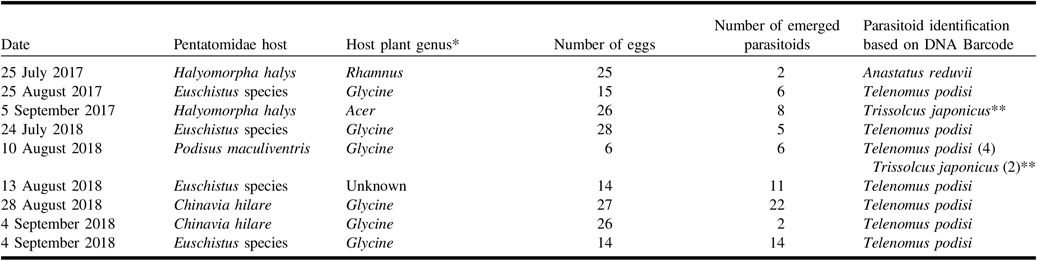
Nine parasitised, naturally laid egg masses were collected, and yielded parasitoids identified as Anastatus reduvii Howard (Hymenoptera: Eupelmidae), Telenomus podisi Ashmead (Hymenoptera: Scelionidae), and T. japonicus based on their DNA barcodes (Table 1). DNA barcode information is publically available in the project “Scelionid adults from field egg masses” (www.boldsystems.org). Following nondestructive DNA extraction, adults identified as T. japonicus were examined and identified using the key to Nearctic Trissolcus (Talamas et al. Reference Talamas, Johnson and Buffington2015b) and are consistent with the species concept of T. japonicus (Talamas et al. Reference Talamas, Johnson and Buffington2015b, Reference Talamas, Buffington and Hoelmer2017). Two parasitoid species were recovered from H. halys eggs – Anastatus reduvii and T. japonicus. Nearctic Anastatus Motschulsky species are known to attack and develop in H. halys (Abram et al. Reference Abram, Hoelmer, Acebes-Doria, Andrews, Beers and Bergh2017); however, this 2017 finding marks the first report of T. japonicus in Ontario. In addition to the discovery of T. japonicus in H. halys populations in southwestern Ontario, the exotic parasitoid was also reared from a native, nontarget Pentatomidae species – Podisus maculiventris (Say) in 2018. This egg mass also yielded the native parasitoid Telenomus podisi, indicating the potential for interspecific competition between native and exotic parasitoids. Trissolcus japonicus was found in successive years, at two different locations in London, indicating the establishment of a local population of T. japonicus in the region. Furthermore, the detection from 2017 suggests that the discovery of T. japonicus in Ontario predates the 2018 detection in British Columbia reported by Abram et al. (Reference Abram, Talamas, Acheampong, Mason and Gariepy2019).
Naturally laid egg masses collected in 2017 and 2018 in London, Ontario, including information of the number and identity of emerged parasitoids based on DNA barcoding. Note that numbers in brackets represent the number of each parasitoid species in egg masses exploited by more than one parasitoid species.

* Acer Linnaeus (Sapindaceae), Glycine Willdenow (Fabaceae), Rhamnus Linnaeus (Rhamnaceae).
** Identification confirmed based on morphological characters.
Given the relative proximity to established populations of T. japonicus in the northeastern United States of America (New York and Michigan; stopbmsb.org), the recoveries in southwestern Ontario likely represent range expansion of these populations. Continued surveys in southwestern Ontario and Niagara region in subsequent years will determine the extent of establishment and the potential impact on H. halys and nontarget pentatomid populations.
Acknowledgements
We thank Allison Bruin, Roger Murray, Catherine Becsky, and James Cowan for assistance in the laboratory and field. Funding for this research was provided to T.D.G. by Agriculture and Agri-Food Canada (A-BASE #2362). We also thank the Florida Department of Agriculture and Consumer Services – Division of Plant Industry and the United States Department of Agriculture/Animal and Plant Health Inspection Service Farm Bill, Monitoring for the presence impact of Trissolcus japonicus – Classical Biological Control of Brown Marmorated Stink Bug for their support on this contribution.