I. INTRODUCTION
Lately, membranes have been of interest in various fields because of their wide applications. The general areas of interest in membrane process include its synthesis, application and post synthesis modification. Reference Bhattacharyya, Schafer, Wickramasinghe and Daunert1 The membrane synthesis process involves techniques and improving materials and methods for manufacturing processes so as to produce a high performance. Reference Mathias2 The application and post synthesis process depends on the specific operating parameters of a membrane system. These include selecting the raw water characteristics, operating pressure, and cleaning at regular intervals to allow the system to operate at a maximum efficiency.
The different techniques for removal of heavy metals include photoreduction, Reference Rengaran, Venkataraj, Yeon, Kim, Li and Pang3–Reference Skubal, Meshkov, Rajh and Thurnauer6 ion exchange, Reference Rafati, Mahvi, Argari and Hosseini7 solvent extraction, Reference Hari Haran and Marali Krishna8 reverse osmosis, Reference Marches, Gangneten, Parma and Rave9 separation, Reference Zheng, Wang, Huang and Wang10 and absorption. Reference Hu, Chen and Lo11 Among all the heavy metals, reduction/removal of hexavalent chromium (Cr) has become a major concern because of its toxicity, carcinogenicity, and mutagenicity. Reference Garcia Rodenas, Weisz, Magaz and Blesa12 Photocatalytic reduction of toxic and hazardous Cr (VI) to nontoxic Cr (III) using semiconductor technology is one of the promising methods for the removal of Cr (VI). However, this application demands high purity, crystallinity, particular phase, and particle size of the semiconductor material. The anatase type of nano titania (titanium dioxide (TiO2)) with an optical bandgap of approximately 3.2 e V has a better catalytic efficiency than rutile phase Reference Spanos, Georgiadou and Lycourghiotis13–Reference Kulczyk-Malecka, Kelly, West, Clarke, Ridealgh, Almtoft, Greer and Barber17 probably because of its lower recombination of electron hole pairs. Hence, it was used for reduction of Cr (VI). On internal recombination, the photogenerated electron hole pair reduces the effectiveness of TiO2 photocatalyst. The idea of immobilization of nanoparticles (NPs) on a polymer matrix can thus contribute to separation of charges in addition to facilitation of recyclability. The uniform dispersion of inorganic catalyst on to a polymeric matrix effectively enhances the physical and mechanical strength and the performance of the membrane as well. Immobilization of TiO2 NPs on membranes can be done by several methods. Reference Kim, Mulmi, Lee, Park, Chung and Lee18,Reference Sayo, Deki and Hayashi19 Cao et al. Reference Cao, Ma, Shi and Ren20 have reported that the TiO2 NPs affect the performance of polyvinylidene difluoride (PVDF) membrane. However, the general problem with the nanocomposite membranes is the formation of agglomerates at increased dosage of nanofillers to a polymer solution. Reference Cao, Ma, Shi and Ren20,Reference Teow, Ahmad, Lim and Ooi21 This affects the homogeneity of the casting solution and the NPs may block the pores of membranes resulting in decreased performance. The decline in hydrophilicity and permeability because of agglomerates at higher concentration of NPs in polysulfone polymer matrix was reported by Yang and Wang. Reference Yang and Wang22 Yang et al. Reference Yang, Zhang, Wang and Zheng23 also found the changes in rheological properties of the casting solution by the addition of TiO2 in polysulfone-N,N-dimethylacetamide-N-methyl-2-pyrrolidone (PSf-DMAC-NMP) system. Emadzadeh reported PSf/TiO2 composite thin film as reverse osmosis membrane for water desalination. Reference Emadzadeh, Lau, Matsuura, Rahbari-Sisakht and Ismail24 Use of the above-mentioned ultrafiltration membrane for the removal of humic acid was reported by Hamid et al. Reference Hamid, Ismail, Matsuura, Zularisam, Lau, Yuliwati and Abdullah25 Yang et al. studied the mechanism of organic–inorganic hybrid membrane formation by phase inversion process, and thermodynamical and rheological properties of the PSf/TiO2 membrane. Reference Yang, Jun, Zheng, Chen and Zhang26 The literature also reports on properties of PSf/TiO2 composite with respect to hydrophilicity due to the effect of nanofillers. This study involves the synthesis of PSf/TiO2 composite membranes by phase inversion process with different concentrations of TiO2 NPs and use of those composites in a challenging application such as, the reduction of toxic Cr (VI). The membranes were repeatedly used for batch reduction of Cr (VI) to Cr (III) under sunlight in the presence of perchloric acid. As discussed above, this type of water treatment by membrane separation process meets the criteria of recyclability and recovery of catalyst. The changes in property, surface morphology, and catalytic efficiency of these hybrid membranes during the course of reduction/recycling processes were investigated. Langmuir–Hinshelwood model was selected to study the kinetic data of photocatalytic reactions. The Cr adsorption isotherm was investigated and the corresponding reaction kinetic parameters were evaluated by Langmuir–Hinshelwood model.
II. EXPERIMENTAL SECTION
A. Materials
Udel PSf (MW: 32,000 Da) was procured from Sigma-Aldrich and the titanium precursor titanium tetrachloride from Merck chemicals. All other chemicals such as 1-methyl-2-pyrrolidone 99% (NMP), perchloric acid, ammonia, and potassium dichromate were purchased from Merck, India, and used as such.
B. Preparation of TiO2 and PSf/TiO2 composite membranes
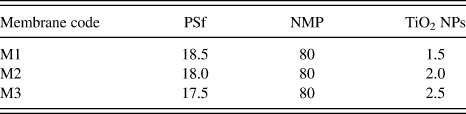
The pure anatase form of TiO2 NPs was prepared as described as in an earlier paper Reference Swetha, Singh, Minchitha and Geetha Balakrishna27 using titanium tetrachloride as titanium precursor. PSf/TiO2 composite membranes with different weight percentages of NPs as listed in Table I were prepared by DIPS method. Reference Yang and Wang22 The desired amount of NPs suspended in 16 mL of NMP was stirred at room temperature for 5 h followed by sonication for 0.5 h to enable uniform dispersion. PSf was discharged into the above solution mixture and was stirred for 24 h to obtain a viscous solution. The solution was cast onto a glass plate and dipped in a coagulation bath containing distilled water to get a composite membrane sheet. The membrane was washed several times and stored in distilled water for 24 h to improve its mechanical strength. The photocatalytic experiments were performed with the above hybrid membranes and repeatedly used for fresh batches without any pretreatment.
Nomenclature of the membranes, with their composition in weight percentage.

C. Characterization of membranes
Field emission scanning electron microscopy (FESEM) micrographs were recorded at certain magnifications using Carl Zeiss field emission scanning electron microscope to study the surface morphology and the microstructure of the composite membranes, before and after the reduction reaction. The membrane samples were cryogenically fractured by liquid nitrogen and then sputtered with platinum. Reference Padaki, Isloor, Fernandes and Narayan Prabhu28
Atomic force microscope (AFM) images were taken by APE Research model F 80 AFM with a Nanoscope V SPM controller operated in Tapping Mode. A silicon cantilever with resonance frequency 300–400 kHz and spring constant 42 N/m was used. AFM height images were presented after simple flattening using V9.0 Nanoscope software.
Shimadzu x-ray diffractometer (Japan) with a scanning rate of 2°/min and a monochromated Cu Kα (1.5406 A0) was used to record XRD patterns of nanocomposites. Smart Sorb 93 BET surface analyzer with sorb 93 reduction software was used to find the surface area and pore volume of the synthesized nano TiO2.
D. Photocatalytic reduction of Cr (VI)
Photocatalytic experiments were carried out by using lone TiO2 NPs and neat PSf membrane as controls to evaluate the catalytic capacity and recycling ability of the hybrid membranes. The irradiation experiments were done on bright sunny days between 11.00 a.m. and 2.00 p.m. with a sunlight intensity of ≥700 W/m2 and no steps were taken to maintain the intensity. A round membrane sheet of 180 cm2 was directly exposed to sunlight along with the Cr (VI) solution of 10 ppm (K2Cr2O7 as a chromium source) taken in a reactor vessel of 2 L capacity. The percentage of reduction in each sample was estimated from standard calibration curves of absorbance versus concentration Reference Mytych, Ciesla and Stasicka29 of the Cr (VI) at a particular value of λmax = 350 nm by a Shimadzu 1800 PC UV-visible spectrophotometer (Shimadzu Corp., Kyoto, Japan). 10 mL of the treated sample, withdrawn at regular time intervals, was used for the analysis. C/C 0 was calculated using concentration of feed and treated sample (C = concentration of treated sample; C 0 = concentration of feed) at different intervals of time.
The prepared composite membranes with different dosages of nano TiO2 shown in Table I were tested for reusability as mentioned earlier. The membranes with different dosages of nano TiO2 were named BM1, BM2, and BM3 and the same membranes were named AM1, AM2, and AM3, respectively, after recycling.
III. RESULTS AND DISCUSSIONS
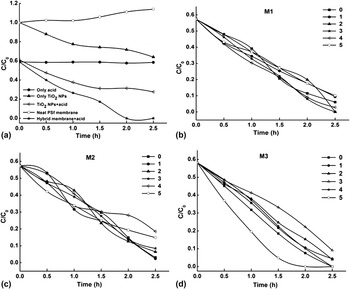
Many sets of experiments were repeated with the same PSf/TiO2 composite membranes of different concentrations of NPs to check the efficiency, reproducibility, and reusability of solid supported catalyst. Figures 1(b)–1(d) show the durability of prepared composite membranes for photocatalytic reactions. It evidently illustrates the recycling of membrane up to six cycles without any pretreatment. Membrane M1 causes a reduction of 97% for the first use and its capacity reduces to 91% at the sixth use. 100% reduction for M2 was achieved because of the increased availability of the active sites. Exposure of the membrane to sunlight increases the surface roughness showing a slight damage on the membrane surface (as depicted by AFM images) which allows exposure of more number of NPs to sunlight and hence an increased activity is observed. The reduction reaches 95% after six cycles within 2.5 h which describes the reusability of the membrane M2. M3 membrane of higher catalyst concentration showed an enhanced and complete reduction within 2 h up to six recycles. All the three membranes showed an enhanced and efficient reduction of hexavalent Cr to trivalent Cr indicating the no-loss of TiO2 NPs on repeated usage and it is supported by XRD patterns. The reductions were conducted in controlled parameters such as concentration of TiO2, hybridization, and acid presence as represented in Fig. 1(a). As expected, catalyst failed to cause any reduction in dark. It was observed that TiO2 NPs catalyze the photoreduction on illumination. The lone membrane remained inept for reduction of Cr. With bare NPs, a small reduction of about 36% was observed. The photocatalyst with a bandgap of 3.1 eV responds to the light of solar spectrum to produce the electron hole pair and cause redox reactions under the illumination of sunlight. However, the produced electrons and holes remain insufficient/ineffective to cause complete reduction. The percentage of recombination of electrons and holes affects photocatalytic efficiency significantly. Reference Sahu and Parida30 When considering a nanoparticle, the concept of deep traps and defects may not be applicable. The defects or the irregularities are only with the surface states. The polymer matrix for the TiO2 allows an easy induction of electrons thus maximizing the charge separation time and acts as carrier traps, avoiding recombination, which later detraps the same to the NP's surface leading to a good interfacial charge transfer. Thus, the importance of polymer matrix on to which the nano-TiO2 has been immobilized contributes to charge carrier separation Reference Sayo, Deki and Hayashi19 and effectively causes redox reactions. The holes that cause oxidative reactions have very strong oxidizing power and they directly oxidize water to produce highly reactive species (OH⋅) as shown in Scheme 1. Reference Zmudzinski, Sobczynska and Sobczynski31 When oxidative tendency increases, possibility of h+ being used in the reaction also increases and the rate of recombination decreases. When the positive holes are sufficiently consumed, the process of electrons transferring to oxygen molecules on the reduction site enhances the rate of photocatalytic reduction. Acids were used as hole scavengers and promote necessary reduction. The pH of target solution is maintained at the value 2 using perchloric acid, which is a strong acid and has a very high dissociation constant. The release of H+ ions is further responsible for the reduction of hexavalent Cr as shown in Scheme 2. At low pH, the formed HCrO4 − species has a standard electrode potential of 1.33 V and this is indicative of the chances of direct reduction (39%) with a strong acid. However, this was only at the initial stages and further reduction was possible only in the presence of a catalyst, and plots in Fig. 1(a) are clearly indicative of this situation. The photocatalytic reduction conducted in dark showed zero reduction. Although sunlight is one of the important parameters, sunlight fails to cause reduction in the absence of a catalyst. The required criteria such as illumination of light on anatase TiO2 catalyst, immobilization of catalyst on PSf polymer matrix as solid support, and use of acid as proton donor are responsible for 100% reduction of Cr (VI) within 2 h.
Extent of Cr (VI) reduction in sunlight under different experimental conditions.

Representation of (a) electron hole formation, (b) hole scavenging, and (c) reduction process.

Variation of surface charge properties of TiO2 with pH.
The adsorption properties of a catalyst vary greatly with the pH. Reference Pettine, Campanella and Millero32 In this study, reduction reaction predominates because of the presence of perchloric acid. TiO2 will have a large surface proton exchange capacity in acidic environment as H+ ions are adsorbed onto the TiO2 surface as shown in Scheme 2. The adsorbed H+ ions also capture photogenerated electrons to form Habs 0 to reduce Cr (VI).
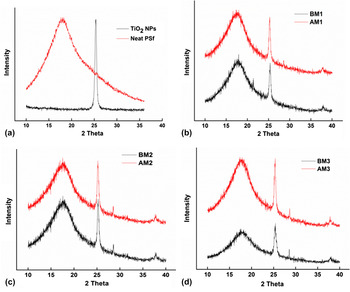
XRD patterns of TiO2 NPs and composite membranes of different concentrations of NPs (1.5/2.0/2.5 wt%), before and after the reductions are as represented in Fig. 2. The XRD patterns were expressed as simple mixed patterns of different components present in the hybrid. Reference Jian, Xu, Hou, Wu and Sun33 The 100% peak observed at 2θ = 25.30 indicated the pure anatase form of prepared TiO2 NPs, with no trace of rutile peaks. The same peak can be observed in all composite membranes suggesting the incorporation of NPs into the polymer matrix with evidence of d-spacing at 3.4937 Å. The height of the peaks (intensity) depends on the number of crystallites diffracting the x-rays or the amount of phase exhibiting the reflection and hence BM3 shows the highest peak height for TiO2. But the absence of peak shifting excludes the existence of long-range internal stresses and/or macroscopic residual stresses. In addition, the lattice parameters and crystal structure remain unaltered. The prominent decrease in the intensity of the characteristic peak in AM3 can be attributed to a decrease in the amount of phase/crystallinity that may have been caused due to turbulence created via repeated stirring during subsequent reductions. The crystallite size of the NPs incorporated into the polymer matrix before and after the recycling process is calculated and shown in Table II. As observed, the crystallite size decreases substantially in lower concentrated membranes after the recycling. Size decrease should be because of crystallite size refinement. Crystallite size refinement is achieved via repeated brittle fracture that occurs during repeated recycling. This also causes membrane damage and can be evidenced from SEM images. However, the presence of NPs after recycling evidences the reliability of the hybrid membrane for such degradations.
XRD patterns of (a) bare TiO2 NPs and neat PSf, (b) M1 membrane before reduction process (BM1) and after recycling (AM1), (c) M2 membrane before reduction process (BM2) and after recycling (AM2), (d) M3 membrane before reduction process (BM3) and after recycling (AM3).

Crystallite size and roughness of the membranes before and after recycling for six times to carry out reduction of Cr (VI).

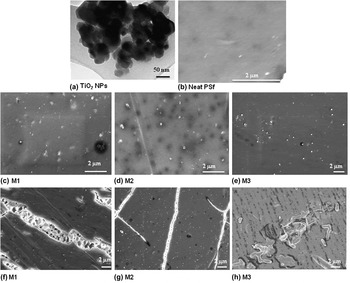
Figure 3 shows surface images of PSf/TiO2 mixed matrix membranes for the membranes before and after the photoreduction obtained by SEM. With the increase in TiO2 concentration, the deposition of NPs increases and is seen as different sizes of flakes indicating agglomeration. Viscosity of the casting solution increases with the concentration of TiO2 leading to a higher interaction between polymer matrices, troubling the penetration of NPs into the sublayers of polymer leading to agglomerates on the surface. The illumination of titania with light allows the electrons in 2p valence band of oxygen to jump to 3d conduction band of titanium. As the holes are continuously scavenged by either adsorbed water and/or acid, the electrons emitted during the process cause the surface damage of the membrane leading to an increase in roughness (evidenced by AFM images). Figure 3 clearly depicts the membrane damage, the damage being proportional to dosage of TiO2 and number of cycles. Roughness facilitates better adsorption of Cr ions and hence enhances photoreduction. It is also important to mention that the third and fourth cycles gave better percentage of reduction because of the above-mentioned fact. But, the damage beyond a particular point (6 cycles for 500 mg of TiO2) adversely affected the reduction capacity of the membrane. This was however dependent on the concentration of TiO2 in the membrane.
SEM images for (a) TiO2 NPs, (b) neat PSf membrane, (c) BM1, (d) BM2, (e) BM3, (f) AM1, (g) AM2, and (h) AM3 six recycles of photocatalytic reaction.

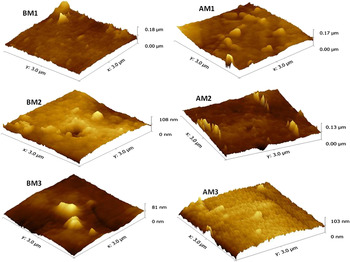
Figure 4 represents the AFM images of the membranes before and after the photoreduction process. In the images, the darker areas belong to the lower points and micrometric valleys of the membranes structure and brighter areas show the points on the membranes with more height. The presence of TiO2 particles in the membrane matrix created some superficial disorders on the membrane surface causing the surface roughness. Reference Mollahosseini and Rahimpour34 The mean roughness (Ra) of the membrane is as tabulated in Table II. It depicts the roughness to be inversely proportional to the concentration of the catalyst. Overall, the roughness of the membrane increases with treatment. Hence, photoreduction process damages the surface and causes more roughness.
3D images of AFM for PSf TiO2 composites before the reduction and after the recycling process.

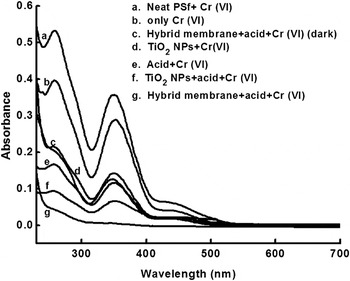
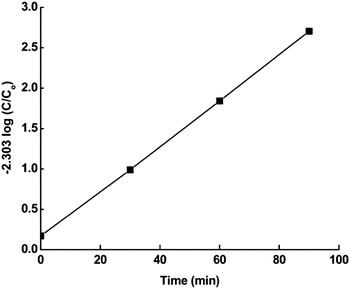
Kinetic study of composite membrane mediated photocatalytic reductions of Cr (VI) to Cr (III) has been investigated as a function of sunlight irradiation. It helped for the evaluation of reaction rates, reaction orders, and equilibrium constants, and helped evaluation of a mechanism for the enhanced elimination of Cr. The PSf/TiO2 composite membrane exhibits a very good catalytic activity with respect to reduction of acidified Cr (VI) to Cr (III) in aqueous solution. M2 exhibited a better rate of reduction than M1 and M3, because of insufficient catalytic sites in M1 and in M3, because of excess catalytic sites promoting oxidation after the consumption of all the necessary acids (no extra acid has been used because of extra catalyst). The UV-visible absorption spectra for reduction of Cr (VI) after 2 h of treatment, under various experimental conditions are shown in Fig. 5. The curve ‘g’ representing the hybrid membrane with TiO2 and acid, showed a steep decrease (and disappearance) in the height of the characteristic absorbance peak of 350 nm within 2 h of sunlight irradiation indicating the completion of reduction. The higher intensity of only neat PSf membrane, represented by curve ‘a’, than of only Cr (VI) solution, represented by curve ‘b’, is observed because of the evaporation of water caused by exposure to sunlight. In Fig. 5, there is no evidence for the formation of Cr+3 because of the high adsorption tendency of Cr (III) on the membrane. UV visible analysis measured for the adsorbed membrane after complete reduction and after 6 recycles, does give a peak at 580 nm substantiating the formation of Cr (III) and is as shown in Fig. 1. The plot of −ln C/C 0 against irradiation time for the 100% photoreduction of Cr (VI) by composite membrane in the presence of acid (Fig. 6) shows a straight line behavior confirming first-order reaction kinetics. It can be explained by rate law for first-order kinetics for any reactant consumption at concentration C which is dC/dt = −k[C], on integration, ln [C]/[C 0] = −kt, where C and C 0 are substrate concentrations at time t and time 0 in minutes, respectively, and k is the first-order rate constant. Because the obtained plot was a complete straight line with all the points on it, it indicates the reduction to be a perfect first-order reaction.
The UV visible absorption spectra for reduction of Cr (VI) after two hours of treatment, under various experimental conditions.

A plot of −2.303 log C/C 0 versus time of illumination for the photoreduction process by using hybrid membrane (M3) in the presence of acid.

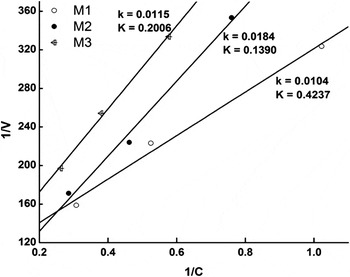
For a single substrate reaction on the surface where the catalyst concentration is very low compared to that of substrate, as in this present study, the expression would be the same as Langmuir–Hinshelwood kinetic rate, v LH = kKC/1 + KC, where ‘C’ indicates the concentration of the substrate. In general, photooxidation is favored by the concentration of solute and oxygen and if the initial oxygen pressure is ambient air (as the present case may be), the equilibrated value of the surface coverage by an oxygen molecule may be regarded as a constant. On rearranging the above equation, we get 1/v = 1/k + 1/kKC, and to obtain an equation analogous to the linear equation y = mx + c, rate constant k and equilibrium constant K have to be found. Figure 7 gives the plot of 1/v versus 1/C. All the three membranes showed a straight line trend and the graphically obtained rate constants (min−1) and equilibrium constants for the corresponding acidified-photocatalytic-membrane oxidations are as depicted in Fig. 7. Although many photocatalytic reactions show good linearity Reference Adris, Hassan, Rashid and Ngomsik35,Reference Sobczynski, Duczmal and Zmudzinski36 in such plots of 1/v versus 1/OD, unfortunately, this fit cannot be taken as a definite proof for pre adsorption, as an identical analytical formulation of this rate law is obtained only for reactions occurring entirely within an homogeneous phase. Reference Geetha Balakrishna and Gomathi Devi37
A plot of 1/v versus 1/C for the photocatalytic reduction of Cr (VI) using composite membranes with different dosages of TiO2 NPs, in the presence of acid and sunlight.

IV. CONCLUSION
Prepared PSf/TiO2 composite membranes responded well for solar light-mediated photocatalytic reduction of Cr (VI) with acid being a hole scavenger for the promotion of reduction. Both micro and macro changes were observed with respect to surface morphology of membranes and crystallite size of TiO2 within the membranes due to recyclability. The investigations reveal membrane damage (because of electron transitions) to be proportional to dosage of TiO2 and number of recycles. The membrane with 500 mg of TiO2 retained its reduction capacity up to a maximum of six cycles. The study reveals the significance of using the reliable membrane repeatedly in batches to treat chromium contaminated water. The Langmuir–Hinshelwood kinetic model for the successful reaction that satisfied all the criteria for 100% reduction of Cr (VI) showed a first-order rate equation.