Introduction
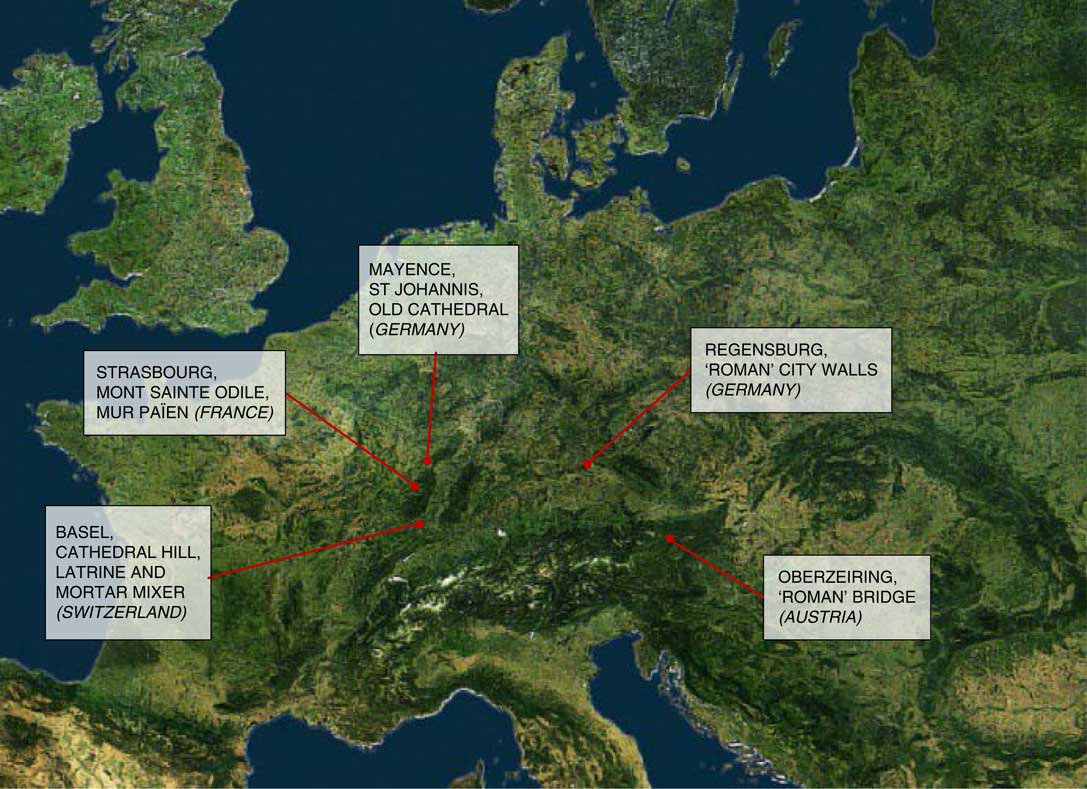
Radiocarbon (14C) dating, more than any other scientific dating method, has become common practice for dry-land excavations worldwide and is also frequently employed in the countries from where the examples of this paper are taken, namely Switzerland, Germany, Austria, and France (Figure 1). 14C has been especially useful, for example, in dating human skeletal remains from depositions without grave goods or a clear relation to known cemeteries. Similarly, it has helped researchers to understand the chronology of isolated settlement features with little or no finds (Haberstroh Reference Haberstroh2013). To employ methodologies of absolute dating is part of the indispensable toolkit of archaeologists whose role model has changed from Indiana Jones to the director of a crime scene team. But although there is enthusiasm for employing new technologies, their complexity is often underestimated and results that do not meet expectations tend to be dismissed or simply ignored instead of being shared and discussed with colleagues and the public in an adequate and timely fashion.
Locations of case studies (illustration by S. Hueglin based on Google maps).

Among archaeologists working on the Roman, Medieval, or Early Modern period, there is no necessity to employ 14C dating within well-defined strata with sufficient finds to date the sequence. Only dendrochronology can enhance the precision of dating here, if a suitable wood object is preserved, i.e. a piece with enough tree rings and from a species for which a chronology for the area exists. After the Roman period, in the Early Middle Ages—from about AD 400 to 1200—there are significantly fewer written sources, datable objects such as coins or brooches, and settlement remains, and in many areas, a return to post-built architecture and handmade pottery vessels can be observed. All in all, this period is not as visible in the archaeological record as the Roman Empire and the later Middle Ages from about AD 1200 onwards, because its impact in terms of material remains is significantly lower. This reduced traceability probably mirrors the much lower population density: between AD 500 and 650, in many parts of Europe, a drastic drop in the numbers of inhabitants—in the range of one-third to one-half—has been estimated. Until AD 1000 this loss is not only compensated, but the population levels then reach again that of Antiquity and rise significantly above it until 1340, when the Black Death leads to drastic losses again (Russell Reference Russell1972).
Other factors that reduce the archaeological visibility of people in the Early Middle Ages are the number of objects they possessed, the kinds of materials that were used, and the proportion of reuse and recycling practiced. Between the 5th and 11th centuries AD, the number of known settlements is much lower than in Roman times, and they yield only a fraction of finds compared with the previous period. In the Early Middle Ages, the materials used in daily life and in architecture tended to be organic rather than inorganic, but leather vessels and wooden houses mostly decay and leave little to no indirect traces. In the rare instance of Early Medieval stone architecture, there is often evidence of the use of so-called spolia: these are stones that have been taken from an older—mostly Roman—buildings and reused in a later structure. With carved stones, this kind of reuse is obvious and can even be interpreted as an intentional act of renovatio imperii—the attempt to re-establish the Roman Empire. But when unworked stones are recycled, which probably was more common, the phenomenon is discreet and almost undetectable. Recently, it has been pointed out that not so much the loss of skills, but rather social disorganization made reuse and recycling a pragmatic choice on a stone building site (Bütter Reference Büttner2012).
The reuse of material is extremely common between Late Antiquity and the Carolingian period and can also be observed in another object category: scrap metal was intensely collected, remolten and reshaped into new objects instead of left lying around like in Roman times. The reason for the reuse of metal was manyfold: there was much reduced primary production of raw materials, the interruption of supply chains that had been active during the Roman Empire led to shortages especially north of the Alps, and Germanic tribes lavishly deposited metal objects in the graves of the deceased, which additionally removed metals from circulation (Baumeister Reference Baumeister2004).
In the historical sources, the invisibility of these centuries in Central Europe goes so far that some deny their very existence: H. Illig (Reference Illig2005) for example argues in his “Phantom Time” hypothesis that the entire Carolingian period—almost three centuries between AD 614 and 911—is not real, but had been fabricated by a later Holy Roman Emperor and a Pope to place them near the special year of AD 1000. From history and archaeology alone it can be quite hard to disprove the hypotheses, but organic remains dated by 14C or dendrochronology can provide arguments to refute this historical conspiracy theory (Flößel Reference Flößel1999).
The following five case studies represent the most recent and most striking examples where 14C dating—often in combination with other (dating) methods—changed either the date or the ability to date a (stone) building and added substantially to our knowledge about the Early Medieval Period. From these examples the potential, but also the challenges for scientists as well as for archaeologists, become evident and will be further discussed.
Case Studies
Basel (Switzerland), Cathedral Hill, Early Medieval Latrine and Mortar Mixer
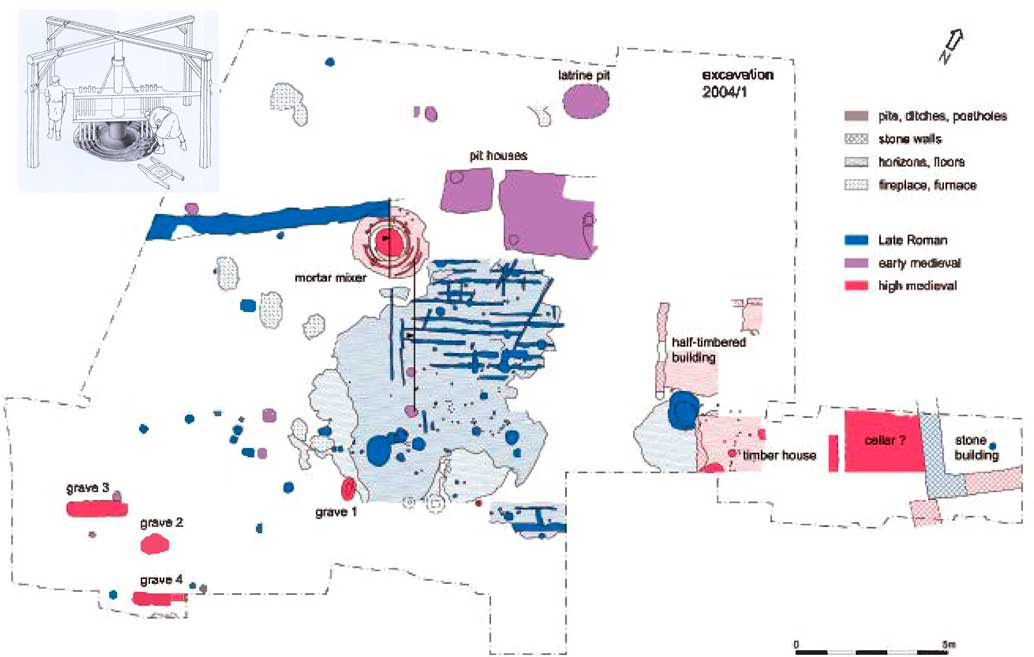
In 2004, the Archaeological Department of Canton Basel-Stadt had to tackle a major excavation in the inner courtyard of a property on Cathedral Hill (in German: Münsterhügel) (Figures 2 and 3). At Martinsgasse 6+8, an area of ca. 450 m2 was previously undisturbed; during excavation 2004/1, altogether 1350 m3 had to be removed for an underground parking lot. The sequence of archaeological layers was between 3 and 6 m thick; it started with a Bronze Age ditch and continued through Iron Age, Roman, and Medieval periods thus comprising 3500 years of (pre-)history (Hagendorn et al. Reference Hagendorn, Stegmüller and Stelzle-Hüglin2006). Unusual with ca. 1.5 m alone was the thickness of the post-Roman to Early Medieval “dark earth” layers. These strata are very rich in organic material; due to their color, it can be very difficult to observe boundaries of features. They often form within wall enclosures, be it a derelict house or in this case the walls of a Roman fort. The lower end of the dark earth sequence was marked by an extensive layer of white mortar. Spread out over 60 m2 and clearly of Late Roman origin, it indicated large-scale stone building activity close by—possibly the (re-)erection of the defensive wall (Asal Reference Asal2017). Another feature, a pit cut into the dark earth from its upper end: the substantial layer of mortar at its base was round in shape and about 2.5 m in diameter. Around a central posthole at least four sticks had left concentric traces on the mortar surface while it still had been semifluid. It was immediately clear to the author—then leading the excavation—that this must be the remains of a mechanical mortar mixer. Devices similar to the feature at Basel have been found throughout Europe, mainly at Early Medieval sites (Hueglin Reference Hueglin2011). So, at the beginning and again at the end of the dark earth-phase the site had been a construction site and supplied raw materials for stone architecture.
Basel, Cathedral Hill (Switzerland), general plan of the Early Medieval and Late Roman features in the excavation at Martinsgasse 6+8 (2004/1); the position of the section (Figure 3) is indicated with a vertical black line. Several samples from the mortar mixer (red)—charcoal, bone, and mortar—have been 14C dated (Hueglin Reference Hueglin2011; Hayen et al. Reference Hayen, Van Strydonck, Fontaine, Boudin, Lindroos, Heinemeier, Ringbom, Michalska, Hajdas, Hueglin, Marzaoili, Terrasi, Passariello, Capano, Maspero, Panzeri, Galli, Artioli, Addis, Secco, Boaretto, Moreau, Guibert, Urbanova, Czernik, Goslar and Caroselli2017). Top left: reconstruction of the mortar mixer (by Heidi Colombi, ABBS). (Colors refer to online version.)

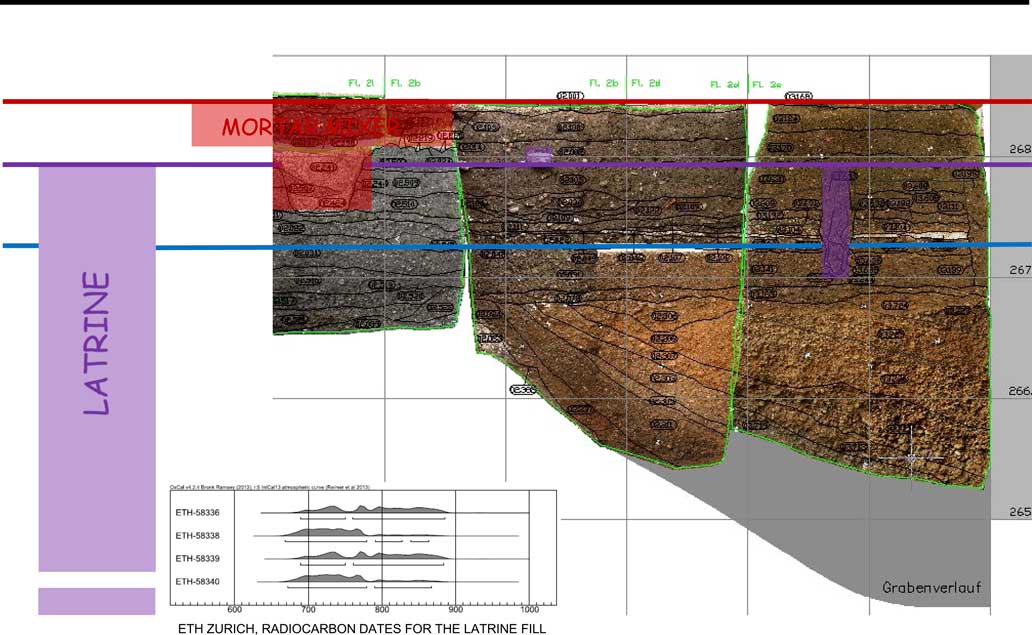
Basel, Cathedral Hill (Switzerland), section through 5 m of stratigraphy from the Late Bronze Age ditch to the “dark earth” layers (above 267 m asl). Emphasized are the levels of Late Roman mortar production (blue), of the Early Medieval latrine pit (purple), and the later Early Medieval mortar mixer (red). Inserted is the graph for the 14C dates of the charred grains from the latrine fill provided in Table 1 (Hueglin Reference Hueglin2011). (Colors refer to online version.)

Toward the end of the excavation another initially unsuspicious feature was observed: a latrine shaft. Unusual in this case was the voidage that remained between the surrounding material and the latrine fill: the cylinder must have been lined with wickerwork or vertical boards instead of a stone wall as is usually the case with later medieval examples. Due to this and due to the pressure of the surrounding and overlaying material, the shaft had lost its original oval-cylindrical shape and appeared buckled and squashed. Because it sat right underneath modern masonry and at the very edge of the excavation, it was only possible to investigate one-half of the content and it was not possible to search for the base of the shaft.
Both features—the remains of the mortar mixer and the latrine and its contents (mainly animal bones)—proved very difficult to date. Firstly, due to the dark color of the strata and to previously mechanically removed top layers, the relative stratigraphy was blurred. Secondly, most of the datable finds—coins and ceramic fragments—were of Late Roman date and either suggested a constant remixing and inverting of matrix and materials within the dark earth or an extremely long circulation—of an additional four to six (!) centuries—of the objects in question.
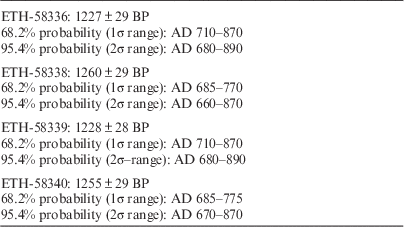
14C dating was in both cases the best option. In the case of the mortar mixer from within the mortar, several charcoal fragments could be extracted and two of them were dated at ETH Zurich. The results—AD 884–1118 for sample Rc7 and AD 778–1020 for sample Rc8 (both 2σ)—match very well (Hueglin Reference Hueglin2011; Hayen et al. Reference Hayen, Van Strydonck, Fontaine, Boudin, Lindroos, Heinemeier, Ringbom, Michalska, Hajdas, Hueglin, Marzaoili, Terrasi, Passariello, Capano, Maspero, Panzeri, Galli, Artioli, Addis, Secco, Boaretto, Moreau, Guibert, Urbanova, Czernik, Goslar and Caroselli2017; Figure 3). In archaeological-historical terms this puts the mortar mixer into the Carolingian to Ottonian period. To date the latrine, part of the earth samples from its content underwent water flotation and were botanically analyzed by Christoph Brombacher at the Institute for Integrative Prehistory and Archaeological Science, University of Basel. Five charred grains—three of them wheat—from different positions within the fill were selected for 14C dating; four of them yielded results (Table 1).
Basel, Martinsgasse 6+8, latrine, 14C AMS dating of four charred grains from the fill (ETH Zurich, Laboratory of Ion Beam Physics, Switzerland).

The results are very consistent across all grains and make it very likely that the fill—being the final use and respectively disuse of the latrine—dates to AD 660–890; in archaeological-historical terms this corresponds with the Merovingian to Carolingian period.
Both dates spark discussion around the appearance and use of Basel Cathedral Hill in the Early Middle Ages. While there is the Cathedral and the bishop’s immunity to the south, there is not much known about the northern part—the so-called Martinskirchsporn—with the supposedly Early Medieval church, St Martin. Due to the patron saint of the church, the northern part is thought to have been used by the Frankish nobility and possibly also by the Carolingian and Ottonian rulers when they were visiting the (prince) bishop and town. Too far from the cathedral, clearly outside the bishop’s immunity, but also not close enough to St Martin, both the mortar mixer and the latrine are unusual features that could indicate the presence of wealthy, secular patrons. These would be patrons who found it necessary to have a private privy and later were among the first to use stone and mortar again for secular architecture. A latrine in the Merovingian resp. Carolingian period indeed is extraordinary as there are currently hardly any comparisons—Cologne, Heumarkt (Dr Thomas Höltken, Cologne, personal communication), Deventer (van Oosten Reference Van Oosten2015), and possibly York—for such facilities across Europe north of the Alps. In this respect, the Basel latrine fill would be very interesting to investigate further because it could yield information on material use and privileged diet that is rarely available for that period from any other site. Possible targets for a series of further 14C dates would be the (unworked) animal bone fragments and a decorated antler object from the fill. In both cases the question would be the same: is this re-deposited refuse from the Roman period or rare remains of Early Medieval life?
The abundant material from the mortar mixer invited to use the already well-dated feature as comparison, maybe even as calibration, for other scientific methods. In 2013, a first attempt to date single sand grains in the mortar by optically stimulated luminescence (OSL), a dating method which determines the last moment a sand grain was exposed to light, was not successful because the emanating signal was too weak. At the same time, the Mortar Dating Inter-comparison Study (MODIS) had begun and agreed to make the Basel mortar mixer one of its four case studies. In this context, the mortar itself was 14C dated by a number of different laboratories and also OSL was tried again, this time a result was achieved.
The results of MODIS are presented in detail elsewhere in this volume (Hayen et al. Reference Hayen, Van Strydonck, Fontaine, Boudin, Lindroos, Heinemeier, Ringbom, Michalska, Hajdas, Hueglin, Marzaoili, Terrasi, Passariello, Capano, Maspero, Panzeri, Galli, Artioli, Addis, Secco, Boaretto, Moreau, Guibert, Urbanova, Czernik, Goslar and Caroselli2017), but some aspects need to be discussed here. In the case of the Basel mortar mixer, surprisingly, neither mortar dating nor OSL could confirm the dates of the previous charcoal dating, but most of the laboratories returned with Roman dates. As the mortar contained organic material, additional 14C ages of charcoal and of a bone fragment were measured for comparison. Both organic samples returned with dates too old: the charcoal dated to the Carolingian period, around AD 800, and the animal bone to the Roman period. The dates can be explained by the so-called old wood effect, which is when wood either from the core of an old tree or from an earlier period gets dated in context with a younger feature. The animal bone obviously belongs to the numerous remains of Roman debris that form the strata, in which the mortar mixer pit was dug and consequently debris got mixed up in the mortar during the building process. But what about the Roman dates for the mortar, considering additionally that the two methods measured the dates of different components? From a stratigraphical point of view it is not possible to correlate the mortar mixer with Roman layers as it sits much higher up. An explanation could be that Roman mortar was crushed into sand and used lavishly as an ingredient in the medieval mortar. This would fit very well with the practice of reuse and recycling that was so typical in the period. Further studies, especially of the composition of the respective Roman mortar layer below the medieval mortar mixer, will be necessary to test the hypothesis. In this case, the significant discrepancy of mortar dating with the expected age was the first indication for the use of spolia on a microscopic scale; in the thin section, so far it seems not to be recognizable.
Strasbourg, Mont Sainte Odile (France), Mur Païen, Early Medieval Wall
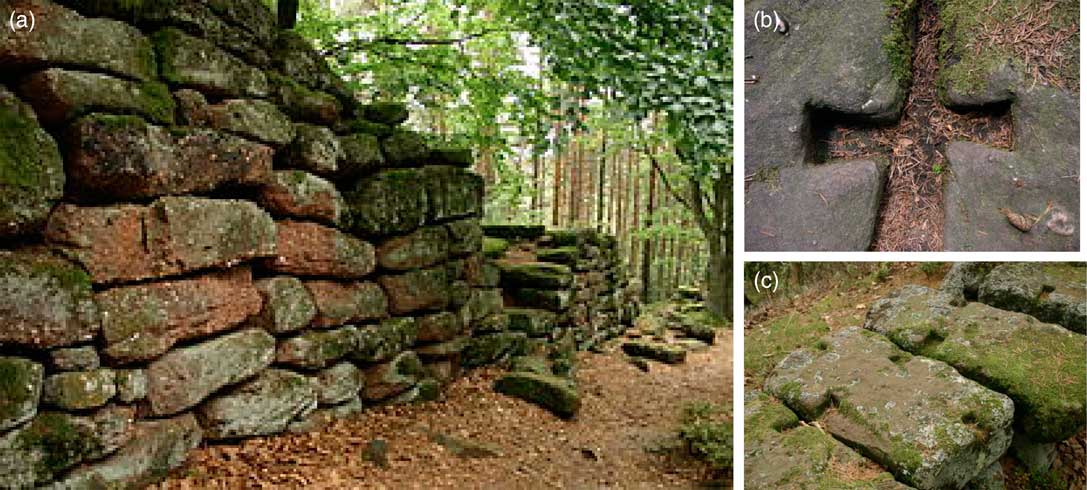
The Mur Païen (Pagan Wall or “Heidenmauer” in German) is one of the emblematic monuments of Alsace; it circles or rather “slaloms” around the summit of Mont Sainte Odile a 760-m-high peak in the Vosges mountain range southwest of Strasbourg (Figure 4). The wall is around 10.5 km long and consists of 250,000–300,000 blocks of locally quarried red sandstone; it is between 1.6 and 1.8 m wide and in some places still 3.5 m high. The drystone wall consists of building blocks of different size, which are mostly 80 cm to 1 m long, 60–70 cm wide, and 50 cm high. The blocks are laid out according to the stretcher binder-principle; they used to be clamped together by dove-tailed tenon joints, which still can be seen as the respective cavities have been chiselled into the stones. The quarries from which the stones have been taken clearly show the use of iron tools and wooden wedges. Traditionally, scholars have assigned the wall either to the Iron Age or to the Roman period, but recent developments have overthrown this (Rieth Reference Rieth1958; Fichtl Reference Fichtl1996; Steuer Reference Steuer2012).
Strasbourg, Mont Sainte Odile (France), Mur Païen: (a) a well-preserved stretch of the “Pagan Wall”; the individual ashlars are approximately 50 cm in height; (b) exposed layer of worked stone blocks on outer face of the wall shows recipients for tenon joints; (c) detail of corresponding cut out cavities with characteristic dove-tailed shape.

Already by the 1870s Auguste Schneegans, a local scholar, had removed more than 65 tenon joints made of oak from the lower levels of the wall. Only in 2000, these objects were rediscovered in a private collection, and in 2001 the Service de l’Archéologie regional d’Alsace had them examined in Freiburg im Breisgau, Germany. According to Willy Tegel, these are the oldest dry-preserved wooden objects in central Europe (Tegel and Muigg Reference Tegel and Muigg2015). They come from up to 300-yr-old trees, which stood in a dense forest probably at the foothills of the Vosges. Due to the good condition of the objects—they provided up to 90 yearly rings—it was possible to date 22 of them, but only one contained reserved sapwood. The felling dates span from AD 685 to 750. They were determined by dating the sapwood—AD 671±10 (DC-Nr. 42), combined with the latest heartwood date—after AD 675 (DC Nr. 17). 14C dating of three tenons confirmed the dendrochronological analysis: the last 20 tree rings of a piece (DC Nr. 7) that had been dated AD 640–660 by dendrochronology produced a 14C age of 1410±50 BP (ETH-23515) or AD 595–670 (68.2%, 1σ range) respectively 530–710 AD (95.4%, 2σ range).
Therefore the Mur Païen—at least the northeast part of it, where the oak clamps were found—must have been erected in the late Merovingian Period (Steuer Reference Steuer2012). This leads to a whole new picture of the historical development of Mont Saint Odile with its Early Medieval nunnery. It is said to have been founded around AD 700 by Adalric, the duke of Alsace, for his daughter Odile. In this context, the wall could have been an attempt to establish a secular seat of power and to install a dynasty by occupying the prominent landmark high above the Rhine Valley not far from the old Roman town of Argentoratum, which is now Strasbourg (Letterlé Reference Letterlé2002, Reference Letterlé2009).
The finding of the oak clamps and the new dates for the Mur Païen rekindled interest in the wall as an archaeological monument of foremost importance. This led also to the installation of a French-German group of researchers that have looked anew at all finds and features and especially into the Early Medieval history of the area. 14C dating here was employed to ascertain the overwhelming and still surprising new results for the dating of the wall.
Mainz (Germany), St Johannis, Early Medieval Cathedral
Next to St Martin’s Cathedral in Mainz lies inconspicuously St Johannis; since 1830 it has served as a Protestant parish church. Art historians have always regarded it as one of the oldest churches in Mainz. By the early 12th century, written sources had already referred to it as vetus monasterium (Latin for “old monastery”) and even Aldedum (German for “old dome/cathedral”). Since 2008, and more intensely since 2013 in context of general restorations, archaeological excavations and research into the building’s history have been carried out and are being continued. These investigations, which included 14C dating, confirmed not only the building to be the “Old Dome” but dated it as far back as the 7th century AD (Kleiner/Knöchlein Reference Kleiner and Knöchlein2014; Kleiner Reference Kleiner2016). This was 250 years earlier than art historians had previously thought, which catapulted it to among the oldest stone church buildings north of the Alps.
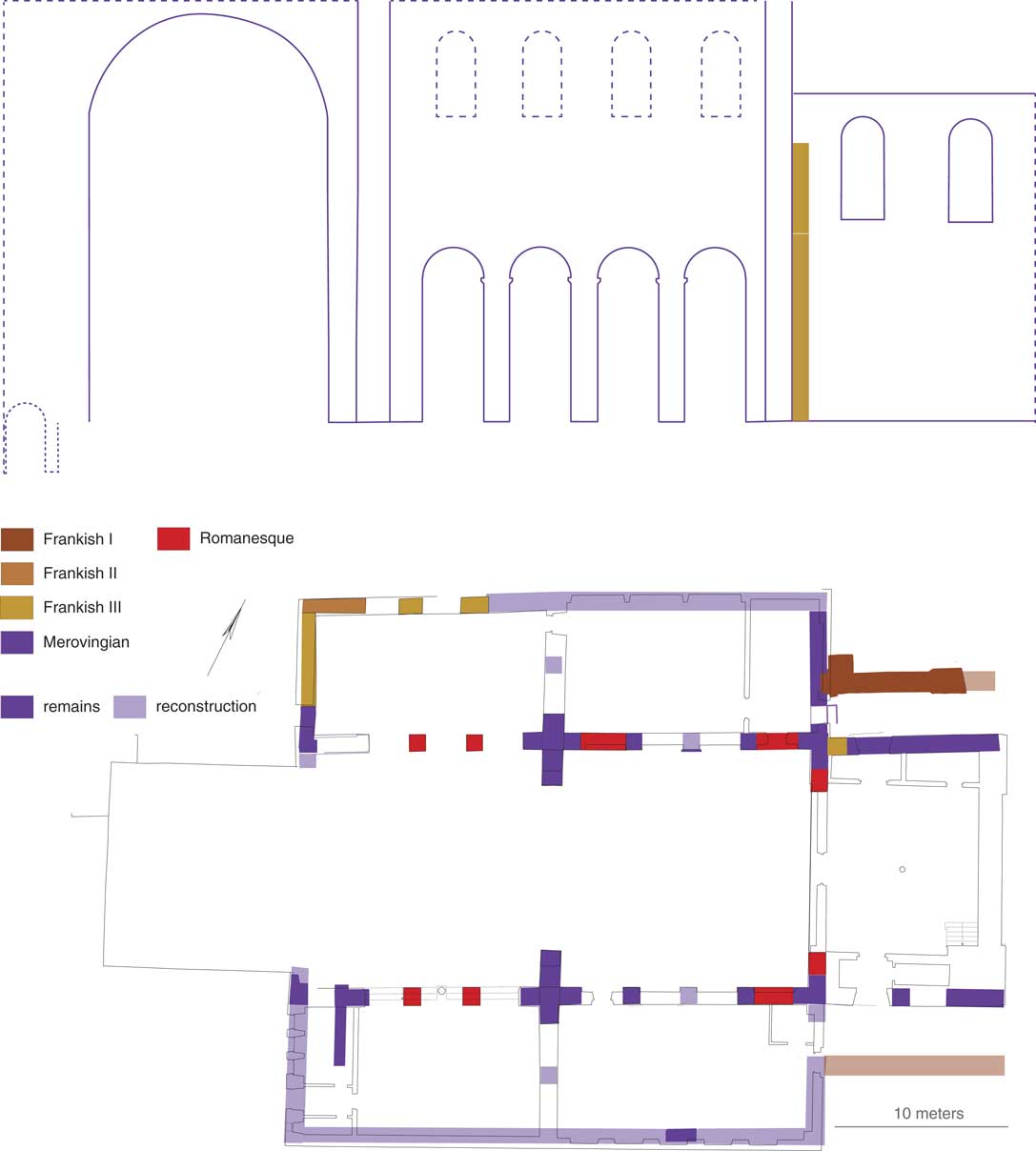
In 1907, during an earlier investigation in the building’s history, R. Kautzsch had discovered the big Early Medieval church within St Johannis. It had a choir at each end and in the west a large intersecting transept. The nave with four arcades is extremely short and its square central part is still visible in today’s groundplan. Almost 4-m-high, round-headed windows with a row of smaller windows—so-called oculi—structured the east chancel wall (Figure 5). The floor of this building lies 2.80 m below today’s level and is erected within a massive predecessor. Its mortared floor functions as the foundation of the Early Medieval binding arches. Kautzsch correlated this phase with recorded building activities at Mainz cathedral under archbishop Hatto I (AD 891–913); he thus believed the church to date to ca. 900 AD (Kautzsch Reference Kautzsch1909).
Mainz, St. Johannis; above: longitudinal section looking north, below: partly reconstructed ground plan of the earliest phase of the “old cathedral”: charcoal samples from the mortar point to an Early Medieval date, ca. AD 650–700 (Kleiner Reference Kleiner2016).

Current research proved the Early Medieval cathedral had at least three building phases. It is the objective of the current excavations to find connections between Early Medieval walls and floor levels, also architectural fragments and plaster pieces with remnants of wall painting have not been analyzed yet. Therefore, 14C dating momentarily is the only possibility to understand the approximate chronology of the Early Medieval building phases.
At the Curt-Engelhorn-Center for Archaeometry in Mannheim, about 20 charcoal samples from wall mortars were 14C dated. While so far there are no samples and therefore no absolute dates for the supposedly Frankish predecessor, the Merovingian cathedral was built in the second half of the 7th century AD. The binding arches, the west transept, and the round-headed windows of the east sanctuary can be connected with a sample that dated to AD 655–765 (1σ range), respectively, AD 646–771 (2σ range). Accordingly, this phase of St Johannis is around 250 years older than previously thought. An extensive Early Medieval restoration of the nave’s clerestory cannot—due to the well-known calibration plateau in the 9th century—be dated more precisely than AD 776–976 (1σ range) and AD 718–980 (2σ range). Possibly, this can be related to Hatto I and his building activities around AD 900. By the end of the 10th century the Merovingian round-headed windows in the east chancel wall were complemented and modernized with oculi. The respective sample provides a date between AD 904–1015 (1σ range) or AD 898–1025 (2σ range) (Kleiner Reference Kleiner2016).
With one sample—so far—published per phase, this exciting new finding will still need a lot of confirmation by stratigraphy and possibly other remains that can be scientifically dated. The danger of the so called “old-wood effect” with charcoal will have to be addressed. A final publication of the database should allow researchers to relate the samples to their respective position and should also lay open the results of all samples, especially also the ones that do not comply with expectations.
Regensburg (Germany), Dachauplatz, “Roman” City Walls
In February 2013, the State Office for Cultural Heritage Bavaria had a workshop in Regensburg on “14C Dating in the Early Middle Ages” to discuss methodology, problems, and perspectives (Lobinger and Later Reference Lobinger and Later2013). One of the main reasons for this meeting was the dispute around the new results from Dachauplatz in Regensburg itself. Castra Regina (Latin for “fort at river Regen”) was the name of Regensburg in Roman times. Regensburg boasts remains even of standing buildings (Porta Praetoria) from that period, but has also a spectacular medieval built heritage. Since 2006 the medieval town center has been a UNESCO world heritage site. As part of this, the walls of the Roman castrum have been subject of intense investigation with the aim to better preserve and present them in future. An inscription found in the area of the former east gate of the Roman camp assigns the completion of the fortification to AD 179 during the reign of Emperor Marc Aurel. Castra Regina existed under Roman rule into the 5th century AD; during that time on several occasions we hear of Germanic tribes damaging and partly destroying the site. For the most part the fortification is thought to have survived into the Early Medieval period, during which it was in use and even rebuilt or modified (Stroh Reference Stroh1958; Aumüller Reference Aumüller2002; Dallmeier Reference Dallmeier2008; von Gosen et al. Reference Von Gosen, Dallmeier, Koch, Boos and Meerheim2013).
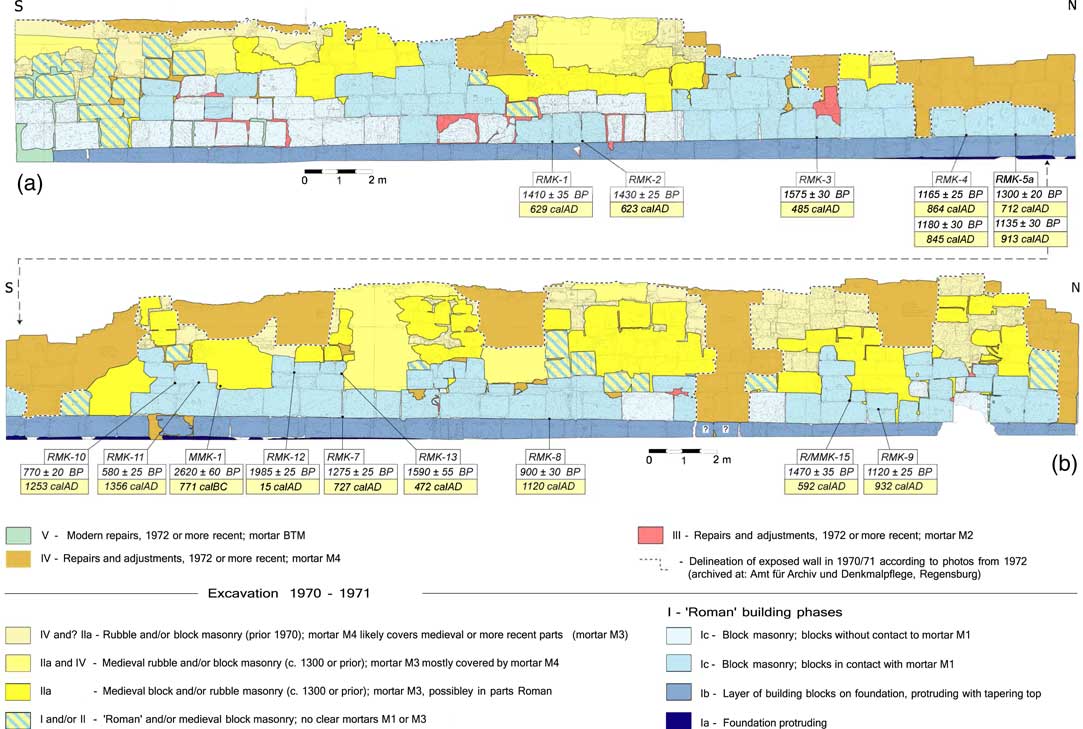
The stretch of wall at Dachauplatz at the east side of Castra Regina is one of the best-preserved parts of the fortification (see also 3D-reconstruction from 2013: http://www.arctron.de/de/galerie/galerie_archiv/2013/roemermauer_regensburg/). In 1970–1971 the eastern outer face of the wall was exposed when buildings on and next to the wall were demolished in order to allow for the construction of a parking garage. In 1972, the situation was documented in a series of photographs, which allow today the identification of original parts of the walls and discriminate them from modern additions and restorations. In preparation for the 14C AMS dating of charcoal from wall mortar, different types of mortar (M1-M4 and BTM) had been macroscopically identified and were then used to recognize different building phases of the fortification (Figure 6). Especially of interest was, to date the first—supposedly Roman—phases of the wall. In the foundation (phases Ia and Ib) no mortar was found between the blocks of lime stone. Mortar M1—whitish with pebbles up to 2 cm in diameter—sets in with the ashlars (Ic); there is not only mortar between the stones, but remains of mortar can be found also on the front of the wall. Charcoal fragments are quite frequent in mortar M1, which seems specific for Dachauplatz and has not been observed at other stretches of the castrum wall. Charcoal from mortar M1 from phase Ic was the main focus of the sampling and dating project. Altogether, 14 samples were taken and dated at the Leibniz Labor für Altersbestimmung und Isotopenforschung at Kiel, Germany. Two identical samples were sent to the Poznań Radiocarbon Laboratory in Poland. Ten of the 14 samples taken from mortar M1 yielded 14C ages between AD 400 and AD 1000, only one was of Roman date, the three others Late Medieval. The archaeologists had expected to get Roman dates—prior to AD 179—from this basal layer of the wall.
Regensburg, Dachauplatz (Germany), eastern/outward face of Roman/medieval city wall; building phases according to mortar types, documented in 2013: southerly (a, above) and northerly (b, below) parts with localization of charcoal samples and results of 14C AMS dating and calculated means of calibrated dates (modified from von Gosen et al. Reference Von Gosen, Dallmeier, Koch, Boos and Meerheim2013).

Authors have discussed different factors as possible sources of contamination that could have influenced the charcoal and caused the “data-shift” (von Gosen et al. Reference Von Gosen, Dallmeier, Koch, Boos and Meerheim2013). One of the concerns raised was that all samples were taken from the wall surface. Therefore, a drilling project has been set up to discriminate the mortar composition deep inside the wall and to obtain more charcoal for 14C dating. The results of this project were expected for spring 2017 (R. Koch, personal communication).
14C dating of charcoal is—in contrast to dating the carbonization process of mortar itself—a well-established method that is very unlikely to produce false results, at least not with such a high number of samples and the controlled circumstances described. Awaiting the results of the samples from deep drilling—which here seems to be the only way to gather samples not influenced by weathering and other surface factors, but at a world heritage site needs to argued for very convincingly—I would suspect the problem to adopt the new dates lies with long-held, uncontested opinions on the building history of many of our oldest stone monuments. Is it unthinkable that the wall at Dachauplatz could be—with regards to the standing structures, probably not the foundation—the product of continuous effort throughout the early middle ages to rebuild the crumbling remains of a past period with the original stones and a mortar that was prepared always in the same traditional way? These well-cut stones actually might not have needed mortar when they were fitted in Roman times, as we can observe in the foundation zones (Ia and Ib). But in medieval times, when wood was more abundant and limestone could be quarried from nearby ruins, mortar might have been the choice to refit stones from different locations with no mason’s effort involved.
Oberzeiring (Austria), “Roman” Bridge
Similar to Bavaria, Austrian colleagues in Styria recently felt inclined no longer to trust alone in the comparative approach of building history, but to gain scientific dates for debated archaeological features and some well-known monuments in their constituency. Of the three examples published by Hebert and Steinklauber (Reference Hebert and Steinklauber2015) only the “Roman Bridge” across the stream Blahbach at Unterzeiring near Oberzeiring shall be presented here. The simple archaic type of construction can be found with two other small bridges in the wider surroundings. All comply with the Roman road network, but so far have not provided evidence—apart from their colloquial denomination—for a construction date in the Roman period. Also, that they would survive intact for such a long time to the present day seemed very unlikely. A crack in the abutment on the left bank of the river allowed researchers to take a sample from the core of the—most likely original—masonry, thus avoiding the many obvious zones of later repair.
Thin sections of the mortar samples were produced to study their microstructure and mineralogical composition. Lime cement was extracted from the samples, and their respective distribution of carbon and oxygen isotopes analyzed. This method specifically is used at Graz University of Technology to select appropriate samples for 14C dating (Kosednar-Legenstein Reference Kosednar-Legenstein2007; Kosednar-Legenstein/Dietzel et al. Reference Kosednar-Legenstein and Dietzel2008). Two different mortar compositions could be discriminated: the wall mortar aggregate, which contains mainly quartz, feldspar, mica, garnet, and chlorite in a calcareous matrix, and the plaster, which differs in that the aggregate consists predominantly of limestone fragments. In both mortars, lime lumps were observed and taken as evidence for dry slaking. None of the samples contained dolomite, which if present would impede mortar dating (Dietzel Reference Dietzel2008 cited by Hebert and Steinklauber Reference Hebert and Steinklauber2015).
The 14C dates for the two samples from the “Römerbrücke” at Oberzeiring are given uncalibrated as 749±75 BP and 707±30 BP. Both samples—respectively the hardening of the mortars in the bridge construction—therefore roughly date to around AD 1300. The results seem to indicate that the so-called “Roman Bridge” in fact is medieval. The author suggests placing the erection of this monument in context with flourishing mining activities in the late Middle Ages.
It must be noted that in this case mortar dating was approached with just two samples and that no other dating method was sought for—such as OSL or the 14C age of organic material from the mortar—to check the results. As it has been established that there is no dolomitic limestone involved, which could lead to retarded hardening, the medieval date of the bridge is very likely.
DISCUSSION OF CASE STUDIES
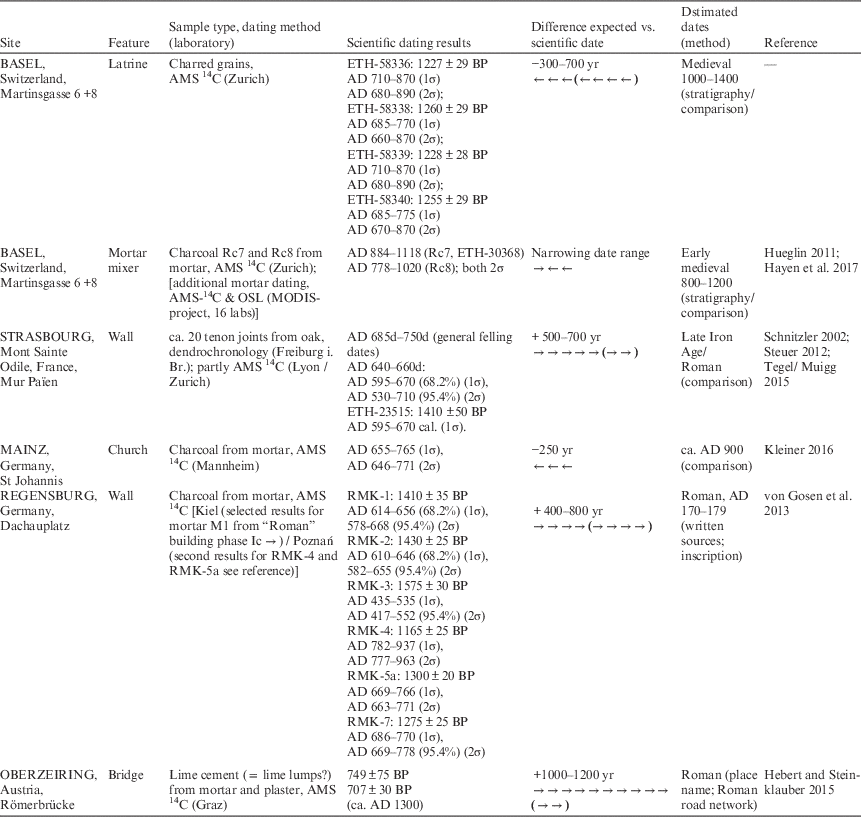
The previous examples show how scientific dating is the key to a new approach to often long and intensely studied features and monuments like the Mur Païen, St Johannis church at Mainz, the wall of the “Roman” fort at Regensburg, or the “Roman” bridge at Oberzeiring (Table 2). It also allows the dating of almost inscrutable “dark earth” strata and stratigraphically “isolated” features like the latrine and mortar mixer at Basel. With the traditional comparative methodology, better-documented epochs like the Roman period always dominate chronological assumptions about features and buildings. This chronological clustering effect leads to a loss of the possibility to recognize continuity in the use of buildings, and more generally, the reshaping and rebuilding of a town and its landscape. 14C and other scientific dating methods can help here to widen the perspective and especially also start to take notice of so-called transitional periods with no or little written sources to draw on. The Early Middle Ages is such a period between the Roman Empire and the medieval towns which has become more visible through scientific dating. It is especially also the upkeep of older monuments like Regensburg’s Roman city walls that can be brought to our awareness through scientific dating.
Overview of sites, samples, scientific dating results, and previous estimations with other methods. Each arrow stands for 100 yr and symbolizes the direction of change (← earlier vs. → later) and the sometimes enormous differences between expected dates and scientific results.

CHALLENGES AND POTENTIAL
Independent of historical period, challenges to 14C dating of organic material from mortar in general and to mortar dating in particular are twofold: methodological and epistemological. The first one, the methodological challenge is obvious, even trivial and certainly crucial: has the right sample been selected and has the method been applied correctly? The epistemological challenge lies on another level and can be described as: Are we asking the right question, if we are just trying to get the “right” date (cf. Boaretto and Poduska Reference Boaretto and Poduska2013)? Is it enough, if we want to know when this was built? There is more chronological information in mortar and in its organic components. It is therefore necessary to further develop the one-dimensional application of 14C dating with historic mortars into a method that characterizes mortars and the processes they undergo chronologically. This then can lead to a better understanding of components, composition, and circumstances of mortar-making for different applications. From just trying to date the beginning of a building, it would be possible to use scientific dating to study, for example, the settling processes of foundations and the hardness profiles in walls. Data on decay, restitution, or destruction of a structure are as interesting as the date of first erection.
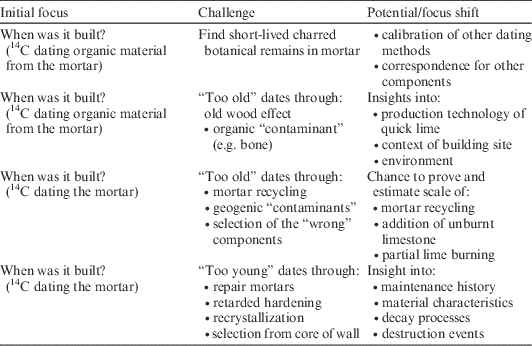
In the following paragraph, I will summarize the main methodological challenges for 14C when dating organic material extracted from mortar as well as when dating mortar itself. Beyond that, I will try to demonstrate the potential of chronological characterization of mortar, if the focus is shifted from getting the “right” date to the wider context in which historic mortar production and stone building takes place (Table 3).
Challenges for 14C dating of organic material from mortar, or mortar itself, and the potential shift of focus regarding research questions.

With organic material from mortar it is clear that charred, short-lived botanical remains will produce the most accurate dates for the moment when a building was erected. These results can act as guidelines for any other component of the mortar chosen to be dated scientifically and they can also be used as point of reference for the calibration of other dating methods. Dates of any other organic material from a mortar—be it wood fragments, charcoal, or bone—are likely to be older than the preparation of the mortar and in many cases just can be taken as a “terminus post quem,” a date after which the preparation took place. In 14C dating, this phenomenon is—with respect to charcoal and wood—known as the old-wood effect, but can occur with bone fragments, too. The old-wood effect is due to the fact that fragments from inner parts of tree trunks when 14C dated will produce results that match the time when the respective part of the stem was formed. If it was an old tree with many rings or if the wood had been around for a long time—for example as part of an earlier building—this will still lead to “naturally” older dates and will not answer the question when the structure in question was built. As there are often no charred remains of short-lived plants in the mortar, but very often fragments of charcoal the latter is used for dating. In this case, several pieces will yield a more reliable result, but the date should always be looked at as terminus post quem or the earliest possible moment after which the feature could have been installed. Beyond dating, charcoal remains in mortar can be used to explore the technology with which the quick lime was produced. Also, the tree species should be investigated as it holds information on forestry and historic land use.
There are still many methodological challenges for mortar dating, and they are described in Boaretto and Poduska (Reference Boaretto and Poduska2013) and other papers in this volume (cf. Hayen et al. Reference Hayen, Van Strydonck, Fontaine, Boudin, Lindroos, Heinemeier, Ringbom, Michalska, Hajdas, Hueglin, Marzaoili, Terrasi, Passariello, Capano, Maspero, Panzeri, Galli, Artioli, Addis, Secco, Boaretto, Moreau, Guibert, Urbanova, Czernik, Goslar and Caroselli2017). Attempts to calibrate the method face the difficulty that historic mortars have not been produced under standardized conditions or at a certain verifiable point in time. So far, mortar dates should not be used as single indicator for the age of a structure, but they can—combined with other dating and characterization methods and when sampling specific components of the mortar—give hints about its composition. If in relation to more reliable dates from organic material or the archaeological context, the results of the mortar dating are consistently far too old, this can point to a high percentage of unburnt limestone, which could have been added deliberately or be the result of partial burning. Another possibility is that mortar from earlier stone buildings has been reused, a hypothesis that should be tested with the help of thin sections and a comparison with actual remains of these older mortars. Mortar dating is the only method that can produce too-young dates for historic buildings. One possibility is of course that a repair mortar was sampled instead of one of the building phase that should have been dated. In this case, the result is correct and the fault lies with the archaeologist who did not recognize the repair. If there are enough samples such a mistake can be helpful to document and date not only building phases, but also the history of maintenance. The other instance when mortar dating invariably leads to too-young results is when hydraulic mortars like cocciopesto, dolomitic, or pozzolanic mortars are dated. They show retarded hardening especially in the inner parts of thick walls. While mortar dating in this case cannot help to date the erection of the building the 14C dates could possibly have been triggered by a final carbonation of the mortar in context with the decay processes or destruction events and could be connected with the end of a building. Again, this hypothesis needs to be tested on stone monuments with hydraulic mortars. Altogether it has to be further investigated to what degree mortar dates are influenced by preservation. Results from standing buildings seem to be more reliable than these from buried archaeological remains. It is clear that the latter through being exposed to rain water and earth are more likely to undergo changes in carbon isotope ratios, which are the basis for 14C dating.
Conclusion
Archaeologists and scientists need to continue to work more closely and to use 14C dating in unison with material characterization methods, for example, thin sections and other dating methods such as OSL, which has its own advantages and drawbacks. 14C dating of wood, charcoal, bones, and other organic matter is now a standard procedure and requires with the AMS method only a minimum of material. Archaeologists and physicists likewise are often not aware enough of the possibility of the old-wood effect, leading to results that are too old with respect to the time of the hardening of the mortar. The Basel mortar mixer shows how the dates from several charcoal pieces and animal bone fragments can differ by centuries, while only the youngest offers the terminus post quem—the date after which the feature was installed.
14C dating of mortar on the other hand still is in an experimental stage and far from becoming a standard method. But the problem generally is more fundamental and lies within the research question itself that focuses too much on dating buildings. For example, when we try to date mortar, we often date by mistake the geological age of a limestone fragment in it or the last time a hydraulic mortar was liquid, but not the time when the respective wall was built. 14C dating therefore tells us of the multiple temporal properties of composite materials like mortar, but also of the limestone, wood, and charcoal in it.
It can help to think of mortar as being “alive” while being prepared—the expression “quick lime” actually evokes the same impression—and as “dying” while hardening. This process actually allows stones to be united in a wall in the same way as it unites sand grains in its matrix. On the other hand, plants, animals, and humans—while they are alive—also contain older, already “dead” matter such as bones and stem wood. Scientists tend to be disappointed about geogenic contamination, mixed materials, or retarded hardening when the results do not comply with their and their clients’ expectations; archaeologists on the other hand often ignore and do not publish such results. We could learn a lot from them if we tried to understand that they answer questions we did not ask: they tell us not so much when, but with what, how and in which context mortar was produced.
Acknowledgments
I would like to thank all the colleagues that contributed to this paper with their engagement and advice. Regarding the Basel case study, they are Dr Irka Hajdas and Dr Georges Bonani (Eidgnössische Technische Hochschule (ETH) Zurich, Laboratory of Ion Beam Physics, Switzerland); Dr Pierre Guibert and Dr Petra Urbanova (15IRAMAT-CRP2A, UMR5060 CNRS-Université Bordeaux Montaigne, France); Dr Christoph Brombacher and Dr Philippe Rentzel (Integrative Prehistory and Archaeological Science (IPNA), University of Basel Switzerland); Guido Lassau, Kantonsarchäologe; Dr Andrea Hagendorn, Marco Bernasconi lic phil. and Dr Markus Asal (Archaeological Department of Canton Basel-Stadt (ADBS), Switzerland).
For Mont Saint Odile, I consulted Dr Willy Tegel (Institute of Forest Sciences/Forest Growth and Dendroecology, University of Freiburg im Breisgau, Germany) and Prof. Heiko Steuer (emeritus, Ur- und Frühgeschichtliche Archäologie/Archäologie des Mittelalters, University of Freiburg im Breisgau, Germany).
In the case of Mainz, I thank Susanne Lindauer, MSc, and Dr Ronny Friedrich (Curt-Engelhorn-Zentrum für Archäometrie (CEZA), Mannheim, Germany) as well as Marlene Kleiner MA (Institut für Europäische Kunstgeschichte, University of Heidelberg, Germany).
For Regensburg I got feedback from Prof. Werner von Gosen (GeoZentrum Nordbayern, Universität Erlangen-Nürnberg, Germany); Prof. Dr Roman Koch (Friedrich-Alexander-Universität Erlangen-Nürnberg, Germany; Geozentrum Nordbayern, Paläoumwelt, Angewandte Sedimentologie und Bausteinforschung); and Dr Andreas Boos (Museen der Stadt Regensburg, Abteilung Archäologie, Regensburg, Germany).
Prof. Martin Dietzel (Technische Universität Graz, Austria, Institut für Angewandte Geowissenschaften) made me aware of the dates from Oberzeiring, and Dr Bernhard Hebert (Bodendenkmalpfleger des Bundesdenkmalamtes am Landeskonservatorat für Steiermark, Austria) provided me with the archaeological background.