Implications
This research provides new insight into how domestic chicks and mature fowl ascend ramp inclines, using the assistance of their wings for inclines steeper than 40°. A wire grip surface, rather than sandpaper, allowed for a higher rate of successful ascent on all inclines and reduced frequency of wing use. Mature birds were more willing to perform aerial behavior than young chicks. We suggest using wire grid ramps to improve three-dimensional space use by layer hens within multi-tiered systems. We hypothesize this will reduce the frequency of injuries such as keel bone damage, while fostering calm and effective locomotion.
Introduction
Keel bone damage in laying hens is a major animal welfare concern. Keel bone damage affects over 80% of adult egg-laying birds, specifically birds kept in complex environments (Wilkins et al., Reference Wilkins, McKinstry, Avery, Knowles, Brown, Tarlton and Nicol2011). Complex housing environments, such as multi-tier systems, generally consist of multiple stacked tier layers in a shelf-like manner and provide internal structures such as feeders, drinkers, nest boxes and perches (Blokhuis et al., Reference Blokhuis, Fiks Van Niekerk, Bessei, Elson, Guémené, Kjaer, Maria Levrino, Nicol, Tauson, Weeks and Van De Weerd2007). Current understanding of the potential causes of keel bone damage in complex housing systems is limited (Harlander-Matauschek et al., Reference Harlander-Matauschek, Rodenburg, Sandilands, Tobalske and Toscano2015). As the prevalence and the severity of keel bone damage increases with internal structure complexity (Wilkins et al., Reference Wilkins, McKinstry, Avery, Knowles, Brown, Tarlton and Nicol2011), it is assumed that internal structure/environmental complexity comes at the cost of increased risk for keel bone damage/trauma (Sandilands et al., Reference Sandilands, Moinard and Sparks2009). It has been shown that the ability of laying hens to successfully navigate/negotiate internal structures, such as perches, depends on heights and angles (Scott et al., Reference Scott, Lambe and Hitchcock1997). However, there is no proof which links unsuccessful laying hen navigation, which potentially results in collisions with the system, to keel bone damage. Nevertheless, providing a more continuous path between adjacent tiers by installing horizontal and inclined platforms (ramps), and thus probably supporting bipedal locomotion, reduced keel bone damage (verified by palpation) in adult laying hens for a major portion of life (Stratmann et al., Reference Stratmann, Fröhlich, Gebhardt-Henrich, Harlander-Matauschek, Würbel and Toscano2015). However, the mode of locomotion on these horizontal and inclined structures was not recorded.
Muir (Reference Muir2000) showed that female chicks are able to locomote using only their legs within 6 to 8 hours after hatching and that neonatal chicks prefer to be in contact with the horizontal ground while supported by two legs. However, when escaping on level ground, neonatal chicks prefer to walk or run with the additional assistance of their wings (Collias and Collias, Reference Collias and Collias1967). Similarly, adult domestic fowl navigate the environment by spending 70% of their active time foraging while walking on the ground (Collias et al., Reference Collias, Collias, Hunsaker and Minning1966). When threatened, Galliformes can outrun predators and use their wings for brief escape flights (Dial and Jackson, Reference Dial and Jackson2011). Domestic fowl seek elevated refuges only when they are threatened or roosting (Jones and Goth, Reference Jones and Goth2008). When roosting, they fly up to the lowest branch of a tree and from there make their way further up, branch by branch. They return by flying directly to the ground (Savory, personal communication; see Moinard et al., Reference Moinard, Statham, Haskell, McCorquodale, Jones and Green2004).
Studies examining bird locomotion on inclines have mainly focused on wild birds and the mechanical demands upon the hind limbs (e.g. Roberts et al., Reference Roberts, Marsh, Weyand and Taylor1997), with less focus on wing mechanics (Birn-Jeffery and Higham, Reference Birn-Jeffery and Higham2014). However, moving along an incline in comparison with level surfaces involves much greater effort and may be challenging to control. Climbing requires additional effort to move because work must be performed against gravity (Birn-Jeffery and Higham, Reference Birn-Jeffery and Higham2014). The challenges of climbing for layer hens, as they are constantly gravid, are likely to be proportionally higher than in wild birds. The proportion of body tissue devoted to reproduction affects walking kinematics in chickens (Rose et al., Reference Rose, Codd and Nudds2016). In order to avoid injury during climbing, birds prevent uncontrolled movement by using their feet as the first and last contact with the surface (Pike and Maitland, Reference Pike and Maitland2004) while maintaining balance with their wings (Necker, Reference Necker2006). As Schmitt (Reference Schmitt2010) demonstrates, the grasping of extremities to a surface material and the frictional properties of the surfaces are essential for securely holding onto and climbing on inclined planes.
Wild Galliform birds, including the Brush-turkey (Alectura lathami) and chukar partridge (Alectoris chukar), employ age-dependent modes of locomotion during incline walking: asymmetric flapping immediately after fledging transitions to wing-assisted incline running (WAIR), in which the wings generate forces that supplement the work of the hind limbs by accelerating the animal upward and toward the substrate (Tobalske and Dial, Reference Tobalske and Dial2007; Jackson et al., Reference Jackson, Tobalske and Dial2011). Flapping movements in wild Galliform birds is used primarily for escape from a threat to achieve a refuge (Tobalske and Dial, Reference Tobalske and Dial2000). As such, the birds use high-amplitude, high angular velocities of wing movement, with disproportionally high wingbeat frequencies for their size. Coupling these vigorous wing movements with high wing loading, they are not adept at maneuvering (Tobalske and Dial, Reference Tobalske and Dial2000). Relating this to layer hens, we therefore reason, subject to future testing, that climbing without using their wings likely offers a safer form of ascent compared with WAIR or flight. To test whether layer hens also use the rapid, high-amplitude flapping typical of other Galliformes, we measured wingbeat kinematics in relation to climbing angle.
In the current study, we investigated age-dependent responses of four commercial strains of domestic fowl (Lohmann Brown, Lohmann LSL lite, Dekalb White and Hyline Brown) to various inclined surfaces in order to reach an elevated tier in a test arena. To determine potential differences in locomotor performance on various inclines, we assessed the following: (1) Do domestic fowl successfully (bird reaches the tier with both feet on the tier) climb various inclined surfaces at two different tier heights? (2) How do birds differ in their mode of locomotion (walking, WAIR or aerial ascent) as inclines become steeper? (3) Are the success rates (bird reaches the tier with both feet) and modes of locomotion dependent on (a) ontogenetic stage, (b) strain or (c) surface material? (4) How do wing morphology (wing loading) and kinematics (angular velocity, wingbeat amplitude and wingbeat frequency) relate to locomotor performance?
First, we hypothesized that domestic fowl would require different strategies for successfully reaching (with both feet) the two different tier heights. Based on prior research using wild-type birds demonstrating that locomotion is dependent on body mass, locomotor machinery and medium (Dial, Reference Dial2003), we predict that domestic chickens would show an increase in the use of WAIR or flight when ascending steeper inclines and that the capacity to climb on steeper inclines without resorting to WAIR should increase with age and experience. Lastly, we predicted that providing improved grip on a substrate (wire grid compared with sandpaper) would reduce the use of WAIR for a given incline. Overall, our goal was to identify maximum climb angles that are likely to result in safe (calm, non-flapping) locomotion for different age classes of layer hens.
Material and methods
Animals and housing
This study was approved by the University of Guelph Animal Care Committee (Animal Utilization Protocol Number 2501) before testing. A total of 20 domestic fowls comprising four different strains (Lohmann Brown, Lohmann LSL, Dekalb White and Hyline Brown; n=5 for each strain) were divided into four home pens with the strains separated by pen (one strain per pen). The home pens (182×243×280 cm) contained wood shavings on the floor, a total of four platforms at two platform heights mirrored within each pen (70 and 160 cm), and a wooden ramp (width=15 cm) and ladder (width=15 cm) at 45° to vertically connect them. The birds were provided with a dark brooder box with a heat pad until they were 8 weeks of age, and nest boxes were put in each pen at 16 weeks of age. Birds were provided with water and feed ad libitum and a standard commercial management plan was provided.
Experimentation
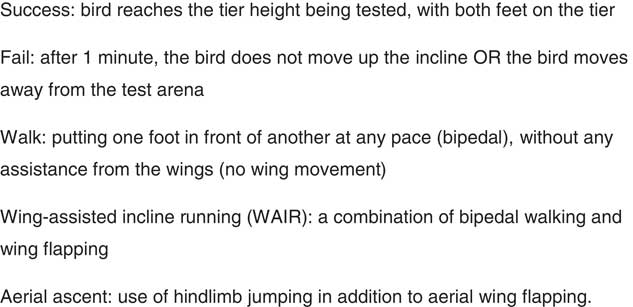
Starting on their second week of life, each bird was tested once on various walkway inclines (0° (horizontal control), 20°, 30°, 40°, 50°, 60°, 70°), with two different walkway (15 cm wide) surface materials (60-grit Mastercraft sandpaper and 2.5 cm2 wire mesh grid), at two constant tier heights (70 and 160 cm). Flat starting (37 cm length on the ground) and landing (41 cm length) platforms flanked the incline sections of the walkway. Each test consisted of a bird beginning in the start box until the start door was lifted (after 3 s). The bird then had one minute (determined from pilot study) to climb up to the tier height being tested. Chicks were provided with motivation to climb using five same-age chicks in a crate on each tier in addition to providing a tablespoon of their commercial feed along with five raisins for each tier. Experimenters were blinded to the strains during the entire testing period. Experimenters observed the behavior of each bird for each incline tested from outside the test arena via a JVC GC-PX100BU HD Everio camcorder. When birds were successful (see ethogram, Figure 1), the mode/modes of locomotion were observed and recorded. All subjects were presented with all inclines in weeks 2, 3, 4, 5, 6, 7, 8, 9, 11, 13, 15, 17, 19, 21, 26, 31 and 36 (see Supplementary Material Videos S1 and S2 for illustrating wing-assisted incline running).
Ethogram describing the behavior of birds observed on the walkway inclines.

Morphometrics and kinematics
Each bird was weighed (kg) using a digital scale (Model #JL6001-GE, Mettler-Toledo, Inc., Mississauga, Ontario, Canada) and photographed with their wings spread against a solid background in order to obtain wing area (m2; analyzed using ImageJ®; Rasband, Reference Rasband1997–2016) to calculate wing loading (BW divided by surface area of both wings; N/m2) (Dial and Jackson, Reference Dial and Jackson2011). These variables were measured on a weekly basis for weeks 2- to 9 of testing, biweekly for weeks 11 to 21, and every 5 weeks from weeks 26 to 36. We tested for an effect of increasing age and wing loading upon wing use by focusing on a subsample of ages (2 to 9 weeks) and on one incline angle (50°) and substrate (sandpaper) that generally induced WAIR for this age interval. We marked the wings of the birds using non-toxic 2-mm dots of contrasting (white or black) acrylic paint on the feathers overlying the shoulder and wrist. A high-speed video camera (JVC GC-PX100BU HD Everio 600 Hz) was placed directly in line with the locomotor path of a given bird and thus provided a frontal view of both wings, orthogonal to the path of the wing stroke. Using these video sequences, we manually digitized the shoulder and wrist points using the MATLAB script DLTdv5 (Hedrick, Reference Hedrick2008). We defined the start and end of downstroke based upon movement of the wrist relative to the shoulder. Using the digitized points, we calculated downstroke duration (s), wingbeat amplitude (°) as the total change in angle between the start and end of downstroke, and angular velocity (rad/s) as amplitude divided by duration of downstroke.
Statistical analysis
Data were analyzed in three groups: weeks 2 to 4, 5 to 7 and 8 to 36. The purpose of the analysis of weeks 2 to 4 was to compare how chicks managed the inclines for only the 1st tier height (70 cm) and using only the sandpaper covered ramps. Testing on the wire mesh grid began when birds were 5 weeks of age when their feet were physically large enough to grip the grid and not fall through. Analysis of weeks 5 to 7 compared the behavior of the birds on both (sandpaper and wire mesh grid) surface materials for the 1st tier height only (70 cm). Birds were only tested on the 2nd tier height (160 cm) when the subjects began utilizing tier 2 in their home pens (8 weeks of age). Finally, analysis of weeks 8 to 36 compared the behavior of the birds on both surface materials (sandpaper and raised wire mesh grid) for both tier heights (70 and 160 cm).
Statistical analysis was performed using the generalized linear mixed model procedure (PROC GLIMMIX) in SAS version 9.4 (2012; SAS Institute Inc., Cary, NC, USA). Plots of studentized residuals were used to assess normality and confirm the best fitting distribution. Full models with all fixed and random effects were then fit to the appropriate distribution and model fitting criteria were used to select the best fitting model.
Reaching the tier height with both feet on the tier (=successful trial), walking, WAIR and aerial ascent for each walkway test was calculated (n=5 for each strain, total n=20 birds) based on a binary distribution. For weeks 2 to 4 analysis, the strain, week (age), incline and interactions (strain×week, strain×incline and week×incline) were included as fixed effects. For weeks 5 to 7 analysis, the strain, week (age), incline, material, and interactions (strain×week, strain×incline, strain×material, material×week, week×incline, and incline×material) were included as fixed effects. For weeks 8 to 36, the strain, week (age), incline nested within tier height, material, and interactions (strain×week, strain×incline, material×week, week×incline, incline×material, tier×material, tier×week, tier×strain, incline (tier), material×incline (tier), strain×incline (tier), and week×incline (tier)) were included as fixed effects. All three sets of analysis included the co-variable of week×wing loading. Parameters were estimated using LAPLACE integral approximation (METHOD=LAPLACE). A compound symmetry structure (TYPE=CS) was fit with bird nested within strain as the repeated measure subject. All dependent variables (count outcomes) were fit with complementary log-log link (LINK=CCLL). Denominator degrees of freedom were determined using the Containment method in the GLIMMIX procedure. Results are presented as mean estimates±standard error of the mean in the results, and raw data is presented as percentage of bird’s±standard error in the graphs.
The same GLIMMIX procedure was used for the morphological and kinematic data except for some minor differences. The Gaussian distribution was fit for all the following variables: wing loading, log body mass, log wingbeat frequency, log wingbeat amplitude and log angular velocity. A first order autoregressive covariance structure (TYPE=AR (1)) was fit as the repeated measure subject for the wing loading, log body mass, log wingbeat frequency and log angular velocity data. A heterogeneous AR (1) covariance structure (TYPE=ARH (1)) was fit as the repeated measure subject for the log wingbeat amplitude variable. The Kenward–Roger method (DDFM=KR) was used to determine denominator degrees of freedom for wing loading and log body mass data. The Containment method (DDFM=CONTAIN) was used to determine denominator degrees of freedom for log wingbeat amplitude, log wingbeat frequency and log angular velocity. Wing loading results are presented as an average for each strain across weeks±standard error of the mean. Results are presented as raw data for log wingbeat frequency, log wingbeat amplitude and log angular velocity plotted against log body mass±standard error. Statistical comparisons performed on the model scale were considered significant at P<0.05, and displayed in the graphs if P<0.05, P<0.01 and P<0.001.
Results
Weeks 2 to 4 (1st tier height only and sandpaper covered inclines)
All chicks were successful on 0°, 20°, 30° and 40° inclines. When considering 50° and 60° (F 1,129.5=4.19, P=0.0427), the number of successful tests decreased to 93% and 62%, respectively, as the inclines became steeper (t 129.5=2.05, 2.79±1.36, P=0.0427). All chicks performed walking behavior on 0°, 20°, 30° and 40°, and therefore did not employ WAIR. When considering 50° and 60° inclines, chicks performed walking and WAIR behavior on the 50° incline, but did not perform walking behavior on the 60° incline. There was a significant (F 3,128.9=3.24, P=0.0243) strain×incline effect for WAIR behavior which can be attributed to the fact that Lohmann LSL lite chicks performed more WAIR on 60° (83% of successful trials, ages grouped together) compared with 50° (42% of successful trials, ages grouped together) (t 128.9=−2.23, −1.52±0.70, P=0.0275). All other strains performed more WAIR on 50° (71% of successful trials, ages grouped together) compared with 60° (53% of successful trials, ages grouped together).
Weeks 5 to 7 (1st tier height and both surface materials on the inclines)
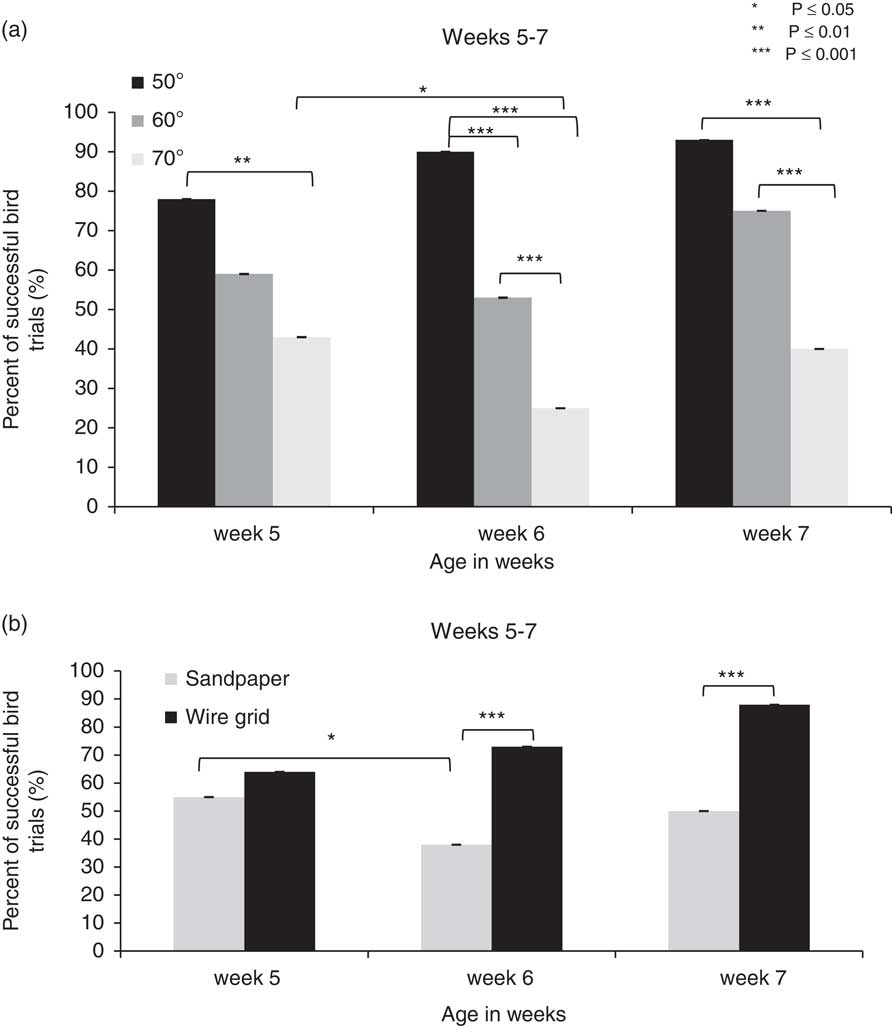
All birds were successful on 0°, 20°, 30° and 40° inclines for both materials. When considering 50°, 60° and 70° for both materials, there was a significant (F 4,279.3=2.86, P=0.0237) week×incline effect. This could be attributed to an increase in success rate across weeks (weeks 5, 6 and 7) for the 50° incline, but not for the 60° and 70° inclines (Figure 2a). In week 6, there were a lower number of successful tests compared with weeks 5 and 7 on the 60° and 70° inclines (Figure 2a).
Percentage of successful trials to reach the 1st tier height on 50°, 60° and 70° inclines for four strains (Hyline Brown, Lohmann Brown, LSL lite and Dekalb White) (n=5 for each strain, displayed together, total=20) of birds in weeks 5, 6 and 7 of life (±SE). (a) Each incline across weeks. (b) Each material across weeks.

Weeks 5 to 7 (1st tier height and both surface materials on the inclines)
There were also significant material×incline (F 2,279.3=4.75, P=0.0093) and material×week (F 2,279.3=4.73, P=0.0096) effects for successful tests. For both materials, there was no difference in the number of successful tests on the 50° incline; however as inclines became steeper (60° and 70°), birds were more successful on the wire grid material (60°: t 279.3=−3.70, −1.29±0.35, P=0.0003; 70°: t 279.3=−4.89, −2.27±0.46, P<0.0001) compared with the sandpaper material. In addition, as the birds aged, they were more successful on the wire grid material.
All birds performed walking behavior on 0°, 20° and 30° inclines, and did not perform WAIR behavior. There was a significant (F 1,58=7.35, P=0.0074) material×incline effect when considering walking behavior on 40° (95% of successful trials) and 50° (78% of successful trials) inclines. As inclines became steeper (50°) there was much less walking behavior performed on the sandpaper material (40°: 85% of successful trials; 50°: 17% of successful trials) compared with wire grid material (40°: 95% of successful trials; 50°: 78% of successful trials) (t 158=−5.16, −3.14±0.61, P<0.0001). Birds did not perform any walking behavior on 60° and 70° inclines for both surface materials.
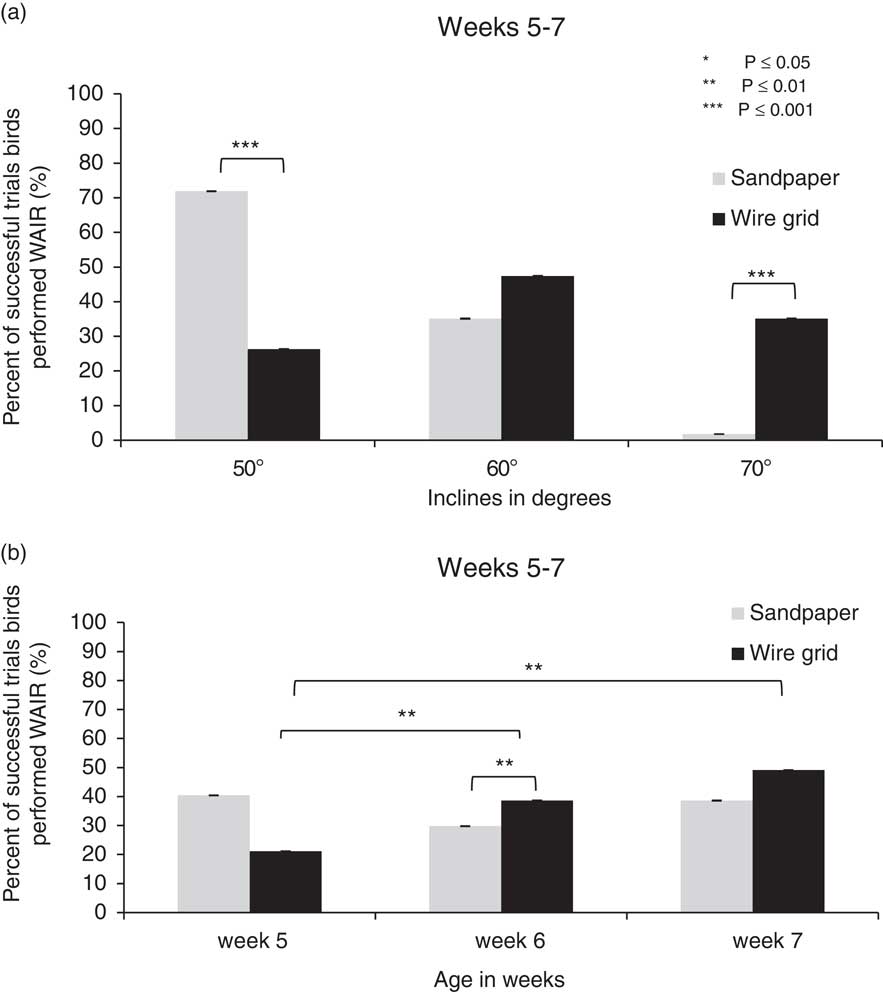
Similar to weeks 2 to 4, birds did not perform WAIR behavior until ascending 50°, 60° and 70° inclines. There was a significant (F 4,265=3.50, P=0.0083) week×incline effect which may be due to the fact that in weeks 6 and 7 birds decreased in performing WAIR behavior as the inclines became steeper (see next section, aerial ascent), but birds in their 5th week of life performed more WAIR on 60° (45% of successful trials) compared with 50° (34% of successful trials) (t 265=−2.82, −1.49±0.53, P=0.0051). There was also a significant (F 2,265=18.94, P<0.0001) incline×material effect for WAIR behavior. Birds performed more WAIR behavior on the sandpaper material for the 50° incline (t 265=5.24, 2.25±0.43, P<0.0001), but the opposite occurred for the 70° (7% of successful trials) incline due to birds performing more WAIR on wire grid material (Figure 3a). There was also a significant (F 2,265=5.83, P=0.0033) week×material effect, which can be attributed to the fact that birds performed more WAIR on the sandpaper material in week 5, but as the birds increased in age (weeks 6 and 7), they performed more WAIR on the wire grid material (Figure 3b).
Percentage of successful trials for birds performing wing-assisted incline running (WAIR) to reach the 1st tier height on 50°, 60° and 70° inclines for four strains (Hyline Brown, Lohmann Brown, LSL lite and Dekalb White) (n=5 for each strain, displayed together) of birds in weeks 5, 6 and 7 of life (±SE). (a) Each material on the inclines. (b) Each material across weeks.

Aerial ascent did not begin until the birds were in their 4th week of life. However, during weeks 5 to 7 when considering 40°, 50°, 60° and 70°, there were significant (F 3,372=7.42, P<0.0001) incline and (F 1,372=15.10, P=0.0001) material main effects. Birds performed significantly more aerial ascent on the 60° (25% of successful trials) and 70° (29% of successful trials) inclines compared with 40° (6% of successful trials) and 50° (7% of birds) (60° v. 40°: t 372=−3.27, −1.68±0.51, P=0.0012; 60° v. 50°: t 372=−3.33, −2.04±0.61, P=0.0010; 70° v. 40°: t 372=−3.39, −1.75±0.52, P=0.0008; 70° v. 50°: t 372=−3.43, −2.11±0.62, P=0.0007). In addition, birds performed more aerial ascent on inclines with wire grid surface material (24% of successful trials) compared with sandpaper surface material (9% of successful trials) (t 372=−3.89, −1.60±0.41, P=0.0001).
Weeks 8 to 36 (1st and 2nd tier heights with both surface materials for each)
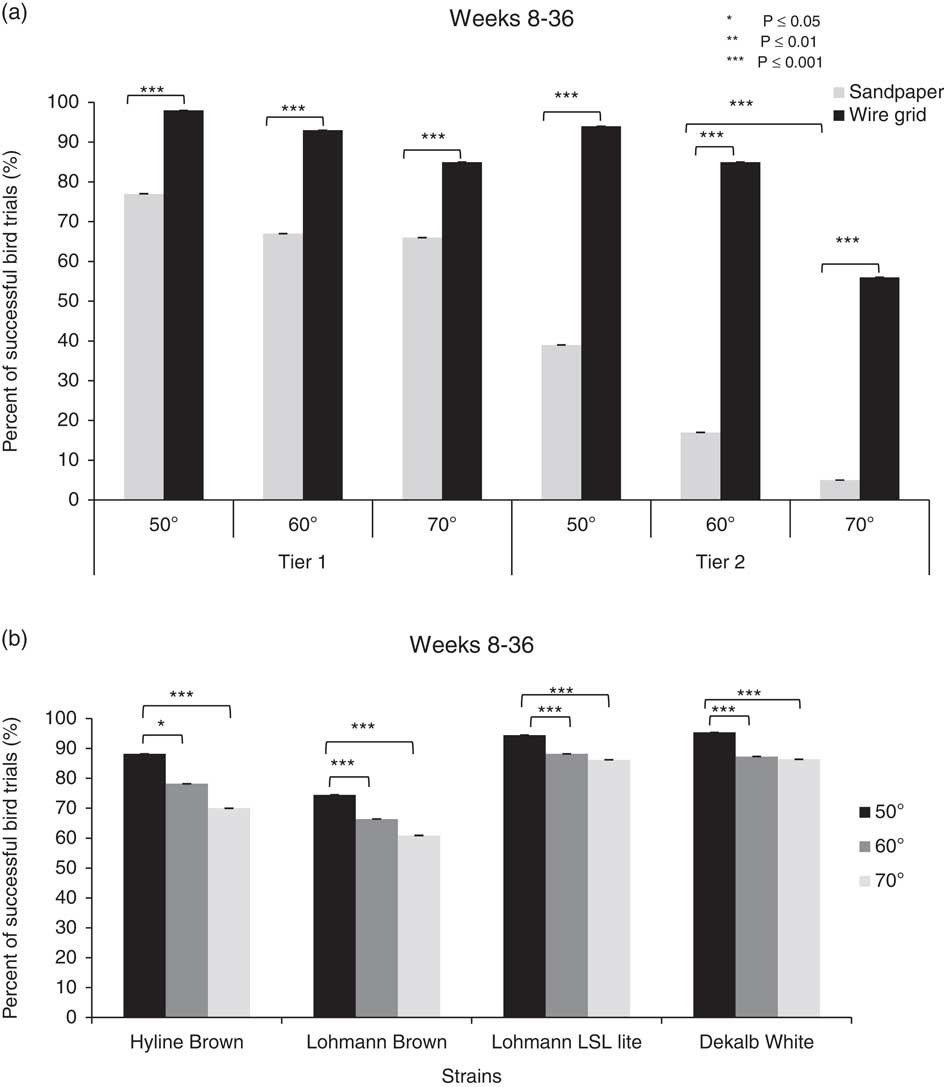
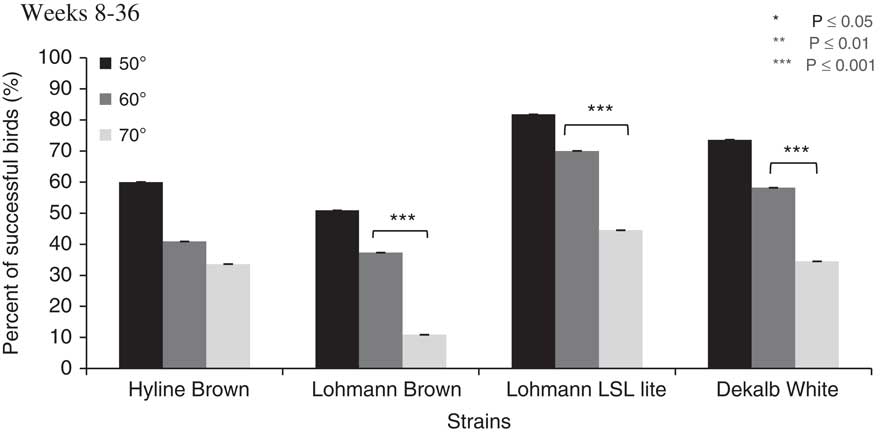
During this stage of development, birds were successful at mastering 20°, 30° and 40° inclines. When considering 50°, 60° and 70° there was a significant (F 2,2330=5.74, P=0.0033) material×incline(tier) effect (Figure 4a). Interestingly, when birds were tested on the higher tier (160 cm), the wire grid material was more important for success, which was reflected by this interaction. For sandpaper covered inclines, there was a significant decrease in success rate for the 2nd tier height (39%, 17%, 5% of successful trials), but not for the 1st tier height (77%, 67%, 66% of successful trials) (Figure 4a).
Percentage of successful trials to reach the 1st tier height on 50°, 60° and 70° inclines for four strains (Hyline Brown, Lohmann Brown, LSL lite and Dekalb White) (n=5 for each strain) of birds in weeks 8 to 36 (ages grouped together) of life (±SE). (a) Each incline for both tier heights comparing the materials. (b) Each incline for the 1st tier height comparing the different strains.

There was also a significant (F 6,2330=2.47, P=0.0218) strain×incline (tier) interaction for bird success (Figure 4b and 5). On the 1st tier height, birds were always more successful at 50° while there was no difference in success at 60° and 70° (Figure 4b). However, on the 2nd tier, as inclines became steeper, Lohmann LSL lite, Lohmann Brown and Dekalb White birds experienced a significant decrease in their success rates, but Hyline Brown birds did not have a significant decrease in success from 60° to 70° (Figure 5).
Percentage of successful trials to reach the 2nd tier heights on 50°, 60° and 70° inclines for four strains (Hyline Brown, Lohmann Brown, LSL lite and Dekalb White) (n=5 for each strain) of birds in weeks 8 to 36 (ages grouped together) of life (±SE).

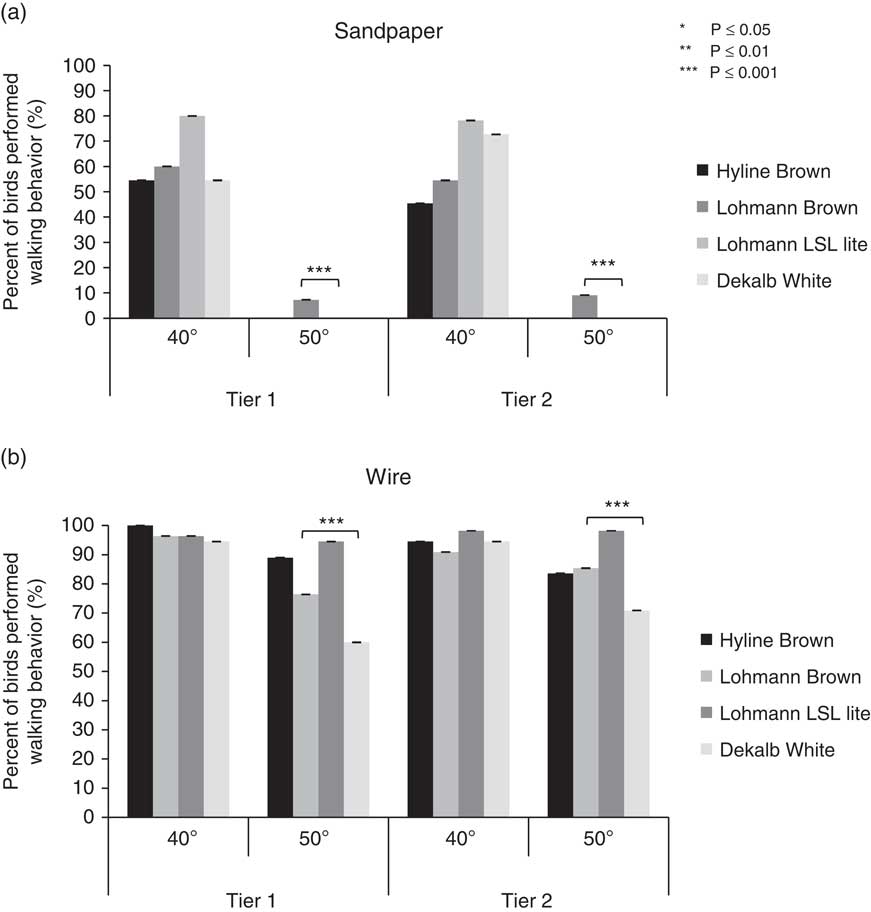
All birds performed walking behavior on 0°, 20° and 30° inclines, and did not perform WAIR. When considering a comparison between 40° and 50° there was a significant (F 3,1481=5.31, P=0.0012) strain×incline interaction. For sandpaper material covered inclines, the Lohmann Brown strain was the only strain to perform walking behavior on the 50° incline for both tier heights (Figure 6a). For the wire grid material, the Hyline Brown, Lohmann Brown and Dekalb White birds demonstrated a decrease in walking behavior as the inclines became steeper (50°), but the Lohmann LSL lite strain demonstrated the same amount of walking behavior for both inclines (Figure 6b). Birds did not perform any walking behavior on 60° and 70° inclines for both surface materials.
Percentage of successful trials for birds performing walking behavior to reach the 1st and 2nd tier heights on 40° and 50° inclines for four strains (Hyline Brown, Lohmann Brown, LSL lite and Dekalb White) (n=5 for each strain) of birds in weeks 8 to 36 (ages grouped together) of life (±SE). (a) Sandpaper covered inclines for both tier heights within each strain. (b) Wire grid covered inclines for both tier heights within each strain.

There were also significant (F 3,1481=3.12, P=0.0252) strain×material and tier×strain (F 3,1481=4.19, P=0.0058) interactions. All strains performed more walking behavior on the wire grid material compared with the sandpaper material; however, the difference was much greater for Hyline Brown birds compared with the other strains. This was demonstrated by the fact that Lohmann Brown birds performed significantly more walking behavior on the sandpaper material compared with Hyline Brown (t 1481=−2.61, −1.11±0.43, P=0.0092), and conversely, the Hyline Brown birds performed significantly more walking behavior on the wire grid material compared with the Dekalb White birds (t 1481=1.96, 1.04±0.53, P=0.0497). Lohmann LSL lite and Lohmann Brown demonstrated no differences in the amount of walking behavior when comparing both tier heights. Hyline Brown birds (t 1481=2.28, 1.23±0.54, P=0.0229) and Lohmann Brown birds (t 1481=2.87, 1.43±0.50, P=0.0042) performed significantly more walking behavior compared with Dekalb White birds on the 1st tier height.
Birds started to perform WAIR at 40° and continued to do so at 50°, 60° and 70°. There was a significant (F 30,3180=1.62, P=0.0179) week×incline (tier) interaction. When considering the 1st tier height, birds in weeks 8 (t 3180=−3.41, −1.91±0.56, P=0.0007), 9 (t 3180=−3.68, −2.46±0.67, P=0.0002) and 11 (t 3180=−3.66, −2.45±0.67, P=0.0003) performed more WAIR behavior on steeper inclines (60°) compared with 40°. As the birds grew older in week 13 (t 3180=3.11, 2.63±0.85, P=0.0019), 17 (t 3180=1.98, 1.62±0.82, P=0.0476), 19 (t 3180=3.87, 4.56±1.18, P=0.0001), 21 (t 3180=2.77, 1.98±0.71, P=0.0057), 26 (t 3180=5.08, 4.10±0.82, P<0.0001), 31 (t 3180=2.99, 3.64±1.22, P=0.0028) and 36 (t 3180=4.15, 3.65±0.88, P<0.0001) they performed more WAIR on shallower inclines (40° and 50°) compared with the steeper inclines (60° and 70°). For the 2nd tier height, when the birds were 8 weeks of age (t 318=−3.71, −3.99±1.06, P=0.0002) they performed more WAIR on 70° incline compared with 40°, and as they matured (weeks 13 to 36) they demonstrated no differences in WAIR behavior for the inclines.
Birds started to perform aerial ascent on the 40° incline and continued for 50°, 60° and 70° for this age class. There were significant (F 3,3183=2.34, P<0.0001) material×incline and (F 10,3183=2.51, P=0.0084) week×material interactions. Birds performed significantly more aerial ascent on the sandpaper material at 50° (t 3183=6.13, 2.30±0.40, P<0.0001) and 60° (t 3183=4.13, 0.93±0.22, P=<0.0001), but this was the opposite for 70° (t 3183=−2.85, −0.68±0.24, P=0.0044), where birds performed more aerial ascent on the wire grid material. As birds developed, there was an increase in the number of birds performing aerial ascent on both materials; however, there was more of a dramatic effect for the sandpaper material; the difference in the amount of aerial ascents performed for the materials was much greater. Birds at 31 weeks of age (t 3183=−2.55, −2.55±1.00, P=0.0108) and 36 weeks of age (t 3183=−2.42, −3.32±1.37, P=0.0157) performed significantly more aerial ascents compared with birds at 15 weeks of age on the sandpaper material.
Kinematics and morphometrics (weeks 2 to 9)
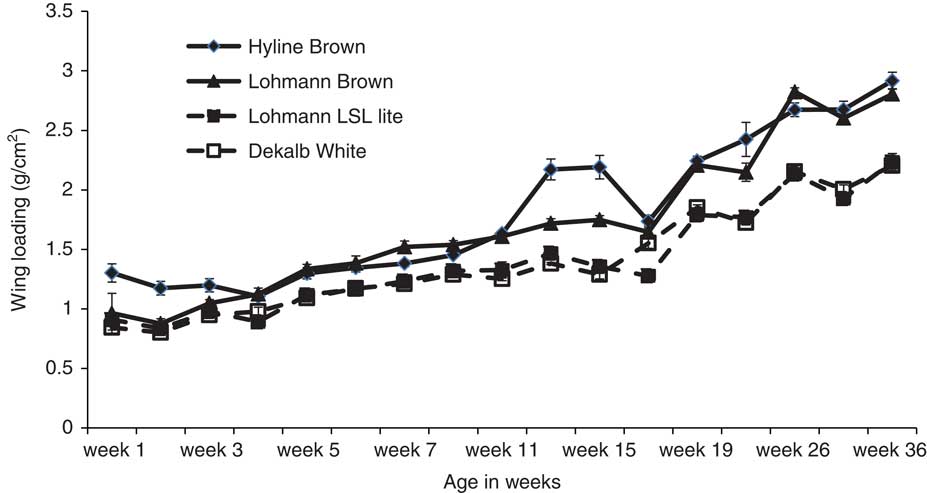
The body mass of the birds had a significant strain×week interaction (F 21,54.44=4.21, P<0.0001) which could be attributed to Hyline Brown and Lohmann Brown birds having the lowest body masses in week 2 of life, but then increased to the highest in week 9. Conversely, the Lohmann LSL lite and Dekalb White birds demonstrated the highest body mass in week 2 but then decreased to lowest in week 9. There was an obvious increasing trend in wing loading throughout development, with brown-feathered strains having higher wing loading compared with white-feathered strains (Figure 7). However, there was no effect of week×wing loading as a co-variable across all age groups.
Average wing loading (±SE) represented in a graph within four strains of birds (Hyline Brown, Lohmann Brown, LSL lite and Dekalb White) (n=5 for each strain) throughout development.

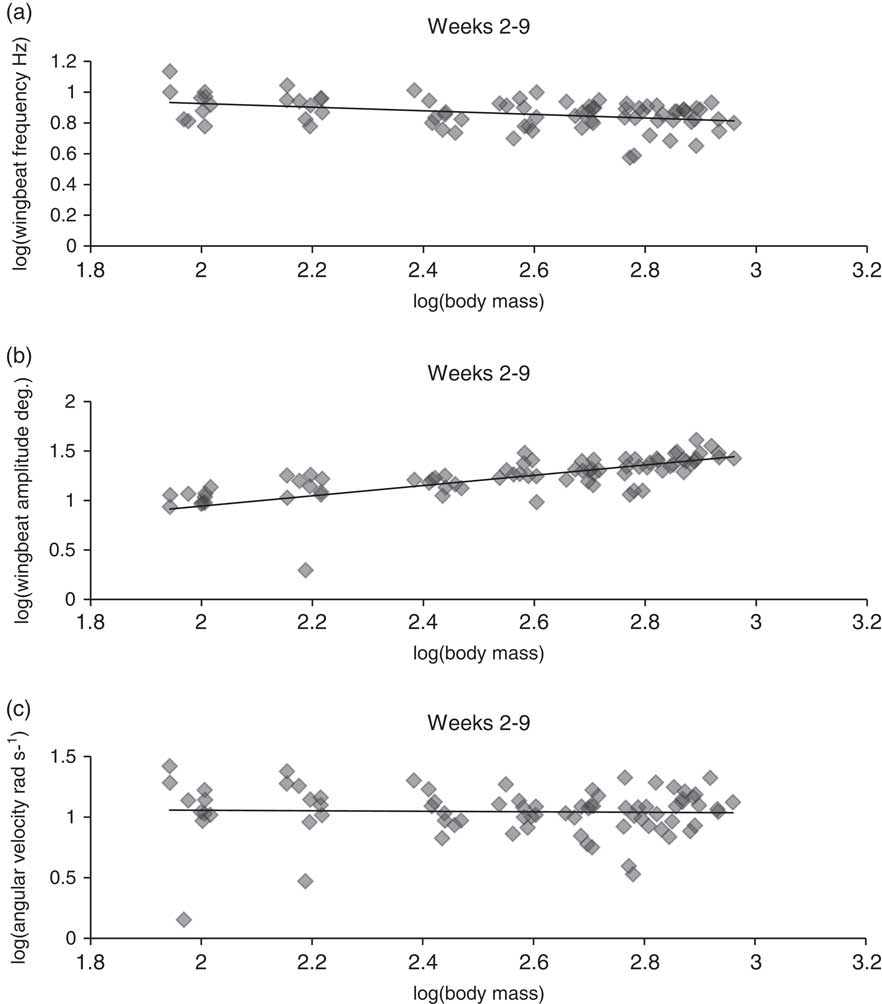
The wingbeat frequency and wingbeat amplitude of the birds significantly changed as the bird’s increased in body mass (wingbeat frequency: F 1,35.9=9.05, P=0.0048; wingbeat amplitude: F 1,9.89=45.27, P<0.0001) (Figure 8a and b). The wingbeat frequency gradually decreased as body mass increased while the wingbeat amplitude gradually increased. There was no effect of strain for wingbeat frequency and wingbeat amplitude and the angular velocity did not change as the bird’s body mass increased. There was also no effect of strain (Figure 8c).
Log body mass relative to (a) log wingbeat frequency (b) log wingbeat amplitude and (c) log wing angular velocity of four strains of birds (Hyline Brown, Lohmann Brown, LSL lite and Dekalb White) (n=5 for each strain, displayed together) in weeks 2 to 9 of life tested on the sandpaper covered 50° incline.

Discussion
In this study we tested four strains of domestic fowl throughout development in their ability to ascend inclined ramps of varying heights, angles and surfaces. The main results indicate that chicks and mature birds were able to master inclines of up to 40° with only walking behavior, and performed WAIR to ascend steeper inclines. In addition, wire grid surfaces provided grip to help birds climb – especially steeper inclines. The steepness of angle achieved during WAIR and the tendency to fly instead of using WAIR increased with increasing age and experience. White-feathered strains performed more wing-associated locomotor behavior compared with brown-feathered strains. A subset of birds was never able to climb incline angles >40°, even when using WAIR.
Bipedal walking
All birds from two weeks old through maturity were successful in ascending inclines at 20° to 40° angles at 70 and 160 cm heights without the use of their wings. These results are consistent with the performance of wild-type chukar partridge during ontogeny (Jackson et al., Reference Jackson, Segre and Dial2009) and highlight the early onset of leg development in these precocial birds (Heers and Dial, Reference Heers and Dial2015). As older layer hens are laying one egg per day, they should experience proportionally greater challenges during climbing than wild-type hens or male birds. Gravidity in birds, as well as the proportion of body tissue devoted to egg development, is understood to affect locomotor performance (Kullberg et al., Reference Kullberg, Houston and Metcalfe2002; Rose et al., Reference Rose, Codd and Nudds2016). Thus, the capacity of older hens to climb at angles ⩾40° without using their wings offers useful insight for the design of ramps in housing systems. Climbing without using the wings requires work output from the extensor muscles acting about the hip, knee and ankle (Roberts et al., Reference Roberts, Marsh, Weyand and Taylor1997 and Reference Roberts, Higginson, Nelson and Gabaldón2007). Our results suggest that the contractile behavior and neuromuscular control of the various leg extensors are sufficiently mature early in hen development to permit walking up moderate inclines.
Wing-assisted incline running
When inclines were configured at angles greater than 40° for both tier heights (70 and 160 cm), the proportion of birds using WAIR increased. One possible explanation for this increase is that the birds used their wings to create an upward force or to maintain balance (LeBlanc et al., Reference LeBlanc, Springthorpe, Quinton, Szkotnicki, Tobalske, Wuerbel and Harlander-Matauschek2016) and control while ascending the ramp (Dial, Reference Dial1992 and Reference Dial2003). The birds make use of their breast muscles (pectoralis major) to generate enough force to assist with climbing (Tobalske and Dial, Reference Tobalske and Dial2007; Jackson et al., Reference Jackson, Tobalske and Dial2011). In the case of inclined motion, gravity acts down the incline and opposes the motion. The larger the angle, the more force required by the bird to move. In this study, the amount of WAIR performed on steep inclines (60° and 70°) was dependent on age and strain. Young birds demonstrated successful WAIR more frequently than older birds, especially for the Lohmann LSL lite strain. They were able to do this by making use of their fluffy, feathered wings to climb the steep slopes. In general, young birds were found to have lower wing loading (ratio of weight to surface area of the wings) which requires less propulsion to move. Birds of the white strain (Lohmann LSL lite and Dekalb White) had the lowest wing loading when compared with the brown strains (Lohmann Brown and Hyline Brown). An interesting finding was that morphological differences (head : torso, wing area to BW proportion, feather coverage ) at a young age (2 weeks of age) resulted in modulation of wingbeat frequency and amplitude in a manner that kept angular velocity of the wings relatively constant during WAIR. This pattern is slightly different from that of wild chukars, which ‘crystallize’ upon adult wingbeat frequencies and amplitudes at 10 to 12 days post hatching (Jackson et al., Reference Jackson, Segre and Dial2009), but yields the same net result of a nearly constant angular velocity of the wing during downstroke. Overall, the angular velocities of layer hen (this study) and wild Galliform (Tobalske and Dial, Reference Tobalske and Dial2000) wingbeats are unusually large for the body size of the birds, and we hypothesize that rearing systems will be safer for the birds if they are designed with ramps that do not require the birds to use wing beating. This assumes a relationship between vigorous wing flapping and injury, such as keel bone damage, which requires future empirical testing.
Aerial ascent
On inclines greater than 40°, birds performed aerial ascent behavior more frequently as they increased in age (weeks 8 to 36). Mature birds had larger wing loading and had to produce larger aerodynamic forces to overcome gravity. Recent studies of chukar indicate that a suite of concurrent changes in neuromuscular control, contractile properties of the pectoralis, bone and feather development during ontogeny function to increase the capacity of the birds to produce aerodynamic forces (Tobalske et al., Reference Tobalske, Jackson and Dial2017). Our observations suggest that the capacity for flight in layer hens develops in a similar manner, although this merits further comparative study of hen physiology and biomechanics. Interestingly, birds performed more successful aerial behavior when tested on the wire grid surface compared with the sandpaper surface. They began by grasping the wire grid before flight to provide a take-off force (C. LeBlanc, unpublished observation). When a bird lands, the legs must function in a coordinated manner to absorb kinetic energy (Provini et al., Reference Provini, Tobalske, Crandell and Abourachid2014). Therefore, grip on the landing surface is likely to be useful. It is possible that other features of the surfaces contributed to the amount of aerial ascent behavior performed such as ramp width (15 cm), but this was not tested in the current study.
Motivation to ascent
Chicks and mature birds had different amounts and different sources of motivation to ascend the inclines. The birds might have found the task itself rewarding, associating a positive experience with exercising and extending their willingness to climb. Incentives included food rewards, seeing or hearing a conspecific, and desiring to reach the top with intrinsic motivation. Without providing social attraction or food rewards, birds would not be motivated to use elevated surfaces, especially at <9 weeks of age (Kozak et al., Reference Kozak, Tobalske, Martins, Bowley, Wuerbel and Harlander-Matauschek2016). In this study, reaching conspecifics as chicks seemed to be the most important and this desire decreased over time. It has been demonstrated chicks become distressed when they are alone or away from their group, and this behavior stops once they are reunited with their conspecifics (Collias and Collias, Reference Collias and Collias1967). We found that as birds matured they ignored their conspecifics and food rewards or intrinsic motivation took precedence. Other studies have also found that after 2 weeks of age, chicks begin to increase their distance from their conspecifics and explore their environments (Wood-Gush, Reference Wood-Gush1971; Muir, Reference Muir2000). This distance continues to increase as the chick’s mature as they develop positive associations with other resources such as raisin food rewards.
Grip surfaces and effective ascent
The capacity to use WAIR and, in general, the ability to ascend inclines depended on the amount of friction and grip provided by the ramp. Domestic birds may act on similar information to that of bipedal children to assess an incline, who make use of exploratory looking and touching movements. Children do this by stretching the skin of their digits/toes to touch the inclined surface and adjust their movement to avoid a backward or sideways slip (Adolph, Reference Adolph1995). Similar patterns are exhibited by wild-type chukars (Alectoris chukar), where birds make little to no forward progress on non-textured inclines due to slippage, even though the birds used their fully functional wings to assist them (Dial, Reference Dial2003). In our trials, all birds were more successful in reaching the tier levels on wire grid surfaces than sandpaper ramps. Hyline Brown birds demonstrated increasingly more walking behavior on the wire grid surfaces as they increased in age (weeks 8 to 36). This could be because white strains have retained more instinctive tendencies to perform wing-associated behaviors associated with predator-escape throughout selection in comparison with brown strains (Hakansson and Jensen, Reference Hakansson and Jensen2005).
Morphological features
As birds mature, they develop morphological features that can have variable effects upon ground and aerial movement (Heers and Dial, Reference Heers and Dial2015). Wing feather coverage has been shown to affect balance (to prevent a fall) in domestic fowl, where birds with poor wing feather coverage demonstrate a higher frequency of rotational corrections to keep the body centered on an elevated moving perch (LeBlanc et al., Reference LeBlanc, Springthorpe, Quinton, Szkotnicki, Tobalske, Wuerbel and Harlander-Matauschek2016). In the present study, the birds had intact feather cover throughout the entire testing period, which may have contributed to the high success rates. Another feature affecting locomotion is claw length and curvature. In woodpeckers, claw length and curvature have been shown to be important for assisting in climbing, especially in nature where it is essential for bird’s claws to dig into the bark of a tree while climbing it (Bock and Miller, Reference Bock and Miller1959). This is applicable to the wire grid surfaces, where developed claws would be able to grasp the wire more effectively. Keel bone damage can have an effect on wing-associated behaviors, since the wing muscles are attached to the keel bone and pain may inhibit use of the muscles (Proctor and Lynch, Reference Proctor and Lynch1993). In this study, there was no keel bone damage in the birds (data not presented). This may be because they were trained and tested on inclines starting from their first week of life until they were fully developed. During this time the birds may have developed sufficient muscle and bone strength to protect their keels from fractures or damage.
The application of the results for the design of three-dimensional housing systems in laying hens involves providing 40° inclines which are easily negotiated (without wing use) by chicks and adult fowl.
Acknowledgments
Haley Leung and Candace Martins deserve many thanks for providing assistance during the testing and Misha Buob for his help building the aviaries. The authors also thank Dr George Ansah (Hendrix Genetics) for providing the Dekalb White chicks free of charge. Funding for this research was provided by the Swiss Federal Food Safety and Veterinary Office (project number 2.13.09, Bern, Switzerland), the AgriInnovation program under the Growing Forward 2 policy framework, Canada.
Supplementary Material
To view supplementary material for this article, please visit https://doi.org/10.1017/S1751731117001896