Familiar to infectious disease specialists for life-threatening conditions like pneumonia and encephalitis, human adenovirus (HAdV) is concerning to ophthalmologists because of epidemic keratoconjunctivitis (EKC), which has forced the closure or near closure of clinics, hospitals, and long-term care facilities.Reference Vastine, West and Yamashiroya
1
–
Reference Piednoir, Bureau-Chalot, Merle, Gotzmanis, Wulbout and Bajolet
3
In contrast to the self-limited form of conjunctivitis also attributable to HAdV, EKC can carry a significant level of long-term ocular morbidity. It can cause conjunctival membranes (which must be removed to prevent adhesions), permanent severe dry-eye syndrome, and recurrent or persistent visual disturbance from corneal infiltrates—all of which occur beyond the 2 weeks of acute signs and symptoms.
As its name implies, outbreaks of EKC have occurred in hospital-based and outpatient clinics, schools, and military settings.Reference Jawetz
4
,
Reference Schrauder, Altmann and Laude
5
In fact, although originally described in 1889, EKC first gained clinical significance in the summer of 1941 when an outbreak affecting 10,000 persons developed in shipyards in Hawaii and the West Coast.Reference Jawetz
4
With its high transmission rate and associated vision impairment, this EKC outbreak altered American military plans in the Pacific Rim, giving rise to the moniker “shipyard eye.”Reference Jawetz
4
Military recruits are routinely immunized against HAdV-4 and -7 because of the epidemic nature of adenoviral infections and mortality from respiratory disease. When production of the vaccine ceased in 1996, outbreaks of adenoviral infection re-emerged in the military, including fatalities in previously healthy recruits.Reference Kajon, Moseley and Metzgar
6
Reservoirs in crowded training environments are the likely reason why seropositivity for type 4 (which can be associated with EKC) rises from 30% to almost 100% among new recruits.Reference Kajon, Moseley and Metzgar
6
In contrast, many view “pink eye” or “red eye” as a minor inconvenience that occurs sporadically in civilian life. At least 50% of infectious conjunctivitis is probably viral (ie, most is adenoviral),Reference O’Brien, Jeng, McDonald and Raizman
7
for which there is no treatment, although many patients request (and receive) topical antibiotics. Adenoviral conjunctivitis is, however, a reportable infection in GermanyReference Schrauder, Altmann and Laude
5
and is classified as a category IV infectious disease by Japan’s National Epidemiological Surveillance of Infectious Diseases, with mandated collection, analysis, and reporting. Although adenoviral conjunctivitis is not a reportable condition in the United States, most states have reporting requirements such that the Center for Disease Control and Prevention (CDC) receives news of potential EKC outbreaks. The CDC reported 6 unrelated outbreaks involving more than 400 persons in 4 states between 2008 and 2010.
2
Unfortunately, hospital or outpatient clinics are the origin of many EKC outbreaks.Reference Vastine, West and Yamashiroya
1
–
Reference Piednoir, Bureau-Chalot, Merle, Gotzmanis, Wulbout and Bajolet
3
In a 6-month period, 2 overlapping epidemics involving 97 community and nosocomial cases of EKC were seen at 1 institution.Reference Vastine, West and Yamashiroya
1
The investigators calculated an attack rate of 20% based on the number of households, inhabitants, and cases of secondary EKC in this outbreak.Reference Vastine, West and Yamashiroya
1
A few years later, another outbreak involving 401 persons, including employees, occurred in the same department over a 6-month period.Reference Warren, Nelson, Farrar, Hurwitz, Hierholzer, Ford and Anderson
8
Infection control and prevention can be difficult, but such measures have been shown to reduce the number of outbreaks and of infected persons.Reference Gottsch
9
HAdV can survive on fomites for prolonged periods of time, adding to the risk of epidemics; type 19 is viable for up to 10 days on textiles and metal and up to 35 days on plastics in in vitro experiments.Reference Gordon, Gordon, Romanowski and Araullo-Cruz
10
HAdVs are also highly resistant to chemical or physical agents and adverse pH conditions. Given these characteristics and the number of sporadic large outbreaks of EKC in healthcare settings, vigilance regarding future outbreaks is imperative.
Accurate diagnosis of adenoviral conjunctivitis in healthcare settings is important not only for infection control but also because of the threat of chronic vision impairment that EKC poses to healthcare workers and patients alike. Not all clinics and hospitals, however, are staffed by ophthalmologists who can examine cases of suspected adenoviral conjunctivitis. Moreover, clinical diagnosis by ophthalmologists may be at most 50% accurate; this figure is probably lower for other professionals.Reference O’Brien, Jeng, McDonald and Raizman
7
In its early course, the infection can simulate other conditions, leading to inadvertent spread. Culture and polymerase chain reaction (PCR) are the diagnostic gold standards,Reference Thompson and Kowalski
11
but unlike culture (which can take days to weeks), results of PCR can return within a few hours.Reference Thompson and Kowalski
11
,
Reference Kuo, Espinosa, Michael Forman and Valsamakis
12
Because of transmissibility in healthcare settings and ramifications for patient care when staff are infected, accurate diagnostic testing with rapid turnaround is important in the context of triage and work furlough for infected employees.Reference Kuo, Espinosa, Michael Forman and Valsamakis
12
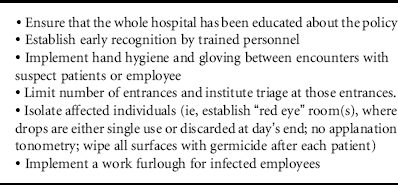
Ensuring that the whole institution knows about the policy beforehand and has open communications, as well as early recognition, isolation, and work furlough for infected persons are key to managing an outbreak of EKC in a healthcare setting (Table 1).Reference Gottsch
9
Epidemiologic monitoring of adenoviral conjunctivitis in employees (as implemented at our institution)Reference Kuo, Espinosa, Michael Forman and Valsamakis
12
can help with early detection of a possible outbreak in employees as well as in the community. Applanation tonometry to measure intraocular pressure without disposable, single-use-only means should not be performed because it is a common method of spreading EKC.
Estimates of the costs of adenoviral conjunctivitis vary. The costs are potentially very high if an EKC outbreak forces the closure of a clinic or department from triage failure. We recently estimated the cost savings from a quality improvement initiative incorporating PCR to diagnose adenoviral conjunctivitis in medical system employees with red eye.Reference Kuo, Espinosa, Michael Forman and Valsamakis
12
In a not-for-profit setting, employee productivity might be equated with employee cost to the institution in terms of salary and benefits. Without including the cost of unnecessary antibiotic use or overtime pay for employees performing the work of furloughed colleagues, the cost of PCR in employees with suspected adenoviral conjunctivitis was 5% of the possible cost of furloughing infected workers for 2 weeks based on clinical diagnosis alone.
Interestingly, work policies regarding healthcare workers with adenoviral conjunctivitis are not standardized. They range from the Association of Health Professionals in Healthcare’s policy that an affected employee “may return to work only when medically cleared by a physician (may remain infectious greater than or equal to 7 days)” to the CDC’s “infected [healthcare] personnel should not provide patient care for the duration of symptoms after onset of EKC or purulent conjunctivitis caused by other pathogens.” Investigators recommended “mandatory sick leave . . . for 2 weeks following onset of symptoms” in 1 outbreak.Reference Vastine, West and Yamashiroya
1
Our work has shown that accurate diagnosis of adenoviral conjunctivitis (including viral typing) can help guide furlough decisions, which can have an impact on clinical operations and productivity.Reference Kuo, Espinosa, Michael Forman and Valsamakis
12
Unwarranted furloughs based on incorrect diagnoses (eg, dry eye, allergic conjunctivitis, or overwearing contact lens) hamper clinical operations; our data show that use of this triage algorithm prevented many such furloughs.Reference Kuo, Espinosa, Michael Forman and Valsamakis
12
The inaccuracy of clinical diagnosis provides impetus for development of commercial HAdV nucleic acid detection tests for use in conjunctival specimens. Without such an assay, centers considering a similar algorithm will have to develop tests that utilize noncommercial primers or adapt tests cleared for use with nasopharyngeal samples. Large medical centers can more easily adopt this PCR-based algorithm with the support of their virology laboratories. The success of such an algorithm also relies on having a centralized site (eg, occupational health) to manage the triage, diagnostic testing, and work furloughs, rather than letting employees scatter to various professionals whose diagnostic acumen is surpassed by PCR.
Given its high transmission rate and endemic nature, the ability of HAdV to survive on fomites, the number of sporadic EKC outbreaks, and potential for persistent ocular morbidity, clinical watchfulness for adenoviral conjunctivitis in healthcare employees should remain high. Patients and staff may benefit from an institution-based “pink-eye” or “red-eye” algorithm that features efficient and effective triage and accurate and timely diagnosis based on highly sensitive and specific diagnostic testing like PCR, as well as appropriate work furlough. Such an algorithm may not only be cost-effective for medical centers but also may protect employees and patients from the sequelae of highly contagious, severe forms of adenoviral conjunctivitis.






Familiar to infectious disease specialists for life-threatening conditions like pneumonia and encephalitis, human adenovirus (HAdV) is concerning to ophthalmologists because of epidemic keratoconjunctivitis (EKC), which has forced the closure or near closure of clinics, hospitals, and long-term care facilities.Reference Vastine, West and Yamashiroya 1 – Reference Piednoir, Bureau-Chalot, Merle, Gotzmanis, Wulbout and Bajolet 3
In contrast to the self-limited form of conjunctivitis also attributable to HAdV, EKC can carry a significant level of long-term ocular morbidity. It can cause conjunctival membranes (which must be removed to prevent adhesions), permanent severe dry-eye syndrome, and recurrent or persistent visual disturbance from corneal infiltrates—all of which occur beyond the 2 weeks of acute signs and symptoms.
As its name implies, outbreaks of EKC have occurred in hospital-based and outpatient clinics, schools, and military settings.Reference Jawetz 4 , Reference Schrauder, Altmann and Laude 5 In fact, although originally described in 1889, EKC first gained clinical significance in the summer of 1941 when an outbreak affecting 10,000 persons developed in shipyards in Hawaii and the West Coast.Reference Jawetz 4 With its high transmission rate and associated vision impairment, this EKC outbreak altered American military plans in the Pacific Rim, giving rise to the moniker “shipyard eye.”Reference Jawetz 4
Military recruits are routinely immunized against HAdV-4 and -7 because of the epidemic nature of adenoviral infections and mortality from respiratory disease. When production of the vaccine ceased in 1996, outbreaks of adenoviral infection re-emerged in the military, including fatalities in previously healthy recruits.Reference Kajon, Moseley and Metzgar 6 Reservoirs in crowded training environments are the likely reason why seropositivity for type 4 (which can be associated with EKC) rises from 30% to almost 100% among new recruits.Reference Kajon, Moseley and Metzgar 6
In contrast, many view “pink eye” or “red eye” as a minor inconvenience that occurs sporadically in civilian life. At least 50% of infectious conjunctivitis is probably viral (ie, most is adenoviral),Reference O’Brien, Jeng, McDonald and Raizman 7 for which there is no treatment, although many patients request (and receive) topical antibiotics. Adenoviral conjunctivitis is, however, a reportable infection in GermanyReference Schrauder, Altmann and Laude 5 and is classified as a category IV infectious disease by Japan’s National Epidemiological Surveillance of Infectious Diseases, with mandated collection, analysis, and reporting. Although adenoviral conjunctivitis is not a reportable condition in the United States, most states have reporting requirements such that the Center for Disease Control and Prevention (CDC) receives news of potential EKC outbreaks. The CDC reported 6 unrelated outbreaks involving more than 400 persons in 4 states between 2008 and 2010. 2
Unfortunately, hospital or outpatient clinics are the origin of many EKC outbreaks.Reference Vastine, West and Yamashiroya 1 – Reference Piednoir, Bureau-Chalot, Merle, Gotzmanis, Wulbout and Bajolet 3 In a 6-month period, 2 overlapping epidemics involving 97 community and nosocomial cases of EKC were seen at 1 institution.Reference Vastine, West and Yamashiroya 1 The investigators calculated an attack rate of 20% based on the number of households, inhabitants, and cases of secondary EKC in this outbreak.Reference Vastine, West and Yamashiroya 1 A few years later, another outbreak involving 401 persons, including employees, occurred in the same department over a 6-month period.Reference Warren, Nelson, Farrar, Hurwitz, Hierholzer, Ford and Anderson 8
Infection control and prevention can be difficult, but such measures have been shown to reduce the number of outbreaks and of infected persons.Reference Gottsch 9 HAdV can survive on fomites for prolonged periods of time, adding to the risk of epidemics; type 19 is viable for up to 10 days on textiles and metal and up to 35 days on plastics in in vitro experiments.Reference Gordon, Gordon, Romanowski and Araullo-Cruz 10 HAdVs are also highly resistant to chemical or physical agents and adverse pH conditions. Given these characteristics and the number of sporadic large outbreaks of EKC in healthcare settings, vigilance regarding future outbreaks is imperative.
Accurate diagnosis of adenoviral conjunctivitis in healthcare settings is important not only for infection control but also because of the threat of chronic vision impairment that EKC poses to healthcare workers and patients alike. Not all clinics and hospitals, however, are staffed by ophthalmologists who can examine cases of suspected adenoviral conjunctivitis. Moreover, clinical diagnosis by ophthalmologists may be at most 50% accurate; this figure is probably lower for other professionals.Reference O’Brien, Jeng, McDonald and Raizman 7 In its early course, the infection can simulate other conditions, leading to inadvertent spread. Culture and polymerase chain reaction (PCR) are the diagnostic gold standards,Reference Thompson and Kowalski 11 but unlike culture (which can take days to weeks), results of PCR can return within a few hours.Reference Thompson and Kowalski 11 , Reference Kuo, Espinosa, Michael Forman and Valsamakis 12 Because of transmissibility in healthcare settings and ramifications for patient care when staff are infected, accurate diagnostic testing with rapid turnaround is important in the context of triage and work furlough for infected employees.Reference Kuo, Espinosa, Michael Forman and Valsamakis 12 Ensuring that the whole institution knows about the policy beforehand and has open communications, as well as early recognition, isolation, and work furlough for infected persons are key to managing an outbreak of EKC in a healthcare setting (Table 1).Reference Gottsch 9 Epidemiologic monitoring of adenoviral conjunctivitis in employees (as implemented at our institution)Reference Kuo, Espinosa, Michael Forman and Valsamakis 12 can help with early detection of a possible outbreak in employees as well as in the community. Applanation tonometry to measure intraocular pressure without disposable, single-use-only means should not be performed because it is a common method of spreading EKC.
Management of an Outbreak of Epidemic Keratoconjunctivitis (EKC) in a Healthcare SettingReference Warren, Nelson, Farrar, Hurwitz, Hierholzer, Ford and Anderson 8 , Reference Gottsch 9
Estimates of the costs of adenoviral conjunctivitis vary. The costs are potentially very high if an EKC outbreak forces the closure of a clinic or department from triage failure. We recently estimated the cost savings from a quality improvement initiative incorporating PCR to diagnose adenoviral conjunctivitis in medical system employees with red eye.Reference Kuo, Espinosa, Michael Forman and Valsamakis 12 In a not-for-profit setting, employee productivity might be equated with employee cost to the institution in terms of salary and benefits. Without including the cost of unnecessary antibiotic use or overtime pay for employees performing the work of furloughed colleagues, the cost of PCR in employees with suspected adenoviral conjunctivitis was 5% of the possible cost of furloughing infected workers for 2 weeks based on clinical diagnosis alone.
Interestingly, work policies regarding healthcare workers with adenoviral conjunctivitis are not standardized. They range from the Association of Health Professionals in Healthcare’s policy that an affected employee “may return to work only when medically cleared by a physician (may remain infectious greater than or equal to 7 days)” to the CDC’s “infected [healthcare] personnel should not provide patient care for the duration of symptoms after onset of EKC or purulent conjunctivitis caused by other pathogens.” Investigators recommended “mandatory sick leave . . . for 2 weeks following onset of symptoms” in 1 outbreak.Reference Vastine, West and Yamashiroya 1 Our work has shown that accurate diagnosis of adenoviral conjunctivitis (including viral typing) can help guide furlough decisions, which can have an impact on clinical operations and productivity.Reference Kuo, Espinosa, Michael Forman and Valsamakis 12
Unwarranted furloughs based on incorrect diagnoses (eg, dry eye, allergic conjunctivitis, or overwearing contact lens) hamper clinical operations; our data show that use of this triage algorithm prevented many such furloughs.Reference Kuo, Espinosa, Michael Forman and Valsamakis 12 The inaccuracy of clinical diagnosis provides impetus for development of commercial HAdV nucleic acid detection tests for use in conjunctival specimens. Without such an assay, centers considering a similar algorithm will have to develop tests that utilize noncommercial primers or adapt tests cleared for use with nasopharyngeal samples. Large medical centers can more easily adopt this PCR-based algorithm with the support of their virology laboratories. The success of such an algorithm also relies on having a centralized site (eg, occupational health) to manage the triage, diagnostic testing, and work furloughs, rather than letting employees scatter to various professionals whose diagnostic acumen is surpassed by PCR.
Given its high transmission rate and endemic nature, the ability of HAdV to survive on fomites, the number of sporadic EKC outbreaks, and potential for persistent ocular morbidity, clinical watchfulness for adenoviral conjunctivitis in healthcare employees should remain high. Patients and staff may benefit from an institution-based “pink-eye” or “red-eye” algorithm that features efficient and effective triage and accurate and timely diagnosis based on highly sensitive and specific diagnostic testing like PCR, as well as appropriate work furlough. Such an algorithm may not only be cost-effective for medical centers but also may protect employees and patients from the sequelae of highly contagious, severe forms of adenoviral conjunctivitis.
ACKNOWLEDGMENTS
Financial support: No financial support was provided relevant to this article.
Potential conflicts of interest: The author reports no conflicts of interest relevant to this article.