There is now ample empirical evidence that depressive symptoms are not exclusive to adulthood. In fact, depression can be detected in children as young as 5 years of age, if not younger (see Luby, Belden, & Spitznagel, Reference Luby, Belden and Spitznagel2006; Luby et al., Reference Luby, Heffelfinger, Mrakowsky, Brown, Hessler and Wallis2003; Rutter, Izard, & Read, Reference Rutter, Izard and Read1986). Depression with childhood onset can have serious long-term developmental consequences, such as poorer school performance, interpersonal conflict, substance abuse, delinquency, and increased risk of suicide during the adolescent years (Elgar, McGrath, Waschbusch, Stewart, & Curtis, Reference Elgar, McGrath, Waschbusch, Stewart and Curtis2004). One important precursor of childhood and adolescent depression identified in the literature is the presence of maternal depressive symptoms (Cummings & Davies, Reference Cummings and Davies1994; Downey & Coyne, Reference Downey and Coyne1990; Goodman & Gotlib, Reference Goodman and Gotlib1999, Reference Goodman and Gotlib2002). Previous research has identified possible mediators (e.g., maternal sensitivity, quality of attachment) and moderators (e.g., gender) of this transmission of depressive symptoms. The purpose of this study was to explore the importance of timing of exposure to maternal depressive symptoms, as well as the relative influence of maternal sensitivity, security, and disorganization of children's attachments, and gender in the prediction of offspring depressive symptoms at 8 and 19 years of age in a low-income sample. The use of an understudied risk group with low-income mothers showing a rather high rate of depressive symptoms should improve the likelihood of observing such transmission of symptoms to their offspring across childhood and adolescence.
Intergenerational Transmission of Depressive Symptoms
Past research aimed at identifying the predictors of psychosocial functioning in infancy, childhood, and adolescence demonstrates the importance of the occurrence of maternal depression. Research has focused both on heterotypic connections between parental depression and various developmental problems, as well as homotypic links between parental depression and child depression (Burt et al., Reference Burt, Van Dulmen, Carlivati, Egeland, Sroufe and Forman2005).
Previous studies have shown associations between maternal and offspring depressive or internalizing symptomatology. For example, a recent meta-analytic review revealed a significant effect size of .16 for the prediction of child internalizing problems from maternal depression (Connell & Goodman, Reference Connell and Goodman2002). Results from Lyons-Ruth, Easterbrooks, and Cibelli (Reference Lyons-Ruth, Easterbrooks and Cibelli1997) further suggest that maternal depressive symptoms are an important overall index linking a climate of family adversity to later internalizing symptoms, capturing variance shared with cumulative demographic risk scores and lowered infant cognitive development. It could be argued, however, that internalizing symptoms are not necessarily the equivalent of depressive symptoms, and therefore, these results must be interpreted cautiously. In line with this argument, Malcarne, Hamilton, Ingram, and Taylor (Reference Malcarne, Hamilton, Ingram and Taylor2000) demonstrated that, compared to internalizing and externalizing problems, children's depressive symptoms were differentially related to maternal variables, including maternal depression and stressful life events. The authors concluded that maternal depression may be specifically associated with affectively similar narrow-band depressive symptoms in children (Malcarne et al., Reference Malcarne, Hamilton, Ingram and Taylor2000). Other studies found that children or adolescents of depressed mothers reported a higher rate of major depressive disorders (Silk, Shaw, Skuban, Oland, & Kovacs, Reference Silk, Shaw, Skuban, Oland and Kovacs2006; Weissman, Wartner, Wickramaratne, Moreau, & Olfson, Reference Weissman, Warner, Wickramaratne, Moreau and Olfson1997), a more depressogenic attributional style (Jaenicke et al., Reference Jaenicke, Hammen, Zupan, Hiroto, Gordon, Adrian and Burge1987; Garber & Flynn, Reference Garber and Flynn2001), lower self-worth (Garber & Flynn, Reference Garber and Flynn2001; Goodman, Adamson, Riniti, & Cole, Reference Goodman, Adamson, Riniti and Cole1994), and more hopelessness (Garber & Flynn, Reference Garber and Flynn2001) than offspring of well mothers.
However, as Jacobvitz, Hazen, Curran, and Hitchens (Reference Jacobvitz, Hazen, Curran and Hitchens2004) pointed out, most investigations of the contributions of family interactions to depression in children are cross-sectional studies. More prospective longitudinal studies, such as Radke-Yarrow's (1998) pioneering work comparing children of depressed, bipolar or healthy mothers, Duggal, Carlson, Sroufe, and Egeland's (2001) prospective study of early family relationships factors associated with depressive symptoms expressed in childhood and adolescence, and Murray, Halligan, Adams, Patterson, and Goodyer's (Reference Murray, Halligan, Adams, Patterson and Goodyer2006) prospective study of children of postnatally depressed mothers, are needed to better understand the development of depressive symptoms over childhood and adolescence. Adolescence is particularly critical as a time of significant transitions in biopsychosocial development during which adult forms of psychopathology often develop. Thus, it is of significant interest to explore the extent to which the socioemotional correlates of exposure to maternal depression observed earlier in childhood extend to adolescent functioning (Murray et al., Reference Murray, Halligan, Adams, Patterson and Goodyer2006).
Children who have a depressed mother are at increased genetic predisposition for depression. Research supporting this notion includes twin studies of depressive symptoms in children and adolescents (Eaves et al., Reference Eaves, Silberg, Meyer, Maes, Simonoff and Pickles1997; Eley & Stevenson, Reference Eley and Stevenson1999; Rice, Harold, & Thapar, Reference Rice, Harold and Thapar2002; Thapar & McGuffin, Reference Thapar and McGuffin1994). Genetic factors, however, do not express themselves in isolation. Silberg and Rutter (Reference Silberg, Rutter, Goodman and Gotlib2002) underlined that genetic effects interact with the environment, and suggested that a better understanding of environmental factors should provide the means for effective intervention by interrupting genetic expression. For that reason, attention has turned to exploring parenting and environmental mechanisms that may mediate the relation between maternal depression and child depressive symptoms (Burt et al., Reference Burt, Van Dulmen, Carlivati, Egeland, Sroufe and Forman2005).
Timing of the First Exposure to Maternal Depression
Few studies have addressed issues of timing and recurrence of maternal depressive symptoms. However, differences in children's adaptation may be related to these factors. Alpern and Lyons-Ruth (Reference Alpern and Lyons-Ruth1993) found that children exposed to maternal depressive symptoms only in infancy showed more anxiety symptoms as reported by both mothers and teachers, whereas children exposed to maternal depression in kindergarten but not infancy displayed hyperactive behavior, and children exposed to chronic maternal depressive symptoms exhibited hostile behavior problems toward peers, compared to children of nondepressed mothers. Essex, Klein, Miech, and Smider's (Reference Essex, Klein, Miech and Smider2001) findings indicated that exposure to maternal depression in infancy increased the risk of externalizing behavior problems only when it occurred in the context of high concomitant internalizing symptoms. By contrast, exposure to maternal depression during the toddler/preschool period was not associated with risk for high internalizing symptoms at kindergarten age. Both sets of authors concluded that their results supported the idea that infancy may be a sensitive period for the occurrence of internalizing symptoms later in childhood. In their longitudinal study, Murray et al. (Reference Murray, Halligan, Adams, Patterson and Goodyer2006) found that the presence or absence of maternal depression outside the postnatal period did not contribute to the prediction of adolescent emotional sensitivity or maturity.
Many reasons could be advanced to explain the significance of the infancy period for the transmission of depressive symptoms. First, timing of maternal depression may exert an effect on child development that is distinct from the effect of recurrence of maternal depression over time. Maternal depression during a limited period followed by remission may lead to increased child problems to the extent that depression interferes with the achievement of tasks specific to that developmental period (Dawson et al., Reference Dawson, Ashman, Panagiotides, Hessl, Self and Yamada2003; Essex, Klein, Cho, & Kraemer, Reference Essex, Klein, Cho and Kraemer2003). Infancy, in particular, is a developmental period of rapid growth in neurological, physical, and emotional systems. Infants develop their first attachment bonds, in turn, providing a framework for the infant's regulation of emotion (Bowlby, Reference Bowlby1980; Davies & Cummings, Reference Davies and Cummings1994; Essex et al., Reference Essex, Klein, Miech and Smider2001). Cummings and Cicchetti (Reference Cummings, Cicchetti, Greenberg, Cicchetti and Cummings1990) suggested that early relationship experiences contribute to a child's internal representation of self, which is critical to the development of healthy self-esteem. Poor self-esteem, in turn, has been considered a core symptom of depressive disorders (Jacobvitz et al., Reference Jacobvitz, Hazen, Curran and Hitchens2004). According to this theoretical viewpoint, if early maternal depression contributes to an insecure attachment relationship (Lyons-Ruth, Connell, Grunebaum, & Botein, Reference Lyons-Ruth, Connell, Grunebaum and Botein1990; Murray, Reference Murray1992) the detrimental effects of an early insecure attachment may continue after maternal depression has remitted.
Second, mothers play an important role as external emotion regulators for their children, whose neurophysiological systems continue to develop postnatally (see Ashman & Dawson, Reference Ashman, Dawson, Goodman and Gotlib2002, for a review). These authors suggested that a depressed mother's inability to model effective self-regulatory strategies and to provide regulatory assistance may increase the stressful nature of mother–infant interaction and fail to provide the infant with effective coping strategies in distressing situations. Further, the negative effects of exposure to maternal depression on the infant's frontal electrical brain activity are thought to have enduring impact beyond the infancy period (Dawson et al., Reference Dawson, Frey, Self, Panagiotides, Hessl and Yamada1999, Reference Dawson, Ashman, Panagiotides, Hessl, Self and Yamada2003). The frontal brain activity is involved in emotion regulation and the inhibition of inappropriate responses, and in the hypothalamic–pituitary–adrenal (HPA) axis activity involved in cortisol regulation and stress responses (Francis et al., Reference Francis, Diorio, LaPlante, Weaver, Seckl and Meaney1996).
Third, the self-regulatory and social skills of school-age children are more robust than during the infancy and preschool periods. With the parent as the initial external regulator, emotional and behavioral regulation gradually are appropriated by the child (Cassidy, Reference Cassidy1994). Similarly, their social worlds are more extensive. According to Denham (Reference Denham1998), mothers have a greater role in the socialization of emotion regulation and expression during the first 2 years of life compared to later developmental periods. It is possible that children are less vulnerable to a first onset of maternal depression occurring later in development, as they have already developed effective emotion regulation and coping strategies as well as a larger social network of support figures (e.g., neighbors, friends, and teachers).
Possible Mediators of Transmission of Depressive Symptomatology
Models of the transmission of risk for depression posit several mechanisms, resulting in child vulnerabilities and mental health outcomes that are moderated by gender and the timing of maternal depression (Cummings & Davies, Reference Cummings and Davies1994; Downey & Coyne, Reference Downey and Coyne1990; Goodman & Gotlib, Reference Goodman and Gotlib1999). Goodman and Gotlib (Reference Goodman and Gotlib1999), for example, suggested several possible mechanisms of transmission, such as (a) heritability of depression; (b) other heritable child dysfunctional neurogulatory mechanisms; (c) negative maternal cognitions, behaviors, and affect; and (d) the stressful context of the children's lives. Other mechanisms such as higher emotional sensitivity of children of depressed mothers (Murray et al., Reference Murray, Halligan, Adams, Patterson and Goodyer2006) have also been highlighted as potential links between maternal and child depression.
Quality of parenting
Various explanations have been advanced to explain parental effects on child depressive symptomatology. For example, Murray, Cooper, and Hipwell (Reference Murray, Cooper and Hipwell2003) suggested several possible pathways, including lack of contingency in the parent's responses, parental insensitivity and unresponsiveness, parental hostility and intrusiveness, and the lack of joint attention. These behaviors could then affect a child's sense of self, capacity to sustain attention, level of distress, and cognitive and memory function.
For example, maternal depressive symptoms have been consistently related to more negative parenting behaviors (Downey & Coyne, Reference Downey and Coyne1990; Nelson, Hammen, Brennan, & Ullman, Reference Nelson, Hammen, Brennan and Ullman2003; NICHD Early Child Care Research Network, 1999). Depressed mothers have been described as more likely to report difficulties managing their infants' crying and demands (Seeley, Murray, & Cooper, Reference Seeley, Murray and Cooper1996); more withdrawn, with less rapid, consistent, and positive responsiveness to their children's actions (Burt et al., Reference Burt, Van Dulmen, Carlivati, Egeland, Sroufe and Forman2005; Dawson et al., Reference Dawson, Ashman, Panagiotides, Hessl, Self and Yamada2003); and more intrusive, coercive, or hostile in their play or interaction with their child (Field, Reference Field1992).
Additional studies indicate that maternal behavior mediates the links between depressive symptoms and children's adjustment. For example, Lyons-Ruth, Alpern, and Repacholi (Reference Lyons-Ruth, Alpern and Repacholi1993) found that the relation between maternal depressive symptoms in infancy and child behavior problems at age 5 was mediated by the more irritable and intrusive interactive stance prospectively observed among depressed mothers in infancy. Belden and Ludy (Reference Belden and Luby2006) also showed a mediating effect of maternal support on specific depressive behaviors based on observational data in a sample of preschoolers. Their results indicated that mothers who are less supportive have children with higher depression scores.
Similar results have also resulted from retrospective reports obtained in adolescence. Garber and Flynn (Reference Garber and Flynn2001) found that early parenting, characterized by low levels of care and acceptance, predicted low levels of global self-worth in young adolescents. Johnson, Cohen, Kasen, Smailes, and Brook (Reference Johnson, Cohen, Kasen, Smailes and Brook2001) also found that associations between more general parental psychiatric disorders and increased offspring risk for disorder was fully mediated by maladaptive parental behaviors. Finally, Bifulco et al. (Reference Bifulco, Moran, Ball, Jacobs, Raines and Bunn2002) found that a composite index of childhood neglect/abuse mediated the association between mother's history of depression and offspring psychiatric disorder. Rose and Abramson (Reference Rose, Abramson, Cicchetti and Toth1992) suggested that highly threatening and/or recurrent negative events associated with such adverse family environments leads to the development of a more general negative and hopeless style. According to this theory, abusive events are particularly likely to lead to pessimistic expectations among individuals who tend to explain such negative events in terms of internal, stable, and global causes, and who have more negative views of themselves (Garber & Flynn, Reference Garber and Flynn2001).
Security and disorganization of attachment
Another factor that could increase the likelihood of depressive symptoms in childhood is the development of insecure and/or disorganized attachment patterns. A basic tenet of attachment theory states that the experience of close relationships in adolescence and adulthood takes place within a framework that emerges from the child's primary attachment relationships early in development (Ainsworth, Blehar, Waters, & Wall, Reference Ainsworth, Blehar, Waters and Wall1978; Bowlby, Reference Bowlby1980). In a recent meta-analysis of six independent studies, Martins and Gaffan (Reference Martins and Gaffan2000) found significantly lower rates of secure attachment among infants of depressed mothers (see also van IJzendoorn, Schuengel, & Bakermans-Kranenburg, Reference van IJzendoorn, Schuengel and Bakermans-Kranenburg1999). However, they reported great variability among studies included in their meta-analysis. Murray et al. (Reference Murray, Halligan, Adams, Patterson and Goodyer2006) also demonstrated that insecure attachment in infancy was associated with higher depressed mood in adolescence. However, the prevalence of insecure attachment in the general population is 40% (see van IJzendoorn et al., Reference van IJzendoorn, Schuengel and Bakermans-Kranenburg1999), which is much higher than the prevalence of depressive symptoms. Finally, in one of the few studies of security of attachment in middle childhood, Easterbrooks and her colleagues (Graham & Easterbrooks, Reference Graham and Easterbrooks2000) did not find a strong relation between maternal depressive symptoms and insecure attachment. In addition, the longitudinal study of Radke-Yarrow (Reference Radke-Yarrow1998) showed that children who were securely attached to depressed or bipolar mothers more often developed problems than did the children who were insecurely attached.
Results are also mixed concerning the association between attachment disorganization and maternal depression. van IJzendoorn and colleagues' (Reference van IJzendoorn, Schuengel and Bakermans-Kranenburg1999) meta-analysis reported that the association between maternal depression and attachment disorganization, while significant, was “disappointingly weak.” However, the van IJzendoorn et al. (Reference van IJzendoorn, Schuengel and Bakermans-Kranenburg1999) meta-analysis also found that the relation between maternal depression and attachment disorganization was stronger among clinical samples than among community samples. In the Martins and Gaffan (Reference Martins and Gaffan2000) meta-analysis more consistent effects on maternal depression were found for attachment disorganization than for the secure and avoidant attachment categories. Taken together, these results suggest a complex interrelation between (a) maternal depression and attachment, and (b) attachment and depression. Therefore, the question is still open regarding the association between insecurity and disorganization of attachment and the transmission of depressive symptoms.
Influence of Children's Gender on Development of Depression
Women are more vulnerable to develop depressive symptoms, with an increased differential risk emerging during adolescence (American Psychiatric Association, 2000). The research literature is less clear, however, concerning a possible moderating effect of child gender on the transmission of maternal depression to children and adolescents (see Sheeber, Davis, & Hops, Reference Sheeber, Davis, Hops, Goodman and Gotlib2002, for a review). Some studies suggest that girls are more vulnerable to maternal depression than are boys (Burt et al., Reference Burt, Van Dulmen, Carlivati, Egeland, Sroufe and Forman2005; Jacobvitz et al., Reference Jacobvitz, Hazen, Curran and Hitchens2004; Murray & Sines, Reference Murray and Sines1996; Radke-Yarrow & Nottelmann, Reference Radke-Yarrow and Nottelmann1989). This may be due to differences in socialization of emotions, with mothers reinforcing sadness and relation-oriented behaviors in girls and anger and instrumental behaviors in boys (Sheeber et al., Reference Sheeber, Davis, Hops, Goodman and Gotlib2002; Silk et al., Reference Silk, Shaw, Skuban, Oland and Kovacs2006). Mothers may also be more salient models for girls than for boys (see Elgar et al., Reference Elgar, McGrath, Waschbusch, Stewart and Curtis2004). Other studies, however, suggest that boys may be more vulnerable to maternal depressive symptoms, especially if exposed at a young age (Carter, Garrity-Rokous, Chazan-Cohen, Little, & Briggs-Gowan, Reference Carter, Garrity-Rokous, Chazan-Cohen, Little and Briggs-Gowan2001; Essex et al., Reference Essex, Klein, Cho and Kraemer2003; Murray, Reference Murray1992); this finding is consistent with boys' documented vulnerability to adverse effects of maternal mental illness in general (Hay et al., Reference Hay, Pawlby, Sharp, Asten, Mills and Kumar2001; Murray, Kempton, Woolgar, & Hooper, Reference Murray, Kempton, Woolgar and Hooper1993; Zahn-Waxler, Reference Zahn-Waxler1993). Finally, some work suggests that gender differences in transmission might differ according to developmental periods, with a more pronounced effect of gender in adolescence as compared to childhood (Duggal et al., Reference Duggal, Carlson, Sroufe and Egeland2001; Fergusson, Horwood, & Lynskey, Reference Fergusson, Horwood and Lynskey1995; Hops, Sherman, & Biglan, Reference Hops, Sherman, Biglan and Patterson1990). Therefore, the existence of a consistent moderator effect of gender on transmission of depressive symptoms in childhood and adolescence remains unclear.
In conclusion, although transmission of depressive symptoms from mothers to offspring has been documented in previous studies, many salient questions remain. Exploration of issues such as (a) timing of first exposure to maternal depression, (b) differential salience of particular developmental periods, and (c) effects of repeated exposure to maternal depression, require longitudinal designs. Moreover, the exploration of different variables as potential mediators or moderators has yielded mixed results across previous studies. Finally, the use of a high psychosocial risk sample should increase the likelihood of observing depressive symptoms, both in mothers and their offspring, and should also provide a wider range of individual differences in parental behavior and child attachment behavior.
Hypotheses
In the present study, we examined the relation of maternal depressive symptoms assessed in infancy, middle childhood, and adolescence to child depressive symptoms in middle childhood and adolescence among a sample of children at socioeconomic risk. In addition, clinical risk, maternal sensitive behavior in mother–child interactions, and attachment security and disorganization were assessed in infancy and maternal sensitivity was also assessed in childhood.
Three general hypotheses were advanced:
1. Maternal depressive symptoms in infancy would make a unique contribution to the prediction of child and adolescent symptoms, even after controlling for maternal concurrent or recurrent depressive symptoms.
2. Attachment insecurity and disorganization in infancy, maternal lack of involvement and hostility in infancy, and maternal sensitivity in childhood as a proximal measure of parenting behavior would mediate the association between maternal and child/adolescent symptoms.
3. Gender would moderate the association between maternal and child/adolescent depressive symptoms. No specific hypotheses were advanced concerning the direction of effect. However, because of the higher prevalence of depressive symptoms demonstrated by girls starting in adolescence, it may be expected that girls will show higher rates of depressive symptoms, at least in adolescence.
Method
Participants
The data were collected at mother–child laboratory visits in infancy (12 and 18 months old; n = 79), school-age (7 and 8 years old; n = 45), and adolescence (19 years old; n = 47). At 18 months, a home visit was conducted to assess maternal behavior.
In infancy, 41 families (18 girls) were referred to the study by health or social service agency staff because of concerns about the quality of the parent–infant relationship and 38 (15 girls) were families from the community, matched to the referred group on per-person family income; mother's education, age, and race; and infant's age, gender, and birth order. All families were below federal poverty level at study entry. The sample was 81% Caucasian, 11% Latino, 4% African American, and 4% biracial children. Forty percent of mothers were not high school graduates and 49% were single parents. Mother's mean age at child's birth was 25 years (range = 16–42 years), 15 mothers (19%) were under 20 years of age.
Forty-five mother–child dyads (28 male, 17 female children) were seen in two lab visits when children were aged 7 and 8 years old. Five families refused participation, and the remainder could not be relocated (Easterbrooks, Davidson, & Chazan, Reference Easterbrooks, Davidson and Chazan1993). The families who participated at middle childhood did not differ significantly from those who did not participate on demographic measures in infancy such as family income, F (1, 78) = 0.98, ns, maternal education, χ2 (79) = 0.32, ns, and single-mother family, χ2 (79) = 0.55, ns. Attrition in middle childhood also was not related to any of the infancy period observations: attachment, F (1, 70) = 1.75, ns, maternal depressive symptoms, F (1, 55) = 0.75, ns, maternal involvement, F (1, 72) = 1.72, ns, or maternal hostility, F (1, 72) = 2.15, ns.
Forty-seven dyads returned for a lab visit when adolescents (24 male, 23 female) were 19 years of age. Families who participated in the adolescent assessment did not differ significantly from those who did not participate on measures of maternal education in infancy, χ2 (79) = 2.01, ns, or measures of infant attachment, F (1, 70) = 0.55, ns, maternal depressive symptoms in infancy, F (1, 55) = 0.68, ns, maternal involvement in infancy, F (1, 72) = 0.01, ns, or maternal hostility in infancy, F (1, 72) = 0.01, ns. However, there was a modest, but statistically significant, relation with attrition for family income, F (1, 78) = 5.36, p = .02, and single-mother headed family, χ2 (79) = 4.38, p = .04. Families who did not come back in adolescence had lower income per person per week in infancy (participants: M = 49.17, SD = 19.53; nonparticipant: M = 40.53, SD = 9.58), and a higher rate of single parenting (participants: 19%; nonparticipant: 41%). Overall, 36 dyads had complete data at all time periods.
Measures
Clinical risk in infancy
Participants in the clinical risk group were referred for clinical home visiting in infancy by pediatric nurses and other healthcare professionals because service providers observed difficulties in the mother's provision of care for the infant. Ten of these families were being followed by state protective service workers because of documented maltreatment. A second group of participants with no history of referral to community services was recruited from the same neighborhoods; this group had never sought or received social services directed at parenting skills, and had never undergone extensive psychiatric treatment (see Lyons-Ruth et al., Reference Lyons-Ruth, Connell, Grunebaum and Botein1990). A score of 1 on clinical risk was assigned to the referred participants and a score of 0 was assigned to the nonreferred group.
Center For Epidemiological Studies Depression Scale (CES-D)
Mothers (Times 1, 2, and 3) and their adolescent offspring (Time 3) completed the CES-D, a 20-item, 60-point self-report scale used to measure current levels of depressive symptoms in adults and late adolescents. The CES-D is a widely used instrument for assessing general depressive symptoms in nonclinical samples, and is among the most frequently used and well-validated self-report measures of depressive symptoms. The reliability and validity of the CES-D has been well established, with 100% sensitivity and 88% specificity in relation to clinical diagnosis using the cutoff scores (Radloff, Reference Radloff1977; Radloff & Locke, Reference Radloff, Locke, Weissman, Myers and Ross1986). The mothers and adolescents rate items (e.g. “My sleep was restless”) according to how often they had felt that way over the course of the past week (rarely or never, little, occasionally, or much). Although a diagnosis of depression cannot be made based on CES-D results, scores of 16 or above indicate that an individual is exhibiting a clinically meaningful level of depressive symptoms (Radloff, Reference Radloff1977). In the present study, the percentages of mothers reporting severe symptoms were 32% in infancy, 36% in middle childhood, and 32% in adolescence. The percentage of adolescents reporting severe symptoms was 43%.
Dimensions of Depression Profile for Children and Adolescents
The Dimensions of Depression Profile for Children and Adolescents (Harter & Nowakowski, Reference Harter and Nowakowski1987) was used to assess depressive symptoms at age 8. The self-report scale, appropriate for children aged 6 and older, consists of five, six-item subscales (self-blame, affect/mood, energy, self-worth, and suicidal ideation; upon recommendation from one of the authors of the scale, the suicidal ideation subscale was not utilized). Scores range from 1 to 4, with low scores indicating greater depressive symptoms. Examples of items include “Some kids feel kind of ‘down’ and depressed a lot of the time, but other kids feel ‘up’ and happy most of the time.” Factorial, convergent, discriminant, and construct validity have been demonstrated (Renouf & Harter, Reference Renouf and Harter1990). In the present sample, because the subscales were highly related to each other (α = .76), a composite score of depressive symptoms was used. There is no established cutoff score for this instrument.
Infant attachment
At 18 months of age, mothers and infants were seen in the Ainsworth Strange Situation (Ainsworth et al., Reference Ainsworth, Blehar, Waters and Wall1978), a series of eight 3-min episodes involving two mother–infant separations and reunions. Videotapes were coded for the three infant attachment classifications as described by Ainsworth et al. (Reference Ainsworth, Blehar, Waters and Wall1978) and for disorganized/disoriented behaviors as described by Main and Solomon (Reference Main, Solomon, Greenberg, Cicchetti and Cummings1990). The three original attachment classifications (secure, avoidant, ambivalent) were assigned by both a computerized multivariate classification procedure developed on the original Ainsworth data (Connell, Reference Connell1976; see also reference in Richters, Waters, & Vaughn, Reference Richters, Waters and Vaughn1988) and a coder trained by M. Main. Agreement between the two sets of classifications on the full 18-month data set was 86% (κ = .79). Note that the computerized classifications were used in the study. Indices of disorganization (see Main & Solomon, Reference Main, Solomon, Greenberg, Cicchetti and Cummings1990, for a full description) were combined into a disorganization scale ranging from 1 (none) to 9 (strong, frequent, or extreme disorganization). M. Main trained the two coders. Agreement on the disorganized classifications between M. Main and the two coders for 32 randomly selected tapes was 83% and 82%, respectively (κs = .72 and .76, respectively). Agreement on the 9-point Level of Disorganized Behavior Scale between two coders for 32 randomly selected tapes was r = .84.
Given the large proportion of disorganization in the sample, the major attachment variable for this study was the extent of disorganization scale. The use of a continuous measure of extent of disorganization was used to maximize the power of the study. A second aspect of the attachment data, orthogonal to the disorganization construct, was whether the best fitting organized category was secure, ambivalent, or avoidant classifications. Given cell sizes (e.g., only three ambivalent [C]), the two insecure-organized categories were combined and a single secure/insecure construct that was also entered into the analyses.Footnote 1
Maternal behavior at home
Naturalistic mother–infant interaction was videotaped at home for 40 min when children were aged 18 months. Maternal behavior was coded in 10 4-min intervals on 12 5-point rating scales and one timed variable (see Lyons-Ruth et al., Reference Lyons-Ruth, Easterbrooks and Cibelli1997, for a detailed description of the scales). Coders were naive to all other data on the families. Interobserver reliabilities were computed on a randomly selected 20% of the videotapes. Intraclass reliability coefficients ranged from .76 to .99 for the 13 variables. The principal components analysis of the scales yielded two main factors: (a) maternal involvement (positive loadings for maternal sensitivity, warmth, verbal communication, and quantity of comforting touch and negative loadings for disengagement and flatness of affect); and (b) hostile-intrusiveness (negative loadings for quality of comforting touch and quality of caretaking touch and positive loadings for covert hostility, interfering manipulation, and anger).
Emotional Availability Scales
Mothers and children were observed in a laboratory playroom when the children were 7 years of age. Assessments of emotional availability in the dyad were conducted based on a child–mother reunion (5–10 min) following an hour-long separation. Emotional availability was evaluated using the Emotional Availability Scales, Middle Childhood Version, Second Edition (Biringen, Robinson, & Emde, Reference Biringen, Robinson and Emde1993), and the maternal sensitivity scale was used for this analysis. Maternal sensitivity is a 9-point scale that assesses the overall interactive quality and affective tone of the mother's behavior. Sensitive behavior is indicated by genuine positive affect, responsiveness to the child, balancing autonomy and child initiative, and flexibility in interaction. Because the maternal sensitivity scale (in this scale edition) was curvilinear, scores were transformed for later analyses. Transformed variables represented the distance of the score from the optimal scale point. For maternal sensitivity, the optimal scale point was 9; based on the distance from optimal, transformed scores could range from 0 to 8. For the transformed variables, lower scores indicated better functioning, because they were closer to the optimal score. All tapes were examined by two coders; kappas ranged from .95 to 1.00 (M = 0.98). Coders were naive to all other data.
Multiple imputation strategy
Missing data were imputed using NORM software (Schafer, Reference Schafer1999), which is designed to follow the multiple imputation guidelines outlined by Rubin (Reference Rubin1987; Schafer, Reference Schafer1997). Procedures outlined by Schafer and Olsen (Reference Schafer and Olsen1998) were followed. Twenty data sets were generated, using norm, and data were analyzed using standard statistical software. We then concatenated the estimates and their standard errors from each data set and submitted them to NORM to assess statistical significance, taking into account the overall rate of missingness. In the present sample, the rate of missing information ranged from 0% to 44% across the study variables (M = 21%, SD = 17.9%).Footnote 2 Rubin has published guidelines for the number of data sets that should be imputed based on the rate of missing data. The efficiency of an estimate based on 20 imputations for a rate of missing information of 40% is 99%, which is excellent (see Rubin, Reference Rubin1987).
Results
Preliminary analyses
Because of the uniformly low-income nature of the sample in infancy, analyses did not reveal any significant relations of family income or single mother family to maternal depressive symptoms in infancy, r = −.13, ns and F (1, 55) = 0.03, ns, respectively; infant disorganization, r = 0.06, ns and F (1, 70) = 0.15, ns, respectively; or maternal hostility in infancy, r = −.12, ns and F (1, 72) = 0.06, ns, respectively. Maternal involvement measured in infancy was not associated with single mother status, F (1, 72) = 0.12, ns, but showed a small but significant association with family income (r = .24, p < .05).
No childhood variables related to single-mother family or family income, respectively: maternal sensitivity at age 7, F (1, 42) = 1.29, ns; F (1, 42) = 1.43, ns; maternal depressive symptoms at age 8, F (1, 42) = 0.01, ns; F (1, 42) = 0.97, ns; child depressive symptoms at age 8, F (1, 42) = 0.23, ns; F (1, 42) = 1.61, ns. Adolescent variables also were unrelated to single-mother family or family income, respectively: maternal depressive symptoms, F (1, 28) = 0.05, ns; r = .11, ns; or adolescent depressive symptoms, F (1, 27) = 3.07, ns; r = .01, ns.
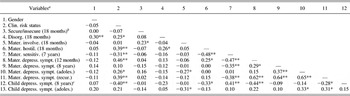
Mothers in the clinical risk group reported higher levels of depressive symptoms than did mothers in the nonclinical risk group, both in infancy and adolescence (see Table 1). Because of the overlap of depressive symptoms and clinical risk, regression models were tested with clinical risk status entered first in the regression models in order to control for the interdependence between clinical risk status and maternal depressive symptoms. Table 1 presents the correlation among all study variables.
Correlation among variables

aCorrelations were run on 20 imputed data sets. Average values are presented.
bSecure = 1, insecure = 2 based on a three-category classification, disregarding the extent of disorganization.
cA lower score on this scale is indicative of higher depressive symptoms.
* p < .05. **p < .01.
Maternal depressive symptoms and child and adolescent depressive symptoms
Hierarchical multiple regression analyses examined the influence of gender, clinical status, and maternal depressive symptoms on child depressive symptoms at 8 and 19 years of age. Variables were entered in decreasing proximal relation to children's symptoms.
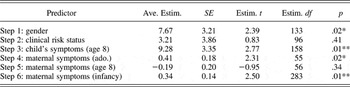
For child depressive symptoms at age 8, the regression model indicated that child gender, clinical risk status, or concurrent maternal depressive symptoms did not contribute to the prediction of child depressive symptoms (see Table 2). Note that low scores on the child depressive symptoms measure indicate higher depressive symptoms. However, maternal depressive symptoms during the first year of life did uniquely contribute to the prediction of child depressive symptoms at age 8, even with gender, clinical risk status, and concurrent maternal depressive symptoms in middle childhood controlled.
Parameter estimates for the hierarchical multiple regression model predicting children's depressive symptoms at age 8

Note: These statistics are based on Rubin's (1987) guidelines for assessing and combining parameter estimates.
† p < .10. **p < .01.
A unique contribution of mothers' depressive symptoms in infancy could occur because of particular aspects of the infancy period or because early maternal symptoms are a marker for more chronic or recurrent maternal symptoms over time. To explore the later possibility, an index of severe recurrent depressive symptoms was created, with one point added for each assessment period where a mother's CES-D symptoms score was above the clinical cutoff level, resulting in a scale which ranged from 0 to 2 for the childhood period and from 0 to 3 for the adolescent period. An additional hierarchical regression analysis, with this recurrence index controlled, t (157) = 0.24, ns, revealed that maternal depressive symptoms in infancy still significantly predicted depressive symptoms in childhood, t (223) = −2.54, p < .01, with gender also controlled, t (120) = 0.11, ns. Therefore, the predictive importance of maternal symptoms in infancy was not due to an effect of repeated exposure over time.
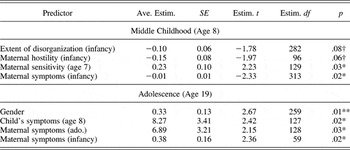
In relation to the prediction of depressive symptoms in adolescence, hierarchical regression results revealed a significant effect of gender on depressive symptoms in adolescence (see Table 3). At age 19, adolescent boys in this sample reported more depressive symptoms (M = 18.82, SD = 14.17) than did adolescent girls (M = 13.50, SD = 9.70). Results also indicated that both the child's own depressive symptoms at age 8 and concurrent maternal depressive symptoms in adolescence contributed to the prediction of adolescent depressive symptoms after controlling for gender and early clinical status. Again, maternal depressive symptoms in infancy uniquely contributed to the prediction of adolescent depressive symptoms after controlling for all the preceding factors.
Parameter estimates for the hierarchical multiple regression model predicting depressive symptoms in adolescence (age 19)

Note: These statistics are based on Rubin's (1987) guidelines for assessing and combining parameter estimates.
* p < .05. **p < .01.
A follow-up regression analysis was again conducted, controlling for recurrence of symptoms. Both child depressive symptoms at age 8, t (134) = 2.42, p < .05, and maternal depressive symptoms in infancy, t (134) = 2.42, p < .05, still significantly predicted depressive symptoms in adolescence when recurrence of symptoms, t (162) = −0.02, ns, was included in the model. However, concurrent maternal depressive symptoms in adolescence were only marginally associated with adolescent symptoms, t (97) = 1.89, p < .10, after the recurrence variable was included in the model.
Contribution of infant attachment and maternal sensitivity to the prediction of depressive symptoms in childhood and adolescence
The third research question concerned variables suggested by previous literature to mediate the obtained relations between maternal and child depressive symptoms. Variables evaluated included secure/insecure attachment status, extent of disorganization of attachment, maternal involvement and hostility at 18 months and maternal sensitivity at 7 years.
Attachment at 18 months
Secure/insecure attachment classification did not meet prerequisites for mediation as classification was not predicted by maternal depressive symptoms at 12 months, t (469) = 0.32, ns, nor was it a predictor of child depressive symptoms either at age 8, t (230) = −0.07, ns, or in adolescence, t (95) = −0.92, ns. Extent of attachment disorganization also did not meet conditions for testing mediation in that there was no relation between attachment disorganization and maternal depressive symptoms in infancy: t (586) = .81, ns. However, importantly, disorganization of attachment was an independent predictor of children's depressive symptoms at age 8, t (225) = −2.01, p < .05.
Maternal involvement and hostility at 18 months
Of the two maternal interaction factors measured at 18 months only maternal hostility met the criteria for a mediation analysis. Maternal hostility was significantly associated both with early maternal depressive symptoms, t (289) = 2.00, p < .05, and with children's symptoms at age 8, t (108) = −2.39, p < .05. Contrary to hypotheses, results of the mediational analyses showed that maternal hostility was an independent predictor but was not a significant mediator of the relation between maternal and child symptoms. Introduction of maternal hostility to the regression models was not associated with a significant decrease in the variance explained by early maternal depressive symptoms as indicated by a Sobel test of −.11 (ns). When included in the same model, maternal hostility in infancy, t (115) = −1.80, p < .10 marginally predicted child depressive symptoms, whereas maternal depressive symptoms in infancy, t (326) = −3.07, p < .01, remained a significant predictor.
In relation to adolescent depressive symptoms, the criteria for testing a mediation model of maternal hostility were not met because of the lack of association between these two variables. The maternal involvement factor measured in infancy also did not meet the criteria for mediation analysis because of the lack of association with maternal symptoms. However, early maternal involvement was an independent predictor of offspring depressive symptoms in adolescence, t (141) = −2.28, p < .02, although not at age 8.
Maternal sensitivity at age 7
Maternal sensitivity measured at 7 years of age met the criteria for a mediation analysis in relation to child symptoms at age 8. This variable was significantly associated with early maternal depressive symptoms, t (243) = −4.12, p < .01, and with children's symptoms at age 8, t (141) = 3.28, p < .01. However, maternal sensitivity was not a significant mediator, as its introduction into the regression models was not associated with a significant decrease in the variance explained by early maternal depressive symptoms (Sobel test = −.06, ns). The criteria for testing a mediation model in adolescence were not met.
Gender as moderator of the association between maternal and child and adolescent's depressive symptoms
To test for moderating effects (Baron & Kenny, Reference Baron and Kenny1986), the interactions of gender and each of the predictors presented in Tables 1 and 2 were included in the regressions. There was no evidence of moderating influences of gender on the prediction of children's depressive symptomatology at either age 8 (p between .62 and .95) or in adolescence (p between .46 and .94). Finally, there was no evidence of a moderating effect of gender on the relation between child depressive symptoms at age 8 and adolescence.
Final regression models predicting child depressive symptoms at age 8 and 19
Based on results from previous analyses, two final regression models, including all significant predictors of child depressive symptoms in both middle childhood and adolescence, are presented in Table 4. First, an additive model including extent of disorganization in infancy, maternal hostility in infancy, maternal sensitivity at age 7, and maternal depressive symptoms in infancy accounted for 30% of variance in 8 years depressive symptoms. Second, an additive model that included child gender, child depressive symptoms at age 8, maternal concurrent symptoms, and maternal symptoms in infancy accounted for 32% of variance in depressive symptoms in adolescence. Note that maternal involvement in infancy is no longer a significant predictor when included in a model with all other predictors; therefore, this variable was not included in the final regression model.
Parameter estimates for the additive regression models predicting depressive symptoms in both middle childhood and adolescence
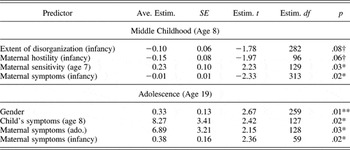
Note: These statistics are based on Rubin's (1987) guidelines for assessing and combining parameter estimates.
† p < .10. *p < .05. **p < .01.
Discussion
The first objective of the present study was to explore the influence of timing of exposure to maternal depressive symptoms on the development of depressive symptoms in children aged 8 and 19 years in a sample of families at high socioeconomic risk. It was proposed that maternal depressive symptoms in infancy would be critical to the prediction of the child's symptoms in middle childhood and adolescence, even after controlling for concurrent and recurrent maternal depressive symptoms. Results supported this hypothesis, which is consistent with previous studies that have shown a significant association between maternal and offspring depressive symptoms (reviewed in Goodman & Gotlib, Reference Goodman and Gotlib2002).
Our results also support the idea that infancy may be a “sensitive period” for the development of depressive symptoms later in childhood and adolescence. There are several reasons why this developmental period may be particularly crucial. First, infancy marks a time of great dependence on caregivers to provide support for both physiological and emotional regulation. At the same time, infants are developing attachment bonds, which form the basis for their “felt security” (Davies & Cummings, Reference Davies and Cummings1994). The quality of the child's early internal representation of self in the context of the primary relationship may be critical to the development of healthy self-esteem (Cummings & Cicchetti, Reference Cummings, Cicchetti, Greenberg, Cicchetti and Cummings1990), a component of depressive symptoms. Moreover, the infant's social world may be more limited than that of a preschooler, or school-aged child, whose multiple social contexts may provide more opportunities for buffering the impact of depressive symptoms of the primary caregiver. It is possible, also, that children who experience negative effects of exposure to early maternal depressive symptoms may show “cascade” effects, with impacts continuing through later periods of development (Dawson et al., Reference Dawson, Ashman, Panagiotides, Hessl, Self and Yamada2003; Essex et al., Reference Essex, Klein, Cho and Kraemer2003).
Although the influence of early maternal depressive symptoms was expected, it was surprising that concurrent maternal symptoms did not play a more important role in the development of depressive symptoms in childhood and adolescence. The only significant relation between maternal and child concurrent symptoms was found in adolescence, but the association became nonsignificant when recurrence of maternal symptoms over time was controlled for. This suggests that it is more the enduring quality of these symptoms rather then their contingency that is influential in adolescents' symptoms. However, it is noteworthy that influence of early maternal symptoms remains after controlling for recurrence of symptoms over time. This is consistent with results by Dawson and colleagues (Reference Dawson, Ashman, Panagiotides, Hessl, Self and Yamada2003), suggesting an enduring effect on child internalizing problems of remitted, nonchronic exposure to early maternal depression. Another study (Hammen & Brennan, Reference Hammen and Brennan2003), however, found that when unconfounded with severity and duration, postpartum depression was not more risky (for youth depression) than was maternal depression at other periods. However, as the authors noted, the study relied on women's retrospective reports of their past depressions, and the reliability of such reports is known to be modest.
It is possible that the stage-salient needs of children at later developmental periods are less impacted by maternal depression than stage salient needs in infancy. Goodman and Gotlib (Reference Goodman and Gotlib1999) suggested that early needs for security and emotion regulation might shift toward a need for social and emotional understanding in preschool, and toward a need for general social support and consistent discipline in middle childhood and adolescence. With development, children's social worlds increasingly include relationships with others (e.g., family members, peers, child care providers, and teachers) who may serve important compensatory or buffering roles in the development of depressive symptoms in the child of a depressed mother.
The association between children's depressive symptoms at ages 8 and 19 also is interesting in itself. Although the zero-order correlation between the two assessments is modest and nonsignificant, depressive symptoms at age 8 became a significant predictor of symptoms at age 19 when covariance of different predictors (such as gender and clinical risk status) was taken into account in a regression model. This is consistent with results obtained by Duggal et al. (Reference Duggal, Carlson, Sroufe and Egeland2001), indicating a modest but significant correlation between measures of child depression and adolescent depression in a high-risk sample. Also in line with Duggal et al. (Reference Duggal, Carlson, Sroufe and Egeland2001), our results suggest that depressive symptoms of girls and boys are equally stable between middle childhood and adolescence. Although these results suggest some continuity between childhood and adolescence in the development of depressive symptoms, this question has been understudied in the past and could have important implications both for treatment and prevention of depression. On the one hand, the fact that early maternal depressive symptoms strongly predict child depressive symptoms at both times may partly explain the continuity observed between middle childhood and adolescence. It is generally accepted that depressive symptoms, along with psychopathology in general, become more apparent and crystallized in adolescence. However, as there are fewer studies including reports of depressive symptoms in middle childhood, it is possible that precursors of adolescent depressive symptoms are already developed and apparent at this earlier period. On the other hand, there is recent evidence that different features characterize depressive symptoms shown at different developmental stages (see meta-analytic study by Weiss & Garber, Reference Weiss and Garber2003), which, along with the use of different assessment instruments, may explain the modest association between childhood and adolescent symptoms obtained in this study.
The second objective of this study was to explore the influence of possible mediators of the relation between maternal depressive symptoms early in infancy and the child's later depressive symptoms. It was hypothesized that infant attachment insecurity and disorganization as well as maternal hostility or sensitivity might play this role. Results showed that neither infant insecurity and disorganization measured at 18 months, maternal hostility and involvement measured at 18 months, nor maternal sensitivity measured at 7 years met criteria required for mediation. However, results showed that infant disorganization, maternal hostility in infancy, and maternal sensitivity in middle childhood were independent predictors of the child's depressive symptoms at age 8, whereas maternal lack of involvement in infancy independently predicted symptoms in adolescence. It should also be noted that the large proportion of disorganized attachments is consistent with the higher rates of disorganization in samples with high psychosocial risk repeatedly been found in the literature (see van IJzendoorn et al., Reference van IJzendoorn, Schuengel and Bakermans-Kranenburg1999).
The absence of association between attachment insecurity and disorganization and maternal depressive symptoms is interesting. Although the meta-analysis by van IJzendoorn et al. (Reference van IJzendoorn, Schuengel and Bakermans-Kranenburg1999) suggested a similar lack of association, a more recent meta-analysis by Martins and Gaffan (Reference Martins and Gaffan2000) suggested associations between maternal depression and both insecurity and disorganization. Jacobvitz et al. (Reference Jacobvitz, Hazen, Curran and Hitchens2004) suggested that only severe and/or chronic maternal depression is associated with infant attachment disorganization and that less severe depression is not. It is possible that our results would have been different had we used clinical evaluation of maternal depression. However, even though disorganization of attachment and maternal depressive symptoms have nonshared features, these nonshared features each contribute to the development of later depressive symptoms in children. It is possible that each explains different dimensions or facets of depressive symptoms in childhood. For example, the sadness and resignation aspect of depression might be explained by exposure to maternal depressive mood, whereas the lack of emotion regulation and deficient problem-solving skills may be more strongly associated with disorganization of attachment. Concerning the lack of predictive power of attachment insecurity, Green and Goldwyn (Reference Green and Goldwyn2002) discussed the fact that its high base rate in the normal population has reduced its predictive value for psychopathology.
The results obtained with regard to mother–infant interaction are also interesting. Both maternal hostility measured in infancy and maternal sensitivity measured at age 7 were associated with children's depressive symptoms, as well as with maternal depressive symptoms in infancy but were not mediators of the transmission of depressive symptoms. These results are consistent with recent studies suggesting that quality of parenting is not a mediator of transmission of depressive symptoms, rather making independent contributions to the prediction of offspring symptoms (Burt et al., Reference Burt, Van Dulmen, Carlivati, Egeland, Sroufe and Forman2005; Garber & Flynn, Reference Garber and Flynn2001; Nelson et al., Reference Nelson, Hammen, Brennan and Ullman2003). As in the case of infant disorganization, these results indicate that maternal hostility, maternal involvement, maternal sensitivity, and maternal depressive symptoms have nonshared features that each contribute to dimensions of depressive symptoms in children at age 8 and/or adolescence. Hart, Jones, and Field (Reference Hart, Jones and Field2003) previously described two interactive styles identified in depressed mothers; maternal withdrawal and intrusiveness. It is expected that different child outcomes would be associated with those two types of maternal depression (see Hart et al., Reference Hart, Jones and Field2003). Nonetheless, it is hard to explain why hostility would be associated with childhood depressive symptoms, whereas lack of involvement would be associated with symptoms in adolescence. At least one previous study showed a similar pattern of results, suggesting that maternal early care lacking in emotional supportiveness measured in infancy was a unique predictor of depressive symptoms in adolescence (Duggal et al., Reference Duggal, Carlson, Sroufe and Egeland2001). Future research is necessary to explore whether different configurations of depressive symptoms in children and adolescents are associated with these different maternal patterns. An additional question would be whether maternal depression is associated with child and adolescent developmental problems other than depressive symptoms.
A last objective was to explore whether gender would be a moderator of the association between early maternal depressive symptoms and child and adolescent symptoms. Our results revealed no gender effect on transmission of depressive symptoms in childhood or adolescence or on continuity of depressive symptoms in the child. It is important to note, however, that the relatively small sample size of the present study may have limited the power to detect such moderation effects and these results should be interpreted cautiously. Although some hypotheses have been advanced in favor of possible moderation effects of gender differences, previous empirical results have been inconsistent in that regard (see Sheeber et al., Reference Sheeber, Davis, Hops, Goodman and Gotlib2002). In their review of this literature, Sheeber et al. (Reference Sheeber, Davis, Hops, Goodman and Gotlib2002) concluded that more studies are necessary to reach firm conclusions. The fact that adolescent boys showed higher rates of depressive symptoms than girls in this sample was unanticipated, considering the higher prevalence of depressive symptoms found in adolescent girls in previous literature (see American Psychiatric Association, 2000; Watts & Markham, Reference Watts and Markham2005). A second significant gender effect was shown for the attachment disorganization, with boys showing higher rates of disorganization than girls. This gender difference was already discussed in previous studies conducted with this sample (David & Lyons-Ruth, Reference David and Lyons-Ruth2005; Lyons-Ruth, Bronfman, & Parsons, Reference Lyons-Ruth, Bronfman and Parsons1999). Although noting that similar results have been obtained in other high-risk samples, David and Lyons-Ruth (Reference David and Lyons-Ruth2005) demonstrated that female infants are more likely to show an affiliative behavioral strategy in the face of maternal disrupted behaviors, whereas male infants are more likely to exhibit conflicted, disorganized behaviors. It may be that boys in at-risk settings from infancy are at higher risk for depressive symptoms than more normative epidemiologic data would indicate.
It is important to note some limitations of the present study. First, because our measures were not clinical diagnostic instruments, care must be used in moving from the level of depressive symptoms to a clinical diagnosis. This is also true for the composite variable evaluating recurrence of symptoms. Although we used symptoms scores in the clinical range, it should not be considered equivalent to a diagnostic instrument. It is possible, but not certain, that results may have been different (e.g., stronger relation with disorganization or influence of clinical risk status) if clinical diagnoses of depression were used. However, the child correlates of maternal depressive symptoms are similar whether depression has been defined by psychiatric diagnostic criteria or by depressive symptom scales and both sets of findings has been well-replicated (see Lyons-Ruth, Wolfe, & Lyubchik, Reference Lyons-Ruth, Wolfe and Lyubchik2000).
Second, it is difficult to determine whether the use of slightly different instruments to assess similar concepts had a significant effect on the pattern of results obtained in this study. Although the maternal depressive symptoms instrument was consistent over time, the longitudinal design necessitated different assessments of child depressive symptoms at the two ages. Nevertheless, Rice, Harold, and Thapar (Reference Rice, Harold and Thapar2005) recently suggested that the structural characteristics and constellations of depressive symptoms are similar in childhood, adolescence, and adulthood, so we have reason to believe that our measures are sufficiently similar. Moreover, compared to existing literature, the utilization of different informants to assess depressive symptoms in children and mothers is a strength of the present study. As Burt et al. (Reference Burt, Van Dulmen, Carlivati, Egeland, Sroufe and Forman2005) pointed out, if mothers rate both their own symptoms and the child's outcomes, any association that is found may be due to effects of the informant rather than true environmental effects. The fact that we found a significant association between maternal depressive symptoms and the child's reports of their own symptoms brings some robustness to the concept of transmission of depressive symptoms.
Third and finally, results from the present study must be interpreted cautiously because of the relatively small sample size and the significant attrition. These are usual features of longitudinal studies conducted in high-risk samples with comprehensive assessment including interviews and laboratory visits. Multiple imputation data analytic methods were employed to minimize the impact of attrition, but as these statistical methods are relatively recent, caution must be made in the interpretation of these results.
Conclusion
In conclusion, our results provide support for the importance of early exposure to maternal depressive symptoms for the child's later depressive symptoms in both middle childhood and adolescence. Although we did not measure the genetic effects or influence of maternal depressive symptoms prior to birth, none of our results contradict hypotheses advanced in these areas. Our results, however, do not support hypotheses of an influence of gender or of early clinical risk status on the transmission of depressive symptoms from mother to child. Finally, it appears that infant attachment disorganization, maternal hostility measured in infancy, and maternal sensitivity measured in middle childhood influence children's depressive symptoms at age 8, whereas maternal lack of involvement during infancy predict depressive symptoms in adolescence. None of these factors, however, serve as a mediator of the transmission of depressive symptoms from mothers to children. These results have important implications for intervention and prevention. The most important implication is the robust and long-term negative effect of early maternal depressive symptoms on child and adolescent dysphoric mood. This speaks to the need for prevention programs during pregnancy and the early years of life. Another meaningful finding was the independent effect of maternal depressive symptoms (relative to other aspects of mother–child interaction and attachment) as a predictor of the development of depressive symptoms in childhood and adolescence. This suggests that interventions that focus on aspects of maternal depressive symptoms, rather than general maternal sensitivity, may be more effective in preventing transmission of depressive symptoms from mothers to their offspring. Previous investigations, however, have documented the effectiveness of relationship-based interventions in promoting secure attachments and better social adaptation among infants of depressed mothers (see Cicchetti, Toth, & Rogosch, Reference Cicchetti, Toth and Rogosch1999; Cohen, Lojkasek, Muir, Muir, & Parker, Reference Cohen, Lojkasek, Muir, Muir and Parker2002; Gelfand, Teti, Seiner, & Jameson, Reference Gelfand, Teti, Seiner and Jameson1996; Toth, Rogosch, Todd Manly, & Cicchetti, Reference Toth, Rogosch, Todd Manly and Cicchetti2006).