1 Introduction
Consonant harmony, or long-distance consonant assimilation, has been a focus of much recent work, in particular in Optimality Theory (Prince & Smolensky Reference Prince and Smolensky2004). The apparently non-local character of consonant-harmony interactions lent such sound patterns a prominent role in the development of autosegmental and underspecification-based theories of locality (Poser Reference Poser, van der Hulst and Smith1982, Steriade Reference Steriade1987, Ao Reference Ao1991, Shaw Reference Shaw, Paradis and Prunet1991, Odden Reference Odden1994). More recently, many works have instead argued either that the non-locality of consonant harmony is an illusion and that intervening segments do carry the assimilating feature/gesture (Ní Chiosáin & Padgett Reference Ní Chiosáin and Padgett1997, Gafos Reference Gafos1999) or else that consonant harmony does not involve feature sharing but featural agreement at a distance, where such agreement is mediated by a correspondence relation between output segments (Walker Reference Walker2000a, Reference Walkerb, Hansson Reference Hansson2001b, Reference Hansson2007, Rose & Walker Reference Rose and Walker2004, McCarthy Reference McCarthy, Bateman, Reilly, O'Keefe and Werle2006).
In the analysis of consonant harmony as agreement, the main factor triggering a correspondence relation between a pair of output segments is similarity: the more similar two consonants are, the more likely they are to become subject to agreement. This sensitivity to trigger–target similarity is one of many properties which consonant agreement shares with phonological speech errors (Walker Reference Walker2000b, Reference Walker, Kirchner, Pater and Wikeley2001, Hansson Reference Hansson2001a, Reference Hanssonb, Rose & Walker Reference Rose and Walker2004; see §§2.1–2). These parallels are assumed to reflect the functional grounding of consonant agreement in the exigencies of speech planning (phonological and phonetic encoding for speech production) and cognitive processing considerations in general. Similar claims have been made about dissimilatory Obligatory Contour Principle effects (Frisch et al. Reference Frisch, Pierrehumbert and Broe2004), which frequently also have non-local manifestations. However, the nature of the link between the observed sound patterns and the processing factors which are claimed to motivate them is still unclear. The connection might be a fairly direct and synchronic one (‘grounding’ in the usual sense) or, alternatively, a more indirect and diachronic one, whereby processing factors incrementally shape the lexicon over time. On either view, processing factors are assumed to be implicated in the diachronic emergence of consonant agreement patterns, and the synchronic properties of these patterns are viewed as reflecting that origin.
The main goal of this paper is to challenge this assumption as an all-purpose explanation for the existence of consonant agreement. I argue that the emergence and evolution of synchronic consonant-agreement patterns reflects a variety of diachronic trajectories, and that this diachronic diversity is to some extent mirrored in the synchronic aspects of the resulting sound patterns. Most importantly, some of these diachronic trajectories constitute ‘unnatural’ histories, in the sense that they partly involve reanalysis or other analogical processes. One particularly rare subtype of consonant agreement will serve as a case study: agreement in secondary articulation (VPlace) features. Only three cases are attested: (labio-)velarisation agreement in Pohnpeian (Oceanic), palatalisation agreement in Karaim (Turkic) and pharyngealisation agreement in Tsilhqot'in (Athabaskan). The diachronic aspects of these systems, in particular the latter two, are examined from the perspective of Evolutionary Phonology (Blevins & Garrett Reference Blevins and Garrett1998, Reference Blevins, Garrett, Hayes, Kirchner and Steriade2004, Blevins Reference Blevins2004, Reference Blevins, Frajzyngier, Hodges and Rood2005, Reference Blevins and Goodto appear, Garrett & Blevins, Reference Blevins and Goodto appear).
The ultimate origins of consonant agreement in Pohnpeian remain largely unknown, but may have involved the phonologisation of coarticulatory interactions, an instance of feature (mis)localisation via listener-based sound change (Blevins Reference Blevins2004: 148ff; cf. Ohala Reference Ohala, Masek, Hendrick and Miller1981, Reference Ohala and Jones1993). By contrast, the Karaim and Tsilhqot'in cases are products of complex developments which, in both cases, crucially involve analogical reanalysis and restructuring. More specifically, both Karaim and Tsilhqot'in have undergone a wholesale ‘transposing’ of a pre-existing harmony or agreement system into a fundamentally different dimension of segmental interaction; in both cases, there is reason to believe that areal factors of language contact were implicated. In Karaim, the phonological front/back contrast was reanalysed, covertly at first, as being an inherent property of consonants (with coarticulatory effects on nearby vowels) rather than of vowels (with coarticulatory effects on consonants). As a result, an inherited palatal vowel harmony became, dialectally, a consonant harmony based on palatalisation agreement (Nevins & Vaux Reference Nevins, Vaux, Csirmaz, Lee and Walter2003). In Tsilhqot'in, sound shifts caused a restructuring of the overall consonant inventory, whereby erstwhile dentals became pharyngealised (‘retracted’) sibilants. As a result, an inherited coronal harmony, attested in related languages and reconstructible for Proto-Athabaskan, became a consonant harmony based on long-distance pharyngealisation agreement. I will argue that this change has had profound consequences elsewhere in the phonology of Tsilhqot'in.
The paper is organised as follows. §2 provides some background on consonant agreement from synchronic and diachronic perspectives. §3 summarises the three attested cases of secondary articulation agreement, and Pohnpeian (labio)velarisation agreement is briefly discussed. The diachronic development of Karaim palatalisation agreement is considered in §4, and that of long-distance pharyngealisation agreement in Tsilhqot'in in greater depth in §5. The three cases are compared and contrasted in §6, and conclusions are summarised in §7.
2 Consonant agreement: synchrony and diachrony
2.1 The typology of consonant harmony as agreement
Consonant harmony can be broadly defined as the assimilatory interaction between two consonants which are separated by at least a vowel, where intervening segmental material (vowels and any non-participating consonants) appears to be phonologically unaffected by the assimilating property. Though such phenomena are not very common, they are not as rare as often assumed. An important finding of recent surveys (Hansson Reference Hansson2001b, Rose & Walker Reference Rose and Walker2004) is that, contrary to earlier claims (Gafos Reference Gafos1999; cf. Shaw Reference Shaw, Paradis and Prunet1991), consonant harmony is by no means limited to features subordinate to the [coronal] node (e.g. [±anterior], [±distributed]), or to articulatory gestures involving the tongue tip/blade.Footnote 1 Although coronal harmony is certainly the predominant type, long-distance assimilations are attested for almost any conceivable featural dimension (major place of articulation being a notable exception). These include laryngeal features, nasality, the velar–uvular contrast in dorsals, laterality and/or rhoticity, secondary-articulation features and even continuancy. The examples in (1) illustrate this remarkable diversity.
(1) Examples of consonant harmony (from Hansson Reference Hansson2001b)
a. stricture agreement

b. laryngeal agreement
c. dorsal agreement
d. secondary articulation agreement
e. liquid agreement
f. nasal agreement
g. coronal (non-sibilant) agreement
h. coronal (sibilant) agreement
The most striking aspect of consonant harmony is the seemingly non-local nature of the interactions. For this reason, well-known cases of consonant harmony figured prominently in works where autosegmental tier-based notions of locality were being developed, often relying on underspecification and specific feature geometries (e.g. Poser Reference Poser, van der Hulst and Smith1982, Steriade Reference Steriade1987, Ao Reference Ao1991, Shaw Reference Shaw, Paradis and Prunet1991, Odden Reference Odden1994; see also Vaux Reference Vaux1999). Some recent studies argue instead that the non-locality is a mere illusion, and that the segments intervening between trigger and target consonants are in fact permeated by the articulatory gesture associated with the spreading feature, such that all phonological spreading is strictly local (Ní Chiosáin & Padgett Reference Ní Chiosáin and Padgett1997, Gafos Reference Gafos1999). Similar claims have been made, and supported with acoustic and/or articulatory phonetic measurements, regarding transparent vowels in many vowel-harmony systems: /i/ in Khalkha Mongolian tongue-root harmony (Rialland & Djamouri Reference Rialland and Djamouri1984), /a/ in Kinande tongue-root harmony (Gick et al. Reference Gick, Pulleyblank, Campbell and Mutaka2006), /i(ː) e(ː)/ in the palatal harmonies of Hungarian (Benus et al. Reference Benus, Gafos and Goldstein2004) and Finnish (Gordon Reference Gordon1999; but see Kim Reference Kim2005). Though such studies serve as a reminder that labels like ‘transparent’ or ‘neutral’ must be employed with great caution, cases of vowel transparency remain which cannot plausibly be explained in this manner. One is the transparency of /i ɪ/ (vs. opacity of /u ʊ/) to rounding harmony among non-high vowels in many Mongolian languages (Kaun Reference Kaun1995, Vaux Reference Vaux1999, Hansson Reference Hansson2006).
An analysis in terms of strictly local feature or gesture spreading is similarly untenable for many types of consonant harmony (e.g. stricture or nasal agreement; see (1a, f)). Even for cases where (perceptually covert) spreading through intervening vowels and consonants seems intuitively plausible, available evidence often speaks against it. In Tlachichilco Tepehua (Watters Reference Watters1988), shown in (1c), uvulars trigger dorsal agreement in velars (/k … q/→[q … q]), but also allophonic lowering of adjacent high vowels (/i u/→[e o]); both might conceivably be viewed as manifestations of a single spreading process. However, when a high vowel intervenes between the trigger and target consonants, but is adjacent to neither, it conspicuously fails to undergo any such lowering (/lak-puːtiq'i-ni-j/→[laqpuːte enij] ‘recounted it to them’, /ak-pitiq'i-j/→[aqpiteej] ‘folds it over’).Footnote 2
On the basis of the non-locality of consonant-harmony interactions, a radically different approach is taken in a series of recent works: the assimilation is interpreted as featural agreement at a distance, rather than feature spreading or gestural extension. By a proposal originally developed by Walker (Reference Walker2000a, Reference Walkerb, Reference Walker, Kirchner, Pater and Wikeley2001), agreement is taken to be mediated by a formal correspondence relation linking certain segments within the output string (Hansson Reference Hansson2001b, Reference Hansson2007, Rose & Walker Reference Rose and Walker2004, McCarthy Reference McCarthy, Bateman, Reilly, O'Keefe and Werle2006).Footnote 3 In the analysis of consonant harmony as correspondence-based agreement, the main factor which helps establish a correspondence relation between a pair of output segments is their relative similarity. The more similar two consonants are, the more likely they are to become (potentially, via correspondence) subject to agreement in some feature [F], and interaction between a pair of less similar consonants is restricted in ways that do not apply to more similar pairs. Consider, for example, the root-internal laryngeal agreement observed in Zulu and Ndebele, shown in (1b) above (Khumalo Reference Khumalo and Steven1987, Hansson Reference Hansson2001b, Reference Hansson2004a). This agreement is restricted to stops and, more interestingly, interacts with a general ban against laryngeally specified velar stops [kʰ g] outside of root-initial position. When the co-occurring stops are heterorganic, the ban overrides agreement; cf. Ndebele /-pʰek-a/ ‘cook, brew’, /-dak-w-a/ ‘be drunk’, and the Zulu loanwords /iː-pʰáketʰe/ ‘packet’, /iː-bakêde/ ‘bucket’ (note the transparency of [k] in the latter two examples). When the stops are homorganic, and thus more similar, agreement in turn overrides the preference for medial [k]; cf. Ndebele /-kʰokʰ-a/ ‘pull, draw out’, /-gug-a/ ‘wear out’, and Zulu loanwords like /-kʰekʰe/ ‘cake’. For a formal analysis of this similarity effect in correspondence-based terms, see Hansson (Reference Hansson2001b); for analogous cases, see also Walker (Reference Walker2000a, Reference Walkerb, Reference Walker, Kirchner, Pater and Wikeley2001), Rose & Walker (Reference Rose and Walker2004).
2.2 Functional motivations for consonant agreement
Dependence on trigger–target similarity is one of several salient characteristics which consonant agreement shares with phonological speech errors (see Hansson Reference Hansson2001a, Reference Hanssonb, Rose & Walker Reference Rose and Walker2004). In the correspondence-based analysis, these parallels are claimed to reflect the functional grounding of such agreement in the cognitive exigencies of speech planning and speech processing, mainly at the level of phonological (and phonetic) encoding for speech production. Dissimilatory co-occurrence restrictions manifested as Obligatory Contour Principle (OCP) effects, which often have non-local manifestations and likewise display significant similarity effects, have also been claimed to be rooted in processing factors (see Frisch et al. Reference Frisch, Pierrehumbert and Broe2004). With respect to the role of similarity in the planning domain, psycholinguistic speech-error studies have shown that segments are far more likely to interact in slips of the tongue if they share a large number of properties (Fromkin Reference Fromkin1971, Frisch Reference Frisch1996). In connectionist models (Stemberger Reference Stemberger and Ellis1985, Dell Reference Dell1986), this follows from spreading activation. When two co-occurring consonants C1 … C2 share a large number of features, there is extensive overlap in the units activated for C1 and C2. The greater the overlap, the greater the potential for unwanted interference, such that properties of one segment may intrude on the other.
Directionality patterns provide another parallel. In speech errors, anticipatory interactions tend to outweigh perseveratory ones by a considerable margin, other things being equal (Dell et al. Reference Dell, Burger and Svec1997). This is not surprising, given that speech planning and production unfolds in time: a segment which is being planned (and hence activated) may interfere with a highly similar segment which is currently being executed, whereas there is less reason for an already-executed segment to influence an upcoming one. To quote Dell et al. (Reference Dell, Burger and Svec1997: 123), ‘when the language-production system is working well, it looks to the future and does not dwell on the past’. The same asymmetry is evident in the typology of consonant agreement. Among the approximately 110 cases surveyed in Hansson (Reference Hansson2001b), the directionality – where one could be determined at all – was found either to reflect constituent structure (inside-out or ‘cyclic’ directionality, understood as stem control; Baković Reference Baković2000) or else to be consistently regressive/anticipatory.
A third and perhaps more striking parallel involves the ‘Palatal Bias effect’, whereby in slips of the tongue postalveolars such as /ʃ ʧ/ intrude on alveolars like /s t/ far more often than the reverse (Shattuck-Hufnagel & Klatt Reference Shattuck-Hufnagel and Klatt1979, Stemberger Reference Stemberger1991). This asymmetry, a preference for /s/→[ʃ] over /ʃ/→[s], is mirrored in the cross-linguistic typology of sibilant harmony systems (the most frequent subtype of consonant agreement by far). Of the 17 sibilant harmony systems which Hansson (Reference Hansson2001b) identifies as being in some way asymmetric along the [s]/[ʃ] axis, all but one show an asymmetry in the direction consistent with Palatal Bias. Moreover, the same is true of the extremely rare subtype of coronal harmony which affects stops rather than sibilants. Here, too, we find /t/→[ʧ] rather than vice versa, e.g. in Kera [t-eːŋa] ‘dry (fem)’ vs. [ʧ-əːʧ] ‘small (fem)’ with /t … ʧ/→[ʧ … ʧ]. Although the underlying causes of Palatal Bias are not well understood, the strong tendency towards the very same kind of asymmetry among coronal harmony systems is yet another argument in favour of the view that phonological consonant-agreement patterns have their roots in the speech-planning domain.
2.3 Diachronic aspects of consonant agreement
Even if we accept the hypothesis that consonant agreement derives from cognitive processing factors, it remains unclear what ‘derives from’ means in this context. The issue could be approached in at least two ways, not necessarily mutually exclusive. One is to assume a more or less direct and synchronic connection, whereby the very existence of constraints generating intersegmental correspondence (and agreement) is dependent on their being ‘functionally grounded’ in such processing factors (cf. Archangeli & Pulleyblank Reference Archangeli and Pulleyblank1994, Hayes Reference Hayes, Darnell, Moravcsik, Newmeyer, Noonan and Wheatley1999). An alternative approach is to view the connection as an indirect one, residing in the diachronic domain: processing factors exert their influence by facilitating, inhibiting or otherwise influencing diachronic changes which affect and shape the lexicon, and in this manner help create (and maintain) the co-occurrence patterns which constitute agreement. There are indeed cases where non-local assimilations of precisely the relevant kind have occurred as sporadic historical changes. For example, in what is the earliest attested occurrence of the term ‘consonant harmony’, Jespersen (Reference Jespersen1904) mentions diachronic correspondences such as French chercher<cercher (cf. English search) and the ‘vulgar’ Danish and German pronunciations [ʃerˈʃant]∼[ʃerˈʒant] for [serˈʃant]∼[serˈʒant] ‘sergeant’.
Diachronic explanations of this sort are feasible in particular for co-occurrence patterns which constitute static morpheme-structure constraints (MSCs). Frisch et al. (Reference Frisch, Pierrehumbert and Broe2004) propose an account along these lines for dissimilatory OCP[Place] restrictions, which are argued to be an effect of similarity avoidance. They suggest that over time, processing constraints incrementally (and, one presumes, sporadically) shape the lexicon as it is being acquired and augmented by successive generations of speakers: lexical items which are less problematic in processing terms will tend to be favoured in acquisition, in borrowing, in the coining of novel forms and in active usage. Categorical or near-categorical patterns of segmental co-occurrence across the lexicon can eventually arise as the cumulative result of this incremental process over long periods.
Rose & Walker (Reference Rose and Walker2004) speculate that a similar diachronic mechanism may be responsible for the emergence of consonant-agreement patterns as well. This view presupposes that all consonant agreement originates in static root-internal co-occurrence restrictions, and that where it reaches beyond the confines of root morphemes, this is due to some kind of analogical generalisation: ‘in circumstances where affixation forms words containing consonant combinations excluded within morphemes, the condition could be extended by analogy within a language to operate over the entire word’ (Rose & Walker Reference Rose and Walker2004: 489; emphasis added). While this is not an implausible hypothesis, it is not sufficient as a general purpose account of the diachronic origins and evolution of consonant agreement in the world's languages. It is true, as noted in §2.1, that consonant agreement is often manifested as morpheme-internal co-occurrence restrictions. However, there are many individual cases which appear to have evolutionary histories wherein the agreement pattern does not originate as an MSC. If we are to gain a proper understanding of consonant agreement as a general phenomenon, and of the extent to which cognitive processing and speech-planning factors are implicated in its emergence, we must direct our attention to the diachronic aspects of individual consonant-agreement systems (to the extent that these are known or can be reconstructed). The immediate goal of such an enterprise, to which this paper is a contribution, is to chart the diachronic trajectories which may lead to the emergence of synchronic consonant-agreement patterns, and which may play a role in shaping the properties of such sound patterns as aspects of synchronic grammars.
Another reason for investigating the diachrony of consonant agreement is to shed light on certain typological inconsistencies and asymmetries. While the typology of consonant agreement is remarkably consistent, especially considering the wide variety of features on which agreement may be based (see Hansson Reference Hansson2001b, Rose & Walker Reference Rose and Walker2004), many empirical generalisations are contradicted by one or two recalcitrant cases. For example, Bantu nasal agreement is the sole exception to the generalisation that when the directionality of consonant agreement is not derivable from constituent structure, it is always regressive, never progressive (Hansson Reference Hansson2001a, Reference Hanssonb). Likewise, a few systems are problematic in that the class of participating segments is difficult to characterise in terms of relative similarity (Hansson Reference Hansson2004a; see §4 below). Finally, it remains to be explained why certain types of agreement are exceedingly rare while others are much better attested. Earlier claims that the only attested type is agreement in [coronal]-dependent features (Gafos Reference Gafos1999), and perhaps laryngeal agreement as well (Shaw Reference Shaw, Paradis and Prunet1991), are certainly an overstatement, since consonant agreement is also attested for features like [±nasal], [±retracted tongue root] and even [±continuant]. Nevertheless, coronal agreement is vastly more common than any other type, and even within this category there are as yet unexplained asymmetries, such that coronal agreement involving stops and nasals is extremely rare compared to that involving fricatives and affricates. For many consonant-agreement types, only a small handful of cases are attested, and for some only a single unambiguous case has been documented (e.g. [±continuant] agreement in Yabem; see Hansson Reference Hansson2001b: 137–139).
In a study of the diachronic aspects of one such rare type, obstruent-voicing agreement, Hansson (Reference Hansson2004a) finds that the majority of attested cases can be accounted for by two diachronic scenarios, which, though conjectural, are supported by circumstantial evidence. The first scenario involves the interaction and interdependence of voicing and tone (see Hansson Reference Hansson2004b): obstruent voicing gives rise to low tone on an adjacent vowel, which may in turn trigger a percept of voicing on an obstruent on the other side of that vowel, and the resulting match in voicing values is reanalysed as a phonological agreement effect in its own right. The second scenario applies to systems in which voicing agreement coexists with agreement in another laryngeal feature ([spread glottis] or [constricted glottis]), where participation of [voice] in the agreement system appears to be of secondary origin, resulting from the analogical generalisation of agreement in one specific laryngeal feature to the set of all such features. The few remaining cases that are not amenable to either account involve MSCs which show acute sensitivity to similarity, and where agreement results in total rather than partial segmental identity. These are therefore highly compatible with the kind of diachronic explanation outlined earlier, whereby consonant-agreement patterns may arise as functional pressures shape the lexicon incrementally over many successive generations of speakers/learners.
In the remainder of this paper, I examine in detail a another cross-linguistically rare type of consonant harmony, secondary articulation agreement, with a view to exploring the role of diachrony in explaining the observed synchronic patterns. As I hope to demonstrate, an adequate understanding of the systems in question is only possible once their individual histories are taken into account.
3 Secondary articulation agreement
On rare occasions, consonant agreement is based on a secondary articulation (VPlace) property: an essentially vocalic constriction accompanying the primary constriction of a consonant, such as labialisation, velarisation, palatalisation or pharyngealisation.Footnote 4 I am aware of only three attested systems which are unambiguously of this type, each operating over a different articulatory dimension. In this section, I present an overview of this mini-typology of secondary articulation agreement, and briefly discuss one case, Pohnpeian (labio)velarisation agreement. The other two cases, Karaim palatalisation agreement and Tsilhqot'in pharyngealisation agreement, are dealt with separately in later sections, as their diachronic background is better known or more easily reconstructible.
By far the best-known case is the (labio)velarisation agreement found in the Pohnpeic subgroup of Micronesian languages, most notably in Pohnpeian (Ponapean) itself (Rehg Reference Rehg1981, Mester Reference Mester1988a, Reference Mester, van der Hulst and Smithb). Velarisation is minimally contrastive only among the labials /p p˭, m m˭/, where it is accompanied by lip rounding in most environments, and tautomorphemically only harmonic combinations of these consonants are found (e.g. /m˭aːm˭/ ‘fish’, /parem/ ‘nipa palm’), never disharmonic ones (*/p … p˭/, */m˭ … p/). An important aspect of this sound pattern is that it is strictly a static distributional pattern characterising individual (native) morphemes.Footnote 5 This sets Pohnpeian apart from the Karaim and Tsilhqot'in cases to be mentioned below, but does not in any way make it stand out within the larger typology of consonant agreement. For example, among the approximately 100 languages and dialects surveyed in Hansson (Reference Hansson2001b) for which some kind of consonant agreement had been reported, 37 display such agreement in the form of morpheme-internal co-occurrence restrictions.
In part due to its limitation to morpheme-internal contexts, it is very difficult to ascertain the diachronic origins and development of Pohnpeian velarisation agreement. Whereas the appearance of this agreement at some point in time implies the existence of roots where an originally disagreeing sequence has undergone assimilation (*/pVp˭/>/p˭Vp˭/ or perhaps */pVp˭/>/pVp/), no such cases can be identified for Proto-Micronesian (Bender et al. Reference Bender, Goodenough, Jackson, Marck, Rehg, Sohn, Trussel and Wang2003a, Reference Bender, Goodenough, Jackson, Marck, Rehg, Sohn, Trussel and Wangb). Instead, lexical items containing multiple labials consistently show agreement already at earlier stages, where reconstruction is possible. For example, Mokilese /p˭ɔːp˭/ ‘white shark’<Proto-Central Micronesian *pʷapʷu, and Pohnpeian /mem/ ‘sweet’<Proto-Eastern Oceanic *mami. The sole reconstructed form I am aware of that contains disagreeing labials, Proto-Micronesian *malemʷu ‘to drown’, appears to lack reflexes in the Pohnpeic branch. Interestingly, Marshallese here has /mal˭eŋʷ/, with unexpected final /ŋʷ/, ‘possibly in dissimilation from initial m’ (Bender et al. Reference Bender, Goodenough, Jackson, Marck, Rehg, Sohn, Trussel and Wang2003a: 50). Progress on the diachronic front is also hampered by the fact that consonantal co-occurrence restrictions have not been systematically investigated elsewhere within Micronesian, nor in other branches of (Central-Eastern) Oceanic. Velarisation agreement may well turn out to be more widespread among Micronesian languages. Bender (Reference Bender1973: 470) mentions that in Marshallese and Chuukese (Trukese), a plain /m/ in stems assimilates to the /m˭/ of the 2nd singular possessive suffix (< Proto-Micronesian *-mʷu), as in Chuukese [seme-j] ‘my father’ vs. [som˭o-m˭] ‘your father’, which might suggest velarisation agreement going beyond a mere MSC.Footnote 6 However, such effects are sporadic, and /p/ does not appear to be subject to velarisation in the same context (Chuukese [sapo-m˭] ‘your cheek’). Furthermore, the effect is dependent on vowel qualities: it is only in dialects where /-m˭/ causes rounding/backing of both stem vowels that a stem-internal /m/ displays velarisation (thus [som˭o-m˭]∼[semo-m˭], depending on dialect). Thus it is only when an /m/ is surrounded by back rounded vowels that it becomes susceptible to assimilation to a subsequent /m˭/ (cf. [mese-j] ‘my eye’ vs. [moso-m˭]∼[meso-m˭] ‘your eye’, with consistently non-velarised initial /m/).
As noted earlier, velarisation in /p˭ m˭/ is accompanied by lip rounding in most environments, and interaction with rounding on adjacent vowels has shaped the development and distribution of these segments. Thus, while the usual Proto-Oceanic sources of Proto-Micronesian *pʷ and *mʷ (=Pohnpeian /p˭ m˭/) are *ŋp and *ŋm respectively, we find that before a rounded vowel, Proto-Oceanic *mp and *m regularly yield Proto-Micronesian *pʷ and *mʷ instead of the usual *p and *m (=Pohnpeian /p m/; Rehg Reference Rehg and Bender1984); cf. Proto-Oceanic *motu->Proto-Micronesian *mʷotu>Pohnpeian /m˭ej/ ‘be broken’ (Bender et al. Reference Bender, Goodenough, Jackson, Marck, Rehg, Sohn, Trussel and Wang2003a: 59). Some interdependence of vowel rounding and (labio)velarisation is evident synchronically as well. Among labial-initial entries in Rehg & Sohl (Reference Rehg and Sohl1979), only /m˭u …/ and /p˭u …/ are attested, not */mu …/ or */pu …/ (with the exception of /pu/ ‘bent, crooked’), and borrowings from English typically display /m˭ p˭/ before the rounded vowels /o ɔ/ (e.g. /p˭ɔʈʂol/ ‘bottle’, /m˭oːni/ ‘money’). These phonological interactions can be assumed to reflect a significant degree of coarticulation at the phonetic level.
Capitalising on such coarticulatory interactions, Blevins (Reference Blevins2004: 150) proposes a diachronic explanation for (labio)velarisation agreement in Pohnpeian labials which categorises this as one of several cases where ‘what was once a phonologically localized feature with an elongated phonetic domain has been reanalyzed as a long-domain or harmonizing feature’. Blevins thus suggests that *mʷVm>*mʷVmʷ, etc. did occur at some point in the prehistory of Pohnpeian as a listener-based sound change (Ohala Reference Ohala, Masek, Hendrick and Miller1981, Reference Ohala and Jones1993; cf. Blevins Reference Blevins2004: 148ff). The change would have involved the misattribution of coarticulatory velarisation and rounding – originating in one of the two labials and affecting the intervening vowel for much or all of its duration – as being an intrinsic phonological property of both consonants.Footnote 7 Given the existence of sporadic non-local consonant velarisation in Chuukese noted above (and its apparent dependence on surrounding vowel qualities), this diachronic account seems plausible, conjectural though it may be, and will be adopted here for convenience.
It should however be noted that the co-occurrence restriction on labials is mirrored by similar restrictions on other consonant pairs which likewise involve a velarised vs. non-velarised (or ‘back’ vs. ‘front’) distinction, including the pairs /ʈʂ/ vs. /t/, /r/ vs. /l/ and /ŋ/ vs. /n/.Footnote 8 The velarisation of the first member of these pairs is evident from vowel-retraction effects, triggered by all of the ‘back’ consonants /p˭ m˭ ʈʂ r k ŋ/. The diachronic aspects of these pairwise co-occurrence restrictions are unclear, and await further research, as does the question of whether they have a shared history with those involving labials (in particular as regards the same-manner combinations of /p˭/ with /p/ or /m˭/ with /m/). It is thus possible that Pohnpeian (labio)velarisation agreement does not have a single diachronic source, but arose from the convergence of several unrelated factors.
Unlike Pohnpeian, the other two attested cases of secondary articulation agreement go beyond static restrictions on tautomorphemic consonant co-occurrences, in that they yield overt phonological alternations. One of these is the palatalisation agreement found dialectally in the Turkic outlier language Karaim (Kowalski Reference Kowalski1929, Musaev Reference Musaev1964, Hamp Reference Hamp, Heissig, Krueger, Oinas and Schütz1976, Nevins & Vaux Reference Nevins, Vaux, Csirmaz, Lee and Walter2003, Denwood Reference Denwood2005). In this language, consonants are specified contrastively for the palatalised/non-palatalised distinction, and such contrastive palatalisation is propagated progressively across the word, triggering alternations in suffix consonants. Vowels appear to be transparent to the agreement, even the back vowels /ɑ o u/ (though this is not uncontroversial; see §4.1).
From a diachronic perspective, the consonant-palatalisation agreement of Karaim is unambiguously a descendant of the palatal vowel harmony found throughout most of the Turkic family. The sequence of changes which led to the transphonologisation of this palatal harmony from a vowel-based to a consonant-based one is discussed in detail in §4, drawing heavily on Nevins & Vaux (Reference Nevins, Vaux, Csirmaz, Lee and Walter2003). What is noteworthy in the present context is that the Karaim pattern constitutes a secondary and thus ‘unnatural’ development (by way of reanalysis) from a pre-existing harmony system. In this case, an important facilitating role can be attributed to intense and prolonged contact with neighbouring Slavic and Baltic languages, where palatalisation is phonemic on consonants, whereas [±back] is not independently contrastive in vowels.
The third and final case involves pharyngealisation agreement among a subset of sibilant coronals in the Northern Athabaskan language Tsilhqot'in (Chilcotin; Krauss Reference Krauss1975, Cook Reference Cook1976, Reference Cook1983, Reference Cook1993, Hansson Reference Hansson2001b). In this language, alveolar sibilants contrast for [retracted tongue root] ([RTR]), and are subject to a consonant-agreement restriction whereby the [+RTR] or [−RTR] value of the last such sibilant in a word is imposed on all preceding alveolar sibilants. The process is not blocked by intervening vowels or consonants of any kind, not even those coronal sibilants that belong to the postalveolar /ʃ/ series. This consonant agreement stands in a somewhat complex and partially overlapping relationship, both synchronically and diachronically, with another [RTR]-related sound pattern: ‘vowel flattening’, a vowel retraction triggered by [+RTR] consonants, including the aforementioned sibilants and certain dorsals.
Because of its complex and unique character, the Tsilhqot'in case is dealt with at considerable length in §5, where the synchronic facts and diachronic reconstruction are laid out in detail. The gist of the proposal is twofold. Firstly, Tsilhqot'in secondary articulation agreement is the reflex of an inherited consonant-agreement system of a more commonplace ‘coronal harmony’ variety (i.e. one based on a feature like [±anterior] or [±distributed]). The shift in the featural dimension of agreement was a by-product of restructurings and regular sound shifts in the overall phonological system, some of which were likely prompted (or at least facilitated) by contact with unrelated languages. Secondly, the unbounded sibilant [RTR] agreement that resulted from this shift in turn interacted with a local spreading of [+RTR] to nearby vowels (local vowel retraction), which, through a kind of telescoping effect and consequent reanalysis, shaped the complex profile of vowel retraction in Tsilhqot'in. Finally, redundancies created by the overlap between consonant agreement and vowel retraction may be contributing to the attrition and loss of sibilant pharyngealisation agreement as a robust sound pattern.
The details of these three cases differ considerably with respect to such aspects as the domain in which consonant agreement is enforced, the directionality of assimilation (where one is detectable), the set of consonants participating in the agreement, and the extent to which the delimitation of that set can be interpreted in terms of relative trigger–target similarity. As will become evident from the diachronic analyses below, these synchronic particulars are to a large extent a reflection of the specific trajectories involved in the emergence and evolution of the individual systems. Differences aside, however, a notable point unifying these three cases is the involvement of coarticulatory vowel–consonant interaction in their emergence and/or subsequent development. This is hardly surprising, given the nature of secondary articulation as an essentially vocalic property with elongated (temporally extended) acoustic cues. One consequence is that such properties are intrinsically hard to localise in the perception and phonological ‘parsing’ of the speech signal. Such perceptual ambiguities of localisation appear to have played a variety of roles in the histories of secondary articulation agreement: as the vehicle which ‘transports’ the phonological property from one consonant to another (Pohnpeian; see above), as the pivot point for reanalysing a vowel-based harmony as a consonant-based one (Karaim; §4) and as the basis for telescoping non-local consonant agreement and local vowel–consonant interaction into an unbounded harmony which targets vowels but is triggered by consonants (Tsilhqot'in; §5).
4 Palatalisation agreement in Karaim
A pervasive consonant palatalisation agreement is attested in Karaim, a severely endangered Turkic language spoken primarily in Lithuania and western Ukraine (Kowalski Reference Kowalski1929, Hamp Reference Hamp, Heissig, Krueger, Oinas and Schütz1976, Csató & Johanson Reference Csató and Lars1996, Csató Reference Csató and Brendemoen1999, Nevins & Vaux Reference Nevins, Vaux, Csirmaz, Lee and Walter2003, Denwood Reference Denwood2005). Geographically speaking, Karaim is an outlier language within the Turkic family, and has been embedded in a Baltic- and Slavic-speaking environment and subject to extensive language contact persisting over many centuries (Dubiński Reference Dubiński1969, Csató Reference Csató and Brendemoen1999). In the late 14th century, a sizeable population of Karaim were relocated from their original homeland on the Crimean peninsula to the town of Trakai (near Vilnius, Lithuania), and a portion of this community later spread into Galicia and Volhynia (currently western Ukraine, formerly Polish territory). The chief dialects are thus Northwest Karaim (Trakai, Vilnius, Panevėžys) and Southwest Karaim (Galich, Lutsk); the differences are mainly phonological. The description below applies only to the northwestern (Trakai) dialect, documented primarily by Kowalski (Reference Kowalski1929); see also Musaev (Reference Musaev1964). This section draws heavily on Nevins & Vaux (Reference Nevins, Vaux, Csirmaz, Lee and Walter2003), to which the reader is referred for detailed discussion.
4.1 The manifestation of agreement in Northwest Karaim
In Northwest Karaim, what corresponds to the palatal vowel harmony found in most other Turkic languages is instead a consonant harmony involving agreement in palatalisation. Like the Baltic and Slavic languages by which it has been surrounded for centuries (Lithuanian, Polish, Ukrainian, Russian, Belorussian), Northwest Karaim displays a consonant inventory wherein practically all consonants can occur either palatalised (/dʲ vʲ mʲ lʲ/) or non-palatalised (/d v m l˭/). The Northwest Karaim vowel inventory, shown in (2), also diverges from the typical Turkic one (for example, front rounded vowels have at best an extremely limited distribution), and shows affinities with the vowel systems of neighbouring languages as well.
(2) Vowel inventory of Northwest Karaim
Most importantly, vocalic [±back] contrasts are neutralised in most environments for most vowels, as signalled by the parentheses in (2). First of all, the [e]:[ɑ] contrast exists only in word-initial syllables, e.g. in /kʰʲelʲ-/ ‘to come’ vs. /kʰɑl˭-/ ‘to remain’ (cf. Turkish /gel-/, /kal-/), but is neutralised in favour of back [ɑ] in all other positions, as in the ablative suffix /-DɑN/→[-dʲɑnʲ]∼[-dɑn] (cf. Turkish /-dEn/→[-den]∼[-dɑn]; segments not contrastively specified for palatality are represented with capital letters). Secondly, the contrasts [y]:[u] and [ø]:[o] are even more restricted, confined to absolute word-initial position (i.e. in vowel-initial words). Thus we find /øzʲ/ ‘self’ vs. /on/ ‘ten’ (cf. Turkish /øz-/, /on-/), as well as /ysʲtʲ/ ‘top, upper’ vs. /us/ ‘reason, intellect’ (cf. Turkish /yst/, /us/), whereas neutralisation to back [u o] is observed in all other environments, e.g. /tʰʲuzʲ/ ‘smooth’ and /tʰuz/ ‘salt’ (cf. Turkish /dyz/, /tuz/).Footnote 9
Finally, though both members of the pair [i]:[ɯ] do occur in most positions, word-initially we find neutralisation to [i], regardless of whether the word/root in question behaves as front-harmonic or back-harmonic for the purpose of palatalisation agreement. For example, the 1st singular possessive suffix shows both vowel qualities (alternating predictably), [-imʲ]∼[-ɯm], whereas word-initially we see consistent [i] in pairs like /inʲɑ/ ‘needle’ and /irl˭ɑ-/ ‘to sing’ (Turkish /iːne/, /ɯrlɑ-/). In this respect, the relationship between Northwest Karaim [i] and [ɯ] is remarkably similar to that of [i] vs. [ɨ]/[ɯ] in neighbouring languages (Lithuanian, Polish, Russian). For example, most analyses of Russian treat the two qualities as allophones of a single /i/ phoneme, with [i] occurring word-initially, after vowels and after palatalised consonants, and [ɨ] after non-palatalised (phonetically often velarised) consonants (see e.g. Padgett Reference Padgett2003).
The palatalised and non-palatalised consonants of Northwest Karaim are subject to agreement, such that the consonants of a given word are either all palatalised or none is. Suffix consonants agree in palatalisation with those of the preceding stem, much like suffix vowels in most Turkic languages harmonise in [±back] with a preceding stem vowel. Examples are shown in (3), with cognate Turkish forms given for comparison. (Note that some alternations show the additional effects of rounding harmony.)
(3)
The palatal glide /j/ does not group with the palatalised consonants, and can occur in palatalised and non-palatalised contexts alike, as the examples in (4) illustrate.
(4)
Though descriptive sources all agree in stating that front-harmonic words contain only palatalised consonants, and back-harmonic words only non-palatalised ones, the interpretation of Northwest Karaim as a consonant-based harmony system – stated in very explicit terms by Kowalski (Reference Kowalski1929) – has not gone unchallenged. Some authors advocate a ‘syllabic harmony’ analysis, where the [±back] property characterises the syllable as a whole and is expressed by vowels and consonants alike (see Denwood Reference Denwood2005 for a similar view). For example, Musaev (Reference Musaev1964: 52) rejects a consonant-harmony interpretation outright, in part on the basis of the residual existence of [±back] vowel contrasts [e]:[ɑ] (in initial syllables) and [y]:[u], [ø]:[o] (in absolute word-initial position), and in part by claiming that the alleged back vowels [ɑ u o] in back-harmonic words are not phonetically back at all, but rather front vowels (which he represents as <ə ü ö>). Csató (Reference Csató and Brendemoen1999) advocates a similar position (see also Csató & Johanson Reference Csató and Lars1996), transcribing <ȧ ȯ  > in front-harmonic words as opposed to <a o u>, and describing the former as front vowels ‘pronounced in a somewhat retracted way’, presumably referring to central(ised) qualities like [a ɵ ʉ] vs. genuinely back [ɑ o u].
The existence of some indeterminacy along these lines is not surprising. The considerable overlap of vowel frontness and consonant palatalisation in the acoustic signal, and the consequent perceptual interdependence of the two, inevitably gives rise to ambiguities of localisation to a certain degree. In various Turkic languages with palatal vowel harmony, such as Turkish, consonants are known to exhibit palatalisation in front-harmonic words (Waterson Reference Waterson1956; cf. Ní Chiosáin & Padgett Reference Ní Chiosáin and Padgett1997, Reference Ní Chiosáin, Padgett and Lombardi2001). The converse is true in the Slavic and Baltic languages spoken in the vicinity of Northwest Karaim, where the [±back] contrast is generally attributed to consonants. Coarticulatory fronting in adjacent vowels is thus one of the strongest cues to consonant palatalisation in Russian (Derkach Reference Derkach, Fant and Tatham1975, Evans-Romaine Reference Evans-Romaine1998). As in the case of Karaim, the ambiguity has prompted some to question the attribution of [±back] contrasts to consonants in these languages (e.g. Bratkowsky Reference Bratkowsky1980).
There are two reasons to reject the claim that phonological backness harmony in Northwest Karaim harmony targets vowels and consonants equally, and that it is therefore not a case of consonant agreement. Firstly, even Musaev (Reference Musaev1964) acknowledges that in the speech of the younger generation, rounded vowels in palatalised contexts (Csató's <ȯ >) are fully back (e.g. [kʰʲozʲ] ‘eye’, a pronunciation which he represents as <kjoz> rather than <kjöz> or <köz>), even in absolute initial position (e.g. [juv(ʲ)] instead of [yvʲ] ‘house’). Musaev attributes this to influence from nearby Slavic (and, one presumes, Baltic) languages. Secondly, in examining the acoustics of Karaim vowels in recordings from Csató & Nathan (Reference Csató and Nathan2002), Nevins & Vaux (Reference Nevins, Vaux, Csirmaz, Lee and Walter2003) find many instances where fully back tokens occur between palatalised segments. This is especially true in initial and final syllables, which are also characterised by greater vowel duration than medial ones, e.g. in [kʰʲotʲ-ʉɾ-ʉlʲ-gʲunʲ] ‘lift yourself up’. They argue that it is precisely the short duration of word-medial vowels (leading to undershoot and increased coarticulatory overlap) which is responsible for the observed centralisation, not that the vowels are being actively targeted by a spreading [−back] feature (or corresponding articulatory gesture). In any case, the fully [+back] quality of the vowels of the peripheral syllables in this form, as well as in many other instances, clearly indicates that the harmony is genuinely a non-local palatalisation agreement among consonants.
4.2 Diachronic aspects of Karaim palatalisation agreement
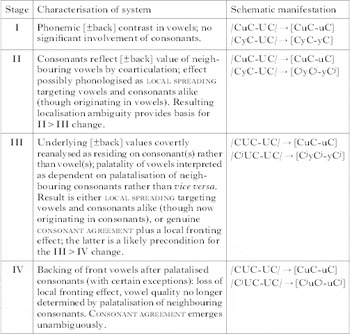
The diachronic trajectory by which Karaim consonant-palatalisation agreement arose is largely uncontroversial. As a harmony system, it is a descendant of the [±back] vowel harmony found in most Turkic languages. The evolution of a consonant-palatalisation harmony from an inherited palatal vowel harmony was no doubt brought on in large part by the sociolinguistic situation of intensive and prolonged contact with languages in which the locus of phonological [±back] contrasts was consonants rather than vowels. In their reconstruction of the history of Northwest Karaim palatalisation agreement, Nevins & Vaux (Reference Nevins, Vaux, Csirmaz, Lee and Walter2003) posit the four-stage scenario summarised in Table I; my formulation differs from theirs only slightly. In the rightmost column, ‘y’ and ‘u’ are generic labels for front and back vowels respectively, whereas ‘U’ stands for a vowel which either lacks a [±back] specification or whose surface [±back] value is otherwise predictable from context.
Evolution of Karaim palatalisation agreement (after Nevins & Vaux Reference Nevins, Vaux, Csirmaz, Lee and Walter2003)

Two steps are central in this reconstructed history. The first of these (the I>II transition) is the appearance of consonant palatalisation in the context of [−back] vowels. This would have originated as a coarticulatory effect, but was possibly entrenched as a categorical phonologised interaction at some point. The second step (the II>III transition) is a covert reanalysis whereby [−back] specifications were attributed to consonants rather than to vowels, made possible by the inherent ambiguity of output configurations like [CʲyCʲyCʲ] with respect to the phonological source of the [−back] feature. A significant contributing factor here would have been the prevalence of phonemic C:Cʲ contrasts in the sound systems of the surrounding Baltic and Slavic languages, and the dependence in these languages of (phonetic) vowel fronting on (phonological) consonant palatalisation rather than vice versa. In effect, the inherited palatal harmony was ‘transphonologised’ from the vocalic to the consonantal dimension. Note that although the II>III transition is effectively the point at which consonant-palatalisation agreement arose as such, the true nature of the system is still largely covert at stage III, due to the vowel-fronting effects attributable to palatalised consonants. It is only when these (now redundant) fronting effects start disappearing at stage IV that the non-local and consonant-based character of the harmony system emerges overtly.
The synchronic properties of Karaim consonant agreement are all attributable to its origins in the metamorphosis of a pre-existing vowel harmony system. These include directionality (progressive, stem-to-suffix), but also some features which are highly unusual for consonant-agreement systems (see §2.1). For example, the agreement shows little or no sensitivity to relative trigger–target similarity, and is not limited to any specific subset of the consonant inventory, defined by such criteria as same place, manner and/or laryngeal features; instead, every consonant in the language falls within its purview. This is entirely as predicted by the above diachronic analysis, given that the vowel harmony ancestral to the agreement was oblivious to the featural composition of neighbouring consonants (and certainly insensitive to whether the consonants flanking a given vowel did or did not happen to have certain properties in common). Another striking feature of Karaim palatalisation agreement which follows from the diachronic analysis is the exemption of the palatal glide [j] from the agreement system (see (4) above). This seems surprising, as [j] embodies the very element which defines the secondary articulation on consonants like [mʲ] or [dʲ]. While one might imagine construing this as a ‘similarity effect’, restricting agreement to [+consonantal] segments, this interpretation is hardly insightful. The diachronic explanation is simpler and far more revealing: in Turkic languages in general, [j] is neutral and transparent with respect to [±back] vowel harmony. Since [j] occurred freely in front-harmonic and back-harmonic contexts all along (that is, in the predecessors of forms with and without consonant palatalisation respectively), no aspect of the distribution or behaviour of [j] has changed whatsoever.
5 Pharyngealisation and agreement in Tsilhqot'in
The third and perhaps most interesting case of consonant agreement based on secondary articulation is sibilant pharyngealisation agreement in Tsilhqot'in (Chilcotin), a Northern Athabaskan language spoken in the central interior of British Columbia, Canada. In §5.1 I detail how the [RTR] feature plays an important role in this language, forming the basis not only of consonant agreement but also of an unbounded anticipatory vowel retraction known as ‘flattening’ (Cook Reference Cook1983, Reference Cook1993). In Tsilhqot'in, as in Karaim, secondary articulation agreement originates in the metamorphosis of an inherited harmony system of a different kind. I argue in §5.2 that what was once a simple coronal agreement was transformed, as a by-product of general sound shifts, into a ‘coronal agreement’ of a different and typologically unique kind, such that the property over which agreement is defined is now [±RTR]. Furthermore, I argue that this metamorphosis of the consonant-agreement system has had dramatic consequences for the synchronic phonology of Tsilhqot'in. I propose in §5.3 that the particular combination of non-local consonant agreement with local retraction effects on neighbouring vowels provided the diachronic source, via analogical reanalysis, of the unbounded spreading pattern known as ‘flattening’. This diachronic analysis helps explain several synchronic properties of Tsilhqot'in flattening which would otherwise require ad hoc stipulation.
5.1 The phonology of Tsilhqot'in pharyngealisation
Tsilhqot'in is unique among the Athabaskan languages, in that a pharyngealised/non-pharyngealised (or retracted/non-retracted, or ‘flat’/‘sharp’) contrast occupies a central place in its phonological system (Krauss Reference Krauss1975, Latimer Reference Latimer1978, Cook Reference Cook1983, Reference Cook1993). Tsilhqot'in is something of a frontier language, located on the southwestern edge of the Northern Athabaskan subgroup, and the prominent role played by pharyngealisation in its sound system has close parallels in the phonology of gutturals and vowel retraction in many neighbouring languages of the Salish, and to some extent Wakashan, families. There is thus clearly an areal component to the phonology of pharyngealisation in Tsilhqot'in (Cook Reference Cook1978, Reference Cook1993). The similarity ends there, however, as the specific details of the sound patterns have no direct counterpart in any of the neighbouring languages.
5.1.1 Contrasting ‘flat’ and ‘sharp’ consonants
There are two things worth noting in the Tsilhqot'in consonant inventory in (5).
(5) Consonant inventory of Tsilhqot'in (Krauss Reference Krauss1975, Cook Reference Cook1993)
One is the rich class of coronals, typical of Athabaskan languages, which here includes a series of anterior sibilants characterised by pharyngealisation, henceforth referred to as ‘flat’ sibilants and labelled Ŝ (in conformity with previous work on the language and with Tsilhqot'in orthography). These contrast minimally with a plain sibilant series, the ‘sharp’ S series, which is not pharyngealised. The second observation is that dorsals exhibit a similar distinction between a (relatively) back vs. front series, labelled here as Q and K. Though these are transcribed here as uvulars and velars, ‘back velar’ vs. ‘front velar’ may be more accurate; a salient characteristic of the Q series is a fricated release (cf. /sε-qεn/→[sʌxʌʌn] ‘my husband’ vs. /bε-k’εs/→[bεk’εs] ‘its gills’. The two series which trigger vowel retraction (see below) are boxed in (5).Footnote 10
Phonologically, the flat Ŝ-series sibilants are the pharyngealised counterparts of the sharp S-series sibilants. In what follows, I will interpret this (following Latimer Reference Latimer1978, Cook Reference Cook1983, Reference Cook1993, Andrews Reference Andrews1988) as an [RTR] contrast, with flat sibilants being [+RTR] and their sharp counterparts [−RTR]. Sibilants which are [+RTR] will be transcribed here as pharyngealised [sˁ], etc., in output forms, but the conventional rendering /ŝ/, etc., is retained in underlying representations. For consistency, I assume that [RTR] underlies the contrast between the dorsal Q and K series as well, though this is not crucial.
The classification of the flat sibilants as phonetically pharyngealised and phonologically [+RTR] is supported not only by their effects on nearby vowels, described below, but also by the acoustic and articulatory findings of Latimer (Reference Latimer1978). Flat sibilants were found (by extrapolation from formant transitions) to have a locus of about 1000 Hz, in contrast to 1500 Hz for the sharp sibilants. Palatography findings indicated that the area of (lateral) tongue-palate contact is considerably farther back for flat sibilants than for sharp ones. In the pair /bε-zi/→[bεzi] ‘his niece’ vs. /bε-ẑi/→[bʌz(ˁ)əi] ‘his mouth’, Latimer (Reference Latimer1978: 41) describes the area of contact as being denti-alveolar in the former but ‘well behind the alveolar ridge’ in the latter. Gafos (Reference Gafos1999: 191–194, citing personal communication with Eung-Do Cook) takes this difference in oral constriction location as being a primary characteristic of the flat/sharp distinction, rather than a mere side-effect of tongue-root retraction (the pharyngealisation aspect of the Ŝ series is not mentioned at all). Gafos thus defines the sharp sibilants as ‘apico-lamino dental-alveolar’ and their flat counterparts as ‘lamino-postalveolar’.
Interestingly, some early works conversely describe the flat Ŝ-series consonants as being ‘post-dental’ retracted sibilants, in contrast to ‘alveolar’ non-retracted sibilants for the sharp S series, and even transcribe the former as /θ tθ dð/, etc. (King Reference King1979). This would at first glance seem inconsistent with Latimer's (Reference Latimer1978) findings, and certainly at odds with Gafos' (Reference Gafos1999) reading of them. However, palatography results should be interpreted with caution in the case of coronal fricatives, since all they show is the extent of linguo-palatal contact along the sides of the tongue blade. This is in turn greatly dependent on the cross-sectional shape of the tongue blade and does not directly reflect the location of the fricative constriction along the front–back axis. In any case, I show in §5.2 how the current [+RTR] vs. [−RTR] opposition almost certainly reflects a genuine dental vs. alveolar contrast at an earlier stage. It is also worth noting that a lamino-dental [ ] or interdental [ð] realisation (often with some lateral element) is often observed for sharp /z/ and flat /ẑ/ alike, especially in coda position (Krauss Reference Krauss1975: 10). The fact that this realisation cuts across the flat/sharp distinction undermines any attempt at characterising the S:Ŝ opposition primarily in terms of the coronal gesture itself. As noted already by Krauss (Reference Krauss1975), this peculiarity of Tsilhqot'in /z ẑ/ has a clear parallel – and a probable areal source – in the phonetic realisation of /z/ and /
 / (its glottalised counterpart) in the Salish language St’át'imcets (Lillooet; van Eijk 1997), which neighbours Tsilhqot'in to the south. Interestingly, in the Lower (Mount Currie) dialect of St’át'imcets, where the dental realisation of /z / is most prevalent, these pattern with contrastively [+RTR] sibilants in triggering vowel retraction (van Eijk 1997: 8), suggesting that they have been reanalysed phonologically as [+RTR].
Despite the acoustic and articulatory differences between sharp and flat sibilants revealed by Latimer (Reference Latimer1978), all descriptive sources have noted that the S:Ŝ pairs are virtually indistinguishable in and of themselves, and that the contrast is perceptible only through the effects on nearby vowels. The quotations below (emphasis added) are indicative of this perceptual dependence of the coronal [RTR] contrast on adjacent vowels. The retraction effects of flat (Ŝ- and Q-series) consonants on vowels are summarised in the next section.
There are two sibilant series, phonetically identical except in that one has a ‘flattening’ effect on vowels whereas the other does not (Krauss Reference Krauss1975: 10).
Unlike the sibilants, the sharp velar stops are phonetically distinct from their flat counterparts (Cook Reference Cook and Efrat1979: 16).
There is … some evidence that the two types of sibilants are different phonetically (as well as phonemically), although the difference is not audible even to a most seasoned Athapaskanist (Cook Reference Cook1983: 128).
It is virtually impossible to distinguish auditorily /s/ from /ŝ/, /dz/ from /dẑ/, /ts/ from /tŝ/, and so forth. But the phonological difference … is manifested in the way in which neighbouring vowels are affected (Cook Reference Cook1993: 151).
5.1.2 Vowel retraction (‘flattening’)
The Ŝ- and Q-series consonants affect neighbouring vowels in similar ways, causing them to surface with a lowered and/or backed quality. The Tsilhqot'in vowel inventory includes three tense and three lax vowels (‘reduced’ vowels in Athabaskanist parlance). Based on their qualities in non-flattening environments, these will be represented as /i u æ/ and /ɪ ʊ ε/ respectively, following Cook (Reference Cook1993). This is largely uncontroversial, with the possible exception of /ε/, the (non-flattened) quality of which varies considerably and is alternately transcribed as [ə] (Krauss Reference Krauss1975, King Reference King1979), [ε] (Cook Reference Cook1976, Reference Cook and Efrat1979, Reference Cook1983, Reference Cook1993, Latimer Reference Latimer1978, King Reference King1979, Andrews Reference Andrews1988) and even [ɨ] (Cook Reference Cook1976).Footnote 11 The effects of flat consonants on nearby vowels are summarised in (6).
(6) Vowel retraction triggered by ‘flat’ (Ŝ- and Q-series) consonants
For /i/, the outcome is dependent on whether flattening is caused by a preceding consonant (creating an [ə]-like transitional onglide, [ i] or [əi]) or by a following consonant (resulting in an overall lowered quality, [e]). As for /ɪ/, the lax counterpart of /i/, the distribution of this phoneme is so limited that it appears never to be found in a position preceding a flat consonant; hence the absence of a monophthongal variant in (6). Finally, I depart from Cook, and follow Krauss (Reference Krauss1975), in rendering the flattened allophone of /ε/ consistently as [ʌ] rather than [ə]; this avoids any confusion arising from the fact that /ε/ may be realised with a [ə]-like quality in non-flattening contexts as well (see above and note 11).
Vowel retraction is one of two major [RTR]-related sound patterns in Tsilhqot'in, and is considerably more complex than (6) suggests. The complexities concern (a) the extent of the effect, (b) its directionality, (c) opacity/transparency of intervening sharp (S- or K-series) consonants and (d) Ŝ- vs. Q-series affiliation of the triggering consonant.
The more dramatic manifestations of vowel retraction are those triggered by a Ŝ-series sibilant, referred to as ‘Ŝ-flattening’. Progressive Ŝ-flattening is illustrated in (7) with data from Krauss (Reference Krauss1975: 30); the relevant vowels are underlined in the surface forms for clarity. An Ŝ-series sibilant will trigger retraction in a following vowel, as in (7a). If that vowel is lax (in practice usually /ε/), retraction will reach the vowel of a subsequent syllable as well (7b). With certain exceptions (see below), progressive retraction applies across an adjacent consonant (7c). For independent reasons, such ŜC clusters will only ever arise at the juncture of a prefix and the (consistently monosyllabic) word-final verb stem. For this reason it is impossible to tell if the adjacent consonant would affect the ability of progressive Ŝ-flattening to reach a second vowel, as in (7b).
(7)
When a sharp consonant intervenes between the triggering Ŝ-series sibilant and a potential target vowel, vowel retraction is blocked; sharp consonants are thus opaque to progressive Ŝ-flattening. In practice, the consonant in question is always a K-series dorsal, never an S-series sibilant. This is because consonant agreement causes Ŝ…S→S…S (see below) and thus removes any incentive for vowel retraction in the first place. Blocking of progressive Ŝ-flattening by a K-series dorsal is shown in (8), with examples from Cook (Reference Cook1993: 156).
(8)
Regressive Ŝ-flattening is strikingly different from its progressive counterpart in two respects. First, it is unbounded, affecting all preceding vowels in the word. Second, an intervening sharp (i.e. K-series) consonant does not interfere with the process, but is instead entirely transparent.Footnote 12 The unbounded character of regressive Ŝ-flattening is illustrated in (9a), and the transparency of intervening K-series consonants in (9b). All examples are cited from Cook (Reference Cook1993: 156), except for the third form in (9a) (from Krauss Reference Krauss1975: 34).
(9)
Retraction triggered by Q-series dorsals, though it yields the same qualitative effects on vowels, is subtly different from that triggered by Ŝ-series sibilants. Progressive Q-flattening simply targets an immediately following vowel, as the examples in (10) show (all from Cook Reference Cook1993). Unlike progressive Ŝ-flattening, the effect does not appear to reach beyond a lax vowel to affect the subsequent syllable; cf. (10c) vs. (7b).
(10)
As noted above in the context of (7c), /… CCV …/ sequences where the first C is a potential flattening trigger can only arise at the prefix–stem boundary in verbs. However, no Q-series consonants happen to occur in any of the prefix morphemes occupying the relevant position in the verb template. It is therefore impossible to tell whether progressive Q-flattening would be blocked by an intervening sharp (e.g. S-series) consonant, in the way that progressive Ŝ-flattening is blocked by sharp (K-series) consonants in that same context.
Finally, regressive Q-flattening is more similar to its progressive counterpart than it is to the pervasive and unbounded regressive Ŝ-flattening shown in (9). Unlike the latter, regressive Q-flattening only reaches the nearest preceding vowel – potentially across an intervening consonant – as in (11a). Furthermore, the effect is blocked if a sharp consonant (always a S-series sibilant) intervenes between the Q-series trigger and a target vowel, as seen in (11b) (examples from Krauss Reference Krauss1975, Cook Reference Cook1993).Footnote 13
(11)
To summarise, there is a fundamental asymmetry which separates regressive Ŝ-flattening from all the other vowel-retraction processes. Progressive Ŝ-flattening and all Q-flattening are quite limited in their scope, and are subject to blocking by an intervening sharp consonant (to the extent that the morphotactics allow such sequences to arise). The same is not true of regressive Ŝ-flattening, which is unbounded and applies freely across intervening sharp consonants. Such [−RTR] consonants are thus transparent to regressive [+RTR] spreading triggered by sibilants, but opaque both to regressive [+RTR] spreading from dorsals and to progressive [+RTR] spreading from sibilants and dorsals alike. This complex state of affairs has proved a hard nut to crack for autosegmental analyses, as many of the details appear to require outright stipulation (Cook Reference Cook1993).
With respect to its unboundedness, its directionality, its being triggered by sibilants rather than dorsals and its lack of sensitivity to intervening segments, regressive Ŝ-flattening bears great resemblance (as observed by Cook Reference Cook1993: 166) to the other major sound pattern involving [RTR] in Tsilhqot'in, namely sibilant pharyngealisation agreement. I will argue in §5.3 below that this convergence is more than coincidental, and that it contains clues to the diachronic origins of (unbounded) vowel flattening.
5.1.3 Sibilant pharyngealisation agreement
Many Athabaskan languages, including Tsilhqot'in, display consonant agreement among certain classes of coronal obstruents, usually sibilants (on coronal agreement elsewhere in Athabaskan, see Gafos Reference Gafos1999, Hansson Reference Hansson2001b). Whereas in most related languages the agreement involves [±anterior] and/or [±distributed] contrasts, Tsilhqot'in is unique in that the basis for agreement among sibilants is a [±RTR] pharyngealisation contrast.Footnote 14
The sound pattern as such is quite simple: a non-local anticipatory assimilation in [±RTR] among sibilants. Thus, a sharp–flat sequence /…S…Ŝ…/ surfaces as uniformly flat […Ŝ…Ŝ…], while in a flat–sharp sequence /…Ŝ…S…/ both sibilants become sharp: […S…S…]. The last alveolar sibilant thus determines the [±RTR] value of any preceding alveolar sibilants in the word. For reasons which will be clarified shortly, only the latter (depharyngealising) instantiation of [RTR] agreement leaves unambiguous surface evidence of its own existence. Examples of this effect are shown in (12); the sibilant undergoing depharyngealisation due to consonant agreement is underlined ((12a) is from Cook Reference Cook1993: 160; (b, c) from Krauss Reference Krauss1975: 36).
(12)
Examples like (13) reveal the truly non-local character of the assimilatory interaction. Here agreement in [−RTR] operates across a span of local [+RTR] spreading, the latter due to Q-flattening (both regressive and progressive) triggered by an intervening /ʁ/. The depharyngealisation of the /ŝε-/ prefix sibilant, surfacing as [z], is evident from the qualities of the vowels preceding it (both are [ε], rather than flattened [ʌ]).
(13)
Recall from §5.1.1 that the phonological Ŝ:S contrast is cued almost exclusively by the retraction effects of the former on nearby vowels. For this reason, the existence of sibilant agreement in forms such as (12) is inferred from the absence of vowel retraction around the underlyingly [+RTR] Ŝ-series sibilant targeted by agreement. Were it not for sibilant agreement, the forms in (12) would have been expected to surface instead as *[nas(ˁ)əiɬts’ɪɬ], *[tʌz(ˁ)əiɬʧæz] and *[nas(ˁ)ʌsk’æz] respectively.
The perceptual dependence of the sibilant [±RTR] contrast on vowel-quality alternations makes it impossible in principle, given the existence of (unbounded) regressive Ŝ-flattening, to observe directly and unambiguously the pharyngealising version of sibilant agreement. Consider the examples in (14), which are expected to show – and might well be interpreted as showing – regressive agreement in [+RTR]. The targeted [−RTR] sibilant (of the 1st singular subject-agreement prefix /s-/) is underlined ((14a) is from Cook Reference Cook1993: 161; (b, c) from Krauss Reference Krauss1975: 36).
(14)
Based on the retracted quality of the vowel(s) preceding the /s-/ prefix in each case, we might infer that the sibilant has been rendered [+RTR] in the output (as indicated by the parenthesised [ˁ] diacritic), as a consequence of sibilant agreement. However, these same vowel qualities can equally be blamed directly on the word-final Ŝ-series sibilant (the ostensible agreement trigger) by the unbounded process of regressive Ŝ-flattening. As long as the [s]:[sˁ] distinction can only be identified (other than instrumentally) by inference from vowel qualities, a surface form like (14a) can equally well be interpreted as [χatasg sˁ] (with no sibilant agreement) rather than [χatasˁgsˁ] (with agreement). On the former interpretation, the sharp S-series sibilant would simply be transparent to regressive Ŝ-flattening in exactly the same way as the sharp K-series [g] is. The situation is even worse for forms like (14c), where the underlyingly [−RTR] /s-/ sibilant prefix is flanked by underlyingly [+RTR] sibilants on both sides, belonging to perfective /ŝε-/ and the stem /-duẑ/. Here the retracted vowel immediately preceding the /s-/ is also adjacent to the /ŝ/ before it, and the latter can thus be blamed for the retracted quality (as well as for that of /æ/ in the initial syllable). This form might thus represent [natʌzˁʌsdozˁ], with no direct evidence for sibilant pharyngealisation agreement whatsoever.
The lack of unambiguous evidence for the pharyngealising version of sibilant agreement is due to the overlapping effects of regressive Ŝ-flattening. This overlap is in turn a consequence of the peculiar way in which regressive Ŝ-flattening differs from all the other vowel-retraction processes examined in §5.1.2. The reason that a form like (14a) can potentially be interpreted as agreement-free (i.e. ‘disharmonic’) [χatasgsˁ] is precisely because regressive Ŝ-flattening is (uniquely) unbounded and (uniquely) impervious to intervening sharp ([−RTR]) consonants. If either of these conditions did not hold true of regressive Ŝ-flattening – that is, if it were more like its progressive counterpart or Q-flattening – then this form, without agreement, would have surfaced as *[χatæsgsˁ]. I will argue in §5.3 that the overlap between regressive Ŝ-flattening and sibilant agreement is far from accidental, suggesting that the peculiar properties of regressive Ŝ-flattening – which it shares with sibilant agreement, but which set it apart from other vowel-retraction processes – are due to reanalysis of the combined (and ‘telescoped’) effects of non-local sibilant agreement and local vowel retraction.
Before leaving the topic of Tsilhqot'in sibilant agreement as a synchronic sound pattern, we must consider the other coronals, in particular the Š-series sibilants, and their non-participation in the agreement. As is clear from examples like (15), a Š-series sibilant neither blocks nor triggers agreement ((15a) is from Krauss Reference Krauss1975: 36; (b, c) from Cook Reference Cook1993: 160).
(15)
If Š-series sibilants were able to block the interaction between sibilants of the S and Ŝ series, then we would expect (15a) to surface instead as *[tʌzˁəiɬtšæz]. Were such consonants to participate in sibilant agreement – as similar segments do in many related languages – we would expect (15b) to surface either as *[ɬæ sεstsis], with the /tš/ undergoing assimilation to the subsequent /s/, or else as something like *[ɬæ šεštšis], with the /tš/ triggering agreement in preceding sibilants. Neither is the case.
Gafos (Reference Gafos1999) views Tsilhqot'in sibilant agreement as a strictly local spreading of articulatory gestures of the tongue tip/blade. As mentioned in §5.1.1, Gafos interprets the Ŝ:S distinction as ‘lamino-postalveolars’ vs. ‘apico-lamino dental-alveolars’. His explanation for the transparency of the Š-series consonants rests on the conjecture that these are not coronals but genuine dorso-palatals. In part this idea rests on somewhat shaky inferences from descriptions found in various earlier works (and ones attributed to personal communication with Eung-Do Cook). Another source on which Gafos draws is the morphophonological patterning exhibited by Š-series consonants, in particular the alternation between /š/ and /y/ in stem-final position (e.g. in imperfective vs. perfective forms), corresponding to a voiceless/voiced alternation in /s/∼/z/, /ŝ/∼/ẑ/, /ɬ/∼/l/, etc. That /š/ alternates with an unambiguously dorso-palatal /y/, rather than with a /ž/ (which is non-existent in Tsilhqot'in), is argued to indicate that the former is dorso-palatal as well. Unfortunately, this argument is a non sequitur. The alternations in question take place only stem-finally, and in this specific position the fricative /š/ is indeed realised as a true dorso-palatal [ç]. The /š/∼/y/ alternation is thus a pure voicing alternation among dorso-palatals, just as Gafos surmises (cf. /tε-d-lʊš/→[tεdlʊç] ‘he laughs’ vs. /tε-ʁε-s-d-lʊy/→[tæsdlʊy] ‘I have laughed’). In all other environments, however, /š/ has a markedly different realisation, and the same goes for the Š-series affricates; these are virtually identical to English /ʃ ʧ ʤ/, and quite clearly involve the tongue blade creating a constriction in the postalveolar region.Footnote 15 Needless to say, for the purpose of explaining the transparency of /š/ (and of /tš tš' dž/) to long-distance assimilation among alveolar sibilants, only the phonetic quality of word-medial allophones is relevant, not that of word-final [ç]. When the harmony is viewed instead as non-local [RTR] agreement among sibilants which contrast for this feature (i.e. which are [coronal, +anterior, +strident]), the problem of the transparency of Š-series sibilants evaporates.
5.2 Pharyngealisation agreement in a diachronic perspective
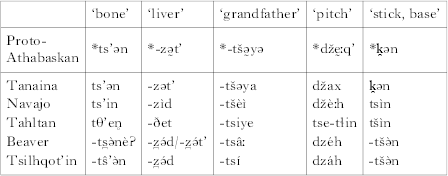
There is little doubt that Tsilhqot'in sibilant agreement is an inherited sound pattern rather than an innovation. Coronal agreement with many of the same properties (regressive directionality, unboundedness) is attested in many other Athabaskan languages, not only in the Northern branch (e.g. Tahltan; Hardwick Reference Hardwick1984, Shaw Reference Shaw, Paradis and Prunet1991), but also in the Southern or Apachean branch (e.g. Navajo; Sapir & Hoijer Reference Sapir and Hoijer1967, McDonough Reference McDonough1990, Reference McDonough1991), and to a limited extent in the Pacific Coast branch (e.g. Tututni; Golla Reference Golla1976). As an MSC, sibilant agreement is reconstructed as far back as Proto-Athabaskan-Eyak (Krauss Reference Krauss1964): sibilants of the reconstructed *ts, *tš and *tšʷ series did not co-occur in roots except with members of the same series.Footnote 16 We have no evidence that sibilant agreement operated in heteromorphemic contexts at that stage, but this may be partly due to limitations of the comparative and internal reconstruction methodology. In any case, deep correspondences between the consonant-agreement patterns attested in different subgroups suggest that agreement alternations in prefix coronals are at least an early innovation.
Cognate sets (Krauss Reference Krauss, Hargus and Rice2005). Tahltan forms after Hardwick (Reference Hardwick1984).
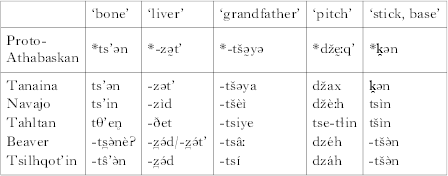
Far more important than geographic/genetic distribution and superficial similarity is the fact that the particular coronals which interact in Tsilhqot'in pharyngealisation agreement correspond directly to those involved in most other Athabaskan coronal agreement systems. In spite of their striking dissimilarity from a synchronic phonetic-phonological point of view, the pharyngealised vs. non-pharyngealised alveolar contrasts in Tsilhqot'in, the dental vs. alveolar contrasts in Tahltan and the alveolar vs. postalveolar ones in Navajo and Apache are all historically cognate with one another, reflecting the Proto-Athabaskan *ts and *tš series respectively. This is shown schematically in (16) for a few representative languages, and illustrated by cognate sets from the same languages in Table II.Footnote 17 Since the Proto-Athabaskan *tš:*tšʷ contrast was merged in all relevant languages, I have conflated the two under *tš(ʷ) for simplicity. The reconstructed front velar * series is included, since these consonants shifted to sibilants in many daughter languages (see below) and thus had the potential of entering into the coronal agreement system. For each case in (16), the participating segments are boxed; dashed lines enclose those coronals which show only partial or secondary involvement.Footnote 18 In all cases, the two series which are centrally involved in agreement in (some of) the daughter languages are precisely those which diachronically reflect Proto-Athabaskan *ts and *tš(ʷ).
(16) Diachronic correspondence classes of agreeing sibilants
In Navajo and other members of the Apachean subgroup, the * series merged with the *ts series, and is indistinguishable from the latter with respect to agreement; cf. PA * ːtš'∼*ːš ‘knot’>Navajo /šaːž/ (instead of otherwise expected */saːž/). In many languages of the Northern subgroup, the fronting of the * series instead yielded [−anterior] sibilants (/tš/, etc.). This forms part of a general and pervasive sound shift which affected the majority of languages in the Northern Athabaskan subgroup, what Leer (Reference Leer, Jelinek, Midgette, Rice and Saxon1996) calls the Great Northern Series Shift (see also Howe & Fulop Reference Howe and Fulop2005):
(17) Great Northern Series Shift (Leer Reference Leer, Jelinek, Midgette, Rice and Saxon1996: 197)
Sibilants become thibilants (interdentals) and shibilants become sibilants. … Palatal onsets become shibilants and uvular onsets become velars.
Many of the Northern Athabaskan languages spoken in the vicinity of Tsilhqot'in have merged, or are in the process of merging, the reflexes of the *ts and *tš series into a single alveolar /ts/ series. Consequently, these languages show no evidence of coronal agreement. These include Sekani (Hargus Reference Hargus1988), Babine-Witsuwit'en (Story Reference Story1984), Dakelh (Carrier; Morice Reference Morice1932, Story Reference Story1984), the Halfway River dialect of Beaver (Randoja Reference Randoja1989) and Fort Liard Slavey (Rice 1989). The fact that the merger is ongoing in some of these languages, and that where it is incomplete the contrast is a dental vs. alveolar one ([tθ]:[ts] or [t ]:[ts]), strongly suggests that the Tsilhqot'in opposition of [+RTR] vs. [−RTR] alveolars goes back to an earlier stage where some kind of dental/alveolar contrast characterised the coronal series in question.
Tsilhqot'in sibilant agreement, as a sound pattern, is thus clearly inherited from Proto-Northern-Athabaskan (or perhaps a later, intermediate diachronic stage). What makes the Tsilhqot'in instantiation of this inherited consonant agreement unique – its being based on [RTR] rather than some coronal-dependent feature like [distributed] or [anterior] – is the result of a general shift in the coronal inventory which did not occur in any of the related languages. By this later change, dental obstruents ([tθ] or [t], etc.) became pharyngealised ones ([tsˁ], etc.). Howe & Fulop (Reference Howe and Fulop2005) discuss this change in the larger context of acoustically motivated sound shifts in Athabaskan languages, and posit an intermediate pre-Tsilhqot'in stage where dentals had acquired an enhancing feature of labialisation ([tθʷ], etc.). Their main motivation is to achieve the introduction of the Jakobsonian feature [flat], whose phonetic manifestation then shifted from labialisation to pharyngealisation. This may not be necessary, however, as connections between dentality and pharyngealisation (uvularisation, velarisation) are attested elsewhere; see the earlier discussion of St'át'imcets /z / in §5.101. Whatever the details of the [tθ tθ' dð θ ð]>[tsˁ tsˁ' dzˁ sˁ zˁ] change, areal convergence with neighbouring Interior Salish languages (St'át'imcets/Lillooet, Secwepemc/Shuswap, Nlaka'pamux/Thompson) likely played a contributing role. These languages all lack dental vs. alveolar contrasts, whereas they do have a pharyngealisation contrast in coronal sibilants (van Eijk Reference Eijk1997).
To summarise, then, we have seen that the emergence of secondary articulation agreement in Tsilhqot'in represents the transmutation of a pre-existing harmony system, whereby sibilant agreement in terms of a coronal-dependent feature like [±distributed] instead came to be based on the tongue-root feature [±RTR]. This was a consequence of the (areally motivated) shift of dentals to pharyngealised alveolars which took place in pre-Tsilhqot'in, and which has set Tsilhqot'in apart from all its Athabaskan relatives. The appearance of consonant pharyngealisation agreement as such is due to the remarkable coincidence of such a sound shift occurring in a language which already had a productive and pervasive coronal agreement between dental ‘thibilants’ and alveolar sibilants. In a sense, the Tsilhqot'in consonant-agreement system could be said to represent the fortuitous and unlikely collision of a typically Athabaskan coronal agreement system with a (very loosely speaking) typically Interior Salish coronal inventory.
5.3 The relationship between agreement and ‘flattening’
As noted in §5.1.2, many characteristics are shared by regressive Ŝ-flattening and sibilant agreement, including those which set regressive Ŝ-flattening apart from the other vowel-retraction processes. The parallels are summarised in (18); see Cook (Reference Cook1993: 166).
(18) Comparison of sibilant pharyngealisation agreement with regressive Ŝ-flattening
a. Both are triggered by sibilants specified for [±RTR].
b. Both apply in a regressive/anticipatory fashion.
c. Both are unbounded, spanning the entire word.
d. Both are unaffected by intervening segments with a conflicting value for [±RTR], which are thus transparent (sharp dorsals in the case of Ŝ-flattening, flat or sharp dorsals in the case of sibilant agreement).
e. Sibilant agreement targets consonants, while Ŝ-flattening targets vowels, but the feature involved in both processes ([±RTR]) is perceived on vowels.
In addition to these striking parallels, we saw in §5.1.3 that there is extensive overlap between the manifestations of the two sound patterns. The effects of [+RTR] sibilant agreement are masked completely by regressive Ŝ-flattening. If a sibilant acquires an output [+RTR] specification by agreement with a [+RTR] sibilant later in the word (S…Ŝ→Ŝ…Ŝ), this is manifested phonetically through retraction of any vowels near the target sibilant. But since regressive Ŝ-flattening is unbounded and never blocked, the same vowels would be retracted in any case, due to direct spreading from the agreement-triggering [+RTR] sibilant. Due to this overlap, there can never be any surface evidence for the pharyngealising version of agreement. The only recoverable evidence for the existence of sibilant agreement comes from its depharyngealising [−RTR] version (Ŝ…S→S…S), in that this process bleeds Ŝ-flattening. The limited evidence base for sibilant agreement as such may be leading to its disappearance. Andrews (Reference Andrews1988) reports many forms where agreement with a later [−RTR] sibilant fails to bleed flattening (though some examples may be due to the ambiguity of [ə] as an allophone of /ε/; see §5.1.2).
I propose that neither the list of parallels in (18) nor the overlap and masking just described are coincidental. Instead, they are indicative of a causal link in the diachronic dimension between these two sound patterns: regressive Ŝ-flattening in its current form represents the analogical reanalysis, or ‘telescoping’, of the combined effects of non-local sibilant agreement and local vowel retraction. The proposal can be summarised as follows. At an earlier stage, all vowel flattening was local, affecting only the vowels of adjacent syllables, or perhaps reaching past a lax vowel into a non-adjacent syllable (as in progressive Ŝ-flattening today). In forms with more than one sibilant, unbounded regressive sibilant agreement and local vowel flattening (emanating bidirectionally from said sibilants) typically had the combined effect that any and all vowels preceding an agreement-triggering (i.e. ‘rightmost’) [+RTR] sibilant ended up surfacing as retracted. For example, if we were to hypothesise that regressive Ŝ-flattening operated as a mirror image of what we see in progressive Ŝ-flattening, all four retracted vowels in (14c) /næ#tε-ŝε-s-d-duẑ/→[natʌzˁʌsˁdozˁ] would be accounted for by the combination of sibilant agreement and such short-range Ŝ-induced flattening. The source of retraction on those vowels is thus ambiguous between a local [+RTR] sibilant (the agreement target) and a distal one (the agreement trigger, which furthermore was the obvious source of the lexical [+RTR] specification). I suggest that such ambiguous contexts were reanalysed as involving unbounded vowel flattening triggered directly by the last (and underlyingly [+RTR]) sibilant, and that this reanalysis is what has lent regressive Ŝ-flattening its current properties and special status. An overt consequence of the reanalysis is that regressive Ŝ-flattening is now applied in an unbounded fashion in all contexts, even in forms which contain no additional sibilants.
Although this analysis is somewhat conjectural, there do exist concrete examples which show reanalysis of sibilant Ŝ:S distinctions due to ambiguities in localising the phonological source of [+RTR] effects on vowels. Krauss (Reference Krauss1975) notes that all stems which were historically ŜVQ have been reanalysed as SVQ in Tsilhqot'in. When the source of stem-vowel retraction was ambiguous, the [+RTR] specification was thus consistently attributed to the following (Q-series) consonant alone. As Krauss (Reference Krauss1975: 37–38) puts it, ‘preceding a flattened vowel, flat sibilants are in no way themselves phonetically distinguishable from sharp. Modern Chilcotin, instead of remembering the history, now treats all such initials as sharp rather than flat’. As in the reanalysis scenario described above, this restructuring would also have led to altered pronunciations of certain forms, as in the examples in (19), from Krauss (Reference Krauss1975: 38). Having been recast as a S-series sibilant, the historically Ŝ-series sibilant of a ŜVQ root now fails to trigger regressive vowel flattening, and triggers [−RTR] agreement on any preceding sibilants.
(19)
The development of unbounded regressive Ŝ-flattening out of a combination of unbounded sibilant agreement and local vowel retraction is shown in (20) and (21). Multiple-sibilant forms like (20) provided the pivot for analogical reanalysis. Propagation of [+RTR] by sibilant agreement is shown at the bottom, with local [+RTR] spreading at the top. I assume the original version of regressive Ŝ-flattening to have been like its progressive counterpart, spanning two syllables if the closer vowel was lax (see §5.1.2).
(20)
In multiple-sibilant forms like those in (20) (as well as in single-sibilant forms that were relatively short, or ones where the sibilant was centrally located within the word), the reanalysis is entirely covert: the surface realisation is the same before and after the change. For forms containing only one ([+RTR]) sibilant, and in which that sibilant was located relatively far from one or more of the vowels present in the form, the reanalysis has some overt consequences, in that certain vowels are affected by retraction which otherwise would not have been. One such example is shown in (21); note that for simplicity the regular contraction of /tε-ʁε-/ to /tæ/ (realised as [tæ]∼[ta], depending on the [±RTR] context) has been built into the ‘underlying’ representation in the diagrams.
(21)
The proposed diachronic analysis of Tsilhqot'in sibilant agreement, and its interplay with (regressive) Ŝ-flattening, has several explanatory advantages. First of all, the account explains the asymmetric (and synchronically problematic) profile of the regressive Ŝ-flattening process relative to the other vowel-retraction processes, especially as regards its unboundedness and the transparency of intervening [−RTR] consonants. Secondly, the diachronic analysis explains the parallels between sibilant agreement and regressive Ŝ-flattening (with respect to directionality and unboundedness), rather than viewing these as purely coincidental. Thirdly, it explains how sibilant agreement and regressive Ŝ-flattening have come to coexist in Tsilhqot'in despite the considerable redundancy arising from their overlapping effects (which may in turn be leading to the disappearance of sibilant agreement as such).
A fourth advantage of the diachronic analysis, pertaining to the interpretation of Tsilhqot'in sibilant pharyngealisation agreement as reflecting an earlier agreement based on a dental vs. alveolar contrast, is the light it sheds on how pharyngealisation agreement in Tsilhqot'in fits into the greater picture of coronal agreement in Athabaskan (and cross-linguistically), despite its synchronic uniqueness. A fifth and final advantage is that the proposed account permits us to formulate in more concrete and precise terms the notion that pharyngealisation-related aspects of Tsilhqot'in phonology may be partly due to areal contact with neighbouring Salish languages (Cook Reference Cook1993: 150). More specifically, the change of dental ‘thibilants’ into pharyngealised sibilants, as well as the local flattening (retraction) effects on nearby vowels by Q- and Ŝ-series consonants, can likely be blamed on language contact or areal convergence. By contrast, the existence of a consonant-agreement system involving coronals is an inherited feature, while its instantiation as pharyngealisation agreement is a mere by-product of the change just described. The complexities of the vowel-flattening processes as a whole, and the special status of regressive Ŝ-flattening within that set, are an entirely Tsilhqot'in-internal phenomenon, arising from the interaction and overlap between [RTR]-related vowel-retraction effects and the inherited consonant agreement which has come to be based on [±RTR] as well.
This study of Tsilhqot'in sibilant pharyngealisation agreement reveals the benefits of diachronic-evolutionary explanations for synchronic sound patterns. A better understanding of the consonant-agreement system is gained: why it involves the particular sibilants it does, why the operative feature is [±RTR], why it shows the directionality effects that it does, and so forth. We have also deepened our understanding of the complex evolutionary trajectories that can produce consonant-agreement patterns which are otherwise rare or unattested. Finally, the diachronic analysis yields explanations for other elements of the synchronic phonology of Tsilhqot'in. In short, diachrony provides us with important clues to two synchronic puzzles: vowel flattening (its internal complexity and interaction with consonant agreement), and the very existence of such a typologically rare phenomenon as long-distance consonant-pharyngealisation agreement.
6 Retrospective comparison
As noted in §3, the three attested cases of secondary articulation agreement differ considerably in their specifics. These differences are, however, largely attributable to the different diachronic trajectories leading to the synchronic agreement patterns. Consider first the fact that the domain in which consonant agreement is enforced is considerably larger in Karaim and Tsilhqot'in than in Pohnpeian – a fact which allows the former two to be manifested by phonological alternations in affix consonants, not merely static distributional generalisations over root morphemes. Given that Karaim and Tsilhqot'in each constitute a transphonologised version of a pre-existing unbounded harmony system (vowel harmony in one case, coronal agreement in the other), this is entirely as predicted.
The existence of alternations makes it possible to discern directionality in Karaim and Tsilhqot'in consonant agreement: progressive and regressive respectively. Since affixal morphology is consistently suffixing in Karaim but prefixing in Tsilhqot'in, both could in principle be characterised in morphological terms as showing cyclic or ‘inside-out’ directionality (stem-to-suffix in Karaim, stem-to-prefix in Tsilhqot'in; on stem control, see Baković Reference Baković2000). However, this would hinge on the questionable assumption that Athabaskan prefixal morphology is uniformly left-branching, and is therefore likely an inappropriate analysis for Tsilhqot'in (see Hansson Reference Hansson2001b: 191–199; cf. Rice Reference Rice2000). More to the point, the directionalities of consonant agreement in Karaim and Tsilhqot'in simply reflect those of the systems from which they evolved: cyclic (stem-to-suffix) in Turkic vowel harmony, regressive (anticipatory) in Athabaskan coronal harmony.
Another important difference concerns the set of segments participating in consonant agreement, and the extent to which the delimitation of that set is based on similarity. Consonant agreement in Pohnpeian and Tsilhqot'in alike is restricted to a narrowly defined subset of the segment inventory, the members of which are highly similar to one another: [labial, −continuant] consonants in Pohnpeian, and [coronal, +anterior, +strident] ones in Tsilhqot'in. The same is not true of Karaim, where all consonants (other than [j]) are subject to palatalisation agreement and no similarity effects whatsoever are detectable, making Karaim quite unique and anomalous among attested consonant-agreement systems (Hansson Reference Hansson2001b, Rose & Walker Reference Rose and Walker2004). From a diachronic perspective, these differences have a very simple explanation. Karaim palatalisation agreement represents a secondary development from an earlier vowel-harmony system in which, needless to say, there were no similarity restrictions on the pairs of consonants permitted to occur on each side of a front vowel (the configuration eventually yielding Northwest Karaim /CʲVCʲ/). Even the non-participation of [j] in consonant agreement is a direct reflection of the fact that it had always been neutral and transparent to the [±back] vowel harmony from which the consonant agreement evolved. By contrast, the diachronic background from which secondary articulation agreement emerged in Tsilhqot'in, and perhaps partly in Pohnpeian as well, involved pre-existing consonantal co-occurrence restrictions (for Tsilhqot'in, a full-fledged consonant-agreement system) which were themselves already highly dependent on similarity.
A unifying theme which runs through all three cases is the involvement of coarticulatory vowel–consonant interactions in their diachronic emergence and/or subsequent development. This dependence is not unexpected when we consider the essentially vocalic nature of secondary articulations and the fact that their manifestation inevitably spans the V-C and C-V transitions in the acoustic signal. Such properties are intrinsically hard to localise perceptually, and this invites a variety of ways in which the phonological parse of the speech signal may go awry or be fundamentally restructured (see also Blevins Reference Blevins2004: 148ff). Taking Cʲ vs. C as generic representations for consonants with and without some secondary articulation, and using ‘y’ vs. ‘u’ to represent vowels distinguished by the corresponding vocalic property, the dilemma is the following: should a sequence like […CʲyCʲ…] be ‘decoded’ as /CyC/, /CʲuCʲ/, /CʲuC/ or something else? The roles played by such coarticulation-related ambiguities are different in the three cases examined in this paper. The diachronic analyses presented can be portrayed as in (22).Footnote 19
(22) Localisation ambiguities and diachronic changes involving secondaryarticulation features (‘C, Cʲ’ and ‘u, y’ are generic symbols)
In Pohnpeian, ambiguities of localisation provide the vehicle which effectively ‘transports’ the property from one consonant to another, across the intervening vowel. In Karaim, they constitute a pivot point for reanalysing a vowel-based harmony with coarticulatory effects on consonants as a consonant-based one with coarticulatory effects on vowels. Finally, in Tsilhqot'in, such ambiguities provide the basis for telescoping unbounded consonant agreement and local vowel retraction into a single unbounded vowel-retraction effect, whereby very little overt evidence remains for the existence of any consonant agreement as such in the language.
7 Conclusions
I hope to have demonstrated that a careful investigation into the diachronic origins and evolution of individual consonant-harmony systems is a fruitful enterprise. Focusing on secondary articulation agreement as a particularly rare instance of consonant harmony, the three attested cases of this phenomenon were found to have quite diverse evolutionary histories (and ‘unnatural’ ones in at least two of the three cases). Of these three, Pohnpeian (labio)velarisation agreement is the least problematic from a synchronic-typological point of view: it is an MSC operating over a narrow class of highly similar segments, and is one of several similarity-based co-occurrence restrictions in the lexicon. Much is yet unclear about the origins of secondary articulation agreement in Pohnpeian, and this topic requires further study. Blevins (Reference Blevins2004: 150) has hypothesised that the development of (labio)velarisation agreement among labials occurred via a listener-based sound change, by hypocorrective misattribution of the secondary articulation feature to both labials in a P˭VP or PVP˭ sequence rather than to just one. However, the presence in Pohnpeian of other pairwise co-occurrence restrictions on velarised vs. non-velarised consonants (e.g. /t/ vs. /ʈʂ˭/, /l/ vs. /r˭/) and the apparent lack of interaction across such pairs (e.g. between /t/ and /r˭/) suggest that the full story may be a bit more complex.
Karaim palatalisation agreement and Tsilhqot'in pharyngealisation agreement were seen to have originated in the transformation of a pre-existing harmony system – in each case, a system of a familiar and robustly attested kind – into a consonant-agreement system of this extremely rare type. Furthermore, areal contact with languages with fundamentally different inventories and phonotactics was almost certainly a contributing factor in both cases. In Northwest Karaim, contrastive palatality was transphonologised from vowels onto surrounding consonants, such that an inherited [±back] vowel harmony evolved into a consonant palatalisation agreement system with otherwise identical properties (with respect to directionality, domain size, lack of similarity effects, and neutrality of [j]). In Tsilhqot'in, an inherited coronal harmony system involving agreement in something like [±distributed] (and, at an earlier stage yet, most likely [±anterior]) became transposed into a novel featural dimension, [±RTR]. This was an automatic consequence of a general reconfiguring of the Tsilhqot'in coronal inventory, whereby an inherited dental vs. alveolar contrast shifted to a pharyngealised alveolar vs. non-pharyngealised alveolar contrast, and we saw how this shift has also had dramatic consequences for the general phonology of pharyngealisation in Tsilhqot'in. In particular, the diachronic-evolutionary account in §5.3 was able to explain certain otherwise challenging complexities in the synchronic phonology of vowel retraction.
The findings presented here have sobering implications for synchronic treatments of consonant harmony as featural agreement. The varied diachronic trajectories which can lead to synchronic consonant-agreement patterns, or fundamentally alter the properties of such patterns, allow a few highly anomalous cases to disrupt an otherwise fairly coherent and restrictive typology. Such typological outliers nevertheless need to be synchronically derivable, as bona fide sound patterns, with the formal-theoretical constructs available, and this in turn means that synchronic-formal accounts of consonant agreement must be permissive to the point of drastic overgeneration. For example, the existence of Karaim palatalisation agreement means that the correspondence-based approach (Rose & Walker Reference Rose and Walker2004), which takes consonant agreement to be criterially dependent on correspondence between highly similar segments, must be able to accommodate cases for which the threshold of minimum trigger–target similarity is set virtually at zero (excluding only vowels and glides). In such cases, the anomaly exhibited by the system in question is in the direction away from the state of affairs most consistent with the notion that consonant harmony, viewed as featural agreement, has its ultimate roots in the psycholinguistic domain of phonological and phonetic encoding for speech production. A more general result, then, is that careful diachronic study of individual consonant-agreement systems can help clarify the extent to which such processing factors do or do not play a role in shaping synchronic sound patterns.