Introduction
Background
On January 12, 2010, a massive 7.0 M earthquake struck Haiti. According to the United States Geological Survey (USGS; Reston, Virginia USA) Hazards Program, it was the deadliest earthquake of the last five centuries with 316,000 people killed, 300,000 injured, and 1.3 million displaced.Reference Bortolin, Morelli, Voskanyan, Joyce and Ciottone 1 Listing earthquakes by death toll since 1990: the Haitian 2010 event is followed by the 2004 Sumatra earthquake (9.1 M), with its 227,898 fatalities; and then the 2008 Eastern Sichuan earthquake (7.9 M), with 87,587 victims. 2 By far, the most significant injury-causing consequence of these “Mega-Mass-Casualty” seismic events is building collapse, causing significant blunt and penetrating trauma, among other things.
Importance
Earthquake-related trauma results in crush injuries and bony- and soft-tissue trauma. 3 There are no systematic reviews analyzing the typical injury patterns and treatments in “Mega-Mass-Casualty” earthquakes. The characterization of an injury pattern specific to disaster type, be it natural or manmade, is imperative to build an effective disaster preparedness and response system. This should include the development of clinical guidelines and the definition of standards-of-care (SOC) for each type of mass-casualty event.
Goals of Investigation
This systematic review focuses on the earthquake-related, adult, orthopedic injuries occurring in specific anatomical regions. Traumas involving head, thorax, or abdomen lie outside this study’s scope. The objective was to analyze the injuries involving limbs, pelvic ring, and spine (with and without spinal cord involvement). The goal of this study was to assess the different fracture patterns seen in earthquake survivors. A further aim was to define the most frequent injury type among open and closed fractures, dislocations, crush injuries, and isolated soft-tissue injuries seen in earthquakes. Among these, burns, deep wounds, peripheral nerve and vascular lesions, and intramuscular hematomas were included.
Regarding treatment-of-injuries, this review attempted to define how often and in what circumstance surgery is required versus conservative treatment. The most common surgical procedures, amputation rates, and the availability of prostheses (artificial limbs) after amputations were characterized. Also assessed was antibiotic use, average event-to-treatment time, patients’ length-of-stay (LOS) in field hospitals, and how frequently rehabilitation was provided.
In brief, the main scopes of the study were: (1) the definition of the SOC for this setting; and (2) the identification of the most common orthopedic injuries and their treatment requirements after “Mega-Mass-Casualty” earthquakes, in order to improve disaster response by medical teams dispatched to the field.
Methods
Search Strategy
The systematic review was conducted in accordance with the Preferred Reporting Items for Systematic Reviews and Meta-Analyses (PRISMA) guidelines.Reference Violante, Kivlehan and Flores 4 A comprehensive search strategy was developed to identify all publications relating to earthquakes and the orthopedic treatment in adult patients. The following databases were searched: PubMed (Medline; US National Library of Medicine, National Institutes of Health; Bethesda, Maryland USA), Ovid (Ovid Technologies; New York, New York USA), Web of Science (Thomson Reuters; New York, New York USA), and The Cochrane Library (The Cochrane Collaboration; Oxford, United Kingdom).
A search of primary studies in databases was carried out: the search terms within the two main categories (A and B) were combined with the conjunction “OR.” The main A category was “earthquake” and the B category was compound by one of the following words: “orthopedic,” “limb,” “hand,” “foot,” “spine,” or “pelvic.”
The search strategy was limited to articles available from January 1, 2000 to December 31, 2014. Only this period was considered to avoid dated and possibly misleading concepts in orthopedic surgery. Moreover, in the last 15 years, disaster preparedness and response, as well as the scientific interest in these subjects, has undergone continuous evolution. Including research papers prior to 2000 could cause misleading results.
Selected languages of publication were English, French, Spanish, and Italian. Finally, the authors also conducted a hand search reviewing the references of the included studies.
Abstract Review and Abstract Inclusion/Exclusion Criteria
Every abstract was reviewed independently. If the two investigators disagreed, they attempted to reach consensus by discussion. A third investigator was consulted to serve as a tie-breaking adjudicator.
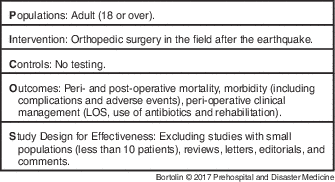
Before starting the research, a Population, Intervention, Control, Outcome, Study Design (PICOS) framework was designed to identify controlled studies, and its elements were used as primary selection criteria (Table 1).
PICOS Framework - Selection Criteria

Abbreviation: LOS, length-of-stay.
Papers were excluded for the following reasons: referencing a single surgical technique; not focused on orthopedic injuries; without data about types of fractures; and specific to pediatrics. Reviews, commentaries, editorials, or single case reports also were not included.
Data Extraction and Statistical Analysis
Data from eligible papers were identified and collected in an electronic database using Microsoft Excel 2011 (Version 14.3.8; Redmond, Washington USA). One reviewer extracted the data and a second reviewer independently checked the completeness by reviewing the extraction tables and full-text articles.
Data were collected about: type of study; characteristics of the earthquake (place, year time, and Richter and Mercalli Scales); features of the patient (age, sex, and type of trauma); type of orthopedic involvement (closed versus open fractures and fracture distribution among upper or lower limbs, pelvis, and/or acetabulum, spine); type of treatment (conservative or surgical procedures, debridement, open reduction internal fixation [ORIF] or external fixations [EFs], and amputations); administration of antibiotics; hospital LOS; rehabilitation LOS; and complications.
Assessing Study Quality and Level of Evidence
The level of evidence of each included study is very low, with the best studies reaching the Level III of evidence, retrospective cohort study.
Results
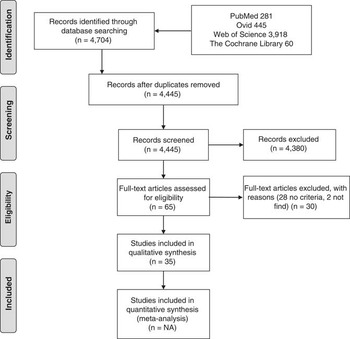
The searches identified 4,740 articles: 4,445 after duplicates were removed. The papers were screened for title and abstract and 65 out of those were selected for full-text analysis. One-thousand three-hundred and thirty-two articles were removed because of: poor data, language not understood (eg, Chinese), format unsuitable (case reports, editorials, comments, and reviews), or because they involved pediatric patients (less than 18 years old). After carefully reading of the full texts, 35 papers met inclusion criteria and were included in the qualitative and quantitative analysis. It was found that two articles reported the same situation with a small difference in number of patients: most of the patients described were the same. Therefore, it was decided to exclude one out of these two papers according to the minor Impact Factor of the journal it was published in.Reference Moher, Liberati, Tetzlaff and Altman 5
Figure 1 illustrates the PRISMA flowchart of this systematic review.
PRISMA 2009 Flow Diagram.Reference Violante, Kivlehan and Flores 4 Abbreviation: Preferred Reporting Items for Systematic Reviews and Meta-Analyses.

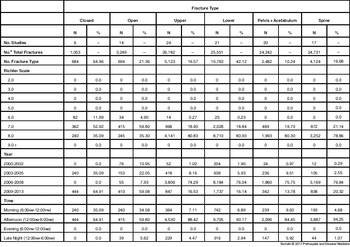
Analysis of the data revealed that fractures involved more lower (42.12%) than upper limbs (19.57%), and less frequently the spine (16.68%) and pelvic ring (10.24%). Also, 4.12% of the spinal column fractures caused spinal injuries as well (Table 2). Spinal injuries were present in 0.69% of all fractures. Closed fractures (64.96%) were more frequent than open ones (21.36%). Whether fractures were open or closed did not correlate with the Richter Magnitude Scale (RMS) of the earthquake. The total amount of fractures, however, did correlate with it: the prevalence of fracture was higher when the RMS was 8.0. The RMS correlated with the number of surgical patients as well. In fact, the number of surgical patients was one-third more when the RMS was 8.0 compared to 7.0, respectively (56.54% vs 43.46%; Table 2).
Characteristics of Fractures by Fracture Type

a Total fractures reported in all studies that reported the specific fracture type.
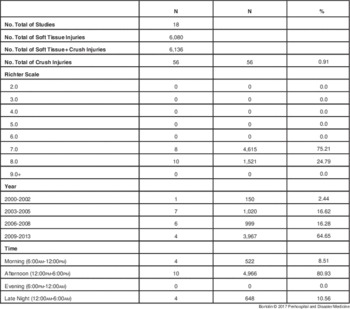
These results underline how the soft-tissue injuries are more frequent during the day than during the night, as well as when RMS is 7.0 compared to 8.0. Crush injuries amounted to 0.91% of the patients affected by soft-tissue injuries (Table 3).
Characteristics of Soft Tissue and Crush Injuries

Dislocations were a rare event during the earthquakes analyzed, with a prevalence of 1.71% of the traumatized patients. Dislocations were more prevalent during the night than in the morning.
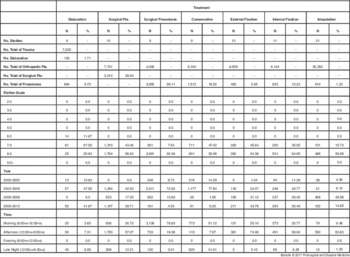
Patients referred to surgical treatment were 38.94% of the overall number of patients needing orthopedic treatment. The “surgical procedure per patient ratio” was 0.99. The percentage of orthopedic surgical procedures increased dramatically as the RMS scale changed: 92.46% with 8.0 versus 7.54% with 7.0 (Table 4).
Characteristics of Orthopedic Treatment

The data collected did not permit an analysis of the “time from the event to treatment.” Moreover, studies did not report if the surgical or conservative treatment was definitive. Conservative treatment was performed in 18.52% of patients. Articles about late-night earthquakes, unlike papers about afternoon earthquakes, reported more conservative treatments. External fixation was performed in 5.38% of the patients that had received an orthopedic treatment, ORIF in 10.23%, and amputations in 1.23% (Table 3).
Data regarding the use of antibiotics were scarce and did not permit an evaluation of their use in the disaster field. There were few data regarding the LOS for surgical patients and no data regarding the use of prostheses and rehabilitation after amputations, as well as their outcome and/or complications.
Discussion
Study Overview
The limitations of this analysis are important to note, with disparities in collected data, methodology variations between studies, inaccuracies, and differences in location of one earthquake versus another.
Taking that into account, the database was very helpful in obtaining descriptive tables, with pooling of the data from the various studies showing frequencies and attempting to describe the injury patterns and subsequent impact of the earthquakes. Due to limitations previously mentioned in the selected papers, it may be impossible to identify best practice in these events, and therefore, SOC. The quality of data does not permit such a standard to be defined. Developing a SOC would require many more studies from a multitude of different events and higher quality data. For example, it was not possible to calculate any relative risk (eg, EF vs internal fixation) because none of the papers calculated any risks, nor had they tabulated results, nor, for instance, stratified the number of victims with fracture by complications versus no complications. They were all descriptive in nature, and this limited the research considerably. Correct data extrapolation and interpretation was challenging. For instance, papers either referred to the number of patients affected by fractures or, alternatively, the number of fractures themselves. In the same way, they referred to the number of surgical patients or the amount of surgeries. Because of these inconsistencies and limitations, this research set about to identify one or two specific associations of interest and focused on the analysis and data collection of those specifically. Only a descriptive analysis could be synthesized from these data.
Fourteen articles described open fractures and only six articles describe closed fractures. Only 16 studies out of 35 reported the prevalence of closed and open fractures (Table 2). With the exception of one article, closed fractures resulted more frequently than open fractures.Reference Moher, Liberati, Tetzlaff and Altman 5 - Reference Elmi, Ganjpour Sales, Tabrizi, Soleimanpour and Mohseni 20 Given the state of the collected data, it is impossible to establish if there is any statistically significant prevalence of a type of fracture or of an anatomical region affected among trauma patients resulting from any given earthquake. This contradicts the understanding that upper and lower extremity injuries are more frequent during nightly/early morning than daytime earthquakes, respectivelyReference Bar-On, Lebel and Kreiss 6 , Reference Teicher, Alberti, Elder, Baron and Herard 21 (Table 2). With the exception of two studies, all articles reported that fractures affected more lower than upper limbs.Reference Bar-On, Lebel and Kreiss 6 - Reference Emami, Tavakoli and Alemzadeh 15 , Reference Bai and Liu 17 , Reference Benner, Stephan and Renard 19 - Reference Fan, Li and Lian 34 No association was found between short time-to-treatment and lower number of complications; amputation rate; or use of EF rather than ORIF.
Qualitatively, it is possible to define that there are more open fractures during daytime hours than at night. This supposition also is verified by the data extracted about upper and lower fractures, and moreover of the pelvis and the spine (Table 2).
With the data collected, and the important limitations, it is difficult to establish whether in the recent years (since 2000) there has been an improvement of the health care delivered, or if results reflect that there has been an increase in international response to earthquake disasters with hospital teams often being deployed.
It should be mentioned that the scarcity and poor quality of the data collected also may suggest a low level of accountability of their activity by the international hospital teams. Moreover, the absence of a comparison between activities of different hospital teams during the same disaster underlines a possible lack of coordination and control during the response. This would result in suboptimal management and subsequent quality-of-care delivered to casualties, as well as a waste of resources. The former brings up significant ethical issues with the provision of sub-standard care to a disaster-afflicted population. These are areas of research that must be explored further.
Orthopedic Treatment
Excluding data about open and closed fractures, for all types of injuries, results underline that the higher the impact of the earthquake, as measured by RMS, the higher is the number of injuries. Moreover, the number of surgical patients also increases dramatically when the RMS is 8.0 versus 7.0. This predicts also that the surgical requirements of a responding team will be higher in RMS 8.0 or higher. Further studies are needed to evaluate whether both “surgical procedures per surgical patient” ratio and surgical complexity also are greater when earthquake magnitude increases.
These results suggest that the mitigation phase is important. The laws and regulations overseeing building construction are fundamental to avoid or decrease the number and severity of injury during earthquakes.Reference Zhang, Zhao and Fu 35
Regarding orthopedic injuries during earthquakes, special attention must be paid to the management of the lower limbs, most frequently injured, as well as to pelvic and spinal injuries, with incidences higher than previously predicted. Spinal cord involvement following spine fractures is an important issue to quantify in order to understand how many neurosurgeons are needed in the disaster setting. Spinal injuries occurred in 4.12% of spine fractures, but in 0.69% of overall fractures. This is not a low number considering an earthquake typically impacts a large population with victims in the hundreds to thousands. This underlines how a neurosurgeon on a disaster team could be an important asset during the response, also considering the head trauma and other injuries that are not evaluated in this review.
Conservative treatment for fractures, when possible, should be encouraged in a disaster setting; in fact, the creation of a cast requires less time, as well as fewer doctors and less materials, than a surgical fixation. 3 In a scenario with a scarce water supply, fiberglass casts should be preferred over plaster casts as they require much less water than plaster. 3 However, the application of conservative treatment in a disaster setting has some limitations as well: (1) the need for low molecular weight heparin to prevent deep venous thrombosis when a lower limb is immobilized; (2) a longer immobilization time than after a surgical procedure; and (3) lack of physical therapy to avoid joint stiffness after prolonged immobilization. When surgery is needed, EF use should be encouraged because of its shorter procedure time than ORIF, as well as the possibility of using makeshift fixators when standard EFs are not available.Reference Lee and Riley 36 In the Haitian experience, for example, the nonstandard EFs were sterile only in the areas near insertion through the skin, and freehand reductions were performed because of the unavailability of C-arm fluoroscopies.Reference Lee and Riley 36 Moreover, EF is the recommended treatment for Gustilo IIIB and IIIC fractures.Reference Bar-On, Lebel, Blumberg, Sagi and Kreiss 37
Eventually, the falling debris from collapsing buildings may cause polytrauma. This may create a life-threatening condition when complicated by multi-organ failure, usually due to: (1) traumatic vital organ injury; (2) massive hemorrhage (ie, in cases of unstable pelvic fractures or abdominal trauma); (3) crush syndrome; and (4) systemic inflammatory response syndrome (SIRS), leading to acute respiratory distress syndrome (ARDS) and disseminated intravascular coagulation (DIC). Damage Control Orthopedics is suggested by several studies because it is considered safer than Early Total Care for unstable polytrauma patients.Reference Cross and Swiontkowski 38 - Reference Harwood, Giannoudis, van Griensven, Krettek and Pape 45
Regarding amputation, it is interesting to state that the overall percentage is relatively low (1.23%); however, it is important to underline how the data are very different during the response to an earthquake rather than other events. As well, during the same event, the average rate of amputation often is significantly variable between each hospital team. This means that the preparedness, response, and quality of health care delivered is different from one team to another. It is recommend following the Harvard (Cambridge, Massachusetts USA) 2011 Humanitarian Action Summit Surgical Working Group guidelines,Reference Taeger, Ruchholtz, Waydhas, Lewan, Schmidt and Nast-Kolb 46 providing recommendations for not only the correct surgical procedure and anesthesia, but also the access to medical follow-up, rehabilitation and mental health services, analgesia, and prevention and management of phantom limb pain (PLP). The surgical team should decide between amputation and orthoplastic limb salvage, considering the availability of blood transfusion, presence of surgeons expert in limb salvage, and availability of rehabilitation and prostheses.Reference Taeger, Ruchholtz, Waydhas, Lewan, Schmidt and Nast-Kolb 46 In fact, if unfollowed by the correct post-operative rehabilitation, an amputation is a condemnation because of its physical complications (PLP, wound dehiscence, and need of stump revisions), and psychological/social problems (depression, work loss, or marginalization).
At the end, this review did not confirm the association between a nightly earthquake and upper limb injury and between a daytime earthquake and lower limb injuries that has been reported in a number of articles.Reference Liu, Tang and Pei 7 , Reference Teicher, Alberti, Elder, Baron and Herard 21
Limitations
The limitations are important: the quantity of the data collected are limited. Every systematic review has the challenge of the quality of data collected. In Disaster Medicine, data from events are often retrospective and, therefore, the scientific quality of the articles and the validity of findings is low. Sometimes the articles reviewed did not follow a method in the collection and analysis of the data. In some cases, data were extrapolated from tables.
Another important limitation involves the setting of the event and the local infrastructure. Mitigation and preparedness can differ greatly from one country to another, so the disaster response capabilities may be different as well. This can have an influence on these results.
Conclusion
The goals of this study were twofold: a description of the state of the field and an analysis of current techniques with the purpose of identifying what works best in order to develop a SOC. This study shows how important it is to improve and to require, as soon as possible, the accountability of international disaster teams in terms of type and quality of the health care delivered, and to standardize the data collection.
At this juncture, with these data, it is not possible to determine the best-practice approach to the earthquake victim. It is not possible to predict outcome differences between patients with immediate access to formal trauma care and those without, nor if there is any association between early time-to-treatment and lower number of complications, amputation, or ORIF. Further study is required to evaluate specific evidence-based treatment guidelines.
The dramatic differences in numbers of amputations and other procedures found in the data spawn important points of reflection and ethical questions regarding the international response to earthquakes and whether inexperienced teams not prepared for such missions should ever be deployed. As the approach creating a SOC in international disaster response through programs should also standardize the training, medical/surgical practice, and data collection and reporting. With such, it will affect optimal, evidence-based care and have a much better quality measurement tool in the future.