Imagine a festival taking place before about five thousand people in a park in Adana, Turkey, in June 1992. In the middle of the park is a stage made of concrete. A touring Kurdish theatre company comprising four men, Hüseyin Kaytan, Kazım Öz, Nihat Öz, and Kemal Orgun, is performing a short play called Du Şivan (Two Shepherds). They enact a village raid and choose the villagers from among the audience. Kemal Orgun plays the commander of the task force raiding the village. The other three carry out the operation, rounding up the villagers. Orgun struts among the villagers, harassing them. All of a sudden, a woman jumps onstage and tries to grab the gun Orgun is carrying. He tries to wrest the gun from her, but she won't let go. A great commotion ensues, and more people clamber onstage to help the woman and attack the actors. When a man tries to strangle Orgun, he yells out in Kurdish, “Bira ma tu çi dikî, te ez kuştim?” (Hey my friend, what are you trying to do, kill me?). When the attacker finally understands Orgun is Kurdish, he releases and embraces him. Recounting this incident in his interview with me, Orgun remarks that they were almost lynched.Footnote 1 The Kurdish woman who had jumped onstage and impulsively attacked Orgun had thought this was a real raid, just like those that had been taking place in Kurdish villages in Turkey for years. Her rage and instinctive self-protection is at one level slightly amusing, but this was also a bitter episode that demonstrated the consequences of the oppression of Kurdish people in the country. After the festival, Orgun and the other members named their theatre company Teatra Jiyana Nû (New Life Theatre). This became the foremost Kurdish theatre company and has trained many Kurdish actors, who in turn have further sustained and promoted Kurdish theatre by establishing their own companies.
As with this production of Du Şivan, the first Kurdish plays in the 1990s were mostly performed unofficially at social gatherings; during strikes, protests, union meetings; and in small makeshift theatres in basements. Most of these were short agitprop plays dealing with current political issues. As Kemal Orgun has remarked:
Kurdish theatre emerged as underground theatre, and we worked underground for years because we were performing in a language that was banned. So to speak, this was urban guerilla theatre. According to the system, we were all illegal, militant and criminals. To be honest, we were really living like militants in order to perform our plays.Footnote 2
During the 1990s it was difficult and dangerous to stage plays in Kurdish. The government was extremely strict and took measures to curb Kurdish performances. With the advent of the new millennium, the productions of these companies, of which there were still only a few, drew the attention of both theatre critics and audiences in Istanbul.
This study provides an overview of the origins of Kurdish theatre and its further development in Istanbul in the new millennium. I have chosen two Kurdish theatres, Destar Tiyatro (Theatre) and Tiyatro (Theatre) Avesta, to epitomize the issues facing Kurdish theatre and the attitudes of the authorities. A close analysis of two plays, Disko 5 No'lu (Disco Number 5) and Daf (Trap), is included to reflect the artistic and political commitments of this new theatre. Before delving into the artistic realm, however, a brief history of the Kurdish people in Turkey is provided in order to outline the conditions under which Kurdish theatre emerged and evolved in Istanbul.
Brief Historical Background
After the collapse of the Ottoman Empire, the new Turkish Republic was built in an authoritarian manner. The ruling elites saw nationalism and secularism as the heart of the nation-building project. In this period, the official ethnic policy was “one country, one language and one nation.”Footnote 3 Because “Islam signalled cultural belonging” and because Kurds were predominantly Muslim, they were more heavily oppressed than non-Muslim minorities.Footnote 4 The 1920s and 1930s witnessed three major Kurdish uprisings: the Sheikh Said Rebellion of 1925, the Mount Ararat Revolt of 1927–31 and the Dersim Rebellion in 1937–8. These revolts, which resulted in thousands of deaths, were harshly suppressed by the military.Footnote 5 Each episode resulted in the deportation of Kurdish people from their lands in southeastern Turkey and their resettlement in western cities. And in terms of the “radical nation-building reforms, Kurdish traditional notions of identity and culture were constructed as ‘reactionary’, ‘tribal’, and an outcome of regional ‘backwardness.’”Footnote 6 For a very long time, Kurds were banned from writing in and even speaking their native language. They were, in effect, silenced for decades.
Kurdish nationalist activities increased in the 1960s and the 1970s. During this period, a Kurdish movement emerged largely among student and leftist labor activists. Public meetings were held to discuss the problems Kurdish people faced. Organizations such as Devrimci Doğu Kültür Ocakları (Revolutionary Cultural Hearths of the East) were established to stand up for Kurdish rights. The Labor Party (TIP) began to champion Kurdish causes. More and more political groups emerged during the 1970s. Among these, PKK (Kurdistan Workers' Party) came to prominence and, under the leadership of Abdullah Öcalan, initiated a war against the Turkish state.Footnote 7
Repression of the Kurds during these years was severe, particularly after a military coup in 1980. This coup and the new 1982 constitution brought further prohibitions. Law 2932 forbade the “utilization of any language in the dissemination, printing, and expression of ideas, which is not in the official language recognized by the Turkish state.” It also stated that “Turkish is the mother tongue of all Turkish citizens” and prohibited “the use and dissemination of other languages as a mother tongue.”Footnote 8 The main aim of this law was to force ethnic groups, especially Kurds, to forget their languages and become assimilated. In addition, the names of Kurdish villages were changed and families were forbidden from giving their children Kurdish names. The tensions erupted into violence in 1984, when the PKK launched its first attack, causing the deaths of more than a dozen people.Footnote 9 The state's response was purely military, and it is estimated that about thirty thousand people lost their lives in the clashes between the Turkish army and the PKK, although the exact numbers are still not known.Footnote 10
However, significant changes occurred during the presidency of Turgut Özal in the late 1980s and 1990s, specifically in terms of acknowledging ethnic differences. In 1991, the government repealed Law 2932, which meant that speaking Kurdish was no longer illegal, although using Kurdish for political purposes, education, and broadcasting was still banned. In short, Kurds in Turkey were not allowed to speak their own mother tongue, not even in the streets, until as recently as 1991. As Ataman has noted, “By breaking one of the taboos, the discussion of ethnicities, Özal opened Pandora's box.”Footnote 11 Many Kurdish artists quickly seized upon these reforms, even though the political climate at the time was hardly peaceful and the armed struggle between PKK and the state was at its peak. The PKK, which had been seen in the 1980s as “a handful of bandits … [whose actions] could easily be eradicated through a few measures,” had gained significant power.Footnote 12 Thus, when the first Kurdish theatre companies and the Mesopotamian Culture Center were set up at the beginning of the 1990s, any artistic expression in Kurdish was still considered dangerous by the state.
After the death of Özal in 1993, the repressive policies not only continued but grew even harsher. In 1999, however, Turkey was officially recognized as a candidate for full membership of the European Union, and the Justice and Development Party (AKP) initiated a number of reforms after its initial discussions with the EU. Emergency rule in the southeast, which had been in place for years, was lifted. The ban on the Kurdish language was removed in 2004. The government established a Kurdish-language TV channel, TRT6, and the Higher Education Board resolved to establish Kurdish language and literature departments in universities.Footnote 13 Even so, limitations on using Kurdish remain. Private channels may not broadcast in Kurdish more than four hours a week, and broadcasting Kurdish language lessons is forbidden, since the constitution still bans the teaching of any language other than Turkish as a mother tongue. As a result, Kurdish cannot be used in education.Footnote 14
Some of these reforms followed the local elections of March 2009 that resulted in the victory of the pro-Kurdish DTP (Demokratik Toplum Partisi; Democratic Society Party) in the southeast. This result convinced the AKP that it could not remain indifferent to Kurdish demands. Consequently, the AKP government launched a “Kurdish initiative” that involved legal, social, and economic measures to curb the ever-growing conflict and achieve a peaceful resolution of the Kurdish question. At first the “initiative” was supported by a majority, but its details were ambiguous, causing uneasiness and prompting criticism by both supporters and opponents. Many people were greatly disappointed, as Welat Zeydanlıoğlu relates: “The positive steps of 2009 by the AKP government raised great expectations, but the government unfortunately backtracked … when faced with difficulties.”Footnote 15 Detailed evaluation of this reform program is beyond the scope of this article. Suffice it to say that over the past decade, the AKP has embarked on a political program without recent precedent.
The development of Kurdish theatre in Istanbul should be evaluated in light of this history. The next section elaborates on the consequences of decades of oppression, such as the loss of the traditional dengbêj tradition. In parallel with historical developments, there was a very long period of artistic silence, and the “new” seeds of Kurdish theatre were sown cautiously when the ban on Kurdish language was lifted in 1991. As will be shown, reviving Kurdish theatre and raising the Kurdish language from the ashes of “linguicide” in Turkey has been a hazardous project.Footnote 16
Dengbêj: The Origins of Kurdish Theatre
It is not easy to elucidate the specific origins of Kurdish theatre, as Kurdish written literature is rudimentary, and oral tradition has long been officially prohibited in Turkey through the language ban. Nevertheless, in general, Kurdish theatre can be traced back to the dengbêj tradition. In Kurdish, dengbêj means to speak a word. The term is made up of deng, meaning voice, and bêj, to tell.Footnote 17 For centuries, dengbêjs recited or sang epic poems. The term is defined comprehensively by Roger Lescot:
These professional poets, who over the course of years furnished their memories as apprentices of certain old masters, assumed the task of conserving the traditions of the past and, if some new event were to occur, the celebration of the heroic deeds of the present. … They sometimes faced each other in competitions which were held regularly until quite recently. Every emir or chief of an important tribe maintained one or more of these bards, whose songs, because of the contemporary allusions they might contain, sometimes also had political connotations. Thanks to their unlimited repertoire and matchless gift of improvisation, these men transmitted, from the remotest centuries until today, poems with thousands of verses.Footnote 18
Thus, dengbêjs were the first practitioners of Kurdish narrative theatre. They told of important events that took place in Kurdish society. These masters not only recounted but also acted out these stories with facial expressions, gestures, and body language. An important concept related to the practice of dengbêj is kılam (song, melody). The kılam is a musical story narrated by the dengbêj. Thus, Kurdish theatre, Kurdish literature, and Kurdish traditional music were interrelated. The dengbêjs required impressive skills to act out the different characters of the story. They were trained through master–apprentice relationships and earned their living by traveling to different villages, meeting with important people in the community and singing at their gatherings. They learned a new kılam in each village and thereby enriched their repertoire. But only those with a strong memory and a fascinating narrative style would gain the title of dengbêj.Footnote 19
For centuries, dengbêjs have recounted the stories of the Kurdish people. Unfortunately, this centuries-old oral tradition faced prohibitive official language policies and barely survived through the end of the twentieth century. The tradition was especially imperiled after the military coup of 1980, when the Kurdish language was officially banned. Intimidated, the dengbêjs stopped singing in the wake of the coup. As one of them stated: “In Diyarbakır, no. Songs were over, they disappeared. Turko [a colloquial Kurdish term for ‘the Turk’] didn't allow it. They tore up our tapes. They didn't allow.”Footnote 20 The dengbêj tradition therefore ceased to be practiced, and even though it has begun to reemerge in recent years, many of the tales associated with it have been lost forever.
Today, young generations of Kurdish performers are trying to make use of the dengbêj tradition. As is discussed below, Kurdish theatres such Destar and Avesta are seeking new techniques to narrate stories, just as their ancestors did. Destar Theatre founder Mirza Metin states that, at the same time, his company utilizes Western theatre traditions. This doesn't cause problems in Istanbul, where audiences are familiar with Western theatre, but Kurdish audiences in the east sometimes react without regard to Western theatre convention. Mirza cited a performance in 2006 in Duhok, Iraq. This was a fifteen-minute performance without dialogue and required great concentration on the part of the actors. The audience, however, “applauded so much and especially when we least expected it that we started thinking they were teasing us.”Footnote 21 The audience members were very sincere and just wanted to show their appreciation. Indeed, right after the performance almost all of them went onstage to greet the actors. Mirza realized once again that this was a different audience and that established Western rules did not apply. The people could not just turn off their phones and sit still for hours; they wanted greater interaction during the performance. Mirza associates this interaction with the dengbêj tradition. When a dengbêj was about to begin his story, he would ask his audience whether he should “tell” or “sing” the story. The interaction would start right from the beginning. During his performance, the audience would again join him during the hawin,Footnote 22 which takes place during the kılam, when the dengbêj sings the story. In effect, the audience would address the dengbêj by shouting praises. This would inspire the dengbêj to sing with more delight and energy. In return, the audience would again praise him. This cycle would continue “until they become one,” says Mirza Metin. He pointed out that perhaps Destar needs to find new ways to communicate with this type of audience and reshape the plays accordingly.Footnote 23 However, since Destar is mainly focused on Istanbul, this issue has not been fully explored yet. For the time being, the theatre concentrates on the use of the storyteller as a political act indicating cultural freedom.
The Mesopotamian Culture Center
The first contemporary Kurdish theatre performances started in the late 1990s, after the establishment of Istanbul's Mesopotamian Culture Center (MKM). A group of Kurdish intellectuals in Istanbul founded this important cultural organization on 28 September 1991. This was also the year the language ban was lifted. In theory, this should have made their project easier. However, as already mentioned, this was also the time when political tensions between the PKK and the state reached their peak, and working for MKM in the 1990s was extremely challenging.
The main aim of the center was and is to promote the culture, language, history, and art of Mesopotamia, specifically the long-assimilated and forgotten Kurdish culture. Since 1995, the center has opened branches in more than ten cities in Turkey, Germany, Austria, and the Netherlands. These centers have organized activities related to Kurdish music, dance, theatre, and language.
The establishment of MKM was an important turning point in Kurdish theatre. At the very beginning it consisted of a team of twenty people, mostly unemployed people, students, and laborers. The students could attend only on weekends, and the laborers did so when they had the time. One of MKM's founders, Erdal Ceviz, noted that it was difficult to rehearse regularly and that they had to contend with other problems as well, such as the lack of texts, directors, professional actors, and instructors.Footnote 24 They did not even have a proper stage, and what they did have was extremely cramped. “You could touch the ceiling when you raised your hand,” explained Kemal Orgun, another founder of MKM.Footnote 25
Eventually, all these efforts bore fruit, and the center established its theatre company, Teatra Jiyana Nû (New Life Theatre), in 1992. Both Orgun and Ceviz, who worked as actors and directors from the very beginnings of MKM, remarked in separate interviews that their main challenge was that those who wanted to establish the theatre knew very little about it.Footnote 26 They needed professional instructors to help them, but no one was willing to take the risk. It was very dangerous to work at MKM in the 1990s. Every day, those involved took a different route to MKM's premises, and reaching the door safe and sound meant a great deal.Footnote 27 But the challenges did not stop there. Mirza Metin, who began his training as an actor at MKM when he was only thirteen, reminisced in 2012 that the cast had to use the basement of MKM for performances. “Some nights we would run out the back door after a performance. During tours, some of our actors would be taken into custody. Kurdish theatre has been through such times.”Footnote 28
The authorities were suspicious of MKM's enthusiastic players and directors, who were considered a threat, regardless of the subject of the plays they put on. Orgun points out that although the songs performed at festivals had much more provocative lyrics, this did not lead to problems for anyone. However, when it came to theatre, even a play with a simple subject could be banned.Footnote 29 Consequently, they received little outside help at the beginning. According to Ceviz, under such circumstances the solution was to train themselves.Footnote 30 Each participant chose a topic to specialize in and read up about it diligently so that he or she could teach others. This approach continued until the company could establish more systematic training. According to Mirza Metin, this was done by founding two subunits of Teatra Jiyana Nû: Şanoya Hêlin (Theatre Hêlin) and Sarya Halk Sahnesi (Sarya Public Theatre). The former offered two years of acting training, after which trainees were sent to Sarya Halk Sahnesi to hone their skills onstage.Footnote 31 Before 1995, most of the plays Sarya Halk Sahnesi performed were agitprop productions that dealt with current political issues, such as guerrilla activities and government policies. Most gatherings took place in secret. Actors would often perform short political sketches during protests, strikes, union meetings, and other similar events. Teatra Jiyana Nû also staged political plays, but its main difference from Sarya Halk Sahnesi lay in its aesthetic concerns and the long-term nature of its projects.
An example of the political orientation of Kurdish theatrical output in the first half of the 1990s is evident in the Newroz celebrations held at Istanbul's Abdi İpekçi Arena in 1994. Newroz is the traditional New Year festival of the Kurdish people, celebrating the advent of spring. These celebrations have become more politicized in response to efforts to suppress them. In this instance, thousands of people from many political organizations came together in the arena and chanted political slogans ceaselessly. The chief of police arrived and announced that the celebrations would end if the slogans persisted. When the MKM choir took the stage, the audience ignored the police order and continued chanting slogans. In contrast, when Teatra Jiyana Nû entered, as one of the actors recalled, “as soon as we stepped onstage, there was absolute silence. And during our fifteen-minute performance nothing could be heard except for the sound of photo flashes. That was the atmosphere we had created.” The actors came onstage with their feet and hands bound in chains. Teatra Jiyana Nû seized the opportunity to perform a short play about the torture of Kurdish prisoners in Diyarbakır Prison.Footnote 32
The earlier productions of Teatra Jiyana Nû in the 1990s were also politically inspired. It is possible to discern three crucial phases in its repertoire. The first is defined by the plays of Hüseyin Kaytan, including Daweya Generalê (The Case of the Tin Plate General), Ta/Sê Ewrên Dûr (Ta,/ Three Distant Clouds), Govenda Hilo (The Dance of the Eagle), Mirin û Jiyan (Death and Life), and Jinên Bindest (Oppressed Women). Kaytan is a composer, playwright, and, above all, a poet from Dersim. Erdal Ceviz, one of the leading actors of Teatra Jiyana Nû, describes his plays as “poetic, like a fable” and “somewhat surrealistic.” Indeed, according to Ceviz, in this period the still-inexperienced MKM actors found his texts too difficult to understand.Footnote 33
The second period began when Erdal Ceviz took over as director. This is often referred to as the “unscripted period” by Kurdish artists to whom I had a chance to talk. The major problem that Teatra Jiyana Nû faced was the lack of Kurdish texts. This was no longer because of the language ban, which had in fact been lifted in 1991, but because of decades of prohibition that had prevented the use and advancement of Kurdish language. Ceviz pointed out the same thing when I asked him why the company didn't translate plays. He said that the Kurdish language was insufficiently developed at the time to allow for this. Kurdish artists and intellectuals needed time to explore their language in greater depth and to learn to use it artistically.
It was not until the turn of the millennium that Kurdish was advanced enough to be used for translating Western plays. Gradually, Kurdish theatre companies translated more and more plays. Another part of the solution to the lack of Kurdish texts was Ceviz's decision to create his plays by improvisation, usually through collective brainstorming about a specific issue. The last phase is closely related to the development of Kurdish and the availability of new texts. During this period, Kemal Orgun, who had been with Teatra Jiyana Nû for a long time, brought greater variety to the repertoire, including Kurdish translations of Aeschylus' Prometheus Bound and David Campton's one-act Us and Them.
From the early 1990s, the reaction of audiences was a great source of inspiration to the nascent Kurdish theatre companies. All the Kurdish artists I interviewed, including Kemal Orgun, Erdal Ceviz, Mirza Metin, and Berfin Zenderlioğlu, explained that in the beginning audience reactions were universally positive. Audiences accepted whatever was staged and applauded enthusiastically. They became emotional and cried, even during comedies, just because the actors were speaking Kurdish. However, there was no critical evaluation. Ceviz remarked that this made the companies feel successful, and it didn't matter if they made mistakes or forgot their lines. The audience respected them simply for performing in such difficult conditions. Looking back, Ceviz believes that this was a disadvantage and prevented advancement. After a decade, however, audience reaction changed, and audiences began to complain that there was nothing new in the plays. This growing selectiveness and desire for greater variety, as Ceviz points out, also propelled the translation of Western plays.
After 2000, many artists working at MKM founded their own theatre companies. Theatre Evîna Welat, Theatre Arsen Poladov, Theatre Avesta, Theatre Bakur, Seyri Mesel Theatre, and Destar are only some of the Kurdish groups that flourished under the aegis of MKM. Some broke away from MKM because of ideological differences, and others had different aesthetic preferences. Erdal Ceviz speaks somewhat resentfully of this disintegration and about what became of MKM. “During those days, to work at MKM meant that our lives were at stake, today it is a matter of interest. Ours was a world of dreams, today it is a monetary world because Kurdish simply brings money.”Footnote 34 Although this disintegration may have weakened MKM, it also created a more challenging milieu for young Kurdish artists, increased variety, and further invigorated Kurdish theatre.
The two Kurdish theatre companies reviewed in this article, Destar and Avesta, are products of MKM and Teatra Jiyana Nû. The founders of these companies are young, second-generation performers who were trained by the founders of Teatra Jiyana Nû.
Destar Theatre
Destar Theatre was founded in October 2008 by Mirza Metin and Berfin Zenderlioğlu. These two young artists had both worked at MKM for years. Zenderlioğlu had started to attend MKM in 1998 and worked in music, literature, and theatre. When she decided to concentrate on theatre, she joined the Seyri Mesel Company, where she worked from 2004 to 2008.Footnote 35 In contrast, Mirza had been sent to MKM in 1993, when he was thirteen years old, by his politically active parents. He trained in music, dance, the Kurdish language, and theatre for five years. After a brief interval, he rejoined MKM, and he joined Teatra Jiyana Nû in 2001 in the hope of becoming a professional actor. He later joined Seyri Mesel in 2003, staying there until he and Berfin Zenderlioğlu established their own company in 2008.Footnote 36
Even though Kurdish theatre companies are not well known to many theatregoers, Destar is one of the exceptions. Berfin Zenderlioğlu believes that this is the result of the company's perseverance and the quality of its plays. She told me that the company has been staging plays regularly for a long time, notwithstanding sometimes small audiences.Footnote 37 As a result, more people keep track of what is being performed at Destar's theatrical home. That is not to say Destar has totally overcome the problem of poor attendance, but it has so far managed to survive better than many others.Footnote 38 The first productions of the company were Reşê Şevê (Nightmare; April 2009) and Cerb (Experiment; January 2010). In February 2010 the company established its own venue, Şermola Performans. Here, it has performed a children's play, Palyaço'nun Maceraları (Adventures of a Clown; October 2010); Bûka Lekî (Plastic Bride; April 2011); Disko 5 No'lu (Disco Number 5; November 2012); Antigone 2012 (May 2012); and Gor (Gravestone; November 2013). Of these, Disko 5 No'lu attracted the greatest attention. The production was highly acclaimed in the media, and critics and audience members were impressed that such a young company could produce and perform a piece as difficult as this with such skill and apparent ease.
Disko 5 No'lu is about a prison, specifically Diyarbakır Prison, which in April 2008 the London Times listed among the ten most notorious jails in the world.Footnote 39Disko, the same word as disco in English, is ironic slang for the notorious military wards of Turkey and is derived from the Turkish word for “disciplinary ward.” The play is about the torture that took place at Diyarbakır, which was built in 1980. It has been referred to as “the hell of Diyarbakır” because of the brutal treatment of political prisoners, most of whom were Kurdish. Following the 1980 Turkish coup d’état, administration of the prison was transferred to the military. It became a martial law prison until 1988, when it was returned to the ministry of justice. The army arrested members of parliament, heads of political parties, ministers, unionists, academics, and journalists. During this period, many famous Turkish and Kurdish politicians and artists were detained in the prison and were subjected to systematic torture. In his article “Torture and Turkification in the Diyarbakır Military Prison,” Welat Zeydanlıoğlu lists the atrocious torture methods used: “extraction of nails and healthy teeth … sexual humiliation and assault, rectal examinations, forcing prisoners to beat/sexually humiliate/rape or urinate on each other, rape or threat of rape of prisoners.”Footnote 40 These are only some of the techniques that were used at Diyarbakır Prison in the period 1981–4. Reportedly, many prisoners died following torture. Hundreds were permanently disabled. However, despite these statistics, not a single person has been found guilty and punished.
In my interview with Mirza Metin in August 2013, he explained that he had heard about Diyarbakır Prison from his activist parents when he was only a child. Dörtlerin Gecesi (The Night of the Four), about four prisoners in Diyarbakır who protested by setting themselves on fire, was one the first books he'd read as a teenager. For years, Mirza had wanted to interrogate this episode onstage, and he finally started working on the play when he met a friend whose father had been in the prison. After interviewing his friend's father in 2010, Mirza compiled the play by gathering material from various books, prison memoirs (especially Bayram Bozyel's Diyarbakır 5 No'lu and Yılmaz Sezgin's Sayım Düzenine Geç), interviews, and documentaries. He also received help from Çayan Demirel, who had shot a documentary, 5 No'lu (Number 5), about the prison. Demirel gave all his film footage to Mirza, including footage he did not use in his documentary. Mirza's thorough research yielded many stories about what had happened in the prison, and he increasingly felt that he had to convey these stories to the audience. However, he wanted the play to be more than a simple political documentary; he also had aesthetic concerns. In his quest for a suitable dramatic technique, he drew on the original traditions of Kurdish theatre, particularly the dengbêj tradition.Footnote 41 He decided to write a solo performance. Just like a dengbêj, then, he alone would recount the story through the voices of different characters—a spider, a mouse, a fly, and a guard, all of whom communicate with the prisoner. This was a risky choice, considering the physical challenges solo performance involves. He would have to transform from one character into the other in seconds. However, the gamble paid off, and the result was a spellbinding one-hour performance by the writer in Kurdish, with Turkish surtitles.
The rehearsal period was exhausting for both Mirza and director Berfin Zenderlioğlu. It took about two months to get the play ready, two weeks of which were extremely intense. Mirza had never been onstage for this length of time before, and the physical and vocal transformations required seemed almost impossible at the beginning of the rehearsals. Disko 5 No'lu finally premiered in the Ankara Theatre Festival in November 2011. After the first performance, Zenderlioğlu realized that some of Mirza's transformations were difficult to distinguish, especially when the dialogue was short. Consequently, she revised the play by extending the dialogues.Footnote 42
Disko 5 No'lu
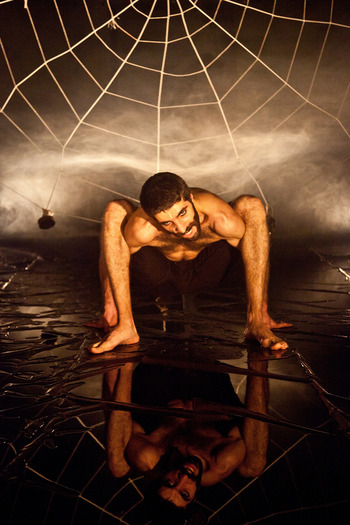
The play captivates the audience from the start as Mirza creeps onstage as a spider, his legs over his shoulders (Fig. 1). On the stage is a single chair, a red rope hanging from the ceiling, and a huge spider's web stretching between the audience and stage. This simple and claustrophobic design accentuates Mirza's brilliant performance. The spider tells the audience a story about a fly he caught four days ago. The fly was “scrawny, weak and in need of blood” and kept on begging for a drop of the latter. He answers the fly that he is the “commander of this web” and the fly is his “prisoner.” It would be useless to eat this fly: he needs more of them and a bigger web. Thus, he makes a deal with the fly. The fly is to find his friends and feed on the people who are to come soon. Later, however, the fly has to betray his friends and entrap them in the web. The spider says that if he is able to do all this, he will give the fly a drop of his own blood, which prolongs the life of flies. The fly agrees and leaves the web. In this scene, Mirza transforms himself into a fly only once; he recounts the narrative solely as a spider. This metaphor continues throughout the play. The spider represents the state and the web its iniquitous system. The flies, on the other hand, are those who serve this bloody system. In the play they are the guards. As the spider implies, more and more people need to be tricked into sucking the blood of others so the system and the spider can survive. The metaphor ends brilliantly in the first scene as the lights fade and the spider speaks: “I became stronger as my web swelled with flies. My web grew as I became stronger. More flies were entrapped as my web grew. I grew stronger and stronger. … Stronger and stronger.”Footnote 43 It is only at the very end of the play that the spider reveals that his own blood is actually of no use to the fly he has tricked.
Mirza Metin performs in Disko 5 No'lu at Şermola Performans in Istanbul. Photo: Nazım Serhat Fırat.

In the next scene, an experienced guard lectures new guards. The spider's story persists on another level as the guard enters and says:
Whoever is caught in my web will become a good person! … As you all know, in past years people who are anarchists, communists, and religion haters and people who are not on our side want to take over and divide our country and our sacred religion! Our duty is to show these people the right path and teach them humanity! This is a sacred duty! This is patriotism! You are free to do whatever you want. (D5N, 6)
The guard tries to justify their duty and supports the other guards unconditionally. He then turns to the audience and tells how he has tortured some of the prisoners. As he does so, Mirza/guard transforms himself into a dog: “I hit him, again, again, again, again, again, again, again (transforms into a dog). My hands, my feet, my uniform, everything was soaked with blood” (D5N, 7). He is no longer a human, but an animal lusting for blood. During the play Mirza transforms himself into seven different characters with ease, including the prisoner. He creeps across the wet floor, climbs the red rope as a spider, comes down as a guard, and transforms into a fly, a rat, and back into a guard as he recounts the story.
For more than twenty minutes, the audience listens to the tale of how the prisoner was tortured by Mirza. He is both victim and assailant. And even though there is no real violence by one person against another onstage, the effect is still powerful. The dog of the commander, Joe, barks offstage as the guardian interrogates and abuses the prisoner in a rage: “How do you like the taste of the baton, ha? Do you like it? Close your eyes and try to enjoy! Good for you! You like it, ha?” (D5N, 9). The level of violence rises constantly, and I saw during the performance that some people averted their gaze, probably because they did not want to read the surtitles while Mirza was talking to an imaginary prisoner. During this torture, the guard speaks incessantly to the prisoner, so that by the end of the scene the atmosphere has become deeply disturbing. The prisoner speaks rarely and briefly. “My friends are forced to watch me … Oh how the guards are enjoying all this … I can smell my own shit on the baton. Joe, did you see? Something just died. Shame … just committed suicide and went to hell” (D5N, 9). Mirza's transformation from one character to another is absorbing. Both guard and prisoner betray their humanity, one by deploying violence and humiliation, the other through his abiding hatred and shame.
The play is at its exhilarating best when the prisoner sees his mother in prison. She asks him in Kurdish, “Kurê min çawayi?” (How are you, son?). He panics and stops her: “Shhhhh, Kurdish is forbidden!” (D5N, 14). We witness the pitiful situation of the mother and the absurdity of banning a language, her true “mother tongue,” the only one in which she can communicate her own son. She appears briefly and leaves when he lapses into delirium.
The end takes us back to the story of the spider and the web. The guard asks the audience: “What now? Do you recognize me? … I am your bloodsucker fly. I know you love me. You love your enemies. Love me … Love me … Love me!” (D5N, 16). Mirza then transforms into a spider again and continues:
Love me! Love me! Whoever witnessed an executioner's blood bestowing life? My blood is poisonous! My blood is torment! Hell! You can hear it right? Listen carefully, my dear flies! Feel it, my children! See it, watchman of time! Can't you hear it? What ancient music! What a brutal symphony! This is my symphony! The symphony of a savage tragedy of death! Love me! Love me! (D5N, 17)
Lights fade as he celebrates his victory.
Mirza's performance was physically impressive, but the pain and injustice that blazed from his eyes suffused the whole production and made me ponder what atrocities humanity is capable of and the reasons for them. This can be understood from the reactions of the audience. Director Berfin Zenderlioğlu recounts that several people needed to go outside and get some fresh air immediately after the play. They told her that the atmosphere the play evoked left them gasping.Footnote 44 One audience member I interviewed, a twenty-six-year-old female account executive, Tuğçe Nuhoğlu, echoed these sentiments:
After half an hour, I felt suffocated. I didn't follow the play for a minute or two. It was disturbing to be so close to something that had really happened and not be able to do anything about it. There it was in all its monstrousness. I left my seat the minute the play ended to get some fresh air.Footnote 45
Another interviewee, Seval Haraç told me that even though she knew about Diyarbakır Prison and what had happened there, she said she still felt somehow guilty. “The transformations were staggering. As if … as if the animal within us was defying our humanity. It was disturbing knowing that this really happened. I felt the room was getting smaller and smaller.”Footnote 46
Zenderlioğlu also told me that some people remained in their seats, sobbing. Several could not believe that all the things they had watched were actually true. They wanted to reaffirm this by talking to members of the company. Yet others embraced the performer and director after the performance and said that the events portrayed just could not be true. “This is what we wanted to achieve,” Zenderlioğlu told me. “We wanted to reach people who didn't know anything about this issue.”Footnote 47 With Disko 5 No'lu, Destar created drama that challenged the audience to become more deeply engaged with theatre.
After watching the play and observing the reactions of the audience, I thought Destar had perfectly adapted this critical issue to the stage. Mirza, however, disagreed with me. He believed that they had truly worked to portray such violence onstage, but in the end he wrote in his notebook that “it is impossible to narrate such diabolical atrocity.” That is why, he told me in an interview, the group considers Disko 5 No'lu as just an “attempt to stage atrocity.”Footnote 48 I realized what Mirza had meant when I did more research into what had happened at Diyabakır Prison. Even so, the play manages to capture the essence of the issue.
Destar Theatre raises themes that are often ignored or to which only short-lived attention is given. It encourages the audience to question socially constructed perceptions of difference and challenges the idea of fixed identities. Disko 5 No'lu speaks for all times and places where people suffer injustice. This kind of play cannot wholly solve political disputes and deadlocks, but it can guide people to interrogate their own consciences and recognize the human dimension of political matters. Destar has empowered Kurdish theatre by probing controversial issues through various aesthetic approaches. Its tenacious search for new modes of expression thrives and gives rise to aesthetic innovation with each new production.
Theatre Avesta
Another prominent Kurdish theatre company with an impressive track record is Theatre Avesta. It was founded by Aydın Orak and Cihan Şan in 2003. The plays they have staged so far are political and in Kurdish, but the company doesn't confine itself to the problems Kurds face. It has a multifaceted repertoire that is constantly expanding. The two men started out in 2005 with a theatrical treatment of Gogol's universally acclaimed and farcical short story “Diary of a Madman.” Translated into Kurdish as Rojniviski Dineki, the play has been staged in many cities by the company over nearly four years.
The play that truly reveals Aydın Orak's skill as a playwright and actor, however, is Daf (Trap). This work, which premiered in 2012, is about borders—borders that separate families, create artificial enemies, and rationalize murders. Aydın Orak was born in Nusaybin, a city in Mardin Province that is populated by Kurds. The city has a border with Syria that is heavily salted with land mines. Having grown up in such a city, Aydın has always had a problem with borders. He lived near a borderline until he was sixteen. Even after he moved to Istanbul, he faced the same bitter reality during his visits to his hometown. He explains that when he went to Nusaybin to stage Rojniviski Dineki years later, he almost stepped on a land mine. The mine was discovered by the people who live near the border, but the authorities got angry with them because they had entered a forbidden area. The officials were right in terms of the regulations, but Aydın points out that the border is a narrow line separating people who can actually see one another's balconies. People can easily stumble upon hazards such as land mines, and better solutions are needed to protect the population of this area.
Aydın observes this situation whenever he goes to Nusaybin. He walks along the border and talks to people, even the soldiers in the area. He says you can see pieces of clothes, scarves, and other belongings caught up in the wires where people tried to cross to see their relatives on the other side. This has been going on for years. He notes that as a result, at least one person in every family in this area has become permanently disabled. The wire fences along the border are damaged, and animals and children can easily stray into the mined area. Only a few years ago, three children playing football in this dangerous zone died after stepping on a land mine.Footnote 49
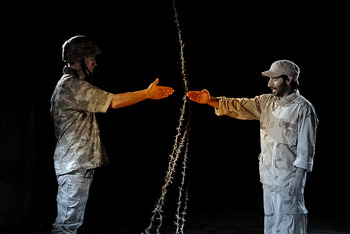
Having experienced such terrible events during his childhood, Aydın's play Daf takes the audience to a border in the middle of nowhere. Two soldiers, Miran and Apol, guard their respective territories, separated by barbed wire. The play begins with two soldiers making funny military gestures. Miran stops after a short time, but Apol continues and makes exaggerated movements as Miran watches him. When he stops, Miran stretches out his hand to shake hands, but Apol refuses (Fig. 2). Miran asks Apol for cigarettes, but Apol is not willing to give him any. Apol, however, needs water and asks Miran if he has any. In response, Miran gestures for cigarettes. Consequently they don't share anything, even though one has cigarettes but no water, the other vice versa. Underlying their dialogue is a criticism of the concepts that recur throughout the play: nationalism and the military. When Miran asks Apol for water, Apol replies: “May God protect me and my people!” Miran ridicules him: “Yeah! Yeah! May God protect you and your people. Your family, your country and your wife and your commander … Hey Apol, you have a cigarette?” Apol in return defends his name: “Now listen to me! Don't you ever call me Apol again. My name is Adullillah. Ab-du-lil-lah! What a buffoon. My name is of great importance. If you ever defame my name again…”Footnote 50 The two characters are totally opposite. Apol is more patriotic, whereas Miran really doesn't care about patriotism, land, or borders. This opposition gives rise to comic disputes. For example, when Miran accidentally spits into Apol's side of the border while trying to smoke a cigarette, Apol becomes ridiculously angry:
Apol: What do you think you are doing? Why are you spitting on our side?
Miran: I was choking to death! What are you talking about!
Apol: Die if I care, you can't spit here! Now you have to spit on your side too.
Miran: What the fuck are you talking about? I said I was choking to death.
Apol: Spit on your side too, or I will. (3)
This humorous exchange takes a different turn when Aydın Orak uses Miran to severely criticize Apol's values.
Miran: Are you joking? Acting like a kid!
Apol: A joke! This is the soil of my country I am talking about. Many martyrs had shed blood on this soil.
Miran: So they died right on that spot? The spot that I just spat on? My God! (4)
Aydın Orak as Miran (left) and Remzi Pamukçu as Apol (right) perform in Daf at the Cihangir Sahne in Istanbul. Photo: Ihsan Kaçar.

This kind of tragicomic argument occurs frequently in the play. When Apol claims that the land doesn't belong to Miran's people, Miran responds sagaciously, highlighting one of the key issues of the play: “Come on, this is old stuff. It doesn't belong to you either. This is not anybody's land. Other people were here before you. Then you came along. It was yours yesterday, it's mine today. Who knows who'll own it tomorrow?” (7). They reach a certain level of awareness, but the issue is complicated and hard to resolve, and their duty forbids them from questioning such dilemmas in depth.
Storytelling, and hence the dengbêj tradition, constitutes a significant part of the play, and colorful techniques are used in recounting the stories. For instance, Orak uses the story of a mouse and a mousetrap. In the story, the mouse sees the owner of the house bring a trap into the house. The mouse asks help from the chicken, the pig, and the cow to get rid of the trap, but none of them will help. That night a snake is caught in the mousetrap. The snake bites the farmer's wife, and she gets a fever. The farmer kills the chicken to make soup to help her get better. Neighbors and friends come to visit her, so the farmer kills the pig to feed them. The farmer's wife dies. For the funeral meal, the farmer slaughters the cow. Everyone eventually gets eaten but the farmer and the mouse. Orak uses shadow play to tell this story with a political point. The lights fade out as Orak goes behind a white screen and uses animal figures to tell the story in an amusing way. This story foreshadows the tragic ending of the play by pointing to the fact that the traps we set for others may spell our own doom.
Another scene in which Orak (Miran) performs two characters, as in the dengbêj tradition, is when Miran makes a “puppet Apol” out of his sock because Apol refuses to talk to him. He then begins a dialogue with the puppet until Apol becomes angry and stops him. Miran then takes a broom, puts his helmet and jacket on it, and talks to him as if he is his commander, thereby once more ridiculing military service:
Commander: Now Miran …
Miran: Yes sir!
Commander: The debt of military service is regarded as a debt of honor. You can't run away from service. Anyone who does so is a traitor. Repeat!
Miran: A traitor, sir! …
Commander: The state is kind. But anyone who does not kiss that kind hand and tries to run away will be slapped right in the face!
Miran: Fuck you, sir!
Commander: What did you say?
Miran: I said, well said, sir! (5)
Over the course of the play Apol and Miran form an uneasy friendship, but it never leads to trust. When Apol sets a trap on his side to ensnare animals for food, Miran believes the trap is set for him. Even though Apol insists that it's only to catch animals, Miran doesn't believe him. This quarrel suddenly turns into a modern battle of the bards as they start singing their troubles. Their altercation turns into rhymed poetry, one sung to the tune of a folk song by Apol, the other in the form of rap music by Miran.
The trap that had started the quarrel eventually brings tragedy to both soldiers. A woman who tries to cross the border to see her family gets caught in the trap. At his point, duty clashes with humanity. Miran wants to let her through and attempts to persuade Apol to do likewise. But Apol exclaims: “No, I will hand her in! She is a captive! I will hand her in and be discharged early!” The system and the circumstances he is in have compelled Apol to lose sight of his humanity. Apol has a family to provide for, and he needs to get back to them as soon as possible, whereas Miran only worries about getting a beer and going to the cinema with his girlfriend. An unjust system has trapped Apol, Miran, and the woman in different ways. At the end of the play, borders destroy friendship as Miran shoots Apol and Apol fires back. The ending proclaims that the traps we set for others destroy our humanity and ourselves.
Throughout the play, Orak expatiates on the concepts of land, nationalism, the military, and borders. When I asked if he really yearned for a world without borders, he replied that he does dream of such a world but is aware of its impossibility. He added that the play doesn't promote such a utopian idea but seeks to show that some borders are drawn randomly or artificially by world powers to serve their own interests, as is the case in the play, where families are separated and children die trying to get to their loved ones.Footnote 51 Though Orak is right in this sense, I believe the play does not make the point that “some” borders are artificial. Instead, it makes a universal statement. The play approaches a complicated issue in a simple and direct way. I assume that Aydın Orak would not ridicule the martyrs or Kurdish nationalists who had died in the Kurdish resistance. These are sensitive and relevant topics. The play dismisses the complex nature of borders altogether, using ridicule to comic effect. The anomaly arises as Orak tries to universalize the matter; one can see that he had his own village in mind in writing the play. As in Nusaybin, we learn that the people on both sides of the border in the play speak the same language and share almost the same culture.
Daf demonstrates the absurdity of borders but leaves the resolution to us. When I asked Aydın about his solution to the problem, he replied that he just stated the problem but did not mean to offer a solution.Footnote 52 The play encourages spectators to evaluate how people slaughter one another in the service of political power struggles. It establishes a new kind of dialogue between those in the majority and those on the margins by proclaiming the oppression and victimization of every one of us. It also obliges us to think about our similarities instead of our differences and how we as humans are trapped within our own rigid, painful, self-constructed worlds.
Beyond Language and Politics
Some Kurdish theatre companies, such as Destar Theatre, have established their own venues, participated in international festivals, and received prestigious awards. In accomplishing these things, they have had to overcome a number of obstacles. First and foremost, these artists are using a language that was banned for many years in Turkey.
Until only a few years ago, Kurdish artists had to submit their credentials to the police before they could stage their plays. As Aydın Orak told me in August 2013, there were also instances when police placed cameras in the theatre to identify the audience.Footnote 53 Orak also recounted an incident in 2008 when Theatre Avesta was to stage a documentary play called Araf/İki Ülke Arasında (Purgatory/Between Two Cities), about the life of Musa Anter, the Kurdish writer and journalist who was assassinated in 1992. This was Avesta's first attempt to highlight a Kurdish issue onstage, and it was not long before it was confronted by the authorities. In 2008, the municipality of İzmir officially allowed the company to use the city's stage, and the İzmir municipal theatre announced in its monthly program that the play would be staged that month. On the day of the performance, however, police warned the company that if it tried to stage the play, they would step in and stop the performance because the company had not received approval from the governorate. The directors retorted that no other theatre company had had to seek such approval and proceeded to the theatre to stage their play as arranged. The police had already blockaded the building by the time they arrived. Consequently, the play could not be performed as planned. Theatre Avesta found a solution by performing the play on one of MKM's stages in İzmir. An audience of three hundred or more walked to this venue to watch the play.Footnote 54
Kurdish theatre has faced many other obstacles similar to these, but some changes are taking place. An important development occurred in 2009, when Lemi Bilgin, the general director of state theatres, announced that the stages of forty-four state theatres in twelve cities would be made available for Kurdish plays. Prior to this, there had been only a limited number of venues where Kurdish companies could stage their plays, and the use of state or municipal theatres had not been an option for a long time. Bilgin's statement, however, did not mean that state theatres would produce Kurdish plays; it meant only that independent companies could apply to use these stages in the designated cities. Ertuğrul Günay, the minister of culture and tourism at the time, thought otherwise and declared to the press that “if folk songs can be sung in Kurdish, then plays can also be staged in Kurdish.” The government had been working on a resolution of the Kurdish question and was taking steps in many areas. In reply to the minister's statement, Bilgin started a controversial discussion about why state theatres couldn't stage Kurdish plays. He noted that staging a play is not as easy as singing a folk song. Conservatories are necessary to teach actors correct Turkish diction and phonetics, even those who can speak Turkish well, and state theatres require such an education as part of the admission process. He thus concluded that it was technically impossible to stage plays in Kurdish because no conservatories in Turkey provide the necessary Kurdish education. He added that after receiving such training, the graduates should themselves teach other Kurdish students to develop Kurdish theatre. In his view, all these changes would require at least thirty to forty years. Nevertheless, he noted again that independent theatres run by Kurds, Armenians, or other minority groups were free to apply to use state theatres.
Kurdish artists have criticized Bilgin's views. Berfin Zenderlioğlu, for one, pointed out that
independent theatres have been staging plays in Kurdish for years. And even though the actors who work for these companies have not received an education at a conservatory, they have trained themselves well enough to be equal to those who have. The government should support us. Kurdish theatre has a history of twenty years. There has been a theatre tradition in Iraq since 1910. We do not have time to wait for 30 or 40 years. We believe in the power of art. People should get rid of their prejudices.Footnote 55
Both sides in this debate touch upon significant issues that will have to be resolved in coming years. The Turkish government has plans to start Kurdish-language education in universities and to introduce Kurdish as an elective course in schools. However, considering the pace of these developments, they may take more than fifty years to have full effect. Zenderlioğlu's objections are understandable, but, as Bilgin points out, independent theatre companies are already staging Kurdish plays in many cities and are allowed to use state theatres in various cities to stage them. For the time being, I believe it would be to the advantage of Kurdish performers to channel their efforts into reaching the public in as many cities as possible. This will ultimately have an effect on authorities and give rise to different solutions to the problems about which Zenderlioğlu complains.
Indeed, Bilgin's announcement has already begun to revitalize Kurdish theatre by prompting certain companies to seize the new opportunities. Destar Theatre immediately applied to stage Reşê Şevê (Nightmare) at Van State Theatre in 2009. However, a minor misunderstanding was related to their initial acceptance. The agency that had applied for Destar wrote the title of the play in Turkish, Karabasan. When it was discovered that the play was in fact in Kurdish, the production was canceled. This happened immediately after Bilgin's announcement, and in the aftermath of the media coverage on the cancellation, Destar reapplied and was accepted. The headlines proclaimed Reşê Şevê to be the first Kurdish play to be performed in a state theatre. The truth is other Kurdish plays had been performed by MKM, but their producers had never officially applied for permission to stage them. Thus, as Zenderlioğlu pointed out in my interview of her in August 2013, Reşê Şevê is considered to be the first Kurdish play officially accepted by a state theatre.Footnote 56 She states that this production was a crucial turning point, as Destar finally received recognition and became known to a wider audience.
Despite their political stance, neither Theatre Avesta nor Destar Theatre want to be confined strictly to politics. Both theatre companies deal with Kurdish issues, but they also try to explore more universal topics. “We have always wanted to talk about art and theater but we could not. Since we are a Kurdish-origin group, we have been drawn into politics unnecessarily. But we want to exist with our productions, not with politics,” stated Mirza Metin.Footnote 57 Avesta adopts a similar approach. Orak affirms that he doesn't restrict himself to politics. He points out that he doesn't always choose which play to perform based on political events. During a time of great conflict between the Kurds and the Turkish government, for example, he did not stage anything directly related to the Kurdish question, as people had expected him to do. Instead, he put on his theatrical adaptation of Gogol's “Diary of a Madman.”
Turkish theatre critic Yaşam Kaya confirms that “being able to engage with the non-political universal topics of theater is a great achievement on the part of urbanized middle-class Kurds” and emphasizes how Avesta and Destar “have succeeded in overcoming the rigid boundaries of a Kurdish theater that is solely concerned with politics.”Footnote 58 The concerns of Kurdish theatre intersect with many other contemporary political issues, which are also interrogated onstage. This does not mean, however, that these are purely and simply theatres that stage plays in Kurdish. Even when they put on universal plays such as Antigone, the dramaturgy is based on Kurdish identity and politics. Moreover, the repertoire of both Destar and Avesta clearly shows that their principal purpose is explicitly political. It is almost impossible for Kurdish theatres to distance themselves from politics for the time being, as the Kurdish question remains one of Turkey's leading challenges. What makes them unique is that they are not just politically but also aesthetically committed to their work.
I believe that most Kurdish companies are still searching for new definitions of what Kurdish theatre is and are exploring new possibilities. Most important, however, although until recently Kurdish theatre has been constrained by political circumstances, Kurdish artists have overcome many of the major obstacles they faced, language being the most compelling. Kurdish theatre is now in the position to make its mark not only on stages but also on the minds of many people. In time, Kurdish theatre will address more critical issues and, it is hoped, dislodge old deep-rooted prejudices and encourage communal exchanges.