Introduction
Sirex noctilio Fabricius (Hymenoptera: Siricidae) has invaded four continents since 1900 (Clark Reference Clark1932; Klasmer et al. Reference Klasmer, Corley and Botto1997; Tribe and Cillié Reference Tribe and Cillié2004; Hoebeke et al. Reference Hoebeke, Haugen and Haack2005) and is the primary forest pest of outplanted North American pine (Pinus Linnaeus; Pinaceae) in New Zealand, Australia, South Africa, and South America (Haugen Reference Haugen1990; Hurley et al. Reference Hurley, Slippers and Wingfield2007). First collected in North America in 2004 (Hoebeke et al. Reference Hoebeke, Haugen and Haack2005), subsequent delineation surveys suggest this insect was established for a considerable length of time before detection (de Groot et al. Reference de Groot, Nystrom and Scarr2006). Sirex noctilio has a long history as a damaging forest insect pest in the southern hemisphere and its arrival elicited great concern because of its potential threat to economically valuable pine plantations in the southern and western United States of America (Carnegie et al. Reference Carnegie, Matsuki, Haugen, Hurley, Ahumada and Klasmer2006; Yemshanov et al. Reference Yemshanov, McKenney, de Groot, Haugen, Sidders and Joss2009).
Parasitoids from North America and Europe have been used as biological control agents for S. noctilio management in the southern hemisphere for several decades (Taylor Reference Taylor1978; Tribe and Cillié Reference Tribe and Cillié2004; Hurley et al. Reference Hurley, Slippers and Wingfield2007). Ibalia leucospoides (Hochworth) (Hymenoptera: Ibaliidae), an egg/early instar parasitoid; and Rhyssa persuasoria (Linnaeus) (Hymenoptera: Ichneumonidae) and Megarhyssa nortoni nortoni (Cresson) (Hymenoptera: Ichneumonidae), both late-instar parasitoids, have had the greatest success in establishment, although by themselves appear insufficient for population regulation (Cameron Reference Cameron2012).
Understanding the phenology of S. noctilio and its relationship to native siricids and parasitoids is critical for successfully managing the species in invaded regions. In marked contrast to its advent in the southern hemisphere, a diverse assemblage of native parasitoids and siricids is native across North America (Townes and Townes Reference Townes and Townes1960; Schiff et al. Reference Schiff, Goulet, Smith, Boudreault, Wilson and Scheffler2012). While the invasive S. noctilio and native woodwasp, Sirex nigricornis Fabricius (Hymenoptera: Siricidae) co-occur in infested pine trees, they differ considerably in their ecology. They have different fungal symbionts (but see Hajek et al. (Reference Hajek, Nielsen, Kepler, Long and Castrillo2013)), emergence phenologies (Ryan et al. Reference Ryan, De Groot, Nott, Drabble, Ochoa and Davis2012), and attack trees in different stages of decline (Schiff et al. Reference Schiff, Goulet, Smith, Boudreault, Wilson and Scheffler2012). Despite this, parasitoids appear to have readily adopted S. noctilio as a host (Long et al. Reference Long, Williams and Hajek2009; Eager et al. Reference Eager, Allen, Frair and Fierke2011; Ryan et al. Reference Ryan, De Groot, Nott, Drabble, Ochoa and Davis2012; Standley et al. Reference Standley, Hoebeke, Parry, Allen and Fierke2012; Foelker et al. Reference Foelker, Standley, Fierke, Parry and Whipps2016).
Components of the phenology and life history of this assemblage has been described in northeast North America (Ryan et al. Reference Ryan, De Groot, Nott, Drabble, Ochoa and Davis2012; Standley et al. Reference Standley, Hoebeke, Parry, Allen and Fierke2012), but a comprehensive understanding of complex seasonal and multiyear emergence patterns is lacking for the region. This may become critical baseline knowledge as S. noctilio invades regions where it will interact with similar populations of native siricids (Chase et al. Reference Chase, Gandhi and Riggins2014), but on a landscape with a more homogenous host composition, and in ecosystems more analogous to regions where S. noctilio has had significant impact.
Our overall research goal was to provide a qualitative and quantitative investigation of the diverse collection of indigenous parasitoids attacking the invasive S. noctilio and the native S. nigricornis in northeastern North America. Specific objectives were to: (1) describes phenological and life history patterns in this system, (2) investigate factors affecting siricid parasitism, and (3) explain variability in the hymenopteran assemblage across tree and site level factors (pine host species, diameter at breast height, height, year). This information enhances our understanding of the invasion of North America by S. noctilio and will prove valuable as the range of this insect expands to encompass economically important pine regions of western and southeastern North America.
Materials and methods
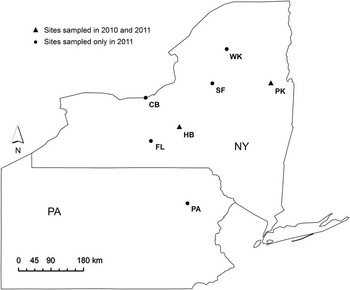
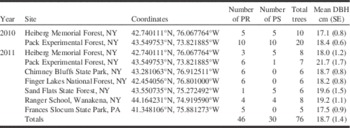
We searched plantations of Pinus resinosa Aiton (Pinaceae) and Pinus sylvestris Linnaeus for symptoms of siricid infestation (fading crowns and resinosis along the main bole) at field sites in Pennsylvania and New York, United States of America in spring 2010 and 2011 (Fig. 1). We collected 30 infested trees at two field sites in 2010 and 46 trees from seven sites in 2011 (Table 1). Felling occurred from 21 April to 24 May 2010 and 31 March to 7 May 2011. In 2010, we collected trees from Pack Experimental Forest in mid-May; this time period straddles the onset of rhyssine emergence and so reported values for that site and year may underestimate parasitism.
Stands sampled for Pinus resinosa and P. sylvestris infested with Sirex noctilio in New York (NY) and Pennsylvania (PA), United States of America. Two stands were sampled in 2010 and seven in 2011. Sampled sites were Heiberg Memorial Forest (HB), Pack Demonstration Forest (PK), Chimney Bluffs State Park (CB), Finger Lakes National Forest (FL), Sand Flats State Forest (SF), State University of New York-College of Environmental Science and Forestry, Ranger School, Wanakena (WK), and Frances Slocum State Park (PA).

Pinus resinosa (PR) and Pinus syslvestris (PS) taken and site information in 2010 and 2011.

Note: DBH, diameter at breast height; NY, New York, United States of America; PA, Pennsylvania, United States of America.
We cut trees 0.25 m from the base and measured height of the trunk from the cut to 6 cm diameter. Nine 0.5 m bolts were subsampled based on stratifications with greatest probability of infestation (Eager et al. Reference Eager, Allen, Frair and Fierke2011). Sample bolts were transported to the State University of New York College of Environmental Science and Forestry (SUNY-ESF) in Syracuse, New York, United States of America. We coated cut ends of all bolts with end sealant (Waxlor, Willamette Valley Company, Eugene, Oregon, United States of America) immediately after cutting to prevent desiccation and placed bolts in horizontal cardboard rearing tubes. We inserted nails into the bolts to space them from the tube sides and housed them at ambient environmental conditions in a screened outdoor insectary. Plastic end-caps with glass emergence jars were fitted to the tube ends and each bolt was placed horizontally on wooden racks. Jars were oriented facing the screened windows to provide a natural photoperiod. Samples were housed in the same manner and location both years. We collected 270 and 396 bolts in 2010 and 2011, respectively.
In addition to S. noctilio and S. nigricornis (hereafter collectively referred to as siricids), we collected and identified an egg/early instar parasitoid, Ibalia leucospoides ensiger (Norton) (Hymenoptera: Ibaliidae); four rhyssine (Hymenoptera: Ichneumonidae: Rhyssinae) late larval parasitoids, Rhyssa lineolata (Kirby), Rhyssa crevieri (Provancher), R. persuasoria, and M. nortoni nortoni; and a cleptoparasitoid of rhyssines, Pseudorhyssa nigricornis (Ratzeburg) (Hymenoptera: Ichneumonidae: Poemeniinae). We collected emerging insects daily and identified individual specimens using Schiff et al. (Reference Schiff, Valley, LaBonte and Smith2006, Reference Schiff, Goulet, Smith, Boudreault, Wilson and Scheffler2012) for siricids and Townes and Townes (Reference Townes and Townes1960), Fitton et al. (Reference Fitton, Shaw and Gauld1988), Smith and Schiff (Reference Smith and Schiff2002), and Standley et al. (Reference Standley, Hoebeke, Parry, Allen and Fierke2012) for parasitoids. We sent a subset of specimens to R. Hoebeke (University of Georgia, Athens, Georgia, United States of America) to confirm species identifications. A subsample of bolts (33.3% in 2010 and 43.2% in 2011) was dissected using an electric log splitter in the fall to estimate the number of siricids and parasitoids that did not emerge. We report unemerged insects as percentages of the total found for each species and omitted these from statistical analyses. We deposited voucher specimens of all species in the SUNY-ESF Entomology Museum Collection in Syracuse, New York.
Statistical analysis
Ibalia leucospoides ensiger and rhyssine parasitism were analysed using a mixed weighted logistic regression model with fixed effects comprised of tree and host factors (species, overall tree height, diameter at breast height, and siricid density (emergents/m3)). We included rhyssine emergents in calculating siricid densities and parasitism for I. leucospoides ensiger, as this would have been a proportion of the siricid population vulnerable to parasitism during their flight season. For all models, we included the random effect structure of site nested within year. We pooled all rhyssines (Rhyssa Gravenhorst species and M. nortoni nortoni) because of their similar ecological function and emergence periodicity in North America (Ryan et al. Reference Ryan, De Groot, Nott, Drabble, Ochoa and Davis2012; Standley et al. Reference Standley, Hoebeke, Parry, Allen and Fierke2012). Cleptoparasitism by P. nigricornis was included in rhyssine parasitism calculations as each case represents an initial colonisation by a rhyssine (Spradbery Reference Spradbery1968). We constructed a full model with all factors and sequentially removed non-significant factors (P>0.25). Reduced models were compared with the full model via corrected Akaike’s Information Criterion (AICc) to select the most parsimonious analysis. Log odds ratios were calculated from the logistic regression and illustrate the magnitude of a factors effect. We standardised all numerical independent variables to facilitate interpretation of parameter coefficients (Gelman Reference Gelman2008). We report all mean parasitism values as weighted averages accounting for the overall number of siricids present in the tree (emergents+parasitoids).
To analyse the hymenopteran community assemblage, we used a permutational multivariate analysis of variance (PERMANOVA) and non-metric multidimensional scaling (NMDS). The PERMANOVA is a non-parametric multivariate test and does not require normal distributions for the multiple response variables, a common issue with count data (Anderson Reference Anderson2001; Oksanen et al. Reference Oksanen, Kindt, Legendre, O’Hara, Stevens and Oksanen2007). We conducted these analyses on untransformed count data using Bray-Curtis distances and 10 000 random permutations. We examined tree species, site, year, height, and diameter at breast height as explanatory variables for hymenopteran community assemblages. Uninformative factors (P>0.25) were removed from the model. Non-metric multidimensional scaling was used to provide a visualisation of the relationships among tree and site variables and abundance of the eight Hymenoptera species in 57 trees. We conducted NMDS using Bray-Curtis distances and a Wisconsin double standardisation. A Shepard diagram was used to visually inspect the data for outliers (none were removed) and assess the non-metric goodness-of-fit (R 2=0.995). We implemented visual overlays of site and host species, but removed year, diameter at breast height, and height to provide a clear visualisation and because they were marginally important. All statistics were conducted in R (R Core Development Team 2015) using the packages “lme4” and “vegan”.
Results
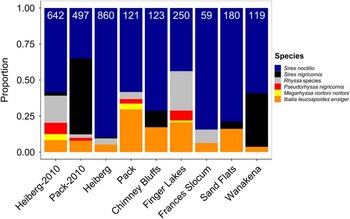
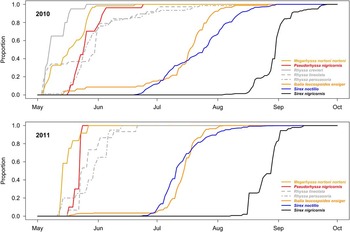
We collected 1139 Hymenoptera in 2010 (mean/tree: 51.6±9.3 (SE); median: 38) and 1553 in 2011 (44.4±11.6; median: 21). In 2010 and 2011, 73.3% and 76.1% of sampled pines produced emergents, respectively. The native woodwasp, S. nigricornis, was collected during both years at five sites (Fig. 2) with the initiation of its flight period occurring approximately one month after S. noctilio (Fig. 3). Of trees with siricids present, 11.1% had only S. nigricornis, 55.6% had only S. noctilio, and 33.3% were co-colonised by both species. From these infested trees, S. noctilio emerged from 96.9% of all P. resinosa sampled and from 81.0% of P. sylvestris. In contrast, S. nigricornis emerged from 40.6% of all P. resinosa and 47.6% of P. sylvestris samples.
Proportions of Hymenoptera reared from all field sites (sites are from 2011 unless otherwise noted). White numbers indicate total number of Hymenoptera collected at each site. Proportions represent the fate of all siricids at each site, either as emerged adults or parasitoids (parasitised Siricidae larvae). All parasitoids consume one host and produce one adult. Pseudorhyssa nigricornis cleptoparasitise rhyssines, which parasitise siricid larvae. We pooled Rhyssa species because of their functional similarity.

Cumulative emergence phenology for all Hymenoptera reared in 2010 and 2011. We pooled species across host species, site, and sex. We removed Rhyssa crevieri from the 2011 graph because there was only one emergent.

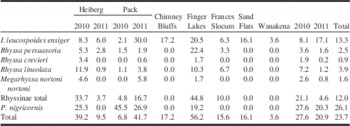
Ibalia leucospoides ensiger was the most abundant parasitoid and was found at all sites in both years (Table 2; Fig. 2). This egg/early instar parasitoid emerges synchronously with S. noctilio (Fig. 3). Rhyssines were less common with Rhyssa species recovered from only four of seven field sites in both years. Additionally, the majority (71.2%) of the recovered Rhyssa species came from a single site, Heiberg Forest, in 2010 (Fig. 2). We collected three species of Rhyssa, with R. lineolata (52.9%) most abundant, followed by R. persuasoria (34.1%), and R. crevieri (12.9%). All three Rhyssa species co-occurred at three sites (Fig. 2), but were found together in only four trees in total. Megarhyssa nortoni nortoni was present at only one site in 2010 and two in 2011, and appears to be an uncommon parasitoid of siricids in pine, at least in this region of New York State. All rhyssines had a similar emergence period, May to mid-June, coinciding with the presence of siricid late instars (Fig. 3). The cleptoparasitoid P. nigricornis was also uncommon and collected at only three field sites in both years (Fig. 2). However, it accounted for 29.3% (±0.1) mortality in rhyssine populations at those sites. Remarkably, the full parasitoid assemblage (I. leucospoides ensiger, all rhyssine parasitoids and the cleptoparasitoid) co-occurred in four trees at those sites.
Parasitism (%) by site from Ibalia leucospoides ensiger and rhyssines and mortality from cleptoparasitism by Pseudorhyssa nigricornis in 2010 and 2011.

Notes: Rhyssine parasitism calculations omit the proportion already attacked by I. leucospoides ensiger. Mortality from P. nigricornis indicates the percentage of the rhyssine population attacked and not cleptoparasitism of the siricid host. We incorporated cleptoparasitism into rhyssine total calculations. Percentages do not include parasitoids found in dissected logs.
In each year, a small but significant portion of siricids and their parasitoids did not emerge from the bolt samples. Dissection of a subsample of logs in late fall 2010 revealed 4.0% of siricids, 6.5% of I. leucospoides ensiger, and 5.0% of Rhyssa species had not emerged. In 2011, 7.1% of siricids and 22.2% of Rhyssa species had not emerged. No unemerged I. leucospoides ensiger were found in 2011.
We found considerable variation in parasitism among siricid-infested trees, ranging from 0–69% in 2010 (mean: 27.6%±5.0 SE) and 0–100% in 2011 (20.9%±4.7). Total parasitism was less in P. sylvestris than P. resinosa (means: 17.3%±5.1 versus 26.2%±3.9), and this was driven equally by differences in rhyssine parasitism (P. sylvestris: 8.7%±4.9; P. resinosa: 13.3%±4.2) and by I. leucospoides ensiger parasitism (P. sylvestris: 9.4%±2.6; P. resinosa 14.8%±2.2). However, this difference was only significant for rhyssines (see below).
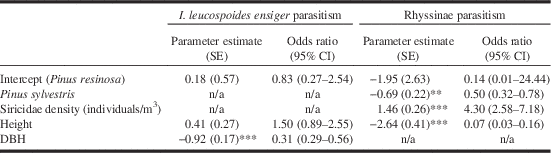
Tree factors and siricid host density affected parasitism by I. leucospoides ensiger and rhyssines, but in different ways. The logistic regression model indicated I. leucospoides ensiger parasitism was negatively affected by tree diameter at breast height (Table 3). Rhyssine parasitism decreased as overall tree height increased, and increased in concert with increasing siricid density. Rhyssine parasitism also was less in P. sylvestris, with log odds ratios indicating an approximate two-fold lesser probability of parasitism of siricids in P. sylvestris.
Effects of tree species, siricid density (inidividuals/m3), overall tree height, and diameter at breast height on parasitism by Ibalia leucospoides ensiger and Rhyssinae.
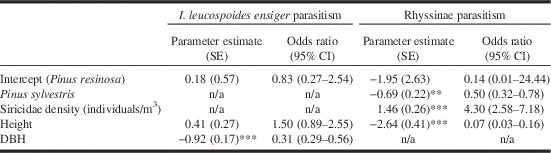
Notes: We present the most parsimonious models based on comparisons via corrected Akaike’s Information Criterion. Multiple logistic regression conducts a z-test on factor coefficients to test if values differ from zero. Rhyssine parasitism includes mortality from Rhyssa species, Megarhyssa nortoni nortoni, and cleptoparasitised rhyssines from Pseudorhyssa nigricornis. Pinus resinosa as the intercept represents the reference condition and only applies to rhyssine parasitism. Odds ratios with 95% confidence intervals (CI) indicate the probability of parasitism given the indicated factor.
*P<0.05; **P<0.01; ***P<0.001.
DBH, diameter at breast height.
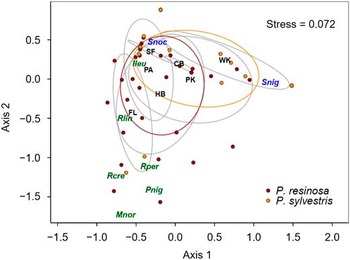
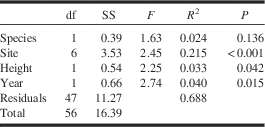
Analysis of the hymenopteran assemblage using PERMANOVA and NMDS indicated that both presence and abundance varied significantly by site, year, and tree height (Table 4). Site explained the greatest amount of variation (21.4%), with year, height, and host species explaining considerably less (9.7%, collectively). Non-metric multi-dimensional scaling of trees based on hymenopteran abundance produced a three-dimensional ordination with low stress (Fig. 4). Species composition overlapped among all field sites; however, comparisons between individual sites indicate substantial variability, most notably among Chimney Bluffs, Finger Lakes, Sand Flats, and Wanakena. Associations with host tree species varied with taxa, Axis 1 of the NMDS indicated S. nigricornis was associated with P. sylvestris whereas presence and abundance of native rhyssines and their cleptoparasitoid were co-correlated along Axis 2, but were not correlated with P. sylvestris, a pattern also evident from logistic regression (Table 3). There was no apparent relationship between pine host species and abundance of either S. noctilio or I. leucospoides ensiger.
Non-metric multidimensional scaling ordination showing relationships among Hymenoptera species, site, and pine host. Each dot represents an individual tree. Grey ellipses indicate sites; red and orange ellipses correspond to P. resinosa and P. sylvestris, respectively. Blue text are Siricidae and green are parasitoids. We have abbreviated site and species to facilitate interpretation.

PERMANOVA table showing the partitioning of variation in hymenopteran community assemblage across pine host species, site, height, and year.
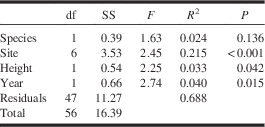
Notes: Diameter at breast height had a P-value >0.25 and was removed from the model.
SS, sum of squares.
Discussion
This research, and that of Ryan et al. (Reference Ryan, De Groot, Nott, Drabble, Ochoa and Davis2012), suggest the emergence phenology of many native parasitoids overlap with relevant developmental stages of S. noctilio. This native parasitoid assemblage is composed of an egg/early instar parasitoid, four late instar rhyssine parasitoids, and a rhyssine cleptoparasitoid. All species have been directly linked to S. noctilio through both observational and molecular means (Foelker et al. Reference Foelker, Standley, Fierke, Parry and Whipps2016). The study described here constitutes the most comprehensive evaluation of parasitism of S. noctilio in North America.
In conjunction with our sampling for S. noctilio, we also collected a significant number of the native siricid, S. nigricornis. This species appeared to readily co-colonise trees infested with S. noctilio, albeit at much lower densities. In northeastern North America, S. nigricornis (formerly called S. edwardsii Brullé by some authors) appears to be the only native siricid developing on P. resinosa and P. sylvestris (Long et al. Reference Long, Williams and Hajek2009; Ryan et al. Reference Ryan, De Groot, Nott, Drabble, Ochoa and Davis2012). Our results confirm that within its established North American range, S. noctilio is now the most abundant pine-feeding siricid (Eager et al. Reference Eager, Allen, Frair and Fierke2011; Ryan et al. Reference Ryan, De Groot, Nott, Drabble, Ochoa and Davis2012). The outcome of interspecific interactions between S. noctilio and S. nigricornis is unknown and both positive and negative outcomes are plausible. If the higher density S. noctilio populations increase background parasitoid levels, spillover into S. nigricornis populations may increase their mortality, the so-called “hyperpredation” effect (e.g. Bate and Hilker Reference Bate and Hilker2012). Conversely, S. noctilio attack on pines may increase available pine host resources for S. nigricornis, which are attracted to dying/dead trees. Unfortunately, very little was known about native siricid population densities before the invasion of S. noctilio.
As did Standley et al. (Reference Standley, Hoebeke, Parry, Allen and Fierke2012), we recovered the native cleptoparasitoid, P. nigricornis. This species uses the drill shaft left by primary rhyssine parasitoids after oviposition. Its larvae then kill the primary parasitoid and consume both the siricid larvae and the rhyssine cadaver as food resources to complete its own development (Spradbery Reference Spradbery1968; Kirk Reference Kirk1974, Reference Kirk1975). Little was known about this species before the invasion of S. noctilio. Mean mortality of rhyssine primary parasitoids was ~29% at sites where P. nigricornis was collected. These sites were characterised by overall higher rhyssine abundance and diversity. In our study and that of Standley et al. (Reference Standley, Hoebeke, Parry, Allen and Fierke2012), this insect emerges in synchrony with the rhyssines it cleptoparasitises, a pattern also seen in Europe (Spradbery and Kirk Reference Spradbery and Kirk1978), where it was closely associated with R. persuasoria (Kirk Reference Kirk1974, Reference Kirk1975). The effect of cleptoparasitism on rhyssine populations in North America is not clear and other recent studies have not recovered P. nigricornis, suggesting their populations may be quite localised (Long et al. Reference Long, Williams and Hajek2009; Ryan et al. Reference Ryan, De Groot, Nott, Drabble, Ochoa and Davis2012).
There appear to be phenological complexities in the S. noctilio system in North America that we do not yet fully understand. These may be driven by variable voltinism in both siricids and their parasitoids, repeated colonisation of the tree by different generations of S. noctilio, or some combination of the preceding. Although many attacked trees succumb to S. noctilio in the first year of attack, an unknown proportion may survive and be re-attacked the following year. In the southern hemisphere, each of these components have been recognised (Madden Reference Madden1974, Reference Madden1975, Reference Madden1981; Taylor Reference Taylor1978). Multiple generations of siricids exhibiting variable voltinism greatly complicates basic quantification of parasitism, particularly when parasitoids may also have variable voltinism (hemivoltinism for I. leucospoides ensiger and bivoltininsm for rhyssines, Taylor Reference Taylor1978, Reference Taylor1981; Madden Reference Madden1981). More explicit experimentation would be required to address these complications, but having this knowledge will be critical for understanding the importance of native parasitoids as S. noctilio moves into economically important southern and western pine forests. We suggest that future research be directed at this conundrum as it prevents a holistic understanding of natural enemy impacts in this system.
We found parasitism varied between tree species, with siricids incurring less rhyssine parasitism in the naturalised P. sylvestris than in native P. resinosa. Total rhyssine parasitism of siricids in P. sylvestris (8.7%) was similar to that previously documented (8.3% in Eager et al. (Reference Eager, Allen, Frair and Fierke2011), 5.2% in 2007 and 12.6% in 2008 in Ryan et al. (Reference Ryan, De Groot, Nott, Drabble, Ochoa and Davis2012)), but this is the first study to show differences in parasitism between pine host species. There are multiple possible mechanisms for this, such as tree morphology (e.g. bark), phytochemistry, or variability in siricid abundance by pine species (Lill et al. Reference Lill, Marquis and Ricklefs2002). Though siricid parasitism was highly variable at the tree and stand scale, overall parasitism (23.7%) was similar to previous rearing studies in North America (21.8% in Long et al. (Reference Long, Williams and Hajek2009), 18.6% in Eager et al. (Reference Eager, Allen, Frair and Fierke2011), 23.2% in Ryan et al. (Reference Ryan, De Groot, Nott, Drabble, Ochoa and Davis2012)). Unlike Ryan et al. (Reference Ryan, De Groot, Nott, Drabble, Ochoa and Davis2012), we found parasitism varied significantly among sites and between years.
Siricid and parasitoid abundance appear to be more a function of site characteristics rather than individual tree factors (species, diameter at breast height, and height). Even site explained a limited amount of variability in this system (~20%) suggesting that processes operating outside of the scale of our study maybe important. Variability in the abundance and composition of parasitoid assemblages are evident in both North America (Eager et al. Reference Eager, Allen, Frair and Fierke2011; Ryan et al. Reference Ryan, De Groot, Nott, Drabble, Ochoa and Davis2012; Haavik et al. Reference Haavik, Dodds and Allison2015), where it is a relatively recent arrival, as well as the southern hemisphere, where it has been present for decades (Taylor Reference Taylor1978; Tribe and Cillié Reference Tribe and Cillié2004). Although there was considerable overlap in species composition across sites in this study, particularly the Heiberg and Pack localities, certain sites exhibited a full complement of parasitoids while others were devoid of all but I. leucospoides ensiger, the comparatively abundant egg/early instar parasitoid (Fig. 2). Across the landscape, parasitoid populations may be contingent upon landscape level processes, such as the structure or composition of the surrounding forest matrix, connectivity among stands, and the availability of alternate siricid hosts for parasitoids (Bascompte et al. Reference Bascompte, Possingham and Roughgarden2002; Quayle et al. Reference Quayle, Régnière, Cappuccino and Dupont2003).
Siricid-parasitoid ecology is not well understood in North America and our comprehensive study suggests it may be much more complex than first assumed. The apparently ready adoption of an exotic species by native parasitoids within a relatively short time frame since introduction suggests that plasticity in behaviour, physiology, and phenology must have been present in these species to enable the rapid acquisition of a novel host. Very limited knowledge about the natural history of these parasitoids using non-pine feeding siricids (e.g. Sirex nitidus in Picea Dietrich species or Sirex cyaneus in Abies Miller species), hampers our understanding of host specificity and phenology of individual species of parasitoids (Townes and Townes Reference Townes and Townes1960; Spradbery and Kirk Reference Spradbery and Kirk1978; Coyle et al. Reference Coyle, Pfammatter, Journey, Pahs, Cervenka and Koch2012; Schiff et al. Reference Schiff, Goulet, Smith, Boudreault, Wilson and Scheffler2012). An additional possibility is that at least some of the parasitoids may have been simultaneously introduced with S. noctilio and have tracked the invasion front across the northeast (Gebiola et al. Reference Gebiola, Lopez-Vaamonde, Nappo and Bernardo2014).
Acknowledgements
The authors appreciate the field assistance of B. Breitmeyer, M. Gooden, E. Keyser, A. Underwood, and J. Welsh. Two reviewers greatly improved the quality of this manuscript. Funding for this project was provided by a McIntire-Stennis Cooperative Forestry research grant, accession number 217770, to M.K. Fierke and D. Parry. The New York State Department of Environmental Conservation provided field vehicles critical for data collection.