INTRODUCTION
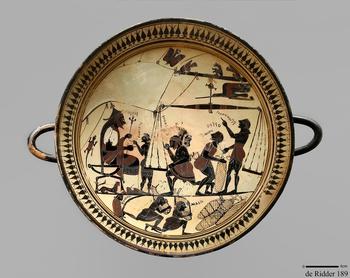
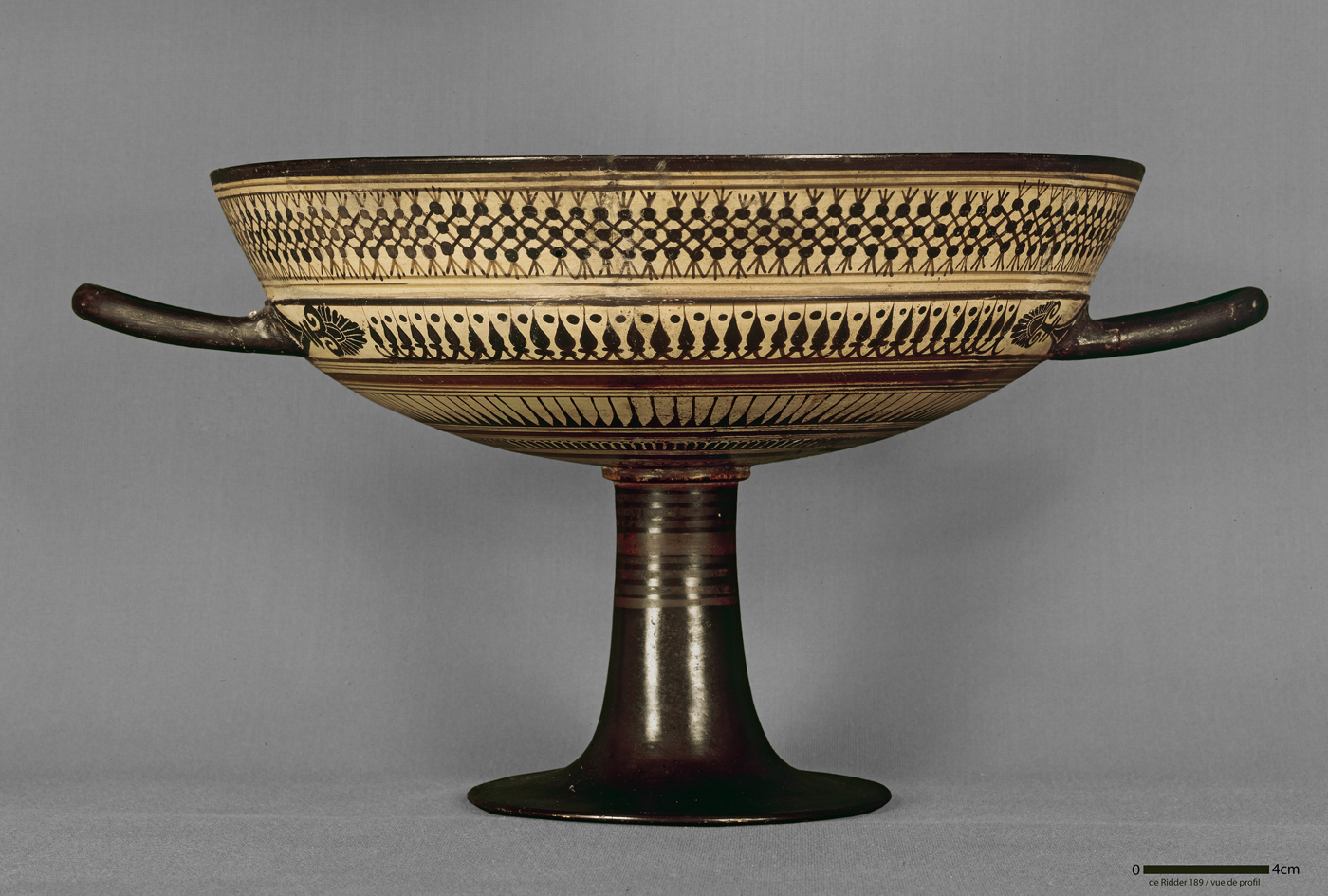
The Arcesilas Cup (Fig. 1, Fig. 2) is a Laconian black-figure kylix dated to the sixth century, c.565–550 bc (Wachter Reference Wachter2001, 160), and attributed to the Arcesilas Painter (De Ridder Reference De Ridder1902, 98–100, no. 189). The cup was bought by the Bibliothèque nationale de France in 1836 at a public auction. The previous owner was a private individual, and no specific find context has been recorded. However, judging from the cup's condition and the fact that its provenance is given as Vulci, it was almost certainly taken from an assemblage of sympotic pottery and other grave goods found in the tomb of an Etruscan man of high status.
The Arcesilas Cup: interior. Laconian black-figure kylix, 565–550 bc, Vulci. De Ridder 189. © BnF.

The Arcesilas Cup: exterior. De Ridder 189. © BnF.

The Arcesilas Cup has received considerable attention in scholarship. Wachter (Reference Wachter2001, 160) provides a comprehensive list of scholarly interest up to the end of the twentieth century, most notable among which are d’Albert (Reference d'Albert1833), Puchstein (Reference Puchstein1880–1), Lane (Reference Lane1933–4), Chamoux (Reference Chamoux1953, Reference Chamoux1966), Benton (Reference Benton1959), Neumann (Reference Neumann1979), Stibbe (Reference Stibbe1972), Simon, Hirmer and Hirmer (Reference Simon, Hirmer and Hirmer1981) and Schaus (Reference Schaus1983). To this list should be added Boardman (Reference Boardman1958), Bresson (Reference Bresson2000), Tivérios (Reference Tivérios2000 [2001]), Maffre (Reference Maffre2004), Schaus (Reference Schaus2006), Coudin (Reference Coudin2009), Mei (Reference Mei2013) and Gönster (Reference Gönster, Kistler, Hoernes, Mohr and Öhlinger2015). It is notable that despite scholarly attention, most aspects of the Arcesilas Cup's decoration and inscriptions, and its place in the wider story of Laconian painted pottery, remain subject to debate. This paper aims to contribute to this debate by accomplishing four goals: (1) to review recent readings of the cup's inscriptions and establish a view on the cup's subject; (2) to highlight features of the cup which do (and do not) support the view that its interior decoration was modelled on Egyptian funerary motifs; (3) to consider the purpose of the cup's subject; 4) to propose contexts for the transmission of designs between the Egyptian funerary domain and Laconian artists.
SCENE AND INSCRIPTIONS
The interior tondo of the Arcesilas Cup is separated into two registers, a main register and a lower register.Footnote 1 The two registers are separated by a solid line, but form part of the same scene. In the main register the central elements are, from left: a large figure seated on a folding stool under a tarpaulin (all figures are male); a worker facing him and pointing to him; a large set of weighing scales loaded with goods; two workers moving goods to be weighed; one seeming to secure goods in a woven container, and another pointing to the scales. The goods appear to be weighed loose, with careful attention to the balance, before being placed in the containers. Other elements around these figures include seven animals, from left: a lizard behind the seated figure; a leopard below his stool; two birds and a monkey atop a beam above the scales; and two other birds in flight, one a raptor (eagle?) and the other a stork (or crane, Tivérios Reference Tivérios2000 [2001], 24). In the lower register, from left, we find: a seated or squatting man, two workers carrying sacks full of goods, and sacks stacked against a wall. The goods in question, which are contained in hatched sacks, have been proposed to be silphium or wool, both of which were likely significant exports of Cyrene/Libya (Gönster Reference Gönster, Kistler, Hoernes, Mohr and Öhlinger2015, 169–84; Chamoux Reference Chamoux1953, 262; White Reference White1984, 28; Mitchell Reference Mitchell, Brock and Hodkinson2000, 89–97; Kiehn Reference Kiehn2006, 57–60; Schaus Reference Schaus2006, 176). Discerning the nature of these goods is essential to the interpretation of the subject's significance, but the pictorial content alone does not provide sufficient clues. The inscriptions which surround the cup's figures are, therefore, critically important to the interpretation of the scene, though most of these lack certain readings.
Six inscriptions appear in the upper register and three in the lower register, matching the number of characters. All are written in the Laconian alphabet (De Ridder Reference De Puma1902, 98–100, no. 198; Schaus Reference Schaus1979, 105; Neumann Reference Neumann1979, 86; Wachter Reference Wachter2001, 160–2), and most are close to the characters, which might indicate that they provide each with an appellation or annotation. Two of the inscriptions, ΑΡΚΕΣΙΛΑΣ and ΦYΛΑΚΟΣ, have relatively straightforward readings. ΑΡΚΕΣΙΛΑΣ most likely identifies the seated figure in the top register as one of the two Battiad kings named Arcesilas who ruled Cyrene in the sixth century, more likely Arcesilas II (ruling c.566–560 bc: Wachter Reference Wachter2001, 160; Stibbe Reference Stibbe1972, 195–201). The figure wears lavish clothing, including footwear and an elaborate hat; he also has long braided hair and holds a staff. The figure's dress, together with his detailed folding stool/throne, exaggerated size, and positioning under a canopy, highlights his relative importance compared to the other smaller, more plainly clothed and labouring characters, all of which supports the conclusion that he is royalty. The leftmost inscription in the lower register, ΦYΛΑΚΟΣ, seems likely to be a speaking name, Φύλακος, since Wachter (Reference Wachter2001, 161) highlights that the name ΦYΛΑΚΟΣ is much more widespread than the use of this form for a noun.Footnote 2 Either way, the indication of the name seems clear; the figure that stands/squats outside of the area where (presumably valuable) goods are being stored, as demarcated by a thick black line, is guarding access to the goods within.
The remaining inscriptions are much more difficult. Their reading has a significant impact on the interpretation of the weighing scene and its engagement with Egyptian art. However, the readings for these inscriptions are often heavily influenced by the identification of a link, through Arcesilas, to Cyrene and its trade in silphium. The word ΣΟΦΟΡΤΟΣ appears above the figure facing the king and pointing towards him with an extended finger. It was proposed by Neumann (Reference Neumann1979, 87–8) to be a proper name, Σώφορτος. Neumann related the name to Σώβιος, arguing that it indicated one ‘dessen (Schiffs-) Ladung unversehrt ist’ (‘one whose (ship-) cargo is safe’), and could thus be attributed to a rich merchant's son. Such an individual could have commissioned the cup to represent their involvement in trade at Cyrene. This reading might be supported by the fact that ΣΟΦΟΡΤΟΣ appears next to a figure wearing slightly more elaborate clothing than those carrying goods or loading the scale, and was accepted by Simon (Reference Simon1976, 60, referring to a draft of Neumann Reference Neumann1979) and Wachter (Reference Wachter2001, 160). Bresson (Reference Bresson2000, 87–8) is critical of such a reading, as the name Σώφορτος is not attested anywhere else and he doubts that a specific mercantile class which might adopt such a name existed around 560 bc (Aubet Reference Aubet1993, 107). Instead, Bresson follows Chamoux's (Reference Chamoux1953, 262) reconstruction of the inscription as [ἰ]σώφορτος ‘of equal balance’, but where Chamoux reads it as a name (Ἰσώφορτος), Bresson sees it as an exclamation directed at the king – ‘the weights are equal’. However, as an exclamation is unlikely (and the word is nominative), and Wachter (Reference Wachter2001, 160) observes that the word appears complete, ΣΟΦΟΡΤΟΣ as a name remains the most likely option. The figure facing the seated Arcesilas may, therefore, be a merchant, though I follow Wachter in concluding that this should be read as a speaking, rather than historical, name.
The words above the centre-right figures, the two workers who load the weights, are fragmentary. Both Bresson (Reference Bresson2000, 88) and Neumann (Reference Neumann1979, 88) were unsure on the reconstruction of the first word, [--]ẠΘΜΟΣ (also given as [ΣΤ]ΑΘΜΟΣ: De Ridder Reference De Ridder1902, 98–100). Neumann proposed that the inscription may have originally read ΕΠΙΣΤΑΘΜΟΣ (ἐπίσταθμος), ‘quartermaster’ or ‘one who weighs out/allots’. This fits well with the fact that the nearest figure to the word is loading the scales, but Wachter's (Reference Wachter2001, 160) ΕYΣΤΑΘΜΟΣ (εὔσταθμος), ‘having good scales’, fits the context equally well. The second central word is read by Neumann (Reference Neumann1979, 88–9) as [Φ]ỌΡΜΟΦΟΡΟΣ, taken as another speaking name related to the commercial scene, ‘basket carrier’ (φορμοφόρος: Lastenträger). Again, this reading fits well with the nearest figure to the inscription, who is carrying a sack. Wachter (Reference Wachter2001, 160–1) contends that the omicron before the rho of [Φ]ỌΡΜΟ is impossible because of a straight letter edge, but finds that the word must read as something similarly connected to carrying goods.
Next is ΟPYΧΟ, which Benton (Reference Benton1959, 181) and Tivérios (Reference Tivérios2000 [2001], 25) took as an imperative, ὄρυξο[ν]. Benton reads this as ‘dig (in)’, an exclamation by the worker pointing at the scales and directed at the birds, instructing them to eat insects from the woodwork.Footnote 3 However, neither the action of eating nor any insects are clearly shown. Furthermore, the figure closest to this inscription is closing the goods in sacking, not pointing upwards, and such a reading of ‘dig in’ as an invitation to eat might be too reliant on modern idiom. Tivérios reads ὄρυξο as ‘tear (out)’, building a narrative of the stork or crane being instructed to tear out Arcesilas’ eyes, which Maffre (Reference Maffre2004, 275) rightly sees as a complex departure from the images. Both readings would attach the imperative to the pointing figure, and so mean that just one character would lack an annotation, which seems improbable. Others read ΟPYΧΟ as an historical or speaking name. Schaus (Reference Schaus2006, 178) takes it as a (perhaps deliberately) misspelled reference to Ἐρυξώ, Arcesilas’ wife, offering an interpretation of the scene as satirical or critical of the Battiads, which is perhaps supported by Wachter's (Reference Wachter2001, 161) conclusion that the word suits a proper name. However, it would seem incongruous to find a name which relates to a character not on the vase when the rest of the labels can be read as having a direct relationship with the nearest painted figure. Neumann (Reference Neumann1979, 88) sees ΟPYΧΟ as either a proper name or appellation, ‘of (continuous) digging’, suggesting that this may refer to the digging up of silphium tubers. Bresson (Reference Bresson2000, 88) settled upon a similar view, repeating Chamoux's interpretation of the goods as silphium tubers and taking OPYΧΟ as déterreur (‘one who digs up/reveals’), labelling the worker as the one who digs up the silphium tubers. Unlike the previous inscriptions’ labelling of the depicted weighing activity, this reading would encompass previous stages in the production of the goods. With no clear silphium plants, and certainly no digging, depicted on the cup, the description of a worker as a ‘digger’ only makes sense when taking the goods to be silphium. Avoiding such a presumption, it might be preferable to give a reading with more immediate relevance to the actions depicted on the cup, namely that OPYXO may not relate to the digging up of tubers of silphium elsewhere but rather to an unclear aspect of the sacking-up of goods happening in the centre of the scene and carried out by the figure nearest this inscription. However, it appears that the goods are loose in the upper level and are sacked-up and taken down into the lower register for storage, rather produced out of it. It seems necessary to refer to readings of the following word, ΣΛΙΦΟΜΑΧΟΣ, and here taking silphium to be the weighed goods, I read ΟPYΧΟ as another speaking name, ‘digger’.
The final word of the upper register is ΣΛΙΦΟΜΑΧΟΣ, read from right to left (it is the only inscription which is also upside-down). It was argued by Benton (Reference Benton1959, 88) to mean ‘insect-hunter’, σλίφομαχος – with σίλφη, ‘insect’, as the root and comparable to a modern colloquial name for the woodpecker, μυρμιγγοφάγος, ‘ant-eater’. This, however, relies on Benton's poorly-evidenced discussion of the scene as an animal-based satire, which is rejected here. Besides Benton, all readings of ΣΛΙΦΟΜΑΧΟΣ are based upon the observation of a resemblance between ΣΛΙΦΟ and σίλφιον, arguing that the inscription is a compound with σίλφιον as its root. Already in 1833 d'Albert had noted both this similarity and the issues posed by such a reading (Wachter Reference Wachter2001, 161). First, ΣΙΛ- must become ΣΛΙ-. To solve this Neumann (Reference Neumann1979, 90) suggested the metathesis of the iota and lambda in σίλφιον, while Wachter suggests that the word may have entered the Greek language as σλίφιον, or that this is a copying error (Wachter Reference Wachter2001, 161–2; see also Gönster Reference Gönster, Kistler, Hoernes, Mohr and Öhlinger2015, 175).Footnote 4 Secondly, φιο must become φο, which Wachter suggests may be explained as a case of abbreviated writing. Finally, and most problematically, the compound with -μαχος must be made intelligible. Tivérios (Reference Tivérios2000 [2001], 25) gives ‘silphium battler’ (σιλφιόμαχος, from μάχη), while Bresson (Reference Bresson2000, 88–9) supports a tentative case for ‘silphium-balance’. The latter can be achieved if the word is a compound of the Greek (or Libyan?) σίλφιον and a transliteration, -μαχος, of the Egyptian word for scales, mekhat (measuring instrument, where < khaj = measure and m + khaj = measuring instrument), as first proposed by Puchstein (Reference Puchstein1880–1, n. 15) and Studniczka (Reference Studniczka1890, 12). Recent study of the phenomenon of ‘nonsense’ in Greek vase inscriptions (e.g. Mayor, Colanrusso and Saunders Reference Mayor, Colanrusso and Saunders2014) supports the principle that such difficult readings could be signs of foreign words spelled out phonetically, but Wachter (Reference Wachter2001, 161) argues that a phonetic similarity is improbable and anachronistic in this case. Neumann (Reference Neumann1979, 90) reads the term as ‘silphium-kneader’, from the verb μάσσω, ‘knead’, but admits that there is nothing about the scene which particularly supports this reading, and the goods could easily be something other than silphium. We might, however, make good sense of the idea of ‘kneading’ silphium through Theophrastus’ description of a process of mixing the sap of the plant with flour, which Gönster identifies as a means of preserving the plant for redistribution (Theophrastus, Historia Plantarum 9.1.7, 6.3.2; Gönster Reference Gönster, Kistler, Hoernes, Mohr and Öhlinger2015, 174–5). Wachter (Reference Wachter2001, 162) suggests a (hypothetical) alternative, ΣΙΛΦ(I)ΟΜΑ(P)ΨΟΣ (Σιλφ(ι)όμα(ρ)ψος, from μάρπτω, ‘to take hold of’), ‘the one who seizes silphium’, but it is not clear whether we should interpret μάρπτω as ‘gather’, ‘acquire’ or something more violent. Of these readings, I am most inclined to follow Neumann's interpretation, taking ‘kneading’ to be a plausible stage in the preparation process. It is notable that either this or ΣΙΛΦ(I)ΟΜΑ(P)ΨΟΣ could extend the viewer's appreciation of the silphium product beyond the immediate scene of the vase, to a production or gathering context. Moreover, it is important that silphium remains the most viable option for the first part of the compound. This identification of the goods as silphium, though tentative, is used and further supported throughout the rest of this paper.
The final two inscriptions, accompanying the workers carrying goods in the lower register, are the most difficult to read. ΜΑΕΝ was reconstructed as μέμαεν, ‘he covets’, by Tivérios (Reference Tivérios2000 [2001], 25), but, as Maffre (Reference Maffre2004, 275) has highlighted, there is no space for the addition of any letters before the initial ‘M’ of ΜΑΕΝ. Mei (Reference Mei2013, 28, after Lane) opts for an abbreviated writing of μα(γ)έν from μάσσω. This would be a reference to a ‘kneaded’ silphium product, perhaps with a gum-like consistency, which makes sense with Neumann's ‘kneader’ and philologically but, as Wachter points out, is awkward in that would appear to annotate the goods rather than a human character. The inscription may be unreadable.Footnote 5 The final inscription, read by Mei (Reference Mei2013, 28) as ΕΛΙΚΤΟΝ, ἑλικτόν, is similarly problematic. This adjective, from ἑλίσσω, would describe something rolled, or twisted. Mei interprets ΕΛΙΚΤΟΝ, together with MAEN, as an indication that the lower register of the scene represents and annotates the storage of silphium in its final, kneaded, form within crafted baskets. Mei's reading, however, is an ambitious reconstruction of very slight remaining marks, elsewhere identified only as E… (Neumann Reference Neumann1979, 91; Wachter Reference Wachter2001, 161). Perhaps these final two inscriptions could be purposefully or mistakenly obscure (Wachter Reference Wachter2001, 162; Neer Reference Neer2002, 9–26).
The Arcesilas Cup's inscriptions reveal at least two Cyrenean connections. The cup names a king of Cyrene, Arcesilas, and most likely uses the inscription ΣΛΙΦΟΜΑΧΟΣ to indicate that its subject is the weighing of the silphium plant or a refined product of the plant. The case for silphium is somewhat tentative, but it makes good sense that we would find silphium alongside Arcesilas in the mid-sixth century. This plant was found only in Libya, around Barca and Euesperides (Herodotus 4.169; Pliny, Natural History 19.15; Mitchell Reference Mitchell, Brock and Hodkinson2000, 98; Austin Reference Austin and Tsetskhladzep2008, 210) and Theophrastus tells us that only the Libyans could gather the plant (Historia Plantarum 9.1.7). Mitchell (Reference Mitchell, Brock and Hodkinson2000, 89–97) stresses the importance of valuable silphium exports for the power of the later rulers of the Battiad regime, and in the fifth century the association of Battiad wealth with silphium was widely enough known to find a place in Aristophanes’ Wealth (925). It is likely that this royal monopoly had already emerged by the early sixth century. The importance of silphium was such for the Cyrenean economy that by the latter part of the sixth-century Cyrenean coins featured the plant, its seed, or a divinity seated before a silphium plant (Gönster Reference Gönster, Kistler, Hoernes, Mohr and Öhlinger2015; Riddle Reference Riddle2003; Faustoferri Reference Faustoferri, Barker, Lloyd and Reynolds1985), and it seems that Demonax's reforms in the middle of the century had maintained pre-existing Battiad control of silphium-producing lands (Mitchell Reference Mitchell, Brock and Hodkinson2000, 88).
These Cyrenean connections must be taken into consideration when discussing the commission of the cup and the significance of its unusual depiction of weighing. However, they are far from being the cup's only, or even most remarkable, links with North Africa.
COMPARISON WITH EGYPTIAN FUNERARY ART
Similarities between the weighing scene on the Arcesilas Cup and depictions of weighing in Egyptian funerary art have been mentioned in most scholarship commenting on the tondo's subject, including Puchstein (Reference Puchstein1880–1 and Reference Puchstein1881–2), Lane (Reference Lane1933–4), Boardman (Reference Boardman1958 and Reference Boardman1980), Benton (Reference Benton1959), Schaus (Reference Schaus1979, Reference Schaus1992 and Reference Schaus2006), Bresson (Reference Bresson2000), Coudin (Reference Coudin2009) and Mei (Reference Mei2013), with Maffre (Reference Maffre2004, 276) providing a rare critical view of such a connection. However, when one reviews previous scholarship it becomes clear that little detailed analysis of the Egyptian influences on the iconography and composition of the Arcesilas Cup was made before Bresson's La Cité Marchande (Reference Bresson2000, 89–94). Furthermore, since Bresson, little further work has been done to describe or explain the ‘Egyptian’ characteristics of the cup, or to challenge his commentary.
The hypothesis that the Arcesilas Painter drew inspiration from Egyptian weighing scenes first appeared in Puchstein's short article ‘Zur Arcesilasschale’ (Puchstein Reference Puchstein1880–1). However, Puchstein barely commented on which specific details he thought might connect the cup to Egyptian art, and focused instead on possible links between Egypt and Cyrene (thought at that time to be the centre of production for Laconian pottery).Footnote 6 Around fifty years later, in an examination of Laconian pottery, Lane (Reference Lane1933–4, 161) noted an ‘unmistakable’ relationship between the decoration of the cup and Egyptian wall painting, but again, he did not outline which features led him to make this observation, and attributed the cup's exotic animals to the fauna of Cyrene, rather than Egypt or Egyptian art. Lane also gave no further detail on whether ‘wall painting’ referred to depictions of the weighing of commercial goods by officials, illustrations of the weighing of the heart before Osiris, or both. Rather, Lane included a footnote (Lane Reference Lane1933–4, 162, n. 1) referring readers to Puchstein's limited coverage for further details of similarities with Egyptian art. Similarly, Benton (Reference Benton1959, 182) directed her readers to Lane when mentioning a connection between weighing scenes in Egyptian art and the Arcesilas Cup. In general, therefore, the cup's Egyptian links were treated as common knowledge, despite a lack of developed discussion of how this conclusion was reached.
Boardman (Reference Boardman1958, 9, n. 22; Reference Boardman1980, 149) added more specific detail to the account of the cup's iconography, stating that the scene of the cup's tondo was parallel in content, but not in spirit, to the weighing of goods by Egyptian officials. Boardman proposed that the most striking Egyptian parallel was the depiction of an official weighing goods painted on the wall of the New Kingdom tomb of Neferronpet (TT 178). In doing so, Boardman implicitly rejected the comparisons with the weighing of the heart scene that Puchstein had drawn, and it is likely that the weighing of goods is also the sort of Egyptian weighing scene that Lane had had in mind, considering that he attributed the Arcesilas Cup's use of animals to the fauna of Cyrene rather than to the variety of birds and reptiles commonly found in weighing of the heart scenes.Footnote 7 However, although the bustle and the positioning of certain workers on the Arcesilas Cup does resemble the gathering and weighing goods in Egyptian scenes such as that from Neferronpet's tomb and others, this explanation of the cup's weighing scene leaves many more of the cup's unusual iconographical and compositional elements largely unexplained, most notably the inclusion of several animals.
It was only when Bresson discussed the Arcesilas Cup in a chapter of La Cité Marchande (Bresson Reference Bresson2000, 89–94) that a convincing study drew out specific similarities between the Arcesilas Cup and Egyptian funerary art. Relying chiefly on two New Kingdom funerary papyri representative of archetypes in Egyptian funerary art (the Papyrus of Ani [BM EA 10470/3] and Papyrus of Hunefer [BM EA 9901/3]), Bresson picked out the cup's archaising weighing mechanism, baboon, and positioning of a ‘scribal’ character as features critical to a definite conclusion that aspects of the composition and iconography of the Arcesilas Cup were modelled on Egyptian weighing of the heart scenes. However, despite a more thorough approach to the identification of similarities, Bresson's discussion contained errors and omissions which remain unaddressed, necessitating a review of the Arcesilas Cup's possible use of Egyptian composition and iconography.
The subject and composition of the weighing scene
Most prior scholarship has picked up on broad parallels between the composition and subject of the Arcesilas Cup and weighing of the heart scenes. An imposing, regal, seated character (Arcesilas, Osiris) positioned to one side of a large weighing device which is operated by several smaller characters provides the central subject of both the Arcesilas Cup and most weighing of the heart scenes. In both, there are multiple connected registers of characters, and the scale of the figures appears manipulated to show their status in the proceedings. Arcesilas is so large that the guard of the lower register is only equal to his shin, and if he were to stand he would easily tower over all the workers, even those in the main register. Clearly, the cup and weighing of the heart share a broadly similar subject and some important compositional elements, but which of these features might be taken as evidence that the weighing of the heart provided the model for the Arcesilas Painter?
The positioning of dominant seated figure to one side of a composition is not an uncommon feature in Laconian depictions of deities and/or the (heroised?) dead in the sixth century bc, and though some comparable instances of the motif may be inspired by the enthroned figures ubiquitous in Egyptian funerary art, there is little evidence of direct copying in this case.Footnote 8 Similarly, the manipulation of natural proportions for aesthetic reasons or to show the status of actors in a scene, though an important feature of Egyptian art, also appears elsewhere in Laconian and other Greek art, for example on the Chrysapha relief and in a depiction of winemaking in the tondo of a Boreads Painter cup.Footnote 9 The use of multiple registers to construct a single scene, common in Egyptian art, is unusual but, again, not without parallel in Greek art. The aforementioned Boreads Painter cup is an especially relevant example. It provides a roughly contemporary parallel for the Arcesilas Cup's use of a lower register contributing to the primary scene, with each using a thick black line to separate the weighing and winemaking activities from storage ‘underground’. It seems, therefore, that neither the use of scale and multiple registers nor the position of the dominant seated character is sufficiently novel as to suggest without doubt that the Arcesilas Painter directly modelled these aspects of the cup's composition on a weighing of the heart scene.
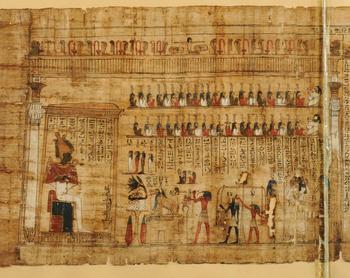
Nonetheless, the unusual combination of the subject and arrangement of the cup remains remarkable. Weighing scenes, especially using large scales, are very rare in the Archaic Period. No similar scenes appear in surviving Laconian art. The few contemporary weighing scenes which do exist, on Athenian black-figure vessels, prioritise simplicity and balance in the action of weighing, typically with a similar individual at either end of the scale, either both standing, or both seated, and both equally engaged in the act of weighing.Footnote 10 Conversely, the Arcesilas Cup uses a crowded and asymmetrical arrangement, in which many characters operate a large set of scales in front of the one large, seated overseer. This crowded asymmetry and suggestion of productivity is paralleled in Boreads Painter's cup, but in the context of a weighing scene, the composition finds its closest parallels in the arrangement of figures in Egyptian illustrations of the weighing of the heart, for example in the roughly contemporary Papyrus of Nehemesratawy (Fig. 3).Footnote 11
Weighing of the heart vignette from the Papyrus of Nehemesratawy, Late Period, Thebes. Museo Egizio Torino 1799. © Museo Egizio Torino.

Parallels in the characters and objects in the weighing scene
The large seated characters of the Arcesilas Cup and the weighing of the heart, Arcesilas and Osiris, are comparable in their use of status symbols, including their staffs and crowns, and in their positioning under a canopy or roof. It is possible that the unusual combination of elements comprising Arcesilas’ dress, such as his staff and peaked hat, were intended to evoke or imitate the paraphernalia of Osiris, as Schaus (Reference Schaus2006, 176–7) has suggested. However, Arcesilas’ hat,Footnote 12 slippersFootnote 13 and staffFootnote 14 all have parallels in contemporary Laconian, East Greek, Lydian, or Etruscan fashion, and may simply reflect an unusual combination of exotic but contemporary tastes. The folding stool on which Arcesilas sits is not comparable to Osiris’ throne, and though it shares its animal-shaped feet with furniture from Egypt and the Near East, it is unlikely that the cup's throne is a depiction of furniture from either of these places. The stool's crooked legs terminate in outward-facing bull's feet. This design appears to be distinctly Greek or Etruscan, and is well attested on Archaic Greek vases, though less commonly represented than stools with inward-facing lion's feet.Footnote 15
Other comparisons in the iconography and paraphernalia of the characters need to be approached carefully. Bresson (Reference Bresson2000, 87–8, 92) notes that the posture and positioning of the figure nearest Arcesilas (Sophortos), and holding a ‘stylus’, are parallel to the depiction of Thoth in many weighing of the heart vignettes. Both characters appear nearest to, face, and seem to address the figure of key authority, and both hold a small stylus indicating their role as scribe. However, it does not appear that Sophortos holds a stylus as Bresson suggests. Instead, this figure points their middle finger, in the same manner as Arcesilas and the rightmost figure in the main register. It seems possible that these gestures are an indication that these characters are communicating (bartering?). Only the position and posture of Sophortos can be considered parallel to Thoth. Similarly, Bresson's use of the design of the weighing mechanism as a significant piece of evidence that the Arcesilas Painter used the Egyptian weighing of the heart as his model is problematic (Bresson Reference Bresson2000, 93–4). In most ways, the weighing mechanism of the Arcesilas Cup is like those found in other Greek weighing scenes, and unlike Egyptian weighing mechanisms. Most notably, the cup's scale is suspended from above, while Egyptian weighing scenes show scales supported by a central post. However, the beam of the Arcesilas Cup's balance terminates with distinctive conical embellishments at either end, from which the ropes for the suspension of the plates protrude and descend. Using Glanville's discussion of Egyptian weighing mechanisms (Glanville Reference Glanville1935–6, 23–35), Bresson suggests that the design of the balance beam's conical ends is a characteristic of Egyptian scales used in the New Kingdom. Such a design was, apparently, functionally defunct by the Late Period, if not before. The continued representation of such scales in Egyptian art until the Roman period thus reflected an archaising artistic trend and the reuse of New Kingdom scenes. Accordingly, Bresson concludes that the Arcesilas Cup's scales are firm evidence for the painter's use of Egyptian art as a model.
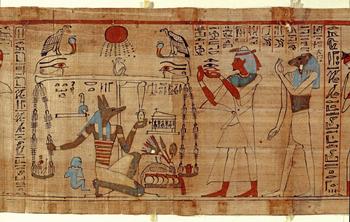
Unfortunately, Glanville's is a single, dated interpretation, and as the development of Egyptian scales is not well addressed in more recent scholarship, it is extremely difficult to appraise the merits of Bresson's case. The difference between the construction of the Arcesilas Cup's weighing beam and those found elsewhere in Greek vase painting is slight. As a result, it is difficult to tell whether the conical ends and the protrusion of the strings truly represent a non-Greek weighing mechanism, especially as this feature can be relatively subtle in Egyptian depictions (Fig. 4). Arguably as notable as the conical ends to the Arcesilas Cup's weighing beam are the dangling strings from the centre of the beam. These are not paralleled elsewhere in contemporary Greek depictions of weighing, and, especially as they appear to be pointed to by a worker, might have been loosely modelled on the line found hanging from the centre of the Egyptian weighing mechanism and checked by an attendant.
A detail from the weighing of the heart vignette of the Book of the Dead of Aaner, Third Intermediate Period. Museo Egizio Torino 1771. © Museo Egizio Torino.

Careful examination of the Arcesilas Cup's figures highlights that Bresson may have overstated the Egyptian root of features such as the ‘scribal’ figure and the weighing mechanism. However, despite these corrections, it is hard to escape the conclusion that the positions and gestures of the characters on the cup seem to follow a broad model found in weighing of the heart scenes and that there is little in Greek art to compare to the cup's unusual combination of subject matter and composition. Such features include the enthroned Arcesilas under his canopy, addressed by the more richly dressed and non-labouring Sophortos nearest him, but also extend to other figures in the scene. As mentioned above, the posture and position of the figure on the right-hand side of the cup, who points upwards to the centre point of the balance, is paralleled by the placement of a figure in some weighing of the heart vignettes, generally Horus (Fig. 3, paralleled in contemporary tombs at the Bahariya Oasis; Fakhry Reference Fakhry1942, 65–93) or Anubis (Fig. 4). Similarly, the small, shrouded ‘guard’ sitting alone in the corner of the lower register, with his legs tucked against his chest, could be argued to (very) loosely resemble the shrouded ‘assessors’ typically represented in a separate register above or below weighing of the heart vignettes on papyri (Fig. 3).
The fauna of the Arcesilas Cup
Thus far, the case for the Arcesilas Painter's use of the weighing of the heart scene as a model for the cup is comprised of a range of features which are suggestive but far from conclusive. A more concrete case for the use of an Egyptian model can be made through an examination of the cup's animals, and especially the baboon. The baboon, which sits on the centre of the upper support for the Arcesilas Cup's weighing beam, is a near-identical use of the motif to the baboon which sits at the centre of the weighing mechanism in most representations of the weighing of the heart. This parallel was noted by Bresson (Reference Bresson2000, 92) and is the most significant piece of evidence linking the cup with Egyptian funerary art. The Arcesilas Painter's inclusion and positioning of the baboon is nearly entirely alien to Greek vase painting, and does not appear in any other Laconian painting of the sixth century.Footnote 16 It is quite certain, therefore, that the inclusion and positioning of the baboon on the Arcesilas Cup in the same position as in Egyptian weighing of the heart scenes was not coincidental. Certain of the other animals on the cup may support such a conclusion. The positioning of birds at either end of the upper support for the cup's weighing beam is paralleled in the similarly positioned vultures of the Papyrus of Aaner (Fig. 4). While it can be noted that birds elsewhere occupy lofty spaces in Laconian vase painting (for example Rider Painter, Louvre E669: Pipili Reference Pipili1987, 51, fig. 77), their posture here is less generic, and seems aimed at engaging them in the wider scene. The unusual, long-beaked stork and the raptor flying above the scene may be fillers, as Laconian vase painting elsewhere displays both horror vacui and the use of prominent bird motifs (compare the Rider Painter's ‘rider cups’, 550–540 bc [Pipili Reference Pipili1987, 76, fig. 108, 109], or the large eagle which appear with Zeus, as on a Laconian III kylix, 575–565 bc [Lane Reference Lane1933–4, pl. 37b]). However, these birds could also allude to the high frequency of birds and avian motifs in Egyptian funerary texts. Schaus (Reference Schaus2006, 177) posits that the stork or crane is an adaptation of the winged eye of Horus, often found near Osiris in weighing of the heart scenes, but if the cup's birds are inspired by weighing of the heart scenes, then surely the stork or crane is more likely to be inspired by Thoth's visually similar ibis head being rendered as a fully formed bird.
One could apply the same logic to the eagle and perhaps even the leopard, which could be interpreted as transformations of Horus’ raptor head and Anubis’ or Sekhmet's canine/feline head. None of these animals is unique in Laconian art, but if the Arcesilas Painter was using an Egyptian model, it is possible that rather than the animal-headed attendant gods of the weighing of the heart being entirely removed, they were used to inspire an especially diverse and interesting mixture of exotic fauna.Footnote 17 The execution of the cup's birds is entirely Greek, and the lizard and leopard, though both find close parallels in Egyptian art, are not unusual enough in Greek art to be evidence of immediate non-Greek influences. The exact shape of the cup's lizard can be seen in Egyptian funerary art such as painted coffins, but as the symbol can be found elsewhere by the mid-sixth century (for example, a kylix, c.550 bc, in the Villa Giulia: Pipili Reference Pipili1987, 6–7, fig. 9), its inclusion here cannot be attributed to the use of an Egyptian model.Footnote 18 Likewise, the leopard, which is collared and tied to Arcesilas’ folding stool, has the distinctive stylised facial structure of felines found, for example, on Egyptian magical objects, but here likely owes its design to recent Corinthian precedents.Footnote 19 The position of the leopard under the stool probably derived, ultimately, from the model of animals depicted under thrones in Egyptian art, but was not unfamiliar in Greek art of the sixth century.Footnote 20
In sum, the only feature of the Arcesilas Cup which gives firm support to the Arcesilas Painter's use of an Egyptian model is the baboon. There is varying merit in the identification of several further interactions between iconographic elements of the cup and Egyptian art, including Arcesilas’ dress, the ‘scribal’ figure, the weighing scales, and the other animals. It is unlikely that present evidence can be used make any such possibilities more concrete. Rather than connecting individual iconographic details, it is more fitting to acknowledge that most features of the subject and organisation of the cup's tondo create only an overall impression that the scene is modelled on the weighing of the heart. Nonetheless, the strength of this impression, the inclusion of the baboon, and the unusualness of the proposed source material, are, on balance, sufficient to suggest that the Arcesilas Painter directly drew upon an example, or otherwise a very clear account, of the weighing of the heart scene while decorating the Arcesilas Cup.
INTERPRETATION OF THE SUBJECT
The Arcesilas Cup appears to spurn the typical themes of sixth-century Laconian pottery, such as mythological conflict, gods and elite banqueting, in favour of a scene showing the weighing of silphium and modelled on Egyptian funerary art. Not only are the subject and use of an Egyptian model unusual, but also the annotation of the tondo and the depiction of a historical figure, Arcesilas II, which is practically unique (Mei Reference Mei2013, 29–30). Such a strange combination of features suggests that the cup could not have been produced as a commercial speculation, but was commissioned to illustrate a specific theme or idea, but what was this theme or idea, and what does it tell us about the buyer?
The agora of Arcesilas
One explanation of the cup's decoration is that it was intended as a depiction of an event witnessed in Cyrene by the artist. Bresson's conclusion, despite his recognition of weighing of the heart scenes as the model for the cup's composition, is that the scene is an attempt to render an act of weighing witnessed by the painter in the agora (or the royal store) of Cyrene (Bresson Reference Bresson2000, 94). Others have similarly suggested that the cup represents exotic animals in an endeavour to capture the fauna witnessed by the painter in Cyrene, and that the overall scene corresponds to a real event, the weighing of Cyrene's silphium in the market or on a ship.Footnote 21 Such a view persists in more recent scholarship, with Prost (Reference Prost and Powell2018, 164) stating ‘some [perioikoi] have seen the palace of Arkesilas II of Kyrene since they are able to represent the scene of the weighing of silphium’.Footnote 22 On the contrary, however, nothing about the cup's detail necessitates that we imagine the Arcesilas Painter to have worked on it in Cyrene, where his work is also not unusually well-represented (Coudin Reference Coudin2009, 233). It has already been discussed that the fauna finds parallels in other art, Greek and Egyptian, and it is hardly possible to imagine that the baboon here represents reality. Furthermore, the idea that the painting reflects either a personal memory or some sort of organised portrait seems at odds with most approaches to the themes and production of Laconian pottery.
Instead, the stylisation of the weighing scene, its annotation, and the adoption of aspects of Egyptian art, suggest that the theme of weighing, aesthetic novelty, and clear identification of the processes and people involved were all greatly more important to the artist than remaining true to life. Even if the painter had visited Cyrene, it is difficult to know whether he would witness the king personally presiding over the weighing of goods. Although evidence points to a royal monopoly on silphium by 560 bc, it is hardly necessary to conclude that the king would regularly sit to supervise the weighing of the silphium, except for perhaps on an occasion of special significance. His inclusion here emphasises his control rather than depicting an instance of such control.
The judgement of the soul
It can be assumed that the Arcesilas Cup was found in a tomb at Vulci belonging to a member of the Etruscan elite. As such, the cup was likely part of an array of imported sympotic material furnishing the burial, some of which may have been commissioned or purchased specifically for this purpose (Perkins Reference Perkins1999; De Puma Reference De Puma1986). Such a find context, together with the use of funerary art as a model for the features of the Arcesilas Cup, might be taken as an indicator that the cup deliberately played with eschatological Egyptian iconographies, engaging the viewer's awareness of a broadly similar scene in Egyptian art.Footnote 23
On the contrary, however, the details of the cup strongly suggest that the painter was not commissioned to represent eschatological themes. The recasting of the scene with Arcesilas and the weighing of goods sheds most of the supernatural elements which give the Egyptian scene its otherworldly character. While the use of animals lends the cup an exotic and somewhat fantastical element (as discussed in Hurwit Reference Hurwit2006, 121–36), and perhaps even relates to the animal-headed deities of Egypt's funerary realm, these animals are not explicitly monstrous or unnatural in their character, unlike, for example, the bearded snakes of sixth-century Laconian funerary stelae. Moreover, the annotations, gestures and positioning of the characters in the scene show little resemblance to Greek or Etruscan funerary scenes. The act of weighing itself is unlikely to have been particularly conceptually connected to the afterlife for a Greek or Etruscan audience, who cannot be demonstrated to have associated weighing with the judgement of the deceased. Although we find Hermes executing the psychostasia of Memnon (?) and Achilles on some late-sixth-century and fifth-century Attic vases, this is not a theme in sixth-century Laconian art (cf. Achilles and Hector: Homer, Iliad 22.208–13). Furthermore, this act of weighing is carried out with hand scales and decides who will die, rather than using large scales in the assessment of an individual's merits at the point of entry to the afterlife.Footnote 24 Only later do depictions of Hermes with scales containing εἴδωλα of apparently non-mythical characters suggest that the weighing process may have become more widely associated with Hermes’ role as psychopompos, and still then it retained an association with heroising combat.Footnote 25 It is safe to conclude that the Arcesilas Painter had no intention to use the cup's weighing scene to depict eschatological themes.
A crisis in the kingship of Arcesilas
A popular interpretation of the Arcesilas Cup has been that it is in some way a satire on or critical of the characters shown, perhaps playing on Arcesilas II's reputation as unlikeable.Footnote 26 However, none of the individual cases for such readings are quite convincing. For example, Applebaum (Reference Applebaum1979, 19) concluded that the similarity of the goods being weighed on each end of the scale undermines the authority figure of Arcesilas by showing the weighing scene to be pointless. However, although other scenes of weighing from the Archaic Period are rare, none of these seem to differentiate the goods on either side of the scales, so there is little reason to suggest that the similarity of the appearance of the goods implies that the weighing action, and by extension Arcesilas’ power, is redundant or inept. Indeed, the painter might have wished to represent the taking of a share of the goods rather than its weighing against a set measure. Unlike certain ‘rigged’ Egyptian scenes of weighing (Kensky Reference Kensky2010, 161–2), the mechanism seems equally proportioned, no one seems to be holding or otherwise interfering with the weighing, and all signs indicate that the weighing is proceeding efficiently.
Benton (Reference Benton1959, 181) suggested a similar satirical reading of the weighing which centred on the birds in the scene. She proposed that the birds are being invited to eat away pests infesting the cargo and weighing mechanism. In this interpretation, the scene is a mockery of the figure of Arcesilas, who is impotent to control the situation. However, Benton's reading of the images and inscriptions on the cup is selective and inaccurate, stressing an insect-eating element which is not illustrated on the vase, ignoring the fact that Arcesilas seems entirely unconcerned with the birds and is looking at the workers, and giving readings only for the two inscriptions which can be argued to relate to her interpretation of the scene. Tivérios (Reference Tivérios2000 [2001], 19–26), though not using the same readings as Benton, also pursues this association of the birds with a satirical or political purpose. In suggesting that the crane is instructed to tear at the eyes of Arcesilas, Tivérios connects sliphomachos (see above), the ‘silphium-fighter’, with anti-Battiad sentiment. Certainly, the Battiads’ exploitative control of the export of silphium could have contributed to internal crisis, especially with the Libyan population, precipitating conflict and later arbitration (Mitchell Reference Mitchell, Brock and Hodkinson2000, 86–9; Herodotus 4.161). Furthermore, a sense of force or crisis might be alluded to in the labelled guard, and, following Hurwit (Reference Hurwit2006, 129), in the positioning of the lizard as an ill omen. The presence of a balance, the king, and silphium could be a wry reference to the relationship between stasis, commerce and rebellious indigenous population. However, Tivérios mirrors Benton in using only a rather limited range of the inscriptions to construct this reading. In addition, sliphomachos is not the only character pointing, and it is proposed above that his raised arm may follow a model in which Egyptian characters at the far end of the scales check a central line. More generally, the subject of anti-Battiad or anti-monopoly sentiment, especially among a Libyan population, and using a character so ambivalently represented as being ‘Greek’ and orderly, seems at odds with the wider elite themes of Laconian pottery. I find it difficult to agree that Arcesilas’ wealth or power are negatively portrayed, or to find reasons why an Etruscan would have such an interest in such a subject as to acquire this cup.Footnote 27
For similar reasons, I do not accept Schaus’ reading of the cup against the context of North African instability and Cyrene's co-dependency with the mercenary forces of pharaoh Amasis II (Schaus Reference Schaus2006, 177–8; Herodotus 2.181; Ladynin Reference Ladynin2006 31–56). Schaus notes Arcesilas II's military alliance with Amasis II following Apries’ failed invasion of Cyrene and the subsequent civil war in Egypt (see Herodotus 4.159; this is argued by Stibbe Reference Stibbe1972, 198–9, on the basis of Plutarch, Moralia 261c, and followed by Schaus) as well as the later internal strife which saw Arcesilas murdered by his brother Learchus, who was then murdered by Eryxo, Arcesilas’ wife. Taking this context, Schaus speculates that the cup and its Egyptian elements may have made a pointed criticism of Arcesilas’ reliance on and relationship with Egyptian forces (perhaps taking silphomachos in a similar ‘fighter’ sense as Tivérios?). It is not clear, however, who would be the audience for such a message, either in the Greek world or in Etruria.Footnote 28
As already noted, the painter did not use ethnographic characterisation, e.g. to denote Egyptian or Libyan characters. A pointed message about Greek–Egyptian interactions would have relied upon the viewer correctly interpreting what now seems like an oblique political subtext in the cup's use of Egyptian elements in the weighing scene. It seems more likely that negative commentary of this kind, if requested, could have found its expression in the manipulation of a Greek myth. It can also be said that Amasis II was very well connected (for example, see Herodotus 2.182). Though there must have been factions which were hostile to the Cyrenean relationship with Egypt around 550 bc, we have no sense of who may have been in these factions, and whether they would choose to advertise their position through the commission of objects like this cup. That the painter also chose not to depict Eryxo, in the context of the other inscriptions mostly being speaking names for characters shown in the scene, makes the reading of ΟPYΧΟ as Eryxo very difficult. Despite the inclusion of several inscriptions, the painter does not exploit the opportunity to include more allusions, for example the name Amasis, in the description of the remaining characters.
Therefore, although silphium and its profits might be linked to Arcesilas’ broader relationship with Egypt, through trade and the hiring of mercenaries, I find Schaus’ suggestion doubtful. If the scene's composition and iconography tell a joke or construct a critique, it is not apparent what that joke or critique is, or who would desire to commemorate the denigration of Arcesilas in such a way. The relationship between the cup's tondo and Arcesilas II's military and personal conflicts in North Africa is inscrutable, and a more immediate reading of the relationship between the scene, its Egyptian model and its historical context is possible.
Commerce and consumption
Looking at which motifs the Arcesilas Painter removed from, retained and added to the weighing of the heart scene, used as the basis for the cup's composition, gives some indication of the intended significance of the weighing scene for its viewer. The religious and supernatural elements of the weighing of the heart are largely removed, together with the most easily recognisable elements of Egyptian iconography, such as crowns or hieroglyphs. The composition, scales and fauna retain some of the distinctive character of the weighing of the heart scene, plausibly as a deliberate, but relatively subtle, allusion to Egypt. Also retained are the power relationship between the dominant seated figure and the rest of the characters (expressed through scale and clothing); and the busy, asymmetrical and detailed representation of the activity of weighing. Added to the scene are stacks of goods, most likely silphium, indicating that the power of the overseer lies in controlling a commercial exchange rather than the moral substance judged by the weighing of the heart. Greek annotations replace hieroglyphic or demotic script, and give descriptive speaking names to the characters involved in weighing the produce, possibly to stress the variety and organisation of labour and to identify the (visually nondescript) silphium.
Taking the tondo of the cup at face value, its subjects are silphium, commerce and royal monopoly. These economic themes appear at odds with Laconian vase painting more broadly. However, interpreting such connections against a context of interpersonal and commercial practices of the sixth century bc shows that the Arcesilas Cup may not be as unusual as it appears.
Tackling the cup's relationship with wider interpersonal or exchange networks means associating it with a market or commission. This task has been best attempted by Mei (Reference Mei2013, 29–31), who takes a substantivist approach, understanding the content and exchange of the cup within the context of the commercial activity it depicts. Taking the deposition of the Arcesilas Cup in a tomb at Vulci as his lead, Mei argues that the cup was commissioned for, but not by, an Etruscan. He proposes that Arcesilas II himself commissioned the cup to be gifted to a member of the Etruscan elite as part of a deal trading in high-value silphium, perhaps in exchange for metals, and that the cup includes the weighing scene to explicitly advertise silphium as an export product and Arcesilas’ role in managing its production and distribution. Mei further argues that an annotated, named drinking cup could have been an especially suitable marker of elite interactions in Etruscan society. However, although he outlines parallels for the gifting of cups with the name of the sender in Etruria, and for the role of agricultural goods (like silphium) in elite–elite exchanges, Mei finds no comparisons for the promotion of goods or those selling them on. Furthermore, Mei's observations do not adequately account for the inclusion of an Egyptian model for the cup's weighing. Mei proposes that Arcesilas himself chose to have the cup's decoration based on an Egyptian scene found in material sent to Arcesilas by Amasis as part of a range of gifts (Mei Reference Mei2013, 30; Herodotus 2.180, 2.182). However, this seems highly unlikely, as the funerary media on which the weighing of the heart is depicted are entirely out of keeping with the typical pharaonic diplomatic gifts, either to Greeks or to others (see Mumford Reference Mumford1998). Finally, Mei's argument places little emphasis on what such a scene would mean to its recipient, and how such an ‘advert’ would be effective.
Reframing this argument with less emphasis on advertisement can provide different options for contextualising the cup and its Egyptian aspects within trade networks. Numerous luxuries and commodities were traded across the Mediterranean, but few were depicted on vases. We can note that in this case, however, the product (a fine, valuable cup) and the subject (silphium) share a single usage context – the feast. Silphium was an extraordinarily highly valued ingredient. Although it later became known as a contraceptive and medicinal substance (Parejko Reference Parejko2003, 925–7), it appears to have always had a significant culinary function. This can be seen in a fragment attributed to Solon (fr. 33 G.-P.2 = 39 W.2 in Julius Pollux’ Onomasticon X.103) which mentions the plant together with a mortar and vinegar, and also in the use of silphium (-like ingredients) in later recipes.Footnote 29 The desirability of such ingredients for feasting purposes complements wider evidence for the exchange of elite feasting practices, the associated valuable goods, and high-status ingredients, such as fish and wine, during the establishment of peer networks in the Mediterranean during the sixth century (Van Neer et al. Reference Van Neer, Lernau, Friedman, Mumford, Poblome and Waelkens2004, 101–47; Villing Reference Villing2006, 31–46; Villing Reference Villing and Tsingarida2009, 319–33; Schreiber Reference Schreiber, Pischikova, Budka and Griffin2014, 241–3 and Reference Schreiber, Budka, Kammerzell and Rzepka2015, 310–11). It seems possible, therefore, that the buyer of the cup either commissioned it to reflect their own consumption of this valuable ingredient in a feasting context or, perhaps more likely, to gift to an individual with whom they had a personal and commercial relationship.
As well as sensationalising the royal redistribution of silphium for the purpose of encouraging its exchange, as Mei proposed, the cup more generally magnifies silphium for the flattery of its buyer and other viewers’ consumption of luxurious foodstuffs acquired as a result of special access to an exotic market. The addition of annotations expands the biography of the silphium plant through the addition of various laborious stages of production. The presence of Arcesilas in recognisably elite garb and the inclusion of a guard both emphasise silphium's value further. The ropes, upper beam and fabric of the tarpaulin might be intended to resemble a ship, and emphasise the importance of trading by sea. The fauna and Egyptian model may have been the result of a trader's personal experience and contacts in Egypt, or a more general demonstration of exotic locales by the artist. To the right audience, however, Egyptian elements could have emphasised access to two markets comparably regulated by royal control, Cyrene and Egypt.Footnote 30 The distribution of silphium through the port of Naucratis, rather than (exclusively) through Cyrene itself, is suggested by Gönster (Reference Gönster, Kistler, Hoernes, Mohr and Öhlinger2015, 169–84) on the basis of the large volumes of Cyrenean coinage depicting the silphium plant which have been found at Naucratis, and other archaeological evidence for their connections to the port (see Schaus Reference Schaus2006). Though this coinage is mostly post-Archaic, Gönster's conclusion that Naucratis played a role in the redistribution of Cyrenean goods is plausible. Naucratis, therefore, may be the link which best explains the Egyptian model, as will be discussed in more detail below.
If one takes such an approach, the Arcesilas Cup is certainly still unusual. Other desirable foodstuffs do not all receive similar treatment, and the inclusion of inscriptions emphasises the royal monopoly, which added interest and value to the silphium but could also have had specific significance for the political or status identity of the user. However, as a valuable object for use in feasting contexts, the cup and its subject can be situated within the same elite sphere of concerns which are demonstrated through the sympotic scenes of many Laconian vases (Pipili Reference Pipili and Powell2018, 145–6). More specifically, the Arcesilas Cup could be considered alongside the Boreads Painter's wine-treading cup, which may or may not be mythical, and compared to contemporary scenes from other production centres depicting the preparation or production of wine or food.Footnote 31
Leading on from this interpretation of the cup's subject, there are numerous options for the attribution of the commission and transmission of the cup. If the cup primarily represents a purchase by the user to reflect an individual interest in silphium as a status marker, then many options as to the commissioner are plausible. Interpersonal connections facilitating the exchange of such a status object are not straightforwardly represented in the broader material record (shown, for example, in the historical account of Egyptian gifts to Laconians [Herodotus 3.47] despite little material evidence for Laconians visiting Egypt: Bergeron Reference Benton2013–15; Johnston Reference Johnston, Tsingarida and Viviers2013, 103–12). There are several ways in which the Egyptian element could come to the attention of such a buyer, as will be discussed below. I believe it is more likely, however, that we can follow Mei's association of the cup's commission with a relationship incorporating commercial interests, in which case it is possible to evaluate some options.
An Etruscan buyer, acquiring such a product for their own or a peer's use, seems unlikely. Besides the ongoing debate as to the likelihood of specific Etruscan commissions (Reusser Reference Reusser2002; Coudin Reference Coudin2009; Pipili Reference Pipili and Powell2018, 146), there are questions as to the wider engagement of Etruscans in Greek emporia. Some evidence indicates Etruscans were well established as traders and were active in trading centres around the Mediterranean (Camporeale Reference Camporeale, Camporeale and Hartmann2004, 78–101), but there is very little ceramic or epigraphic evidence for Etruscan travellers at Greek or Egyptian sites in North Africa, despite their interest in aegyptiaca (Naso Reference Naso2006, 194; Johnston Reference Johnston, Villing, Bergeron, Bourogiannis, Johnston, Leclère, Masson and Thomas2013–15, 47, 78; Gorton Reference Gorton1996, 155–64; Hölbl Reference Hölbl1979). For similar reasons, as noted above, the case for a Laconian buyer is weak, as there are few indications that Laconians were themselves active in commerce among the relevant networks through which their exports were traded (Bergeron Reference Bergeron, Villing, Bergeron, Bourogiannis, Johnston, Leclère, Masson and Thomas2013–15; Johnston Reference Johnston, Tsingarida and Viviers2013, 103–12).
The relationship between Cyrene and Laconia, and the North African location of Cyrene, might support the case for a Cyrenean buyer.Footnote 32 The community at Cyrene was closely linked to Laconia. The cities shared ancestral and cult ties, not only through Thera, but also because Laconians took the opportunity to migrate onto the agricultural lands discovered by the Therans as they moved from hostile coastal sites like Aziris to more fertile regions (Herodotus 4.151–9; Vries Reference Vries2015, 1–11; Schaus Reference Schaus2006, 175; Reference Schaus1985, 98–102; Reference Schaus1979, 105; Malkin Reference Malkin1994, 48–57, 169–81, 192–203; White Reference White1984, 99; Currie Reference Currie2005, 245; Evans Reference Evans and Munson2013, 116–17; James Reference James2005, 1–20).Footnote 33 In part owing to these connections, there was an export market for a very wide array of Laconian pottery in Cyrene, which continued even while exports elsewhere declined (Pipili Reference Pipili and Powell2018, 138; Mei Reference Mei2013; Coudin Reference Coudin2009, 86–92; Schaus Reference Schaus1985). Differences in the shapes and painters of Laconian pottery found at Cyrene, Tocra and Naucratis appear to present a picture of specific relationships between patrons and producers or traders, rather than some sort of cabotage trade in Laconian fine wares across North Africa (Pipili Reference Pipili and Powell2018, 141; Coudin Reference Coudin2009, 92–9; Schaus Reference Schaus2006, 176; Schaus Reference Schaus1979). With evidence for direct Cyrenean access to the Laconian market, and a Cyrenean presence at Naucratis in Egypt (Schaus Reference Schaus2006; Johnston Reference Johnston, Villing, Bergeron, Bourogiannis, Johnston, Leclère, Masson and Thomas2013–15), we can, therefore, consider a Cyrenean commission highly plausible. The specific distribution of Arcesilas Painter cups does not contribute especially strongly for or against such a conclusion (Coudin Reference Coudin2009, 150, 158, 233). However, it can be objected that evidence for Cyreneans in Etruria or vice versa is sparse, and the presence of Laconian pottery in Cyrene might not indicate that it was traded on from here to Etruria.Footnote 34
A viable alternative would be that the cup was commissioned by a trader from an East Greek city, such as Miletus or Samos, with links stretching across Egypt, Cyrene, Laconia and Etruria. It has already been noted that silphium may have been traded out of Naucratis, a predominantly East Greek trading centre (Villing and Schlotzhauer Reference Villing and Schlotzhauer2006). East Greek communities were significant consumers, and likely movers, of Laconian pottery around the middle of the sixth century bc (Coudin Reference Coudin2009; Schaus Reference Schaus, Gürtekin Demir, Cevizoğlu, Polat and Polat2018, 285–302). Samos’ imported Laconian pottery was long held as evidence for an especially intense Laconian-Samian relationship. However, the roughly equivalent body of Laconian pottery from Miletus makes it clear that both these poleis were engaged, likely separately, in the acquisition and exchange of Laconian pottery (Schaus Reference Schaus, Gürtekin Demir, Cevizoğlu, Polat and Polat2018). It is not difficult to trace the presence of such East Greek traders across relevant emporia in Italy and Africa. Dedications which can be associated with Milesians and Samians have been found at Naucratis and the Etruscan port of Gravisca, and it might be possible to trace one Samian individual, Hyblesios, to both these ports.Footnote 35 Material interactions within this network, direct or otherwise, are also attested in the Egyptian and Egyptianising objects originating in Naucratis’ faience workshops which have been found at Gravisca, Miletus and Samos (Demetriou Reference Demetriou2012; Hölbl Reference Hölbl1999; Webb Reference Webb2016). These East Greek traders were likely putting in at a Laconian port such as Gytheion (Schaus Reference Schaus, Gürtekin Demir, Cevizoğlu, Polat and Polat2018, 299) to exchange goods and acquire Laconian pottery, and here they could make commissions. In a competitive trading environment, it would not be surprising that the cementation of interpersonal networks of supply and exchange through the gifting of status goods like the Arcesilas Cup could accompany exchange arrangements for especially valuable cargoes such as silphium.
I propose that this context of commerce and common consumption practices among a high-wealth and status group, with associations across the Mediterranean and North Africa, might offer a strong explanation of the links between the Arcesilas Cup's Laconian production, subject matter, use of Egyptian art, and deposition in an Etruscan tomb. I find the case for the Arcesilas Cup being an East Greek, that is Samian or Milesian, commission the most compelling, based on their use of Laconian pottery and the evidence for their mobility across the relevant networks. A Cyrenean buyer, however, cannot be ruled out.
CONTEXTS FOR TRANSMISSION BETWEEN EGYPT AND LACONIA
It is relevant for the discussion of the Arcesilas Cup, and of broader significance for the study of Greek interactions with Egypt, whether it was the Arcesilas Painter or their customer who elected to use an Egyptian model as the basis for the composition of the Arcesilas Cup, and how the painter or customer came to be aware of such a model in the first place. An assumption underlying many interpretations of the Arcesilas Cup, including that proposed in this paper, is that the Egyptian iconography was purposefully deployed as a contribution to the meaning of the cup's subject. This conclusion might suggest that whoever commissioned the cup acquired the model and supplied it to the painter, or else more generally instructed the use of Egyptian elements. On the other hand, some scholars, including Coudin (Reference Coudin2009, 161), clearly believe that the Arcesilas Cup might be based upon sketches taken by the artist ‘on site’ (d'un croquis sur place). For many, the extent to which the cup shows familiarity with Egyptian weighing of the heart scenes reflects a direct study of Egyptian art, which if not taken ‘on site’ must likely indicate the movement of a portable version of Egyptian funerary art. Uncertainty about the process of transmission stems mostly from the fact that no prior discussion of the Arcesilas Cup has made a priority of clarifying the contexts of Egyptian funerary art, its transmission within and beyond Egypt, and the situations in which we might imagine it being accessible for a Greek ‘on site’.
Contributing to these shortcomings is, undoubtedly, the fact that previous observations on the similarities between the Arcesilas Cup and Egyptian weighing scenes have been restrictively based on New Kingdom examples, all dated to the latter half of the second millennium bc. Boardman (Reference Boardman1958) draws comparison with the New Kingdom tomb of Neferronpet, and similar examples of tomb painting were the primary point of reference for Lane and Puchstein. Bresson (Reference Bresson2000, 90–1) and Schaus (Reference Schaus2006, 177) both use the same two New Kingdom texts, The Papyrus of Ani and The Papyrus of Hunefer. Schaus notes that the Arcesilas Painter more likely accessed such designs through something like a ‘pattern book’ or common knowledge than a tomb; however, all the examples of the weighing of the heart in other media which he mentions date 400–900 years earlier than the Arcesilas Cup.Footnote 36 Such uses of evidence hundreds of years removed from the date of the Arcesilas Cup have elsewhere been justified through references to an overall archaising trend in the art of the Late Period (Bresson Reference Bresson2000, 93; Boardman Reference Boardman1958, 9). As shown below, to an extent the observation of archaising habits is accurate (Russmann Reference Russmann and Lloyd2010, 944). Nonetheless, a clearer understanding of how an archaising trend in Late Period Egyptian art intersected with the transmission of Egyptian motifs to Laconian artists is achievable and useful.
Funerary papyri have been used to illustrate this paper's discussion of the Arcesilas Cup's links to Egyptian art, in part for practical reasons.Footnote 37 However, it is Egyptian tombs that present the broadest evidence of sixth-century Graeco-Egyptian interactions in contexts where we find funerary art, and it makes sense to start by discussing these. Egyptian royals and elites often had their tomb walls and funerary chapels decorated with idealised depictions of the life of the deceased and illustrated extracts of funerary texts associated with a successful transition into the afterlife. The scenes used included illustrations both of the weighing of the heart, suggested here and by several other scholars to be a model for the Arcesilas Cup (Puchstein Reference Puchstein1880; Bresson Reference Bresson2000; Schaus Reference Schaus2006; and Mei Reference Mei2013) and the weighing of goods, New Kingdom examples of which Boardman (Reference Boardman1958), and probably Lane (Reference Lane1933–4), linked to the Arcesilas Cup.
Key to imagining a causal relationship between tomb painting and the Arcesilas Cup is the fact that although tomb painting in Egypt declined sharply after the New Kingdom,Footnote 38 it regained popularity in the Third Intermediate Period and Late Period, coinciding with renewed construction of tombs, the use of funerary amulets among groups of more diverse social status, and the decoration of elite tombs with depictions of funerary rites and beliefs previously restricted to royalty (Li Reference Li2010; Taylor Reference Taylor and Wendrich2010b; Stammers Reference Stammers2009). During the Third Intermediate Period and Late Period, monumental funerary activity was widespread beyond the Theban necropolis. Richly decorated tombs, often with substantial surface superstructures, were constructed in the expansive necropolis of Saqqara, near Memphis, and even in remote communities such as the important trading and military post at the Bahariya Oasis (Hawass Reference Hawass2000; Bassir and Sherbiny Reference Bassir and Sherbiny2014, 171–89; Fakhry Reference Fakhry1942, 65–93). Many royals and some elite individuals, previously given extra-urban tombs, were now entombed within storerooms or chapels in temple complexes attached to urban and palatial sites central to Egypt's administrative and religious organisation, for example at Tanis and Saïs (Taylor Reference Taylor and Wendrich2010b, 223–6; Dodson Reference Dodson and Lloyd2010, 821; Naunton Reference Naunton and Lloyd2010, 131; Dodson Reference Dodson1988, 221–33; Montet Reference Montet1947). As well as the construction of new tombs, tombs of the Old Kingdom and New Kingdom, as well as those recently built, were reused very extensively (Bard Reference Bard2015, 306–8; Dodson Reference Dodson and Lloyd2010; Wilkinson Reference Wilkinson, Wilkinson and Weeks2016, 347–59; Taylor Reference Taylor, Wilkinson and Weeks2016, 360–72; Aston Reference Aston, Strudwick and Taylor2003, 138–55). These changes marked both a popular revival of lavish funerary activity and the drawing together of religious and funerary spheres.
This resurgence in tomb painting, and the changes in funerary activity, reflected a wider archaising phenomenon which recycled and reimagined traditional designs, styles and titles. Late Period Egyptian artists did not only use similar motifs to those found in New Kingdom tombs (Dodson Reference Dodson and Lloyd2010, 821–4; Taylor Reference Taylor and Wendrich2010b; Stammers Reference Stammers2009, 48–68; Manassa Reference Manassa2007, 438–40); they also directly reproduced scenes from reused or opened tombs, sometimes using a grid-measure technique (for example, the replication of the girls quarrelling from the hall of the New Kingdom TT 69: Porter and Moss Reference Porter and Moss1960, 59, 135; Bryan Reference Bryan and Lloyd2010, 1006–7).Footnote 39 Furthermore, these reproductions were not confined to tombs around Thebes. A tomb at Saqqara belonging to Bakenrenef, an Egyptian official who moved from Thebes to Memphis when Dynasty XXVI established the latter as its administrative centre, incorporated designs which had been copied from several Theban tombs and brought to Memphis, either specifically for this tomb, or as part of a workshop's wider repertoire (Stammers Reference Stammers2009, 54–5, 63). Clearly, therefore, there were sixth-century ‘pattern books’ of funerary art in some form.Footnote 40 The scenes replicated in this way may have included the weighing of the heart scene, which was popular in New Kingdom private tombs and appeared in royal tombs for the first time in the Third Intermediate period (Dodson Reference Dodson and Lloyd2010, 821).Footnote 41 There are many forms of weighing of the heart in the seventh and sixth century, but basic similarities between examples from the grand, palatial mastaba tomb of Tjery (Saqqara, early Dynasty XXVI), and contemporary, richly decorated tombs of Bannantiu and Pa-Nentwy, in the distant Bahariya Oasis, indicate widespread common knowledge or common source material containing at least the most basic attributes of the scene (Hawass Reference Hawass2000, 188–92; Tiradritti Reference Tiradritti2008, 352–8; Aufrère, Golvin and Goyon Reference Aufrère, Golvin and Goyon1994, 125–40; El-Sadeek Reference El-Sadeek1984). There is a strong case, therefore, for the mobility of such designs within Egypt, but could Greeks also have seen these paintings sur place, and if so which Greeks and where?
Schaus (Reference Schaus2006, 180, n. 33) has argued, following Hoeckman and Verhoeven, that the Greeks would be explicitly barred from tombs and therefore the tomb and associated funerary equipment were problematic sources for Greek contact with the model for the Arcesilas Cup. He cites an example of the Book of the Dead (P. Colon. Aeg. 10207) which states that it was undesirable to have Greeks learning spells of the afterlife. However, evidence that the Egyptians desired to avoid the Greeks developing an understanding of the esoteric knowledge required to navigate eschatological journeys does not necessarily suggest that Greeks were not accessing Egyptian tombs (and may rather indicate the anxiety of some over the fact that they were). Late Period tomb complexes served as monuments for the worship of Osiris long after the burial of the deceased, with superstructures designed for ‘conspicuous display’ and decorated to ‘welcome the visitor’ and invite them to make offerings, as well as with scenes from the Book of the Dead (Stammers Reference Stammers2009, 62; see also Taylor Reference Taylor and Wendrich2010b, 223–6; Dodson Reference Dodson and Lloyd2010, 821; Naunton Reference Naunton and Lloyd2010, 131; Pischikova Reference Pischikova1998, 63). The aforementioned mastaba tomb of Tjery, for example, placed the weighing of the heart scene in Chamber 2, a central, open chamber where Tjery would receive mortuary cult and offerings would be made to Osiris (Stammers Reference Stammers2009, 62; for a roughly contemporary example from Thebes, see Griffith Reference Griffith, Pischikova, Budka and Griffin2014, 251–68).
Tjery's tomb remained in use for subsequent burials, and must have received many visitors. It is reasonable to speculate that visitors to tombs like Tjery's may have included Greeks, welcome or otherwise. Memphis, as well as being an administrative centre for Dynasty XXVI, was a major focus for religious pilgrimage and travel within Egypt and, during the reigns of Apries and Amasis, the home of a substantial foreign mercenary force based at the palatial and religious complex around the Palace of Apries (Herodotus 2.154, 3.139; Stammers Reference Stammers2009, 2; Rutherford Reference Rutherford, Roemer and Matthews2003, 171–90; Trindade Lopes Reference Trindade Lopes2011, 247–58 and Reference Trindade Lopes, Goyon and Cardin2007, 1163–6). Sixth-century funerary stelae and other objects inscribed in Carian or (typically Ionian) Greek have been found at the Saqqara necropolis (Masson Reference Masson1978, Vittmann Reference Vittmann2003, 162–77, 219–31). These objects suggest that the Carians and, to a lesser extent, Greeks used Egyptian iconography and objects for their burials. The stelae most likely reflect the surviving element of a wider engagement with funerary art, ideas, amulets and practices, which may have included the reuse of Egyptian burial spaces.Footnote 42 Scenes on Carian (or Egyptian) stelae do not include the weighing of the heart, but the East Greek craftsmen attributed with the production of these stelae appear to have adapted aspects from a variety of sources (Masson Reference Masson1978, 57).Footnote 43 At the very least, it is apparent that Greeks and Carians at Memphis had some interaction with the nearby funerary landscape of Saqqara. This very likely extended to communication with the temple staff organising this landscape, who probably decided where foreigners should be buried, but might not have been willing to share designs which included or alluded to spells.
Evidence elsewhere supports the idea of Greek access to tombs. Carian graffiti has been found between entrances to funerary chapels inside the first court of the Late Period tomb complex of Montouemhet at Thebes (Porter and Moss Reference Porter and Moss1960, 57; Leclant Reference Leclant1950–1, 371; Russman Reference Russmann1994, 1–19). The nature of the short inscriptions is unclear, but that such a visit resulted in graffiti need not necessarily be considered an unwelcome aberration of Egyptian practices, as elsewhere Egyptian graffiti in tombs is considered an acceptable, indeed desirable, part of Gedächtniskultur.Footnote 44 It is quite possible that visitors from Greece may have been taken to, or encouraged to visit, tombs monumentalising leading individuals from elite families. A hospitable and prestigious relationship between some Greeks and Egyptian elites in the sixth century can be inferred from the relatively significant volume of Greek amphorae repurposed as valued funerary equipment and offerings in Egyptian Dynasty XXVI burials at Thebes (Schreiber Reference Schreiber, Pischikova, Budka and Griffin2014, 241–3 and Reference Schreiber, Pischikova, Budka and Griffin2015, 310–11; Villing Reference Villing, Tsingarida and Viviers2013, 80–1) and also at Saqqara (Villing Reference Villing, Tsingarida and Viviers2013, 88). Furthermore, Herodotus claims to have been taken to the area of the royal burials at Saïs, which were within the complex of the temple of Neith, and appears to demonstrate some understanding of the context of these burials, the separation of the outer area from that containing the coffin, and the symbolic burial of Osiris:
The tomb of Amasis is farther from the sanctuary than the tomb of Apries and his ancestors; yet it, too, is within the temple court; it is a great colonnade of stone, richly adorned, the pillars made in the form of palm trees. In this colonnade are two portals, and the place where the coffin lies is within their doors. There is also at Saïs the burial-place of one whose name I think it impious to mention. (Herodotus 2.169–70)
Other, older tombs, such as those in the Theban necropolis, were hardly inaccessible. The weighing of the heart scenes in the Theban New Kingdom tombs catalogued in Porter and Moss’ bibliography of the Theban necropolis (Porter and Moss Reference Porter and Moss1960) are generally positioned in a traversal space, in the hall near to the entrance, and appear among other scenes known to have been copied into Late Period tombs.Footnote 45 Contacts with distant funerary landscapes such as these probably extended well beyond Psammetichus’ Nubian campaign of 592 bc, which included East Greek and Carian forces (Meiggs and Lewis Reference Meiggs and Lewis1989 no. 7; Agut-Labordère Reference Agut-Labordère and Moreno García2013, 989–95).Footnote 46 Under Apries, Neshor of Elephantine, the guardian of the southern border, earned the epithet ‘the one who satisfies the hearts which were angry’ by negotiating that a rebelling southern army, including Greeks and others, would not leave the country and join the Nubians.Footnote 47 Even Bahariya's tombs, situated hundreds of kilometres from Memphis, were perhaps not outside of the reach of mercenary forces, considering that Bahariya was a point both of conflict and of rich mercantile exchange between Libya and Egypt during the reign of Apries, when it received royal attention.Footnote 48
Concluding that mercenaries and perhaps elite Greeks of the Archaic Period could access tombs across Egypt in such a way that they saw scenes of the weighing of the heart is, therefore, not too great a stretch. It is more difficult, however, to conclude that an artistic study of any detail took place in the context of such a visit. Boardman (Reference Boardman1958), Thorndike-Martin and Vaughan-Nicholls (in Masson Reference Masson1978), and others have shown a range of Greek uses of Egyptian art which suggest close attention to the source material. Firm evidence for ‘sketches’, however, is scarce. A single sherd, described as belonging to a Late Period Aegean amphora, and found discarded in an extensively reused shaft chamber of the Old Kingdom tomb of Ramose at Saqqara, deep in the interior of the superstructure, was used to sketch a rough depiction of a bird-headed deity.Footnote 49 However, who made this sketch and whether it truly dates to the Late Period are both uncertain, especially considering Egyptian uses of Greek amphorae. Certainly, there is nothing to support the view that a sketch would be made and kept for some time, or taken out of Egypt, without a clear purpose.
This discussion of Egyptian tombs demonstrates two points. Firstly, an extensive funerary industry existed in the sixth century bc and necessitated the communication, transportation and reproduction of funerary scenes between Egyptian workshops in some portable form which we could roughly describe as a ‘pattern book’. Secondly, it is plausible that Greek experiences of Egyptian funerary landscapes incorporated visits to exterior areas of the tombs of contemporary elites. Such visits may have produced sketches, but may more easily be imagined as having piqued a wider interest in funerary motifs and, thereby, an interest in seeking out what must have been relatively scarce, non-commercial objects bearing the proportions and compositions of tomb painting designs, which we could call ‘pattern books’. There are two obvious problems with such a conclusion. The first is that tomb depictions of the weighing of the heart are often more limited in their composition than the design that the Arcesilas Cup seems to have used as its model. In my study, only Bahariya has shown suitably complex weighing scenes of sixth-century production. A similar problem would face most portable versions of the scene, such as coffins. Though these were frequently painted with the weighing of the heart during Dynasty XX–XXVI (Taylor Reference Taylor, Strudwick and Taylor2003, 95–121; Manassa Reference Manassa2007, 437–45), they tended to include too few elements of the scene to provide the Arcesilas Cup's model.Footnote 50 The second, lesser, problem is that the extent of Greek access to the workmen and resources of Egyptian funerary workshops is uncertain, and they may even have been obstructed from copying or taking away sections of the Book of the Dead.Footnote 51
Funerary papyri could help us to resolve, or at least sidestep, both problems. The Third Intermediate Period and Late Period saw a significant rise in the volume of funerary papyri produced and used in burial contexts (Taylor Reference Taylor and Wendrich2010b, 220–37). These papyri were used by a wider range of social groups than ever before, and increasingly focused on illustrations of funerary texts rather than copying out the text of the spells itself. Representations of the weighing of the heart on funerary papyri are common and often very detailed, so a single papyrus could have contained all the elements argued to have influenced the Arcesilas Cup's decoration. The Papyrus of Nehemesratawy (Fig. 3), for example, contains almost all the major details found on the Arcesilas Cup. Despite their increased production, the correct decoration of these objects was clearly carefully executed. Several Late Period papyri can be found to combine Memphite media with spells originating from the Theban tradition (Mosher Reference Mosher2010, 123–72). This seems to have produced an eventual homogenisation, to an extent, of local theologies and traditions in funerary texts (Taylor Reference Taylor2010a, 272; Manassa Reference Manassa2007). More importantly, it demonstrates that it was not only tomb decoration which was recorded and transported to Memphis to furnish the relocation of officials under Dynasty XXVI, but a wider corpus of designs associated with Theban funerary traditions. Perhaps, considering the division of labour in funerary industries (Goelet Reference Goelet and Schiffman2003, 13–14), those responsible for illustrating the weighing of the heart scenes worked on designing such scenes for a variety of media with overlapping themes (Massana Reference Manassa2007, 411).
A sixth-century pattern book could, therefore, have contained a suitably detailed depiction of the scene to be used as the Arcesilas Painter's model. It still seems unlikely that such objects would be readily available at a market somewhere like Naucratis. However, a Greek whose specific interest in funerary media had already been piqued through engagement, whether first hand or through stories, with the elite funerary culture of Egypt, might well have been able to purchase either a ‘pattern book’ or an actual funerary papyrus, perhaps illicitly acquired during the widespread practice of tomb reuse, clearance and robbery. An alternative, and simpler, narrative would be that the extensive reuse and emptying of tombs in the Late Period, combined with the increased production of funerary papyri, could have resulted in funerary papyri or pattern books reaching a market place for secondary use as writing or wrapping materials. An example showing the weighing of the heart could have caught the eye of a passing traveller or trader, or been accidentally acquired in the purchase of papyrus, and later enjoyed. Papyri, therefore, seem a plausible medium for the transmission of motifs between Egyptian art and the Greeks.
In sum, the Arcesilas Painter was most plausibly informed of the weighing of the heart through a portable model brought to Laconia from Egypt. The acquisition may have been chance, but was perhaps prompted by an interest in the resurgent Egyptian funerary tradition, and especially its elite tombs, which could have been the result either of personal travel or of conversation with other travellers and mercenaries.
CONCLUSIONS
The Arcesilas Cup depicts Arcesilas, king of Cyrene, controlling the weighing of goods, which are most likely silphium. The annotations of this scene serve to emphasise the process of acquisition and exchange. This unusual subject is proposed to have been chosen and explicitly described so that the exchange of the cup could serve to reflect and reinforce an interpersonal relationship by emphasising a link between commerce and consumption. The valuable drinking cup, the high, exotic status it emphasises for silphium, and the use of silphium as a feasting ingredient, are tied together in a way that connects commercial relationships to likenesses in the expression of status and identity, constructed through shared dining practices. Tentatively, the agents in this relationship have been described as East Greek (the buyer) and Etruscan (the recipient), perhaps with shared investment in the exchange of silphium between North Africa and Etruria. In reaching this conclusion, I have argued that prior interpretations of the cup's subject, including satire, political critique or the depiction of a real Cyrenean marketplace, are either incompatible with norms in the production and exchange of Laconian pottery, or anticipate too strange and specific a frame of reference for the Etruscan owner of the cup.
Although a number of the parallels previously drawn between the cup and Egyptian art have been suggested here to be inaccurate or inconclusive, the use of Egyptian depictions of the weighing of the heart as a model for the cup's tondo is strongly suggested in the overall arrangement of the scene, and more securely attested in the positioning of the baboon. It appears that access to this model, and perhaps many other Egyptian motifs which appear in Greek art, was acquired through the transmission of Egyptian funerary papyri or designs recorded on papyri for reproduction. Funerary materials were produced in sixth-century Egypt in great quantities, furnishing a broadened participation in archaising funerary practice. Greek access to the mortuary landscapes used by contemporary Egyptian officials, responsible for orchestrating trade, religion and mercenary service, may have helped prompt an interest in and acquisition of funerary designs or materials, or these may have been acquired coincidentally.
It remains unclear whether the introduction of Egyptian elements to the cup was part of the commission or the inventive application of foreign and aesthetically pleasing elements by an artist exploring a new subject. However, that these elements seem to compound the association of silphium with both Cyrene and Egypt, and that the cup's buyer may reasonably be suggested to have travelled to Egypt, would support the view that the former option is the case. Whether by instruction or choice, the artist's refiguring of the weighing of the heart scene to eliminate much of its unnatural imagery, while maintaining the significance of the weighing and aesthetic novelty, reflects the resourcefulness and imagination of sixth-century Laconian painters.
ACKNOWLEDGEMENTS
I am grateful for the many valuable comments offered on this article by my reviewers, the editor and the copy-editor, and for those made on several different drafts and earlier iterations of the work by L.G. Mitchell and A. Villing. G.P. Schaus kindly provided a draft of his now-published chapter on East Greek consumption of Laconian pottery, as well as several stimulating discussions on the Arcesilas Cup. Finally, A. Catania provided valuable assistance in the acquisition of reproduction permissions.