


“It is a law of nature that quantitative change brings about qualitative change,” North Korean writer Pan Sangsŏ (Reference Sangsŏ2013, 32) once noted, paraphrasing a precept of dialectical materialism. North Korean literature's quantitative turn is older than the country itself: in 1946, two years before the Democratic People's Republic of Korea (DPRK) was formally established, the North Korean Writers’ Union introduced production objectives. Like several other parts of the North Korean economy, literary production became centrally planned, with yearly quotas by genre and length and regular campaigns to increase production of works on themes mandated by the Korean Workers’ Party (Park Reference Namsu1999; Shin and Oh Reference Hyŏnggi and Oh2000).
Outside the DPRK, the qualitative impact of this number-driven mode of literary writing has generally been assessed negatively: works written “less for the reader and other writers than for the eyes of the party hierarchy” (Pihl Reference Pihl1977, 81), “boring, similar to an assembly line” (Choi Reference Choi1994, 81), and “repeating the same themes and material over and over” (Lee Reference Sangsuk2013, 181). Yet, a number of scholars have nonetheless argued that North Korean literature still exhibits literary qualities in spite of these constraints (David-West Reference David-West2007; Epstein Reference Epstein2002; Immanuel Kim Reference Kim2012; Ryu Reference Ch'anyŏl and Lee1998), and they have sought to extract select examples of well-wrought narratives, complex characters, or poignant metaphors from the country's textual production. Despite being seemingly diametrically opposed, these two ways of assessing the value of North Korean literature nonetheless share a common premise about what literary writing is or ought to be. Both rely on a normative conception of literature as autonomous, free from the external political pressure of a government (Bourdieu Reference Bourdieu1991): isolating the literary bits from the heteronomous political discourse transparently reflects the binary logic of autonomy while characterizing North Korean literature as merely propaganda amounts to denying that any sort of literariness can be salvaged from its politically laden discourse.
Autonomy, however, is foreign to the literary tradition of the DPRK, and therefore it can be of only limited analytical value when trying to understand the dynamics and standards of the North Korean literary field. This article attempts to move beyond these limitations by mapping some of the features of literary texts that are actually valued (as evidenced by external signs of literary recognition) in the DPRK, regardless of their status in other, perhaps more familiar, systems of aesthetic valuation. How is literary quality assessed within the DPRK? If the political field plays an important role in the way a literary work is evaluated and valued, how is this relationship between politics and literary valuation concretely structured and realized? And if repetitiveness and conformism do not seem to be anathema, what is the place of originality in the North Korean economy of literary value?Footnote 1
Autonomy, Autonymy, Automation
The absence of scholarly inquiry into the specific mechanics of the literary system in North Korea is symptomatic of a more general tendency to either dismiss politically laden, state-sponsored literature as presenting little artistic interest or to study it outside the literary institutions in which it was produced. It is not that authoritarian literature as such is not an object of research. Much to the contrary, a vast body of the scholarship on the topic has developed since the numerous landmark studies of the subject were published in the 1980s (Clark Reference Clark1981; Gardner Reference Gardner1983; Günther Reference Günther1990; Suleiman Reference Suleiman1983). But the works studied are treated as ideological tools, independent of the system of publishers, critics, prizes, and academies in which they were originally embedded. On the other hand, theories of “world literature” (Buchholz Reference Buchholz2017; Casanova Reference Casanova1999, Reference Casanova2005; Moretti Reference Moretti2013) conveniently ignore vast areas of literary history, such as East Asian proletarian literary movements (Cho Reference Cho2018) or the USSR's “People's Republic of Letters” (Djagalov Reference Djagalov, Skradol and Dobrenko2018), and end up offering a very Eurocentric and implicitly normative conception of literature (Friedman Reference Friedman, Wollaeger and Eatough2013; Neuman and Rippl Reference Neumann and Rippl2017). Only when they can be opposed to dissident authors are authoritarian writers considered part of a literary system, but one in which autonomous actors struggles against heteronomous ones. In the case of Stalinist literature in the USSR, for instance, the dogmatists of socialist realism such as Gribachev or Kochetov are opposed to autonomous dissidents such as Akhmatova or Mendelstam.Footnote 2 Yet the latter were effectively excluded from the period's literary scene, while the rules and forces that allowed the former to rise to the heights of literary fame over a multitude of other zealous Party apologists remain largely ignored.Footnote 3
The opposition between autonomous and heteronomous literature is more complex than the common distinction between political and pure literature (Goldstone Reference Goldstone2013; Van Rooden Reference Van Rooden2015). After all, Mendelstam wrote a considerable amount of political verse, as did even more openly militant yet still highly regarded poets such as Mayakovsky. But there is a difference between the autonomous engagement (Bourdieu Reference Bourdieu1992, 442) of writers committing to a cause they believe in (often clashing with authorities in that process), and the bureaucratic labor of writing for the state according to policy objectives, from potato yield increase to electricity saving campaigns. In the former case, literature is still produced according to a paradigm of literary autonomy, which favors distinction and experimentation, and these literary qualities can be acknowledged by critics regardless of the work's political dimension. In the latter case, however, while originality may not be nonexistent, other factors come into play, such as how relevant the work is to current policy or how precisely or comprehensively government objectives are communicated. In the autonomy paradigm, which considers literature and politics as separate fields, these factors are not literary—but they are in North Korea. That is why trying to isolate “purely” literary aspects in North Korean works can only be a frustrated endeavor. Whatever aspects are isolated will necessarily appear inferior compared with works produced under the autonomy paradigm, since they only constitute a part of what makes the work valuable in the DPRK. And, more importantly, the method will overlook the other (for instance, political, moral, or ideological) valuation criteria actually used in the country.
Indeed, literature being propagandistic does not preclude the existence of a valuation system (or, in Bourdieusian terms, of symbolic capital): there can be good or bad propaganda, and the criteria separating one from the other are open to interpretation and competition. Some topics of propaganda might carry more value than other. For instance, it is not inconceivable that writing about war and writing about potatoes would carry different levels of literary prestige. Furthermore, when the same heteronomous norm (e.g., loyalty to the Party or any political leader) applies equally to all participants in the field as a prerequisite to entry, it loses its power as a positive valuation factor. Instead, it will primarily work negatively, as a factor of exclusion—for instance, when writers are purged for failing to toe the Party line. It therefore remains necessary to understand the standards against which literary works and their authors are judged once political orthodoxy and loyalty are accounted for.
This is not to advocate for North Korean literature or to call for a reevaluation of the literary heritage of Stalinist poetry. Both tasks entail a judgment of taste that is best left to critics or readers themselves. Rather, the point is to develop a way to analyze the workings of literary systems under authoritarian regimes—and, more broadly, in any historical or cultural context in which the separation of social activities into autonomous spheres is not the norm—beyond the binary perspective of autonomy and heteronomy. This would make it possible to consider political didacticism and plot construction, state policy and thematic choices, cult of personality and writing style not as elements to be disentangled but as fundamentally intertwined and equally integral components of literary evaluation. This does not imply that what is valued in authoritarian literary systems is necessarily radically different from other literary systems. North Korean literature is not the absolute other of literature in liberal capitalist countries; similar aspects of literary writing could be valued in both systems, but according to different modalities and in different proportions.
In order to map North Korean literary standards, this article relies on an approach that may be termed “autonymy.”Footnote 4 This is not a new, alternative theory of literary value but rather a methodology for understanding existing systems of literary evaluations and how they distinguish between good and bad literature. I do not posit a priori that the criteria for this distinction are radically different—or similar—from criteria used elsewhere. Rather, I intend to map these criteria either from scratch or through hypothesis testing, based on what is labeled good or bad literature in North Korea. This approach is therefore fundamentally nominalist in that it rejects abstract universals (Quine Reference Quine1953) and asserts that properties such as “literary quality” exist in name only (there is no universal standard of literary value). It is also pragmatist in that considers the meaning of a word to be determined by its use in language within a certain cultural context (Wittgenstein Reference Wittgenstein1953, 20): what is good North Korean literature is what North Koreans call good literature. Therefore, autonymy does not offer a definition of literary value, but merely acts as a framework to understand how literary value is defined by the agents of a specific literary system. It does not seek to give a definite, comprehensive exposition of literary standards, but rather favors induction from a set of necessarily partial, but empirically grounded, observations.
Such an approach necessarily means prioritizing primary sources from within the DPRK. But it also implies favoring certain sources over others, as the question of what constitutes a valid, reliable label of literary quality is far from straightforward. A traditional approach in literary studies would be to turn to criticism, literary theory, and writers’ essays on the nature of their craft. Yet such sources are usually normative or aspirational and therefore may not reflect the effective standards of the field. A classic example, from Korean literary history, is novelist Lee Kwangsu, who condemned literature's submission to morality and the cheap sentimentality of popular literature in his essays (Lee Reference Kwangsu1916), all the while publishing didactic, melodramatic fiction to popular and critical acclaim. In the context of North Korea, the strong incentive to appear to follow or to prescribe ideological orthodoxy likewise means that the theoretical definitions of literary value put forth by critics are quite removed from the actual practices of the field. It is nonetheless possible to address this issue by focusing on nontextual symbols of literary value—literary prizes, institutional appointments, publication in more or less prestigious venues, commendation by the Party or the Leader—over textual ones. Indeed, these multiple acts of designation constitute realized instances of literary judgment. Textual sources, of course, need not be dispensed with entirely. For instance, when other forms of data are scarce or inaccessible—a common conundrum in the study of North Korea—literary criticism might be the only source from which to infer the state and rules of the literary system.
There would seem to be a natural methodological affinity between such an approach and the practice of distant reading (Moretti Reference Moretti2013, 48; Reference Moretti2015, 688), which aims to eschew “direct textual reading” and underline the primacy of “abstract institutions.” Yet, as critics have pointed out (Goldstone Reference Goldstone2015; Merriman Reference Merriman2015), distant-reading-based scholarship has still mostly concerned itself with textual properties rather than the “the institutional matrix that actually produces and circulates them.” Conversely, this article is mostly concerned with understanding a literary system and its economy of literary value, rather than producing knowledge about the specificities of individual texts or authors. Furthermore, the context in which distant reading was originally conceived—the study of world literature—presupposed the universality and transparency of the notion of “literature” and its associated lexicon. Franco Moretti's famous and oft-debated (Beecroft Reference Beecroft and Damrosch2014, 182; Milner Reference Milner2005, 136; Spivak Reference Spivak2003, 107–9) conclusion that all modern novel forms are “variations” from an “Anglo-French core” (Moretti Reference Moretti2013, 35) is here exemplary. The observation is true, but tautological and normative (since foreign texts too different to be considered “variations” will be excluded), and it is precisely the pitfall that the methodological decision to study a literature on its own terms—by focusing on autonymy and the way things are labeled in their original context (here munhak 문학Footnote 5 as a category corresponding to literature)—is trying to avoid in the first place.
Distant reading has also become shorthand for studies that work on a large scale using computation—although, as Ted Underwood (Reference Underwood2017) points out, neither large corpora nor computational methods are necessarily specific or inherent to itFootnote 6—and this work is certainly indebted to the quantitative studies done at the Stanford Literary Lab as well as to other traditions of computational criticism. As the goal of the present study is to map the dynamics of an entire literary system, a large scale of analysis seems a prerequisite. It may be possible to reach similar conclusions through the study of a more restricted, representative corpus, as is often done in traditional cultural studies. But such small corpora present a higher risk of selection bias and their actual representativeness is hard to evaluate. A larger amount of data, on the other hand, minimizes the risk of relying on anecdotal evidence and lets us evaluate the statistical significance of our observations. Computational methods, in turn, allow us to work efficiently at such a scale by automating the labor of reading and counting necessary to draw conclusions from large volumes of textual data.
Data-driven approaches are not, of course, a panacea. As Judea Pearl and Dana Mackenzie (Reference Pearl and Mackenzie2018, 22) remind us, data are “profoundly dumb,” and at least until more sophisticated causal models become commonplace, the task of interpretation and explanation still falls to the human scholar. But the idiocy of “offensively simpleminded” (So Reference So2017, 668) computer models may also present an advantage for the analysis of literatures that are understudied and easily subject to cultural bias: first because they require framing questions simply, as hypotheses whose validity is easy to test and contest and can substitute empirical validation to intuitive induction, and second because this idiocy is also a great revealer of idiosyncrasies. Computer models are “stochastic parrots” (Bender et al. Reference Emily M., Gebru, McMillan-Major and Shmitchell2021) that reproduce and amplify the cultural specificities and biases of the data it was trained on. While this naive form of data mimicry has deleterious effects in practice, it also offers an unfiltered picture of a society's discriminatory actions—of what is deemed normal, valuable, or original and what is not.
Politics and Literary Prestige in Early North Korean Literary History
Defined by Kim Jong Il as an “an ideological weapon under the control of the Party” (Kim Reference Kim1992b, 14), North Korean literature has been a political endeavor ever since its inception after Korea's liberation from Japan in 1945. In 1946, the North Korean Writers’ Union (Chosŏn Chakka Tongmaeng, 조선작가동맹) was established as the country's sole literary organization under the tutelage of the Party's department of agitation and propaganda (Shin Reference Hyŏnggi1988). Now state employees, writers received guidelines from the Party instructing them to produce works on current political issues, from labor laws and land reform to alphabetization campaigns. Apolitical writing was rare to begin with—most North Korean authors had been active members of the Korean Artists Proletarian Federation (KAPF)Footnote 7 during the colonial period—and increasing censorship and public condemnations quickly rooted it out entirely. By the end of the 1940s, virtually all published literature contained an ideological message in line with the Party's current policies, while dissident writing remains unheard of to the present day (Immanuel Kim Reference Kim2012).
The complete politicization of the field, however, did not mark the end of debates regarding what literature was or ought to be. Different factions continued to vie for prestige. The main one, composed of former KAPF writers such as Han Sŏrya and Yi Kiyŏng, had come to fame during the colonial period. Dominating the country's artistic institutions, their aesthetic strategy was, first and foremost, a patrimonial one, aiming to preserve their legacy by designating their own works from the colonial period as the standard to be emulated (An 1946; Myers Reference Myers1994). Their main competitors were a group of Soviet-Korean Red Army officers and their young North Korean protégés. Their literary careers either nonexistant or unknown in the peninsula in 1945, the Soviet-Koreans built their claim to artistic legitimacy by leveraging the literary capital of the Soviet Union and presenting themselves as proponents of orthodox Soviet socialist realism, upholding the “noble aesthetic tradition of the developed country of the USSR” (Min [Reference Pyŏnggyun and Chaeyong1949] 1993, 384; see also Kang Reference Sangho1993; Lee Reference Ch’ŏnggu1950). Their role in the Soviet cultural apparatus in the DPRK also helped them secure literary prestige by giving them the financial resources to establish the country's first literary prize—a legitimizing symbol that they could, and regularly did, award to members of their faction to build their reputation. Other smaller groups—for instance, writers such as Im Hwa who were affiliated with the Southern Communist Party and its leader Pak Hŏnyŏng—defended their own literary positions, but regardless of their size, all groups mapped to political forces within the DPRK.
The field became more homogenous after the Korean War, as power was concentrated in the hands of Kim Il Sung and most literary factions lost their political patrons. The Southern communists were purged at the end of the Korean War and their representative writer, Im Hwa, was executed (Shin and Oh Reference Hyŏnggi and Oh2000, 164–67), while the Soviet-Koreans were purged along with Maoists at the end of the 1950s (Lankov Reference Lankov2002). Former KAPF writers were now in a monopolistic position, in control of the field's entryways and responsible for the training of new and aspiring writers. But despite their newly gained authority on literary matters, writers were now subject to much more Party supervision than they had been before the war. By 1967, Kim Il Sung had removed his remaining political rivals and called for a cultural revolution to secure the establishment of a monolithic ideological system within the DPRK (Person Reference Person2013). His son, Kim Jong Il, who was appointed head of the arts and letters section of the Party's agitation and propaganda department, was in charge of outlining what the revolutionary literature of this new political era ought to be (Kim [Reference Kim1967a] 1987).
The transformative effect of the events of 1967 on the literary field can hardly be overstated. In June, Kim Jong Il overtly criticized the “anti-Party anti-revolutionary elements and their followers” who insisted on “upholding the ‘tradition of the KAPF’” instead of the “glorious tradition of revolutionary art and letters established by the Great Leader during the time of armed resistance to the Japanese Empire” (Kim [Reference Kim1967b] 1994, 242). The literary tradition of the KAPF represented more than an aesthetic position. It was a reminder that other resistance movements to Japanese colonization had existed besides Kim Il Sung's, and a competing historical narrative with the potential to cast shade on Kim's claims of being the sole defender and liberator of colonized Korea. The “glorious tradition” that was to replace it, on the other hand, was indissociable from the figure of the North Korean Leader. Originally a loose and largely oral compilation of music, theater, and tales produced in Manchuria during the 1920s and 1930s that focused on the activities of local partisans, the new revolutionary classics would be adapted to several media forms (such as revolutionary operas, cinema, or novels), and their authorship, often uncertain, attributed to Kim Il Sung himself (Kim Reference Kim1994, 200–211; Shin and Oh Reference Hyŏnggi and Oh2000, 290). Upholding the legacy of this new canon meant writing “Leader literature” (suryŏng hyŏngsang munhak 수령형상문학) that represented the ruling Kim family and their historical role in the resistance to the Japanese colonizer and the construction of a revolutionary Korea.
Kim Jong Il's pronouncements redefined literary value—effectively pegging it to the figure of Kim Il Sung—and institutionalized it. Kim created a subgroup within the Writers’ Union called the April 15 Literary Production Unit (4.15 문학창작단, hereafter April 15 LPU), which was tasked with producing a series of hagiographic novels depicting the revolutionary exploits of the North Korean Leader. The unit was staffed with the country's most talented writers, and being nominated to it constitutes, to this day, the highest sign of literary recognition in the DPRK (Immanuel Kim Reference Kim2016; Paek Reference Sŏnggŭn2017). While the unit's writers are free to write on topics of their own choosing, they have an obligation to produce works, and particularly full-length novels, on the lives of the DPRK's ruling family. These works are collected in a series called Immortal History for novels about Kim Il Sung, Immortal Guidance for novels about Kim Jong Il, and, recently, Immortal Journey for Kim Jong Un. All of the works in these collections hold a canonical position in the DPRK's literary pantheon.Footnote 8
The cultural revolution of the late 1960s therefore seems to have rendered the issue of literary quality straightforward: good literature is Leader literature, and good writers are those who write it. But that simplicity is misleading. That writers recognized as talented get tasked with writing about the Leaders implies that the recognition of their literary skills is based on their output prior to their appointment as specialized hagiographers—that is, on writings that may have little to do with the Leaders. More generally, the majority of North Korean literary production comprises texts that do not deal with the cult of personality of the Kim family. How do we account for these works in the general economy of literary value in the DPRK? Furthermore, equating quality with cult of personality tells us something about the content of literature, but little about its form. How does the style of canonical hagiographical novels compare with other forms of literary writing? Finally, as the “immortal” epithet of the collection of Leader literature indicates, the North Korean canon presents itself as the embodiment of ahistorical, immutable aesthetic standards. But this is an aspiration, a claim, rather than an observed reality. One is reminded here of Andre Schmid's (Reference Schmid2018) observation about the risk of reproducing features of North Korean propaganda within one own's analytical framework by taking its normative claims at face value. Rather than consider aesthetic standards to have been made immutable, is it possible to historicize them and perhaps detect trends and changes in their application?
A writer's admission to the April 15 LPU gives us some potentially exploitable information. Like a literary prize, it signals that a writer has achieved a certain level of recognition for the literary quality of their work. While this fact, in and by itself, provides insufficient ground for analysis, it can nonetheless be cross-referenced with a quantitative survey of these writers’ outputs throughout their careers. Thus, by leveraging a single marker of literary quality, one can trace the careers of writers who achieved literary fame, map the themes that brought them recognition, and question their propensity to conform to or depart from the literary standards of their day.
Genre and Literary Recognition: Topic Modeling Forty Years of North Korean Literature
North Korean literary prose falls within a limited number of thematic genres, such as the production novel dealing with workers and factory life, the agrarian novel about collective farming, or the Leader literature depicting the deeds of the Kim family.Footnote 9 With the exception of Leader literature—explicitly considered the highest form of art—genre is only a descriptive concept in North Korean literary criticism. The quality of a work is instead assessed through more abstract criteria such as “relevance to contemporary times” (hyŏndaesŏng 현대성), “veracity” (chinsilsŏng 진실성) or “party spirit” (tan'gsŏng 당성).Footnote 10 This, in turn, would suggest that literary quality in the DPRK is agnostic to genre and that works are evaluated solely based on the same ideological and aesthetic features regardless of their thematic content. But these terms are far from unambiguous, and relying on them to understand literary quality may tell us more about what some critics think literature should be rather than what is actually valued.Footnote 11 Following the methodology outlined earlier, I opt to overlook critics’ opinions in a favor of a more empirical approach. Instead, taking inclusion in the April 15 LPU as a marker of literary quality, I compare the generic breakdown of the output of writers from the April 15 LPU over their careers with the production of other writers to see whether there are any discrepancies that could hint at certain genres carrying more or less prestige than others.
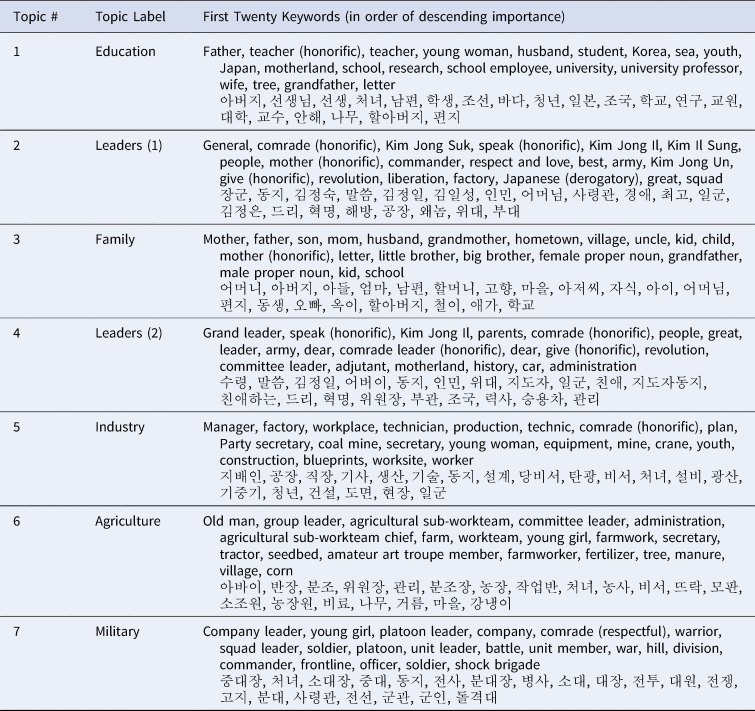
To do so, I compiled a corpus of 1,492 short stories published in the DPRK's main literary journal, Chosŏn Munhak, between January 1977 and December 2016. Short stories are an important element of the North Korean literary field. They are the format through which writers make their literary debut and account for the majority of writers’ early-career output. Senior writers, too, regularly produce short stories for literary magazines or anthologies, even if they have already published several full-length novels. The corpus was obtained from a DVD commercially sold in the DPRK that contains digitized copies of the journal and a reader application.Footnote 12 To break down the corpus by genre, I use topic modeling, a set of algorithmic methods that can help “discover hidden thematic structure in large collections of texts” (Blei Reference Blei2012). Topic modeling generates topics, or clusters of words likely to appear in the same context, without human supervision.Footnote 13 The topics are simply automatically generated collections of related words, as well as their associated probabilities, and it is up to a human interpreter to determine their common underlying themes and give them appropriate labels. Running the algorithm on the corpus produces the seven topics listed in table 1, along with their twenty most representative words.Footnote 14
Topics and their most representative words

The topics generated largely map to genres manually identified in a previous survey of short stories published in Chosŏn Munhak during the 1980s (Choi Reference Choi1994).Footnote 15 They show little overlap, save for topics 2 and 4, which pertain to the DPRK's ruling family and, for the rest of the present analysis, are merged under the label “Leaders” (narratives about each Leader are distinctive enough thematically for the algorithm to group them in separate clusters, but the distinction is of little relevance to our present analysis). It must be noted that topics do not exactly correspond to literary genres per se. In topic modeling, a document is always a mix of different topics. For instance, a short story about a soldier writing to his family about his experience fighting alongside Kim Il Sung might be broken down as being 50 percent “Military,” 30 percent “Leaders,” and 20 percent “Family.” To get from topic to genre, I make the assumption that the topic most prominently represented in a short story is its genre.
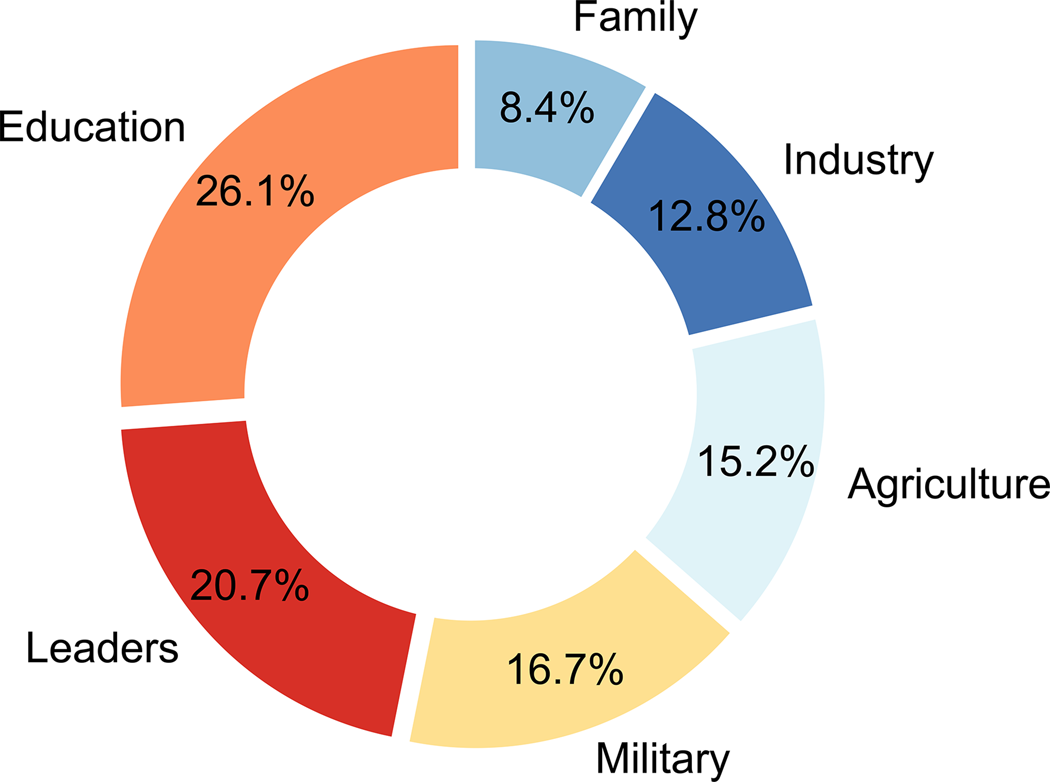
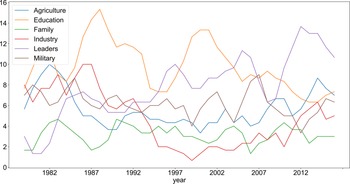
Having thus labeled the topics and assigned a genre to each story, one can plot the proportions of each genre in the corpus (figure 1) as well as their diachronic variations over the period considered (figure 2). This first overview of the corpus confirms some of the intuitions outlined earlier. The 20 percent share of Leader literature highlights the importance of looking at North Korean literature beyond the cult of personality in order to account for the remaining 80 percent of literary production. The most common genre in the corpus, education, is almost entirely absent from academic research on North Korean literature. Such a discrepancy may be explained by the scholarly practice of using North Korean literature as source material for the study of internal and external politics. Stories that can be used to directly illustrate Party directives, agrarian reforms, or military policies seem to gather more scholarly attention than works about learning and studying. This, in turn, reinforces the idea that North Korean literature is predominantly concerned with these themes. On the other hand, the significant changes in generic trends over time underscore the need for historical perspective and proper contextualization. For instance, only a decade after the instauration of Leader literature, the genre was almost dormant, but it regained a dominant share in the last three decades, with pronounced peaks at times of national crises (the famine of the 1990s, the breakdown of the Agreed Framework and economic sanctions in 2002, and the death of Kim Jong Il and transition of power to Kim Jong Un in 2010).
Distribution of genres in the short stories published by Chosŏn Munhak, 1977–2016.

Yearly number of short stories published in Chosŏn Munhak for each genre considered (three-year moving average smoothing).

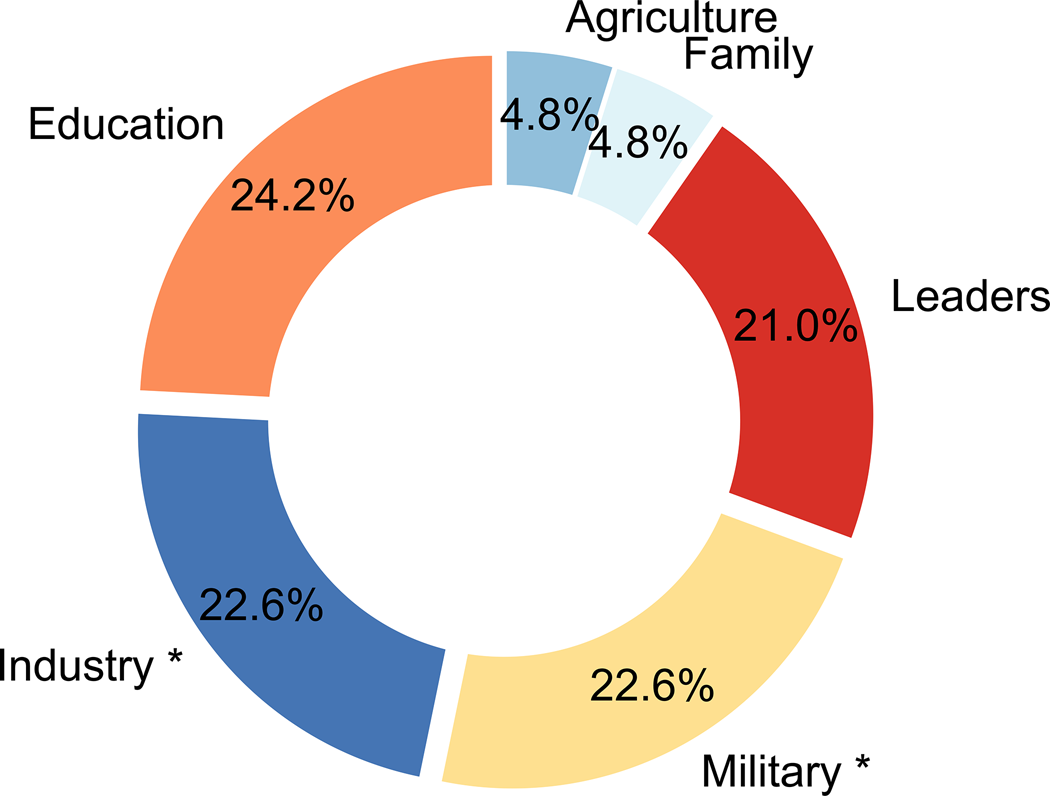
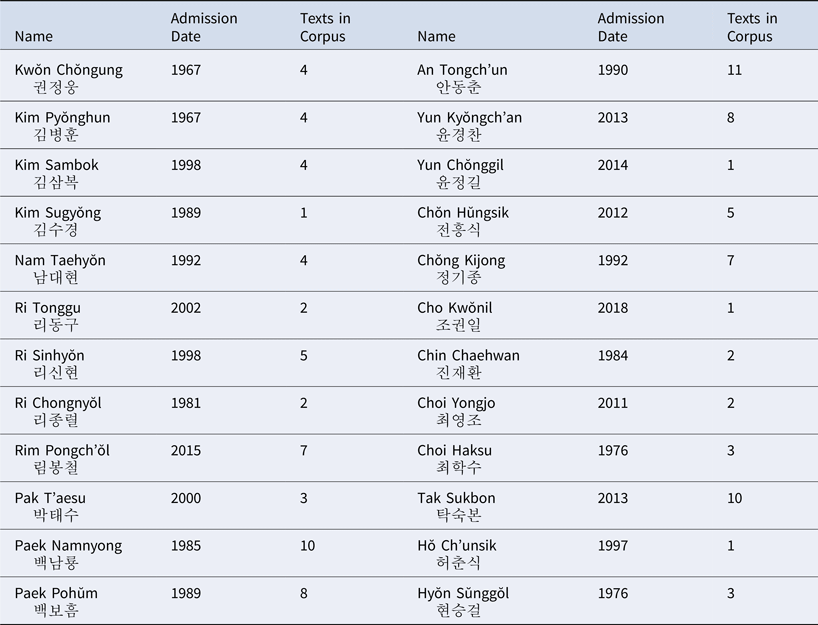
These insights, however, are merely quantitative and do not tell us anything about the different degrees of literary prestige attached to each of the genres. That “Education” is the most commonly represented genre in the corpus may tell us something about its importance to Party officials who set production quotas, but that does not necessarily imply that the genre is particularly highly regarded within the literary field. In order to examine the relationship between genre and prestige specifically, I selected twenty-six authors known to be members of the April 15 LPU (detailed list available in appendix 1) and created a set of the short stories they published “pre-recognition” (i.e., before being admitted to the group; 62 stories), as well as a set of stories published “post-recognition” (46 stories). The goal is to see whether the thematic structure of their literary production evolves before and after they achieve literary recognition and how it compares with that of non-LPU writers.Footnote 16 To make sure these differences are not products of random chance (as the proportion of each topic in the subset of short stories written by recognized authors might actually be within the range of variation that could be expected of any subset of the general corpus), I use a permutation test with a significance level of 90 percent because of the small sample sizes (Bradley and Tibshirani Reference Bradley and Tibshirani1994; Jockers and Mimno Reference Jockers and Mimno2013).
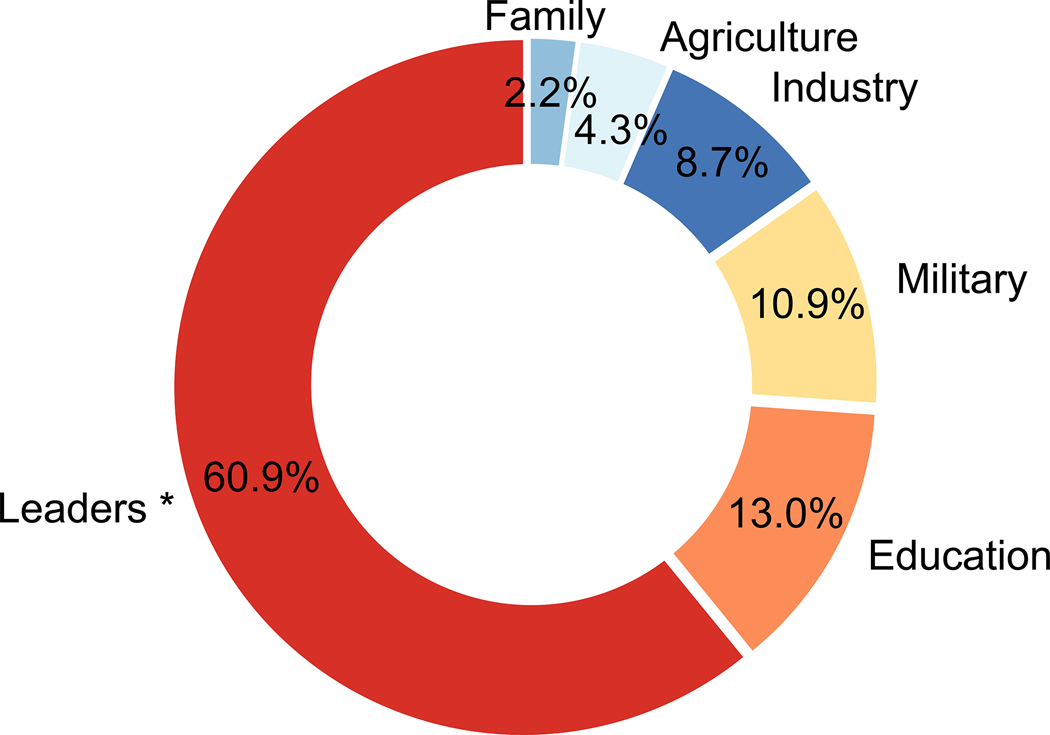
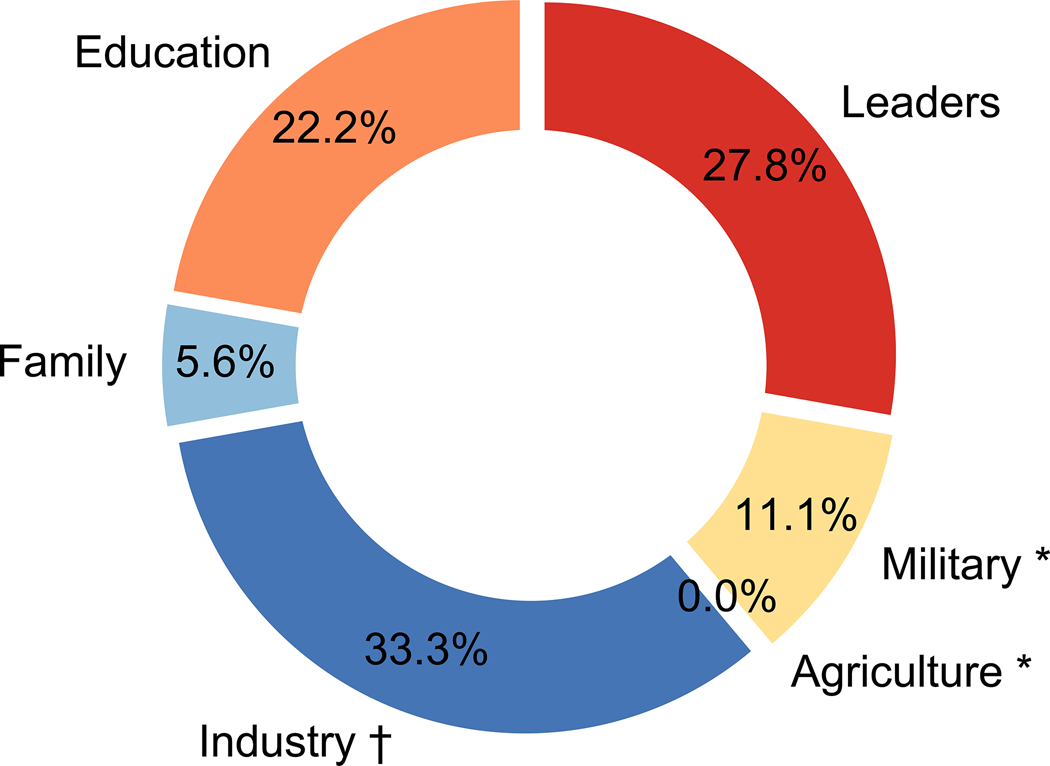
The results are presented in figure 3 for short stories published before the writers’ admission to the LPU and in figure 4 for short stories published afterward. The statistically significant differences are the overrepresentation of Leader literature output post-recognition (after writers joined the April 15 LPU) and the overrepresentation of industrial production stories and military stories pre-recognition. The high prevalence of the “Leaders” topic post-recognition is unsurprising: writers from the April 15 LPU are, after all, in charge of producing the full-length biographic novels of the Immortal series. The data nonetheless show that this duty extends to the form of the short story, and that writers still produce a large amount of works that do not focus on the Kim family after being accepted into the group (about 40 percent of their output). More importantly, this reveals that the writing of works praising the Leaders is more a symptom of literary recognition than a way into it. The proportion of works dedicated to the Leaders is roughly the same for LPU writers pre-recognition than it is for writers overall, meaning that one does not gain recognition by specializing in the production of cult of personality stories. Rather, the specialization comes as a consequence of being a famous writer.
Distribution of genres in short stories of writers from the April 15 LPU before their admission to the group. Statistically significant differences with non-LPU writers are marked with an asterisk.

Distribution of genres for short stories of writers from the April 15 LPU after their admission to the group. Statistically significant differences with non-LPU writers are marked with an asterisk.

On the other hand, the fact that writers who were eventually admitted to the LPU published significantly more stories about the military and the industrial working class indicates that these two genres may be more highly regarded and more likely to lead authors to literary recognition. The valuation of these genres intersects with cultural and ideological hierarchies of class and gender. At least half the writers considered worked on industrial sites or served in the military prior to their literary career. Furthermore, writers from the working class have historically enjoyed more opportunities to start a literary career than agrarian workers or service sector employees. As social groups and professional activities, both the military and the working class have been predominantly gendered as male in textual and visual representations.Footnote 17 The patriarchal structure of North Korean society may thus skew literary capital distribution toward themes that are predominantly male in both their content and authorship (every member of the April 15 LPU analyzed here is male).
These findings, however, lack a diachronic perspective. The oldest members of the April 15 LPU joined upon its creation in 1967, and the most recent member in the data set joined in 2015. While literary standards have been shown to change slowly in other Western contexts (Underwood and Sellers Reference Underwood and Sellers2016), the same can not assumed to hold true in North Korea, where writers’ interconnectedness with politics may put them on a time scale closer to that of a quinquennial plan. To get a sense of this change, I divide the group of prestigious writers into an “old guard” and a “young guard,” based on the date they joined the April 15 LPU. I set the threshold date for the separation between the two groups at 1991, as the end of the Cold War outside the Korean peninsula marked the beginning of a period of radical change for the DPRK (Lankov Reference Lankov2014, 77–111). Like before, only their output prior to their admission to the April 15 LPU is considered.
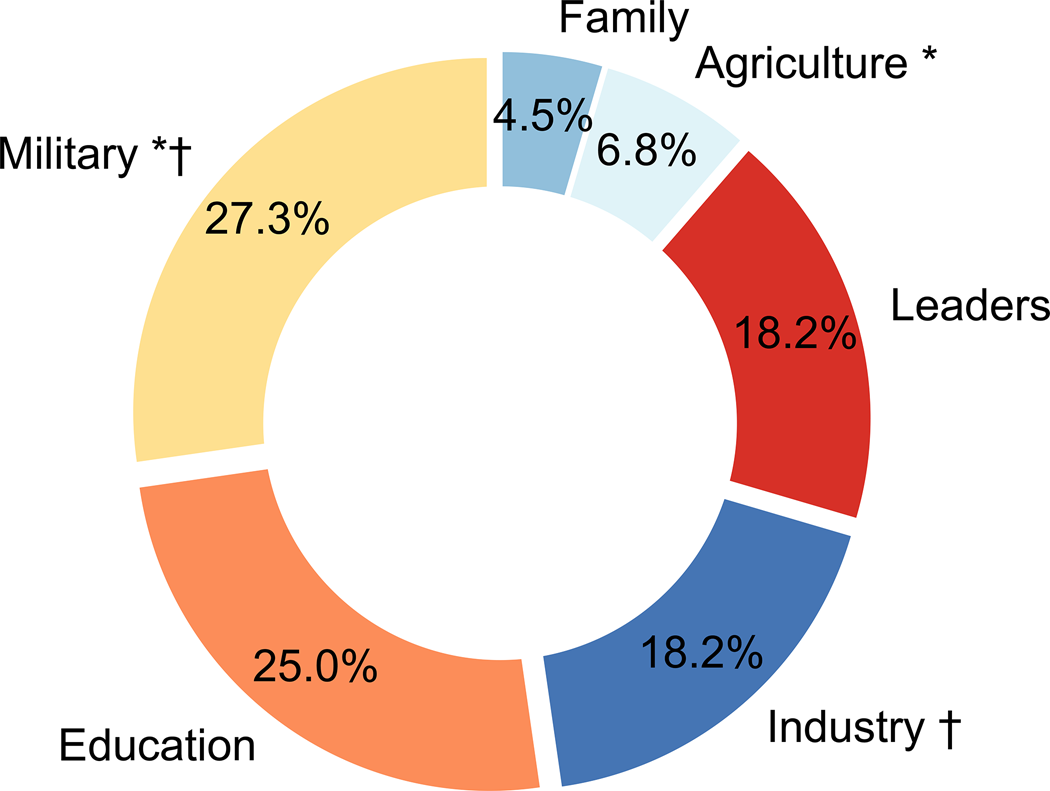
Comparing the two groups (figures 5 and 6), two genres—agrarian and military fiction—show statistically significant differences. While some of the younger generation of elite writers tried their hand at agrarian fiction in their early careers, the genre was completely ignored by the older generation. Both groups still produced less agrarian fiction (although the difference lacks sufficient statistical significance to be considered conclusive) than regular writers, suggesting that the genre could carry less prestige—perhaps a reflection of the traditionally low status accorded to the peasantry in the DPRK.Footnote 18
Distribution of genres in short stories of “old guard” writers before their admission to the LPU (N = 18). Statistically significant differences with the “young guard” are marked with an asterisk. Statistically significant differences with the output of non-LPU writers before 1991 are marked with a cross.

Distribution of genres in short stories of “new guard” writers before their admission to the LPU (N = 44). Statistically significant differences with the “old guard” are marked with an asterisk. Statistically significant differences with the output of non-LPU writers after 1991 are marked with a cross.

The difference in the proportion of military fiction, higher by a factor of two among younger writers, shows the rising value of the genre over the last three decades. Young writers admitted to the April 15 LPU produced significantly more military fiction than writers who never joined the LPU, indicating that more literary prestige is attached to this particular genre. The rise of the military genre can be explained by the advent of “military first” (sŏn'gun 선군) politics in the 1990s. Following the tremendous social, economic, and political upheaval caused by the combined events of the dissolution of the USSR, the death of Kim Il Sung, and the famine, Kim Jong Il ushered in a new ideological line prioritizing defense and the military to ensure the survival of the regime (Smith Reference Smith2015, 235). The new policy made the military a demographically larger and politically crucial social class, eventually supplanting the working class as the “main force of the revolution” (Kim Reference Kim2007, 1).
The declining political weight of the working class seems to be reflected in the decreasing volume of industry-themed short stories from the end of the 1980s onward. Yet despite this quantitative slump, there is still a hysteresis effect in the amount of literary prestige associated with the genre. Indeed, young writers admitted to the April 15 LPU still wrote industrial production stories on a much larger scale than regular writers. While they did write less industrial fiction compared with older members of the April 15 LPU, the difference, although sizable, is not statistically significant,Footnote 19 which makes it impossible to confidently conclude that the stock of the genre may have eroded between the two generations.
That so much of the relationship between literary genre and prestige revolves around social classes raises the question of whether class is really just a confounding variable. As previously noted, most of the April 15 LPU members came from either the working class or the military. And, more generally, because of the realist framework governing literary production in the DPRK, writers tend to produce stories that reflect their social background. As both the military and the working class have historically been politically key social groups in North Korea, the higher prestige conferred to military and industrial fiction in the literary field may simply reflect the privileges enjoyed by these two classes. One might see this as yet more evidence of the heteronomy of the North Korean literary field and its lack of purely literary standards. But social determinations weigh upon all literary fields, even those traditionally considered autonomous, and the brokers of literary value (critics, publishers, or prize committees) that inhabit them. For instance, as Richard Jean So (Reference So2020) has demonstrated, the simple factor of whiteness remains the best predictor of literary success in postwar American literature, despite an allegedly autonomous critical apparatus. What seems more necessary, therefore, is to highlight the institutional, systemic mechanics by which social forms of discrimination are translated into the language of literary standards.
Modeling Stylistic Originality
Literary consecration through admission to the prestigious April 15 LPU comes with a mandate to produce works featuring the Leaders. This task has been described as forcing writers to “sacrifice their creativity as artists” (Immanuel Kim Reference Kim2016) since it imposes a subject matter and requires them to follow specific conventions: ways of describing the Leaders, grandiloquent metaphors, plot conventions, or stock characters. It would then seem that the North Korean literary field operates in a manner that is diametrically opposed to the paradigm of modern Western literature. Whereas in the latter, originality, or the ability to distinguish oneself from the rest, is essential to the logic of aesthetic evaluation (Bourdieu Reference Bourdieu1979), in the former, it appears that quality is determined by conformism to existing writing patterns. This would conform to the characterizations of North Korean literature by foreign readers as boring and repetitive. Yet such a hypothesis cannot be taken at face value without being tested and investigated. That North Korean literature operates according to a different system of literary value does not necessarily imply that this system is a perfect negative image of the modern Western literary valuation system. The importance of conformity, for instance, does not necessarily prevent some creativity from being valued under certain modalities.
That all novels from the Immortal collections share roughly the same theme would certainly make them more homogenous than general literature and its multiple genres. But does this homogeneity extend to style? Are the canonical cult of personality novels of the Immortal collections really less stylistically innovative than the rest of North Korean literary production? As noted previously, Leader literature may represent the pinnacle of literary value, but it is not necessarily what writers are evaluated on before their consecration. To account for this, it is also necessary to consider the literary output of April 15 LPU writers besides their contributions to the Immortal collections and try to infer whether these works, too, exhibit a higher degree of conformity.
To answer these questions, I begin with a formal definition of literary creativity as a deviation from a syntactic or lexical norm. This differential perspective is often used to define literary language in computational research (Louwerse, Benesh, and Zhang Reference Louwerse, Benesh, Zhang and Zyngier2008; Van Cranenburgh, van Dalen-Oskam, and van Zundert Reference Van Cranenburgh, van Dalen-Oskam and van Zundert2019) and formalist theories of literature such as Roman Jakobson's (Reference Jakobson and Sebeok1960) poetic function or the concept of “foregrounding” (Fricke Reference Fricke and Peer2008). Such a definition is limited in that it does not account for narrative aspects of literary singularity, but it still offers a way to model and potentially measure the originality of writing style.
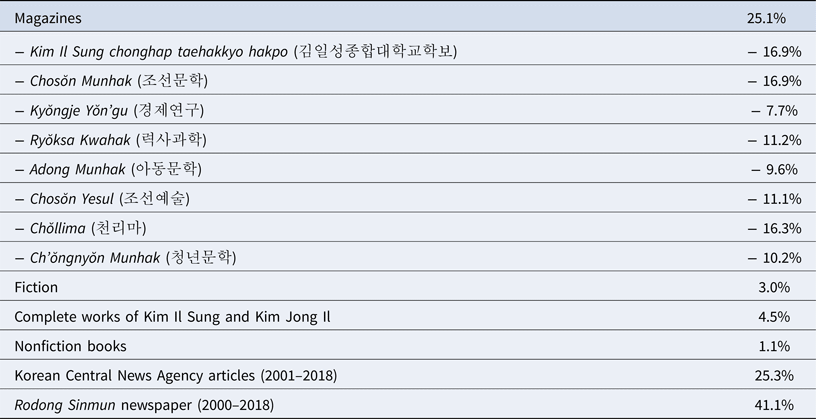
How to measure a text's deviation from linguistic norms? I propose a solution based on a probabilistic way to represent language known as language modeling. Language models are used to predict the probability that a certain word will appear based on the words that precede or (in so-called masked language models) surround it. For instance, a language model can assess that the word “literature” is more likely than the word “car” to follow the sequence of words “I want to read Korean” (Jurafsky and Martin Reference Jurafsky and Martin2019). Likewise, the same language model could tell us that the whole sentence “I want to read Korean literature” is more likely to be said by an English speaker than the sentence “I want to read Korean car.” Traditional language models learn these probabilities by counting the frequencies with which words appear alongside each other within a very large corpus of texts.Footnote 20 These probabilities thus approximate likelihood that a sequence of words will be uttered by an “average” speaker of the language.Footnote 21 For the purposes of the present study, I used the deep-learning-based BERT language model (Devlin et al. Reference Devlin, Chang, Lee and Toutanova2019),Footnote 22 which I trainedFootnote 23 on a corpus of roughly 4.5 million sentences extracted from various North Korean language sources (a general description of the corpus’ content is given in appendix 2).
I posit that language models’ ability to assign probabilities to sequences of words is similar to the concept of a norm against which to measure the deviations of literary language. Indeed, the probabilities returned by a language model line up with a basic model of literary creativity: they reflect lexical sophistication (given two synonyms, the rarer one will receive a lower probability) as well as the unexpectedness of word associations common in literary language. BERT has been shown to capture both semantic and syntactic aspects of language (Clark et al. Reference Clark, Khandelwal, Levy and Manning2019; Jawahar, Sagot, and Seddah Reference Jawahar, Sagot and Seddah2019). One might say, following Jakobson, that its probabilities are computed following paradigmatic (predicting a word over others) and syntagmatic (based on its context) axes, which the poetic function subverts.
To illustrate this premise, let us take a sentence from a North Korean novel with a literary simile: “It was the jewel-like voice of little girls” (처녀아이들의 구슬 같은 목소리였소). A language model can predict the probability of the word “jewel” appearing given the words that surround it (a sort of fill-in-the-blank exercise). Doing so returns a certain probability for the word “jewel,” and that probability will be higher compared with almost all other words in the Korean lexicon. Some words, such as “fire” (불), “storm” (폭풍), or “iron and stone” (철석), would be assigned slightly higher probabilities. This, however, is a feature, not a bug: expressions such as “a voice like iron and stone” or “a voice like fire” are simply more common clichéd similes in North Korean literature. A word producing an original, unique simile, on the other hand, would have be assigned a much lower probability. Instead of simply evaluating a single word, I aggregate the probabilities of different words within a sentence to compute an “originality score” for that sentence.Footnote 24
The advantage of the method is not only that it provides a quantifiable measure of originality, but also that it allows us to avoid the subjectivity and biases that may come with having individual readers evaluate the originality of a sentence. The issue of bias is, of course, all the more complex in the case of North Korean literature, for which North Korean assessors would be hard to find. A reader familiar with South Korean language and culture but unfamiliar with North Korean literature may judge a sentence to be original simply because it is linguistically different from what they are used to. Or, conversely, they could judge a sentence to be overly trite because it sounds more stilted than what is common in South Korean literature. Furthermore, evaluations would differ because of individual proclivities, requiring the use of several readers and a way to aggregate their responses. On the other hand, a large language model acts as a “model reader” that would, thanks to its training corpus, be familiar with the North Korean language, but also with a good portion of its literary output.
Having thus constructed a way to estimate the stylistic originality of a sentence, it is now possible to attempt to score sentences taken from books of different levels of literary prestige to investigate the relationship between literary quality and creativity in the DPRK. To do so, I take three corpora of fiction:
1. Novels taken from the Immortal History (22 titles) and Immortal Guidance (16 titles) collections, hereafter referred to as canonical novels.
2. Novels written by members of the April 15 LPU on themes of their own choosing. These works do not depict the lives of the North Korean Leaders and therefore do not have the same canonical status as works from the Immortal collections. Their symbolic status is nonetheless still different from that of other regular novels due to the prestige of their authors. I will refer to these texts as prestigious novels.
3. Novels published by literary publishing houses in Pyongyang. These works are not of low quality, but their authors have not achieved the same level of recognition as the authors of the two previous corpora. I will refer to these texts as regular novels.
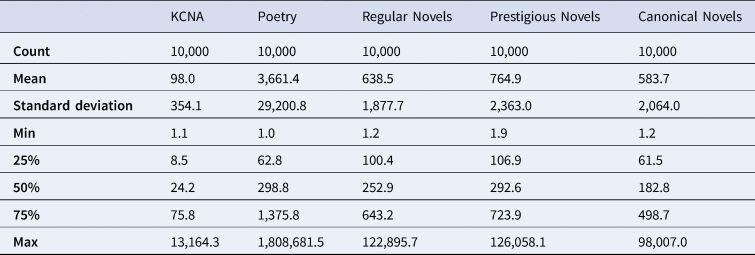
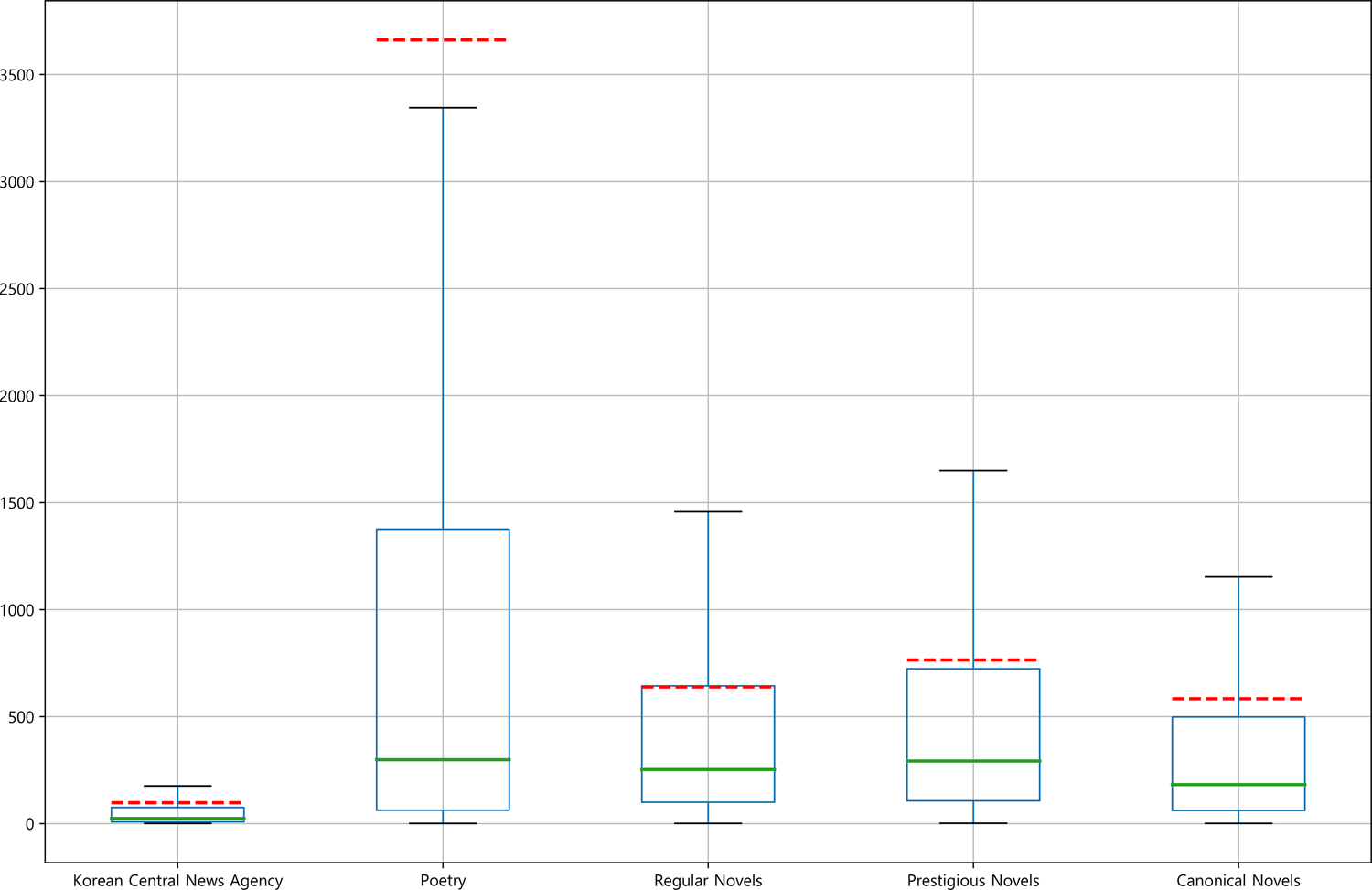
I also include a corpus of poetry and a corpus of articles from the Korean Central News Agency (KCNA) from the year 2000 to provide elements of comparison. None of the data were included in the data set that the language model was trained on. I sample 10,000 sentences from each of these five corpora and give every sentence an originality score. A low score means that the words in a sentence are highly predictable and therefore unoriginal. A high score means a less predictable and more original word choice. The results are given in figure 7 and table 2.Footnote 25
Descriptive statistics for the five corpora

Boxplots of the originality scores for 10,000 sentences from each of the five corpora. The green solid lines are the medians and the red dotted lines the means.

That there would be little literary originality in KCNA articles compared with literary writing might seem unsurprising, but it nonetheless tells us something about literary language in the DPRK. Namely, even if conformity were valued in Leader literature, it is still conformity to literary standards—that is, to a language that differs significantly from the everyday language of a news dispatch. The poetry corpus, on the other hand, displays the highest average level of originality among the four literary corpora. However, one needs to distinguish here between the mean and median. While the mean score of poetry is comparatively extremely high, the median is roughly equal to that of prestigious novels. Furthermore, the 25th percentile of the poetry corpus is lower than two of the fiction corpora. This indicates that while North Korean poetry does have some very original verses, it also contains a large amount of highly predictable ones.
Looking at the fiction corpora, one can see that the writing style of novels from the Immortal collections (canonical novels) is, on average, less original compared with other types of novels. The mean score is only slightly lower than that for regular novels, but the median is much lower and the overall distribution skews more heavily to the left, indicating that the corpus has fewer original sentences and more clichéd expressions. The corpus of prestigious novels, on the other hand, displays a significantly higher level of originality than the two other corpora of fiction. The writers are all members of the April 15 LPU and have published titles in the Immortal collections, but when freed from the stylistic and thematic constraints imposed by the collection, their writing style becomes more creative. These writers are also more creative than regular writers. This could mean that admission to the April 15 LPU is predicated upon literary creativity rather than a propensity to write on the themes favored by the Party. If this were true, the structure of the North Korean literary field might not be so different from that of many other literary cultures where creative avant-gardes eventually petrify into rigid academies (Bourdieu Reference Bourdieu1992). Another possibility, however, is that acceptance into the April 15 LPU gives writers more leeway to experiment, a phenomenon that has previously been observed in the realm of visual arts (De Ceuster Reference De Ceuster and Frank2011).
As almost all of the novels available in the corpus were published after their author's admission to the April 15 LPU, I am unable to test which of these hypotheses might be correct. Nam Taehyŏn's Hymn of Youth (청춘송가) is the only novel in the sample to be published before its author's institutional consecration, but Nam's “bright and light” (Choi Reference Chae-bong2005), plain writing style did not change much after he achieved recognition. Scoring the book individually and comparing it with the score of his later novel Unification Love Song (통일련가), for instance, shows that both works fare low on the originality scale.
Hymn of Youth's low score is a reminder that the present estimation of literary originality is limited to writing style and does not extend to plot, themes, or even context. The book's romantic storyline was considered radically innovative at the time of its publication—but that novelty was about what was being said rather than how it was being said. Likewise, Nam's Unification Love Song scores low despite dealing with the same subject—unconverted long-term North Korean prisoners in the South—as Ri Chongnyŏl's Sons of the Motherland (조국의 아들), the novel with the highest individual originality score in the corpus. Relying on a single feature (style) to judge originality is certainly a limitation but could be augmented as new methods are developed to gauge the predictability of plot (Underwood Reference Underwood2020; Wilmot and Keller Reference Wilmot and Keller2020). There are, of course, other limitations to the present approach. For one, other forms of literary distinctions in the DPRK, such as literary prizes, critical acclaim, or institutional appointments were disregarded. Kim Taesŏng, the author with the highest originality ratings among the writers of “regular novels,” for instance, was chair of the North Korean Writers’ Union—which would suggest that other forms of literary recognition might also correlate with literary originality. Scarcity of data also currently makes deeper analysis at the individual and historical levels impossible, but as digitized North Korean texts become easier to acquire, such limitations could soon be overcome.
Conclusion
The thematic analysis conducted using topic modeling has shown the importance of genre distinctions for the study of the relationship between politics and literary value in North Korea. Writers who received the highest level of literary distinction usually had careers as authors of military or industrial production novels. The relative value attached to each theme shifted over time, depending upon which social class the Party sees at its base. The lower proportion of agricultural short stories in the production of writers who achieved literary consecration might also indicate that the genre does not carry much prestige. There was no other statistically significant relation to literary value for other topics in the sample, but this does not necessarily imply that such other relations are nonexistent. Finally, while politics directly influences the level of prestige achieved by individual authors, it does not preclude the existence of other factors of literary evaluation.
The second part of the article analyzed one such factor, stylistic originality. Using the probabilities returned by a masked language model to estimate how original a sentence's writing is, I find that novels of the Immortal collections are stylistically less creative than other types of fiction. A more surprising finding, however, is that when the authors of these novels write on other topics, they exhibit higher literary originality than their peers. This suggests that originality has a dual status in North Korea. Where the pinnacle of literary value is concerned, conformity is more valued than creativity. But one step below in the literary hierarchy, stylistic originality does correlate with literary recognition. Either because consecrated writers are able to write more freely than their peers or because the state is selecting the most creative writers to produce its cult of personality.
Regardless of the causal direction, this nonetheless shows that creativity is valued in the North Korean literary system, although not necessarily in the same proportions as in other literary systems and in negotiation with political imperatives. Whereas conformity is more important than originality for the production of the most highly valued literary texts that deal with the personality cult of the Leaders, stylistic creativity does act as a distinguishing factor between writers of different prestige levels. The relationship between politics and creativity in the North Korean literary field can thus not simply be reduced to one of opposition. Whether writers accumulate political capital to gain a right to creativity or their literary capital gives them the possibility to accumulate political capital by gaining a monopoly on the production of a specific part of political discourse, what is at stake is a process of arbitrage, negotiation and trade between different forms of capital. It is therefore this fungibility of political and symbolic capitals rather than the antagonism between literature and politics—or between ideological and autonomous writing—that constitutes the core of literary activity in North Korea.
Acknowledgments
The author would like to thank Immanuel Kim, Henry Lydecker, Alex Shaw, Clara Sitbon, Chao Sun, the three anonymous reviewers, and the journal's editors for their help, comments, and corrections on earlier versions of the article. The author also acknowledges the Sydney Informatics Hub and the University of Sydney's high-performance computing cluster, Artemis, for providing the computing resources that contributed to the results reported here.
Author Bio
Benoit Berthelier is Lecturer in the Department of Korean Studies, Faculty of Arts and Social Sciences, at the University of Sydney.
Appendices
The 24 writers from the April 15 LPU used for analyzing the output of canonized writers before and after they achieved recognition

Proportion of the publications in the corpus used for the training of a North Korean BERT. The final corpus corpus is 1.2 gigabytes, containing 4,428,438 sentences and 208,638,834 words. The data were scraped from the web or extracted from electronic books obtained in the DPRK