









1 Introduction
1.1 Motivation: arithmetic of continued fraction expansions
Every positive real number
$\gamma $
 admits a Euclidean continued fraction expansion:

Such an expansion is infinite if and only if
$\gamma $
 is irrational, in which case it is unique. Moreover, this expansion is periodic if and only if
$\gamma $
 is quadratic.
The group
$\operatorname {\mathrm {PGL}}_2(\mathbb {Z})$
 acting faithfully on
$\mathbb {R}\mathbf {P}^1$
 is generated by the inversion
$\gamma \mapsto 1/\gamma $
 and the translation
$\gamma \mapsto \gamma +1$
 . The positive powers of these two transformations generate the submonoid
$\operatorname {\mathrm {PGL}}_2(\mathbb {N})$
 preserving and acting freely on
$(0,\infty )$
 . Two numbers
$\alpha , \beta \in (0,\infty )$
 belong to the same orbit when some tails of their continued fraction expansions
$\alpha _i= \lfloor \,{a_i,\ldots }\,\rfloor $
 and
$\beta _j= \lfloor \,{b_j,\ldots }\,\rfloor $
 coincide. In particular, the set of rationals forms a single orbit and the quadratic irrationals are grouped according to the periodic parts of their expansion. Hence, the action of
$\operatorname {\mathrm {PGL}}_2(\mathbb {N})\subset \operatorname {\mathrm {PGL}}_2(\mathbb {Z})$
 on
$(0,\infty )\subset \mathbb {R}\mathbf {P}^1$
 is well understood, as its orbits correspond to those of the action of the monoid
$\mathbb {N}$
 on
$(0,1)$
 generated by the Gauss map
$\gamma \mapsto \gamma _1$
 that shifts the expansion
$(c_i)\mapsto (c_{i+1})$
 .
The multiplicative action of
$\mathbb {N}_{>0}\subset \mathbb {Z}^*$
 on
$(0,\infty )\subset \mathbb {R}$
 , which is very natural from the arithmetic viewpoint, is much more cryptic from the viewpoint of continued fraction expansions. Various works have studied the evolution of continued fractions under integer multiplication.
Indeed, it has recently been shown in [Reference AkaAka20] (building on work in [Reference Aka and ShapiraAS18]) that for a fixed quadratic irrational
$\gamma $
 , there is an infinite set of primes
$\mathbb {P}_\gamma $
 such that the continued fraction expansions along
$\{q\gamma \colon q \in \mathbb {P}_\gamma \}$
 approach the Gauss–Kuzmin statistics describing those of a random number. Under the generalized Riemann hypothesis, a similar result is shown where
$\mathbb {P}_\gamma $
 is a full density set of primes and even a full density set of natural numbers. Thus, while the continued fraction expansions of
$\gamma $
 and
$q\gamma $
 determine one another, they become de-correlated in the limit. This reveals that the actions of
$\mathbb {N}_{>0}$
 by multiplication and by the Gauss map are somewhat asymptotically decorrelated.
The multiplicative action of
$\mathbb {Q}^*$
 and the action of
$\operatorname {\mathrm {PGL}}_2(\mathbb {Z})$
 on
$\mathbb {R}\mathbf {P}^1$
 generate the action of
$\operatorname {\mathrm {PGL}}_2(\mathbb {Q})$
 . Note that all these actions preserve (the projective line over) each real field
$\mathbb {K} \subset \mathbb {R}$
 , in particular, the rationals, consisting of a single orbit, and each real quadratic field, which partitions into exactly two orbits.
1.2 From continued fractions to Sturmian systems
The diophantine approximation properties of
$\gamma \in (0,1)$
 are encoded by its sequences of continuants
$c_j\in \mathbb {N}_{\ge 1}$
 for
$j\in \mathbb {N}_{>0}$
 and of fractional parts
$q\gamma -\lfloor q\gamma \rfloor \in [0,1)$
 for
$q\in \mathbb {N}_{>0}$
 .
This leads to the dynamical setting: consider the torus
$\mathbb {T} = \mathbb {R}\bmod {\mathbb {Z}}$
 together with the rotation
$R_\gamma \colon \mathbb {T} \to \mathbb {T}$
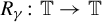 defined by
$t \mapsto t+\gamma \bmod {1}$
 which, under the identification
$\mathbb {T}=[0,1)$
 , implements a piecewise translation on the two intervals
$I_0= [0, 1-\gamma )$
 and
$I_1 = [1-\gamma , 1)$
 . The orbit
$R_\gamma ^q(0)$
 of
$0$
 recovers the fractional parts of
$q\gamma $
 . Recording the sequence of intervals containing the points
$R_{\gamma }^{q}(0)$
 yields the Sturmian sequence
$x_{\gamma } \in \{0,1\}^{\mathbb {Z}}$
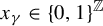 associated to
$\gamma $
 .
Geometrically, the line
 in the Cartesian plane
$\mathbb {R}^2$
 intersects the integral translates of vertical and horizontal coordinate lines according to the bi-infinite sequence
$x_\gamma \in \{0,1\}^{\mathbb {Z}}$
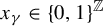 . The generators of the Euclidean monoid
$J\colon \gamma \mapsto 1/\gamma $
 and
$R \colon \gamma \mapsto \gamma +1$
 acting on real numbers
$\gamma \in (0,\infty )$
 lift to an action on words over
$\{0,1\}$
 via the substitutions defined by
$J(0)=1, J(1)=0$
 and
$R(0)=01, R(1)=1$
 , and the sequence
$x_{\gamma } \in \{0,1\}^{\mathbb {Z}}$
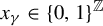 can then be derived from the continued fraction expansion. Conversely, one can recover the continued fraction expansion of
$\gamma $
 using the S-adic expansion of its Sturmian sequence x.
The compact space
$\{0,1\}^{\mathbb {Z}}$
 is endowed with the shift homeomorphism
$\operatorname {\mathrm {\sigma }}(u)_{n} = u_{n+1}$
 , and the closure of the orbit of our Sturmian sequence
$x_{\gamma }$
 gives a subshift
$X_\gamma \subset \{0,1\}^{\mathbb {Z}}$
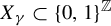 called the Sturmian subshift associated to the parameter
$\gamma $
 . Hence, the one-dimensional dynamical system given by the rotation
$R_\gamma \colon \mathbb {T}\to \mathbb {T}$
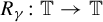 is encoded by the zero-dimensional system given by the Sturmian subshift
$\operatorname {\mathrm {\sigma }}_\gamma \colon X_{\gamma } \to X_{\gamma }$
 .
One connection between the arithmetic of real irrationals and the dynamics of Sturmian systems occurs via the flow equivalence relation. Given a system
$(X,S)$
 , its suspension is the space
$\Sigma _{S}X = (X\times \mathbb {R})\bmod {\mathbb {Z}}$
 where the diagonal action of
$n\in \mathbb {Z}$
 is by
$(x,s)\to (S^n(x), s-n)$
 . The suspension comes with the continuous flow
$\Phi _{s'} \colon (x,s)\mapsto (x, s+s')$
 , and we say two systems
$(X,S)$
 and
$(Y,T)$
 are flow equivalent when there is a homeomorphism between their suspension spaces
$\Sigma _{S} X$
 and
$\Sigma _{T} Y$
 that preserves the leaves of the flow and their orientation induced by the flow.
Our work is motivated by the following correspondences between the arithmetic of real irrationals
$\alpha , \beta \in \mathbb {R}\setminus \mathbb {Q}$
 and the dynamics of their associated Sturmian systems
$(X_\alpha ,\operatorname {\mathrm {\sigma }}_\alpha ), (X_\beta ,\operatorname {\mathrm {\sigma }}_\beta )$
 . First, it is easy to see that
$(X_\alpha ,\operatorname {\mathrm {\sigma }}_\alpha )$
 and
$(X_\beta ,\operatorname {\mathrm {\sigma }}_\beta )$
 are topologically conjugate if and only if
$\alpha = \pm \beta \bmod {\mathbb {Z}}$
 (equal up to sign and
$\mathbb {Z}$
 -addition). Second, Fokkink [Reference FokkinkFok91] showed that
$(X_\alpha ,\operatorname {\mathrm {\sigma }}_\alpha )$
 and
$(X_\beta ,\operatorname {\mathrm {\sigma }}_\beta )$
 are flow equivalent if and only if
$\alpha , \beta $
 are
$\operatorname {\mathrm {PGL}}_{2}(\mathbb {Z})$
 -equivalent (we reprove this in Theorem 4.5 using our modern methods involving states and coinvariants).
In light of this result and the discussions in the previous paragraphs, one of our main motivations is to describe the projective action of
$\operatorname {\mathrm {PGL}}_2(\mathbb {Q})$
 on
$\mathbb {R}\setminus \mathbb {Q}$
 in terms of Sturmian systems.
The action of
$\mathbb {Z}$
 by multiplication on irrationals leads us to consider powers of systems and introduce the notion of infinitesimal 2-asymptotic factors of systems. Indeed, we will see that the Sturmian system
$(X_{m\alpha }, \operatorname {\mathrm {\sigma }}_{m\alpha })$
 is an infinitesimal 2-asymptotic factor of the mth power of the Sturmian system
$(X_\alpha , \operatorname {\mathrm {\sigma }}_\alpha ^m)$
 . However, the mth power
$(X_\alpha , \operatorname {\mathrm {\sigma }}_\alpha ^m)$
 is no longer Sturmian. We are thus naturally led to extend the class of Sturmian systems (particular encodings of rotations on the circle) to the class of Denjoy systems (Cantor extensions of Denjoy homeomorphisms of the circle).
With this motivation in mind, we now introduce a few definitions in more detail to give an account of our main constructions and results, including some applications to the Sturmian, Denjoy, and interval exchange systems (IESs).
Section 2 introduces the main definitions and running examples of dynamical systems, which will be discussed in the applications ending each of the following sections.
1.3 Isogenies between dynamical systems
By a (dynamical) system
$(X,S)$
 , we mean a non-empty compact topological space X together with a homeomorphism
$S \colon X\to X$
 .
For a system
$(X,S)$
 and
$m\in \mathbb {N}_{>0}$
 , its mth power is the system
$(X, S^m)$
 , where as usual,
$S^{m}$
 means S composed with itself m times. Given an equivalence relation
$\mathcal {R}$
 on systems, we say that two systems
$(X,S)$
 and
$(Y,T)$
 are virtually
$\mathcal {R}$
 when there exist
$m,n\in \mathbb {N}_{>0}$
 such that the systems
$(X,S^m)$
 and
$(Y,T^n)$
 are
$\mathcal {R}$
 .
The suspension of a system
$(X,S)$
 consists of its mapping torus
$\Sigma _{S}X = (X\times \mathbb {R})\bmod {\mathbb {Z}}$
 where the diagonal action of
$n\in \mathbb {Z}$
 is by
$(x,s)\to (S^n(x), s-n)$
 , together with the continuous flow
$\Phi _{s'} \colon (x,s)\mapsto (x,s+s')$
 . Two systems
$(X,S)$
 and
$(Y,T)$
 are called flow equivalent when their suspension spaces
$\Sigma _{S} X$
 and
$\Sigma _{T} Y$
 are homeomorphic by a homeomorphism respecting the orientation induced by the flow.
We must finally introduce the notion of infinitesimal 2-asymptotic (2-AI) factor and the corresponding infinitesimal 2-asymptotic (2-AI) equivalence relation. This requires a lengthy and technical discussion involving the group of coinvariants of a system (§3) and the index map of a 2-asymptotic factor (§5), so we take it as a black box for this introduction. Let us just mention one useful characterization that we prove in Corollary 5.10. To a zero-dimensional system
$(X,S)$
 is associated a unital ordered group of coinvariants
${\mathcal {G}}_S$
 , and each invariant Borel probability measure
$\mu $
 on the system defines a state on that group
$\tau _{\mu }\colon {\mathcal {G}}_S \to \mathbb {R}_{\ge 0}$
 given by integration against that measure. For uniquely ergodic minimal Cantor systems, the existence of a 2-AI factor map between the systems implies that the images in
$\mathbb {R}$
 of their respective states coincide after tensoring with the rationals. Moreover, for such systems, if the rational images of the states coincide, then every 2-asymptotic factor map between them must be infinitesimal.
Thus, 2-AI equivalence is imposed on us after considering powers of systems (as in virtual topological conjugacy). Indeed, we prove in Corollary 5.21 that the Sturmian system
$(X_{m\alpha }, \operatorname {\mathrm {\sigma }}_{m\alpha })$
 and the Denjoy system
$(X_\alpha , \operatorname {\mathrm {\sigma }}_\alpha ^m)$
 are 2-AI equivalent.
We are now ready to formulate one of the main definitions in this work (Definition 6.2).
Definition 1.1. (Isogeny)
We say that two systems are isogenous when they are related by a sequence of virtual flow equivalences and 2-AI equivalences.
One of our first main results (Theorem 6.6) characterizes the action of
$\operatorname {\mathrm {PGL}}_{2}(\mathbb {Q})$
 on
$\mathbb {R} \setminus \mathbb {Q}$
 in terms of isogeny of Sturmian systems.
Theorem 1.2. (Isogenies of Sturmian systems)
The following are equivalent.
-
• The points $\alpha ,\beta \in \mathbb {R}\mathbf {P}^1\setminus \mathbb {Q}\mathbf {P}^1$
 belong to the same
$\operatorname {\mathrm {PGL}}_{2}(\mathbb {Q})$
-orbit.
-
• The Sturmian subshifts $(X_{\alpha },\operatorname {\mathrm {\sigma }}_{\alpha })$
,
$(X_{\beta },\operatorname {\mathrm {\sigma }}_{\beta })$
are isogenous.



Our methods also enable us to characterize isogenies within the class of Denjoy systems, which generalize Sturmian systems according to the following construction. A homeomorphism of the circle
$F\colon \mathbb {T} \to \mathbb {T}$
 with irrational rotation number
$\alpha $
 that is not conjugate to the rotation
$R_\alpha $
 is uniquely characterized up to topological conjugacy by its action on its unique minimal set
${\mathcal {D}}_F$
 , which is a Cantor set. The restriction of F to
$\mathcal {D}_{F}$
 yields a Denjoy system
$({\mathcal {D}}_{F}, F)$
 that is characterized up to conjugacy by its invariants: the rotation number
$\alpha $
 and a countable set of points
$A\subset \mathbb {T}$
 (see §2.3).
We now state the characterization of Denjoy systems up to isogeny achieved in Theorem 6.8.
Theorem 1.3. (Isogenies of Denjoy systems)
For
$k \in \{0,1\}$
 , consider Denjoy systems
$({\mathcal {D}}_{F_k}, F_k)$
 with invariants
$(\alpha _k, A_k)$
 .
-
(1) If there exists $M= (m_{ij}) \in \operatorname {\mathrm {PGL}}_2(\mathbb {Q})$
such that $$ \begin{align*} \alpha_1 = \frac{m_{11}\cdot\alpha_0+m_{12}}{m_{21}\cdot\alpha_0+m_{22}} \quad \text{and} \quad \mathbb{Q} A_1 \equiv \frac{1}{m_{21}\cdot\alpha_0+m_{22}} \cdot \mathbb{Q} A_0, \end{align*} $$then the Denjoy systems $({\mathcal {D}}_{F_k}, F_k)$
are isogenous.
-
(2) If the Denjoy systems are isogenous through a chain of Denjoy systems, then there exists $M= (m_{ij}) \in \operatorname {\mathrm {PGL}}_2(\mathbb {Q})$
such that $$ \begin{align*} \alpha_1 = \frac{m_{11}\cdot\alpha_0+m_{12}}{m_{21}\cdot\alpha_0+m_{22}} \quad \text{and} \quad \mathbb{Q} A_1 \equiv \frac{1}{m_{21}\cdot\alpha_0+m_{22}} \cdot \mathbb{Q} A_0. \end{align*} $$





1.4 Generalizations to interval exchange systems
We also discuss interval exchange systems (symbolic encodings of interval exchange transformations, abbreviated IETs), which also generalize Sturmian systems (encoding irrational rotations). More precisely, an IES on d symbols is a subshift obtained from the canonical encoding of an IET on d intervals. Given an IES
$(X,\operatorname {\mathrm {\sigma }})$
 , its ergodic probability measures correspond (via length of segments) to the IETs
$T\colon (0,1]\to (0,1]$
 with that encoding.
We focus on those that generalize irrational rotations, namely the IETs satisfying Keane’s infinite distinct orbits (ido) condition. This is equivalent to saying that the associated IES has complexity
$n\mapsto (d-1)n+1$
 , and also to the fact that it is infinitely many times renormalizable via Rauzy–Veech induction (the analog of continued fraction expansions).
We prove an analog to Fokkink’s theorem characterizing flow equivalence of IES in terms of two-sided Rauzy induction 4.9. We describe 2-A factors of IES in §5.5, by providing a preferred representative (related to the minimal models in [Reference DahmaniDah19, §2.1]).
For an IES
$(X,\operatorname {\mathrm {\sigma }})$
 , its invariant measures correspond to the IETs
$T\colon (\alpha _0,\alpha _d]\to (\alpha _0,\alpha _d]$
 with that symbolic encoding, which form a cone in
$\mathbb {R}_+^d$
 . Let us recall that the IETs form a group under composition. Arnoux and Fathi introduced a surjective homomorphism
$\mathrm {SAF}\colon \mathrm {IET}\to \mathbb {R}\wedge _{\mathbb {Q}} \mathbb {R}$
 , which is a kind of scissor-congruence invariant: they showed that it is invariant by inducing IETs on smaller intervals (see [Reference VeechVee84a, Proposition 2.3]). Then, Sah showed that
$\mathrm {SAF}\colon \mathrm {IET}\to \mathbb {R}\wedge _{\mathbb {Q}} \mathbb {R}$
 corresponds to the abelianization (see [Reference VeechVee84b, Theorem 1.3]).
Definition 1.4. (Rational invariants)
Consider an IES
$(X,\operatorname {\mathrm {\sigma }})$
 with ido and let
$\mu _1,\ldots ,\mu _e$
 be its
$e\in \mathbb {N}_{>0}$
 ergodic probability measures. Each
$\mu _i$
 corresponds to an IET
$T_{\mu _i}\colon (0,1]\mapsto (0,1]$
 with that encoding, to which we associate the
$\mathbb {Q}$
 -vector space
$\mathbb {Q}\otimes \operatorname {\mathrm {im}}(\tau _{\mu _i})\subset \mathbb {R}$
 of dimension at most
$d-1$
 generated by the
$\mu _i$
 -measures of cylinders in X, and the vector
$\mathrm {SAF}(T_{\mu _i})\in \mathbb {R}\wedge _{\mathbb {Q}} \mathbb {R}$
 .
We define the rational invariants of
$(X,\operatorname {\mathrm {\sigma }})$
 as the product of subspaces
$\prod _i \mathbb {Q}\otimes \operatorname {\mathrm {im}}(\tau _{\mu _i})\subset \mathbb {R}^e$
 up to multiplication by
$\unicode{x3bb} \in \mathbb {R}_{>0}$
 on
$\mathbb {R}^e$
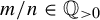
 together with the product of vectors
$\prod _i \mathrm {SAF}(T_{\mu _i})\in (\mathbb {R}\wedge _{\mathbb {Q}} \mathbb {R})^e$
 up to multiplication by
$m/n\in \mathbb {Q}_{>0}$
 .
We propose the following Conjecture 6.10.
Conjecture 1.5. (Rational invariants of isogenies)
If two IES with ido are isogenous, then they have the same rational invariants.
We prove this conjecture in the totally ergodic case for isogenies staying within the class of IESs, in Proposition 6.11.
Proposition 1.6. (Isogenous totally ergodic IES have same rational invariants)
If totally ergodic IES with ido are related by isogenies through IES, then they have the same rational invariants.
We will see in Corollary 6.12 that this proposition applies to IES with ido that are linearly recurrent, in particular (Corollary 6.14), to those that are self-induced, and hence (Corollary 6.17), to the minimal IES with lengths in a quadratic field (characterized by [Reference Boshernitzan and CarrollBC97] as satisfying the generalization of Lagrange’s theorem on the periodicity of continued fractions).
Self-induced minimal IES are precisely those arising from the stable laminations of pseudo-Anosov automorphisms of translation surfaces: the isogeny relation thus yields an equivalence relation between such pseudo-Anosov automorphisms that we believe is worth studying. In particular, we propose Conjecture 6.18 relating isogenies of minimal self-induced IES and commensurators of their Veech groups (the automorphism groups of their underlying translation surfaces in
$\operatorname {\mathrm {PSL}}_2(\mathbb {R})$
 ), supported by the fact that isogenies preserve their rational invariants.
Let us conclude the discussion on isogenies with Table 1 summarizing the classification results achieved in this work. The notion of isogeny arose from our questions about Sturmian systems and
$\operatorname {\mathrm {PGL}}_2(\mathbb {Q})$
 equivalence, for which we achieved the desired classification results. We extended this classification to Denjoy systems and certain IES using rational invariants, in restriction to isogenies that remain in this class. To understand the structure of isogenies in general (not restricted to a certain class of systems), we were led to ask Questions 6.20 and 6.21.
Summary of the classification results toward isogeny.

Table 1 Long description
The table consists of four columns and five primary data rows.
Column headers:
1. Equivalence.
2. Sturmian: alpha in T.
3. Denjoy: alpha in A subset of T.
4. I E S with i d o.
Row 1: Conjugacy.
- Sturmian: plus or minus alpha b mod Z (Lemma 7.5).
- Denjoy: plus or minus (alpha, A) b mod Z (Markley: Section 2.3).
- I E S with i d o: Question marks.
Row 2: Flow.
- Sturmian: P G L sub 2 (Z) dot alpha (Theorem 4.5).
- Denjoy: P G L sub 2 (Z) dot (alpha, A) (Theorem 4.7).
- I E S with i d o: Rauzy tail (Theorem 4.9).
Row 3: Virtual 2-A I.
- Sturmian: Q dot alpha b mod Z (Corollaries 5.20 and 5.21).
- Denjoy: (Q alpha, Q A) b mod Z (Corollaries 5.20 and 5.21).
- I E S with i d o: Question marks.
Row 4: Isogeny (preserving type).
- Sturmian: P G L sub 2 (Q) dot alpha (Theorem 6.6).
- Denjoy: P G L sub 2 (Q) dot (alpha, A) (Theorem 6.8).
- I E S with i d o: Q-invariants (Conjecture 6.10 and Proposition 6.11).
1.5 Eventual flow equivalence
Given an equivalence relation
$\mathcal {R}$
 on systems, we say that two systems
$(X,S)$
 and
$(Y,T)$
 are eventually
$\mathcal {R}$
 if for all but finitely many
$n \in \mathbb {N}$
 , the systems
$(X,S^{n})$
 and
$(Y,T^{n})$
 are
$\mathcal {R}$
 -equivalent. In general, we have the following implications:

The notion of eventual topological conjugacy and its connection with shift equivalence of non-negative square matrices lies at the heart of Williams’ problem and the classification of shifts of finite type (as explained in the survey [Reference Boyle and SchmiedingBS24]). Furthermore, for shifts of finite type, the relation between eventual topological conjugacy and flow equivalence had been studied in [Reference BoyleBoy00], and has recently been reexamined in [Reference BoyleBoy26], where it was shown that eventual conjugacy implies flow equivalence.
We focus on eventual flow equivalence, and show that it implies topological conjugacy for Sturmian systems (Theorem 7.24) and Denjoy systems (Theorem 7.32).
Theorem 1.7. (Eventual flow equivalence for Sturmian systems)
Two Sturmian systems are eventually flow equivalent if and only if they are topologically conjugate.
Theorem 1.8. (Eventual flow equivalence for Denjoy systems)
Two Denjoy systems are eventually flow equivalent if and only if they are topologically conjugate.
It follows from the previous theorem that even for Sturmian subshifts, flow equivalence does not imply eventual flow equivalence. This provides another motivation to study our notion of isogeny. We also give some examples (Examples 7.26, 7.27) of Sturmian subshifts that are not flow equivalent, but have powers that are flow equivalent.
The following diagrams summarize the various implications between virtual and eventual equivalencies (topological conjugacy and flow) that we obtain for Sturmian systems (§7.2) and Denjoy systems (§7.3).


In contrast, Mike Boyle communicated to us that among shifts of finite type, there exist pairs that are eventually flow equivalent but not eventually conjugate (hence, not topologically conjugate), and pairs that are flow equivalent but not eventually flow equivalent (see Theorem 7.3).
Question 1.9. (From eventual flow equivalence to flow equivalence or topological conjugacy)
In which classes of systems does eventual flow equivalence imply topological conjugacy? In which classes of systems does eventual flow equivalence imply flow equivalence?
It may be that eventual flow equivalence implies topological conjugacy among large classes of minimal systems, but the proof would require a deeper understanding of topological invariants under flow equivalence and powers, which would have to subsume the difficulties of the self-induced Sturmian case (see proof of Theorem 7.15 as well as Example 7.17 and Question 7.18). Indeed, our characterizations of eventual flow equivalence for Sturmian and Denjoy systems rely on our Theorem 7.15, a novel arithmetic result that we believe is of independent interest.
Theorem 1.10. (Eventual
$\operatorname {\mathrm {PGL}}_2(\mathbb {Z})$
-equivalence)

Consider
$\alpha ,\beta \in \mathbb {R}\setminus \mathbb {Q}$
 . If for all but finitely many prime integers
$n\in \mathbb {P}$
 the numbers
$n\alpha ,n\beta $
 are
$\operatorname {\mathrm {PGL}}_2(\mathbb {Z})$
 -equivalent, then
$\alpha \equiv \pm \beta \bmod {\mathbb {Z}}$
 .
Let us mention the following Question 7.18, hinting at the arithmetic subtleties of eventual
$\operatorname {\mathrm {PGL}}_2(\mathbb {Z})$
 equivalence.
Question 1.11. (
$\mathbb {N}'$
-virtual
$\operatorname {\mathrm {PGL}}_2(\mathbb {Z})$
-equivalence)


For a subset of
$\mathbb {N}' \subset \mathbb {N}$
 , say that
$\alpha ,\beta $
 are
$\mathbb {N}'$
 -virtually
$\operatorname {\mathrm {PGL}}_2(\mathbb {Z})$
 -equivalent when for all
$n\in \mathbb {N}'$
 , the numbers
$n\alpha ,n\beta $
 are
$\operatorname {\mathrm {PGL}}_2(\mathbb {Z})$
 -equivalent.
For which subsets
$\mathbb {N}'$
 does
$\mathbb {N}'$
 -virtual
$\operatorname {\mathrm {PGL}}_2(\mathbb {Z})$
 -equivalence imply
$\operatorname {\mathrm {PGL}}_2(\mathbb {Z})$
 -equivalence, or further equality up to sign and addition by an integer?
Theorem 7.15 replies both positively when
$\mathbb {N}'$
 is a subset of primes of full Dirichlet density, while Example 7.17 shows that both are false when
$\mathbb {N}'$
 consists of the powers of a single prime.
We believe that it is false if
$\mathbb {N}'$
 is a finite subset of primes (Example 7.17 suggests a constructive way to prove this), but what if
$\mathbb {N}'$
 is a subset of primes of positive Dirichlet density?
2 Background
A system
$(X,S)$
 is a non-empty compact metric space X with a homeomorphism
$S \colon X\to X$
 . A morphism of systems is a continuous map
$\pi \colon (X,S) \to (Y,T)$
 such that
$\pi S = T \pi $
 , and it is called a factor when it is surjective. We say
$(X,S)$
 and
$(Y,T)$
 are semi-conjugate if there exists a factor
$\pi \colon (X,S) \to (Y,T)$
 .
A system
$(X,S)$
 is minimal when its only closed S-invariant subsets are
$\emptyset $
 and X, or equivalently, when every S-orbit is dense. A system
$(X,S)$
 is called a Cantor system when X is a Cantor space and is called a zero-dimensional system when X is zero-dimensional.
For a system
$(X,S)$
 , we let
$\mathcal {M}(X,S)$
 denote the space of finite Borel S-invariant measures on X, and
$\mathcal {M}_{p}(X,S) \subset \mathcal {M}(X,S)$
 the subspace of probability measures.
A system
$(X,S)$
 is uniquely ergodic when there is a unique Borel probability measure on X that is S-invariant.
For a property
$\mathtt {P}$
 of systems, a system
$(X,T)$
 is totally
$\mathtt {P}$
 when the system
$(X,T^{n})$
 has property
$\mathtt {P}$
 for every
$n \in \mathbb {N}$
 .
2.1 Subshifts
Fix a finite set
$\mathcal {A}$
 of cardinality
$|{\mathcal {A}}| \in \mathbb {N}_{>1}$
 called the alphabet and let
$\mathcal {A}^{\star }=\bigcup _{n=1}^{\infty } \mathcal {A}^n$
 be the set of finite words over
$\mathcal {A}$
 . The set of bi-infinite sequences
$\mathcal {A}^{\mathbb {Z}}$
 with the product topology is a compact space. A basis of neighborhoods for the topology is given by the clopen sets
$\mathrm {Cyl}_k(w)= \{x\in \mathcal {A}^{\mathbb {Z}} \colon x_{[k,k+n-1]}=w\}$
 for
$k \in \mathbb {Z}$
 and
$w\in \mathcal {A}^n$
 . It is metrized by

The shift
$\operatorname {\mathrm {\sigma }} \colon \mathcal {A}^{\mathbb {Z}} \to \mathcal {A}^{\mathbb {Z}}$
 defined by
$\operatorname {\mathrm {\sigma }}(x)_{n} = x_{n+1}$
 is a homeomorphism.
A subsystem
$(X,\operatorname {\mathrm {\sigma }})$
 of
$(\mathcal {A}^{\mathbb {Z}}, \operatorname {\mathrm {\sigma }})$
 is called a subshift on
$|{\mathcal {A}}|$
 symbols. A word
$w\in \mathcal {A}^{\star }$
 is a subword of
$x\in X$
 when there exists
$k\in \mathbb {Z}$
 such that
$x\in \mathrm {Cyl}_k(w)$
 . The language of
$(X,\operatorname {\mathrm {\sigma }})$
 is the set
$\mathcal {A}^{\star }_X \subset \mathcal {A}^{\star }$
 of all subwords of all elements. There is an equivalence between subshifts of
$(\mathcal {A}, \operatorname {\mathrm {\sigma }})$
 and languages in
$\mathcal {A}^\star $
 that are factorial (closed by taking subwords) and extendable (every word is a proper subword of some other word). The factor complexity of
$(X,\operatorname {\mathrm {\sigma }})$
 is the function
$C_X\colon \mathbb {N}\to \mathbb {N}$
 defined by
$C_X(n)=|{\mathcal {A}^{\star }_X \cap \mathcal {A}^n}|$
 .
The subshift
$(X,\operatorname {\mathrm {\sigma }})$
 is called uniformly recurrent if for every
$x\in X$
 , every word in
$\mathcal {A}^\star _X$
 occurs in the sequence
$\operatorname {\mathrm {\sigma }}^k(x)$
 infinitely often and with bounded gaps. This is equivalent to the minimality of
$(X,\operatorname {\mathrm {\sigma }})$
 .
The subshift
$(X,S)$
 has a recurrence function
$R_X\colon \mathbb {N}\to \mathbb {N}$
 that to
$n\in \mathbb {N}$
 , associates the minimum
$R(n)$
 of the integers
$r\in \mathbb {N}$
 such that every word in
$\mathcal {A}^r_X$
 contains every word in
$\mathcal {A}^n_X$
 . One may show (see [Reference Berthé and DelecroixBD14, Theorem 2.3]) that
$C_X\le R_X$
 .
A subshift
$(X,S)$
 is called linearly recurrent when there exists
$C\in \mathbb {R}_{>0}$
 such that for all
$n\in \mathbb {N}$
 , we have
$R_X(n)\le Cn$
 . Linear recurrence implies uniform recurrence (equivalently minimality), sublinear factor complexity (as
$C_X\le R_X$
 ), and unique ergodicity (this is [Reference Berthé and DelecroixBD14, Theorem 2.5], which refers to [Reference Durand, Host and SkauDHS99]).
Let us recall a criterion due to Boshernitzan for linear recurrence of minimal subshifts (see [Reference DelecroixDel15, Theorem 21] for a proof). For a subshift
$(X, \operatorname {\mathrm {\sigma }})$
 with an invariant probability measure
$\mu \in \mathcal {M}_{p}(X,\operatorname {\mathrm {\sigma }})$
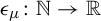
 , define the function
$\epsilon _\mu \colon \mathbb {N}\to \mathbb {R}$
 by
$\epsilon _\mu (n)=\min \{\mu (\mathrm {Cyl}_0(w)\cap X) \colon w \in \mathcal {A}^n_X \}$
 (the minimal measure of cylinders of width n). The minimal subshift
$(X,\operatorname {\mathrm {\sigma }})$
 is linearly recurrent if and only if any
$\mu \in \mathcal {M}_{p}(X,\operatorname {\mathrm {\sigma }})$
 satisfies
$\inf n\epsilon _\mu (n)>0$
 . It follows that if a subshift is totally minimal and linearly recurrent, then it is totally linearly recurrent; hence, totally uniquely ergodic.
Let us finally mention that the notions of uniform recurrence and linear recurrence can be characterized in terms of S-adic representations (see [Reference Berthé and DelecroixBD14, §5]). In particular, it is shown in [Reference DurandDur98] that a subshift is linearly recurrent if and only if it is a strongly primitive and proper S-adic subshift.
2.2 Rotations and Sturmian systems
On the circle
$\mathbb {T}=\mathbb {R}\bmod {\mathbb {Z}}$
 , let
$R_\alpha \colon \mathbb {T} \to \mathbb {T}$
 denote the rotation by
$\alpha \in \mathbb {T}$
 . If
$\alpha $
 is rational, then
$R_\alpha $
 is periodic. If
$\alpha $
 is irrational, then
$(\mathbb {T}, R_\alpha )$
 is minimal and uniquely ergodic, with Lebesgue measure on
$\mathbb {T}$
 the unique invariant probability measure.
For an irrational
$\alpha \in \mathbb {T}$
 , we define the Sturmian system
$(X_\alpha , \operatorname {\mathrm {\sigma }}_\alpha )$
 as the simplest symbolic encoding of
$R_\alpha $
 , that is, a subshift on two symbols that factors onto
$(\mathbb {T}, R_\alpha )$
 . For this, we construct a point
$x \in \{0,1\}^{\mathbb {Z}}$
 by

and let
$X_{\alpha }$
 be the closure of the
$\operatorname {\mathrm {\sigma }}$
 -orbit of x in
$\{0,1\}^{\mathbb {Z}}$
 .
The language of
$X_{\alpha }$
 has complexity
$C_{X_\alpha }(n) = n+1$
 (which is the smallest possible among aperiodic sequences, by Morse and Hedlund [Reference Morse and HedlundMH40]). Conversely, every recurrent subshift of complexity
$C_{X}(n) = n+1$
 is obtained by the previous construction for a unique
$\alpha \in \mathbb {T}$
 .
It is well known [Reference Pytheas Fogg, Berthé, Ferenczi, Mauduit and SiegelFog02] that for irrational
$\alpha \in \mathbb {T}$
 , the system
$(X_{\alpha },\operatorname {\mathrm {\sigma }}_{\alpha })$
 is minimal and uniquely ergodic.
The irrational
$\alpha \in \mathbb {R}\setminus \mathbb {Q}$
 has a unique Euclidean continued fraction expansion:

Thus, it is the fixed point of the infinite product of matrices
$R^{a_0}L^{a_1}\cdots $
 where

act by linear fractional transformations on
$\mathbb {R}\mathbf {P}^1$
 .
Such a sequence can be generated from any seed by applying its S-adic representation, which is determined by the continued fraction expansion of
$\alpha $
 (see [Reference Schmieding and SimonSS24]).
2.3 Homeomorphisms of the circle and Denjoy systems
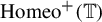
Let us briefly recall, following [Reference Putnam, Schmidt and SkauPSS86], the main results of Poincaré [Reference PoincaréPoi85] concerning homeomorphisms of the circle and their rotation numbers, and of Markley [Reference MarkleyMar70] describing the invariants for conjugacy classes in
$\operatorname {\mathrm {Homeo}}^+(\mathbb {T})$
 of Denjoy homeomorphisms.
Let
$F\in \operatorname {\mathrm {Homeo}}^+(\mathbb {T})$
 be an orientation preserving homeomorphism of the circle. Choose a lift to the universal cover
$\tilde {F}\colon \mathbb {R}\to \mathbb {R}$
 : it is determined by
$\lfloor \tilde {F}(0)\rfloor \in \mathbb {Z}$
 as any two lifts differ by an integer. There exists
$\tau (\tilde {F}) \in \mathbb {R}$
 such that for all
$x\in \mathbb {R}$
 , we have
$({1}/{n})({F}^n(x)-x)\to \tau (\tilde {F})$
 , and the value
$\tau (\tilde {F}) \in \mathbb {R}\bmod {\mathbb {Z}}$
 does not depend on the lift: it is called the rotation number of F and denoted
$\rho (F)\in \mathbb {T}$
 .
The rotation number
$\rho \colon \operatorname {\mathrm {Homeo}}^+(\mathbb {T})\to \mathbb {T}$
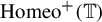
 is invariant by conjugacy in
$\operatorname {\mathrm {Homeo}}^+(\mathbb {T})$
 . More generally, if
$F_1, F_2\in \operatorname {\mathrm {Homeo}}^+(\mathbb {T})$
 and there exists a continuous surjective map
$H\colon \mathbb {T}\to \mathbb {T}$
 satisfying
$HF_{1} = F_{2}H$
 , then
$\rho (F_1)=\pm \rho (F_2)$
 , where the sign depends on the orientation preserving or reversing behavior of H. Moreover, for all
$n\in \mathbb {Z}$
 , we have
$\rho (F^n)=n\rho (F)$
 .
If
$\rho (F)$
 is rational, then F has a periodic point and F is conjugate to
$R_{\rho (F)}$
 . If
$\rho (F)$
 is irrational, then every point
$x\in \mathbb {T}$
 has an orbit
$\{F^n(x)\colon n\in \mathbb {Z}\}$
 with the same cyclic order structure as
$\{n \cdot \rho (F)\colon n\in \mathbb {Z}\}$
 ; hence, F is semi-conjugate to
$R_{\rho (F)}$
 by a map
$H\colon \mathbb {T} \to \mathbb {T}$
 that is unique up to post-composing by a rotation.
We say that F is a Denjoy homeomorphism when it is semi-conjugate but not conjugate to
$R_{\rho (F)}$
 , that is, when
$\rho (F)$
 is irrational and the semi-conjugacy
$H\colon \mathbb {T} \to \mathbb {T}$
 is not a homeomorphism (in which case, it is necessarily orientation preserving).
Fix a Denjoy homeomorphism
$F\in \operatorname {\mathrm {Homeo}}^+(\mathbb {T})$
 and let
$H\colon \mathbb {T} \to \mathbb {T}$
 be a semi-conjugacy from F to
$R_\alpha $
 . The homeomorphism F is uniquely ergodic with invariant probability measure
$dH$
 . The support of
$dH$
 , denoted
${\mathcal {D}}_F\subset \mathbb {T}$
 , is homeomorphic to a Cantor space, and the Denjoy system
$({\mathcal {D}}_F, F)$
 is the unique minimal F-invariant subsystem of
$(\mathbb {T}, F)$
 . The restriction of H to
$ {\mathcal {D}}_{F}$
 yields a factor
$({\mathcal {D}}_{F}, F) \to (\mathbb {T}, R_{\rho (F)})$
 .
The open set
$\mathbb {T}\setminus {\mathcal {D}}_F$
 is a disjoint union of open intervals
$I_n\subset \mathbb {T}$
 indexed by
$\mathbb {N}$
 , and H collapses the closure of each interval
$I_n$
 to a point. The map F uniquely determines that set of points
$\{H(I_n)\colon n\in \mathbb {N}\}$
 up to post-composition by a rotation: denote by
$Q(F)$
 its rotation class. The set
$\{I_n\colon n\in \mathbb {N}\}$
 with its cyclic order and F-orbit structures is isomorphic to the set
$Q(F)$
 with its cyclic order and
$R_{\rho (F)}$
 -orbit structures.
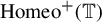
The Denjoy homeomorphism F is characterized up to topological conjugacy in
$\operatorname {\mathrm {Homeo}}^+(\mathbb {T})$
 by
$(\rho (F), Q(F))$
 and in
$\operatorname {\mathrm {Homeo}}(\mathbb {T})$
 by
$\pm (\rho (F), Q(F))$
 [Reference MarkleyMar70]. Similarly, the Denjoy system
$({\mathcal {D}}_F, F)$
 is characterized up to cyclic-order preserving topological conjugacy by
$( \rho (F), Q(F) )$
 and up to topological conjugacy by
$\pm (\rho (F), Q(F))$
 (see [Reference Putnam, Schmidt and SkauPSS86, Remark 3]). From now on, for a pair consisting of an irrational
$\alpha \in \mathbb {T}$
 and a countable
$R_\alpha $
 -invariant subset
$A \subset \mathbb {T}$
 containing the origin, we denote such a Denjoy homeomorphism by
$(\mathbb {T}, F_{\alpha , A})$
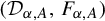
 and its minimal subsystem by
$({\mathcal {D}}_{\alpha , A}, F_{\alpha , A})$
 .
The following is a key fact for us. The first part is folklore (for a proof, see for instance [Reference MasuiMas09]).
Proposition 2.1. (From Sturmian to Denjoy)
Let
$\alpha \in \mathbb {T}$
 be irrational and
$A=\{R_\alpha ^n(0)\colon n\in \mathbb {Z}\}$
 .
-
(1) The Denjoy system $({\mathcal {D}}_{\alpha , A}, F_{\alpha , A})$
is topologically conjugate to the Sturmian system
$(X_\alpha ,\operatorname {\mathrm {\sigma }}_\alpha )$
. -
(2) For all $m\in \mathbb {Z} \setminus \{0\}$
, the Denjoy systems
$({\mathcal {D}}_{\alpha , A}, F_{\alpha , A}^m)$
and
$({\mathcal {D}}_{m\alpha , A}, F_{m\alpha , A})$
coincide, and are topologically conjugate to the system
$(X_\alpha ,\operatorname {\mathrm {\sigma }}^m_\alpha )$
, which is not Sturmian when
$\lvert m \rvert>1$
.
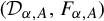


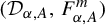



Note that a Denjoy system factors onto a unique Sturmian system, given by its rotation number
$\alpha \bmod {\mathbb {Z}}$
 .
2.4 Interval exchange transformations and their subshifts
Fix our alphabet
$\mathcal {A}=\{1,\ldots , d\}$
 for
$d\in \mathbb {N}_{\ge 1}$
 . Consider a permutation
$\sigma \colon \mathcal {A} \to \mathcal {A}$
 and length parameters
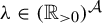
$\unicode{x3bb} \in (\mathbb {R}_{>0})^{\mathcal {A}}$
 . We fix
$\alpha _0=0$
 , define the discontinuities
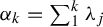
$\alpha _k=\sum _{1}^k \unicode{x3bb} _j$
 for
$k\in \mathcal {A}$
 , and consider the intervals
$I_k=(\alpha _{k-1},\alpha _{k}]$
 of lengths
$\unicode{x3bb} _k=\alpha _k-\alpha _{k-1}$
 .
The interval exchange transformation (IET) with permutation
$\sigma $
 and lengths
$\unicode{x3bb} $
 is the function
$T\colon (\alpha _0,\alpha _d] \to (\alpha _0,\alpha _d]$
 permuting the intervals
$I_k= (\alpha _{k-1}, \alpha _{k}]$
 according to
$\sigma $
 . It is given by the formula

Two IETs are called equivalent when they have the same permutation and their length parameters yield proportional vectors in
$\mathbb {R}_{>0}^{\mathcal {A}}$
 . Every equivalence class contains a unique representative with
$\sum \unicode{x3bb} _k=1$
 , defined on the interval
$(0,1]$
 .
The symbolic encoding of T is the subshift
$(X,\operatorname {\mathrm {\sigma }}) \subset (\mathcal {A}^{\mathbb {Z}}, \operatorname {\mathrm {\sigma }})$
 defined as follows. We define
$X_o \subset (\alpha _0,\alpha _d]$
 to be the complement of the orbits of all discontinuities: a point
$x\in X_o$
 yields a sequence of labels
$l_j \in \mathcal {A}$
 recording the intervals
$I_{l_j}$
 containing the
$T^j(x)$
 . This defines a map
$X_o \to \mathcal {A}^{\mathbb {Z}}$
 and the closure of its image is X, a subshift. Such a subshift
$(X,\operatorname {\mathrm {\sigma }})$
 will be called an interval exchange system (IES).
For
$m\in \mathbb {Z}$
 , the mth power
$T^m$
 is an interval exchange with discontinuities given by
$\alpha ^{(m)}_k\in \bigcup _{n=1}^{m} T^{1-n}(\{\alpha _0,\ldots ,\alpha _d\})$
 , of which there are at most
$(d-1)\lvert m\rvert +1$
 , with equality unless some discontinuities belong to the same orbit. The intervals
$(\alpha ^{(m)}_{k}, \alpha ^{(m)}_{k+1}] \subset (\alpha _0,\alpha _d]$
 whose endpoints are consecutive discontinuities for
$T^m$
 correspond to cylinders
$\mathrm {Cyl}_0(w)\subset X$
 of words
$w\in \mathcal {A}_X^m$
 .
We say that T satisfies Keane’s infinite distinct orbit condition (or has ido) when the past-orbits of the discontinuities
$\{T^{-n}(\alpha _k)\colon n\in \mathbb {N}\}$
 are all infinite and disjoint. This implies that the map
$X_o \to X$
 is injective and its inverse, which is partially defined on its image, extends to a unique map
$X\to [\alpha _0,\alpha _d]$
 .
If T has ido, then
$(X,\operatorname {\mathrm {\sigma }})$
 has complexity function
$C_X(n)=(d-1)n+1$
 and it is minimal (Keane [Reference KeaneKea75] showed that the ido condition implies that every T-orbit is dense). Conversely, if a minimal IES
$(X,\operatorname {\mathrm {\sigma }})$
 has
$C_X(n)=(d-1)n+1$
 , then every IET with that encoding has ido (so it makes sense to say whether a minimal IES has ido).
If a minimal subshift on d unordered letters of complexity
$n\mapsto (d-1)n+1$
 comes from an IES, then the order on its alphabet
$\mathcal {A}$
 and the permutation
$\pi \colon \mathcal {A} \to \mathcal {A}$
 are uniquely determined up to the action of either the reflection group
$\mathbb {Z}/2$
 generated by the order reversing involution
$k\mapsto d+1-k$
 or else the dihedral group
$\mathbb {Z}/d\rtimes \mathbb {Z}/2$
 obtained as its semi-direct product by the cyclic group
$\mathbb {Z}/d$
 generated by the cyclic order preserving permutation
$k\mapsto k+1\bmod {d}$
 .
Given a minimal subshift
$(X,\operatorname {\mathrm {\sigma }})\subset (\mathcal {A},\operatorname {\mathrm {\sigma }})$
 of complexity
$C_X(n)=(d-1)n+1$
 on the ordered alphabet
$\mathcal {A}$
 , one may decide from its language whether there exist a permutation
$\pi \colon \mathcal {A}\to \mathcal {A}$
 and lengths
$\unicode{x3bb} \colon \mathcal {A} \to \mathbb {R}_{>0}$
 yielding an IET with ido having that encoding [Reference Ferenczi and ZamboniFZ08]. When so, the permutation
$\pi \colon \mathcal {A} \to \mathcal {A}$
 is uniquely determined and it follows from [Reference YoccozYoc10, §8.1] that the possible length parameters
$\unicode{x3bb} $
 are in bijective correspondence with the invariant measures of
$(X, \operatorname {\mathrm {\sigma }})$
 .
The permutation
$\pi $
 is called irreducible when
$\pi ^{-1}(\{1,\ldots , k\})=\{1,\ldots , k\} \iff k\in \{1,d\}$
 ; this means that T does not restrict to an IET on a smaller interval. If T has ido, then
$\pi $
 is irreducible. If
$\pi $
 is irreducible and the rational relations between the lengths
$\unicode{x3bb} _k$
 are generated by
$\sum \unicode{x3bb} _k=1$
 , then T has ido. Moreover, Masur [Reference MasuiMas82] and Veech [Reference VeechVee82] showed that for every irreducible
$\pi $
 , almost all probability vectors
$\unicode{x3bb} $
 yield an IES that is uniquely ergodic.
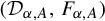
Note that a Denjoy system
$({\mathcal {D}}_{\alpha , A}, F_{\alpha , A})$
 with
$A\bmod {R_\alpha }$
 of cardinal
$d\in \mathbb {N}_{\ge 2}$
 is topologically conjugate to an IES on d intervals and its permutation
$\pi $
 is a d-cycle, which preserves the cyclic order on
$\mathcal {A}\bmod {d}$
 in the sense that if
$(i,j,k)$
 are cyclically ordered, then
$(\pi (i),\pi (j),\pi (k))$
 is also cyclically ordered. Conversely, all such cyclic-order-preserving d-cycles arise from Denjoy systems. For instance, the Sturmian system
$(X_\alpha , \operatorname {\mathrm {\sigma }}_\alpha )$
 is the IES associated to the transposition
$\tau $
 of
$d=2$
 intervals with lengths
$\unicode{x3bb} _1 = \alpha $
 and
$\unicode{x3bb} _2 = 1-\alpha $
 .
3 Coinvariants, states, and the suspension
3.1 Coinvariants, states, and cohomology of the suspension
Let
$(X,S)$
 be a system and denote by
$C(X,\mathbb {Z})$
 the abelian group of continuous integer valued functions on X. It is endowed with the coboundary homomorphism
$f\mapsto f - f\circ S$
 , whose image defines the subgroup of coboundaries
$\textrm {cbd}_{S}(X,\mathbb {Z})$
 and whose cokernel defines the group of coinvariants

A homomorphism
$\tau \colon {\mathcal {G}}_{S} \to \mathbb {R}$
 is called positive if
$\tau ([f])$
 is non-negative whenever
$[f]=[g]$
 for some non-negative
$g \in C(X,\mathbb {Z}_{\ge 0})$
 , and a positive homomorphism
$\tau $
 is called a state when
$\tau ([1]) = 1$
 . We let
$\mathcal {P}(X,S)$
 denote the space of states for a system
$(X,S)$
 .
The following is very well known; a proof can be found in [Reference Boyle and HandelmanBH96, §1.6].
Proposition 3.1. (States as measures)
Let
$(X,S)$
 be a zero-dimensional system. The space of states is in bijection with the space
$\mathcal {M}_{p}(X,S)$
 of S-invariant Borel probability measures on X by the map sending
${\mu \in \mathcal {M}_{p}(X,S)}$
 to the state
$\tau _\mu \in \mathcal {P}(X,S)$
 defined by

More precisely, the space of states and the space of S-invariant Borel probability measures on X both have the structure of a non-empty metrizable Choquet simplex. The map
$\mu \mapsto \tau _\mu $
 is an isomorphism, in particular, it preserves the convex structure.
A morphism of systems
$\pi \colon (X,S)\to (Y,T)$
 yields an induced homomorphism of groups
$\pi ^*\colon {\mathcal {G}}_{T} \to {\mathcal {G}}_{S}$
 given by
$\pi ^{*}([f]) = f \circ \pi $
 and an associated affine morphism of simplices
$\pi _*\colon {\mathcal {P}}(X,S) \to {\mathcal {P}}(Y,T)$
 given by
$\pi _{*}(\tau )([f]) = \tau (\pi ^{*}([f]))$
 . For minimal Cantor systems, the induced map
$\pi ^*$
 on coinvariants is injective and, hence, the map
$\pi _*$
 on states is surjective (see [Reference Glasner and WeissGW95, Proposition 3.1]).
We define the subgroup of infinitesimals
$\operatorname {\mathrm {Inf}}_{S}\subset {\mathcal {G}}_{S}$
 as the set of classes
$[f] \in {\mathcal {G}}_{S}$
 such that
$\tau ([f]) = 0$
 for every state
$\tau $
 on
${\mathcal {G}}_{S}$
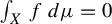
 , or equivalently, such that
$\int _{X} f\, d\mu = 0$
 for every S-invariant Borel probability measure
$\mu $
 on X; in formula,

Let
$(X,S)$
 be a system. The product space
$X \times \mathbb {R}$
 is endowed with the diagonal action of the lattice
$\mathbb {Z}\subset \mathbb {R}$
 by
$n\cdot (x,s)=(S^{n}(x),s-n)$
 . The quotient
$\Sigma _S X := X\times \mathbb {R} \bmod {\mathbb {Z}}$
 is endowed with the
$\mathbb {R}$
 -action by left translation of the right component, namely the flow
$\Phi _{s^{\prime }}(x,s)=(x,s+s^{\prime })$
 . We call
$\Sigma _S X$
 the suspension of the system
$(X,S)$
 .
Note that if
$(M,S)$
 is a minimal subsystem of
$(X,S)$
 , then
$\Sigma _S M$
 is a minimal subsystem of
$\Sigma _S X$
 . Conversely, if N is a minimal subsystem of
$\Sigma _S X$
 , then the set
$M=\{x\in X\colon (x,0)\in N\}$
 yields a minimal subsystem
$(M,S)$
 of
$(X,S)$
 . Moreover, the projection
$\Sigma _S X \to X$
 yields an isomorphism
$\mathcal {P}(\Sigma _S X,\Phi ) \to \mathcal {P}(X,S)$
 between the respective spaces of invariant Borel probability measures (see [Reference Itzá-OrtizIO15, Lemma 3.8]).
For a topological space Y, let
$\pi ^{1}(Y)$
 denote the group of homotopy classes of maps from Y to the unit circle
$\mathbf {S}^{1}$
 , for which the group operation is pointwise multiplication in the target
$\mathbf {S}^1$
 . If Y is compact Hausdorff, then
$\pi ^{1}(Y)$
 is isomorphic to the first integral Čech cohomology group
$\check {H}^{1}(Y,\mathbb {Z})$
 .
Now, suppose that
$(X,S)$
 is a zero-dimensional system. Given a map
${\varphi \colon \Sigma _{S}X \to \mathbf {S}^{1}}$
 , there exists for every
$z \in \Sigma _{S}X$
 a continuous function
$\phi _{z} \colon \mathbb {R} \to \mathbb {R}$
 satisfying
$\phi _z(0)=0$
 and
$\varphi (z+s) = \varphi (z)e^{2 \pi i \phi _{z}(s)}$
 for all
$s \in \mathbb {R}$
 . Denote by
$C_{+}(\Sigma _{S}X,\mathbf {S}^{1})$
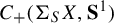 the set of maps
$\varphi \colon \Sigma _{S}X \to \mathbf {S}^{1}$
 such that we may choose
$\phi _{z}$
 to be non-decreasing for all
$z \in \Sigma _{S}X$
 . The abelian group
$\pi ^{1}(\Sigma _{S}X)$
 is endowed with the pre-order defined by the positive cone

For
$f \in C(X,\mathbb {Z})$
 , we define
$\varphi _{f} \in C(\Sigma _{S}X,\mathbf {S}^{1})$
 by

The following result is well known and a proof may be found in [Reference Boyle and HandelmanBH96, Proposition 4.5].
Proposition 3.2. (From coinvariants to homotopy classes)
Let
$(X,S)$
 be a zero-dimensional system. The exponential map yields an isomorphism of groups:

Moreover, if
$(X,S)$
 is minimal, then the isomorphism respects the order structures and, hence, gives an isomorphism of ordered abelian groups

3.2 Coinvariants of Denjoy and interval exchange systems
Recall from §2.3 the definition of Denjoy homeomorphisms as well as the invariants classifying them up to (orientation preserving) conjugacy in
$\operatorname {\mathrm {Homeo}}(\mathbb {T})$
 .
Fix an irrational
$\alpha \in \mathbb {T}$
 and an
$R_\alpha $
 -invariant countable subset
$A\subset \mathbb {T}$
 containing the origin. Let
$N\in \mathbb {N}\sqcup \{\infty \}$
 denote the number of
$R_{\alpha }$
 -orbits in A and choose a point
$a_i\in A$
 in each of these orbits in such a way that
$a_1=\alpha $
 . Such pairs
$(\alpha , A)$
 parametrize Denjoy homeomorphisms
$(\mathbb {T}, F_{\alpha , A})$
 and Denjoy systems
$({\mathcal {D}}_{\alpha , A}, F_{\alpha , A})$
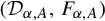 up to cyclic order preserving conjugacy.
The surjective map
$H\colon \mathbb {T} \to \mathbb {T}$
 yielding the factor
$(\mathbb {T}, F_{\alpha , A}) \to (\mathbb {T}, R_{\alpha })$
 restricts to a factor
$\pi _{\alpha , A} \colon ({\mathcal {D}}_{\alpha , A}, F_{\alpha , A}) \to (\mathbb {T}, R_{\alpha })$
 . Both systems
$(\mathbb {T}, F_{\alpha , A})$
 and
$({\mathcal {D}}_{\alpha , A}, F_{\alpha , A})$
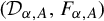 are uniquely ergodic, with invariant probability measures given by
$dH$
 on
$\mathbb {T}$
 and its restriction to its support
${\mathcal {D}}_{\alpha , A}$
 .
The following is [Reference Putnam, Schmidt and SkauPSS86, Theorem 5.3].
Theorem 3.3. (Denjoy systems)
Consider a Denjoy system
$({\mathcal {D}}_{\alpha , A}, F_{\alpha , A})$
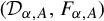 and choose as above some representatives
$a_i\in A$
 of
$A\bmod {R_\alpha }$
 with
$a_1=\alpha $
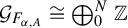
 . Then,
${\mathcal {G}}_{F_{\alpha , A}} \cong \bigoplus _0^N \mathbb {Z}$
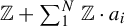
 and its unique state
$\tau \colon {\mathcal {G}}_{F_{\alpha , A}} \to \mathbb {R}$
 has image
$\mathbb {Z} + \sum _{1}^{N} \mathbb {Z} \cdot a_i$
 . The group of infinitesimals
$\operatorname {\mathrm {Inf}}_{F_{\alpha , A}}$
 corresponds to the
$\mathbb {Z}$
 -module of relations among elements in
$A\subset \mathbb {T}$
 . In particular, for a Sturmian system
$(X_{\alpha },\operatorname {\mathrm {\sigma }}_{\alpha })$
 , we have
${\mathcal {G}}_{\operatorname {\mathrm {\sigma }}_{\alpha }} \cong \mathbb {Z} ^{2}$
 and the image under the unique state is
$\mathbb {Z} + \alpha \mathbb {Z}$
 .
Let us briefly outline some of the ideas in the proof, as it will be useful later.
Ideas of the proof.
We identify points in
$\mathbb {T} = \mathbb {R}\bmod {\mathbb {Z}}$
 by their representatives in
$[0,1)\subset \mathbb {R}$
 . Under
$\pi _{\alpha , A}$
 , each point
$a \in A \subset \mathbb {T}$
 has two preimages
$a^\pm \in {\mathcal {D}}_{\alpha , A}$
 , which are the endpoints of an interval
$(a^-, a^+) \subset \mathbb {T}\setminus {\mathcal {D}}_{\alpha , A}$
 collapsed to a by
$H\colon \mathbb {T} \to \mathbb {T}$
 . The characteristic functions of the closed intervals
$[0,a], [a,1]\subset \mathbb {T}$
 are discontinuous, but their lifts
$\chi _{a}^-, \chi _a^+ \colon {\mathcal {D}}_{\alpha , A}\to \{0,1\}$
 belong to
$C({\mathcal {D}}_{\alpha , A}, \mathbb {Z})$
 , and they sum to
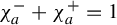
$\chi _a^-+\chi _a^+=1$
 . Since the measure
$dH$
 is supported on
${\mathcal {D}}_{\alpha , A}$
 and trivial on all intervals of the form
$(a^-, a^+)\subset \mathbb {T} \setminus {\mathcal {D}}_{\alpha , A}$
 , the trace satisfies
$\tau (\chi _{a}^-)=a\in [0, 1)$
 and
$\tau (\chi _{a}^+)=1-a\in [0, 1)$
 . The core of the proof then consists in showing that the quotient of
${\mathcal {G}}_{\alpha , A}$
 by coboundaries is generated by the (classes of the) constant function
$1$
 and of the
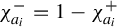
$\chi _{a_i}^-=1-\chi _{a_i}^+$
 for our representatives
$a_i$
 of
$A\bmod {R_\alpha }$
 , and showing that these classes are all linearly independent.
Observe that the group of infinitesimals
$\operatorname {\mathrm {Inf}}_{F_{\alpha , A}}$
 corresponds to the
$\mathbb {Z}$
 -module of relations of the
$\mathbb {Z}$
 -submodule of
$\mathbb {R}$
 generated by
$\tau (1)=1$
 and the
$\tau (\chi _{a_i}^-) = a_i \in (0, 1)$
 , which amounts to the stated description.
We now turn to the symbolic codings of IETs satisfying Keane’s ido condition. Their coinvariants and trace follow from [Reference PutnamPut89] or [Reference PutnamPut92].
Theorem 3.4. (Interval exchange systems)
Consider an IET associated to a permutation of
$\mathcal {A}=\{1,\ldots ,d\}$
 and discontinuities
$0=\alpha _0<\cdots < \alpha _d = 1$
 , which satisfies Keane’s ido condition. Let
$(X,\operatorname {\mathrm {\sigma }})\subset (\mathcal {A}^{\mathbb {Z}}, \operatorname {\mathrm {\sigma }})$
 be the associated IES, which is minimal. Denote by
$\chi _k \colon X\to \{0,1\}$
 the characteristic function of the cylinder
$\mathrm {Cyl}_0(k)\subset X$
 , corresponding to that of the interval
$(\alpha _{k-1}, \alpha _{k}]\subset (0,1]$
 , of length
$\unicode{x3bb} _k$
 . The group
${\mathcal {G}}(X,\operatorname {\mathrm {\sigma }})$
 is isomorphic to a free abelian group
$\mathbb {Z}^d$
 and the classes of the characteristic functions
$\chi _k$
 form a basis. The trace map
$\tau \colon {\mathcal {G}}(X,\operatorname {\mathrm {\sigma }}) \to \mathbb {R}$
 coming from the Lebesgue measure on
$[0,1)$
 sends
$\chi _k$
 to
$\unicode{x3bb} _k$
 .
4 Flow equivalence
4.1 Flow equivalence and states
A flow equivalence between two systems
$(X,S)$
 and
$(Y,T)$
 is a homeomorphism between their suspensions
$\Sigma _{S}X \to \Sigma _{T}Y$
 that maps flow orbits bijectively to flow orbits and preserves the orientation on each flow orbit. Two systems are called flow equivalent when there exists a flow equivalence between their suspensions.
Note that a topological conjugacy
$\psi \colon (X,S) \to (Y,T)$
 induces a flow equivalence
${\Psi \colon \Sigma _{S}X \to \Sigma _{T}Y}$
 defined by
$\Psi \colon (x,t) \mapsto (\psi (x),t)$
 .
Now, consider zero-dimensional systems
$(X,S)$
 and
$(Y,T)$
 with a flow equivalence
${\Psi \colon \Sigma _{S}X \to \Sigma _{T}Y}$
 . The map
$\Psi $
 induces an isomorphism of groups

which preserves the positive cones, since
$\Psi $
 preserves the orientation induced by the flow. Hence, it follows from Proposition 3.2 that the flow equivalence
$\Psi \colon \Sigma _{S}X \to \Sigma _{T}Y$
 also induces an isomorphism
$\Psi ^{*} \colon {\mathcal {G}}_{T} \to {\mathcal {G}}_{S}$
 . When
$(X,S)$
 is minimal, the standard isomorphism given in Proposition 3.2 respects the order (see [Reference Boyle and HandelmanBH96, Proposition 4.5]); thus,
$\Psi ^{*} \colon {\mathcal {G}}_{T} \to {\mathcal {G}}_{S}$
 is an isomorphism of ordered groups. An explicit method to compute
$\Psi ^{*}$
 without appealing to Proposition 3.2 can be found in [Reference Schmieding and YangSY21, §4]. Note that, in general,
$\Psi ^{*}([1])$
 need not be equal to
$[1]$
 .
When
$(X,S)$
 and
$(Y,T)$
 are minimal, the induced isomorphism
$\Psi ^{*} \colon {\mathcal {G}}_{T} \to {\mathcal {G}}_{S}$
 that is order preserving thus induces a linear isomorphism between the spaces of positive homomorphisms

We summarize this in the following proposition.
Proposition 4.1. (Flow equivalence yields isomorphism of coinvariants)
Suppose that
$(X,S)$
 and
$(Y,T)$
 are minimal Cantor systems and
${\Psi \colon \Sigma _{S}X \to \Sigma _{T}Y}$
 is a flow equivalence. The map
$\Psi $
 induces a linear isomorphism between the spaces of invariant measures
$\Psi _{*} \colon \mathcal {M}(X,S) \to \mathcal {M}(Y,T)$
 . In particular, for every
$\mu _X \in \mathcal {M}_p(X,S)$
 , there exist unique
$\mu _{Y} \in \mathcal {M}_{p}(Y,T)$
 and
$\unicode{x3bb} \in \mathbb {R}_{>0}$
 such that
$\tau _{\mu _{Y}}=\unicode{x3bb} \cdot \Psi _*(\tau _{\mu _{X}})$
 , and hence,
$\operatorname {\mathrm {im}}(\tau _{\mu _{X}}) = \unicode{x3bb} \cdot \operatorname {\mathrm {im}}(\tau _{\mu _{Y}})$
 .
Remark 4.2. (Average stretch factor)
Suppose that
$(X,S)$
 and
$(Y,T)$
 are minimal and uniquely ergodic with unique invariant probability measures
$\mu _{X}$
 and
$\mu _{Y}$
 , respectively. Then, both of
${\mathcal {P}}(X,S)$
 and
${\mathcal {P}}(Y,T)$
 are rays, given by scalar multiples of
$\tau _{\mu _{X}}$
 and
$\tau _{\mu _{Y}}$
 . Hence, if
$\Psi \colon \Sigma _{S}X \to \Sigma _{T}Y$
 is a flow equivalence, then there exists a unique
$\unicode{x3bb} \in \mathbb {R}_{>0}$
 such that
$\Psi _{*}(\tau _{\mu _{X}}) = \unicode{x3bb} \cdot \tau _{\mu _{Y}}$
 , so for all
$[f] \in {\mathcal {G}}_{T}$
 , we have
$\tau _{\mu _{X}}(\Psi ^{*}(f)) = \unicode{x3bb} \cdot \tau _{\mu _{Y}}(f)$
 .
The number
$\unicode{x3bb} $
 can be interpreted as the average expansion of the flow equivalence on leaves in the following sense. Given the flow equivalence
$\Psi \colon \Sigma _{S}X \to \Sigma _{T}Y$
 , the function
$\alpha _{\Psi } \colon \Sigma _{f}X \times \mathbb {R} \to \mathbb {R}$
 defined implicitly by
$\Psi (z+t) = \Psi (z) + \alpha _{\Psi }(z,t)$
 is well defined, continuous, and satisfies the cocycle condition
$\alpha _{\Psi }(z,t_{1} + t_{2}) = \alpha _{\Psi }(z,t_{1}) + \alpha _{\Psi }(z+t_{1},t_{2})$
 . Since
$(X,S)$
 and
$(Y,T)$
 are uniquely ergodic, so are the corresponding flows
$(\Sigma _{S}X,\mathbb {R})$
 and
$(\Sigma _{T}Y,\mathbb {R})$
 . Using ergodicity of the flow and the ergodic theorem, there exists
$\unicode{x3bb} _{\Psi } \in \mathbb {R}$
 such that for all
$z \in \Sigma _{S}X$
 , we have
$\lim _{t\to \infty }({1}/{t})\alpha _{\Psi }(z,t)=\unicode{x3bb} _{\Psi }$
 . This
$\unicode{x3bb} _{\Psi }$
 is precisely the
$\unicode{x3bb} $
 given by Proposition 4.1 (see [Reference Schmieding and YangSY21] for details).
4.2 Flow equivalence and discrete cross sections
Let
$(X,S)$
 be a zero-dimensional system. A discrete cross section of
$(X,S)$
 is a closed subset
$C \subset X$
 such that
${X = \{S^{i}(x) \colon x \in C, i \in \mathbb {N}_{>0}\}}$
 and the function
$r_{C} \colon C \to \mathbb {N}_{>0}$
 defined by
$r_{C}(x) = \min \{i \in \mathbb {N}_{>0} \colon S^{i}(x) \in C\}$
 is continuous. Note that the continuity of
$r_C$
 implies that C will be clopen. Associated to a discrete cross section
$C \subset X$
 is a return system
$(C,S_{C})$
 defined by

The systems
$(X,S)$
 and
$(C,S_{C})$
 are always flow equivalent and there is a natural flow equivalence
$\Psi \colon \Sigma _{S}X \to \Sigma _{S_C} C$
 defined as follows. For each
$x \in C$
 ,
$\Psi $
 maps the segment in
$\Sigma _{S}X$
 with endpoints
$(x,0)$
 and
$(x,r_C(x)) = (S_{C}(x),0)$
 linearly via
${t \mapsto ({1}/{r_{C}(x)})t}$
 onto the segment in
$\Sigma _{S_{C}}C$
 with endpoints
$(x,0)$
 and
$(x,1) = (S_{C}(x),0) \in \Sigma _{S_{C}}X$
 . That
$\Psi $
 is well defined and is a flow equivalence then follows from the fact that C is a discrete cross section of
$(X,S)$
 .
Note that if
$(X,S)$
 is minimal, then any clopen subset is a discrete cross section and any return system
$(C,S_{C})$
 is also minimal.
It follows from the above discussion that if
$(C,S_{C})$
 and
$(D,T_{D})$
 are return systems for
$(X,S)$
 and
$(Y,T)$
 , then any topological conjugacy
$\psi \colon (C,S_{C}) \to (D,T_{D})$
 induces a flow equivalence between their suspensions, and hence, a flow equivalence between the suspensions of the initial systems

A return equivalence between systems
$(X,S)$
 and
$(Y,T)$
 is a triple
$(\psi ,C,D)$
 , where
${C \subset X, D \subset Y}$
 are discrete cross sections and
$\psi \colon (C,S_{C}) \to (D,T_{D})$
 is a topological conjugacy.
The following result is originally due to Parry and Sullivan in [Reference Parry and SullivanPS75], and is fundamental in the study of flow equivalence; we give a version that is worded differently, more in line with the proof given in [Reference Boyle, Carlsen and EilersBCE17b, Reference Boyle, Carlsen and EilersBCE17a].
Theorem 4.3. (Parry and Sullivan)
Between zero-dimensional systems, every flow equivalence is isotopic to one that is induced by a return equivalence.
More background on flow equivalence can be found in [Reference Boyle, Carlsen and EilersBCE17b, Reference Boyle, Carlsen and EilersBCE17a].
Remark 4.4. (Flow codes)
When
$(X,T)$
 and
$(Y,S)$
 are subshifts, return equivalences are induced by flow codes, a notion developed in [Reference Boyle, Carlsen and EilersBCE17b, Reference Boyle, Carlsen and EilersBCE17a] (see also [Reference Boyle and ChuysurichayBC18, Appendix]). For subshifts, flow codes encode flow maps between their suspensions in an analogous way to how block codes encode continuous shift commuting maps.
4.3 Flow equivalence of Sturmian, Denjoy, and interval exchange systems
4.3.1 Flow equivalence of Sturmian systems
Fix
$\alpha , \beta \in \mathbb {R}\setminus \mathbb {Q}$
 and consider the associated Sturmian subshifts
$(X_{\alpha },\operatorname {\mathrm {\sigma }}_{\alpha }), (X_{\beta },\operatorname {\mathrm {\sigma }}_{\beta })$
 with unique invariant Borel probability measures
$\mu _{\alpha }, \mu _{\beta }$
 .
The classification of Sturmian systems up to flow equivalence was first proved by Fokkink in [Reference FokkinkFok91] (although using different language); an alternative proof was given in [Reference Barge and WilliamsBW00]. We give an alternative short proof here.
Theorem 4.5. (Flow equivalence of Sturmian systems)
For
$\alpha ,\beta \in \mathbb {R} \setminus \mathbb {Q}$
 , the following are equivalent:
-
(1) the points $\alpha ,\beta \in \mathbb {R}\mathbf {P}^1\setminus \mathbb {Q}\mathbf {P}^1$
belong to the same
$\operatorname {\mathrm {PGL}}_{2}(\mathbb {Z})$
-orbit; -
(2) the Sturmian subshifts $(X_{\alpha },\operatorname {\mathrm {\sigma }}_{\alpha })$
and
$(X_{\beta },\operatorname {\mathrm {\sigma }}_{\beta })$
are flow equivalent.



Proof. Recall that a flow equivalence
$\Psi \colon \Sigma _{\operatorname {\mathrm {\sigma }}_{\alpha }}X_{\alpha } \to \Sigma _{\operatorname {\mathrm {\sigma }}_{\beta }}X_{\beta }$
 induces by Proposition 4.1 an isomorphism
$\Psi ^{*} \colon {\mathcal {G}}_{\operatorname {\mathrm {\sigma }}_{\beta }} \to {\mathcal {G}}_{\operatorname {\mathrm {\sigma }}_{\alpha }}$
 and an induced map on the spaces of positive homomorphisms
$\Psi _{*} \colon \mathcal {P}({\mathcal {G}}_{\operatorname {\mathrm {\sigma }}_{\alpha }}) \to \mathcal {P}({\mathcal {G}}_{\operatorname {\mathrm {\sigma }}_{\beta }})$
 . Letting
$\tau _{\alpha }$
 and
$\tau _{\beta }$
 denote the unique states on
$\mathcal {G}_{\operatorname {\mathrm {\sigma }}_{\alpha }}$
 and
$\mathcal {G}_{\operatorname {\mathrm {\sigma }}_{\beta }}$
 , respectively, there exists
$\unicode{x3bb}> 0$
 such that
$\Psi _{*}(\tau _{\alpha }) = \unicode{x3bb} \tau _{\beta }$
 . It follows from Theorem 3.3 that
$\mathbb {Z}+\mathbb {Z}\alpha = \unicode{x3bb} (\mathbb {Z} + \mathbb {Z}\beta )$
 , and we deduce (see Lemma 7.6) that
$\alpha $
 and
$\beta $
 are
$\operatorname {\mathrm {PGL}}_{2}(\mathbb {Z})$
 -equivalent.
For the converse, suppose
$A\alpha = \beta $
 for some
$A \in \operatorname {\mathrm {GL}}_{2}(\mathbb {Z})$
 . The factor maps
$H_{\alpha } \colon X_{\alpha } \to \mathbb {T}$
 and
$H_{\beta } \colon X_{\beta } \to \mathbb {T}$
 extend to factor maps
$\pi _{\alpha } \colon \Sigma _{\operatorname {\mathrm {\sigma }}_{\alpha }}X_{\alpha } \to \mathbb {T}^{2}, \pi _{\beta } \colon \Sigma _{\operatorname {\mathrm {\sigma }}_{\beta }}X_{\beta } \to \mathbb {T}^{2}$
 , which intertwine the flows on the suspensions with the flows on
$\mathbb {T}^{2}$
 in the direction of
$(\alpha ,1)$
 and
$(\beta ,1)$
 , respectively. The automorphism
$T_{A} \colon \mathbb {T}^{2} \to \mathbb {T}^{2}$
 induced by A lifts to a homeomorphism
$\tilde {T}_{A} \colon \Sigma _{\operatorname {\mathrm {\sigma }}_{\alpha }}X_{\alpha } \to \Sigma _{\operatorname {\mathrm {\sigma }}_{\beta }}X_{\beta }$
 . If
$\tilde {T}_{A}$
 does not respect the orientation on flow lines, then we may compose this with the self-homeomorphism
$\Sigma _{\operatorname {\mathrm {\sigma }}_{\beta }}X_{\beta } \to \Sigma _{\operatorname {\mathrm {\sigma }}_{\beta }}X_{\beta }$
 obtained by lifting the automorphism
$-{\mathbf {1}}$
 on
$\mathbb {T}^{2}$
 to obtain a flow equivalence.
Remark 4.6. (Flow equivalence preserving cyclic order on the fiber)
Irrationals
$\alpha , \beta \in \mathbb {R}\setminus \mathbb {Q}$
 belong to the same
$\operatorname {\mathrm {PSL}}_{2}(\mathbb {Z})$
 -orbit if and only if the Sturmian subshifts
$(X_{\alpha },\operatorname {\mathrm {\sigma }}_{\alpha })$
 and
$(X_{\beta },\operatorname {\mathrm {\sigma }}_{\beta })$
 are related by a flow equivalence that preserves the cyclic order of the fibers. The orientation reversing homeomorphism of
$\mathbb {T}=\mathbb {R}/\mathbb {Z}$
 given by
$x \mapsto 1-x$
 conjugates
$R_{\alpha }$
 to
$R_{-\alpha }$
 and induces a conjugacy (hence, a flow equivalence) between the Sturmian systems
$(X_{\alpha },\operatorname {\mathrm {\sigma }}_{\alpha })$
 and
$(X_{-\alpha },\operatorname {\mathrm {\sigma }}_{-\alpha })$
 , which reverses the cyclic order on the fibers.
4.3.2 Flow equivalence of Denjoy systems
The following generalization of Theorem 4.5 was proved by Putnam in the context of
$C^{*}$
 -algebras. The proof in [Reference PutnamPut88, Theorem 6] is stated just for homeomorphisms of the suspensions, but it can be seen from the proof that one can find a homeomorphism respecting orientation of the flow (see also [Reference Aranson, Belitsky and ZhuzhomaABZ96, 6.1.5]).
Theorem 4.7. (Flow equivalence of Denjoy systems)
For
$k\in \{0,1\}$
 , the Denjoy systems
$({\mathcal {D}}_{F_k}, F_k)$
 with invariants
$(\alpha _k, A_k)$
 (satisfying
$0\in A_k$
 ) are flow equivalent if and only if there exists
$M= (m_{ij}) \in \operatorname {\mathrm {GL}}_2(\mathbb {Z})$
 such that

where
$\equiv $
 denotes equality of subsets of
$\mathbb {T}$
 up to rotation.
Remark 4.8. (Flow equivalence preserving the cyclic order on fibers)
Similar to the case of Sturmian systems, for
$k\in \{0,1\}$
 , the Denjoy systems
$({\mathcal {D}}_{F_k}, F_k)$
 with invariants
$(\alpha _k, A_k)$
 (satisfying
$0\in A_k$
 ) are related by a flow equivalence preserving the cyclic order on the fibers if and only if there exists
$M= (m_{ij}) \in \operatorname {\mathrm {GL}}_2(\mathbb {Z})$
 satisfying the relations in the previous Theorem 4.7 with
$\det (M)>0$
 and
${1}/({m_{21}\cdot \alpha _0+m_{22}})>0$
 .
The orientation reversing homeomorphism of
$\mathbb {T}=\mathbb {R}/\mathbb {Z}$
 given by
$x \mapsto -x$
 induces a conjugacy (hence, a flow equivalence) between the Denjoy systems
$({\mathcal {D}}_{\alpha , A},F_{\alpha , A})$
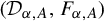 and
$({\mathcal {D}}_{-\alpha , -A}, F_{-\alpha , -A})$
 , which reverses the cyclic order on the fibers.
4.3.3 Flow equivalence of interval exchange systems
Our final goal for this section is to generalize Fokkink’s theorem on flow equivalence to interval exchanges, of which Sturmian systems correspond to the case of alphabets on
$d=2$
 letters. The continued fraction expansion is generalized by the Rauzy–Veech induction.
Consider
$(X,\operatorname {\mathrm {\sigma }})\subset (\mathcal {A}, \operatorname {\mathrm {\sigma }})$
 a minimal IES with ido on an unordered alphabet. We saw that up to global inversion, the order on
$\mathcal {A}$
 and the permutation
$\pi $
 are uniquely determined (and that
$\pi $
 must be irreducible, although it may have factors).
Let us recall the description of all IETs with that symbolic encoding. It follows from [Reference YoccozYoc10, §8.1] that the length vectors
$\unicode{x3bb} $
 of IETs
$T\colon (0,1]\to (0,1]$
 having that symbolic encoding correspond to the invariant probability measures of
$(X, \operatorname {\mathrm {\sigma }})$
 .
The proof relies on Rauzy induction, which to any IET associates a path in the Rauzy diagram, and this path is infinite if and only if it satisfies ido. Two IETs with ido yield the same path in the Rauzy diagram if and only if their symbolic encodings are subshifts on the same number of letters that are topologically conjugate, in which case, their length parameters correspond to invariant measures for that system.
In short, for minimal IES on the same ordered alphabet, the topological conjugacy is equivalent (up to the order reversing involution) to having the same path in the Rauzy diagram (a generalization of the fact that two real numbers are equal up to inversion if and only if they have the same continued fraction expansion).
The following Theorem 4.9 can thus be viewed as a generalization of Fokkink’s theorem about flow equivalence of Sturmian systems to IES.
For
$T\colon (\alpha _0,\alpha _d] \to (\alpha _0,\alpha _d]$
 an IET with ido, the first return on a non-empty subinterval
$I\subset (\alpha _0,\alpha _d]$
 yields an interval exchange with ido on
$d'\in \{d, d+1, d+2\}$
 intervals, where
$d'-d\in \{0,1,2\}$
 is the number of endpoints of I that do not belong to the past orbits of the discontinuities
$\{T^{-n}(\alpha _k)\colon n\in \mathbb {N}, 0\le k \le d\}$
 . In particular, the cylinder-intervals defined by consecutive discontinuities of
$T^{-m}$
 for some
$m\in \mathbb {N}_{>0}$
 have
$d'=d$
 . They correspond to the cylinders in the associated IES.
For a subshift
$(X,\operatorname {\mathrm {\sigma }})$
 and a cylinder
$C\subset X$
 , the return system
$(C,\operatorname {\mathrm {\sigma }}_C)$
 will be called a cylinder-induced system.
The following sharpens the Parry–Sullivan Theorem 4.3 in the case of interval exchange systems.
Theorem 4.9. (Flow equivalence of IES)
Two minimal IES with ido are flow equivalent if and only if they admit cylinder-induced systems that are topologically conjugate.
Proof. Let
$(X,\operatorname {\mathrm {\sigma }})$
 and
$(Y,\operatorname {\mathrm {\sigma }})$
 be minimal IES with ido.
Suppose first that they admit cylinder-induced IETs that are topologically conjugate. By minimality, these cylinder-induced systems are return systems, so their topological conjugacy yields a flow equivalence between the initial systems by Theorem 4.3.
Now, suppose that they are flow equivalent. Choose corresponding IETs and apply the zippered-rectangle construction [Reference YoccozYoc10, §4] for any choice of valid height parameters to obtain two marked translation surfaces (the marking is a horizontal segment satisfying [Reference YoccozYoc10, Corollary 5.5]). By assumption, the translation surfaces are isomorphic, but the isomorphism may not preserve the marked transversal.
Hence, we may identify the translation surfaces so that the two IETs and height parameters correspond to two transverse segments
$I=(\alpha _0,\alpha _1), J=(\beta _0,\beta _1)$
 (satisfying the conditions in [Reference YoccozYoc10, Corollary 5.5]). Note that every non-empty open horizontal segment yields an IET by following the vertical flow, since the return time is finite by Keane’s condition (see [Reference YoccozYoc10, §3.1]).
Now, consider any point
$x\in I$
 in the first transversal that does not belong to the orbit of a discontinuity and follow the vertical flow until it first arrives to a point
$y\in J$
 in the second transversal, say in time
$t\in \mathbb {R}_{\ge 0}$
 . There exists an open interval neighborhood of x denoted
$(\alpha _0^{\prime }, \alpha _1^{\prime })\subset I$
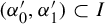 that flows vertically to an interval neighborhood of y denoted
$(\beta _0^{\prime }, \beta _1^{\prime })\subset J$
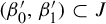 in the same constant time t. The vertical flow yields a conjugacy between the IETs on
$(\alpha _0^{\prime }, \alpha _1^{\prime }]$
 and
$(\beta _0^{\prime }, \beta _1^{\prime }]$
 .
Moreover, we may assume that
$\alpha _0^{\prime }, \alpha _1^{\prime }$
 (hence,
$\beta _0^{\prime }, \beta _1^{\prime }$
 ) belong to the orbits of distinct discontinuities. Hence, the IETs induced on
$(\alpha _0^{\prime }, \alpha _1^{\prime }]$
 and
$(\beta _0^{\prime }, \beta _1^{\prime }]$
 have the same number of intervals given by
$d-1=2g-2+s$
 , where g is the genus of the punctured surface and s is the number of conical singularities.
In fact, we may even assume that
$(\alpha _0^{\prime }, \alpha _1^{\prime }]$
 corresponds to a cylinder interval for the IET on
$I=(\alpha _0, \alpha _1]$
 and, hence,
$(\beta _0^{\prime }, \beta _1^{\prime }]$
 will also be a cylinder interval for the IET on
$J=(\beta _0, \beta _1]$
 . The associated symbolic subshifts yield cylinder-induced systems of
$(X,S)$
 and
$(Y,T)$
 that are topologically conjugate.
Remark 4.10. (Generalizing the class of cylinder-induced systems)
The previous theorem also holds replacing the class of cylinder-induced systems by any class of induced systems (defined in the first order theory of IES) whose associated cross sections satisfy the following properties:
-
• they are unions of consecutive cylinders;
-
• they form a basis for the topology of X;
-
• they are closed under induction.
Special cases of such collections are given by the ‘child intervals’ considered in [Reference Boshernitzan and CarrollBC97] and the ‘admissible intervals’ in [Reference Dolce and PerrinDP17].
Remark 4.11. (Cones of invariant measures are rationally equivalent)
By Proposition 4.1, if two minimal IES with ido on alphabets of the same cardinality are flow equivalent, then their cones of invariant measures are mapped to one another by a matrix in
$\operatorname {\mathrm {GL}}(d,\mathbb {N})$
 .
5 2-asymptotic equivalences
We now introduce a certain equivalence relation on systems that will serve as a key ingredient for our definition of isogeny in the following section.
Definition 5.1. (Transitive closure of factor equivalences)
Consider a property
$\mathtt {P}$
 that, to a factor map
$\pi \colon (X,S) \to (Y,T)$
 , associates a truth value
$\mathtt {P}(\pi ) \in \{\top , \bot \}$
 and such that
$\mathtt {P}(\mathrm {id})=\top $
 .
Two systems
$(Y_{1}, T_{1})$
 and
$(Y_2, T_{2})$
 are called elementary-
$\mathtt {P}$
 -equivalent when there exists a system
$(X,S)$
 and factor maps
$\pi _i \colon (X,S)\to (Y_i, T_i)$
 satisfying
$\mathtt {P}$
 ,

Thus, elementary-
$\mathtt {P}$
 -equivalence is a reflexive and symmetric relation on systems. Its transitive closure defines an equivalence relation on systems, called
$\mathtt {P}$
 -equivalence.
5.1 2-asymptotic factor maps
Let
$(X,S)$
 be a system. We say two points
$x,x^{\prime } \in X$
 are asymptotic, denoted
$x\Bumpeq x'$
 , when
$d(S^{n}(x),S^{n}(x^{\prime })) \to 0$
 as
$n \to -\infty $
 and
$n\to +\infty $
 . This is an equivalence relation.
Note that for a factor map
$\pi \colon (X,S)\to (Y,T)$
 , we have
$x\Bumpeq x' \implies \pi (x)\Bumpeq \pi (x')$
 .
Definition 5.2. (2-asymptotic)
A factor map
$\pi \colon (X,S) \to (Y,T)$
 is called 2-asymptotic (2-A) when there exists a countable subset of blown-up points
$B \subset Y$
 such that:
-
(1) for $y\in Y$
, we have
$|{\pi ^{-1}(y)}|> 1$
if and only if
$y \in B$
; -
(2) for every $y\in B$
, we have
$|{\pi ^{-1}(y)}| = 2$
; -
(3) for every $y \in B$
, the pair of points in
$\pi ^{-1}(y)=\{x,x'\}$
are asymptotic.

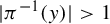


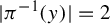


Note that a topological conjugacy is a 2-A factor, since one may choose the set B in the definition to be empty.
Remark 5.3. (2-A factors between minimal Cantor systems)
For factors
$\pi \colon (X,S) \to (Y,T)$
 between minimal Cantor systems, the definition of 2-A amounts to that found in [Reference Giordano, Putnam and SkauGPS01]:
$\pi $
 is at most
$2$
 -to-
$1$
 and
$ \text { for all } \epsilon> 0$
 , the set
$\{(x_{1},x_{2}) \in X \times X \colon \pi (x_{1}) = \pi (x_{2}), \; d(x_{1},x_{2}) \ge \epsilon \}$
 is finite.
Remark 5.4. (2-A factors induce isomorphism of invariant measures)
If
$\pi \colon (X,S) \to (Y,T)$
 is a 2-A factor map between minimal Cantor systems, then the pushforward map on measures
$\pi _{*} \colon \mathcal {M}(S) \to \mathcal {M}(T)$
 is bijective; in particular, it sends ergodic measures to ergodic measures. Indeed, a factor map always induces a surjective pushforward map on the space of measures (see for instance [Reference Denker, Grillenberger and SigmundDGS76, Proposition 3.11]), and it is injective because
$\pi $
 is injective off a countable set and no S-invariant measure can have atoms by minimality.
Consider a 2-A factor
$\pi \colon (X,S) \to (Y,T)$
 . Choose a representative
$y\in B\bmod {T}$
 in every blown-up orbit, and an order on its preimage
$\pi ^{-1}(y)=\{x, x'\}$
 . For such an asymptotic pair
$(x, x')$
 , there is a group homomorphism
$C(X,\mathbb {Z}) \to \mathbb {Z}$
 defined by

which only depends on the orbit
$y\bmod {T}$
 and the order of its preimage
$(x, x')\bmod {S}$
 . This homomorphism vanishes on coboundaries, so it induces a homomorphism
${\mathcal {I}}_{y} \colon {\mathcal {G}}_{S} \to \mathbb {Z}$
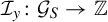 . For every
$f \in C(X,\mathbb {Z})$
 , there are only a finite number of
$y\in B\bmod {T}$
 such that
${\mathcal {I}}_y(f)\ne 0$
 ; hence, following [Reference Giordano, Putnam and SkauGPS01], we may define the index homomorphism

Recall that for any factor
$\pi \colon (X,S)\to (Y,T)$
 between minimal Cantor systems, the map
$\pi ^*\colon {\mathcal {G}}_{T}\to {\mathcal {G}}_{S}$
 is injective. When
$\pi $
 is 2-A, the cokernel of
$\pi ^*$
 is identified with the index map by [Reference Giordano, Putnam and SkauGPS01, Theorem 3.1] as follows.
Theorem 5.5. (Index exact sequence)
Let
$\pi \colon (X,S) \to (Y,T)$
 be a 2-A factor map between minimal Cantor systems. The index homomorphism
${\mathcal {I}}\colon {\mathcal {G}}_{S} \to \bigoplus _{B\bmod {T}}\mathbb {Z}$
 is surjective and its kernel is the image of the induced homomorphism
$\pi ^{*}\colon {\mathcal {G}}_{T} \to {\mathcal {G}}_{S}$
 . In other words, there is a short exact sequence of abelian groups:

5.2 Infinitesimal 2-asymptotic equivalence
Definition 5.6. (infinitesimal)
We say that a 2-A factor
$\pi \colon (X,S) \to (Y,T)$
 with index homomorphism
${\mathcal {I}}$
 is infinitesimal when
${\mathcal {I}}({\mathcal {G}}_{S})/{\mathcal {I}}(\operatorname {\mathrm {Inf}}_{S})$
 is torsion, namely

Note that if
$\pi $
 is a topological conjugacy, the associated index map is the zero map and, hence,
$\pi $
 is an infinitesimal 2-A factor map. Thus, we may define the notion of infinitesimal 2-A equivalence.
Remark 5.7. (Full-rank implies infinitesimal)
Consider a 2-A factor
$\pi \colon (X,S) \to (Y,T)$
 with index homomorphism
${\mathcal {I}}$
 . If the restriction
${\mathcal {I}} \colon \operatorname {\mathrm {Inf}}_{S} \to \bigoplus _{B\bmod {T}}\mathbb {Z}$
 has torsion cokernel, then
$\pi $
 is infinitesimal, namely
${\mathcal {I}}({\mathcal {G}}_{S}) / {\mathcal {I}}(\operatorname {\mathrm {Inf}}_{S})$
 is torsion. When
$(X,S)$
 and
$(Y,T)$
 are minimal Cantor systems, these conditions are equivalent, since in this case,
${\mathcal {I}} \colon {\mathcal {G}}_{S} \to \bigoplus _{B\bmod {T}}\mathbb {Z}$
 is surjective by Theorem 5.5.
The following propositions connect infinitesimal 2-A factors with the rational images of respective states.
Proposition 5.8. (2-AI factors and states)
Consider an infinitesimal 2-asymptotic factor
$\pi \colon (X,S) \to (Y,T)$
 whose index homomorphism
${\mathcal {I}}$
 satisfies
$\ker ({\mathcal {I}})\subset \pi ^*({\mathcal {G}}_{T})$
 (as it is the case when
$(X,S)$
 and
$(Y,T)$
 are minimal Cantor systems by Theorem 5.5). Then, for any state
$\tau _X$
 of
$(X,S)$
 , its push-forward state
$\tau _Y=\pi _*(\tau _X)$
 of
$(Y,T)$
 satisfies

Proof. Let
$[f] \in {\mathcal {G}}_{S}$
 . Since
${\mathcal {I}}({\mathcal {G}}_{S})/{\mathcal {I}}(\operatorname {\mathrm {Inf}}_{S})$
 is torsion, we may choose
$r\in \mathbb {N}_{>0}$
 and
$g \in \operatorname {\mathrm {Inf}}_{S}$
 such that
$r{\mathcal {I}}(f) = {\mathcal {I}}(g)$
 . Thus,
${\mathcal {I}}(rf - g) = 0$
 , so the assumption
$\ker {\mathcal {I}} = \operatorname {\mathrm {im}}(\pi ^*)$
 ensures that we may choose
$h \in C(Y,\mathbb {Z})$
 such that
$\pi ^{*}(h) = rf - g$
 .
Now, consider a state
$\tau _X$
 of
$(X,S)$
 and let
$\tau _Y=\pi _*(\tau _X)$
 be the push-forward state of
$(Y,T)$
 . By definition of
$\operatorname {\mathrm {Inf}}_{S}$
 , we have
$\tau _X(g)=0$
 , thus,

proving that
$\operatorname {\mathrm {im}}(\tau _X)\otimes \mathbb {Q} = \operatorname {\mathrm {im}}(\tau _Y)\otimes \mathbb {Q}$
 , as desired.
Proposition 5.9. (2-AI factors of UE systems)
Consider a 2-asymptotic factor
$\pi \colon (X,S)\to (Y,T)$
 whose index homomorphism
${\mathcal {I}}$
 satisfies
$\ker ({\mathcal {I}})\supset \pi ^*({\mathcal {G}}_{T})$
 (as it is the case when
$(X,S)$
 and
$(Y,T)$
 are minimal Cantor systems by Theorem 5.5). Assume that
$(X,S)$
 is uniquely ergodic with unique state
$\tau _X$
 and let
$\tau _Y=\pi _*(\tau _X)$
 be its push-forward state on
$(Y,T)$
 . If
$\operatorname {\mathrm {im}}(\tau _X)\otimes \mathbb {Q} = \operatorname {\mathrm {im}}(\tau _Y)\otimes \mathbb {Q}$
 , then the 2-A factor
$\pi $
 is infinitesimal.
Proof. To show that
${\mathcal {I}}({\mathcal {G}}_{S})/{\mathcal {I}}(\operatorname {\mathrm {Inf}}_{S})$
 is torsion, we fix
$b\in {\mathcal {I}}({\mathcal {G}}_{S})$
 and will construct
$f'\in \operatorname {\mathrm {Inf}}_S$
 and
$d\in \mathbb {N}_{>0}$
 such that
${\mathcal {I}}(f')=db$
 .
We may choose
$f\in {\mathcal {G}}_{S}$
 with
${\mathcal {I}}(f)=b$
 . By assumption
$\operatorname {\mathrm {im}}(\tau _X)\otimes \mathbb {Q}=\operatorname {\mathrm {im}}(\tau _Y)\otimes \mathbb {Q}$
 , so there exists
$d\in \mathbb {N}_{>0}$
 and
$g\in {\mathcal {G}}_{T}$
 such that
$\tau _X(f)=({1}/{d})\tau _Y(g)$
 . Let
$f'=df- \pi ^*(g)\in {\mathcal {G}}_{S}$
 . On the one hand,

so
$f'\in \ker (\tau _X)$
 ; hence,
$f'\in \operatorname {\mathrm {Inf}}_{S}$
 by unique ergodicity of
$(X,S)$
 . On the other hand,
${\mathcal {I}}(f')=d{\mathcal {I}}(f)$
 since
$\pi ^*(g)\in \pi ^*({\mathcal {G}}_{T})\subset \ker {\mathcal {I}}$
 by assumption.
Let us sum up the previous results in a particular case of interest.
Corollary 5.10. (2-asymptotic factors of uniquely ergodic minimal Cantor systems)
Consider uniquely ergodic minimal Cantor systems
$(X,S), (Y,T)$
 with states
$\tau _X, \tau _Y$
 . Both of the following hold:
-
(1) if there exists a 2-AI factor $\pi \colon (X,S) \to (Y,T)$
, then
$\operatorname {\mathrm {im}}(\tau _X)\otimes \mathbb {Q}=\operatorname {\mathrm {im}}(\tau _Y)\otimes \mathbb {Q}$
; -
(2) if $\operatorname {\mathrm {im}}(\tau _X)\otimes \mathbb {Q}=\operatorname {\mathrm {im}}(\tau _Y)\otimes \mathbb {Q}$
, then every 2-A factor
$\pi \colon (X,S) \to (Y,T)$
is infinitesimal.




Thus, if
$(X,S)$
 and
$(Y,T)$
 are 2-AI equivalent, then
$\operatorname {\mathrm {im}}(\tau _{X}) \otimes \mathbb {Q} = \operatorname {\mathrm {im}}(\tau _{Y}) \otimes \mathbb {Q} $
 .
2-AI extensions can also arise from maximal equicontinuous factors of certain substitution subshifts, as in the following example.
Example 5.11. (Period doubling substitution)
Let
$(X,\operatorname {\mathrm {\sigma }}_{X})$
 be the minimal subshift associated to the period doubling substitution defined by
$\tau (a) = ab$
 ,
$\tau (b) = aa$
 . The group of continuous eigenvalues of the system
$(X,\operatorname {\mathrm {\sigma }}_{X})$
 is isomorphic to
$\mathbb {Z}[\tfrac {1}{2}]$
 giving a factor onto the
$2$
 -adic odometer
$\pi \colon (X,\operatorname {\mathrm {\sigma }}_{X}) \to (\mathcal {O}_{2},S)$
 (see [Reference Pytheas Fogg, Berthé, Ferenczi, Mauduit and SiegelFog02, §1.6]). This is a 2-AI factor, which can be seen from the calculations given in [Reference Barge, Kellendonk and SchmiedingBKS12, §5.3.2].
5.3
$\mathbb {M}$
-measured equivalence

In this subsection, we fix a subgroup
$\mathbb {M}\subset \mathbb {R}$
 and generalize the notion of infinitesimal 2-A equivalence to that of
$\mathbb {M}$
 -measured equivalence.
Definition 5.12. (
$\mathbb {M}$
-measured)

Let
$\pi \colon (X,S) \to (Y,T)$
 be a 2-asymptotic factor. We say that
$\pi $
 is
$\mathbb {M}$
 -measured with respect to a subset of states
$\mathcal {T} \subset {\mathcal {P}}(X,S)$
 when there exists a subgroup
$G \subset {\mathcal {G}}_{S}$
 such that
${\mathcal {I}}({\mathcal {G}}_{S})/{\mathcal {I}}(G)$
 is torsion and every
$\tau _{X}\in \mathcal {T}$
 satisfies
$\tau _{X}(G) \subset ~\mathbb {M}$
 . In particular, when
$\mathcal {T}$
 consists of:
-
(1) a single state $\tau _X$
, we say that
$\tau _X$
is
$\mathbb {M}$
-measured with respect to
$\pi $
; -
(2) the whole set ${\mathcal {P}}(X,S)$
, we say that
$\pi $
is
$\mathbb {M}$
-measured; -
(3) the set of ergodic measures, we say that $\pi $
is ergodically
$\mathbb {M}$
-measured.


Note that for any subgroup
$\mathbb {M} \subset \mathbb {R}$
 , a topological conjugacy is always
$\mathbb {M}$
 -measured and we may consider the notion of
$\mathbb {M}$
 -measured 2-A equivalence between uniquely ergodic systems.
Remark 5.13. (Infinitesimal if and only if
$0$
-measured)

A 2-asymptotic factor is infinitesimal if and only if it is
$\{0\}$
 -measured. One direction of this is obvious: set
$G = \operatorname {\mathrm {Inf}}({\mathcal {G}}_{S})$
 . For the other direction, suppose
$\pi $
 is
$\{0\}$
 -measured and let
$G \subset {\mathcal {G}}_{S}$
 be the subgroup given by the definition. Then,
$\tau (G) = 0$
 for every state
$\tau \in {\mathcal {P}}(X,S)$
 , so
$G \subset \operatorname {\mathrm {Inf}}(\mathcal {G}_{S})$
 . Since
$\mathcal {I}(\mathcal {G}_{S})/\mathcal {I}(G)$
 is torsion and
$G \subset \operatorname {\mathrm {Inf}}(\mathcal {G}_{S})$
 , it follows that
$\mathcal {I}(\mathcal {G}_{S}) / \mathcal {I}(\operatorname {\mathrm {Inf}}(\mathcal {G}_{S}))$
 is torsion as well.
Proposition 5.14. (
$\mathbb {M}$
-measured and states)

Consider a 2-asymptotic factor
$\pi \colon (X,S) \to (Y,T)$
 with index homomorphism
${\mathcal {I}}$
 . Fix a state
$\tau _X$
 of
$(X,S)$
 and let
$\tau _Y=\pi _*(\tau _X)$
 be its push-forward state on
$(Y,T)$
 . Let
$\mathbb {M}\subset \mathbb {R}$
 be a subgroup. When
$\ker ({\mathcal {I}})\subset \pi ^*({\mathcal {G}}_{T})$
 , we have the implication:

When
$\ker ({\mathcal {I}})\supset \pi ^*({\mathcal {G}}_{T})$
 , we have the implication:

Consequently, when
$\ker ({\mathcal {I}})=\operatorname {\mathrm {im}}(\pi ^*)$
 , as it is the case when
$(X,S)$
 and
$(Y,T)$
 are minimal Cantor systems by Theorem 5.5, we have the equivalence:

Proof. Suppose that
$\ker ({\mathcal {I}})\subset \pi ^*({\mathcal {G}}_{T})$
 and that
$\pi $
 is
$\mathbb {M}$
 -measured with respect to
$\tau _{X}$
 . Let
$G\subset {\mathcal {G}}_{S}$
 be a subgroup such that
${\mathcal {I}}({\mathcal {G}}_{S})/{\mathcal {I}}(G)$
 is torsion and
$\tau _X(G)\subset \mathbb {M}$
 . For every
$[f] \in {\mathcal {G}}_{S}$
 , we may choose
$r\in \mathbb {N}_{>0}$
 and
$g \in G$
 such that
$r{\mathcal {I}}(f) = {\mathcal {I}}(g)$
 . Thus,
${\mathcal {I}}(rf - g) = 0$
 , so we may choose
$h \in C(Y,\mathbb {Z})$
 such that
$\pi ^{*}(h) = rf - g$
 . By assumption,
$\tau _X(g)\in \mathbb {M}$
 , so

proving
$(\operatorname {\mathrm {im}}(\tau _{X})+\mathbb {M}) \otimes \mathbb {Q} = (\operatorname {\mathrm {im}}(\tau _{Y})+\mathbb {M}) \otimes \mathbb {Q}$
 , as desired.
Suppose that
$\ker ({\mathcal {I}})\supset \pi ^*({\mathcal {G}}_{T})$
 and that
$(\operatorname {\mathrm {im}}(\tau _X)+\mathbb {M})\otimes \mathbb {Q} = (\operatorname {\mathrm {im}}(\tau _Y)+\mathbb {M})\otimes \mathbb {Q}$
 . Define the subgroup
$G=\tau _X^{-1}(\mathbb {M})\subset {\mathcal {G}}_{S}$
 and let us show that
${\mathcal {I}}({\mathcal {G}}_{S})/{\mathcal {I}}(G)$
 is torsion. Let
$b\in {\mathcal {I}}({\mathcal {G}}_{S})$
 and choose
$f\in {\mathcal {G}}_{S}$
 with
${\mathcal {I}}(f)=b$
 . Since
$(\operatorname {\mathrm {im}}(\tau _X)+\mathbb {M})\otimes \mathbb {Q}=(\operatorname {\mathrm {im}}(\tau _Y)+\mathbb {M})\otimes \mathbb {Q}$
 , there exists
$d\in \mathbb {N}_{>0}$
 ,
$m\in \mathbb {M}$
 , and
$g\in {\mathcal {G}}_{T}$
 such that
$\tau _X(f)=({1}/{d})(\tau _Y(g)+m)$
 . Let
$f'=df-\pi ^*(g)\in {\mathcal {G}}_{S}$
 . On the one hand,

thus,
$f'\in \tau _X^{-1}(\mathbb {M})=G$
 . On the other hand,
${\mathcal {I}}(f')=d{\mathcal {I}}(f)$
 since
$\pi ^*(g)\in \pi ^*({\mathcal {G}}_{T})\subset \ker {\mathcal {I}}$
 by assumption.
Definition 5.15. (
$\mathbb {M}$
-equivalence)

We say that two systems are ergodically
$\mathbb {M}$
 -equivalent when they are related by a sequence of 2-A factors that are ergodically
$\mathbb {M}$
 -measured.
Remark 5.16. (Applications of
$\mathbb {M}$
-equivalence to classify non-uniquely ergodic systems)

We will not need to refer to the definition of ergodic
$\mathbb {M}$
 -equivalence in this work, since most of our applications will concern totally uniquely ergodic systems. However, we believe that it may be a useful notion to classify systems up to isogenies, in particular, interval exchanges with ido that may not be totally uniquely ergodic (see Conjecture 6.10).
5.4 2-A factors of Denjoy and Sturmian systems
In this subsection, we describe all 2-A factors of Denjoy systems (up to topological conjugacy) and characterize which ones are infinitesimal or
$\mathbb {M}$
 -measured.
The subsets of
$\mathbb {R}$
 containing
$0$
 can be added and scaled by real numbers. Hence, the subsets of
$\mathbb {T} = \mathbb {R}/\mathbb {Z}$
 containing
$0$
 can be added and multiplied by a real number, by first lifting them along
$\mathbb {R} \to \mathbb {R}/\mathbb {Z}$
 , then adding them or scaling them, and projecting back down along
$\mathbb {R}\to \mathbb {R}/\mathbb {Z}$
 . For a subring
$\mathbb {K}\subset \mathbb {R}$
 and a subset
$A \subset \mathbb {T}$
 containing
$0$
 , the
$\mathbb {K}$
 -submodule of
$\mathbb {T}$
 generated by A is thus:

In particular,
$\mathbb {K}{A} = \mathbb {K}{(A+\mathbb {K}/\mathbb {Z})}$
 .
Fix an irrational
$\alpha \in \mathbb {T}$
 and an
$R_\alpha $
 -invariant countable subset
$A\subset \mathbb {T}$
 containing
$0$
 . The factor
$\pi _{\alpha , A} \colon ({\mathcal {D}}_{\alpha , A}, F_{\alpha , A}) \to (\mathbb {T}, R_{\alpha })$
 is 2-asymptotic. Each point
$a \in A \subset \mathbb {T}$
 has two preimages
$a^\pm \in {\mathcal {D}}_{\alpha , A}$
 , which form a naturally ordered asymptotic pair for
$\pi _{\alpha , A}$
 , and all asymptotic pairs arise this way.
Now, for every
$R_\alpha $
 -invariant subset
$A'\subset A$
 containing
$0$
 , there is a factor map
$({\mathcal {D}}_{\alpha , A}, F_{\alpha , A}) \to ({\mathcal {D}}_{\alpha ,A}, F_{\alpha , A'})$
 obtained by identifying pairs of points
$a^-, a^+\in {\mathcal {D}}_{\alpha ,A}$
 such that
$\pi _{\alpha ,A}(a^-) = \pi _{\alpha , A}(a^+)\in A\setminus A'$
 , and these are all its asymptotic pairs.
Lemma 5.17. (2-A factor of Denjoy)
There is a 2-A factor of Denjoy systems
$\pi \colon ({\mathcal {D}}_{\alpha ,A},F_{\alpha , A}) \to ({\mathcal {D}}_{\alpha ',A^{\prime }},F_{\alpha ',A^{\prime }})$
 if and only if there is
$\epsilon \in \{\pm 1\}$
 such that
$\alpha ' = \epsilon \alpha \bmod {\mathbb {Z}}$
 and
$A'\subset \epsilon A \subset \mathbb {T}$
 .
Proof. Let us show the implication (only if) as the converse (if) is clear. Since a Denjoy system admits a 2-A factor onto a rotation of the torus that is unique up to conjugacy, we have that
$\pi _{\alpha , A}$
 is conjugate to
$\pi _{\alpha ', A'} \circ \pi $
 ; hence,
$\alpha '=\pm \alpha \bmod {\mathbb {Z}}$
 . Hence, up to composing with the map
$x \mapsto -x$
 on
$\mathbb {T}$
 , the image of non-trivial asymptotic points in
${\mathcal {D}}_{\alpha ',A^{\prime }}$
 under
$\pi _{\alpha ^{\prime },A^{\prime }}$
 must be contained in the image of non-trivial asymptotic points in
${\mathcal {D}}_{\alpha ,A}$
 under
$\pi _{\alpha ,A}$
 , and hence,
$A^{\prime } \subset \pm A$
 .
Remark 5.18. (Factor from Denjoy to circle-rotation is not 2-AI but may be
$\mathbb {M}$
-measured)

The 2-A factor
$\pi _{\alpha , A} \colon ({\mathcal {D}}_{\alpha , A}, F_{\alpha , A}) \to (\mathbb {T}, R_{\alpha })$
 of uniquely ergodic systems is not infinitesimal. For a subgroup
$\mathbb {M}\subset \mathbb {R}$
 , it is
$\mathbb {M}$
 -measured if and only if
$\mathbb {Q}{A}\subset \mathbb {Q} \otimes (\mathbb {Z}+\mathbb {M}) \bmod {\mathbb {Z}}$
 .
Let us prove this remark for completeness, as it involves computations shedding light on the structure of Denjoy systems, akin to those in the proofs of [Reference Putnam, Schmidt and SkauPSS86, Theorem 3.3] and [Reference Giordano, Putnam and SkauGPS01, Theorem 5.5]. We cannot invoke Theorem 5.5, but only one of the implications from Proposition 5.14 as
$\ker ({\mathcal {I}})\supsetneq \operatorname {\mathrm {im}}(\pi _{\alpha , A}^*)$
 .
Proof. Choose representatives
$a_i\in A\bmod {R_\alpha }$
 with
$a_1=\alpha $
 . Let us describe the index homomorphism
${\mathcal {I}} \colon {\mathcal {G}}_{\alpha , A} \to \bigoplus _{A\bmod {R_{\alpha }}} \mathbb {Z}$
 of
$\pi _{\alpha , A}$
 .
Recall the constructions described in the proof of Theorem 3.3. The group
${\mathcal {G}}_{\alpha , A}$
 has a basis consisting of the classes of
$1$
 and
$\chi _{a_i}^-$
 for our representatives
$a_i\in A\bmod {R_\alpha }$
 , on which the trace evaluates as
$\tau _{\alpha , A}(1)=1$
 and
$\tau _{\alpha , A}(\chi _{a_i}^-)=a_i$
 , and the subgroup
$\operatorname {\mathrm {Inf}}_{\alpha , A}$
 corresponds to
$\mathbb {Z}$
 -linear relations among these values. The sum defining the homomorphism
${\mathcal {I}}_{a_i} \colon {\mathcal {G}}_{\alpha , A} \to \mathbb {Z}$
 yields
${\mathcal {I}}_{a_i}(\chi _{a_j}^-)=\delta _{i,j}$
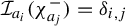 . Hence,
${\mathcal {I}}\colon {\mathcal {G}}_{\alpha , A}\to \bigoplus _{A\bmod {R_\alpha }} \mathbb {Z}$
 restricts to an isomorphism on
$\bigoplus \chi _{a_i}^-$
 , so
${\mathcal {I}}({\mathcal {G}}_{\alpha , A})/{\mathcal {I}}(\operatorname {\mathrm {Inf}}_{\alpha , A})=(\bigoplus \mathbb {Z}\cdot a_i )/\operatorname {\mathrm {Inf}}_{\alpha , A}$
 . This is an abelian group with positive rank since A contains irrational numbers; thus, it is not torsion, proving that
$\pi _{\alpha , A}$
 is not infinitesimal.
Now, consider a subgroup
$\mathbb {M}\subset \mathbb {R}$
 . Observe that every continuous function in
$C(\mathbb {T}, \mathbb {Z})$
 and the subgroup of
$R_\alpha $
 -coboundaries is trivial, whence
${\mathcal {G}}_{R_\alpha }=\mathbb {Z}$
 and the trace has image
$\tau _{\alpha }=\mathbb {Z}$
 . The injective homomorphism
$\pi _{\alpha , A}^* \colon \mathbb {Z} \to \mathbb {Z}+\bigoplus _{i}\mathbb {Z}\chi _{a_i}^-$
 restricts to a bijection
$\mathbb {Z}\mapsto \mathbb {Z}$
 between the subgroups of constant functions. In particular,
$\operatorname {\mathrm {im}}(\pi _{\alpha , A}^*)\subset \ker ({\mathcal {I}})$
 . Since
$({\mathcal {D}}_{\alpha , A}, F_{\alpha , A})$
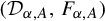 is uniquely ergodic, Proposition 5.14 implies that if
$\pi _{\alpha , A}$
 is
$\mathbb {M}$
 -measured, then
$(\mathbb {M} + \operatorname {\mathrm {im}}(\pi _{\alpha , A}))\otimes \mathbb {Q} = (\mathbb {M}+\mathbb {Z})\otimes \mathbb {Q}$
 . Conversely, assume
$(\mathbb {M} + \operatorname {\mathrm {im}}(\pi _{\alpha , A}))\otimes \mathbb {Q} = (\mathbb {M}+\mathbb {Z})\otimes \mathbb {Q}$
 . Let us show that the subgroup
$G=\tau _{\alpha , A}^{-1}(\mathbb {M})$
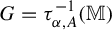 of
${\mathcal {G}}_{\alpha , A}$
 is such that
${\mathcal {I}}({\mathcal {G}}_{\alpha , A})/{\mathcal {I}}(G)$
 is torsion. Note that G contains the subgroup
$\mathbb {Z}$
 of constants if and only if
$\mathbb {M}$
 contains
$\mathbb {Z}$
 . Since
${\mathcal {I}}$
 is an isomorphism in restriction to the complement
$\bigoplus \chi _{a_i}^-$
 , we must show that
${\mathcal {G}}_{\alpha , A}/(\mathbb {Z}+G)$
 is torsion. After dividing by
$\ker (\operatorname {\mathrm {Inf}}_{\alpha , A})\subset G$
 , it is enough to show that
$\tau _{\alpha , A}({\mathcal {G}}_{\alpha , A})/\tau _{\alpha , A}(\mathbb {Z}+G)= \operatorname {\mathrm {im}}(\tau _{\alpha , A})/(\mathbb {Z}+\mathbb {M})$
 is torsion, which follows from the assumption.
Now, let us reap from the previous two subsections the corollaries of main interest.
Corollary 5.19. (Which 2-A factors of Denjoy are infinitesimal and
$\mathbb {M}$
-measured)

The 2-A factor
$\pi \colon ({\mathcal {D}}_{\alpha ,A},F_{\alpha , A}) \to ({\mathcal {D}}_{\alpha ,A^{\prime }},F_{\alpha ,A^{\prime }})$
 is infinitesimal if and only if the
$\mathbb {Q}$
 -modules
$\mathbb {Q}{A'} \subset \mathbb {Q}{A}$
 are equal. Moreover, if
$\mathbb {M}\subset \mathbb {R}$
 is a subgroup, then the 2-A factor
$\pi $
 is
$\mathbb {M}$
 -measured if and only if the subsets
$A'\cup \mathbb {M}\subset A\cup \mathbb {M}$
 generate the same
$\mathbb {Q}$
 -submodules of
$\mathbb {T}$
 .
Proof. The Denjoy systems are uniquely ergodic: let
$\tau $
 and
$\tau '$
 be their unique states so that
$\pi _*(\tau )=\tau '$
 . They are minimal Cantor, so by Theorem 5.5, the index homomorphism
${\mathcal {I}}$
 of
$\pi $
 has kernel
$\ker ({\mathcal {I}})=\operatorname {\mathrm {im}}(\pi ^*)$
 .
Hence, the hypotheses of Propositions 5.8, 5.9, and 5.14 are satisfied. Thus,
$\pi $
 is infinitesimal if and only if
$\operatorname {\mathrm {im}}(\tau )\otimes \mathbb {Q}=\operatorname {\mathrm {im}}(\tau ')\otimes \mathbb {Q}$
 , and it is
$\mathbb {M}$
 -measured if and only if
$(\operatorname {\mathrm {im}}(\tau )+\mathbb {M})\otimes \mathbb {Q} = (\operatorname {\mathrm {im}}(\tau ')+\mathbb {M})\otimes \mathbb {Q}$
 .
It follows from Theorem 3.3 that
$\operatorname {\mathrm {im}}(\tau ) \bmod {\mathbb {Z}}$
 and
$\operatorname {\mathrm {im}}(\tau ') \bmod {\mathbb {Z}}$
 are the
$\mathbb {Z}$
 -submodules of
$\mathbb {T}$
 respectively generated by A and
$A'$
 , which concludes the proof.
Corollary 5.20. (2-AI equivalence preserving the class of Denjoy systems)
The Denjoy systems
$({\mathcal {D}}_{\alpha , A}, F_{\alpha , A})$
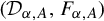 and
$({\mathcal {D}}_{\beta , B}, F_{\beta , B})$
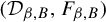 are related by 2-AI equivalencies preserving the class of Denjoy systems if and only if
$\alpha =\pm \beta \bmod {\mathbb {Z}}$
 and
$\mathbb {Q} A = \mathbb {Q} B$
 .
Proof. Suppose there is
$\epsilon \in \{\pm 1\}$
 such that
$\alpha = \epsilon \beta $
 and
$\mathbb {Q} A = \mathbb {Q} B$
 . Up to conjugacy, we may replace
$(\beta , B)$
 by
$(\epsilon \beta , \epsilon B)$
 . We have
$\mathbb {Q} A = \mathbb {Q} (A \cup B) = \mathbb {Q} B$
 , so the 2-asymptotic factors
$\pi _{A} \colon ({\mathcal {D}}_{\alpha , A \cup B}, F_{\alpha , A \cup B}) \to ({\mathcal {D}}_{\alpha , A}, F_{\alpha , A})$
 and
$\pi _{B} \colon ({\mathcal {D}}_{\alpha , A \cup B}, F_{\alpha , A \cup B}) \to ({\mathcal {D}}_{\alpha , B}, F_{\alpha , B})$
 are both infinitesimal by Corollary 5.19.
Conversely, suppose that the Denjoy systems are 2-AI equivalent through Denjoy systems. By Lemma 5.17, each 2-AI factor (blowup or blowdown) preserves the rotation number up to a sign; hence,
$\alpha = \pm \beta \bmod {\mathbb {Z}}$
 . That
$\mathbb {Q}{A} = \mathbb {Q}{B}$
 then follows from Theorem 3.3 and Corollary 5.10.
Corollary 5.21. (2-AI factors of powers of Denjoy systems)
Consider an irrational
$\alpha \in \mathbb {T}$
 and an
$R_\alpha $
 -invariant countable subset
$A \subset \mathbb {T}$
 containing zero. Fix
$m \in \mathbb {N}_{> 0}$
 and let
$A^{\prime }$
 be a set containing one point from each
$R_{\alpha }$
 -orbit in A such that
$0 \in A^{\prime }$
 and let
${A^{\prime }(m) = \{R_{m\alpha }^{k}(x) \colon x \in A^{\prime }, k \in \mathbb {Z} \}}$
 . There is a 2-AI factor between Denjoy systems
$({\mathcal {D}}_{\alpha , A}, F_{\alpha , A}^{m}) \to ({\mathcal {D}}_{m\alpha , A_{m}^{\prime }}, F_{m\alpha , A^{\prime }(m)})$
 . Hence, the Sturmian system
$(X_{m \alpha },\operatorname {\mathrm {\sigma }}_{m \alpha })$
 is 2-AI equivalent to the system
$(X_{\alpha }, \operatorname {\mathrm {\sigma }}_{\alpha }^{m})$
 .
Proof. First, observe that
$({\mathcal {D}}_{\alpha , A}, F_{\alpha , A}^{m})$
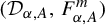 is topologically conjugate to
$({\mathcal {D}}_{m\alpha , A}, F_{m\alpha , A})$
 . The factor map
$\pi \colon ({\mathcal {D}}_{m\alpha , A}, F_{m\alpha , A}) \to ({\mathcal {D}}_{m\alpha , A^{\prime }(m)}, F_{m\alpha , A^{\prime }(m)})$
 obtained by identifying all pairs of points
$x^{-},x^{+} \in {\mathcal {D}}_{m\alpha ,A}$
 such that
$\pi _{m\alpha ,A}(x^{-})=\pi _{m\alpha ,A}(x^{+}) \in A \setminus A^{\prime }(m)$
 is 2-A, and it is infinitesimal by Corollary 5.19 since the subsets
$A^{\prime }(m) \subset A$
 generate the same
$\mathbb {Q}$
 -submodule of
$\mathbb {T}$
 . Hence, there is a 2-AI factor map
$({\mathcal {D}}_{\alpha , A}, F_{\alpha , A}^{m}) \to ({\mathcal {D}}_{m\alpha , A^{\prime }(m)}, F_{m\alpha , A^{\prime }(m)})$
 .
The last part is the special case where A is the
$R_{\alpha }$
 -orbit of
$0$
 .
Remark 5.22. (Iterated trees and fibered products of 2-A factors)
There exist 2-A factor maps between zero-dimensional systems with non-trivial fibers lying over points belonging to non-trivial asymptotic classes. We record here an example of such.
Fix an irrational
$\alpha \in \mathbb {R}$
 and let
$(X_{\alpha },\operatorname {\mathrm {\sigma }}_{\alpha })$
 be the associated Sturmian subshift with canonical 2-A factor map
$\pi \colon X_{\alpha } \to \mathbb {T}$
 . Let
$(Z,U)$
 denote the fiber product of
$\pi $
 with itself, that is,
$Z=\{(x_1,x_2) \in X_{\alpha } \times X_{\alpha } \colon \pi (x_1) = \pi (x_2)\}\subset X_\alpha \times X_\alpha $
 with
$U= \operatorname {\mathrm {\sigma }} \times \operatorname {\mathrm {\sigma }}$
 , so that we have a diagram:

We claim that
$\psi _{1}$
 and
$\psi _{2}$
 are 2-A factor maps. We argue for
$\psi _{1}$
 . Fix
$x_1 \in X_\alpha $
 . By construction,
$\psi _{1}^{-1}(x_1)= \{(x_1,x_2)\in X_\alpha \times X_\alpha \colon x_2 \in \pi ^{-1}(\pi (x_1))\}$
 . Thus,
$|{\psi _{1}^{-1}(x_1)}| = |{\pi ^{-1}(\pi (x_1))}|\in \{1,2\}$
 is equal to
$2$
 precisely when
$x_1$
 belongs to a non-trivial
$\operatorname {\mathrm {\sigma }}$
 -asymptotic class. Finally, suppose that
$\{(x_{1},x_2), (x_{1}, x_2')\}$
 is a non-trivial fiber of
$\psi _{1}$
 . Then, since
$\pi (x_{2})=\pi (x_{2}')$
 , we must have
$x_{2}\Bumpeq x_{2}'$
 for
$\operatorname {\mathrm {\sigma }}$
 ; hence,
$(x_{1},x_2)\Bumpeq (x_{1}, x_2')$
 for U.
Note that while Z is zero-dimensional, the system
$(Z,U)$
 is not minimal since the diagonal
$\{(x,x) \in X_{\alpha } \times X_{\alpha }\}$
 is proper, closed, and invariant. The off-diagonal points are isolated and they form two orbits, which are both asymptotic to the orbits of the non-trivial asymptotic pair in
$X_{\alpha }$
 . Hence, the factor
$Z\to \mathbb {T}$
 has non-trivial fibers of cardinal
$4$
 consisting of asymptotic points.
5.5 2-A factors of interval exchanges and minimal models
Fix our ordered alphabet
$\mathcal {A}=\{1,\ldots ,d\}$
 on
$d\in \mathbb {N}_{\ge 1}$
 letters and recall the previous subsections about interval exchange systems
$(X,\operatorname {\mathrm {\sigma }})\subset (\mathcal {A}, \operatorname {\mathrm {\sigma }})$
 . In particular, if a minimal subshift
$(X,\operatorname {\mathrm {\sigma }})\subset (\mathcal {A},\operatorname {\mathrm {\sigma }})$
 has complexity
$C_X(n)=(d-1)n+1$
 , then the IETs with that encoding all have ido, the same irreducible permutation
$\pi \colon \mathcal {A}\to \mathcal {A}$
 , and their lengths
$\unicode{x3bb} \colon \mathcal {A} \to \mathbb {R}_{>0}$
 correspond to the invariant measures of
$(X, \operatorname {\mathrm {\sigma }})$
 .
Let us first describe the 2-A factors of
$(X,\operatorname {\mathrm {\sigma }})\subset (\mathcal {A},\operatorname {\mathrm {\sigma }})$
 , a minimal IES with complexity
$C_X(n)=(d-1)n+1$
 and permutation
$\pi \colon \mathcal {A}\to \mathcal {A}$
 .
The proofs of the following two propositions are left as exercises. They follow from the description in [Reference DahmaniDah19, §2.1] of a minimal model for an IET, combined with the characterization [Reference Ferenczi and ZamboniFZ08] of languages associated to d-IETs with ido (relying on the notion of bispecial words).
Proposition 5.23. (Cyclic case)
The system
$(X,\operatorname {\mathrm {\sigma }})$
 factors onto a Sturmian system
$(X_\rho , \operatorname {\mathrm {\sigma }}_\rho )$
 if and only if the permutation
$\pi $
 preserves the cyclic order of
$\mathcal {A}\bmod {d}$
 . If so, then
$(X,\operatorname {\mathrm {\sigma }})$
 is uniquely ergodic and its invariant probability measure
$\unicode{x3bb} \in \mathbb {R}_{>0}^{\mathcal {A}}$
 yields an IET T with discontinuities
$\alpha _k=\sum _1^k \unicode{x3bb} _j$
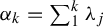 such that
$\rho =T(\alpha _d)=\alpha _{\pi (d)}$
 . Moreover
$(X,\operatorname {\mathrm {\sigma }})$
 is topologically conjugate to the Denjoy system with parameters
$\rho $
 and
$Q\equiv \{\alpha _1,\ldots ,\alpha _d\}\bmod R_\rho $
 , so its 2-A factors have already been described. Finally, if two Sturmian systems on
$\mathcal {A}=\{1,2\}$
 are topologically conjugate, then they are equal up to the morphism extending the involution
$1\leftrightarrow 2$
 .
Now, assume that
$\pi $
 is not a cyclic permutation preserving the cyclic order. We say that
$\pi \colon \mathcal {A} \to \mathcal {A}$
 can be factored at
$k\in \mathcal {A}\setminus \{d\}$
 when
$\pi (k+1)=\pi (k)+1\bmod {d}$
 , that is, when T has
$\alpha _k$
 as a removable discontinuity.
Proposition 5.24. (Acyclic case)
Suppose that
$\pi $
 does not preserve the cyclic order of
$\mathcal {A}\bmod {d}$
 , namely that
$(X,\operatorname {\mathrm {\sigma }})$
 does not factor onto a Sturmian system. The 2-A factors of
$(X,\operatorname {\mathrm {\sigma }})$
 are obtained by merging disjoint pairs of consecutive letters
$\{k,k+1\}$
 at which
$\pi $
 factors. The factored systems are minimal IES with ido on a smaller alphabet and there is a unique smallest 2-A factor. Finally, consider two minimal IES on
$\mathcal {A} = \{1,\ldots , d\}$
 that are not factorable: if they are topologically conjugate, then they are equal up to the morphism extending global inversion
$k\mapsto d+1-k$
 .
To summarize, any minimal IES
$(X,\operatorname {\mathrm {\sigma }})$
 with ido has a smallest 2-A factor
$(X_{\downarrow }, \operatorname {\mathrm {\sigma }}_{\downarrow })$
 that is an IES with ido, which is uniquely determined as a subshift on an ordered alphabet (up to order reversal of the alphabet). Let us note that if an IET has encoding X, then its minimal model will have encoding
$(X_{\downarrow }, \sigma _{\downarrow })$
 .
6 Isogenies: virtual 2-AI and flow equivalences
We now bring together our various equivalence relations with the additional move of passing to powers. Combining these will lead to our notion of isogeny.
Definition 6.1. (Virtual equivalence)
Given an equivalence relation
$\mathcal {R}$
 on systems, we say that two systems
$(X,S)$
 and
$(Y,T)$
 are virtually
$\mathcal {R}$
 when there exist
$m,n\in \mathbb {N}_{>0}$
 such that
$(X,S^m)$
 and
$(Y,T^n)$
 are
$\mathcal {R}$
 .
Virtual flow equivalence has an interpretation in terms of covers, in the following sense. Given a system
$(X,S)$
 , the product space
$X \times \mathbb {R}$
 is endowed with the diagonal action of the lattice
$\mathbb {Z}\subset \mathbb {R}$
 by
$n\cdot (x,t)=(S^{n}(x),t-n)$
 . For
$m\in \mathbb {Z}$
 , the quotient space
$\Sigma _S^{(m)} X := X\times \mathbb {R} \bmod {m\mathbb {Z}}$
 by the normal subgroup
$m\mathbb {Z}\subset \mathbb {Z}$
 is a
$\mathbb {Z}/m$
 -Galois cover of
$ \Sigma _S X$
 with covering map denoted

Note that when
$m \ge 1$
 , there is a flow equivalence

Hence, two systems
$(X,S)$
 and
$(Y,T)$
 are virtually flow equivalent if and only if there exists an orientation preserving homeomorphism between the
$m,n$
 -fold covers

We now come to one of the key definitions for us.
Definition 6.2. (Isogeny)
We say that two zero-dimensional systems
$(X,S)$
 and
$(Y,T)$
 are isogenous when there exist systems
$(X_{i},S_{i})$
 for
$1 \le i \le n$
 such that
$(X_{1},S_{1}) = (X,S)$
 ,
$(X_{n},S_{n}) = (Y,T)$
 , and for every
$1 \le i \le n-1$
 , the systems
$(X_{i},S_{i})$
 and
$(X_{i+1},S_{i+1})$
 are either virtually 2-AI equivalent or flow equivalent.
Equivalently, two systems are isogenous when they are connected by a sequence of any of the following: virtual topological conjugacies, 2-AI equivalences, and flow equivalences.
Certain properties, such as minimality or unique ergodicity, are not necessarily preserved by taking powers. Following usual terminology, given a property
$\mathtt {P}$
 for systems, we say a system
$(X,S)$
 is totally
$\mathtt {P}$
 if all powers
$(X,S^m)$
 for
$m\in \mathbb {N}_{>0}$
 have property
$\mathtt {P}$
 .
Remark 6.3. (Isogenies preserve total ergodicity)
Given two isogenous systems, if one is totally uniquely ergodic, then so is the other. This follows from the fact that both flow equivalence and 2-AI factors preserve unique ergodicity.
6.1 Isogenies of Cantor systems
Lemma 6.4. (Virtual 2-AI and flow of minimal Cantor systems preserve ratios of states)
Consider minimal Cantor systems
$(X,S)$
 and
$(Y,T)$
 with invariant probability measures
$\mu \in \mathcal {M}_{p}(X,S)$
 and
$\nu \in \mathcal {M}_{p}(Y,T)$
 . If there exists one of the following:
-
(1) a measure preserving virtual conjugacy $h \colon (X,S^{m},\mu ) \to (Y,T^{n},\nu )$
; -
(2) a measure preserving 2-AI factor $\pi \colon (X,S,\mu ) \to (Y,T,\nu )$
; -
(3) a flow equivalence $\Psi \colon \Sigma _{S}X \to \Sigma _{T}Y$
and
$\unicode{x3bb}>0$
such that
$\Psi _{*}(\mu ) = \unicode{x3bb} \nu $
;





then there exists a real
$\unicode{x3bb}> 0$
 such that the states
$\tau _{\mu }$
 and
$\tau _{\nu }$
 satisfy
$\operatorname {\mathrm {im}}(\tau _{\mu }) \otimes \mathbb {Q} = \unicode{x3bb} \cdot \operatorname {\mathrm {im}}(\tau _\nu ) \otimes \mathbb {Q}$
 .
Proof. The first item is straightforward: the image of
$\tau _{\mu } \colon {\mathcal {G}}_{S} \to \mathbb {R}$
 is equal to the image of
$\tau _{\mu } \colon {\mathcal {G}}_{S^{m}} \to \mathbb {R}$
 , and a topological conjugacy
$h \colon (X,S^{m}) \to (Y,T^{n})$
 that takes
$\mu $
 to
$\nu $
 satisfies
$\operatorname {\mathrm {im}}(\tau _{\mu }) = \operatorname {\mathrm {im}}(\tau _{\nu })$
 .
The second item follows from Proposition 5.8.
For the third item, the flow equivalence
$\Psi $
 induces an isomorphism
$\Psi ^{*} \colon {\mathcal {G}}_{T} \to {\mathcal {G}}_{S}$
 . Given
$[f] \in {\mathcal {G}}_{S}$
 , there exists
$[g] \in {\mathcal {G}}_{T}$
 such that
$\Psi ^{*}([g]) = [f]$
 , and hence,

It follows that
$\operatorname {\mathrm {im}}(\tau _{\mu }) \otimes \mathbb {Q} \subset \unicode{x3bb} \cdot \operatorname {\mathrm {im}}(\tau _{\nu }) \otimes \mathbb {Q} $
 . The same argument applied to
$\Psi ^{-1}$
 implies
$\operatorname {\mathrm {im}}(\tau _{\nu }) \otimes \mathbb {Q} \subset \unicode{x3bb} ^{-1} \cdot \operatorname {\mathrm {im}}(\tau _{\mu }) \otimes \mathbb {Q} $
 , so
$\unicode{x3bb} \cdot \operatorname {\mathrm {im}}(\tau _{\nu }) \otimes \mathbb {Q} \subset \operatorname {\mathrm {im}}(\tau _{\mu }) \otimes \mathbb {Q} $
 .
Corollary 6.5. (When isogenies preserve ratios of states)
Suppose
$(X,S)$
 and
$(Y,T)$
 are Cantor systems which are totally minimal and totally uniquely ergodic. If they are isogenous, then there exists a positive real
$\unicode{x3bb}>0$
 such that their unique invariant probability measures
$\mu $
 and
$\nu $
 satisfy

Proof. Suppose
$(X,S)$
 and
$(Y,T)$
 are both totally minimal and totally uniquely ergodic, and let
$\mu , \nu $
 be the unique invariant measures. Both 2-A factors and flow equivalences between these minimal Cantor systems induce isomorphisms between their spaces of invariant probability measures, so they take
$\mu $
 to
$\nu $
 . Moreover, a virtual conjugacy
$h \colon (X,S^{m}) \to (Y,T^{n})$
 must take the unique invariant measure
$\mu $
 under
$S^m$
 to the unique invariant measure
$\nu $
 under
$T^n$
 . Hence, the result follows from Lemma 6.4.
6.2 Isogenies of Sturmian systems and Denjoy systems
6.2.1 Isogenies of Sturmian systems
Recall that Fokkink’s Theorem 4.5 classifies Sturmian systems up to flow equivalence by the
$\operatorname {\mathrm {PGL}}_{2}(\mathbb {Z})$
 -orbit of their rotation number.
We are now in a position to prove one of our main theorems, classifying Sturmian systems up to isogenies by the
$\operatorname {\mathrm {PGL}}_2(\mathbb {Q})$
 -orbit of their rotation number.
Theorem 6.6. (Isogenies of Sturmian systems)
The following are equivalent.
-
• The points $\alpha ,\beta \in \mathbb {R}\mathbf {P}^1\setminus \mathbb {Q}\mathbf {P}^1$
belong to the same
$\operatorname {\mathrm {PGL}}_{2}(\mathbb {Q})$
-orbit. -
• The Sturmian subshifts $(X_{\alpha },\operatorname {\mathrm {\sigma }}_{\alpha })$
,
$(X_{\beta },\operatorname {\mathrm {\sigma }}_{\beta })$
are isogenous.



Proof. Suppose that
$\alpha ,\beta \in \mathbb {R}\setminus \mathbb {Q}$
 are
$\operatorname {\mathrm {PGL}}_{2}(\mathbb {Q})$
 -equivalent. Let
$M \in \operatorname {\mathrm {PGL}}_{2}(\mathbb {Q})$
 be such that
$M \alpha = \beta $
 and choose a representative
$M\in \operatorname {\mathrm {M}}_{2}(\mathbb {Z})$
 . By Lemma 7.7, we may factorize
$M = UDV$
 with
$U,V \in \operatorname {\mathrm {SL}}_{2}(\mathbb {Z})$
 and
$D = \mathrm {diag}(m,1)$
 for some
$m\in \mathbb {N}_{>0}$
 , so that
$U^{-1}\beta = DV\alpha $
 . Note that
$(X_{\alpha },\operatorname {\mathrm {\sigma }}_{\alpha })$
 is flow equivalent to
$(X_{V\alpha },\operatorname {\mathrm {\sigma }}_{V \alpha })$
 and
$(X_{\beta },\operatorname {\mathrm {\sigma }}_{\beta })$
 is flow equivalent to
$(X_{U^{-1}\beta },\operatorname {\mathrm {\sigma }}_{U^{-1}\beta })$
 by Theorem 4.5. Since
$DV\alpha = m \cdot V\alpha $
 , the systems
$(X_{V\alpha },\operatorname {\mathrm {\sigma }}_{V\alpha })$
 and
$(X_{DV\alpha },\operatorname {\mathrm {\sigma }}_{DV\alpha })$
 are virtually 2-AI equivalent by Corollary 5.21, from which one implication follows.
Now, suppose that
$(X_{\alpha },\operatorname {\mathrm {\sigma }}_{\alpha })$
 and
$(X_{\beta },\operatorname {\mathrm {\sigma }}_{\beta })$
 are isogenous. These systems are totally minimal and totally uniquely ergodic, and by Theorem 3.3, their states satisfy
$\operatorname {\mathrm {im}}(\tau _X)=\mathbb {Z}+\alpha \mathbb {Z}$
 and
$\operatorname {\mathrm {im}}(\tau _Y)=\mathbb {Z}+\beta \mathbb {Z}$
 so by Corollary 6.5, there exists
$\unicode{x3bb}>0$
 such that we have the equality of oriented lattices
$\mathbb {Q}+\alpha \mathbb {Q}=\unicode{x3bb} \mathbb {Q}+\unicode{x3bb} \beta \mathbb {Q}$
 . We thus conclude using Lemma 7.6 that
$\alpha $
 and
$\beta $
 belong to the same
$\operatorname {\mathrm {PGL}}_2(\mathbb {Q})$
 orbit.
6.2.2 Isogenies of Denjoy systems
Recall the classification of Denjoy systems up to flow equivalence from Theorem 4.7. We propose the following conjecture, classifying Denjoy systems up to isogeny. This generalizes the case of Sturmian systems.
Conjecture 6.7. (Isogenies of Denjoy systems)
For
$k\in \{0,1\}$
 , the Denjoy systems
$({\mathcal {D}}_{F_k}, F_k)$
 with invariants
$(\alpha _k, A_k)$
 are isogenous if and only if there exists
$M= (m_{ij}) \in \operatorname {\mathrm {PGL}}_2(\mathbb {Q})$
 such that

where
$\mathbb {Q}{A_k}\subset \mathbb {T}$
 denotes the
$\mathbb {Q}$
 -submodule of
$\mathbb {T}$
 generated by a subset
$A_k\subset \mathbb {T}$
 and
$\equiv $
 denotes equality of sets in
$\mathbb {T}$
 up to rotations.
For now, we can prove the following weak version of the conjecture.
Theorem 6.8. (Isogenies of Denjoy systems)
For
$k \in \{0,1\}$
 , consider Denjoy systems
$({\mathcal {D}}_{F_k}, F_k)$
 with invariants
$(\alpha _k, A_k)$
 .
-
(1) If there exists $M= (m_{ij}) \in \operatorname {\mathrm {PGL}}_2(\mathbb {Q})$
such that $$ \begin{align*} \alpha_1 = \frac{m_{11}\cdot\alpha_0+m_{12}}{m_{21}\cdot\alpha_0+m_{22}} \quad \text{and} \quad \mathbb{Q} A_1 \equiv \frac{1}{m_{21}\cdot\alpha_0+m_{22}} \cdot \mathbb{Q} A_0, \end{align*} $$then the Denjoy systems $({\mathcal {D}}_{F_k}, F_k)$
are isogenous.
-
(2) If the Denjoy systems are isogenous through a chain of Denjoy systems, then there exists $M= (m_{ij}) \in \operatorname {\mathrm {PGL}}_2(\mathbb {Q})$
such that $$ \begin{align*} \alpha_1 = \frac{m_{11}\cdot\alpha_0+m_{12}}{m_{21}\cdot\alpha_0+m_{22}} \quad \text{and} \quad \mathbb{Q} A_1 \equiv \frac{1}{m_{21}\cdot\alpha_0+m_{22}} \cdot \mathbb{Q} A_0. \end{align*} $$





Proof. For part one, consider
$M \in \operatorname {\mathrm {PGL}}_{2}(\mathbb {Q})$
 as in the assumption, and choose a lift still denoted
$M\in \operatorname {\mathrm {M}}_2(\mathbb {Z})$
 (thus,
$\det (M)\ne 0$
 ). By Lemma 7.7, we may factorize
$M = U_{1}DU_{0}$
 with
$U_{0},U_{1} \in \operatorname {\mathrm {SL}}_{2}(\mathbb {Z})$
 and
$D = \mathrm {diag}(m,1)$
 for some non-zero
$m \in \mathbb {Z}$
 . Thus,
$U_{1}^{-1}\alpha _{1} = DU_{0}\alpha _{0} = m\cdot U_{0} \alpha _{0}$
 . Let us introduce the following notation:


By Theorem 4.7, the Denjoy system
$({\mathcal {D}}_{F_{k}},F_{k})$
 is flow equivalent to the Denjoy system with invariants
$(\alpha ^{\prime }_{k},A^{\prime }_{k})$
 , and we will now show that these two systems are virtually 2-AI equivalent.
By Corollary 5.21, the Denjoy system
$({\mathcal {D}}_{\alpha ^{\prime }_0, A^{\prime }_0}, F^{m}_{\alpha _0, A^{\prime }_0})$
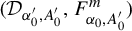 is 2-AI equivalent to the Denjoy system with invariants
$(m\cdot \alpha ^{\prime }_{0}, A^{\prime }_{0}) = (\alpha ^{\prime }_{1}, A^{\prime }_{0})$
 . Since
$U_{1}^{-1}M = DU_{0}$
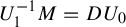 , we have
$cm_{11} + dm_{21} = g$
 and
$cm_{12}+dm_{22} = h$
 . By assumption,
$\mathbb {Q} A_{1} = ({1}/({m_{21} \cdot \alpha _{0} + m_{22}})) \cdot \mathbb {Q} A_{0}$
 and
$\alpha _{1}(m_{21} \cdot \alpha _{0} + m_{22}) = m_{11} \cdot \alpha _{0} + m_{12}$
 , so

Thus,
$\mathbb {Q} A^{\prime }_{1} = \mathbb {Q} A^{\prime }_{0}$
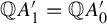 , so by Corollary 5.20, the Denjoy systems with invariants
$(\alpha ^{\prime }_{1},A^{\prime }_{0})$
 and
$(\alpha ^{\prime }_{1},A^{\prime }_{1})$
 are 2-AI equivalent, completing the proof of part one.
For part two, suppose the two Denjoy systems
$({\mathcal {D}}_{F_k}, F_k)$
 are isogenous through a chain of Denjoy systems. Recall that any isogeny can be written as a chain of flow equivalences, taking powers or roots, and 2-AI equivalences. Any 2-AI factor between Denjoy systems does not change the rotation number, and by Corollary 5.19, it does not change the rational span of the cut points. Moreover, if
$({\mathcal {D}}_{\alpha , A}, F_{\alpha , A})$
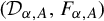 is a Denjoy system and
$m \in \mathbb {N}$
 , then
$({\mathcal {D}}_{\alpha , A}, F_{\alpha , A}^{m})$
 is a Denjoy system with rotation number
$m\alpha $
 and same cut point set. The result then follows from Theorem 4.7.
6.3 Isogenies of interval exchange systems
For an IET
$T\colon (\alpha _0,\alpha _d]\to (\alpha _0,\alpha _d]$
 with discontinuities
$\alpha _k \in (\alpha _0,\alpha _d]$
 and length vector
$\unicode{x3bb} \in (\mathbb {R}_{>0})^{\mathcal {A}}$
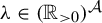 , its SAF-invariant is the element
$SAF(T)\in \mathbb {R}\wedge _{\mathbb {Q}} \mathbb {R}$
 defined by

Arnoux and Fathi showed [Reference VeechVee84a, Proposition 2.3] that if an interval
$I\subset (\alpha _0, \alpha _d]$
 intersects every T-orbit, then the IET induced by T on I has the same SAF-invariant.
The IETs on
$(0,1]$
 form a group under composition, and Sah showed [Reference VeechVee84b, Theorem 1.3] that its abelianization is given by the surjective homomorphism
$\mathrm {SAF}\colon \mathrm {IET}\to \mathbb {R}\wedge _{\mathbb {Q}} \mathbb {R}$
 .
Moreover, it is straightforward from the definition that the SAF-invariant is preserved by 2-A factors, in particular, any IET has the same SAF-invariant as its minimal model.
Definition 6.9. (Rational invariants)
Consider an IES
$(X,\operatorname {\mathrm {\sigma }})$
 with ido and let
$\mu _1,\ldots ,\mu _e$
 be its
$e\in \mathbb {N}_{>0}$
 ergodic probability measures. Each
$\mu _i$
 corresponds to an IET
$T_{\mu _i}\colon (0,1]\mapsto (0,1]$
 with that encoding, to which we associate the
$\mathbb {Q}$
 -vector space
$\mathbb {Q}\otimes \operatorname {\mathrm {im}}(\tau _{\mu _i})\subset \mathbb {R}$
 of dimension at most
$d-1$
 generated by the
$\mu _i$
 -measures of cylinders in X, and the vector
$\mathrm {SAF}(T_{\mu _i})\in \mathbb {R}\wedge _{\mathbb {Q}} \mathbb {R}$
 .
We define the rational invariants of
$(X,\operatorname {\mathrm {\sigma }})$
 as the product of subspaces
$\prod _i \mathbb {Q}\otimes \operatorname {\mathrm {im}}(\tau _{\mu _i})\subset \mathbb {R}^e$
 up to multiplication by
$\unicode{x3bb} \in \mathbb {R}_{>0}$
 on
$\mathbb {R}^e$
 together with the product of vectors
$\prod _i \mathrm {SAF}(T_{\mu _i})\in (\mathbb {R}\wedge _{\mathbb {Q}} \mathbb {R})^e$
 up to multiplication by
$m/n\in \mathbb {Q}_{>0}$
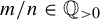 .
Conjecture 6.10. (Rational invariants of isogenies)
If two IES with ido are isogenous, then they have the same rational invariants.
Let us prove the conjecture in the totally ergodic case for isogenies remaining among IES.
Proposition 6.11. (Isogenous totally ergodic IES have the same rational invariants)
Consider two IES with ido that are totally uniquely ergodic. If they are related by isogenies through IES, then they have the same rational invariants.
Proof. Note that an IES with ido has its powers with ido; hence, it is totally minimal. The invariance of the
$\mathbb {R}$
 -projectivized rational tracial image subgroup
$\operatorname {\mathrm {im}}(\tau )\otimes \mathbb {Q} \subset \mathbb {R}$
 follows from Corollary 6.5 (the
$\mathbb {R}$
 -projectivization is needed because of flow equivalences). The invariance of the
$\mathbb {Q}$
 -projectivized vector
$\mathrm {SAF}(T_\mu )$
 follows from the properties of the
$\mathrm {SAF}$
 -invariant (the
$\mathbb {Q}$
 -projectivization is required because of virtual conjugacies).
This result applies to the IES with ido that are linearly recurrent (see §2.1).
Corollary 6.12. (Linearly recurrent IES with ido)
Consider two minimal IES with ido that are linearly recurrent. If they are isogenous through IES, then they have the same rational invariants.
Proof. Note that if an IES has ido, then its powers are also IES with ido, and hence totally minimal (by Keane). We saw in §2.1 (using Boshernitzan’s criterion for linear recurrence) that if a subshift is totally minimal and linearly recurrent, then it is totally linearly recurrent; hence, totally ergodic. Thus, IES with ido that are linearly recurrent are totally ergodic.
Remark 6.13. (Diophantine properties of IES)
The fact that a real number is irrational if and only if its continued fraction expansion is infinite generalizes to the fact that an IES has ido if and only if its Rauzy induction is infinite.
The fact that an irrational is badly approximable by rationals if and only if its continued fraction expansion has bounded entries generalizes to the fact that an IES with ido satisfies Boshernitzan’s criterion if and only if its Rauzy induction yields a primitive proper S-adic representation.
The fact that real numbers with infinite periodic continued fraction expansions correspond to slopes of foliations of the torus that are fixed by elements of the mapping class group generalizes to the fact that IES with ido and infinite periodic Rauzy induction correspond to the attractive foliations of pseudo-Anosov mapping class of translation surfaces.
More specifically, we wish to mention the special case of minimal IES that are self-induced. A system
$(X,S)$
 is called self-induced when it admits a proper return system
$(C, S_C)$
 such that
$(X,S)$
 and
$(C,S_C)$
 are topologically conjugate. For a minimal subshift, this is equivalent to saying that it is substitutive in the sense of [Reference Durand, Ormes and PetiteDOP18]. For IES, this is equivalent to saying that its Rauzy induction is periodic. Let us recall the well-known relation between self-induced IES and pseudo-Anosov mapping classes of orientable surfaces.
Consider a minimal IES
$(X,S)$
 on d letters and assume that it is self-induced. Under these conditions, it must satisfy Keane’s ido condition and it is linearly recurrent; hence, uniquely ergodic. By unique ergodicity, it arises from a unique IET
$T\colon (0,1]\to (0,1]$
 up to conjugation by
$x \mapsto 1-x$
 on the complement of the discontinuities. The Rauzy induction will be infinite (ido condition) and periodic (by the self-induced condition). Hence, the corresponding length data
$\unicode{x3bb} \in \mathbb {R}_+^d$
 are given by the probability right eigenvector of a primitive matrix
$M\in \operatorname {\mathrm {SL}}_d(\mathbb {N})$
 for its maximal eigenvalue
$\unicode{x3bb} _0 \in \mathbb {R}_+$
 (so the entries
$\unicode{x3bb} _1,\ldots ,\unicode{x3bb} _d$
 lie in the algebraic number field
$\mathbb {Q}(\unicode{x3bb} _0)$
 ). Moreover, there are preferred suspension data given by the dual left eigenvector of M for that eigenvalue
$\unicode{x3bb} _0$
 : the zippered-rectangle construction [Reference YoccozYoc10, §4] yields a translation surface
$\bar {\Sigma }_S$
 that is marked by a horizontal segment, whose vertical and horizontal directions of
$\bar {\Sigma }_S$
 are the attractive and repulsive line-fields of a unique primitive pseudo-Anosov mapping class
$A\in \operatorname {\mathrm {Mod}}^+(\bar {\Sigma }_S)$
 . After puncturing
$\bar {\Sigma }_S$
 at its singularities (namely those of the stable or unstable foliations of A), we obtain a punctured surface
$\bar {\Sigma }^*_S$
 whose negative Euler characteristic is equal to the number
$-\chi (\bar {\Sigma }^*_S) = d-1$
 of internal discontinuities of the IET T.
Corollary 6.14. (Type preserving isogenies of self-induced IES)
If two minimal self-induced IES are isogenous through IES, then they have the same rational invariants.
The case of self-induced IES thus provides a terrain to investigate to what extent the rational invariants of IES determine their isogeny class. This motivates the following.
Question 6.15. (Rational invariants of pseudo-Anosov mapping classes)
Given an irreducible pseudo-Anosov mapping class of an oriented surface, what are the rational invariants of its attracting measured lamination? Under which conditions do the rational invariants of self-induced IES uniquely determine them up to isogenies (among IES)?
The IETs whose lengths generate a quadratic extension of
$\mathbb {Q}$
 were studied in [Reference Boshernitzan and CarrollBC97]. The main result is that they coincide with IETs such that repeatedly inducing on sub-intervals bounded by discontinuities yields a finite number of IETs (generalizing Lagrange’s theorem for the continued fraction expansion of quadratic numbers). In particular, they satisfy Keane’s idoc, and hence are totally minimal.
Remark 6.16. (Purely periodic quadratic IES)
Boshernitzan and Carroll also characterize those IETs with quadratic lengths that are purely periodic under Rauzy induction (namely that are self-induced) in terms of pseudo-Anosov classes whose dilatation factor is a quadratic irrational. Note that [Reference Boshernitzan and CarrollBC97, Corollary 4.4] shows that when the foliation is orientable, these are obtained as branched covers of the torus with a foliation of quadratic irrational slope.
Corollary 6.17. (Quadratic IES)
If two minimal quadratic IES are isogenous through IES, then they have the same rational invariants.
Proof. We already noted that a minimal quadratic IES satisfies Keane’s idoc, so it is totally minimal. We now show that it is totally uniquely ergodic so that we may apply Proposition 6.11.
By [Reference Boshernitzan and CarrollBC97, Theorem 6.1], a minimal quadratic IES is uniquely ergodic. A power of a minimal IES that is quadratic is a minimal IES that is quadratic (its lengths lie in the same quadratic field); hence, it is again uniquely ergodic.
Conjecture 6.18. (Veech group commensurators)
Consider two isogenous IES. If one is minimal self-induced, then so is the other. For such a pair of isogenous minimal self-induced IES, the associated translation surfaces with pseudo-Anosov automorphisms should satisfy the following: one is Veech if and only if the other is Veech, in which case, the Veech groups have isomorphic commensurators in
$\operatorname {\mathrm {PGL}}_2(\mathbb {R})$
 .
6.4 Classifying systems up to isogeny: questions and constructions
Our attempts at proving Conjectures 6.7 and 6.10 led to the following questions and constructions, which are interesting in their own right.
Given a family of zero-dimensional systems (such as Denjoy or IES for instance), a natural goal would be to find classification results for the isogeny classes within that family (or at least for isogenies through members of the family).
Ideally, one might hope to find a simple complete set of isogeny-invariants. Such invariants may involve the structure of the ordered abelian group of coinvariants and of its morphisms to
$\mathbb {R}$
 given by ergodic states.
6.4.1 Factoring isogenies
Recall that isogenies involve compositions of flow equivalencies and virtual 2-AI equivalencies, in any order. The following factorization result could be of help in classifying systems up to isogeny (at least in restriction to certain classes).
Question 6.19. (Simple isogenies)
If two systems
$(X,S)$
 and
$(Y,T)$
 are isogenous, must there exist
$m,n\in \mathbb {N}_{\ge 1}$
 such that the systems
$(X,S^m)$
 and
$(Y,T^n)$
 are 2-AI equivalent to systems that are flow equivalent; diagrammatically:

A positive answer to the question would improve the classification results for Denjoy systems Theorem 6.8 and IES Proposition 6.11 by removing the hypothesis that the chain of equivalences in the isogeny remain within the respective class.
6.4.2 Minimal models under 2-A factors
One is naturally led to search for ‘minimal models’ of systems under 2-A or 2-AI factors. Those may be applied to obtain the smallest systems
$(X',S')$
 and
$(Y',T')$
 in Question 6.19.
Question 6.20. (Factoring asymptotic orbits)
Given a system
$(X,S)$
 with a pair of asymptotic points
$x\bumpeq x'$
 , when does there exist a 2-A factor
$\pi \colon (X,S)\to (Y,T)$
 such that
$\pi (x)=\pi (x')$
 ? Or simply such that
$\pi (\{S^n(x)\colon n\in \mathbb {Z}\})=\{S^n(x')\colon n\in \mathbb {Z}\}$
 ?
The following question aims at a general construction encompassing the results in §5.5, which provide minimal models for IES.
Question 6.21. (Terminal 2-A factors)
Let
$(X,S)$
 be a system and consider the category of factors
$(X,S)\to (Y,T)$
 obtained as a composition of 2-A factors (respectively, 2-AI factors). Does it admit a universal terminal element? In restriction to which families of systems does this hold? When such minimal models exist, how do they relate to maximal equicontinuous factors?
7 Virtual and eventual flow equivalence
For an equivalence relation on systems, we have already introduced the notion of virtual equivalence, which asks that some powers are equivalent. The stronger notion of eventual equivalence is defined as follows.
Definition 7.1. (Eventual equivalence)
Given an equivalence relation
$\mathcal {R}$
 on systems, we say that two systems
$(X,S)$
 and
$(Y,T)$
 are eventually
$\mathcal {R}$
 when there exist
$k\in \mathbb {N}$
 such that
$(X,S^m)$
 and
$(Y,T^m)$
 are
$\mathcal {R}$
 for all
$m \ge k$
 .
Remark 7.2. (Some easy implications)
Since topological conjugacy implies flow equivalence, it follows that eventual topological conjugacy implies eventual flow equivalence and virtual conjugacy implies virtual flow equivalence.

Eventual topological conjugacy has played an important role, especially in the context of shifts of finite type. Furthermore, for shifts of finite type, the relation between eventual conjugacy and flow equivalence has also been studied in [Reference BoyleBoy00], and more recently in [Reference BoyleBoy26], where it was shown that for all shifts of finite type, eventual conjugacy implies flow equivalence.
In general, eventual flow equivalence does not imply eventual conjugacy and flow equivalence does not imply eventual flow equivalence; in fact, both of these implications can fail already for shifts of finite type. We are grateful to Mike Boyle for communicating to us these facts and showing us the following theorem.
Theorem 7.3. (SFT examples)
For non-negative integral matrix
$A\in \operatorname {\mathrm {M}}_d(\mathbb {N})$
 , let
$(X_{A},\operatorname {\mathrm {\sigma }}_{A})$
 denote the associated edge shift of finite type.
-
(1) Suppose $C,D \in \operatorname {\mathrm {M}}_2(\mathbb {N})$
are primitive with
$\det (C) = \det (D) = -1$
, but different spectral radii, and set
$A=I+C, B=I+D$
. Then, the shifts of finite type
$(X_{A},\operatorname {\mathrm {\sigma }}_{A})$
and
$(X_{B},\operatorname {\mathrm {\sigma }}_{B})$
are flow equivalent, but not eventually flow equivalent. -
(2) There exist primitive $E,F\in \operatorname {\mathrm {M}}_d(\mathbb {N})$
such that for every
$m \ge 1$
, the systems
$(X_{E},\operatorname {\mathrm {\sigma }}_{E}^{m})$
and
$(X_{F},\operatorname {\mathrm {\sigma }}_{F}^{m})$
are flow equivalent, but
$(X_{E},\operatorname {\mathrm {\sigma }}_{E})$
, and
$(X_{F},\operatorname {\mathrm {\sigma }}_{F})$
are not eventually conjugate.








Explicit examples satisfying item
$(2)$
 can be extracted from the proof of their existence, but are cumbersome to write down, and we omit them.
Question 7.4. (From eventual flow equivalence to flow equivalence or topological conjugacy)
In which classes of systems does eventual flow equivalence imply topological conjugacy? In which classes of systems does eventual flow equivalence imply flow equivalence?
In this section, we show that eventual flow equivalence implies topological conjugacy for Sturmian systems (Theorem 7.24) and Denjoy systems (Theorem 7.32). It may be that eventual flow equivalence implies topological conjugacy among large classes of minimal systems, but the proof would require a deeper understanding of topological invariants under flow equivalence and powers, which would have to subsume the difficulties of the self-induced Sturmian case (see proof of Theorem 7.15 as well as Example 7.17 and Question 7.18).
7.1 Eventual
$\operatorname {\mathrm {PGL}}_2(\mathbb {Z})$
-equivalence of real numbers

The purpose of this subsection is to prove Theorem 7.15. We first gather arithmetic lemmas (that serve in past, present, and future subsections) about rank-
$2$
 modules and
$\operatorname {\mathrm {PGL}}_2$
 -equivalence.
Lemma 7.5. For
$\alpha ,\beta \in \mathbb {R}\setminus \mathbb {Q}$
 , we have
$(\mathbb {Z}+\alpha \mathbb {Z}) = (\mathbb {Z} + \beta \mathbb {Z}) \iff \alpha =\pm \beta \bmod {\mathbb {Z}}$
 .
Proof. If
$(\mathbb {Z}+\alpha \mathbb {Z}) = (\mathbb {Z} + \beta \mathbb {Z})$
 , then there exist
$u,v,x,y\in \mathbb {Z}$
 such that
$\alpha =u+v\beta $
 and
$\beta =x+y\alpha $
 . Thus,
$\alpha =(u+vx)+vy\alpha $
 , which implies
$vy=1$
 ; hence,
$v=y$
 and are equal to
$\pm 1$
 , which proves the implication. The converse implication is easy.
We will only apply the following Lemma 7.6 with
$\mathbb {K}=\mathbb {R}$
 or a real quadratic number field, and
$\mathcal {O}=\mathbb {Z}$
 or an order in such a quadratic number field.
Lemma 7.6. (Proportional rank-
$2$
lattices)

Consider a field
$\mathbb {K}$
 containing a ring
$\mathcal {O}$
 and
$\alpha ,\beta \in \mathbb {K}$
 . The numbers
$\alpha ,\beta \in \mathbb {K}$
 are
$\operatorname {\mathrm {PGL}}_{2}(\mathcal {O})$
 -equivalent if and only if there exists
$\unicode{x3bb} \in \mathbb {K}^*$
 such that
$(\mathcal {O}+\alpha \mathcal {O}) = \unicode{x3bb} (\mathcal {O} + \beta \mathcal {O})$
 .
Proof.
$\implies $
 Suppose that there exists
$M\in \operatorname {\mathrm {PGL}}_2(\mathcal {O})$
 whose action on
$\mathbb {K}\mathbf {P}^1$
 satisfies
$\beta = M\alpha $
 . Choose a representative in
$M=(m_{ij})\in \operatorname {\mathrm {GL}}_{2}(\mathcal {O})$
 so that
$\beta = ({m_{11} \alpha + m_{12}})/({m_{21} \alpha + m_{22}})$
 . Thus, for
$x,y\in \mathcal {O}$
 , we have
$x \cdot \beta +y \cdot 1=((m_{11}x+m_{21}y)\alpha +(m_{12}x + m_{22} y) \cdot 1)({1}/({m_{21}\alpha + m_{22}}))$
 , and the map
$(x,y)\in \mathcal {O}^2\mapsto (m_{11}x+m_{21}y,m_{12}x + m_{22} y)\in \mathcal {O}^2$
 is the linear automorphism corresponding to multiplication by M on the right. In other words, we have the following equality of
$\mathcal {O}$
 -submodules of rank
$\le 2$
 of
$\mathbb {K}$
 :

which proves
$(\mathcal {O}+\alpha \mathcal {O})=\unicode{x3bb} (\mathcal {O}+\beta \mathcal {O})$
 for
$\unicode{x3bb} = 1/(m_{21} \alpha + m_{22})\in \mathbb {K}$
 .
$\impliedby $
 Suppose that
$\unicode{x3bb} \in \mathbb {K}^*$
 satisfies
$(\mathcal {O}+\alpha \mathcal {O}) = \unicode{x3bb} (\mathcal {O} + \beta \mathcal {O})$
 . The multiplication by
$\unicode{x3bb} $
 yields an isomorphism of
$\mathcal {O}$
 -modules
$M_\unicode{x3bb} \colon (\mathcal {O}+\beta \mathcal {O}) \to (\mathcal {O} + \alpha \mathcal {O})$
 , which in the bases
$(1,\beta ), (1,\alpha )$
 yields a matrix
$M=(m_{ij})\in \operatorname {\mathrm {GL}}_2(\mathcal {O})$
 such that
$\unicode{x3bb} \cdot \beta = m_{11}\alpha +m_{12}$
 and
$\unicode{x3bb} \cdot 1 = m_{21}\alpha +m_{22}$
 , whereby
$\beta =M\alpha $
 for the action of
$M\in \operatorname {\mathrm {PGL}}_2(\mathcal {O})$
 on
$\mathbb {K}\mathbf {P}^1$
 .
Let us now recall the Smith normal form. For a ring
$\mathcal {O}$
 , we denote by
$\mathcal {O}^\times $
 and
$\mathcal {O}^*$
 its invertible and non-zero elements, respectively. A subset of
$\mathcal {O}$
 consists of coprime elements when it generates
$\mathcal {O}$
 as an
$\mathcal {O}$
 -module.
Lemma 7.7. (Smith normal form)
Let
$\mathcal {O}$
 be a principal ideal domain with fraction field
$\mathbb {K}$
 . Every
$A\in \operatorname {\mathrm {M}}_2(\mathcal {O})$
 with
$\det (A)\ne 0$
 and globally coprime entries has a factorization of the form
$A=UMV$
 with
$U,V\in \operatorname {\mathrm {SL}}_2(\mathcal {O})$
 and
$M=\mathrm {diag}(m,1)$
 for
$m\in \mathcal {O}^*$
 whose class
$m \bmod {\mathcal {O}^\times }$
 is uniquely determined by A. Hence, the automorphism group
$\operatorname {\mathrm {PGL}}_2(\mathbb {K})$
 of the projective line
$\mathbb {K}\mathbf {P}^1$
 is generated by the union of its:
-
• subgroup of integral units $\operatorname {\mathrm {PSL}}_2(\mathcal {O})$
; -
• submonoid of integral multiplications $\mathcal {O}^* \simeq \{x\mapsto mx\colon m\in \mathcal {O}^*\}$
.


Proof. Every element in
$\operatorname {\mathrm {PGL}}_2(\mathbb {K})$
 has a representative
$A\in \operatorname {\mathrm {M}}_2(\mathcal {O})$
 with
$\det (A)\ne 0$
 and globally coprime entries, so the second statement will follow from the first.
The Smith normal form (as stated in [Reference StanleySta16]) provides a factorization
$A=PDQ$
 for some
$P,Q\in \operatorname {\mathrm {GL}}_2(\mathcal {O})$
 and
$D=\mathrm {diag}(1,d)$
 , where
$d \in \mathcal {O}^*$
 is unique up to multiplication by units
$\mathcal {O}^\times $
 .
Observe that
 conjugates
$D=\mathrm {diag}(1,d)$
 to
$D'=\mathrm {diag}(d,1)$
 , so
$A=P'D'Q'$
 with
$P'=PJ, Q'=JQ \in \operatorname {\mathrm {GL}}_2(\mathcal {O})$
 . We deduce the desired factorization by setting
$U=P'\mathrm {diag}(\det (P'),1)$
 ,
$V=\mathrm {diag}(\det (Q'),1) Q'$
 , and
$D=\mathrm {diag}(d/\det (P'Q'),1)$
 .
The following two remarks recall some background on quadratic orders and their units that will serve subsequently.
Remark 7.8. (Orders in quadratic fields and Dirichlet unit theorem)
Consider a real quadratic field
$\mathbb {K} \subset \mathbb {R}$
 . An order is a subring
$\mathcal {O}\subset \mathbb {K}$
 that is also a
$\mathbb {Z}$
 -module of rank two and its discriminant
$\mathrm {disc}(\mathcal {O})\in \mathbb {N}_{>0}$
 is defined as the determinant of a
$\mathbb {Z}$
 -basis. The ring of integers
$\mathcal {O}_{\mathbb {K}}$
 contains every other order and its discriminant is denoted
$\Delta _{\mathbb {K}}$
 . (These so-called fundamental quadratic discriminants
$\Delta _{\mathbb {K}}$
 can be characterized as the positive integers that are either square-free and
$\equiv 1\bmod {4}$
 or else
$4$
 times a square-free number that is
$\ne 1\bmod {4}$
 , see [Reference CohnCoh78, Reference HatcherHat22].) Thus, every order
$\mathcal {O} \subset \mathbb {K}$
 is of the form
$\mathbb {Z}+f\mathcal {O}_{\mathbb {K}}$
 , where
$f= [\mathcal {O}_{\mathbb {K}} \colon \mathcal {O}]\in \mathbb {N}_{>0}$
 is called its conductor, so it has discriminant
$\Delta =f^2\Delta _{\mathbb {K}}$
 . Conversely, if
$\Delta \in \mathbb {N}$
 is such that
$\mathbb {Q}(\sqrt {\Delta })=\mathbb {K}$
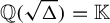 , then there is a unique order
$\mathcal {O}_\Delta \subset \mathcal {O}_{\mathbb {K}}$
 of discriminant
$\Delta $
 .
Remark 7.9. (Dirichlet unit theorem)
Consider a real quadratic field
$\mathbb {K} \subset \mathbb {R}$
 and denote by
$\gamma \in \mathbb {K} \mapsto \bar {\gamma }\in \mathbb {K}$
 the Galois involution so that
$\gamma \bar {\gamma }$
 is the norm of
$\gamma $
 . By Dirichlet’s unit theorem [Reference CohnCoh78, Reference HatcherHat22], its ring of integers
$\mathcal {O}$
 has a group of units
$\mathcal {O}_{\mathbb {K}}^{\times }= \{\gamma \in \mathcal {O}\colon \gamma \bar {\gamma }=\pm 1\}$
 .
The positive units admit a unique minimal element
$\varepsilon _{\mathbb {K}}=\min \mathcal {O}_{\mathbb {K}}^{\times } \cap \mathbb {R}_{>0}$
 , called the fundamental unit of
$\mathcal {O}_{\mathbb {K}}$
 . That yields the presentation
$\mathcal {O}_{\mathbb {K}}^{\times } = \{\pm \varepsilon ^e \colon e\in \mathbb {Z}\}$
 .
For
$f\in \mathbb {N}_{>0}$
 , let
$\Delta =f^2\Delta _{\mathbb {K}}$
 and consider the order
$\mathcal {O}_\Delta \subset \mathcal {O}_{\mathbb {K}}$
 : its units form a subgroup of index f in
$\mathcal {O}_{\mathbb {K}}^\pm $
 , namely
$\mathcal {O}_\Delta ^\pm = \{\pm \varepsilon ^{fe}\colon e\in \mathbb {Z}\}$
 .
Denoting
$\varepsilon _\Delta =t+s\tfrac {1}{2} \sqrt {\Delta }$
 for
$(2t,s)\in \mathbb {N}\times \mathbb {Z}$
 yields the fundamental solution of the Pell–Fermat equation
$(2t)^2-s^2\Delta =\pm 4$
 (where again, the equation with
$+4$
 always has a solution whereas that with
$-4$
 may or may not have one).
Now, we relate the action of
$\operatorname {\mathrm {PGL}}_2(\mathbb {Q})$
 on
$\mathbb {R}\mathbf {P}^1$
 and real quadratic numbers.
Lemma 7.10. (Stabilizers in
$\operatorname {\mathrm {PGL}}_2(\mathbb {Q})$
)

Consider a real quadratic irrational number
$\alpha \in \mathbb {R}\mathbf {P}^1$
 and let
$a,b,c\in \mathbb {Z}$
 be coprime such that
$a\alpha ^{2}+b\alpha +c=0$
 . Under the projective action of
$\operatorname {\mathrm {PGL}}_{2}(\mathbb {Q})$
 on
$\mathbb {R}\mathbf {P}^1$
 , the stabilizer subgroup of
$\alpha $
 is parameterized by
$[t:s]\in \mathbb {Q}\mathbf {P}^1$
 according to

Note that
$\det (A)=t^2-s^2\Delta /4$
 . In particular, the stabilizer of
$\alpha $
 under the action of
$\operatorname {\mathrm {SL}}_2^\pm (\mathbb {Q})$
 corresponds to the rational points
$(2t,s)\in \mathbb {Q}\times \mathbb {Q}$
 on the Pell–Fermat conic
$(2t)^2- s^2\Delta =\pm 4$
 .
Proof. Suppose
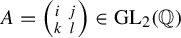 satisfies
$A\alpha =\alpha $
 , namely
$k\alpha ^{2}+(l-i) \alpha -j = 0$
 . If
$k=0$
 , then
$i=l$
 and
$j=0$
 ; hence,
$A = {\mathbf {1}}$
 in
$\operatorname {\mathrm {PGL}}_{2}(\mathbb {Q})$
 and this corresponds to
$s=0$
 . Otherwise, since the minimal polynomial of
$\alpha $
 over
$\mathbb {Q}$
 is projectively unique, there exists
$s\in \mathbb {Q}\setminus \{0\}$
 such that
$(k,(l-i),-j)=s.(a,b,c)$
 , so we obtain the desired form for A.
Conversely, any matrix of the given form fixes
$\alpha $
 .
Lemma 7.11. (Stabilizer in
$\operatorname {\mathrm {PGL}}_2(\mathbb {Z})$
)

Consider a real quadratic irrational
$\alpha \in \mathbb {R}$
 .
There is a unique triple of coprime integers
$a,b,c\in \mathbb {Z}$
 such that
$\alpha =({-b+\sqrt {\Delta }})/{2a}$
 with
$\Delta = b^2-4ac$
 . There is a unique primitive hyperbolic matrix
$F_\alpha \in \operatorname {\mathrm {PGL}}_2(\mathbb {Z})$
 with attractive fixed point
$\alpha $
 and its entries are expressed in terms of the fundamental
$(\pm )$
 -unit
$\varepsilon _\Delta =t+s\tfrac {1}{2}\sqrt {\Delta }\in \mathcal {O}_\Delta ^{\times }$
 a,

Under the projective action of
$\operatorname {\mathrm {PGL}}_{2}(\mathbb {Z})$
 on
$\mathbb {R}\mathbf {P}^1$
 , the stabilizer of
$\alpha \in \mathbb {R}\mathbf {P}^1$
 coincides with the maximal cyclic subgroup
$\{F_\alpha ^e \colon e \in \mathbb {Z} \}$
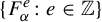 generated by
$F_\alpha $
 .
For two real quadratic irrationals
$\alpha , \beta \in \mathbb {R}$
 , an element
$C\in \operatorname {\mathrm {PGL}}_2(\mathbb {Q})$
 satisfies
$C\alpha = \beta $
 if and only if
$CF_\alpha C^{-1}=F_\beta $
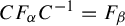 .
Proof. These classical results can be derived from the previous lemma and the structure of the discrete subgroup
$\operatorname {\mathrm {PSL}}_2(\mathbb {Z})\subset \operatorname {\mathrm {PGL}}_2(\mathbb {R})$
 . We refer to [Reference LachaudLac88, Reference SimonSim22a, Reference SimonSim22b] for details.
Remark 7.12. (Expansion factor is unit)
Let
$M\in \operatorname {\mathrm {PGL}}_2(\mathbb {Z})$
 such that
$M^2$
 is hyperbolic with attractive fixed point
$\alpha \in \mathbb {R}$
 . We have
$M\alpha =\alpha $
 and taking the Galois conjugate,
$M\bar {\alpha }=\bar {\alpha }$
 ; therefore, we have a diagonalization of M:

and the product of eigenvectors
$(m_{21} \alpha + m_{22})(m_{21} \bar {\alpha } + m_{22}) = \det (M)=\pm 1$
 reveals that the expansion factor
$(m_{21} \alpha + m_{22})\in \mathbb {Z}[\alpha ]^\times $
 is a quadratic unit.
Remark 7.13. (
$\operatorname {\mathrm {PGL}}_2(\mathbb {Z})$
-equivalence with multiples)

For
$m\in \mathbb {N}_{>1}$
 , a real irrational
$\alpha $
 is
$\operatorname {\mathrm {PGL}}_2(\mathbb {Z})$
 -equivalent to
$m\alpha $
 if and only if it is the root of a primitive integral quadratic polynomial
$ax^2+bx+c\in \mathbb {Z}[x]$
 with discriminant
$\Delta =b^2-4ac$
 such that
$m\mid a$
 and the Pell–Fermat equation
$(2t)^2-s^2\Delta =\pm 4m$
 has an integral solution
$(t,s)\in \mathbb {Z}\times \mathbb {Z}$
 with
$2m\mid 2t+sb$
 .
Let
$m\in \mathbb {N}_{>1}$
 and consider a real irrational
$\alpha $
 that is
$\operatorname {\mathrm {PGL}}_2(\mathbb {Z})$
 equivalent to
$m \alpha $
 . This implies that
$\alpha $
 is quadratic, so we may consider the unique triple of coprime integers
$a,b,c\in \mathbb {Z}$
 such that
$\alpha = ({-b+\sqrt {\Delta }})/{2a}$
 , where
$\Delta =b^2-4ac$
 . Since the discriminant
$\Delta $
 of such a quadratic number is invariant under the
$\operatorname {\mathrm {PGL}}_2(\mathbb {Z})$
 -action, we find by writing
$m\alpha = ({-mb+m\sqrt {\Delta }})/{2a}=({-b'+\sqrt {\Delta }})/{2a'}$
 that
$a=ma'$
 and
$b'=b$
 , in particular, m must divide a.
Writing
$M\alpha =m\alpha $
 with
 , we find that
$mk\alpha ^2+(ml-i)\alpha -j=0$
 ; hence, there exists
$s\in \mathbb {Z}$
 such that
$s.(a,b,c)=(mk, ml-i, -j)$
 . Taking the discriminant yields an integral solution
$(2t,s)$
 to the Pell–Fermat equation
$(2t)^2-s^2\Delta =4m\det (M)$
 with
$2t+sb=2ml$
 .
Conversely, if the Pell equation
$(2t)^2-s^2\Delta =\pm 4m$
 has an integral solution
$(t,s)$
 , we may determine
$i,j,k,l\in \mathbb {Q}$
 satisfying
$il-kj=\pm 1$
 from the equations
$2t=ml+i$
 and
$s(a,b,c)=(mk, ml-i, -j)$
 , as
$i=(2t-sb)/2$
 ,
$l=(2t+sb)/2m$
 ,
$k=sa/m$
 ,
$j=-sc$
 . If
$m\mid a$
 and
$2m\mid (2t+sb)$
 , then
$i,j,k,l\in \mathbb {Z}$
 .
Question 7.14. (
$\operatorname {\mathrm {PGL}}_2(\mathbb {Z})$
-equivalence with multiples)

Can one provide alternative descriptions for the quadratic numbers in Remark 7.13 so as to answer the following questions?
-
(1) Can we construct an infinite family of examples in each quadratic field?
-
(2) What are the corresponding ideal classes of quadratic orders?
-
(3) Can we characterize the corresponding geodesics in the modular surface?
We are now ready to prove the main arithmetic result of this subsection, which we believe is novel and of independent interest.
Theorem 7.15. (Eventual
$\operatorname {\mathrm {PGL}}_2(\mathbb {Z})$
-equivalence)

Consider irrationals
$\alpha ,\beta \in \mathbb {R}\setminus \mathbb {Q}$
 . Consider a subset of rational primes
$\mathbb {P}'\subset \mathbb {P}$
 having full Dirichlet density (say all but finitely many). If for all
$n\in \mathbb {P}'$
 , the numbers
$n\alpha ,n\beta $
 are
$\operatorname {\mathrm {PGL}}_2(\mathbb {Z})$
 -equivalent, then
$\alpha =\pm \beta \bmod {\mathbb {Z}}$
 .
Proof. Fix
$m\in \mathbb {P}'$
 and consider for each
$n \in \mathbb {P}^{\prime }_{\ge m}$
 , an element
 satisfying
$C_{n} \cdot (n\alpha ) = n\beta $
 . Thus, for any
$n \in \mathbb {P}^{\prime }_{\ge m}$
 , we have
$B_{n} \alpha = \beta $
 , where
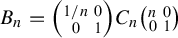 ; hence, the matrix
$A_{n} = B_{m}^{-1}B_{n} \in \operatorname {\mathrm {PGL}}_2(\mathbb {Q})$
 with
$\det (A_{n})=\pm 1\bmod {(\mathbb {Q}^*)^2}$
 stabilizes
$\alpha \in \mathbb {R}\mathbf {P}^1$
 . Note that since
$m\alpha ,m\beta $
 are
$\operatorname {\mathrm {PGL}}_2(\mathbb {Z})$
 -equivalent, they are either both non-quadratic or both generate the same quadratic field.
Suppose first that
$\alpha ,\beta $
 have degree
$>2$
 . In this case, the stabilizer of
$\alpha $
 is
$\{\pm {\mathbf {1}}\}$
 , so we must have
$A_{n} = \pm {\mathbf {1}}$
 so
$B_{m} = \pm B_{n}$
 . Writing this out in terms of the coefficients of
$C_{m}, C_{n}\in \operatorname {\mathrm {PGL}}_2(\mathbb {Z})$
 and letting
$n\to \infty $
 shows that
$B_{m}$
 is upper triangular. Thus,
$C_{m}$
 is upper triangular with diagonal entries
$\pm 1$
 and hence,
$\alpha =\pm \beta \bmod {\mathbb {Z}}$
 .
Suppose now that
$\alpha ,\beta $
 are quadratic irrational. Consider the unique primitive
$(a,b,c)\in \mathbb {Z}^3$
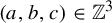 such that
$\alpha =({-b+\sqrt {\Delta }})/{2a}$
 with
$\Delta =b^2-4ac$
 (not a rational square; hence,
$ac\ne 0$
 ). By Lemma 7.10, there exist
$t_{n} , s_{n} \in \mathbb {Q}$
 such that
 . If there exist infinitely many
$n \in \mathbb {P}^{\prime }_{\ge m}$
 such that
$A_{n} = \pm {\mathbf {1}}$
 , then we are done as for the non-quadratic case, so we now assume otherwise and consider only those
$n \in \mathbb {P}^{\prime }_{\gg m}$
 large enough such that
$A_{n} \ne \pm {\mathbf {1}}$
 ; hence,
$s_{n}\ne 0$
 . The relation
$\pm 1 = \det (A_{n}) = t_{n}^2 - s_{n}^2 \Delta /4$
 implies that
$t_n\ne 0$
 (as
$\Delta \in \mathbb {N}$
 is not a square).
Spelling out
$B_{m}^{-1}B_{n} = A_{n}$
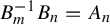 in terms of the coefficients of
$C_{m}, C_{n} \in \operatorname {\mathrm {GL}}_2(\mathbb {Z})$
 yields

Equating the lower-left entries shows that
$s_na\in \mathbb {Z}$
 , so for every prime
$p\nmid a$
 , we have
$\operatorname {\mathrm {val}}_p(s_n)\ge 0$
 . Assume that
$n\in \mathbb {P}^{\prime }_{\gg m}$
 is coprime to
$abcm$
 and all non-zero entries of
$C_m$
 . Equating the difference of diagonal entries shows that
$n \mid j_{n}k_{m}$
 ; hence, either
$n \mid j_n$
 or
$k_m=0$
 . Equating the upper-right entries shows that
$n\mid j_{n}l_{m}$
 ; hence, either
$n\mid j_{n}$
 or
$l_{m}=0$
 . Since
$(k_m,l_m)\ne (0,0)$
 , we must have
$n\mid j_n$
 , which impliers that
$B_{n}\in \operatorname {\mathrm {PGL}}_2(\mathbb {Z})$
 . This shows that
$\alpha $
 and
$\beta $
 are
$\operatorname {\mathrm {PGL}}_2(\mathbb {Z})$
 -equivalent.
Consequently, we have
$C_1\in \operatorname {\mathrm {PGL}}_2(\mathbb {Z})$
 such that
$C_1\alpha =\beta $
 , and repeating the previous reasoning with
$m=1$
 shows that if
$n\in \mathbb {P}'$
 is coprime to
$abc$
 and the non-zero entries of
$C_1$
 , then we have
$B_n\in \operatorname {\mathrm {GL}}_2(\mathbb {Z})$
 satisfying
$B_n=C_1A_n$
 , where
$A_n\in \operatorname {\mathrm {PGL}}_2(\mathbb {Z})$
 stabilises
$\alpha $
 .
By Lemma 7.11, there is
$e_n\in \mathbb {Z}$
 such that
 , where we have, in terms of the fundamental unit
$\varepsilon _\Delta \in \mathcal {O}^\times _\Delta $
 (as in Remark 7.8), the formulas
$t_n= \tfrac {1}{2}(\varepsilon _\Delta ^{e_n}+\bar {\varepsilon }_\Delta ^{e_n})$
 and
$s_n =({1}/{2\sqrt {\Delta }}) (\varepsilon _\Delta ^{e_n}-\bar {\varepsilon }_\Delta ^{e_n})$
 . Equating the lower-left entries of
$B_n = C_1 A_n$
 yields

Recall that if
$k_1=0$
 , then
$\alpha =\beta \bmod {\mathbb {Z}}$
 so we may assume otherwise; hence,
$\eta \ne 0$
 . Now, assume further that the prime
$n\in \mathbb {P}'$
 is coprime to
$\eta $
 in
$\mathbb {Q}(\sqrt {\Delta })$
 and multiply both terms of (7) by
$\varepsilon _\Delta ^{e_n}/\bar {\eta }$
 to find that n divides
$| \varepsilon _\Delta ^{2e_n}-\eta /\bar {\eta } |$
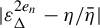 . Since this holds for a positive density of primes
$n\in \mathbb {P}'$
 , we deduce from Schinzel’s local-to-global theorem on power residues [Reference SchinzelSch75, Theorem 2] that there exists
$e_0\in \mathbb {N}$
 such that
$\epsilon ^{2e_0}=\eta /\bar {\eta }$
 .
Now, observe that
$C_1 F_\alpha ^{e_0}\in \operatorname {\mathrm {PGL}}_2(\mathbb {Z})$
 has its lower left entry equal to
$0$
 , and by definition, it sends
$\alpha $
 to
$\beta $
 , proving that
$\alpha = \pm \beta \bmod {\mathbb {Z}}$
 .
Remark 7.16. (Acknowledgments)
In a previous version of this work, we had left Theorem 7.15 as a conjecture and only showed that when
$\alpha ,\beta \in \mathbb {R}\setminus \mathbb {Q}$
 are eventually
$\operatorname {\mathrm {PGL}}_2(\mathbb {Z})$
 -equivalent:
-
• if $\alpha ,\beta $
are not quadratic, then
$\alpha = \pm \beta \bmod {\mathbb {Z}}$
; -
• if $\alpha ,\beta $
are quadratic, then for all
$n\in \mathbb {N}$
, the numbers
$n\alpha , n\beta $
are
$\operatorname {\mathrm {PGL}}_2(\mathbb {Z})$
-equivalent; moreover, we have
$\alpha = \pm \beta \bmod {\mathbb {Q}}$
.





Soon after, Daniel Martin communicated a sketch to complete the proof of the quadratic case using Kummer theory, which we simplified and refined using Schinzel’s local-to-global principle.
In addition, François Maucourant communicated to us the following geometric argument showing that if quadratic
$\alpha ,\beta \in \mathbb {R}\setminus \mathbb {Q}$
 are eventually
$\operatorname {\mathrm {PGL}}_2(\mathbb {Z})$
 -equivalent, then
$\alpha =\pm \beta \bmod {\mathbb {Q}}$
 . Define the height of a real quadratic number
$\gamma $
 with Galois conjugate
$\bar {\gamma }$
 as
$h(z) = \lvert \gamma -\bar {\gamma }\rvert $
 , and say that
$\gamma $
 maximizes the height in its
$\operatorname {\mathrm {PGL}}_2(\mathbb {Z})$
 -class when for any
$\gamma '$
 in its
$\operatorname {\mathrm {PGL}}_2(\mathbb {Z})$
 -orbit, we have
$h(\gamma ')\le h(\gamma )$
 . Notice that if
$\gamma $
 is a quadratic integer, then it maximizes its height in its
$\operatorname {\mathrm {PGL}}_2(\mathbb {Z})$
 -class, since for every
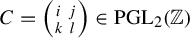 , we have

and the denominator is the norm of the quadratic integer
$\lvert j\gamma +l\rvert $
 , that is, a non-zero integer. There exists (a common denominator)
$n\in \mathbb {N}$
 such that
$n\alpha , n\beta $
 are both integers in
$\mathbb {Q}(\sqrt {\Delta })$
 , so they both maximize the height in their common
$\operatorname {\mathrm {PGL}}_2(\mathbb {Z})$
 -class; hence,
$n\lvert \alpha -\bar {\alpha }\rvert = n\lvert \beta -\bar {\beta }\rvert $
 . We deduce that
$\alpha = \pm \beta \bmod {\mathbb {Q}}$
 .
Let us mention an example that hints at some of the subtlety in Theorem 7.15.
Example 7.17. (Almost counter-example)
Denoting
$\phi = \tfrac {1}{2}(1+\sqrt {5})$
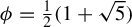 , set
$\alpha = \tfrac {1}{2}\phi =\lfloor \,{0;1,(4,4)^{\mathbb {N}}}\,\rfloor $
 and
$\beta = \tfrac {1}{2}(\phi -1)=\lfloor \,{0;3,(4,4)^{\mathbb {N}}}\,\rfloor $
 . We have that
$\alpha \ne \pm \beta \bmod {\mathbb {Z}}$
 , but they are
$\operatorname {\mathrm {PGL}}_2(\mathbb {Z})$
 equivalent. Moreover, for many
$f\in \mathbb {N}$
 , we have that
$f\alpha $
 and
$f\beta $
 are
$\operatorname {\mathrm {PGL}}_2(\mathbb {Z})$
 -equivalent: this holds when f is even (since
$f\alpha -f\beta =f/2$
 ) and experimentally for many odd values of f (in particular, all those for which the order of discriminant
$5f^2$
 is principal). However, by Theorem 7.15, there must be some
$f\in \mathbb {N}$
 such that
$f\alpha , f\beta $
 are not
$\operatorname {\mathrm {PGL}}_2(\mathbb {Z})$
 -equivalent: the smallest is
$f=9$
 , for which we have
$9\alpha = \lfloor \,{7; 3, (1, 1, 3, 1, 9, 3,)^{\mathbb {N}}}\,\rfloor $
 and
$9\beta = \lfloor \,{2; 1, (3, 1, 1, 3, 9, 1)^{\mathbb {N}}}\,\rfloor $
 .
A similar phenomenon can be observed with
$\alpha = \tfrac {1}{5}\sqrt {2}$
 and
$\beta = \tfrac {1}{5}(\sqrt {2}+2)$
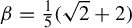 .
The previous example shows that the assumption in Theorem 7.15 on the full Dirichlet density of primes would be difficult to generalize. The following question makes this more precise.
Question 7.18. (
$\mathbb {N}'$
-virtual
$\operatorname {\mathrm {PGL}}_2(\mathbb {Z})$
-equivalence)


For a subset of
$\mathbb {N}' \subset \mathbb {N}$
 , say that
$\alpha ,\beta $
 are
$\mathbb {N}'$
 -virtually
$\operatorname {\mathrm {PGL}}_2(\mathbb {Z})$
 -equivalent when for all
$n\in \mathbb {N}'$
 , the numbers
$n\alpha ,n\beta $
 are
$\operatorname {\mathrm {PGL}}_2(\mathbb {Z})$
 -equivalent.
For which subsets
$\mathbb {N}'$
 does
$\mathbb {N}'$
 -virtual
$\operatorname {\mathrm {PGL}}_2(\mathbb {Z})$
 -equivalence imply
$\operatorname {\mathrm {PGL}}_2(\mathbb {Z})$
 - equivalence, or further equality up to sign and addition by an integer?
Theorem 7.15 replies both positively when
$\mathbb {N}'$
 is a subset of primes of full Dirichlet density, while Example 7.17 shows that both are false when
$\mathbb {N}'$
 consists of the positive powers of a single prime (and we believe a similar construction extends this counter examples to
$\mathbb {N}'$
 the positive powers of any finite subset of primes). What if
$\mathbb {N}'$
 is a subset of primes of positive Dirichlet density?
7.2 Eventual equivalencies between Sturmian systems
Recall the diagram for virtual and eventual equivalencies (conjugacy and flow) of dynamical systems from Remark 7.2. The goal of this section is to complete it for Sturmian systems into the following diagram; in which all non-indicated implications are false. The main result is Theorem 7.24 saying that eventual flow equivalence implies topological conjugacy.

Let us begin by characterizing virtual conjugacy of Sturmian systems.
Proposition 7.19. (Virtual conjugacy of Sturmian systems)
Two Sturmian systems
$(X_{\alpha },\operatorname {\mathrm {\sigma }}_{\alpha })$
 and
$(X_{\beta },\operatorname {\mathrm {\sigma }}_{\beta })$
 are virtually conjugate if and only if
$\alpha =\pm \beta \bmod {\mathbb {Q}}$
 .
Proof. The proof is easy and left as an exercise.
Remark 7.20. (Virtual flow equivalence of Sturmian systems)
Two Sturmian systems
$(X_{\alpha },\operatorname {\mathrm {\sigma }}_{\alpha })$
 and
$(X_{\beta },\operatorname {\mathrm {\sigma }}_{\beta })$
 are virtually flow equivalent if and only if
$n\alpha =\pm n\beta \bmod {\operatorname {\mathrm {PGL}}_2(\mathbb {Z})}$
 , in other terms, when there is
$C\in \bigcup _{n\in \mathbb {N}_{>0}}\mathrm {diag}(n,1)\operatorname {\mathrm {PGL}}_2(\mathbb {Z})\mathrm {diag}(n,1)^{-1}$
 such that
$C\cdot \alpha = \beta $
 .
For Sturmian systems, it is not hard to show that eventual conjugacy implies conjugacy.
Proposition 7.21. (Eventually conjugate implies conjugate)
Sturmian subshifts are eventually conjugate if and only if they are conjugate.
Proof. For the non-trivial direction, suppose
$(X_{\alpha },\operatorname {\mathrm {\sigma }}_{\alpha }^{n})$
 and
$(X_{\beta },\operatorname {\mathrm {\sigma }}_{\beta }^{n})$
 are topologically conjugate for all
$n \ge m$
 . Let
$p \ge m$
 be prime. Then, we have
$p \alpha = \epsilon _{0} p \beta + k_0$
 and
$(p+1)\alpha = \epsilon _{1} (p+1) \beta + k_1$
 for some
$k_i \in \mathbb {Z}$
 and
$\epsilon _{i} \in \{-1,+1\}$
 . Thus,
$\alpha = \epsilon _{0} \beta + {k_0}/{p}$
 and
$\alpha = \epsilon _{1} \beta + {k_1}/({p+1})$
 , so
$(\epsilon _{0}-\epsilon _{1}) \beta = {k_1}/({p+1})-{k_0}/{p}$
 . We must have
$\epsilon _{0}=\epsilon _{1}$
 since
$\beta $
 is irrational; hence,
${k_1}/({p+1})={k_0}/{p}$
 . Since p is prime, it must divide
$k_0$
 , so
$\alpha = \epsilon _{0} \beta \bmod {\mathbb {Z}}$
 .
We now consider the relation of eventual flow equivalence for Sturmian systems. For non-quadratic irrationals, we will show that it implies topological conjugacy. This also gives some motivation for our introduction of isogenies, yielding a richer equivalence relation that connects to the arithmetic of continued fractions.
Remark 7.22. (If Sturmian have flow equivalent powers, then powers coincide)
Note that if Sturmian systems
$(X_{\alpha },\operatorname {\mathrm {\sigma }}_{\alpha })$
 and
$(X_{\beta },\operatorname {\mathrm {\sigma }}_{\beta })$
 are such that
$(X_{\alpha },\operatorname {\mathrm {\sigma }}_{\alpha }^m)$
 and
$(X_{\beta },\operatorname {\mathrm {\sigma }}_{\beta }^n)$
 are flow equivalent for some
$m,n\ge 1$
 , then
$m=n$
 . Indeed, the Denjoy system
$(X_{\alpha }^m,\operatorname {\mathrm {\sigma }}_{\alpha }^m)$
 has exactly m distinct asymptotic orbits; hence,
$\Sigma _{\operatorname {\mathrm {\sigma }}_{\alpha }^{m}}X$
 has exactly m pairs of asymptotic leaves. Since a flow equivalence must carry asymptotic leaves to asymptotic leaves, this implies that
$m=n$
 .
Lemma 7.23. (Eventual flow equivalence of Sturmian systems)
Consider for
$k\in \{0,1\}$
 two Sturmian systems
$(X_{\alpha _k},\operatorname {\mathrm {\sigma }}_{\alpha _k})$
 and let
$m\in \mathbb {N}_{\ge 1}$
 . The systems
$(X_{\alpha _0},\operatorname {\mathrm {\sigma }}_{\alpha _0}^{m})$
 and
$(X_{\alpha _1},\operatorname {\mathrm {\sigma }}_{\alpha _1}^{m})$
 are flow equivalent if and only if there exists
$C_{m} \in \operatorname {\mathrm {PGL}}_{2}(\mathbb {Z})$
 such that
$C_{m} \cdot (m\alpha _0) = m\alpha _1$
 . In particular,
$(X_{\alpha _0},\operatorname {\mathrm {\sigma }}_{\alpha _0})$
 and
$(X_{\alpha _1},\operatorname {\mathrm {\sigma }}_{\alpha _1})$
 are eventually flow equivalent if and only if for all but finitely many
$m\in \mathbb {N}_{\ge 1}$
 , there exists
$C_{m} \in \operatorname {\mathrm {PGL}}_{2}(\mathbb {Z})$
 such that
$C_{m} \cdot (m\alpha ) = m\beta $
 .
Proof. We cannot apply Theorem 4.5 since a proper power of the Sturmian system is not Sturmian. However, for
$k=0,1$
 , both
$(X_{\alpha _k},\operatorname {\mathrm {\sigma }}_{\alpha _k}^{m})$
 are Denjoy systems with invariants
$(m\alpha _k,A_k)$
 , where
$\tilde {A}_{k} = \mathbb {Z}+\alpha _k\mathbb {Z} \subset \mathbb {R}$
 are the lifts of
$A_{k}$
 to
$\mathbb {R}$
 . Choosing a representative
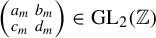 of
$C_{m} \in \operatorname {\mathrm {PGL}}_{2}(\mathbb {Z})$
 , we have by Lemma 7.6 that
$({1}/({c_{m}\alpha _0+d_{m}}))\tilde {A}_{0} = ({1}/({c_{m}\alpha +d_{m}}))\mathbb {Z} +\alpha _0 \mathbb {Z} = \mathbb {Z} + \alpha _1 \mathbb {Z} = \tilde {A}_{1}$
 , so the result follows from Theorem 4.7.
Theorem 7.24. (Eventual flow implies conjugacy)
For Sturmian systems, eventual flow equivalence implies topological conjugacy (hence, flow equivalence and eventual conjugacy).
Proof. Suppose that two Sturmian systems
$(X_{\alpha },\operatorname {\mathrm {\sigma }}_{\alpha })$
 and
$(X_{\beta },\operatorname {\mathrm {\sigma }}_{\beta })$
 are eventually flow equivalent. By Lemma 7.23, their rotation numbers
$\alpha , \beta $
 must be eventually
$\operatorname {\mathrm {PGL}}_2(\mathbb {Z})$
 -equivalent: there exists m such that for all
$n \ge m$
 , there exists
$C_{n} \in \operatorname {\mathrm {GL}}_{2}(\mathbb {Z})$
 such that
$C_{n} \cdot (n\alpha ) = n\beta $
 . By Theorem 7.15, this implies that
$\alpha =\pm \beta \bmod {\mathbb {Z}}$
 .
Corollary 7.25. (Flow equivalent, but not eventually flow equivalent)
For Sturmian systems, flow equivalence does not imply eventual flow equivalence.
The following examples exhibit Sturmian systems which are virtually flow equivalent, but not flow equivalent.
Example 7.26. (Virtual flow equivalent but not flow equivalent)
Let
$\alpha $
 be an irrational that is not quadratic and let
 .
The Sturmian systems associated to
$\alpha $
 and
$\beta = C_1 \alpha $
 are flow equivalent by Theorem 4.5. However, for
$n \ge 2$
 , the Sturmian systems with rotation numbers
$({1}/{n})\alpha $
 and
$({1}/{n})\beta $
 are not flow equivalent. Indeed, if they were, there would exist
$C_n \in \operatorname {\mathrm {GL}}_{2}(\mathbb {Z})$
 such that
$C_n ({1}/{n})\alpha = {1}/{n}\beta $
 ; hence,
$B_{n} \alpha = \beta $
 , where
 . Thus,
$C_1^{-1} B_{n} \in \operatorname {\mathrm {GL}}_2(\mathbb {Q})$
 stabilizes
$\alpha $
 , so
$B_{n}=\pm C_1$
 ; hence, the upper right coefficient of
$C_n$
 is
$\pm 1/n$
 , leading to a contradiction once
$n \ge 2$
 .
A slightly more involved example shows that even for quadratic irrationals, two Sturmian systems can be virtually flow equivalent but not flow equivalent.
Example 7.27. (Virtual flow equivalent but not flow equivalent for quadratic)
Let
$\alpha = \sqrt {2}$
 ,
 and set
$\beta = C_1 \alpha = 3-\sqrt {2}$
 .
The Sturmian systems associated to
$\alpha $
 and
$\beta $
 are flow equivalent by Theorem 4.5. We claim that the Sturmian systems associated to
$\frac {1}{2}\alpha $
 and
$\frac {1}{2}\beta $
 are not flow equivalent. For if they were, there would exist
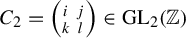 such that
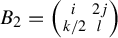 satisfies
$B_2\alpha = \beta $
 . Hence,
 stabilizes
$\alpha $
 , which by Lemma 7.10 means it has the form
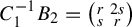 for some
$r, s \in \mathbb {Q}$
 . Equating the ratio of the off-diagonal coefficients leads to
$2\mid l$
 . Equating the difference of diagonal coefficients leads to
$2\mid k$
 . This contradicts
$\gcd (k,l)=1$
 .
Remark 7.28. (Self-isogenies of Sturmian systems)
For an integer
$m>1$
 , the Sturmian systems with parameters
$\alpha $
 and
$m\alpha $
 are flow equivalent if and only if
$\alpha $
 is the root of a primitive integral quadratic polynomial
$ax^2+bx+c\in \mathbb {Z}[x]$
 with discriminant
$\Delta =b^2-4ac$
 such that
$m\mid a$
 and the Pell–Fermat equation
$(2t)^2-s^2\Delta =\pm 4m$
 has a solution
$(t,s)\in \mathbb {Z}\times \mathbb {Z}$
 with
$2m\mid 2t+sb$
 . This follows from Remark 7.13. Question 7.14 asks about alternative descriptions for such numbers
$\alpha $
 and if one may construct infinite families of examples in each quadratic field.
7.3 Eventual flow equivalence of Denjoy systems
Recall the diagram for virtual and eventual equivalencies (conjugacy and flow) of dynamical systems from Remark 7.2. The goal of this section is to complete it for Denjoy systems into the following diagram; in which all non-indicated implications are false. The main result is Theorem 7.32 saying that eventual flow equivalence implies topological conjugacy.

We begin by characterizing virtual conjugacy of Denjoy systems.
Proposition 7.29. (Virtual conjugacy of Denjoy systems)
Consider for
$k \in \{0,1\}$
 Denjoy systems
$({\mathcal {D}}_{F_k}, F_k)$
 with (rotation number, cut-point set) invariants
$(\alpha _k, A_k)$
 (with
$0\in A_k$
 ). They are virtually conjugate if and only if
$\alpha _0=\pm \alpha _1\bmod {\mathbb {Q}}$
 and
$A_0 \equiv A_1$
 .
Proof. This follows from the classification of Denjoy systems up to topological conjugacy (§2.3), noting that for
$n\in \mathbb {N}_{>0}$
 , the systems
$({\mathcal {D}}_{\alpha _k, A_k}, F_{\alpha _k, A_k}^{n})$
 are Denjoy with invariants
$(n\alpha _k,A_k)$
 .
The following contrasts the Remark 7.22 for Sturmian systems.
Remark 7.30. (If Denjoy have conjugate powers, then powers may not coincide)
For any
$m,n\in \mathbb {N}_{\ge 1}$
 , one may find pairs of Denjoy systems
$({\mathcal {D}}_{F_0}, F_0), ({\mathcal {D}}_{F_1}, F_1)$
 with rotation numbers satisfying
$m\alpha _0=n\alpha _1$
 such that
$({\mathcal {D}}_{F_0}, F_0^m)$
 and
$({\mathcal {D}}_{F_1}, F_1^n)$
 are topologically conjugate (hence, flow equivalent). We leave the construction as an exercise.
Remark 7.31. (Virtual flow equivalence of Denjoy systems)
For
$k \in \{0,1\}$
 , the Denjoy systems
$({\mathcal {D}}_{F_k}, F_k)$
 with invariants
$(\alpha _k, A_k)$
 are virtually flow equivalent if and only if there exists
$M\in \bigcup _{n\in \mathbb {N}_{>0}}\mathrm {diag}(n,1)\operatorname {\mathrm {PGL}}_2(\mathbb {Z})\mathrm {diag}(n,1)^{-1}$
 such that (3) holds.
Theorem 7.32. (Eventual flow implies conjugacy)
For Denjoy systems, eventual flow equivalence implies topological conjugacy (hence, flow equivalence and eventual conjugacy).
Proof. Consider for
$k \in \{0,1\}$
 Denjoy systems
$({\mathcal {D}}_{F_k}, F_k)$
 with (rotation number, cut-point set) invariants
$(\alpha _k, A_k)$
 , normalized so that
$0\in A_k$
 and
$\alpha _k\in (0,1)$
 .
For each
$n\in \mathbb {N}_{>0}$
 , the systems
$({\mathcal {D}}_{\alpha _k, A_k}, F_{\alpha _k, A_k}^{n})$
 are Denjoy with invariants
$(n\alpha _k,A_k)$
 , so by Theorem 4.7, they are flow equivalent if and only if there is
$M^{(n)}= (m^{(n)}_{ij}) \in \operatorname {\mathrm {GL}}_2(\mathbb {Z})$
 such that

where
$\equiv $
 denotes equality of subsets of
$\mathbb {T}$
 up to rotation.
By assumption, the systems
$({\mathcal {D}}_{\alpha _k, A_k}, F_{\alpha _k, A_k})$
 are eventually flow equivalent so there is a cofinite subset
$\mathbb {N}'\subset \mathbb {N}_{>0}$
 such that for all
$n\in \mathbb {N}'$
 , we have (8). In particular,
$\alpha _0,\alpha _1$
 are eventually
$\operatorname {\mathrm {PGL}}_2(\mathbb {Z})$
 -equivalent; hence, by Theorem 7.15, we have
$\alpha _0=\pm \alpha _1\bmod {\mathbb {Z}}$
 . Up to exchanging the sign of
$(\alpha _1, A_1)$
 , we now assume
$\alpha _0=\alpha _1=\alpha \in (0,1)$
 . If
$\alpha $
 is not quadratic, then the stabiliser of
$n\alpha $
 in
$\operatorname {\mathrm {PGL}}_2(\mathbb {Z})$
 is trivial, so for all (hence, for some)
$n\in \mathbb {N}'$
 , we have
$M^{(n)}=\pm {\mathbf {1}}$
 , which proves
$A_1\equiv \pm A_0$
 , as desired. Now, suppose that
$\alpha $
 generates the quadratic order
$\mathcal {O}_{\Delta }$
 of discriminant
$\Delta $
 with fundamental unit
$\varepsilon _\Delta \in \mathbb {Z}[\alpha ]$
 . Note that for all
$n\in \mathbb {N}$
 , the quadratic order
$\mathbb {Z}[n\alpha ]$
 has index n in
$\mathbb {Z}[\alpha ]$
 so it is
$\mathbb {Z}[n\alpha ]=\mathcal {O}_{n^2\Delta }$
 ; hence, by Remark 7.9, it has fundamental unit
$\varepsilon _\Delta ^n$
 .
For every
$n\in \mathbb {N}'$
 , we know by Remark 7.12 that the number
$\unicode{x3bb} ^{(n)} = m_{21}^{(n)} n\alpha _0+m_{22}^{(n)}\in \mathbb {Z}[n\alpha ]$
 is a unit in
$\mathbb {Z}[n\alpha ]=\mathcal {O}_{n^2\Delta }$
 ; hence, by Remark 7.9, there is
$e_n\in \mathbb {N}$
 such that
$\pm \unicode{x3bb} ^{(n)}=\varepsilon _\Delta ^{n.e_n}$
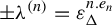 . If for some
$n\in \mathbb {N}'$
 we have
$\unicode{x3bb} ^{(n)}=\pm {\mathbf {1}}$
 , then we are done, so assume otherwise, namely
$e_n> 0$
 .
Fix
$m,n\in \mathbb {N}'$
 . We have
$\varepsilon _\Delta ^{me_m-ne_n}A_0\equiv A_0$
 . Let
$G\subset \mathbb {Z}[\alpha ]^\times $
 be the subgroup generated by all
$\pm \varepsilon _\Delta ^{me_m-ne_n}$
 , so that
$G A_0\equiv A_0$
 and
$G A_1\equiv A_1$
 . Denoting
$g=\gcd \{me_m-ne_n \colon m, n\in \mathbb {N}'\}>0$
 , we have
$G=\{\pm (\epsilon _\Delta ^g)^e \colon e\in \mathbb {Z}\}$
 . Now, observe that
$\mathbb {N}'\cap g\mathbb {N}$
 is non-empty and for
$n\in \mathbb {N}'\cap g\mathbb {N}$
 , we have
$\pm \unicode{x3bb} ^{(n)}=\varepsilon _\Delta ^{n e_n} \in G$
 ; therefore,
$A_0\equiv \unicode{x3bb} ^{(n)} A_1 \equiv A_1$
 .
Acknowledgements
S.S. was partially supported by NSF grant DMS-2247553. We sincerely thank Pierre Arnoux, Mike Boyle, John Chaika, Vincent Delecroix, Pascal Hubert, and Chris Leininger for their continuous interest in reading and effort in responding to our questions. We are also grateful to Menny Akka, Daniel Martin, and François Maucourant for discussions concerning eventual
$\operatorname {\mathrm {PGL}}_2(\mathbb {Z})$
 -equivalence.
Disclosure
This work did not benefit from the use of artificial intelligence except for typographical corrections.


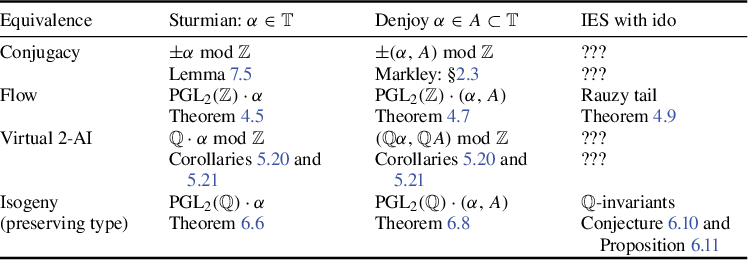

 Open access

